Market Minds Advisory
Gaskets and Seals Market

Gaskets and Seals Market: Material Science, Electrification, and the New Sealing Performance Bar

Automakers electrifying powertrains and semiconductor fabs scaling advanced nodes are pulling gasket and seal demand toward PTFE, silicone, and specialty elastomer chemistries, forcing legacy rubber-focused suppliers to requalify materials or cede share to polymer specialists.

Lead Analyst

David Horsley

Published

September 2026

Make Smarter Decisions with Customized Research Insights

Request a free sample report and evaluate market opportunities, growth trends, and competitive dynamics relevant to your business needs.

2025 MARKET VALUE$71.5BMarket Size 2025
2036 FORECAST VALUE$132.9BBase Case , 2026 to 2036
CAGR 2026 TO 20365.8 %Bull 6.9% / Bear 4.5%
INCREMENTAL OPPORTUNITY$57.2BNet 10- year value creation
EXPANSION MULTIPLE1.76x2036 value over 2026 base
Strategic Levers
M&A Pipeline
Regional Outlook
Country Rankings
Competitive Intelligence
Segmental Deep-dive
Call-Us : 91 93563 13602

Executive Snapshot and Market Trajectory

Gasket and seal demand is quietly re-materializing around electrification and semiconductor manufacturing rather than simply shrinking with the internal combustion engine, as EV battery enclosures, thermal management loops, hydrogen storage systems, and chip fabrication chambers all now require sealing performance well beyond traditional automotive and industrial specifications.
PTFE and fluoropolymer seals are growing fastest, at roughly eight and a half percent annually, as semiconductor fabrication, hydrogen infrastructure, and chemical processing applications demand chemical resistance and temperature tolerance that conventional rubber compounds cannot deliver reliably. North America holds the largest single regional share, anchored by its chemical processing, oil and gas, and aerospace manufacturing base, while East Asia's automotive and electronics manufacturing volume drives the fastest absolute unit growth.
Competition splits along material science lines rather than pure scale: elastomer and rubber compounders defend volume automotive and industrial accounts, while fluoropolymer and high-performance silicone specialists capture premium share in semiconductor, hydrogen, and aerospace applications where a seal failure carries outsized cost. Consolidation continues as diversified industrial groups acquire specialty polymer formulators, and REACH-style chemical regulation is accelerating replacement of older PFAS-containing compounds across regulated end markets.
Market Definition
The gaskets and seals market covers static and dynamic sealing components, including gaskets, O-rings, mechanical seals, and molded or extruded seal profiles, used to prevent fluid, gas, or pressure loss across automotive, industrial, energy, and electronics applications. It excludes adhesives, coatings, and structural fasteners sold independently of sealing function.
Base Year Value
$71.5B in 2025 (MMA Primary Research Dataset, August 2026)
Forecast Period
2026 to 2036, eleven discrete annual values
CAGR
5.8% base case. Bull 6.9%. Bear 4.5%.
Fastest Growth Segment
PTFE and Fluoropolymer Seals: 8.6% CAGR
Fastest Growth Country
India: 8.3% CAGR
Fastest Growth Region
South Asia and Pacific: 7.8% CAGR
Largest Region
North America: 30% of 2025 global value
Market Leaders
Freudenberg Sealing Technologies, Trelleborg AB, Parker Hannifin Corporation, SKF Group, Dana Incorporated. Source: MMA Analysis based on company annual reports and investor filings.
Primary Survey
n=3,800 procurement and R&D decision-makers, Q4 2025, six countries
Methodology
Demand-side build-up, cross-validated against public data, 47 expert interviews

Gaskets and Seals Market Forecast Scenarios

gaskets-and-seals-market-size-forecast-scenario-1787333123614
Gasket and seal demand dipped in 2020 as automotive and industrial production halted globally, then recovered unevenly through 2021 and 2022 as supply chains normalized. Semiconductor and EV-related demand accelerated from 2023 onward, offsetting slower growth in traditional internal combustion powertrain applications. The market grew at a historical rate of roughly 5.0% annually across the 2020 to 2025 period, gaining momentum as electrification-linked demand broadened.
The base case assumes steady growth driven by three mechanisms: EV battery enclosure and thermal management sealing content per vehicle rising well above internal combustion equivalents; semiconductor fabrication capacity expansion under national chip incentive programs requiring high-purity fluoropolymer seals; and hydrogen infrastructure buildout demanding specialized elastomer and PTFE components rated for high-pressure gas containment. Replacement demand across aging industrial and process manufacturing installations adds a steady secondary layer independent of new capacity investment.
The bull case rests on faster-than-expected global semiconductor fabrication capacity additions pulling forward fluoropolymer seal demand across multiple fab construction cycles simultaneously. The bear case centers on a global auto production slowdown, mirroring past cyclical downturns, that would defer both internal combustion and EV vehicle output and stretch replacement cycles on installed industrial sealing equipment beyond typical five to seven year intervals.

Sealing Performance Becomes a Material Science Contest

Sealing components rarely draw attention until they fail, and that low visibility has historically kept the category out of strategic procurement conversations entirely. That is changing as electrification and semiconductor manufacturing push sealing specifications toward chemical and thermal extremes that commodity rubber compounds cannot reliably meet, turning material selection into an engineering decision made early in product design rather than a late-stage sourcing afterthought handled by
MARKET CONCENTRATION26% (CR5)Highly fragmented supplier base spans thousands of regional producers
AVERAGE SELLING PRICE$0.15-$450 per unitPrice spans commodity gaskets to precision aerospace seals
TOP PRODUCING COUNTRYChina, 19% shareLargest single manufacturing base for volume rubber components
CAPACITY UTILIZATION76%Molding and extrusion lines run below full theoretical capacity
TRADE INTENSITY38% exportedSubstantial share of production crosses borders before final assembly
INPUT COST SHARE42% of COGSSynthetic rubber and fluoropolymer resin dominate material cost
Demand growth concentrates unevenly across end markets. Automotive electrification, semiconductor fabrication, and hydrogen infrastructure are expanding fastest, while traditional internal combustion powertrain sealing volume gradually declines as a share of total automotive demand even as absolute vehicle production remains substantial worldwide. Industrial process manufacturing provides a large, stable base of replacement demand largely insulated from these broader shifts in end-market mix and technology direction.
Over the next decade, sealing suppliers increasingly compete on material science and qualification speed rather than manufacturing scale alone. Suppliers able to requalify compounds quickly against tightening chemical regulation and emerging application requirements, particularly around PFAS restrictions, will capture share from slower-moving rivals still dependent on legacy formulations facing regulatory obsolescence across several key end markets and geographies.
"Nobody budgets for a seal until one fails at the worst possible moment. Now semiconductor fabs and battery plants are specifying seal chemistry before they've even ordered the equipment it goes into."
Director, Industrial Components and Materials Practice · MMA Industrial Sealing

Market Trends

PFAS Regulation Forces Fluoropolymer Seal Reformulation Industry-Wide

Tightening PFAS restrictions under the EU's REACH framework and parallel US state-level regulations are forcing seal manufacturers to reformulate fluoropolymer compounds that have relied on long-chain PFAS chemistry for decades of proven chemical resistance. Suppliers are racing to qualify short-chain and PFAS-free alternatives that meet the same temperature and chemical resistance thresholds demanded by semiconductor and chemical processing customers. Requalification cycles typically take twelve to eighteen months per application, creating a genuine first-mover advantage for suppliers with the deepest polymer chemistry research capability and the closest customer co-development relationships already underway.
Market Impact: Adds fab-linked demand worth $2.1B

EV Battery Sealing Content Rises Sharply

Electric vehicle battery enclosures, thermal management loops, and power electronics housings require substantially more sealing surface area and higher-performance silicone and fluorosilicone compounds than internal combustion powertrain applications, since battery pack integrity is directly safety-critical rather than simply a fluid-containment concern. Sealing content per vehicle is rising as automakers move from module-level to cell-to-pack battery architectures that eliminate some mechanical structure but add new sealed interfaces. This is pulling volume toward specialty silicone formulators capable of meeting flame-retardant and thermal-runaway containment specifications that most legacy automotive rubber suppliers have not previously needed to develop.
Market Impact: Targets 700 bar containment ratings

Market Opportunities and Growth Drivers

Global Semiconductor Fabrication Capacity Expansion Accelerates

National semiconductor incentive programs, including the US CHIPS Act and equivalent initiatives in the EU and Asia, are driving a wave of new fabrication plant construction requiring high-purity fluoropolymer and elastomer seals rated for ultra-clean processing environments. Each new fab represents a concentrated, discrete order for thousands of precision seals across wafer handling, chemical delivery, and vacuum chamber systems. Seal suppliers qualified for semiconductor-grade purity standards, which require extensive outgassing and particle contamination testing, are capturing outsized share of this build-out relative to their position in broader industrial sealing markets.
Market Impact: Swings input costs by over 30%

Hydrogen Infrastructure Buildout Demands New Seal Grades

Hydrogen production, storage, and refueling infrastructure requires seals rated for hydrogen embrittlement resistance and high-pressure containment up to 700 bar in refueling applications, specifications that exceed most conventional natural gas sealing requirements considerably. Government-backed hydrogen infrastructure programs across Europe, Japan, South Korea, and increasingly the United States are funding refueling station and pipeline buildout that requires these specialized components at scale. Seal manufacturers with hydrogen-qualified elastomer and PTFE formulations are winning early-mover positioning in a segment still small in absolute terms but growing considerably faster than the broader sealing market overall.
Market Impact: Caps commodity segment margins near

Market Restraints and Challenges

Raw Material Price Volatility Compresses Margin

Synthetic rubber and fluoropolymer resin prices tied to crude oil derivatives have swung by more than 30% within single-year periods over the past several years, squeezing margin for suppliers unable to pass through cost increases quickly under fixed-price automotive supply agreements. The root cause is that most sealing suppliers operate on annual or multi-year contracts negotiated before material costs are known with certainty. This forces smaller suppliers without hedging capability to absorb margin compression during volatile periods. Larger suppliers are increasingly negotiating quarterly price adjustment clauses and dual-sourcing resin from multiple regional suppliers to reduce single-source exposure to price spikes.
Market Impact: Adds 12 to 18 month cycles

Fragmented Supply Base Limits Pricing Power

With a CR5 of only 26%, the sealing components market remains highly fragmented relative to many adjacent industrial component categories, limiting any individual supplier's ability to set pricing or pass through cost increases without losing share to smaller regional competitors. The root cause traces to relatively low capital barriers for commodity rubber gasket production compared with precision fluoropolymer or metallic sealing manufacturing. This keeps commodity segment margins persistently thin. Larger suppliers are responding by shifting mix toward higher-specification, harder-to-replicate product categories where fragmentation is considerably less severe and qualification barriers protect pricing.
Market Impact: Lifts EV sealing content by 25%
3 additional market trends, 3 additional growth drivers, and 4 additional restraints and challenges are covered in the full report. Contact sales@marketmindsadvisory.com to access the complete intelligence.

Segment CAGR and Growth Architecture

MMA segments the gaskets and seals market by material and product technology, the classification that determines qualification pathway, price point, and end-application suitability more precisely than an end-use or application-based split would for a component category defined primarily by material science performance rather than end use, customer industry, distribution channel, or sales model alone.
gaskets-and-seals-market-market-share-analysis-1787333124159

PTFE and Fluoropolymer Seals

PTFE and fluoropolymer seals offer chemical inertness and temperature tolerance up to 260 degrees Celsius that conventional elastomers cannot match, making them the default choice for semiconductor fabrication, chemical processing, and hydrogen containment applications where failure carries severe safety or cost consequences. The segment is growing at roughly 8.6% annually, driven by semiconductor fab capacity expansion and accelerating PFAS-related reformulation activity across the industry. Unit prices run considerably higher than rubber equivalents, reflecting both raw material cost and the extensive qualification testing required for critical applications. Suppliers with established semiconductor and chemical industry customer relationships and deep fluoropolymer formulation expertise hold a durable advantage that new entrants find difficult to replicate quickly given multi-year qualification cycles.
CAGR 8.6%

Silicone Gaskets and Seals

Silicone gaskets and seals are growing at roughly 7.5% annually, driven primarily by electric vehicle battery enclosure, thermal management, and power electronics sealing applications that require flame retardancy, thermal stability, and flexibility across a wide temperature range. Demand concentrates among automotive tier-one suppliers and battery pack manufacturers building cell-to-pack architectures that introduce new sealed interfaces not present in earlier module-based designs. Silicone's combination of thermal performance and manufacturability at scale makes it the preferred choice over fluoropolymers for applications where extreme chemical resistance is not required but thermal and flame-safety performance is critical. Suppliers investing in flame-retardant silicone formulation research are capturing disproportionate share of this fast-growing automotive electrification demand pool.
CAGR 7.5%
Full segment breakdown across 6 segments available in the complete report.

Regional Architecture and Country Demand Map

North America holds the largest single regional share on the strength of its chemical processing, oil and gas, and aerospace manufacturing base, while South Asia and Pacific grows fastest as India's automotive and industrial manufacturing base expands. East Asia contributes the largest volume of commodity rubber component production.

North America

North America holds the largest single regional share of global gasket and seal demand, built on the depth of its chemical processing, oil and gas, and aerospace manufacturing base rather than automotive volume alone, which has increasingly shifted production toward Mexico. The United States' semiconductor fabrication buildout under CHIPS Act incentives is adding a fast-growing new demand pool for high-purity fluoropolymer seals that did not meaningfully exist domestically a decade ago. Canada's oil and gas sector sustains steady demand for high-pressure sealing components rated for extreme temperature and pressure conditions. Mexico's expanding automotive assembly footprint under nearshoring trends adds incremental volume demand for standard elastomer gaskets, reinforcing the region's position as the largest and most diversified single sealing components market.
Share: 30% | CAGR: 6.8% (2026 to 2036)

Western Europe

Western Europe's gasket and seal demand centers on Germany, France, and Italy, where automotive, chemical processing, and precision industrial machinery manufacturing sustain a large but slower-growing base of sealing component demand. The region grows the slowest of the seven as automotive production volume continues shifting toward Eastern Europe and Asia, leaving a shrinking but still substantial base of higher-value precision sealing manufacturing behind. REACH chemical regulation is forcing accelerated reformulation of PFAS-containing fluoropolymer seals across the region, a compliance burden falling disproportionately on European manufacturers relative to overseas rivals. German and Swedish suppliers, several ranking among the market's global leaders, maintain deep aerospace and industrial customer relationships that partially offset slower automotive volume growth.
Share: 21% | CAGR: 4.3% (2026 to 2036)
Regional intelligence for 5 additional markets available in the complete report: East Asia, South Asia and Pacific, Latin America, Middle East and Africa, Eastern Europe. Contact sales@marketmindsadvisory.com.
gaskets-and-seals-market-country-cagr-analysis-1787333124684

Capturing Margin Beyond Commodity Rubber

Commodity rubber gasket margins remain thin under fragmented competition across a global supplier base with low entry barriers, but suppliers that move up the material science curve into fluoropolymer, silicone, and application-critical sealing solutions capture considerably better margin and build durable, qualification-based customer relationships that are difficult for lower-cost rivals to displace quickly once established.

Migrating Mix Toward Fluoropolymer and Silicone

Suppliers shifting product mix away from commodity rubber gaskets toward fluoropolymer and specialty silicone formulations capture gross margins 15 to 20 percentage points higher, reflecting both material cost and the extensive qualification testing that creates switching costs once a customer has approved a specific formulation for a critical application. This migration requires sustained investment in polymer chemistry research and application engineering capability that smaller commodity-focused competitors typically lack, but it delivers a durable margin advantage extending across the multi-year life of qualified customer programs rather than a single one-time transactional gain.
Market Impact: Lifts gross margin by 15 to 20 poin

Building Semiconductor-Grade Qualification and Testing Capability

Investing in the ultra-clean manufacturing and testing infrastructure required for semiconductor-grade seal qualification opens access to a fast-growing, high-margin demand pool worth an estimated $2.1 billion tied to global fab capacity expansion, where customers pay a substantial premium for proven outgassing and particle contamination performance under strict specification. Qualification typically takes twelve to eighteen months and requires significant upfront capital investment in clean manufacturing environments, but suppliers that complete this process capture multi-year exclusive or near-exclusive supply positions on individual fab programs worth considerable recurring revenue for the winning supplier each year.
Market Impact: Opens access to a $2.1B fab demand

Expanding Hydrogen-Rated Product Certification and Testing

Developing and certifying seal formulations rated for hydrogen embrittlement resistance and high-pressure containment up to 700 bar positions suppliers to capture early share in a still-small but rapidly expanding hydrogen infrastructure demand pool worth an estimated $400 million today, before the segment matures and competition intensifies meaningfully across every major geography. Early movers benefit from close co-development relationships with hydrogen infrastructure developers and equipment manufacturers, relationships that tend to persist through subsequent procurement cycles once a supplier's formulation has been proven reliable in field operation across multiple installations over several years.
Market Impact: Captures early share in a growing $

Offering Application Engineering and Failure Analysis Services

Suppliers bundling application engineering support and in-field failure analysis services alongside standard component sales build deeper customer relationships extending well beyond a single transactional purchase, particularly for critical applications where seal failure carries severe safety or downtime cost implications. This service layer, typically monetized through engineering fees or embedded within premium pricing that runs 5 to 8% above standard component rates, is difficult for lower-cost competitors focused purely on manufacturing to replicate without comparable technical staff investment across their entire commercial organization, field engineering staff, and a comparable support network.
Market Impact: Adds a 5 to 8% service revenue prem

Who Controls the Margin Pool

The gaskets and seals market remains highly fragmented, with a CR5 of only 26%, reflecting relatively low capital barriers in commodity rubber gasket production even as premium fluoropolymer and precision sealing segments carry meaningfully higher qualification barriers than the category average. Freudenberg and Trelleborg lead a group of diversified global suppliers with only a moderate gap over the next tier of specialized regional and application-focused competitors.
Competitive activity concentrates on three fronts: fluoropolymer and PFAS-free reformulation to meet tightening chemical regulation, semiconductor-grade qualification capability to capture fab-linked demand, and application engineering services that deepen customer relationships beyond commodity component sales. Diversified industrial groups continue acquiring specialty polymer formulators to accelerate access to premium material science capability rather than building it organically.

Emerging pressure comes from Chinese and Indian domestic suppliers improving formulation quality fast enough to challenge established Western suppliers on mid-tier automotive and industrial applications, not only on price for commodity gaskets. Rankings could shift meaningfully if a regional Asian supplier successfully qualifies for semiconductor-grade or hydrogen-rated applications, segments currently dominated almost entirely by established European and American specialty formulators with decades of accumulated qualification history.
gaskets-and-seals-market-company-positioning-matrix-1787333125198

Competitive Moat and Risk Dimensions

FREUDENBERG SEALING TECHNOLOGIES

Moat: Deep Material Science Portfolio

Freudenberg's decades of accumulated polymer chemistry research across elastomer, silicone, and fluoropolymer formulations give it qualification capability across nearly every application segment simultaneously, from commodity automotive gaskets to semiconductor-grade fluoropolymer seals, a breadth few rivals can match without comparable long-term research investment and global testing infrastructure.
FREUDENBERG SEALING TECHNOLOGIES

Risk: Exposure to Legacy Automotive Volume

A substantial share of Freudenberg's revenue base remains tied to internal combustion powertrain sealing applications that face gradual, sustained decline as vehicle electrification progresses, requiring sustained mix-shift investment toward EV and semiconductor applications to offset this slow-moving but persistent revenue headwind across the company's core legacy markets.
TRELLEBORG AB

Moat: Diversified End-Market Exposure

Trelleborg's presence across automotive, aerospace, industrial, and marine sealing applications insulates it from downturns concentrated in any single end market, while its engineered polymer solutions division provides application engineering capability that pure component manufacturers typically cannot offer to the same technical depth or organizational breadth.
TRELLEBORG AB

Risk: Integration Complexity From Acquisitions

Trelleborg's growth strategy has relied heavily on acquiring specialty polymer formulators, creating integration complexity across multiple manufacturing footprints and product lines that can slow decision-making and formulation standardization relative to more organically structured competitors with simpler, more centralized operating models and fewer ongoing integration dependencies to manage.

Players Tracked

Prominent Players

Freudenberg Sealing Technologies
Trelleborg AB
Parker Hannifin Corporation
SKF Group
Dana Incorporated

Other Key Players

NOK Corporation
ElringKlinger AG
EnPro Industries
James Walker Group
Flowserve Corporation
Tenneco Inc.
Hutchinson SA
Datwyler Holding
Precision Polymer Engineering
A.W. Chesterton Company
Mahle GmbH
NAK Sealing Technologies
Hallite Seals International
Interface Performance Materials
Cooper Standard Holdings

Recent Developments

FEBRUARY 2025

Freudenberg Opens Semiconductor-Grade Seal Facility in Taiwan

Freudenberg Sealing Technologies opened a new manufacturing facility in Taiwan dedicated to semiconductor-grade fluoropolymer seals, aimed at serving the region's expanding fabrication capacity closer to customer sites. The facility includes ultra-clean manufacturing environments meeting the particle contamination standards required for advanced node chip production at scale.
Signal: Signals established suppliers are localizi
JUNE 2025

Trelleborg Acquires Specialty Hydrogen Sealing Formulator

Trelleborg completed the acquisition of a specialty elastomer formulator focused on hydrogen-rated sealing compounds, adding certified hydrogen embrittlement resistant product lines to its existing industrial sealing portfolio. The deal expands Trelleborg's presence in hydrogen infrastructure ahead of anticipated demand growth across Europe and Asia over the coming decade.
Signal: Signals major diversified suppliers are ac
OCTOBER 2025

Parker Hannifin Expands PFAS-Free Fluoropolymer Line

Parker Hannifin launched an expanded line of PFAS-free fluoropolymer seals designed to meet tightening REACH regulation ahead of upcoming compliance deadlines, targeting chemical processing and semiconductor customers seeking to derisk their supply chains against future regulatory restriction on legacy long-chain formulations still widely used industry-wide.
Signal: Signals regulatory-driven reformulation is

Synthetic Rubber and Fluoropolymer Resin Exposure

Synthetic rubber and elastomer feedstocks, derived primarily from petrochemical inputs, account for roughly 30 to 35% of manufacturing cost for standard gasket production, sourced from a concentrated group of global petrochemical producers. Fluoropolymer resin, used in higher-specification seals, contributes a further 10 to 15% for suppliers serving semiconductor and chemical processing applications, with production concentrated among a small number of specialty chemical manufacturers globally.
Crude oil price volatility during 2022 pushed synthetic rubber feedstock prices up by more than 30% within several months, compressing margin for suppliers locked into fixed-price automotive supply agreements negotiated before the spike occurred, according to petrochemical pricing data tracked by the IEA. The disruption prompted several major suppliers to renegotiate contract terms to include quarterly price adjustment mechanisms tied to published feedstock indices going forward.

Smaller regional suppliers without long-term feedstock supply agreements or hedging capability face greater margin exposure to price swings than larger diversified players like Freudenberg and Trelleborg, who negotiate volume-based contracts directly with petrochemical producers. Fluoropolymer-focused suppliers face concentrated supply risk given the small number of qualified resin producers globally, a persistent supply vulnerability that rubber-focused competitors sourcing from a broader supplier base do not share to the same degree.
gaskets-and-seals-market-cost-volatility-analysis-1787333125393

Negotiating Quarterly Feedstock Price Adjustment Clauses

Larger suppliers are increasingly building quarterly price adjustment mechanisms tied to published petrochemical feedstock indices into automotive and industrial supply contracts, reducing the lag between input cost changes and pricing recovery that previously compressed margin significantly during volatile periods across the industry, particularly for smaller suppliers lacking this contractual protection during periods of sharp feedstock cost swings.

Dual-Sourcing Fluoropolymer Resin Globally

Suppliers dependent on fluoropolymer resin are qualifying secondary resin producers across different geographic regions to reduce exposure to any single supplier's capacity constraints, a meaningful undertaking given the extensive qualification testing fluoropolymer formulations typically require before approval for critical semiconductor and chemical processing applications where a single qualified source represents unacceptable long-term supply risk.

Building Strategic Feedstock Inventory Buffers

Several larger suppliers have expanded safety stock of critical rubber and fluoropolymer feedstocks to buffer against short-term supply disruption, absorbing additional working capital cost in exchange for more predictable production scheduling and customer delivery commitments across volatile periods, a tradeoff smaller competitors often cannot easily afford to make given considerably tighter working capital constraints overall.

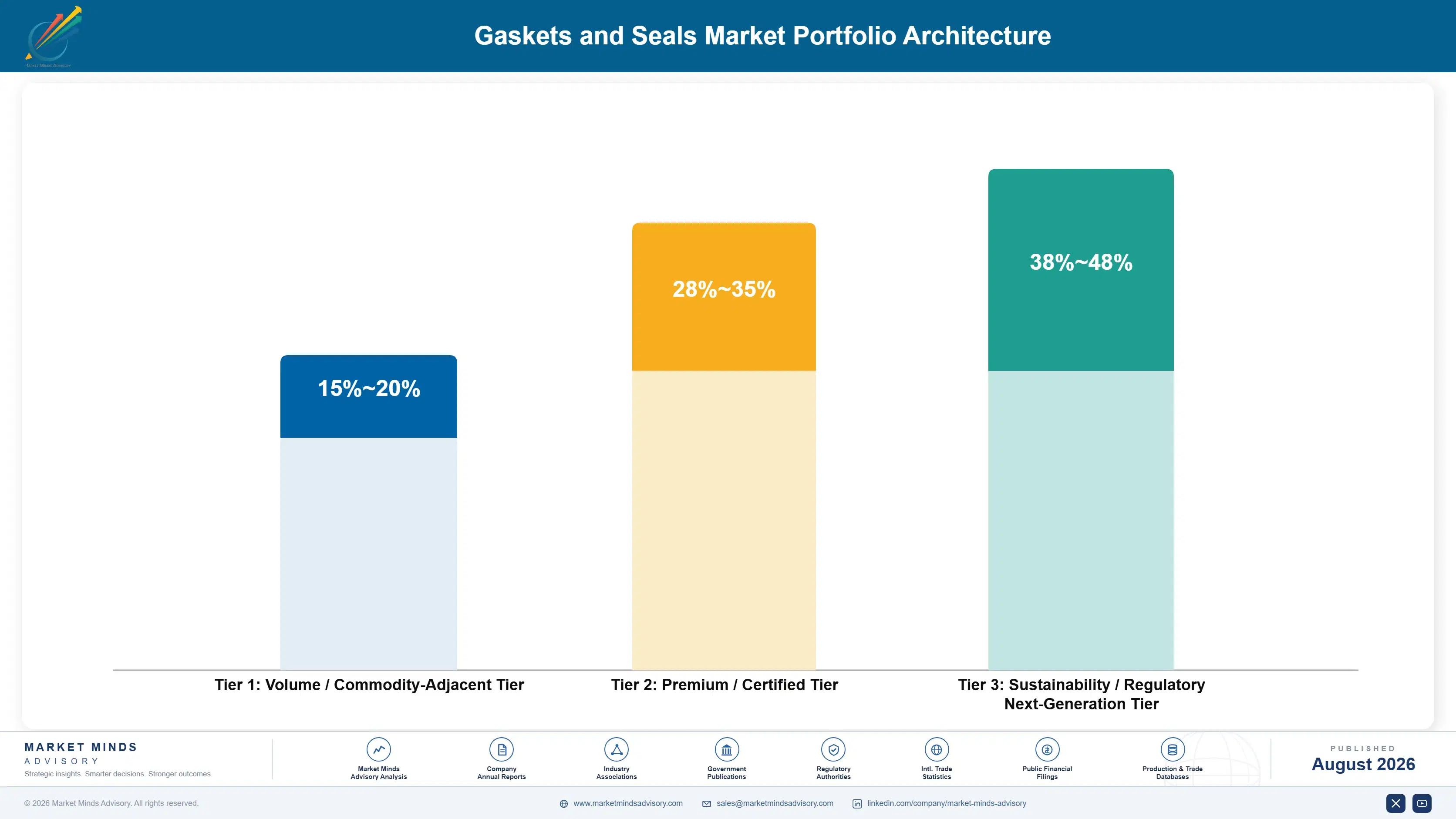
Portfolio Architecture for Margin Defence

The market splits into three tiers running from commodity rubber gaskets to certified, application-critical fluoropolymer and hydrogen-rated sealing solutions sold under long-term qualified supply agreements. Margin concentrates heavily at the top: semiconductor-grade and hydrogen-rated seals earn gross margins 20 to 25 percentage points above commodity rubber gaskets, reflecting both material cost and the extensive qualification testing that creates durable customer lock-in once a formulation i
Volume and premium tiers pull suppliers in different strategic directions simultaneously. Chinese and Indian regional manufacturers are pushing into mid-tier standard elastomer and silicone applications, compressing margin in segments where established Western suppliers historically earned steady returns, forcing incumbents to defend premium fluoropolymer and application-critical segments more aggressively through material science differentiation rather than manufacturing scale alone, which is increasingly commoditized across the industry.

High-value margin pools concentrate among suppliers serving semiconductor fabrication, hydrogen infrastructure, and aerospace customers, where qualification barriers and safety-critical performance requirements sustain pricing power that commodity automotive and industrial gasket segments have largely lost to fragmented, price-competitive regional manufacturing operating on considerably thinner margins and considerably shorter, less durable customer relationship cycles overall.

Volume / Commodity-Adjacent Tier

Standard rubber and elastomer gaskets sold into automotive and general industrial applications, competing on price across a highly fragmented global supplier base with thin margins reflecting low qualification barriers and intense regional competition.
Gross Margin: 15-20%

Premium / Certified Tier

Silicone and mid-tier fluoropolymer seals sold with application engineering support into automotive electrification and industrial process applications, capturing better margin through qualification barriers and meaningful technical differentiation from commodity rivals.
Gross Margin: 28-35%

Sustainability / Regulatory / Next-Generation Tier

Semiconductor-grade and hydrogen-rated fluoropolymer seals meeting the strictest purity, chemical resistance, and safety certification requirements, commanding the highest margin given intensive multi-year qualification barriers that few competitors can clear quickly or affordably.
Gross Margin: 38-48%
gaskets-and-seals-market-portfolio-architecture-1787333125892

High-value Sub-segments and Strategic Watch-out

Semiconductor-Grade Fluoropolymer Seals

Ultra-clean seals qualified for advanced chip fabrication environments, growing fastest as global fab capacity expansion under national incentive programs drives sustained demand for components meeting stringent particle contamination and outgassing standards across multiple regions and customer programs simultaneously, with qualification lead times creating durable multi-year supplier lock-in once approved.
Gross Margin: 42-48%

Hydrogen-Rated Sealing Components

Specialized elastomer and PTFE seals certified for hydrogen embrittlement resistance and high-pressure containment up to 700 bar, expanding steadily as government-backed hydrogen infrastructure programs fund refueling and pipeline buildout across Europe, Japan, and increasingly North America and South Korea, positioning early-certified suppliers well ahead of broader segment maturation.
Gross Margin: 36-42%

Standard Automotive and Industrial Elastomer Seals

The largest unit volume segment, serving established automotive and general industrial applications globally, forming the steady revenue backbone of most suppliers' current order books despite thin and persistently competitive commodity-tier margins that continue narrowing further each year as fragmented regional manufacturers compete aggressively on price.
Gross Margin: 18-24%

PFAS-Legacy Fluoropolymer Formulations

Older long-chain PFAS-containing fluoropolymer compounds facing accelerating regulatory restriction across Europe and several US states, a segment strategic watchers should track closely as replacement timelines compress faster than some suppliers' reformulation roadmaps currently anticipate, risking a sudden and costly loss of regulatory eligibility across several affected export markets.
Gross Margin: 25-32%

From Component Sale to Program Relationship

Sealing component demand increasingly functions as a qualified program relationship rather than a transactional component sale, since once a supplier's formulation is approved for a critical automotive, semiconductor, or hydrogen application, switching carries substantial requalification cost and multi-year timeline risk that customers are reluctant to absorb without a genuinely compelling technical or commercial reason to justify the disruption and cost involved.
Adoption depth varies sharply by end-use vertical. Semiconductor and hydrogen infrastructure customers demand the deepest qualification rigor and exhibit the strongest supplier lock-in once approved, given the safety-critical nature of these applications and the cost of any failure. Standard automotive and industrial customers maintain more transactional purchasing relationships, particularly for commodity gasket applications where multiple qualified suppliers typically compete on price and delivery performance rather than on deep technical differentiation between otherwise comparable qualified suppliers.

A generational shift in buyer profile is underway as procurement increasingly involves materials engineers alongside traditional purchasing staff, particularly for electrification and semiconductor-linked applications where formulation performance directly affects product safety and reliability, a change elevating technical qualification capability above pure price competitiveness in supplier selection criteria across nearly every fast-growing end market.
gaskets-and-seals-market-end-use-penetration-index-1787333126379

Where Sealing Suppliers Should Focus Next

These are among the four positions where our research anticipates prominent divergence between winners and laggards over the coming forecast period. Each is grounded in the demand model, the regulatory perimeter, and the announced capacity pipeline.
01 / MATERIAL SCIENCE INVESTMENT

Migrate mix toward fluoropolymer and silicone before commoditization spreads further

Commodity rubber gasket margins continue compressing under fragmented, price-driven competition from regional manufacturers with low capital barriers to entry into the category. Suppliers still concentrated in commodity segments face a a weaker long-term margin trajectory than those investing in fluoropolymer and silicone formulation capability tied to electrification and semiconductor demand. Moving now, well ahead of broader industry recognition of this shift, allows suppliers to capture qualification-based customer lock-in before competition in premium segments intensifies meaningfully across the board in the years ahead.
02 / SEMICONDUCTOR QUALIFICATION PRIORITY

Build fab-grade qualification capability ahead of confirmed capacity announcements

Global semiconductor fabrication capacity is expanding rapidly under national incentive programs, creating a concentrated, high-margin demand pool for suppliers with proven ultra-clean qualification capability already in place. The twelve to eighteen month qualification timeline means suppliers waiting for confirmed fab announcements before beginning the process will consistently arrive too late to capture early program positions worth pursuing. Building this capability proactively, even before specific fab contracts materialize, positions suppliers to win exclusive multi-year supply relationships worth considerable recurring revenue over time.
03 / REGULATORY REFORMULATION SPEED

Accelerate PFAS-free reformulation ahead of binding compliance deadlines

Tightening PFAS restrictions across Europe and several US states are compressing the timeline suppliers have to requalify legacy fluoropolymer formulations before losing regulatory eligibility entirely in affected markets and customer segments. Suppliers treating this as a proactive commercial opportunity, rather than a reactive compliance burden, are winning new customer relationships from rivals still dependent on formulations facing near-term restriction and eventual withdrawal. Moving early also allows suppliers to help shape emerging industry standards around acceptable replacement chemistries before they fully solidify.
04 / REGIONAL MANUFACTURING LOCALIZATION

Localize semiconductor and hydrogen-grade production closer to end customers

Customers in fast-growing semiconductor and hydrogen infrastructure segments increasingly favor suppliers with local manufacturing presence, reducing logistics risk and lead time for safety-critical components that cannot easily tolerate supply disruption of any kind. Suppliers relying solely on centralized production in Europe or North America risk losing share to competitors establishing regional facilities closer to Asian fabrication and infrastructure buildout already underway. Localization requires meaningful capital investment, but the alternative is gradually ceding fast-growing regional demand to better-positioned local and regionalizing competitors over time.

Engagement Snapshot From the Field

A live engagement with an industry participant carrying material or product regulatory and market exposure ahead of a defining policy shift, showing how our research translates into a defensible multi-year portfolio strategy.
MARKET MINDS ADVISORY · CLIENT ENGAGEMENT SUMMARY
Gaskets and Seals Producer Strategic Portfolio Review and Transition Roadmap 2026·Investment Scenario on Gaskets and Seals Exposure Evaluation 2025-26
CLIENT PROFILE
The client is a diversified sealing component manufacturer generating roughly $850 million in annual revenue (client-reported, unverified by MMA) across automotive, industrial, and energy end markets, with production facilities in North America and Eastern Europe. Historically concentrated in standard rubber gasket production, the company had limited exposure to fluoropolymer or semiconductor-grade sealing applications and was facing margin compression across its core commodity product lines.
STRATEGIC CHALLENGE
Management needed to determine whether to invest in fluoropolymer formulation capability and semiconductor-grade qualification infrastructure or continue optimizing its existing commodity rubber gasket operations, given real uncertainty about the capital required and the multi-year timeline before any new capability would generate meaningful returns against continued near-term commodity margin pressure across its core business.
MMA APPROACH
MMA benchmarked the client's cost structure against fluoropolymer-focused competitors, modeled the capital and timeline required to build semiconductor-grade qualification capability from the ground up, and assessed which existing customer relationships offered the clearest near-term pathway to cross-sell higher-specification products once new formulation and testing capability came online across the organization.
KEY FINDINGS
  1. Commodity rubber gasket margins had compressed by roughly six percentage points over the preceding three years, confirming management's concern about the segment's deteriorating long-term trajectory.
  2. Three existing automotive customers already purchased fluoropolymer seals from competing suppliers, representing an immediate cross-sell opportunity once qualification capability existed internally within the client's own manufacturing footprint.
  3. Building semiconductor-grade qualification infrastructure required an estimated $40 million in capital and eighteen months before first qualified shipments, longer than management had initially assumed.
  4. Hydrogen-rated certification was assessed as a lower near-term priority given the client's limited existing relationships in that specific end market segment currently.
CLIENT PROFILE
The client is a diversified sealing component manufacturer generating roughly $850 million in annual revenue (client-reported, unverified by MMA) across automotive, industrial, and energy end markets, with production facilities in North America and Eastern Europe. Historically concentrated in standard rubber gasket production, the company had limited exposure to fluoropolymer or semiconductor-grade sealing applications and was facing margin compression across its core commodity product lines.
STRATEGIC CHALLENGE
Management needed to determine whether to invest in fluoropolymer formulation capability and semiconductor-grade qualification infrastructure or continue optimizing its existing commodity rubber gasket operations, given real uncertainty about the capital required and the multi-year timeline before any new capability would generate meaningful returns against continued near-term commodity margin pressure across its core business.
MMA APPROACH
MMA benchmarked the client's cost structure against fluoropolymer-focused competitors, modeled the capital and timeline required to build semiconductor-grade qualification capability from the ground up, and assessed which existing customer relationships offered the clearest near-term pathway to cross-sell higher-specification products once new formulation and testing capability came online across the organization.
KEY FINDINGS
  1. Commodity rubber gasket margins had compressed by roughly six percentage points over the preceding three years, confirming management's concern about the segment's deteriorating long-term trajectory.
  2. Three existing automotive customers already purchased fluoropolymer seals from competing suppliers, representing an immediate cross-sell opportunity once qualification capability existed internally within the client's own manufacturing footprint.
  3. Building semiconductor-grade qualification infrastructure required an estimated $40 million in capital and eighteen months before first qualified shipments, longer than management had initially assumed.
  4. Hydrogen-rated certification was assessed as a lower near-term priority given the client's limited existing relationships in that specific end market segment currently.
RECOMMENDED STRATEGY
Phase 1: Phase 1 (Months 1 to 6): Begin fluoropolymer formulation development targeting the three existing automotive customers already purchasing the product category from competitors. Phase 2: Phase 2 (Months 7 to 18): Invest in semiconductor-grade qualification infrastructure while cross-selling fluoropolymer products to existing automotive relationships in parallel. Phase 3: Phase 3 (Months 19 to 30): Pursue semiconductor fab customer qualification once infrastructure investment is complete, targeting regional fabs near existing manufacturing footprint.
OUTCOME
The client began fluoropolymer formulation development within four months and secured a supply agreement with one existing automotive customer within the first year (client-reported, unverified by MMA). Semiconductor-grade qualification infrastructure investment was approved by the board, with first qualified shipments targeted within the originally estimated eighteen-month window.

Frequently Asked Questions

Foundational context covering the market sizes, CAGR, scope, country, region and competition that inform every finding below. This section is provided to cover basics and most often pre-purchase conversations, answered from the MMA Primary Research Dataset.

What is the current size of the Gaskets and Seals Market?

The global gaskets and seals market was valued at approximately $71.5 billion in 2025. Growth is being driven by electrification, semiconductor fabrication, and hydrogen infrastructure demand.

How large will the Gaskets and Seals Market be by 2036?

The market is projected to reach approximately $132.9 billion by 2036, up from $75.65 billion in 2026. This represents a substantial expansion over the ten-year forecast window.

What is the CAGR for the Gaskets and Seals Market 2026 to 2036?

The market is forecast to grow at a CAGR of 5.8% between 2026 and 2036. Bull and bear scenarios range from roughly 4.5% to 6.9%.

Which segment is growing fastest?

PTFE and fluoropolymer seals are the fastest-growing segment, expanding at approximately 8.6% annually. This is roughly 1.5 times the overall market's 5.8% growth rate today.

Who are the major companies in the Gaskets and Seals Market?

Leading suppliers include Freudenberg Sealing Technologies, Trelleborg AB, Parker Hannifin Corporation, SKF Group, and Dana Incorporated. Together these five hold roughly 26% of global share, reflecting a highly fragmented market.

Which country is growing fastest?

India is currently the fastest-growing single country, expanding at approximately 8.3% annually. This reflects India's rapidly expanding automotive and industrial manufacturing base under incentive programs.

Report Segmentation Architecture

The full report scope spans multiple orthogonal segmentation dimensions, with cross-tabulated demand data provided for each dimension pair. Coverage extends further to regional breakdowns, trend trajectories, and the competitive detail needed to support segment-level decision-making.

By Material and Product Technology

  • Rubber and Elastomer Gaskets
  • Metallic and Semi-Metallic Gaskets
  • PTFE and Fluoropolymer Seals
  • Silicone Gaskets and Seals
  • Cork and Composite Gaskets
  • Foam and Sponge Seals

By End-Use Industry

  • Automotive and EV
  • Semiconductor and Electronics
  • Chemical and Process Industries
  • Oil and Gas
  • Aerospace and Defense

By Commercial Dimension

  • Original Equipment Supply
  • Aftermarket Replacement
  • Application Engineering Services
  • Distributor and Channel Sales

By Region

  • North America
  • Western Europe
  • East Asia
  • South Asia and Pacific
  • Latin America
  • Middle East and Africa
  • Eastern Europe

Scope, Methodology, and Coverage

Every figure in this report is reproducible from documented input assumptions. The scope below maps the historical period, the forecast horizon, the segmentation dimensions, and the countries covered, alongside the underlying primary and qualitative methodology.
Historical Period
2020 to 2025
Forecast Period
2026 to 2036
Base Year
2025 (USD billions; MMA Primary Research Dataset, August 2026)
Market Definition
The gaskets and seals market covers static and dynamic sealing components, including gaskets, O-rings, mechanical seals, and molded or extruded seal profiles, used to prevent fluid, gas, or pressure loss across automotive, industrial, energy, and electronics applications. It excludes adhesives, coatings, and structural fasteners sold independently of sealing function.
Quantitative Units
USD billions (current prices); unit shipments where disclosed
Segmentation Dimensions
By Material and Product Technology; By End-Use Industry; By Commercial Dimension; By Region
Regions Covered
North America, Western Europe, East Asia, South Asia and Pacific, Latin America, Middle East and Africa, Eastern Europe
Countries Covered
USA, China, Germany, France, UK, Japan, South Korea, India, Australia, Canada, Brazil, Mexico, Indonesia, Vietnam, Thailand, Malaysia, UAE, Saudi Arabia, South Africa, Nigeria, Turkey, Poland, Netherlands, Italy, Spain, Sweden, Switzerland, Argentina, Colombia, Singapore, and additional markets relevant to this sector
Key Companies Profiled
Freudenberg Sealing Technologies, Trelleborg AB, Parker Hannifin Corporation, SKF Group, Dana Incorporated, NOK Corporation, ElringKlinger AG, EnPro Industries, James Walker Group, Flowserve Corporation, Tenneco Inc., Hutchinson SA, Datwyler Holding, Precision Polymer Engineering, A.W. Chesterton Company, Mahle GmbH, NAK Sealing Technologies, Hallite Seals International, Interface Performance Materials, Cooper Standard Holdings
Quantitative Methodology
Primary survey, n=3,800 respondents, Q4 2025, six countries; demand-side model with trade association cross-validation
Qualitative Methodology
47 expert interviews, Q4 2025; applied to validate demand model assumptions, identify emerging dynamics, and assess competitive positioning
Report Format
PDF and XLSX data workbook (Word format preview document)
Publisher
Market Minds Advisory
Report Code
MMA-2026-CON-310
Published
August 2026
Contact
sales@marketmindsadvisory.com | www.marketmindsadvisory.com

Purchase the full Gaskets and Seals Market Report (2026 to 2036).

The full report provides a comprehensive assessment of the global gaskets and seals market, including detailed segmentation by material and product technology, end-use industry, and commercial dimension across all seven world regions. It profiles twenty leading and emerging sealing manufacturers, benchmarking material science capability, qualification barriers, and regulatory exposure. The analysis includes ten-year forecasts through 2036 under base, bull, and bear scenarios, alongside primary research findings drawn from MMA's survey of 3,800 respondents and 47 expert interviews conducted in the fourth quarter of 2025. A dedicated input cost section examines synthetic rubber and fluoropolymer resin exposure across major manufacturing regions.
Detailed segment-level ten-year forecasts through 2036
Profiles of twenty leading and emerging suppliers
Regional analysis spanning all seven world regions
Input cost and supply chain risk assessment
Competitive benchmarking on moats and vulnerabilities
Primary survey and expert interview data appendix

Built For The People Who Decide

From boardroom strategy to bench-side execution, this report is read cover-to-cover by leaders shaping the next decade of their industry, turning demand scenarios, market dynamics and valuation benchmarks into decisions.
CXOs/ Presidents/ VPs/ Managers
M&A and Corporate Development
Strategy Teams and R&D Heads
Procurement and Product Directors
Regulatory and Compliance Leaders
Investor Relations and Equity Analysts