Market Minds Advisory
Gas Treating Amine Market

Gas Treating Amine Market: Acid Gas Removal Solvents Across Processing, Refining and Capture, 2026 to 2036

A solvent that costs a fraction of a percent of plant capital decides whether the plant meets its sulphur specification, and operators still buy it on price per tonne rather than on energy consumed.

Lead Analyst

Bilal Shaikh

Published

September 2026

Make Smarter Decisions with Customized Research Insights

Request a free sample report and evaluate market opportunities, growth trends, and competitive dynamics relevant to your business needs.

2025 MARKET VALUE$2.1BMarket Size 2025
2036 FORECAST VALUE$4.3BBase Case , 2026 to 2036
CAGR 2026 TO 20366.8 %Bull 8.1% / Bear 5.6%
INCREMENTAL OPPORTUNITY$2.1BNet 10- year value creation
EXPANSION MULTIPLE1.93x2036 value over 2026 base
Strategic Levers
M&A Pipeline
Regional Outlook
Country Rankings
Competitive Intelligence
Segmental Deep-dive
Call-Us : 91 93563 13602

Executive Snapshot and Market Trajectory

Amine solvent is a rounding error in a gas plant's capital cost and it determines the plant's largest operating expense. Regeneration steam accounts for 62% of treating operating cost, and solvent selection sets how much of it a unit consumes for the whole life of the asset.
Growth concentrates in formulated and activated MDEA blends, expanding at 10.2%, which use promoters and inhibitors to hit sulphur specification at lower circulation rates and considerably lower reboiler duty than generic amines manage. North America holds 30% of value on treated gas volume: shale processing plants, Gulf Coast liquefaction trains and refinery hydrotreating together consume more solvent than any other region, though Middle Eastern sour gas runs at higher amine intensity per unit processed.
The supplier base is concentrated, with the top five holding 58% of solvent volume supplied, because formulation know-how and the ethylene oxide feedstock position behind it both sit with large chemical producers. Competition runs on energy performance and degradation resistance rather than on price per tonne, at least among operators who have done the arithmetic. Carbon capture is the demand that changes this market's trajectory.
Market Definition
The market comprises alkanolamine solvents supplied for acid gas removal from natural gas, refinery streams, syngas and flue gas, spanning formulated and activated methyldiethanolamine blends, piperazine and advanced promoter amines, generic methyldiethanolamine, diethanolamine and monoethanolamine. Sizing captures solvent revenue at realised delivered price including initial fills, top-up volumes and reclaimed solvent services. Physical solvents, hot potassium carbonate systems, membrane separation units, solid adsorbents, treating equipment and licensed process technology packages fall outside scope.
Base Year Value
$2.1B in 2025 (MMA Primary Research Dataset, August 2026)
Forecast Period
2026 to 2036, eleven discrete annual values
CAGR
6.8% base case. Bull 8.1%. Bear 5.6%.
Fastest Growth Segment
Formulated and Activated MDEA Blends: 10.2% CAGR
Fastest Growth Country
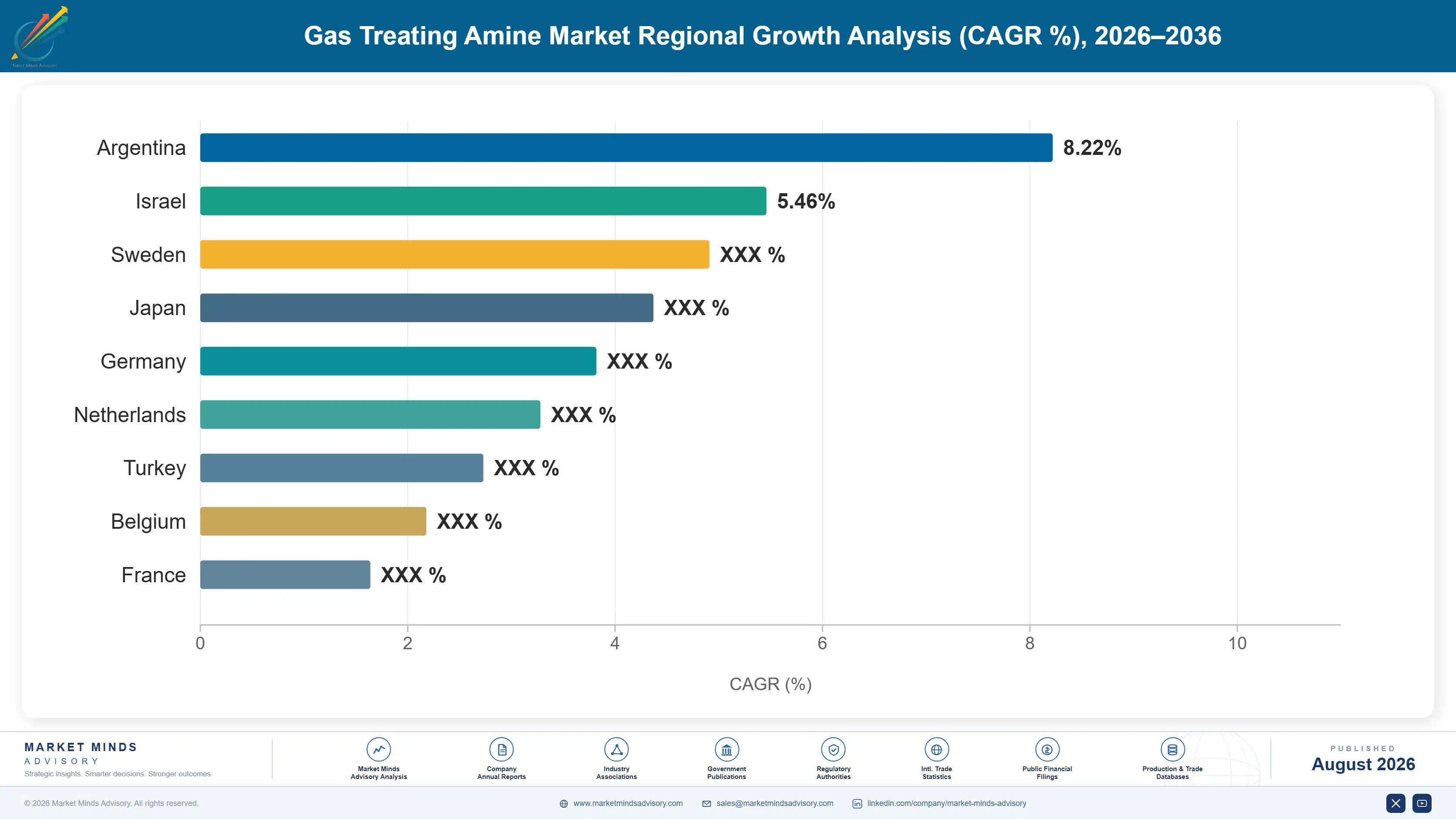
India: 9.2% CAGR
Fastest Growth Region
South Asia and Pacific: 8.9% CAGR
Largest Region
North America: 30% of 2025 global value
Market Leaders
BASF, Dow, Huntsman, Eastman Chemical, Nouryon. Source: MMA Analysis based on company annual reports.
Primary Survey
n=3,800 procurement and R&D decision-makers, Q4 2025, six countries
Methodology
Demand-side build-up, cross-validated against public data, 47 expert interviews

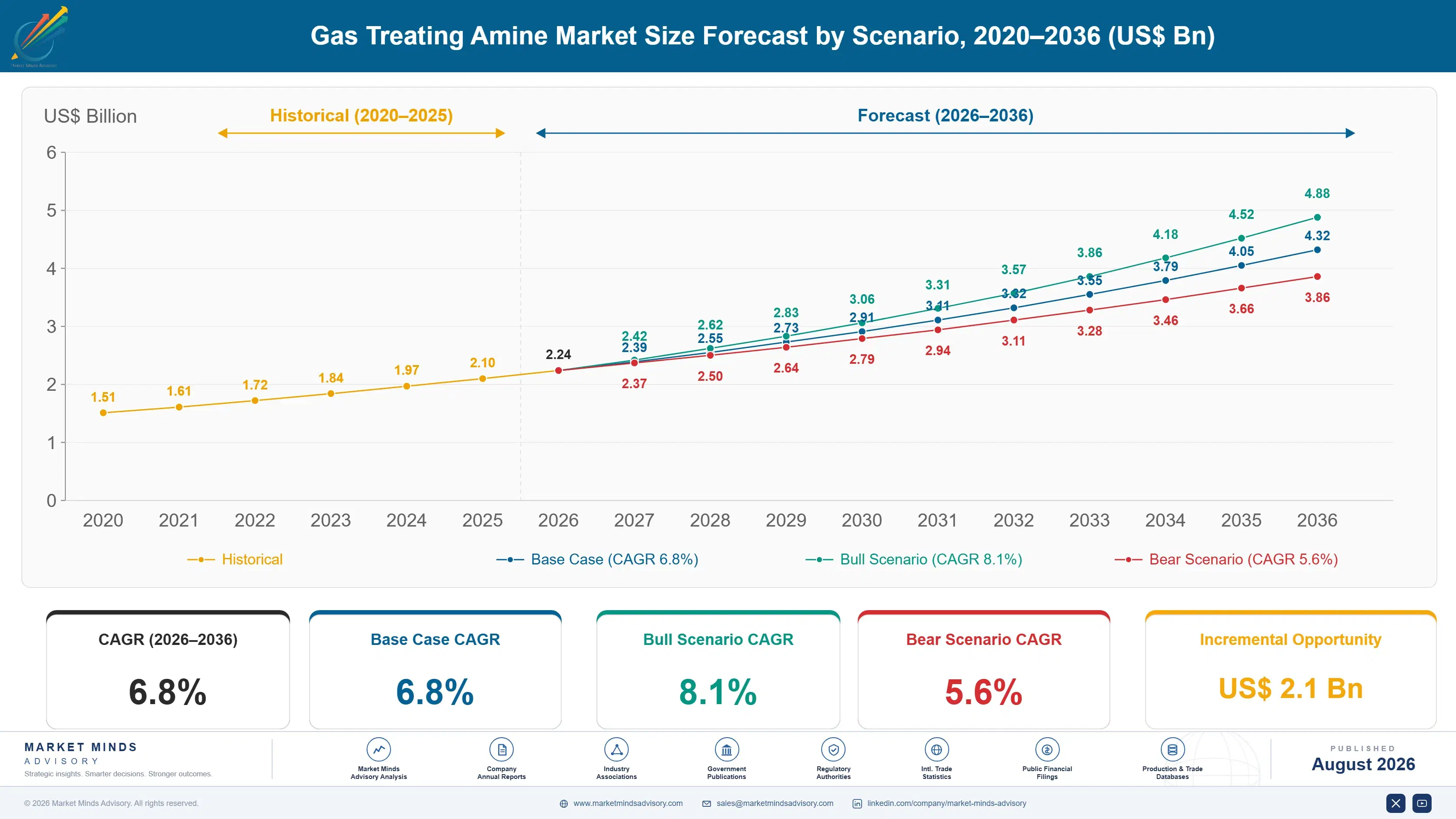
Gas Treating Amine Market Forecast Scenarios

gas-treating-amine-market-trend-size-forecast-scenario-1787310291783
Growth of 5.5% across 2020 to 2025 tracked gas processing volumes with one significant distortion. Liquefaction capacity commissioned across the United States and Qatar carried large initial solvent fills into a market that normally grows on replacement, and the pandemic year suppressed refinery treating demand before recovery. Underneath both, migration from generic amines toward formulated blends continued steadily and largely unremarked.
The base case at 6.8% rests on three mechanisms. Liquefaction capacity under construction across North America, Qatar and Africa carries initial fills followed by decades of top-up demand. Sulphur specifications tighten across pipeline and product standards, which pushes operators toward formulations able to hit tighter targets without any additional capital spend. And carbon capture projects reaching final investment decision consume amine at volumes per unit treated that dwarf conventional sweetening duty entirely.
The bull case at 8.1% turns on post-combustion capture deployment accelerating past current project pipelines, since one large capture unit consumes solvent on the scale of several gas plants. The bear case at 5.6% turns on the same variable in reverse. Capture projects have a long history of reaching announcement and never reaching construction, and the amine demand attached is the least certain part of this forecast.

What Governs Treating Solvent Economics

The commercial logic of this market is systematically misread by the people buying in it. Solvent represents a small fraction of a treating unit's lifetime cost, while the reboiler duty that solvent selection determines accounts for 62% of operating expense. A formulation that cuts circulation rate by a fifth saves more in a year of steam than the entire annual solvent purchase costs. Operators who model this buy on energy performance; a good many still tender on price per tonne.
TOP FIVE SHARE58%Concentration of treating solvent volume across the largest suppliers
FORMULATED SOLVENT PRICEUSD 3,150 per tonneDelivered price per tonne of formulated treating solvent blend
ANNUAL SOLVENT LOSS14%Inventory replaced annually through degradation, vaporisation and mechanical carryover
REGENERATION ENERGY SHARE62%Steam and reboiler share of total treating unit operating cost
FEEDSTOCK COST SHARE48%Ethylene oxide and amine feedstock share of production cost
TREATED GAS SPECIFICATION4 ppmvPipeline sulphur specification that treating units must consistently meet
Solvent inventory turns over at roughly 14% annually through thermal and oxidative degradation, vaporisation losses and mechanical carryover, which makes replacement rather than initial fill the recurring business. Degradation resistance therefore matters twice: it reduces make-up volume and, more importantly, it prevents the corrosion and foaming that degradation products cause downstream.
Formulation is where the technical differentiation genuinely lives. Activated MDEA blends use promoters such as piperazine to accelerate carbon dioxide absorption while retaining selectivity for hydrogen sulphide, alongside corrosion inhibitors and antifoams tuned to the specific gas composition. That package is difficult to reverse engineer and is usually developed against the conditions of one particular plant.
"The most expensive decision in a gas plant's operating life is which solvent goes into it, and it is routinely made by procurement against a price per tonne. I have seen units running generic amine at twice the reboiler duty they need, saving perhaps two hundred thousand dollars a year on solvent while burning several million in extra steam."
Director, Gas Processing and Industrial Chemicals Practice · MMA Chemicals and M

Market Trends

Carbon Capture Projects Reshape Amine Demand Scale

Post-combustion capture uses the same amine chemistry as gas sweetening at volumes that change the shape of this market entirely, since a single large capture unit holds solvent inventory comparable to several conventional gas plants. Roughly 11 million tonnes of announced annual capture capacity now sits behind projects with amine-based solvent selections. Degradation behaviour under flue gas conditions differs sharply from natural gas service, because oxygen and nitrogen oxides attack conventional amines, which has driven development of oxidation-resistant formulations commanding genuine premiums over conventional treating grades. Capture duty is where this market's growth assumptions now sit.
Market Impact: Adds 180 million tonnes capacity
Formulated Blends Displace Generic Amine Solvents Steadily

Operators are migrating from generic monoethanolamine and diethanolamine toward activated and inhibited MDEA formulations, on reboiler duty savings that pay for the price difference several times over in a single operating year. Formulated blends now account for roughly 46% of solvent volume supplied, against a considerably smaller share a decade ago. The migration is slower than the economics justify, held back by procurement processes that evaluate solvent as a chemical purchase and by operating teams understandably reluctant to change anything in a unit that currently meets its specification without incident.
Market Impact: Specification near 4 ppmv sulphur

Market Opportunities and Growth Drivers

Liquefaction Capacity Additions Carry Large Initial Fills

Liquefaction trains require deep acid gas removal because carbon dioxide freezes in the cold box, which means specifications far tighter than pipeline gas and correspondingly large, carefully formulated solvent inventories. Roughly 180 million tonnes per annum of new liquefaction capacity is under construction across North America, Qatar and Africa. Each train carries an initial fill followed by decades of top-up demand at around 14% annually, which is exactly the kind of installed-base annuity that solvent suppliers build their businesses on rather than the one-off capital sale it superficially appears to be.
Market Impact: Replaces 14% of inventory annually

Tightening Sulphur Specifications Push Formulation Upgrades

Pipeline and product sulphur limits have tightened across most producing regions, with typical pipeline specification now near 4 ppmv hydrogen sulphide and several jurisdictions moving lower. Meeting a tighter target with existing equipment means either more circulation, which costs steam, or better solvent, which costs less overall. That arithmetic favours formulated blends on every occasion anybody actually performs it. Regulatory tightening therefore converts a discretionary efficiency decision into a compliance requirement, which historically has been the only thing that reliably moves an operator off an incumbent solvent that currently works.
Market Impact: Determines 62% of operating cost

Market Restraints and Challenges

Solvent Degradation Creates Corrosion And Foaming Problems

Amines degrade thermally and oxidatively into heat stable salts and organic acids that corrode carbon steel and cause foaming, and roughly 14% of inventory is replaced annually as a result. The root cause is chemistry rather than operation: the same nitrogen basicity that absorbs acid gas makes the molecule vulnerable to oxidation and to irreversible reaction with carbon dioxide. Commercially the damage falls on equipment and throughput rather than on solvent cost. Mitigation runs through inhibitor packages, on-site reclaiming units that remove heat stable salts, and formulations designed for oxidative service.
Market Impact: Covers 11 million tonnes announced

Procurement Evaluates Solvent Against The Wrong Cost

Treating solvent is tendered as a chemical purchase against price per tonne, while the decision actually determines 62% of the unit's operating cost through reboiler duty. The root cause is organisational: solvent sits in a procurement category alongside commodity chemicals, and the energy consequence lands in a different budget belonging to a different function. Commercially this caps the addressable value of better formulations well below their technical worth. Suppliers are responding with total cost modelling, energy performance guarantees, and service contracts priced against treated gas volume rather than tonnes delivered.
Market Impact: Reaches 46% of solvent volume
4 additional market trends, 2 additional growth drivers, and 3 additional restraints and challenges are covered in the full report. Contact sales@marketmindsadvisory.com to access the complete intelligence.

Segment CAGR and Growth Architecture

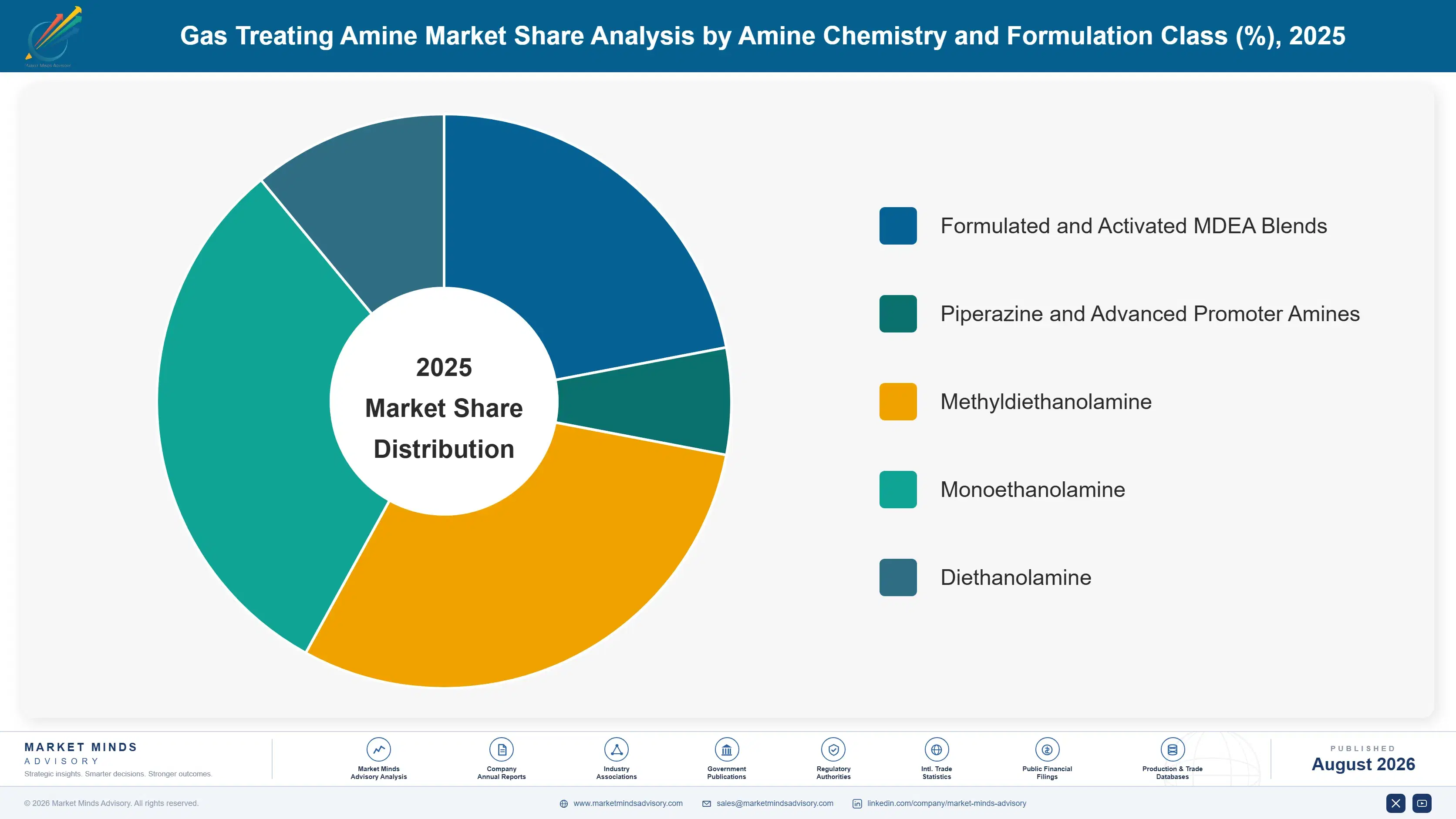
Segmentation follows amine chemistry and formulation class, which is the dimension determining absorption selectivity, regeneration energy, degradation behaviour and realised price together. Treating application, whether natural gas, refinery streams or flue gas, cuts across every chemistry without separating them commercially, since the same formulated blend serves several duties, so application sits in demand analysis instead.
gas-treating-amine-market-trend-market-share-analysis-1787310292321

Formulated and Activated MDEA Blends

Growing at 10.2%, exactly 1.50 times the market rate, and the segment where technical differentiation actually translates into pricing power. Activated blends combine methyldiethanolamine with promoters that accelerate carbon dioxide absorption, corrosion inhibitors matched to the plant's own metallurgy, and antifoams tuned to the specific gas composition being treated. The result hits sulphur specification at lower circulation rates and materially lower reboiler duty than any generic amine manages. Formulations are usually developed against one particular unit and are genuinely difficult to reverse engineer, which is why supplier positions here survive procurement pressure that generic amine supply never withstands for long. Migration from generic grades continues steadily across every producing region.
CAGR 10.2%

Piperazine and Advanced Promoter Amines

Expanding at 8.9% on demand from carbon capture and deep removal duties where absorption kinetics rather than capacity set the design. Piperazine accelerates carbon dioxide uptake dramatically and resists thermal degradation better than conventional promoters, which matters a great deal in capture service, where regeneration temperatures run high and oxidative attack is continuous rather than occasional. Handling and toxicity requirements are considerably more demanding than for conventional amines, and supply comes from a much narrower producer base. Pricing sits well above generic alkanolamines and holds, because the applications specifying piperazine have no adequate alternative at the performance level they actually require. Capture project pipelines are what will decide this segment's eventual scale.
CAGR 8.9%
Full segment breakdown across 5 segments available in the complete report.

Regional Architecture and Country Demand Map

Regional value follows treated gas volume and sour gas severity together, which are different things and point in different directions. Sweet shale gas processed in enormous volume and highly sour reservoirs processed in smaller volume both generate substantial solvent demand, for reasons that have almost nothing in common.

North America

Thirty percent of value rests on volume rather than on gas quality. United States shale processing plants treat enormous throughput at relatively modest acid gas content, Gulf Coast liquefaction trains require deep removal for cold box protection, and refinery hydrotreating and sulphur recovery add steady demand across both countries. That combination consumes more solvent than any other region despite the gas itself being comparatively sweet. Canadian sour gas in Alberta and British Columbia runs at considerably higher amine intensity per unit processed. Growth of 6.2% reflects liquefaction commissioning and steady replacement demand rather than any expansion in the underlying processing base, which has been broadly flat for several years now.
Share: 30% | CAGR: 6.2% (2026 to 2036)

Middle East and Africa

Eighteen percent of value, well above the band this report applies to global markets. Note: the deviation is genuine, since Middle Eastern sour gas contains hydrogen sulphide at concentrations found almost nowhere else and requires amine intensity per unit of gas processed far beyond conventional service. Saudi, Qatari and Emirati sour gas developments consume formulated solvent in large volumes, and Qatari liquefaction expansion adds substantial initial fills. North African gas processing serves both domestic consumption and European export demand. Sub-Saharan African liquefaction projects in Mozambique and Nigeria carry significant initial fills whenever they finally proceed. Growth of 7.1% runs above the global rate and is underpinned by projects already under construction.
Share: 18% | CAGR: 7.1% (2026 to 2036)
Regional intelligence for 5 additional markets available in the complete report: Western Europe, East Asia, South Asia and Pacific, Latin America, Eastern Europe. Contact sales@marketmindsadvisory.com.
gas-treating-amine-market-trend-country-cagr-analysis-1787310292844

Where Amine Suppliers Can Earn More

Selling tonnes into a procurement process that compares price per tonne gives away the entire value of the formulation work behind it. The margin available sits in the reboiler duty a solvent determines, in the degradation losses it avoids, in reclaiming services, and in the carbon capture duties where no adequate alternative chemistry currently exists.

Price Against Reboiler Duty Rather Than Tonnes Delivered

Solvent selection determines 62% of a treating unit's operating cost through steam consumption, and a formulation cutting circulation by a fifth saves more annually than the entire solvent purchase costs. Suppliers who model total cost for the customer and contract against energy performance realise roughly 35% above tonnage-based pricing on identical volumes. The modelling work requires plant data and engineering time rather than any new chemistry at all. Most suppliers never attempt it, because the sales relationship sits with procurement teams who cannot act on the argument even when they accept it.
Market Impact: Realises roughly 35% more than tonn

Sell Reclaiming Services Alongside Make-Up Volume

Heat stable salts and degradation products cause the corrosion and foaming that damage plant availability, and roughly 14% of solvent inventory turns over annually because of them. Suppliers offering on-site reclaiming, heat stable salt removal and inventory management convert an episodic chemical sale into a continuing service relationship worth roughly 1.8 times the make-up solvent revenue alone. It also places the supplier's own engineers inside the plant continuously, which is where formulation upgrade decisions actually get made, rather than in a purchasing office reviewing a price list once a year.
Market Impact: Worth roughly 1.8 times make-up sol

Develop Oxidation-Resistant Chemistry For Capture Duty

Flue gas contains oxygen and nitrogen oxides that attack conventional amines far faster than any natural gas service does, and roughly 11 million tonnes of announced capture capacity has amine-based solvent selections behind it. Suppliers with genuinely oxidation-resistant formulations command premiums near 50% above conventional treating grades, because capture project economics are ruined outright by high solvent make-up rates over an operating life. The development work is demanding and the qualification cycle runs for years, which is precisely why the position holds firmly once established and closes to everybody else.
Market Impact: Commands premiums near 50% above co

Capture Liquefaction Initial Fills For Long Annuities

Roughly 180 million tonnes per annum of liquefaction capacity is under construction, each train carrying a large initial fill followed by decades of top-up at around 14% annually. Winning the initial fill effectively wins the annuity, since requalifying a solvent on an operating liquefaction train is something nobody undertakes lightly. Suppliers engaging at front end engineering rather than at procurement capture roughly 4 times the lifetime value per project. Engagement has to happen years before anybody issues a purchase enquiry, which most commercial organisations are simply not structured to do.
Market Impact: Captures roughly 4 times the lifeti

Who Controls the Margin Pool

Concentration is high and traces to feedstock as much as to formulation. The top five participants hold 58% of treating solvent volume supplied, the basis used throughout this section, and the gap between BASF and the challenger group reflects licensed process technology bundled with solvent supply rather than chemistry alone. Ethylene oxide integration underpins most positions here, since alkanolamine production starts from it and merchant ethylene oxide is not freely traded.
Competition currently runs on three dimensions. Formulation performance decides where technical evaluation happens, which is a minority of tenders and the profitable minority. Feedstock integration decides cost position in generic grades. Service capability, particularly reclaiming and inventory management, decides retention once a solvent is in a plant and running reliably to its specification.

Pressure is building from two directions. Carbon capture is drawing new entrants with oxidation-resistant chemistry and no legacy gas treating business to defend. Regional blenders in Asia and the Middle East are formulating locally from imported base amines. Rankings shift first in capture duty, where incumbency counts for very little and the chemistry requirements differ from conventional sweetening in ways that matter.
gas-treating-amine-market-trend-company-positioning-matrix-1787310293367

Competitive Moat and Risk Dimensions

BASF

Moat: Licensed technology and solvent

Supplying gas treating process technology alongside the solvent that runs in it creates a position no pure chemical supplier can attack, because the solvent is specified in the licensed design and validated through the performance guarantee. Ethylene oxide integration underpins cost position in the underlying amines, and decades of operating data across licensed units inform each formulation.
BASF

Risk: Capture chemistry opens entry

Post-combustion capture requires oxidation resistance that conventional gas treating formulations were never designed to provide, which opens a genuine entry point for specialists carrying no legacy business. Incumbency in natural gas sweetening confers limited advantage in flue gas service, and capture projects select solvent through a process where existing relationships matter far less.
DOW

Moat: Ethylene oxide feedstock integration

Deep integration back into ethylene and ethylene oxide gives a cost position in alkanolamine production that non-integrated formulators cannot approach, particularly in generic grades where price competition is direct. Scale across multiple producing regions provides supply security that large operators value highly when a treating unit cannot run without solvent.
DOW

Risk: Value migrating toward formulation

Growth concentrates in formulated blends and capture chemistry, where feedstock integration matters far less than application engineering and where the customer relationship runs through plant operations rather than procurement. A cost advantage in commodity amines defends a shrinking share of the market's value, and rebuilding around service capability takes considerable time.

Players Tracked

Prominent Players

BASF
Dow
Huntsman
Eastman Chemical
Nouryon

Other Key Players

INEOS
Arkema
Clariant
ChampionX
Baker Hughes
SLB
Shell Catalysts and Technologies
Honeywell UOP
Fluor Corporation
Mitsubishi Heavy Industries
Sinopec
Chevron Phillips Chemical
Sadara Chemical
Petronas Chemicals
Mitsubishi Gas Chemical

Recent Developments

APRIL 2025

Oxidation-resistant capture solvent qualified at demonstration scale

An amine solvent formulation developed specifically for post-combustion capture duty completed its qualification programme at demonstration scale, documenting solvent degradation rates under flue gas oxygen and nitrogen oxide exposure well below conventional treating grades over an extended continuous operating campaign at representative flue gas conditions.
Signal: Degradation rate rather than absorption ca
SEPTEMBER 2025

Liquefaction train awards formulated solvent supply contract

A liquefaction project under construction awarded its formulated treating solvent supply covering initial fill and multi-year top-up volumes, with the selection made during front end engineering alongside the acid gas removal unit design itself rather than through a later procurement tender once construction was underway.
Signal: Solvent decisions taken at engineering sta
JANUARY 2025

Regional blending capacity commissioned for Asian markets

Formulated amine blending capacity entered commercial operation in Asia, producing activated methyldiethanolamine and inhibitor packages from imported base amines for regional gas processing and refinery customers, shortening delivery times considerably against finished solvent imported from Western producers and allowing formulation adjustment against local plant conditions.
Signal: Local blending erodes the delivery advanta

What Sits Inside Amine Production Cost

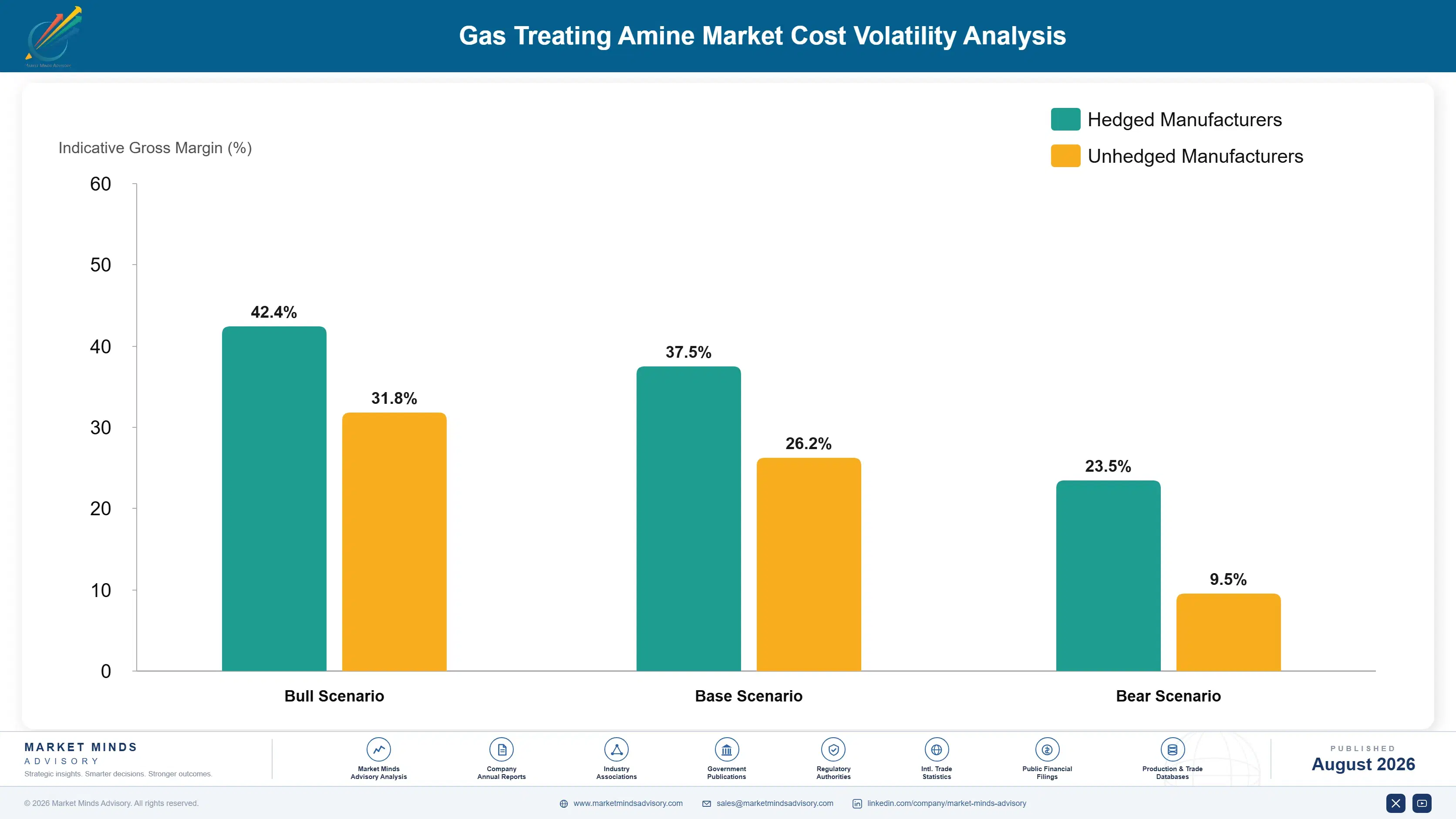
Ethylene oxide and the amine feedstocks reacted with it account for roughly 48% of alkanolamine production cost, with ethylene oxide sourced almost entirely from integrated producers because it is hazardous to transport and thinly traded. Ammonia and methylamine contribute a further 14%. Energy for reaction and distillation adds around 11%, and formulation components including promoters, inhibitors and antifoams make up perhaps 9% of a finished blend.
Feedstock supply proved fragile in early 2021. Winter Storm Uri froze United States Gulf Coast petrochemical capacity in February, taking ethylene and ethylene oxide production offline across multiple sites simultaneously, and alkanolamine availability tightened for months. European gas prices through 2022 then raised ammonia and energy costs sharply. BASF Annual Report 2022 and Dow Annual Report 2021 both recorded the feedstock and energy disruptions and their effect on downstream derivative availability.

The competitive disadvantage mechanism runs through ethylene oxide access rather than through purchasing terms. Non-integrated formulators buy base amines from competitors who also sell finished solvents, which caps their cost position permanently and exposes them during allocation. Integrated producers absorb feedstock disruption comfortably. Regional blenders working from imported base amines carry both a cost handicap and a supply dependency on their direct competitors.
gas-treating-amine-market-trend-cost-volatility-analysis-1787310293562

Contract base amine supply on multi-year indexed terms

Non-integrated formulators buying base amines from integrated competitors are exposed on both price and allocation, and spot purchasing offers no real protection against either exposure. Multi-year agreements indexed to published ethylene and ethylene oxide benchmarks share the exposure and secure volume during the periods when integrated producers quite reasonably serve their own downstream operations first.

Build formulation value that survives feedstock cost swings

A blend whose customer pays for reboiler duty savings rather than for tonnes is far less exposed to base amine cost movement than a generic grade sold on price. Formulation and application engineering therefore function as a hedge as well as a margin source, which is not how most producers' commercial teams present them internally.

Site blending capacity near customers rather than feedstock

Base amines ship economically, while finished formulated blends carry freight and lead time that matter to operators managing solvent inventory. Blending close to the customer regions themselves shortens delivery, allows formulation adjustment against the actual plant conditions encountered, and reduces the working capital tied up in solvent sitting on ships for weeks at a time.

Portfolio Architecture for Margin Defence

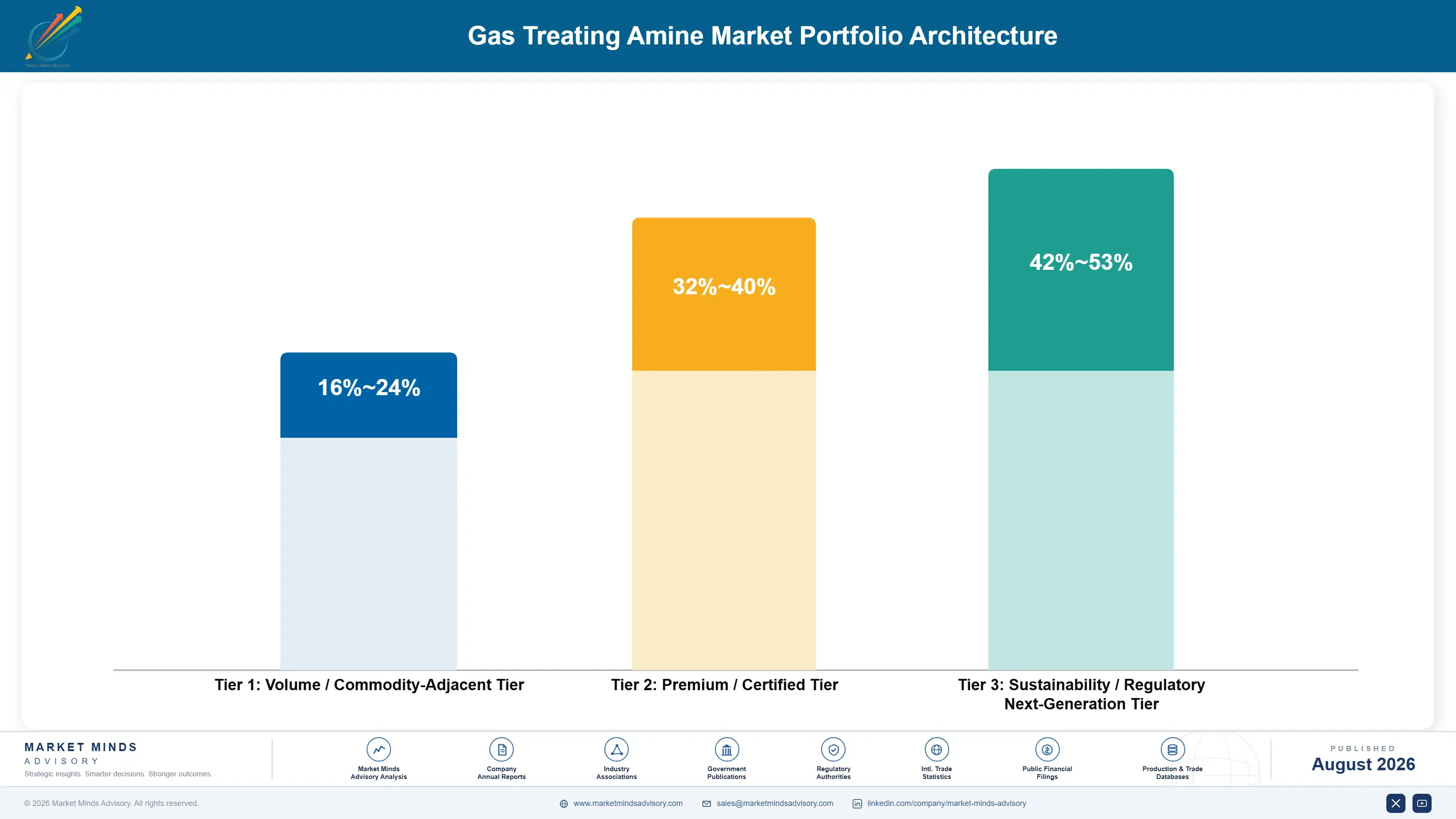
Margin architecture here separates by whether the customer is buying a chemical or an outcome. Generic monoethanolamine and diethanolamine sold on price per tonne earn what feedstock integration allows and nothing more, which for non-integrated suppliers is very little indeed. Value rises with formulation content, application engineering and service wrapped around the molecule, rather than with volume shipped or tonnes produced.
The volume versus premium tension runs between installed conventional treating and everything newer. Generic and standard MDEA grades carry the tonnage that justifies production assets and distribution, at margins that procurement tendering compresses continuously. Formulated blends, capture chemistry and reclaiming services earn considerably better on smaller volumes tied to specific plants. A supplier chasing tonnage funds an integrated asset base from margins that commodity tendering will not support.

High-value pools concentrate in three places. Activated and inhibited blends developed against particular units command price because they are difficult to reverse engineer and painful to displace. Oxidation-resistant capture formulations earn premiums because project economics fail without them. And reclaiming and inventory services earn on plant availability rather than on chemistry, which is a quite different sale requiring quite different people.

Volume / Commodity-Adjacent Tier

Generic monoethanolamine, diethanolamine and standard methyldiethanolamine supplied against specification through distributors and procurement tender, where feedstock integration alone determines whether the tonnage earns anything meaningful. Price per tonne is the only criterion applied.
Gross Margin: 16-24%

Premium / Certified Tier

Formulated and activated blends with promoters, corrosion inhibitors and antifoams developed against specific plant conditions and metallurgy. Application engineering and difficulty of substitution defend pricing. The eight-point range reflects standard against custom formulation work.
Gross Margin: 32-40%

Sustainability / Regulatory / Next-Generation Tier

Oxidation-resistant capture solvents, piperazine-based advanced promoters and reclaiming service packages. Scarcity of adequate alternatives defends pricing strongly here. Long qualification cycles reinforce that position. The eleven-point range reflects qualified capture chemistry against service-led revenue economics.
Gross Margin: 42-53%
gas-treating-amine-market-trend-portfolio-architecture-1787310294061

High-value Sub-segments and Strategic Watch-out

Oxidation-resistant capture formulations

High value and high growth together, because roughly 11 million tonnes of announced capture capacity depends on solvent degradation rates that conventional treating grades cannot deliver under flue gas conditions. Qualification cycles run long enough to keep the competitive set genuinely narrow for years ahead.
Gross Margin: 42-53%

Plant-specific activated MDEA formulations

Strong realised value on rapid growth, defended because blends developed against particular gas compositions and metallurgy are difficult to reverse engineer and painful to displace once a unit is running reliably to its sulphur specification without incident. Migration from generic grades continues steadily across every producing region.
Gross Margin: 32-40%

Generic amine tonnage supply

The volume core here, justifying production assets and distribution reach while earning whatever feedstock integration permits once procurement tendering has finished doing its work on the price. Necessary for scale, but this tier will never fund capture chemistry development or application engineering on its own.
Gross Margin: 16-24%

Reclaiming and inventory service contracts

The strategic watch-out here, because service revenue runs near 1.8 times the make-up solvent value itself and it puts supplier engineers inside the plant continuously, where formulation upgrade decisions are actually taken and acted on rather than in a purchasing office somewhere else in the organisation.
Gross Margin: 38-50%

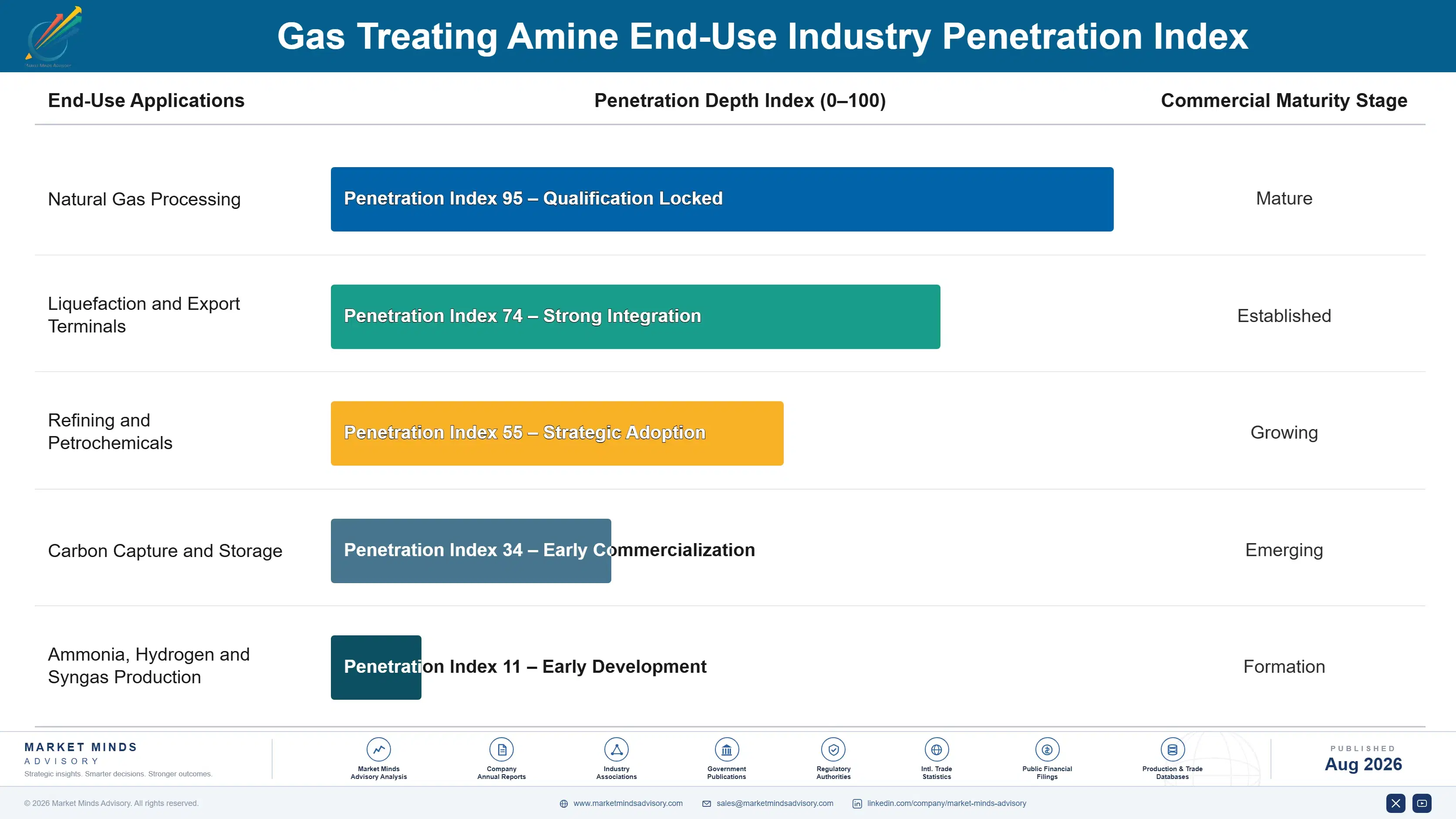
How Solvent Demand Behaves

Demand is inventory annuity revenue attached to operating assets. A treating unit holds a solvent inventory, loses roughly 14% of it annually to degradation and carryover, and buys make-up on a standing schedule for the life of the plant. Winning the initial fill effectively wins that annuity, because requalifying a solvent on a running unit means process risk that no operations manager accepts without a compelling reason. Acquisition is slow and technical; retention costs almost nothing.
Stickiness varies sharply by duty. Generic amine supply into refinery treating is loosest, retendered against specification where any qualified supplier can bid and switching costs little. Formulated blends in gas processing are considerably tighter, because the formulation was developed against that plant's gas and metallurgy. Liquefaction service is stickiest of all, where a solvent change on an operating train risks the cold box and nobody proposes it lightly.

The buyer profile has been slowly shifting back toward engineering. A decade ago solvent selection had drifted almost entirely into procurement, evaluated on price per tonne. Energy cost pressure and capture project economics have pulled process engineering back into the decision at a growing number of operators, which favours suppliers who can model reboiler duty credibly.
gas-treating-amine-market-trend-end-use-penetration-index-1787310294550

Where We Land On This

These are among the four positions where our research anticipates prominent divergence between winners and laggards over the coming forecast period. Each is grounded in the demand model, the regulatory perimeter, and the announced capacity pipeline.
01 / ENERGY-BASED SOLVENT PRICING

Sell reboiler duty savings rather than tonnes of solvent

Solvent selection determines 62% of a treating unit's operating cost through steam consumption, and a formulation cutting circulation by a fifth saves more in a year than the entire annual solvent purchase costs the operator. Suppliers modelling total cost and contracting against energy performance realise roughly 35% above tonnage-based pricing on identical volumes delivered. The obstacle here is organisational rather than technical, since a procurement team cannot act on an argument whose entire benefit lands in somebody else's operations budget.
02 / FRONT END ENGAGEMENT

Win solvent selection at engineering, not at procurement

Roughly 180 million tonnes per annum of liquefaction capacity is under construction, and each train carries an initial fill followed by decades of top-up demand at around 14% annually that nobody will retender. Suppliers engaging during front end engineering capture roughly 4 times the lifetime value per project compared with those bidding when an enquiry is issued. That engagement has to begin years before a purchase order exists, which most commercial organisations in this industry are simply not structured to do at all.
03 / CAPTURE CHEMISTRY DEVELOPMENT

Build oxidation resistance before capture projects specify

Flue gas oxygen and nitrogen oxides attack conventional amines far faster than natural gas service ever does, and roughly 11 million tonnes of announced annual capture capacity has amine-based selections behind it still awaiting a qualified solvent. Formulations with genuine oxidation resistance command premiums near 50% above conventional treating grades, because make-up rates would otherwise ruin the project economics entirely. Long qualification cycles mean the position holds for years once established, and effectively closes to everybody who was not qualified early.
04 / SERVICE REVENUE CAPTURE

Wrap reclaiming services around every solvent supply relationship

Heat stable salts and degradation products drive the corrosion and foaming that damage plant availability, and roughly 14% of a unit's solvent inventory turns over every year because of them. Suppliers offering on-site reclaiming and inventory management convert what is an episodic chemical sale into a continuing service relationship worth roughly 1.8 times make-up revenue alone. More valuable still, it places supplier engineers inside the plant continuously, which is exactly where formulation upgrade decisions genuinely get made rather than deferred.

Engagement Snapshot From the Field

A live engagement with an industry participant carrying material or product regulatory and market exposure ahead of a defining policy shift, showing how our research translates into a defensible multi-year portfolio strategy.
MARKET MINDS ADVISORY · CLIENT ENGAGEMENT SUMMARY
Gas Treating Amine Producer Strategic Portfolio Review and Transition Roadmap 2026·Investment Scenario on Gas Treating Amine Exposure Evaluation 2025-26
CLIENT PROFILE
A specialty chemical producer supplying gas treating amines across North America and the Middle East, with generic and standard grades sold through distributors alongside a smaller formulated blend business serving gas processors directly. Treating solvent revenue approached USD 165 million annually (client-reported, unverified by MMA), roughly three quarters of it in generic and standard grades tendered on price per tonne.
STRATEGIC CHALLENGE
Margins in the generic business had compressed for four consecutive years and management responded by pursuing volume, which accelerated the compression. The formulated business earned far better but had grown slowly, and nobody had established why. A proposed investment in additional amine production capacity assumed generic volume growth would continue absorbing it.
MMA APPROACH
MMA interviewed forty-seven plant managers, process engineers, procurement leads and engineering contractors across five markets, reconstructing how solvent selections are actually made and by whom. We modelled reboiler duty and total treating cost for eleven representative units, benchmarked the client's formulations against competitors, and mapped where each recent liquefaction award had been decided.
KEY FINDINGS
  1. Every liquefaction and greenfield award the client had lost was decided during front end engineering, and in seven of nine cases the client's commercial team first heard about the project after selection.
  2. Total cost modelling at eleven units showed the client's formulated blend saving substantially more in annual steam than its price premium, which nobody had ever quantified for a single customer.
  3. Procurement made solvent decisions at fourteen of nineteen customer sites, and at none of those had process engineering been consulted on reboiler duty implications before award.
  4. The formulated business generated markedly higher gross margin than generic grades on a fraction of the tonnage (client-reported, unverified by MMA), while receiving under a tenth of commercial resource.
CLIENT PROFILE
A specialty chemical producer supplying gas treating amines across North America and the Middle East, with generic and standard grades sold through distributors alongside a smaller formulated blend business serving gas processors directly. Treating solvent revenue approached USD 165 million annually (client-reported, unverified by MMA), roughly three quarters of it in generic and standard grades tendered on price per tonne.
STRATEGIC CHALLENGE
Margins in the generic business had compressed for four consecutive years and management responded by pursuing volume, which accelerated the compression. The formulated business earned far better but had grown slowly, and nobody had established why. A proposed investment in additional amine production capacity assumed generic volume growth would continue absorbing it.
MMA APPROACH
MMA interviewed forty-seven plant managers, process engineers, procurement leads and engineering contractors across five markets, reconstructing how solvent selections are actually made and by whom. We modelled reboiler duty and total treating cost for eleven representative units, benchmarked the client's formulations against competitors, and mapped where each recent liquefaction award had been decided.
KEY FINDINGS
  1. Every liquefaction and greenfield award the client had lost was decided during front end engineering, and in seven of nine cases the client's commercial team first heard about the project after selection.
  2. Total cost modelling at eleven units showed the client's formulated blend saving substantially more in annual steam than its price premium, which nobody had ever quantified for a single customer.
  3. Procurement made solvent decisions at fourteen of nineteen customer sites, and at none of those had process engineering been consulted on reboiler duty implications before award.
  4. The formulated business generated markedly higher gross margin than generic grades on a fraction of the tonnage (client-reported, unverified by MMA), while receiving under a tenth of commercial resource.
RECOMMENDED STRATEGY
Phase 1: Phase 1 (0 to 9 months): Halt the capacity investment and build total cost modelling capability, quantifying steam savings for every existing formulated customer. Phase 2: Phase 2 (9 to 24 months): Establish engineering contractor relationships and engage projects at front end design rather than at procurement tender. Phase 3: Phase 3 (24 to 42 months): Develop oxidation-resistant capture chemistry and pursue qualification with capture projects approaching final investment decision.
OUTCOME
The client deferred roughly USD 70 million of amine capacity investment (client-reported, unverified by MMA) and redirected commercial resource toward formulated business and engineering engagement. Two greenfield solvent selections were won at front end design stage within eighteen months, and generic tonnage was allowed to decline deliberately for the first time in the company's history.

Frequently Asked Questions

Foundational context covering the market sizes, CAGR, scope, country, region and competition that inform every finding below. This section is provided to cover basics and most often pre-purchase conversations, answered from the MMA Primary Research Dataset.

What is the current size of the Gas Treating Amine Market?

The market reached USD 2.1 billion in 2025, measured as solvent revenue at realised delivered price including initial fills and top-up volumes. Natural gas processing accounts for the largest share of consumption.

How large will the Gas Treating Amine Market be by 2036?

MMA forecasts USD 4.33 billion by 2036, an expansion of 1.93 times the 2026 level. Incremental value across the forecast period reaches USD 2.09 billion.

What is the CAGR for the Gas Treating Amine Market 2026 to 2036?

The base case compound annual growth rate is 6.8%, with a bull case of 8.1% and a bear case of 5.6%. Carbon capture project execution separates those two scenarios almost entirely.

Which segment is growing fastest?

Formulated and activated MDEA blends grow fastest at 10.2%, exactly 1.50 times the overall market rate. Lower circulation rates and reduced reboiler duty are what drive that migration.

Who are the major companies in the Gas Treating Amine Market?

BASF, Dow, Huntsman, Eastman Chemical and Nouryon lead, holding 58% of solvent volume between them. Ethylene oxide integration and licensed process technology explain most of that concentration.

Which country is growing fastest?

India grows fastest at 9.2%, driven by refinery hydrotreating expansion under tighter fuel sulphur specifications alongside gas processing and regasification capacity. Local blending increasingly serves that demand.

Report Segmentation Architecture

The full report scope spans multiple orthogonal segmentation dimensions, with cross-tabulated demand data provided for each dimension pair. Coverage extends further to regional breakdowns, trend trajectories, and the competitive detail needed to support segment-level decision-making.

By Amine Chemistry and Formulation Class

  • Formulated and Activated MDEA Blends
  • Piperazine and Advanced Promoter Amines
  • Methyldiethanolamine
  • Monoethanolamine
  • Diethanolamine

By End-Use Industry

  • Natural Gas Processing
  • Liquefaction and Export Terminals
  • Refining and Petrochemicals
  • Carbon Capture and Storage
  • Ammonia, Hydrogen and Syngas Production

By Customer Type and Channel

  • Gas Producers and Midstream Operators
  • Refinery and Petrochemical Operators
  • Engineering and Technology Licensors
  • Chemical Distributors and Blenders
  • Service and Solvent Management Providers

By Region

  • North America
  • Western Europe
  • East Asia
  • South Asia and Pacific
  • Latin America
  • Middle East and Africa
  • Eastern Europe

Scope, Methodology, and Coverage

Every figure in this report is reproducible from documented input assumptions. The scope below maps the historical period, the forecast horizon, the segmentation dimensions, and the countries covered, alongside the underlying primary and qualitative methodology.
Historical Period
2020 to 2025
Forecast Period
2026 to 2036
Base Year
2025 (USD billions; MMA Primary Research Dataset, August 2026)
Market Definition
The market comprises alkanolamine solvents supplied for acid gas removal from natural gas, refinery streams, syngas and flue gas, spanning formulated and activated methyldiethanolamine blends, piperazine and advanced promoter amines, generic methyldiethanolamine, monoethanolamine and diethanolamine, together with the promoter, inhibitor and antifoam components blended into finished solvents. Sizing captures solvent revenue at realised delivered price including initial unit fills, recurring top-up volumes and associated reclaiming and solvent management services. Physical solvents, hot potassium carbonate systems, membrane separation, solid adsorbents, treating equipment and licensed process technology packages fall outside scope.
Quantitative Units
USD billions (current prices); solvent tonnes supplied annually; USD per tonne of formulated solvent at delivered price
Segmentation Dimensions
By Amine Chemistry and Formulation Class; By End-Use Industry; By Customer Type and Channel; By Region
Regions Covered
North America, Western Europe, East Asia, South Asia and Pacific, Latin America, Middle East and Africa, Eastern Europe
Countries Covered
USA, Canada, Mexico, UK, Norway, Netherlands, Germany, France, Italy, Spain, Poland, Romania, Turkey, Russia, China, Japan, South Korea, India, Malaysia, Indonesia, Thailand, Australia, Brazil, Argentina, Colombia, Saudi Arabia, Qatar, UAE, Kuwait, Oman, Egypt, Algeria, Nigeria, Mozambique, and additional markets relevant to this sector
Key Companies Profiled
BASF, Dow, Huntsman, Eastman Chemical, Nouryon, INEOS, Arkema, Clariant, ChampionX, Baker Hughes, SLB, Shell Catalysts and Technologies, Honeywell UOP, Fluor Corporation, Mitsubishi Heavy Industries, Sinopec, Chevron Phillips Chemical, Sadara Chemical, Petronas Chemicals, Mitsubishi Gas Chemical.
Quantitative Methodology
Primary survey, n=3,800 respondents, Q4 2025, six countries; demand-side model with trade association cross-validation
Qualitative Methodology
47 expert interviews, Q4 2025; applied to validate demand model assumptions, identify emerging dynamics, and assess competitive positioning
Report Format
PDF and XLSX data workbook (Word format preview document)
Publisher
Market Minds Advisory
Report Code
MMA-2026-CHM-424
Published
August 2026
Contact
sales@marketmindsadvisory.com | www.marketmindsadvisory.com

Purchase the full Gas Treating Amine Market Report (2026 to 2036).

The full report sizes the gas treating amine market across five chemistry classes, five end-use industries, five customer channels and seven regions, with annual forecasts to 2036 in revenue and solvent tonnes supplied. It models total treating cost including reboiler duty for representative unit configurations, which is the analysis establishing what formulation performance is actually worth to an operator. Twenty participants are assessed on a consistent solvent volume supplied basis, with formulation and service capability mapped separately from feedstock integration. Announced carbon capture projects are tracked by solvent selection status and expected inventory.
Five amine chemistry classes sized and forecast annually
Total treating cost modelled including reboiler duty
Twenty participants on consistent solvent volume supplied basis
Formulation and service capability mapped against feedstock integration
Carbon capture projects tracked by solvent selection status
Liquefaction fill and top-up demand forecast train by train

Built For The People Who Decide

From boardroom strategy to bench-side execution, this report is read cover-to-cover by leaders shaping the next decade of their industry, turning demand scenarios, market dynamics and valuation benchmarks into decisions.
CXOs/ Presidents/ VPs/ Managers
M&A and Corporate Development
Strategy Teams and R&D Heads
Procurement and Product Directors
Regulatory and Compliance Leaders
Investor Relations and Equity Analysts