Gas Separation Membrane Market

Gas Separation Membrane Market

Gas Separation Membrane Market Outlook 2026-2033

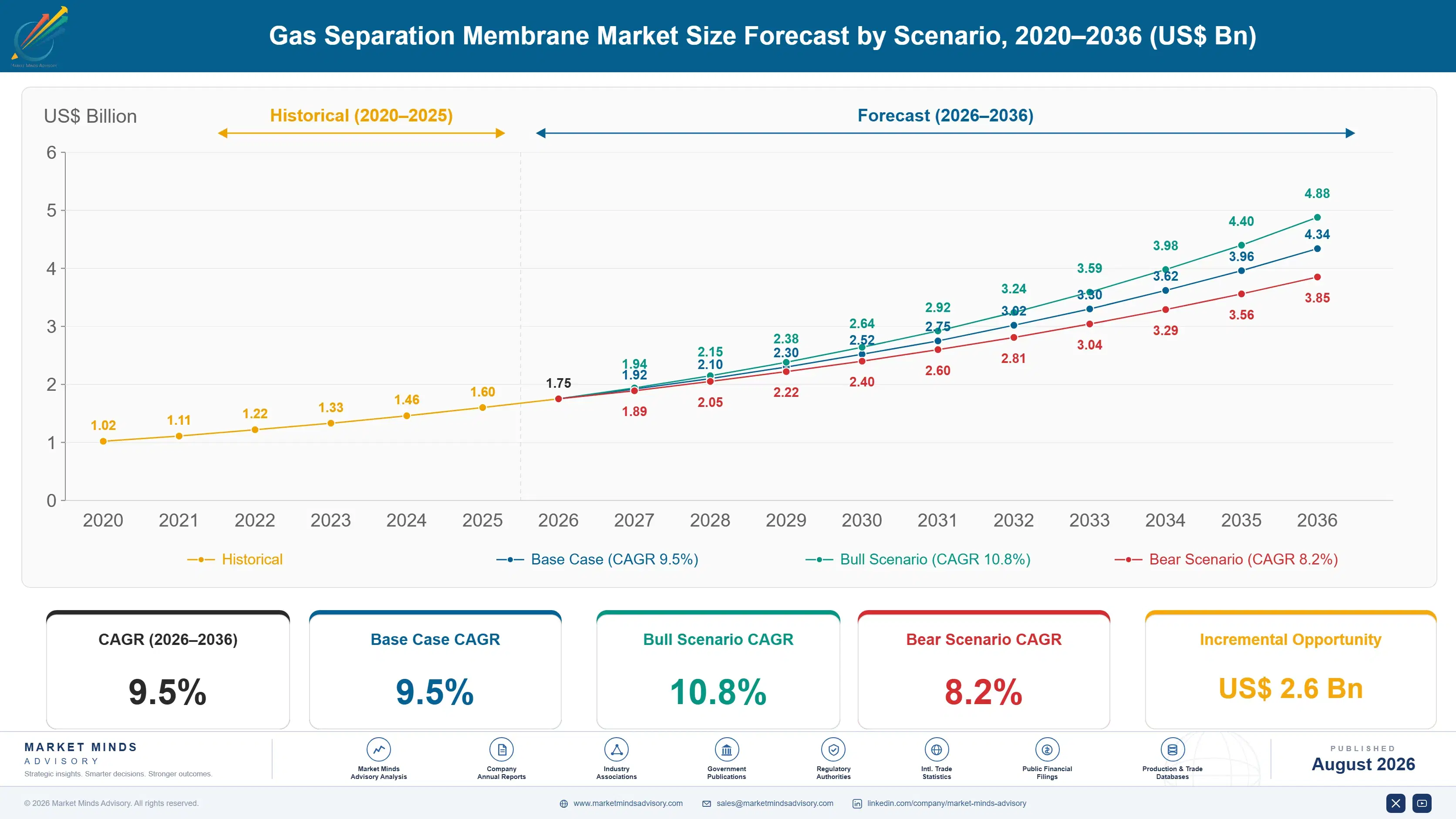
The Gas Separation Membrane Market is poised for significant expansion, driven by increasing demand for efficient gas separation technologies across various industries such as oil & gas, chemicals, and environmental applications. The market was valued at USD 1.45 billion in 2026 and is projected to reach USD 2.68 billion by 2033, registering a CAGR of 9.2% during the forecast period. This robust growth is attributed to the rising adoption of membrane-based separation processes, which offer energy efficiency, operational simplicity, and environmental benefits compared to conventional methods.

Technological advancements in membrane materials and configurations are further propelling market growth, enabling higher selectivity, permeability, and durability. The increasing focus on carbon capture, natural gas processing, and hydrogen recovery is also fueling demand for advanced gas separation membranes. As industries strive to meet stringent emission regulations and enhance process efficiencies, the Gas Separation Membrane Market is expected to witness sustained investment and innovation throughout the forecast period.

Gas Separation Membrane Market Value

Gas Separation Membrane Market Scenario & Strategic Insights

The Gas Separation Membrane Market is undergoing a transformative phase, characterized by the integration of novel polymeric and inorganic membrane materials. These advancements are enabling higher performance in terms of selectivity and permeability, which are critical for applications such as carbon dioxide removal, nitrogen generation, and hydrogen purification. The market is also witnessing a shift towards modular and scalable membrane systems, which offer flexibility and cost-effectiveness for both large-scale industrial operations and smaller decentralized applications.

Strategically, key market players are focusing on expanding their product portfolios and enhancing their global footprint through mergers, acquisitions, and partnerships. The competitive landscape is marked by continuous research and development activities aimed at improving membrane lifespan and reducing operational costs. Additionally, the growing emphasis on sustainability and energy efficiency is prompting end-users to transition from traditional separation technologies to membrane-based solutions. This trend is particularly evident in regions with stringent environmental regulations and ambitious decarbonization targets.

The market’s growth trajectory is further supported by government initiatives and funding for clean energy projects, especially in the context of carbon capture and utilization. As industries increasingly prioritize operational efficiency and environmental compliance, the adoption of gas separation membranes is expected to accelerate, positioning the market for robust expansion over the next decade.

Attribute2026 (USD Billion)2033 (USD Billion)CAGR (2026 – 2033)
Market Size1.452.689.2%

Gas Separation Membrane Market Trends

  • Rising Adoption of Membrane-Based Carbon Capture Solutions

The increasing global focus on reducing greenhouse gas emissions is driving the adoption of membrane-based carbon capture technologies. Gas separation membranes are being integrated into carbon capture and storage (CCS) systems due to their energy efficiency, modularity, and lower operational costs compared to traditional amine-based absorption methods. This trend is particularly prominent in power generation, cement, and steel industries, where large-scale CO₂ emissions are prevalent. The development of advanced membranes with higher selectivity and resistance to harsh operating conditions is further enhancing their suitability for CCS applications, positioning them as a critical component in global decarbonization efforts.

  • Technological Advancements in Polymeric and Inorganic Membranes

Continuous innovation in membrane materials is a defining trend in the Gas Separation Membrane Market. Polymeric membranes, such as polysulfone, polyimide, and cellulose acetate, are being engineered for improved permeability and selectivity. Simultaneously, inorganic membranes, including ceramic and metallic variants, are gaining traction for their superior thermal and chemical stability. Hybrid membranes that combine the advantages of both material types are also emerging, offering enhanced performance for challenging gas separation tasks. These technological advancements are expanding the application scope of gas separation membranes, enabling their use in more demanding industrial environments.

  • Expansion of Applications in Hydrogen Recovery and Natural Gas Processing

The growing demand for hydrogen as a clean energy carrier and the need for efficient natural gas processing are catalyzing the deployment of gas separation membranes. Membrane systems are increasingly used for hydrogen purification in refineries and chemical plants, as well as for removing contaminants such as CO₂, H₂S, and water vapor from natural gas streams. The ability of membranes to operate continuously, with minimal maintenance and lower energy consumption, is driving their adoption in these sectors. This trend is expected to intensify as global energy markets transition towards cleaner fuels and more sustainable processing technologies.

Segment & Category Analysis for Gas Separation Membrane Market

By Material Type

  • Polymeric Membranes
  • Inorganic Membranes
  • Mixed Matrix Membranes

Polymeric membranes dominate the Gas Separation Membrane Market due to their cost-effectiveness, ease of fabrication, and versatility in various gas separation applications. Inorganic membranes, such as ceramic and metallic types, are preferred for high-temperature and chemically aggressive environments, offering superior durability and selectivity. Mixed matrix membranes, which combine polymeric matrices with inorganic fillers, are gaining traction for their enhanced performance characteristics. The ongoing research in material science is expected to yield next-generation membranes with improved permeability, selectivity, and operational lifespan, further diversifying the material landscape.

Gas Separation Membrane Market Material Type

By Application

  • Nitrogen Generation & Oxygen Enrichment
  • Hydrogen Recovery
  • Carbon Dioxide Removal
  • Vapor/Gas Separation
  • Air Dehydration

Nitrogen generation and oxygen enrichment represent significant application areas, particularly in the food & beverage, electronics, and healthcare sectors. Hydrogen recovery is gaining momentum in refineries and chemical manufacturing, driven by the global shift towards hydrogen economy. Carbon dioxide removal is a critical application in natural gas processing and carbon capture initiatives. Vapor/gas separation and air dehydration are essential in industrial processes requiring high-purity gases. The diverse application spectrum underscores the versatility and growing importance of gas separation membranes across multiple industries.

By Module Type

  • Hollow Fiber
  • Spiral Wound
  • Plate and Frame
  • Others

Hollow fiber modules are widely adopted due to their high surface area-to-volume ratio, compact design, and scalability. Spiral wound modules offer advantages in terms of packing density and are suitable for large-scale operations. Plate and frame modules are used in niche applications requiring easy maintenance and cleaning. The choice of module type is influenced by factors such as feed gas composition, required purity levels, and operational constraints. Manufacturers are continually innovating module designs to enhance performance, reduce footprint, and lower installation costs.

By End-Use Industry

  • Oil & Gas
  • Chemical & Petrochemical
  • Power Generation
  • Food & Beverage
  • Healthcare

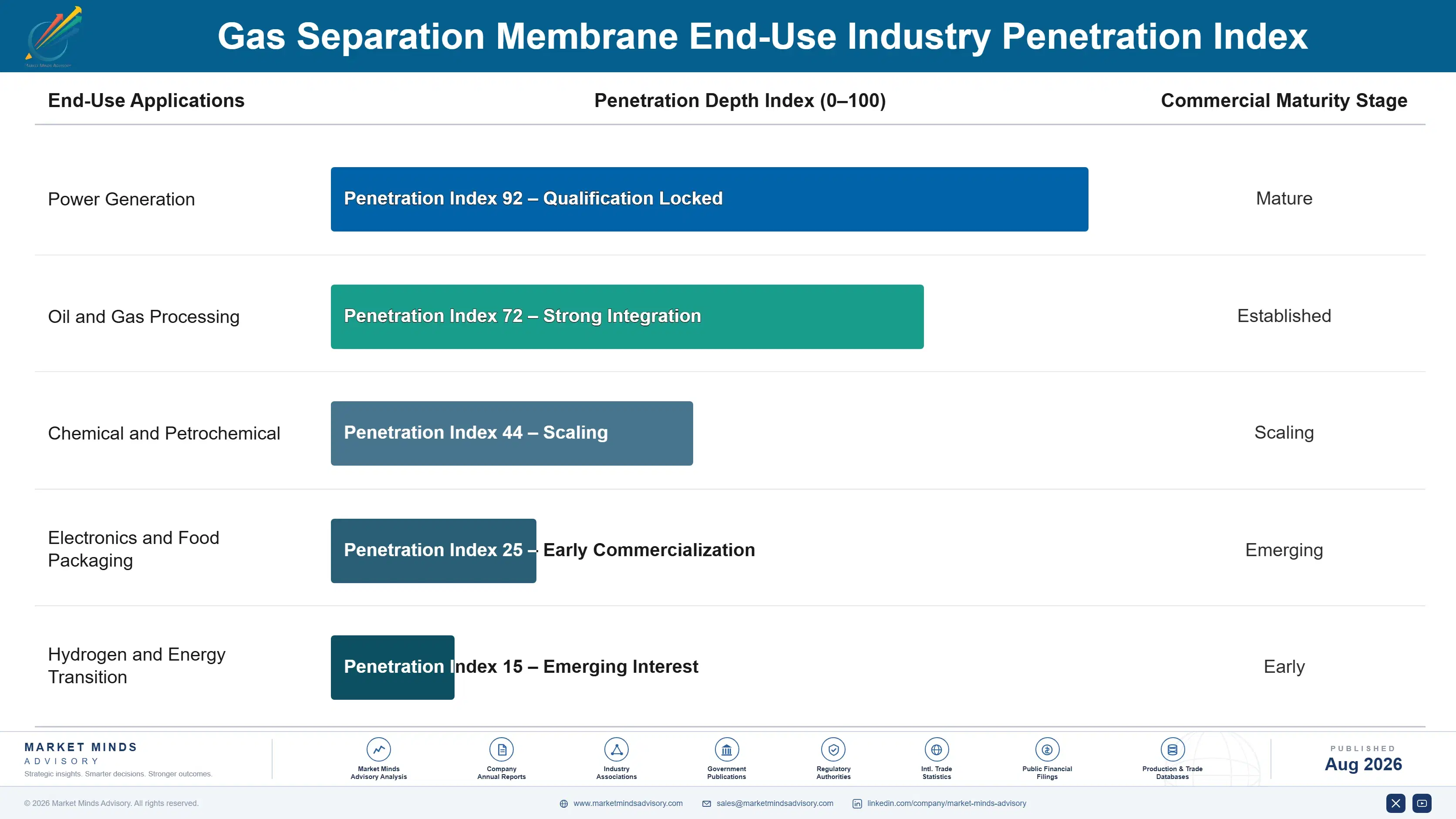
The oil & gas sector is the largest end-user of gas separation membranes, primarily for natural gas processing and hydrogen recovery. The chemical & petrochemical industry utilizes membranes for process gas purification and emissions control. Power generation facilities are increasingly adopting membrane technologies for carbon capture and flue gas treatment. The food & beverage and healthcare industries leverage gas separation membranes for nitrogen generation, oxygen enrichment, and sterile air supply. The expanding end-use landscape reflects the growing recognition of membrane technology as a key enabler of process efficiency and environmental compliance.

Gas Separation Membrane Market End User

By Region

  • Asia-Pacific
  • North America
  • Europe
  • South America
  • Middle East & Africa

Asia-Pacific leads the Gas Separation Membrane Market, driven by rapid industrialization, stringent environmental regulations, and significant investments in clean energy infrastructure. North America and Europe are mature markets characterized by advanced technological adoption and strong regulatory frameworks. South America and the Middle East & Africa are emerging markets with increasing demand for efficient gas processing solutions in oil & gas and industrial sectors. Regional dynamics are shaped by factors such as economic development, energy policies, and environmental priorities.

Growth Drivers and Opportunities in Gas Separation Membrane Market

  • Stringent Environmental Regulations and Decarbonization Initiatives

The implementation of stringent environmental regulations worldwide is a major growth driver for the Gas Separation Membrane Market. Governments and regulatory bodies are enforcing limits on industrial emissions, particularly greenhouse gases such as CO₂ and methane. This regulatory pressure is compelling industries to adopt advanced gas separation technologies for emission control and compliance. The increasing focus on decarbonization, especially in power generation and heavy industries, is creating substantial opportunities for membrane-based carbon capture and utilization solutions. As countries commit to net-zero targets, the demand for efficient and scalable gas separation membranes is expected to surge.

  • Rising Demand for Clean Energy and Hydrogen Economy

The global transition towards clean energy sources is fueling demand for gas separation membranes, particularly in hydrogen production and purification. Hydrogen is emerging as a key energy carrier in the quest for sustainable and low-carbon energy systems. Gas separation membranes enable efficient recovery and purification of hydrogen from various feedstocks, including natural gas, biogas, and water electrolysis. The expansion of hydrogen infrastructure, coupled with investments in fuel cell technologies and renewable energy integration, is opening new avenues for membrane manufacturers. This trend is expected to accelerate as governments and industries invest in building a robust hydrogen economy.

Emerging Opportunities for Gas Separation Membrane Market

  • Integration with Renewable Energy and Biogas Upgrading

The integration of gas separation membranes with renewable energy systems, such as biogas upgrading and power-to-gas applications, presents significant growth opportunities. Membrane technologies are increasingly used to purify biogas by removing CO₂ and other impurities, enabling its use as a renewable natural gas substitute. This application is gaining traction in regions with supportive policies for renewable energy and waste-to-energy initiatives. The ability of membranes to operate efficiently at varying scales makes them ideal for decentralized and distributed energy systems, further expanding their market potential.

  • Advancements in Membrane Material Science and Hybrid Technologies

Ongoing advancements in membrane material science, including the development of hybrid and mixed matrix membranes, are unlocking new performance capabilities. These innovations are enabling membranes to achieve higher selectivity, permeability, and resistance to fouling and degradation. The emergence of hybrid technologies that combine membranes with other separation processes, such as adsorption and cryogenic distillation, is enhancing overall process efficiency and flexibility. These technological breakthroughs are expected to drive the adoption of gas separation membranes in new and challenging applications, creating additional growth opportunities for market participants.

Growth Restrain Factors and Challenges in Gas Separation Membrane Market

  • Membrane Fouling and Limited Lifespan

Membrane fouling, caused by the accumulation of contaminants and particulates on the membrane surface, remains a significant challenge in the Gas Separation Membrane Market. Fouling leads to reduced permeability, increased operational costs, and frequent maintenance requirements. Despite advancements in membrane materials and cleaning protocols, fouling continues to impact the long-term performance and economic viability of membrane systems. Addressing this challenge requires ongoing research into anti-fouling coatings, improved module designs, and optimized operational strategies. The limited lifespan of certain membrane types, particularly in harsh industrial environments, further constrains market growth by necessitating frequent replacements and increasing total cost of ownership.

The issue of membrane durability is particularly pronounced in applications involving aggressive chemicals, high temperatures, or fluctuating operating conditions. Inorganic and hybrid membranes offer improved resistance, but their higher initial costs can be a barrier for widespread adoption. Manufacturers are investing in the development of robust membranes with extended service life, but the pace of innovation must keep up with the evolving demands of end-users. Overcoming these technical and economic barriers is essential for unlocking the full potential of gas separation membranes across diverse industries.

  • High Initial Investment and Competition from Alternative Technologies

The high initial investment required for membrane system installation and integration is a notable restraint, especially for small and medium-sized enterprises. While membrane technologies offer long-term operational savings, the upfront costs associated with equipment, installation, and system customization can deter adoption. Additionally, gas separation membranes face competition from established alternative technologies such as pressure swing adsorption (PSA), cryogenic distillation, and absorption processes. These conventional methods are well-entrenched in certain applications and may offer cost advantages at large scales.

The competitive landscape is further complicated by the need for specialized expertise in membrane system design, operation, and maintenance. End-users may be hesitant to transition from familiar technologies to membrane-based solutions without clear evidence of performance and cost benefits. Market participants must focus on demonstrating the value proposition of membranes through pilot projects, case studies, and comprehensive technical support. Addressing these challenges will be critical for expanding the market reach and accelerating the adoption of gas separation membranes.

Gas Separation Membrane Market Regional Analysis

RegionMarket Share (2025)Key Market Highlight
Asia-Pacific36%Rapid industrialization, strong demand for natural gas processing and carbon capture
North America28%Mature market, high adoption in oil & gas and hydrogen recovery sectors
Europe22%Stringent emission regulations, focus on clean energy and CCS technologies
South America8%Emerging market, increasing investments in gas processing infrastructure
Middle East & Africa6%Growing oil & gas sector, rising interest in efficient gas separation solutions

Asia-Pacific

Asia-Pacific is the largest and fastest-growing region in the Gas Separation Membrane Market, accounting for approximately 36% of global market share in 2025. The region’s growth is driven by rapid industrialization, expanding energy infrastructure, and increasing investments in clean energy and emission control technologies. Countries such as China, India, Japan, and South Korea are at the forefront of adopting membrane-based gas separation solutions, particularly in natural gas processing, hydrogen recovery, and carbon capture applications. Supportive government policies and the presence of leading membrane manufacturers further bolster regional market growth.

North America

North America holds a significant share of the Gas Separation Membrane Market, with a mature industrial base and advanced technological adoption. The region is characterized by high demand for gas separation membranes in oil & gas, chemical, and power generation sectors. The United States and Canada are leading markets, driven by stringent environmental regulations, robust R&D activities, and a strong focus on hydrogen economy development. Ongoing investments in carbon capture and utilization projects are expected to sustain market growth in the region.

Europe

Europe is a key market for gas separation membranes, supported by stringent emission regulations and ambitious decarbonization targets. The region is witnessing increasing adoption of membrane technologies in carbon capture, natural gas processing, and industrial gas purification. Countries such as Germany, the UK, France, and the Netherlands are leading adopters, leveraging membrane solutions to achieve energy efficiency and environmental compliance. The presence of established membrane manufacturers and research institutions further enhances the region’s market position.

South America

South America is an emerging market for gas separation membranes, with growing investments in oil & gas and industrial gas processing infrastructure. Brazil and Argentina are the primary markets, driven by the need for efficient gas purification and emission control solutions. The region’s market growth is supported by increasing awareness of environmental issues and the adoption of advanced technologies in key industries. However, challenges related to economic volatility and limited technical expertise may impact the pace of market development.

Middle East & Africa

The Middle East & Africa region is witnessing rising demand for gas separation membranes, particularly in the oil & gas sector. Countries such as Saudi Arabia, the UAE, and South Africa are investing in advanced gas processing and emission control technologies to enhance operational efficiency and meet environmental standards. The region’s market potential is supported by abundant natural gas reserves and ongoing infrastructure development. However, market growth may be constrained by limited local manufacturing capabilities and reliance on imported technologies.

Gas Separation Membrane Market Region

Competition Landscape in Gas Separation Membrane Market

The Gas Separation Membrane Market is characterized by intense competition among global and regional players, with a strong emphasis on technological innovation, product differentiation, and strategic partnerships. Leading companies are investing in research and development to enhance membrane performance, durability, and cost-effectiveness. The market is also witnessing consolidation through mergers and acquisitions, as players seek to expand their product portfolios and geographic reach. Collaboration with end-users and research institutions is a common strategy to accelerate innovation and address evolving market needs. The competitive landscape is further shaped by the entry of new players offering specialized membrane solutions for niche applications.

Major Players in Gas Separation Membrane Market

  • Air Liquide Advanced Separations
  • Air Products and Chemicals, Inc.
  • UBE Industries, Ltd.
  • Honeywell UOP
  • Parker Hannifin Corporation
  • Membrane Technology and Research, Inc. (MTR)
  • Evonik Industries AG
  • Fujifilm Manufacturing Europe B.V.
  • Schlumberger Limited
  • DIC Corporation
  • Generon IGS, Inc.
  • Atlas Copco AB
  • Hitachi Zosen Corporation
  • Zeon Corporation
  • Polymem S.A.
  • Compact Membrane Systems, Inc.
  • Linde Engineering
  • W. L. Gore & Associates, Inc.
  • Novamem Ltd.
  • Airrane Co., Ltd.

Recent Developments in Gas Separation Membrane Market

  • In January 2024, Air Liquide Advanced Separations launched a new generation of polymeric membranes for enhanced CO₂ capture efficiency in industrial applications.
  • In October 2023, Honeywell UOP announced the expansion of its membrane manufacturing facility in the United States to meet growing demand for hydrogen recovery solutions.
  • In July 2023, Evonik Industries AG introduced a hybrid membrane technology combining polymeric and inorganic materials for improved gas selectivity and durability.
  • In May 2023, Membrane Technology and Research, Inc. (MTR) secured a contract for supplying membrane systems for a large-scale carbon capture project in Europe.
  • In March 2023, UBE Industries, Ltd. partnered with a leading oil & gas company in Asia-Pacific to develop advanced membranes for natural gas processing.
  • In December 2022, Parker Hannifin Corporation launched a new line of hollow fiber membrane modules targeting the food & beverage and healthcare sectors.

FAQ for Gas Separation Membrane Market

  1. What is the projected market size of the Gas Separation Membrane Market by 2033?
    The Gas Separation Membrane Market is expected to reach USD 2.68 billion by 2033, growing from USD 1.45 billion in 2026, at a CAGR of 9.2% during the forecast period.
  2. Which material type dominates the Gas Separation Membrane Market?
    Polymeric membranes currently dominate the market due to their cost-effectiveness, versatility, and widespread use in various gas separation applications. However, inorganic and mixed matrix membranes are gaining traction for specialized and high-performance applications.
  3. What are the key growth drivers for the Gas Separation Membrane Market?
    The primary growth drivers include stringent environmental regulations, increasing demand for clean energy and hydrogen, technological advancements in membrane materials, and the rising adoption of membrane-based carbon capture solutions.
  4. Which region holds the largest share in the Gas Separation Membrane Market?
    Asia-Pacific holds the largest market share, driven by rapid industrialization, expanding energy infrastructure, and significant investments in clean energy and emission control technologies.
  5. What are the major challenges faced by the Gas Separation Membrane Market?
    Key challenges include membrane fouling and limited lifespan, high initial investment costs, and competition from alternative gas separation technologies such as pressure swing adsorption and cryogenic distillation. Addressing these challenges is crucial for sustained market growth.

Take Action Now!

Contact us today to access the full report and propel your business forward.

Click here to connect with us on WhatsApp