Market Minds Advisory
Gas Insulated Substation Market

Gas Insulated Substation Market: Fluorinated Gas Phase-Down, Footprint Economics, and Order Backlog Constraints

The gas that made compact substations possible warms the planet twenty four thousand times more than carbon dioxide and lasts three millennia, and the alternatives need bigger enclosures, which is the entire problem.

Lead Analyst

David Horsley

Published

August 2026

Make Smarter Decisions with Customized Research Insights

Request a free sample report and evaluate market opportunities, growth trends, and competitive dynamics relevant to your business needs.

2025 MARKET VALUE$19.5BMarket Size 2025
2036 FORECAST VALUE$43.6BBase Case , 2026 to 2036
CAGR 2026 TO 20367.6 %Bull 8.9% / Bear 6.4%
INCREMENTAL OPPORTUNITY$22.7BNet 10- year value creation
EXPANSION MULTIPLE2.08x2036 value over 2026 base
Strategic Levers
M&A Pipeline
Regional Outlook
Country Rankings
Competitive Intelligence
Segmental Deep-dive
Call-Us : 91 93563 13602

Executive Snapshot and Market Trajectory

Gas insulated substations exist for one reason: they occupy roughly a tenth of the land an air insulated equivalent needs. Every argument in this market, including the awkward one about replacing the insulating gas, eventually comes back to that footprint. Land, not electricity, is what this equipment actually sells.
Ultra high voltage equipment above 800 kV compounds at 11.4%, a full 1.50x the market rate, driven by transmission programmes that only a few countries attempt. East Asia holds the largest share at 30%, because China builds more ultra high voltage transmission than the rest of the world combined and its domestic manufacturers supply almost all of it at costs Western suppliers cannot approach. Nobody else builds at that scale.
Concentration sits at 64%, with Hitachi Energy and Siemens Energy leading a group whose real constraint is factory capacity rather than orders. Lead times have run past two years since 2022. The European fluorinated gas phase-down is forcing an insulation technology transition on a product whose commercial justification is being small, and the alternatives are larger. Utilities must replace the property that justified buying this equipment, on forty year assets. Nothing else matters as much.
Market Definition
This market covers gas insulated switchgear and complete gas insulated substations for electricity transmission and distribution, spanning circuit breakers, disconnectors, earthing switches, busbars, instrument transformers and enclosures across all voltage classes, together with associated engineering, installation, commissioning and gas handling services. Measurement is at manufacturer and contractor revenue. Air insulated switchgear, power transformers, protection and control systems sold independently, overhead line and cable infrastructure, and substation civil works are excluded.
Base Year Value
$19.5B in 2025 (MMA Primary Research Dataset, August 2026)
Forecast Period
2026 to 2036, eleven discrete annual values
CAGR
7.6% base case. Bull 8.9%. Bear 6.4%.
Fastest Growth Segment
Ultra High Voltage Above 800 kV: 11.4% CAGR
Fastest Growth Country
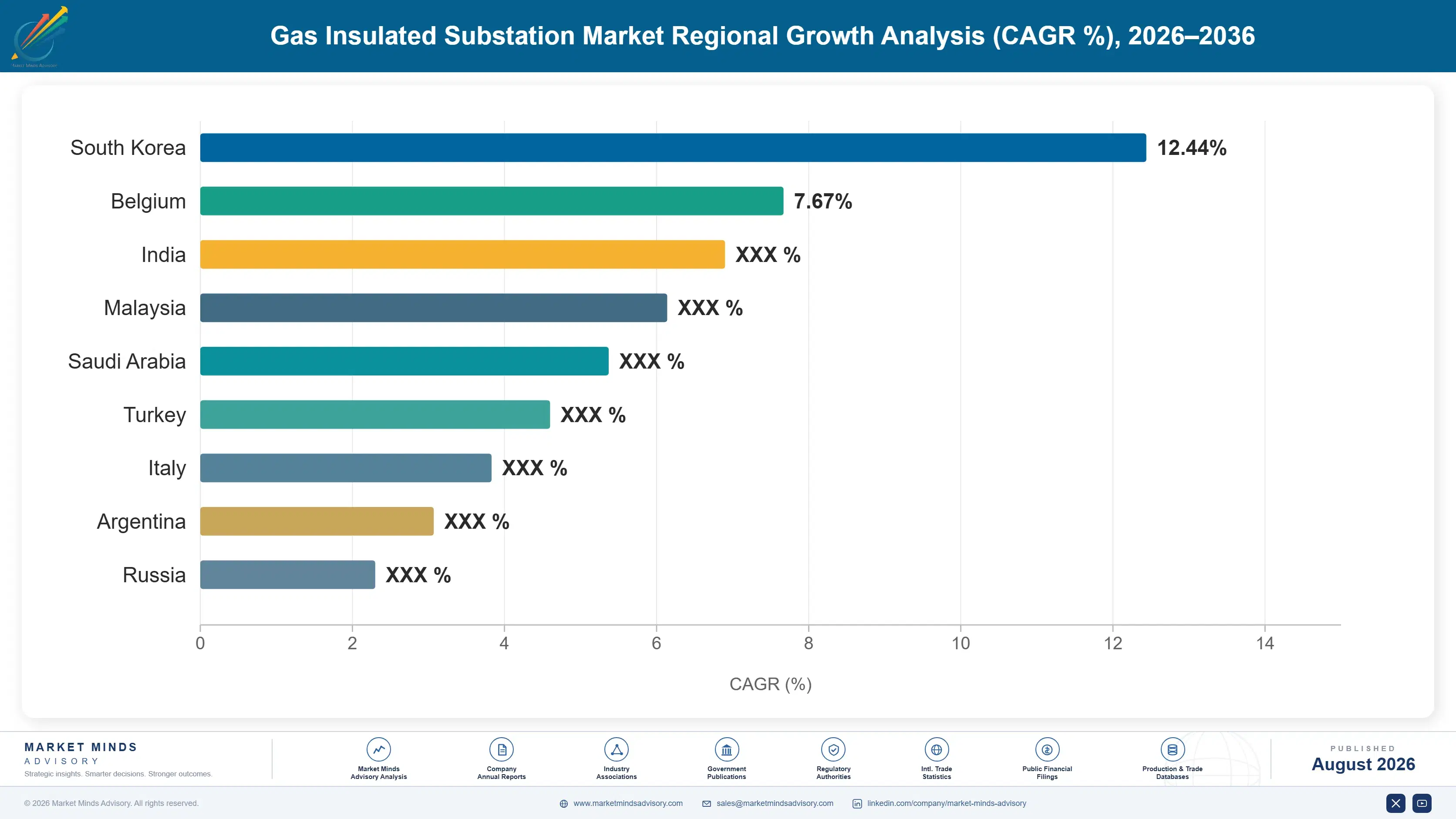
India: 12.6% CAGR
Fastest Growth Region
South Asia and Pacific: 9.8% CAGR
Largest Region
East Asia: 30% of 2025 global value
Market Leaders
Hitachi Energy, Siemens Energy, GE Vernova, Schneider Electric, and Mitsubishi Electric. Source: MMA Primary Research Dataset, July 2026.
Primary Survey
n=3,800 procurement and R&D decision-makers, Q4 2025, six countries
Methodology
Demand-side build-up, cross-validated against public data, 47 expert interviews

Gas Insulated Substation Market Forecast Scenarios

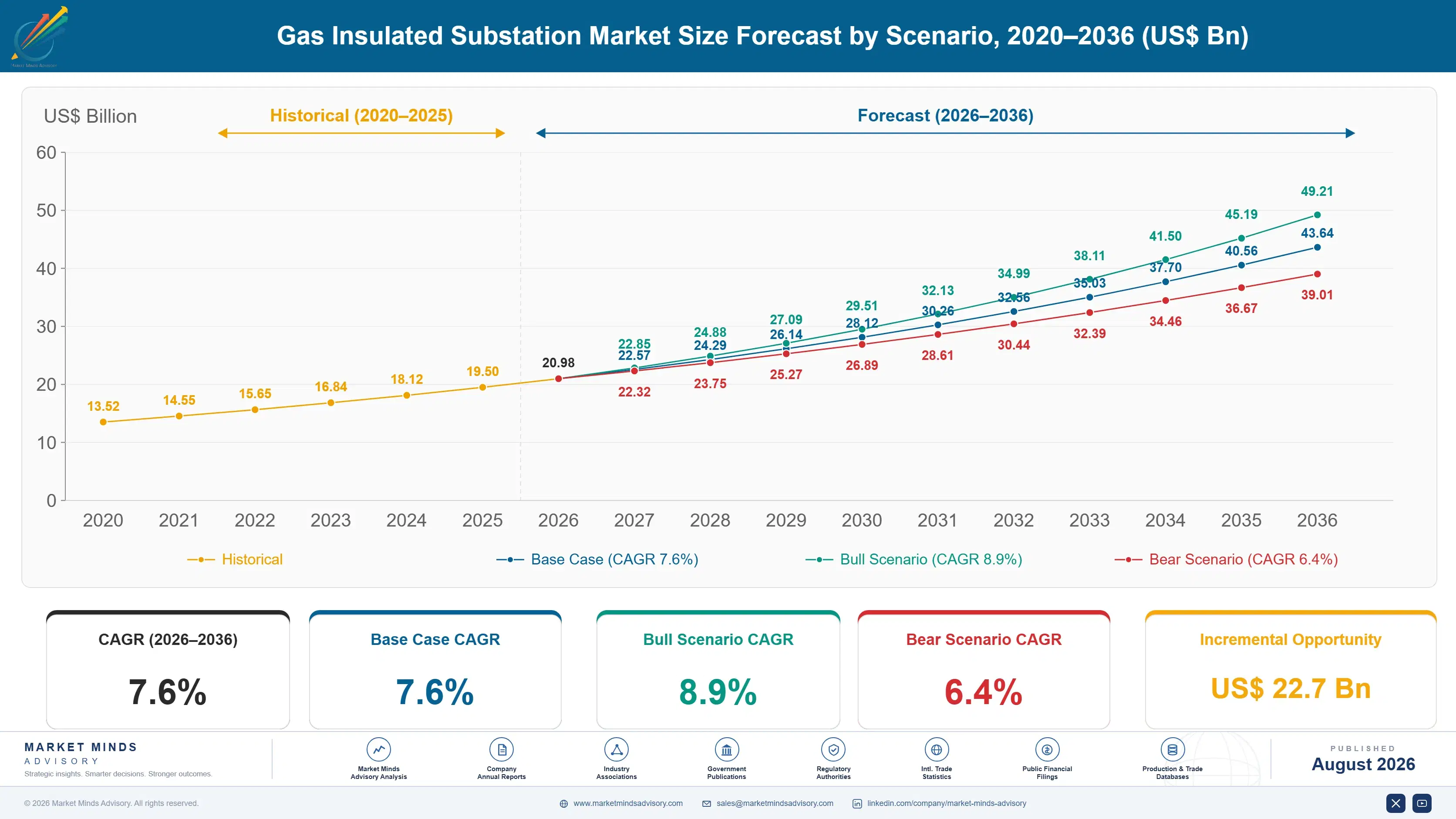
gas-insulated-substation-market-size-forecast-scenario-1787303457843
Growth ran at roughly 6.4% between 2020 and 2025, and the shape changed halfway through. Grid investment was subdued through 2020 and 2021 as utilities deferred capital, then accelerated sharply from 2022 as renewable connection queues, electrification and data centre load all arrived at once. Supply could not follow. Lead times stretched past two years and the constraint moved decisively from order intake to factory capacity.
Base case growth of 7.6% rests on three mechanisms. Transmission investment programmes across Asia, the Gulf and Europe are committed for a decade and gas insulated equipment is specified wherever land is scarce or environmental permitting is difficult. Ultra high voltage build-out continues in China and India at scale nobody else attempts. And fluorinated gas regulation is forcing replacement of equipment that would otherwise have run for another fifteen years without complaint.
The bull case at 8.9% assumes manufacturers commission the capacity expansions currently announced, converting a backlog into delivered revenue faster than the base case allows. The bear case at 6.4% is a capacity case in the opposite direction: if factory expansion slips and component supply stays tight, orders continue accumulating as backlog rather than converting into recognised revenue within the forecast period.

Gas Insulated Substations: Footprint Value and Gas Transition

The whole product category rests on one physical property. Sulphur hexafluoride withstands roughly three times the electric field strength of air, which lets a complete substation fit inside enclosures occupying about 12% of the land an air insulated equivalent would need. That is why gas insulated equipment appears in city centres, offshore platforms, mountain valleys and anywhere permitting a large open switchyard is impossible.
TOP FIVE CONCENTRATION64%Established transmission equipment manufacturers hold most high voltage capacity
FLUORINE-FREE ORDER SHARE22%New orders specifying alternatives to conventional sulphur hexafluoride insulation
FOOTPRINT REDUCTION88%Land saved against an equivalent air insulated substation installation
EQUIPMENT LEAD TIME26 monthsTypical interval from order placement to delivered high voltage bay
DESIGN SERVICE LIFE40 yearsExpected operating life before major refurbishment or full replacement
AVERAGE INSTALLED AGE24 yearsMean age of installed switchgear across tracked transmission networks worldwide
The same gas is among the most potent greenhouse agents identified, with warming potential many thousands of times carbon dioxide and an atmospheric lifetime measured in millennia. European regulation now phases it down by voltage class, and utilities elsewhere are writing similar specifications voluntarily. Roughly 22% of new orders already specify a fluorine-free alternative, which was close to nothing five years ago.
The uncomfortable part is that alternatives need more room. Clean air with vacuum interruption works well at distribution and sub-transmission voltages and requires noticeably larger enclosures above that. Fluoronitrile and fluoroketone mixtures hold dielectric performance closer to the original but introduce handling, byproduct and low-temperature questions utilities are still working through. Each option erodes some part of the footprint argument that justified buying gas insulated equipment at all.
"Utilities bought this equipment because it was small, and now they are being asked to replace the thing that made it small. Every technical conversation about alternatives is really a conversation about how much extra land a substation site can absorb before the business case disappears."
Director, Transmission Infrastructure and Grid Equipment Practice · MMA Energy P

Market Trends

Fluorinated gas regulation forces an insulation technology transition

European regulation now phases down sulphur hexafluoride in new switchgear on a timetable set by voltage class, with distribution equipment restricted first and transmission classes following through the next decade. Utilities in North America, Japan and Australia are writing comparable specifications voluntarily ahead of any legal requirement. Roughly 22% of new orders already specify a fluorine-free alternative. The transition is unusual because it is being driven by atmospheric chemistry rather than by any performance, reliability or cost failing in the incumbent technology. Nothing about the incumbent technology failed, which makes the transition hard to sell internally.
Market Impact: Adds over 400 GW connection queue
Order backlogs move the constraint from demand to factory capacity

Renewable connection queues, electrification of heat and transport, and data centre load arrived together from 2022, and switchgear factories that had been sized for a decade of flat grid investment could not respond. Lead times for high voltage bays now run past two years and utilities are placing orders against projects that have not completed permitting. Manufacturers are committing capital to new capacity, but a high voltage switchgear plant takes three to four years to build and qualify. Manufacturers now allocate scarce factory slots deliberately rather than competing for orders at all.
Market Impact: Above 800 kV growing at 11.4%

Market Opportunities and Growth Drivers

Renewable connection and data centre load reshape transmission planning

Grid operators across Europe, North America and Asia are connecting generation and load at a pace their networks were never planned for, and both ends require substations. Offshore wind connects through compact platform-mounted equipment where nothing else physically fits, and data centre campuses draw hundreds of megawatts into sites with no room for open switchyards. Those two demand sources alone have redirected transmission capital in several national systems, and gas insulated equipment is specified by default in both. Neither demand source existed at this scale when the current generation of switchgear factories was sized and built.
Market Impact: Enclosures grow above 145 kV

Ultra high voltage programmes concentrate demand in a few countries

Transmission above 800 kV exists in meaningful quantity only in China and India, where distances between generation and load make lower voltages uneconomic. State Grid has built more ultra high voltage line than every other country combined, and Indian transmission planning has committed to a 765 kV backbone linking renewable zones to demand centres. Equipment at these voltages is technically demanding, supplied by very few manufacturers, and carries pricing that reflects both facts clearly. Very few plants worldwide hold the type testing qualification these voltages demand, and building that capability takes years rather than quarters.
Market Impact: New plants take 4 years

Market Restraints and Challenges

Fluorine-free alternatives enlarge the footprint that justified the purchase

Clean air with vacuum interruption performs well at distribution voltages and needs materially larger enclosures above 145 kV, because air withstands far less electric field strength than the gas it replaces. The root cause is physics rather than engineering immaturity. Commercial impact is direct: a utility that chose gas insulated equipment for a constrained urban site may find the compliant alternative does not fit. Manufacturers are responding with fluoronitrile and fluoroketone mixtures that hold dielectric performance much closer to the original. Those mixtures carry handling, byproduct and low-temperature questions utilities are still working through carefully.
Market Impact: Fluorine-free reaching 22% of order

Factory capacity limits conversion of orders into delivered revenue

High voltage switchgear plants require specialist welding, precision machining, gas-tight assembly and type testing facilities, and building one takes three to four years before the first qualified bay leaves the door. The root cause is that the industry sized capacity for a decade of flat grid investment that ended abruptly in 2022. Commercial impact is a backlog that flatters order books while constraining recognised revenue. Manufacturers are expanding, and several are prioritising allocation toward utilities with long-term framework agreements. Order books look stronger than delivered revenue across the whole industry as a result.
Market Impact: Lead times exceeding 26 months
3 additional market trends, 4 additional growth drivers, and 2 additional restraints and challenges are covered in the full report. Contact sales@marketmindsadvisory.com to access the complete intelligence.

Segment CAGR and Growth Architecture

Segmentation follows voltage class, because voltage determines the engineering complexity, the manufacturing qualification required, the supplier set capable of building it and the pricing the equipment commands. Six voltage bands cover gas insulated switchgear without overlap. Insulating medium, whether conventional gas, fluoronitrile mixture or clean air, cuts across every band and is treated as a technology attribute here.
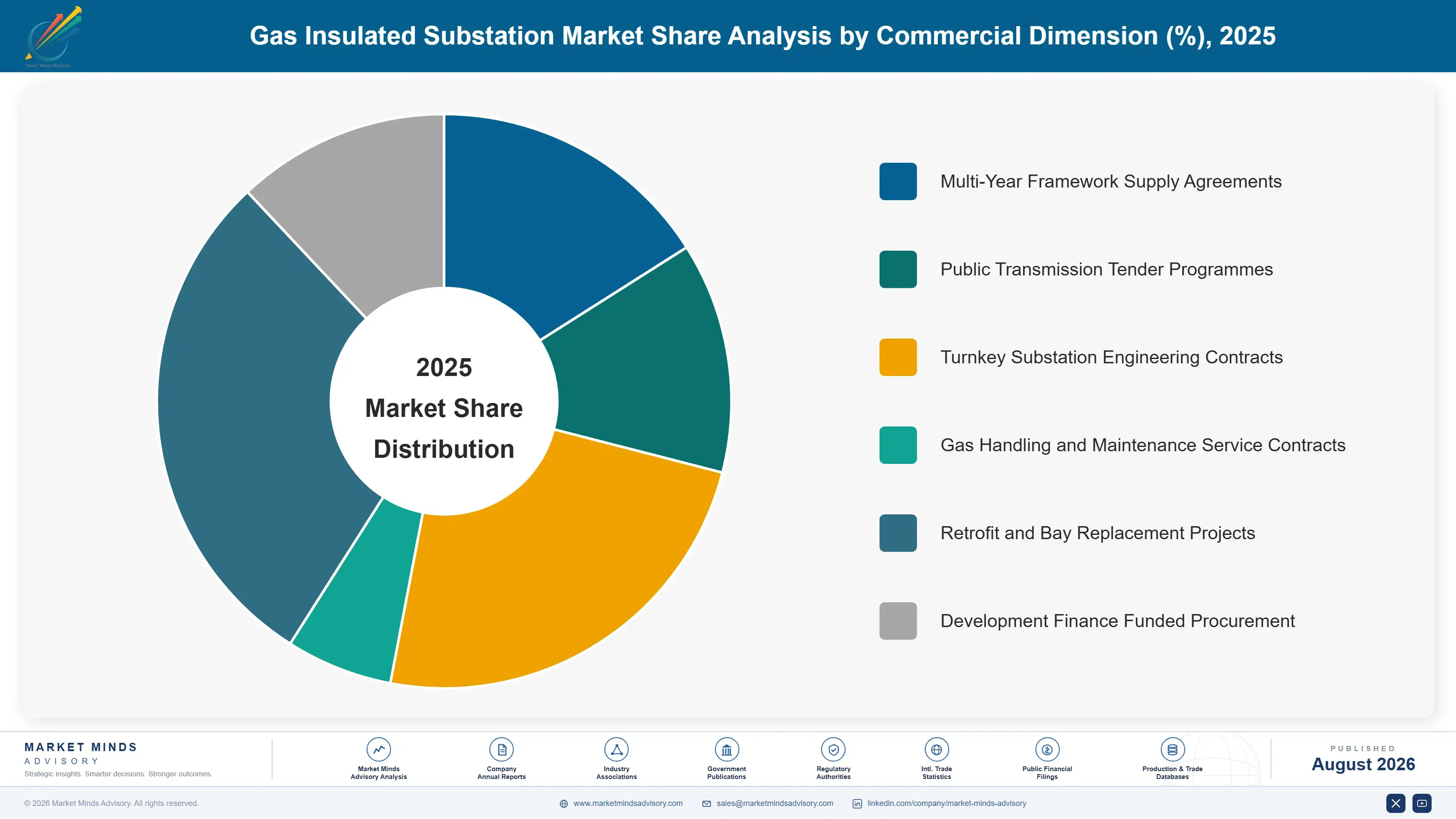
gas-insulated-substation-market-market-share-analysis-1787303458378

Ultra High Voltage Above 800 kV

Growing at 11.4%, a full 1.50x the market rate, equipment above 800 kV exists in commercial quantity only where distances between generation and load make lower voltages uneconomic, which in practice means China and to a growing extent India. Engineering at these levels is genuinely demanding: dielectric clearances, mechanical stresses and testing requirements all escalate faster than voltage does. Very few manufacturers worldwide can supply and type test at this class, and pricing reflects that scarcity clearly. Fluorine-free alternatives remain furthest from viability here, because the enclosure penalty grows with voltage rather than staying constant. Demand is concentrated enough that a single national transmission plan can move the whole segment's trajectory for several years.
CAGR 11.4%

Extra High Voltage 550 to 800 kV

Equipment between 550 and 800 kV grows at 9.6% and forms the backbone of long-distance transmission across China, India, the Gulf states and parts of North America. Demand here follows national transmission master plans rather than any commercial cycle, which makes it lumpy but unusually visible several years ahead. Chinese and Indian manufacturers have built genuine capability at this class and now compete internationally on price against established suppliers. Fluorine-free options are in qualification rather than deployment, and utilities specifying at this voltage generally accept conventional insulation for now while requiring a retrofit pathway. Chinese and Indian manufacturers now compete internationally at this class on price against established European and Japanese suppliers.
CAGR 9.6%
Full segment breakdown across 6 segments available in the complete report.

Regional Architecture and Country Demand Map

Regional value follows committed transmission capital programmes rather than electricity consumption or economic size, and those diverge sharply. Countries building long-distance high voltage networks dominate demand, while mature grids replace equipment gradually on age and regulatory obligation instead. Committed capital, not consumption, is the variable that matters here.

East Asia

East Asia takes the largest share at 30%, and China alone explains most of it. State Grid and China Southern Power Grid have built more ultra high voltage transmission than every other country combined, moving power thousands of kilometres from western generation to eastern load, and every one of those corridors terminates in gas insulated equipment. Domestic manufacturers including Pinggao, China XD and Sieyuan supply almost all of it at costs international suppliers cannot approach. Japanese demand is replacement-driven across a dense, ageing and heavily urban network. South Korean and Taiwanese utilities specify gas insulated equipment widely because available land is genuinely scarce. Domestic capability and domestic ambition reinforce each other here.
Share: 30% | CAGR: 8.6% (2026 to 2036)

North America

Twenty-two per cent of value, growing at 7.0%. Transmission investment has accelerated sharply since 2022 as interconnection queues lengthened and data centre load growth became a planning problem rather than a forecast. Gas insulated equipment is specified where permitting an open switchyard is impractical, which increasingly means anywhere near a populated area. Federal transmission funding and state-level clean energy mandates have committed capital for a decade ahead. Supply rather than demand constrains delivery here more than anywhere else tracked, with utilities placing orders against projects still years from construction and manufacturers allocating scarce factory slots deliberately. Data centre load growth has become a transmission planning problem rather than a forecasting exercise.
Share: 22% | CAGR: 7.0% (2026 to 2036)
Regional intelligence for 5 additional markets available in the complete report: Western Europe, South Asia and Pacific, Middle East and Africa, Latin America, Eastern Europe. Contact sales@marketmindsadvisory.com.
gas-insulated-substation-market-country-cagr-analysis-1787303458897

Where Substation Equipment Value Concentrates

Orders exceed capacity, so nothing here is won through commercial effort in the ordinary sense. Value accrues to whoever holds qualified factory slots, to whoever can offer a credible gas transition pathway on assets designed to last forty years, and to the service revenue that follows every installation. Commercial effort decides remarkably little at present.

Allocate scarce factory slots toward framework agreement customers

Lead times past 26 months mean a manufacturer is choosing which customers to serve rather than competing for them. Allocating capacity toward utilities holding multi-year framework agreements converts a shortage into a relationship that survives the eventual return to normal supply. Utilities offered guaranteed delivery slots accept pricing roughly 15% above spot tender levels, because a delayed substation delays an entire connection project. Manufacturers who allocated purely on order date during the shortage found they had filled capacity with transactional buyers. Those transactional buyers disappear the moment supply normalises again, leaving nothing behind.
Market Impact: Supports about 15% pricing premium

Sell a retrofit pathway on forty year assets

Equipment specified today will still be operating in 2066, well past any plausible fluorinated gas phase-down date, and utilities know it. Designs offering a credible conversion route to fluorine-free insulation, or modular architecture allowing bay replacement without rebuilding the substation, resolve a procurement risk that otherwise stalls decisions entirely. Suppliers presenting a documented retrofit pathway win roughly 25% more evaluations at transmission voltages where alternatives are not yet qualified. It is a specification argument rather than a product one. Procurement decisions stall entirely without one, whatever the equipment itself happens to cost.
Market Impact: Wins around 25% more transmission v

Build gas handling and service into the original supply contract

Fluorinated gas carries leak monitoring, recovery, recycling and reporting obligations that intensify with every regulatory revision, and utilities are poorly equipped to manage them across ageing fleets. Service contracts covering gas handling, condition monitoring and end-of-life recovery generate recurring revenue at roughly 3% of installed asset value annually across a forty year life. That stream is larger than the original equipment margin and considerably more defensible, because it depends on regulatory obligation rather than on any competitive tender. Utilities are poorly equipped to manage those obligations across ageing and heterogeneous installed fleets.
Market Impact: Yields roughly 3% of asset value ea

Qualify alternative insulation at transmission voltage before competitors

Fluorine-free options are established at distribution voltages and remain in qualification above 145 kV, where the enclosure penalty grows with voltage. Type testing, long-term dielectric validation and utility field trials take years, and the first supplier to complete them at each voltage class effectively writes the specification others must then meet. Roughly 22% of orders already specify alternatives and that share rises with every regulatory revision. Qualification investment made now determines who is bidding compliant equipment when the transmission deadlines arrive. Testing laboratory queues rather than engineering readiness are the binding constraint on that work.
Market Impact: Alternatives already reaching 22% o

Who Controls the Margin Pool

Concentration sits at 64% across the top five, measured on annual revenue from gas insulated switchgear equipment, installation and associated service, the single basis applied throughout. Hitachi Energy and Siemens Energy lead, followed by GE Vernova, Schneider Electric and Mitsubishi Electric. Above 550 kV the field narrows sharply, because very few plants worldwide hold the necessary type testing qualification.
Competition runs on availability first, which is unusual for capital equipment. A utility facing a 26-month lead time weights delivery date above almost everything else, and manufacturers are allocating capacity rather than chasing orders. Insulation technology comes second, since utilities buying forty year assets want a credible path through the fluorinated gas phase-down. Price ranks third at transmission voltages and much higher in distribution classes.

Pressure builds from two directions. Chinese manufacturers including Pinggao, China XD and Sieyuan have built genuine ultra high voltage capability at home and now bid internationally at prices established suppliers cannot match, particularly across the Gulf, Africa and Southeast Asia. Indian producers are following the same path. Rankings shift most where a supplier completes fluorine-free qualification at a transmission voltage class before its competitors reach the same point.
gas-insulated-substation-market-company-positioning-matrix-1787303459419

Competitive Moat and Risk Dimensions

HITACHI ENERGY

Moat: Ultra high voltage qualification depth

Hitachi Energy holds type-tested manufacturing capability across the full voltage range including ultra high voltage classes that very few plants worldwide can build, and its fluoronitrile insulation programme is among the most advanced qualified alternatives available. That combination lets it bid work where the qualified supplier list runs to a handful of names rather than a competitive field.
HITACHI ENERGY

Risk: Capacity conversion constraint

Order intake substantially exceeds what factories can deliver, and building qualified high voltage capacity takes three to four years, so backlog accumulates while recognised revenue lags. Chinese manufacturers are bidding aggressively in export markets the company has historically held. Fluorine-free qualification at the highest voltage classes remains incomplete across the industry.
SIEMENS ENERGY

Moat: Grid portfolio integration breadth

Siemens Energy supplies switchgear alongside transformers, high voltage direct current converter stations and grid automation, which lets it contract entire substation and connection scopes rather than individual equipment lines. For utilities managing large connection programmes under time pressure, a single supplier carrying integrated delivery risk is worth a meaningful premium over component procurement.
SIEMENS ENERGY

Risk: Project execution exposure

Integrated scope carries integrated risk, and large grid connection projects have historically generated cost overruns across the industry when schedules slip or interfaces fail. Supply chain constraints in transformers compound switchgear delays on the same sites. Competition from Chinese suppliers on price is intensifying across exactly the export markets where integrated scope has been most valuable.

Players Tracked

Prominent Players

Hitachi Energy
Siemens Energy
GE Vernova
Schneider Electric
Mitsubishi Electric

Other Key Players

Toshiba Energy Systems
Fuji Electric
Meidensha
Hyundai Electric
Pinggao Electric
China XD Electric
Sieyuan Electric
TBEA
CG Power and Industrial Solutions
Bharat Heavy Electricals
Nissin Electric
ABB
Eaton
Chint Electric
Efacec

Recent Developments

MARCH 2025

European fluorinated gas phase-down timetable takes effect for distribution switchgear

The revised European fluorinated gas regulation began restricting sulphur hexafluoride in new medium voltage switchgear, with transmission voltage classes following on a staged timetable through the next decade, and manufacturers shifting distribution production lines toward clean air and vacuum designs. Transmission classes remain unaffected for now.
Signal: Regulation is now setting the equipment sp
SEPTEMBER 2025

Hitachi Energy commits further capital to high voltage switchgear capacity

Hitachi Energy announced additional investment in high voltage switchgear manufacturing capacity, an organic expansion rather than an acquisition, responding to order backlogs that had pushed delivery lead times past two years across European and North American transmission customers. Commissioning is expected toward the end of the decade.
Signal: Capital is chasing factory capacity now, b
FEBRUARY 2026

Indian transmission plan commits further 765 kV substation capacity

India's central transmission planning body committed additional 765 kV substation capacity linking western and southern renewable energy zones to northern and eastern demand centres, extending a backbone programme that domestic and international manufacturers have been building against for several years. Domestic content requirements apply throughout.
Signal: Ultra high voltage demand stays concentrat

Copper, Steel and Insulating Gas Exposure

Cost structures are dominated by metals and by precision fabrication. Copper for conductors and current-carrying components accounts for roughly 21% of equipment cost of goods, with aluminium enclosures and fabricated steel contributing a further 19%, all sourced through conventional metals channels. Epoxy insulators, precision machining and gas-tight welding carry most of the remainder, and the insulating gas itself is a small fraction of delivered cost.
The 2021 to 2023 metals and component squeeze demonstrated the exposure. Copper pricing rose sharply while grain-oriented electrical steel, semiconductors for protection systems and specialist castings all faced allocation delays, and Siemens Energy and Hitachi Energy both documented supply chain cost pressure and delivery constraint in their annual reporting across those years. Long-cycle project contracts signed before the increase could not be repriced, so margin absorbed most of it.

The disadvantage falls hardest on manufacturers without vertically integrated fabrication. A supplier machining its own enclosures and winding its own instrument transformers controls schedule and cost that a competitor buying those assemblies does not. Geography compounds it directly: Chinese and Indian manufacturers hold labour, energy and regulatory cost positions that Western plants cannot approach, in markets where public transmission tenders increasingly evaluate on delivered price.
gas-insulated-substation-market-cost-volatility-analysis-1787303459614

Hedge copper and aluminium exposure across long-cycle project contracts

Substation contracts are signed years before delivery and metals exposure runs across that whole period, which converts a manageable commodity movement into a margin event. Structured hedging matched to contracted delivery schedules removes most of it. Manufacturers who priced long-cycle work on spot assumptions absorbed the entire increase during the last commodity cycle. Very few carried hedges through it.

Integrate enclosure fabrication and instrument transformer manufacture internally

Bought-in enclosures and instrument transformers sit on the critical path of every bay and are supplied by a narrow specialist base with its own allocation pressures. Owning that fabrication controls both cost and schedule, which matters more than the unit price when lead times already run past two years and every slipped week compounds downstream.

Write escalation provisions into multi-year framework supply agreements

Framework agreements signed at fixed pricing transferred the full metals and component increase onto manufacturers during the last cycle. Newer agreements increasingly carry narrow indexation tied to published copper and aluminium benchmarks. Utilities accept that far more readily than a general escalator, because the underlying exchange data is public, verifiable and clearly outside any supplier's control.

Portfolio Architecture for Margin Defence

Margin architecture follows how few suppliers can qualify to build the equipment. Medium voltage switchgear has many qualified manufacturers worldwide and moves on tendered price accordingly. High voltage classes narrow the field considerably and pricing improves with it. Ultra high voltage equipment above 800 kV can be supplied by a handful of plants globally, and pricing at that class reflects genuine scarcity rather than any negotiating position.
The volume versus premium tension runs along the same voltage line. Distribution classes supply most units and the thinnest margin, and Chinese and Indian manufacturers compete hard there wherever tenders allow. Transmission classes supply far fewer units and most of the profit, protected by type testing, manufacturing qualification and utility conservatism that no amount of price aggression overcomes quickly. Utility conservatism about four decade assets resists aggressive pricing.

High-value pools also sit outside the equipment itself. Gas handling, leak monitoring, condition assessment and end-of-life recovery services generate recurring revenue across a forty year asset life, driven by regulatory obligation rather than competitive tender. Retrofit and bay replacement work on ageing installed fleets carries similar characteristics. Plain distribution switchgear sold into an open tender sits at the opposite extreme entirely.

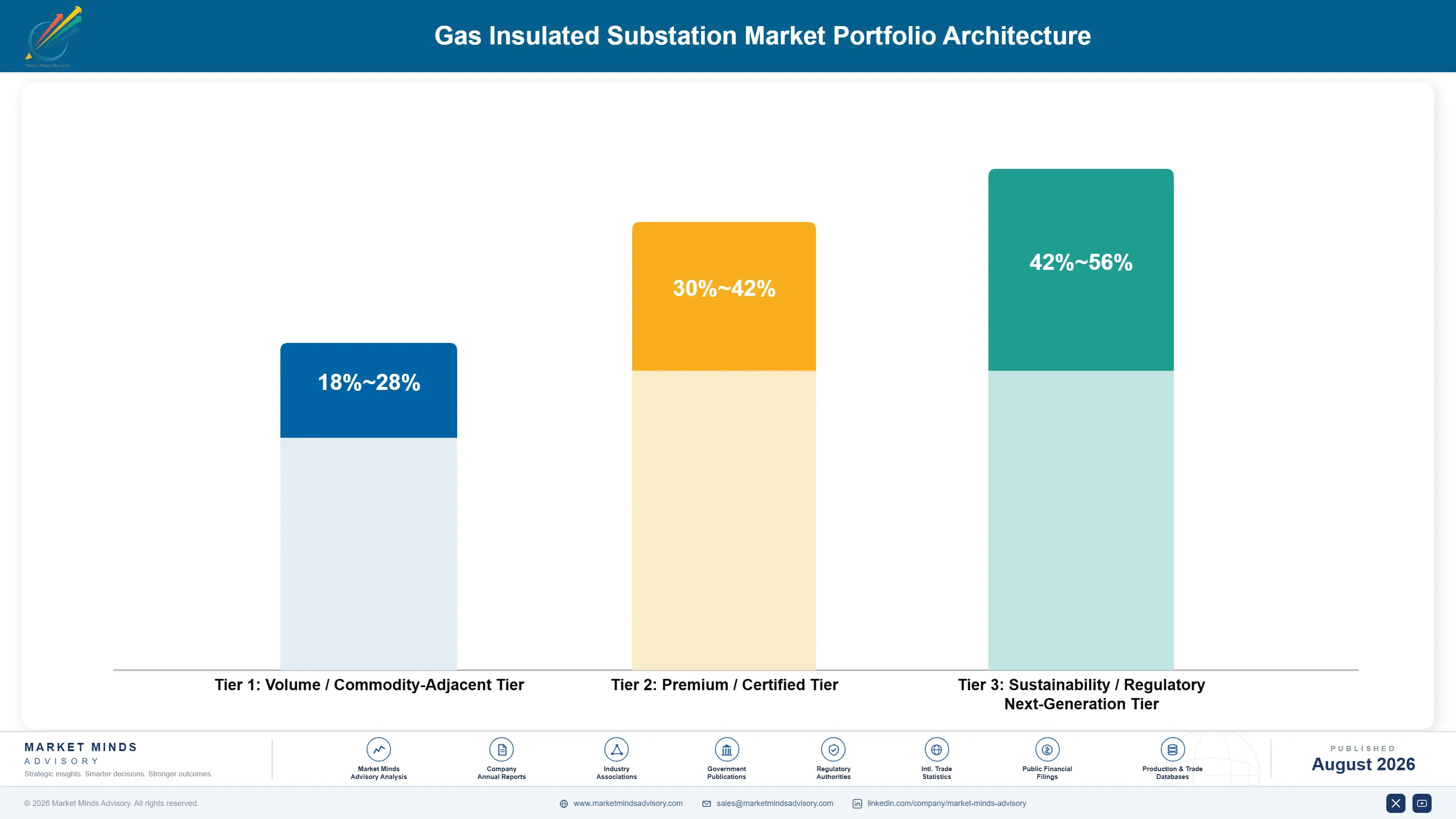
Volume / Commodity-Adjacent Tier

Medium voltage gas insulated switchgear up to 52 kV, where many manufacturers qualify worldwide and public tenders decide on delivered price. Chinese, Indian and Turkish suppliers compete directly and set the cost floor across most open markets.
Gross Margin: 18-28%

Premium / Certified Tier

High and extra high voltage equipment from 72.5 to 420 kV, protected by type testing requirements, manufacturing qualification and utility conservatism about assets expected to run for four decades without incident.
Gross Margin: 30-42%

Sustainability / Regulatory / Next-Generation Tier

Ultra high voltage equipment above 550 kV and qualified fluorine-free designs at transmission classes, buildable by very few plants worldwide. Best margins available and the least contested competitive positions in the entire market.
Gross Margin: 42-56%
gas-insulated-substation-market-portfolio-architecture-1787303460129

Forty Year Assets Under Regulatory Change

Equipment specified today will still be operating in the twenty sixties, which shapes every purchasing decision made in this market. A utility buying a substation bay is committing to a technology, a supplier relationship and a maintenance regime for four decades, and it will replace almost nothing voluntarily before then. That horizon makes utilities conservative in a way no commercial argument overcomes quickly.
Stickiness follows the installed fleet. A network standardised on one manufacturer's bay architecture keeps buying it, because spares, gas handling equipment, training and protection interfaces are all aligned to it and divergence creates operational cost across decades. Service and gas handling relationships are stickier still, since they depend on documented asset history. Medium voltage tender purchases show almost no stickiness and change supplier freely between framework periods.

Buyer profiles have shifted toward programme management. A decade ago utility engineering departments specified equipment and procurement executed. Today transmission system operators run multi-year connection programmes with committed capital, framework agreements covering hundreds of bays, and delivery slots negotiated years ahead. Regulators have also entered the decision indirectly, since fluorinated gas rules now constrain what a utility is permitted to specify at all.
gas-insulated-substation-market-end-use-penetration-index-1787303460622

Where Substation Strategy Must Land

These are among the four positions where our research anticipates prominent divergence between winners and laggards over the coming forecast period. Each is grounded in the demand model, the regulatory perimeter, and the announced capacity pipeline.
01 / CAPACITY ALLOCATION DISCIPLINE

Lead times mean choosing customers rather than winning them

Delivery intervals past 26 months have inverted the ordinary commercial relationship, so a manufacturer is deciding which utilities to serve rather than competing to be selected by them. Allocating scarce factory slots toward customers holding multi-year framework agreements converts a temporary shortage into a relationship that survives the eventual return to normal supply. Utilities offered guaranteed delivery accept pricing roughly 15% above spot tender levels, because a single delayed substation delays an entire connection programme behind it, at costs far exceeding the equipment premium.
02 / RETROFIT PATHWAY SPECIFICATION

Utilities buying forty year assets need an exit route

Equipment specified today will still be operating well past any plausible fluorinated gas phase-down date, and transmission utilities understand that precisely, which is exactly why procurement decisions stall entirely without a credible conversion story attached to the bid. Designs offering a documented route to fluorine-free insulation, or modular architecture allowing bay replacement without rebuilding the whole substation, resolve that risk directly. Suppliers presenting a documented pathway win roughly 25% more evaluations at transmission voltages where alternatives remain entirely unqualified today.
03 / SERVICE ANNUITY CAPTURE

Gas obligations outlast and outearn the equipment sale

Fluorinated gas carries leak monitoring, recovery, recycling and reporting duties that intensify with every regulatory revision, and most utilities are poorly equipped to manage any of them across ageing and heterogeneous installed fleets. Service contracts covering handling, condition assessment and end-of-life recovery generate roughly 3% of installed asset value each year across a forty year life. That recurring stream exceeds the original equipment margin and proves far more defensible, because regulatory obligation rather than competitive tender is what sustains it.
04 / QUALIFICATION RACE TIMING

First to type test writes the specification everyone follows

Fluorine-free insulation is established at distribution voltages and remains in qualification above 145 kV, where the enclosure penalty grows with voltage rather than staying constant across classes. Type testing, long-term dielectric validation and utility field trials take years, and cannot be meaningfully shortened by spending more money on any of them. The first supplier completing qualification at each transmission voltage class effectively sets the specification competitors must subsequently meet, and roughly 22% of new orders already require an alternative of some kind.

Engagement Snapshot From the Field

A live engagement with an industry participant carrying material or product regulatory and market exposure ahead of a defining policy shift, showing how our research translates into a defensible multi-year portfolio strategy.
MARKET MINDS ADVISORY · CLIENT ENGAGEMENT SUMMARY
Gas Insulated Substation Producer Strategic Portfolio Review and Transition Roadmap 2026·Investment Scenario on Gas Insulated Substation Exposure Evaluation 2025-26
CLIENT PROFILE
A European transmission equipment manufacturer supplying gas insulated switchgear from 72.5 to 420 kV across European, Middle Eastern and African markets, with annual switchgear revenue of approximately USD 720 million (client-reported, unverified by MMA). Order backlog stood at roughly three times annual delivery capacity. The company held qualified fluorine-free designs at distribution voltages only and none above 145 kV.
STRATEGIC CHALLENGE
Backlog had grown faster than the company could convert it while Chinese suppliers were winning Gulf and African tenders on price and delivery. The board needed to decide whether to commit capital to a new high voltage manufacturing plant, or to redirect that investment into completing fluorine-free type testing at transmission voltage classes ahead of competitors, since it could not fund both within the period.
MMA APPROACH
MMA conducted 47 expert interviews across transmission operator engineering and procurement leads, utility asset managers, regulatory specialists, testing laboratory directors and contractors in six countries. A quantitative survey of 3,800 respondents established specification drivers, delivery sensitivity and technology preference across utility buyer types. We then modelled revenue, margin and competitive position under both investment options against observed backlog conversion rates and regulatory timetables.
KEY FINDINGS
  1. Transmission utilities ranked guaranteed delivery date above price in five of six markets surveyed, and several reported paying premiums well above tender levels to secure firm slots.
  2. Procurement decisions at transmission voltages were stalling where suppliers could not document a conversion pathway to fluorine-free insulation across the expected asset life.
  3. Chinese suppliers were winning on price and delivery in Gulf and African tenders but were rarely shortlisted where fluorine-free capability formed part of the technical specification.
  4. Testing laboratory capacity for transmission voltage type approval was itself constrained, with queues extending well beyond a year and no realistic prospect of shortening them.
CLIENT PROFILE
A European transmission equipment manufacturer supplying gas insulated switchgear from 72.5 to 420 kV across European, Middle Eastern and African markets, with annual switchgear revenue of approximately USD 720 million (client-reported, unverified by MMA). Order backlog stood at roughly three times annual delivery capacity. The company held qualified fluorine-free designs at distribution voltages only and none above 145 kV.
STRATEGIC CHALLENGE
Backlog had grown faster than the company could convert it while Chinese suppliers were winning Gulf and African tenders on price and delivery. The board needed to decide whether to commit capital to a new high voltage manufacturing plant, or to redirect that investment into completing fluorine-free type testing at transmission voltage classes ahead of competitors, since it could not fund both within the period.
MMA APPROACH
MMA conducted 47 expert interviews across transmission operator engineering and procurement leads, utility asset managers, regulatory specialists, testing laboratory directors and contractors in six countries. A quantitative survey of 3,800 respondents established specification drivers, delivery sensitivity and technology preference across utility buyer types. We then modelled revenue, margin and competitive position under both investment options against observed backlog conversion rates and regulatory timetables.
KEY FINDINGS
  1. Transmission utilities ranked guaranteed delivery date above price in five of six markets surveyed, and several reported paying premiums well above tender levels to secure firm slots.
  2. Procurement decisions at transmission voltages were stalling where suppliers could not document a conversion pathway to fluorine-free insulation across the expected asset life.
  3. Chinese suppliers were winning on price and delivery in Gulf and African tenders but were rarely shortlisted where fluorine-free capability formed part of the technical specification.
  4. Testing laboratory capacity for transmission voltage type approval was itself constrained, with queues extending well beyond a year and no realistic prospect of shortening them.
RECOMMENDED STRATEGY
Phase 1: Phase one: book transmission voltage type testing laboratory slots immediately, since queue length rather than engineering readiness was the binding constraint on qualification. Phase 2: Phase two: fund fluorine-free qualification at two transmission voltage classes rather than a new plant, and expand existing factory capacity incrementally instead. Phase 3: Phase three: convert backlog customers onto multi-year framework agreements with guaranteed delivery slots, repricing the premium those slots demonstrably command.
OUTCOME
The client booked testing capacity within a quarter and completed qualification at one transmission voltage class ahead of every European competitor (client-reported, unverified by MMA). Framework conversion lifted realised pricing on roughly half the backlog, and the company was shortlisted on three tenders that had specified fluorine-free capability as mandatory.

Frequently Asked Questions

Foundational context covering the market sizes, CAGR, scope, country, region and competition that inform every finding below. This section is provided to cover basics and most often pre-purchase conversations, answered from the MMA Primary Research Dataset.

What is the current size of the Gas Insulated Substation Market?

The global gas insulated substation market was valued at USD 19.5 billion in 2025, covering switchgear across all voltage classes together with engineering, installation and gas handling services. Power transformers and air insulated switchgear fall outside this definition.

How large will the Gas Insulated Substation Market be by 2036?

MMA forecasts the market at USD 43.65 billion by 2036, expanding 2.08 times from the 2026 base of USD 20.98 billion. That represents roughly USD 22.67 billion of incremental value across the forecast decade.

What is the CAGR for the Gas Insulated Substation Market 2026 to 2036?

The base case compound annual growth rate is 7.6%, with a bull case of 8.9% and a bear case of 6.4%. Both cases turn on factory capacity conversion rather than on order intake.

Which segment is growing fastest?

Ultra high voltage equipment above 800 kV grows at 11.4%, a full 1.50x the overall market rate. Demand concentrates in China and India, where transmission distances make lower voltages uneconomic.

Who are the major companies in the Gas Insulated Substation Market?

Hitachi Energy, Siemens Energy, GE Vernova, Schneider Electric and Mitsubishi Electric together hold 64% of revenue. Above 550 kV the qualified supplier field narrows sharply because type testing capability is genuinely scarce.

Which country is growing fastest?

India grows fastest at 12.6%, building a 765 kV transmission backbone linking renewable generation zones to demand centres. East Asia is the largest region at 30% of value.

Report Segmentation Architecture

The full report scope spans multiple orthogonal segmentation dimensions, with cross-tabulated demand data provided for each dimension pair. Coverage extends further to regional breakdowns, trend trajectories, and the competitive detail needed to support segment-level decision-making.

By Voltage Class

  • Up to 52 kV
  • 72.5 to 145 kV
  • 170 to 245 kV
  • 300 to 420 kV
  • 550 to 800 kV
  • Above 800 kV

By End-Use Industry

  • Transmission System Operators
  • Distribution Network Utilities
  • Renewable Generation and Offshore Wind
  • Data Centre and Digital Infrastructure
  • Oil, Gas and Petrochemical Facilities
  • Mining, Metals and Heavy Industry

By Commercial Dimension

  • Multi-Year Framework Supply Agreements
  • Public Transmission Tender Programmes
  • Turnkey Substation Engineering Contracts
  • Gas Handling and Maintenance Service Contracts
  • Retrofit and Bay Replacement Projects
  • Development Finance Funded Procurement

By Region

  • East Asia
  • North America
  • Western Europe
  • South Asia and Pacific
  • Middle East and Africa
  • Latin America
  • Eastern Europe

Scope, Methodology, and Coverage

Every figure in this report is reproducible from documented input assumptions. The scope below maps the historical period, the forecast horizon, the segmentation dimensions, and the countries covered, alongside the underlying primary and qualitative methodology.
Historical Period
2020 to 2025
Forecast Period
2026 to 2036
Base Year
2025 (USD billions; MMA Primary Research Dataset, August 2026)
Market Definition
This market comprises gas insulated switchgear and complete gas insulated substations used in electricity transmission and distribution networks, measured at manufacturer and contractor revenue across framework agreements, public tenders, turnkey engineering contracts and service arrangements. Coverage spans gas insulated circuit breakers, disconnectors, earthing switches, busbar systems, enclosures, current and voltage instrument transformers and surge arresters supplied within a gas insulated assembly, across all voltage classes from distribution through ultra high voltage, together with the engineering, installation, commissioning, gas handling, leak monitoring and end-of-life recovery services associated with them. Air insulated switchgear and outdoor switchyard equipment, power and distribution transformers, high voltage direct current converter valves, protection relays and substation automation systems sold independently, overhead transmission line and underground cable infrastructure, substation civil works and buildings, and standalone insulating gas supply fall outside scope.
Quantitative Units
USD billions (current prices); bay shipments by voltage class; average price per installed bay; installed base age profile; order backlog and lead time in months
Segmentation Dimensions
By Voltage Class; By End-Use Industry; By Commercial Dimension; By Region
Regions Covered
East Asia, North America, Western Europe, South Asia and Pacific, Middle East and Africa, Latin America, Eastern Europe
Countries Covered
China, Japan, South Korea, Taiwan, United States, Canada, Mexico, Germany, United Kingdom, France, Netherlands, Spain, Italy, Sweden, Norway, India, Australia, Singapore, Vietnam, Indonesia, Thailand, Brazil, Chile, Colombia, Peru, Saudi Arabia, United Arab Emirates, Qatar, Egypt, Morocco, South Africa, Poland, Czechia, Romania, and additional markets relevant to transmission equipment supply analysis
Key Companies Profiled
Hitachi Energy, Siemens Energy, GE Vernova, Schneider Electric, Mitsubishi Electric, Toshiba Energy Systems, Fuji Electric, Meidensha, Hyundai Electric, Pinggao Electric, China XD Electric, Sieyuan Electric, TBEA, CG Power and Industrial Solutions, Bharat Heavy Electricals, Nissin Electric, ABB, Eaton, Chint Electric, Efacec
Quantitative Methodology
Primary survey, n=3,800 respondents, Q4 2025, six countries; demand-side model with trade association cross-validation
Qualitative Methodology
47 expert interviews, Q4 2025; applied to validate demand model assumptions, identify emerging dynamics, and assess competitive positioning
Report Format
PDF and XLSX data workbook (Word format preview document)
Publisher
Market Minds Advisory
Report Code
MMA-2026-ENE-157
Published
August 2026
Contact
sales@marketmindsadvisory.com | www.marketmindsadvisory.com

Purchase the full Gas Insulated Substation Market Report (2026 to 2036).

The full MMA report examines a product category whose commercial justification is compactness at exactly the moment regulation is removing the substance that makes it compact. It sizes six voltage classes and seven regions to 2036, modelling bay shipments, pricing, backlog conversion and fluorine-free order share separately so that capacity constraints can be distinguished from underlying demand. Competitive assessment covers twenty manufacturers on one consistent revenue basis. Input cost exposure is traced through copper, aluminium and specialist component supply across long-cycle contracts. Four commercial levers and a strategic verdict close the report, grounded in 47 expert interviews and a 3,800-respondent survey.
Six voltage classes sized separately to 2036
Fluorine-free transition modelled by voltage and region
Order backlog conversion tracked against factory capacity expansion
Twenty manufacturers assessed on one consistent basis
Gas handling service annuity economics quantified across asset life
Anonymised client engagement with tested strategic recommendations

Built For The People Who Decide

From boardroom strategy to bench-side execution, this report is read cover-to-cover by leaders shaping the next decade of their industry, turning demand scenarios, market dynamics and valuation benchmarks into decisions.
CXOs/ Presidents/ VPs/ Managers
M&A and Corporate Development
Strategy Teams and R&D Heads
Procurement and Product Directors
Regulatory and Compliance Leaders
Investor Relations and Equity Analysts