Market Minds Advisory
Gas Detection Equipment Market

Gas Detection Equipment Market: Connected Safety Infrastructure and Compliance-Driven Replacement

Rising process safety enforcement across chemical, oil and gas, and mining operations is pushing procurement toward connected, multi-gas detection networks, while sensor miniaturization and wireless calibration data reshape replacement cycles and vendor selection criteria.

Lead Analyst

David Horsley

Published

September 2026

Make Smarter Decisions with Customized Research Insights

Request a free sample report and evaluate market opportunities, growth trends, and competitive dynamics relevant to your business needs.

2025 MARKET VALUE$3.8BMarket Size 2025
2036 FORECAST VALUE$7.8BBase Case , 2026 to 2036
CAGR 2026 TO 20366.8 %Bull 8.0% / Bear 5.5%
INCREMENTAL OPPORTUNITY$3.8BNet 10- year value creation
EXPANSION MULTIPLE1.93x2036 value over 2026 base
Strategic Levers
M&A Pipeline
Regional Outlook
Country Rankings
Competitive Intelligence
Segmental Deep-dive
Call-Us : 91 93563 13602

Executive Snapshot and Market Trajectory

Gas detection has shifted from a compliance checkbox to a connected safety infrastructure decision. Buyers now weigh cloud-linked calibration records and wireless mesh coverage as heavily as sensor accuracy, and procurement cycles increasingly route through corporate EHS technology budgets rather than plant-level maintenance spend alone, reshaping vendor shortlists.
Wireless networked detection systems are growing at roughly 1.4x the market average as refineries, LNG terminals, and battery gigafactories replace isolated fixed points with mesh connected sensor grids feeding centralized control rooms. East Asia has recently pulled ahead of North America on installed base growth, driven by China's expanding chemical park safety mandates and a wave of new battery and semiconductor fabrication capacity requiring continuous multi gas monitoring across confined and open work areas today.
Competitive intensity centers on five diversified safety conglomerates that bundle detection hardware with calibration services and cloud software, leaving specialist instrument makers to compete on sensor life and total cost of ownership. New ATEX and NFPA revisions, combined with falling electrochemical sensor prices, are compressing margins even as unit volumes expand across mid sized industrial accounts previously priced out of continuous monitoring programmes until sensor costs fell sharply this cycle.
Market Definition
The gas detection equipment market covers portable and fixed instruments, sensors, and controllers used to detect combustible, toxic, and oxygen deficiency hazards across industrial, commercial, and infrastructure settings. It includes single gas and multi gas portable units, fixed point and open path systems, and the wireless networking hardware linking them to central control rooms. Calibration gas, standalone fire detection systems, and software subscriptions sold apart from hardware are excluded.
Base Year Value
$3.8B in 2025 (MMA Primary Research Dataset, August 2026)
Forecast Period
2026 to 2036, eleven discrete annual values
CAGR
6.8% base case. Bull 8.0%. Bear 5.5%.
Fastest Growth Segment
Wireless Networked Detection Systems: 9.8% CAGR
Fastest Growth Country
India: 9.5% CAGR
Fastest Growth Region
South Asia and Pacific: 8.9% CAGR
Largest Region
East Asia: 28% of 2025 global value
Market Leaders
Honeywell International, Dräger, MSA Safety, Teledyne Technologies, Industrial Scientific. Source: MMA Analysis based on company annual reports.
Primary Survey
n=3,800 procurement and R&D decision-makers, Q4 2025, six countries
Methodology
Demand-side build-up, cross-validated against public data, 47 expert interviews

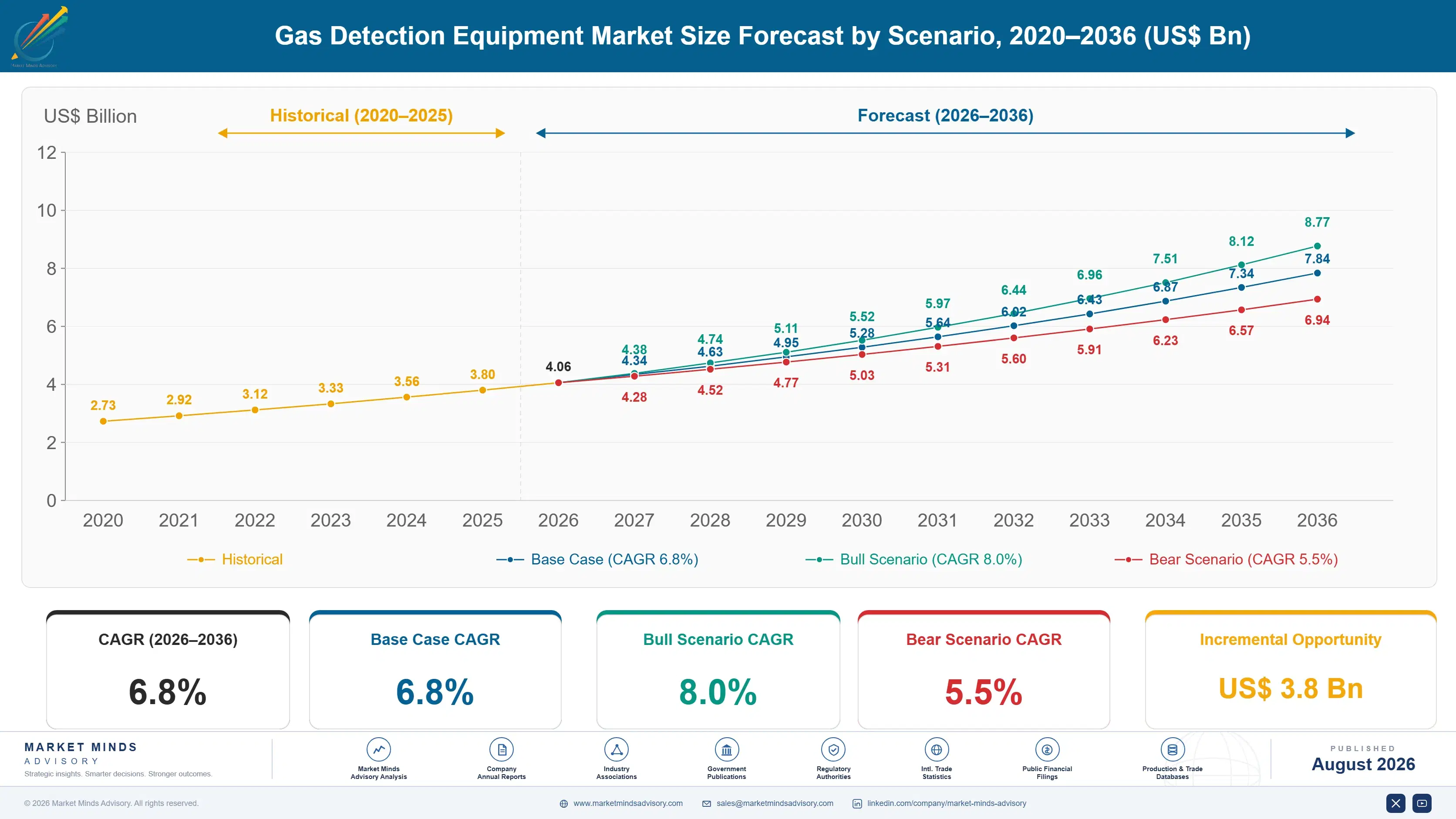
Gas Detection Equipment Market Forecast Scenarios

gas-detection-equipment-market-size-forecast-scenario-1787302255576
Between 2020 and 2025 the market grew at an estimated 5.8% historical CAGR, recovering from pandemic era plant shutdowns before accelerating on renewed capital spending in petrochemicals, LNG export capacity, and battery manufacturing. Early wireless retrofit programmes stayed niche through 2022, then scaled once mesh network reliability improved and insurers began discounting premiums for continuously monitored sites.
The base case assumes 6.8% CAGR through 2036, anchored in three mechanisms: mandatory replacement of first generation electrochemical sensors reaching end of life, expansion of confined space and perimeter monitoring rules under updated OSHA and ATEX frameworks, and enterprise EHS platforms standardizing on wireless multi gas fleets to cut manual calibration labor. Battery and semiconductor fabrication buildouts in East Asia add a reinforcing tailwind through the decade, pulling forward replacement of legacy fixed-point networks across chemical parks and gigafactory campuses.
A bull scenario, near 8.0% CAGR, assumes accelerated LNG buildout and mandatory continuous monitoring rules across India and Southeast Asia pull deployment forward. The bear case, near 5.5%, assumes industrial capex slows and plants stretch detector replacement cycles by two to three years, delaying network upgrades and softening demand for premium wireless hardware across mid tier accounts.

Compliance Enforcement Meets Connected Safety Infrastructure

Three forces are converging on this market at once: tightening confined space and combustible gas regulation, a generational sensor replacement wave, and the migration of safety data into enterprise EHS software. Plants that once bought detectors as isolated capital items now specify them as nodes on a wireless safety network, changing who signs the purchase order and how vendors are shortlisted, and pulling procurement decisions upward into corporate technology budgets.
MARKET CONCENTRATION38%Combined revenue share held by top five suppliers
PORTABLE MULTI-GAS ASP$420Blended price point for standard multi gas units
REPLACEMENT CYCLE5-7 yrsTypical service life span before mandated unit replacement occurs
WIRELESS PENETRATION34%Share of new shipments carrying wireless connectivity today
TOP PRODUCTION BASEChinaLeading country for finished detector manufacturing volume today
CALIBRATION SERVICE SHARE22%Recurring service revenue as portion of total sales
Commercially, the market behaves less like a pure instrumentation category and more like an annuity business built on calibration, certification, and software attach. Hardware margins are thinning as electrochemical sensor costs fall, so vendors increasingly price detectors near cost and recover margin through service contracts, extended warranties, and cloud subscription tiers sold alongside the physical unit rather than through the unit sale itself.
Over the next decade, expect consolidation among specialist sensor makers unable to fund wireless platform development, continued share gains for connected multi gas systems, and rising scrutiny of detector data integrity as regulators begin auditing calibration logs directly rather than trusting paper records submitted after the fact, which will reward vendors with defensible digital audit trails.
"The detectors themselves are commoditizing faster than buyers realize. What actually differentiates a winning vendor now is whether their calibration data survives an audit without a technician re-keying half of it by hand."
Director, Industrial Safety and Instrumentation Practice · MMA Industrial Safety

Market Trends

Wireless Mesh Networks Replace Isolated Fixed Points

Operators at large refining and LNG sites are retrofitting isolated fixed point detectors with wireless mesh networks that feed a single control room dashboard, cutting cable installation cost by an estimated 60% versus hardwired runs. The shift is most visible in brownfield expansions where trenching new conduit through active process areas is costly and disruptive. Vendors bundling detectors, gateways, and software into one wireless platform are winning multi year framework agreements that previously went to point instrument suppliers, and the trend is spreading from oil and gas into chemicals and battery manufacturing sites seeking comparable flexibility.
Market Impact: Covers 28,000 additional facilities
Battery and Semiconductor Fabs Drive New Fixed Demand

The buildout of lithium battery gigafactories and semiconductor fabrication capacity across the United States, South Korea, and China is generating fresh demand for toxic gas and combustible gas monitoring in cleanroom and chemical storage areas that did not exist five years ago. Each new gigafactory typically installs several hundred fixed point and open path detectors during commissioning, a volume comparable to a mid sized refinery. Because these facilities open with modern EHS software already specified, they favor networked detection from day one rather than retrofitting later, giving an early advantage to vendors already qualified on hyperscale construction projects.
Market Impact: Adds $410 million replacement reven

Market Opportunities and Growth Drivers

Updated OSHA Confined Space and ATEX Directive Revisions

Revised confined space entry rules moving through United States rulemaking, alongside the European Union's updated ATEX equipment directive, are expanding the list of work areas requiring continuous atmospheric monitoring rather than periodic spot checks. Facilities previously relying on portable single gas meters checked twice a shift must now demonstrate continuous coverage in classified zones, pushing budget toward fixed and wireless networked systems. Compliance officers report insurers are independently tightening underwriting ahead of the formal changes, meaning demand shifts before either regulation is finalized, with plants preferring to over comply rather than face a mid cycle retrofit mandate later on.
Market Impact: Delays 15% of installations one qua

Electrochemical Sensor Replacement Wave Reaching End of Life

The generation of electrochemical and catalytic bead sensors installed during the 2015 to 2018 capital cycle is reaching its typical five to seven year service life simultaneously across process industries, creating a synchronized replacement wave rather than steady attrition. Maintenance teams replacing failed sensors are increasingly opting for wireless capable housings even when only the sensor cell needs changing, since incremental cost over a standard replacement is small. Distributors report this bundled upgrade behavior is adding meaningfully to average order value per replacement job, effectively converting routine maintenance spend into platform upgrade revenue for suppliers offering compatible housings.
Market Impact: Erodes 6% of aftermarket sensor mar

Market Restraints and Challenges

Calibration Labor Shortage Slows Fleet Expansion

Certified calibration technicians remain scarce relative to the growing installed base of detectors, and the root cause is a training pipeline that has not scaled alongside fixed and wireless unit counts. Plants report calibration backlogs stretching two to four weeks beyond schedule during peak turnaround seasons, which delays commissioning of newly purchased units and discourages some facilities from expanding fixed networks faster than their technician headcount can support. Vendors are mitigating the gap by pushing remote diagnostic and bump test automation features that reduce the technician hours required per unit, though full autonomous calibration remains commercially unavailable at scale.
Market Impact: Adds 9.8% CAGR to wireless segment

Price Competition From Unqualified Import Sensors

Low cost electrochemical sensor imports, mostly from unqualified manufacturers, are undercutting certified suppliers on portable single gas units by a wide margin, and the root cause is a certification gap that some regional distributors exploit by selling uncertified stock as compatible replacements. The commercial impact falls hardest on branded aftermarket sensor sales, since buyers substitute cheaper cells into existing housings rather than repurchasing full certified units. Established vendors are responding with sensor authentication chips and warranty voiding clauses tied to non genuine parts, though enforcement varies significantly by country and certification regime.
Market Impact: Adds 340 new fab sites
3 additional market trends, 3 additional growth drivers, and 2 additional restraints and challenges are covered in the full report. Contact sales@marketmindsadvisory.com to access the complete intelligence.

Segment CAGR and Growth Architecture

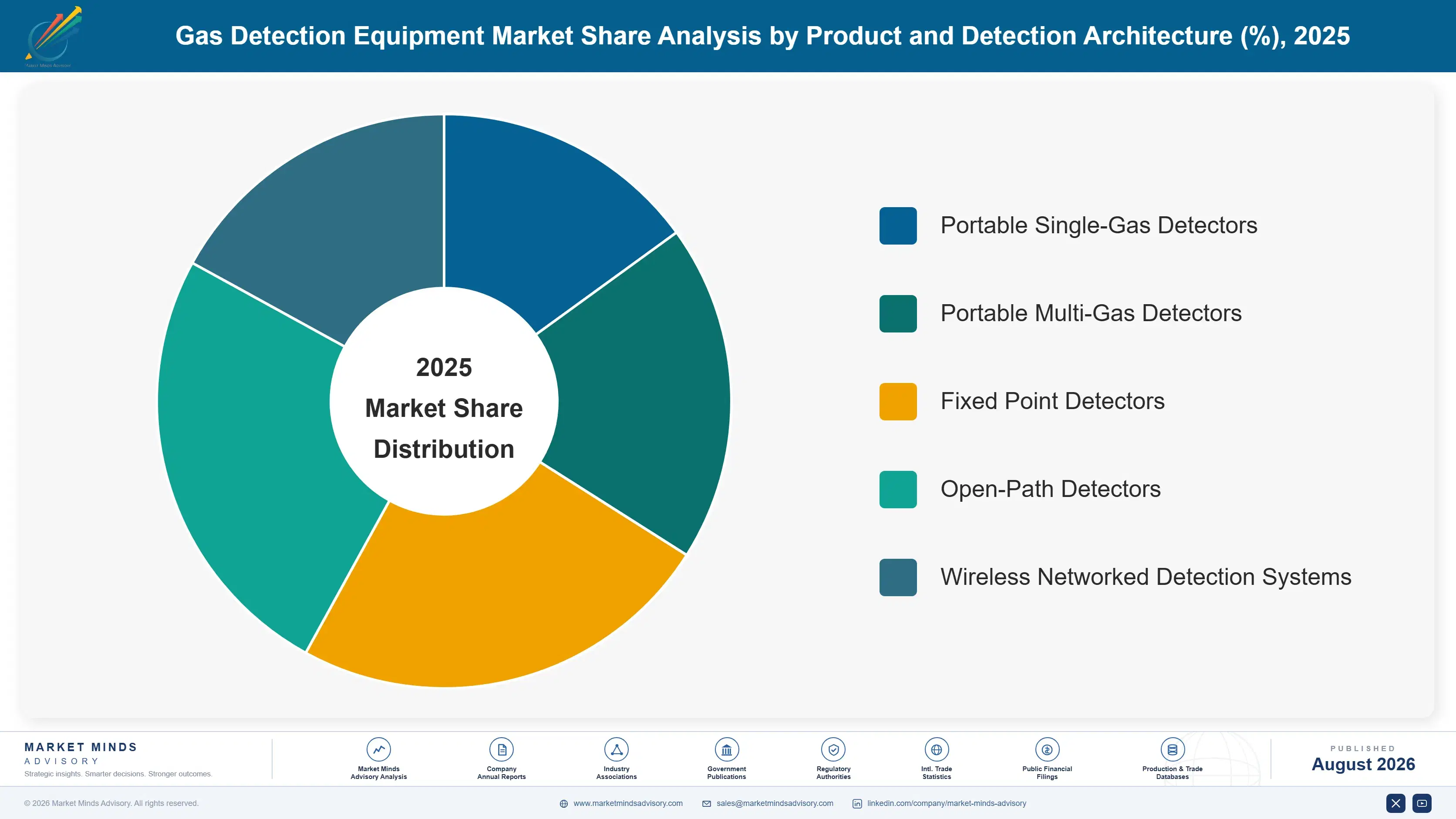
Segmentation follows product and detection architecture, the single dimension buyers actually specify against when writing a purchase order. Portable single gas and multi gas units serve worker level protection, while fixed point, open path, and wireless networked systems serve area and perimeter monitoring across industrial sites, keeping upstream sensor technology and downstream software or services in separate dimensions entirely.
gas-detection-equipment-market-market-share-analysis-1787302256374

Wireless Networked Detection Systems

Wireless networked systems link fixed and portable detectors into a single mesh reporting to a central dashboard, eliminating much of the cabling cost that historically limited fixed point coverage. Adoption is concentrated in brownfield refinery and LNG retrofits and in new battery and semiconductor fabs specifying connected safety from commissioning. Growth outpaces the broader market by roughly 1.4x as insurers begin discounting premiums for continuously monitored, digitally logged sites, giving facility owners a direct financial incentive beyond regulatory compliance alone. Vendors are racing to certify gateway hardware against multiple wireless protocols since large industrial customers increasingly require interoperability with existing plant network infrastructure rather than a single proprietary mesh standard tied to one supplier.
CAGR 9.8%

Portable Multi-Gas Detectors

Portable multi gas detectors, typically monitoring four gases simultaneously, remain the largest single purchase category for confined space entry and turnaround work crews. Demand is shifting from basic four gas units toward models with integrated wireless check in and man down alerting, which command a meaningful price premium over analog predecessors. Contractors servicing multiple client sites favor rental fleets over ownership, a channel shift that is reshaping how vendors structure service agreements and calibration bundling. Growth is fastest among midstream pipeline operators and specialty chemical processors expanding confined space work scopes, both of which are increasing crew headcounts faster than their existing detector fleets can absorb without incremental purchases across the next several budget cycles.
CAGR 7.5%
Full segment breakdown across 5 segments available in the complete report.

Regional Architecture and Country Demand Map

East Asia leads on installed base growth as chemical park safety mandates and new battery and semiconductor capacity drive fixed system orders, while North America retains a large absolute revenue base on entrenched oil and gas and LNG compliance spend across its established process industry footprint.

North America

Entrenched petrochemical, LNG, and shale gathering infrastructure keeps North America the largest single revenue base even as its growth rate cedes the regional lead to East Asia. OSHA confined space enforcement and insurer driven monitoring requirements sustain steady fixed and wireless network upgrades across the Gulf Coast. Canadian oil sands operators are adding perimeter open path detection around tailings and processing areas, while United States battery gigafactory construction, concentrated in the Southeast and Midwest, is generating a fresh wave of cleanroom and storage area fixed point orders that did not exist in the prior capital cycle, keeping absolute order volume high despite a maturing base rate of replacement demand across older refining assets.
Share: 26% | CAGR: 6.9% (2026 to 2036)

Western Europe

Western Europe's growth trails the global rate as its process industry base matures and chemical capacity growth stalls relative to Asian competitors, though ATEX directive updates keep replacement demand steady across Germany, France, and the Benelux petrochemical corridor. German specialty chemical clusters are early adopters of wireless mesh retrofits, valuing the reduced downtime versus cabled installation during live plant operation. United Kingdom North Sea platforms continue replacing legacy fixed detectors under offshore safety case renewal cycles. Regional demand is increasingly concentrated in retrofit and replacement rather than new capacity, since few large greenfield chemical or refining projects are underway across the region relative to prior decades, a pattern distributors expect to persist through most of the forecast window.
Share: 20% | CAGR: 5.3% (2026 to 2036)
Regional intelligence for 5 additional markets available in the complete report: East Asia, South Asia and Pacific, Latin America, Middle East and Africa, Eastern Europe. Contact sales@marketmindsadvisory.com.
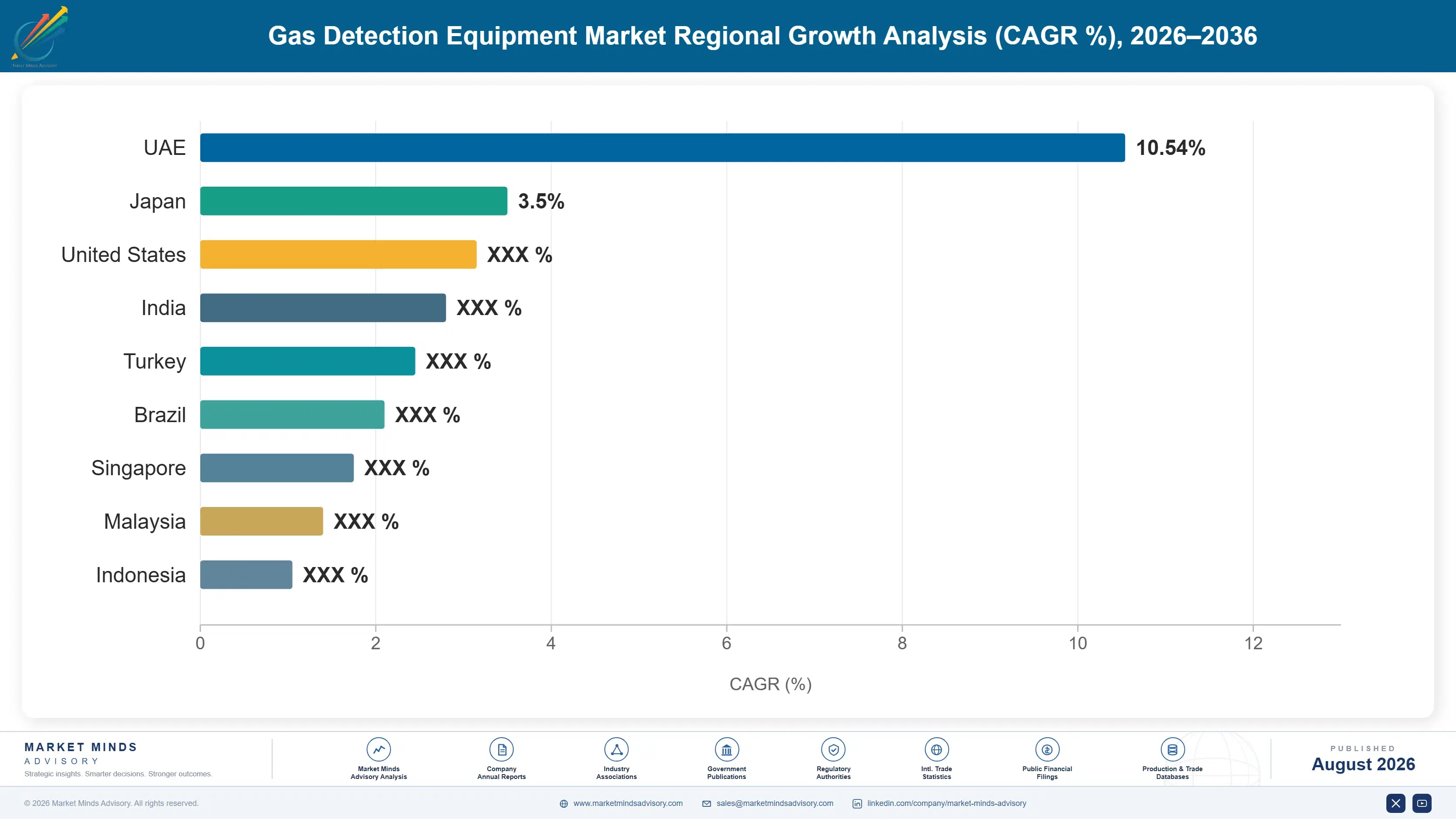
gas-detection-equipment-market-country-cagr-analysis-1787302256893

Converting Hardware Sales Into Recurring Safety Revenue

Vendors are restructuring commercial models around calibration, software, and rental revenue rather than one time hardware sales, since detector hardware margins continue compressing as electrochemical sensor costs fall industry wide and Asian import competition intensifies at the entry price tier, forcing a decisive move away from equipment-only economics toward services customers cannot easily replicate in house.

Calibration and Bump Test Service Contracts

Suppliers are bundling mandatory calibration and bump testing into multi year service contracts rather than selling detectors as standalone hardware, converting a previously fragmented maintenance task into predictable recurring revenue. Contracts typically run three to five years and include loaner units during service, which raises customer switching costs meaningfully once a fleet is enrolled. Early adopters among the top five suppliers report service attach rates above 55% on new wireless fleet sales, versus roughly 20% historically on standalone portable unit sales, reflecting how bundled contracts capture value hardware pricing alone increasingly cannot.
Market Impact: Lifts recurring revenue share to ro

Cloud Software and Fleet Analytics Subscriptions

Detector makers are layering cloud based fleet management software on top of hardware sales, charging per seat or per device subscription fees for calibration tracking, compliance reporting, and man down alerting dashboards. This shifts revenue from one time capital purchase to annual recurring software fees, improving visibility and smoothing the historically lumpy capital cycle nature of detector sales that once left suppliers guessing at next year's order book. Subscription attach is highest among large multi site accounts needing centralized reporting, and top vendors now report attach rates above 40% on new wireless fleet sales.
Market Impact: Adds $180 per unit in annual softwa

Rental and Managed Fleet Programmes for Contractors

Turnaround and maintenance contractors increasingly rent portable multi gas detectors rather than owning fleets outright, since rental shifts calibration and certification liability onto the supplier and avoids capital tie up between project cycles. Rental programmes typically bundle same day replacement for failed units, a service level that owned fleets rarely match without dedicated in house technician staff. Suppliers running large rental depots near refining and petrochemical hubs, often within a 2-hour service radius, are capturing share from smaller regional rental houses lacking wireless capable inventory, consolidating a previously fragmented market around a handful of national scale operators.
Market Impact: Grows rental revenue at 11% annuall

Data Integrity and Audit Readiness Add-Ons

Regulators in several jurisdictions are beginning to audit digital calibration logs directly rather than accepting paper certificates, and suppliers are monetizing this shift by selling tamper evident data logging and audit report generation as a premium software tier. Facilities preparing for insurer or regulator site visits pay a meaningful premium for one click audit packages that assemble calibration history, bump test records, and sensor replacement logs automatically. This add on carries close to zero marginal delivery cost once the underlying platform exists, making it a high margin layer suppliers are prioritizing across 2026 and 2027 product roadmaps.
Market Impact: Adds 4 to 6 points of software gros

Who Controls the Margin Pool

The top five suppliers hold roughly 38% combined share, a moderate concentration that leaves meaningful room for specialist sensor makers and regional distributors beneath them. The gap between the leading conglomerates and the next tier of challengers is widening, driven less by hardware performance than by which vendors have built credible wireless network and cloud software platforms rather than bolting connectivity onto legacy hardware lines.
Current competitive activity centers on three fronts: wireless protocol certification and interoperability claims, calibration service network density measured in technician coverage radius, and cloud software feature depth for compliance reporting. Several mid tier players are pursuing partnerships with industrial IoT platform vendors rather than building software in house, a faster but margin diluting route to feature parity with the leaders' proprietary platforms.

Emerging pressure comes from Asian sensor manufacturers moving up the value chain from commodity electrochemical cells into complete wireless capable housings sold directly to regional distributors at prices established players struggle to match. Rankings among the top five could shift over the next several years if any single leader fails to close its wireless software gap, since customers increasingly evaluate platform completeness ahead of individual sensor accuracy specifications during vendor selection.
gas-detection-equipment-market-company-positioning-matrix-1787302257414

Competitive Moat and Risk Dimensions

HONEYWELL INTERNATIONAL

Moat: Bundled platform breadth

Honeywell's combination of detection hardware, industrial cybersecurity, and process control software gives it a bundling advantage few specialists can match, particularly with large multi site accounts that prefer a single enterprise vendor relationship spanning safety and automation across geographically dispersed operations. Its channel reach also lets it set new plant engineering standards early.
HONEYWELL INTERNATIONAL

Risk: Slower specialist responsiveness

Scale and internal complexity slow Honeywell's response to niche application requests that smaller specialist vendors serve quickly, occasionally costing it accounts in specialized mining or marine segments where a dedicated regional vendor wins purely on faster service turnaround and local presence. That gap has begun costing it multi-year contracts.
DRÄGER

Moat: Deep calibration service network

Dräger's century long reputation in respiratory and gas detection, paired with an extensive certified calibration technician network across Europe and the Middle East, gives it strong incumbency in confined space and mining applications where service trust outweighs price sensitivity almost entirely. That trust compounds slowly and is difficult for challengers to replicate.
DRÄGER

Risk: Concentrated European cost base

A manufacturing and engineering base weighted toward Germany leaves Dräger more exposed to European labor cost inflation than competitors with diversified Asian production, pressuring margins as Chinese rivals undercut on portable unit pricing across export markets it has served for decades. That cost gap is unlikely to close within the next several years.

Players Tracked

Prominent Players

Honeywell International
Dräger
MSA Safety
Teledyne Technologies
Industrial Scientific

Other Key Players

Blackline Safety Corp
Crowcon Detection Instruments
RKI Instruments
Sensidyne LP
GfG Instrumentation
New Cosmos Electric
Riken Keiki
ESP Safety Inc
Bacharach Inc
Trolex Ltd
Dynament Ltd
AMETEK Process Instruments
Nevada Nanotech Systems
Emerson Electric
Xtralis

Recent Developments

NOVEMBER 2025

MSA Safety Acquires Wireless Sensor Startup

MSA Safety completed the acquisition of a privately held wireless gas sensor startup, adding low power mesh networking intellectual property to its fixed detection portfolio. The deal expands MSA's ability to offer factory integrated wireless nodes rather than aftermarket gateway retrofits, positioning it against Honeywell's bundled platform offering.
Signal: Signals continued platform consolidation a
MARCH 2026

Honeywell Launches Cloud Native Fleet Analytics Platform

Honeywell introduced a cloud native analytics platform unifying calibration tracking, man down alerting, and compliance reporting across its portable and fixed detector lines. The launch targets large multi site accounts seeking a single dashboard across previously fragmented fleets, cutting audit prep time in pilot trials.
Signal: Confirms software differentiation, not sen
JUNE 2026

Dräger Signs Multi-Year Supply Agreement With Gulf Refiner

Dräger signed a multi year supply and calibration service agreement with a major Gulf state refining operator covering fixed and wireless detector fleets across several downstream sites. The agreement, a supply arrangement rather than a joint venture or acquisition, secures recurring calibration revenue for Dräger.
Signal: Highlights service contract bundling as th

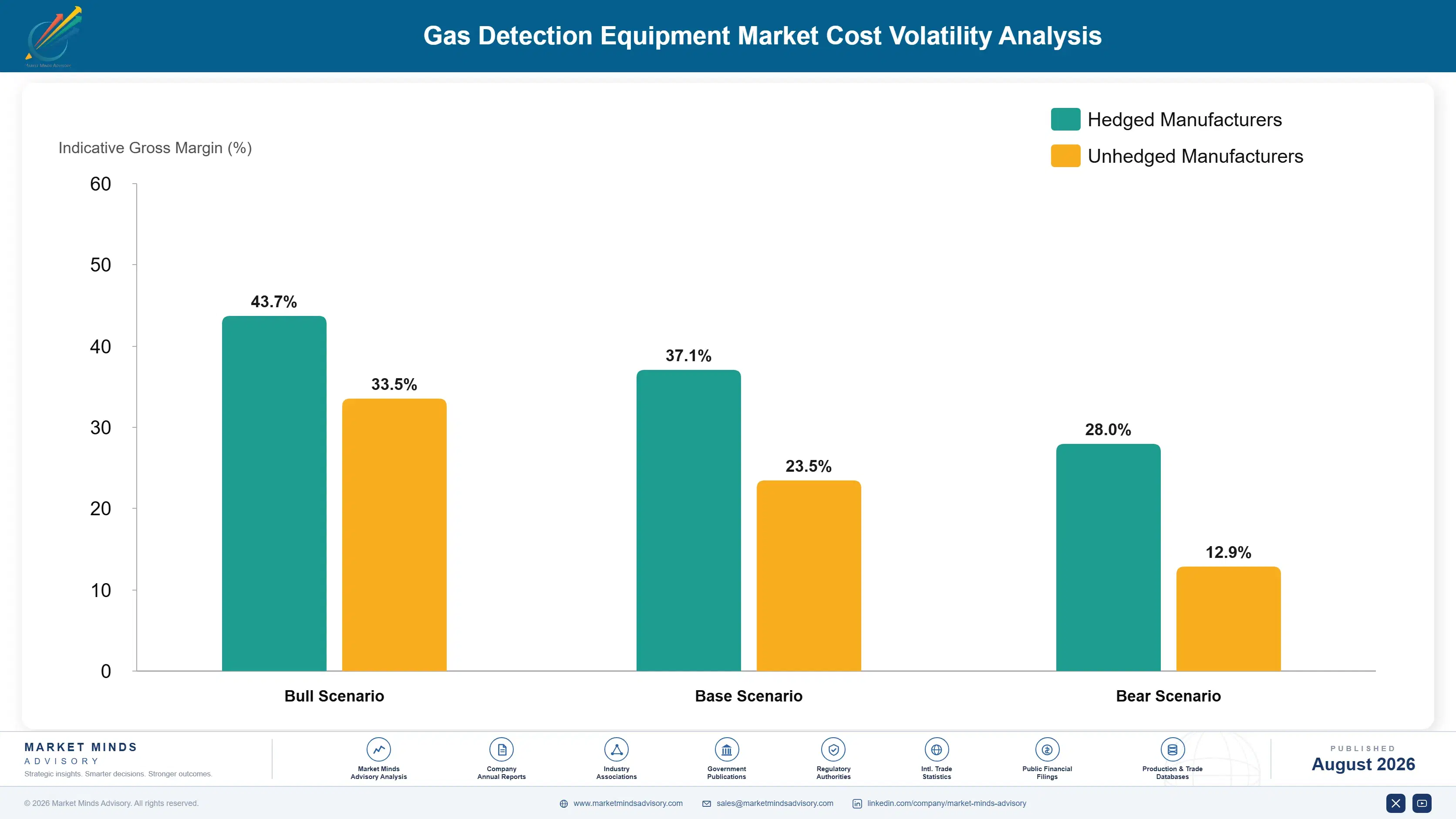
Sensor Cell and Electronics Component Exposure

Electrochemical and infrared sensor cells, along with printed circuit assemblies and wireless radio modules, together represent an estimated 45 to 55% of detector cost of goods sold. Precious metal catalysts used in electrochemical cells, primarily platinum and gold, are sourced through a small number of specialty refiners concentrated in Europe and East Asia, creating a narrow supply base relative to overall detector production volume.
Semiconductor component shortages during 2021 and 2022 delayed detector production broadly, and the IEA's subsequent critical materials reporting flagged platinum group metal supply concentration as an ongoing risk across multiple industrial sensor categories, not gas detection alone. Several vendors disclosed in annual reports that wireless radio module lead times stretched beyond twenty weeks during the shortage, forcing temporary reliance on higher cost secondary market components to maintain production schedules for contracted fixed network installations.

Smaller specialist vendors carry disproportionate exposure to these input swings since they lack the scale to negotiate multi year fixed pricing contracts that the top five suppliers secure directly with component manufacturers. This gap widens for vendors reliant on single source radio modules, leaving them vulnerable to margin compression during shortages that diversified competitors can absorb by shifting specifications across qualified suppliers.
gas-detection-equipment-market-cost-volatility-analysis-1787302257609

Multi-Sourcing Wireless Radio Modules

Leading vendors now qualify at least two radio module suppliers per product line, avoiding the single source exposure that stretched lead times to twenty weeks during the 2021 to 2022 shortage and protecting delivery commitments on multi year fixed network installation contracts signed with large industrial accounts, even when spot prices for radio components spike unexpectedly.

Long-Term Precious Metal Supply Contracts

Top five suppliers increasingly lock multi year pricing with specialty refiners for platinum and gold catalyst inputs, smoothing electrochemical sensor cell costs and insulating margin from the spot price volatility smaller specialist vendors remain exposed to directly across every purchasing cycle. This approach has already shielded margins during two separate catalyst price spikes since 2023, according to disclosed investor commentary.

Modular Housing Designs Across Sensor Types

Standardizing housings across electrochemical, catalytic bead, and infrared sensor variants lets manufacturers shift production toward whichever sensor technology has the most favorable component pricing in a given quarter without retooling entire assembly lines or requalifying finished products. The approach also shortens new product qualification timelines, letting one certified housing carry multiple sensor variants to market.

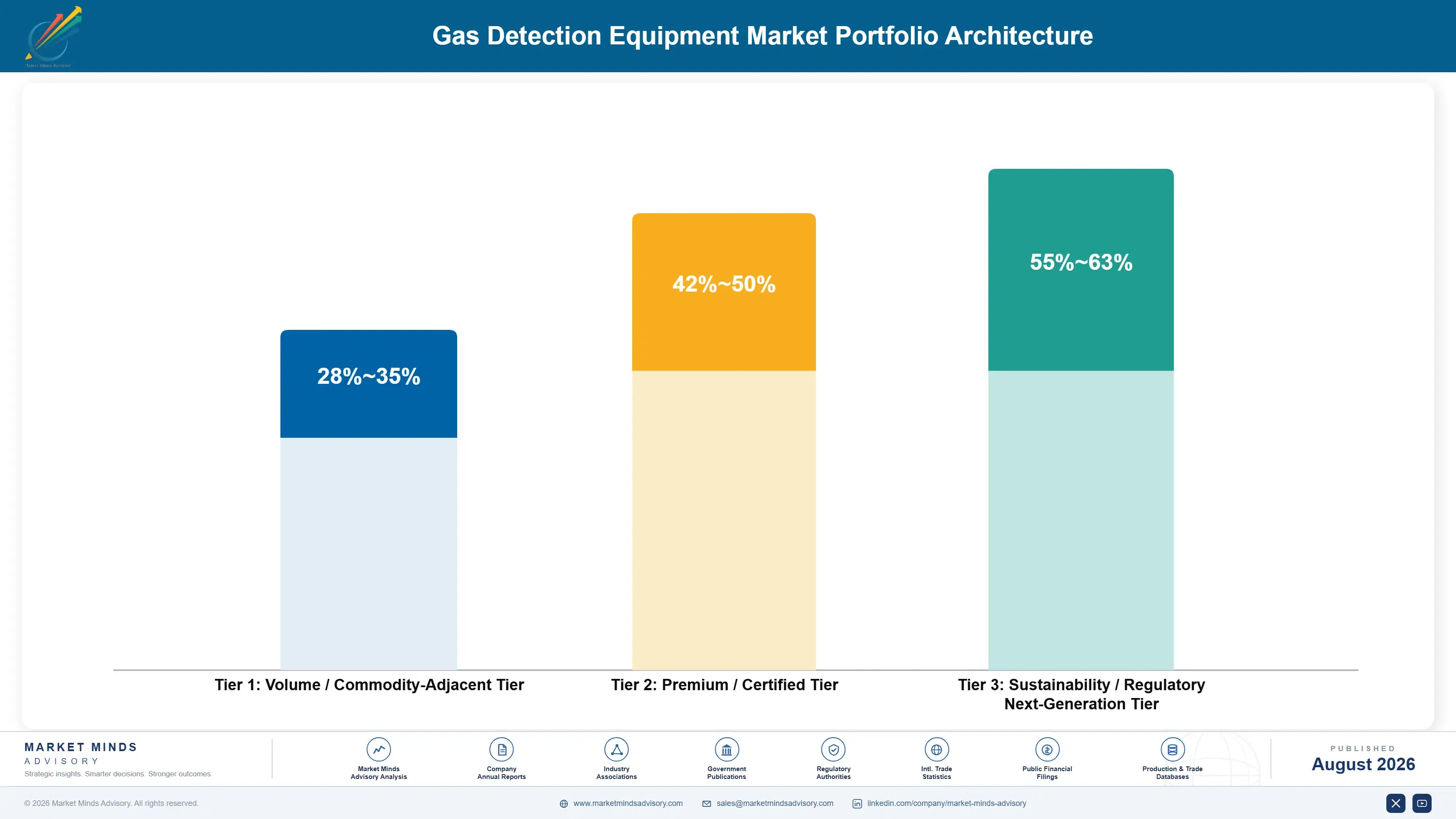
Portfolio Architecture for Margin Defence

Portfolio architecture splits across three tiers: volume priced single gas and basic multi gas portables competing largely on cost, certified premium units carrying intrinsic safety and marine certifications that command a durable price premium, and next generation wireless networked platforms bundled with software subscriptions. Gross margins widen meaningfully moving up this ladder as hardware commoditization pressure concentrates hardest at the volume tier, squeezing vendors without a credibl
The volume versus premium tension is sharpest in portable single gas detectors, where Asian import competition has compressed prices fastest, pushing established vendors to defend share through calibration service bundling rather than matching import pricing directly on hardware alone. Premium certified units retain pricing power because marine, mining, and hazardous area certifications carry meaningful requalification cost and time for buyers switching suppliers mid contract.

High value margin pools concentrate in wireless networked systems paired with cloud software subscriptions, where recurring revenue and high switching costs together support gross margins well above the portfolio average. Vendors are consequently prioritizing capital and engineering investment toward this tier even though it remains a minority of total unit volume shipped across the broader portfolio today, betting the mix shifts within the decade.

Volume / Commodity-Adjacent Tier

Basic single gas and entry level multi gas portables competing primarily on unit price against low cost Asian imports, with limited calibration service attach and thin per unit margins today.
Gross Margin: 28-35%

Premium / Certified Tier

Intrinsically safe, marine, and hazardous area certified units serving regulated confined space and offshore applications, where certification cost and switching friction support durable pricing power across most contract renewal cycles each year.
Gross Margin: 42-50%

Sustainability / Regulatory / Next-Generation Tier

Wireless networked platforms bundled with calibration and cloud compliance software, sold on recurring service revenue and audit ready data integrity value rather than hardware specification alone, across every deployment scenario going forward.
Gross Margin: 55-63%
gas-detection-equipment-market-portfolio-architecture-1787302258111

Calibration Contracts Anchor Recurring Demand

Detector economics function increasingly like an annuity once a fleet is installed, since mandated calibration, bump testing, and periodic sensor cell replacement generate recurring revenue for years after the initial hardware sale closes. This recurring layer now represents a growing share of total category revenue and is the primary reason suppliers compete aggressively on initial fleet placement even at thin hardware margins, treating the sale as a foothold rather than the event.
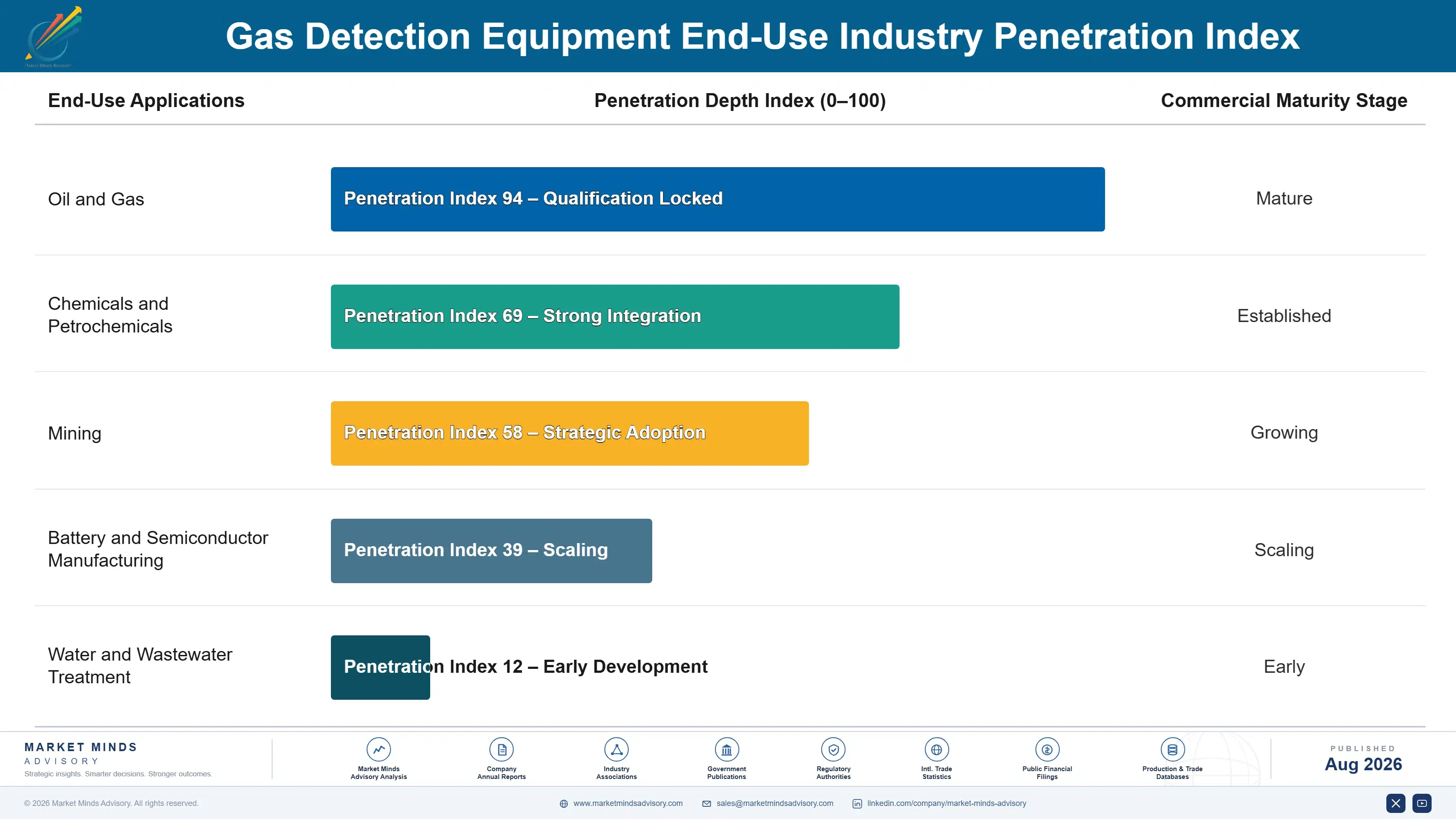
Adoption depth varies sharply by end use vertical. Oil and gas and chemical processing sites run near saturated fixed detection coverage and generate mostly replacement demand, while battery, semiconductor, and pharmaceutical manufacturing verticals are still building out first time coverage, generating a different mix of new installation revenue layered on top of the maturing replacement base across older industrial verticals nearing full instrumentation.

Buyer profiles are shifting generationally as EHS software administrators, often younger and more comfortable with cloud dashboards than traditional plant maintenance staff, increasingly influence vendor selection alongside safety engineers. This is accelerating demand for platforms with strong software usability even among buyers who historically evaluated detectors purely on sensor specification sheets and hardware certification credentials, a shift some legacy vendors are struggling to answer.
gas-detection-equipment-market-end-use-penetration-index-1787302258601

Where the Category Is Headed

These are among the four positions where our research anticipates prominent divergence between winners and laggards over the coming forecast period. Each is grounded in the demand model, the regulatory perimeter, and the announced capacity pipeline.
01 / PLATFORM AND SOFTWARE STRATEGY

Prioritize wireless mesh and cloud software over sensor accuracy claims

Sensor accuracy has become table stakes across certified suppliers, no longer a meaningful differentiator in vendor selection. Buyers now evaluate platform completeness, including wireless interoperability and audit ready software, ahead of marginal sensor performance gains that once justified a price premium on their own. Vendors that keep competing primarily on sensor specification sheets risk losing share to platform focused rivals bundling hardware, calibration service, and compliance software into one recurring revenue relationship that is far harder for a customer to unwind once enrolled.
02 / SERVICE AND RECURRING REVENUE

Shift commercial models toward calibration and software subscriptions

Hardware margins will keep compressing as Asian sensor imports gain share at the volume tier of the category, leaving little room for suppliers still pricing primarily around one time hardware sales. Suppliers that convert calibration, bump testing, and fleet analytics into contracted recurring revenue will outperform peers slower to make that shift. This also raises customer switching costs meaningfully, since replacing an enrolled service fleet requires displacing an entrenched, multi year calibration relationship rather than simply rebuying comparable hardware from a rival vendor.
03 / REGIONAL INVESTMENT PRIORITY

Weight investment toward East Asia and South Asia over mature markets

East Asia and South Asia are compounding faster than North America and Western Europe on both share and CAGR, driven by new chemical park mandates, fab construction, and first time factory safety statutes across previously unmonitored facilities. Vendors weighting sales and calibration service investment toward these regions ahead of competitors will capture a disproportionate share of first time installation revenue. Mature markets, running mostly on replacement cycles, simply cannot replicate that category of demand at comparable scale or growth rate.
04 / SUPPLY CHAIN RESILIENCE

Diversify radio module and precious metal sourcing now

The 2021 to 2022 component shortage demonstrated that single sourced wireless radio modules and concentrated precious metal catalyst supply chains can stretch lead times past twenty weeks during disruption. Vendors that have not since diversified qualified suppliers remain exposed to the next shortage cycle in a market where fixed network commissioning schedules for gigafactories and fabs carry contractual delivery penalties. That exposure raises the commercial cost of any repeat disruption meaningfully, particularly for smaller suppliers lacking scale to absorb a prolonged component squeeze.

Engagement Snapshot From the Field

A live engagement with an industry participant carrying material or product regulatory and market exposure ahead of a defining policy shift, showing how our research translates into a defensible multi-year portfolio strategy.
MARKET MINDS ADVISORY · CLIENT ENGAGEMENT SUMMARY
Gas Detection Equipment Producer Strategic Portfolio Review and Transition Roadmap 2026·Investment Scenario on Gas Detection Equipment Exposure Evaluation 2025-26
CLIENT PROFILE
The client operates a multinational specialty chemical business with production sites across North America, Western Europe, and East Asia, generating revenue in the low single digit billions (client-reported, unverified by MMA). Its gas detection fleet spanned three decades of legacy fixed point hardware from multiple vendors, managed through site level paper calibration logs with no centralized visibility for corporate EHS leadership.
STRATEGIC CHALLENGE
Following a near miss incident at one facility traced partly to an expired but undetected sensor calibration, corporate leadership sought a unified wireless detection and calibration tracking platform across all sites within eighteen months, while minimizing production downtime during retrofit at continuously operating chemical processing units running near capacity most of the year.
MMA APPROACH
MMA benchmarked five candidate vendors against wireless interoperability, calibration service network density, and total cost of ownership over a ten year horizon, then modeled retrofit sequencing to minimize simultaneous downtime across the client's highest risk sites during the phased wireless network installation programme spanning three continents, using a standardized weighted scorecard.
KEY FINDINGS
  1. Three of five vendors evaluated could not demonstrate audit ready digital calibration logs without manual data re-entry at the site level, even after repeated requests.
  2. Wireless retrofit reduced projected installation labor cost by 42% versus rewiring existing conduit at brownfield chemical processing sites (client-reported, unverified by MMA).
  3. Centralizing calibration tracking was projected to cut corporate audit preparation time by roughly a third across all seven priority sites, based on internal projections.
  4. Sites with the oldest sensor generations carried the highest near term compliance exposure, which reprioritized the client's original rollout sequence ahead of the original schedule.
CLIENT PROFILE
The client operates a multinational specialty chemical business with production sites across North America, Western Europe, and East Asia, generating revenue in the low single digit billions (client-reported, unverified by MMA). Its gas detection fleet spanned three decades of legacy fixed point hardware from multiple vendors, managed through site level paper calibration logs with no centralized visibility for corporate EHS leadership.
STRATEGIC CHALLENGE
Following a near miss incident at one facility traced partly to an expired but undetected sensor calibration, corporate leadership sought a unified wireless detection and calibration tracking platform across all sites within eighteen months, while minimizing production downtime during retrofit at continuously operating chemical processing units running near capacity most of the year.
MMA APPROACH
MMA benchmarked five candidate vendors against wireless interoperability, calibration service network density, and total cost of ownership over a ten year horizon, then modeled retrofit sequencing to minimize simultaneous downtime across the client's highest risk sites during the phased wireless network installation programme spanning three continents, using a standardized weighted scorecard.
KEY FINDINGS
  1. Three of five vendors evaluated could not demonstrate audit ready digital calibration logs without manual data re-entry at the site level, even after repeated requests.
  2. Wireless retrofit reduced projected installation labor cost by 42% versus rewiring existing conduit at brownfield chemical processing sites (client-reported, unverified by MMA).
  3. Centralizing calibration tracking was projected to cut corporate audit preparation time by roughly a third across all seven priority sites, based on internal projections.
  4. Sites with the oldest sensor generations carried the highest near term compliance exposure, which reprioritized the client's original rollout sequence ahead of the original schedule.
RECOMMENDED STRATEGY
Phase 1: Phase 1 (Months 1-6): Pilot wireless network retrofit at the two highest risk sites identified through incident and audit history review. Phase 2: Phase 2 (Months 7-14): Scale the validated wireless platform across remaining North American and European sites in risk priority order. Phase 3: Phase 3 (Months 15-18): Extend the platform to East Asian facilities and integrate all sites into a single corporate compliance dashboard.
OUTCOME
The client completed wireless retrofit across seven priority sites within the eighteen month window and reported a meaningful reduction in calibration compliance gaps identified during subsequent internal audits (client-reported, unverified by MMA). Corporate EHS leadership gained real time fleet visibility previously unavailable under the prior paper based system.

Frequently Asked Questions

Foundational context covering the market sizes, CAGR, scope, country, region and competition that inform every finding below. This section is provided to cover basics and most often pre-purchase conversations, answered from the MMA Primary Research Dataset.

What is the current size of the Gas Detection Equipment Market?

The global gas detection equipment market reached an estimated $3.8 billion in 2025. Growth is driven by tightening confined space regulation and a generational sensor replacement cycle across process industries.

How large will the Gas Detection Equipment Market be by 2036?

The market is projected to reach approximately $7.8 billion by 2036, roughly 1.93 times its 2026 value. Wireless networked systems and first time installations in emerging manufacturing hubs drive most of the added value.

What is the CAGR for the Gas Detection Equipment Market 2026 to 2036?

The base case CAGR is 6.8% through 2036. Bull and bear scenarios range from roughly 5.5% to 8.0%, depending on industrial capex cycles and regulatory timing.

Which segment is growing fastest?

Wireless networked detection systems lead at a 9.8% CAGR, about 1.4x the overall market rate. Growth is concentrated in brownfield retrofits and new battery and semiconductor fabrication sites.

Who are the major companies in the Gas Detection Equipment Market?

Honeywell International, Dräger, MSA Safety, Teledyne Technologies, and Industrial Scientific lead the category. Combined, the top five suppliers hold roughly 38% of global revenue today.

Which country is growing fastest?

India leads country level growth at an estimated 9.5% CAGR. New factory safety statutes following recent industrial accidents are driving first time installation across previously unmonitored facilities.

Report Segmentation Architecture

The full report scope spans multiple orthogonal segmentation dimensions, with cross-tabulated demand data provided for each dimension pair. Coverage extends further to regional breakdowns, trend trajectories, and the competitive detail needed to support segment-level decision-making.

By Product and Detection Architecture

  • Portable Single-Gas Detectors
  • Portable Multi-Gas Detectors
  • Fixed Point Detectors
  • Open-Path Detectors
  • Wireless Networked Detection Systems

By End-Use Industry

  • Oil and Gas
  • Chemicals and Petrochemicals
  • Mining
  • Battery and Semiconductor Manufacturing
  • Water and Wastewater Treatment

By Commercial Dimension

  • Direct Enterprise Sales
  • Distributor Channel Sales
  • Rental and Managed Fleet Programmes
  • Calibration Service Contracts

By Region

  • North America
  • Western Europe
  • East Asia
  • South Asia and Pacific
  • Latin America
  • Middle East and Africa
  • Eastern Europe

Scope, Methodology, and Coverage

Every figure in this report is reproducible from documented input assumptions. The scope below maps the historical period, the forecast horizon, the segmentation dimensions, and the countries covered, alongside the underlying primary and qualitative methodology.
Historical Period
2020 to 2025
Forecast Period
2026 to 2036
Base Year
2025 (USD billions; MMA Primary Research Dataset, August 2026)
Market Definition
The gas detection equipment market covers portable and fixed instruments, sensors, and controllers used to detect combustible, toxic, and oxygen deficiency hazards across industrial, commercial, and infrastructure settings. It includes single gas and multi gas portable units, fixed point and open path systems, and the wireless networking hardware linking them to central control rooms.
Quantitative Units
USD billions (current prices); unit shipment volume where disclosed
Segmentation Dimensions
By Product and Detection Architecture; By End-Use Industry; By Commercial Dimension; By Region
Regions Covered
North America, Western Europe, East Asia, South Asia and Pacific, Latin America, Middle East and Africa, Eastern Europe
Countries Covered
USA, China, Germany, France, UK, Japan, South Korea, India, Australia, Canada, Brazil, Mexico, Indonesia, Vietnam, Thailand, Malaysia, UAE, Saudi Arabia, South Africa, Nigeria, Turkey, Poland, Netherlands, Italy, Spain, Sweden, Switzerland, Argentina, Colombia, Singapore, and additional markets relevant to this sector
Key Companies Profiled
Honeywell International, Dräger, MSA Safety, Teledyne Technologies, Industrial Scientific, Blackline Safety Corp, Crowcon Detection Instruments, RKI Instruments, Sensidyne LP, GfG Instrumentation, New Cosmos Electric, Riken Keiki, ESP Safety Inc, Bacharach Inc, Trolex Ltd, Dynament Ltd, AMETEK Process Instruments, Nevada Nanotech Systems, Emerson Electric, Xtralis
Quantitative Methodology
Primary survey, n=3,800 respondents, Q4 2025, six countries; demand-side model with trade association cross-validation
Qualitative Methodology
47 expert interviews, Q4 2025; applied to validate demand model assumptions, identify emerging dynamics, and assess competitive positioning
Report Format
PDF and XLSX data workbook (Word format preview document)
Publisher
Market Minds Advisory
Report Code
MMA-2026-CON-101
Published
August 2026
Contact
sales@marketmindsadvisory.com | www.marketmindsadvisory.com

Purchase the full Gas Detection Equipment Market Report (2026 to 2036).

The full report delivers a complete quantitative and qualitative assessment of the global gas detection equipment market through 2036. It includes detailed segmentation by product architecture, end use industry, and commercial channel, alongside country level sizing across thirty markets covering every major industrial demand center. Competitive profiles cover twenty companies with capability, pricing, and service network benchmarking assessed on a consistent revenue basis. Buyers also receive access to the underlying primary survey and expert interview datasets referenced throughout the analysis, along with editable data tables.
Segment level CAGR and sizing tables
Regional and country level market breakdowns
Twenty company competitive profiles and benchmarks
Detailed wireless platform capability benchmarking matrix
Input cost and supply chain risk analysis
Primary survey and expert interview datasets

Built For The People Who Decide

From boardroom strategy to bench-side execution, this report is read cover-to-cover by leaders shaping the next decade of their industry, turning demand scenarios, market dynamics and valuation benchmarks into decisions.
CXOs/ Presidents/ VPs/ Managers
M&A and Corporate Development
Strategy Teams and R&D Heads
Procurement and Product Directors
Regulatory and Compliance Leaders
Investor Relations and Equity Analysts