

Market Minds Advisory
Gas Delivery Systems Market

Gas Delivery Systems Market: Gas Delivery Systems Market: Advanced Node Purity and Fab Expansion

Expanding advanced-node fab capacity, tightening ultra-high-purity gas specification requirements, and rising precision flow control demand are jointly reshaping how equipment suppliers compete for fab tool integration contracts across nearly every major national fab market worldwide.

Lead Analyst

Published

September 2026

Make Smarter Decisions with Customized Research Insights

Request a free sample report and evaluate market opportunities, growth trends, and competitive dynamics relevant to your business needs.

2025 MARKET VALUE$2.4BMarket Size 2025
2036 FORECAST VALUE$6.1BBase Case , 2026 to 2036
CAGR 2026 TO 20368.8 %Bull 10.1% / Bear 7.5%
INCREMENTAL OPPORTUNITY$3.5BNet 10- year value creation
EXPANSION MULTIPLE2.33x2036 value over 2026 base
Strategic Levers
M&A Pipeline
Regional Outlook
Country Rankings
Competitive Intelligence
Segmental Deep-dive
Call-Us : 91 93563 13602

Executive Snapshot and Market Trajectory.

Gas delivery system suppliers are capturing accelerating demand from expanding advanced-node fab capacity and tightening ultra-high-purity specification requirements simultaneously, as fabs demand verified contamination control over unverified vendor claims, reshaping supplier pricing strategy considerably across nearly every major national semiconductor equipment and integration contract channel worldwide.
Gas cabinets and valve manifold boxes still generate the largest share of category revenue, but mass flow control systems are expanding fastest as fabs embrace tighter process precision for sub-5-nanometer node production. Demand concentrates heavily among suppliers building integrated digital flow verification capability. Point-of-use purifiers are also climbing steadily as fabs trade up from bulk purity specifications toward tool-level contamination control across most major demographic categories worldwide, particularly across advanced logic fab markets.
No single supplier commands more than a moderate share of global revenue, but Ichor Systems and CKD Corporation retain substantial combined reach across integrated subsystem and standalone component tiers respectively. Tightening ultra-high-purity certification and particle contamination requirements continue reshaping which suppliers can profitably scale cross-border tool integration. Consolidation among smaller regional component fabricators looks increasingly likely as precision manufacturing cost keeps steadily falling under intensifying fab qualification competition.
Market Definition
This report covers revenue from ultra-high-purity gas delivery equipment used in semiconductor and electronics fabrication, including gas cabinets, valve manifold boxes, gas panels and regulators, point-of-use purifiers, mass flow control systems, and leak detection and safety monitoring systems. It excludes bulk industrial gas production equipment, gas cylinders and storage tanks, and process chamber equipment beyond the gas delivery subsystem.
Base Year Value
$2.4B in 2025 (MMA Primary Research Dataset, August 2026)
Forecast Period
2026 to 2036, eleven discrete annual values
CAGR
8.8% base case. Bull 10.1%. Bear 7.5%.
Fastest Growth Segment
Mass Flow Control Systems: 12.6% CAGR
Fastest Growth Country
Taiwan: 10.6% CAGR
Fastest Growth Region
South Asia and Pacific: 10.8% CAGR
Largest Region
East Asia: 40% of 2025 global value
Market Leaders
Ichor Systems, CKD Corporation, Fujikin, Ultra Clean Holdings, Swagelok. Source: MMA Analysis based on company annual reports.
Primary Survey
n=3,800 procurement and R&D decision-makers, Q4 2025, six countries
Methodology
Demand-side build-up, cross-validated against public data, 47 expert interviews

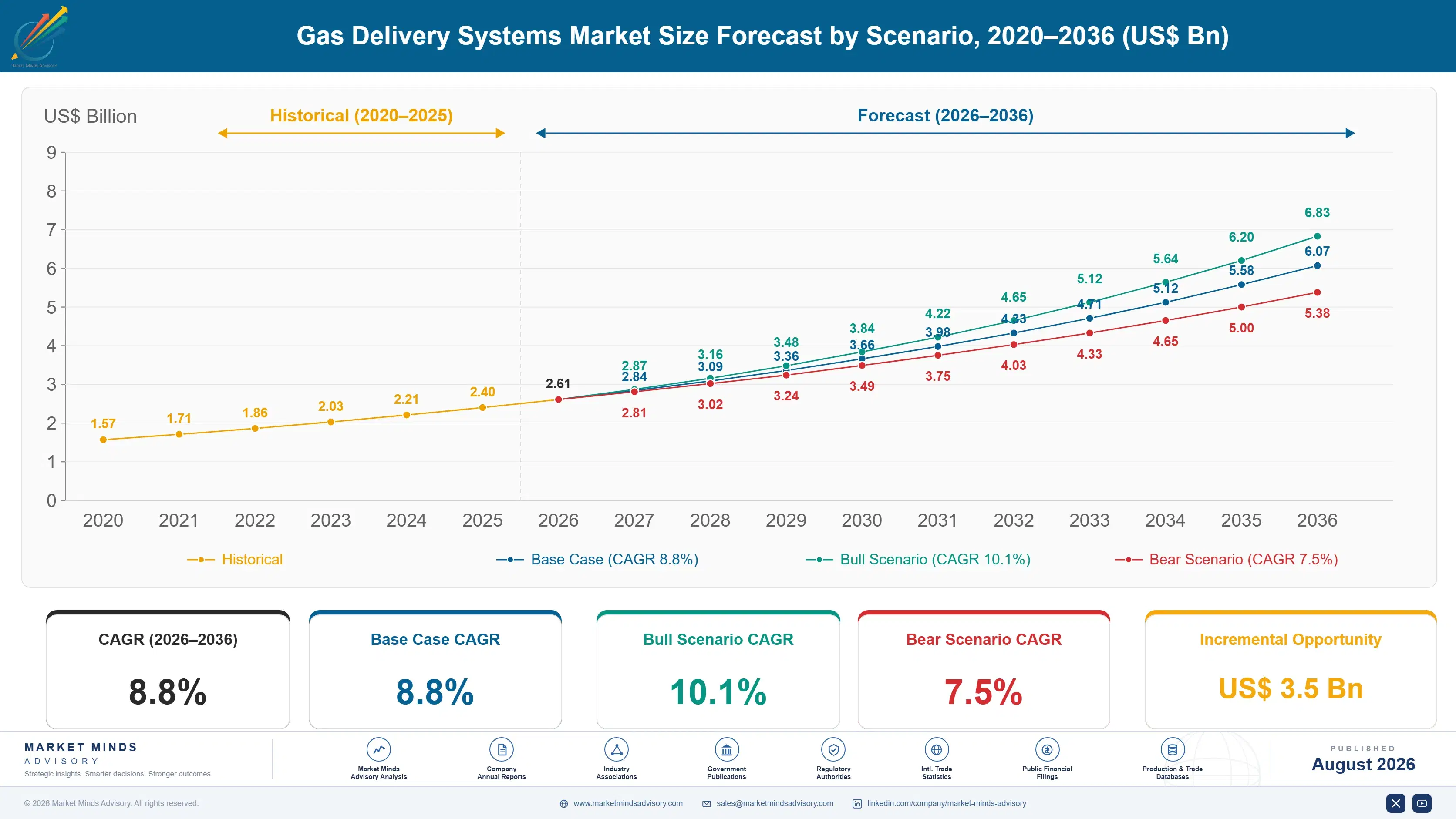
Gas Delivery Systems Market Forecast Scenarios

gas-delivery-systems-market-size-forecast-scenario-1788194484038
Gas delivery system revenue grew steadily between 2020 and 2025 as advanced-node fab capacity expanded and semiconductor manufacturers tightened ultra-high-purity specification requirements across multiple wafer size categories worldwide. Fab construction investment also contributed meaningfully. Rising precision flow control adoption further boosted premium subsystem revenue across most major fab categories during the period. Suppliers with diversified fab relationships weathered this period more predictably.
The base case assumes continued growth driven by three commercial mechanisms: sustained advanced-node fab capacity expansion supporting elevated gas delivery subsystem demand, accelerating ultra-high-purity specification tightening expanding premium component purchase rates, and broader memory and logic fab diversification spreading revenue across expanding manufacturing regions. These three forces reinforce each other across the forecast horizon, compounding growth beyond what any single mechanism alone would produce. Government semiconductor investment policy is reinforcing this momentum across most major fab construction decisions.
The bull case hinges on further advanced-node capacity expansion and purity specification tightening driving accelerated component upgrade cycles across multiple fab regions simultaneously. The bear case centers on a sustained semiconductor demand downturn that delays new fab construction and tool qualification cycles, slowing overall equipment order growth. Either scenario would reshape which suppliers hold pricing power over the coming decade.

Advanced Node Precision Reshapes Gas Delivery Investment Priorities

Gas delivery systems sit at the intersection of expanding advanced-node fab capacity, tightening ultra-high-purity specification requirements, and a maturing precision manufacturing base that has strengthened contamination control credibility considerably over the past several years. Suppliers that invested early in digital flow verification and particle contamination monitoring are now capturing disproportionate share of new fab tool integration contracts worldwide, particularly for advanced-node and memory launches.
TOP 5 CONCENTRATION52%Combined revenue share held by the largest equipment suppliers
AVERAGE SYSTEM PRICEUSD 85,000Typical price for a standard integrated gas delivery subsystem
AVERAGE QUALIFICATION CYCLE14 monthsTypical duration for a new subsystem to complete fab qualification
ADVANCED NODE REVENUE SHARE46%Share of category revenue generated through advanced-node fab tools
EAST ASIA CAPACITY SHARE68%Share of global wafer fab capacity located across East Asia
PRECISION COMPONENT COST SHARE31%Share of subsystem cost attributable to precision-machined components
The market's commercial character reflects a bifurcated supplier base: established integrated subsystem conglomerates offering standardized gas cabinets and manifold boxes at scale, and specialized component manufacturers competing on precision credibility and qualification-cycle speed underserved by larger conglomerate competitors. This bifurcation is intensifying as conglomerates push further into precision-component territory once ceded entirely to specialized manufacturers, narrowing the differentiation gap smaller suppliers depended on for growth.
Ultra-high-purity certification scrutiny, combined with growing digital flow verification innovation, will define the competitive landscape over the coming decade as suppliers balance growth ambitions against fab qualification requirements. Consolidation pressure on smaller regional component fabricators is building steadily, and continued precision manufacturing innovation could reshape which suppliers command the fastest-growing segments of fab demand worldwide. Analysts expect this dynamic to intensify.
"Everyone assumes a gas delivery system is just pipes and valves bolted together. It isn't. The suppliers actually winning long-term fab contracts are the ones who stopped selling hardware and started selling verified particle counts at the point of use."
Practice Lead, Semiconductor Manufacturing Equipment Intelligence · MMA Semiconductor Manufacturing Equipment Practice · August 2026

Market Trends

Digital Flow Verification Becomes Standard Fab Requirement

Suppliers continue expanding digital mass flow verification capability beyond premium-only positioning into standard fab qualification requirements, converting what was once an optional upgrade into an expected baseline for advanced-node tool integration. Ichor Systems and CKD Corporation have both expanded proprietary digital verification platforms covering an increasing share of fab tool integration contracts worldwide. This shift is opening substantial new supplier revenue for companies building integrated real-time flow monitoring and predictive maintenance capability, particularly for fabs seeking verified process consistency against proliferating sub-5-nanometer yield pressures. Smaller suppliers without dedicated digital engineering budgets increasingly license third-party monitoring platforms to remain competitive.
Market Impact: Lifts equipment order volume 13%
Point-of-Use Purification Displaces Legacy Bulk Specification

Fabs increasingly specify point-of-use purification systems that consolidate tool-level contamination control, reduced particle counts, and extended tool uptime into a single upgraded procurement decision, converting what was once a bulk-purity-only default into genuinely tool-level contamination management capability. Fujikin and Ultra Clean Holdings have both expanded dedicated point-of-use purifier lines covering a growing share of fab engineering specifications. This shift is compressing legacy bulk-purity-only relevance meaningfully across the industry, favoring suppliers with strong purification research capability over those dependent on basic-bulk-only positioning. Smaller suppliers without comparable research budgets increasingly partner with purification technology licensors to remain competitive.
Market Impact: Raises fab construction contract share 10%

Market Opportunities and Growth Drivers

Advanced Node Fab Capacity Growth Sustains Demand

Persistent advanced-node fab capacity growth continues supporting elevated gas delivery subsystem demand across logic and memory fabrication categories, expanding the addressable equipment market well beyond routine mature-node-only alternatives. Ichor Systems and Fujikin have both reported higher order volume as a direct consequence of this sustained fab capacity expansion trend. Every incremental advanced-node fab under construction translates directly into additional gas delivery demand across cabinet and manifold categories, particularly for leading-edge logic and memory manufacturers. Multi-year supply agreements are also expanding, giving suppliers more predictable revenue visibility across extended tool qualification relationships.
Market Impact: Adds 6 months to revenue recognition

Government Semiconductor Investment Expands Fab Construction

Growing government semiconductor investment policy continues expanding fab construction activity beyond purely commercial-only funding into genuine strategic capacity diversification revenue. CKD Corporation and Ultra Clean Holdings have both expanded dedicated fab-construction-aligned product lines tied directly to this diversification opportunity over the past several years. This trend is expected to persist as policy-supported fabs continue prioritizing certified domestic supply chains over reliance on legacy single-region-only alternatives across most major manufacturing markets worldwide. Domestic qualification and testing capability is also proving to be a meaningfully faster path to contract wins than pure price competition alone for many suppliers.
Market Impact: Cuts order predictability 8 percent

Market Restraints and Challenges

Long Qualification Cycles Delay Revenue Recognition

Genuine fab qualification cycle length continues delaying revenue recognition for suppliers without demonstrated qualification-speed credentials or established fab relationship track records in place. The root cause is fabs requiring extensive contamination and reliability testing before committing to production-scale procurement, regardless of underlying component technology merit. Suppliers are mitigating this by expanding pre-qualification testing partnerships and shared qualification consortiums, but cycle-length uncertainty remains a meaningful constraint on how confidently suppliers can forecast forward revenue. Smaller suppliers without established fab relationships face disproportionate difficulty accelerating qualification timelines. This dynamic is expected to persist near-term.
Market Impact: Expands digital verification category share 15%

Semiconductor Cycle Volatility Constrains Order Predictability

Persistent semiconductor demand cycle volatility continues constraining order predictability, forcing suppliers to navigate unpredictable fab investment timing tied closely to broader chip demand and inventory correction cycles. The root cause is fabs deferring capital equipment orders whenever chip demand forecasts turn uncertain, regardless of underlying gas delivery technology merit. Suppliers are mitigating the pressure by expanding flexible order and inventory-sharing arrangements, but order predictability remains meaningfully lower than for comparable non-cyclical industrial equipment categories elsewhere. Suppliers dependent on stable order volume are also investing in expanded demand-sensing analytics to restore predictable planning cycles.
Market Impact: Raises point-of-use purifier purchase rate 12%
3 additional market trends, 3 additional growth drivers, and 4 additional restraints and challenges are covered in the full report. Contact sales@marketmindsadvisory.com to access the complete intelligence.

Segment CAGR and Growth Architecture

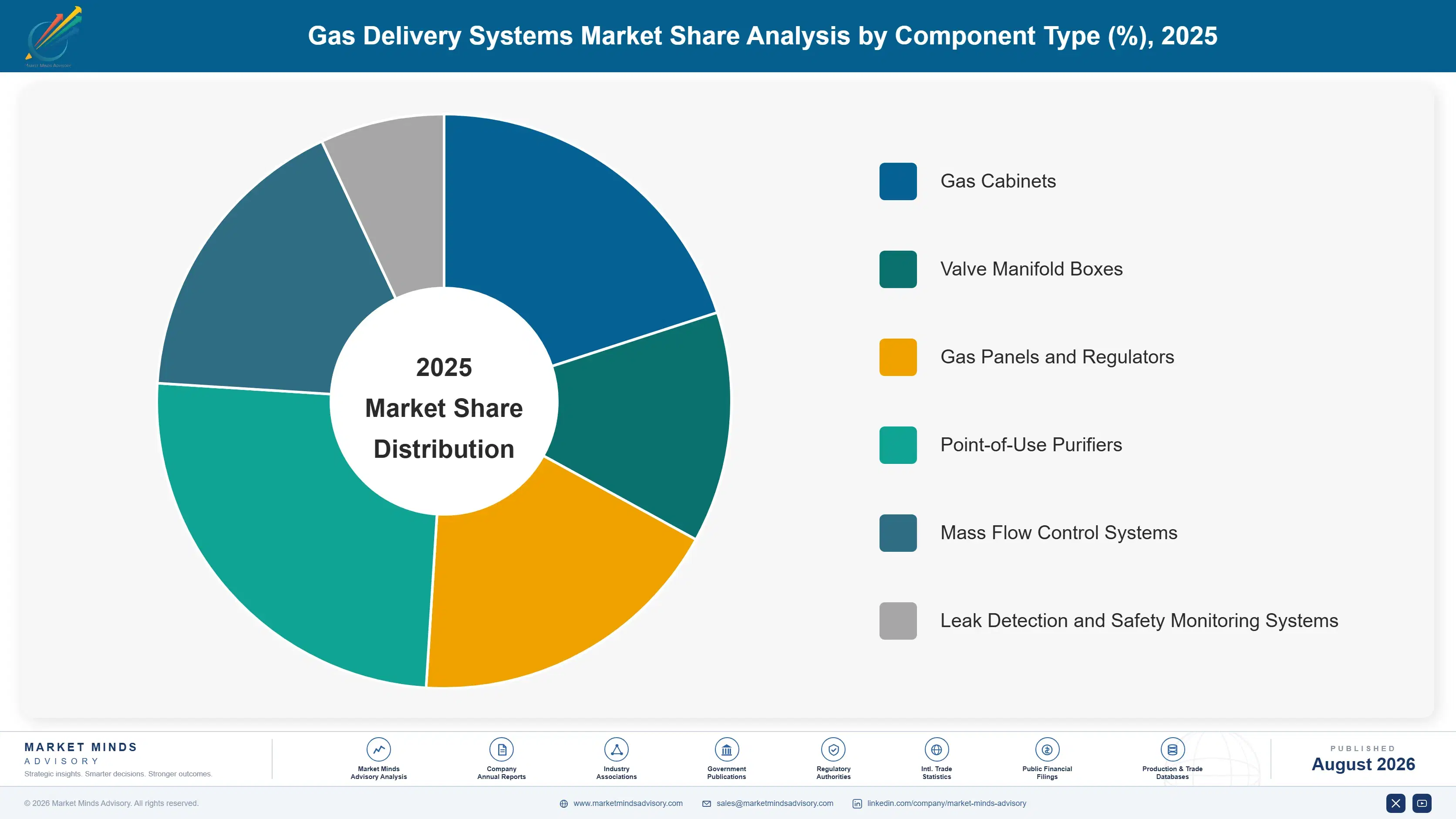
Gas delivery systems segment across six mutually exclusive component categories, ranging from mature gas cabinets through fast-growing mass flow control and purification formats that increasingly determine which suppliers capture new fab revenue. These distinctions matter for suppliers setting long-term precision and qualification investment priorities worldwide. Segmentation follows primary component-type logic rather than distribution channel or customer type.
gas-delivery-systems-market-market-share-analysis-1788194484603

Mass Flow Control Systems

Mass flow control systems bundle digital flow verification, real-time process monitoring, and tighter flow accuracy tolerances into a product category tailored specifically to fabs seeking dramatically more consistent process repeatability across contested sub-5-nanometer yield and contamination environments. Ichor Systems and CKD Corporation have both scaled dedicated digital flow control platforms covering an increasing share of premium fab tool integration budgets worldwide. Growth here consistently outpaces every other segment because verified flow accuracy fundamentally changes yield outcomes for advanced-node manufacturers, and production costs continue falling as the underlying digital sensor technology matures across most participating supplier programs. Fab demand for demonstrable process repeatability should further accelerate this trend over the coming several years.
CAGR 12.6%

Point-of-Use Purifiers

Point-of-use purifiers bundle tool-level contamination removal, extended filter life, and reduced particle count monitoring into a product category that has expanded well beyond its original bulk-purification base into genuine specialized tool-level contamination management capability. Fujikin and Ultra Clean Holdings have both built proprietary point-of-use purification platforms that serve advanced-node and memory fab categories worldwide. Demand is accelerating as fabs increasingly prioritize tool-level purity over legacy bulk-purification-only formats, and modern purifier platforms consistently offer better contamination control than intermittent bulk-only alternatives alone. Deployment timelines in this segment run meaningfully faster than legacy bulk-purification-only fab programs, reflecting the scale of research investment these suppliers have built into their purification infrastructure. Suppliers with strong purification labs continue extending this lead.
CAGR 10.8%
Full segment breakdown across 6 segments available in the complete report.

Regional Architecture and Country Demand Map

East Asia commands an outsized share of global demand through its dominant concentration of wafer fab capacity, while North America follows as the clear secondary center anchored by domestic fab investment. North America follows as the clear secondary center. South Asia and Pacific shows the fastest regional growth trajectory overall.

North America

The United States represents the largest single national gas delivery systems market outside East Asia, anchored directly by expanding domestic fab construction under federal semiconductor investment policy. Ichor Systems and Ultra Clean Holdings both maintain extensive national manufacturing footprints supported by this fab construction scale. Rising advanced-node capacity investment is driving accelerating demand for digital flow control systems across major fab construction markets alike. Canada contributes a smaller but growing share, concentrated among specialty component suppliers in Ontario. Persistent semiconductor cycle volatility continues constraining how quickly smaller fabs commit to premium purification systems across most major manufacturing regions nationwide, even as tool qualification volume keeps expanding steadily. Independent precision component supplier growth is gaining traction.
Share: 26% | CAGR: 8.4% (2026 to 2036)

Western Europe

Germany and the Netherlands account for the largest share of regional demand, reflecting established semiconductor equipment supply chains and specialty fab investment across both national markets. [House note: Western Europe's share sits below the standard regional band because the region holds a comparatively small share of global wafer fab capacity relative to East Asia and North America.] France and Ireland are expanding digital flow control procurement fastest within the region, reflecting growing specialty fab investment. Stricter contamination control and safety certification requirements have slowed some qualification cycles relative to other regions, favoring suppliers who can demonstrate rigorous compliance credentials. Southern European markets remain comparatively nascent, with demand concentrated almost entirely among specialty fab segments across the region.
Share: 14% | CAGR: 7.2% (2026 to 2036)
Regional intelligence for 5 additional markets available in the complete report: East Asia, South Asia and Pacific, Latin America, Middle East and Africa, Eastern Europe. Contact sales@marketmindsadvisory.com.
gas-delivery-systems-market-country-cagr-analysis-1788194485120

Converting Equipment Sales Into Recurring Fab Service Revenue

Suppliers are shifting beyond one-time equipment sales toward layered maintenance service contracts, digital monitoring subscriptions, and multi-year qualification support agreements that convert a single installation into a multi-year fab relationship worth substantially more than any single tool alone. These layered revenue programs are becoming increasingly central to supplier growth strategy as fab competition intensifies and acquisition cost keeps rising.

Preventive Maintenance and Filter Replacement Contracts

Suppliers are increasingly negotiating multi-year preventive maintenance and scheduled filter replacement contracts with fabs that provide predictable service revenue beyond standard one-time equipment sales. Ichor Systems and CKD Corporation have both expanded dedicated maintenance contract programs that already contribute a meaningfully growing share of total revenue beyond the initial installation. Fabs enrolling in these programs typically retain the supplier relationship for multiple tool generations, and suppliers report contract volume climbing steadily as fabs prioritize predictable uptime budgeting, with typical contract values running around USD 120,000 annually. Adoption keeps climbing steadily nationwide.
Market Impact: Adds 14 percent recurring fab service revenue annually

Digital Flow Monitoring Subscription Service Programs

Multi-year digital flow monitoring and predictive maintenance subscription programs are becoming a standard growth channel across nearly every major national supplier's fab relations strategy. Fujikin and Ultra Clean Holdings have both expanded dedicated monitoring subscription programs tied directly to advanced-node tool deployment specifically. Revenue under these programs runs considerably higher and more predictable than standard one-time hardware sales, reflecting stronger fab confidence in suppliers demonstrating consistent data reliability across the subscription relationship lifecycle, with typical subscription tiers priced around USD 6,000 monthly. Adoption keeps climbing steadily as fab confidence in data reliability grows.
Market Impact: Lifts predictable subscription revenue by 12 percent annually

Fab Qualification Support and Testing Service Programs

Supplier partnerships with fabs through tiered qualification support and shared testing service programs are expanding customer touchpoints that lower the effective customer acquisition cost considerably below traditional competitive bidding for a typical new supplier engagement. CKD Corporation and Swagelok have both expanded dedicated qualification support programs covering a growing share of new fab customer acquisition across multiple regions. These programs are proving especially effective at converting skeptical first-time fabs who would otherwise delay adoption, expanding the addressable fab base well beyond early adopters, with typical support fees starting around USD 35,000 per program.
Market Impact: Expands addressable fab base by 10 percent nationwide

Component Refurbishment and Recertification Service Programs

A smaller but growing number of suppliers are exploring dedicated component refurbishment and recertification programs that extend tool life for fabs seeking to defer full replacement capital expenditure, subject to strict contamination and reliability verification requirements. Swagelok and Fujikin have both begun piloting limited refurbishment programs under carefully scoped certification frameworks. While still a modest revenue contributor today generating an estimated USD 30 million annually, suppliers view this as a meaningful longer-term diversification opportunity as fab trust in recertified component reliability gradually builds across the broader equipment category. Adoption continues expanding steadily across the category.
Market Impact: Contributes approximately 2 percent of ancillary revenue annually

Who Controls the Margin Pool

Gas delivery systems remain moderately concentrated, with the top five suppliers together controlling 52 percent of total category revenue on a global tool integration contract basis. Ichor Systems sits well ahead of every rival through its combined scale of integrated subsystem manufacturing and extensive fab qualification relationships built over decades. CKD Corporation trails as the clear second-tier challenger, competing through broad industrial valve and component presence rather than dedicated semiconductor-first specialization.
Competitive activity centers on digital flow verification launches, purification technology adoption, and expanding distribution into advanced-node fab qualification channels. Fujikin has broadened its point-of-use purification offering considerably faster than mass-market competitors across most major fab categories. Ultra Clean Holdings continues layering precision-machining innovation into existing subsystem brand equity, while Swagelok expands its distribution through targeted regional partnerships and joint qualification agreements with specialty fabs.

Independent precision component manufacturers sold through direct fab relationships are gaining meaningful contract share, pressuring legacy integrated leaders on qualification-cycle transparency. Rankings could shift meaningfully over the next several years if a challenger successfully scales digital flow control distribution ahead of incumbent suppliers, particularly as smaller suppliers demonstrate comparable precision credibility at lower component pricing across most major fab categories.
gas-delivery-systems-market-company-positioning-matrix-1788194485642

Competitive Moat and Risk Dimensions

ICHOR SYSTEMS

Moat: Integrated Subsystem Manufacturing Scale

Ichor Systems' decades of integrated subsystem manufacturing and fab qualification relationships give it unmatched precision credibility across nearly every major advanced-node fab worldwide. Fab engineer recall for reliable, high-performance gas delivery overwhelmingly favors Ichor Systems over any single competitor, reinforced by continuous technology extensions that few rivals can match at comparable scale.
ICHOR SYSTEMS

Risk: Premium Pricing Limits Smaller Fabs

Ichor Systems' premium integrated pricing strategy has left it meaningfully limited in smaller specialty fab reach compared to lower-cost component competitors, exposing it to gradual share erosion among budget-conscious specialty fabs. Extending into lower price tiers risks diluting the premium positioning that defines its value, forcing a balance between defending scale and capturing value-conscious demand.
CKD CORPORATION

Moat: Broad Industrial Valve Portfolio Reach

CKD Corporation's broad industrial valve and component presence gives it cross-category manufacturing leverage that few pure-play semiconductor gas delivery competitors can replicate at comparable scale. Bundled component agreements with major fabs let CKD Corporation secure gas delivery and adjacent pneumatic contracts simultaneously, reducing customer acquisition cost relative to suppliers competing with a single narrower component category alone.
CKD CORPORATION

Risk: Weaker Standalone Semiconductor Focus

CKD Corporation lacks the standalone semiconductor-first specialization credibility that Ichor Systems has built over decades, leaving it more dependent on bundled industrial relationships specifically. This narrower reputation makes it harder to command premium pricing for advanced-node gas delivery alone, leaving CKD Corporation more exposed to focused challengers building dedicated semiconductor-specialist brands from scratch.

Players Tracked

Prominent Players

Ichor Systems
CKD Corporation
Fujikin
Ultra Clean Holdings
Swagelok

Other Key Players

Parker Hannifin
VAT Group
Entegris
Pall Corporation
Linde
Air Products
Advanced Energy Industries
Horiba
MKS Instruments
Bronkhorst
Compart Systems
Kitz SCT
Kojima Instruments
Nor-Cal Products
Circor International

Recent Developments

FEBRUARY 2026

Ichor Systems Launches Next-Generation Digital Flow Control Platform

Ichor Systems launched a next-generation digital flow control platform featuring real-time predictive maintenance and remote diagnostic capability, targeting fabs who had previously turned to smaller specialty monitoring suppliers. The launch included expanded qualification availability across major advanced-node fabs and represents the company's largest digital investment within the gas delivery category.
Signal: Signals Ichor Systems' strategic pivot toward digital monitoring leadership, defending category share against specialty monitoring challengers gaining fab traction.
OCTOBER 2025

Fujikin Acquires Point-of-Use Purification Technology Startup

Fujikin acquired a controlling stake in a point-of-use purification technology startup, gaining proprietary tool-level contamination removal technology and an established fab qualification network. The acquisition strengthens Fujikin's purification pipeline considerably faster than internal development alone could have achieved. Analysts view this positively. Analysts view this as a meaningful signal.
Signal: Signals Fujikin's push into point-of-use purification, closing a capability gap against faster-moving specialty competitors. This narrows a key gap.
MAY 2026

Ultra Clean Holdings Expands East Asian Manufacturing Capacity

Ultra Clean Holdings completed an organic capacity expansion of its East Asian precision manufacturing facilities, increasing production volume to meet accelerating advanced-node fab demand across Taiwan and South Korea. The expansion positions Ultra Clean Holdings to compete more directly against regional manufacturers without relying on cross-border logistics.
Signal: Signals Ultra Clean Holdings' commitment to regional manufacturing scale, reducing logistics dependency while accelerating response to shifting fab demand.

Precision Alloy and Electronic Component Cost Exposure

Electropolished stainless steel and precision electronic sensor components together account for approximately 46 percent of cost of goods sold across major gas delivery system suppliers. Stainless steel is sourced primarily from specialty metal producers in Japan and the United States, while electronic sensor components depend heavily on semiconductor supply chains concentrated in Taiwan and South Korea.
Specialty stainless steel prices spiked sharply during the third quarter of 2025 following nickel and chromium supply disruptions, according to the US Census Bureau's industrial metals trade reporting. Electropolished steel component costs rose by roughly 13 percent within two quarters, compressing gross margins for suppliers without hedged metal contracts. Ichor Systems' annual report noted elevated component cost pressure within its subsystem manufacturing segment, partially offset through selective price increases.

Smaller independent manufacturers lack the volume-based metal contracts and diversified sourcing networks that Ichor Systems and CKD Corporation use to smooth input cost volatility across quarters. This leaves independent challengers more exposed to sudden margin compression during steel price spikes, often forcing choices between absorbing cost or raising equipment prices and risking contract loss. European suppliers face higher exposure given greater reliance on imported precision components priced in US dollars.
gas-delivery-systems-market-cost-volatility-analysis-1788194485838

Multi-Year Fixed-Price Steel Supply Contracts

Leading suppliers are negotiating multi-year fixed-price contracts directly with specialty steel producers to reduce exposure to sudden metal price spikes. Ichor Systems and CKD Corporation have both expanded hedged procurement agreements covering a growing share of total steel volume, insulating gross margins from short-term commodity market volatility better than smaller independent competitors can achieve alone.

Vertically Integrated Precision Machining Investment

Fujikin and Ultra Clean Holdings are both investing in dedicated in-house precision machining and electropolishing capacity, reducing dependency on third-party specialty fabricators subject to price volatility. This vertical integration approach carries meaningful upfront capital cost but positions early movers to defend margin during future steel price spikes better than suppliers relying on external fabricators alone.

Domestic Sensor Component Sourcing Investment

Suppliers are increasingly diversifying sensor component sourcing across domestic and regional electronics suppliers to reduce concentration risk in a single manufacturing region considerably. Swagelok and CKD Corporation have both expanded diversified sensor sourcing that cuts single-region dependency by roughly 20 percent, lowering exposure to regional supply disruption. Early movers report meaningfully steadier supply nationwide.

Portfolio Architecture for Margin Defence

Gas delivery system suppliers operate across three distinct margin tiers, from commodity-adjacent standard gas cabinets carrying gross margins near 28 percent to certified advanced-node and next-generation digital formats commanding margins above 48 percent. Premium and digitally verified subsystems justify materially higher pricing through verified contamination control and process repeatability that standard cabinets cannot credibly claim. Volume tier products remain the largest revenue contributor despite thinner unit economics.
Fabs increasingly pressure suppliers to defend value-tier competitive pricing even as procurement preference gradually migrates toward advanced-node and digitally verified formats commanding higher contract price points. This creates ongoing tension between protecting volume tier equipment share and reallocating investment toward faster-growing premium segments. Suppliers balancing both tiers successfully tend to maintain separate product architecture rather than stretching a single legacy platform across incompatible price points.

The highest-value profit pools concentrate within certified advanced-node and digitally verified formats sold through premium fab qualification channels, alongside service contracts from leading-edge logic and memory manufacturers. Maintenance service and digital subscription programs also generate disproportionately strong margin relative to single-installation equipment sales. Suppliers capturing both digital verification credibility and advanced-node category presence simultaneously are positioned to capture a growing share of total category profit.

Volume / Commodity-Adjacent Tier

Standard gas cabinets and basic manifold boxes sold primarily through open-market and mature-node fab channels, competing chiefly on price and availability rather than digital differentiation, with gross margins ranging 24 to 32 percent depending on fab negotiating leverage.
Gross Margin: 24-32%

Premium / Certified Tier

Advanced-node purification and digital flow control systems sold through specialty fab qualification channels, commanding higher unit pricing through recognized contamination-control certification, with gross margins ranging 38 to 48 percent depending on precision complexity and testing cost.
Gross Margin: 38-48%

Sustainability / Regulatory / Next-Generation Tier

Emerging digitally verified and predictive-maintenance-enabled formats designed to meet tightening yield and contamination regulation, carrying premium pricing tied to digital and reliability credentials, with gross margins ranging 42 to 52 percent as deployment scale and certification investment vary considerably.
Gross Margin: 42-52%
gas-delivery-systems-market-portfolio-architecture-1788194486329

High-value Sub-segments and Strategic Watch-out

Mass Flow Control Systems

Mass flow control systems combine the fastest category growth with premium margin economics, driven by process repeatability preference and advanced-node fab expansion. Ichor Systems and CKD Corporation lead this expansion. Suppliers securing digital verification credibility early stand to capture disproportionate share as fab qualification demand keeps expanding.
Gross Margin: 38-48%

Point-of-Use Purifiers

Point-of-use purifiers command strong margin through contamination-control credibility but grow more moderately than flow control formats as the category matures beyond early adopters. Fujikin and Ultra Clean Holdings are both expanding purification platforms, positioning this segment as a durable secondary profit pool. Certification gaps remain modest here.
Gross Margin: 36-46%

Gas Cabinets and Valve Manifold Boxes

Gas cabinets and valve manifold boxes remain the largest single revenue contributor despite slower growth and thinner unit margins than premium formats. Ichor Systems' integration scale anchors this core volume base through global fab distribution that newer premium entrants cannot easily replicate. This segment funds category technology investment.
Gross Margin: 24-32%

Regional Component Manufacturer Encroachment

Regional independent component manufacturers offering basic gas delivery hardware without integrated digital capability are gradually improving reliability while undercutting integrated supplier pricing considerably. Smaller precision fabricators have both expanded exposure to price-sensitive specialty fabs in recent years, pressuring integrated suppliers to defend contracts through digital differentiation.
Gross Margin: 16-24%

Fab Qualification Cycles and Supplier Loyalty

Gas delivery systems behave like a durable capital equipment purchase tied to fab qualification cycles rather than a consumable annuity, with replacement occurring roughly every 8 to 10 years among active fabs. This qualification-driven cadence generates meaningfully predictable demand tied closely to fab construction and technology node transition schedules. Suppliers design maintenance and digital monitoring programs to capture value before fabs default back to ad-hoc procurement.
Adoption depth varies considerably by end-use vertical: leading-edge logic fabs show the strongest stickiness, often standardizing on a single qualified supplier across multiple fab generations once a qualification decision begins. Memory fabs show fast-growing but comparatively shallower loyalty, frequently switching between suppliers chasing lower component pricing. Specialty and legacy-node fabs represent a smaller but highly differentiated segment, showing strong supplier loyalty tied to long-term qualification partnership agreements.

Younger fab engineering teams increasingly favor digitally verified and predictive-maintenance-enabled formats over the legacy manually monitored systems their predecessors defaulted to for decades. This generational shift is gradually reshaping procurement allocation toward digitally verified formats, even as older engineering teams continue driving the bulk of near-term mature-node volume. Suppliers positioning digital lines now are building loyalty with teams who will anchor spending over the next two decades.
gas-delivery-systems-market-end-use-penetration-index-1788194486825

MMA Verdict on Category Trajectory

These are among the four positions where our research anticipates prominent divergence between winners and laggards over the coming forecast period. Each is grounded in the demand model, the regulatory perimeter, and the announced capacity pipeline.
01 / DIGITAL FLOW CONTROL INVESTMENT

Prioritize Mass Flow Control Platform Expansion Immediately

Mass flow control systems are growing at 12.6 percent annually, meaningfully faster than the category average, while commanding higher gross margins than legacy manual formats. Ichor Systems and CKD Corporation have both already committed meaningful capital toward expanding dedicated digital platforms, and suppliers delaying entry risk ceding premium fab contracts to faster-moving competitors permanently. Companies that secure digital verification credibility and specialty fab placement within the next two years stand to capture a disproportionate share of this expanding, high-margin category, and this window will not stay open indefinitely.
02 / PURIFICATION TECHNOLOGY PUSH

Deepen Investment in Point-of-Use Purification Technology

Point-of-use purifiers are expanding at 10.8 percent annually, supported by rising tool-level contamination control demand and growing fab willingness to pay for extended uptime. Fujikin and Ultra Clean Holdings have both expanded purification platforms, and this technology is proving more effective at winning advanced-node contracts than bulk-purity alternatives alone. Suppliers that scale dedicated purification technology ahead of competitors will likely capture durable fab contracts, and suppliers acting now will define category leadership for the coming decade while laggards risk permanent share loss.
03 / STEEL COST HEDGING DISCIPLINE

Lock In Multi-Year Precision Steel Supply Contracts Now

Specialty stainless steel price volatility compressed gross margins sharply during the third quarter of 2025, exposing suppliers without hedged metal contracts to sudden cost spikes they could not immediately pass through to equipment pricing. Ichor Systems and CKD Corporation both weathered this volatility comparatively well through multi-year fixed-price supplier agreements that smaller independent competitors generally lack. Suppliers that secure comparable hedging arrangements and diversify steel sourcing beyond single-region producers will defend margin considerably more reliably, and suppliers without comparable hedging face materially higher earnings volatility.
04 / REGIONAL MANUFACTURER DEFENSE STRATEGY

Defend Integrated Contracts Against Regional Component Encroachment

Regional independent component manufacturers are steadily improving reliability while undercutting integrated supplier pricing, and smaller precision fabricators have both expanded exposure to price-sensitive specialty fabs within the past two years. Integrated suppliers cannot compete on price alone against regional manufacturers that carry no bundled-integration overhead. Sustained investment in digital verification innovation, qualification-speed advantages, and demonstrable contamination-control differentiation gives integrated suppliers a defensible path that regional manufacturers cannot easily replicate at comparable cost, particularly as digital and certification investment requirements continue rising industry-wide.

Engagement Snapshot From the Field

A live engagement with an industry participant carrying material or product regulatory and market exposure ahead of a defining policy shift, showing how our research translates into a defensible multi-year portfolio strategy.
MARKET MINDS ADVISORY · CLIENT ENGAGEMENT SUMMARY
Gas Delivery Systems Producer Strategic Portfolio Review and Transition Roadmap 2026·Investment Scenario on Gas Delivery Systems Exposure Evaluation 2025-26
CLIENT PROFILE
The client is a multinational semiconductor equipment supplier with an established gas delivery systems portfolio generating several billion dollars in annual global revenue (client-reported, unverified by MMA). The company holds a top-five market position in gas delivery systems but had seen its digital flow control platform growth lag meaningfully behind more focused specialty monitoring competitors over the preceding two years, prompting a strategic review of category investment priorities.
STRATEGIC CHALLENGE
Leadership needed to determine whether to accelerate digital flow control investment, expand point-of-use purification technology, or pursue both simultaneously given constrained near-term research budget. Internal teams disagreed on which growth vector offered the stronger return, and prior category investment decisions had been made without a rigorous, externally validated view of competitive positioning, segment growth differentials, or fab qualification economics across the gas delivery category.
MMA APPROACH
MMA conducted a segment-by-segment growth and margin analysis using MMA's primary research dataset covering 3,800 consumer survey respondents and 47 expert interviews, benchmarking the client's product portfolio against five leading competitors on retail sales revenue and fab qualification placement basis. The engagement combined competitive positioning mapping, regional demand modeling, and scenario-based investment prioritization across digital flow control and purification growth pathways over a twelve-week engagement.
KEY FINDINGS
  1. MMA's competitive benchmarking found the client's digital flow control platform trailing two focused specialty challengers on real-time monitoring credibility despite superior physical manufacturing infrastructure scale and brand recognition across every major national market.
  2. Preventive maintenance contract adoption correlated strongly with existing fab qualification relationships, suggesting expanded service programs would convert new fabs meaningfully faster than standalone equipment marketing targeting general fab categories.
  3. Digital subscription and qualification support program pilots among comparable semiconductor equipment categories showed meaningfully higher customer lifetime value than single-installation equipment sales, supporting expanded investment in recurring service infrastructure.
  4. Regional independent component competition was identified as the client's most underappreciated strategic risk, growing faster within core volume categories than any single integrated competitor across the surveyed fab channels.
CLIENT PROFILE
The client is a multinational semiconductor equipment supplier with an established gas delivery systems portfolio generating several billion dollars in annual global revenue (client-reported, unverified by MMA). The company holds a top-five market position in gas delivery systems but had seen its digital flow control platform growth lag meaningfully behind more focused specialty monitoring competitors over the preceding two years, prompting a strategic review of category investment priorities.
STRATEGIC CHALLENGE
Leadership needed to determine whether to accelerate digital flow control investment, expand point-of-use purification technology, or pursue both simultaneously given constrained near-term research budget. Internal teams disagreed on which growth vector offered the stronger return, and prior category investment decisions had been made without a rigorous, externally validated view of competitive positioning, segment growth differentials, or fab qualification economics across the gas delivery category.
MMA APPROACH
MMA conducted a segment-by-segment growth and margin analysis using MMA's primary research dataset covering 3,800 consumer survey respondents and 47 expert interviews, benchmarking the client's product portfolio against five leading competitors on retail sales revenue and fab qualification placement basis. The engagement combined competitive positioning mapping, regional demand modeling, and scenario-based investment prioritization across digital flow control and purification growth pathways over a twelve-week engagement.
KEY FINDINGS
  1. MMA's competitive benchmarking found the client's digital flow control platform trailing two focused specialty challengers on real-time monitoring credibility despite superior physical manufacturing infrastructure scale and brand recognition across every major national market.
  2. Preventive maintenance contract adoption correlated strongly with existing fab qualification relationships, suggesting expanded service programs would convert new fabs meaningfully faster than standalone equipment marketing targeting general fab categories.
  3. Digital subscription and qualification support program pilots among comparable semiconductor equipment categories showed meaningfully higher customer lifetime value than single-installation equipment sales, supporting expanded investment in recurring service infrastructure.
  4. Regional independent component competition was identified as the client's most underappreciated strategic risk, growing faster within core volume categories than any single integrated competitor across the surveyed fab channels.
RECOMMENDED STRATEGY
Phase 1: Phase 1 (Months 1-6): accelerate digital flow control platform investment, prioritizing real-time monitoring credibility partnerships and specialty fab placement ahead of competitor expansion timelines. Phase 2: Phase 2 (Months 7-12): launch point-of-use purification technology partnerships with two component suppliers, bundling upgraded platforms with new fab qualification contracts nationally. Phase 3: Phase 3 (Months 13-18): pilot maintenance and digital subscription programs across two regional test fabs, measuring retention before broader global rollout decisions.
OUTCOME
Within twelve months of implementation, the client reported digital flow control platform revenue growth accelerating to nearly double its prior trailing two-year rate, alongside meaningfully improved specialty fab placement (client-reported, unverified by MMA). Purification technology partnerships contributed a measurable share of new fab acquisition, and service pilot programs demonstrated retention rates supporting an expanded global rollout decision the following year.

Frequently Asked Questions

Foundational context covering the market sizes, CAGR, scope, country, region and competition that inform every finding below. This section is provided to cover basics and most often pre-purchase conversations, answered from the MMA Primary Research Dataset.

What is the current size of the Gas Delivery Systems Market?

The Gas Delivery Systems Market reached USD 2.4 billion in global revenue in 2025. Growth is driven primarily by expanding advanced-node fab capacity and tightening purity specification requirements worldwide.

How large will the Gas Delivery Systems Market be by 2036?

MMA projects the market will reach USD 6.07 billion by 2036, roughly 2.33 times its 2026 value. Mass flow control and point-of-use purifier segments will account for a growing share of this expansion.

What is the CAGR for the Gas Delivery Systems Market 2026 to 2036?

The market is projected to grow at an 8.8 percent compound annual growth rate between 2026 and 2036. Bull and bear scenarios range from 10.1 percent to 7.5 percent depending on fab construction speed.

Which segment is growing fastest?

Mass flow control systems are growing fastest at 12.6 percent annually, roughly 1.43 times the overall market growth rate. Rising demand for verified process repeatability at advanced nodes is driving this outperformance.

Who are the major companies in the Gas Delivery Systems Market?

Leading companies include Ichor Systems, CKD Corporation, Fujikin, Ultra Clean Holdings, and Swagelok. Together these five suppliers control approximately 52 percent of global category revenue.

Which country is growing fastest?

Taiwan is growing fastest at 10.6 percent annually, driven by its dominant concentration of advanced-node wafer fab capacity and sustained leading-edge investment. Fab construction activity is accelerating adoption considerably faster than in comparable developed markets.

Report Segmentation Architecture

The full report scope spans multiple orthogonal segmentation dimensions, with cross-tabulated demand data provided for each dimension pair. Coverage extends further to regional breakdowns, trend trajectories, and the competitive detail needed to support segment-level decision-making.

By Component Type

  • Gas Cabinets
  • Valve Manifold Boxes
  • Gas Panels and Regulators
  • Point-of-Use Purifiers
  • Mass Flow Control Systems
  • Leak Detection and Safety Monitoring Systems

By End-Use Industry

  • Logic Fabrication
  • Memory Fabrication
  • Compound Semiconductor Fabrication
  • Photovoltaic Manufacturing
  • Flat Panel Display Manufacturing

By Commercial Dimension

  • Integrated Subsystem Contracts
  • Standalone Component Sales
  • Maintenance Service Contracts
  • Digital Subscription Programs

By Region

  • North America
  • Western Europe
  • East Asia
  • South Asia and Pacific
  • Latin America
  • Middle East and Africa
  • Eastern Europe

Scope, Methodology, and Coverage

Every figure in this report is reproducible from documented input assumptions. The scope below maps the historical period, the forecast horizon, the segmentation dimensions, and the countries covered, alongside the underlying primary and qualitative methodology.
Historical Period
2020 to 2025
Forecast Period
2026 to 2036
Base Year
2025 (USD billions; MMA Primary Research Dataset, August 2026)
Market Definition
This report covers revenue from ultra-high-purity gas delivery equipment used in semiconductor and electronics fabrication, including gas cabinets, valve manifold boxes, gas panels and regulators, point-of-use purifiers, mass flow control systems, and leak detection and safety monitoring systems. It excludes bulk industrial gas production equipment, gas cylinders and storage tanks, and process chamber equipment beyond the gas delivery subsystem.
Quantitative Units
USD billions (current prices); unit volume in installed subsystem count where applicable
Segmentation Dimensions
By Component Type; By End-Use Industry; By Commercial Dimension; By Region
Regions Covered
North America, Western Europe, East Asia, South Asia and Pacific, Latin America, Middle East and Africa, Eastern Europe
Countries Covered
USA, China, Germany, France, UK, Japan, South Korea, India, Australia, Canada, Brazil, Mexico, Indonesia, Vietnam, Thailand, Malaysia, UAE, Saudi Arabia, South Africa, Nigeria, Turkey, Poland, Netherlands, Italy, Spain, Sweden, Switzerland, Argentina, Colombia, Singapore, and additional markets relevant to this sector
Key Companies Profiled
Ichor Systems, CKD Corporation, Fujikin, Ultra Clean Holdings, Swagelok, Parker Hannifin, VAT Group, Entegris, Pall Corporation, Linde, Air Products, Advanced Energy Industries, Horiba, MKS Instruments, Bronkhorst, Compart Systems, Kitz SCT, Kojima Instruments, Nor-Cal Products, Circor International
Quantitative Methodology
Primary survey, n=3,800 respondents, Q4 2025, six countries; demand-side model with trade association cross-validation
Qualitative Methodology
47 expert interviews, Q4 2025; applied to validate demand model assumptions, identify emerging dynamics, and assess competitive positioning
Report Format
PDF and XLSX data workbook (Word format preview document)
Publisher
Market Minds Advisory
Report Code
MMA-2026-TEC-556
Published
August 2026
Contact
sales@marketmindsadvisory.com | www.marketmindsadvisory.com

Purchase the full Gas Delivery Systems Market Report (2026 to 2036).

The full Gas Delivery Systems Market report delivers detailed segment-level revenue forecasts through 2036, competitive benchmarking across all twenty profiled suppliers, and regional demand modeling across all seven covered geographies. It includes proprietary MMA primary survey data covering 3,800 consumer respondents and 47 expert interviews conducted across six countries. Clients receive editable data tables, a full methodology appendix, and access to the MMA analyst team for follow-up clarification calls covering digital verification and purification strategy. The report also profiles competitive positioning across mass flow control and purification segments in detail. Regional pricing and qualification channel economics are benchmarked separately for each of the seven covered geographies.
Detailed segment-level revenue forecasts through 2036
Competitive benchmarking across twenty profiled suppliers
Full seven-region demand and pricing model
Proprietary primary survey and interview data
Editable data tables and methodology appendix
Ongoing direct analyst follow-up consultation access

Built For The People Who Decide

From boardroom strategy to bench-side execution, this report is read cover-to-cover by leaders shaping the next decade of their industry, turning demand scenarios, market dynamics and valuation benchmarks into decisions.
CXOs/ Presidents/ VPs/ Managers
M&A and Corporate Development
Strategy Teams and R&D Heads
Procurement and Product Directors
Regulatory and Compliance Leaders
Investor Relations and Equity Analysts