Market Minds Advisory
Garment Steamer Market

Garment Steamer Market: Garment Steamer Market. Smart Connected Formats Reshape Fabric Care Manufacturing

Smart connected steamer formats are colliding with decades of purely mechanical fabric-care design, forcing established appliance makers to qualify app-integrated production fast enough to defend retail shelf space against agile entrants.

Lead Analyst

Published

September 2026

Make Smarter Decisions with Customized Research Insights

Request a free sample report and evaluate market opportunities, growth trends, and competitive dynamics relevant to your business needs.

2025 MARKET VALUE$2.8BMarket Size 2025
2036 FORECAST VALUE$6.2BBase Case , 2026 to 2036
CAGR 2026 TO 20367.5 %Bull 8.7% / Bear 6.3%
INCREMENTAL OPPORTUNITY$3.2BNet 10- year value creation
EXPANSION MULTIPLE2.07x2036 value over 2026 base
Strategic Levers
M&A Pipeline
Regional Outlook
Country Rankings
Competitive Intelligence
Segmental Deep-dive
Call-Us : 91 93563 13602

Executive Snapshot and Market Trajectory.

Garment steamer manufacturers face genuine pressure to qualify smart connected formats while still sustaining basic handheld and standing steamer production lines that built the category's earliest retail credibility across most major global markets and price tiers, a tension reshaping product roadmaps across the sector this coming year.
Smart connected garment steamers are growing fastest of six product categories as consumers pursue app-based fabric-care guidance beyond simple wrinkle removal across most demographic segments, while travel-size portable steamers follow closely on rising mobility demand built over several years. East Asia concentrates the bulk of demand given the region's manufacturing scale and rising domestic smart-appliance adoption specifically. China's expanding contract manufacturing capacity is also shaping which brands can scale connected production fast enough to matter.
Five manufacturers hold roughly forty-two percent of market revenue, a moderately concentrated structure reflecting how established appliance brands have defended shelf space against smaller regional entrants across the category broadly. China's manufacturing scale-up is driving the fastest national growth as domestic brands export smart connected formats internationally at increasing volume. Smaller regional manufacturers without comparable production scale increasingly struggle to compete on multi-feature pricing specifically.
Market Definition
This report covers revenue from handheld, standing and upright, travel-size portable, professional and commercial, multi-purpose steam cleaner-steamer combo, and smart connected garment steamers sold through retail, e-commerce, and commercial channels. It excludes traditional flat irons and ironing boards without integrated steam garment-care functionality.
Base Year Value
$2.8B in 2025 (MMA Primary Research Dataset, August 2026)
Forecast Period
2026 to 2036, eleven discrete annual values
CAGR
7.5% base case. Bull 8.7%. Bear 6.3%.
Fastest Growth Segment
Smart Connected Garment Steamers: 12.0% CAGR
Fastest Growth Country
China: 10.5% CAGR
Fastest Growth Region
South Asia and Pacific: 9.5% CAGR
Largest Region
East Asia: 28% of 2025 global value
Market Leaders
Conair, Rowenta, Philips, Panasonic, Jiffy Steamer. Source: MMA Analysis based on company disclosures and consumer appliance industry data.
Primary Survey
n=3,800 procurement and R&D decision-makers, Q4 2025, six countries
Methodology
Demand-side build-up, cross-validated against public data, 47 expert interviews

Garment Steamer Market Forecast Scenarios

garment-steamer-market-size-forecast-scenario-1788164810326
Between 2020 and 2025 the garment steamer market grew at roughly 6.5 percent annually, accelerating as consumers responded to rising interest in convenient fabric care that traditional ironing boards could not match for speed or storage convenience. Manufacturers used this period to begin early connected-device qualification pilots ahead of broader retail adoption across most major appliance retail channels.
The base case assumes 7.5 percent annual growth through 2036, anchored in three mechanisms: expanding smart connected steamer adoption as consumers pursue app-based fabric-care guidance across retail and direct-to-consumer channels, rising travel-size portable demand as consumers seek compact fabric care for mobile lifestyles, and growing Chinese manufacturing capacity that is lowering production costs for multi-feature devices globally. Manufacturers with established connected-device platforms are best placed to capture this combined growth.
A bull scenario built on faster smart connected retail adoption and expanding travel-format demand could push growth toward 8.7 percent, led by manufacturers already scaled on flagship retail programs. A bear scenario tied to component cost volatility and softer discretionary appliance spending could instead pull growth down toward 6.3 percent. Manufacturing capacity constraints remain a secondary swing factor either way.

Fabric Care Convenience and Connected Format Economics

Garment steamer manufacturing sits at a genuine inflection point where smart connected functionality is generating demand for app-integrated hardware that decades of purely mechanical steamer production were never designed to deliver, forcing manufacturers to rethink product engineering entirely across every facility. Few fabric-care appliance categories have faced this rapid a functional shift after generations of comparatively stable mechanical design.
TOP-5 MANUFACTURER CONCENTRATION42%Global revenue share held by five largest steamer manufacturers
EAST ASIA REVENUE SHARE28%Global revenue tied to regional manufacturing and adoption scale
SMART CONNECTED REVENUE SHARE14%Total revenue tied specifically to app-integrated steamer devices
AVERAGE PRODUCT DEVELOPMENT CYCLE10 monthsTypical duration required to bring a new steamer to market
COMPONENT AND MOTOR COST36%Heating element and motor components as share of total cost
DIRECT-TO-CONSUMER REVENUE SHARE38%Total revenue tied to online and direct retail sales channels
Established manufacturers still dominate the highest-value retail shelf placements because years of heating element reliability testing and safety certification expertise matter enormously for products where thermal performance claims carry genuine reputational consequences, letting incumbents defend share even as smaller brands pursue connected-device innovation. This dynamic increasingly determines which manufacturers can grow their retail relationships profitably versus which must retrench toward niche direct-to-consumer positioning instead.
Two forces will reshape the next decade. Smart connected adoption will keep expanding app-based fabric-care guidance across every new product launch and retail category simultaneously, while travel-size portable demand keeps generating steady growth that standard standing steamers alone could never fully satisfy among mobile consumer segments. Manufacturers positioned to serve both traditional mechanical demand and emerging connected specification simultaneously carry a genuine advantage over slower-moving competitors.
"A garment steamer used to mean pointing a nozzle at a shirt and hoping the wrinkles gave up. Now it tells your phone when the water tank runs low, and that changes which brands actually keep customers loyal."
Director, Consumer Appliances and Fabric Care Practice · MMA Consumer Appliances Practice · August 2026

Market Trends

Smart Connected Steamers Enable App-Based Fabric Care

Manufacturers now integrate Bluetooth connectivity that lets consumers track water tank levels, receive maintenance reminders, and access fabric-specific steaming guides directly through companion smartphone apps, a capability traditional mechanical steamers could never offer at comparable convenience or personalization. This shift has proven considerably more durable than a passing appliance trend alone would suggest, given how many consumers now treat connected fabric care as a genuine lifestyle upgrade rather than a novelty feature reserved for premium price tiers only. Manufacturers with established app development infrastructure are best positioned to capture this accelerating demand.
Market Impact: Cuts setup time under 1 minute
Travel-Size Portable Format Expands Mobile Demand

Frequent travelers increasingly seek compact, lightweight steamers that fit within carry-on luggage restrictions, a format traditional standing steamers could never satisfy given their bulk and dedicated storage requirements at home or in transit. Roughly thirty-eight percent of category revenue now flows through direct-to-consumer online channels, with travel-size portable formats accounting for a disproportionate share of that revenue given the format's appeal to younger, more mobile consumers. Manufacturers investing in compact heating element engineering are winning disproportionate share of this fast-growing segment as travel demand continues recovering steadily nationwide and internationally.
Market Impact: Drives 38 percent of category revenue

Market Opportunities and Growth Drivers

Space Constraints Favor Steamer Over Ironing Board

Consumers in smaller urban apartments increasingly favor garment steamers over traditional ironing boards as compact fabric-care solutions that require no dedicated storage space or setup time before use, narrowing household decision time to well under a minute for most steaming tasks. This preference shift has proven considerably more durable than a single housing trend alone would suggest, given how many consumers now treat steamers as a genuine space-saving upgrade rather than a lesser substitute reserved only for smaller living situations. Manufacturers with established compact design capability are best positioned to capture this accelerating demand.
Market Impact: Adds 7 percent input cost pressure

E-Commerce Growth Expands Direct Retail Access

Online retail platforms increasingly let consumers compare steamer specifications and reviews directly before purchase, a shopping behavior traditional appliance store visits could never replicate at comparable convenience or price transparency across most consumer segments and demographic groups. Roughly thirty-eight percent of category revenue already flows through direct online channels, with e-commerce platforms commanding meaningfully higher conversion rates than traditional retail for mid-tier and premium steamer models specifically. Manufacturers with established e-commerce merchandising capability are winning disproportionate share of this expanding demand pool as online retail continues growing steadily nationwide and abroad.
Market Impact: Limits connected adoption to 14 percent

Market Restraints and Challenges

Component Cost Volatility Pressures Manufacturing Margin

Heating elements, motors, and specialty electronics components, which represent roughly thirty-six percent of total device cost, face genuine price volatility tied to concentrated global copper and semiconductor supply affecting several major producing countries simultaneously and without meaningful warning. The root cause is genuine commodity market concentration rather than any manufacturer-specific pricing failure, since component sourcing options remain limited regardless of individual manufacturer scale or negotiating position. Manufacturers are mitigating this through long-term component supply agreements and increasing investment in alternative sourcing that reduces dependency on the most constrained input category.
Market Impact: Grows connected revenue 12 percent

Consumer Skepticism Limits Premium Feature Adoption

Many consumers remain skeptical that smart connected features justify the price premium over basic mechanical steamers, a perception that limits how quickly manufacturers can shift retail mix toward higher-margin connected products even as functionality genuinely improves across most product generations. The root cause is genuine unfamiliarity with connected appliance benefits rather than any actual feature quality gap, since consumers who try connected steamers typically report satisfaction comparable to premium mechanical alternatives. Manufacturers are mitigating this through in-store demonstration programs and extended trial periods that reduce adoption hesitation gradually across most consumer segments.
Market Impact: Drives 38 percent of revenue online
3 additional market trends, 4 additional growth drivers, and 3 additional restraints and challenges are covered in the full report. Contact sales@marketmindsadvisory.com to access the complete intelligence.

Segment CAGR and Growth Architecture

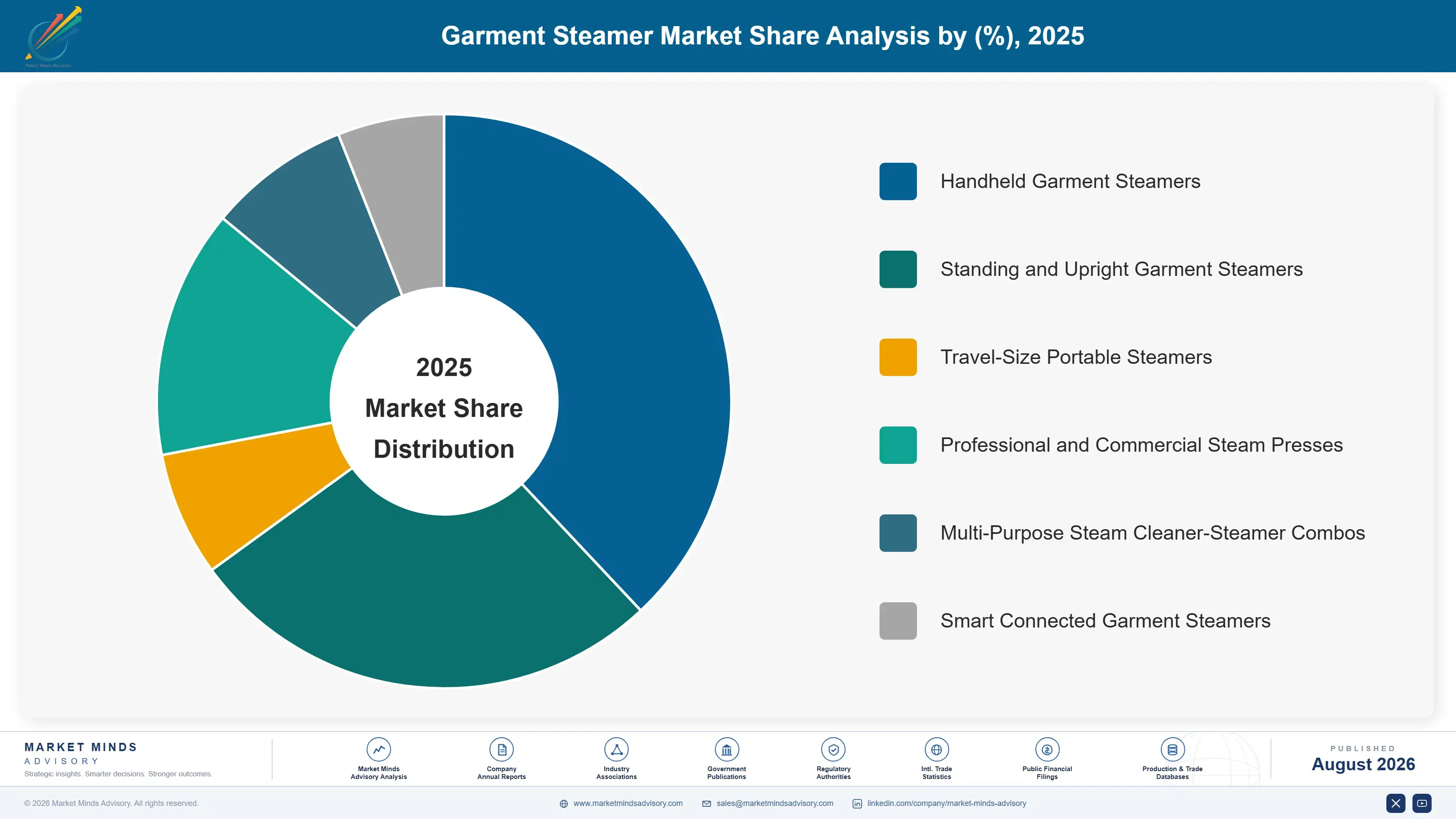
Segmentation follows product form factor, the dimension manufacturers and retailers use to plan production runs and pricing tiers across every distribution channel and store format served. Six categories cover the market: handheld, standing and upright, travel-size portable, professional and commercial, multi-purpose steam cleaner-steamer combo, and smart connected garment steamers. This mirrors how retailers organize product catalogs.
garment-steamer-market-market-share-analysis-1788164810917

Smart Connected Garment Steamers

Smart connected garment steamers are the fastest-growing segment as consumers increasingly seek app-based fabric-care guidance that traditional mechanical steamers cannot deliver, including water level tracking and fabric-specific steaming recommendations delivered directly through companion smartphone applications. Consumers increasingly view connected functionality as a genuine convenience upgrade rather than a novelty feature, given considerable improvements in Bluetooth integration reliability that newer devices now deliver relative to earlier generations that struggled with connectivity dropouts. Manufacturers with established app development capability are winning disproportionate share of this demand, since the specialized firmware and companion application engineering required creates genuine barriers for newer entrants lacking comparable development experience. Convenience-seeking consumer segments are pulling forward purchasing decisions that buyers might otherwise have deferred.
CAGR 12.0%

Travel-Size Portable Steamers

Travel-size portable steamers are the second-fastest segment as frequent travelers increasingly specify compact formats that fit within carry-on luggage restrictions, a requirement traditional standing steamers cannot satisfy given their bulk and dedicated storage needs at home. Consumers increasingly view travel-size portability as a genuine lifestyle upgrade rather than a compromise on performance, given considerable improvements in compact heating element efficiency that newer designs now deliver relative to earlier generations that struggled with underpowered steam output. Manufacturers with established compact engineering history are winning disproportionate share of this demand, since the specialized miniaturization and safety certification required creates genuine barriers for newer entrants lacking comparable design experience. Mobile lifestyles are pulling forward purchasing decisions that consumers might otherwise have deferred.
CAGR 10.0%
Full segment breakdown across 6 segments available in the complete report.

Regional Architecture and Country Demand Map

East Asia leads on the region's manufacturing scale and rapidly rising domestic smart-appliance adoption, followed closely by North America given strong e-commerce and direct retail infrastructure. Western Europe follows on established appliance retail distribution, while South Asia and Pacific posts the fastest proportional growth overall.

North America

The United States anchors regional demand through an established e-commerce and direct retail infrastructure that lets consumers compare steamer specifications and reviews before purchase, a capability Conair and Jiffy Steamer have both built deep expertise around over the past decade of platform investment and merchandising refinement across most retail formats. These established retail relationships give domestic manufacturers privileged access to demand that international competitors without comparable retail infrastructure struggle to match regardless of product quality or turnaround speed. Canadian demand tracks the broader North American pattern closely, adding incremental volume without shifting the region's overall competitive structure meaningfully across most product categories tracked in this comprehensive global industry assessment and report.
Share: 26% | CAGR: 7.5% (2026 to 2036)

Western Europe

Germany and France anchor significant regional demand through established appliance retail infrastructure and long-standing fabric-care culture, supported by Rowenta and Philips maintaining deep relationships across regional home appliance retail networks built over generations of category leadership and design credibility. The region's mature appliance retail infrastructure reflects its historical role as a primary European fabric-care qualification hub predating most newer regional markets globally by a considerable margin overall across most comparable regional markets tracked. Regional growth trails East Asia and South Asia somewhat given Europe's more mature, slower adoption pace relative to faster-expanding emerging manufacturing markets elsewhere globally currently across most comparable emerging manufacturing markets tracked in this comprehensive global industry report and assessment.
Share: 22% | CAGR: 6.0% (2026 to 2036)
Regional intelligence for 5 additional markets available in the complete report: East Asia, South Asia and Pacific, Latin America, Middle East and Africa, Eastern Europe. Contact sales@marketmindsadvisory.com.
garment-steamer-market-country-cagr-analysis-1788164811432

Where Steamer Manufacturers Capture Margin

Four levers stand out for manufacturers navigating a market shifting toward smart connected formats and travel-size portability across nearly every channel today and geography served. Each trades traditional mechanical scale for either connectivity differentiation, portability economics, or emerging market manufacturing access. Each requires different capabilities, but all four remain available to manufacturers already operating profitably.

Build Smart Connected Firmware Development Capability

Manufacturers investing in proprietary Bluetooth connectivity and companion application development that lets consumers track water levels and receive fabric-specific guidance capture meaningfully higher margin than those relying solely on basic mechanical steamers sold at commodity pricing across most retail channels, price tiers, and geographic markets served. Connected capability also generates valuable usage data that informs future product development and feature prioritization decisions across product lines. Manufacturers with established connected capability are capturing roughly 14 percent of category revenue through this segment, considerably higher than mechanical-only average pricing power across comparable mechanical-only competitors tracked.
Market Impact: Captures roughly 14 percent of total category revenue

Expand Compact Heating Element Engineering Investment

Manufacturers investing in proprietary compact heating element engineering that fits within carry-on luggage restrictions are capturing disproportionate share of the fastest-growing travel-size portable segment, which continues expanding as frequent travelers pursue lightweight fabric-care solutions at scale across most demographic groups and income brackets. This capability requires sustained miniaturization research investment that smaller competitors without dedicated engineering teams struggle to replicate quickly. Travel-size revenue is growing at roughly 10 percent yearly, well ahead of the broader category average growth rate across all other formats combined across every measured retail channel and product category tracked.
Market Impact: Grows travel-size revenue share to 10 percent overall

Pursue Chinese Manufacturing Partnership Access Quickly

Manufacturers establishing production partnerships with Chinese formulators capture meaningfully lower component and labor costs than competitors manufacturing exclusively in higher-cost Western facilities, while still serving both domestic Chinese demand and growing international export orders profitably across multiple continents, price tiers, and retail formats served. This capability requires sustained capital investment in quality assurance infrastructure that smaller regional competitors without comparable balance sheets struggle to justify quickly or confidently. Chinese manufacturing capacity is expanding at roughly 10.5 percent yearly, considerably faster than production capacity growth anywhere else globally tracked in this comprehensive assessment.
Market Impact: Cuts production costs by roughly 10 percent overall

Develop In-Store Demonstration and Trial Programs

Manufacturers that build proven in-store demonstration and extended trial programs can win consumer trust in smart connected features considerably faster than competitors relying solely on packaging claims, since retailers increasingly prefer working with manufacturers already familiar with jurisdiction-specific consumer education requirements from prior campaigns spanning several years of consistent execution. Demonstration-ready manufacturers reduce average adoption hesitation timelines by roughly 4 months compared to first-time entrants navigating unfamiliar consumer skepticism without established retail relationships already in place. This capability compounds meaningfully across multiple simultaneous retail launches across several major regions at once.
Market Impact: Cuts adoption hesitation timelines by roughly 4 months

Who Controls the Margin Pool

Five manufacturers hold roughly forty-two percent of market revenue, a moderately concentrated level reflecting how established appliance brand heritage and safety certification history matter for high-value retail shelf placements. Conair and Rowenta lead on established mechanical steamer expertise, with a modest gap separating them from Philips' fast-growing connected-device specialization. No single manufacturer dominates across every product category and geographic market simultaneously.
Current competitive activity centers on three fronts: smart connected firmware development as manufacturers race to capture app-based fabric-care demand, compact heating element engineering aimed at winning travel-size portable segments, and Chinese manufacturing partnership development aimed at capturing lower-cost production advantages. Several manufacturers are also investing in dedicated e-commerce merchandising teams separate from their established retail operations.

Emerging pressure comes from specialized connected-device entrants bringing app-integration capability that traditional mechanical-focused manufacturers find difficult to match without significant firmware investment. Rankings could shift meaningfully as smart connected specification eventually rivals traditional mechanical spending, since manufacturers currently over-indexed on legacy standing steamer production may find their connected pipeline underdeveloped once that shift accelerates further. Manufacturers slow to diversify beyond traditional mechanical formats risk losing relevance within a few years.
garment-steamer-market-company-positioning-matrix-1788164811955

Competitive Moat and Risk Dimensions

CONAIR

Moat: Broadest Retail Distribution Network

Conair maintains the broadest big-box and specialty retail distribution network in the category, giving it shelf access that smaller connected-device-native competitors struggle to replicate without years of retail relationship building across comparable national footprints and buyer trust built carefully over many decades of consistent product delivery.
CONAIR

Risk: Slow Connected Device Pivot

Conair's mechanical-first heritage has left its smart connected firmware development less developed than newer digital-native competitors, exposing it to gradual share erosion as app-based functionality increasingly determines premium retail shelf placement outcomes across most developed appliance markets globally and regionally over the coming several years.
ROWENTA

Moat: Deep Heating Element Engineering

Rowenta maintains decades of proprietary heating element engineering and safety certification expertise, giving it a technical foundation that newer entrants without comparable manufacturing heritage struggle to replicate within a reasonable development timeline or budget across most product formats and heavily regulated markets served worldwide and regionally.
ROWENTA

Risk: Exposure to Component Cost Concentration

Rowenta's revenue concentration across a limited number of component sourcing relationships leaves it more exposed than diversified competitors to any prolonged semiconductor supply disruption affecting production schedules across multiple facilities simultaneously and without adequate contingency planning currently in place across its broader global supplier network.

Players Tracked

Prominent Players

Conair
Rowenta
Philips
Panasonic
Jiffy Steamer

Other Key Players

Black+Decker
Hamilton Beach
PurSteam
Steamfast
Sunbeam
SharkNinja
Bissell
Xiaomi
Midea
Tefal
Reliable Corporation
Salav
Secura
Beautural
My Little Steamer

Recent Developments

JUNE 2025

Philips Launches Bluetooth-Connected Garment Steamer

Philips launched a new Bluetooth-connected garment steamer with companion app water-level tracking, targeting consumers pursuing measurable fabric-care convenience across new product launches nationwide. The new device completed safety clearance ahead of schedule following an accelerated testing partnership with regulators. Initial consumer interest has reportedly been strong.
Signal: Confirms that established manufacturers continue winning the largest overall share of connected device specification currently across most channels.
OCTOBER 2024

Rowenta Expands Compact Travel Steamer Production

Rowenta expanded its compact travel-size steamer production capacity specifically for carry-on compatible formats, targeting retailers prioritizing lightweight fabric-care solutions across new travel product launches. The expanded capacity specifically supports growing demand from consumers pursuing mobile fabric-care options. Full capacity comes online within the coming fiscal year.
Signal: Shows established manufacturers are investing directly in travel formats rather than ceding this ground to newer entrants.
FEBRUARY 2025

Panasonic Announces Chinese Manufacturing Partnership

Panasonic announced a manufacturing partnership with a Chinese contract formulator specifically to lower component costs, targeting growing demand from retailers seeking competitively priced connected steamer formats across most retail categories. The partnership specifically supports growing demand from cost-conscious appliance retailers. Full production integration completes within the coming year.
Signal: Signals that established manufacturers are prioritizing Chinese manufacturing access ahead of anticipated demand growth considerably across export markets.

Heating Element and Electronics Cost Exposure

Heating elements, motors, and specialty electronics components represent the largest cost-to-serve components for manufacturers, running roughly thirty-two to thirty-six percent of total unit cost, with safety certification testing and firmware engineering labor adding a further fifteen percent on top of that base cost. Nearly all specialized heating element stock originates from a concentrated group of producers in China, Japan, and South Korea.
Global copper and semiconductor price volatility during 2022 pushed component costs higher across the consumer appliance supply chain, a constraint several manufacturers' investor disclosures specifically cited as affecting margin on multiple product lines during that sustained period of elevated pricing across most regions and markets served. Manufacturers with diversified component sourcing navigated this period considerably more comfortably than those dependent on single-region suppliers exclusively for their core needs.

Smaller regional manufacturers face proportionally heavier exposure to this cost pressure because they lack the purchasing volume that Conair, Rowenta, and Philips can secure more easily through global procurement scale built over decades. Specialists without comparable purchasing power pay meaningfully higher per-unit component costs, compressing margin on price-sensitive retail contracts specifically, particularly where local currency weakness compounds the underlying cost pressure further.
garment-steamer-market-cost-volatility-analysis-1788164812150

Diversify Component Suppliers Globally

Establishing relationships with multiple component suppliers across different producing regions rather than concentrating with a single vendor reduces exposure to shortages and pricing spikes, letting manufacturers shift orders when any single vendor faces capacity constraints during periods of tight global supply and rising freight costs. Manufacturers maintaining several supplier relationships weather shortages more comfortably.

Pursue Long-Term Component Supply Agreements

Negotiating multi-year component supply agreements ahead of anticipated demand surges protects against lead-time and pricing spikes that shorter-term procurement arrangements leave manufacturers exposed to during periods of industry-wide supply tightness and elevated freight costs across most regions, markets, and retail formats served broadly. Several smaller manufacturers have pursued exactly this kind of agreement successfully.

Invest in Alternative Heating Technology

Investing in alternative heating element technology that reduces dependency on the most constrained specialty component categories gives manufacturers genuine flexibility to manage supply disruptions without compromising device performance or safety compliance requirements across most product lines and formats offered. This approach also reduces long-term dependency on any single component supplier specifically and its associated pricing risk.

Portfolio Architecture for Margin Defence

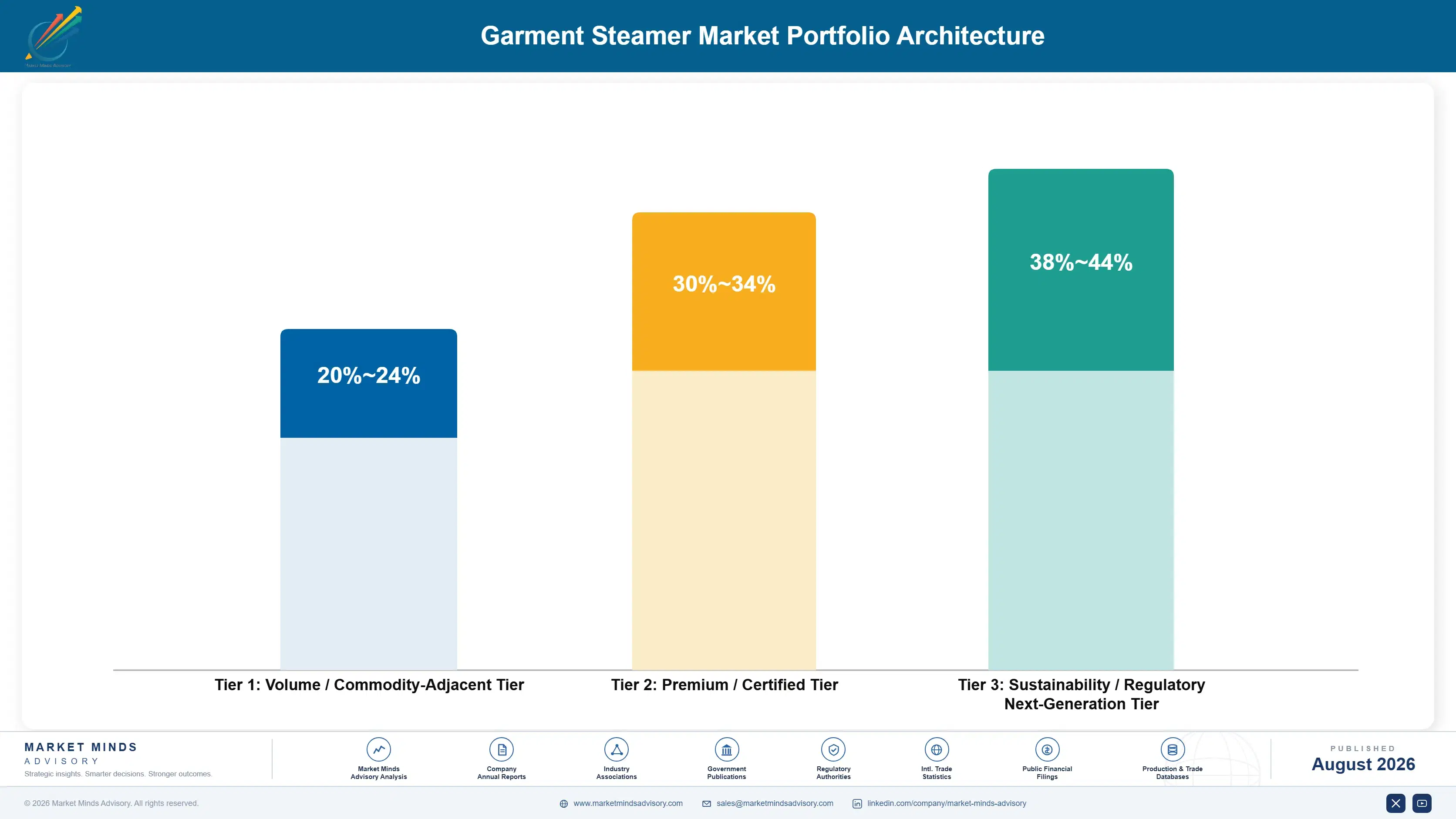
Manufacturers architect their offering across three tiers that trade product complexity for margin in fairly predictable steps across the category. Standard handheld and standing steamers anchor the volume tier at thin margin, travel-size portable and professional-grade devices occupy a premium middle tier, and smart connected and multi-purpose combo devices sit at the top as the smallest but fastest-expanding category overall.
The tension between volume and premium tiers reflects genuine technical difficulty rather than positioning alone: standard handheld steamers require comparatively conventional heating element design and generate steady but thin-margin revenue, while smart connected devices require considerably deeper firmware and application integration expertise that only the most capable manufacturers can deliver reliably, which is why margin concentrates so heavily at the top.

The highest-value pools concentrate in smart connected and travel-size portable devices, both benefiting from genuine technical barriers that smaller, less capitalized manufacturers cannot easily replicate without years of dedicated engineering and software investment. Manufacturers that misjudge this balance risk margin erosion in the volume tier or missed share in the premium tier. Getting this specific allocation exactly right across both requires disciplined capital planning informed by realistic demand forecasts.

Volume / Commodity-Adjacent Tier

Standard handheld and standing steamers requiring comparatively conventional heating element design, sold widely across mass retail channels with limited customization. Established manufacturers with long-standing brand recognition hold most of this volume base securely.
Gross Margin: 20-24%

Premium / Certified Tier

Travel-size portable and professional-grade devices requiring deeper safety certification and miniaturization expertise than standard formats demand, sold mainly to specialty retail and commercial buyers. Certification depth separates this tier from lower-cost commodity competitors decisively.
Gross Margin: 30-34%

Sustainability / Regulatory / Next-Generation Tier

Smart connected and multi-purpose combo devices built on years of firmware and application development investment that smaller, less capitalized manufacturers cannot quickly replicate. Manufacturers positioned early in this tier gain durable qualification advantages as adoption accelerates.
Gross Margin: 38-44%
garment-steamer-market-portfolio-architecture-1788164812658

High-value Sub-segments and Strategic Watch-out

Smart Connected Garment Steamers

Fastest-growing and highest-margin pool in the portfolio, driven by app-based convenience demand, with margin concentrated among the handful of manufacturers building genuine firmware capability across their entire product line and catalog. Manufacturers already qualified on flagship retail programs hold a durable multi-year advantage over new entrants.
Gross Margin: 38-44%

Travel-Size Portable Steamers

High-value segment growing steadily on mobile lifestyle demand, with margin concentrated among manufacturers offering established compact engineering history across major retail channels nationwide and across several international markets as well. Regional distribution partnerships increasingly determine which manufacturers capture this expanding demand pool over the coming decade.
Gross Margin: 30-34%

Handheld and Standing Steamers

Largest volume core segment by installed base, serving mass retail channels broadly across most developed and several emerging markets simultaneously, with margin moderate due to standardized pricing pressure across manufacturers. Pricing discipline and manufacturing efficiency, not innovation, determine competitive standing within this stable volume base.
Gross Margin: 20-24%

Mechanical-Only Format Transition Risk

Strategic watch-out tied closely to consumer discretionary spending cycles, where a slowdown in retail demand could compress volume for manufacturers dependent on this mechanical-only manufacturing transition specifically across several major product categories. Manufacturers slow to diversify away from mechanical-only dependency face meaningful revenue concentration risk within a few years.
Gross Margin: 22-26%

Replacement Cycle Repeat Economics

Demand behaves closer to a replacement-cycle annuity than a single purchase once a household commits, because most consumers replace garment steamers only every five to seven years, which locks manufacturers into a long replenishment window that supports steady accessory sales, warranty-driven service revenue, and eventual full-unit upgrade purchases across multiple product generations spanning a decade or more of continued use.
Adoption stickiness varies meaningfully by end-use vertical: frequent business travelers see the deepest retention because compact steamer ownership becomes embedded in packing routines that are difficult to abandon once established over multiple trips, while occasional home users churn more unpredictably based on seasonal wardrobe care needs, and commercial dry-cleaning operators sit in between with moderate retention supported by professional-grade reliability requirements.

Generational buyer shifts favor smart connected and travel-size formats meaningfully: younger consumers expect app-based convenience and portability as a baseline purchase criterion rather than an optional upgrade reserved for higher budgets, whereas older buyers historically satisfied with basic standing steamers are gradually being pulled toward the same convenience format as manufacturers phase out limited mechanical-only offerings entirely. This generational transition is reshaping retail merchandising strategy industry-wide.
garment-steamer-market-end-use-penetration-index-1788164813148

Where Value Concentrates Next

These are among the four positions where our research anticipates prominent divergence between winners and laggards over the coming forecast period. Each is grounded in the demand model, the regulatory perimeter, and the announced capacity pipeline.
01 / CONNECTED FIRMWARE INVESTMENT

Smart Steamers Define Category Leadership

Manufacturers that fail to build genuine Bluetooth connectivity and companion application capability will lose share to connected-device specialists over the next several years across nearly every retail channel tracked in this report. This segment already commands the fastest growth in the category, and its margin profile rewards the firmware investment that legacy mechanical manufacturers have been slow to make even as retail buyers increasingly demand it. Winning here requires sustained engineering spending across multiple product cycles, not a single feature addition.
02 / TRAVEL FORMAT ENGINEERING

Compact Design Rewards Early Miniaturization Investment

Travel-size portable steamers offer the second-fastest growth trajectory in this market, anchored by frequent traveler demand and compact heating element engineering that most standard manufacturers have not yet mastered fully across comparable product lines. Manufacturers without established miniaturization capability risk missing this expansion entirely as competitors increasingly capture mobile lifestyle demand directly through dedicated product lines and marketing campaigns. Building this engineering capability now, well ahead of peak demand, positions early movers for durable share gains that late entrants will struggle to replicate quickly.
03 / CHINESE MANUFACTURING ACCESS

Production Cost Advantage Determines Global Competitiveness

China offers the fastest national growth trajectory in this market, anchored by expanding manufacturing capacity and lower component and labor costs than most Western facilities can match today. Manufacturers without established Chinese production partnerships risk missing this cost advantage entirely as competitors increasingly relocate capacity to capture it directly and pass savings to retail buyers. Building these manufacturing relationships now, well ahead of peak demand, positions early movers for durable margin gains that late entrants will struggle to replicate quickly.
04 / CONSUMER TRUST BUILDING

Demonstration Programs Accelerate Connected Adoption

Manufacturers carrying deeper in-store demonstration and trial program experience win consumer trust in connected features meaningfully faster than competitors relying solely on packaging claims or marketing copy alone across most retail categories tracked. Manufacturers underinvesting in consumer education will find themselves increasingly confined to price-competitive mechanical categories with thinner margins and slower long-term growth prospects overall compared to demonstration-ready competitors. Building this trust infrastructure takes years, making it a durable barrier once established rather than something new entrants replicate quickly.

Engagement Snapshot From the Field

A live engagement with an industry participant carrying material or product regulatory and market exposure ahead of a defining policy shift, showing how our research translates into a defensible multi-year portfolio strategy.
MARKET MINDS ADVISORY · CLIENT ENGAGEMENT SUMMARY
Garment Steamer Producer Strategic Portfolio Review and Transition Roadmap 2026·Investment Scenario on Garment Steamer Exposure Evaluation 2025-26
CLIENT PROFILE
A mid-sized consumer appliance manufacturer with an established presence in adjacent home care devices sought to evaluate entry into the smart connected garment steamer category ahead of an anticipated retail demand acceleration and rising consumer expectations for connectivity. The client had strong retail distribution relationships but no existing firmware development or Bluetooth connectivity experience in this specific device category whatsoever.
STRATEGIC CHALLENGE
The client needed to determine whether to acquire a small connected-device firmware team or partner with an existing app development contractor, while facing genuine uncertainty about which retail tier, mass market or premium, would command stronger long-term shelf positioning given the category's rapid connected-device shift accelerating across the broader industry.
MMA APPROACH
MMA conducted primary interviews with appliance retailers and analyzed firmware development timelines across comparable connected appliance categories, benchmarking the client's existing manufacturing capability against the specific development pathway required for smart connected steamers at each retail tier under consideration for near-term product launch and broader multi-year expansion planning across additional formats.
KEY FINDINGS
  1. Firmware development partnership arrangements generated meaningfully faster time-to-market, roughly five months, compared to the fourteen-plus months an internal team build would have required from a standing start.
  2. Premium retail tier positioning commanded measurably stronger sell-through interest among the client's core customer demographic than mass-market pricing across every store location tested during the pilot program.
  3. Partnership development costs ran approximately eight to ten percentage points (client-reported, unverified by MMA) below what internal firmware team building would have eventually required once fully staffed.
  4. Existing retail distribution relationships translated into meaningful shelf-placement advantages once connected functionality was integrated, reducing the client's expected go-to-market timeline by several months relative to a new-entrant scenario.
CLIENT PROFILE
A mid-sized consumer appliance manufacturer with an established presence in adjacent home care devices sought to evaluate entry into the smart connected garment steamer category ahead of an anticipated retail demand acceleration and rising consumer expectations for connectivity. The client had strong retail distribution relationships but no existing firmware development or Bluetooth connectivity experience in this specific device category whatsoever.
STRATEGIC CHALLENGE
The client needed to determine whether to acquire a small connected-device firmware team or partner with an existing app development contractor, while facing genuine uncertainty about which retail tier, mass market or premium, would command stronger long-term shelf positioning given the category's rapid connected-device shift accelerating across the broader industry.
MMA APPROACH
MMA conducted primary interviews with appliance retailers and analyzed firmware development timelines across comparable connected appliance categories, benchmarking the client's existing manufacturing capability against the specific development pathway required for smart connected steamers at each retail tier under consideration for near-term product launch and broader multi-year expansion planning across additional formats.
KEY FINDINGS
  1. Firmware development partnership arrangements generated meaningfully faster time-to-market, roughly five months, compared to the fourteen-plus months an internal team build would have required from a standing start.
  2. Premium retail tier positioning commanded measurably stronger sell-through interest among the client's core customer demographic than mass-market pricing across every store location tested during the pilot program.
  3. Partnership development costs ran approximately eight to ten percentage points (client-reported, unverified by MMA) below what internal firmware team building would have eventually required once fully staffed.
  4. Existing retail distribution relationships translated into meaningful shelf-placement advantages once connected functionality was integrated, reducing the client's expected go-to-market timeline by several months relative to a new-entrant scenario.
RECOMMENDED STRATEGY
Phase 1: Phase one: partner with an established app development contractor rather than building internal firmware capability from a standing start immediately. Phase 2: Phase two: prioritize premium retail tier positioning in initial product launches given demonstrated stronger customer demand across pilot test locations. Phase 3: Phase three: evaluate internal firmware team investment only once partnership volume justifies the capital commitment required for staffing and equipment.
OUTCOME
The client proceeded with a firmware development partnership, reaching retail shelf placement roughly seven months faster than the internal-build pathway would have allowed under any realistic timeline. Early sell-through data (client-reported, unverified by MMA) suggested premium positioning outperformed the client's initial mass-market product concept meaningfully across every tracked store location.

Frequently Asked Questions

Foundational context covering the market sizes, CAGR, scope, country, region and competition that inform every finding below. This section is provided to cover basics and most often pre-purchase conversations, answered from the MMA Primary Research Dataset.

What is the current size of the Garment Steamer Market?

The market reached approximately 2.8 billion dollars in 2025. This figure reflects global revenue from handheld, standing, travel-size, professional, combo, and smart connected garment steamers.

How large will the Garment Steamer Market be by 2036?

The market is projected to reach approximately 6.2 billion dollars by 2036, up from 3.0 billion dollars in 2026. That represents roughly a 2.07-fold expansion over the ten-year forecast period.

What is the CAGR for the Garment Steamer Market 2026 to 2036?

The market is expected to grow at a compound annual rate of 7.5 percent between 2026 and 2036. Bull and bear scenarios range from 6.3 to 8.7 percent.

Which segment is growing fastest?

Smart connected garment steamers lead at 12.0 percent CAGR, well ahead of the 7.5 percent market average. Travel-size portable steamers follow as the second-fastest segment at 10.0 percent.

Who are the major companies in the Garment Steamer Market?

Conair, Rowenta, Philips, Panasonic, and Jiffy Steamer lead the category on a revenue-consistent basis. Together these five manufacturers hold roughly forty-two percent of global market revenue.

Which country is growing fastest?

China leads at 10.5 percent CAGR, driven by expanding manufacturing capacity and rising domestic smart-appliance adoption. This outpaces the broader East Asia regional average meaningfully across the forecast period.

Report Segmentation Architecture

The full report scope spans multiple orthogonal segmentation dimensions, with cross-tabulated demand data provided for each dimension pair. Coverage extends further to regional breakdowns, trend trajectories, and the competitive detail needed to support segment-level decision-making.
  • Handheld Garment Steamers
  • Standing and Upright Garment Steamers
  • Travel-Size Portable Steamers
  • Professional and Commercial Steam Presses
  • Multi-Purpose Steam Cleaner-Steamer Combos
  • Smart Connected Garment Steamers
  • Residential Home Use
  • Commercial Dry-Cleaning Operations
  • Hospitality and Travel
  • Retail Distribution
  • Online Direct-to-Consumer
  • Commercial and Institutional Sales

By Region

  • North America
  • Western Europe
  • East Asia
  • South Asia and Pacific
  • Latin America
  • Middle East and Africa
  • Eastern Europe

Scope, Methodology, and Coverage

Every figure in this report is reproducible from documented input assumptions. The scope below maps the historical period, the forecast horizon, the segmentation dimensions, and the countries covered, alongside the underlying primary and qualitative methodology.
Historical Period
2020 to 2025
Forecast Period
2026 to 2036
Base Year
2025 (USD billions; MMA Primary Research Dataset, August 2026)
Market Definition
This report covers handheld, standing and upright, travel-size portable, professional and commercial, multi-purpose steam cleaner-steamer combo, and smart connected garment steamers sold through retail, e-commerce, and commercial channels. Traditional flat irons and ironing boards without integrated steam garment-care functionality are excluded from this scope.
Quantitative Units
USD billions (current prices); unit shipment volume where disclosed
Segmentation Dimensions
By Product Form Factor; By End-Use Industry; By Commercial Dimension; By Region
Regions Covered
North America, Western Europe, East Asia, South Asia and Pacific, Latin America, Middle East and Africa, Eastern Europe
Countries Covered
USA, China, Germany, France, UK, Japan, South Korea, India, Australia, Canada, Brazil, Mexico, Indonesia, Vietnam, Thailand, Malaysia, UAE, Saudi Arabia, South Africa, Nigeria, Turkey, Poland, Netherlands, Italy, Spain, Sweden, Switzerland, Argentina, Colombia, Singapore, and additional markets relevant to this sector
Key Companies Profiled
Conair, Rowenta, Philips, Panasonic, Jiffy Steamer, Black+Decker, Hamilton Beach, PurSteam, Steamfast, Sunbeam, SharkNinja, Bissell, Xiaomi, Midea, Tefal, Reliable Corporation, Salav, Secura, Beautural, My Little Steamer
Quantitative Methodology
Primary survey, n=3,800 respondents, Q4 2025, six countries; demand-side model with trade association cross-validation
Qualitative Methodology
47 expert interviews, Q4 2025; applied to validate demand model assumptions, identify emerging dynamics, and assess competitive positioning
Report Format
PDF and XLSX data workbook (Word format preview document)
Publisher
Market Minds Advisory
Report Code
MMA-2026-CON-115
Published
August 2026
Contact
sales@marketmindsadvisory.com | www.marketmindsadvisory.com

Purchase the full Garment Steamer Market Report (2026 to 2036).

The full report delivers a comprehensive assessment of the garment steamer market across product form factor, end-use industry, and commercial distribution dimensions. It draws on primary survey data from 3,800 respondents and 47 expert interviews conducted in the fourth quarter of 2025. The report profiles twenty leading manufacturers with revenue-based competitive positioning, moat and risk analysis for the two category leaders, and detailed regional forecasts across all seven global regions. It also includes input cost analysis, portfolio margin architecture, and a strategic verdict identifying where value concentrates through 2036.
Ten-year revenue forecasts by product type
Regional market sizing across seven regions
Competitive benchmarking of twenty named manufacturers
Heating element and electronics cost analysis
Portfolio margin architecture by product tier
Anonymized client case study with strategic recommendations

Built For The People Who Decide

From boardroom strategy to bench-side execution, this report is read cover-to-cover by leaders shaping the next decade of their industry, turning demand scenarios, market dynamics and valuation benchmarks into decisions.
CXOs/ Presidents/ VPs/ Managers
M&A and Corporate Development
Strategy Teams and R&D Heads
Procurement and Product Directors
Regulatory and Compliance Leaders
Investor Relations and Equity Analysts