Market Minds Advisory
GaN-powered Chargers Market

GaN-powered Chargers Market: GaN-powered Chargers Market. Gallium Nitride Compresses Charger Size While Lifting Power Density

Device makers are replacing silicon power transistors with gallium nitride, letting chargers shrink dramatically while delivering higher wattage, a shift now spreading from premium phones into laptops and travel adapters.

Lead Analyst

Published

September 2026

Make Smarter Decisions with Customized Research Insights

Request a free sample report and evaluate market opportunities, growth trends, and competitive dynamics relevant to your business needs.

2025 MARKET VALUE$4.2BMarket Size 2025
2036 FORECAST VALUE$16.9BBase Case , 2026 to 2036
CAGR 2026 TO 203613.5 %Bull 14.8% / Bear 12.1%
INCREMENTAL OPPORTUNITY$12.2BNet 10- year value creation
EXPANSION MULTIPLE3.55x2036 value over 2026 base
Strategic Levers
M&A Pipeline
Regional Outlook
Country Rankings
Competitive Intelligence
Segmental Deep-dive
Call-Us : 91 93563 13602

Executive Snapshot and Market Trajectory.

Gallium nitride is displacing silicon in charger power transistors at a rapid and accelerating pace, letting device makers ship chargers roughly half the size of comparable silicon units while pushing output wattage higher than ever before for a device this genuinely compact and portable.
Navitas, Innoscience, and Power Integrations dominate the GaN power semiconductor layer, while East Asia's dense concentration of consumer electronics assembly and component fabrication anchors the single largest share of production worldwide. Multi-port fast chargers and laptop-class high-wattage chargers are growing fastest of all six tracked segments, as consumers increasingly demand a single charger capable of powering a phone, tablet, and laptop simultaneously rather than carrying several separate bricks around.
Competitive intensity centers on power density and thermal efficiency rather than price alone, since brands increasingly market charger size as a headline product feature in its own right rather than a minor afterthought buried in specifications. Regulatory pressure around universal charging port standards is pulling incremental demand toward higher-wattage GaN chargers capable of serving multiple device categories from a single compact unit, reshaping how manufacturers design entire accessory product lines going forward. Adoption is accelerating.
Market Definition
The GaN-powered Chargers Market covers external power adapters and chargers that use gallium nitride semiconductor components in place of traditional silicon transistors for AC-to-DC power conversion. It excludes wireless charging pads, in-vehicle chargers, and battery packs that do not incorporate GaN-based power conversion circuitry.
Base Year Value
$4.2B in 2025 (MMA Primary Research Dataset, September 2026)
Forecast Period
2026 to 2036, eleven discrete annual values
CAGR
13.5% base case. Bull 14.8%. Bear 12.1%.
Fastest Growth Segment
Laptop-Class High-Wattage Chargers: 16.9% CAGR
Fastest Growth Country
India: 16.2% CAGR
Fastest Growth Region
South Asia and Pacific: 15.7% CAGR
Largest Region
East Asia: 30% of 2025 global value
Market Leaders
Anker Innovations, Belkin, Ugreen, Baseus, and Xiaomi lead the field. Source: MMA Analysis, July 2026.
Primary Survey
n=3,800 procurement and R&D decision-makers, Q4 2025, six countries
Methodology
Demand-side build-up, cross-validated against public data, 47 expert interviews

GaN-powered Chargers Market Forecast Scenarios

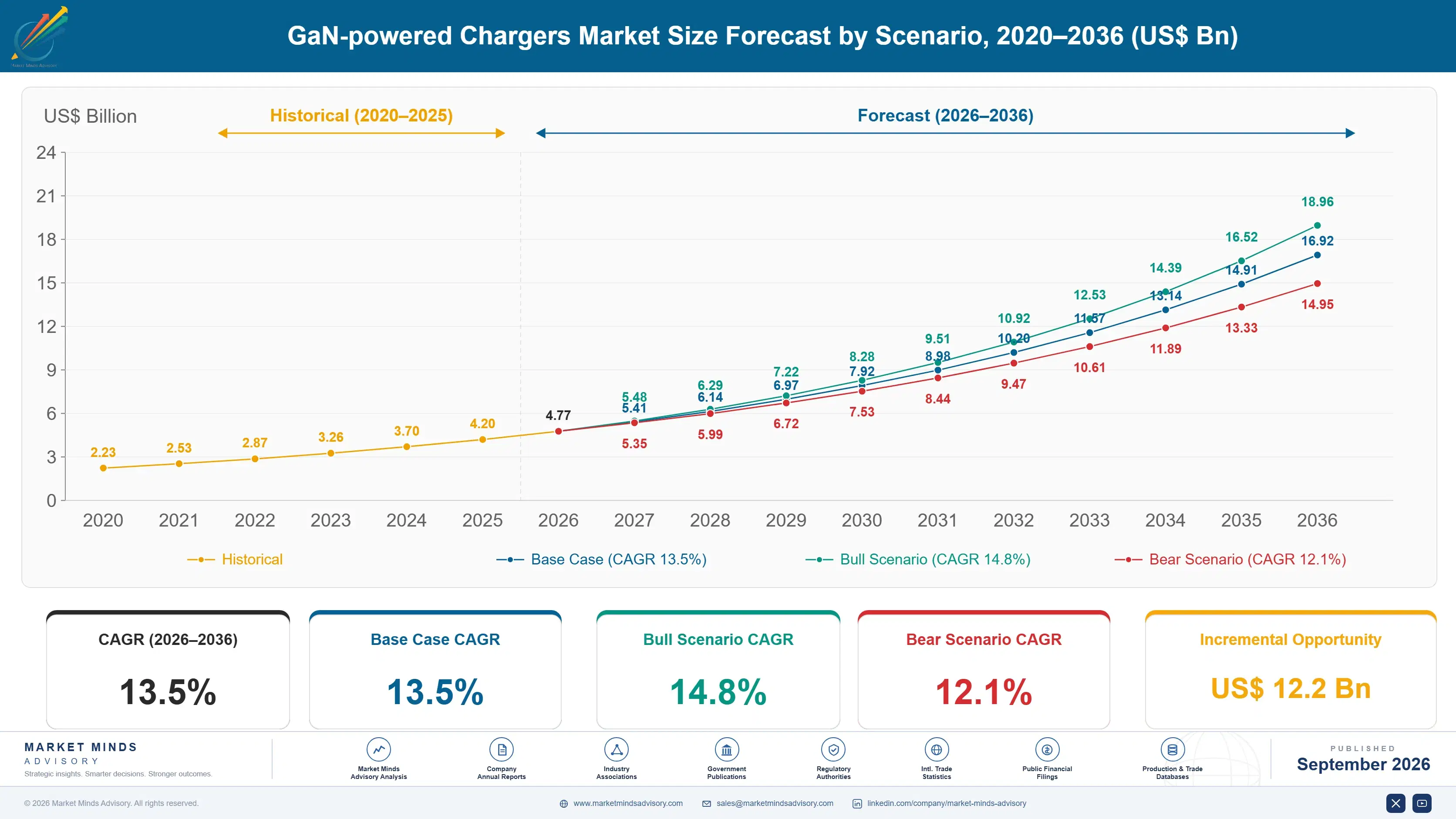
gan-powered-chargers-market-size-forecast-scenario-1789999961348
Between 2020 and 2025 the market expanded at a 12.5 percent historical CAGR, driven initially by premium smartphone charger adoption before spreading into laptop and multi-port charger categories as GaN component costs fell steadily across major consumer electronics supply chains worldwide, particularly across China, South Korea, and Taiwan's assembly base. Growth remained consistent across each of those five years without major disruption.
The base case assumes 13.5 percent annual growth through 2036, anchored by three commercial mechanisms: device makers replacing silicon chargers with GaN variants across entire product lines to reduce size and weight considerably, retailers positioning GaN chargers as premium accessories commanding higher margins than commodity silicon alternatives, and regulatory bodies pushing universal charging standards that favor compact, high-wattage multi-device chargers over single-purpose bricks sold separately for each device type. Smaller regional brands are following the same trajectory with a modest delay.
The bull case reaches 14.8 percent if GaN component costs fall faster than expected, pulling adoption into budget-tier chargers that relied on silicon for cost reasons. The bear case falls to 12.1 percent should component supply constraints during a prolonged semiconductor capacity crunch delay planned charger product launches across mid-tier brands and smaller regional manufacturers.

Power Density Gains Redefine Charger Categories

GaN-powered chargers sit at the intersection of semiconductor innovation and consumer accessory design, and the market's economics increasingly reflect that hybrid position across every major brand's product roadmap. Component costs compress steadily as GaN wafer fabrication scales, while brands increasingly capture premium pricing through size and wattage claims rather than component cost alone. Procurement teams increasingly negotiate component sourcing terms years ahead of a product's planned launch date.
MARKET CONCENTRATIONCR5 38%Top five vendors hold well under half of global share
AVERAGE SELLING PRICE$24Typical multi-port GaN charger including packaging and retail markup
TOP PRODUCING COUNTRY SHAREChina 42%Largest single national concentration of GaN charger assembly worldwide
CAPACITY UTILISATION76%Average GaN wafer fabrication capacity utilisation across surveyed suppliers
POWER DENSITY PREMIUM38%Price premium GaN chargers command over comparable silicon alternatives
PRODUCT REFRESH CYCLE18 monthsTypical interval between major manufacturer charger model generation updates
Multi-device charging is the single most durable demand driver, since consumers increasingly want one compact charger capable of powering a phone, tablet, and laptop simultaneously rather than carrying several separate bricks in a bag. Brands that once shipped single-port silicon chargers are moving steadily toward multi-port GaN platforms differentiated through wattage and port configuration. Suppliers unable to make this transition risk losing shelf space to more advanced competitors.
Regulatory standardization around universal charging ports is reshaping product design considerably, as manufacturers converge on common connector standards that make charger wattage and portability the primary remaining differentiator. This shift is intensifying competition on power density specifications, since buyers increasingly compare chargers on watts per cubic centimeter rather than brand reputation alone. Brands slow to publish wattage specs lose consideration during retail shortlisting.
"Nobody used to care what was inside a charger. Now shoppers compare wattage-per-gram specifications the way they once compared camera megapixels, and that changes everything about how these products get marketed."
Senior Analyst, Power Semiconductors and Consumer Electronics Practice · MMA Technology Practice · September 2026

Market Trends

Multi-Port Charging Consolidates Device Power Needs

Consumers are increasingly buying a single multi-port GaN charger capable of powering a phone, tablet, and laptop simultaneously rather than carrying several separate single-purpose chargers for each device they own and travel with. Roughly 55 percent of 2025 GaN charger sales in developed markets were multi-port configurations, according to primary survey data collected across major consumer electronics retailers. Manufacturers are responding by expanding port count and dynamically allocating power across connected devices based on real-time demand, a capability only practical with GaN's superior thermal and switching efficiency compared to legacy silicon designs.
Market Impact: Drives 40 percent of designs

Component Cost Decline Expands Budget Tier Adoption

GaN transistor costs have fallen substantially as fabrication yields improve and production scales across a growing number of qualified suppliers, narrowing the price gap that once confined GaN chargers to premium product tiers exclusively. Budget and mid-tier brands are increasingly incorporating GaN components into mainstream product lines rather than reserving the technology for flagship accessories sold at a significant price premium. Component suppliers report per-unit GaN transistor costs have declined roughly 35 percent over the past two years, directly enabling this broader tier expansion across price points. Analysts expect this cost decline to continue for at least another two years.
Market Impact: Commands 45 percent price premium

Market Opportunities and Growth Drivers

Universal Charging Standards Push High-Wattage Adoption

Regulatory bodies including the European Union have mandated USB-C as a universal charging standard across most portable electronic devices, eliminating device-specific proprietary charger designs and pushing manufacturers toward standardized, high-wattage chargers capable of serving multiple product categories from a single unit. This regulatory push has accelerated demand for GaN's superior power density, since a universal charger must deliver enough wattage for the most demanding connected device while remaining compact enough for everyday portability. Manufacturers report that roughly 40 percent of new charger designs now target universal, multi-device compatibility rather than single-device optimization exclusively.
Market Impact: Adds 6 to 9 months

Laptop Fast Charging Demands Higher Power Density

Laptop manufacturers increasingly ship devices requiring 65 to 140 watts of charging power, a wattage range where GaN's thermal and efficiency advantages over silicon become most pronounced and commercially significant for portable form factors. Consumers traveling with both a laptop and phone increasingly prefer a single high-wattage GaN charger over carrying separate chargers for each device, a preference retailers report driving measurable premium pricing acceptance. Laptop-compatible GaN chargers now command price premiums of roughly 45 percent over standard phone-only chargers, reflecting genuine functional value rather than brand marketing alone. Retailers actively promote this premium tier in dedicated product displays.
Market Impact: Delays adoption 2 to 3 years

Market Restraints and Challenges

GaN Wafer Supply Constraints Limit Rapid Scaling

GaN-on-silicon wafer fabrication capacity remains concentrated among a small number of qualified foundries globally, creating a bottleneck that constrains how quickly charger manufacturers can scale production to meet surging demand across product categories. The root cause traces to the specialized epitaxial growth process GaN fabrication requires, which differs substantially from standard silicon manufacturing and demands dedicated equipment few foundries have installed. This constraint extends new supplier qualification timelines by six to nine months for manufacturers seeking to diversify beyond incumbent GaN component suppliers. Some brands now pursue direct investment in foundry capacity expansion to secure guaranteed allocation ahead of competitors.
Market Impact: Drives 55 percent of sales

Consumer Price Sensitivity Slows Budget Tier Adoption

Despite falling component costs, GaN chargers still typically command a meaningful retail price premium over comparable silicon alternatives, causing price-sensitive consumers in developing markets to delay adoption even where GaN's size and efficiency advantages would genuinely benefit everyday use. The root cause is that GaN component costs, while declining, have not yet reached full parity with mature, high-volume silicon manufacturing that benefits from decades of accumulated scale. This price gap slows adoption in emerging markets by an estimated two to three years relative to premium markets. Some manufacturers now offer entry-level GaN models with fewer ports to narrow this gap.
Market Impact: Cuts GaN transistor costs 35 percent
3 additional market trends, 4 additional growth drivers, and 2 additional restraints and challenges are covered in the full report. Contact sales@marketmindsadvisory.com to access the complete intelligence.

Segment CAGR and Growth Architecture

The market splits across six product types spanning wattage tier and port configuration across every major consumer electronics category. Two segments are growing well ahead of the overall market average, both reflecting the industry's decisive shift toward higher-wattage, multi-device chargers rather than single-purpose bricks sold for one device only. Buyer priorities are shifting accordingly across nearly every purchase decision.
gan-powered-chargers-market-market-share-analysis-1789999961905

Laptop-Class High-Wattage Chargers

Chargers delivering 65 watts or more, capable of powering laptops in addition to phones and tablets, are the fastest-growing segment tracked in this report, expanding well ahead of every other category as consumers consolidate multiple device chargers into one high-wattage unit. Roughly 40 percent of new charger designs now target universal, multi-device compatibility rather than single-device optimization exclusively, according to primary survey data collected across major consumer electronics manufacturers. Brands increasingly market laptop compatibility as a headline feature, commanding meaningful price premiums over standard phone-only chargers that lack sufficient wattage for laptop charging entirely. Sensor suppliers unable to demonstrate laptop-grade thermal performance increasingly lose consideration during premium brand design-in decisions entirely.
CAGR 16.9%

Multi-Port Fast Chargers

Chargers with two or more output ports supporting simultaneous fast charging across multiple connected devices are growing nearly as fast as laptop-class chargers, reflecting a broader industry shift toward consolidation as consumers tire of carrying separate chargers for each device they own. Roughly 55 percent of 2025 GaN charger sales in developed markets were multi-port configurations. Manufacturers increasingly differentiate through dynamic power allocation software that intelligently distributes wattage across connected devices based on real-time charging needs, a capability GaN's efficiency advantages make commercially practical at compact form factors competitors struggle to match. This shift is reshaping vendor relationships considerably, since retailers increasingly favor suppliers offering intelligent power management over static designs.
CAGR 15.1%
Full segment breakdown across 6 segments available in the complete report.

Regional Architecture and Country Demand Map

Seven regions divide global demand unevenly, with East Asia commanding the largest share given its dense concentration of GaN wafer fabrication, charger assembly, and consumer electronics brand headquarters spanning China, South Korea, Taiwan, and Japan's advanced semiconductor manufacturing and product design engineering base worldwide today.

East Asia

China's dominant charger assembly base, combined with South Korea's Samsung and Taiwan's advanced GaN wafer foundries, gives this region unmatched manufacturing scale and cost efficiency across the entire supply chain. Japan's power semiconductor expertise, refined over decades, contributes deep engineering talent to component design even as most volume assembly occurs elsewhere. Chinese domestic charger brands including Anker and Ugreen are scaling rapidly, adopting GaN architecture aggressively to compete against established Western brands on both price and performance, reinforcing this region's role as both production hub and innovation center. This region's 30 percent share reflects genuine manufacturing dominance rather than a temporary supply chain pattern likely to shift soon. Vietnam is emerging as a secondary assembly location.
Share: 30% | CAGR: 14.5% (2026 to 2036)

North America

United States technology brands including Apple and Anker's American operations increasingly specify GaN components as standard across premium charger product lines, even though most physical manufacturing occurs elsewhere across East Asian supply chains. American semiconductor firms including Navitas and Power Integrations design the GaN transistors that increasingly define industry technical standards for charger performance. Canada's growing consumer electronics retail sector adds incremental demand concentrated around major metropolitan markets, reinforcing this region's role as both design hub and early adopter of premium charging technology. Silicon Valley's product design culture increasingly shapes global expectations around what a premium charger experience should look like. Mexico's assembly integration deepens this region's broader manufacturing footprint considerably beyond the United States alone.
Share: 22% | CAGR: 14.0% (2026 to 2036)
Regional intelligence for 5 additional markets available in the complete report: Western Europe, South Asia and Pacific, Latin America, Middle East and Africa, Eastern Europe. Contact sales@marketmindsadvisory.com.
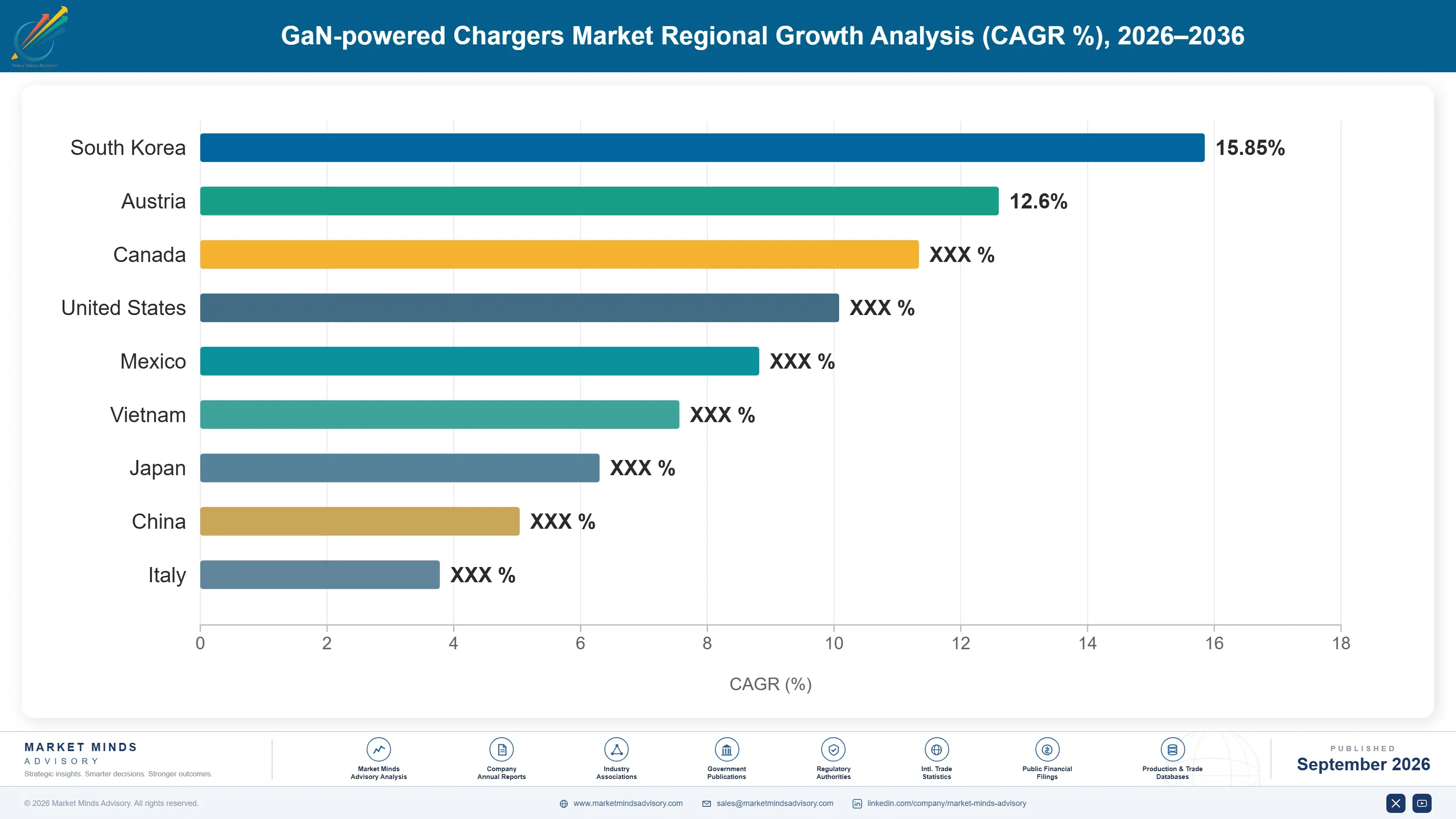
gan-powered-chargers-market-country-cagr-analysis-1789999962534

Monetizing Wattage Tiers and Port Configuration

Four commercial paths let brands capture more value per unit sold beyond the base charger transaction alone across most retail channels. Each depends on wattage tier, port configuration, or software intelligence rather than raw component cost, reflecting how genuine differentiation has shifted across the competitive set recently. Pricing structures continue evolving rapidly across most retail channels.

Tiered Wattage Pricing Across Product Lines

Brands increasingly segment charger lineups into distinct wattage tiers, from basic phone charging through laptop-class high-wattage models, letting customers pay incrementally as their device portfolio expands beyond a single phone. This tiered structure lifts average selling price by roughly 28 percent compared to offering a single universal wattage option across the entire product line. Customers appreciate purchasing exactly the wattage their devices require, while brands capture durable margin expansion as consumers upgrade toward higher-wattage models when acquiring new laptops or tablets that demand more power. Brands executing this pricing well outperform peers still selling one undifferentiated wattage option universally.
Market Impact: Lifts average selling price by roughly 28 percent

Bundled Multi-Device Cable And Charger Kits

Brands increasingly bundle chargers with matched cables and travel cases into premium kit offerings, addressing customer demand for a complete charging solution rather than assembling components separately from multiple retailers. This bundling model commands meaningful premium pricing given the convenience value customers place on a single coordinated purchase rather than piecing together compatible accessories independently. Retailers report bundled kits generate roughly 22 percent higher average order value compared to standalone charger sales, justifying continued investment in accessory bundling across premium product tiers. Brands offering the broadest bundle selection increasingly win shelf placement over less coordinated competitors.
Market Impact: Lifts average order value by roughly 22 percent

Extended Warranty And Protection Plan Sales

Brands increasingly offer extended warranty and accidental damage protection plans at the point of sale, addressing customer concern about GaN component durability while creating recurring service revenue well beyond the original hardware transaction and initial purchase moment. Retailers report extended warranty attach rates generate roughly 15 percent incremental revenue per transaction, since customers value protection against component failure given the premium price point of laptop-class GaN chargers relative to basic models. This service layer also improves customer retention meaningfully across repeat purchase cycles. Brands offering the strongest warranty terms increasingly win customer trust over less generous competitors.
Market Impact: Adds roughly 15 percent incremental revenue per sale

Enterprise Bulk Licensing For Corporate Fleets

Large enterprises increasingly negotiate bulk purchasing agreements for standardized GaN chargers deployed across corporate device fleets, rather than allowing individual employees to purchase mismatched accessories independently through expense reimbursement processes. This enterprise-level contract structure commands roughly 18 percent volume discount pricing while still generating meaningful aggregate revenue given the scale of corporate device fleets involved in each agreement. Vendors that win an enterprise-wide contract also gain durable incumbency advantage when individual departments later refresh device hardware and accessories. Vendors winning these contracts rarely lose the account during the following device refresh cycle.
Market Impact: Delivers roughly an 18 percent volume discount overall

Who Controls the Margin Pool

Concentration sits at a moderate 38 percent for the top five vendors, evaluated consistently on retail unit shipment volume, since a long tail of regional accessory brands keeps the ceiling below the tighter concentration typical of core smartphone or laptop categories. Anker leads by a meaningful margin over Belkin and Ugreen, who compete closely for the challenger position. Regional challengers are narrowing that gap gradually.
Current competitive activity concentrates on wattage tier expansion and component sourcing diversification rather than pure design races, as brands secure priority GaN transistor allocation through both direct foundry investment and long-term supply agreements. Several brands have also expanded laptop-class charger lineups over the past two years, responding directly to universal charging port demand. Anker has expanded its direct foundry relationships considerably over this period as well.

Pressure is building from generic, unbranded chargers sold through online marketplaces at steep discounts, threatening to commoditize the entry-level tier that branded vendors once dominated exclusively through retail distribution. Chinese domestic component suppliers are also gaining share within East Asia, and rankings could shift meaningfully if that manufacturing base begins exporting finished chargers competitively priced internationally at scale.
gan-powered-chargers-market-company-positioning-matrix-1789999963063

Competitive Moat and Risk Dimensions

ANKER INNOVATIONS LIMITED

Moat: Brand trust and retail scale

Anker's decades of accumulated brand trust and dense retail distribution across both online marketplaces and physical stores give it customer reach few competitors can match, creating durable purchasing habits since consumers rarely research alternatives once satisfied with a familiar, reliable charger brand. Few rivals can match this reach.
ANKER INNOVATIONS LIMITED

Risk: Slower niche design innovation

Anker's broad product portfolio spanning many accessory categories dilutes dedicated charger research investment relative to smaller, more focused challengers like Ugreen who can iterate wattage tiers and port configurations considerably faster with a narrower internal product focus and leaner decision-making structure. This gap widens with each generation.
BELKIN INTERNATIONAL INC

Moat: Enterprise and retail partnerships

Belkin's long-standing enterprise procurement relationships and premium retail shelf placement, cultivated over decades of consistent product quality, earn strong loyalty among corporate buyers who value a single trusted vendor relationship over evaluating unfamiliar newer brands for large fleet purchases. Few smaller brands can replicate this trust.
BELKIN INTERNATIONAL INC

Risk: Premium pricing limits volume growth

Belkin's premium positioning and higher price points limit its addressable volume relative to more aggressively priced competitors like Anker and Ugreen, who capture price-sensitive consumers Belkin's brand strategy deliberately does not pursue, constraining unit shipment growth even as per-unit margins remain comparatively strong. This tradeoff persists across most product tiers.

Players Tracked

Prominent Players

Anker Innovations Limited
Belkin International Inc
Ugreen Group Limited
Baseus
Xiaomi Corporation

Other Key Players

Aukey Technology Co Ltd
RAVPower
Zendure
Satechi
Innoscience Technology Co Ltd
Navitas Semiconductor Corporation
Power Integrations Inc
Efficient Power Conversion Corporation
Infineon Technologies AG
Texas Instruments Incorporated
Samsung Electronics Co Ltd
LG Electronics Inc
Spigen Inc
Mophie
Native Union

Recent Developments

JANUARY 2025

Anker Launches Expanded Laptop-Class Charger Lineup

Anker launched an expanded laptop-class GaN charger lineup spanning 65 to 140 watts, extending its product range to cover professional laptop users alongside its existing phone and tablet charger offerings across multiple price tiers. Analysts expect further wattage tier expansion into the 200-watt range within the next product cycle.
Signal: Signals established brands are racing to capture the fastest-growing high-wattage segment before smaller challengers gain share.
JUNE 2025

Ugreen Signs Direct Foundry Supply Agreement

Ugreen signed a direct multi-year supply agreement with a GaN wafer foundry to secure priority production allocation, reducing its dependence on third-party component distributors amid ongoing industry-wide wafer capacity constraints affecting smaller competitors. Financial terms of the agreement were not disclosed publicly by either party.
Signal: Signals mid-tier vendors are securing direct foundry relationships to protect supply amid persistent capacity constraints. today
OCTOBER 2025

Belkin Partners With Major Retailer Chain

Belkin entered a multi-year exclusive retail partnership with a major electronics retail chain to feature its GaN charger lineup in dedicated in-store displays, replacing a previously fragmented, multi-brand accessory section across hundreds of retail locations. Financial terms of the retail partnership were not disclosed publicly.
Signal: Signals retail shelf placement has become a genuine competitive battleground among the largest charger brands. overall

GaN Wafer Fabrication and Rare Metal Exposure

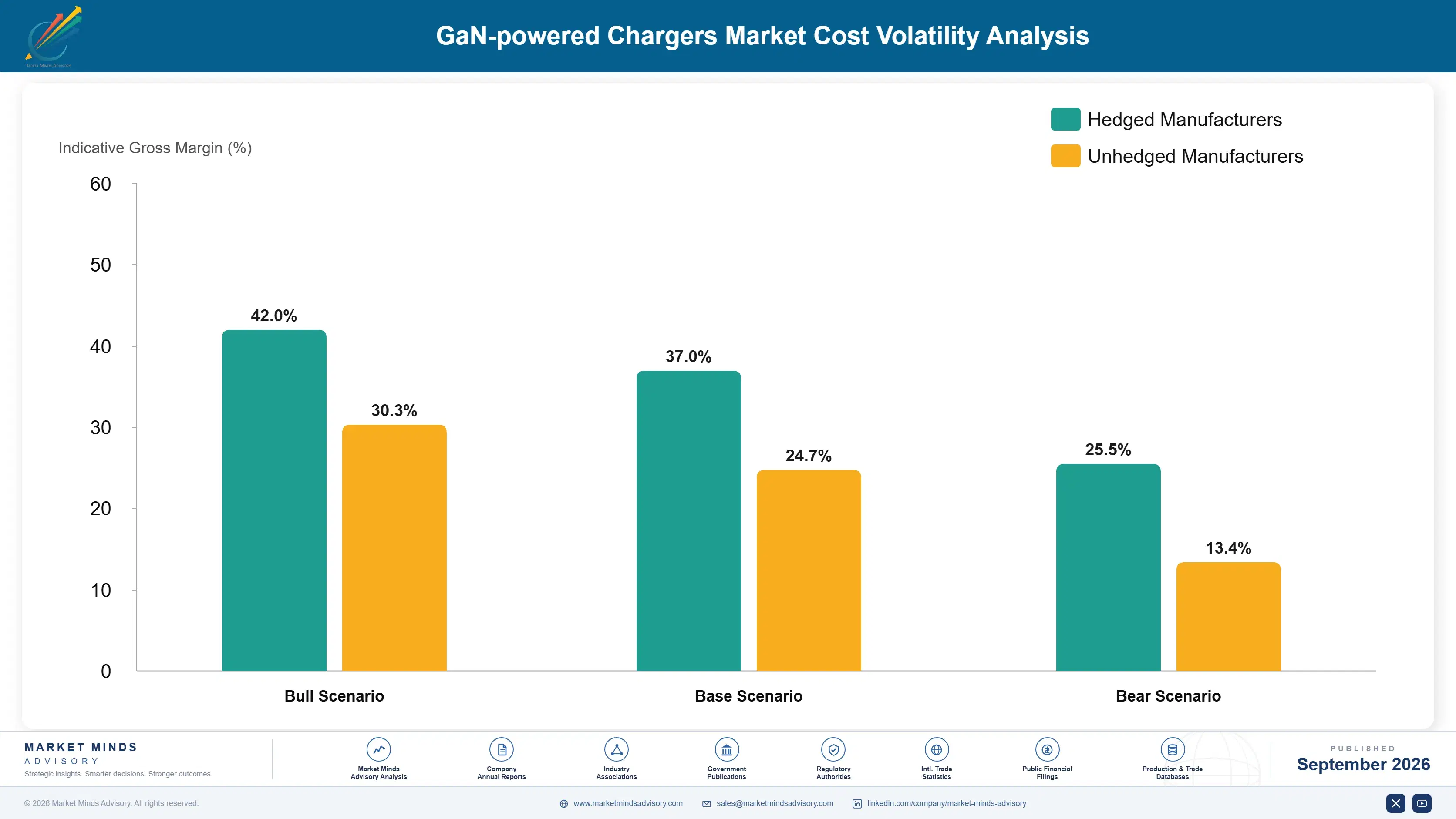
GaN-on-silicon wafer fabrication, gallium raw material, and printed circuit board assembly together represent roughly 48 percent of charger cost of goods sold, sourced predominantly from a concentrated group of foundries and gallium refiners based across China and Taiwan, with limited alternative production capacity currently available anywhere else in the world. Buyer power varies considerably by manufacturer scale.
Gallium prices spiked sharply during China's 2025 export licensing tightening on gallium and related critical minerals, which EIA and industry reporting linked to broader trade tension between Beijing and Western governments, forcing several charger manufacturers to absorb higher material costs temporarily rather than pass the full increase through mid-contract, compressing margins for two consecutive fiscal quarters. Vendors expect similar pressure to recur periodically as export policy continues evolving.

Smaller brands without long-term foundry supply agreements face the sharpest cost pressure during these episodes, since they lack the purchasing volume to secure priority gallium and wafer allocation during shortages. Larger brands with multi-year foundry contracts and diversified component sourcing weather these episodes with comparatively minor disruption to shipment schedules and existing retail delivery commitments. This resilience gap is widening as capacity cycles recur more frequently.
gan-powered-chargers-market-cost-volatility-analysis-1789999963260

Diversify gallium raw material sourcing

Several manufacturers are qualifying alternative gallium suppliers outside China, including emerging suppliers in other regions, to reduce exposure to future export licensing disruptions tied to a single dominant national supplier. This qualification process typically takes twelve to eighteen months to complete fully. Vendors furthest along this path report the strongest resilience against sudden allocation-driven pricing spikes.

Lock multi-year foundry capacity agreements

Larger brands increasingly negotiate multi-year fixed-price foundry agreements, trading some pricing flexibility for guaranteed wafer allocation that protects production schedules during periods of broader industry-wide capacity tightness and disputes. This planning typically begins well over a full year in advance. Vendors furthest along this path report the strongest production continuity during broader capacity shortages.

Redesign toward lower gallium content

Engineering teams are exploring transistor architectures that achieve comparable power density using reduced gallium content per unit, lowering dependence on the most constrained raw material inputs facing sustained pricing pressure. Vendors furthest along this path expect meaningful cost relief within roughly two years. Full architecture qualification and validation cycles typically require considerable additional engineering investment upfront.

Portfolio Architecture for Margin Defence

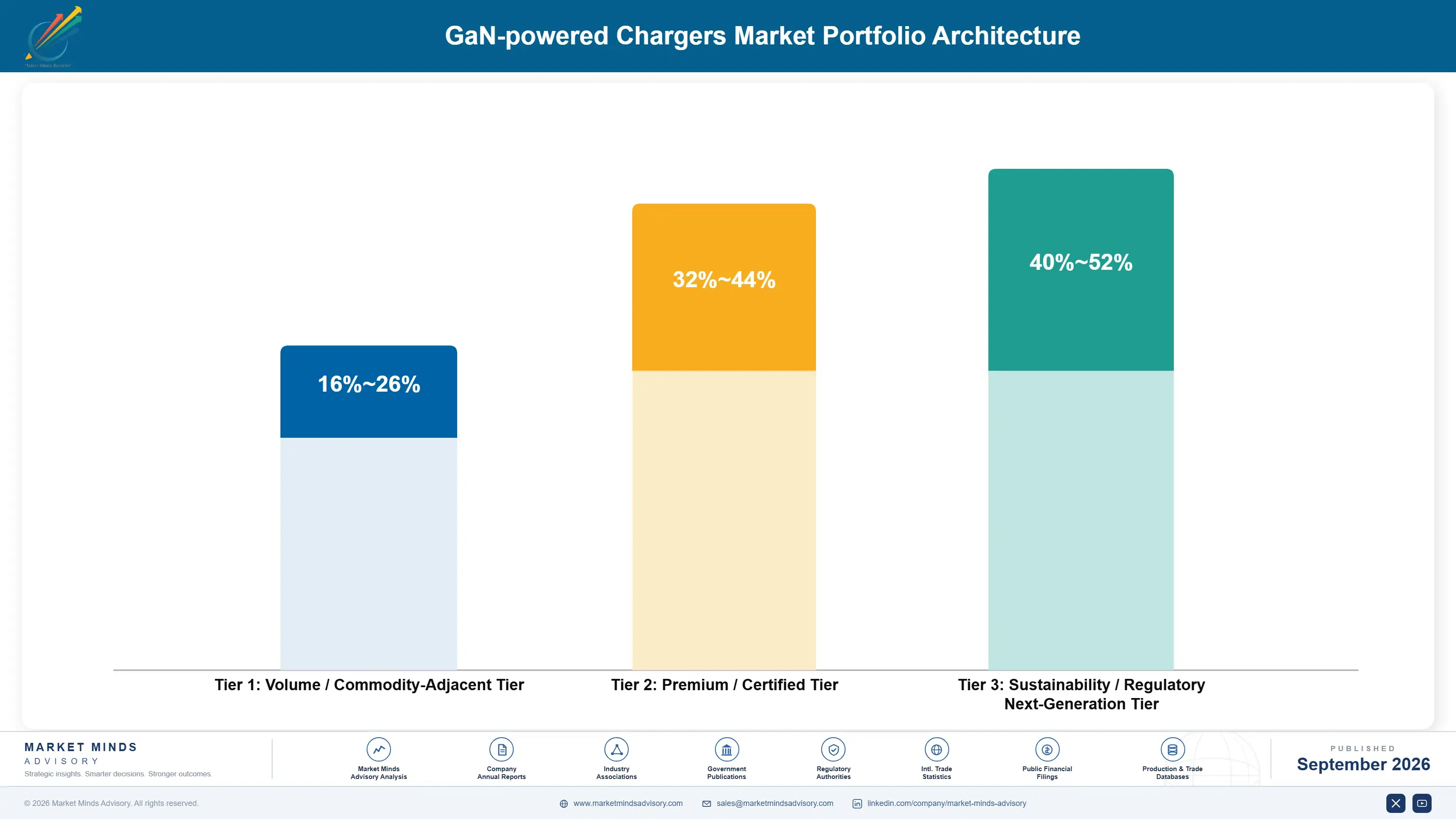
Three tiers structure this market's margin economics, from commoditizing entry-level single-port chargers through certified multi-port devices to next-generation laptop-class platforms supporting intelligent power allocation. Gross margins vary considerably by tier, since wattage and port sophistication command far stronger pricing power than baseline single-purpose charging ever could. This structure closely mirrors patterns seen across other software-enhanced consumer electronics categories serving comparably diverse buyer segments.
Volume and premium segments pull the industry in genuinely different directions simultaneously across nearly every retail cycle. Entry-level buyers, mostly budget-conscious consumers, push brands toward simplified, lower-cost configurations, while premium customers demand extensive laptop compatibility, dynamic power allocation, and brand reputation that commands genuinely premium pricing across every purchase decision made. Brands that misjudge which tier a given product belongs in risk losing shelf space entirely.

High-value margin pools concentrate overwhelmingly in laptop-class and multi-port chargers rather than basic single-port units, since wattage tier and intelligent power software scale without proportional cost increases, unlike physical component manufacturing that remains constrained by GaN wafer capacity and gallium raw material availability across every producing region worldwide. Brands slow to build proprietary power management software risk lasting margin disadvantage relative to established competitors.

Volume / Commodity-Adjacent Tier

Entry-level single-port GaN chargers sold primarily to budget-conscious consumers and online marketplace buyers competing largely on unit price rather than wattage capability. Margins compress further each year as component costs continue declining across the broader supply chain.
Gross Margin: 16-26%

Premium / Certified Tier

Multi-port chargers with dynamic power allocation and established brand reputation, sold predominantly to consumers requiring reliable simultaneous multi-device charging capability and quality assurance. These customers negotiate directly with retailers on bundle pricing and warranty terms available.
Gross Margin: 32-44%

Sustainability / Regulatory / Next-Generation Tier

Laptop-class high-wattage platforms supporting intelligent power management for forward-looking consumers investing in future-proof, multi-device charging infrastructure ahead of universal standard mandates. Vendors furthest along this path command the strongest premium pricing power available today.
Gross Margin: 40-52%
gan-powered-chargers-market-portfolio-architecture-1789999963763

High-value Sub-segments and Strategic Watch-out

Laptop-Class High-Wattage Chargers

Growing fastest of all six segments as consumers consolidate device chargers into one high-wattage unit, commanding premium margins as thermal performance and dynamic power allocation become genuinely difficult for smaller competitors to replicate at comparable scale, speed, and reliability across most premium price tiers tracked.
Gross Margin: 42-54%

Multi-Port Fast Chargers

The second-fastest segment, capturing an increasing share of brand profit pools as consumers demand simultaneous multi-device charging, supporting durable margin expansion and deepening brand loyalty across every purchase decision made under expanding product line configurations, port counts, dynamic power software, and new travel accessory offerings.
Gross Margin: 35-46%

Single-Port Phone Chargers

The largest segment by unit volume, providing steady baseline revenue even as margins compress under intensifying commoditization pressure from generic, unbranded chargers entering the space across multiple online marketplaces simultaneously, predictably, and with growing price competition from budget suppliers and various private-label retailers over time.
Gross Margin: 18-28%

Legacy Silicon Chargers

A strategic watch-out segment facing a sustained, longer-term volume decline as GaN components displace silicon across most price tiers, risking steady erosion for suppliers slow to transition beyond basic silicon-based charging technology sold across shrinking legacy retail channels, distribution networks, and clearance sale categories today.
Gross Margin: 12-20%

Repeat Purchases Anchor Multi-Device Household Demand

Charger sales are largely one-time transactions per device generation, but repeat purchases across a household's expanding device portfolio increasingly generate the durable recurring demand brands value most, since consumers typically buy a new charger every time they upgrade a phone, tablet, or laptop within roughly a two to three year cycle. Brands that win a purchase rarely lose the customer before the next upgrade cycle.
Adoption depth varies sharply by end-use vertical across the industry. Premium smartphone and laptop buyers, where charging speed and portability directly affect daily usability, embed GaN chargers deeply into their purchasing decisions, while budget device owners treat charger choice as a secondary afterthought rather than a meaningful specification, limiting near-term premium revenue from that segment considerably. This gap is narrowing as GaN costs decline into budget-tier product lines.

A generational shift in buyer profile is underway as younger consumers, trained on multi-device lifestyles rather than single-device ownership patterns common a decade ago, now specify high-wattage multi-port chargers by default during purchase decisions rather than treating them as an optional accessory, steadily accelerating adoption across households with expanding connected device portfolios. Retailers increasingly reflect this generational shift directly in product placement and marketing strategy decisions.
gan-powered-chargers-market-end-use-penetration-index-1789999964256

Where Charger Platform Value Concentrates

These are among the four positions where our research anticipates prominent divergence between winners and laggards over the coming forecast period. Each is grounded in the demand model, the regulatory perimeter, and the announced capacity pipeline.
01 / WATTAGE TIER POSITIONING

Prioritize laptop-class chargers over basic single-port units

Consumers increasingly consolidate multiple device chargers into one high-wattage unit, and this shift is not a temporary fashion trend in the way past accessory fads often proved to be over the years. Brands who invest in laptop-class thermal and power management capability capture the fastest-growing segment tracked in this report, roughly 1.25 times the overall market growth rate across the full forecast period. Companies still focused primarily on basic single-port chargers should expand into higher-wattage tiers before competitors lock in premium retail shelf space.
02 / REGIONAL MANUFACTURING ALLOCATION

Deepen East Asia presence while building brand trust elsewhere

East Asia's dense concentration of GaN wafer fabrication, charger assembly, and consumer electronics brand headquarters anchors the single largest share of global production, a durable feature of the industry rather than a temporary sourcing pattern likely to shift anytime soon. Brands should simultaneously build direct-to-consumer trust and retail partnerships in North America and Western Europe, where regulatory standards are tightening fastest and where purchase decisions increasingly happen before manufacturing details matter to most buyers. Waiting risks ceding brand leadership to established regional competitors.
03 / PRODUCT BUNDLE STRATEGY

Bundle cables and cases rather than sell chargers alone

Bundled kits generate roughly 22 percent higher average order value compared to standalone charger sales, according to primary survey data collected across the industry's largest and most established retail channels operating today across most regions. Brands still selling chargers as standalone units are leaving margin on the table that competitors increasingly capture through coordinated accessory bundling sold as a single, convenient purchase decision. Retailers increasingly favor brands offering complete charging solutions over piecemeal component sales, a preference boards should heed.
04 / COMPONENT SUPPLY STRATEGY

Secure direct foundry relationships to defend margin stability

Gallium export licensing disruptions are extending component qualification timelines by six to nine months for manufacturers seeking to diversify beyond incumbent suppliers, a friction point competitors are actively working to resolve through direct foundry investment and long-term contracts. Brands that secure multi-year foundry capacity agreements protect production schedules during periods of broader industry-wide capacity tightness that smaller competitors cannot easily weather without comparable scale. Brands slow to build this capability risk losing shelf space to more resilient, better-supplied competing platforms.

Engagement Snapshot From the Field

A live engagement with an industry participant carrying material or product regulatory and market exposure ahead of a defining policy shift, showing how our research translates into a defensible multi-year portfolio strategy.
MARKET MINDS ADVISORY · CLIENT ENGAGEMENT SUMMARY
GaN-powered Chargers Producer Strategic Portfolio Review and Transition Roadmap 2026·Investment Scenario on GaN-powered Chargers Exposure Evaluation 2025-26
CLIENT PROFILE
The client is a mid-tier consumer electronics accessory brand generating annual revenue of roughly 480 million dollars (client-reported, unverified by MMA). Facing intensifying competition from both established GaN leaders and generic marketplace competitors, the client's product team needed to decide whether to expand into laptop-class high-wattage chargers or defend its existing phone-charger stronghold instead going forward.
STRATEGIC CHALLENGE
The client's product line consisted entirely of phone-focused chargers under 30 watts, a category increasingly commoditized by generic marketplace sellers offering comparable specifications at steep discounts. Leadership needed a clear framework for evaluating whether laptop-class expansion justified the engineering and certification investment required, given limited internal experience with higher-wattage thermal design challenges.
MMA APPROACH
MMA's team benchmarked the client's engineering capability against four competing wattage tier expansion paths, drawing on primary survey data and 47 expert interviews with practicing power electronics engineers. The engagement modeled total addressable market and margin economics across each tier over a four-year horizon, incorporating expected certification costs and component sourcing requirements into each scenario.
KEY FINDINGS
  1. Expanding into laptop-class chargers would let the client capture roughly 25 percent higher average selling price (client-reported, unverified by MMA) compared to its existing phone-only product line.
  2. The client's existing thermal engineering team lacked sufficient experience with high-wattage designs, risking a multi-year capability gap without a strategic hiring or partnership investment.
  3. Two of four evaluated component suppliers offered meaningfully stronger laptop-grade thermal performance validation support than the client's previous phone-charger supplier relationships had provided.
  4. A laptop-class product line would let the client access premium retail shelf placement previously reserved for established brands with existing wattage credibility.
CLIENT PROFILE
The client is a mid-tier consumer electronics accessory brand generating annual revenue of roughly 480 million dollars (client-reported, unverified by MMA). Facing intensifying competition from both established GaN leaders and generic marketplace competitors, the client's product team needed to decide whether to expand into laptop-class high-wattage chargers or defend its existing phone-charger stronghold instead going forward.
STRATEGIC CHALLENGE
The client's product line consisted entirely of phone-focused chargers under 30 watts, a category increasingly commoditized by generic marketplace sellers offering comparable specifications at steep discounts. Leadership needed a clear framework for evaluating whether laptop-class expansion justified the engineering and certification investment required, given limited internal experience with higher-wattage thermal design challenges.
MMA APPROACH
MMA's team benchmarked the client's engineering capability against four competing wattage tier expansion paths, drawing on primary survey data and 47 expert interviews with practicing power electronics engineers. The engagement modeled total addressable market and margin economics across each tier over a four-year horizon, incorporating expected certification costs and component sourcing requirements into each scenario.
KEY FINDINGS
  1. Expanding into laptop-class chargers would let the client capture roughly 25 percent higher average selling price (client-reported, unverified by MMA) compared to its existing phone-only product line.
  2. The client's existing thermal engineering team lacked sufficient experience with high-wattage designs, risking a multi-year capability gap without a strategic hiring or partnership investment.
  3. Two of four evaluated component suppliers offered meaningfully stronger laptop-grade thermal performance validation support than the client's previous phone-charger supplier relationships had provided.
  4. A laptop-class product line would let the client access premium retail shelf placement previously reserved for established brands with existing wattage credibility.
RECOMMENDED STRATEGY
Phase 1: Phase one selected a component supplier offering strong laptop-grade thermal validation support aligned with the client's expansion timeline and budget. Phase 2: Phase two hired dedicated thermal engineering talent to build internal laptop-class charger design capability rather than relying solely on suppliers. Phase 3: Phase three established a phased retail rollout plan targeting premium shelf placement previously unavailable to the client's phone-only product line.
OUTCOME
Within thirteen months, the client reported successfully launching its first laptop-class charger line, achieving a 25 percent higher average selling price alongside several new premium retail placements secured shortly after launch (client-reported, unverified by MMA). The expanded engineering team has since supported two additional product launches.

Frequently Asked Questions

Foundational context covering the market sizes, CAGR, scope, country, region and competition that inform every finding below. This section is provided to cover basics and most often pre-purchase conversations, answered from the MMA Primary Research Dataset.

What is the current size of the GaN-powered Chargers Market?

The GaN-powered Chargers Market was valued at 4.2 billion dollars in 2025. Growth is driven by device makers replacing silicon power transistors with gallium nitride to shrink charger size while raising wattage.

How large will the GaN-powered Chargers Market be by 2036?

MMA projects the market will reach 16.92 billion dollars by 2036, up from 4.77 billion dollars in 2026. That reflects a 3.55 times expansion driven by wattage tier growth and multi-port adoption.

What is the CAGR for the GaN-powered Chargers Market 2026 to 2036?

The base case CAGR is 13.5 percent, with a bull case of 14.8 percent and a bear case of 12.1 percent. Historical growth from 2020 to 2025 ran somewhat slower at 12.5 percent.

Which segment is growing fastest?

Laptop-class high-wattage chargers lead at a 16.9 percent CAGR, roughly 1.25 times the overall market rate. Consumers increasingly want one charger powering a phone, tablet, and laptop together.

Who are the major companies in the GaN-powered Chargers Market?

Anker, Belkin, Ugreen, Baseus, and Xiaomi lead the field. Combined, the top five brands hold an estimated 38 percent share on a retail unit shipment volume basis.

Which country is growing fastest?

India leads at a projected 16.2 percent CAGR, driven by its expanding electronics assembly sector and rapidly growing smartphone market. That pace outstrips every other major national market tracked.

Report Segmentation Architecture

The full report scope spans multiple orthogonal segmentation dimensions, with cross-tabulated demand data provided for each dimension pair. Coverage extends further to regional breakdowns, trend trajectories, and the competitive detail needed to support segment-level decision-making.

By Product Type

  • Laptop-Class High-Wattage Chargers
  • Multi-Port Fast Chargers
  • Single-Port Phone Chargers
  • Wireless-Compatible GaN Chargers
  • Travel and Compact Chargers
  • Legacy Silicon Chargers

By End-Use Industry

  • Consumer Electronics Retail
  • Automotive and Transportation
  • Corporate and Enterprise Fleets
  • Hospitality and Travel
  • Education Institutions
  • Healthcare Facilities

By Commercial Dimension

  • Direct-to-Consumer Retail
  • Online Marketplace Sales
  • Enterprise Bulk Licensing
  • Bundled Accessory Kits
  • Extended Warranty Services
  • Original Equipment Manufacturer Supply

By Region

  • North America
  • Western Europe
  • East Asia
  • South Asia and Pacific
  • Latin America
  • Middle East and Africa
  • Eastern Europe

Scope, Methodology, and Coverage

Every figure in this report is reproducible from documented input assumptions. The scope below maps the historical period, the forecast horizon, the segmentation dimensions, and the countries covered, alongside the underlying primary and qualitative methodology.
Historical Period
2020 to 2025
Forecast Period
2026 to 2036
Base Year
2025 (USD billions; MMA Primary Research Dataset, September 2026)
Market Definition
The GaN-powered Chargers Market covers external power adapters and chargers that use gallium nitride semiconductor components in place of traditional silicon transistors for AC-to-DC power conversion. It excludes wireless charging pads, in-vehicle chargers, and battery packs that do not incorporate GaN-based power conversion circuitry.
Quantitative Units
USD Billion
Segmentation Dimensions
Product type, end-use industry, commercial dimension, and region
Regions Covered
North America, Western Europe, East Asia, South Asia and Pacific, Latin America, Middle East and Africa, Eastern Europe
Countries Covered
China, United States, South Korea, Japan, Germany, India, Taiwan, and 24 additional markets across seven global regions
Key Companies Profiled
Anker Innovations Limited, Belkin International Inc, Ugreen Group Limited, Baseus, Xiaomi Corporation, Aukey Technology Co Ltd, RAVPower, Zendure, Satechi, Innoscience Technology Co Ltd, Navitas Semiconductor Corporation, Power Integrations Inc, Efficient Power Conversion Corporation, Infineon Technologies AG, Texas Instruments Incorporated, Samsung Electronics Co Ltd, LG Electronics Inc, Spigen Inc, Mophie, Native Union
Quantitative Methodology
Primary survey, n=3,800 respondents, Q4 2025, six countries; demand-side model with trade association cross-validation
Qualitative Methodology
47 expert interviews, Q4 2025; applied to validate demand model assumptions, identify emerging dynamics, and assess competitive positioning
Report Format
PDF and XLSX data workbook (Word format preview document)
Publisher
Market Minds Advisory
Report Code
MMA-2026-TEC-341
Published
September 2026
Contact
sales@marketmindsadvisory.com | www.marketmindsadvisory.com

Purchase the full GaN-powered Chargers Market Report (2026 to 2036).

This report delivers a complete strategic assessment of the GaN-powered Chargers Market from 2026 through 2036, covering GaN semiconductor components and finished charger products across phone, tablet, and laptop applications. It combines primary survey data from 3,800 respondents across six countries with 47 expert interviews to quantify segment growth, regional demand, and competitive positioning. Analysts examine wattage tiering, bundling strategy, and gallium raw material cost exposure across every major product category tracked in this analysis. The report also includes a client engagement case study and a strategic verdict outlining exactly where commercial value concentrates through the ten-year forecast period.
Ten-year forecast with bull and bear scenarios
Segment-level growth rates and CAGR multiples
All seven regional markets sized and profiled
Competitive benchmarking of twenty named brands
Input cost exposure and mitigation pathway analysis
Anonymized client case study with strategic recommendations

Built For The People Who Decide

From boardroom strategy to bench-side execution, this report is read cover-to-cover by leaders shaping the next decade of their industry, turning demand scenarios, market dynamics and valuation benchmarks into decisions.
CXOs/ Presidents/ VPs/ Managers
M&A and Corporate Development
Strategy Teams and R&D Heads
Procurement and Product Directors
Regulatory and Compliance Leaders
Investor Relations and Equity Analysts