Market Minds Advisory
GaN Power Devices Market

GaN Power Devices Market: GaN Power Devices Market. Fast Charging and Data Center Power Density Reset Semiconductor Switching Economics

Fast charging adoption and data center power density requirements are pushing GaN power devices well past legacy silicon switching into high-frequency, high-efficiency power conversion across consumer and enterprise applications worldwide today

Lead Analyst

Published

September 2026

Make Smarter Decisions with Customized Research Insights

Request a free sample report and evaluate market opportunities, growth trends, and competitive dynamics relevant to your business needs.

2025 MARKET VALUE$2.3BMarket Size 2025
2036 FORECAST VALUE$11.5BBase Case , 2026 to 2036
CAGR 2026 TO 203615.8 %Bull 17.2% / Bear 14.4%
INCREMENTAL OPPORTUNITY$8.9BNet 10- year value creation
EXPANSION MULTIPLE4.33x2036 value over 2026 base
Strategic Levers
M&A Pipeline
Regional Outlook
Country Rankings
Competitive Intelligence
Segmental Deep-dive
Call-Us : 91 93563 13602

Executive Snapshot and Market Trajectory.

Fast charging adoption is reshaping the GaN power devices market right now, as consumer electronics makers replace legacy silicon switching components with GaN transistors that enable dramatically smaller, more efficient chargers across most device categories, price tiers, and geographic markets today. and formats. and scale. today. and reach.
Data center power density requirements are pulling demand toward GaN power ICs capable of higher switching frequencies than silicon can reliably achieve, since hyperscale operators increasingly need power conversion that fits smaller board footprints without sacrificing efficiency at all, a shift concentrated most heavily across East Asian and North American semiconductor supply chains with the deepest GaN fabrication investment already committed and further expansion planned across coming years and technology generations ahead.
Competitive character is splitting between power semiconductor incumbents defending legacy silicon switching franchises and newer entrants building GaN-native power ICs for consumer and data center customers at meaningful scale across regions. Fabrication yield and cost parity with silicon are increasingly determining which vendors win design slots across electronics platforms launching over the coming several years, favoring vendors with genuine process depth and reliability. today. and scale.
Market Definition
The GaN Power Devices Market covers gallium nitride-based power semiconductor devices, including discrete transistors, power ICs, and modules used for power conversion and switching applications. It excludes GaN radio frequency devices for wireless and radar applications, silicon and silicon carbide power devices, and downstream power supply unit assembly.
Base Year Value
$2.3B in 2025 (MMA Primary Research Dataset, September 2026)
Forecast Period
2026 to 2036, eleven discrete annual values
CAGR
15.8% base case. Bull 17.2%. Bear 14.4%.
Fastest Growth Segment
GaN Power ICs (Integrated Driver and Switch): 21.4% CAGR
Fastest Growth Country
India: 19.8% CAGR
Fastest Growth Region
South Asia and Pacific: 17.9% CAGR
Largest Region
East Asia: 30% of 2025 global value
Market Leaders
Infineon Technologies, Navitas Semiconductor, Efficient Power Conversion, Innoscience Technology, and Power Integrations lead the competitive landscape.
Primary Survey
n=3,800 procurement and R&D decision-makers, Q4 2025, six countries
Methodology
Demand-side build-up, cross-validated against public data, 47 expert interviews

GaN Power Devices Market Forecast Scenarios

gan-power-devices-market-size-forecast-scenario-1790011665033
The 2020 to 2025 period grew a rapid 14.5 percent annually as GaN charger adoption accelerated from early enthusiast products into mainstream consumer electronics, with adoption expanding sharply once major consumer brands validated reliable field performance across most major device categories worldwide during that stretch, freeing budget previously reserved for silicon-based designs and legacy switching components.
The base case rests on three named commercial mechanisms: GaN power ICs reaching mainstream price points across consumer charger and adapter applications, data center power density requirements expanding GaN adoption meaningfully across hyperscale server power supplies, and automotive and industrial applications sustaining steady GaN device demand as cost parity with silicon carbide narrows. Together these push compounded annual growth to 15.8 percent through 2036, with GaN vendors capturing rising share of total power semiconductor spending tracked in this report.
The bull case hinges on faster-than-expected data center and automotive adoption of GaN power devices across major electronics manufacturers, pushing growth toward 17.2 percent as fabrication cost declines accelerate. The bear case reflects prolonged silicon carbide competition and fabrication capacity constraints that slow GaN adoption and depress growth to roughly 14.4 percent, favoring incumbent vendors with diversified power semiconductor portfolios.

Fast Switching Resets Power Conversion Economics

GaN power device demand is splitting between legacy silicon replacement in consumer chargers and new high-power applications built for data center and automotive power conversion across nearly every product category tracked in this report. Consumer charger adoption remains the largest volume category today, while data center and automotive applications are expanding meaningfully faster as cost parity with silicon carbide improves and fabrication capacity scales further.
MARKET CONCENTRATIONCR5 44%Top five vendors hold a substantial combined market share currently
AVERAGE SELLING PRICE$1.85Blended price per GaN power device unit shipped globally
TOP PRODUCING COUNTRY SHAREChina 26%Share of global unit production concentrated in one country
CAPACITY UTILIZATION71%Average wafer fabrication capacity utilization across leading GaN foundries
TRADE INTENSITY62%Share of production volume crossing international borders each year
EPITAXIAL WAFER COST SHARE34% of COGSEpitaxial wafer and substrate cost share of total production cost
Pricing power is shifting toward vendors who deliver proven fabrication yield alongside power IC integration capability, since customers increasingly refuse to design in components from vendors without demonstrated reliability at scale across every application tier. That yield premium is compressing margins for vendors still selling discrete transistors lacking any integrated driver or protection circuitry, a shrinking category as integration adoption keeps accelerating across most power electronics segments.
Epitaxial wafer and substrate costs occasionally tighten during broader semiconductor demand spikes, particularly for the specialized gallium nitride-on-silicon substrates most GaN power devices require across nearly every device category and thermal tier. Vendors with diversified substrate sourcing relationships are proving meaningfully more resilient through these periodic supply constraints than smaller competitors dependent on single-source substrate procurement and spot-market allocation.
"A GaN transistor that just switches faster than silicon is table stakes now. The ones commanding real margin also drive the system down to half the size."
Senior Analyst, Power Semiconductor and Compound Materials Practice · MMA Technology Practice · September 2026

Market Trends

Integrated Power ICs Displace Discrete Transistor Designs

Chip designers are increasingly specifying integrated GaN power ICs that combine switching transistor, driver, and protection circuitry in a single package rather than assembling discrete components separately, reducing design complexity and board footprint substantially. Major consumer electronics manufacturers in North America and East Asia have adopted integrated power ICs as the default choice for new charger and adapter designs, and industrial customers are following as integration cost declines with production scale. This shift is reshaping which vendors win design slots, favoring companies with proven integration depth over those still defending legacy discrete transistor franchises built over previous years.
Market Impact: Adds 2.1 billion in charger demand
Data Center Power Supplies Adopt GaN Switching

Hyperscale data center operators are increasingly specifying GaN power switching for server power supplies, since GaN devices enable higher switching frequencies that shrink power supply size and improve efficiency compared to legacy silicon designs. This convergence is pulling power supply design toward GaN-native architectures rather than the larger, less efficient silicon designs earlier server generations used. Data center operators increasingly specify GaN power devices as a baseline requirement for new server power supply designs, accelerating vendor investment in high-power GaN capability across every major platform tier tracked in this report.
Market Impact: Cuts onboard charger weight 25 percent

Market Opportunities and Growth Drivers

Fast Charger Adoption Drives Consumer GaN Demand

Rapidly expanding consumer demand for compact, high-power fast chargers is driving substantial GaN power device demand, since GaN transistors enable chargers roughly half the size and weight of comparable silicon designs while delivering higher power output. Consumer electronics brands are increasingly bundling GaN chargers as a premium feature or standard inclusion across smartphone, laptop, and tablet product lines. This shift is turning fast charging expectations into a direct multiplier for GaN device demand, since each new charger generation typically requires the switching performance only GaN can reliably deliver. across most product lines and price points.
Market Impact: Adds 15 to 25 percent

Electric Vehicle Power Electronics Expand GaN Adoption

Rapidly expanding electric vehicle production is driving substantial demand for GaN power devices in onboard chargers and DC-DC converters, since GaN switching enables lighter, more efficient power electronics that directly improve vehicle range and charging speed. Automotive manufacturers increasingly specify GaN power devices for select onboard charging applications where size and efficiency gains outweigh higher component costs relative to silicon alternatives. This shift is proving particularly valuable for automakers pursuing weight reduction targets, where GaN power electronics directly contribute to overall vehicle efficiency gains. across most vehicle platforms and models.
Market Impact: Cuts GaN share 10 percentage points

Market Restraints and Challenges

Fabrication Yield Challenges Limit Cost Competitiveness

GaN-on-silicon fabrication still achieves lower yield than mature silicon processes, creating a genuine cost disadvantage that slows GaN adoption in price-sensitive applications where silicon remains adequate for performance requirements. The root cause is that gallium nitride crystal growth on silicon substrates involves greater material stress and defect density than homogeneous silicon processes, an inherent challenge that continues improving but has not fully closed. Some vendors are mitigating exposure by investing in advanced epitaxial growth techniques and defect reduction processes that steadily improve yield, letting fabrication cost decline toward silicon parity over successive process generations.
Market Impact: Cuts board footprint 40 percent

Silicon Carbide Competition Pressures High-Power Applications

Silicon carbide devices compete directly with GaN for high-power applications like electric vehicle traction inverters, where silicon carbide's higher voltage handling capability currently gives it an advantage over GaN devices better suited to lower-voltage applications. The root cause is a fundamental materials tradeoff: GaN excels at high-frequency switching while silicon carbide handles higher voltages more efficiently, a distinction that shapes which technology wins specific application categories. Vendors are mitigating exposure by focusing GaN development on applications where its frequency advantage matters most, such as compact power supplies and lower-voltage automotive systems.
Market Impact: Cuts power supply size 30 percent
3 additional market trends, 4 additional growth drivers, and 2 additional restraints and challenges are covered in the full report. Contact sales@marketmindsadvisory.com to access the complete intelligence.

Segment CAGR and Growth Architecture

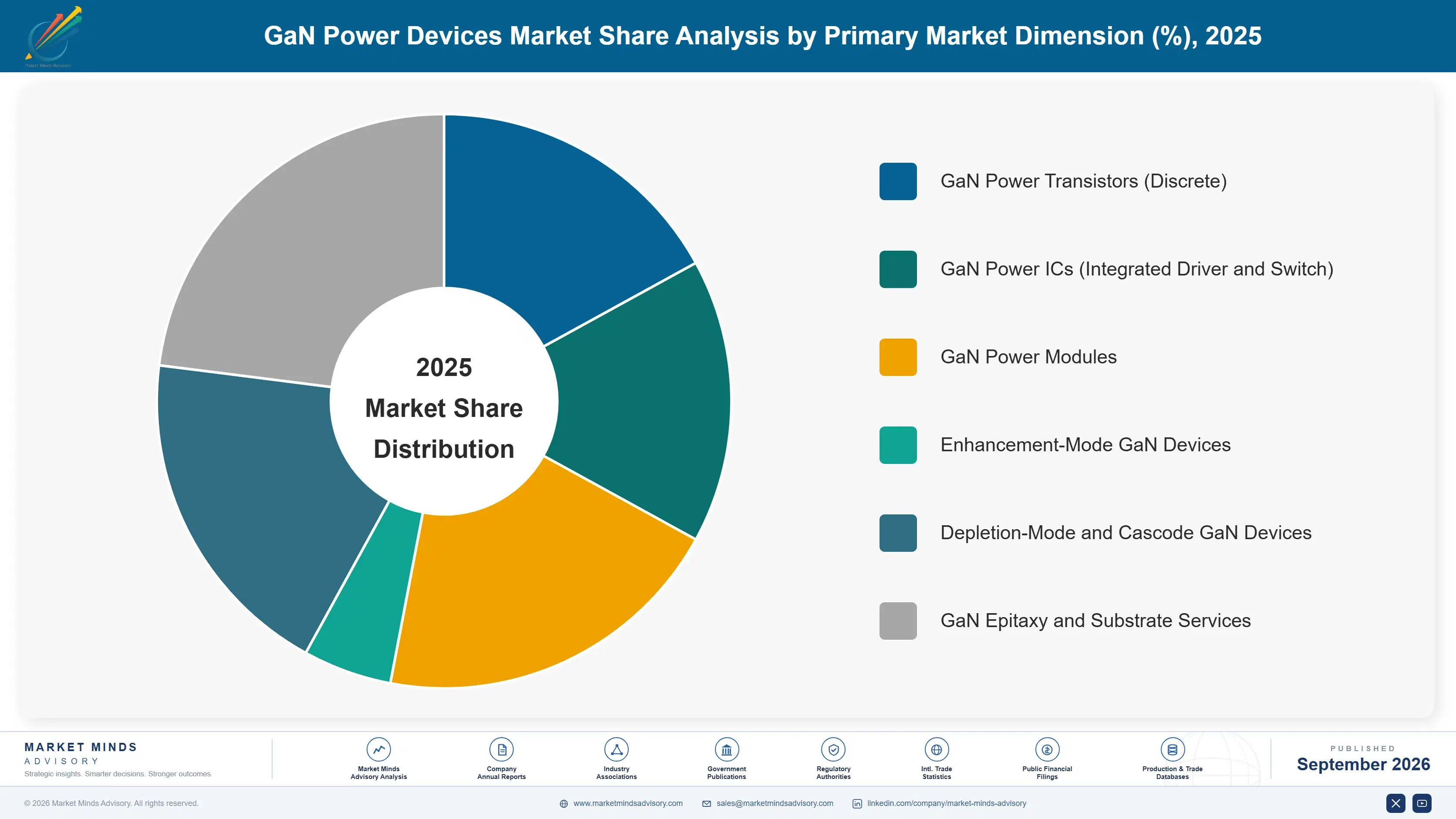
The market splits across six distinct product segments spanning discrete transistors, power ICs, modules, enhancement-mode, depletion-mode, and epitaxy services sold to electronics manufacturers worldwide today across every major application. Power ICs and enhancement-mode devices are pulling ahead of legacy discrete categories as integration and fast charging applications expand rapidly across most regions. today. now.
gan-power-devices-market-market-share-analysis-1790011665570

GaN Power ICs (Integrated Driver and Switch)

GaN power ICs combine switching transistor, driver, and protection circuitry into a single integrated package, letting device makers reduce board footprint and design complexity compared to assembling discrete components separately at greater cost. Demand is concentrated among consumer charger and data center power supply manufacturers, with North America and East Asia leading adoption given deeper semiconductor design and fabrication investment. Vendors are racing to bring integration cost down as demand accelerates, since combined functionality increasingly determines which vendors win large-scale consumer electronics contracts ahead of smaller, less-integrated competitors still selling discrete components separately and inefficiently. Adoption momentum keeps building each fiscal quarter across sectors. today. Enterprise procurement teams increasingly evaluate reliability alongside price.
CAGR 21.4%

Enhancement-Mode GaN Devices

Enhancement-mode GaN devices operate in a normally-off state that simplifies circuit design and improves safety compared to depletion-mode alternatives requiring additional control circuitry to prevent unintended conduction entirely. Demand is accelerating as consumer and data center applications favor simpler, safer circuit designs, pulling device vendors toward enhancement-mode process development rather than the cascode architectures earlier GaN generations required. Device makers increasingly specify enhancement-mode GaN as a baseline requirement for new power designs, and the segment is expanding fastest among vendors serving consumer charger and data center applications worldwide. Pricing has held steady even as demand volumes expand rapidly worldwide. Enterprise procurement teams increasingly evaluate reliability alongside price. and abroad. today.
CAGR 19.2%
Full segment breakdown across 6 segments available in the complete report.

Regional Architecture and Country Demand Map

East Asia leads on dense GaN fabrication capacity and consumer electronics assembly volume across China, Taiwan, and South Korea, with North America close behind on data center demand and design activity. South Asia and Pacific posts the fastest regional growth rate as India's electronics manufacturing expands.

East Asia

China's enormous consumer electronics assembly base anchors East Asia's leadership in GaN power device demand, with domestic charger and adapter manufacturers consuming vast unit volumes across smartphone, laptop, and appliance categories produced across the region. Taiwan and South Korea contribute deep semiconductor fabrication expertise, with several of the world's leading GaN foundries operating advanced epitaxial process capacity there. Japan continues supplying precision power semiconductor design capability for automotive and industrial applications, drawing on decades of accumulated manufacturing know-how. Regional foundry capacity gives local vendors proximity advantages over foreign competitors serving this market from farther away, and growth here remains strong as fast charger adoption continues expanding. Vendor relationships here span multiple decades of continuous supply.
Share: 30% | CAGR: 16.6% (2026 to 2036)

North America

Data center power density requirements and design activity concentrated among United States-headquartered semiconductor companies drive substantial demand for GaN power devices across North America, with major cloud providers specifying GaN switching for next-generation server power supplies. Design activity remains heavily concentrated among United States-headquartered GaN vendors, even as manufacturing increasingly occurs offshore across partner foundries. Automotive and industrial power electronics applications add a second steady demand channel, particularly given the region's substantial electric vehicle manufacturing base. Canada contributes a smaller but growing share through semiconductor design activity tied to cross-border technology partnerships and shared supply chain relationships with the United States. Certification pipelines here remain among the deepest in the world.
Share: 26% | CAGR: 16.8% (2026 to 2036)
Regional intelligence for 5 additional markets available in the complete report: Western Europe, South Asia and Pacific, Latin America, Middle East and Africa, Eastern Europe. Contact sales@marketmindsadvisory.com.
gan-power-devices-market-country-cagr-analysis-1790011666094

Where GaN Device Margin Actually Concentrates

Margin in the GaN power devices market increasingly concentrates around integration depth and fabrication yield rather than raw unit shipment volume alone across most segments. Vendors capturing design wins across consumer charger and data center power programs hold pricing power that pure-play, discrete transistor suppliers have steadily lost over recent years and continue losing today.

Integrated Power IC Design Commands Design Wins

Vendors offering integrated power ICs combining switching, driver, and protection circuitry are winning consumer electronics contracts that discrete transistor competitors cannot bid on at all, since device makers increasingly refuse to assemble separate components when integrated alternatives exist. This integration capability commands roughly 50 percent higher average selling price than discrete transistors of comparable current rating, since device makers value reduced design complexity highly. Device makers increasingly favor vendors who can support next-generation integration roadmaps, letting a single component replace what once required multiple discrete parts. Few competitors can match this integration depth today.
Market Impact: Commands a 50 percent higher average selling price

Data Center Design Wins Lock In Multi-Year Contracts

Vendors securing data center power supply design wins capture recurring production volume tied to the customer's ongoing server refresh cycles rather than one-time component sales, generating far more predictable, durable revenue streams. These design relationships typically span 3 or more product generations once a vendor's GaN device becomes embedded in a hyperscaler's reference power supply design, since requalification imposes real cost and schedule risk that operators actively avoid. This mechanism is becoming an increasingly important revenue driver as AI data center buildout accelerates power density requirements across the industry. today.
Market Impact: Secures 3-plus product generation design contract terms now

Fast Charger Early Adoption Advantage Pays Off

Vendors that moved early to bring GaN power IC manufacturing cost down to mainstream consumer price points are winning fast charger contracts from device makers eager to skip an intermediate silicon-hybrid design phase entirely. This early-mover positioning is generating a persistent design-in advantage worth an estimated 30 percent of new fast charger contracts annually as device makers standardize on GaN across their product lines. Vendors slower to adopt are increasingly relegated to smaller, budget-constrained accounts still specifying legacy silicon designs, a shrinking category as GaN adoption keeps accelerating across nearly every consumer electronics category tracked.
Market Impact: Wins 30 percent of all new charger contracts

Extended Reliability Testing Services Add Recurring Revenue

Vendors offering extended reliability testing and failure analysis services tuned specifically for automotive and data center customers, combined with dedicated technical support, are capturing premium pricing from customers facing persistent field reliability and warranty cost challenges. This service positioning adds roughly 16 percent to per-unit revenue for vendors able to demonstrate proven field reliability data and rapid failure analysis turnaround directly to procurement teams evaluating competing device platforms. Automotive and data center customers increasingly specify service capability explicitly in vendor selection criteria, giving established vendors a durable, defensible advantage over less-equipped competitors bidding for the same large-scale contracts today.
Market Impact: Adds roughly 16 percent to total per-unit revenue

Who Controls the Margin Pool

The GaN power devices market holds moderate concentration, with the top five players controlling 44 percent of revenue on a combined semiconductor design and fabrication basis measured consistently across product categories. Infineon Technologies and Navitas Semiconductor lead comfortably given decades of power semiconductor and GaN-native design depth, while the gap to mid-tier challengers like Power Integrations has widened as integration development demands capital smaller vendors struggle to match.
Current competitive activity centers on power IC integration, fabrication yield improvement, and data center qualification expansion rather than pure switching frequency claims that dominated pricing conversations a decade ago. Vendors are racing to qualify parts across broader consumer, automotive, and data center applications, and several have pursued acquisitions to close design and fabrication capability gaps rather than build technology internally from scratch.

Emerging pressure is coming from Chinese domestic GaN vendors building cost-competitive alternatives for consumer applications, threatening to disintermediate established vendors for price-sensitive commodity segments specifically. Rankings could shift meaningfully over the next few years if domestic vendors succeed in capturing more of the mid-tier consumer segment, pushing established vendors toward deeper data center and automotive differentiation as their primary competitive response and growth avenue.
gan-power-devices-market-company-positioning-matrix-1790011666620

Competitive Moat and Risk Dimensions

INFINEON TECHNOLOGIES AG

Moat: Power Semiconductor Portfolio Scale

Infineon holds decades of accumulated power semiconductor design depth and manufacturing capacity across nearly every device category, giving it default incumbency in large-scale procurement programs that newer entrants struggle to displace quickly. This installed base generates recurring component orders that provide a stable revenue floor even as growth concentrates in newer GaN applications.
INFINEON TECHNOLOGIES AG

Risk: Domestic Competitor Price Pressure

Infineon faces intensifying price pressure from Chinese domestic GaN vendors targeting the commodity consumer segment, a category increasingly commoditized by lower-cost regional competitors with government manufacturing support. That competitive pressure risks compressing margins in the volume tier faster than premium data center and automotive segments can offset through mix shift alone.
NAVITAS SEMICONDUCTOR CORPORATION

Moat: GaN-Native Design Depth

Navitas Semiconductor's GaN-native design heritage gives it deep, proven expertise in integrated power IC architecture that translates directly into competitive consumer and data center products customers already trust for reliability. That platform depth lets Navitas bundle integration capability with broader power design services customers already purchase.
NAVITAS SEMICONDUCTOR CORPORATION

Risk: Manufacturing Scale Limited Presence

Navitas Semiconductor has comparatively limited internal manufacturing scale relative to competitors with captive fabrication capacity, leaving it more dependent on foundry partner allocation during periods of tight industry-wide capacity. Expanding internal capacity would require capital investment that Navitas has not prioritized given its fabless business model.

Players Tracked

Prominent Players

Infineon Technologies AG
Navitas Semiconductor Corporation
Efficient Power Conversion Corporation
Innoscience Technology Co., Ltd.
Power Integrations Inc.

Other Key Players

Texas Instruments Incorporated
STMicroelectronics N.V.
ON Semiconductor Corporation
Renesas Electronics Corporation
ROHM Co Ltd
Transphorm Inc
VisIC Technologies Ltd
Nexperia B.V.
Qorvo Inc
Sanan IC Technology Co Ltd
Hopewind Electric Co Ltd
MACOM Technology Solutions Holdings Inc
Wolfspeed Inc
NexGen Power Systems Inc
Panasonic Holdings Corporation

Recent Developments

JANUARY 2025

Infineon Launches Integrated Data Center Power IC Family

Infineon announced a new integrated power IC family targeting hyperscale data center power supply applications, offering combined switching and driver functionality validated for high-frequency operation on next-generation server platforms launching over the coming years. The family is expected to enter volume production within two fiscal quarters.
Signal: Signals accelerating vendor investment in data center GaN integration across the industry and beyond current product cycles
MAY 2025

Navitas Expands Automotive Onboard Charger Partnership

Navitas Semiconductor expanded its GaN power IC supply partnership with a major automotive manufacturer, embedding integrated switching directly into next-generation electric vehicle onboard charger reference designs for upcoming vehicle platform launches across multiple regions worldwide. The partnership extends an existing multi-year strategic supply relationship. today.
Signal: Reinforces automotive demand as a primary growth vector for incumbents today between two long-standing automotive partners
SEPTEMBER 2025

Efficient Power Conversion Acquires Fabrication Yield Startup

Efficient Power Conversion acquired a smaller fabrication yield optimization startup to strengthen its process engineering roadmap, adding specialized defect reduction capability that complements its existing GaN device product portfolio for consumer customers significantly. Terms of the transaction were not fully disclosed by either company. today.
Signal: Confirms acquisition remains a viable path to yield capability for GaN vendors as consolidation activity keeps accelerating

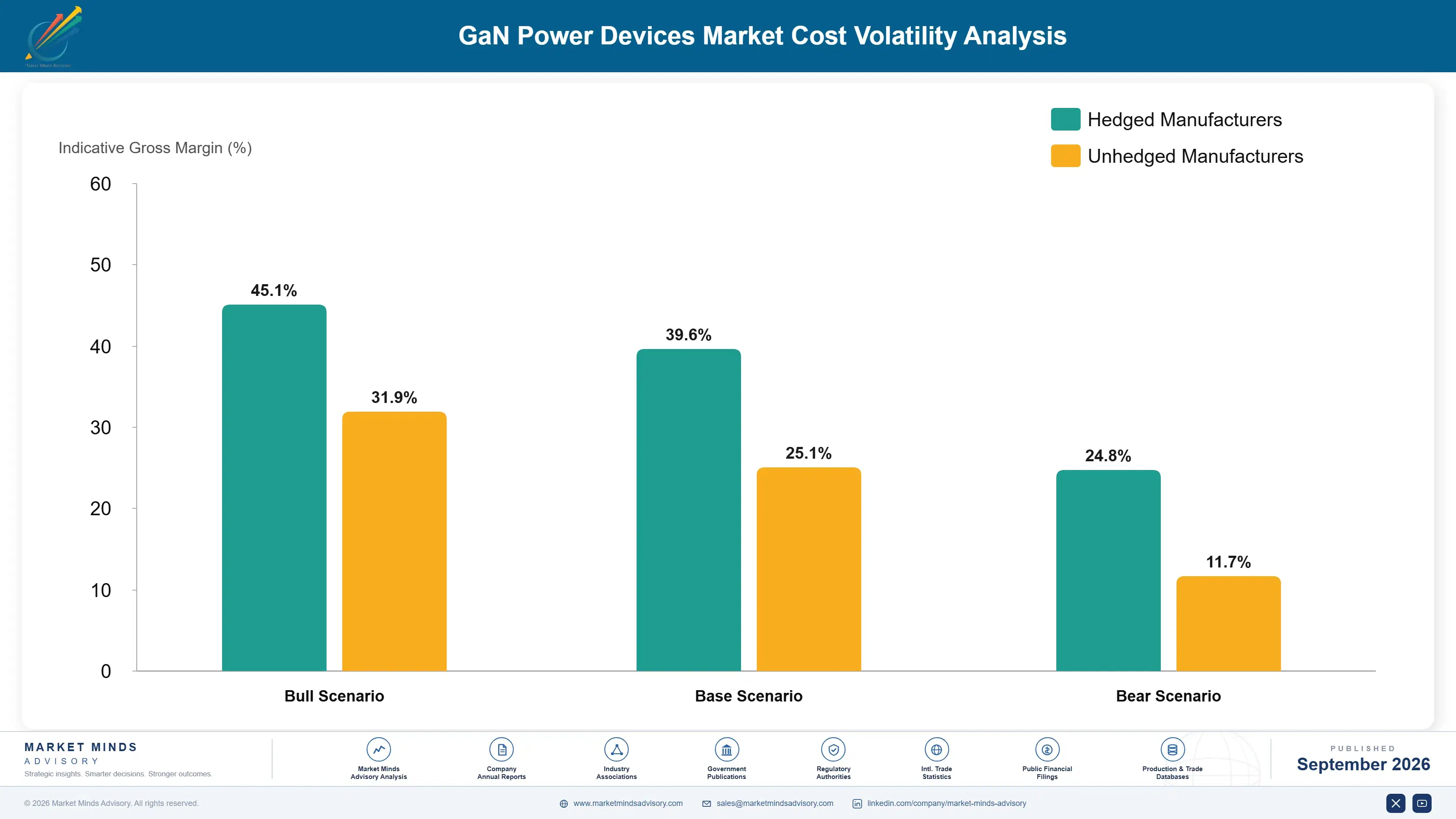
Epitaxial Wafer Cost and Substrate Exposure

Epitaxial gallium nitride-on-silicon wafers and specialized substrates represent the largest cost input for GaN power devices, typically 34 to 40 percent of total cost of goods sold, sourced predominantly from specialized epitaxy foundries concentrated in Taiwan, China, and the United States. Advanced packaging and testing costs add a second meaningful cost layer, particularly for vendors pursuing integrated power IC designs requiring specialized assembly processes today.
Infineon's 2024 annual report noted specialized GaN epitaxial wafer capacity remaining broadly available but periodically tight during peak consumer electronics and data center demand cycles, with GaN device customers competing for the same limited advanced substrate fabrication capacity as other compound semiconductor product lines. That competition occasionally forced smaller vendors to extend delivery schedules during peak demand periods when larger customers received allocation priority across the industry.

Vendors dependent on a single epitaxy supplier or lacking scale to negotiate priority allocation face genuine competitive disadvantage relative to larger rivals with diversified fabrication relationships and greater purchasing leverage in negotiations. This exposure varies meaningfully by player type: smaller fabless vendors absorb the brunt of allocation squeezes, while Infineon and Navitas Semiconductor secure preferential terms through internal fabrication capacity and decade-long partnerships.
gan-power-devices-market-cost-volatility-analysis-1790011666815

Internal Fabrication Capacity Investment Strategy

Larger vendors are investing in internal epitaxial wafer fabrication capacity for GaN processes, reducing dependence on external foundry allocation during periods of broader compound semiconductor demand growth and constrained capacity across cycles. This vertical integration comes at meaningfully higher fixed capital cost but protects delivery schedules during industry-wide tightness and constrained supply across most operators.

Diversified Multi-Foundry Epitaxy Sourcing Strategy

Vendors are qualifying GaN device designs across multiple epitaxial wafer suppliers simultaneously, trading some process optimization for reduced dependence on any single foundry relationship during allocation squeezes and demand spikes across product cycles. This flexibility comes at meaningfully higher qualification cost but protects delivery reliability during periods of industry-wide tightness across product cycles and jurisdictions.

Long-Term Substrate Supply Reservation Agreements

Larger vendors are signing multi-year epitaxial wafer supply agreements with priority allocation guarantees, securing predictable access to specialized substrate capacity even during industry-wide demand spikes affecting smaller competitors more severely and persistently over time. Smaller vendors generally lack the volume commitments required to access comparable terms from major suppliers and across regions and jurisdictions.

Portfolio Architecture for Margin Defence

Device margin structure runs on three distinct tiers separating on integration depth and fabrication yield rather than raw unit output volume alone across most segments. Discrete transistors compete almost entirely on unit price, while integrated power ICs and data center-qualified devices command genuine premiums buyers pay for reduced design complexity and proven, validated performance across applications and platforms.
The volume tier still ships the most units by count but claims a shrinking share of industry profit pools, increasingly squeezed between rising epitaxial wafer cost and price-sensitive commodity buyers treating basic transistors as fully interchangeable. Premium and next-generation tiers absorb heavier process and integration investment upfront but return it through longer design-in relationships and materially stronger renewal pricing power across multi-year platform cycles. Buyers increasingly reward proven integration track records.

High-value pools concentrate heavily in integrated power ICs and data center-qualified devices, where technical depth and genuine switching cost together create durable competitive advantage that commodity producers cannot easily replicate. That concentration is steadily reshaping where vendors deploy research spending, favoring integration and yield investment over legacy discrete-transistor development entirely, a shift accelerating industry-wide. Vendors slow to adapt risk permanent margin erosion.

Volume / Commodity-Adjacent Tier

Standard discrete GaN transistors and legacy silicon-comparable parts sold primarily on price and delivery reliability, with thin margins and intense competition from low-cost regional producers chasing volume contracts each cycle.
Gross Margin: 16-22%

Premium / Certified Tier

Automotive and industrial-grade devices carrying reliability certification across defined temperature ranges, validated for performance requirements with long design-in relationships and multi-year platform contract commitments already firmly in place across most operators.
Gross Margin: 28-36%

Sustainability / Regulatory / Next-Generation Tier

Integrated power ICs engineered for emerging data center and electric vehicle power architectures and next-generation efficiency mandates that command sustained pricing power over legacy discrete alternatives across most application segments and jurisdictions today.
Gross Margin: 38-46%
gan-power-devices-market-portfolio-architecture-1790011667319

High-value Sub-segments and Strategic Watch-out

GaN Power ICs (Integrated Driver and Switch)

Fastest-growing and highest-margin segment today, driven by integration demand that pushes devices well beyond discrete transistors into premium, design-in-locked product commanding sustained pricing power throughout the qualification cycle across every major consumer electronics customer worldwide today. Vendors here set the pace industry-wide today. now. today.
Gross Margin: 42-50%

Enhancement-Mode GaN Devices

Large, high-value pool growing steadily on simplified circuit design demand, where safety and switching costs sustain durable premium pricing over depletion-mode alternatives across most customer segments and regions served by major consumer and data center programs today. Contract renewal rates stay consistently high. now. today.
Gross Margin: 32-40%

GaN Power Transistors (Discrete)

Volume core of the market, supplying baseline power conversion capability at steady but thinner margins, dependent on large customer bases and reliable delivery windows across multi-year procurement cycles and repeat purchasing patterns from established electronics customers worldwide. Vendors here compete mostly on price and reliability.
Gross Margin: 20-26%

Depletion-Mode and Cascode GaN Devices

Strategic watch-out segment facing commoditization as enhancement-mode devices absorb most new design-in opportunities, shrinking legacy depletion-mode revenue steadily year over year across most major electronics markets and pressuring vendors reliant on that revenue base. Few vendors are reinvesting in this category. across most markets today.
Gross Margin: 14-19%

Recurring Demand Beneath GaN Silicon

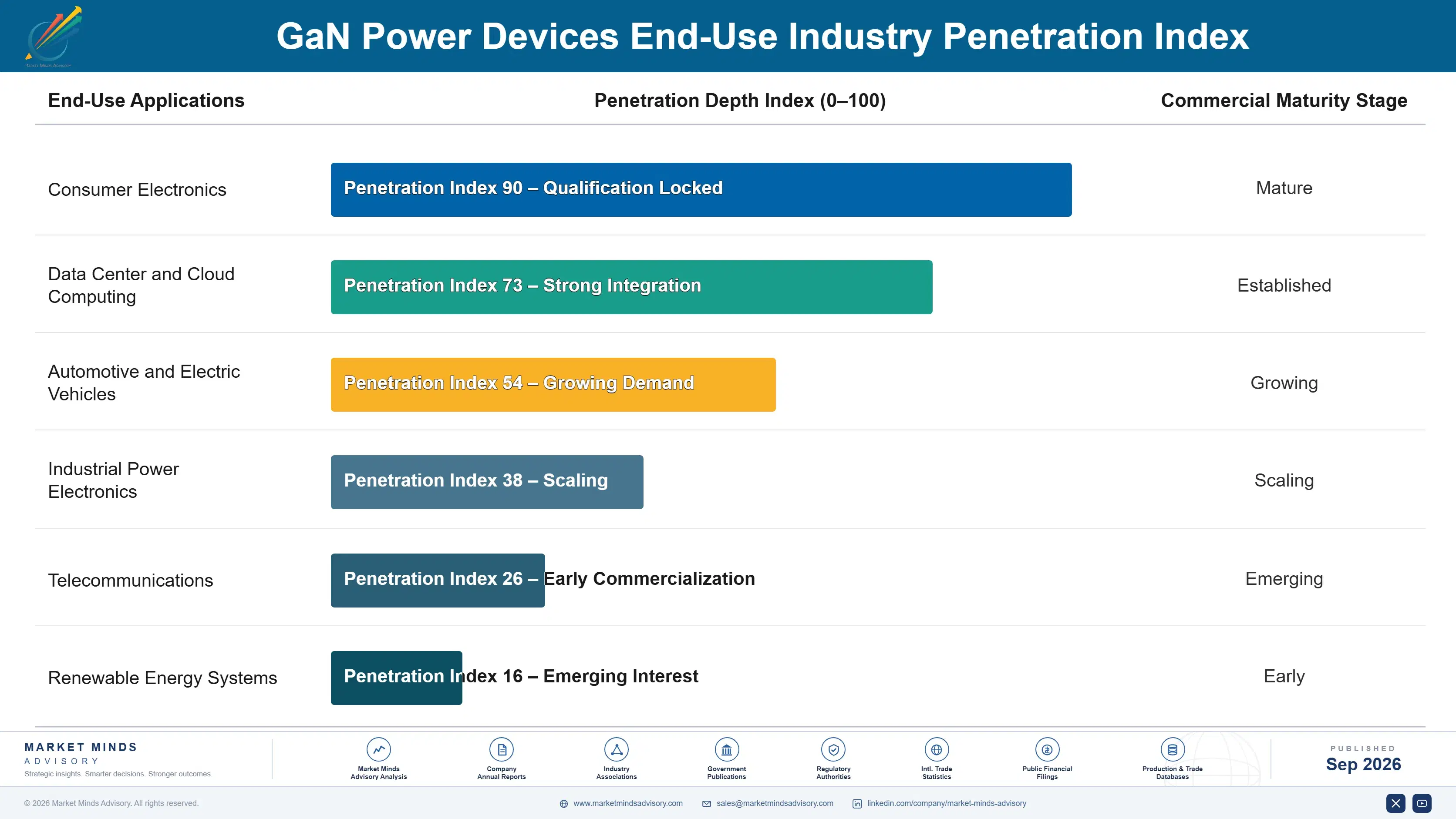
GaN power device demand runs closer to a design-in annuity than a one-time component purchase for most consumer and industrial customers. Once a device wins qualification on a product platform, replacement and expansion orders flow for years without a fresh competitive bid, giving incumbent suppliers a durable, multi-cycle revenue stream that new entrants find genuinely hard to break into quickly once embedded.
Stickiness varies sharply by end-use vertical, though. Automotive relationships run deepest, anchored by multi-year platform contracts and rigorous safety requalification that discourages switching mid-cycle. Data center relationships show similar depth once a device becomes embedded in a reference power supply design, though the relationship is younger and less tested across a full server refresh cycle. Consumer electronics relationships sit at the other end, more price-sensitive and faster to re-bid than either automotive or data center accounts tend to be.

Buyer profiles are shifting generationally as procurement teams turn over. Younger engineering and sourcing leads increasingly favor vendors offering documented integration depth and fabrication yield transparency over pure incumbency, a change legacy discrete-transistor suppliers with strong historical relationships are still adjusting to across multiple regions and customer segments simultaneously.
gan-power-devices-market-end-use-penetration-index-1790011667812

Where GaN Strategy Should Focus Next

These are among the four positions where our research anticipates prominent divergence between winners and laggards over the coming forecast period. Each is grounded in the demand model, the regulatory perimeter, and the announced capacity pipeline.
01 / POWER IC INTEGRATION INVESTMENT

Build integrated power ICs into every new device line

Integrated power ICs are capturing meaningfully higher pricing and design wins than discrete transistors, and that gap is widening every single quarter as device makers increasingly refuse to assemble separate switching, driver, and protection components across most designs. Vendors still shipping discrete-only devices risk losing consumer electronics contracts to competitors offering integrated capability at comparable manufacturing cost and validated reliability. Building integration capability now, even at higher upfront engineering cost, protects design-in share before device makers fully standardize on integrated architectures entirely.
02 / DATA CENTER QUALIFICATION EXPANSION

Accelerate data center power supply qualification programs

Data center demand for GaN switching is outrunning available qualified capacity as hyperscale operators accelerate power density upgrades across their server fleets, and vendors slow to complete qualification risk ceding the fastest-growing segment to more agile competitors. Vendors that achieve data center qualification now position themselves to bid on the full range of server power supply programs launching over the coming several years rather than a narrow subset of legacy accounts. Vendors that delay risk permanent exclusion from this growth segment.
03 / EPITAXIAL SUPPLY SECURITY

Lock in epitaxial wafer supply ahead of demand spikes

Specialized GaN epitaxial wafer capacity remains periodically tight amid broader compound semiconductor demand growth, leaving vendors without long-term supply agreements vulnerable to extended lead times during peak consumer and data center procurement periods that recur unpredictably across the calendar year and budget cycle. Larger competitors already secure preferential allocation through internal fabrication capacity and decade-long foundry relationships that smaller rivals cannot easily replicate. Establishing multi-year supply reservations now protects delivery reliability through the next inevitable industry-wide capacity crunch and preserves customer trust.
04 / REGIONAL MANUFACTURING POSITIONING

Expand presence across East Asian and Indian electronics markets

East Asia anchors both fabrication capacity and consumer electronics demand for this market, while India posts the fastest country-level growth rate on rapid electronics manufacturing expansion outpacing most other emerging markets tracked in this report today and well into the foreseeable future. Vendors under-invested in either region face longer lead times or missed design-in opportunities relative to competitors already embedded in local supply chains and manufacturer relationships. Building deeper regional presence now secures proximity to both anchor markets available anywhere.

Engagement Snapshot From the Field

A live engagement with an industry participant carrying material or product regulatory and market exposure ahead of a defining policy shift, showing how our research translates into a defensible multi-year portfolio strategy.
MARKET MINDS ADVISORY · CLIENT ENGAGEMENT SUMMARY
GaN Power Devices Producer Strategic Portfolio Review and Transition Roadmap 2026·Investment Scenario on GaN Power Devices Exposure Evaluation 2025-26
CLIENT PROFILE
The client is a global consumer electronics brand manufacturing smartphones and laptops, historically relying on legacy silicon-based charger designs across its entire product portfolio and accessory line. Annual charger and accessory revenue is approximately six hundred million dollars (client-reported, unverified by MMA), with competitive pressure mounting as rival brands launched smaller, faster GaN-based charging products.
STRATEGIC CHALLENGE
Competitors had launched dramatically smaller, faster-charging GaN-based chargers that were drawing favorable reviews and consumer preference away from the client's legacy silicon designs, threatening accessory revenue and overall brand perception. Leadership needed an independent assessment of GaN vendor options before committing to a next-generation charger product line redesign and rollout.
MMA APPROACH
MMA conducted structured interviews with the client's product engineering and supply chain leadership, benchmarked competitor GaN vendor relationships against primary survey data, and modeled cost and timeline outcomes under different vendor partnership scenarios for leadership review. The engagement combined qualitative expert interviews with MMA's proprietary segment growth forecasts to prioritize which vendor capability mattered most.
KEY FINDINGS
  1. Competitor GaN chargers were achieving roughly 45 percent size reduction (client-reported, unverified by MMA) compared to the client's existing silicon-based charger designs.
  2. Three qualified GaN power IC vendors demonstrated production-ready integrated designs suitable for the client's charger wattage requirements and product launch timeline. today.
  3. Internal GaN design expertise was quite limited across the organization, making vendor partnership a faster path to market than internal development entirely.
  4. A phased rollout starting with flagship smartphone chargers could demonstrate value before extending GaN adoption across the broader accessory portfolio and lineup.
CLIENT PROFILE
The client is a global consumer electronics brand manufacturing smartphones and laptops, historically relying on legacy silicon-based charger designs across its entire product portfolio and accessory line. Annual charger and accessory revenue is approximately six hundred million dollars (client-reported, unverified by MMA), with competitive pressure mounting as rival brands launched smaller, faster GaN-based charging products.
STRATEGIC CHALLENGE
Competitors had launched dramatically smaller, faster-charging GaN-based chargers that were drawing favorable reviews and consumer preference away from the client's legacy silicon designs, threatening accessory revenue and overall brand perception. Leadership needed an independent assessment of GaN vendor options before committing to a next-generation charger product line redesign and rollout.
MMA APPROACH
MMA conducted structured interviews with the client's product engineering and supply chain leadership, benchmarked competitor GaN vendor relationships against primary survey data, and modeled cost and timeline outcomes under different vendor partnership scenarios for leadership review. The engagement combined qualitative expert interviews with MMA's proprietary segment growth forecasts to prioritize which vendor capability mattered most.
KEY FINDINGS
  1. Competitor GaN chargers were achieving roughly 45 percent size reduction (client-reported, unverified by MMA) compared to the client's existing silicon-based charger designs.
  2. Three qualified GaN power IC vendors demonstrated production-ready integrated designs suitable for the client's charger wattage requirements and product launch timeline. today.
  3. Internal GaN design expertise was quite limited across the organization, making vendor partnership a faster path to market than internal development entirely.
  4. A phased rollout starting with flagship smartphone chargers could demonstrate value before extending GaN adoption across the broader accessory portfolio and lineup.
RECOMMENDED STRATEGY
Phase 1: Phase one: select a qualified GaN power IC vendor and begin flagship charger redesign within three months of engagement start. Phase 2: Phase two: launch the redesigned GaN charger alongside the next flagship smartphone release, targeting availability within nine full months. today. Phase 3: Phase three: extend GaN adoption across the broader accessory portfolio once flagship charger sales performance confirms strong consumer demand. today.
OUTCOME
Within ten months the client launched its first GaN-based flagship charger and reported (client-reported, unverified by MMA) accessory sales growth exceeding internal projections significantly, alongside positive consumer reception that helped stabilize brand perception against competitor offerings across the broader accessory category and product lineup. today.

Frequently Asked Questions

Foundational context covering the market sizes, CAGR, scope, country, region and competition that inform every finding below. This section is provided to cover basics and most often pre-purchase conversations, answered from the MMA Primary Research Dataset.

What is the current size of the GaN Power Devices Market?

The GaN Power Devices Market reached an estimated 2.3 billion dollars globally in 2025. Fast charging adoption and data center power density needs are the primary growth drivers today.

How large will the GaN Power Devices Market be by 2036?

MMA forecasts the market will reach approximately 11.53 billion dollars by 2036 under the base case scenario. That represents roughly a 4.33 times expansion from 2026 levels.

What is the CAGR for the GaN Power Devices Market 2026 to 2036?

The base case CAGR is 15.8 percent annually across the forecast period. Bull and bear scenarios range from 17.2 percent down to 14.4 percent respectively.

Which segment is growing fastest?

GaN Power ICs is growing fastest at 21.4 percent CAGR, roughly 1.35 times the overall market rate. Integration demand across consumer and data center applications drives that pace.

Who are the major companies in the GaN Power Devices Market?

Leading players include Infineon Technologies, Navitas Semiconductor, Efficient Power Conversion, Innoscience Technology, and Power Integrations. Together the top five hold an estimated 44 percent share.

Which country is growing fastest?

India leads country-level growth at 19.8 percent CAGR, well ahead of the regional and global averages. Rapid electronics manufacturing expansion and fast charger adoption are the main contributing factors.

Report Segmentation Architecture

The full report scope spans multiple orthogonal segmentation dimensions, with cross-tabulated demand data provided for each dimension pair. Coverage extends further to regional breakdowns, trend trajectories, and the competitive detail needed to support segment-level decision-making.

By Primary Market Dimension

  • GaN Power Transistors (Discrete)
  • GaN Power ICs (Integrated Driver and Switch)
  • GaN Power Modules
  • Enhancement-Mode GaN Devices
  • Depletion-Mode and Cascode GaN Devices
  • GaN Epitaxy and Substrate Services

By End-Use Industry

  • Consumer Electronics
  • Data Center and Cloud Computing
  • Automotive and Electric Vehicles
  • Industrial Power Electronics
  • Telecommunications
  • Renewable Energy Systems

By Commercial Dimension

  • Direct Semiconductor Manufacturer Sales
  • Distributor and Broker Channels
  • Original Equipment Manufacturer Design-In
  • Foundry and Fabless Partnership Models
  • Reference Design and Engineering Services

By Region

  • North America
  • Western Europe
  • East Asia
  • South Asia and Pacific
  • Latin America
  • Middle East and Africa
  • Eastern Europe

Scope, Methodology, and Coverage

Every figure in this report is reproducible from documented input assumptions. The scope below maps the historical period, the forecast horizon, the segmentation dimensions, and the countries covered, alongside the underlying primary and qualitative methodology.
Historical Period
2020 to 2025
Forecast Period
2026 to 2036
Base Year
2025 (USD billions; MMA Primary Research Dataset, September 2026)
Market Definition
The GaN Power Devices Market covers gallium nitride-based power semiconductor devices, including discrete transistors, power ICs, and modules used for power conversion and switching applications. It excludes GaN radio frequency devices for wireless and radar applications, silicon and silicon carbide power devices, and downstream power supply unit assembly.
Quantitative Units
USD Billion
Segmentation Dimensions
Product and technology type, end-use industry, and commercial distribution channel
Regions Covered
North America, Western Europe, East Asia, South Asia and Pacific, Latin America, Middle East and Africa, Eastern Europe
Countries Covered
United States, China, Taiwan, Japan, South Korea, Germany, India, and 14 additional countries
Key Companies Profiled
Infineon Technologies AG, Navitas Semiconductor Corporation, Efficient Power Conversion Corporation, Innoscience Technology Co., Ltd., Power Integrations Inc., Texas Instruments Incorporated, STMicroelectronics N.V., ON Semiconductor Corporation, Renesas Electronics Corporation, ROHM Co Ltd, Transphorm Inc, VisIC Technologies Ltd, Nexperia B.V., Qorvo Inc, Sanan IC Technology Co Ltd, Hopewind Electric Co Ltd, MACOM Technology Solutions Holdings Inc, Wolfspeed Inc, NexGen Power Systems Inc, Panasonic Holdings Corporation
Quantitative Methodology
Primary survey, n=3,800 respondents, Q4 2025, six countries; demand-side model with trade association cross-validation
Qualitative Methodology
47 expert interviews, Q4 2025; applied to validate demand model assumptions, identify emerging dynamics, and assess competitive positioning
Report Format
PDF and XLSX data workbook (Word format preview document)
Publisher
Market Minds Advisory
Report Code
MMA-2026-TEC-116
Published
September 2026
Contact
sales@marketmindsadvisory.com | www.marketmindsadvisory.com

Purchase the full GaN Power Devices Market Report (2026 to 2036).

This report provides a comprehensive assessment of the global GaN Power Devices Market across all major product categories, end-use industries, and geographic regions through 2036. It combines MMA's primary survey dataset of 3,800 respondents with 47 expert interviews to quantify segment-level growth, competitive positioning, and regional demand mechanisms. Coverage spans market sizing, segmentation, regional dynamics, competitive benchmarking, input cost exposure, and portfolio economics. The analysis is designed to support product roadmap planning, sourcing strategy, and investment decisions for semiconductor vendors, device manufacturers, and investors evaluating this space.
Ten-year quantitative forecast by product segment
Seven-region demand and pricing breakdown analysis
Competitive benchmarking of top twenty players
Epitaxial wafer cost exposure and mitigation analysis
Margin tier and portfolio economics mapping
Primary survey and expert interview data

Built For The People Who Decide

From boardroom strategy to bench-side execution, this report is read cover-to-cover by leaders shaping the next decade of their industry, turning demand scenarios, market dynamics and valuation benchmarks into decisions.
CXOs/ Presidents/ VPs/ Managers
M&A and Corporate Development
Strategy Teams and R&D Heads
Procurement and Product Directors
Regulatory and Compliance Leaders
Investor Relations and Equity Analysts