Market Minds Advisory
Galvanic Isolation Market

Galvanic Isolation Market: Isolation Voltage Rating as the Real Design Constraint

Electric vehicle power electronics designers now specify digital isolators over legacy optocouplers for faster switching, renewable inverter manufacturers expand isolated gate driver capacity, and suppliers without automotive-grade certification lose multi-year platform contracts outright.

Lead Analyst

David Horsley

Published

September 2026

Make Smarter Decisions with Customized Research Insights

Request a free sample report and evaluate market opportunities, growth trends, and competitive dynamics relevant to your business needs.

2025 MARKET VALUE$3.4BMarket Size 2025
2036 FORECAST VALUE$8.9BBase Case , 2026 to 2036
CAGR 2026 TO 20369.2 %Bull 10.5% / Bear 7.8%
INCREMENTAL OPPORTUNITY$5.2BNet 10- year value creation
EXPANSION MULTIPLE2.41x2036 value over 2026 base
Strategic Levers
M&A Pipeline
Regional Outlook
Country Rankings
Competitive Intelligence
Segmental Deep-dive
Call-Us : 91 93563 13602

Executive Snapshot and Market Trajectory

Power electronics designers increasingly treat isolation voltage rating and switching speed as the deciding purchasing factor rather than raw component cost alone, since certified isolation performance now determines which devices actually qualify for automotive and grid-connected platform designs across most major manufacturers simultaneously and without any costly requalification delay whatsoever.
Digital isolators lead growth at 13.5%, roughly 1.47 times the overall rate, as electric vehicle and renewable inverter designers move away from legacy optocouplers toward faster-switching, longer-lived semiconductor alternatives that older components cannot match. East Asia now holds the largest regional share at 29%, driven by China's dominant electric vehicle power electronics and solar inverter manufacturing base scaling faster than any other region's power electronics and grid infrastructure manufacturing base.
Competitive intensity stays moderate at 48% held by five suppliers, since strict automotive qualification requirements and application-specific engineering fragment share across dozens of regional specialists rather than concentrating around a handful of global platforms the way some capital-intensive semiconductor categories do. Buyers increasingly select suppliers on documented certification depth rather than unit price alone across most major design-in decisions and every subsequent platform refresh cycle.
Market Definition
Base Year Value
$3.4B in 2025 (MMA Primary Research Dataset, August 2026)
Forecast Period
2026 to 2036, eleven discrete annual values
CAGR
9.2% base case. Bull 10.5%. Bear 7.8%.
Fastest Growth Segment
Digital Isolators: 13.5% CAGR
Fastest Growth Country
China: 11.5% CAGR
Fastest Growth Region
South Asia and Pacific: 11.2% CAGR
Largest Region
East Asia: 29% of 2025 global value
Market Leaders
Primary Survey
n=3,800 procurement and R&D decision-makers, Q4 2025, six countries
Methodology
Demand-side build-up, cross-validated against public data, 47 expert interviews

Galvanic Isolation Market Forecast Scenarios

galvanic-isolation-market-size-forecast-scenario-1787301940493
Between 2020 and 2025 the market grew at an estimated 8.3% annually, as electric vehicle production scaling and renewable inverter capacity expansion pushed power electronics designers toward higher-performance isolation components faster than the industry's typical multi-year design cycle would otherwise dictate across most major manufacturing regions worldwide, a pace that held steady even through broader semiconductor supply disruptions.
Three mechanisms carry the base case to 9.2%. First, electric vehicle production keeps scaling globally, and every new power electronics platform requires isolated gate drivers and DC-DC converters for battery management systems. Second, renewable inverter manufacturers keep expanding capacity as solar and wind installations accelerate across major markets. Third, industrial automation keeps driving replacement demand as legacy optocoupler-based designs reach end of life and require certified digital isolator upgrades across every affected production line and product platform.
The bull case at 10.5% assumes accelerating electric vehicle production and renewable capacity additions pull forward isolator demand faster than currently planned by most power electronics manufacturers. The bear case at 7.8% assumes budget-constrained automotive and industrial capital programs delay planned platform upgrades, slowing the pace of new isolator design-in demand growth across affected sectors.

Isolation Voltage Rating as the Real Design Constraint

Galvanic isolation devices sit at the center of power electronics safety economics for any platform separating high-voltage and low-voltage circuits, since certified isolation rating increasingly determines which components an engineer can actually specify across automotive and grid-connected designs. Documented switching speed and certification depth, not raw component price, increasingly separates competing suppliers across most major design-in decisions and every subsequent platform certifica
MARKET CONCENTRATION (CR5)48%Five suppliers hold moderate share across fragmented specialist field
ISOLATION VOLTAGE RATING2.5 to 12 kVTypical certified rating range across automotive and industrial designs
TOP PRODUCING COUNTRY SHARE23%China supplies largest share of installed isolator manufacturing capacity
PRODUCT DESIGN-IN CYCLE3 to 6 yearsTypical interval before platforms require component requalification review
SILICON WAFER COST SHARE25-34% of COGSSemiconductor wafer inputs weigh heavily on production costs today
TRADE INTENSITY44% cross-borderFinished components frequently cross borders before final assembly
Commercially, the category behaves like a specialized certification and qualification business wrapped inside a broader semiconductor component supply relationship. Suppliers maintain automotive and industrial certification data across dozens of platform configurations simultaneously, which locks design engineers into suppliers holding the specific qualifications their target platforms require rather than encouraging part-by-part shopping on price. Switching isolator suppliers requires costly platform requalification testing and updated safety documentation.
Over the next decade, expect digital isolators and isolated gate drivers to keep displacing legacy optocoupler technology as electric vehicle and renewable power electronics designs demand faster switching and longer operating life. Automotive and grid infrastructure applications will keep driving the sharpest adoption activity as certification and safety requirements tighten further across the coming decade and beyond as safety standards bodies raise minimum performance thresholds.
"Nobody argues about isolation anymore until the certification lab sends the report back. Then it is the only conversation that matters."
Director, Power Electronics and Semiconductor Components Practice · MMA Electron

Market Trends

Electric Vehicle Power Electronics Drive Isolator Redesign

Electric vehicle battery management and traction inverter systems require galvanic isolation between high-voltage battery circuits and low-voltage control electronics, and rising EV production volume is pushing designers toward higher-performance isolators with faster switching and longer certified operating life than legacy platforms specified. China's expanding EV production base has pushed several domestic power electronics suppliers toward formal digital isolator adoption rather than continued reliance on optocoupler designs that cannot match required switching speed. Texas Instruments and Analog Devices have both expanded automotive-grade isolator product lines to meet this accelerating platform transition.
Market Impact: Adds 4,000 platforms under mandate

Renewable Inverter Capacity Expansion Sustains Gate Driver Demand

Global solar and wind inverter manufacturing capacity continues expanding to meet rising renewable installation targets, and each new inverter design now requires isolated gate drivers to safely switch high-voltage power semiconductors from low-voltage control circuits. China's continued investment in solar inverter manufacturing capacity has expanded the installed base of platforms requiring certified isolation components across major renewable production regions worldwide. Suppliers with established renewable sector relationships are capturing disproportionate share of this expanding capacity-driven demand across the region's fastest-growing manufacturing zones, particularly in coastal solar panel and inverter assembly hubs.
Market Impact: Adds 22% automation platform demand

Market Opportunities and Growth Drivers

Functional Safety Standards Expand Certified Isolator Demand

Tightening functional safety standards across automotive and industrial platforms are pushing design engineers to specify galvanic isolators with documented certification data rather than accept component-level safety claims without third-party verification across every affected subsystem. ISO 26262 automotive functional safety requirements increasingly reference isolation component certification explicitly in platform safety case documentation, creating design specification requirements that did not previously exist at this level of rigor. Suppliers with comprehensive automotive safety certification are capturing disproportionate share of new platform design-ins as engineering teams standardize on documented components across every new vehicle platform launch.
Market Impact: Requires 3 to 6 million

Industrial Automation Expansion Sustains Isolator Replacement Demand

Global industrial automation investment continues expanding factory floor sensor and control networks across most major manufacturing economies, and each new or upgraded automation system requires galvanic isolation to protect control electronics from high-voltage industrial power circuits. China's continued investment in smart manufacturing infrastructure has expanded the installed base of automation platforms requiring certified isolation components across major industrial regions and their extensive surrounding supply chains and vendor networks. Suppliers with established industrial automation relationships are capturing disproportionate share of this expanding infrastructure-driven demand base across every major producing region worldwide.
Market Impact: Delays deliveries 4 to 8 months

Market Restraints and Challenges

Automotive Qualification Costs Limit Smaller Supplier Entry

Bringing a new isolator design to automotive-grade qualification requires extensive AEC-Q100 reliability testing and functional safety documentation across multiple temperature and voltage conditions, a cost burden smaller specialty semiconductor manufacturers often cannot justify against uncertain design-in timelines. The root cause is evidentiary rigor: automotive customers require increasingly comprehensive reliability and safety case data before granting platform approval, a standard that has risen considerably as EV safety scrutiny intensifies. That cost structure concentrates the highest-value automotive design-in portfolio among a handful of well-capitalized suppliers. Suppliers are responding by pursuing shared qualification consortiums to distribute testing costs.
Market Impact: Converts 30% of EV platforms

Semiconductor Supply Volatility Complicates Production Planning

Isolator manufacturing depends on specialty semiconductor wafer supply that has experienced repeated capacity constraints and pricing volatility over the past several years, making it difficult for suppliers to guarantee delivery timelines against customer platform launch schedules. The root cause is capacity concentration: a small number of specialty wafer foundries supply the bulk of global isolator manufacturing capacity, leaving the entire industry exposed to any single facility's capacity or quality issues. That concentration risk pushes some customers to dual-source designs across multiple isolator suppliers as a hedge. Suppliers are responding by diversifying wafer sourcing across multiple foundry partners.
Market Impact: Adds 18% inverter platform demand
3 additional market trends, 4 additional growth drivers, and 2 additional restraints and challenges are covered in the full report. Contact sales@marketmindsadvisory.com to access the complete intelligence.

Segment CAGR and Growth Architecture

Segmentation follows component technology type, a single classification logic spanning digital isolators, optocouplers and optoisolators, isolated DC-DC converters, isolation transformers, isolation amplifiers, and isolated gate drivers. Each technology carries distinct switching mechanism, certification pathway, and application context, so commercial position tracks component architecture rather than end-use industry alone across every platform and design cycle.
galvanic-isolation-market-market-share-analysis-1787301941024

Digital Isolators

Digital isolators grow fastest at 13.5%, about 1.47 times the overall market rate, as electric vehicle and renewable inverter designers move away from legacy optocouplers toward capacitive and inductive coupling technology that switches faster and lasts longer under continuous operating conditions. Adoption concentrates first in automotive battery management systems where certified reliability data increasingly decides platform qualification, and industrial automation designers are increasingly following given comparable switching speed requirements across their control architectures. Suppliers with proven automotive certification data are capturing disproportionate share of new platform design-ins as engineering teams increasingly specify digital isolation explicitly in component sourcing requirements, particularly across China, Germany, and the broader electric vehicle manufacturing base worldwide.
CAGR 13.5%

Isolated Gate Drivers

Isolated gate drivers grow second-fastest at 12.0%, driven by rising adoption of silicon carbide and gallium nitride power semiconductors in electric vehicle and renewable inverter platforms that require faster and more precise gate switching than legacy silicon designs. Power electronics engineers now increasingly specify isolated gate drivers as a mandatory complement to wide-bandgap semiconductors rather than an optional upgrade, since the higher switching frequencies these devices enable demand correspondingly faster isolation response. Suppliers offering combined gate driver and isolation packages are capturing share from single-product specialists, since design engineers increasingly prefer a single accountable vendor for the complete power stage across every connected subsystem within the broader power electronics stack.
CAGR 12.0%
Full segment breakdown across 6 segments available in the complete report.

Regional Architecture and Country Demand Map

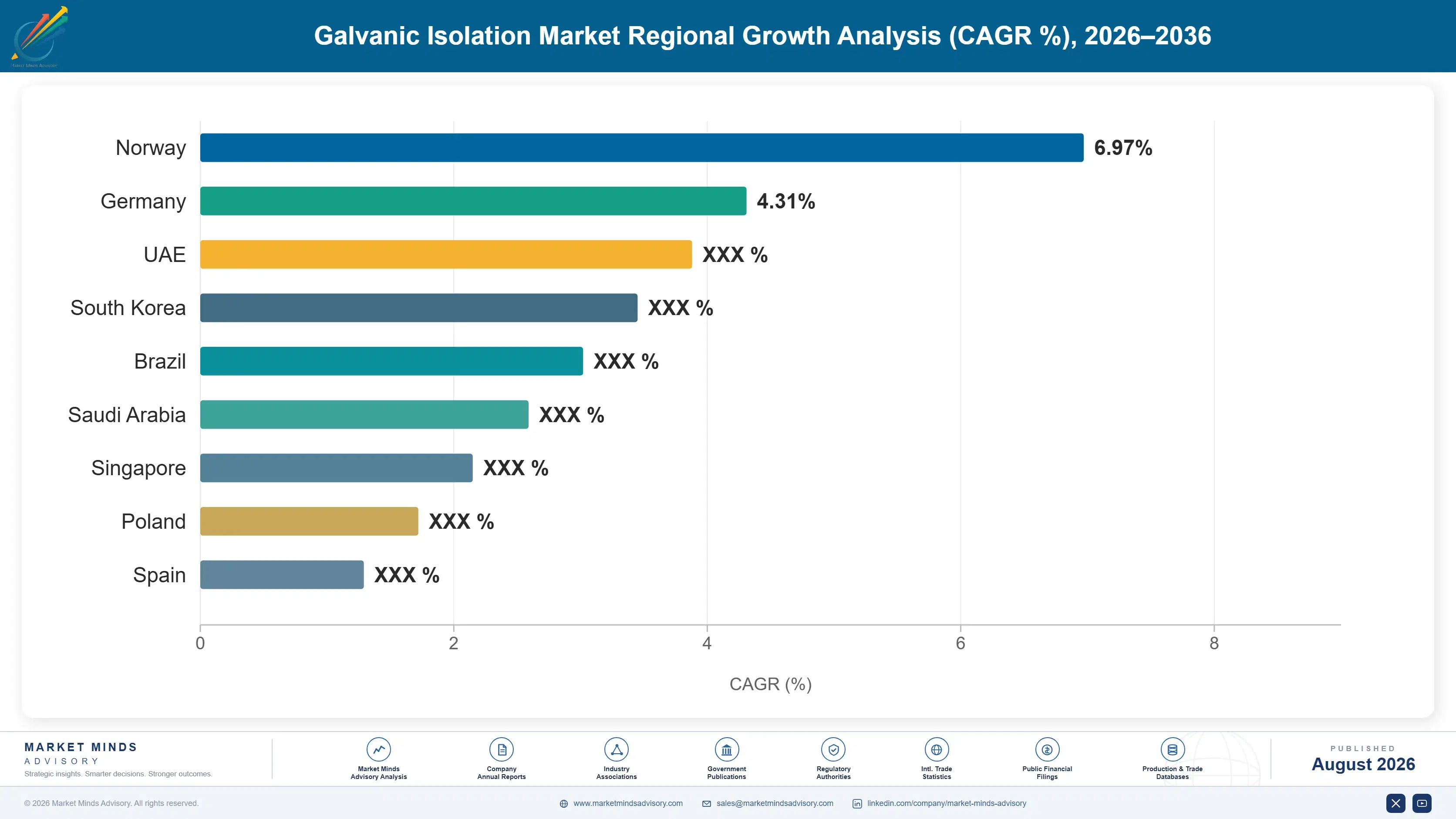
East Asia leads at 29% of global value on China's dominant electric vehicle power electronics and solar inverter manufacturing base, followed by North America at 25% and Western Europe at 19% on established automotive and industrial certification demand. Remaining regions account for the balance of demand.

North America

The United States accounts for most North American demand, where electric vehicle production scaling alongside ISO 26262 automotive functional safety requirements shape which isolation components design engineers actually specify across automotive, industrial, and grid infrastructure sectors. Domestic semiconductor manufacturing incentives have pushed several suppliers toward expanded automotive-grade isolator production capacity, sustaining elevated design-in volume across major manufacturing states. Canada's industrial automation and grid infrastructure sectors follow comparable regulatory patterns at smaller absolute scale, anchored by its own certification framework. Growth of 9.8% outpaces the global rate as electric vehicle platform expansion and semiconductor onshoring investment compound across an already substantial installed customer base spanning multiple industrial sectors and their extensive existing supplier certification networks nationwide.
Share: 25% | CAGR: 9.8% (2026 to 2036)

Western Europe

Germany and France host substantial automotive and industrial electronics manufacturing supporting isolator demand across the European Union's rigorous automotive functional safety certification framework, which requires extensive documentation before granting platform approval across all member states simultaneously. The Netherlands maintains significant semiconductor design and testing capability supporting the region's broader electronics supply chain. The United Kingdom maintains comparable certification requirements following its departure from the European Union's centralized regulatory system, creating some duplicative qualification burden for suppliers serving both markets separately. Growth of 7.6% trails the global average because the region's automotive manufacturing base, while technically sophisticated, has already driven most feasible platform transitions across mature accounts and long-established automotive supplier relationships built over decades.
Share: 19% | CAGR: 7.6% (2026 to 2036)
Regional intelligence for 5 additional markets available in the complete report: East Asia, South Asia and Pacific, Latin America, Middle East and Africa, Eastern Europe. Contact sales@marketmindsadvisory.com.
galvanic-isolation-market-country-cagr-analysis-1787301941540

Where Isolator Suppliers Can Defend Margin

Suppliers can defend margin against commoditized component pricing in several distinct ways beyond simply selling more units into a growing platform base. The three levers below identify genuine commercial advantage: automotive certification leadership, bundled gate driver packages, and design-in engineering support across regulated automotive and industrial accounts worldwide, from EV platforms to grid inverters.

Lead Automotive Certification Depth Documentation Now

Suppliers with the broadest AEC-Q100 qualified product portfolio across multiple voltage and temperature ratings capture premium pricing of 18% to 28% over competitors with narrower certification coverage, since automotive customers increasingly specify minimum qualification depth before approving platform design-in. This advantage compounds as electric vehicle safety standards tighten industry-wide, since suppliers with the deepest certification libraries can respond to new platform requests faster than competitors starting testing from scratch. Texas Instruments and Analog Devices have both built durable certification leadership that smaller regional competitors cannot quickly or affordably replicate across comparable voltage classes.
Market Impact: Commands a durable 18 to 28 percent

Bundle Isolated Gate Drivers With Digital Isolators

Power electronics engineers increasingly want a single accountable vendor for complete isolated power stage design spanning gate drivers, digital isolators, and DC-DC converters, rather than sourcing each component separately from different specialists. Suppliers offering bundled packages can charge premiums of 15% to 24% over component-only competitors, since customers value avoiding the integration risk of mismatched switching characteristics across multiple vendors and design cycles. Infineon and Broadcom have both built durable bundling advantages across dozens of platform configurations that smaller specialists cannot quickly replicate across comparable process configurations and platform types.
Market Impact: Commands a durable 15 to 24 percent

Offer Embedded Design-In Engineering Support Now

Manufacturers moving beyond selling standalone isolator components toward embedded design-in engineering support, spanning circuit simulation, layout guidance, and post-launch reliability monitoring under a single contract, capture engineering fees that a component-only sale never reaches. This shift matters most for automotive and grid infrastructure customers launching entirely new platforms, where design-in engineering support can add 20% to 35% above the component's standalone list price. It also deepens the customer relationship ahead of the next platform refresh, since the original design partner typically wins the follow-on contract a decade or more later.
Market Impact: Adds 20 to 35 percent to engineerin

Who Controls the Margin Pool

Concentration stays moderate at 48% held by the top five suppliers, evaluated on revenue from isolation and isolated power component product lines specifically. Texas Instruments and Analog Devices lead on certification breadth and design win depth, while Infineon, Broadcom, and Skyworks compete across different application specialties and regional footprints. The gap between leader and challenger is meaningful but not decisive, since design engineers often qualify multiple suppliers per platfor
Competitive activity currently runs along three dimensions. Automotive certification breadth matters most, as suppliers race to qualify components across every voltage and temperature rating platforms require. Bundled gate driver and isolator packaging runs a close second, as power electronics engineers increasingly want a single accountable vendor. Embedded design-in engineering support is the third, converting standalone component sales into deeper platform relationships.

Pressure is building from two directions. Chinese domestic semiconductor manufacturers are scaling rapidly and narrowing the technology gap on conventional isolator designs, threatening incumbents' share in price-sensitive emerging markets. Meanwhile wide-bandgap semiconductor specialists are commercializing novel gate driver architectures that could eventually challenge conventional isolator suppliers on power stage integration. Rankings will shift toward suppliers combining defensible certification portfolios with genuine bundling innovation.
galvanic-isolation-market-company-positioning-matrix-1787301942062

Competitive Moat and Risk Dimensions

TEXAS INSTRUMENTS INCORPORATED

Moat: Broadest Automotive Certification Portfolio

Texas Instruments maintains AEC-Q100 certified isolator designs across more voltage and temperature ratings than any other supplier, giving it breadth that smaller regional competitors cannot match while also letting it serve multinational automotive customers seeking a single supplier across all target platforms. That certification depth took decades to build and cannot be quickly replicated.
TEXAS INSTRUMENTS INCORPORATED

Risk: Exposure to Qualification Cost Inflation

Texas Instruments' certification-heavy business model makes it more exposed than smaller competitors to rising automotive qualification costs, which keep climbing as electric vehicle safety scrutiny intensifies. That cost inflation pressures margin on lower-volume certified configurations specifically, a persistent cost trend affecting specialty semiconductor suppliers broadly across the industry.
ANALOG DEVICES INC.

Moat: Integrated Signal Chain Manufacturing Scale

Analog Devices' integrated signal chain and power management manufacturing base gives it cross-selling advantages that pure-play isolator specialists cannot match, letting it bundle isolation into broader platform contracts while maintaining meaningful margin across its diversified product lines and adjacent semiconductor categories it manufactures at meaningful scale.
ANALOG DEVICES INC.

Risk: Isolators a Smaller Portfolio Slice

Isolation components represent a relatively small segment within Analog Devices' much larger diversified semiconductor portfolio, meaning specialized competitors sometimes out-innovate ADI on isolator-specific technology since their entire engineering focus concentrates there exclusively, without the competing internal capital priorities ADI's broader portfolio must constantly balance across its many other global business units.

Players Tracked

Prominent Players

Texas Instruments Incorporated
Analog Devices Inc.
Infineon Technologies AG
Broadcom Inc.
Skyworks Solutions Inc.

Other Key Players

NVE Corporation
Silicon Laboratories Inc.
Toshiba Corporation
ROHM Co. Ltd.
STMicroelectronics N.V.
Vishay Intertechnology Inc.
Renesas Electronics Corporation
onsemi
Murata Manufacturing Co. Ltd.
TDK Corporation
Littelfuse Inc.
Power Integrations Inc.
Isocom Components Ltd.
Sensata Technologies Holding plc
Bourns Inc.

Recent Developments

JUNE 2026

Texas Instruments launches next-generation digital isolator for EV battery management

Texas Instruments received automotive qualification for a new digital isolator specifically engineered for electric vehicle battery management applications, expanding its certified product portfolio ahead of tightening functional safety requirements. This was a qualification milestone, not a corporate transaction, extending Texas Instruments' automotive isolator roadmap significantly.
Signal: Shows leading suppliers continuing to inve
OCTOBER 2025

Infineon acquires specialty gate driver technology developer

Infineon Technologies acquired a privately held gate driver technology developer specializing in wide-bandgap semiconductor switching for an undisclosed sum. The acquisition was a full corporate purchase, not a licensing arrangement or joint venture, giving Infineon direct ownership of the underlying gate driver technology and its intellectual property.
Signal: Indicates suppliers increasingly prefer ow
FEBRUARY 2025

Analog Devices signs supply agreement with major EV platform manufacturer

Analog Devices entered a multi-year supply agreement to provide isolated power components to a major global electric vehicle platform manufacturer expanding battery management system production across several plants. The arrangement was a supply agreement, not an acquisition or joint venture, extending Analog Devices' automotive customer relationships meaningfully.
Signal: Signals automotive manufacturers increasin

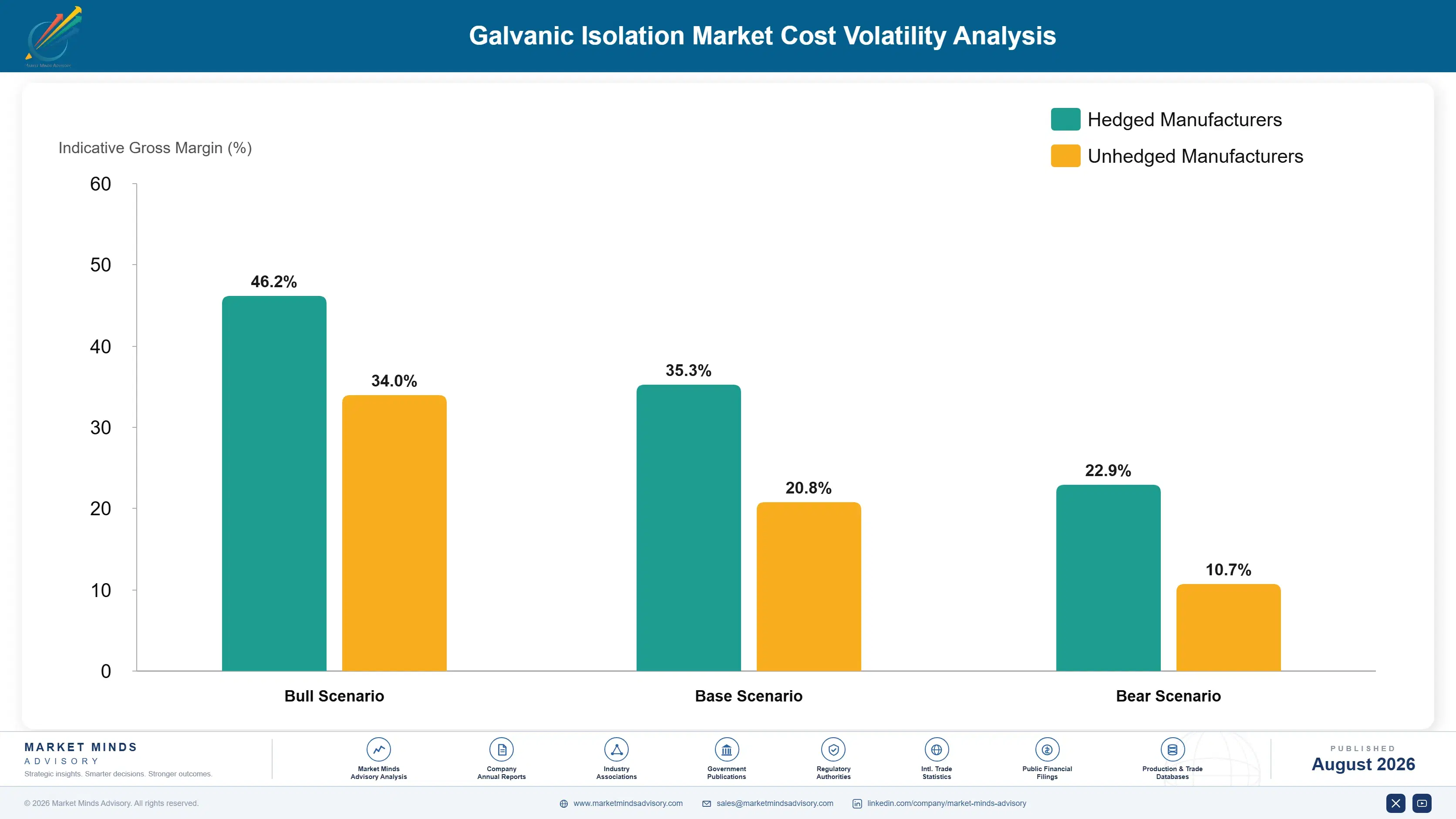
Wafer Foundry Supply Sets the Cost Ceiling

Specialty semiconductor wafers, primarily silicon and increasingly silicon carbide, together account for roughly 25% to 34% of isolator product COGS, sourced primarily from wafer foundries in Taiwan, the United States, and Germany. Packaging materials and certification testing add a further 14% to 20%, reflecting the accredited third-party validation every new automotive design configuration requires before commercial release.
Semiconductor wafer prices rose meaningfully through 2024 as global demand for automotive and renewable power electronics competed directly with broader consumer electronics uses for the same specialty wafer capacity, according to trade data. Texas Instruments' 2024 annual report disclosed higher input costs attributable to wafer and packaging intermediate inflation, noting that raw material costs rose meaningfully faster than the company could pass through to automotive customers without meaningful margin compression across its isolation product segment specifically.

Smaller specialty isolator manufacturers carry more exposure than the largest diversified suppliers, since they lack the purchasing scale to negotiate favorable long-term wafer foundry supply contracts. Suppliers sourcing wafers from a concentrated set of foundry partners face additional exposure to capacity and price volatility, while diversified suppliers absorb volatility more predictably across their broader, globally diversified supply chain relationships.
galvanic-isolation-market-cost-volatility-analysis-1787301942257

Lock Wafer Pricing Through Annual Contracts

Specialty semiconductor wafers are the largest single volatile input across most isolator product lines and increasingly competed for by broader automotive electrification demand worldwide. Annual supply agreements with fixed or collared pricing, common practice among larger diversified suppliers, smooth quarter-to-quarter volatility and let commercial teams quote customer contracts with genuine confidence rather than repricing against spot markets.

Diversify Wafer Sourcing Across Foundries

Reliance on a single wafer foundry concentrates both price and availability risk unnecessarily across an entire isolator product line and customer base. Qualifying secondary foundry partners across multiple regions, even at modestly higher unit cost, protects continuity when any single foundry faces capacity outage or a sudden demand spike from competing semiconductor sectors expanding simultaneously.

Portfolio Architecture for Margin Defence

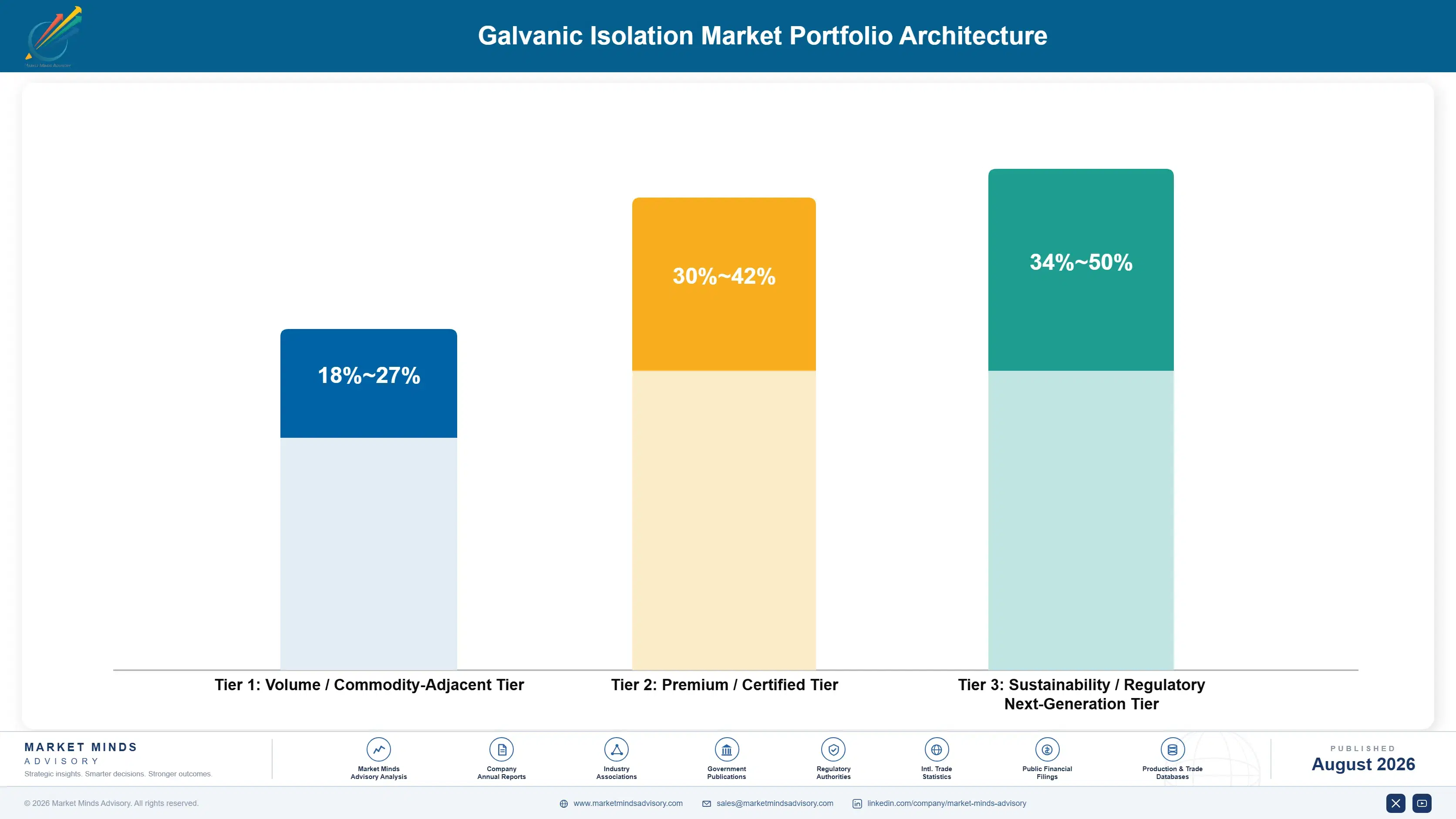
The portfolio splits into three tiers with meaningful margin separation tied to certification depth and switching performance. Volume tier products carry standard optocouplers and basic digital isolators for conventional industrial applications, competing largely on price against a crowded field of regional suppliers. Premium certified products carry automotive-grade digital isolators and gate drivers backed by documented AEC-Q100 data. Sustainability products, including wide-bandgap compatible
The tension between volume and premium runs through nearly every supplier's product roadmap. Volume products fund the manufacturing scale premium products eventually depend on, yet volume margins keep compressing as Chinese manufacturers scale aggressively on conventional isolator designs. Suppliers that under-invest in premium certification breadth risk commoditization within their own category, while those chasing premium exclusively struggle to fund the manufacturing base needed to serve routine industrial demand.

High-value margin pools concentrate specifically in automotive-grade digital isolators and wide-bandgap compatible gate drivers where certification depth and documented switching performance carry the largest commercial stakes, and where certification breadth commands genuine pricing power. Conventional optocouplers generate steadier volume but thinner margin, since that segment competes against a wider set of lower-cost regional suppliers with adequate but unremarkable certification differentiation.

Volume / Commodity-Adjacent Tier

Standard optocouplers and basic digital isolators for conventional industrial applications, competing largely on price against a crowded field of regional suppliers offering broadly comparable certification coverage and switching quality across the industry.
Gross Margin: 18-27%

Premium / Certified Tier

Automotive-grade digital isolators and gate drivers backed by documented AEC-Q100 qualification data and formal customer approval, commanding meaningful pricing premiums over standard equivalents across major regulated markets and multinational automotive accounts.
Gross Margin: 30-42%

Sustainability / Regulatory / Next-Generation Tier

Wide-bandgap compatible isolation systems still scaling across electric vehicle and renewable inverter applications, targeting switching performance conventional silicon-based isolators simply cannot achieve under current and anticipated future platform requirements worldwide.
Gross Margin: 34-50%
galvanic-isolation-market-portfolio-architecture-1787301942752

The Annuity Behind Every Design-In

Isolator demand behaves like an annuity once a platform designer commits to a specific supplier's certification data, since switching vendors requires costly platform requalification testing and updated safety case documentation across every affected subsystem. That structure rewards incumbency heavily: a supplier that wins the initial design-in keeps the customer relationship through multiple platform generations unless a competitor demonstrates a meaningful switching performance or certificati
Adoption stickiness varies meaningfully by end-use vertical once a supplier's component is qualified into a platform's safety architecture. Automotive and grid infrastructure customers rarely switch isolator suppliers mid-platform because requalifying certification against a new vendor risks production delay during testing, so switching costs run high. Industrial automation customers show similar loyalty tied to established design relationships, while general consumer electronics applications switch more readily since specifications are less exacting and price competition dominates purchasing decisions.

Buyer profiles are shifting generationally as platform design teams increasingly favor suppliers offering digital simulation tools and predictive reliability data over those selling hardware alone. Younger power electronics engineers trained on connected design environments expect components that integrate directly into simulation workflows, a preference reshaping which suppliers win platform design-ins as incumbent decision-makers retire.
galvanic-isolation-market-end-use-penetration-index-1787301943242

What Suppliers Should Do Next

These are among the four positions where our research anticipates prominent divergence between winners and laggards over the coming forecast period. Each is grounded in the demand model, the regulatory perimeter, and the announced capacity pipeline.
01 / CERTIFICATION DEPTH STRATEGY

Build the deepest automotive certification portfolio before rivals do

Buyers now pay a documented premium for certified breadth rather than raw switching speed alone, and that premium is widening as automotive customers increasingly specify minimum qualification depth before approving platform design-in across every affected subsystem. Suppliers without comprehensive certification libraries will find themselves squeezed into commodity price competition, where ten points of margin separate certified leaders from narrowly qualified followers across most automotive accounts. The investment case favors certification depth over manufacturing scale alone, particularly for suppliers targeting large multi-platform accounts.
02 / BUNDLED POWER STAGE POSITIONING

Bundle gate drivers and isolators ahead of integration mandates

Power electronics engineers increasingly want a single accountable vendor for complete isolated power stage design rather than sourcing gate drivers and isolators separately from different specialists across their platform architectures. Suppliers without bundling capability increasingly lose bids among platforms standardizing on integrated power stages, regardless of individual component quality on either side of the sale. Those building bundled offerings now, ahead of rivals still selling components separately, will capture disproportionate share as integration mandates spread across every major regulated market.
03 / EV PLATFORM POSITIONING

Expand distribution across China's EV production base now

China's electric vehicle production base and its expanding domestic power electronics manufacturers are creating a predictable demand wave that rewards suppliers who establish regional certification depth ahead of production capacity coming online rather than scrambling once platforms are already committed elsewhere and contractually locked in. Automotive customers facing platform launch deadlines cannot wait for new certification to complete elsewhere, which means late-moving suppliers miss the premium pricing window entirely regardless of eventual component performance. Suppliers positioning now will capture disproportionate share of this expanding demand.
04 / DESIGN ENGINEERING POSITIONING

Offer embedded design-in support to capture full platform value

Engineering capacity for embedded design-in support has repeatedly struggled to keep pace with sudden demand spikes when new platform launches take effect, creating temporary shortages that reward suppliers who invested in engineering capacity ahead of the wave rather than reactively scrambling once demand materializes. Suppliers with pre-positioned engineering teams can capture premium project pricing during platform launch cycles, since customers facing launch deadlines cannot wait for capacity elsewhere. Suppliers investing ahead of the next platform wave will capture disproportionate share.

Engagement Snapshot From the Field

A live engagement with an industry participant carrying material or product regulatory and market exposure ahead of a defining policy shift, showing how our research translates into a defensible multi-year portfolio strategy.
MARKET MINDS ADVISORY · CLIENT ENGAGEMENT SUMMARY
Galvanic Isolation Producer Strategic Portfolio Review and Transition Roadmap 2026·Investment Scenario on Galvanic Isolation Exposure Evaluation 2025-26
CLIENT PROFILE
A mid-size European power electronics manufacturer operating three production sites across Germany and Austria, supplying battery management systems to electric vehicle and industrial automation customers. The client generated approximately 240 million euros in annual revenue (client-reported, unverified by MMA) and faced pressure to redesign its isolator architecture ahead of a major EV platform refresh requiring higher switching speed.
STRATEGIC CHALLENGE
The client needed to select isolator suppliers for its next-generation battery management platform while meeting an automaker's aggressive design freeze deadline across multiple interconnected subsystems. Leadership also questioned whether to prioritize established suppliers offering full automotive certification depth or evaluate lower-cost alternatives with narrower documented reliability data and testing history.
MMA APPROACH
MMA conducted supplier benchmarking across five isolator vendors using primary interviews with design engineers and automotive quality staff, alongside analysis of certification depth and switching performance data for each candidate component under evaluation. The engagement mapped total design-in cost across the full platform development timeline rather than upfront component price alone.
KEY FINDINGS
  1. Two of five candidate suppliers lacked sufficient AEC-Q100 certification depth for the client's specific voltage rating, narrowing realistic options considerably ahead of the deadline.
  2. The leading candidate's digital isolator technology eliminated a costly redesign step the client's prior optocoupler-based architecture would have otherwise required across the platform.
  3. Bundled isolator and gate driver packages reduced total design-in engineering time by roughly 25 percent (client-reported, unverified by MMA) compared with separate component sourcing.
  4. A phased subsystem-by-subsystem transition, prioritizing the battery management module facing the nearest deadline first, reduced schedule risk considerably compared with a simultaneous full-platform redesign.
CLIENT PROFILE
A mid-size European power electronics manufacturer operating three production sites across Germany and Austria, supplying battery management systems to electric vehicle and industrial automation customers. The client generated approximately 240 million euros in annual revenue (client-reported, unverified by MMA) and faced pressure to redesign its isolator architecture ahead of a major EV platform refresh requiring higher switching speed.
STRATEGIC CHALLENGE
The client needed to select isolator suppliers for its next-generation battery management platform while meeting an automaker's aggressive design freeze deadline across multiple interconnected subsystems. Leadership also questioned whether to prioritize established suppliers offering full automotive certification depth or evaluate lower-cost alternatives with narrower documented reliability data and testing history.
MMA APPROACH
MMA conducted supplier benchmarking across five isolator vendors using primary interviews with design engineers and automotive quality staff, alongside analysis of certification depth and switching performance data for each candidate component under evaluation. The engagement mapped total design-in cost across the full platform development timeline rather than upfront component price alone.
KEY FINDINGS
  1. Two of five candidate suppliers lacked sufficient AEC-Q100 certification depth for the client's specific voltage rating, narrowing realistic options considerably ahead of the deadline.
  2. The leading candidate's digital isolator technology eliminated a costly redesign step the client's prior optocoupler-based architecture would have otherwise required across the platform.
  3. Bundled isolator and gate driver packages reduced total design-in engineering time by roughly 25 percent (client-reported, unverified by MMA) compared with separate component sourcing.
  4. A phased subsystem-by-subsystem transition, prioritizing the battery management module facing the nearest deadline first, reduced schedule risk considerably compared with a simultaneous full-platform redesign.
RECOMMENDED STRATEGY
Phase 1: Phase one: redesign the battery management module facing the nearest deadline first using the leading bundled isolator and gate driver package. Phase 2: Phase two: complete redesign across the remaining subsystems, carefully sequencing around the automaker's broader platform validation schedule and testing windows. Phase 3: Phase three: establish an internal component certification tracking process to flag future design-in requirements well before deadlines approach at any site.
OUTCOME
The manufacturer completed its battery management redesign ahead of the automaker's design freeze deadline, avoiding any schedule penalty, and the bundled approach reduced total engineering time meaningfully compared with the client's prior separate-component design history (client-reported, unverified by MMA). The certification tracking process is now flagging future design-in needs earlier.

Frequently Asked Questions

Foundational context covering the market sizes, CAGR, scope, country, region and competition that inform every finding below. This section is provided to cover basics and most often pre-purchase conversations, answered from the MMA Primary Research Dataset.

What is the current size of the Galvanic Isolation Market?

The global galvanic isolation market reached 3.4 billion dollars in 2025, with automotive and industrial power electronics applications accounting for most of that installed demand base.

How large will the Galvanic Isolation Market be by 2036?

The market is projected to reach 8.95 billion dollars by 2036, representing a 2.41 times expansion over the eleven-year forecast period driven by EV and renewable demand.

What is the CAGR for the Galvanic Isolation Market 2026 to 2036?

The market is forecast to grow at a 9.2% compound annual rate, with bull and bear scenarios ranging from 10.5% to 7.8% depending on EV production pace.

Which segment is growing fastest?

Digital isolators lead at a 13.5% CAGR, roughly 1.47 times the overall market rate, as EV and renewable inverter designers move away from legacy optocoupler technology.

Who are the major companies in the Galvanic Isolation Market?

Texas Instruments, Analog Devices, Infineon Technologies, Broadcom, and Skyworks Solutions lead the field, together holding 48% of global output on a consistent revenue basis today.

Which country is growing fastest?

China leads national growth at an estimated 11.5% CAGR, driven by its dominant electric vehicle power electronics and solar inverter manufacturing base scaling rapidly nationwide.

Report Segmentation Architecture

The full report scope spans multiple orthogonal segmentation dimensions, with cross-tabulated demand data provided for each dimension pair. Coverage extends further to regional breakdowns, trend trajectories, and the competitive detail needed to support segment-level decision-making.

By Primary Market Dimension

  • Digital Isolators
  • Optocouplers and Optoisolators
  • Isolated DC-DC Converters
  • Isolation Transformers
  • Isolation Amplifiers
  • Isolated Gate Drivers

By End-Use Industry

  • Automotive and Electric Vehicles
  • Renewable Energy and Grid Infrastructure
  • Industrial Automation
  • Medical Devices
  • Consumer Electronics

By Commercial Dimension

  • Direct Platform Design-In Sales
  • Distributor and Wholesale Sales
  • Embedded Design Engineering Services
  • Private Label Manufacturing

By Region

  • North America
  • Western Europe
  • East Asia
  • South Asia and Pacific
  • Latin America
  • Middle East and Africa
  • Eastern Europe

Scope, Methodology, and Coverage

Every figure in this report is reproducible from documented input assumptions. The scope below maps the historical period, the forecast horizon, the segmentation dimensions, and the countries covered, alongside the underlying primary and qualitative methodology.
Historical Period
2020 to 2025
Forecast Period
2026 to 2036
Base Year
2025 (USD billions; MMA Primary Research Dataset, August 2026)
Market Definition
This report covers semiconductor and electromechanical components that provide electrical isolation between circuits in automotive, industrial, renewable energy, and medical device applications. It includes digital isolators, optocouplers, isolated DC-DC converters, isolation transformers, isolation amplifiers, and isolated gate drivers. It excludes standalone power semiconductors and control software sold without accompanying isolation hardware.
Quantitative Units
USD billions (current prices); unit shipment volume where applicable
Segmentation Dimensions
By Primary Market Dimension; By End-Use Industry; By Commercial Dimension; By Region
Regions Covered
North America, Western Europe, East Asia, South Asia and Pacific, Latin America, Middle East and Africa, Eastern Europe
Countries Covered
USA, China, Germany, France, UK, Japan, South Korea, India, Australia, Canada, Brazil, Mexico, Indonesia, Vietnam, Thailand, Malaysia, UAE, Saudi Arabia, South Africa, Nigeria, Turkey, Poland, Netherlands, Italy, Spain, Sweden, Switzerland, Argentina, Colombia, Singapore, and additional markets relevant to this sector
Key Companies Profiled
Texas Instruments Incorporated; Analog Devices Inc.; Infineon Technologies AG; Broadcom Inc.; Skyworks Solutions Inc.; NVE Corporation; Silicon Laboratories Inc.; Toshiba Corporation; ROHM Co. Ltd.; STMicroelectronics N.V.; Vishay Intertechnology Inc.; Renesas Electronics Corporation; onsemi; Murata Manufacturing Co. Ltd.; TDK Corporation; Littelfuse Inc.; Power Integrations Inc.; Isocom Components Ltd.; Sensata Technologies Holding plc; Bourns Inc.
Quantitative Methodology
Primary survey, n=3,800 respondents, Q4 2025, six countries; demand-side model with trade association cross-validation
Qualitative Methodology
47 expert interviews, Q4 2025; applied to validate demand model assumptions, identify emerging dynamics, and assess competitive positioning
Report Format
PDF and XLSX data workbook (Word format preview document)
Publisher
Market Minds Advisory
Report Code
MMA-2026-TEC-301
Published
August 2026
Contact
sales@marketmindsadvisory.com | www.marketmindsadvisory.com

Purchase the full Galvanic Isolation Market Report (2026 to 2036).

The full report provides complete segmentation data across all six isolator technology segments, detailed profiles of the top twenty market participants, and country-level analysis across all seven global regions covered by this study. It includes a proprietary MMA certification depth index built from primary survey data collected across forty-seven expert interviews conducted throughout the fourth quarter of 2025. Buyers also receive quarterly market updates through the end of 2026. Direct analyst access is included for methodology questions or custom data requests specific to their strategic priorities.
Full seven-region CAGR and market share breakdown
Twenty-company competitive profile database included in full
Segment-level pricing and gross margin analysis
Wafer foundry input cost exposure tracking model
Quarterly market update subscription through 2026
Direct analyst access for custom data queries

Built For The People Who Decide

From boardroom strategy to bench-side execution, this report is read cover-to-cover by leaders shaping the next decade of their industry, turning demand scenarios, market dynamics and valuation benchmarks into decisions.
CXOs/ Presidents/ VPs/ Managers
M&A and Corporate Development
Strategy Teams and R&D Heads
Procurement and Product Directors
Regulatory and Compliance Leaders
Investor Relations and Equity Analysts