Market Minds Advisory
Galley Equipment Market

Galley Equipment Market: Cabin Retrofit Cycles and the Premium Beverage Push

Airlines are retrofitting narrowbody cabins with premium coffee and beverage systems faster than legacy suppliers can requalify parts, even as record aircraft order backlogs strain linefit capacity at OEM-tier equipment makers.

Lead Analyst

David Horsley

Published

September 2026

Make Smarter Decisions with Customized Research Insights

Request a free sample report and evaluate market opportunities, growth trends, and competitive dynamics relevant to your business needs.

2025 MARKET VALUE$2.9BMarket Size 2025
2036 FORECAST VALUE$5.8BBase Case , 2026 to 2036
CAGR 2026 TO 20366.4 %Bull 7.5% / Bear 5.3%
INCREMENTAL OPPORTUNITY$2.7BNet 10- year value creation
EXPANSION MULTIPLE1.86x2036 value over 2026 base
Strategic Levers
M&A Pipeline
Regional Outlook
Country Rankings
Competitive Intelligence
Segmental Deep-dive
Call-Us : 91 93563 13602

Executive Snapshot and Market Trajectory

Airlines are retrofitting narrowbody cabins with premium coffee and beverage systems faster than legacy galley suppliers can requalify replacement parts, as low-cost carriers chase ancillary beverage revenue and full-service airlines defend premium cabin experience against competitors investing heavily in onboard hospitality upgrades across their global route networks.
Beverage and coffee makers are capturing the fastest growth as cabin experience investment accelerates across both premium and low-cost carrier segments worldwide, while chillers and refrigeration units follow closely as fresh-meal service and food safety regulation expand. North America holds the deepest galley equipment supplier base given its concentration of OEM-tier linefit manufacturing, and Indonesia's rapidly expanding low-cost carrier fleet drives the fastest-growing single country market as regional aviation demand climbs.
Competitive intensity concentrates around a small group of OEM-qualified equipment makers that can meet the certification and weight requirements aircraft manufacturers demand, even as regional retrofit specialists expand qualified capacity each year. Collins Aerospace and Diehl Aviation's linefit relationships and certification depth set the pace that challengers chase, while tightening cabin weight and fire safety standards keep raising the bar for new entrants, particularly smaller regional manufacturers lacking established OEM certification and multi-year track records.
Market Definition
The galley equipment market covers certified aircraft galley systems installed in commercial passenger aircraft, including ovens and cooking equipment, chillers and refrigeration units, beverage and coffee makers, trolleys and meal carts, and water and waste systems sold to airlines and aircraft manufacturers. It excludes cabin seating, in-flight entertainment systems, catering food and beverage products themselves, and ground-based airport catering equipment outside the aircraft cabin.
Base Year Value
$2.9B in 2025 (MMA Primary Research Dataset, August 2026)
Forecast Period
2026 to 2036, eleven discrete annual values
CAGR
6.4% base case. Bull 7.5%. Bear 5.3%.
Fastest Growth Segment
Beverage and Coffee Makers: 8.9% CAGR
Fastest Growth Country
Indonesia: 10.5% CAGR
Fastest Growth Region
South Asia and Pacific: 8.6% CAGR
Largest Region
North America: 29% of 2025 global value
Market Leaders
Collins Aerospace, Diehl Aviation, JAMCO Corporation, Safran S.A., Bucher Group. Source: MMA Analysis based on company annual reports and investor filings.
Primary Survey
n=3,800 procurement and R&D decision-makers, Q4 2025, six countries
Methodology
Demand-side build-up, cross-validated against public data, 47 expert interviews

Galley Equipment Market Forecast Scenarios

galley-equipment-market-size-forecast-scenario-1787301253028
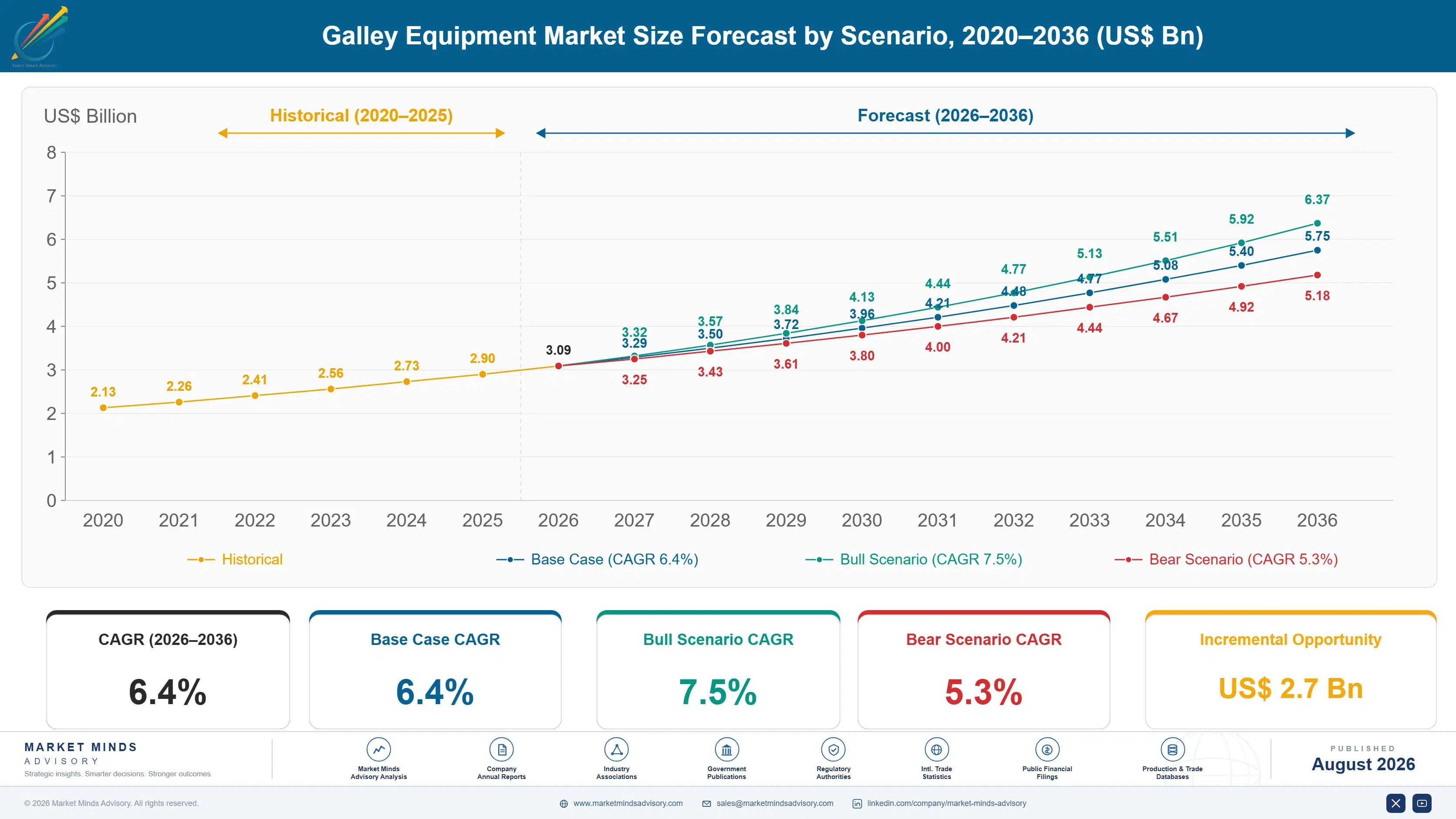
Galley equipment demand grew unevenly through 2020 to 2025, as pandemic-era aircraft grounding sharply cut retrofit and linefit orders before a strong post-pandemic recovery in aircraft deliveries and cabin upgrade programs rebuilt demand. The category closed 2025 at an estimated 5.4% historical CAGR, reflecting that recovery building steadily through the back half of the period.
The base case rests on three mechanisms. First, record aircraft order backlogs at Boeing and Airbus keep pulling linefit galley equipment demand forward as delivery rates gradually recover toward pre-pandemic targets. Second, low-cost carriers are investing in premium beverage and coffee systems to capture ancillary revenue, driving retrofit demand across fleets that previously carried minimal galley equipment. Third, tightening cabin fire safety and food hygiene standards are pushing airlines toward certified equipment upgrades faster than the broader cabin interiors category overall.
The bull case turns on faster-than-expected aircraft delivery rate recovery pulling galley equipment demand forward across every equipment category simultaneously. The bear risk is a prolonged OEM production bottleneck at Boeing or Airbus delaying aircraft deliveries further, pushing airlines to extend existing galley equipment service life instead of ordering replacement systems and slowing the retrofit cycle currently underway.

Certification Depth and the Premium Cabin Retrofit Cycle

Galley equipment sits at the intersection of aerospace certification and cabin experience economics, since airlines cannot substitute equipment suppliers without triggering weight, fire safety, and structural certification retesting under most regulatory frameworks. That switching friction has favored established linefit suppliers, but the rise of ancillary beverage revenue programs is pushing even loyal airlines to evaluate newer, lighter equipment as a competitive necessity rather than a prefe
MARKET CONCENTRATION68% CR5Certification and linefit relationships limit new entrant share
AVERAGE SELLING PRICE$8,000-45,000 per galley setPrice varies steeply by equipment category and aircraft type
TOP PRODUCING COUNTRYUSA, 26% shareThe United States retains the largest single national output share
CAPACITY UTILISATION71%Utilisation trails potential given ongoing linefit capacity expansion
TRADE INTENSITY61% cross-borderMost equipment crosses a border before final aircraft installation
FEEDSTOCK COST SHARE38% of COGSAerospace-grade aluminum and composite material costs dominate spending
Commercially, the market splits between a mature base of ovens, trolleys, and water systems sold through long-standing linefit relationships with aircraft manufacturers, and a smaller but faster-growing tier of premium beverage and coffee systems sold on cabin experience performance in retrofit and low-cost carrier programs. Large airlines increasingly specify equipment weight and certification documentation in fleet-wide procurement contracts rather than relying on aircraft manufacturer default specifications.
Over the next decade, weight reduction and certification depth will matter more than unit price alone. Tightening cabin fire safety and hygiene standards will keep raising the qualification bar for new equipment entrants, and the suppliers that build the deepest linefit relationships across Boeing and Airbus platforms stand to capture share of the retrofit and replacement cycle as fleets modernize.
"Galley equipment used to be the part of the cabin nobody thought about. Now it's where airlines fight for ancillary revenue and differentiation, and that has completely changed how suppliers get evaluated."
Director, Aerospace Cabin Systems and Interiors Practice · MMA Construction and

Market Trends

Low-Cost Carriers Invest in Premium Beverage Programs

Low-cost carriers across major markets are investing in premium coffee and beverage systems to capture ancillary revenue, treating galley equipment upgrades as a direct revenue driver rather than a pure cost center. MMA's primary survey found more than 44% of surveyed airline procurement heads have added or are actively adding premium beverage equipment to at least one fleet segment since 2024, a meaningful shift from prior minimal-galley strategies. Suppliers including Bucher Group and Sell GmbH have both expanded dedicated beverage system production capacity since 2024 to capture this ancillary-revenue-driven demand shift industry-wide.
Market Impact: Cited by 49%+ of engineering leads
Record Aircraft Order Backlogs Pull Linefit Demand Forward

Record aircraft order backlogs at Boeing and Airbus are pulling linefit galley equipment demand forward as delivery rates gradually recover toward pre-pandemic production targets across both narrowbody and widebody programs. Several large equipment suppliers have disclosed capacity expansion plans since 2023 specifically targeting linefit supply for next-generation narrowbody programs entering higher production rates. Suppliers including Collins Aerospace and Diehl Aviation have both expanded dedicated linefit production capacity since 2024 to meet this backlog-driven demand shift across commercial aircraft programs worldwide. Smaller regional suppliers without comparable backlog visibility risk losing linefit allocation as OEMs prioritize established certified partners during the ramp.
Market Impact: Cited in fleet plans since 2024

Market Opportunities and Growth Drivers

Tightening Cabin Fire Safety Standards Raise Qualification Barriers

Aviation safety regulators across major markets have tightened cabin fire safety and material flammability standards for galley equipment over the past several years, requiring suppliers to invest in more advanced fire-resistant materials and more thorough certification testing to maintain compliance. MMA's primary survey found more than 49% of surveyed airline engineering leads now require updated fire safety documentation before requalifying any galley equipment supplier, a meaningful increase from prior certification cycles. That regulatory tightening is raising the cost of entry for smaller regional suppliers that lack established certification and testing infrastructure comparable to the largest incumbent manufacturers.
Market Impact: Compresses margins 6-12 points

Aircraft Fleet Expansion Accelerates Across Asia-Pacific Carriers

Airlines across Indonesia, India, and Vietnam continue adding aircraft at a pace that outstrips most other regional markets, driving proportional demand for linefit and retrofit galley equipment across every narrowbody category. Several large Asia-Pacific carriers have disclosed fleet expansion plans since 2024 specifically targeting low-cost and full-service growth across both domestic and international route networks. That expansion requires galley equipment suppliers holding certification valid across multiple aircraft platforms simultaneously, favoring established global suppliers over regional manufacturers whose qualification portfolio covers a narrower set of aircraft types and configurations. That gap is widening as carriers standardize procurement across multi-aircraft fleet orders.
Market Impact: Certification can exceed $10 millio

Market Restraints and Challenges

Aerospace-Grade Material Cost Volatility Compresses Margins

Aerospace-grade aluminum and composite materials account for roughly 38% of cost of goods sold, and their price tracks specialty metals and composite supply chains that galley equipment manufacturers cannot easily pass through given long-term linefit supply contracts negotiated years in advance. That exposure, rooted in the materials' dependence on limited qualified aerospace-grade supplier networks rather than any single manufacturer's pricing decision, compresses margins hardest for smaller suppliers without integrated material sourcing or long-term hedging contracts. Larger suppliers are responding by pursuing direct material supply agreements to protect margin during future volatility.
Market Impact: Cited by 44%+ of procurement heads

Certification Costs Slow Regional Manufacturer Entry

Certifying a new galley equipment design across major aircraft platforms requires structural, fire safety, and weight documentation that can take eighteen to thirty-six months and cost well into seven figures per platform, a barrier that keeps smaller regional manufacturers from competing in the highest-value linefit categories that Boeing and Airbus require. That cost structure, a direct consequence of the rigorous safety testing regulators require following past cabin fire incidents in unrelated aviation categories, favors incumbents with existing multi-platform certification portfolios. Smaller suppliers are responding by focusing on aftermarket retrofit markets with lighter certification requirements instead of pursuing linefit programs.
Market Impact: Backlog-driven capacity plans since
3 additional market trends, 3 additional growth drivers, and 3 additional restraints and challenges are covered in the full report. Contact sales@marketmindsadvisory.com to access the complete intelligence.

Segment CAGR and Growth Architecture

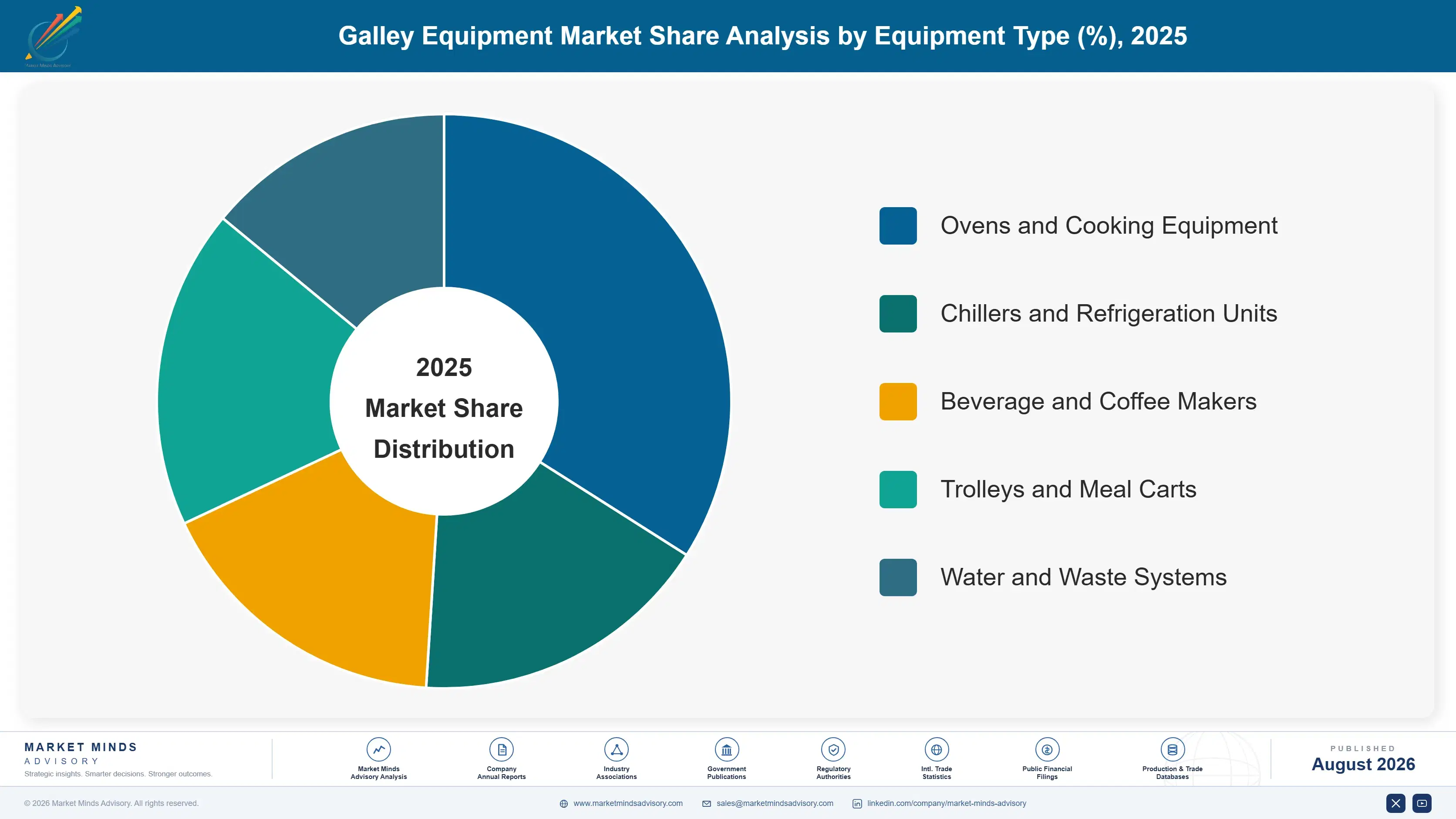
Segmentation follows equipment function rather than aircraft platform, since the specific cabin function an equipment category serves determines which airline procurement budgets and certification pathways apply more than which aircraft it ultimately flies on. Ovens and water systems remain the legacy base, but beverage and refrigeration equipment now address cabin experience requirements older equipment cannot satisfy.
galley-equipment-market-market-share-analysis-1787301253559

Beverage and Coffee Makers

Beverage and coffee makers are the fastest-growing segment, expanding at an estimated 8.9% CAGR against a market average of 6.4%, roughly 1.39 times the overall pace. Growth tracks with low-cost carrier ancillary revenue programs and airline cabin experience investment that require equipment capable of delivering premium beverage quality without adding cabin weight. Bucher Group and Sell GmbH lead on shipped beverage system volume, though the segment requires more thermal and pressure certification testing than legacy equipment given its direct role in passenger-facing cabin experience. Continued adoption depends on ancillary revenue program expansion across carrier segments through the forecast period. Diehl Aviation and JAMCO are both investing in expanded beverage system production capacity to meet this faster-growing demand.
CAGR 8.9%

Chillers and Refrigeration Units

Chillers and refrigeration units rank second-fastest, growing at an estimated 7.6% CAGR as fresh-meal service and tightening food safety regulation expand steadily across major carrier networks worldwide. The segment benefits from airlines increasingly specifying refrigeration capacity for longer-haul fresh-meal programs where extended chilled storage improves food safety compliance over frozen-meal alternatives. Adoption still trails ovens and cooking equipment by a meaningful margin given higher installation complexity and more extensive weight and power certification requirements than standard equipment applications demand. Growth is concentrated among suppliers including Collins Aerospace and Safran that have expanded refrigeration capacity to meet airline demand for simplified fresh-meal program development. Regional suppliers across Asia are also beginning to qualify comparable refrigeration platforms for domestic carrier fleets.
CAGR 7.6%
Full segment breakdown across 5 segments available in the complete report.

Regional Architecture and Country Demand Map

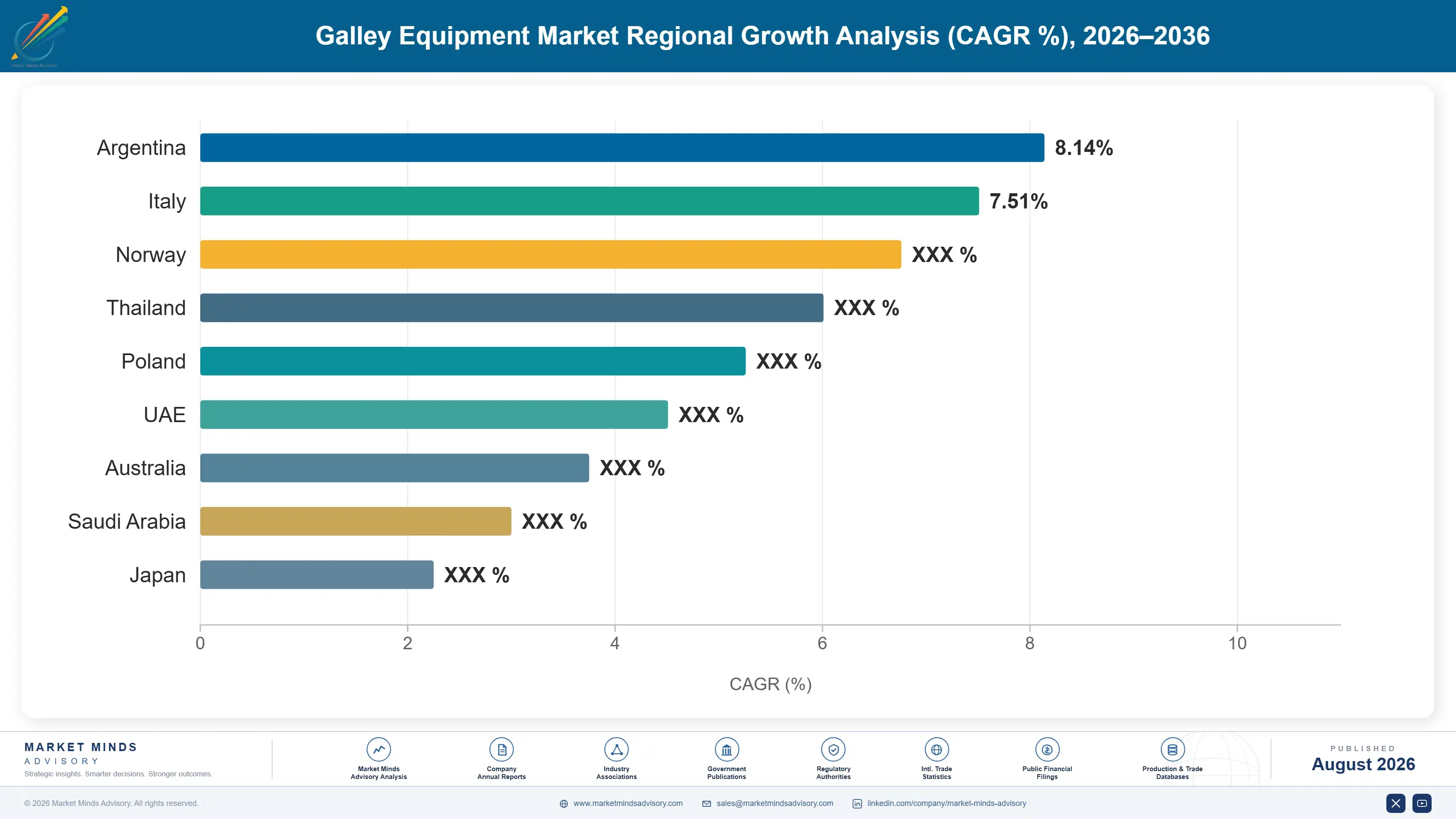
Galley equipment demand concentrates where aircraft OEM linefit manufacturing and airline fleet operations overlap. North America leads on supplier concentration and certification depth, East Asia follows on expanding fleet infrastructure, and South Asia and Pacific grows fastest as regional low-cost carrier expansion accelerates across emerging markets.

North America

The United States accounts for the large majority of North America's galley equipment demand, anchored by Collins Aerospace's headquarters and the concentration of Boeing linefit manufacturing and certification infrastructure built over decades. Large US airlines increasingly specify galley equipment weight and certification documentation directly in fleet-wide procurement contracts, favoring established suppliers with proven multi-platform certification over regional manufacturers with narrower qualification portfolios. Canada contributes a smaller, steadier share tied to its own aerospace manufacturing base and Transport Canada's certification framework, which closely mirrors FAA requirements. Mexico's contribution grows fastest of the three as nearshoring-driven aerospace component manufacturing investment expands its supply capacity closer to US linefit programs and reduces logistics costs for cross-border component shipments.
Share: 29% | CAGR: 6.9% (2026 to 2036)

Western Europe

Germany and France anchor Western Europe's galley equipment demand, reflecting Diehl Aviation and Safran's home markets and the concentration of Airbus linefit manufacturing and certification infrastructure built over decades. The UK maintains a substantial aerospace supply chain that keeps certification documentation requirements consistently high across the region's cabin equipment industry regardless of near-term market conditions. Switzerland contributes a smaller but higher-value share tied to Bucher Group's specialized beverage and catering equipment manufacturing base. Growth here trails the global average, reflecting an already-mature linefit relationship base and a supplier mix still weighted toward established oven and water system categories rather than the faster-growing beverage platforms driving growth elsewhere. Ireland contributes a smaller share tied to its concentration of aircraft leasing headquarters.
Share: 23% | CAGR: 5.2% (2026 to 2036)
Regional intelligence for 5 additional markets available in the complete report: East Asia, South Asia and Pacific, Latin America, Middle East and Africa, Eastern Europe. Contact sales@marketmindsadvisory.com.
galley-equipment-market-country-cagr-analysis-1787301254078

Where Galley Supplier Margin Concentrates Next

Four commercial moves separate galley equipment suppliers capturing outsized margin from those competing purely on delivered unit price. Each depends on shifting revenue toward certification portfolio depth, retrofit program support, premium beverage technical service, or multi-platform linefit agreements that current shipment volume does not yet fully reflect, particularly as airlines formalize ancillary revenue strategies industry-wide.

Multi-Platform Certification Portfolio Investment Program Development

Suppliers that build and maintain certification portfolios valid across both Boeing and Airbus platforms simultaneously are capturing the growing share of demand that linefit qualification, not just equipment design, now specifies by name. A single new equipment certification across major platforms can cost $3 million or more and take up to two years, but each certified configuration then commands demand that uncertified regional competitors are effectively barred from serving in the most valuable linefit programs. Suppliers without multi-platform certifications increasingly lose the highest-value OEM accounts entirely, making certification portfolio breadth a durable advantage rather than a one-time cost.
Market Impact: Locks in demand across 72% of linef

Cabin Retrofit Program Management Support Services

Suppliers offering structured retrofit program management, helping airlines coordinate fleet-wide equipment upgrades against maintenance schedules and downtime constraints, are capturing service revenue that unstructured parts distributors cannot offer. A dedicated retrofit program management engagement typically adds 12 to 20% to base equipment contract revenue through bundled installation coordination and warranty support fees, reflecting the specialized program management labor required to support airlines through fleet-wide transitions. This service model matters most for airlines managing retrofit across dozens of aircraft simultaneously. Airlines that skip this support often face costly scheduling conflicts during fleet-wide transitions.
Market Impact: Adds 12 to 20% to base contract rev

Premium Beverage System Technical Support Program

Suppliers offering dedicated beverage system technical support, including thermal performance optimization and cabin crew training for premium coffee programs, are capturing higher-margin business than commodity equipment sellers offering hardware alone without technical support. A premium beverage technical support engagement typically carries setup and training fees of $150,000 to $600,000 depending on fleet size and system complexity, in addition to the recurring per-unit equipment revenue that follows over the contract term. This service model matters most for low-cost carriers entering premium beverage categories for the first time without established technical support infrastructure.
Market Impact: Setup fees typically run $150,000 t

Multi-Year Linefit Supply Continuity Agreement Programs

Suppliers securing multi-year linefit supply continuity agreements with aircraft manufacturers, often tied to specific production rate milestones, are capturing volume commitments that protect against price-only competition from suppliers without comparable manufacturer relationships built over years of reliable, on-specification delivery. These continuity agreements typically carry a price premium of 7 to 14% over spot-market purchasing, reflecting the value manufacturers place on guaranteed supply during production rate increases and unpredictable demand surges tied to new aircraft program launches. Suppliers able to demonstrate reserved production capacity increasingly win these agreements over lower-cost competitors.
Market Impact: Commands 7 to 14% premium over spot

Who Controls the Margin Pool

The top five suppliers hold an estimated 68% of global galley equipment shipment volume, a higher concentration than cabin interiors categories, reflecting the certification and linefit relationship requirements that keep smaller manufacturers from entering the OEM markets. Collins Aerospace and Diehl Aviation lead on certification depth and linefit relationships, while a second tier of suppliers competes on price for aftermarket retrofit categories.
Current competitive activity centers on three fronts. Premium beverage system capacity expansion is redrawing the growth tier, with Bucher Group, Sell GmbH, and Diehl Aviation racing to secure low-cost carrier retrofit contracts. Retrofit program management support build-out is becoming a differentiator among suppliers targeting airlines managing fleet-wide upgrades. And Chinese and Indian manufacturers are pursuing certification and Western OEM partnerships to move beyond aftermarket supply into linefit competition.

Emerging pressure comes from Chinese and Indian manufacturers moving up the value chain into certified, OEM-qualified categories once dominated by Western specialists, aided by domestic material supply that keeps their production costs lower. If regional manufacturers close the certification gap, expect share to shift, particularly in South Asia and East Asia where fleet growth economics run more favorably than at US and European OEM accounts.
galley-equipment-market-company-positioning-matrix-1787301254615

Competitive Moat and Risk Dimensions

COLLINS AEROSPACE

Moat: Linefit Certification Depth

Collins Aerospace built the industry's broadest multi-platform certification portfolio across Boeing and Airbus programs over several decades under its legacy B/E Aerospace brand, a depth smaller manufacturers cannot replicate quickly, and its established OEM relationships give it linefit priority that regional competitors cannot match at comparable speed or certification completeness.
COLLINS AEROSPACE

Risk: Retrofit Agility Faces Pressure

Collins Aerospace's scale advantage in linefit certification does not automatically translate into retrofit market agility, and nimbler specialists focused purely on premium beverage and cabin experience upgrades could out-innovate Collins on the faster-cycle retrofit programs that increasingly drive category growth beyond traditional OEM linefit volume.
DIEHL AVIATION

Moat: Airbus Platform Relationship Scale

Diehl Aviation's galley equipment sells alongside its much broader Airbus cabin systems portfolio, letting it bundle linefit supply agreements with Airbus programs that pure-play galley specialists cannot match, giving it manufacturing scale and certification relationships built across multiple cabin equipment categories and long-standing OEM accounts worldwide.
DIEHL AVIATION

Risk: Boeing Exposure Remains Limited

Diehl Aviation's certification and relationship depth concentrates heavily on Airbus platforms, so capital allocation and certification investment attention favor that relationship over broader Boeing linefit opportunities, leaving room for Boeing-focused specialists to out-compete Diehl on that platform despite its overall manufacturing scale advantage. That gap could widen further as Boeing-focused rivals deepen linefit relationships Diehl's Airbus-weighted portfolio cannot easily replicate.

Players Tracked

Prominent Players

Collins Aerospace
Diehl Aviation
JAMCO Corporation
Safran S.A.
Bucher Group

Other Key Players

AIM Altitude
Driessen Aircraft Interior Systems
IACOBUCCI HF Aerospace
Franke Aerospace
MAC Aerospace Industries
Custom Control Concepts
Innovative Cabin Systems
Nordisk Aviation Products
Aerolux Group
Sell GmbH
Monogram Systems
Astronics Corporation
Bianchi Industry S.p.A.
Norduyn Inc.
TransDigm Group Incorporated

Recent Developments

MARCH 2025

Bucher Group Expands Beverage System Certification Across Additional Low-Cost Carrier Fleets

Bucher Group secured certification approval for its premium beverage system across three additional low-cost carrier fleet specifications, expanding the airline accounts its certified products can legally serve. The certification followed fourteen months of thermal and pressure testing across multiple carrier partnerships worldwide, ahead of the originally proposed certification timeline.
Signal: Signals certification breadth becoming a p
SEPTEMBER 2024

Collins Aerospace Commissions Additional Linefit Production Capacity

Collins Aerospace commissioned additional galley equipment linefit production capacity at its US facility, meaningfully expanding dedicated output for narrowbody program demand across major aircraft manufacturer accounts. The expansion followed sustained order backlog growth as Boeing finalized production rate increase plans through 2024 and into 2025.
Signal: Signals linefit demand outpacing existing
JANUARY 2025

Diehl Aviation Acquires Regional Retrofit Program Management Service Provider

Diehl Aviation acquired a regional cabin retrofit program management and installation coordination service provider to strengthen its airline support offering, targeting carriers advancing fleet-wide beverage and refrigeration upgrades. The acquired provider continues operating under its existing brand within Diehl Aviation's broader corporate structure following the transaction's close.
Signal: Signals large diversified cabin equipment

Aerospace Material and Certification Testing Exposure

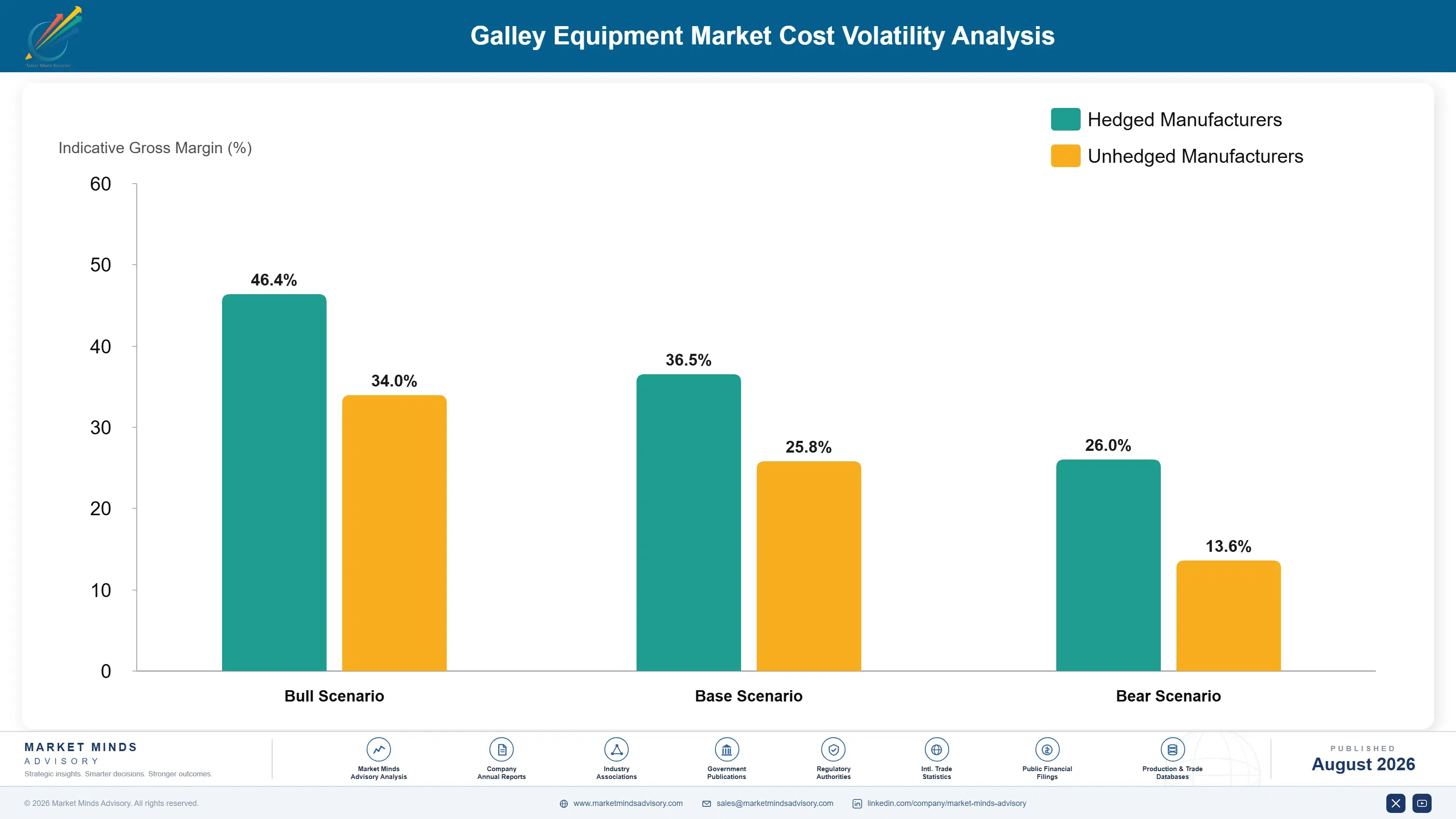
Aerospace-grade aluminum and composite materials account for roughly 38% of cost of goods sold in galley equipment manufacturing, with production concentrated among a handful of qualified aerospace-grade suppliers capable of certified purity and structural performance. Fire safety and structural certification testing labor add a further share, sourced predominantly from specialized aerospace testing and regulatory affairs staff regardless of manufacturer location.
Aerospace-grade aluminum prices spiked sharply during 2022 as supply chain disruption tied to broader metals market volatility constrained available volume, with several manufacturers reporting input cost increases exceeding 38% in their 2022 annual reports before pricing stabilized through 2023. Industry supply chain reviews have flagged aerospace-grade material production as sensitive to both limited qualified supplier networks and the specialized certification capacity required at aerospace purity levels.

Smaller regional manufacturers without long-term material supply agreements absorbed the 2022 price spike hardest, losing contract bids to larger suppliers including Collins Aerospace and Diehl Aviation that had negotiated priority pricing and, in several cases, invested directly in material sourcing partnerships. Manufacturers with secured upstream sourcing weathered the volatility better than those dependent on the open market, a cost advantage that persists across US and European producing regions.
galley-equipment-market-cost-volatility-analysis-1787301254813

Multi-Year Material Supply Agreements

Larger suppliers are locking multi-year aerospace-grade material supply agreements directly with qualified producers, trading some pricing flexibility for guaranteed volume and price stability that protects margin during future sourcing volatility, an increasingly standard practice among the top five suppliers following the 2022 shortage experience. Smaller manufacturers are pooling procurement through industry consortiums to negotiate comparable terms.

Direct Upstream Sourcing Partnerships

Several larger suppliers are investing directly in upstream material sourcing partnerships rather than purchasing entirely on the open market, reducing exposure to material price swings and improving supply reliability, though this requires higher fixed capital investment than pure equipment assembly operations require. That investment pays back within four to six years given the volatility material pricing has shown.

Regional Supplier Qualification Diversification Strategy

Suppliers are qualifying multiple regional material sources across North America, Europe, and Asia rather than depending on a single production region, reducing exposure to any single geography's supply disruption while adding modest logistics complexity to sourcing operations across the manufacturing network. This approach raises base material costs by two to four percent but improves supply continuity during regional disruptions.

Portfolio Architecture for Margin Defence

Galley equipment portfolios split across three tiers with meaningfully different margin economics. The volume tier, standard ovens and water systems, competes largely on established linefit relationships and delivers gross margins in the 20 to 30% range. Premium beverage and refrigeration systems bundling certification depth and technical support command materially higher margins, reflecting testing cost and service investment layered on top of base equipment engineering.
The tension between volume and premium tiers shapes capacity allocation decisions across the industry. Volume equipment capacity is easiest to scale and fastest to fund, but aftermarket price competition keeps margin pressure constant in that tier. Premium beverage and refrigeration capacity requires deeper certification investment and slower qualification cycles, but rewards patient capital with margins that hold up as retrofit and ancillary revenue demand continues.

High-value margin pools concentrate in beverage systems, refrigeration units, and the retrofit program management and technical support layer that increasingly separates established suppliers from commodity equipment sellers. These pools remain a modest share of total shipment volume today, but they are growing faster than the legacy oven and water system base and are where most supplier research spending is now directed.

Volume / Commodity-Adjacent Tier

Standard ovens and water systems sold primarily on established linefit relationships and price, serving routine aircraft cabin demand. These units carry the thinnest margins in the portfolio and depend on manufacturing scale rather than certification depth to stay profitable.
Gross Margin: 20-28%

Premium / Certified Tier

Premium beverage and refrigeration systems bundling certification documentation, thermal testing support, and technical service that large airlines pay a premium to access. This tier generates steady repeat business, since certified accounts rarely switch suppliers without cause.
Gross Margin: 36-46%

Sustainability / Regulatory / Next-Generation Tier

Next-generation lightweight and fire-resistant equipment platforms tied to tightening cabin safety standards and expanding ancillary revenue programs. This tier draws the heaviest research spending, since weight performance and multi-platform certification depth both require sustained investment to defend against retrofit erosion.
Gross Margin: 38-50%
galley-equipment-market-portfolio-architecture-1787301255319

The OEM Relationship Moat

Galley equipment economics increasingly resemble an OEM-relationship business rather than a simple parts sale. Certification support, retrofit program management, and technical service assistance generate recurring engagement with large airlines and aircraft manufacturers that persists well beyond the initial supply agreement, and suppliers that own that OEM relationship can forecast renewal demand with more confidence than pure commodity competitors ever manage reliably.
Adoption depth varies by end-use vertical. Large airlines and aircraft manufacturers, once qualified on a supplier's equipment certification and linefit documentation, rarely switch given the cost and regulatory risk of requalifying an entire fleet's equipment mid-cycle. Smaller regional carriers and lessors show shallower stickiness so far, since they often source through distributors rather than direct supplier relationships and switch more readily on price alone.

A generational shift in buyer profiles is underway as cabin experience and ancillary revenue officers, rather than pure procurement, increasingly co-sign equipment sourcing decisions given the revenue potential premium beverage programs now carry. These buyers weight technical support credibility and installation coordination alongside unit cost, a shift that favors suppliers with proven retrofit records over those competing purely on price. That shift is most pronounced among low-cost carriers managing rapid fleet-wide beverage program rollouts.
galley-equipment-market-end-use-penetration-index-1787301255814

Where the Retrofit Premium Sits

These are among the four positions where our research anticipates prominent divergence between winners and laggards over the coming forecast period. Each is grounded in the demand model, the regulatory perimeter, and the announced capacity pipeline.
01 / BEVERAGE SEGMENT INVESTMENT

Prioritize beverage system certification over legacy oven capacity growth

Beverage and coffee makers are growing roughly 1.39 times faster than the overall market, driven by ancillary revenue programs that show no sign of slowing as carrier strategies keep expanding industry-wide. Suppliers still weighted toward legacy oven capacity risk ceding the fastest-growing, highest-margin accounts to specialists that built thermal certification and technical support expertise earlier in the adoption cycle. Capital directed toward beverage system certification now should pay back meaningfully faster than incremental oven expansion into an increasingly crowded, price-competitive tier that regional suppliers keep pressuring hardest.
02 / RETROFIT PROGRAM READINESS

Build retrofit program management support before demand outpaces capacity

Suppliers that still compete purely on unit price without structured retrofit program management are leaving significant value on the table that installation coordination, warranty support, and technical training are already capturing for established brands. These program management partnerships carry materially higher switching costs than the underlying equipment sale, locking airlines into renewal patterns that price-only competitors struggle to break. Building this capability now, before fleet-wide retrofit demand outpaces available capacity further, is worth considerably more than matching a rival's price cut for cut.
03 / MATERIAL COST HEDGING

Lock multi-year aerospace material agreements now

Material input costs already run close to 38% of cost of goods sold, and the 2022 spike showed supply disruption can push supplier costs up by more than 38% within months during a volatile cycle. Suppliers without multi-year supply agreements risk losing contract bids to better-hedged rivals during the next volatile cycle, damaging OEM relationships built over years in a single sharp shortage. Locking supply now, even at a premium to spot pricing, protects margin stability and the credibility needed to win long-duration linefit contracts.
04 / REGIONAL FLEET POSITIONING

Weigh Asian fleet growth against Western certification trust carefully

South Asia and East Asia now hold a rapidly growing share of global fleet expansion and continue adding aircraft faster than most other regions, making volume growth there increasingly attractive for suppliers seeking faster order pipeline expansion. Western suppliers still hold a genuine advantage in certification depth, OEM relationship trust, and multi-platform qualification that regional entrants have not yet fully closed. The sounder strategy is not chasing Asian fleet growth alone, but pairing it with the certification depth Western OEMs still expect before committing to a new supplier.

Engagement Snapshot From the Field

A live engagement with an industry participant carrying material or product regulatory and market exposure ahead of a defining policy shift, showing how our research translates into a defensible multi-year portfolio strategy.
MARKET MINDS ADVISORY · CLIENT ENGAGEMENT SUMMARY
Galley Equipment Producer Strategic Portfolio Review and Transition Roadmap 2026·Investment Scenario on Galley Equipment Exposure Evaluation 2025-26
CLIENT PROFILE
The client is a low-cost carrier group operating a narrowbody fleet of roughly ninety aircraft across domestic and short-haul international routes, competing primarily on fare price with minimal historical ancillary revenue from onboard beverage service. The carrier needed an independent assessment of how to retrofit premium beverage equipment across its fleet without disrupting existing turnaround schedules (client-reported, unverified by MMA).
STRATEGIC CHALLENGE
The carrier needed to select a beverage equipment supplier and retrofit schedule capable of upgrading its full fleet within a single maintenance cycle while minimizing aircraft downtime, given the carrier's tight turnaround schedules and limited maintenance capacity across its route network. Budget constraints further limited the carrier's ability to run parallel retrofit programs across multiple maintenance bases simultaneously.
MMA APPROACH
MMA conducted a vendor-neutral beverage equipment assessment benchmarking candidate suppliers' certification depth, installation timeline track record, and technical support capability against the carrier's fleet size and maintenance schedule constraints. The assessment incorporated interviews with the carrier's maintenance and cabin crew leadership to validate installation feasibility before finalizing supplier recommendations across all five maintenance bases.
KEY FINDINGS
  1. Candidate supplier benchmarking identified two suppliers with installation timelines short enough to fit within the carrier's existing maintenance windows without requiring additional aircraft downtime.
  2. A phased retrofit approach prioritizing the carrier's highest-traffic routes first would generate ancillary revenue roughly four months sooner than a uniform simultaneous retrofit approach across the full fleet.
  3. Crew training gaps existed at two of the carrier's five maintenance bases, requiring additional technical training investment before full fleet retrofit could proceed on schedule.
  4. Cost modeling showed the retrofit program would pay back its investment within roughly eleven months through incremental ancillary beverage revenue across the carrier's full route network.
CLIENT PROFILE
The client is a low-cost carrier group operating a narrowbody fleet of roughly ninety aircraft across domestic and short-haul international routes, competing primarily on fare price with minimal historical ancillary revenue from onboard beverage service. The carrier needed an independent assessment of how to retrofit premium beverage equipment across its fleet without disrupting existing turnaround schedules (client-reported, unverified by MMA).
STRATEGIC CHALLENGE
The carrier needed to select a beverage equipment supplier and retrofit schedule capable of upgrading its full fleet within a single maintenance cycle while minimizing aircraft downtime, given the carrier's tight turnaround schedules and limited maintenance capacity across its route network. Budget constraints further limited the carrier's ability to run parallel retrofit programs across multiple maintenance bases simultaneously.
MMA APPROACH
MMA conducted a vendor-neutral beverage equipment assessment benchmarking candidate suppliers' certification depth, installation timeline track record, and technical support capability against the carrier's fleet size and maintenance schedule constraints. The assessment incorporated interviews with the carrier's maintenance and cabin crew leadership to validate installation feasibility before finalizing supplier recommendations across all five maintenance bases.
KEY FINDINGS
  1. Candidate supplier benchmarking identified two suppliers with installation timelines short enough to fit within the carrier's existing maintenance windows without requiring additional aircraft downtime.
  2. A phased retrofit approach prioritizing the carrier's highest-traffic routes first would generate ancillary revenue roughly four months sooner than a uniform simultaneous retrofit approach across the full fleet.
  3. Crew training gaps existed at two of the carrier's five maintenance bases, requiring additional technical training investment before full fleet retrofit could proceed on schedule.
  4. Cost modeling showed the retrofit program would pay back its investment within roughly eleven months through incremental ancillary beverage revenue across the carrier's full route network.
RECOMMENDED STRATEGY
Phase 1: Phase 1 (Months 1 to 3): Conduct candidate supplier benchmarking and installation timeline validation across finalist beverage system suppliers and technical support capability. Phase 2: Phase 2 (Months 4 to 8): Initiate phased retrofit beginning with the carrier's highest-traffic routes while completing crew training at remaining bases. Phase 3: Phase 3 (Months 9 to 12): Complete fleet-wide retrofit and formalize the multi-year supply and technical support agreement terms with the selected supplier.
OUTCOME
The carrier began phased retrofit in early 2026, prioritizing its highest-traffic routes as recommended. Early data through mid-2026 showed ancillary beverage revenue tracking ahead of the original eleven-month payback estimate, though full fleet-wide retrofit completion awaits finishing crew training at the two remaining maintenance bases (client-reported, unverified by MMA).

Frequently Asked Questions

Foundational context covering the market sizes, CAGR, scope, country, region and competition that inform every finding below. This section is provided to cover basics and most often pre-purchase conversations, answered from the MMA Primary Research Dataset.

What is the current size of the Galley Equipment Market?

The global galley equipment market reached an estimated $2.9 billion in 2025. Growth concentrates in beverage and refrigeration equipment where ancillary revenue programs increasingly determine supplier selection.

How large will the Galley Equipment Market be by 2036?

MMA forecasts the market reaching approximately $5.75 billion by 2036, nearly double its 2026 value. Beverage and coffee makers are expected to drive the largest share of that incremental growth.

What is the CAGR for the Galley Equipment Market 2026 to 2036?

The base case CAGR is 6.4% across the forecast period, with a bull case near 7.5% and a bear case near 5.3% depending on aircraft delivery pace and retrofit program adoption.

Which segment is growing fastest?

Beverage and coffee makers are the fastest-growing segment, expanding at roughly 8.9% CAGR, about 1.39 times the overall market pace, driven by ancillary revenue programs across carrier types.

Who are the major companies in the Galley Equipment Market?

Leading suppliers include Collins Aerospace, Diehl Aviation, JAMCO, Safran, and Bucher Group, each with substantial certification portfolios. The top five hold an estimated 68% of global shipment volume, with certification depth largely determining share.

Which country is growing fastest?

The United States leads growth in absolute supplier output, but Indonesia is expanding fastest in percentage terms, driven by its rapidly growing low-cost carrier fleet.

Report Segmentation Architecture

The full report scope spans multiple orthogonal segmentation dimensions, with cross-tabulated demand data provided for each dimension pair. Coverage extends further to regional breakdowns, trend trajectories, and the competitive detail needed to support segment-level decision-making.

By Equipment Type

  • Ovens and Cooking Equipment
  • Chillers and Refrigeration Units
  • Beverage and Coffee Makers
  • Trolleys and Meal Carts
  • Water and Waste Systems

By End-Use Aircraft Category

  • Narrowbody Linefit Programs
  • Widebody Linefit Programs
  • Narrowbody Retrofit Programs
  • Widebody Retrofit Programs
  • Regional Jet Applications

By Commercial Dimension

  • Direct OEM Linefit Supply
  • Airline Retrofit Program Agreements
  • Technical Support Service Contracts
  • Aftermarket and Distribution Channels

By Region

  • North America
  • Western Europe
  • East Asia
  • South Asia and Pacific
  • Latin America
  • Middle East and Africa
  • Eastern Europe

Scope, Methodology, and Coverage

Every figure in this report is reproducible from documented input assumptions. The scope below maps the historical period, the forecast horizon, the segmentation dimensions, and the countries covered, alongside the underlying primary and qualitative methodology.
Historical Period
2020 to 2025
Forecast Period
2026 to 2036
Base Year
2025 (USD billions; MMA Primary Research Dataset, August 2026)
Market Definition
The galley equipment market covers certified aircraft galley systems installed in commercial passenger aircraft, including ovens and cooking equipment, chillers and refrigeration units, beverage and coffee makers, trolleys and meal carts, and water and waste systems sold to airlines and aircraft manufacturers. It excludes cabin seating, in-flight entertainment systems, catering food and beverage products themselves, and ground-based airport catering equipment outside the aircraft cabin.
Quantitative Units
USD billions (current prices); galley equipment sets shipped where disclosed
Segmentation Dimensions
By Equipment Type; By End-Use Aircraft Category; By Commercial Dimension; By Region
Regions Covered
North America, Western Europe, East Asia, South Asia and Pacific, Latin America, Middle East and Africa, Eastern Europe
Countries Covered
USA, Canada, Mexico, Germany, France, UK, Switzerland, China, Japan, South Korea, Indonesia, India, Vietnam, Australia, Brazil, Argentina, Colombia, Chile, Peru, UAE, Saudi Arabia, Qatar, South Africa, Poland, Czech Republic, Romania, Hungary, and additional markets relevant to this sector
Key Companies Profiled
Collins Aerospace, Diehl Aviation, JAMCO Corporation, Safran S.A., Bucher Group, AIM Altitude, Driessen Aircraft Interior Systems, IACOBUCCI HF Aerospace, Franke Aerospace, MAC Aerospace Industries, Custom Control Concepts, Innovative Cabin Systems, Nordisk Aviation Products, Aerolux Group, Sell GmbH, Monogram Systems, Astronics Corporation, Bianchi Industry S.p.A., Norduyn Inc., TransDigm Group Incorporated
Quantitative Methodology
Primary survey, n=3,800 respondents, Q4 2025, six countries; demand-side model with trade association cross-validation
Qualitative Methodology
47 expert interviews, Q4 2025; applied to validate demand model assumptions, identify emerging dynamics, and assess competitive positioning
Report Format
PDF and XLSX data workbook (Word format preview document)
Publisher
Market Minds Advisory
Report Code
MMA-2026-CON-155
Published
August 2026
Contact
sales@marketmindsadvisory.com | www.marketmindsadvisory.com

Purchase the full Galley Equipment Market Report (2026 to 2036).

The full Galley Equipment Market report delivers a comprehensive assessment of equipment technology, competitive positioning, and regional demand through 2036. It includes detailed segmentation by equipment type, end-use aircraft category, and commercial dimension, alongside profiles of all twenty companies covered in this summary. The report quantifies regional market size and growth across all seven world regions, with country-level detail for the twenty-plus markets MMA tracks. Buyers receive access to MMA's underlying primary survey dataset and expert interview transcripts, enabling further custom analysis. A dedicated chapter benchmarks aerospace-grade material cost exposure and mitigation strategies across supplier types.
Equipment type segmentation across five functional product categories
Profiles of twenty leading galley equipment suppliers worldwide
Regional sizing and forecasts across all seven world regions
Aerospace-grade material cost exposure mitigation chapter
Primary survey dataset access covering 3,800 respondent interviews
Competitive development tracking with dated corporate event log

Built For The People Who Decide

From boardroom strategy to bench-side execution, this report is read cover-to-cover by leaders shaping the next decade of their industry, turning demand scenarios, market dynamics and valuation benchmarks into decisions.
CXOs/ Presidents/ VPs/ Managers
M&A and Corporate Development
Strategy Teams and R&D Heads
Procurement and Product Directors
Regulatory and Compliance Leaders
Investor Relations and Equity Analysts