Market Minds Advisory
Fuse Combination Unit Market

Fuse Combination Unit Market: Isolation and Protection In One Enclosure As Grids Expand

Every motor starter needs a way to isolate load and clear a fault in one device, and the combinations doing both jobs are specified into grid projects faster than panel builders can source them.

Lead Analyst

David Horsley

Published

September 2026

Make Smarter Decisions with Customized Research Insights

Request a free sample report and evaluate market opportunities, growth trends, and competitive dynamics relevant to your business needs.

2025 MARKET VALUE$2.6BMarket Size 2025
2036 FORECAST VALUE$5.0BBase Case , 2026 to 2036
CAGR 2026 TO 20366.2 %Bull 7.4% / Bear 5.1%
INCREMENTAL OPPORTUNITY$2.3BNet 10- year value creation
EXPANSION MULTIPLE1.83x2036 value over 2026 base
Strategic Levers
M&A Pipeline
Regional Outlook
Country Rankings
Competitive Intelligence
Segmental Deep-dive
Call-Us : 91 93563 13602

Executive Snapshot and Market Trajectory

Fuse combination units have shifted from a commodity component to a specified line item in grid interconnection projects, because utilities increasingly require isolation and fault protection combined in one certified device rather than separately sourced switches and fuses. Panel builders now order units earlier in the design cycle.
Commercial demand concentrates around motor starting applications, feeder protection panels, and medium-voltage substation interconnections, where combining load-break isolation with fuse protection in one device simplifies both specification and maintenance considerably. Medium-voltage units are pulling ahead of standard low-voltage combinations as renewable energy interconnection projects specify higher-voltage protection at the grid tie-in point. East Asia leads deployment volume on China's grid buildout, with South Asia and Pacific close behind on India's electrification programme specifically.
Competitive character splits between diversified electrical equipment majors bundling fuse combination units into wider switchgear and panel platforms and specialist fuse and disconnect makers selling purpose-built protection devices. Regulatory pressure is a genuine constant here: national electrical codes and utility interconnection standards increasingly specify certified combination devices rather than field-assembled switch and fuse pairings, pushing panel builders toward pre-certified units that simplify compliance documentation.
Market Definition
The fuse combination unit market covers switch-fuse combination devices that integrate a load-break switch with fuse links in a single enclosure for isolation and fault protection, spanning open and panel-mount units, enclosed IP-rated units, DIN-rail switches, motor starting units, medium-voltage combinations, and the replacement fuse links sold alongside this equipment. It excludes standalone circuit breakers without fuses, fuses sold independent of any switch mechanism, and general switchgear assemblies as a broader category.
Base Year Value
$2.6B in 2025 (MMA Primary Research Dataset, August 2026)
Forecast Period
2026 to 2036, eleven discrete annual values
CAGR
6.2% base case. Bull 7.4%. Bear 5.1%.
Fastest Growth Segment
Medium-Voltage Fuse Combination Units: 9.5% CAGR
Fastest Growth Country
India: 8.9% CAGR
Fastest Growth Region
South Asia and Pacific: 8.2% CAGR
Largest Region
East Asia: 29% of 2025 global value
Market Leaders
Eaton Corporation, Schneider Electric, ABB Ltd, Siemens AG, Mersen S.A. Source: MMA Analysis based on company annual reports.
Primary Survey
n=3,800 procurement and R&D decision-makers, Q4 2025, six countries
Methodology
Demand-side build-up, cross-validated against public data, 47 expert interviews

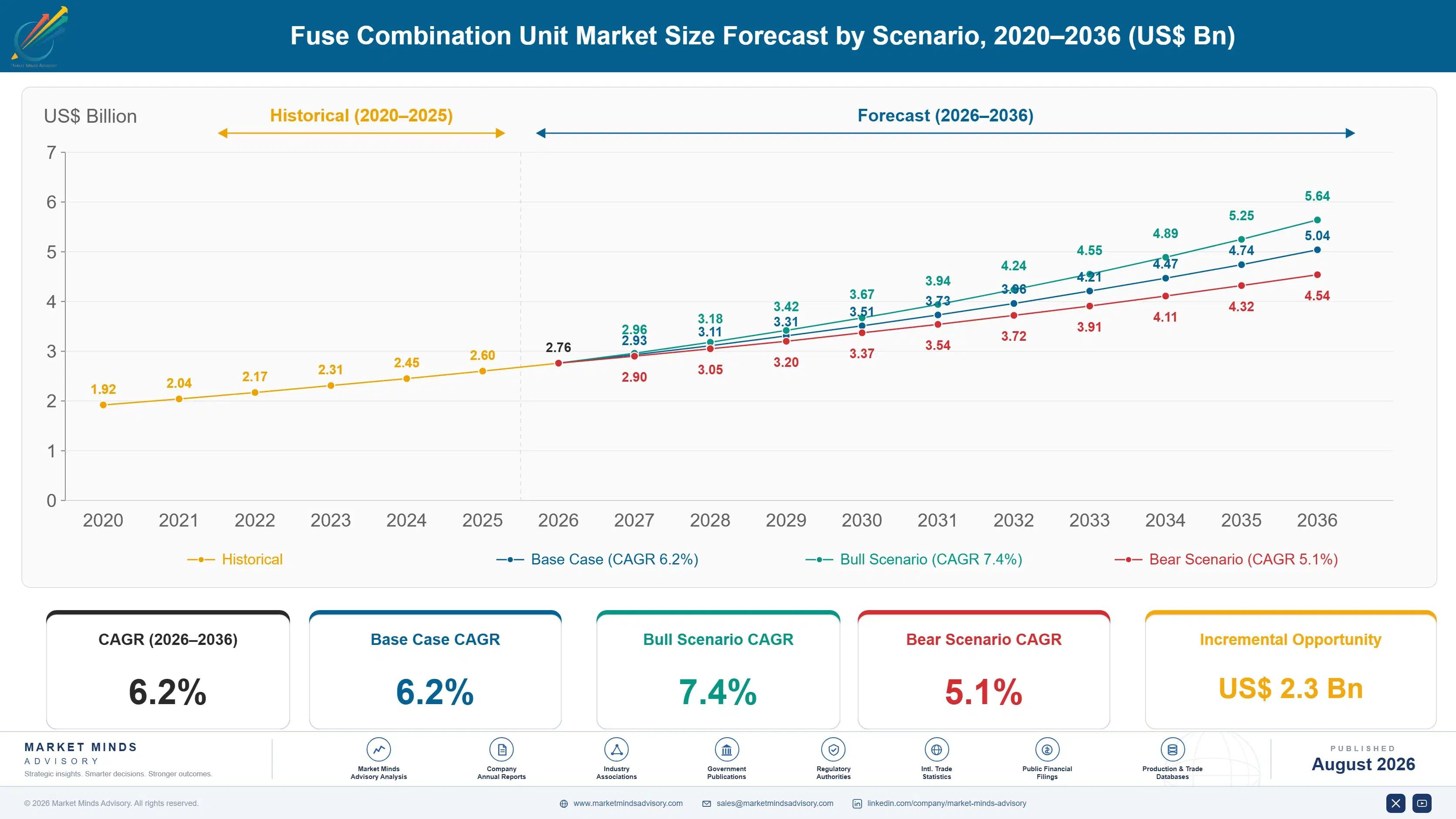
Fuse Combination Unit Market Forecast Scenarios

fuse-combination-unit-market-size-forecast-scenario-1787302084979
Between 2020 and 2025 the market grew at a 5.5% historical CAGR, anchored by steady industrial and commercial construction demand for standard low-voltage units. Growth tracked general electrical construction activity closely. Medium-voltage and renewable interconnection demand only gained real momentum from 2023 onward. Panel builders sourced components as needed rather than through longer cycles. That habit is changing now.
The base case carries the market to a 6.2% CAGR through 2036 on three mechanisms. First, grid modernisation and renewable energy interconnection projects specify medium-voltage fuse combination units at substation and feeder tie-in points across expanding transmission networks. Second, national electrical codes increasingly favour certified combination devices over field-assembled switch and fuse pairings, pushing panel builders toward pre-certified units. Third, industrial capacity expansion multiplies the number of motor starting and feeder protection points requiring these units.
The bull case reaches 7.4% if renewable interconnection and grid modernisation spending accelerates faster than currently modelled, pulling medium-voltage unit orders forward across a compressed project timeline. The bear case falls to 5.1% if industrial construction activity slows broadly, keeping demand tied mostly to standard replacement cycles rather than new specification into expanding projects. Buyers would then default to standard specification made mostly on price.

Why Combined Isolation And Protection Became The Default

Three forces converge on fuse combination units at once. Grid modernisation and renewable interconnection projects specify medium-voltage units at substation and feeder tie-in points across expanding transmission networks. National electrical codes increasingly favour certified combination devices over field-assembled pairings. And industrial capacity expansion multiplies the number of motor starting and feeder protection points requiring specification.
MARKET CONCENTRATIONCR5: 38%Diversified electrical majors and fuse specialists split roughly two-fifths
AVERAGE SELLING PRICEUSD 90 to 18,000 per unitPricing spans small DIN-rail units to large medium-voltage systems
TOP PRODUCING COUNTRY SHAREChina: 27% of units shippedElectrical equipment manufacturing clusters concentrate production across regions
CAPACITY UTILISATION70 to 77%Certified production lines run consistently near full committed capacity
INPUT COST SHARE28 to 35% of COGSCopper and silver contact materials dominate recurring cost spending
REPLACEMENT CYCLE LENGTH12 to 20 yearsHousing and switch mechanism outlast individual fuse link replacements
Commercially, the market behaves like specialised protection infrastructure rather than generic electrical hardware. Buyers specify by fault current rating, voltage class, and certification standard rather than by price alone, because an undersized or improperly rated unit fails to clear a fault safely and can trigger a much larger equipment or safety incident. That specification discipline protects margin for makers with genuine protection engineering depth and keeps generic switch makers from moving into technically demanding medium-voltage applications.
Over the next decade, medium-voltage capability becomes the real differentiator. Medium-voltage combination units are closing the specification gap with standard low-voltage devices as renewable interconnection and grid modernisation projects multiply. Makers that combine reliable fault protection engineering with digital monitoring capability, rather than mechanical devices alone, will capture the utility and large industrial contracts increasingly dominating new specification spending.
"A fuse combination unit is the part nobody thinks about until a fault happens, and then everyone wants to know exactly which certification it carried and whether it cleared correctly the first time."
Director, Electrical Protection and Distribution Equipment Practice · MMA Electr

Market Trends

Grid Modernisation Specifies Medium-Voltage Units At Tie-In Points

Utilities modernising transmission and distribution infrastructure, and renewable energy developers connecting new solar and wind capacity to the grid, increasingly specify medium-voltage fuse combination units at substation and feeder tie-in points rather than relying on separately sourced switches and fuses assembled in the field. Each new interconnection point typically requires several certified units rated for the specific fault current and voltage class of that connection, and utilities increasingly require documented certification before approving a new interconnection application at all. Eaton and Schneider Electric have both expanded medium-voltage product lines specifically to capture this fast-scaling grid modernisation and renewable interconnection demand.
Market Impact: Adds 3-6 units per GW

Electrical Codes Favour Certified Combination Devices

National electrical codes and utility interconnection standards in multiple jurisdictions increasingly specify certified fuse combination devices rather than permitting field-assembled switch and fuse pairings, since a certified combination unit carries tested fault-clearing performance that an ad hoc assembly cannot reliably guarantee. That code shift is pushing panel builders and electrical contractors to source pre-certified units even in applications where a field assembly was previously acceptable and often cheaper. ABB and Siemens have both expanded certified product ranges specifically to meet the broadening set of national and utility-level certification requirements now in force.
Market Impact: Adds 2-4 units per facility

Market Opportunities and Growth Drivers

Renewable Interconnection Projects Multiply Protection Points

Solar and wind capacity additions have accelerated sharply as renewable energy investment expands globally, and every new interconnection point between a generation asset and the grid requires certified isolation and fault protection equipment rated for the specific voltage class and fault current involved. Developers increasingly build specification into project engineering from the outset rather than treating it as a late-stage decision, since a delayed or incorrectly rated unit can push back an interconnection approval and delay a project's commercial operation date. That shift has turned renewable interconnection into a recurring demand channel manufacturers now staff dedicated teams to serve.
Market Impact: Compresses margin 8-15% during spik

Industrial Capacity Expansion Multiplies Motor Starting Points

Manufacturing capacity expansion, particularly in electronics, automotive, and data centre construction, multiplies the number of motor starting and feeder protection points requiring fuse combination units across each new facility, since every major motor and feeder circuit needs dedicated isolation and protection equipment sized to its specific load. Facility engineers increasingly specify these units during electrical design rather than during construction, when component sourcing options narrow and lead times can delay a facility's commissioning schedule considerably. That earlier specification timing gives makers with established design-stage relationships a durable advantage over competitors who only engage once construction procurement begins in earnest.
Market Impact: Adds 15-25% cost for multi-region c

Market Restraints and Challenges

Copper And Silver Contact Cost Volatility Compresses Margin

Fuse combination units rely on copper and silver contact and fuse link materials whose pricing moves with broader industrial metals markets, and manufacturers with fixed-price supply contracts cannot always pass through sudden input cost spikes quickly, the root cause being that many distribution contracts lock pricing for periods that do not match metals market volatility. That mismatch compresses margin sharply for smaller makers lacking the purchasing scale to negotiate favourable terms. Makers are responding by shortening contract pricing windows where relationships allow, and by expanding alternative contact alloys that reduce silver content without compromising certified performance.
Market Impact: Adds 3-6 units per interconnection

Certification Requirements Vary Widely Across Jurisdictions

Fuse combination units require certification against different national and regional electrical standards, and a unit certified for one jurisdiction frequently cannot be sold directly into another without additional testing, the root cause being that voltage classes, fault current conventions, and safety testing protocols differ meaningfully across major markets. That fragmentation multiplies testing and documentation burden for multi-region sellers, adding cost smaller specialists absorb less easily than larger competitors. Makers are responding by designing modular platforms that share core components across certification variants, reducing the incremental engineering cost of each new regional certification.
Market Impact: Requires certification on 100% of i
3 additional market trends, 3 additional growth drivers, and 2 additional restraints and challenges are covered in the full report. Contact sales@marketmindsadvisory.com to access the complete intelligence.

Segment CAGR and Growth Architecture

Segmentation follows product configuration, the single engineering logic that determines voltage class, mounting method, and certification pathway. Open and panel-mount units, enclosed IP-rated units, DIN-rail switches, motor starting units, medium-voltage combinations, and replacement fuse links each serve a genuinely distinct protection need and are evaluated consistently throughout this report. Underlying panel and switchgear equipment sit outside this hierarchy.
fuse-combination-unit-market-market-share-analysis-1787302085528

Medium-Voltage Fuse Combination Units

Medium-voltage fuse combination units grow fastest at 9.5%, about 1.53 times the market's 6.2% overall rate, as grid modernisation and renewable energy interconnection projects specify certified protection at substation and feeder tie-in points across expanding transmission networks. These units carry a fault-clearing performance certification that field-assembled switch and fuse pairings cannot reliably match, which is exactly the documented assurance utilities increasingly require before approving a new interconnection application at all. Eaton and Schneider Electric have both expanded medium-voltage product lines specifically to serve this fast-scaling demand, competing on certification breadth and fault current rating range across multiple voltage classes. Adoption concentrates first among utility-scale renewable projects, spreading into large industrial substations as facilities modernise ageing infrastructure.
CAGR 9.5%

Enclosed IP-Rated Fuse Combination Units

Enclosed IP-rated fuse combination units grow second-fastest at 8.0%, driven by outdoor and harsh-environment industrial applications that require weatherproof and dust-tight protection beyond what open panel-mount units can provide reliably. Rather than requiring a separate protective enclosure built around a standard open unit, these devices integrate rated ingress protection directly into the unit's own housing, simplifying both specification and installation for facilities managers who previously had to source and coordinate two separate components. ABB and Siemens have both expanded enclosed product lines specifically to serve mining, water treatment, and outdoor substation applications where environmental protection is a genuine specification requirement. Adoption is fastest in outdoor industrial and utility applications where weather exposure makes open units genuinely unsuitable regardless of cost.
CAGR 8.0%
Full segment breakdown across 6 segments available in the complete report.

Regional Architecture and Country Demand Map

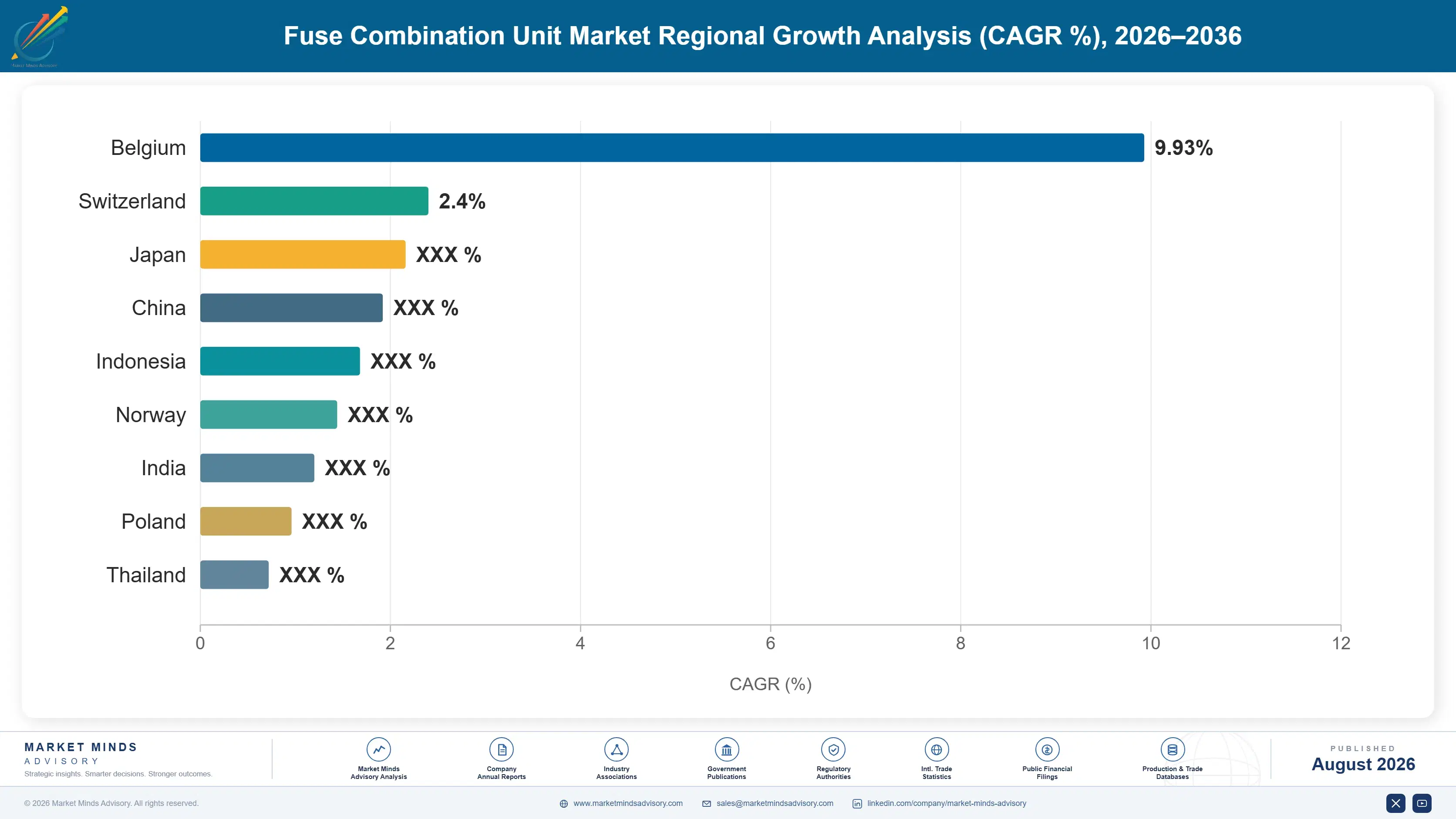
Global demand concentrates where grid expansion and industrial construction run deepest. East Asia leads on China's grid buildout, South Asia and Pacific follows on India's electrification programme, and Western Europe trails both on a mature, replacement-driven base overall. North America and Latin America each add steady, if slower, incremental demand.

North America

The United States drives regional demand through grid modernisation spending and renewable interconnection projects that increasingly specify medium-voltage certified combination units at substation and feeder tie-in points across expanding transmission networks. Data centre and manufacturing construction across Texas and the broader southern corridor add a further demand layer, with each new facility requiring dedicated motor starting and feeder protection points sized to its electrical design. Eaton and Schneider Electric both hold deep incumbency in North American panel builder and utility contracts, bundling fuse combination units into wider switchgear platform relationships. Canada contributes a smaller layer through mining and industrial electrification projects. Growth of 6.7% tracks grid and industrial construction investment more than any single project announcement.
Share: 24% | CAGR: 6.7% (2026 to 2036)

Western Europe

Germany, France, and the Netherlands anchor demand through established industrial and utility infrastructure that increasingly upgrades toward certified combination devices as national electrical codes tighten across multiple member states. Schneider Electric and Siemens both hold genuine home-market advantage across French and German utility and panel builder accounts, competing on certification breadth against smaller regional specialists. Renewable interconnection activity adds a meaningful demand layer, though the region's broadly mature grid infrastructure caps the underlying replacement-driven growth rate relative to faster-electrifying regions elsewhere. Growth of 4.9% reflects that infrastructure maturity directly, sitting below the global rate despite the region's genuinely deep industrial base. Nordic wind interconnection projects add a smaller but growing demand layer regionally.
Share: 21% | CAGR: 4.9% (2026 to 2036)
Regional intelligence for 5 additional markets available in the complete report: East Asia, South Asia and Pacific, Latin America, Middle East and Africa, Eastern Europe. Contact sales@marketmindsadvisory.com.
fuse-combination-unit-market-country-cagr-analysis-1787302086044

Where Fuse Combination Makers Can Defend Margin

Specification budgets are shifting earlier into grid and facility design and toward medium-voltage units that carry certification premiums. The four levers below capture revenue before a project locks its equipment list rather than after, and each rewards makers who can prove certification breadth credibly across a customer's full project portfolio. That shift rewards makers proving certification breadth early.

Bundle Units Into Grid Interconnection Design Contracts

Fuse combination unit specification increasingly happens during grid interconnection engineering rather than during later procurement, when voltage class and fault current requirements are already fixed and costly to change. Makers that place protection engineers inside interconnection design teams from the outset capture the full specification scope rather than competing for a smaller order later, and early involvement lets them influence certification pathway decisions that reduce future approval delay. Eaton reports that projects bundling specification into initial interconnection design carry order values roughly 26% higher than late-stage procurement orders on comparable projects.
Market Impact: Lifts contract value roughly 26% ve

Sell Digital Monitoring Subscriptions For Medium-Voltage Fleets

Utilities and large industrial operators increasingly want visibility into fuse combination unit condition and fault history across their full interconnection fleet rather than discovering a failed unit only after an outage occurs. Makers bundling digital monitoring hardware with subscription analytics software are capturing service revenue worth 8 to 14% of the original unit price annually, extending customer relationships well past the initial installation and improving retention across renewal cycles considerably. Schneider Electric has expanded its subscription monitoring offering specifically to capture this recurring layer across medium-voltage fleets. That recurring layer compounds meaningfully as more fleets renew across multiple cycles.
Market Impact: Adds a durable 8-14% annual recurri

Target Renewable Developer Pipeline Framework Deals

Renewable energy developers building multiple interconnection points across a project pipeline need certified protection equipment specified consistently across every site rather than negotiating separately for each individual interconnection, which shifts the purchasing decision upstream to a small number of engineering and procurement teams planning full project pipelines. Securing a framework agreement covering a developer's full pipeline delivers volume that no number of individual site orders can match, and it locks in specification before competitors ever see an individual project's tender. ABB has pursued exactly this structure with several renewable developers since 2023.
Market Impact: Locks in supply across a full pipel

Offer Modular Multi-Certification Platforms For Global Panel Builders

Panel builders selling into multiple regional markets need units certified against different national standards, and a single modular platform that shares core components across certification variants cuts the incremental engineering cost of serving each additional region considerably. Makers offering this modular approach win global panel builder relationships that single-certification competitors cannot serve as economically, and standardisation lets a single sales team support far more regional variants than bespoke certification engineering ever could. Mersen has scaled exactly this modular platform approach across its global panel builder accounts since 2024. That approach now covers more than half of Mersen's panel builder accounts.
Market Impact: Cuts multi-region certification cos

Who Controls the Margin Pool

Concentration sits at CR5 38%, moderate for a category split between diversified electrical equipment majors and fuse specialists. Eaton and Schneider Electric lead on breadth, bundling fuse combination units into wider switchgear and panel platform contracts, while the gap to specialists like Mersen and Socomec is more about certification depth than channel reach. All participants are assessed on one consistent basis, fuse combination unit revenue.
Current competitive activity runs across three dimensions. Product development concentrates on medium-voltage and enclosed units to close the specification gap with lower-value standard devices. Software investment focuses on digital monitoring rather than mechanical reliability alone. And account structure centres on renewable developer and grid operator framework agreements rather than one-off panel builder orders, a shift that rewards makers with genuine multi-project delivery capability.

Emerging pressure comes from Chinese and Indian electrical equipment makers scaling behind domestic grid buildout, winning price-sensitive business that incumbents once assumed was theirs. Rankings will shift toward makers combining medium-voltage certification with proven framework delivery, since that is what large utilities now specify. Low-voltage-only makers without a credible medium-voltage roadmap face the sharpest erosion ahead. That erosion accelerates fastest where domestic scale already gives regional entrants a durable price edge.
fuse-combination-unit-market-company-positioning-matrix-1787302086559

Competitive Moat and Risk Dimensions

EATON CORPORATION

Moat: Bundled switchgear platform incumbency

Eaton sells fuse combination units as part of a wider switchgear and panel platform that utilities and industrial customers already purchase from for other protection equipment, making it the default choice for customers who prefer a single consolidated vendor relationship across their full protection equipment portfolio.
EATON CORPORATION

Risk: Slower on emerging market pricing

Eaton's premium positioning sometimes trades off against the price competitiveness that fast-growing emerging markets increasingly demand, leaving room for regional specialists like Chint and Larsen & Toubro to win standard low-voltage business in China and India specifically. That gap is widening fastest in China and India, where domestic scale delivers a genuine cost advantage.
SCHNEIDER ELECTRIC

Moat: Deep grid modernisation relationships

Schneider Electric holds decades of accumulated relationships with utilities and grid operators across their modernisation and renewable interconnection programmes, giving it a genuine advantage winning framework agreements that smaller certification specialists cannot access without comparable established utility trust. That trust compounds as utilities renew and expand programme scope across successive project cycles.
SCHNEIDER ELECTRIC

Risk: Broad platform, thinner niche depth

Schneider Electric's platform breadth sometimes trades off against the deep, narrow certification specialisation that the most demanding medium-voltage applications require, leaving room for specialists like Mersen to win technically complex individual contracts on certification merit. That gap has widened as Mersen invests heavily in narrow, application-specific certification engineering.

Players Tracked

Prominent Players

Eaton Corporation
Schneider Electric
ABB Ltd
Siemens AG
Mersen S.A.

Other Key Players

Legrand SA
Littelfuse Inc.
Chint Group Corporation
Larsen & Toubro Limited
Havells India Limited
Socomec Group
OEZ s.r.o.
Ensto Group
Rittal GmbH
Hager Group
Sécheron SA
NHP Electrical Engineering Products
Fuji Electric Co. Ltd
General Electric
Bel Fuse Inc.

Recent Developments

APRIL 2025

Schneider Electric launches digital-monitoring enclosed fuse combination line

Schneider Electric introduced a new enclosed fuse combination unit line with integrated digital condition monitoring, targeting utility and large industrial substation applications. This was an organic product launch rather than an acquisition, extending Schneider Electric's monitoring capability into medium-voltage enclosed applications specifically. across its wider utility customer base.
Signal: Incumbents are investing in digital monito
OCTOBER 2025

Eaton acquires specialty medium-voltage fuse switch manufacturer

Eaton completed the acquisition of a European specialty medium-voltage fuse switch manufacturer serving utility and renewable interconnection customers. The deal brought established certification credentials and regional manufacturing capacity in-house, expanding Eaton's European medium-voltage footprint considerably beyond its prior direct presence. across multiple European markets. directly.
Signal: Certification credentials are becoming a g
JULY 2025

ABB signs supply agreement with renewable interconnection contractor

ABB entered a multi-year supply agreement to provide medium-voltage fuse combination units across a major renewable interconnection contractor's multiple substation projects. The agreement was a commercial supply contract, not a joint venture or equity transaction, covering units across the contractor's full project pipeline. across the contractor's full pipeline.
Signal: Multi-year, multi-project supply agreement

Copper And Silver Contact Material Cost Exposure

Copper and silver contact and fuse link materials run 28 to 35% of COGS, sourced from a concentrated set of metals refiners and specialised contact material manufacturers that also supply the wider electrical switchgear industry. Insulating housing materials, thermoplastic and porcelain components rated for the relevant voltage class, add a further 18 to 24%, with steel enclosures and assembly labour accounting for most of the remainder.
The copper and silver price spike running through 2021 and 2022 hit fuse combination unit production cost directly, since contact and fuse link materials depend on metals pricing that moved sharply during that period alongside broader industrial metals inflation. Eaton Corporation's 2022 Annual Report disclosed elevated input costs across its electrical sector segment, attributing part of the margin pressure to copper and precious metals inflation that persisted through much of the year.

Exposure varies sharply by player type. Vertically integrated majors like Eaton and Schneider Electric carry enough purchasing scale to negotiate favourable metals supply contracts, while smaller regional makers depend on spot market purchasing and absorb price spikes directly into thinner margins. Geography matters, since makers sourcing copper and silver domestically face different exposure than those buying through longer, more exposed supply chains.
fuse-combination-unit-market-cost-volatility-analysis-1787302086753

Lock Copper And Silver Supply Through Multi-Year Contracts

Fixed-volume, multi-year procurement contracts with metals refiners smooth contact and fuse link material costs across price cycles. Several makers moved a majority of their copper and silver purchasing onto contract pricing rather than spot markets after the 2021 spike exposed their exposure directly. That approach has meaningfully reduced spot-market exposure across the largest makers' product lines.

Develop Reduced-Silver Contact Alloys Where Certification Allows

Alternative contact alloys that reduce silver content while maintaining certified fault-clearing performance cut precious metals exposure meaningfully. Several makers have invested in alloy development specifically to reduce dependence on silver pricing without compromising the certification standards their units must meet. That approach helps offset broader raw material cost pressure across product lines. Certification bodies have generally approved these alloys readily.

Shift Product Mix Toward Digital Monitoring To Add Margin Buffer

Digital monitoring hardware and subscription software carry meaningfully higher margin than mechanical devices alone, giving makers a durable way to offset raw material cost volatility over time simply by shifting sales mix toward the category's higher-margin monitoring-enabled product lines. That shift has meaningfully improved blended margin across the makers' product portfolios. That shift also reduces exposure to future metals disruption.

Portfolio Architecture for Margin Defence

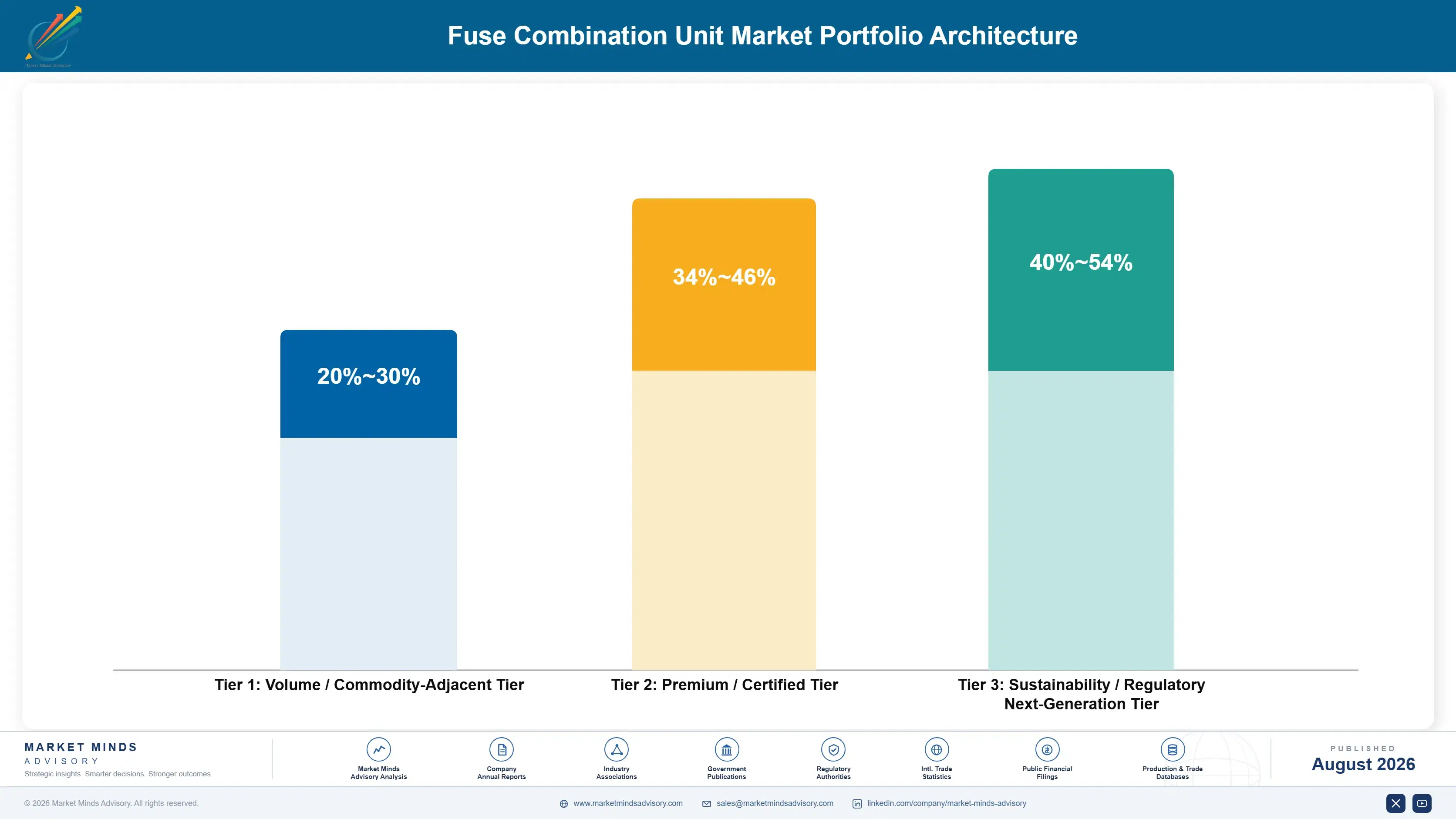
The portfolio splits into three tiers with real margin separation, and the gap between tiers has widened as medium-voltage certification becomes a genuine differentiator rather than an add-on feature. Volume-tier standard low-voltage units compete on price against generic switch and fuse alternatives and earn modestly. Premium medium-voltage and framework-contracted units earn considerably more because they solve a genuine certification and reliability problem that customers cannot engineer arou
The tension is between panel builder volume and per-project engineering margin. Distributors buying standard units in bulk push hard on unit price, while utilities and renewable developers standardising on framework agreements pay for certification breadth and delivery consistency rather than negotiating down to the last dollar on every unit. Makers serving both buyer types run genuinely different sales motions under one brand.

High-value pools concentrate in medium-voltage units sold with digital monitoring subscriptions and developer framework agreements, where switching cost is highest and price sensitivity lowest. Legacy low-voltage business remains large in volume but persistently thin in margin, as customers treat it as a commodity purchase rather than a differentiated one, and few makers manage to change that perception.

Volume / Commodity-Adjacent Tier

Standard low-voltage units sold into general panel builder and distributor channels, priced against generic switch and fuse alternatives. Margin stays thin because buyers negotiate primarily on unit price. Buyers rarely differentiate between vendors on anything beyond delivery speed and price.
Gross Margin: 20-30%

Premium / Certified Tier

Medium-voltage units and renewable developer framework agreements sold into utilities standardising interconnection specifications. Buyers pay for certification breadth and delivery consistency rather than for hardware alone. Delivery timelines and documentation quality matter as much as the hardware specification.
Gross Margin: 34-46%

Sustainability / Regulatory / Next-Generation Tier

Enclosed and digitally monitored units bundled with condition monitoring subscriptions sold to utilities and large industrial operators. Margin reflects both certification scarcity and recurring revenue. Few makers currently combine both elements convincingly at meaningful commercial scale.
Gross Margin: 40-54%
fuse-combination-unit-market-portfolio-architecture-1787302087254

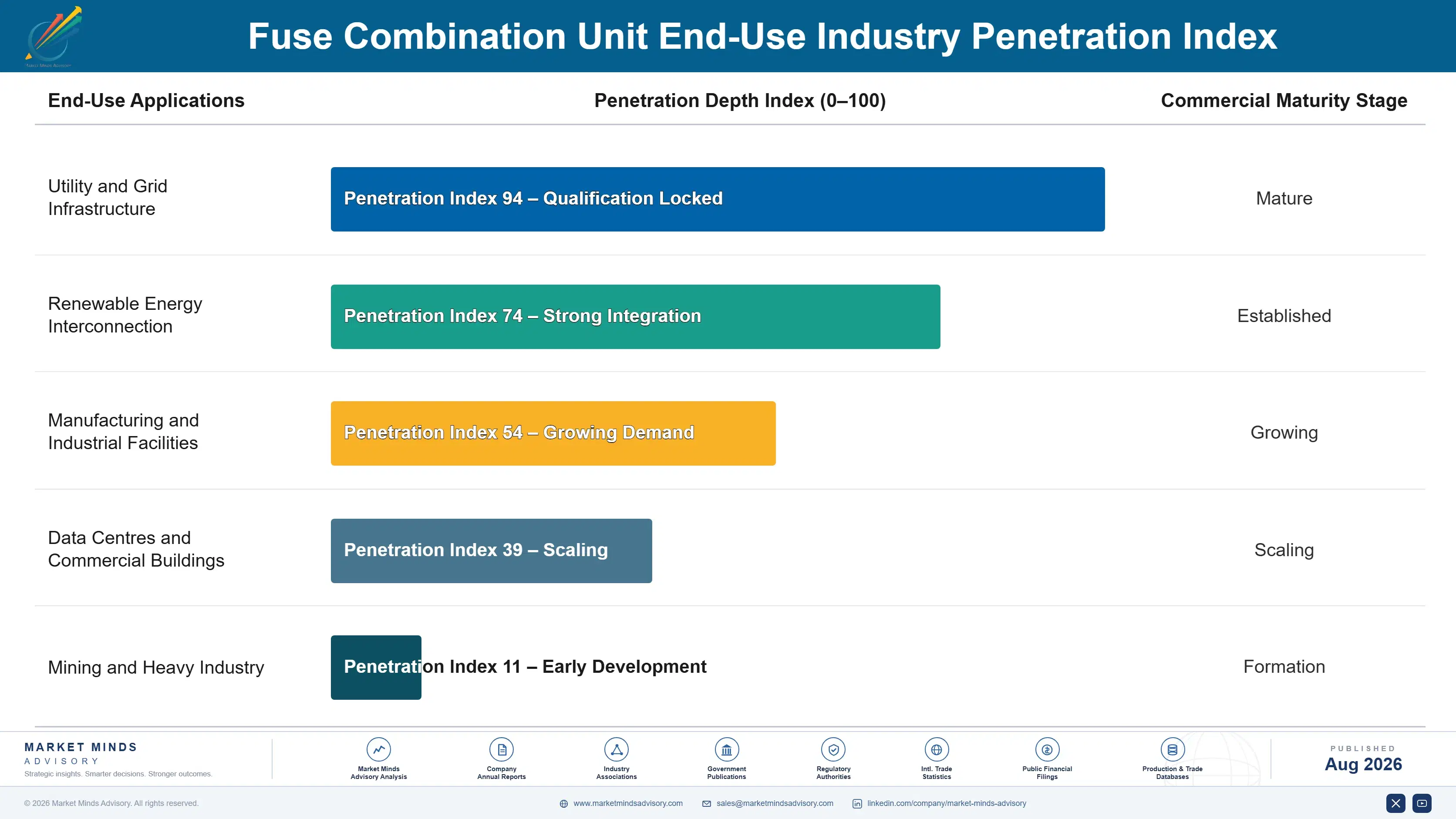
Certification-Anchored Recurring Fuse Demand

Demand behaves like an annuity once a unit is installed, because the housing and switch mechanism outlast individual fuse link replacements across a 12 to 20 year service life, generating recurring consumable revenue independent of the original unit sale. That replacement cycle, plus the underlying grid and industrial expansion demand it does not capture, gives makers a predictable revenue tail well beyond any single installation, converting a one-time unit sale into an ongoing account relations
Adoption depth varies sharply by end-use vertical. Utilities and renewable developers adopt medium-voltage certification fastest and deepest, since interconnection approval depends directly on documented protection equipment performance. Industrial manufacturers follow closely on facility electrical design specification. Smaller commercial and residential-adjacent applications adopt more slowly and selectively, often defaulting to standard low-voltage units without medium-voltage requirements.

Buyer profiles are shifting generationally. Procurement once sat with panel builders selecting individual components; it now increasingly involves grid interconnection and facility engineering teams who specify protection requirements before a single unit is selected. That shift moves the real purchasing decision earlier into the project planning cycle and rewards makers who can prove certification breadth credibly.
fuse-combination-unit-market-end-use-penetration-index-1787302087748

Where Fuse Combination Value Concentrates

These are among the four positions where our research anticipates prominent divergence between winners and laggards over the coming forecast period. Each is grounded in the demand model, the regulatory perimeter, and the announced capacity pipeline.
01 / MEDIUM-VOLTAGE CERTIFICATION POSITIONING

MV Certification Now Decides Long-Run Category Position

Medium-voltage fuse combination units are growing at 9.5%, about 1.53 times the market's 6.2% overall rate, and that gap is widening as grid modernisation and renewable interconnection projects specify certified protection at every tie-in point. Makers still anchored on low-voltage products alone risk losing the fastest-growing, highest-margin interconnection contracts to rivals offering broader certification already proven across multiple voltage classes. The window to build credible medium-voltage capability is closing within this forecast period, not the next one, and latecomers will find the largest reference projects already claimed.
02 / DIGITAL MONITORING STRATEGY

Condition Monitoring Is Becoming Table Stakes For Utilities

Utilities and large industrial operators increasingly refuse to specify fuse combination units without digital condition monitoring, since discovering a failed unit only after an outage occurs is no longer an acceptable operating standard across modernised grid infrastructure. Makers who build this monitoring capability capture recurring subscription revenue and preferred-vendor status that mechanical-only competitors cannot easily replicate at comparable scale. Those without a credible monitoring platform will find themselves excluded from the largest utility and developer framework agreements entirely, regardless of how competitive their base hardware pricing happens to be.
03 / DEVELOPER FRAMEWORK CHANNEL

Multi-Project Frameworks Will Outgrow Standalone Unit Sales

Renewable developers building multiple interconnection points across a project pipeline are increasingly folding protection equipment specification into corporate engineering standards rather than leaving it to individual project teams, concentrating real purchasing power in a small number of framework decisions that smaller makers cannot easily access at scale. Makers who secure framework status with major developers capture volume across an entire project pipeline that no number of individual site orders can replicate. Those still selling purely site by site risk being locked out of this fastest-growing channel entirely.
04 / REGIONAL MANUFACTURING PRICING

East Asian And Indian Scale Will Keep Pressuring Global Pricing

China and India's expanding grid and electrical equipment manufacturing base has scaled domestic makers fast enough to win price-sensitive standard low-voltage tenders that global incumbents once assumed were theirs by default, and that pricing pressure is starting to spread into broader regional procurement decisions as well. Makers competing purely on price against fast-scaling regional entrants will struggle to hold margin over any meaningful time horizon. The more durable response is competing on medium-voltage certification and monitoring depth, categories where regional entrants still visibly lag behind global incumbents.

Engagement Snapshot From the Field

A live engagement with an industry participant carrying material or product regulatory and market exposure ahead of a defining policy shift, showing how our research translates into a defensible multi-year portfolio strategy.
MARKET MINDS ADVISORY · CLIENT ENGAGEMENT SUMMARY
Fuse Combination Unit Producer Strategic Portfolio Review and Transition Roadmap 2026·Investment Scenario on Fuse Combination Unit Exposure Evaluation 2025-26
CLIENT PROFILE
A renewable energy developer building solar interconnection projects across a dozen sites approached MMA after a delayed certification approval pushed back one project's commercial operation date by several weeks. The client reported project-level revenue delay costs in the low single-digit millions per site during commissioning delays, alongside inconsistent equipment specifications across its existing project portfolio (client-reported, unverified by MMA).
STRATEGIC CHALLENGE
The client had historically let each project team select fuse combination units independently, resulting in a mix of vendors and certification pathways that made it difficult to apply lessons learned from one project's approval process to the next. The delayed certification that triggered the engagement traced to a unit specification that had not been pre-validated against the local utility's specific interconnection requirements.
MMA APPROACH
MMA benchmarked the client's certification approval timelines against comparable developers that had standardised on a single vendor and certification pathway, quantifying the delay risk reduction a standardised specification would deliver. We evaluated three qualified vendors on certification breadth across the client's target markets and modelled the cost of standardisation against continuing with project-by-project sourcing decisions.
KEY FINDINGS
  1. Roughly half of the client's prior projects had used a different fuse combination unit specification, with no consistent process for validating certification against local utility interconnection requirements ahead of submission.
  2. A single standardised vendor relationship covering all target markets was projected to cut certification approval timelines meaningfully by eliminating the review cycle needed for each new equipment specification.
  3. Two of three vendors evaluated could offer certified units across all of the client's target markets under one modular platform; the third required separate regional product lines with longer individual approval timelines.
  4. Standardising specification also simplified the client's spare parts inventory considerably, since consistent equipment across sites reduced the range of replacement fuse links technicians needed to stock (client-reported, unverified by MMA).
CLIENT PROFILE
A renewable energy developer building solar interconnection projects across a dozen sites approached MMA after a delayed certification approval pushed back one project's commercial operation date by several weeks. The client reported project-level revenue delay costs in the low single-digit millions per site during commissioning delays, alongside inconsistent equipment specifications across its existing project portfolio (client-reported, unverified by MMA).
STRATEGIC CHALLENGE
The client had historically let each project team select fuse combination units independently, resulting in a mix of vendors and certification pathways that made it difficult to apply lessons learned from one project's approval process to the next. The delayed certification that triggered the engagement traced to a unit specification that had not been pre-validated against the local utility's specific interconnection requirements.
MMA APPROACH
MMA benchmarked the client's certification approval timelines against comparable developers that had standardised on a single vendor and certification pathway, quantifying the delay risk reduction a standardised specification would deliver. We evaluated three qualified vendors on certification breadth across the client's target markets and modelled the cost of standardisation against continuing with project-by-project sourcing decisions.
KEY FINDINGS
  1. Roughly half of the client's prior projects had used a different fuse combination unit specification, with no consistent process for validating certification against local utility interconnection requirements ahead of submission.
  2. A single standardised vendor relationship covering all target markets was projected to cut certification approval timelines meaningfully by eliminating the review cycle needed for each new equipment specification.
  3. Two of three vendors evaluated could offer certified units across all of the client's target markets under one modular platform; the third required separate regional product lines with longer individual approval timelines.
  4. Standardising specification also simplified the client's spare parts inventory considerably, since consistent equipment across sites reduced the range of replacement fuse links technicians needed to stock (client-reported, unverified by MMA).
RECOMMENDED STRATEGY
Phase 1: Phase 1 (0 to 2 months): Select a single standardised vendor and certification pathway validated across all current target markets. Phase 2: Phase 2 (2 to 6 months): Apply the standardised specification retroactively to remaining projects still in the design phase., applying lessons from the initial rollout consistently. Phase 3: Phase 3 (6 to 18 months): Fold the standardised specification into the corporate engineering standard for all future project pipelines.
OUTCOME
The client completed its next three interconnection approvals within the standard review timeline, avoiding a reported repeat of the earlier delay. The standardised specification has since been adopted as the default starting point for the client's expanding project pipeline in new markets (client-reported, unverified by MMA).

Frequently Asked Questions

Foundational context covering the market sizes, CAGR, scope, country, region and competition that inform every finding below. This section is provided to cover basics and most often pre-purchase conversations, answered from the MMA Primary Research Dataset.

What is the current size of the Fuse Combination Unit Market?

The market was valued at USD 2.6 billion in 2025, and demand is concentrated in grid modernisation, renewable interconnection, and industrial motor starting applications. Growth is closely tied to grid modernisation and industrial capacity expansion pace.

How large will the Fuse Combination Unit Market be by 2036?

The market is projected to reach USD 5.04 billion by 2036, an expansion multiple of 1.83 times its 2026 value. Medium-voltage units drive most of that growth.

What is the CAGR for the Fuse Combination Unit Market 2026 to 2036?

The base case CAGR is 6.2%, with a bull case of 7.4% and a bear case of 5.1%. The range reflects uncertainty around grid modernisation spending pace.

Which segment is growing fastest?

Medium-voltage fuse combination units grow fastest at 9.5%, about 1.53 times the overall market rate, as grid modernisation and renewable interconnection projects drive most of that growth.

Who are the major companies in the Fuse Combination Unit Market?

Eaton, Schneider Electric, ABB, Siemens, and Mersen lead the market, with concentration at CR5 38%, reflecting genuine engineering and certification depth across this category broadly.

Which country is growing fastest?

India grows fastest at 8.9%, driven by its national electrification programme and expanding renewable capacity. China remains the largest market by production volume and installed base.

Report Segmentation Architecture

The full report scope spans multiple orthogonal segmentation dimensions, with cross-tabulated demand data provided for each dimension pair. Coverage extends further to regional breakdowns, trend trajectories, and the competitive detail needed to support segment-level decision-making.

By Product Configuration

  • Open and Panel-Mount Units
  • Enclosed IP-Rated Units
  • DIN-Rail Fuse Combination Switches
  • Motor Starting Fuse Combination Units
  • Medium-Voltage Fuse Combination Units
  • Replacement Fuse Links and Carriers

By End-Use Industry

  • Utility and Grid Infrastructure
  • Renewable Energy Interconnection
  • Manufacturing and Industrial Facilities
  • Data Centres and Commercial Buildings
  • Mining and Heavy Industry

By Commercial Dimension

  • Grid Interconnection Design Contracts
  • Panel Builder and Distributor Sales
  • Digital Monitoring Subscriptions
  • Multi-Project Framework Agreements

By Region

  • North America
  • Western Europe
  • East Asia
  • South Asia and Pacific
  • Latin America
  • Middle East and Africa
  • Eastern Europe

Scope, Methodology, and Coverage

Every figure in this report is reproducible from documented input assumptions. The scope below maps the historical period, the forecast horizon, the segmentation dimensions, and the countries covered, alongside the underlying primary and qualitative methodology.
Historical Period
2020 to 2025
Forecast Period
2026 to 2036
Base Year
2025 (USD billions; MMA Primary Research Dataset, August 2026)
Market Definition
The fuse combination unit market comprises switch-fuse combination devices that integrate a load-break switch with fuse links in a single enclosure for isolation and fault protection, spanning open and panel-mount units, enclosed IP-rated units, DIN-rail switches, motor starting units, medium-voltage combinations, and replacement fuse links. Standalone circuit breakers without fuses, fuses sold independent of any switch mechanism, and general switchgear assemblies are excluded as a broader category.
Quantitative Units
USD billions (current prices); installed units and fault current rating capacity where applicable
Segmentation Dimensions
By Product Configuration; By End-Use Industry; By Commercial Dimension; By Region
Regions Covered
North America, Western Europe, East Asia, South Asia and Pacific, Latin America, Middle East and Africa, Eastern Europe
Countries Covered
USA, China, Germany, France, UK, Japan, South Korea, India, Australia, Canada, Brazil, Mexico, Indonesia, Vietnam, Thailand, Malaysia, UAE, Saudi Arabia, South Africa, Nigeria, Turkey, Poland, Netherlands, Italy, Spain, Sweden, Switzerland, Argentina, Colombia, Singapore, and additional markets relevant to this sector
Key Companies Profiled
Eaton Corporation, Schneider Electric, ABB Ltd, Siemens AG, Mersen S.A., Legrand SA, Littelfuse Inc., Chint Group Corporation, Larsen & Toubro Limited, Havells India Limited, Socomec Group, OEZ s.r.o., Ensto Group, Rittal GmbH, Hager Group, Sécheron SA, NHP Electrical Engineering Products, Fuji Electric Co. Ltd, General Electric, Bel Fuse Inc.
Quantitative Methodology
Primary survey, n=3,800 respondents, Q4 2025, six countries; demand-side model with trade association cross-validation
Qualitative Methodology
47 expert interviews, Q4 2025; applied to validate demand model assumptions, identify emerging dynamics, and assess competitive positioning
Report Format
PDF and XLSX data workbook (Word format preview document)
Publisher
Market Minds Advisory
Report Code
MMA-2026-CON-107
Published
August 2026
Contact
sales@marketmindsadvisory.com | www.marketmindsadvisory.com

Purchase the full Fuse Combination Unit Market Report (2026 to 2036).

The full MMA Fuse Combination Unit report sizes the market across six product configurations, five end-use industries, four commercial dimensions, and seven regions through 2036. It profiles twenty participants on a consistent fuse combination unit revenue basis, scoring each on certification breadth, monitoring capability, and multi-project delivery capacity. Scenario models quantify how grid modernisation spending, renewable interconnection pace, and electrical code certification requirements move both demand and realised pricing. The report also includes delivered-cost modelling by product configuration and a framework-agreement benchmarking tool built for engineering, procurement, and utility relations teams.
Product configuration cost and certification benchmarking
Certification pathway comparison by region and code
Renewable developer framework agreement and pipeline tracker
Grid interconnection demand forecasting and sizing model
Component and metals supply chain risk screen
Digital monitoring subscription revenue forecasting model

Built For The People Who Decide

From boardroom strategy to bench-side execution, this report is read cover-to-cover by leaders shaping the next decade of their industry, turning demand scenarios, market dynamics and valuation benchmarks into decisions.
CXOs/ Presidents/ VPs/ Managers
M&A and Corporate Development
Strategy Teams and R&D Heads
Procurement and Product Directors
Regulatory and Compliance Leaders
Investor Relations and Equity Analysts