Market Minds Advisory
Furniture Polish Wipes Market

Furniture Polish Wipes Market: Furniture Polish Wipes Market: Silicone Build-Up, Surfaces That Are Not Wood and A Format Under Regulatory Pressure, 2026 to 2036

Around two thirds of what people polish is a printed plastic foil, and the silicone making it shine builds into a layer somebody eventually has to strip off with solvent.

Lead Analyst

Published

September 2026

Make Smarter Decisions with Customized Research Insights

Request a free sample report and evaluate market opportunities, growth trends, and competitive dynamics relevant to your business needs.

2025 MARKET VALUE$1.9BMarket Size 2025
2036 FORECAST VALUE$3.4BBase Case , 2026 to 2036
CAGR 2026 TO 20365.4 %Bull 6.6% / Bear 4.2%
INCREMENTAL OPPORTUNITY$1.4BNet 10- year value creation
EXPANSION MULTIPLE1.70x2036 value over 2026 base
Strategic Levers
M&A Pipeline
Regional Outlook
Country Rankings
Competitive Intelligence
Segmental Deep-dive
Call-Us : 91 93563 13602

Executive Snapshot and Market Trajectory.

About 68% of the surfaces people polish are melamine, laminate, or foil-wrapped board rather than wood. Oil and wax chemistry does nothing useful on a printed plastic film except sit on top of it and collect dust. It still produces a shine, which is why nobody notices.
Plant fibre and biodegradable substrate wipes grow at 8.1%, half again the market rate of 5.4%, and the reason is regulatory rather than commercial. Around 74% of wipes still use fossil-derived nonwoven, and the single-use plastic rules tightening across several markets capture exactly that material. Oil-based wood conditioning wipes follow at 7.2%. Consumer demand for that change is close to nil, and retailers de-list ahead of legislation anyway.
Silicone is the category's own worst product. It produces the shine buyers want and does not fully wear away, so repeated application builds a cloudy film that traps dust and eventually requires solvent stripping. Roughly 31% of users report exactly that residue, and the next purchase is generally sold as the answer to it. Restorers spend their working lives removing what this category deposits. That argument is not one anybody selling wants raised in public.
Market Definition
This market covers pre-moistened wipes formulated for cleaning and polishing furniture and hard household surfaces, including plant fibre and biodegradable substrate wipes, oil-based wood conditioning wipes, antimicrobial furniture wipes, electrostatic dusting wipes with polish, wax-based polish wipes, and silicone-based polish wipes. It excludes aerosol and liquid furniture polish, general purpose surface wipes without polish function, glass and floor wipes, baby and personal care wipes, healthcare disinfectant wipes, and dry dusting cloths.
Base Year Value
$1.9B in 2025 (MMA Primary Research Dataset, September 2026)
Forecast Period
2026 to 2036, eleven discrete annual values
CAGR
5.4% base case. Bull 6.6%. Bear 4.2%.
Fastest Growth Segment
Plant Fibre And Biodegradable Substrate Wipes: 8.1% CAGR
Fastest Growth Country
China: 9.6% CAGR
Fastest Growth Region
South Asia and Pacific: 7.4% CAGR
Largest Region
North America: 32% of 2025 global value
Market Leaders
SC Johnson, Reckitt Benckiser, Procter and Gamble, Clorox, and Church and Dwight lead the field. Source: MMA Primary Research Dataset, July 2026.
Primary Survey
n=3,800 procurement and R&D decision-makers, Q4 2025, six countries
Methodology
Demand-side build-up, cross-validated against public data, 47 expert interviews

Furniture Polish Wipes Market Forecast Scenarios

furniture-polish-wipes-market-size-forecast-scenario-1790015609166
Between 2020 and 2025 the category grew at 4.3% on convenience rather than on performance. Wipes displaced aerosol and cloth because they remove two steps and produce no overspray, and household cleaning frequency rose sharply through the pandemic period before settling back. Silicone formulations dominated throughout, and the substrate question attracted almost no attention until regulation began arriving.
The base case at 5.4% rests on three mechanisms. Plant fibre substrates take share as single-use plastic rules broaden beyond the markets that adopted them first. Chinese and wider Asian household cleaning premiumisation adds volume in markets where wipes penetration remains far below Western levels. And oil-based conditioning products grow among the minority of households that actually own solid wood furniture worth conditioning. None of the three requires households to clean any more often than now.
The bull case at 6.6% depends on refill and reusable systems finding a format that consumers accept, since repurchase currently runs at around 12% and the convenience that drove adoption is precisely what those systems remove. The bear case at 4.2% is regulation: wipes are non-flushable, mostly plastic, and increasingly restricted, and a broad prohibition would remove the format rather than reform it.

What People Are Actually Polishing

Furniture polish was formulated for finished wood, where oils and waxes feed the surface and waxes build a protective layer that can be renewed. Around 68% of what people apply it to is melamine, laminate, or foil-wrapped board, and on a printed plastic film none of that chemistry does anything except deposit a residue. The product still produces a shine, which is why nobody notices the mismatch.
TOP FIVE CONCENTRATION52%Share of category revenue held by the leading manufacturers
NON-WOOD SURFACE SHARE68%Furniture surfaces where polish chemistry does nothing useful
SILICONE BUILD-UP COMPLAINTS31%Users reporting cloudy residue after repeated application over time
PLASTIC SUBSTRATE SHARE74%Wipes still using fossil-derived nonwoven rather than plant fibre
REFILL SYSTEM REPURCHASE12%Buyers of reusable systems who continue with them afterwards
AVERAGE PACK PRICEUSD 4.60Typical shelf price across a standard wipe canister
Silicone is what produces that shine and it is also the category's most awkward ingredient. It spreads readily, gives an immediate gloss, and does not fully wear away between applications, so repeated use builds a film that goes cloudy, holds dust, and eventually needs stripping with solvent. About 31% of users report exactly that residue, and furniture restorers spend a considerable part of their working lives removing it.
The format itself is now the commercial question. Wipes grew because they replaced a cloth and an aerosol with a single motion, and roughly 74% of them use polypropylene or polyester nonwoven that single-use plastic rules across several markets now capture. Plant fibre substrates cost more and perform adequately, and the regulation rather than the consumer is what will decide the transition.
"The shine comes from silicone, the silicone builds up, and eventually somebody pays a restorer to take it off with solvent. Meanwhile two thirds of the surfaces being treated are printed plastic that needed a damp cloth. It is a very well-marketed category."
Practice Director, Home Care and Household Cleaning Products · MMA Chemicals and Materials Practice · September 2026

Market Trends

Substrate Regulation Rather Than Preference Drives Reformulation

Around 74% of furniture polish wipes still use fossil-derived nonwoven, and single-use plastic rules tightening across several markets capture that material directly rather than the formulation inside it. Plant fibre substrates grow at 8.1% as a result, at higher cost and broadly comparable performance. Consumer demand for the change is negligible and regulatory momentum is not, which makes this one of the few reformulations in home care driven entirely from outside the market. Viscose, lyocell, and cotton blends cost more per sheet and perform comparably here. The conversion is a cost increase rather than a product improvement for everybody involved.
Market Impact: Country grows at 9.6%
Oil Conditioning Grows Among The Minority With Wood

Oil-based conditioning wipes grow at 7.2% because they do something real on solid wood and finished veneer, which is roughly a third of the surfaces this category treats. Buyers of those products generally own furniture worth maintaining and understand what conditioning achieves, which makes them considerably less price sensitive than the mainstream. The segment stays small precisely because the surfaces it serves are a minority of household furniture and always will be. Those buyers repurchase far more consistently than the mainstream, and they select on formulation rather than on price or fragrance.
Market Impact: Removes 2 cleaning steps

Market Opportunities and Growth Drivers

Chinese Household Cleaning Premiumisation Adds Volume

Chinese growth of 9.6% leads every country covered, driven by household cleaning products moving from basic detergents toward specialised categories that Western households adopted decades ago. Wipe penetration across the region remains far below Western levels, which leaves substantial headroom independent of any product improvement. Domestic e-commerce sells these categories at volumes physical retail never reached, and Chinese manufacturers supply most of that demand directly. Furniture across the region is also overwhelmingly laminate and foil-wrapped board, which means the category arrives selling conditioning into homes with essentially nothing to condition.
Market Impact: Affects 31% of users

Convenience Removed Two Steps From The Task

A wipe replaces a cloth and an aerosol with one motion, produces no overspray onto floors or electronics, and requires no laundering afterwards. That is the entire commercial proposition and it has proved durable across every market where the format launched. Households cleaning weekly rather than seasonally value the time saved considerably more than any polish performance difference, which is why formulation quality has never driven purchasing in this category. Private label understood that earlier than the branded manufacturers did, which is part of why store products took share so quickly once households stopped comparing formulations.
Market Impact: Covers 68% of surfaces

Market Restraints and Challenges

Silicone Build-Up Creates The Next Problem

Roughly 31% of users report a cloudy greasy residue after repeated application, and the root cause is that silicone does not fully wear away between uses and accumulates into a film that traps dust. Commercially it produces dissatisfaction attributed to the furniture rather than the product. Manufacturers respond with lower silicone loadings, with cleaning agents that remove previous coats before depositing new ones, and with silicone-free oil formulations entirely. None of those approaches removes the underlying tension, which is that the shine consumers buy comes from the ingredient causing the complaint.
Market Impact: Covers 74% of substrates

Most Treated Surfaces Cannot Benefit At All

About 68% of the surfaces this category treats are melamine, laminate, or foil-wrapped board where oils and waxes deposit residue rather than conditioning anything, and the root cause is that mass furniture has not been solid wood for decades. Commercially it means most of the category delivers a shine and nothing else. Manufacturers respond with surface-specific ranges, with cleaning-led rather than polish-led positioning, and with clearer labelling. Manufacturers continue selling conditioning language into households that own almost nothing worth conditioning, and the labelling has not changed in decades. Labelling has not changed in decades.
Market Impact: Serves 32% of surfaces
4 additional market trends, 3 additional growth drivers, and 2 additional restraints and challenges are covered in the full report. Contact sales@marketmindsadvisory.com to access the complete intelligence.

Segment CAGR and Growth Architecture

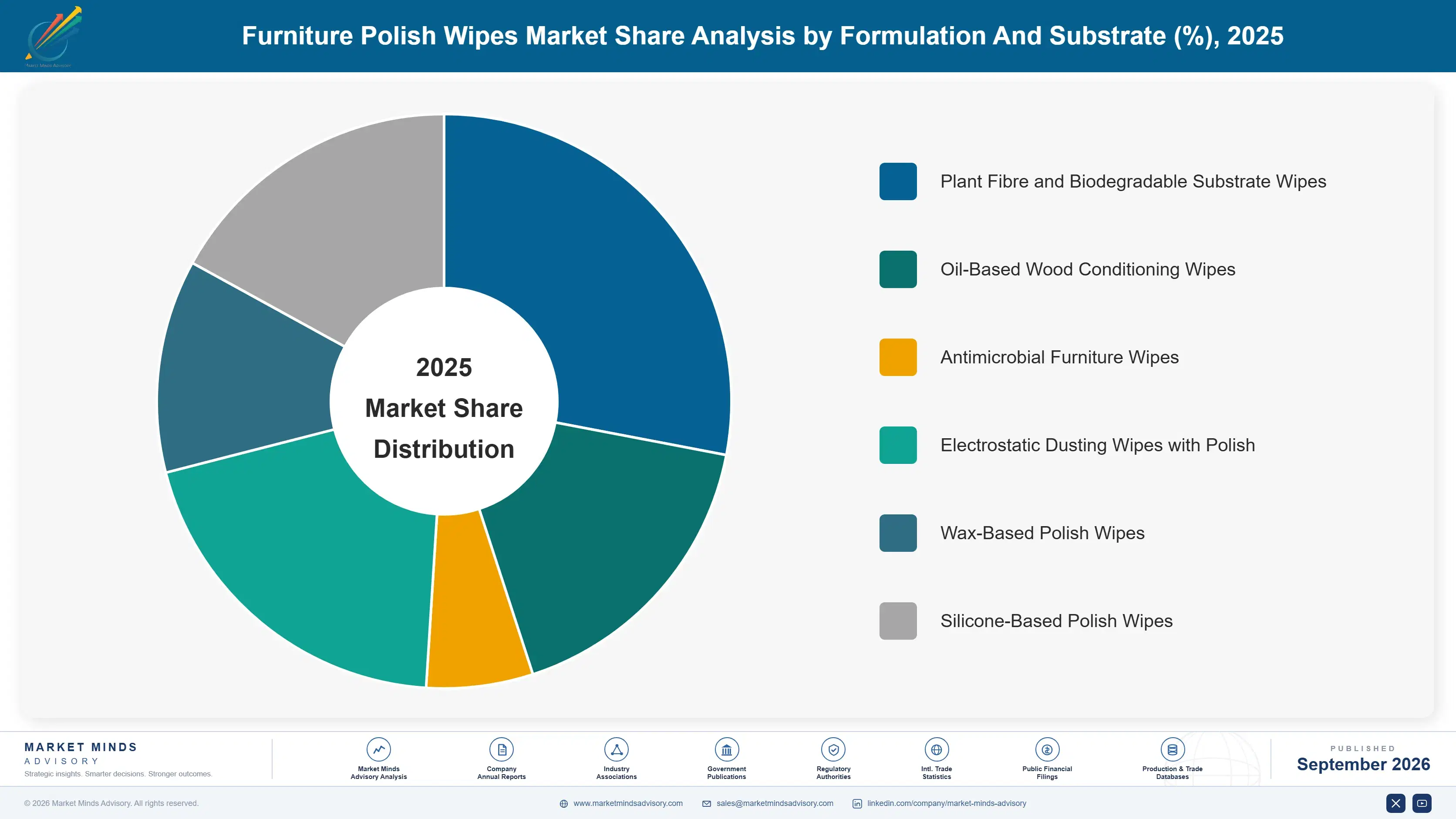
Segmentation follows wipe formulation and substrate across six categories: plant fibre and biodegradable substrate wipes, oil-based wood conditioning wipes, antimicrobial furniture wipes, electrostatic dusting wipes with polish, wax-based polish wipes, and silicone-based polish wipes. Pack format, surface application, and retail channel are treated as separate dimensions entirely. Impregnation formulation is counted within the substrate carrying it.
furniture-polish-wipes-market-market-share-analysis-1790015609710

Plant Fibre And Biodegradable Substrate Wipes

Plant fibre substrates grow at 8.1%, half again the market rate of 5.4%, and almost none of that growth comes from consumers asking for it. Single-use plastic rules across several markets capture the polypropylene and polyester nonwoven that around 74% of wipes still use, and manufacturers are reformulating ahead of prohibition rather than in response to demand. Viscose, lyocell, and cotton blends cost more per sheet and perform comparably for this application. The commercial question is whether regulation arrives fast enough to justify the conversion before retailers force the price back down. Retailers are moving ahead of legislators on this question. Every brand needs the same converting lines at once, which makes timing the whole commercial question here.
CAGR 8.1%

Oil-Based Wood Conditioning Wipes

Oil conditioning wipes grow at 7.2% by doing something genuinely useful on the roughly third of surfaces that are actually wood. Tung, linseed, and mineral oil formulations penetrate finished timber and veneer, restore appearance without building the silicone film that eventually needs stripping, and appeal to households owning furniture worth maintaining. Those buyers are considerably less price sensitive than the mainstream and repurchase more consistently. The segment stays small because the surfaces it serves are a minority of household furniture, and no marketing will change what mass furniture is made of. Build-up removal is a genuine advantage these formulations hold over silicone. No marketing alters what mass furniture is made of.
CAGR 7.2%
Full segment breakdown across 6 segments available in the complete report.

Regional Architecture and Country Demand Map

Regional shares here reflect where furniture polish wipes are actually being purchased by their own households, rather than where the substrates and the formulations themselves are manufactured for them. All seven regions sit inside the standard bands for both share and growth across this market.

North America

Wipe penetration in household cleaning is the highest of any region by a wide margin, and the format itself was commercialised here before spreading elsewhere. Growth of 4.8% tracks close to the world rate. Households clean more frequently and buy more specialised products per surface type than anywhere else covered. Substrate regulation is developing at state level rather than federally, which produces a patchwork that manufacturers find harder to plan around than a single national rule. Private label penetration is correspondingly high, since a wipe is a wipe once a shopper compares two canisters made by the same contract converter on the same shelf. State-level rules complicate planning. A single federal rule would be easier.
Share: 32% | CAGR: 4.8% (2026 to 2036)

Western Europe

Single-use plastic regulation is furthest advanced here, and it captures the nonwoven substrate rather than the formulation, which is reshaping the category from the material upward. Growth of 3.7% is the slowest of the seven regions, reflecting both mature penetration and the regulatory drag on a plastic-substrate format. German and Nordic households have moved toward reusable cloth and concentrate systems faster than anywhere, though repurchase rates remain modest even there. Retailers have begun de-listing plastic substrate lines ahead of legislation to protect their own positions, which compresses the conversion timeline for every brand supplying them considerably. Reusable and concentrate systems have advanced furthest here, though repurchase remains modest even in the markets most receptive to them.
Share: 24% | CAGR: 3.7% (2026 to 2036)
Regional intelligence for 5 additional markets available in the complete report: East Asia, South Asia and Pacific, Latin America, Middle East and Africa, Eastern Europe. Contact sales@marketmindsadvisory.com.
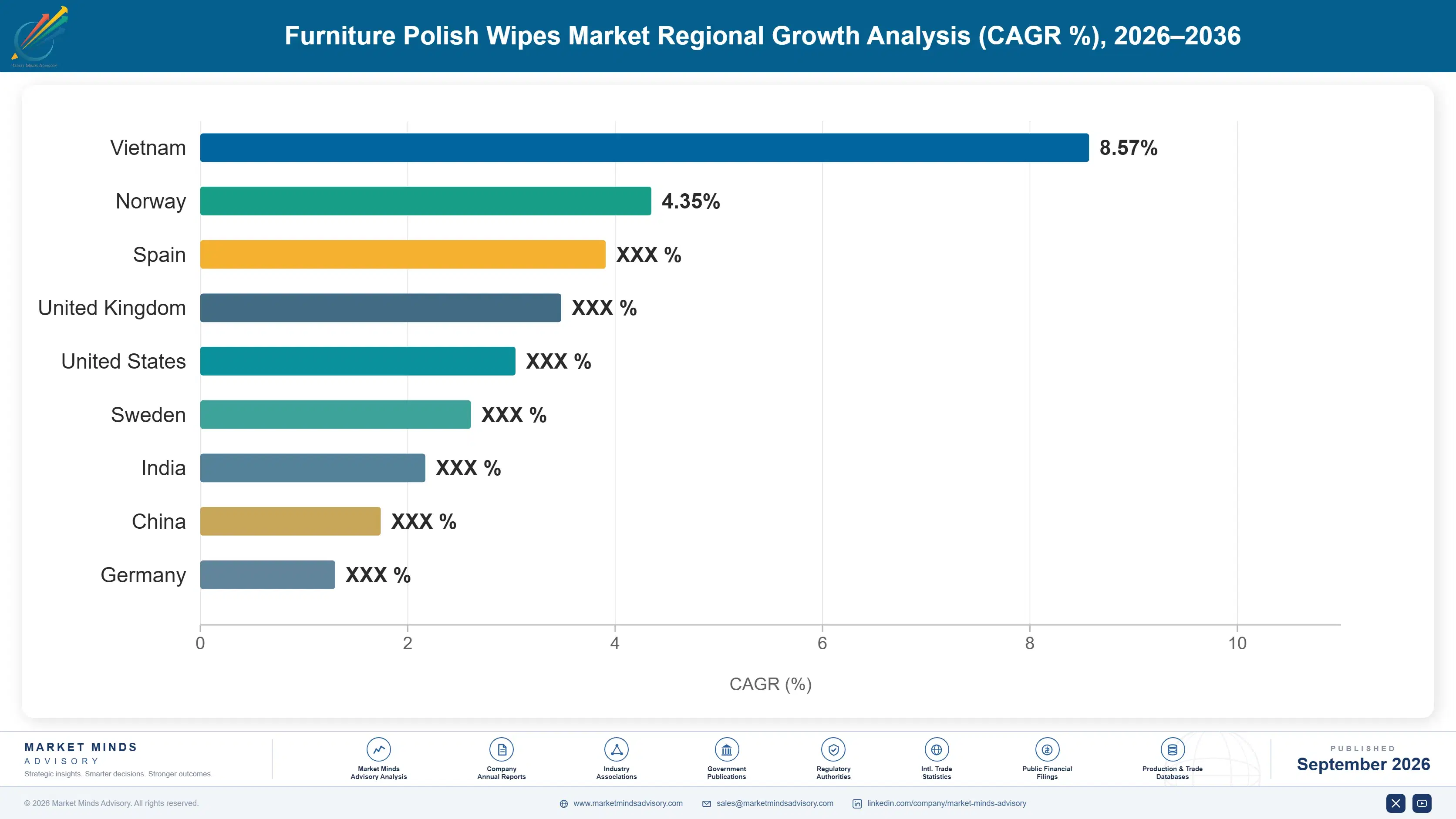
furniture-polish-wipes-market-country-cagr-analysis-1790015610231

Where Brands Can Defend Position

Four commercial moves separate brands building durable positions from those defending shelf space against private label wipes of identical construction. Each addresses something this category knows and avoids saying: the surfaces, the silicone, the substrate, and a refill idea consumers keep rejecting. Only one of the four requires reformulation at all. The other three cost a decision and nothing more.

Range By Surface Rather Than By Fragrance

About 68% of treated surfaces are laminate or foil where conditioning chemistry achieves nothing, and shoppers cannot tell which product suits their furniture. Brands offering explicit surface-specific ranges report basket values 2.3 times higher, because households buy two products rather than one and use each correctly. It converts a single undifferentiated purchase into a considered selection, and it is the clearest defence available against private label equivalents. Private label rarely ranges by surface, which is the whole point. Households buy two products and use each one correctly afterwards. Nothing else defends against private label here.
Market Impact: Raises average basket values to 2.3 times higher

Remove Previous Coats Before Adding New Ones

Roughly 31% of users report cloudy silicone residue after repeated application, and they blame the furniture rather than the product that caused it. Brands formulating a cleaning stage that lifts prior coats before depositing fresh polish report repeat purchase 2.6 times higher than straight polish formulations. The chemistry is well understood, the cost difference is modest, and it addresses the single most common complaint anybody in this category receives. Complaints currently attach to the furniture rather than the product. The chemistry involved has been well understood for years. Cost difference is genuinely modest.
Market Impact: Raises repeat purchase rates to 2.6 times higher

Convert Substrates Ahead Of The Regulation

Around 74% of wipes still use fossil-derived nonwoven that single-use plastic rules now capture across several markets, and conversion takes time that a prohibition deadline will not provide. Brands converting early report retailer listing retention 3.2 times higher as buyers de-list plastic substrate lines pre-emptively. Retailers move ahead of legislation to protect their own positions, which compresses the available timeline considerably below what the legal deadline suggests. Every brand needs the same converting lines at the same moment. Retailers act well ahead of the legal deadline itself. The timeline is shorter than legislation suggests.
Market Impact: Raises retailer listing retention 3.2 times higher overall

Make Refills Convenient Rather Than Virtuous

Refill and reusable system repurchase runs at roughly 12%, because the convenience that drove wipe adoption is exactly what those systems remove. Brands designing refills around speed rather than around environmental messaging report continuation rates of 34% to 47%. The buyer who tried a refill system and abandoned it did so because it was slower, not because they stopped caring, and no amount of sustainability framing addresses that. Speed rather than virtue is what the buyer abandoned. Environmental framing does not fix a slower routine. They abandoned it because it was slower.
Market Impact: Raises system continuation rates to 34 to 47%

Who Controls the Margin Pool

Concentration is high. Five manufacturers hold 52% of category revenue, measured consistently on that basis across all participants, and retailer private label is a substantial sixth competitor supplying wipes of effectively identical construction from the same contract converters at considerably lower shelf prices. Barriers to entry are effectively zero, since the same contract converters will make wipes for anybody placing an order of adequate size.
Competition currently turns on three dimensions: substrate conversion progress, which decides retailer listing security as plastic rules tighten; formulation approach, particularly whether a product removes previous coats or simply adds another; and surface-specific ranging, which is the clearest defence against private label. Contract converting relationships have become a fourth dimension, since capacity rather than formulation now decides who can supply through a substrate transition at all.

Pressure builds from two directions. Private label matches the construction at a large price gap. Meanwhile substrate regulation threatens the format rather than any individual brand. Rankings will shift toward manufacturers converting substrates early, since retailers de-list ahead of legislation rather than waiting. Surface-specific ranging is the only defence that private label has not copied.
furniture-polish-wipes-market-company-positioning-matrix-1790015610757

Competitive Moat and Risk Dimensions

SC JOHNSON

Moat: Category Definition And Recognition

Brand recognition built across decades of furniture polish advertising transfers directly into the wipe format, and households reaching for a familiar name in an unfamiliar category default to it without comparison. Shelf position across every major grocery channel compounds that advantage in a category where most purchases are unconsidered.
SC JOHNSON

Risk: Silicone Formulation Heritage

Portfolio depth sits in the silicone chemistry that produces the residue complaints driving dissatisfaction, and reformulating away from it means abandoning the immediate shine that built the brand recognition in the first place. Oil-based competitors face no such conflict when positioning against build-up. Oil-based challengers face no equivalent conflict.
RECKITT BENCKISER

Moat: Multi-Surface Cleaning Breadth

Positions across surface cleaning, disinfection, and polish let the business range by surface type rather than by product category, which suits a household that owns laminate, wood, glass, and stone and does not know which product suits which. That breadth also spreads substrate conversion cost across a far wider volume base.
RECKITT BENCKISER

Risk: Private Label Construction Parity

Wipes are converted by a small number of contract manufacturers who supply branded and retailer products from comparable substrate and formulation, which makes the construction difference genuinely small. Defending price on brand alone works until a shopper compares the ingredient panels, and increasingly they do.

Players Tracked

Prominent Players

SC Johnson
Reckitt Benckiser
Procter and Gamble
Clorox
Church and Dwight

Other Key Players

Unilever
Colgate-Palmolive
Henkel
Kao Corporation
Nice-Pak Products
Rockline Industries
Diamond Wipes International
Weiman Products
Guardsman
Howard Products
Blueland
Grove Collaborative
Bona
Astonish
Dr. Beckmann

Recent Developments

MARCH 2026

SC Johnson Converts Furniture Wipe Range To Plant Fibre Substrate

SC Johnson completed conversion of its furniture polish wipe range to plant fibre substrate across European markets, moving ahead of single-use plastic deadlines that retailers had begun applying to listings before legislation required it. Only the substrate converted, keeping reformulation cost out of the programme.
Signal: Retailers are de-listing plastic substrates ahead of any legal requirement. Competitors still on plastic face listing risk now.
OCTOBER 2025

Nice-Pak Expands Biodegradable Nonwoven Converting Capacity

Nice-Pak Products completed an organic capacity expansion for biodegradable nonwoven converting, funded internally with no partner involved, after branded and retailer customers converting substrates simultaneously outran available impregnation and packing throughput. Branded and private label customers converted simultaneously, which is what created the bottleneck in the first place.
Signal: Contract converters became the bottleneck in an industry-wide substrate change. Converting capacity decides who converts on schedule.
MAY 2025

Reckitt Benckiser Acquires Plant-Based Cleaning Wipes Brand

Reckitt Benckiser completed an acquisition of a plant-based cleaning wipes brand with established substrate sourcing and subscription distribution, adding conversion-ready supply relationships to a portfolio still weighted toward conventional nonwoven. The substrate sourcing relationships mattered more than the brand itself, since supply rather than formulation is the constraint.
Signal: Substrate supply relationships are being bought rather than negotiated slowly. Supply access is the asset actually changing hands.

What A Wipe Canister Costs

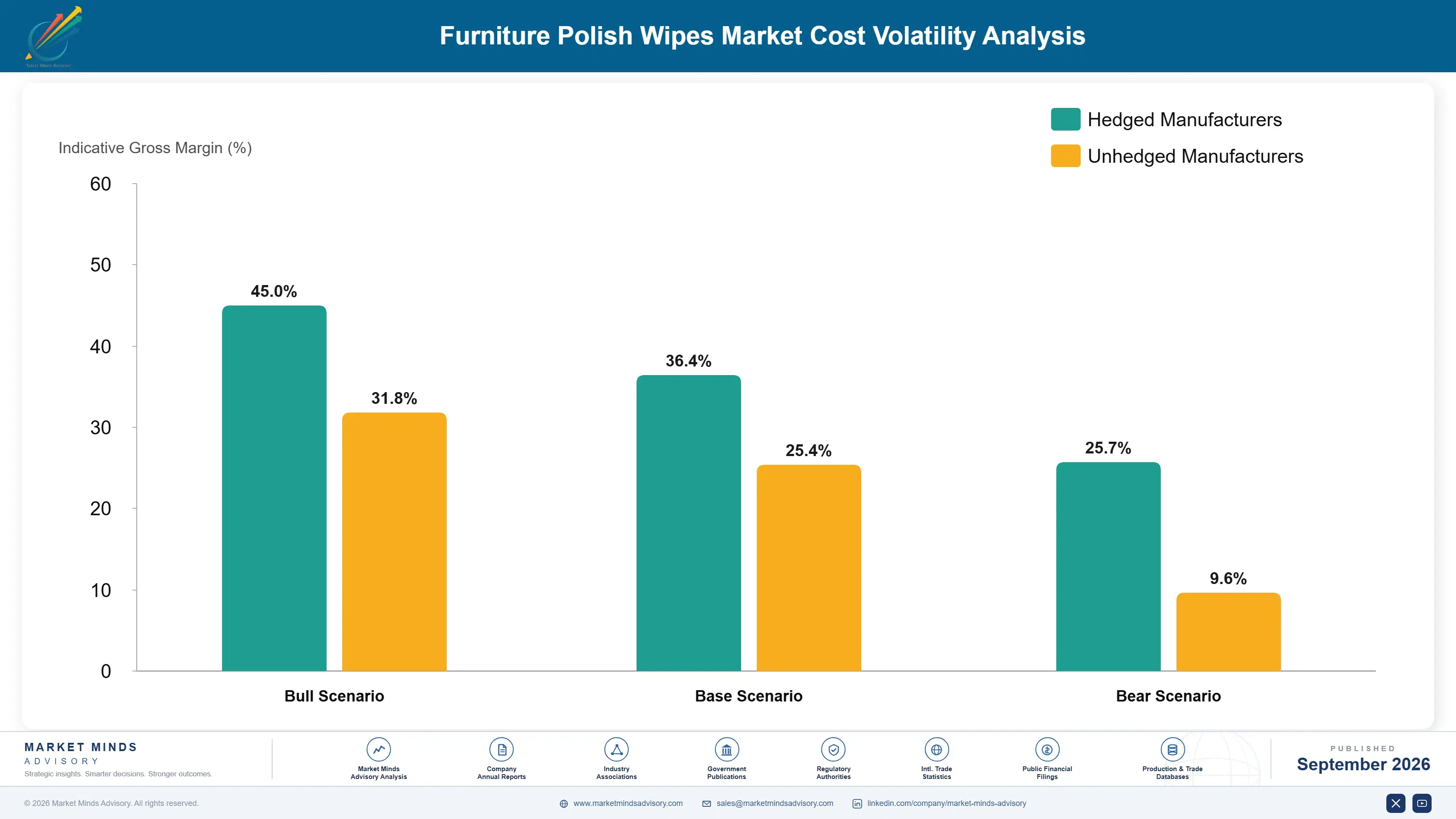
Three input groups dominate cost. Nonwoven substrate runs 32% to 40% of cost of goods sold, and the eight-point range separates commodity polypropylene from viscose and lyocell blends that cost considerably more per sheet. Formulation including silicones, waxes, solvents, and surfactants takes 24% to 32%. Packaging with resealable canisters and lids adds 26% to 34%, which is high for a consumable.
Polypropylene and polyester nonwoven pricing moved through 2024 and 2025 as resin capacity and hygiene sector demand shifted together, and American Chemistry Council statistics documented the underlying movements across both years. Several manufacturers described the resulting margin pressure in their annual reports. Viscose pricing followed dissolving pulp markets on an entirely separate and considerably slower path throughout the same period. Canister resin followed general packaging markets separately again.

The competitive disadvantage mechanism runs through converting capacity rather than through material cost. A very small number of contract converters impregnate and pack wipes for branded and retailer products alike, and a brand without secured capacity through a substrate transition simply cannot supply. Exposure varies sharply by relationship depth: brands with contracted converting move first, while those buying spot capacity move whenever a converter has a line free.
furniture-polish-wipes-market-cost-volatility-analysis-1790015610956

Secure Converting Capacity Before Substrate Deadlines

A small number of contract converters serve branded and retailer wipe products together, and an industry-wide substrate change means every customer needs capacity at once. Contracting converting capacity ahead of deadlines is the difference between converting on schedule and discovering that every line is already committed to somebody else. Every competitor faces exactly the same deadline.

Reduce Packaging Volume Rather Than Substrate Quality

Canisters, lids, and outer packaging together approach a third of cost of goods sold, and none of it is what the consumer evaluates when using the product. Substrate quality determines whether the wipe tears or leaves lint, which the user notices immediately, so cost reduction belongs in the packaging rather than the sheet. Nobody evaluates a canister after opening it.

Contract Viscose Against Dissolving Pulp Cycles

Plant fibre substrates follow dissolving pulp markets that move on forestry and textile demand entirely unrelated to household cleaning volumes. Contracting against those cycles rather than reacting to them removes most of the price exposure that a substrate transition would otherwise add on top of the conversion cost itself. Conversion cost is already substantial without adding price exposure.

Portfolio Architecture for Margin Defence

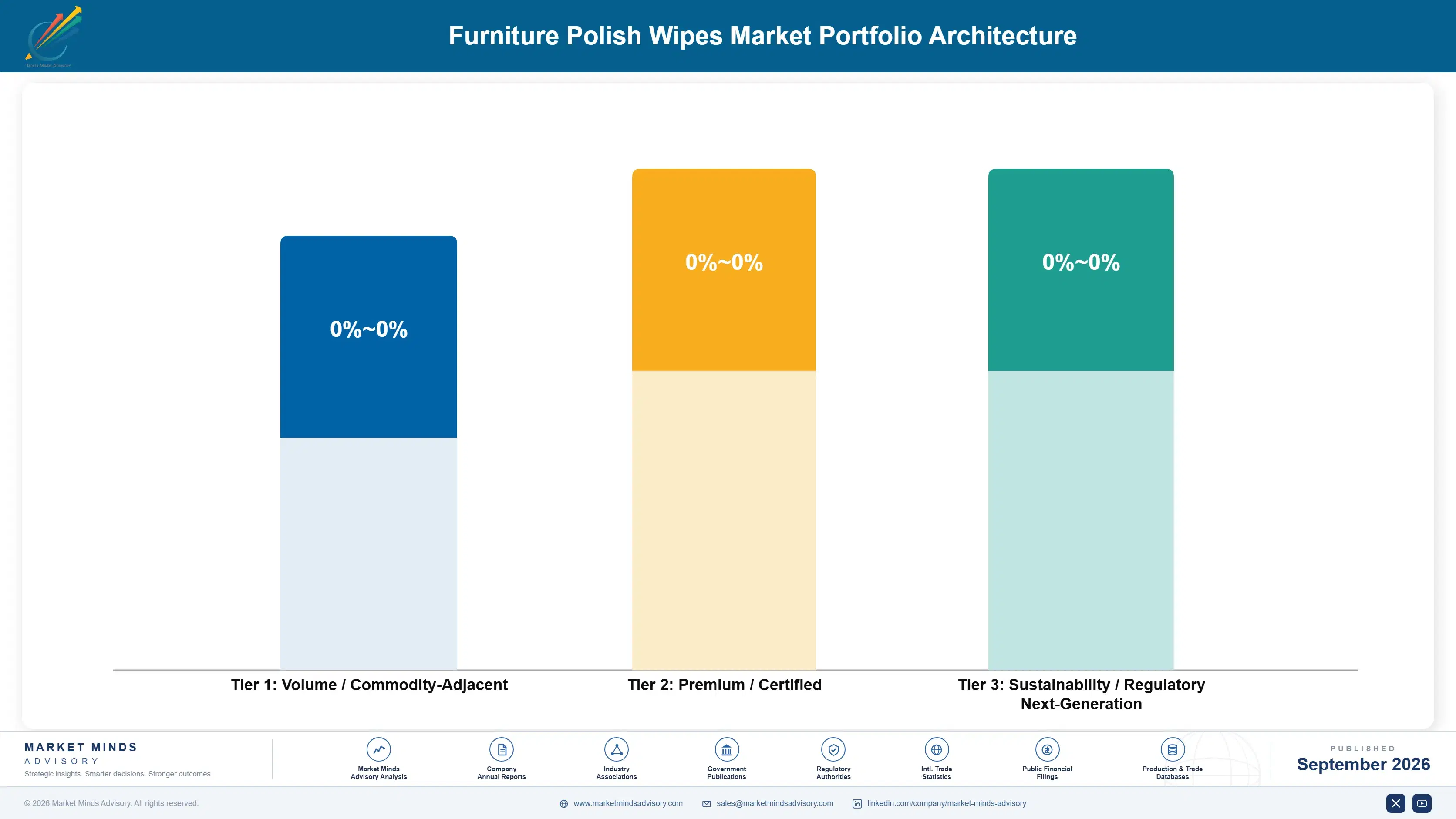
Margin follows what private label cannot copy from a contract converter. Silicone polish wipes compete close to commodity terms against retailer products of identical construction. Wax and electrostatic formats earn moderately on format familiarity. Oil conditioning products earn better on a genuine functional difference, and surface-specific ranges with cleaning stages earn most, because both require formulation work rather than a specification.
The tension between volume and premium runs through how the shopper approaches the shelf. A household buying furniture polish takes the familiar name or the cheapest canister without comparison, which is where private label wins. A household that has been shown that laminate and wood need different products buys two, uses each correctly, and returns for both rather than for whatever is on promotion.

High-value pools concentrate where the furniture is real and the owner cares: solid wood and veneer maintenance, antique and restored pieces, and households that have experienced silicone build-up and want it removed rather than added to. Where the surface is a laminate desk cleaned once a month, price decides and any wipe will do the job equally well. That divide follows the furniture rather than income.

Volume / Commodity-Adjacent

Silicone-based polish wipes on conventional plastic substrate sold against retailer private label of essentially identical construction. The ten-point range reflects converting scale and substrate purchasing rather than any property a shopper could distinguish on shelf.
Gross Margin: 26% to 36%

Premium / Certified

Wax, electrostatic, and antimicrobial formats sold on specific functional claims through mainstream grocery and hardware distribution. The twelve-point range separates products with meaningful formulation differences from those relying on fragrance and pack design alone.
Gross Margin: 40% to 52%

Sustainability / Regulatory / Next-Generation

Plant fibre substrate products and oil conditioning ranges sold with surface-specific guidance and build-up removal chemistry. The fourteen-point range reflects whether substrate conversion is complete and whether the formulation removes prior coats.
Gross Margin: 54% to 68%
furniture-polish-wipes-market-portfolio-architecture-1790015611475

High-value Sub-segments and Strategic Watch-out

Surface-Specific Product Ranges

Highest value in the category, since a household buying two correctly matched products spends more than one buying a single compromise. The sixteen-point range reflects whether guidance genuinely differentiates or the products differ only in labelling. Private label has not copied this yet. Guidance is the differentiator.
Gross Margin: 54% to 70%

Oil Conditioning For Real Wood

High value growing at 7.2% on a functional benefit that exists only on the third of surfaces that are actually timber. The twelve-point range reflects oil quality and whether the formulation avoids the silicone that build-up complaints centre on. Repurchase runs well above category norms.
Gross Margin: 46% to 58%

Plant Fibre Substrate Conversions

Volume core where regulation rather than consumer demand is forcing a material change across the whole category. The twelve-point range reflects converting capacity secured, since every brand needs the same lines at the same moment. Timing decides who supplies through the transition. Capacity is finite and shared.
Gross Margin: 38% to 50%

Conventional Silicone Wipes

The strategic watch-out. Private label matches the construction exactly, the silicone causes the residue complaints, and plastic substrate faces prohibition in several markets. The ten-point range reflects converting scale and purchasing alone. Nothing about the product resists comparison. Substrate rules threaten the format itself now.
Gross Margin: 24% to 34%

How This Demand Repeats

Consumption is genuinely consumable and entirely habitual, since a canister lasts a defined number of cleaning sessions and the household that cleans weekly replaces it on a predictable schedule. What varies is which product, and the decision is made in seconds at a shelf by somebody who has not thought about furniture surfaces at all. That combination produces stable volume and almost no brand loyalty worth the name.
Attachment depth divides between the habitual and the invested. A household cleaning laminate surfaces buys whatever is familiar or cheapest and switches on promotion. A household maintaining solid wood furniture selects deliberately, understands why oil differs from silicone, and repurchases the same product for years. The second group is far smaller and worth several times more per customer. Furniture composition predicts loyalty almost exactly.

The buyer has not changed and the furniture underneath them has. Households own progressively less solid wood and more laminate and foil-wrapped board, which steadily erodes the surfaces where this category does anything beyond producing a shine. Manufacturers have not adjusted positioning to reflect that, and continue selling conditioning language into homes with almost nothing left to condition.
furniture-polish-wipes-market-end-use-penetration-index-1790015611969

Where This Market Rewards

These are among the four positions where our research anticipates prominent divergence between winners and laggards over the coming forecast period. Each is grounded in the demand model, the regulatory perimeter, and the announced capacity pipeline.
01 / SURFACE SPECIFIC RANGING

Two thirds of it is not wood

Around 68% of the surfaces this category treats are melamine, laminate, or foil-wrapped board where conditioning chemistry deposits residue and achieves nothing else at all. Brands offering explicit surface-specific ranges report average basket values 2.3 times higher, since households then buy two products rather than one and use each of them correctly. It converts an unconsidered purchase into a considered selection, which is the clearest defence against private label, and private label has not copied surface-specific ranging anywhere in this category yet.
02 / BUILD-UP REMOVAL CHEMISTRY

Strip the last coat before adding

Roughly 31% of users report the cloudy greasy residue that silicone accumulation produces, and almost all of them blame the furniture rather than the product responsible for it. Brands formulating a cleaning stage that lifts the prior coats before depositing fresh polish report repeat purchase 2.6 times higher than straight polish formulations manage to achieve. The chemistry is well understood and the cost difference is genuinely modest, and it addresses the single most common complaint anybody in this trade receives.
03 / EARLY SUBSTRATE CONVERSION

Retailers delist before regulators act

About 74% of wipes still use fossil-derived nonwoven that single-use plastic rules now capture across several markets, and converting capacity is held by very few contract manufacturers. Brands that convert their substrates early now report retailer listing retention 3.2 times higher, as buyers de-list plastic substrate lines pre-emptively to protect their own positions. Retailers move ahead of legislation, which compresses the timeline well below the legal deadline, and every competing brand needs the same converting lines at the same moment.
04 / REFILL CONVENIENCE DESIGN

They quit because it was slower

Refill and reusable system repurchase runs at around 12%, because the convenience that drove wipe adoption in the first place is precisely what those systems take away again. Brands designing their refills around speed rather than around environmental messaging report continuation rates of 34% to 47% instead of that. Somebody who abandoned a refill system did so because it was slower, and no amount of sustainability framing addresses that, and no amount of environmental framing addresses a system that takes longer.

Engagement Snapshot From the Field

A live engagement with an industry participant carrying material or product regulatory and market exposure ahead of a defining policy shift, showing how our research translates into a defensible multi-year portfolio strategy.
MARKET MINDS ADVISORY · CLIENT ENGAGEMENT SUMMARY
Furniture Polish Wipes Producer Strategic Portfolio Review and Transition Roadmap 2026·Investment Scenario on Furniture Polish Wipes Exposure Evaluation 2025-26
CLIENT PROFILE
A household cleaning manufacturer with furniture care revenue near USD 180 million (client-reported, unverified by MMA), selling polish wipes, aerosols, and liquids across nineteen markets. Wipe volumes had grown while category margin fell for three consecutive years, and private label share had risen in every market the business served. The board wanted the margin decline explained before any promotional change.
STRATEGIC CHALLENGE
Marketing attributed the margin decline to promotional intensity and had proposed reducing depth on the leading wipe line. Nobody had examined whether the branded product differed from private label in any way a shopper could identify, or what customers were actually using the wipes on. A promotional problem and a differentiation problem imply entirely different remedies.
MMA APPROACH
MMA compared branded and private label wipes on substrate, formulation, and construction across five markets, surveyed users on furniture surface composition and residue experience, tested silicone accumulation across repeated applications, and modelled outcomes under promotional reduction, surface ranging, and reformulation. Contract converter relationships were traced across both branded and retailer products, which nobody in the business had previously examined.
KEY FINDINGS
  1. Branded and private label wipes in four of five markets came from the same contract converter on comparable substrate with formulation differences a shopper could not detect.
  2. Around 71% of surveyed users applied the product primarily to laminate or foil-wrapped surfaces, where the conditioning claim on the pack has no basis whatsoever.
  3. Accumulation testing showed visible silicone film after twelve applications without intermediate cleaning, matching the residue complaints appearing in customer service records. Complaint volumes rose with usage frequency.
  4. Reducing promotional depth would have surrendered volume on a product no shopper had any reason to prefer at a higher shelf price.
CLIENT PROFILE
A household cleaning manufacturer with furniture care revenue near USD 180 million (client-reported, unverified by MMA), selling polish wipes, aerosols, and liquids across nineteen markets. Wipe volumes had grown while category margin fell for three consecutive years, and private label share had risen in every market the business served. The board wanted the margin decline explained before any promotional change.
STRATEGIC CHALLENGE
Marketing attributed the margin decline to promotional intensity and had proposed reducing depth on the leading wipe line. Nobody had examined whether the branded product differed from private label in any way a shopper could identify, or what customers were actually using the wipes on. A promotional problem and a differentiation problem imply entirely different remedies.
MMA APPROACH
MMA compared branded and private label wipes on substrate, formulation, and construction across five markets, surveyed users on furniture surface composition and residue experience, tested silicone accumulation across repeated applications, and modelled outcomes under promotional reduction, surface ranging, and reformulation. Contract converter relationships were traced across both branded and retailer products, which nobody in the business had previously examined.
KEY FINDINGS
  1. Branded and private label wipes in four of five markets came from the same contract converter on comparable substrate with formulation differences a shopper could not detect.
  2. Around 71% of surveyed users applied the product primarily to laminate or foil-wrapped surfaces, where the conditioning claim on the pack has no basis whatsoever.
  3. Accumulation testing showed visible silicone film after twelve applications without intermediate cleaning, matching the residue complaints appearing in customer service records. Complaint volumes rose with usage frequency.
  4. Reducing promotional depth would have surrendered volume on a product no shopper had any reason to prefer at a higher shelf price.
RECOMMENDED STRATEGY
Phase 1: Phase one: halt the promotional reduction and split the range into distinct wood and laminate products with explicit surface guidance on pack. Phase 2: Phase two: reformulate the laminate product to clean rather than condition, and add a build-up removal stage to the wood variant. Phase 3: Phase three: contract plant fibre converting capacity before substrate deadlines force every competitor toward the same lines. Capacity is finite and deadlines are shared.
OUTCOME
Category margin recovered 3.9 points within four quarters as the surface-split range replaced the single product (client-reported, unverified by MMA). Residue complaints fell by roughly half. Private label share stabilised in three of the five markets reviewed. Substrate converting capacity was contracted ahead of the regional deadlines that followed.

Frequently Asked Questions

Foundational context covering the market sizes, CAGR, scope, country, region and competition that inform every finding below. This section is provided to cover basics and most often pre-purchase conversations, answered from the MMA Primary Research Dataset.

What is the current size of the Furniture Polish Wipes Market?

The market was worth USD 1.9 billion in 2025 and reaches USD 2.0 billion in 2026. Value covers pre-moistened wipes formulated for furniture cleaning and polishing.

How large will the Furniture Polish Wipes Market be by 2036?

MMA forecasts USD 3.4 billion by 2036, an increase of USD 1.4 billion across the forecast period. That represents 1.70 times the 2026 base of USD 2.0 billion.

What is the CAGR for the Furniture Polish Wipes Market 2026 to 2036?

The base case compound annual growth rate is 5.4%, with a bull case at 6.6% and a bear case at 4.2%. Historical growth from 2020 to 2025 ran at 4.3%.

Which segment is growing fastest?

Plant fibre and biodegradable substrate wipes grow at 8.1%, half again the market rate of 5.4%. Single-use plastic regulation rather than consumer demand is driving that conversion.

Who are the major companies in the Furniture Polish Wipes Market?

SC Johnson, Reckitt Benckiser, Procter and Gamble, Clorox, and Church and Dwight lead. Together they hold 52% of revenue, with retailer private label a substantial sixth competitor.

Which country is growing fastest?

China grows at 9.6%, the fastest of any country covered here. Household cleaning is moving from basic detergents toward specialised categories that Western markets adopted several decades earlier.

Report Segmentation Architecture

The full report scope spans multiple orthogonal segmentation dimensions, with cross-tabulated demand data provided for each dimension pair. Coverage extends further to regional breakdowns, trend trajectories, and the competitive detail needed to support segment-level decision-making.

By Formulation And Substrate

  • Plant Fibre and Biodegradable Substrate Wipes
  • Oil-Based Wood Conditioning Wipes
  • Antimicrobial Furniture Wipes
  • Electrostatic Dusting Wipes with Polish
  • Wax-Based Polish Wipes
  • Silicone-Based Polish Wipes

By End-Use Industry

  • Household Furniture Care
  • Solid Wood and Antique Maintenance
  • Office and Commercial Cleaning
  • Hospitality Housekeeping
  • Contract Cleaning Services
  • Retail and Showroom Presentation

By Commercial Dimension

  • Grocery and Supermarket Retail
  • Hardware and Home Improvement
  • Online Retail and Marketplaces
  • Retailer Private Label Supply
  • Janitorial and Contract Distribution
  • Subscription and Direct to Consumer

By Region

  • North America
  • Western Europe
  • East Asia
  • South Asia and Pacific
  • Latin America
  • Middle East and Africa
  • Eastern Europe

Scope, Methodology, and Coverage

Every figure in this report is reproducible from documented input assumptions. The scope below maps the historical period, the forecast horizon, the segmentation dimensions, and the countries covered, alongside the underlying primary and qualitative methodology.
Historical Period
2020 to 2025
Forecast Period
2026 to 2036
Base Year
2025 (USD billions; MMA Primary Research Dataset, September 2026)
Market Definition
This market covers pre-moistened wipes formulated for cleaning and polishing furniture and hard household surfaces, across plant fibre and biodegradable substrate wipes, oil-based wood conditioning wipes, antimicrobial furniture wipes, electrostatic dusting wipes with polish, wax-based polish wipes, and silicone-based polish wipes. It excludes aerosol and liquid polish, general purpose surface wipes without polish function, glass and floor wipes, baby and personal care wipes, healthcare disinfectant wipes, and dry dusting cloths.
Quantitative Units
USD billions, retail value at manufacturer selling price
Segmentation Dimensions
Formulation and substrate, end-use application, commercial dimension, region
Regions Covered
North America, Western Europe, East Asia, South Asia and Pacific, Latin America, Middle East and Africa, Eastern Europe
Countries Covered
United States, Canada, Mexico, Germany, United Kingdom, France, Italy, Spain, Netherlands, Sweden, Poland, Czechia, China, Japan, South Korea, Taiwan, India, Australia, Indonesia, Thailand, Vietnam, Brazil, Colombia, Chile, Argentina, Saudi Arabia, United Arab Emirates, Egypt, Nigeria, South Africa
Key Companies Profiled
SC Johnson, Reckitt Benckiser, Procter and Gamble, Clorox, Church and Dwight, Unilever, Colgate-Palmolive, Henkel, Kao Corporation, Nice-Pak Products, Rockline Industries, Diamond Wipes International, Weiman Products, Guardsman, Howard Products, Blueland, Grove Collaborative, Bona, Astonish, Dr. Beckmann
Quantitative Methodology
Primary survey, n=3,800 respondents, Q4 2025, six countries; demand-side model with trade association cross-validation
Qualitative Methodology
47 expert interviews, Q4 2025; applied to validate demand model assumptions, identify emerging dynamics, and assess competitive positioning
Report Format
PDF and XLSX data workbook (Word format preview document)
Publisher
Market Minds Advisory
Report Code
MMA-2026-CHM-371
Published
September 2026
Contact
sales@marketmindsadvisory.com | www.marketmindsadvisory.com

Purchase the full Furniture Polish Wipes Market Report (2026 to 2036).

The full report sizes the furniture polish wipes market across six formulation and substrate types, seven regions, and thirty countries, with forecasts to 2036 under base, bull, and bear cases. It quantifies how much of the treated surface area cannot benefit from polish chemistry at all, measures silicone accumulation against user residue complaints, and maps single-use plastic regulation against substrate conversion progress. Competitive analysis covers twenty participants evaluated consistently on category revenue, with detailed treatment of contract converting capacity. Cost structure, private label construction parity, and refill continuation rates are analysed throughout. Primary research includes 3,800 survey responses and 47 expert interviews.
Six formulation and substrate types sized and forecast separately
Twenty participants evaluated on category revenue consistently
Treated surface composition measured against polish chemistry benefit
Silicone accumulation tested across repeated application cycles
Substrate regulation timelines mapped against conversion progress
Refill system continuation rates analysed by design approach

Built For The People Who Decide

From boardroom strategy to bench-side execution, this report is read cover-to-cover by leaders shaping the next decade of their industry, turning demand scenarios, market dynamics and valuation benchmarks into decisions.
CXOs/ Presidents/ VPs/ Managers
M&A and Corporate Development
Strategy Teams and R&D Heads
Procurement and Product Directors
Regulatory and Compliance Leaders
Investor Relations and Equity Analysts