Market Minds Advisory
Fume and Smoke Collectors Market

Fume and Smoke Collectors Market: Capturing Weld Smoke Before It Becomes an Exposure Claim

Welding, laser cutting, and soldering release particulate that regulators measure in limits fabricators cannot meet with ventilation alone, and the arms, torches, and units built to catch it are shifting from optional to specified equipment.

Lead Analyst

David Horsley

Published

September 2026

Make Smarter Decisions with Customized Research Insights

Request a free sample report and evaluate market opportunities, growth trends, and competitive dynamics relevant to your business needs.

2025 MARKET VALUE$2.1BMarket Size 2025
2036 FORECAST VALUE$4.2BBase Case , 2026 to 2036
CAGR 2026 TO 20366.5 %Bull 7.7% / Bear 5.4%
INCREMENTAL OPPORTUNITY$2.0BNet 10- year value creation
EXPANSION MULTIPLE1.88x2036 value over 2026 base
Strategic Levers
M&A Pipeline
Regional Outlook
Country Rankings
Competitive Intelligence
Segmental Deep-dive
Call-Us : 91 93563 13602

Executive Snapshot and Market Trajectory

Fume and smoke collection has moved from a discretionary shop-floor purchase to a specified line item in fabrication facility design, because tightening exposure limits and rising workers' compensation costs have made manual ventilation an insufficient control on its own. Fabricators increasingly budget for source-capture equipment before a bay opens.
Commercial demand concentrates around welding, laser cutting, and metal fabrication facilities, where particulate exposure directly drives both compliance risk and equipment maintenance cost on nearby machinery. Fume extraction torches are pulling ahead of standalone ambient filtration units as fabricators favour capturing smoke at the source rather than after it disperses across the shop floor. East Asia leads deployment volume on China's fabrication base, with North America close behind on tightening exposure enforcement specifically.
Competitive character splits between diversified industrial filtration majors bundling fume collection into wider air quality platforms and specialist welding fume equipment makers selling purpose-built source-capture systems. Regulatory pressure is a genuine constant here: several jurisdictions have tightened welding fume exposure limits in recent years, and insurers increasingly require documented exposure monitoring before underwriting fabrication facilities that handle high-volume welding work. That scrutiny is intensifying fastest in shipbuilding.
Market Definition
The fume and smoke collectors market covers stationary and portable equipment engineered to capture welding fume, laser and plasma cutting smoke, soldering fume, and related process particulate, including source-capture extraction arms, ambient filtration units, fume extraction torches, mobile collectors, centralized extraction systems, and the filter cartridges sold alongside this equipment. It excludes general dust collection for non-fume particulate and personal respiratory protection equipment, which are separate categories.
Base Year Value
$2.1B in 2025 (MMA Primary Research Dataset, August 2026)
Forecast Period
2026 to 2036, eleven discrete annual values
CAGR
6.5% base case. Bull 7.7%. Bear 5.4%.
Fastest Growth Segment
Fume Extraction Torches and Guns: 10.0% CAGR
Fastest Growth Country
India: 8.9% CAGR
Fastest Growth Region
South Asia and Pacific: 8.5% CAGR
Largest Region
East Asia: 29% of 2025 global value
Market Leaders
Kemper GmbH, Lincoln Electric, Nederman Holding, Donaldson Company, Camfil AB. Source: MMA Analysis based on company annual reports.
Primary Survey
n=3,800 procurement and R&D decision-makers, Q4 2025, six countries
Methodology
Demand-side build-up, cross-validated against public data, 47 expert interviews

Fume and Smoke Collectors Market Forecast Scenarios

fume-and-smoke-collectors-market-size-forecast-scenario-1787302077026
Between 2020 and 2025 the market grew at a 5.8% historical CAGR, anchored by large fabricators and shipyards that adopted centralized extraction systems earliest given their scale and existing safety infrastructure. Growth was steady rather than event-driven. Smaller fabricator adoption only gained real momentum from 2023 onward. Smaller shops largely deferred capital spending on equipment they viewed as a discretionary shop-floor add-on.
The base case carries the market to a 6.5% CAGR through 2036 on three mechanisms. First, tightening welding fume exposure limits across multiple jurisdictions force fabricators of every size to specify capture equipment rather than relying on general ventilation alone. Second, laser and plasma cutting capacity expansion multiplies the number of smoke capture points per facility as sheet metal processing scales. Third, rising insurer scrutiny of exposure monitoring pushes fabrication facilities toward documented, source-capture solutions rather than ambient filtration alone.
The bull case reaches 7.7% if additional jurisdictions tighten exposure limits faster than currently expected, pulling equipment specification forward across a compressed compliance timeline. The bear case falls to 5.4% if enforcement remains inconsistent across regions, leaving smaller fabricators to defer source-capture investment until an inspection or claim forces the decision. Enforcement inconsistency predicts deferred purchase decisions best.

Why Fume Capture Became A Specified Line Item

Three forces converge on fume and smoke collection at once. Tightening welding fume exposure limits force fabricators of every size to specify capture equipment rather than relying on general ventilation alone. Laser and plasma cutting capacity expansion multiplies smoke capture points per facility as sheet metal processing scales. And rising insurer scrutiny of exposure monitoring pushes facilities toward documented, source-capture solutions over ambient filtration.
MARKET CONCENTRATIONCR5: 36%Diversified filtration majors and specialists split a third of revenue
AVERAGE SELLING PRICEUSD 1,200 to 65,000 per systemPricing spans single-arm units to centralized facility-wide systems
TOP PRODUCING COUNTRY SHAREChina: 26% of units shippedFabrication cluster density concentrates equipment production across regions
CAPACITY UTILISATION68 to 75%Certified production lines run consistently near full committed capacity
INPUT COST SHARE20 to 28% of COGSFilter media dominates recurring component cost spending considerably
FILTER REPLACEMENT CYCLE3 to 9 monthsCartridge replacement frequency depends heavily on particulate load
Commercially, the market behaves like specialised safety infrastructure rather than generic HVAC equipment. Buyers specify by particulate capture efficiency, airflow rate, and filter media type rather than by price alone, because an undersized system fails exposure compliance testing and can trigger regulatory penalties. That specification discipline protects margin for makers with genuine filtration engineering depth and keeps generic ventilation generalists from moving into technically demanding compliance-critical contracts.
Over the next decade, source-capture integration becomes the real differentiator. Fume extraction torches and mobile collectors are closing the deployment-speed gap with fixed centralized systems as smaller fabricators demand equipment that fits existing floor layouts. Makers that combine reliable at-source capture with flexible deployment, rather than fixed installations alone, will capture the smaller fabricator contracts increasingly dominating new compliance spending.
"Exposure limits used to be a paperwork exercise nobody enforced closely, and now an inspector with a monitor can shut a bay down the same afternoon, which has changed how fast fabricators actually buy this equipment."
Director, Industrial Air Quality and Workplace Safety Practice · MMA Industrial

Market Trends

Tightening Exposure Limits Force Source-Capture Specification

Several jurisdictions have tightened permissible exposure limits for welding fume and manganese-containing particulate in recent years, and general ventilation alone increasingly fails to keep measured exposure within the new thresholds during sustained welding operations. Fabricators are responding by specifying source-capture equipment, extraction arms mounted directly at the welding station or fume extraction torches integrated into the welding gun itself, that captures particulate before it disperses across the shop floor at all. Kemper and Lincoln Electric have both expanded source-capture product lines specifically to help fabricators meet the newer, stricter exposure thresholds without a full facility ventilation redesign.
Market Impact: Cuts premium increases 15-25% at re

Laser And Plasma Cutting Capacity Expansion Multiplies Smoke Points

Sheet metal fabrication capacity built around laser and plasma cutting has expanded steadily as manufacturers automate cutting operations previously done manually, and each cutting station generates fine particulate smoke requiring dedicated capture equipment distinct from standard welding fume extraction. Laser cutting in particular produces sub-micron particulate that standard filter media struggles to capture efficiently, pushing fabricators toward specialised filtration rated specifically for laser and plasma applications. Nederman and Donaldson have both built dedicated laser cutting fume product lines, treating it as a distinct application from welding fume rather than a simple variant.
Market Impact: Adds contracts across 20+ welding s

Market Opportunities and Growth Drivers

Insurer Exposure Documentation Requirements Drive Equipment Specification

Insurers underwriting fabrication facilities increasingly require documented exposure monitoring data before renewing workers' compensation coverage, and facilities without source-capture equipment struggle to produce monitoring results that satisfy the newer underwriting standards being applied across the industry. That documentation requirement has converted fume collection from a general safety good practice into a specific, auditable purchasing decision that facility managers must justify with monitoring data rather than general assurances. Fabricators that installed source-capture equipment early are reporting measurably lower premium increases at renewal than comparable facilities relying on ventilation alone, a gap that is widening as insurers refine their underwriting models further.
Market Impact: Adds 200-400% lifecycle filter cost

Shipbuilding And Heavy Fabrication Specify Centralized Systems

Shipyards and heavy fabrication facilities running dozens of simultaneous welding stations increasingly specify centralized extraction systems rather than individual portable units, since a single ducted system serving an entire bay is more cost-effective at scale and easier to maintain consistently across a large workforce. These centralized installations represent a much larger single purchase than portable equipment, and shipbuilders increasingly negotiate multi-year maintenance and filter replacement contracts alongside the initial system purchase itself. Kemper has built a dedicated shipbuilding and heavy fabrication account team specifically to capture this larger, higher-value centralized system opportunity across major shipyard contracts.
Market Impact: Adds 30-50% to installed system cos

Market Restraints and Challenges

Filter Media Replacement Cost Erodes Total Cost Advantage

Filter cartridges in high-particulate-load environments require replacement every three to nine months depending on welding volume, the root cause being that dense particulate loading clogs filter media faster than lighter-duty applications ever encounter. That replacement frequency means cumulative filter cost over a system's service life can exceed the original equipment price several times over, a total cost smaller fabricators often underestimate when comparing capture equipment against relying on general ventilation alone. Suppliers are responding with longer-life filter media and predictive replacement alerts that avoid both premature swaps and the compliance risk of running past capacity.
Market Impact: Cuts measured exposure 40-60% at so

Retrofit Ductwork Integration Complicates Older Facility Installation

Centralized extraction systems require ductwork routing through existing facility structures, and older buildings frequently lack the structural clearance or electrical capacity a new system demands without significant modification, the root cause being that most older facilities were never designed with fume extraction in mind at all. That retrofit complexity can push installation cost and timeline well beyond the base equipment price alone, deterring smaller fabricators in older buildings from centralized options. Makers are responding by expanding portable collector lines that avoid ductwork entirely, and by offering pre-installation assessments that price retrofit complexity before a customer commits.
Market Impact: Adds 2-3 capture points per cell
3 additional market trends, 3 additional growth drivers, and 2 additional restraints and challenges are covered in the full report. Contact sales@marketmindsadvisory.com to access the complete intelligence.

Segment CAGR and Growth Architecture

Segmentation follows equipment solution type, the single engineering logic that determines capture method, deployment flexibility, and filter replacement economics. Source-capture arms, ambient filtration units, fume extraction torches, mobile collectors, centralized systems, and filter cartridges each serve a genuinely distinct capture need and are evaluated consistently throughout this report. Underlying HVAC and PPE equipment sit outside this hierarchy.
fume-and-smoke-collectors-market-market-share-analysis-1787302077564

Fume Extraction Torches and Guns

Fume extraction torches and guns grow fastest at 10.0%, about 1.54 times the market's 6.5% overall rate, as fabricators favour capturing particulate directly at the arc rather than relying on a separate extraction arm positioned nearby that a welder must remember to reposition. These torches integrate a small extraction nozzle directly into the welding gun itself, capturing fume before it ever disperses into the welder's breathing zone, which delivers measurably better exposure results than positional extraction arms in independent testing. Lincoln Electric and Kemper have both expanded integrated torch product lines specifically to meet tightening exposure thresholds without requiring a separate capital purchase. Adoption is concentrated first among manual welding-intensive fabricators, spreading into robotic cells as integrators adapt the technology.
CAGR 10.0%

Mobile and Portable Fume Collectors

Mobile and portable fume collectors grow second-fastest at 9.0%, driven by fabricators needing flexible capture equipment that can move between welding stations without the fixed ductwork a centralized system requires permanently. Rather than committing to a single fixed installation, these units mount on wheeled bases and connect via flexible hose to whichever station is active, letting a single unit serve multiple bays across a shift as production needs shift. Nederman and RoboVent have both expanded mobile collector product lines specifically to serve smaller fabricators and contract welding shops that cannot justify a centralized system's fixed cost. Adoption is fastest among job shops and contract fabricators running variable, unpredictable production schedules across different customer projects.
CAGR 9.0%
Full segment breakdown across 6 segments available in the complete report.

Regional Architecture and Country Demand Map

Global demand concentrates where fabrication capacity and exposure enforcement run deepest. East Asia leads on China's fabrication base, North America follows on tightening enforcement, and Western Europe trails both despite a mature industrial base. South Asia and Pacific is closing the gap fastest. North America follows closely on enforcement.

North America

The United States drives regional demand through tightening OSHA enforcement of welding fume exposure limits, which has pushed fabricators of every size to reassess ventilation-only compliance strategies that regulators increasingly consider insufficient on their own. Shipbuilding capacity along the Gulf Coast and heavy fabrication in the Midwest add a further demand layer, with several yards specifying centralized extraction systems across multiple simultaneous welding bays. Lincoln Electric and Donaldson both hold deep incumbency in North American fabrication contracts, bundling fume collection into wider welding and filtration platform relationships. Canada contributes a smaller layer through automotive and heavy equipment manufacturing. Growth of 7.3% tracks enforcement intensity more than any single facility announcement across the region.
Share: 25% | CAGR: 7.3% (2026 to 2036)

Western Europe

Germany, France, and Italy anchor demand through established automotive and heavy fabrication bases that adopted early exposure monitoring standards and are now upgrading toward source-capture torches from older ambient filtration systems. Kemper and Nederman both hold genuine home-market advantage across German and Nordic manufacturing accounts, competing on filtration engineering depth against larger global generalists entering the category. Exposure limits across the region are already among the strictest globally, capping the marginal compliance-driven growth that newer regulation delivers elsewhere. Growth of 5.2% reflects that regulatory maturity directly, sitting below the global rate despite the region's genuinely deep industrial base. Poland's growing fabrication capacity adds a smaller adjacent demand layer within the wider European market.
Share: 21% | CAGR: 5.2% (2026 to 2036)
Regional intelligence for 5 additional markets available in the complete report: East Asia, South Asia and Pacific, Latin America, Middle East and Africa, Eastern Europe. Contact sales@marketmindsadvisory.com.
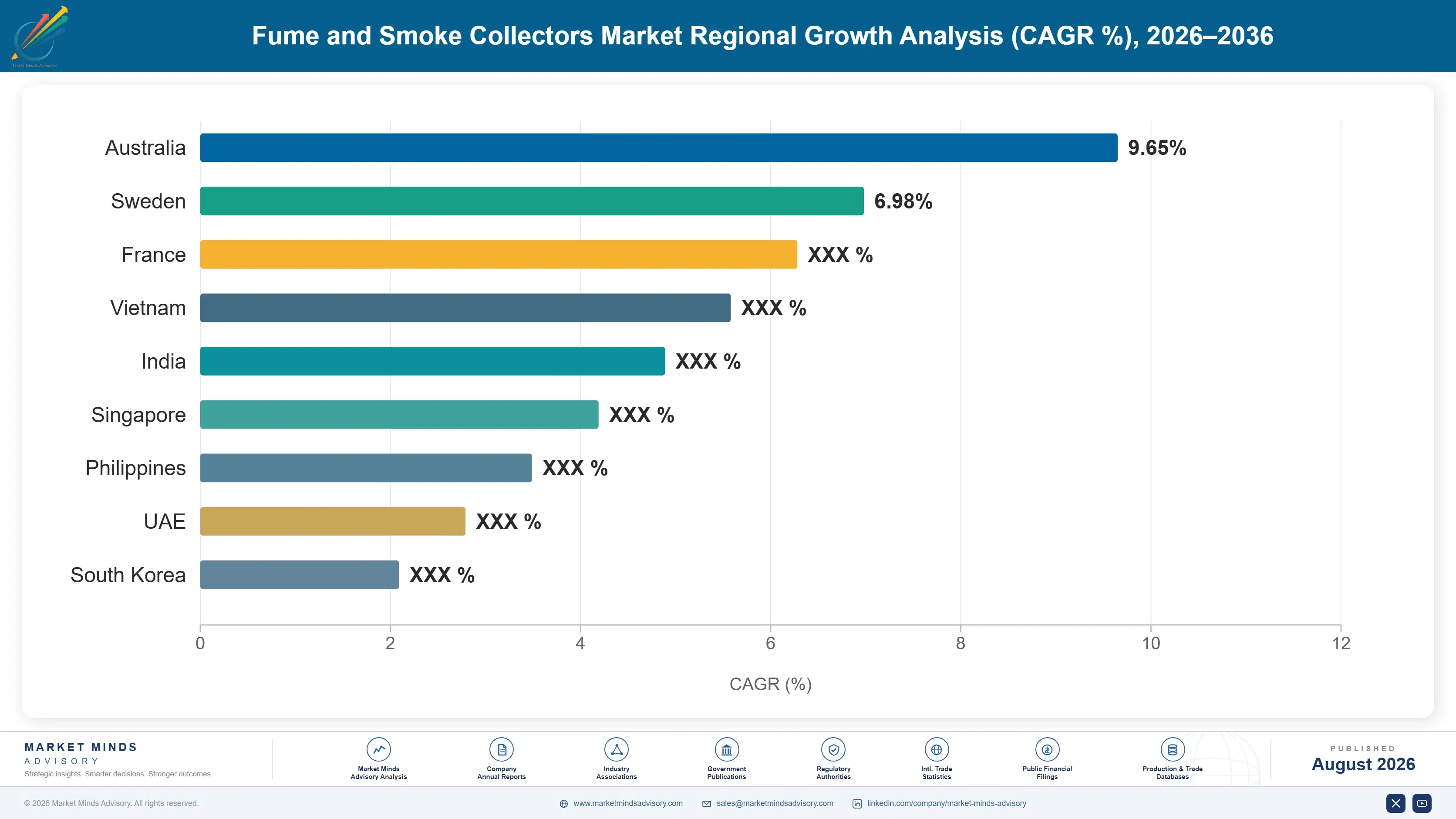
fume-and-smoke-collectors-market-country-cagr-analysis-1787302078091

Where Fume Collection Makers Can Defend Margin

Compliance budgets are shifting earlier into facility design and toward source-capture equipment that satisfies exposure monitoring directly. The four levers below capture revenue before an inspection or claim forces the decision, and each rewards makers who can prove exposure performance credibly across a customer's full facility footprint. That shift rewards makers proving performance early.

Bundle Capture Equipment Into New Facility Design Contracts

Fume collection increasingly gets specified during new fabrication facility design rather than retrofitted after a compliance failure, when ductwork routing and electrical capacity are already fixed and costly to change. Makers that place filtration engineers inside facility design teams from the outset capture the full equipment scope rather than competing for a smaller retrofit order later, and early involvement lets them influence layout decisions that reduce future installation cost considerably. Kemper reports that projects bundling capture equipment into initial facility design carry order values roughly 28% higher than post-commissioning retrofit contracts on comparable facilities.
Market Impact: Lifts contract value roughly 28% ve

Sell Exposure Monitoring And Predictive Filter Subscriptions

Insurers increasingly require documented exposure monitoring data, and connected monitoring hardware paired with a subscription analytics platform captures that requirement directly while creating recurring revenue that a one-time equipment sale never provides on its own. Makers bundling monitoring hardware with subscription software are capturing service revenue worth 10 to 15% of the original equipment price annually, extending customer relationships well past the initial installation and improving retention across renewal cycles considerably. Nederman has expanded its subscription monitoring offering specifically to capture this recurring layer. That recurring layer compounds meaningfully as more customers renew across multiple cycles.
Market Impact: Adds a durable 10-15% annual recurr

Target Shipyard And Heavy Fabrication Framework Agreements

Shipyards running dozens of simultaneous welding stations need capture equipment specified and maintained across an entire facility rather than one bay at a time, which shifts the purchasing decision upstream to a small number of facility engineering and safety teams planning yard-wide compliance programmes. Securing a framework agreement covering a shipyard's full station count delivers volume that no number of individual bay orders can match, and it locks in maintenance revenue across the agreement's full multi-year term. Kemper has pursued exactly this structure with several shipbuilders since 2023, converting single-bay wins into standing yard-wide contracts.
Market Impact: Locks in supply across 20+ welding

Offer Standardised Mobile Packages For Smaller Fabricators

Smaller job shops and contract fabricators cannot justify the ductwork and installation cost a centralized system requires, yet they represent a large, historically underserved segment of the market that larger makers previously found uneconomical to pursue directly at scale. Makers offering standardised mobile collector packages with pre-engineered filtration configurations capture this segment at a fraction of the installation cost a centralized system requires, and standardisation lets a single sales team serve far more customers than bespoke engineering ever could. RoboVent has scaled exactly this standardised approach across smaller fabricators since 2024.
Market Impact: Cuts standard installation cost by

Who Controls the Margin Pool

Concentration sits at CR5 36%, moderate for a category split between diversified filtration majors and specialist welding fume equipment makers. Kemper and Lincoln Electric lead on breadth, bundling fume collection into wider welding and industrial safety platform contracts, while the gap to specialists like Nederman and Camfil is more about filtration engineering depth than channel reach. All participants are assessed on one consistent basis, fume collection equipment revenue.
Current competitive activity runs across three dimensions. Product development concentrates on integrated extraction torches to close the exposure-performance gap with positional capture arms. Software investment focuses on exposure monitoring and predictive filter analytics rather than mechanical capture alone. And account structure centres on shipyard and multi-facility framework agreements rather than one-off equipment orders, a shift that rewards makers with genuine multi-site delivery capability.

Emerging pressure comes from Chinese filtration makers scaling behind the country's fabrication buildout, winning price-sensitive standard equipment business that global incumbents once assumed was theirs. Rankings will shift toward makers who combine source-capture torches with proven multi-facility framework delivery, since that combination is what large shipbuilders and fabricators are now specifying by default. Ambient-filtration-only makers without a credible source-capture roadmap face the sharpest erosion over the coming decade.
fume-and-smoke-collectors-market-company-positioning-matrix-1787302078618

Competitive Moat and Risk Dimensions

KEMPER GMBH

Moat: Deep source-capture engineering depth

Kemper holds decades of accumulated engineering expertise specifically in source-capture extraction arms and integrated torch systems, giving it a genuine performance advantage on exposure-critical applications that newer entrants cannot easily replicate without years of accumulated field testing and application data. That accumulated expertise is difficult for newer entrants to replicate quickly at comparable scale.
KEMPER GMBH

Risk: Narrower category focus

Kemper's specialisation in fume collection leaves it more exposed than diversified rivals like Donaldson to a slowdown in fabrication capital spending specifically, since it lacks the wider industrial filtration portfolio that larger competitors use to smooth demand across different end markets. That narrower focus leaves less room to absorb a fabrication capital spending downturn than larger rivals.
LINCOLN ELECTRIC

Moat: Bundled welding equipment platform

Lincoln Electric sells fume extraction torches as part of a wider welding equipment platform that fabricators already purchase from for welders and consumables, making it the default choice for customers who prefer a single consolidated vendor relationship across welding and fume capture equipment. That bundled relationship is difficult for standalone specialists to displace quickly.
LINCOLN ELECTRIC

Risk: Thinner centralized systems expertise

Lincoln Electric's platform breadth sometimes trades off against the deep centralized ductwork and filtration engineering that the largest shipyard and heavy fabrication projects genuinely require, leaving room for specialists like Kemper and Nederman to win the most complex facility-wide contracts. That gap has widened as specialists invest heavily in centralized ductwork engineering expertise.

Players Tracked

Prominent Players

Kemper GmbH
Lincoln Electric
Nederman Holding
Donaldson Company
Camfil AB

Other Key Players

RoboVent
Miller Electric (ITW)
ESAB Group
Sentry Air Systems Inc.
PlymoVent Group
Filtration Group Corporation
Parker Hannifin
Absolent Group
BOFA International
Purex International
Airflow Systems Inc.
Diversitech Corporation
Micro Air Corporation
AirBench Ltd
Solberg Manufacturing Inc.

Recent Developments

MARCH 2025

Nederman launches AI-driven fume extraction monitoring platform

Nederman introduced a new connected monitoring platform using machine learning to predict filter saturation and exposure trends across installed fume extraction systems. This was an organic product launch rather than an acquisition, extending Nederman's software capability across its existing hardware installed base considerably. across its full installed base.
Signal: Incumbents are investing in predictive ana
SEPTEMBER 2025

Donaldson acquires specialty laser fume filtration company

Donaldson Company completed the acquisition of a specialty filtration company focused on sub-micron particulate capture for laser and plasma cutting applications. The deal brought proprietary filtration media technology in-house, expanding Donaldson's laser cutting fume capability considerably beyond its prior welding-focused product range. across multiple regions.
Signal: Laser cutting fume capture is emerging as
JUNE 2025

Kemper signs supply agreement with shipbuilding contractor

Kemper entered a multi-year supply agreement to provide centralized fume extraction systems across a major shipbuilding contractor's multiple shipyards. The agreement was a commercial supply contract, not a joint venture or equity transaction, covering equipment and ongoing maintenance across the contractor's full yard portfolio. across the contractor's full portfolio.
Signal: Multi-year, multi-yard supply agreements a

Filter Media And Steel Housing Cost Exposure

Filter media, primarily specialised nonwoven cartridge fabric, runs 20 to 28% of COGS, sourced from a concentrated set of filtration media manufacturers that also supply the wider industrial air filtration industry. Steel housings and ductwork components add a further 22 to 30%, with motors, blowers, and control electronics accounting for most of the remainder on centralized systems.
The steel price spike running through 2021 and 2022 hit equipment production cost directly, since housings and ductwork depend on structural steel pricing that moved sharply during that period alongside broader construction material inflation. Donaldson Company's 2022 Annual Report disclosed elevated input costs across its industrial filtration segment, attributing part of the margin pressure to steel and filtration media inflation that persisted through much of the year across its global operations.

Exposure varies sharply by player type. Vertically integrated majors like Donaldson and Camfil manufacture much of their own filter media in-house, insulating them from the worst supply constraints, while smaller specialists depend on third-party media suppliers and absorb price spikes directly into thinner margins. Geography matters too, since makers sourcing steel domestically face different exposure than those buying through longer, more exposed international supply chains during periods of tight supply.
fume-and-smoke-collectors-market-cost-volatility-analysis-1787302078813

Vertically Integrate Filter Media Production Where Feasible

Manufacturing filter media in-house rather than sourcing it externally insulates the largest filtration makers from allocation shortages during industry-wide supply crunches. Smaller specialists lacking that scale have instead pursued long-term supply agreements with established media manufacturers to secure priority allocation during shortages specifically. That approach has meaningfully reduced allocation risk across the largest filtration makers' product lines.

Lock Steel Housing Supply Through Multi-Year Contracts

Fixed-volume, multi-year procurement contracts with steel suppliers smooth housing and ductwork acquisition costs across price cycles. Several makers moved a majority of their steel purchasing onto contract pricing rather than spot markets after the 2021 spike exposed their exposure directly. That approach trades some upside during price dips for real protection against sharper cost spikes.

Shift Product Mix Toward Torches To Reduce Steel Exposure

Integrated extraction torches use far less steel than centralized ductwork systems, giving makers a durable way to cut input cost volatility over time simply by shifting sales mix toward source-capture products as exposure regulation pushes demand in that direction anyway. That shift also reduces exposure to future steel supply disruption considerably over the full period.

Portfolio Architecture for Margin Defence

The portfolio splits into three tiers with real margin separation, and the gap between tiers has widened as source-capture engineering becomes a genuine differentiator rather than an add-on feature. Volume-tier ambient filtration units compete on price against generic ventilation equipment and earn modestly. Premium centralized and framework-contracted systems earn considerably more because they solve a genuine compliance-documentation problem that customers cannot engineer around cheaply.
The tension is between fleet-wide unit volume and per-contract engineering margin. Fabricators buying dozens of standard mobile units across a facility push hard on unit price, while shipyards and large fabricators standardising on centralized framework agreements pay for exposure performance and delivery consistency rather than negotiating down to the last dollar on every unit. Makers serving both buyer types run genuinely different sales motions under one brand.

High-value pools concentrate in source-capture torches and centralized systems sold with exposure monitoring subscriptions and multi-year maintenance agreements, where switching cost is highest and price sensitivity lowest. Legacy ambient filtration business remains large in volume but persistently thin in margin, as customers treat it as a commodity purchase rather than a differentiated one, and few makers manage to change that perception.

Volume / Commodity-Adjacent Tier

Ambient filtration units sold into legacy retrofit programmes, priced against generic ventilation equipment. Margin stays thin because buyers negotiate primarily on unit price rather than capture performance. Buyers rarely differentiate between vendors on anything beyond delivery speed and price.
Gross Margin: 18-28%

Premium / Certified Tier

Centralized systems and shipyard framework agreements sold into large fabricators standardising exposure compliance. Buyers pay for documented exposure performance rather than for hardware alone. Delivery timelines and documentation quality matter as much as the hardware specification.
Gross Margin: 32-44%

Sustainability / Regulatory / Next-Generation Tier

Source-capture torches and mobile collectors bundled with exposure monitoring subscriptions sold to fabricators facing tightening exposure limits. Margin reflects both compliance scarcity and recurring revenue. Few makers currently combine both elements convincingly at meaningful commercial scale.
Gross Margin: 38-52%
fume-and-smoke-collectors-market-portfolio-architecture-1787302079314

Compliance-Anchored Recurring Filter Demand

Demand behaves like an annuity once a facility installs capture equipment, because filter cartridges require replacement every three to nine months and cannot simply be left in place past their effective capacity without breaching exposure compliance. That replacement cycle, plus the underlying equipment expansion demand it eventually triggers, gives makers a predictable revenue tail well beyond the original installation, converting a one-time equipment sale into an ongoing account relationship.
Adoption depth varies sharply by end-use vertical. Shipbuilders and heavy fabricators adopt fastest and deepest, since large simultaneous welding operations make exposure risk immediately visible across many workers at once. Automotive component manufacturers follow closely behind on supplier qualification requirements. Smaller job shops adopt more slowly and selectively, often waiting for an insurance renewal or inspection to force the automation decision.

Buyer profiles are shifting generationally. Procurement once sat with shop floor supervisors evaluating individual extraction units; it now increasingly involves safety and facilities engineering leaders who specify exposure performance requirements before a single piece of equipment is selected. That shift moves the real purchasing decision earlier into the capital planning cycle and rewards makers who can prove exposure performance credibly.
fume-and-smoke-collectors-market-end-use-penetration-index-1787302079804

Where Fume Collection Value Concentrates

These are among the four positions where our research anticipates prominent divergence between winners and laggards over the coming forecast period. Each is grounded in the demand model, the regulatory perimeter, and the announced capacity pipeline.
01 / SOURCE-CAPTURE TORCH POSITIONING

Torch Integration Now Decides Long-Run Category Position

Fume extraction torches are growing at 10.0%, about 1.54 times the market's 6.5% overall rate, and that gap is widening as fabricators favour capturing particulate directly at the arc over positional extraction arms. Makers still anchored on ambient filtration alone risk losing the fastest-growing exposure-critical contracts to rivals offering integrated torch systems already proven in independent exposure testing. The window to build credible torch capability is closing within this forecast period, not the next one, and early movers are already locking in relationships that latecomers will struggle to displace.
02 / EXPOSURE DOCUMENTATION STRATEGY

Predictive Monitoring Software Is Becoming Table Stakes

Insurers increasingly require documented exposure monitoring data before renewing fabrication facility coverage, and equipment makers who build connected monitoring capability capture recurring subscription revenue and preferred-vendor status that hardware-only competitors cannot easily replicate. Those without a credible monitoring platform will find themselves excluded from the largest shipyard and multi-facility framework agreements entirely, regardless of how competitive their underlying hardware pricing happens to be. That software gap is widening faster than most hardware-only makers currently appreciate, and it now risks exclusion from the largest multi-facility contracts industry-wide.
03 / SHIPYARD FRAMEWORK CHANNEL

Multi-Yard Agreements Will Outgrow Single-Bay Equipment Sales

Shipbuilders running dozens of simultaneous welding stations are increasingly folding fume collection into corporate facility engineering standards rather than leaving it to individual yard managers, concentrating real purchasing power in a small number of framework decisions that smaller makers cannot easily access at scale. Makers who secure framework status with major shipbuilders capture volume across an entire multi-yard portfolio that no number of individual bay orders can replicate. Those still selling purely bay by bay risk being locked out of this fastest-growing channel entirely.
04 / REGIONAL EQUIPMENT PRICING

East Asian Scale Will Keep Pressuring Global Equipment Pricing

China's fabrication and shipbuilding buildout has scaled domestic filtration makers fast enough to win price-sensitive standard equipment tenders that global incumbents once assumed were theirs by default, and that pricing pressure is starting to spread into South Asia and Pacific procurement decisions as well. Makers competing purely on price against fast-scaling Chinese entrants will struggle to hold margin across any meaningful time horizon. The more durable response is competing on source-capture engineering and monitoring software, categories where Chinese entrants still visibly lag behind global incumbents.

Engagement Snapshot From the Field

A live engagement with an industry participant carrying material or product regulatory and market exposure ahead of a defining policy shift, showing how our research translates into a defensible multi-year portfolio strategy.
MARKET MINDS ADVISORY · CLIENT ENGAGEMENT SUMMARY
Fume and Smoke Collectors Producer Strategic Portfolio Review and Transition Roadmap 2026·Investment Scenario on Fume and Smoke Collectors Exposure Evaluation 2025-26
CLIENT PROFILE
A mid-sized structural steel fabricator running two facilities approached MMA after an OSHA inspection flagged elevated manganese exposure readings at several welding stations. The client reported annual revenue near USD 190 million, with the flagged facility representing a meaningful share of total production capacity and an approaching compliance deadline set by the inspection citation (client-reported, unverified by MMA).
STRATEGIC CHALLENGE
The client had relied on general shop ventilation for over a decade without dedicated source-capture equipment, assuming compliance so long as no prior citation had been issued. The inspection citation carried a fixed remediation deadline, and management had no existing relationship with a fume collection vendor or clear sense of which equipment type would resolve the specific exposure readings flagged.
MMA APPROACH
MMA benchmarked the client's exposure readings against comparable fabricators that had already resolved similar citations, identifying which equipment types delivered the exposure reduction needed within the compliance deadline. We evaluated both centralized and torch-based options against the facility's existing layout and welding volume, and assessed three qualified vendors on installation timeline and documented performance data.
KEY FINDINGS
  1. The flagged welding stations shared a common characteristic, high manganese-content material and sustained welding duration, that made integrated extraction torches a faster fix than a centralized system requiring facility-wide ductwork installation.
  2. A torch-based retrofit at the flagged stations could be installed and validated within the compliance deadline, while a centralized system alternative would have missed the deadline by several weeks given ductwork lead times.
  3. Two of three vendors evaluated could deliver validated torch systems within the compressed compliance window; the third required a longer engineering timeline regardless of price offered.
  4. Documenting the remediation plan formally ahead of the deadline satisfied the inspection citation without a follow-up penalty, according to the client's compliance team (client-reported, unverified by MMA).
CLIENT PROFILE
A mid-sized structural steel fabricator running two facilities approached MMA after an OSHA inspection flagged elevated manganese exposure readings at several welding stations. The client reported annual revenue near USD 190 million, with the flagged facility representing a meaningful share of total production capacity and an approaching compliance deadline set by the inspection citation (client-reported, unverified by MMA).
STRATEGIC CHALLENGE
The client had relied on general shop ventilation for over a decade without dedicated source-capture equipment, assuming compliance so long as no prior citation had been issued. The inspection citation carried a fixed remediation deadline, and management had no existing relationship with a fume collection vendor or clear sense of which equipment type would resolve the specific exposure readings flagged.
MMA APPROACH
MMA benchmarked the client's exposure readings against comparable fabricators that had already resolved similar citations, identifying which equipment types delivered the exposure reduction needed within the compliance deadline. We evaluated both centralized and torch-based options against the facility's existing layout and welding volume, and assessed three qualified vendors on installation timeline and documented performance data.
KEY FINDINGS
  1. The flagged welding stations shared a common characteristic, high manganese-content material and sustained welding duration, that made integrated extraction torches a faster fix than a centralized system requiring facility-wide ductwork installation.
  2. A torch-based retrofit at the flagged stations could be installed and validated within the compliance deadline, while a centralized system alternative would have missed the deadline by several weeks given ductwork lead times.
  3. Two of three vendors evaluated could deliver validated torch systems within the compressed compliance window; the third required a longer engineering timeline regardless of price offered.
  4. Documenting the remediation plan formally ahead of the deadline satisfied the inspection citation without a follow-up penalty, according to the client's compliance team (client-reported, unverified by MMA).
RECOMMENDED STRATEGY
Phase 1: Phase 1 (0 to 6 weeks): Install integrated extraction torches at the flagged welding stations to resolve the immediate compliance citation. Phase 2: Phase 2 (6 weeks to 6 months): Validate exposure readings against the citation threshold and extend torch coverage to remaining high-volume stations. Phase 3: Phase 3 (6 to 18 months): Evaluate a centralized system for the second facility as part of its next scheduled equipment refresh cycle.
OUTCOME
The client resolved the OSHA citation within the compliance deadline and avoided a reported follow-up penalty that would have applied had remediation slipped past the given date. The facility's insurance renewal the following year came in below the client's initial projection, which the client attributed partly to the documented exposure improvement (client-reported, unverified by MMA).

Frequently Asked Questions

Foundational context covering the market sizes, CAGR, scope, country, region and competition that inform every finding below. This section is provided to cover basics and most often pre-purchase conversations, answered from the MMA Primary Research Dataset.

What is the current size of the Fume and Smoke Collectors Market?

The market was valued at USD 2.1 billion in 2025, and demand is concentrated in welding, laser cutting, and shipbuilding facilities facing tightening exposure enforcement. Regulatory tightening continues to pull budgets earlier into facility design cycles.

How large will the Fume and Smoke Collectors Market be by 2036?

The market is projected to reach USD 4.20 billion by 2036, an expansion multiple of 1.88 times its 2026 value. Source-capture torches drive most of that growth.

What is the CAGR for the Fume and Smoke Collectors Market 2026 to 2036?

The base case CAGR is 6.5%, with a bull case of 7.7% and a bear case of 5.4%. The range reflects uncertainty around exposure enforcement pace.

Which segment is growing fastest?

Fume extraction torches and guns grow fastest at 10.0%, about 1.54 times the overall market rate. Fabricators increasingly favour capturing particulate directly at the arc.

Who are the major companies in the Fume and Smoke Collectors Market?

Kemper, Lincoln Electric, Nederman Holding, Donaldson Company, and Camfil lead the market. Concentration sits at CR5 36%, moderate for a category split between generalists and specialists.

Which country is growing fastest?

India grows fastest at 8.9%, driven by expanding fabrication capacity and tightening workplace safety enforcement, though China remains the largest market by installed equipment base. Enforcement intensity is rising fastest across newly built fabrication capacity.

Report Segmentation Architecture

The full report scope spans multiple orthogonal segmentation dimensions, with cross-tabulated demand data provided for each dimension pair. Coverage extends further to regional breakdowns, trend trajectories, and the competitive detail needed to support segment-level decision-making.

By Equipment Solution Type

  • Source-Capture Extraction Arms
  • Ambient Filtration Units
  • Fume Extraction Torches and Guns
  • Mobile and Portable Collectors
  • Centralized Extraction Systems
  • Filter Cartridges and Consumables

By End-Use Industry

  • Shipbuilding and Heavy Fabrication
  • Automotive Manufacturing
  • Metal Fabrication and Welding Shops
  • Electronics and Laser Cutting
  • Construction and Structural Steel

By Commercial Dimension

  • New Facility Design Contracts
  • Retrofit and Upgrade Installations
  • Exposure Monitoring Subscriptions
  • Multi-Facility Framework Agreements

By Region

  • North America
  • Western Europe
  • East Asia
  • South Asia and Pacific
  • Latin America
  • Middle East and Africa
  • Eastern Europe

Scope, Methodology, and Coverage

Every figure in this report is reproducible from documented input assumptions. The scope below maps the historical period, the forecast horizon, the segmentation dimensions, and the countries covered, alongside the underlying primary and qualitative methodology.
Historical Period
2020 to 2025
Forecast Period
2026 to 2036
Base Year
2025 (USD billions; MMA Primary Research Dataset, August 2026)
Market Definition
The fume and smoke collectors market comprises stationary and portable equipment engineered to capture welding fume, laser and plasma cutting smoke, soldering fume, and related process particulate, spanning source-capture extraction arms, ambient filtration units, fume extraction torches, mobile collectors, centralized extraction systems, and the filter cartridges sold alongside this equipment. General dust collection for non-fume particulate and personal respiratory protection equipment are excluded as separate categories.
Quantitative Units
USD billions (current prices); installed extraction units and airflow capacity where applicable
Segmentation Dimensions
By Equipment Solution Type; By End-Use Industry; By Commercial Dimension; By Region
Regions Covered
North America, Western Europe, East Asia, South Asia and Pacific, Latin America, Middle East and Africa, Eastern Europe
Countries Covered
USA, China, Germany, France, UK, Japan, South Korea, India, Australia, Canada, Brazil, Mexico, Indonesia, Vietnam, Thailand, Malaysia, UAE, Saudi Arabia, South Africa, Nigeria, Turkey, Poland, Netherlands, Italy, Spain, Sweden, Switzerland, Argentina, Colombia, Singapore, and additional markets relevant to this sector
Key Companies Profiled
Kemper GmbH, Lincoln Electric, Nederman Holding, Donaldson Company, Camfil AB, RoboVent, Miller Electric (ITW), ESAB Group, Sentry Air Systems Inc., PlymoVent Group, Filtration Group Corporation, Parker Hannifin, Absolent Group, BOFA International, Purex International, Airflow Systems Inc., Diversitech Corporation, Micro Air Corporation, AirBench Ltd, Solberg Manufacturing Inc.
Quantitative Methodology
Primary survey, n=3,800 respondents, Q4 2025, six countries; demand-side model with trade association cross-validation
Qualitative Methodology
47 expert interviews, Q4 2025; applied to validate demand model assumptions, identify emerging dynamics, and assess competitive positioning
Report Format
PDF and XLSX data workbook (Word format preview document)
Publisher
Market Minds Advisory
Report Code
MMA-2026-CON-105
Published
August 2026
Contact
sales@marketmindsadvisory.com | www.marketmindsadvisory.com

Purchase the full Fume and Smoke Collectors Market Report (2026 to 2036).

The full MMA Fume and Smoke Collectors report sizes the market across six equipment solution types, five end-use industries, four commercial dimensions, and seven regions through 2036. It profiles twenty participants on a consistent fume collection equipment revenue basis, scoring each on filtration engineering depth, monitoring software, and multi-facility delivery capability. Scenario models quantify how exposure limit tightening, shipbuilding capacity investment, and insurer underwriting requirements move both demand and realised pricing. The report also includes delivered-cost modelling by equipment solution type and a framework-agreement benchmarking tool built for safety, facilities, and procurement teams.
Equipment solution type cost and performance benchmarking
Exposure limit compliance comparison by region
Shipyard and multi-facility framework agreement tracker
Laser cutting fume capture demand forecasting model
Component and filter media supply chain risk screen
Exposure monitoring subscription revenue forecasting model

Built For The People Who Decide

From boardroom strategy to bench-side execution, this report is read cover-to-cover by leaders shaping the next decade of their industry, turning demand scenarios, market dynamics and valuation benchmarks into decisions.
CXOs/ Presidents/ VPs/ Managers
M&A and Corporate Development
Strategy Teams and R&D Heads
Procurement and Product Directors
Regulatory and Compliance Leaders
Investor Relations and Equity Analysts