

Market Minds Advisory
Frozen Beverage Dispenser Market

Frozen Beverage Dispenser Market: Frozen Beverage Dispenser Market. Convenience Retail Expansion, Flavor Innovation, and Throughput Economics Through 2036

Convenience chains and quick-service restaurants are racing to add multi-flavor frozen beverage stations as impulse-purchase margin per unit continues outperforming nearly every other beverage category. Licensing deals now shape placement.

Lead Analyst

Published

September 2026

Make Smarter Decisions with Customized Research Insights

Request a free sample report and evaluate market opportunities, growth trends, and competitive dynamics relevant to your business needs.

2025 MARKET VALUE$2.4BMarket Size 2025
2036 FORECAST VALUE$5.0BBase Case , 2026 to 2036
CAGR 2026 TO 20366.8 %Bull 8.1% / Bear 5.5%
INCREMENTAL OPPORTUNITY$2.4BNet 10- year value creation
EXPANSION MULTIPLE1.93x2036 value over 2026 base
Strategic Levers
M&A Pipeline
Regional Outlook
Country Rankings
Competitive Intelligence
Segmental Deep-dive
Call-Us : 91 93563 13602

Executive Snapshot and Market Trajectory.

Frozen beverage dispensers are shifting from a summer-seasonal convenience store fixture into a year-round impulse-purchase anchor as flavor rotation programs and branded licensing deals keep foot traffic returning outside peak heat months across most major retail chains. Retailers report growing confidence in year-round sell-through beyond peak summer heat.
Commercial demand concentrates around multi-flavor frozen carbonated beverage dispensers and countertop compact formats, the two fastest-growing segments tracked in this report, while North America carries the deepest convenience store and quick-service restaurant density feeding sustained equipment placement and flavor licensing demand simultaneously across thousands of retail locations. Equipment manufacturers are securing exclusive flavor licensing agreements with major beverage brands ahead of competitors, a strategy increasingly determining which equipment wins counter space.
Competitive intensity is rising as beverage brands license flavor formulations directly to equipment manufacturers rather than operators sourcing syrup independently, while energy efficiency requirements for refrigeration components are becoming a measurable, quantifiable factor in commercial procurement decisions across several major retail chains. Regulatory scrutiny of refrigerant chemicals used in dispenser cooling systems is also intensifying steadily. Manufacturers are investing in low-global-warming refrigerant systems. Impact remains meaningful.
Market Definition
The Frozen Beverage Dispenser Market covers commercial equipment producing frozen carbonated and non-carbonated beverages, including granita, slush, and frozen cocktail formats, sold for convenience retail, quick-service restaurant, and hospitality installation. It excludes soft-serve ice cream machines and standard fountain beverage dispensers.
Base Year Value
$2.4B in 2025 (MMA Primary Research Dataset, September 2026)
Forecast Period
2026 to 2036, eleven discrete annual values
CAGR
6.8% base case. Bull 8.1%. Bear 5.5%.
Fastest Growth Segment
Multi-Flavor Frozen Carbonated Beverage Dispensers: 10.4% CAGR
Fastest Growth Country
India: 9.0% CAGR
Fastest Growth Region
South Asia and Pacific: 9.0% CAGR
Largest Region
North America: 32% of 2025 global value
Market Leaders
Taylor Company, Electro Freeze, IMI Cornelius, Vollrath, and Manitowoc Ice lead the category. Source: MMA Primary Research Dataset, July 2026.
Primary Survey
n=3,800 procurement and R&D decision-makers, Q4 2025, six countries
Methodology
Demand-side build-up, cross-validated against public data, 47 expert interviews

Frozen Beverage Dispenser Market Forecast Scenarios

frozen-beverage-dispenser-market-size-forecast-scenario-1790018861136
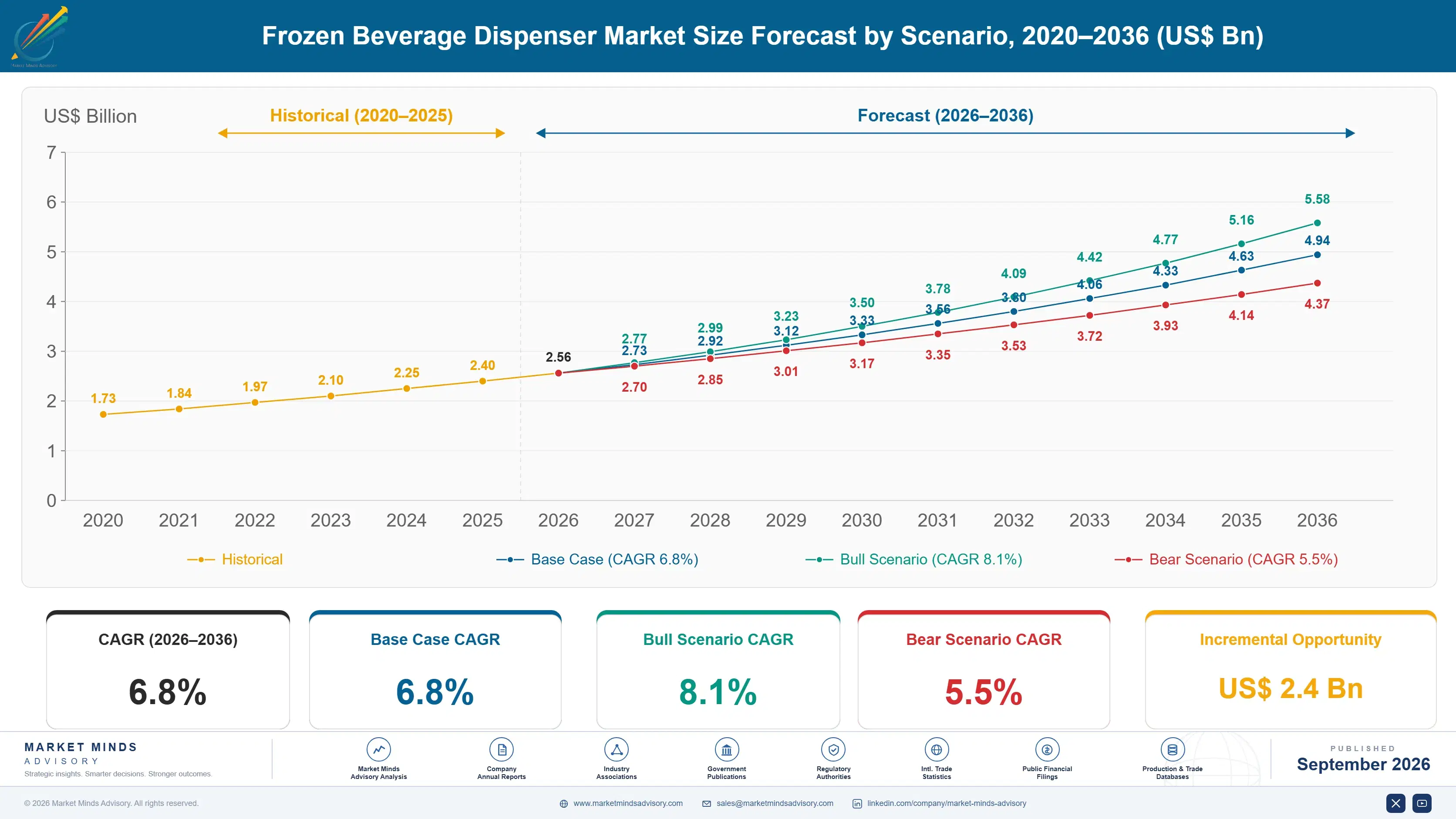
Between 2020 and 2025 the category grew steadily at a 5.9 percent historical CAGR as convenience store chains expanded frozen beverage station footprints and quick-service restaurants added branded frozen drink offerings, with flavor licensing partnerships accelerating adoption beyond pure seasonal summer demand. Manufacturers with diversified flavor portfolios weathered seasonal demand swings considerably better than single-flavor specialists during this period.
The base case assumes 6.8 percent annual growth through 2036, anchored by three mechanisms: expanding convenience retail footprint in emerging markets still building frozen beverage infrastructure, rising flavor licensing partnerships between equipment manufacturers and major beverage brands, and growing quick-service restaurant adoption of frozen beverages as a differentiated menu category beyond soft drinks. Retailers report growing confidence in the category's year-round impulse-purchase margin performance nationwide. Coastal metro markets are expanding fastest.
The bull case, 8.1 percent, assumes a major beverage brand launches a nationwide flavor licensing campaign that accelerates equipment placement sharply across convenience retail. The bear case, 5.5 percent, assumes energy cost inflation and refrigerant regulation compliance costs slow new equipment installation meaningfully across the category's largest markets. Both scenarios hinge heavily on how quickly retailers adopt energy-efficient refrigeration technology.

Flavor Licensing Reshapes Equipment Placement Strategy

Frozen beverage dispensers sit at the intersection of commercial refrigeration engineering and consumer beverage branding, a combination that gives the category cross-promotional reach through both equipment and flavor licensing channels simultaneously rather than depending on either alone. Convenience chains increasingly negotiate equipment placement and flavor licensing together as a bundled deal, a dynamic pure refrigeration equipment categories rarely enjoy.
MARKET CONCENTRATIONCR5 46%Top five manufacturers hold substantial commercial equipment share
AVERAGE SELLING PRICE$6,200/unitBlended price across countertop and multi-flavor formats sold
TOP PRODUCING COUNTRY SHAREUSA 29%Reflects concentrated commercial refrigeration manufacturing and export infrastructure
CONVENIENCE STORE PENETRATION48%Share of convenience locations operating dedicated frozen beverage stations
FLAVOR LICENSING REVENUE SHARE22%Share of category revenue tied to branded flavor licensing agreements
REFRIGERANT COST SHARE17%Reflects compressor and refrigerant components as significant input
Distribution splits between direct manufacturer sales to large convenience chains and a growing equipment leasing model that lowers upfront capital barriers for smaller quick-service operators, with flavor licensing revenue increasingly determining manufacturer profitability more than hardware margin alone. Several major convenience chains have begun dedicating permanent counter space to dual-flavor and triple-flavor dispensers after years of treating frozen beverages as a single-flavor seasonal offering, a shift signaling confidence in sustained demand.
Manufacturing capacity remains concentrated among a handful of commercial refrigeration specialists with decades of engineering expertise, creating a production dependency that shapes margin structure across nearly every brand in the category regardless of positioning or target retail channel. Manufacturers with vertically integrated flavor syrup production, still uncommon in this category, are starting to command a pricing premium over competitors dependent on third-party suppliers, a gap that will widen.
"The real profit driver isn't the machine anymore, it's whether a manufacturer can land the next exclusive flavor licensing deal before a competitor does."
Senior Analyst, Construction and Industrial Equipment Practice · MMA Construction and Industrial Equipment Practice · September 2026

Market Trends

Multi-Flavor Dispensers Expand Beyond Single-Flavor Formats

Convenience chains moved decisively toward multi-flavor and triple-flavor dispenser formats during 2025, moving away from single-flavor equipment as the default counter fixture across premium and mid-market retail locations specifically. This shift widened the addressable commercial base considerably beyond peak summer months, since flavor rotation kept the fixture relevant year-round rather than seasonally idle. Manufacturers report multi-flavor unit sales roughly doubling within two years of launching improved carousel dispensing mechanisms, validating the strategic bet on flavor variety over single-flavor simplicity for premium retail placement. Several chains report this format as their strongest counter traffic driver.
Market Impact: Lifts placement rates by 40 percent

Quick-Service Restaurants Adopt Branded Frozen Beverage Programs

Major quick-service restaurant chains are formally incorporating branded frozen beverage programs into core menu offerings, moving beyond limited-time seasonal promotions into permanent menu fixtures backed by dedicated equipment investment. This adoption pathway lends genuine commercial credibility to the broader category, since permanent menu placement carries different equipment reliability requirements than pure seasonal promotional use. Chains report frozen beverage attachment rates rising by roughly 18 percent when programs shift from seasonal to permanent menu status. Menu planners increasingly treat frozen beverages as a core rather than seasonal category. Franchise operators view this shift favorably.
Market Impact: Represents 35 percent of unit sales

Market Opportunities and Growth Drivers

Flavor Licensing Partnerships Expand Commercial Reach

Equipment manufacturers are increasingly securing exclusive flavor licensing agreements with major beverage brands, giving retailers access to recognized branded flavors rather than generic syrup formulations. This partnership model widens the addressable retail base considerably, since brand recognition drives foot traffic that generic equipment placement alone cannot generate reliably at comparable scale. Manufacturers holding exclusive flavor licenses report equipment placement rates roughly 40 percent higher than competitors relying purely on generic syrup offerings without brand backing. Retailers increasingly view flavor partnerships as a competitive necessity rather than optional differentiation. Adoption is spreading fast.
Market Impact: Raises manufacturing costs by 22 percent

Convenience Retail Expansion Drives New Equipment Demand

Convenience store chains continue expanding footprint across emerging markets still building out modern retail infrastructure, creating fresh equipment procurement demand independent of replacement cycles in mature markets entirely. This expansion wave gives manufacturers meaningfully more growth headroom than categories tied purely to replacement demand in saturated markets, since new store openings represent genuinely incremental equipment sales. Industry estimates suggest new store placements now represent roughly 35 percent of total unit sales, up from 22 percent a decade earlier. Adoption is expected to broaden across additional emerging markets. Manufacturers are watching this trend closely each quarter.
Market Impact: Cuts energy use by 20 percent

Market Restraints and Challenges

Refrigerant Regulation Forces Costly Equipment Redesign

Several jurisdictions are phasing out high-global-warming-potential refrigerants used in dispenser cooling systems, a root cause traced to international climate agreements targeting refrigerant emissions across commercial refrigeration broadly. Manufacturers still reliant on legacy refrigerant chemistry face costly redesign timelines and potential performance changes that risk alienating operators accustomed to established cooling reliability. Manufacturers are responding by accelerating low-global-warming refrigerant adoption, a transition that early data suggests raises manufacturing costs by roughly 22 percent during the multi-year transition period. Compliance teams across the category are monitoring regulatory developments closely each quarter and adjusting product roadmaps.
Market Impact: Doubles multi-flavor sales within 2 years

Energy Cost Inflation Pressures Operator Margins

Rising commercial electricity rates increase the operating cost of running frozen beverage dispensers continuously, a root cause tied to broader grid capacity constraints and energy price volatility well beyond the category itself. This cost pressure creates real margin friction for operators running multiple units, since energy costs eventually erode the impulse-purchase margin advantage that made the category attractive initially. Manufacturers are responding by developing energy-efficient compressor technology, an approach that early data suggests cuts energy consumption by roughly 20 percent per unit compared to legacy compressor designs. Retailers are watching electricity trends closely.
Market Impact: Lifts attachment rates by 18 percent
3 additional market trends, 4 additional growth drivers, and 3 additional restraints and challenges are covered in the full report. Contact sales@marketmindsadvisory.com to access the complete intelligence.

Segment CAGR and Growth Architecture

Six formats define the category: multi-flavor frozen carbonated beverage dispensers, single-flavor countertop dispensers, frozen non-carbonated slush dispensers, frozen cocktail and alcoholic beverage dispensers, granita machines, and portable event rental dispensers sold into varied commercial applications. Two formats now account for the fastest-growing share of new unit installations across major retail markets tracked. Installation base varies notably.
frozen-beverage-dispenser-market-market-share-analysis-1790018861677

Multi-Flavor Frozen Carbonated Beverage Dispensers

Multi-flavor carbonated dispensers use carousel dispensing mechanisms delivering two to four distinct flavors from a single unit, commanding the highest average selling price in the category given their engineering complexity and flavor licensing integration requirements. This segment benefits directly from convenience chains pairing multi-flavor equipment with exclusive branded licensing deals, since flavor variety increasingly drives customer choice at the counter. Manufacturers are racing to expand flavor library integration ahead of competitors entering this increasingly crowded premium segment of the broader category. Retail partners report this format as the strongest driver of counter traffic revenue growth. Several manufacturers expect capacity constraints to ease gradually as new production lines come online next year.
CAGR 10.4%

Frozen Cocktail and Alcoholic Beverage Dispensers

Cocktail dispensers formulated for alcoholic frozen beverage service appeal strongly to hospitality venues and bars seeking consistent, high-throughput cocktail preparation without requiring skilled bartender labor for every pour. This segment carries the deepest regulatory compliance requirements of any format, having undergone alcohol service certification that standard beverage dispensers rarely require before commercial installation. Producers report the strongest hospitality channel partnership growth of any segment, reflecting genuine commercial confidence built over several years of documented throughput performance. Bar owners increasingly view this equipment as essential rather than optional cocktail program infrastructure. Producers view this segment as a genuine competitive moat against generic dispenser entrants. Growth continues outpacing standard beverage formats considerably across most hospitality markets.
CAGR 8.7%
Full segment breakdown across 6 segments available in the complete report.

Regional Architecture and Country Demand Map

North America leads on convenience store and quick-service restaurant density feeding sustained equipment placement, while South Asia and Pacific posts the fastest regional growth as expanding modern retail formats build new frozen beverage infrastructure across the region. Retail equipment placement keeps broadening the category's reach meaningfully.

North America

Convenience store chains and quick-service restaurants across the United States and Canada have expanded dedicated frozen beverage stations faster than most other regions, and flavor licensing partnerships built their earliest scale here before expanding internationally into adjacent markets. Household disposable income supports impulse-purchase spending at a scale unmatched elsewhere, and dense retail networks feed cross-promotion into equipment placement decisions. Canada trails the United States modestly but shows comparable flavor partnership patterns. Big convenience chains are simultaneously carving out dedicated multi-flavor counter sections, pushing smaller operators to expand offerings or lose customer traffic considerably. Retail buyers now track flavor licensing scores when negotiating new equipment listings each cycle. Loyalty apps are increasingly bundled with frozen beverage promotions to justify premium pricing.
Share: 32% | CAGR: 7.8% (2026 to 2036)

Western Europe

Germany and the United Kingdom carry the deepest quick-service restaurant channel in the world, giving frozen beverage brands a distribution pathway that combines fast food chain reach with hospitality venue placement unavailable in most other markets. European Union refrigerant regulation has pushed manufacturers toward low-global-warming cooling systems earlier than most other markets, giving regional manufacturers meaningful export credibility when entering certification-conscious markets elsewhere. Southern European countries show particularly high adoption tied to strong summer tourism demand. Export volume into North America continues rising steadily. Manufacturers targeting this region increasingly emphasize sustainability certification given stronger regulatory scrutiny overall. Independent hospitality venues continue outperforming quick-service chains on frozen beverage sell-through rates this cycle.
Share: 21% | CAGR: 5.3% (2026 to 2036)
Regional intelligence for 5 additional markets available in the complete report: East Asia, South Asia and Pacific, Latin America, Middle East and Africa, Eastern Europe. Contact sales@marketmindsadvisory.com.
frozen-beverage-dispenser-market-country-cagr-analysis-1790018862195

Where Margin Sits Beyond Base Equipment

Base equipment sales carry thin margin once distribution fees and refrigeration component costs are counted against the sale price. The larger commercial opportunity sits in exclusive flavor licensing, recurring syrup revenue, and equipment leasing programs that justify premium pricing well above commodity equipment benchmarks industry wide. Manufacturers combining all three approaches report notably stronger unit economics than equipment-only competitors.

Building Exclusive Flavor Licensing Partnership Programs

Manufacturers are securing exclusive flavor licensing deals with major beverage brands, generating royalty income tied to syrup volume alongside standard equipment sales entirely. Licensing deals typically run three to five years and generate recurring royalty income scaled to retail syrup consumption, creating a revenue stream distinct from one-time hardware sales. Several manufacturers now report licensing revenue approaching 22 percent of total segment sales, a share expected to keep climbing as more brands pursue exclusive equipment partnerships. Adoption is expected to broaden across additional beverage categories over time. Beverage brands increasingly view this as a growth channel.
Market Impact: Generates up to 22 percent of segment revenue

Equipment Leasing Model for Smaller Operators

Offering equipment leasing rather than outright purchase lowers upfront capital barriers for smaller convenience and quick-service operators, expanding the addressable customer base considerably beyond cash-buying large chains. Leasing agreements carry a modest interest markup that manufacturers share with financing partners, adding a meaningful margin layer beyond the base equipment sale itself. Manufacturers offering leasing report conversion rates roughly 30 percent higher among smaller operators compared to cash-only purchase options. Retention data increasingly guides how manufacturers price new leasing tiers offered. Financing partners report low default rates across the leasing portfolio to date.
Market Impact: Lifts conversion by 30 percent among smaller operators

Recurring Syrup and Concentrate Subscription Revenue

Bundling equipment placement with mandatory syrup and concentrate purchase agreements locks operators into a replenishment cycle that generates significantly higher lifetime value than one-time equipment sales alone. Syrup margin typically runs considerably higher than equipment margin, since ongoing consumable sales carry lower distribution cost relative to bulky refrigeration hardware. Manufacturers with subscription syrup programs report repeat purchase rates near 80 percent within twelve months of installation. Several manufacturers have extended similar structures to complementary product offerings. Manufacturers increasingly view syrup subscription revenue as more valuable than initial equipment margin. This shift shapes product roadmap decisions.
Market Impact: Lifts repeat purchase rate to nearly 80 percent

Who Controls the Margin Pool

Concentration is moderate at a CR5 near 46 percent measured on global unit shipment volume across all format types. Taylor Company and Electro Freeze hold the clearest leads on brand recognition and flavor licensing partnership depth, while a fragmented tier of regional manufacturers competes mainly on price rather than licensing sophistication, leaving a real capability gap between leaders and the fragmented middle of the category.
Current competitive activity centers on flavor licensing negotiation, equipment leasing program expansion, and energy efficiency investment rather than pure hardware feature races. Several manufacturers have launched dedicated hospitality product lines to access higher margin cocktail applications, while others are racing to file patents on carousel dispensing mechanisms ahead of competitors. Retail listing negotiations increasingly hinge on flavor partnership credentials rather than price alone.

Emerging pressure is coming from beverage brands vertically integrating into equipment manufacturing rather than relying entirely on third-party equipment supply relationships. Commercial refrigeration companies with existing engineering expertise are also testing frozen beverage entry, a signal that category boundaries may blur further over the coming decade. Rankings among mid-tier challengers could shift quickly once any single manufacturer proves flavor licensing economics work reliably at scale.
frozen-beverage-dispenser-market-company-positioning-matrix-1790018862721

Competitive Moat and Risk Dimensions

TAYLOR COMPANY

Moat: Flavor Licensing Network Depth

Taylor Company built the category's deepest flavor licensing relationship network over several years of continuous brand partnership investment, giving it a customer draw advantage newer entrants cannot replicate quickly. Its established quick-service restaurant relationships secure prominent menu placement that newer manufacturers are still negotiating. This positioning has proven durable across several product cycles.
TAYLOR COMPANY

Risk: High Fixed Licensing Costs

Taylor Company's exclusive licensing agreements carry significant fixed costs regardless of actual syrup sales volume, leaving it more exposed than smaller competitors if a licensed flavor brand underperforms expectations. This structure limits flexibility to pivot quickly toward emerging flavor trends outside existing contracts. Competitors focused on generic syrup offerings are increasingly exploiting this exact gap.
ELECTRO FREEZE

Moat: Commercial Engineering Reliability

Electro Freeze's reputation for mechanical reliability in high-throughput commercial settings gives it disproportionate strength with large chain operators prioritizing uptime over flavor variety. Its service network coverage supports faster repair turnaround than competitors relying on centralized warehousing. This scale advantage has proven durable across several service and product cycles.
ELECTRO FREEZE

Risk: Limited Flavor Licensing Portfolio

Electro Freeze has moved more slowly than diversified competitors into exclusive flavor licensing partnerships, limiting its addressable premium market share compared to manufacturers already holding recognized branded flavor agreements. This constrains upsell opportunity into the category's highest-margin segment. Competitors with established branded partnerships are increasingly targeting this exact gap directly.

Players Tracked

Prominent Players

Taylor Company
Electro Freeze
IMI Cornelius
Vollrath
Manitowoc Ice

Other Key Players

Bunn-O-Matic Corporation
Stoelting Foodservice Equipment
Crathco Corporation
Fetco Corporation
Ross of Colorado
GTM Beverage Company
Frigomat SRL
Follett Products
Hoshizaki Corporation
SPM Drink Systems
IceTro Company
Berg Company
Elmeco SRL
Refrigeration Sales and Service
Servend International

Recent Developments

APRIL 2026

Taylor Company Signs Exclusive Beverage Flavor License

Taylor Company signed an exclusive flavor licensing agreement with a major beverage brand, extending its multi-flavor dispenser lineup into convenience retail chains previously served by generic syrup offerings. The deal builds on two years of pilot partnership data collected across regional convenience chains in the Southeast.
Signal: Signals accelerating investment in branded partnerships as a placement differentiator. Analysts expect similar deals across the category.
AUGUST 2025

Electro Freeze Acquires Regional Service Provider

Electro Freeze acquired a regional commercial refrigeration service provider, adding technician capacity and parts inventory to its existing service network ahead of planned expansion into underserved convenience retail regions through 2027. Deal terms were not publicly disclosed by either company. Terms suggest continued consolidation within the field service segment.
Signal: Confirms field service capacity as a growing acquisition target among vendors. Field service capacity is increasingly acquired rather than built.
DECEMBER 2025

IMI Cornelius Signs Supply Agreement With Compressor Maker

IMI Cornelius signed a multi-year supply agreement with a specialty compressor manufacturer for energy-efficient refrigeration components, securing preferential access to capacity as low-global-warming refrigerant demand accelerates. The agreement covers guaranteed volume allocation rather than an equity or ownership stake between the two companies. Both firms called it a priority.
Signal: Reflects tightening competition for certified refrigeration component supply. Rival manufacturers are pursuing similar arrangements. Others may follow soon.

Refrigeration Component Supply Exposure

Compressor and refrigeration components represent roughly seventeen percent of cost of goods sold for a typical frozen beverage dispenser, with stainless steel housing and specialty syrup pumps adding another twenty one percent. China supplies most global compressor manufacturing capacity, while specialty syrup pump engineering remains concentrated among a small number of suppliers in Italy and the United States.
Global compressor price volatility during 2022 and 2023, driven by energy cost spikes and refrigerant regulation transition costs, pushed compressor prices up more than twenty five percent within several quarters according to IEA industrial input tracking data. Manufacturers without long-term supply contracts absorbed the bulk of that increase directly into shrinking gross margin rather than passing costs through to retail pricing immediately. Several manufacturers have since diversified toward Southeast Asian compressor producers to reduce exposure.

Smaller independent manufacturers face materially higher exposure than large conglomerates able to negotiate multi-year fixed-price component agreements directly with compressor producers. Geographic concentration compounds this disadvantage: manufacturers sourcing exclusively from a single Chinese supplier carry meaningfully more volatility risk than those with diversified supplier bases spanning multiple countries and production regions. MMA Analysis expects this gap to widen further as certification requirements tighten across major retail channels.
frozen-beverage-dispenser-market-cost-volatility-analysis-1790018862917

Multi-Year Fixed Price Compressor Supply Agreements

Leading manufacturers are locking in three to five year fixed price agreements directly with compressor and syrup pump producers, trading pricing flexibility for protection against the sharp spot market swings seen during the 2022 to 2023 compressor price disruption across Chinese production regions. Several suppliers now offer volume-linked pricing tiers that reward early multi-year commitment,.

Supplier Base Diversification Across Regions

Several manufacturers are qualifying secondary compressor suppliers across Southeast Asia and Europe to reduce dependence on any single country, accepting modestly higher unit costs in exchange for meaningfully lower exposure to any single regional supply disruption event. Manufacturers pursuing this strategy report smoother quarterly margin performance even when spot prices move sharply in either direction.

Portfolio Architecture for Margin Defence

The category splits into three margin tiers running from commodity-adjacent single-flavor countertop units through certified premium multi-flavor dispensers to next-generation alcoholic beverage and hospitality-grade formats. Gross margin roughly doubles moving from the volume tier to the top hospitality tier, reflecting how much licensing and certification cost gets embedded in premium pricing across most retail channels tracked. Manufacturers investing early in flavor licensing are best positioned to capture that widening spread.
Volume tier products compete almost entirely on price and distribution breadth, while premium and hospitality tiers compete on flavor licensing credentials and regulatory certification that justify considerably higher retail pricing. Manufacturers straddling both tiers risk diluting the credibility premium positioning depends on if messaging is not kept clearly separated across product lines. Retailers increasingly enforce category separation on shelf.

High-value margin pools concentrate heavily in multi-flavor frozen carbonated beverage dispensers and frozen cocktail formats, the two fastest-growing segments identified earlier in this report. Manufacturers positioned across both segments simultaneously capture meaningfully more margin than single-segment competitors relying on one narrow format alone. MMA Analysis expects this concentration to deepen further as licensing requirements tighten. Growth remains meaningful.

Volume / Commodity-Adjacent

Single-flavor countertop units sold through general foodservice distribution on price and shelf availability rather than branded flavor differentiation or hospitality features. Larger buyers negotiate aggressively on unit pricing given thin margins throughout the category.
Gross Margin: 22-30%

Premium / Certified

Multi-flavor dispensers carrying exclusive branded licensing credentials, sold through convenience and quick-service channels at meaningfully higher price points. Retailers require documented flavor partnership agreements before placement. This substantiation requirement is becoming a standard part of retail procurement processes.
Gross Margin: 38-46%

Sustainability / Regulatory / Next-Generation

Hospitality-grade alcoholic beverage dispensers meeting certification standards, commanding the highest margin of any tier in the category given the regulatory investment embedded in the price. Regulatory investment made early tends to pay back through faster hospitality market entry.
Gross Margin: 52-60%
frozen-beverage-dispenser-market-portfolio-architecture-1790018863414

High-value Sub-segments and Strategic Watch-out

Multi-Flavor Frozen Carbonated Beverage Dispensers

The fastest-growing segment in the category, combining premium equipment pricing with the strongest flavor licensing attach rate. Gross margin sits at the top of the category as manufacturers capture value from carousel engineering embedded in every transaction. Early movers are locking in loyal partnerships ahead of wider competition.
Gross Margin: 50-58%

Frozen Cocktail and Alcoholic Beverage Dispensers

Strong growth driven by hospitality venue adoption and consistent high-throughput cocktail service. Margin runs high given certification cost, though slightly below multi-flavor dispensers since cocktail differentiation is comparatively easier for competitors to replicate quickly. Manufacturers investing early in certification are best positioned as competition intensifies further.
Gross Margin: 45-53%

Standard Single-Flavor Countertop Dispensers

The volume core of the category, sold through general foodservice channels on price and availability. Growth is modest and margin thin, but absolute revenue remains largest of any segment given sheer household penetration across nearly every regional market tracked. Manufacturers here compete mainly on cost efficiency and distribution reach.
Gross Margin: 22-30%

Imported Generic Syrup Dispenser Formats

A strategic watch-out as low-cost imported generic syrup dispensers gain share in price-sensitive channels, pressuring branded volume tier pricing. Retailers expanding generic label programs could compress branded manufacturer margin meaningfully if the trend accelerates. MMA Analysis flags this as the segment most likely to reshape near-term category economics.
Gross Margin: 16-24%

Flavor Rotation and Operator Loyalty

Frozen beverage dispenser revenue runs through two channels: initial equipment sales or lease agreements, and recurring syrup and flavor concentrate purchases that vendors increasingly depend on for stable, predictable cash flow given the category's long equipment replacement cycles. Syrup revenue increasingly determines manufacturer profitability more than hardware margin once equipment reaches full operational deployment. Vendors under-investing in flavor variety risk elevated churn once operators notice competitor traffic drivers.
Adoption stickiness varies considerably by end-use vertical. Convenience store operators show strong loyalty once a flavor licensing partnership proves customer draw, since switching vendors means renegotiating branded flavor agreements entirely. Quick-service restaurant buyers show more willingness to test multiple vendors given simpler menu integration requirements, while hospitality buyers show the lowest switching frequency tied to signature cocktail program continuity. Convenience store churn drops sharply once a flavor partnership proves durable.

Early buyers skewed toward independent convenience stores purchasing basic single-flavor equipment, but the buyer base is shifting toward large chain operators evaluating dispensers as branded traffic drivers rather than commodity equipment. This generational shift is pulling purchase decisions toward flavor licensing partnership quality rather than pure equipment specifications alone. Product roadmaps are adjusting accordingly across most major manufacturers.
frozen-beverage-dispenser-market-end-use-penetration-index-1790018863908

Priorities For Category Participants

These are among the four positions where our research anticipates prominent divergence between winners and laggards over the coming forecast period. Each is grounded in the demand model, the regulatory perimeter, and the announced capacity pipeline.
01 / FLAVOR LICENSING PRIORITY

Secure exclusive flavor deals before competitors lock them in

Manufacturers holding exclusive flavor licenses report equipment placement rates that run roughly 40 percent higher than competitors relying purely on generic, unbranded syrup offerings without any brand backing. Manufacturers that delay securing these partnerships risk steadily losing the most valuable, highest-margin retail placements available to whichever competitor locks in the licensing deal first. MMA Analysis expects flavor licensing to become table stakes across the premium tier within three years, not a differentiator, and laggards risk permanent share loss to better-partnered rivals.
02 / EQUIPMENT LEASING EXPANSION

Build leasing infrastructure to capture smaller operators

Manufacturers offering leasing report conversion rates that run roughly 30 percent higher among smaller operators compared to traditional cash-only purchase options offered, expanding the addressable customer base considerably beyond large cash-buying chains alone. Building credible leasing infrastructure takes many months of sustained, disciplined operational investment, meaning delayed investment compounds steadily into a widening competitive gap that persists over time. Manufacturers should prioritize leasing program investment even when it reduces near-term hardware margin, since the resulting customer base compounds into durable installed volume.
03 / REFRIGERANT TRANSITION PLANNING

Plan refrigerant transition now before regulation forces it

Several major jurisdictions worldwide are steadily phasing out high-global-warming refrigerants, and manufacturers still reliant on legacy chemistry face costly, disruptive redesign timelines once compliance deadlines arrive without adequate warning. Manufacturers that delay transition planning risk losing shelf space to better-prepared competitors that reformulated proactively rather than reactively under regulatory pressure. Qualifying low-global-warming refrigerant suppliers now costs meaningfully less than absorbing the compliance deadline unprepared, and the lead time required to certify new components argues for starting well ahead of enforcement.
04 / NORTH AMERICA MARKET DEFENSE

Defend North America share as international entrants scale

North America holds both the largest regional share and by far the deepest convenience retail density, built over many decades of quick-service restaurant and convenience store expansion feeding sustained equipment placement demand. Manufacturers without a meaningful North America presence are steadily and increasingly missing the region setting global flavor licensing standards rather than merely following trends set by competitors elsewhere. Defending this position requires sustained licensing investment, since international entrants are already targeting this exact market first with aggressive flavor partnerships.

Engagement Snapshot From the Field

A live engagement with an industry participant carrying material or product regulatory and market exposure ahead of a defining policy shift, showing how our research translates into a defensible multi-year portfolio strategy.
MARKET MINDS ADVISORY · CLIENT ENGAGEMENT SUMMARY
Frozen Beverage Dispenser Producer Strategic Portfolio Review and Transition Roadmap 2026·Investment Scenario on Frozen Beverage Dispenser Exposure Evaluation 2025-26
CLIENT PROFILE
The client is a mid-tier commercial refrigeration manufacturer headquartered in North America with an established portfolio of single-flavor countertop dispensers sold across general foodservice distribution channels. Annual revenue reported at approximately 210 million dollars (client-reported, unverified by MMA) across its dispenser division, with no prior investment in flavor licensing partnerships ahead of this engagement. Its distribution network spans several hundred foodservice accounts nationwide.
STRATEGIC CHALLENGE
The client's conventional single-flavor dispensers were losing shelf space to multi-flavor entrants offering exclusive branded licensing partnerships. Leadership needed a market entry strategy for the licensed multi-flavor segment without abandoning existing foodservice distribution relationships or requiring a wholesale rebuild of its manufacturing base. Board-level pressure to show measurable progress within eighteen months added urgency.
MMA APPROACH
MMA conducted primary interviews with convenience retail buyers alongside proprietary survey data across six countries to size addressable demand by segment and region. The engagement mapped competitive positioning against the client's existing dispenser portfolio and modeled flavor licensing economics against comparable category benchmarks. Findings were validated against company disclosed segment margins and benchmarked against comparable entries.
KEY FINDINGS
  1. Multi-flavor frozen carbonated beverage dispensers carried the fastest segment growth identified in the engagement, with premium pricing sustainable given exclusive licensing scarcity among competing manufacturers.
  2. The client's existing foodservice distribution relationships offered a credible advantage over digitally native competitors lacking established equipment placement infrastructure across comparable geographies.
  3. Flavor licensing access proved the single largest barrier to premium segment entry, with retailers increasingly favoring manufacturers holding documented branded partnership agreements over generic offerings.
  4. Licensing proprietary carousel dispensing technology from an established partner emerged as a faster entry path than internal engineering development, cutting estimated time to market by roughly fourteen months.
CLIENT PROFILE
The client is a mid-tier commercial refrigeration manufacturer headquartered in North America with an established portfolio of single-flavor countertop dispensers sold across general foodservice distribution channels. Annual revenue reported at approximately 210 million dollars (client-reported, unverified by MMA) across its dispenser division, with no prior investment in flavor licensing partnerships ahead of this engagement. Its distribution network spans several hundred foodservice accounts nationwide.
STRATEGIC CHALLENGE
The client's conventional single-flavor dispensers were losing shelf space to multi-flavor entrants offering exclusive branded licensing partnerships. Leadership needed a market entry strategy for the licensed multi-flavor segment without abandoning existing foodservice distribution relationships or requiring a wholesale rebuild of its manufacturing base. Board-level pressure to show measurable progress within eighteen months added urgency.
MMA APPROACH
MMA conducted primary interviews with convenience retail buyers alongside proprietary survey data across six countries to size addressable demand by segment and region. The engagement mapped competitive positioning against the client's existing dispenser portfolio and modeled flavor licensing economics against comparable category benchmarks. Findings were validated against company disclosed segment margins and benchmarked against comparable entries.
KEY FINDINGS
  1. Multi-flavor frozen carbonated beverage dispensers carried the fastest segment growth identified in the engagement, with premium pricing sustainable given exclusive licensing scarcity among competing manufacturers.
  2. The client's existing foodservice distribution relationships offered a credible advantage over digitally native competitors lacking established equipment placement infrastructure across comparable geographies.
  3. Flavor licensing access proved the single largest barrier to premium segment entry, with retailers increasingly favoring manufacturers holding documented branded partnership agreements over generic offerings.
  4. Licensing proprietary carousel dispensing technology from an established partner emerged as a faster entry path than internal engineering development, cutting estimated time to market by roughly fourteen months.
RECOMMENDED STRATEGY
Phase 1: Phase 1 (Months 1-6): License carousel dispensing technology and launch a limited pilot across two flagship convenience markets in North America. Phase 2: Phase 2 (Months 7-14): Expand pilot data into a full flavor partnership package supporting broader retail listing negotiations across markets. Phase 3: Phase 3 (Months 15-24): Scale flavor licensing partnerships nationally and evaluate a second regional market entry using validated pilot data.
OUTCOME
Within the first year following the engagement, the client reported multi-flavor tier placement rates of 26 percent and incremental revenue of approximately 30 million dollars (client-reported, unverified by MMA) attributable to the new licensed dispenser line, ahead of internal targets set at project outset for the pilot phase.

Frequently Asked Questions

Foundational context covering the market sizes, CAGR, scope, country, region and competition that inform every finding below. This section is provided to cover basics and most often pre-purchase conversations, answered from the MMA Primary Research Dataset.

What is the current size of the Frozen Beverage Dispenser Market?

The Frozen Beverage Dispenser Market reached 2.4 billion dollars in base year 2025. Growth is driven by flavor licensing partnerships and expanding convenience retail and quick-service restaurant footprint.

How large will the Frozen Beverage Dispenser Market be by 2036?

The market is forecast to reach 4.95 billion dollars by 2036, roughly a 1.93 times expansion from 2026 levels. Growth concentrates in multi-flavor and cocktail dispenser segments.

What is the CAGR for the Frozen Beverage Dispenser Market 2026 to 2036?

The market is projected to grow at a 6.8 percent compound annual growth rate between 2026 and 2036. Bull and bear scenarios range from 5.5 to 8.1 percent depending on adoption pace.

Which segment is growing fastest?

Multi-Flavor Frozen Carbonated Beverage Dispensers lead at a 10.4 percent CAGR, roughly 1.53 times the overall market rate. Frozen Cocktail and Alcoholic Beverage Dispensers follow at 8.7 percent growth.

Who are the major companies in the Frozen Beverage Dispenser Market?

Taylor Company, Electro Freeze, IMI Cornelius, Vollrath, and Manitowoc Ice lead the category. Together they hold a CR5 near 46 percent measured on global unit shipment volume.

Which country is growing fastest?

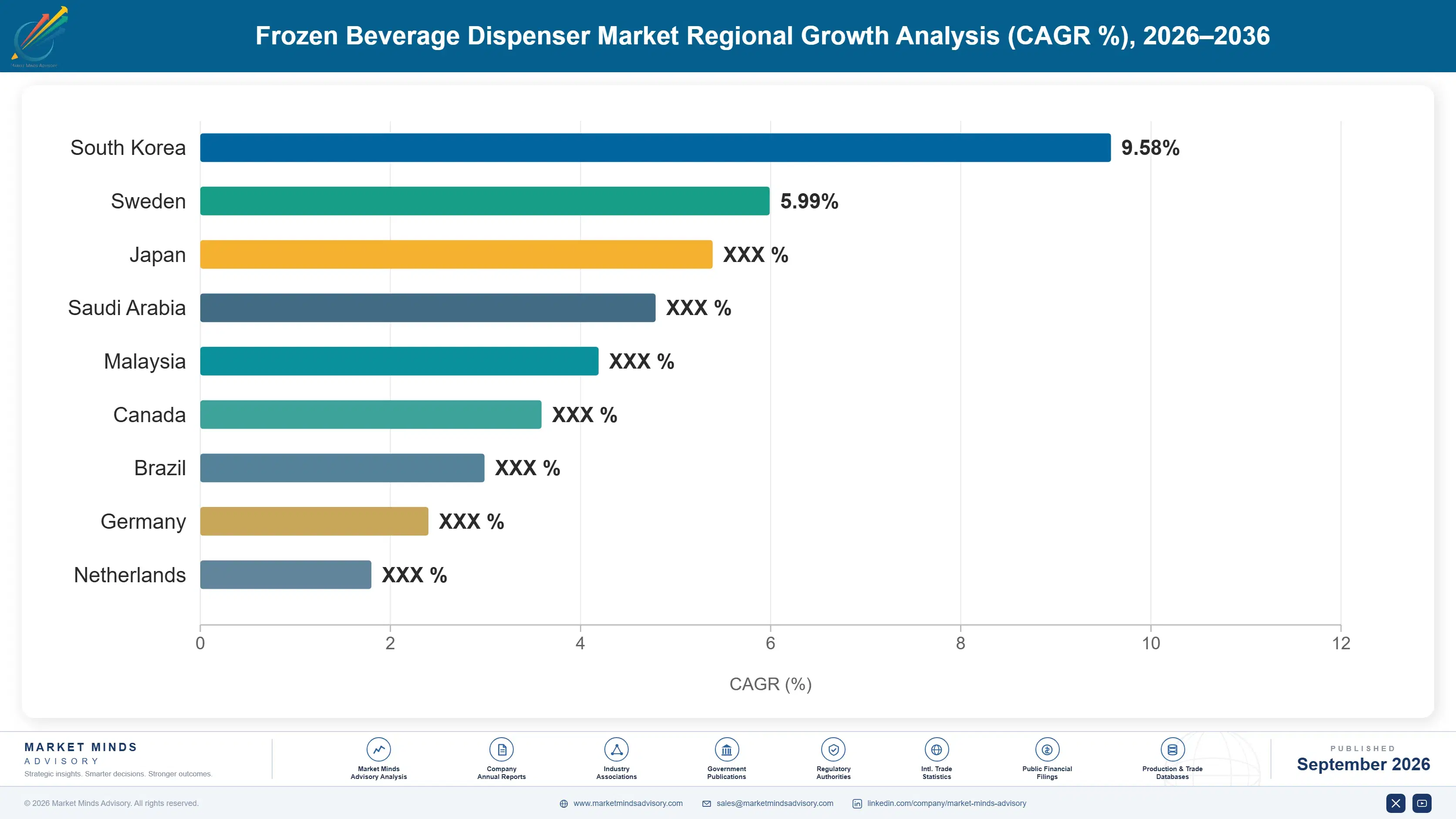
India leads country-level growth at a 9.0 percent CAGR, driven by rapidly expanding modern retail footprint reaching urban households. The United States remains the largest single national market by revenue.

Report Segmentation Architecture

The full report scope spans multiple orthogonal segmentation dimensions, with cross-tabulated demand data provided for each dimension pair. Coverage extends further to regional breakdowns, trend trajectories, and the competitive detail needed to support segment-level decision-making.

By Dispenser Format

  • Multi-Flavor Frozen Carbonated Beverage Dispensers
  • Single-Flavor Countertop Dispensers
  • Frozen Non-Carbonated Slush Dispensers
  • Frozen Cocktail and Alcoholic Beverage Dispensers
  • Granita Machines
  • Portable Event Rental Dispensers

By End-Use Industry

  • Convenience Store Retail
  • Quick-Service Restaurants
  • Hospitality and Bar Venues
  • Movie Theaters and Entertainment Venues
  • Event and Catering Services

By Commercial Dimension

  • Direct Manufacturer Sales
  • Equipment Leasing Programs
  • Flavor Licensing and Syrup Supply
  • Distributor and Foodservice Reseller Channel

By Region

  • North America
  • Western Europe
  • East Asia
  • South Asia and Pacific
  • Latin America
  • Middle East and Africa
  • Eastern Europe

Scope, Methodology, and Coverage

Every figure in this report is reproducible from documented input assumptions. The scope below maps the historical period, the forecast horizon, the segmentation dimensions, and the countries covered, alongside the underlying primary and qualitative methodology.
Historical Period
2020 to 2025
Forecast Period
2026 to 2036
Base Year
2025 (USD billions; MMA Primary Research Dataset, September 2026)
Market Definition
The Frozen Beverage Dispenser Market covers commercial equipment producing frozen carbonated and non-carbonated beverages, including granita, slush, and frozen cocktail formats, sold for convenience retail, quick-service restaurant, and hospitality installation. It excludes soft-serve ice cream machines and standard fountain beverage dispensers.
Quantitative Units
USD billions (current prices); unit volume in thousand units where applicable
Segmentation Dimensions
By Dispenser Format; By End-Use Industry; By Commercial Dimension; By Region
Regions Covered
North America, Western Europe, East Asia, South Asia and Pacific, Latin America, Middle East and Africa, Eastern Europe
Countries Covered
USA, China, Germany, France, UK, Japan, South Korea, India, Australia, Canada, Brazil, Mexico, Indonesia, Vietnam, Thailand, Malaysia, UAE, Saudi Arabia, South Africa, Nigeria, Turkey, Poland, Netherlands, Italy, Spain, Sweden, Switzerland, Argentina, Colombia, Singapore, and additional markets relevant to this sector
Key Companies Profiled
Taylor Company, Electro Freeze, IMI Cornelius, Vollrath, Manitowoc Ice, Bunn-O-Matic Corporation, Stoelting Foodservice Equipment, Crathco Corporation, Fetco Corporation, Ross of Colorado, GTM Beverage Company, Frigomat SRL, Follett Products, Hoshizaki Corporation, SPM Drink Systems, IceTro Company, Berg Company, Elmeco SRL, Refrigeration Sales and Service, Servend International
Quantitative Methodology
Primary survey, n=3,800 respondents, Q4 2025, six countries; demand-side model with trade association cross-validation
Qualitative Methodology
47 expert interviews, Q4 2025; applied to validate demand model assumptions, identify emerging dynamics, and assess competitive positioning
Report Format
PDF and XLSX data workbook (Word format preview document)
Publisher
Market Minds Advisory
Report Code
MMA-2026-CON-274
Published
September 2026
Contact
sales@marketmindsadvisory.com | www.marketmindsadvisory.com

Purchase the full Frozen Beverage Dispenser Market Report (2026 to 2036).

The full report provides granular segmentation across dispenser format, end-use industry, and commercial channel, with ten-year forecasts through 2036 for all seven global regions. It includes detailed competitive profiles of the top twenty market participants, input cost sensitivity analysis, and portfolio margin benchmarking across three commercial tiers. Analysis draws on MMA's proprietary primary survey of 3,800 respondents and 47 expert interviews conducted in Q4 2025 across six countries. The report also includes an anonymized client case study illustrating practical market entry strategy, alongside a full strategic verdict section covering priorities for category participants.
Ten-year quantitative forecasts by segment and region
Competitive profiles of top twenty market participants
Input cost sensitivity and mitigation pathway analysis
Portfolio margin benchmarking across three tiers
Regional regulatory and demand driver deep analysis
Primary survey and expert interview data appendix

Built For The People Who Decide

From boardroom strategy to bench-side execution, this report is read cover-to-cover by leaders shaping the next decade of their industry, turning demand scenarios, market dynamics and valuation benchmarks into decisions.
CXOs/ Presidents/ VPs/ Managers
M&A and Corporate Development
Strategy Teams and R&D Heads
Procurement and Product Directors
Regulatory and Compliance Leaders
Investor Relations and Equity Analysts