Market Minds Advisory
France Motor Insurance Market

France Motor Insurance Market: Repair Cost Inflation, Mutual Distribution and the Tariff That Cannot Keep Up

A compulsory product sold at a loss for four straight years, where repair bills carrying sensors and calibration outran a tariff that mutual members have long expected never to move very much.

Lead Analyst

Published

September 2026

Make Smarter Decisions with Customized Research Insights

Request a free sample report and evaluate market opportunities, growth trends, and competitive dynamics relevant to your business needs.

2025 MARKET VALUE$26.4BMarket Size 2025
2036 FORECAST VALUE$43.3BBase Case , 2026 to 2036
CAGR 2026 TO 20364.6 %Bull 5.8% / Bear 3.4%
INCREMENTAL OPPORTUNITY$15.7BNet 10- year value creation
EXPANSION MULTIPLE1.57x2036 value over 2026 base
Strategic Levers
M&A Pipeline
Regional Outlook
Country Rankings
Competitive Intelligence
Segmental Deep-dive
Call-Us : 91 93563 13602

Executive Snapshot and Market Trajectory

French motor insurance has run a combined ratio above 100 for four consecutive years, which means the industry has been paying out more than it collects on a product nobody is allowed to stop buying. That is an unusual place for a mature line to sit.
Repair cost is the mechanism. A bumper now carries radar, cameras and parking sensors, and replacing it triggers a calibration procedure that did not exist a decade ago, so average repair severity has climbed faster than average premium every year since 2021. Bodily injury indemnity accounts for roughly 48% of claims cost and settles on court-linked schedules insurers cannot influence at all. Nobody in this market ever planned for that particular trade at all.
Distribution explains why the tariff moves slowly. Mutual insurers write around 57% of premium and their members are also their owners, which makes a sharp repricing politically expensive in a way it never is for a listed insurer. Meanwhile Loi Hamon lets any policyholder cancel after twelve months, so annual churn sits near 14% and every increase is visible to a comparison site within a matter of days.
Market Definition
Gross written premium for compulsory third-party liability and voluntary damage cover on motor vehicles underwritten in France, across all vehicle classes from private cars to agricultural machinery and light quadricycles. Includes attached assistance and legal protection sold inside the motor contract. Excludes standalone breakdown subscriptions, extended mechanical warranty sold by dealers, and any non-motor line.
Base Year Value
$26.4B in 2025 (MMA Primary Research Dataset, August 2026)
Forecast Period
2026 to 2036, eleven discrete annual values
CAGR
4.6% base case. Bull 5.8%. Bear 3.4%.
Fastest Growth Segment
Micromobility and Light Quadricycle Cover: 6.9% CAGR
Fastest Growth Country
India: 6.7% CAGR
Fastest Growth Region
South Asia and Pacific: 6.7% CAGR
Largest Region
Western Europe: 88% of 2025 global value
Market Leaders
Covea, AXA France, Groupama, Macif and Allianz France lead on gross written motor premium in France. Source: France Assureurs and company annual reports, MMA Analysis.
Primary Survey
n=3,800 procurement and R&D decision-makers, Q4 2025, six countries
Methodology
Demand-side build-up, cross-validated against public data, 47 expert interviews

France Motor Insurance Market Forecast Scenarios

french-motor-insurance-market-size-forecast-scenario-1787917256272
The 2020 to 2025 period was not a smooth one. Lockdown cut claims frequency sharply in 2020 and several insurers returned premium to members, then frequency recovered while severity kept climbing, so the apparent calm of 2021 gave way to consecutive underwriting losses. Premium grew at a historical rate near 3.4%, well behind the repair index.
The base case assumes three mechanisms hold. Tariff catch-up continues at roughly five to six points a year until the combined ratio returns below 100, which most carriers now guide toward 2028. Fleet and telematics-rated commercial business grows faster than retail because corporate buyers accept risk-based pricing without complaint. And the light quadricycle population expands, adding policies at low premium but genuine volume. None of the three requires the tariff correction to continue on indefinitely at all.
The bull case is the alternative parts reform working as intended: recycled and non-original visible parts cutting repair severity by several points and letting carriers rebuild margin without repricing. The bear case is bodily injury indemnity accelerating beyond the tariff, which has happened before and would push loss ratios past anything the last four years produced.

A Compulsory Line That Stopped Paying For Itself

Motor is the largest non-life line in France by premium and has been the least profitable one for most of this decade. Cover is compulsory under the Code des assurances, which guarantees demand and removes almost all pricing freedom at the same time, because a product everybody must buy attracts political attention whenever its price moves. Carriers have therefore raised tariffs in increments smaller than their own loss experience justified.
MARKET CONCENTRATION CR562%Share held by the five largest domestic underwriters
AVERAGE ANNUAL PREMIUMEUR 685Mean private car policy cost across the country
COMBINED RATIO103%Claims and expenses measured against earned premium income
BODILY INJURY SHARE48%Portion of total claims cost from personal injury
ANNUAL POLICY CHURN14%Policyholders switching underwriter within a single calendar year
MUTUAL DISTRIBUTION SHARE57%Premium written through member owned mutual insurers nationally
The gap has a specific cause. Advanced driver assistance systems reduced accident frequency, which the industry expected, but they raised the cost of every accident that still happens, which it underestimated. A windscreen with a camera mount behind it costs several times the old part and requires recalibration afterwards. Paint, labour rates and courtesy vehicle days have all risen alongside. Frequency fell and severity won.
Bodily injury remains the harder half. Around 48% of claims cost is personal injury, settled against the Nomenclature Dintilhac heads of damage and court awards that trend upward independently of anything an underwriter does. Reserving runs years, so a bad accident year is recognised slowly and corrected slowly. That lag is why the market talks about a 2028 recovery rather than a 2026 one.
"The French motor market spent a decade celebrating falling accident frequency and never priced for what a modern bumper costs. Every carrier now has a sensor calibration problem it describes as a claims inflation problem."
Director, Retail and Motor Underwriting Practice · MMA Financial Services and Insurance Practice · August 2026

Market Trends

Alternative Parts Reform Reaches The Visible Panel

Since January 2023 the Loi Climat et Resilience has opened glazing, mirrors and optical parts to suppliers other than the vehicle manufacturer, ending a design-protection monopoly that had held since the 1990s. Repairers must offer a recycled option on eligible parts and record the customer refusal if one is given. Uptake has been slower than the drafters hoped because bodyshops earn margin on original parts and customers associate recycled with inferior. Insurers who build their own sourcing network capture the saving; those who leave it to the shop do not.
Market Impact: Adds 6% annual premium increases
Telematics Moves From Retail Gimmick To Fleet Standard

Pay-how-you-drive never took hold in French retail, where drivers treat continuous monitoring as intrusive and the bonus-malus coefficient already provides a familiar behaviour signal. Commercial fleets went the other way entirely. Logistics operators and public works contractors accept telematics because it lowers their premium and gives them driver management data they wanted anyway. That has made fleet the segment where risk-based pricing actually functions, and where an insurer can distinguish itself on underwriting rather than on brand and branch network alone. Retail may follow eventually, but nothing about the current refusal suggests it will happen soon.
Market Impact: Adds 340,000 insurable vehicles annually

Market Opportunities and Growth Drivers

Four Years Of Underwriting Loss Force Tariff Correction

The market has run above a 100 combined ratio since 2022 and carriers have finally accepted that investment income will not cover the difference indefinitely. Average premium rose around six points in 2024 and again in 2025, which is the largest sustained correction French motor has seen since the early 2000s. Mutual boards resisted longer than listed insurers and are now moving too, because a member-owned balance sheet still has to hold solvency capital. The correction is expected to run until roughly 2028. Nobody enjoys explaining a rate rise on a compulsory product.
Market Impact: Drives 14% annual policyholder churn

Light Quadricycle Fleet Expands Outside The Licence System

Vehicles that can be driven without a full licence have become a genuine category rather than a rural curiosity, helped by electric models priced near a scooter and by urban buyers who want weather protection. Every one of them needs compulsory cover, and the risk profile is unlike anything the standard car tariff was built for: low speed, young or elderly drivers, and body panels that are cheap to replace. Insurers pricing this properly are writing profitable volume while competitors apply car assumptions. Almost nobody has built the dedicated table this needs.
Market Impact: Represents 48% of claims cost

Market Restraints and Challenges

Loi Hamon Churn Punishes Any Visible Price Move

Since 2015 a policyholder may cancel motor cover at any point after the first twelve months, without penalty and with the incoming insurer handling the paperwork. The root cause is a consumer protection reform that worked exactly as designed. Commercially it means every tariff increase is immediately shoppable, and comparison sites make the alternative visible within minutes. Carriers mitigate through multi-product bundling, loyalty pricing that rewards tenure rather than penalising it, and by staggering increases across renewal cohorts so no single month produces a visible spike. None of it removes the underlying shoppability.
Market Impact: Cuts 8% from eligible part cost

Bodily Injury Indemnity Sits Beyond Underwriter Control

Nearly half of claims cost is personal injury settled against court-linked schedules and medical expert assessment, neither of which an insurer influences. The root cause is a compensation framework that indexes to wage and care costs while premium indexes to competitive pressure. Large claims take years to settle, so reserves are set on assumptions that later prove light. Mitigation runs through earlier rehabilitation intervention, structured settlement offers, and reinsurance attachment points reset annually, but none of it changes the underlying award trend. The award trend is set entirely outside the industry.
Market Impact: Covers 41% of commercial fleet policies
3 additional market trends, 4 additional growth drivers, and 2 additional restraints and challenges are covered in the full report. Contact sales@marketmindsadvisory.com to access the complete intelligence.

Segment CAGR and Growth Architecture

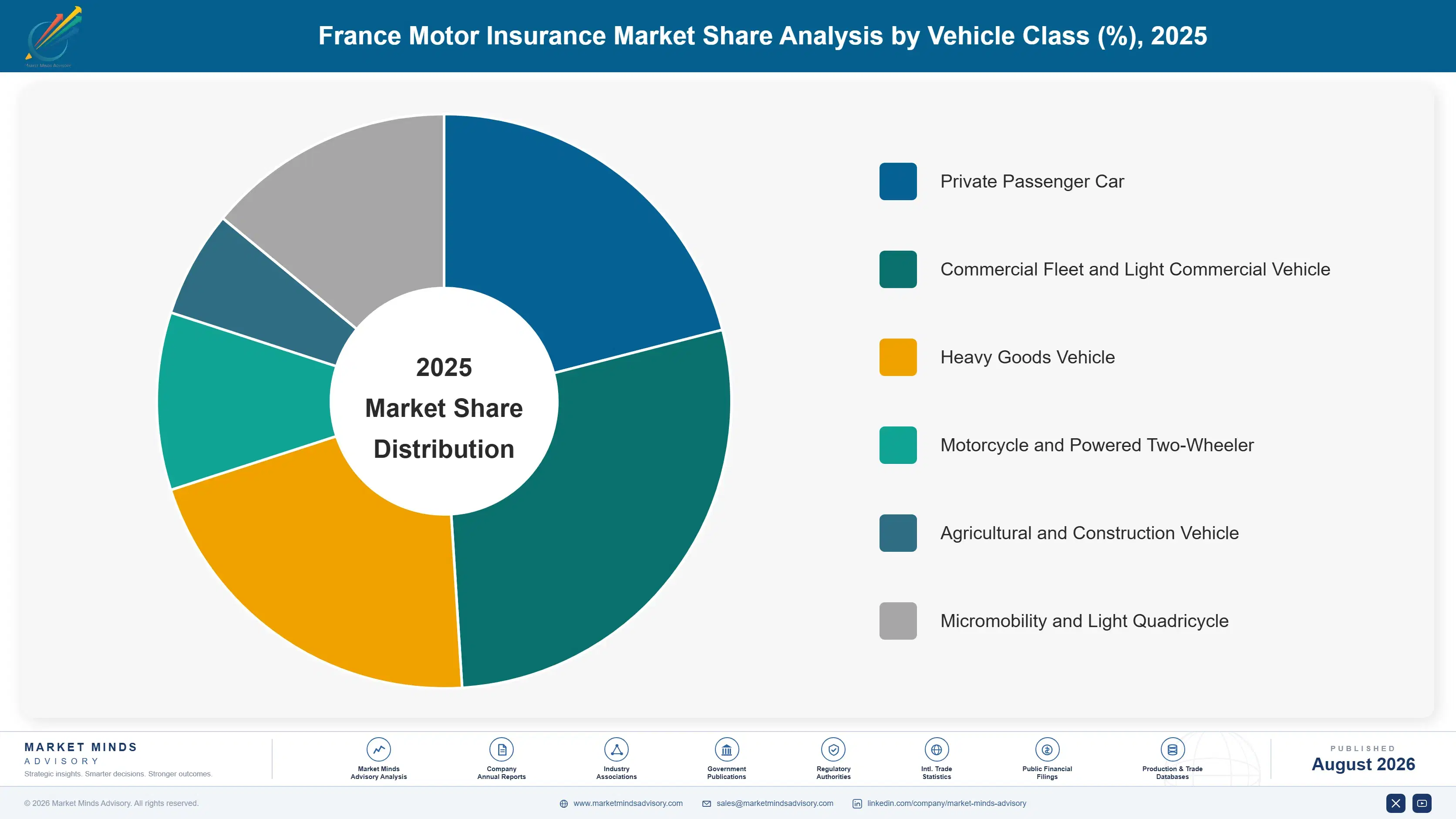
Segmentation follows vehicle class, because that is the axis on which French motor risk, tariff structure and regulatory obligation genuinely differ. Six classes cover the insurable fleet without overlap, from private passenger cars through heavy goods vehicles to the light quadricycles that need no driving licence at all, which is where the growth now sits.
french-motor-insurance-market-market-share-analysis-1787917256823

Micromobility and Light Quadricycle Cover

The fastest segment grows at 6.9%, half again the market rate of 4.6%, and it exists because electric quadricycles reached a price point ordinary buyers could reach. Registrations of vehicles drivable without a full licence have climbed steadily, drawing teenage drivers, elderly drivers who surrendered a licence, and urban households replacing a second car. Compulsory cover applies exactly as it does to any vehicle. The tariff, however, does not translate: these vehicles rarely exceed 45 kilometres an hour, carry no advanced sensors, and use body panels that cost a fraction of a modern bumper. Insurers still pricing them off car tables are either losing volume or writing it far too cheaply.
CAGR 6.9%

Commercial Fleet and Light Commercial Vehicle

Fleet grows at 5.6% and is the only part of French motor where underwriting skill reliably shows in the result. Corporate buyers accept telematics, accept risk-based pricing and negotiate on total cost rather than headline premium, which lets an insurer price the actual exposure instead of a demographic proxy. Light commercial vehicle volume has risen with last-mile delivery, and those vehicles run high annual mileage in dense urban conditions, so frequency is elevated but severity is contained. The commercial channel also carries less churn than retail: switching a hundred-vehicle programme involves procurement, broker involvement and a renewal calendar, none of which move on a comparison site impulse at any speed at all.
CAGR 5.6%
Full segment breakdown across 6 segments available in the complete report.

Regional Architecture and Country Demand Map

This is a French market, so domestic underwriting accounts for nearly all of it. The regions that matter beyond Western Europe do so through claims handling operations, reinsurance capacity, parts supply chains and the overseas activity of French-headquartered carriers rather than through any premium written locally.

North America

Share sits below the standard band because this is a French market by definition and no premium is written outside France. What North America supplies is reinsurance capacity and catastrophe modelling. French motor cedes relatively little compared with property lines, but large bodily injury losses and the aggregate cost of civil unrest events attach to treaties placed partly with Bermudian and United States reinsurers, and the pricing of those treaties has hardened since 2023. Several French carriers also buy their actuarial reserving software and claims analytics from vendors headquartered there, which is a cost line rather than a revenue one and is quietly growing every renewal. That is a cost line nobody talks about.
Share: 3% | CAGR: 4.0% (2026 to 2036)

Western Europe

Effectively the entire market sits here, well above the standard band, because motor insurance is written where the vehicle is registered and this report covers France. Roughly 39 million insured vehicles generate the premium, split across a distribution structure unlike any neighbouring country: mutual insurers write around 57%, bancassurance has taken a meaningful share through Credit Agricole and Credit Mutuel networks, and traditional agent distribution has shrunk without disappearing. Cross-border matters at the edges, since the Green Card system and the Motor Insurance Directive mean a French policy responds to accidents anywhere in the European Economic Area. Nothing in the neighbouring markets resembles this distribution structure, and no imported playbook has ever worked here properly.
Share: 88% | CAGR: 3.6% (2026 to 2036)
Regional intelligence for 5 additional markets available in the complete report: East Asia, South Asia and Pacific, Latin America, Middle East and Africa, Eastern Europe. Contact sales@marketmindsadvisory.com.
french-motor-insurance-market-country-cagr-analysis-1787917257363

Where Motor Margin Can Still Be Found

Four levers address the actual profit problem rather than the visible one. Repair cost control, fleet underwriting discipline, quadricycle pricing and retention economics all improve the combined ratio without relying on tariff increases that Loi Hamon churn immediately punishes at renewal. Each of them works on the loss side rather than the price side.

Own The Parts Sourcing Rather Than The Repair

Insurers who contract directly with recycled and alternative parts distributors, rather than leaving sourcing to the bodyshop, capture the saving the 2023 reform created. Eligible visible parts run roughly 25% to 40% cheaper than original equipment, and on a book where parts are around 45% of repair cost that is worth several points of loss ratio. The obstacle is repairer incentive: shops earn margin on original parts and will not volunteer the alternative. Directing volume to an approved network that agrees to sourcing terms is the only mechanism that reliably works here.
Market Impact: Delivers around a 3 point loss ratio improvement

Price Quadricycles Off Their Own Loss Data

Light quadricycles are being underwritten on assumptions borrowed from small cars, which is wrong in both directions. Speed caps and cheap body panels make severity far lower than a passenger car, while driver demographics skew toward the inexperienced and the elderly, so frequency runs higher. Building a dedicated tariff table on segment-specific data typically reveals 15% to 20% of mispricing in the existing book. The segment grows at 6.9% against a market rate of 4.6%, so the pricing error compounds annually for any carrier that leaves the table uncorrected year after year.
Market Impact: Corrects roughly 18% of average quadricycle tariff mispricing

Convert Fleet Telematics Into Underwriting Advantage

Around 41% of commercial fleet policies now carry telematics, but most insurers use the data for renewal pricing and nothing else. The value sits earlier: intervening with the operator on the specific drivers generating harsh braking and speed events reduces frequency inside the policy period rather than repricing after the loss. Fleets running structured driver feedback programmes show frequency reductions near 12% within two years. That is a shared saving, which is precisely why fleet managers accept the monitoring their retail counterparts refuse. Most carriers have not staffed for that at all.
Market Impact: Reduces commercial fleet claim frequency by around 12%

Stagger Renewal Increases Across Cohort Calendars

A uniform tariff increase applied on one date produces a visible spike, a comparison site surge and a churn event. Spreading the same aggregate increase across renewal cohorts, weighted toward policies with the lowest switching propensity, delivers identical premium with materially less attrition. Carriers running cohort-weighted increases retain roughly four points more of the book than those applying a flat move. On a 14% baseline churn rate that difference is worth more than the increase itself, and it costs nothing beyond actuarial and systems work. Almost nobody in this market does it.
Market Impact: Retains around 4 additional points of the book

Who Controls the Margin Pool

Concentration is high. The five largest underwriters hold around 62% of gross written motor premium in France, with Covea holding a substantial position through its MAAF, MMA and GMF brands. The leader-to-challenger gap is wide enough that no organic movement closes it, and mutual structure rules out the acquisitions that would. Below them, regional mutuals and bancassurance arms compete on distribution reach rather than price.
Competition runs on three dimensions and no participant leads on all of them. The first is claims network economics: who controls repair sourcing. The second is distribution, where bancassurers hold a channel mutuals and agents cannot replicate. The third is tariff courage, the live differentiator, because carriers repricing earlier restored margin sooner and can now hold rate while slower movers catch up.

Pressure is emerging from two directions. Digital direct brands on lower expense ratios are taking price-sensitive retail business mutuals assumed loyal, and Loi Hamon gives them a permanent recruiting window. Meanwhile fleet underwriting is professionalising, favouring participants with telematics capability over those with branch networks. Rankings shift where a carrier lacks both a controlled repair network and a data-led fleet proposition, since neither builds quickly.
french-motor-insurance-market-company-positioning-matrix-1787917257886

Competitive Moat and Risk Dimensions

COVEA

Moat: Three brands, one claims network

Covea runs MAAF, MMA and GMF as distinct customer propositions across a single claims and parts sourcing infrastructure, which gives it repair volume no competitor matches and the negotiating leverage that follows. The brands reach different customer groups without competing internally on cost. Rebuilding an equivalent position would require acquiring three mutuals at once.
COVEA

Risk: Mutual governance slows repricing

Member-owned governance makes sharp tariff correction politically difficult in a way it is not for a listed carrier, and Covea moved later than several competitors when losses first appeared. The structure that protects it from takeover also protects its members from price signals. Restoring margin therefore takes longer and costs more when the correction eventually arrives.
AXA FRANCE

Moat: Group capital and reinsurance access

AXA France sits inside a group with global reinsurance relationships and internal capital allocation, so it absorbs a bad accident year without the solvency strain a standalone domestic mutual would face. It also operates Direct Assurance as a separate low-cost brand, letting it compete on price without contaminating the main tariff. Few French competitors hold both capacities at once.
AXA FRANCE

Risk: Agent network cost structure

The traditional agent distribution AXA France relies on carries an expense ratio that digital-only competitors simply do not have, and every point of expense is a point unavailable for tariff competitiveness. Reducing that network means dismantling relationships built across decades. The alternative is accepting a permanent cost disadvantage in the price-sensitive retail segment where volume actually sits.

Players Tracked

Prominent Players

Covea
AXA France
Groupama
Macif
Allianz France

Other Key Players

Generali France
MAIF
Matmut
Pacifica
Assurances du Credit Mutuel
Abeille Assurances
Direct Assurance
L'olivier Assurance
Thelem Assurances
SMACL Assurances
Mutuelle de Poitiers Assurances
Sogessur
Suravenir Assurances
Amaguiz
Leocare

Recent Developments

JANUARY 2023

Alternative parts opened to non-manufacturer supply

A regulatory change under the Loi Climat et Resilience ended manufacturer design protection on glazing, mirrors and optical parts, allowing independent suppliers to sell equivalents. Repairers must now present a recycled option on eligible parts. This was legislative reform, not any commercial transaction between participants.
Signal: The parts monopoly ended by statute rather than by any competitive pressure from insurers themselves here.
JUNE 2023

Civil unrest produced concentrated vehicle losses

Urban disorder across multiple French cities destroyed several thousand vehicles within roughly a week, with France Assureurs estimating insured damage across all lines in the hundreds of millions of euros. Motor accounted for a substantial portion. The event was an accumulation loss rather than a corporate development.
Signal: Motor books carry a concentration exposure that annual frequency modelling does not really capture at all.
APRIL 2024

Paper insurance certificate withdrawn nationally

France abolished the windscreen green certificate and moved enforcement entirely to the Fichier des Vehicules Assures, a national database checked by roadside and automated systems. The change was administrative reform by the state, not a joint venture, acquisition or supply agreement between any market participants.
Signal: Uninsured driving becomes detectable automatically, which changes enforcement economics far more than it changes underwriting practice.

What A Motor Claim Actually Costs

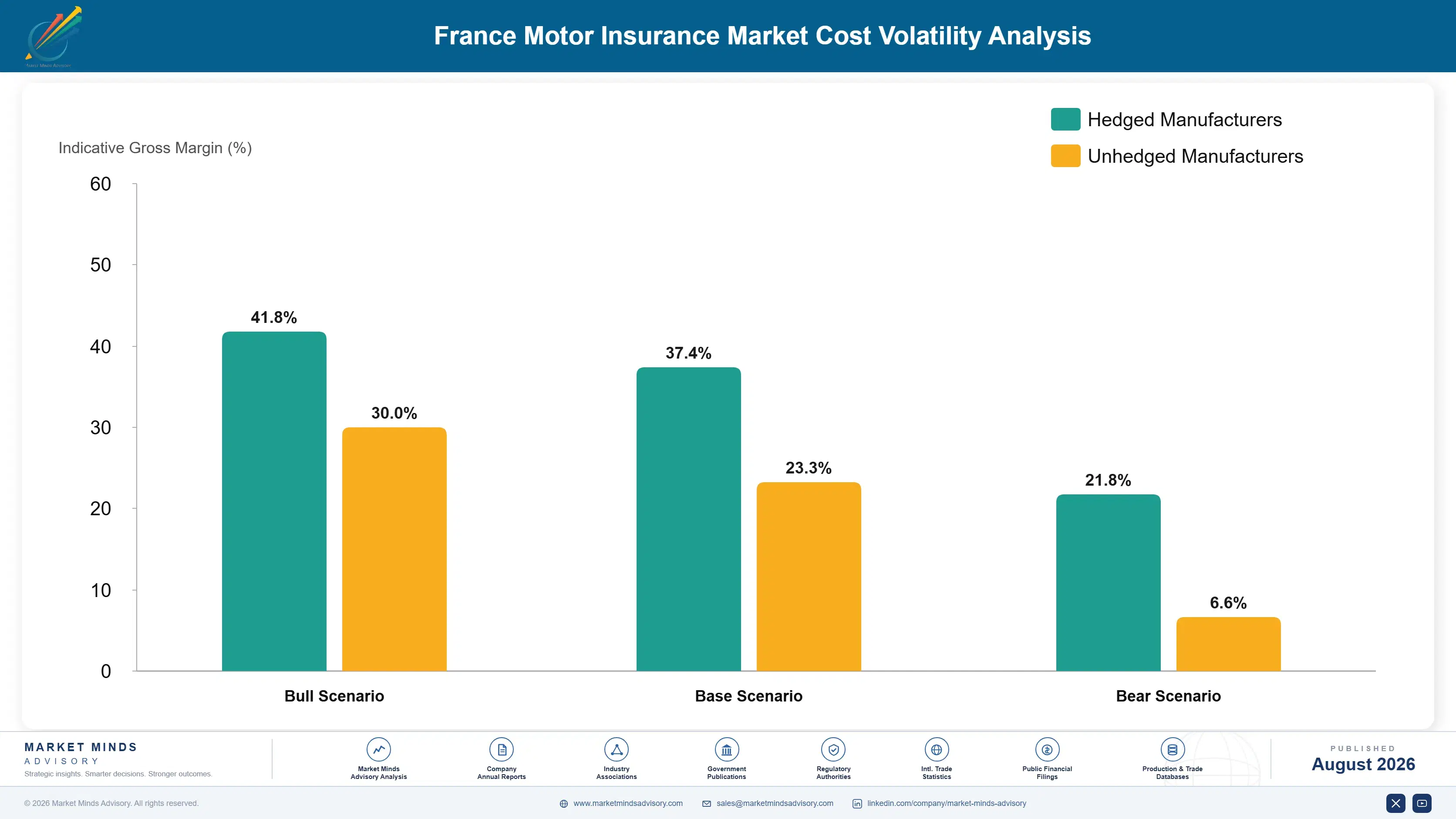
Claims cost is the input, splitting into three unequal parts. Bodily injury indemnity runs around 48% of the total, settled against court-linked compensation schedules. Vehicle repair, covering parts, paint and labour, accounts for roughly 39%, with parts alone near 45% of that figure and sourced increasingly from East Asian component manufacturers. Assistance, courtesy vehicles and claims handling expense make up the remaining 13%.
The 2021 to 2023 semiconductor shortage is the cleanest recent illustration. Sensor and control module availability collapsed, repair times extended from days to weeks, and courtesy vehicle days per claim rose sharply while the vehicle waited for a part. AXA and Covea both disclosed elevated claims cost in their annual reports. The parts cost more and the delay cost more again, neither recoverable through a tariff already fixed for that policy year.

Exposure varies sharply by book composition and that is the competitive mechanism. A carrier weighted toward recent premium vehicles carries far higher sensor content per claim than one weighted toward older cars, so identical frequency produces different severity. Direct brands writing younger, cheaper vehicles hold a cost advantage they did not engineer. Mutuals with long-tenure members driving newer cars carry the opposite position.
french-motor-insurance-market-cost-volatility-analysis-1787917258081

Approved repair network with sourcing conditions

Directing claims to a contracted network that agrees to alternative parts sourcing, fixed labour rates and repair time commitments converts the 2023 reform into an actual saving. Shops accept the terms in exchange for guaranteed volume. Carriers without sufficient claims volume to make that trade cannot obtain the same conditions on any terms at all.

Earlier rehabilitation intervention on injury claims

Bodily injury settles faster and cheaper when medical and vocational rehabilitation starts early rather than after litigation begins. The saving comes from reduced loss of earnings heads of damage rather than from disputing the claim. It requires case handlers with medical training and a willingness to spend money years before the settlement is reached at all.

Reinsurance attachment reset against accumulation risk

Civil unrest and severe storm events showed that motor books carry accumulation exposure conventional frequency models understate badly. Resetting treaty attachment points and buying dedicated aggregate cover costs premium but caps the tail. Carriers that reviewed their programmes after 2023 paid noticeably more at the following renewal and secured considerably better terms than those who waited.

Portfolio Architecture for Margin Defence

The portfolio splits by margin logic rather than by vehicle class. Volume retail motor is the commodity core: compulsory, price-shopped, transparent, and running at or below breakeven for most participants through this cycle. It exists because scale in claims and parts sourcing depends on it, not because the business itself pays. Losing it would raise unit repair cost across everything else.
Premium sits in commercial fleet and specialist classes where underwriting information is genuinely asymmetric. A fleet programme priced off telematics data, or an agricultural book priced off local claims history, earns margin that retail cannot because the buyer is comparing total cost rather than a headline figure on a comparison screen. The tension is that these books are smaller and slower to grow, so a carrier chasing them exclusively loses the volume its claims economics depend on.

The highest-value pools are forming at the edges. Quadricycle and micromobility cover, telematics-priced fleet, and attached legal protection all carry margins the standard car tariff cannot approach, and none of them attracts the political scrutiny compulsory retail motor does. That combination is unusual and will not last once competitors notice it properly.

Volume / Commodity-Adjacent

Standard private passenger car cover sold through comparison sites and branch networks. Fully price-transparent, heavily shopped, and running near breakeven across most of the current cycle. Retained for claims scale rather than for the margin itself.
Gross Margin: 2-5%

Premium / Certified

Commercial fleet, agricultural and specialist vehicle classes where underwriting information asymmetry survives. Range spans four points because fleet margin varies materially with telematics penetration and operator sector, not with insurer skill alone.
Gross Margin: 7-11%

Sustainability / Regulatory / Next-Generation

Quadricycle, micromobility and telematics-native propositions plus attached legal protection. Range spans six points because segment loss data remains thin and pricing accuracy differs sharply between carriers with dedicated tables and those extrapolating from car assumptions.
Gross Margin: 10-16%
french-motor-insurance-market-portfolio-architecture-1787917258582

High-value Sub-segments and Strategic Watch-out

Light Quadricycle Cover

High value and high growth at 6.9%, driven by electric models reaching mass-market pricing. Margin holds while most competitors still price off passenger car tables. Four point range reflects genuine tariff dispersion between carriers. That window closes as soon as somebody builds a proper table.
Gross Margin: 13-17%

Telematics-Rated Commercial Fleet

High value with moderate growth at 5.6%. Corporate buyers accept monitoring and risk pricing, so underwriting skill converts directly into result. Margin depends on whether the insurer intervenes during the policy or only reprices at renewal. Most of them still only reprice at the annual renewal.
Gross Margin: 9-12%

Private Passenger Car

The volume core and the reason claims scale exists at all. Compulsory, shopped annually under Loi Hamon, and priced against a repair cost line that has outrun the tariff for four consecutive years across essentially the whole market. No participant can realistically exit it at all.
Gross Margin: 2-5%

Bodily Injury Reserve Book

The strategic watch-out rather than a growth pool. Nearly half of claims cost settles on court-linked schedules over multiple years, so today's pricing assumptions are validated or destroyed long after the underwriting decision was actually taken. That reporting lag is the real risk in this book.
Gross Margin: Variable

Why The Premium Keeps Arriving

Compulsory cover produces annuity economics almost no other consumer product enjoys. Every registered vehicle must carry third-party liability under the Code des assurances, enforcement now runs automatically through the vehicle database, and the penalty for driving uninsured is severe enough that evasion stays limited. Revenue therefore arrives regardless of economic conditions, brand preference or customer satisfaction, which is why the line survived four unprofitable years without any participant seriously considering exit.
Stickiness varies enormously by buyer type. Retail policyholders churn at roughly 14% annually because Loi Hamon made switching free and comparison sites made it easy. Commercial fleet buyers churn far less, since moving a programme involves procurement cycles, broker relationships and a renewal calendar. Agricultural and specialist classes are stickier still, because local mutual relationships carry decades of history and the alternative underwriters barely understand the risk.

Buyer profiles are shifting generationally. Younger urban households increasingly own no car at all, arriving instead through quadricycles, scooters or occasional-use cover, which fragments a premium base built on one household one vehicle. Older policyholders remain with mutual insurers they joined in their thirties. The gap between those two groups is widening every year and no carrier currently serves both well.
french-motor-insurance-market-end-use-penetration-index-1787917259067

Where Motor Profit Returns

These are among the four positions where our research anticipates prominent divergence between winners and laggards over the coming forecast period. Each is grounded in the demand model, the regulatory perimeter, and the announced capacity pipeline.
01 / REPAIR COST CONTROL

Own the parts supply or accept the loss ratio

Parts represent roughly 45% of repair cost and repair represents around 39% of total claims, so sourcing is the single largest controllable input in the entire book that any carrier holds. The 2023 reform opened eligible visible parts to independent supply, but bodyshops earn margin on original equipment and will not volunteer the alternatives to anybody at all. Carriers that contract sourcing terms directly with their own approved network capture the saving; those leaving it to the repairer simply do not.
02 / TARIFF SEQUENCING DISCIPLINE

Stagger increases across cohorts rather than moving once

A uniform increase applied on a single date produces a visible spike, a comparison site surge and an immediate churn event against a churn baseline already running near 14% annually. Spreading the same aggregate move across renewal cohorts, weighted toward the least price-sensitive policies in the book, delivers identical premium while retaining around four additional points of the book. The work is actuarial and systems-based, costing nothing beyond effort, and almost nobody in this particular market currently does it properly at all.
03 / EMERGING CLASS PRICING

Build a quadricycle tariff before competitors notice the segment

Light quadricycles grow at 6.9%, half again the market rate of 4.6%, and almost every carrier prices them off passenger car tables that fit neither their severity profile nor their actual driver demographics. Speed caps and cheap body panels make severity far lower, while inexperienced and elderly drivers push frequency considerably higher. A dedicated tariff table built on actual segment loss data typically finds 15% to 20% of mispricing, and that error compounds annually while the segment itself keeps on expanding.
04 / FLEET UNDERWRITING CAPABILITY

Intervene during the policy, do not reprice after it

Telematics now reaches around 41% of all commercial fleet policies, yet most insurers treat the data purely as a renewal pricing input rather than as an operational tool during the cover period itself at all. Fleets running structured driver feedback on harsh braking and speed events show frequency reductions near 12% within roughly two years of starting. That saving is shared with the operator, which is precisely why commercial buyers accept the monitoring that their retail counterparts have consistently refused outright.

Engagement Snapshot From the Field

A live engagement with an industry participant carrying material or product regulatory and market exposure ahead of a defining policy shift, showing how our research translates into a defensible multi-year portfolio strategy.
MARKET MINDS ADVISORY · CLIENT ENGAGEMENT SUMMARY
France Motor Insurance Producer Strategic Portfolio Review and Transition Roadmap 2026·Investment Scenario on France Motor Insurance Exposure Evaluation 2025-26
CLIENT PROFILE
A French composite mutual with a substantial motor book written predominantly through member relationships and regional branches, holding a national position outside the top five by gross written premium. The organisation had operated above a 100 combined ratio in motor for three consecutive years while maintaining member-facing pricing restraint that its board considered central to the mutual proposition and its own identity.
STRATEGIC CHALLENGE
The board needed to restore motor underwriting profitability without the sharp tariff correction that member governance made politically unacceptable, and without conceding volume to digital direct competitors recruiting continuously through the Loi Hamon cancellation window. Management could not establish which portion of the deterioration was pricing, which was claims cost, and which was book composition drift.
MMA APPROACH
MMA decomposed three years of claims data by vehicle sensor content, repair channel and injury reserve development, then benchmarked parts sourcing and labour rates against contracted network terms available in the market. Expert interviews with repairers, parts distributors and fleet buyers established what sourcing conditions were genuinely obtainable at the client's claims volume rather than in theory.
KEY FINDINGS
  1. Parts sourcing accounted for more of the deterioration than tariff shortfall did, with the client paying original equipment prices on eligible visible parts where alternatives existed.
  2. Book composition had drifted toward newer, higher sensor content vehicles as members replaced cars, raising severity per claim by an estimated 11% without any change in driving behaviour.
  3. Quadricycle policies were being written off passenger car tables, producing an estimated 19% underpricing against segment loss experience the client had never separated out.
  4. Injury reserve development on the 2021 and 2022 accident years was running ahead of assumption, meaning the reported combined ratio understated the underlying position materially.
CLIENT PROFILE
A French composite mutual with a substantial motor book written predominantly through member relationships and regional branches, holding a national position outside the top five by gross written premium. The organisation had operated above a 100 combined ratio in motor for three consecutive years while maintaining member-facing pricing restraint that its board considered central to the mutual proposition and its own identity.
STRATEGIC CHALLENGE
The board needed to restore motor underwriting profitability without the sharp tariff correction that member governance made politically unacceptable, and without conceding volume to digital direct competitors recruiting continuously through the Loi Hamon cancellation window. Management could not establish which portion of the deterioration was pricing, which was claims cost, and which was book composition drift.
MMA APPROACH
MMA decomposed three years of claims data by vehicle sensor content, repair channel and injury reserve development, then benchmarked parts sourcing and labour rates against contracted network terms available in the market. Expert interviews with repairers, parts distributors and fleet buyers established what sourcing conditions were genuinely obtainable at the client's claims volume rather than in theory.
KEY FINDINGS
  1. Parts sourcing accounted for more of the deterioration than tariff shortfall did, with the client paying original equipment prices on eligible visible parts where alternatives existed.
  2. Book composition had drifted toward newer, higher sensor content vehicles as members replaced cars, raising severity per claim by an estimated 11% without any change in driving behaviour.
  3. Quadricycle policies were being written off passenger car tables, producing an estimated 19% underpricing against segment loss experience the client had never separated out.
  4. Injury reserve development on the 2021 and 2022 accident years was running ahead of assumption, meaning the reported combined ratio understated the underlying position materially.
RECOMMENDED STRATEGY
Phase 1: Phase one: contract an approved repair network with binding alternative parts sourcing and fixed labour terms, directing sufficient claims volume to make the conditions obtainable. Phase 2: Phase two: build a dedicated quadricycle tariff on segment loss data and reprice the existing book at renewal across staggered cohorts. Phase 3: Phase three: implement cohort-weighted tariff sequencing across the retail motor book, targeting the aggregate increase actuarial work indicated without a single visible move.
OUTCOME
The client reported a 2.8 point combined ratio improvement in motor within four quarters (client-reported, unverified by MMA), with roughly two thirds attributed to parts sourcing and the remainder to quadricycle repricing. Retention held within half a point of the prior year despite the aggregate tariff movement, which the board had considered the binding constraint.

Frequently Asked Questions

Foundational context covering the market sizes, CAGR, scope, country, region and competition that inform every finding below. This section is provided to cover basics and most often pre-purchase conversations, answered from the MMA Primary Research Dataset.

What is the current size of the France Motor Insurance Market?

The market is valued at USD 26.4 billion in 2025, measured as gross written premium for compulsory and voluntary motor cover underwritten in France. It is the largest French non-life line by premium.

How large will the France Motor Insurance Market be by 2036?

MMA forecasts USD 43.29 billion by 2036, up from USD 27.61 billion in 2026. That represents incremental premium of USD 15.68 billion and an expansion multiple of 1.57 times.

What is the CAGR for the France Motor Insurance Market 2026 to 2036?

The base case CAGR is 4.6%, with a bull case of 5.8% and a bear case of 3.4%. Growth comes primarily from tariff correction rather than from any increase in insured vehicle numbers.

Which segment is growing fastest?

Micromobility and light quadricycle cover grows at 6.9%, half again the market rate of 4.6%. Electric quadricycles priced near a scooter have made the category genuinely mainstream.

Who are the major companies in the France Motor Insurance Market?

Covea, AXA France, Groupama, Macif and Allianz France lead on gross written motor premium, holding around 62% between them. Mutual insurers account for roughly 57% of total premium written.

Which country is growing fastest?

India grows fastest at 6.7%, though that reflects expanding offshore claims administration and actuarial support rather than any premium written outside France. All motor risk here is underwritten domestically.

Report Segmentation Architecture

The full report scope spans multiple orthogonal segmentation dimensions, with cross-tabulated demand data provided for each dimension pair. Coverage extends further to regional breakdowns, trend trajectories, and the competitive detail needed to support segment-level decision-making.

By Vehicle Class

  • Private Passenger Car
  • Commercial Fleet and Light Commercial Vehicle
  • Heavy Goods Vehicle
  • Motorcycle and Powered Two-Wheeler
  • Agricultural and Construction Vehicle
  • Micromobility and Light Quadricycle

By End-Use Industry

  • Retail Households
  • Road Freight and Logistics
  • Passenger Transport and Taxi
  • Agriculture and Viticulture
  • Construction and Public Works
  • Public Sector and Local Authority Fleets

By Commercial Dimension

  • Agent and Broker Distribution
  • Mutual Direct Membership
  • Bancassurance Networks
  • Digital Direct and Comparison Sites
  • Affinity and Dealer Point of Sale
  • Delegated Underwriting and Managing General Agents

By Region

  • North America
  • Western Europe
  • East Asia
  • South Asia and Pacific
  • Latin America
  • Middle East and Africa
  • Eastern Europe

Scope, Methodology, and Coverage

Every figure in this report is reproducible from documented input assumptions. The scope below maps the historical period, the forecast horizon, the segmentation dimensions, and the countries covered, alongside the underlying primary and qualitative methodology.
Historical Period
2020 to 2025
Forecast Period
2026 to 2036
Base Year
2025 (USD billions; MMA Primary Research Dataset, August 2026)
Market Definition
Gross written premium for compulsory third-party liability and voluntary damage cover on motor vehicles underwritten in France, spanning private passenger cars, commercial fleets, heavy goods vehicles, powered two-wheelers, agricultural and construction machinery, and light quadricycles requiring no full licence. Assistance and legal protection sold inside the motor contract are included. Standalone breakdown subscriptions, dealer mechanical warranty and all non-motor lines are excluded.
Quantitative Units
USD billions, gross written premium
Segmentation Dimensions
Vehicle class, end-use industry, commercial distribution dimension, region
Regions Covered
North America, Western Europe, East Asia, South Asia and Pacific, Latin America, Middle East and Africa, Eastern Europe
Countries Covered
France, with cross-border claims exposure across the European Economic Area, Morocco and Tunisia
Key Companies Profiled
Covea, AXA France, Groupama, Macif, Allianz France, Generali France, MAIF, Matmut, Pacifica, Assurances du Credit Mutuel
Quantitative Methodology
Primary survey, n=3,800 respondents, Q4 2025, six countries; demand-side model with trade association cross-validation
Qualitative Methodology
47 expert interviews, Q4 2025; applied to validate demand model assumptions, identify emerging dynamics, and assess competitive positioning
Report Format
PDF and XLSX data workbook (Word format preview document)
Publisher
Market Minds Advisory
Report Code
MMA-2026-TEC-341
Published
August 2026
Contact
sales@marketmindsadvisory.com | www.marketmindsadvisory.com

Purchase the full France Motor Insurance Market Report (2026 to 2036).

The full report examines French motor insurance as a compulsory line that has run an underwriting loss for four consecutive years, and identifies where margin can still be recovered. It decomposes claims cost by bodily injury, repair and expense, and traces how advanced driver assistance systems converted a frequency improvement into a severity problem. Segment analysis covers all six vehicle classes with dedicated attention to light quadricycles, the fastest growing and most consistently mispriced category. Competitive analysis assesses twenty participants on gross written motor premium, with detailed positioning on the five largest. Regional coverage addresses reinsurance, parts supply and offshore claims administration as genuine cost transmission channels.
Six vehicle class segmentation with growth rates
Claims cost decomposition by component share
Twenty participant competitive assessment on premium basis
Parts sourcing benchmark against contracted network terms
Quadricycle tariff mispricing quantification against segment loss data
Cohort-weighted retention modelling for tariff sequencing

Built For The People Who Decide

From boardroom strategy to bench-side execution, this report is read cover-to-cover by leaders shaping the next decade of their industry, turning demand scenarios, market dynamics and valuation benchmarks into decisions.
CXOs/ Presidents/ VPs/ Managers
M&A and Corporate Development
Strategy Teams and R&D Heads
Procurement and Product Directors
Regulatory and Compliance Leaders
Investor Relations and Equity Analysts