Market Minds Advisory
Freeze-Dried Food Market

Freeze-Dried Food Market: Energy Cost Geography, Premium Pet Conversion and the Chamber Utilisation Problem

Sublimating a kilogram of water costs several times what evaporating it does, which means the map of who makes freeze-dried food is drawn almost entirely by the price of industrial electricity.

Lead Analyst

Lisa Gevelber

Published

September 2026

Make Smarter Decisions with Customized Research Insights

Request a free sample report and evaluate market opportunities, growth trends, and competitive dynamics relevant to your business needs.

2025 MARKET VALUE$38.4BMarket Size 2025
2036 FORECAST VALUE$84.2BBase Case , 2026 to 2036
CAGR 2026 TO 20367.4 %Bull 8.7% / Bear 6.1%
INCREMENTAL OPPORTUNITY$43.0BNet 10- year value creation
EXPANSION MULTIPLE2.04x2036 value over 2026 base
Strategic Levers
M&A Pipeline
Regional Outlook
Country Rankings
Competitive Intelligence
Segmental Deep-dive
Call-Us : 91 93563 13602

Executive Snapshot and Market Trajectory

Freeze-drying competes on quality and loses on cost, because sublimating water under vacuum consumes roughly 6.2 kilowatt hours per kilogram against a fraction of that for spray drying. Where an application genuinely pays for that quality, the process wins outright. Where it will not, nothing about the technology helps anybody.
Freeze-dried pet food and treats compound at 11.1%, exactly 1.50 times the market rate, because premium pet owners will pay for raw nutrition preserved without heat in a way grocery shoppers rarely will for their own food. East Asia holds 30% of value, the largest position, combining Japanese ready meal culture with Chinese processing capacity supplying much of the world. Finished product realises roughly USD 24 per kilogram across the category.
Five producers ship 31% of finished tonnage, which is remarkably fragmented for a capital-intensive process, because a lyophiliser is buyable and the barriers are energy price and utilisation rather than technology. Chambers run at 68% utilisation on 22 hour cycles. Both numbers decide whether a plant makes money at all. Production has migrated toward cheap industrial power, and the customers who requalified elsewhere never came back.
Market Definition
Covers food and beverage products preserved by lyophilisation, meaning freezing followed by sublimation of water under vacuum, spanning freeze-dried pet food and treats, freeze-dried ready meals and soups, freeze-dried fruit and vegetables, freeze-dried coffee and beverage powders, freeze-dried meat, fish and dairy, and freeze-dried ingredients supplied to food manufacturers. Sizing captures finished product revenue at realised selling price across retail, foodservice, industrial and institutional channels. Excludes spray-dried, drum-dried and air-dried products, lyophilised pharmaceuticals and biologics, freeze-drying equipment and lyophiliser capital, retort and canned shelf-stable foods, dehydrated products using heat alone, and frozen foods sold frozen.
Base Year Value
$38.4B in 2025 (MMA Primary Research Dataset, August 2026)
Forecast Period
2026 to 2036, eleven discrete annual values
CAGR
7.4% base case. Bull 8.7%. Bear 6.1%.
Fastest Growth Segment
Freeze-Dried Pet Food and Treats: 11.1% CAGR
Fastest Growth Country
India: 10.1% CAGR
Fastest Growth Region
South Asia and Pacific: 9.5% CAGR
Largest Region
East Asia: 30% of 2025 global value
Market Leaders
Nestle, Ajinomoto, Asahi Group Holdings, European Freeze Dry, Van Drunen Farms. Source: MMA Analysis based on company annual reports.
Primary Survey
n=3,800 procurement and R&D decision-makers, Q4 2025, six countries
Methodology
Demand-side build-up, cross-validated against public data, 47 expert interviews

Freeze-Dried Food Market Forecast Scenarios

freeze-dried-food-market-size-forecast-scenario-1787309946314
Growth of 6.2% across 2020 to 2025 was reshaped in the middle by an energy shock nobody in the industry had modelled. Household stockpiling lifted shelf-stable food demand sharply during 2020 and 2021, and premium pet conversion accelerated throughout. Then European industrial electricity prices made freeze-drying uneconomic at several plants, capacity closed, and production shifted permanently toward cheaper power.
The base case of 7.4% rests on three mechanisms. Premium pet food keeps converting to freeze-dried because raw nutrition preserved without heat is a claim owners pay for readily, and the segment absorbs the process cost that grocery categories cannot. Japanese and Korean ready meal formats keep expanding into neighbouring retail markets successfully. And Asian processing capacity keeps growing on electricity prices that make the arithmetic work where European plants cannot.
The bull case of 8.7% assumes premium pet food conversion continues at current rates across Western and Asian markets together, which would grow the highest-value application faster than any process cost pressure erodes it. The bear case of 6.1% reflects two pressures: energy prices staying elevated enough to push marginal producers out entirely, and consumer trading down in the premium categories carrying the process cost.

Electricity Decides Who Makes It

Everything about this industry follows from one physical fact. Removing water by sublimation consumes roughly 6.2 kilowatt hours per kilogram, several times what evaporation costs, and no engineering changes the thermodynamics much. What the process buys is quality that nothing else delivers: 94% of original texture and nutrient profile recovered on rehydration, structure preserved rather than collapsed, and shelf life measured in years without refrigeration or preservatives.
TOP FIVE CONCENTRATION31%Finished product tonnage shipped by the leading global producers
ENERGY PER KILOGRAM REMOVED6.2 kWhElectricity consumed to sublimate one kilogram of water
AVERAGE SELLING PRICEUSD 24Realised price for one kilogram of finished product
CHAMBER UTILISATION68%Share of installed lyophiliser chamber hours actually running
CYCLE DURATION22 hoursTypical time to complete one full drying batch
REHYDRATION RETENTION94%Original texture and nutrient profile recovered on rehydration
That trade determines the whole commercial map. Applications willing to pay for the quality thrive, which is why premium pet food compounds at 11.1% while commodity dehydration never moved to freeze-drying at all. Applications that will not pay simply use another method. And production migrates relentlessly toward cheap industrial electricity, which is why the 2022 European energy shock closed plants that had operated profitably for decades and moved that volume permanently eastward.
Two operating numbers decide whether any individual plant earns anything. Chambers run at 68% utilisation because cycles take 22 hours and loading, freezing and unloading consume the rest, and a chamber standing idle still carries its capital and its vacuum system. Producers who fill chambers and buy power well make money, and those who do neither do not survive a shock.
"People think this is a food industry and it is mostly an electricity industry that happens to produce food. A lyophiliser is a machine for converting cheap power into shelf life. When European power went to five times normal, the question was never whether the product was good. It was whether anyone could still afford to make it there."
Director, Food Preservation and Processing Practice · MMA Agriculture and Food /

Market Trends

Premium pet food absorbs process cost grocery never could

Raw nutrition preserved without heat is a claim premium pet owners pay for readily, at price points per kilogram that grocery shoppers refuse for their own food, which makes pet the one application that comfortably absorbs the 6.2 kilowatt hours per kilogram the process consumes. The segment compounds at 11.1% against 7.4% for the market. Ingredient cost is also higher, since the meat and organ inputs premium formulations use are expensive before any drying happens. Contract capacity for pet formats is now genuinely tight in several regions, which is unusual for a process anybody can buy equipment for.
Market Impact: Retains 94% on rehydration quality
Production migrates toward cheap industrial electricity permanently

The 2022 European energy shock made freeze-drying uneconomic at several established plants, and curtailed or closed capacity has not returned even as prices eased, because customers requalified supply elsewhere and requalification runs both ways. Production shifted toward Asian and North American regions with cheaper industrial power. That migration is built into the cost curve rather than reflecting any preference, and neither product quality nor proximity to raw material has reversed it anywhere. Siting now follows power price rather than raw material origin, which reverses decades of established industry siting practice entirely.
Market Impact: Holds 30% of global category value

Market Opportunities and Growth Drivers

Japanese ready meal formats export into neighbouring markets

Freeze-dried miso soup, rice bowls and instant ready meals are an established everyday category in Japan rather than a novelty, supported by decades of format development and consumer familiarity that no Western market has built. Those formats are now exporting into Korean, Taiwanese, Chinese and Southeast Asian retail with considerable success. The segment grows at 9.4%. Rehydration quality at 94% retention is what makes the format work at all, since a reconstituted soup that tastes processed simply does not sell twice to anybody. Western equivalents stay confined to outdoor and emergency channels at far lower volumes.
Market Impact: Consumes 6.2 kWh per kilogram

Asian processing capacity grows on industrial electricity arithmetic

Chinese and Indian industrial electricity prices make freeze-drying economics work at volumes and margins European plants can no longer reach, and capacity has been added accordingly across fruit, vegetable and ingredient formats. East Asia holds 30% of category value at 8.4% growth and South Asia and Pacific grows at 9.5%. Western food manufacturers increasingly buy freeze-dried ingredients from Asian processors rather than making them, which moves value as well as tonnage and is proving very difficult to reverse. Requalifying a processor takes months in either direction, which is what makes the shift durable.
Market Impact: Idles chambers 32% of hours

Market Restraints and Challenges

Energy intensity caps which applications can ever afford it

Sublimation consumes roughly 6.2 kilowatt hours per kilogram of water removed, and the root cause is thermodynamic rather than engineering: the latent heat of sublimation must be supplied under vacuum whatever the equipment does. That places most food categories permanently out of reach, since a commodity vegetable cannot carry the cost. Producers respond by concentrating on premium applications, by siting plants where industrial power is cheapest, and by improving cycle design and chamber loading rather than pretending the physics will change. Commodity vegetable applications will never carry it whatever anybody builds.
Market Impact: Pays roughly 3 times grocery pricin

Chamber utilisation determines whether a plant earns anything

Lyophiliser chambers run at 68% utilisation because a 22 hour cycle plus loading, freezing and unloading leaves substantial idle time, and the root cause is batch physics rather than scheduling failure. An idle chamber still carries capital, vacuum pumps and refrigeration standby. Producers respond by running mixed product campaigns to fill gaps, by taking contract work between owned production runs, and by investing in pre-freezing capacity so chambers are never waiting for frozen product to arrive. Utilisation without margin is exactly how several producers went bankrupt through the energy shock.
Market Impact: Shifted 6.2 kWh cost eastward
3 additional market trends, 4 additional growth drivers, and 2 additional restraints and challenges are covered in the full report. Contact sales@marketmindsadvisory.com to access the complete intelligence.

Segment CAGR and Growth Architecture

Segmentation follows the finished product category, because category determines whether an application can carry the process cost, which channel sells it and what price it commands. Processing format, packaging type and geography all matter commercially but cut across every category, so they belong in later discussion. Six categories cover current freeze-dried food production worldwide.
freeze-dried-food-market-market-share-analysis-1787309946846

Freeze-Dried Pet Food and Treats

Freeze-dried pet food compounds at 11.1%, exactly 1.50 times the market rate, and it is the one application that comfortably absorbs what the process costs. Raw nutrition preserved without heat is a claim premium owners pay for readily, at per kilogram pricing grocery shoppers refuse for their own food. Three commercial features follow. Ingredient cost is high before drying even begins, since premium formulations use meat and organ inputs rather than cereal. Contract chamber capacity for pet formats is genuinely tight in several regions. And brand rather than process differentiates, which suits pet marketers and frustrates processors considerably. Brand owners contract the chambers rather than building them, which keeps value with the brand.
CAGR 11.1%

Freeze-Dried Ready Meals and Soups

Ready meals and soups grow at 9.4%, second fastest, and Japan is the reason. Freeze-dried miso soup, rice bowls and instant meals are an ordinary everyday category there rather than a camping novelty, built on decades of format development that no Western market attempted. Those formats now export into Korean, Taiwanese, Chinese and Southeast Asian retail successfully. Rehydration quality is what carries it, since a reconstituted meal that tastes processed does not sell twice. Western equivalents remain concentrated in outdoor and emergency channels at considerably lower volumes and consumer expectations. Several Western producers have attempted to build equivalent everyday familiarity and none has ever managed it at meaningful scale anywhere.
CAGR 9.4%
Full segment breakdown across 6 segments available in the complete report.

Regional Architecture and Country Demand Map

East Asia leads at 30% of value, combining Japanese ready meal culture with Chinese processing capacity supplying much of the world. North America follows at 24% on premium pet food. South Asia and Pacific grows fastest, led by India at 10.1%, on processing capacity additions.

North America

Twenty-four percent of global value sits in North America, growing at 6.7%, and premium pet food explains most of the growth rather than any human food category. Freeze-dried raw pet formats moved from specialist retail into mainstream pet channels and now support contract chamber capacity that is genuinely tight in several states. Industrial electricity prices are competitive by global standards, which kept domestic processing viable when European capacity closed. Outdoor and emergency food remains a real but static niche. Coffee volumes are large and priced as commodity ingredient rather than as premium product. Industrial power contracting rather than raw material access is what separates the plants earning here from those merely operating.
Share: 24% | CAGR: 6.7% (2026 to 2036)

Western Europe

Growth of 5.9% is the slowest of any region, and 22% of value reflects a processing base that shrank permanently after 2022. Industrial electricity prices made freeze-drying uneconomic at several established plants, capacity was curtailed or closed, and customers requalified supply in Asia and North America rather than waiting. German, Dutch and Nordic producers hold strong positions in premium ingredient and pet formats where pricing carries the cost. British and Polish plants serve regional retail. The remaining capacity is concentrated in applications where proximity or provenance genuinely commands a premium. Customers who requalified Asian and North American supply during the 2022 interruption have not returned, which is why the capacity loss proved permanent rather than cyclical.
Share: 22% | CAGR: 5.9% (2026 to 2036)
Regional intelligence for 5 additional markets available in the complete report: East Asia, South Asia and Pacific, Latin America, Middle East and Africa, Eastern Europe. Contact sales@marketmindsadvisory.com.
freeze-dried-food-market-country-cagr-analysis-1787309947347

Four Ways To Beat The Physics

Sublimation costs 6.2 kilowatt hours per kilogram and no engineering changes that, so the commercial question is which applications carry the cost and which chambers stay full. The levers that matter choose applications deliberately, fill chambers, and buy power like an industrial rather than a food business. Each carries returns tested against disclosed producer economics and primary interview evidence.

Concentrate capacity on applications that carry the cost

Premium pet food pays roughly three times what grocery categories will for the same processing, and commodity vegetable applications never carry it at all. Producers shifting chamber time toward premium pet and specialty ingredient formats report gross margin roughly 18 points above general food processing mix. It means declining volume that would fill chambers at low margin, which plant managers measured on utilisation resist strongly, and utilisation without margin is exactly how producers went bankrupt through the energy shock. Commodity vegetable work fills chambers and earns very little worth having at all.
Market Impact: Lifts gross margin roughly 18 point

Fill idle chamber hours with contract campaign work

Chambers run at 68% utilisation because 22 hour cycles plus loading and freezing leave gaps that owned production cannot fill evenly, and an idle chamber still carries capital and vacuum standby cost. Producers running contract campaigns between owned runs report facility contribution roughly 30% above those operating owned volume alone. It requires scheduling discipline, allergen and changeover management, and a willingness to process for competitors that several family-held producers find genuinely uncomfortable. An idle chamber still draws vacuum standby and refrigeration load whether there is anything at all inside it.
Market Impact: Lifts facility contribution roughly

Contract industrial power the way a smelter would

Electricity is the single largest variable cost and the 2022 shock destroyed producers who bought it on spot exposure like a food business rather than hedging it like an industrial one. Producers holding multi-year power contracts and interruptible tariffs report cost stability roughly 40% better through price volatility than spot-exposed competitors. It requires energy procurement capability food companies rarely hold, and the alternative is discovering during a shock that your product is fine and your plant is not viable. Interruptible tariffs suit batch processes unusually well, since a cycle can be scheduled around them.
Market Impact: Improves cost stability roughly 40%

Invest in pre-freezing so chambers never wait

A lyophiliser chamber waiting for frozen product to arrive is the most expensive idle asset in the plant, and pre-freezing capacity is comparatively cheap to add against the chamber it feeds. Producers matching pre-freezing to chamber capacity report utilisation roughly 12 points higher than those constrained upstream. It is unglamorous capital that no commercial argument ever asks for, and it is the cheapest utilisation improvement available in a plant where utilisation determines whether anything is earned. Pre-freezing tunnels cost a fraction of the chamber they keep running continuously through a week.
Market Impact: Raises chamber utilisation roughly

Who Controls the Margin Pool

Five producers ship 31% of finished tonnage, the basis on which MMA assesses every participant here, and that fragmentation is unusual for a capital-intensive process, because a lyophiliser can be bought by anyone and the real barriers are power price and utilisation. Nestle leads on coffee volume across every region. Ajinomoto holds the strongest position in Japanese ready meal and soup formats.
Competitive activity runs along three lines. Application selection is the primary contest, since premium pet and specialty ingredient formats carry the process cost and commodity categories never will. Contract chamber capacity is being secured by brand owners who do not want to build plants of their own. And energy procurement capability separates producers who survived 2022 from those who did not.

Pressure arrives from two directions. Chinese and Indian processors supply ingredient volume at industrial electricity prices Western plants cannot match, and Western food manufacturers keep switching to them. Meanwhile premium pet brands own the consumer relationship while contracting the processing, which keeps value with the brand rather than the chamber. Rankings shift toward participants holding premium application positions and hedged power, because those two decide who earns through a cycle.
freeze-dried-food-market-company-positioning-matrix-1787309947860

Competitive Moat and Risk Dimensions

NESTLE

Moat: Coffee scale and global siting

The company operates freeze-dried coffee capacity across several regions and can site production against industrial power prices in a way single-plant producers cannot, which matters more here than in almost any other food category. Its brand positions carry pricing that commodity ingredient producers never achieve. Green coffee procurement scale also insulates it from raw material movement smaller producers absorb directly.
NESTLE

Risk: Coffee category growth limits

Freeze-dried coffee is a mature category growing at roughly 5.6% while premium pet food compounds at double that, which means the company's largest position sits in the slowest part of the market. Instant coffee also faces competition from fresh and capsule formats in developed markets. Redirecting chamber capacity toward premium pet formats needs brand positions it does not hold.
AJINOMOTO

Moat: Japanese format development depth

The company holds decades of freeze-dried soup and ready meal format development that no Western producer attempted, in the one market where these products are an everyday purchase rather than a novelty. Rehydration quality expertise built over that period is difficult to replicate. Those formats now export successfully into neighbouring Asian retail, which extends the position beyond its domestic base.
AJINOMOTO

Risk: Domestic market concentration risk

A large share of ready meal revenue depends on Japanese retail in a market with a declining population and intense competition from chilled convenience formats. Export growth into neighbouring markets is real and considerably smaller. Building equivalent consumer familiarity in Western markets has been attempted repeatedly by several producers and has never worked at meaningful scale anywhere.

Players Tracked

Prominent Players

Nestle
Ajinomoto
Asahi Group Holdings
European Freeze Dry
Van Drunen Farms

Other Key Players

OFD Foods
Freeze-Dry Foods GmbH
Chaucer Foods
Paradise Fruits
Mercer Foods
Nissin Foods
House Foods Group
Harmony House Foods
Wise Company
Thrive Life
Instinct Pet Food
Primal Pet Foods
Stella and Chewys
Lyofood
Xinghua Lianfu Food

Recent Developments

MARCH 2025

Nestle expanded freeze-dried coffee capacity in a lower energy cost region

The company commissioned additional lyophilisation capacity sited against industrial electricity pricing rather than against proximity to green coffee origin, which reverses the siting logic the industry followed for decades. It was an organic capacity expansion rather than an acquisition, joint venture or partnership arrangement of any kind whatsoever.
Signal: Siting new chambers against power price ra
SEPTEMBER 2025

European Freeze Dry consolidated production across fewer European sites

The company combined lyophilisation capacity into fewer plants, citing industrial electricity costs that had not returned to pre-2022 levels and customers who had already requalified supply elsewhere during the interruption. It was an internal restructuring and capital rationalisation decision rather than any acquisition or partnership arrangement whatsoever.
Signal: Requalified customers not returning after
JANUARY 2026

Ajinomoto acquired a premium freeze-dried pet food processor

The acquisition adds dedicated pet format chamber capacity and the allergen segregation that pet processing requires, moving the company into the application that carries the process cost most comfortably anywhere. Terms were not disclosed. It was an outright acquisition rather than a licensing or supply arrangement.
Signal: A soup producer buying pet capacity confir

Electricity, Raw Material And Barrier Film

Cost structure here looks nothing like the rest of food processing. Industrial electricity is roughly 31% of conversion cost, driven by refrigeration, vacuum pumping and sublimation heat across a 22 hour cycle. Raw food inputs contribute 34% and vary by category, since premium pet formulations use meat and organ material far more expensive than fruit feedstock. Barrier film, foil laminate and nitrogen flush packaging add 14%.
The 2022 European energy shock is the defining recent event and its effects have not reversed. IEA data recorded European industrial electricity prices at multiples of prior averages, several established plants curtailed or closed production, and customers requalified supply elsewhere during the interruption. USDA and Eurostat data recorded elevated food commodity prices across the window. Several producers disclosed energy and raw material cost pressure in reports for those years.

Exposure varies by power contracting and product mix, and the mechanism is annual pricing against highly variable electricity cost. Producers buying power on spot exposure carried the whole movement and several did not survive it. Those with multi-year or interruptible tariffs absorbed it far better. Asian and Gulf producers with cheaper industrial power gained the volume European plants surrendered, and requalification kept it there.
freeze-dried-food-market-cost-volatility-analysis-1787309948054

Contract industrial power on multi-year and interruptible terms

Electricity is 31% of conversion cost and spot exposure destroyed producers who bought it like a food business rather than an industrial one. Multi-year contracts and interruptible tariffs cost a premium in calm periods and remove the exposure that closed plants in 2022. Energy procurement capability of this kind sits outside what most food processors hold.

Recover condenser heat back into the drying cycle

Refrigeration condensers reject heat that the sublimation stage of the same cycle then has to supply again from another source, which is thermodynamically absurd and commercially significant at 31% energy cost. Heat recovery integration reduces net consumption materially on new installations. Retrofitting existing chambers is considerably harder and rarely justifies the capital unless a major refurbishment is already planned.

Index long retail supply agreements to energy benchmarks

Annual retail and manufacturer supply agreements transferred the whole 2022 electricity movement onto producers with no recovery mechanism at all. Indexation to published industrial energy benchmarks shares that exposure, and buyers accept it more readily at renewal than producers expect once the arithmetic is explained. Those who never asked absorbed the movement and several closed capacity as a direct result.

Portfolio Architecture for Margin Defence

Portfolio economics separate entirely on whether the application carries the process cost. Freeze-dried ingredient volume sold to food manufacturers earns gross margin in the low twenties, competing against Asian processors on industrial electricity price alone. Coffee and beverage powders earn somewhat more on brand rather than process. Premium pet food earns most, because owners pay for raw nutrition preserved without heat at pricing no grocery category approaches.
The volume and premium tension runs through chamber utilisation. Filling chambers with low-margin ingredient work keeps utilisation high and earns very little, while holding capacity for premium campaigns risks idle hours that carry full capital cost. Plant managers measured on utilisation choose volume and finance directors choose selectivity, and producers who came through 2022 intact had resolved that in favour of margin.

High-value pools concentrate in three places: premium pet formats with dedicated allergen-segregated capacity, Japanese and Asian ready meal formats where consumer familiarity supports repeat purchase, and specialty ingredient work where structure preservation genuinely cannot be achieved another way. None is large against total tonnage. Each is defended by application economics, format development or capacity qualification rather than by process technology, which anybody can buy.

Volume / Commodity-Adjacent Tier

Freeze-dried fruit, vegetable and general ingredient volume supplied to food manufacturers on specification. Asian processors set pricing on industrial electricity cost, and nothing about the process differentiates one supplier from another.
Gross Margin: 18-28%

Premium / Certified Tier

Branded coffee and beverage powders, ready meals and soups, and specialty meat, fish and dairy formats. Brand position and format development defend pricing rather than process. The ten-point range reflects branded against private label economics.
Gross Margin: 34-44%

Sustainability / Regulatory / Next-Generation Tier

Premium pet food and treats, and specialty ingredient work where structure preservation cannot be achieved another way. Application economics carry the process cost comfortably. The twelve-point range reflects dedicated against shared chamber capacity.
Gross Margin: 48-60%
freeze-dried-food-market-portfolio-architecture-1787309948554

High-value Sub-segments and Strategic Watch-out

Premium pet dedicated capacity

The one application paying roughly three times grocery pricing for identical processing, with allergen-segregated chambers genuinely tight in several regions. Brand owners contract rather than build. Value stays with the brand rather than the chamber. Ingredient cost is already high before any of the drying even begins.
Gross Margin: 50-60%

Asian ready meal formats

Built on decades of format development and everyday consumer familiarity that no Western market ever managed to establish for these products. Rehydration quality carries repeat purchase entirely. Export growth into neighbouring retail is real. Western attempts to build the same familiarity have all quietly failed so far.
Gross Margin: 38-46%

Manufacturer ingredient volume

The largest tonnage position and weakest economics, priced by Asian processors against industrial electricity cost with nothing else distinguishing suppliers. It fills chambers and earns very little. Requalified Western customers have not returned. Industrial electricity price remains the only real variable genuinely operating anywhere here.
Gross Margin: 18-28%

Hedged industrial power positions

What separated producers who survived 2022 from those who closed capacity permanently, and the capability sits outside normal food processing skill sets. Multi-year and interruptible contracts are the mechanism. Spot exposure is what actually killed plants. Interruptible tariffs suit a batch process such as this unusually well.
Gross Margin: 42-54%

How Freeze-Dried Demand Actually Repeats

Demand behaves differently on each side of this category and neither side is seasonal in the way most food processing is. Retail and pet formats repeat on household consumption cycles, with premium pet buyers unusually loyal because a dog that eats a formulation happily is not a decision owners revisit casually. Ingredient supply to food manufacturers repeats on their production schedules and is governed by qualification: once a manufacturer has approved a processor for a specification, switchin
Adoption depth varies sharply by application and by market familiarity. Japanese and Korean households buy freeze-dried soups and meals as ordinary groceries and repeat weekly. Western households buy them for outdoor and emergency use and repeat rarely. Premium pet owners in North America, Europe and increasingly urban Asia buy them continuously at high price points. Food manufacturers buy ingredient volume wherever structure preservation matters and use cheaper dehydration everywhere else.

Buyer profiles diverge more than in most food categories. A pet owner buys nutrition claims, a Japanese shopper buys convenience and taste, and a food manufacturer buys a specification and a qualified plant. Very little commercial capability transfers between those three.
freeze-dried-food-market-end-use-penetration-index-1787309949040

What We Would Do Here

These are among the four positions where our research anticipates prominent divergence between winners and laggards over the coming forecast period. Each is grounded in the demand model, the regulatory perimeter, and the announced capacity pipeline.
01 / APPLICATION SELECTION DISCIPLINE

Process only what can carry the energy cost

Sublimation consumes roughly 6.2 kilowatt hours per kilogram of water removed and no engineering improvement changes the thermodynamics by very much at all. Premium pet food pays roughly three times what grocery categories will for identical processing, and producers shifting chamber time toward premium pet and specialty ingredient formats report gross margin roughly 18 points above general food processing mix. It means declining volume that would fill chambers cheaply, which plant managers measured on utilisation resist and which is exactly how producers survived 2022.
02 / ENERGY PROCUREMENT CAPABILITY

Buy electricity like a smelter, not a food company

Electricity is the single largest variable cost in this process and the 2022 shock destroyed producers who bought it on spot exposure the way a food business normally would rather than hedging it industrially. Producers holding multi-year power contracts and interruptible tariffs report cost stability roughly 40% better through price volatility than spot-exposed competitors managed. It requires energy procurement capability food companies rarely hold, and the alternative is discovering mid-shock that the product is fine and the plant is not viable.
03 / CHAMBER UTILISATION MANAGEMENT

Fill the gaps without filling them cheaply

Chambers run at 68% utilisation because a 22 hour cycle plus loading, freezing and unloading leaves gaps that owned production cannot fill evenly across a week. Producers running contract campaigns between owned runs report facility contribution roughly 30% above those operating owned volume alone through a year. It demands scheduling discipline, allergen and changeover management and a willingness to process for competitors, which several family-held producers find genuinely uncomfortable and which the plant arithmetic settles for them regardless of that.
04 / UPSTREAM FREEZING CAPACITY

Never let a chamber wait for frozen product

A lyophiliser chamber waiting for frozen product to arrive is the most expensive idle asset anywhere in the plant, and pre-freezing capacity is comparatively cheap to add against the chamber it actually feeds. Producers matching pre-freezing capacity to chamber capacity report utilisation roughly 12 points higher than those constrained upstream of the chambers. It is unglamorous capital no commercial argument ever asks for, and it remains the cheapest utilisation improvement available in a plant where utilisation decides more or less everything.

Engagement Snapshot From the Field

A live engagement with an industry participant carrying material or product regulatory and market exposure ahead of a defining policy shift, showing how our research translates into a defensible multi-year portfolio strategy.
MARKET MINDS ADVISORY · CLIENT ENGAGEMENT SUMMARY
Freeze-Dried Food Producer Strategic Portfolio Review and Transition Roadmap 2026·Investment Scenario on Freeze-Dried Food Exposure Evaluation 2025-26
CLIENT PROFILE
A Western European freeze-dried food processor with revenue near EUR 118 million annually (client-reported, unverified by MMA), four plants running fruit, vegetable and ingredient volume for food manufacturers, a small premium pet contract business, electricity purchased largely on annual spot-linked terms, and no dedicated allergen-segregated pet capacity. Roughly 77% of tonnage was ingredient work priced against Asian processors.
STRATEGIC CHALLENGE
Two plants had run at a loss since 2022 and management proposed closing one while bidding harder for ingredient volume to fill the remaining three. The board doubted that competing on cost against Asian processors with far cheaper power was survivable, and nobody had modelled what the plants would earn on a different application mix.
MMA APPROACH
MMA modelled plant-level contribution across four application mixes for each site, holding chamber capacity constant and varying product mix, power contracting and pre-freezing capacity. Forty-seven expert interviews with pet brand owners, food manufacturer procurement leads, energy traders and plant engineers established both demand for dedicated capacity and the achievable power contracting terms. Requalification behaviour among lost customers was traced directly.
KEY FINDINGS
  1. Ingredient volume at prevailing prices delivered contribution below closure economics at two of the four sites, meaning bidding harder for it would have destroyed value rather than filling chambers usefully.
  2. Premium pet brand owners at six of nine companies interviewed wanted dedicated allergen-segregated contract capacity in Europe and could not find it, and several were paying to ship product to North America instead.
  3. None of the customers lost during the 2022 curtailment had returned, because requalifying an Asian processor had taken them months and reversing it would take months again.
  4. Multi-year and interruptible power contracting was available to the client at terms that would have removed most of the 2022 movement, and nobody in the business had ever approached an energy trader.
CLIENT PROFILE
A Western European freeze-dried food processor with revenue near EUR 118 million annually (client-reported, unverified by MMA), four plants running fruit, vegetable and ingredient volume for food manufacturers, a small premium pet contract business, electricity purchased largely on annual spot-linked terms, and no dedicated allergen-segregated pet capacity. Roughly 77% of tonnage was ingredient work priced against Asian processors.
STRATEGIC CHALLENGE
Two plants had run at a loss since 2022 and management proposed closing one while bidding harder for ingredient volume to fill the remaining three. The board doubted that competing on cost against Asian processors with far cheaper power was survivable, and nobody had modelled what the plants would earn on a different application mix.
MMA APPROACH
MMA modelled plant-level contribution across four application mixes for each site, holding chamber capacity constant and varying product mix, power contracting and pre-freezing capacity. Forty-seven expert interviews with pet brand owners, food manufacturer procurement leads, energy traders and plant engineers established both demand for dedicated capacity and the achievable power contracting terms. Requalification behaviour among lost customers was traced directly.
KEY FINDINGS
  1. Ingredient volume at prevailing prices delivered contribution below closure economics at two of the four sites, meaning bidding harder for it would have destroyed value rather than filling chambers usefully.
  2. Premium pet brand owners at six of nine companies interviewed wanted dedicated allergen-segregated contract capacity in Europe and could not find it, and several were paying to ship product to North America instead.
  3. None of the customers lost during the 2022 curtailment had returned, because requalifying an Asian processor had taken them months and reversing it would take months again.
  4. Multi-year and interruptible power contracting was available to the client at terms that would have removed most of the 2022 movement, and nobody in the business had ever approached an energy trader.
RECOMMENDED STRATEGY
Phase 1: Phase 1 (0 to 9 months): Stop bidding for low-margin ingredient volume, contract multi-year power across all sites, and open dedicated pet capacity discussions immediately. Phase 2: Phase 2 (9 to 24 months): Convert one site to allergen-segregated premium pet capacity, and add pre-freezing capacity at the two constrained plants. Phase 3: Phase 3 (24 to 42 months): Close the weakest site rather than subsidising it, and index remaining manufacturer agreements to published energy benchmarks.
OUTCOME
Low-margin ingredient bidding stopped and tonnage fell as expected while contribution improved. Multi-year power contracts were signed across all four sites within two quarters (client-reported, unverified by MMA). One site converted to dedicated pet capacity and filled it before conversion completed. Pre-freezing capacity was added at one plant rather than two, and the weakest site closed on schedule.

Frequently Asked Questions

Foundational context covering the market sizes, CAGR, scope, country, region and competition that inform every finding below. This section is provided to cover basics and most often pre-purchase conversations, answered from the MMA Primary Research Dataset.

What is the current size of the Freeze-Dried Food Market?

MMA sizes the global freeze-dried food market at USD 38.4 billion in 2025, rising to USD 41.24 billion in 2026. That covers finished product revenue at realised selling price across retail, foodservice, industrial and institutional channels.

How large will the Freeze-Dried Food Market be by 2036?

MMA forecasts USD 84.2 billion by 2036, an expansion multiple of 2.04 times the 2026 base. That represents roughly USD 42.96 billion of incremental revenue across the forecast period.

What is the CAGR for the Freeze-Dried Food Market 2026 to 2036?

The base case compounds at 7.4% annually, with a bull case of 8.7% and a bear case of 6.1%. Whether premium pet conversion holds its current pace decides which case materialises.

Which segment is growing fastest?

Freeze-dried pet food and treats compound at 11.1%, exactly 1.50 times the market rate. Premium owners pay roughly three times grocery pricing for the identical process, which is what carries the energy cost.

Who are the major companies in the Freeze-Dried Food Market?

The top five producers ship 31% of finished tonnage, led by Nestle and Ajinomoto. Twenty participants are profiled in full, spanning coffee, ready meal, ingredient and premium pet processors.

Which country is growing fastest?

India compounds at 10.1%, ahead of every other national market MMA tracks here. Expanding fruit, vegetable and spice processing capacity on favourable industrial electricity pricing drives that growth.

Report Segmentation Architecture

The full report scope spans multiple orthogonal segmentation dimensions, with cross-tabulated demand data provided for each dimension pair. Coverage extends further to regional breakdowns, trend trajectories, and the competitive detail needed to support segment-level decision-making.

By Product Category

  • Freeze-Dried Pet Food and Treats
  • Freeze-Dried Ready Meals and Soups
  • Freeze-Dried Fruit and Vegetables
  • Freeze-Dried Coffee and Beverage Powders
  • Freeze-Dried Meat, Fish and Dairy
  • Freeze-Dried Ingredients for Food Manufacture

By End-Use Application

  • Premium Pet Nutrition
  • Everyday Retail Convenience Food
  • Outdoor, Expedition and Emergency Supply
  • Industrial Food Manufacturing Ingredients
  • Institutional and Military Rations

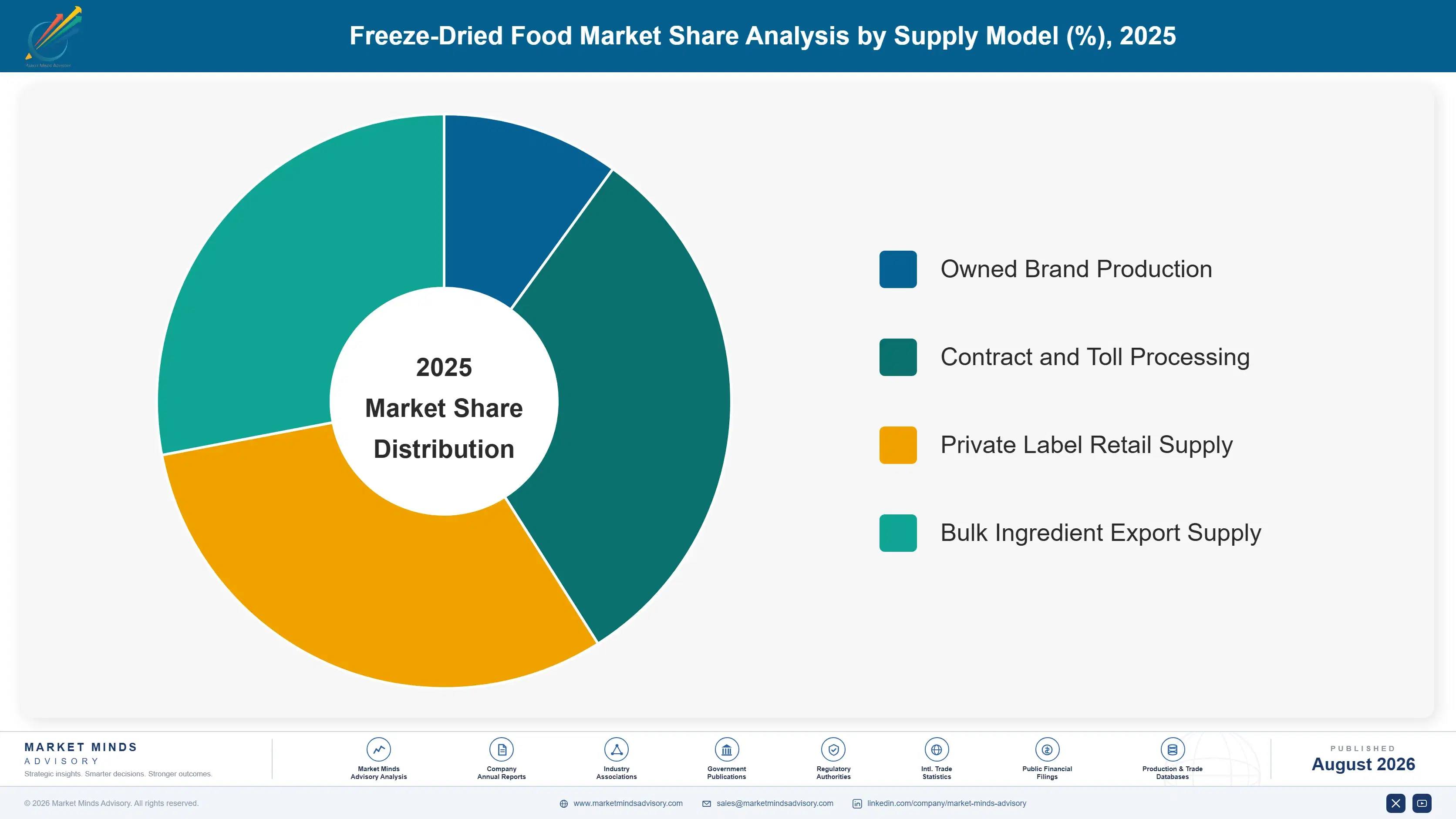
By Supply Model

  • Owned Brand Production
  • Contract and Toll Processing
  • Private Label Retail Supply
  • Bulk Ingredient Export Supply

By Region

  • North America
  • Western Europe
  • East Asia
  • South Asia and Pacific
  • Latin America
  • Middle East and Africa
  • Eastern Europe

Scope, Methodology, and Coverage

Every figure in this report is reproducible from documented input assumptions. The scope below maps the historical period, the forecast horizon, the segmentation dimensions, and the countries covered, alongside the underlying primary and qualitative methodology.
Historical Period
2020 to 2025
Forecast Period
2026 to 2036
Base Year
2025 (USD billions; MMA Primary Research Dataset, August 2026)
Market Definition
The market comprises food and beverage products preserved by lyophilisation, meaning freezing followed by sublimation of water under vacuum, spanning freeze-dried pet food and treats, freeze-dried ready meals and soups, freeze-dried fruit and vegetables, freeze-dried coffee and beverage powders, freeze-dried meat, fish and dairy, and freeze-dried ingredients supplied to food manufacturers. Sizing captures finished product revenue at realised selling price across retail, foodservice, industrial and institutional channels. Spray-dried, drum-dried and air-dried products, lyophilised pharmaceuticals and biologics, freeze-drying equipment and lyophiliser capital, retort and canned shelf-stable foods, heat-based dehydration, and frozen foods sold frozen are outside scope.
Quantitative Units
USD billions (current prices); thousand tonnes of finished product shipped annually; USD per kilogram at realised selling price
Segmentation Dimensions
By Product Category; By End-Use Application; By Supply Model; By Region
Regions Covered
North America, Western Europe, East Asia, South Asia and Pacific, Latin America, Middle East and Africa, Eastern Europe
Countries Covered
Japan, China, South Korea, Taiwan, USA, Canada, Germany, Netherlands, Poland, UK, France, Italy, Spain, Denmark, Sweden, India, Australia, New Zealand, Thailand, Vietnam, Indonesia, Brazil, Chile, Peru, Mexico, Colombia, UAE, Saudi Arabia, Turkey, South Africa, and additional markets relevant to this sector
Key Companies Profiled
Nestle, Ajinomoto, Asahi Group Holdings, European Freeze Dry, Van Drunen Farms, OFD Foods, Freeze-Dry Foods GmbH, Chaucer Foods, Paradise Fruits, Mercer Foods, Nissin Foods, House Foods Group, Harmony House Foods, Wise Company, Thrive Life, Instinct Pet Food, Primal Pet Foods, Stella and Chewys, Lyofood, Xinghua Lianfu Food.
Quantitative Methodology
Primary survey, n=3,800 respondents, Q4 2025, six countries; demand-side model with trade association cross-validation
Qualitative Methodology
47 expert interviews, Q4 2025; applied to validate demand model assumptions, identify emerging dynamics, and assess competitive positioning
Report Format
PDF and XLSX data workbook (Word format preview document)
Publisher
Market Minds Advisory
Report Code
MMA-2026-AGR-340
Published
August 2026
Contact
sales@marketmindsadvisory.com | www.marketmindsadvisory.com

Purchase the full Freeze-Dried Food Market Report (2026 to 2036).

The full report sizes the freeze-dried food market across six product categories, five end-use applications, four supply models and seven regions, with annual forecasts to 2036 in revenue and finished tonnage. It models plant-level contribution against application mix, power contracting and chamber utilisation, which is the analysis that explains why identical equipment earns very differently depending on what it processes and where it sits. Twenty participants are assessed on a consistent finished tonnage basis, with premium pet capacity and energy contracting position mapped separately. Industrial electricity exposure is quantified plant by plant, and requalification behaviour after supply interruption is traced.
Six product categories sized and forecast annually
Plant contribution modelled against application mix and utilisation
Twenty participants on consistent finished tonnage basis
Premium pet chamber capacity mapped producer by producer
Industrial electricity exposure quantified plant by plant
Customer requalification behaviour traced after supply interruption

Built For The People Who Decide

From boardroom strategy to bench-side execution, this report is read cover-to-cover by leaders shaping the next decade of their industry, turning demand scenarios, market dynamics and valuation benchmarks into decisions.
CXOs/ Presidents/ VPs/ Managers
M&A and Corporate Development
Strategy Teams and R&D Heads
Procurement and Product Directors
Regulatory and Compliance Leaders
Investor Relations and Equity Analysts