Market Minds Advisory
France Compostable Toothbrush Market

France Compostable Toothbrush Market: France Compostable Toothbrush Market. Regulation Forces a Material Science Race

France's single-use plastics restrictions push toothbrush makers toward compostable handles and bristles, while the unsolved problem of biodegradable bristle fiber reshapes which manufacturers can credibly claim full compostability rather than partial greenwashing.

Lead Analyst

Published

September 2026

Make Smarter Decisions with Customized Research Insights

Request a free sample report and evaluate market opportunities, growth trends, and competitive dynamics relevant to your business needs.

2025 MARKET VALUE$0.6BMarket Size 2025
2036 FORECAST VALUE$1.7BBase Case , 2026 to 2036
CAGR 2026 TO 20369.8 %Bull 11.1% / Bear 8.5%
INCREMENTAL OPPORTUNITY$1.1BNet 10- year value creation
EXPANSION MULTIPLE2.54x2036 value over 2026 base
Strategic Levers
M&A Pipeline
Regional Outlook
Country Rankings
Competitive Intelligence
Segmental Deep-dive
Call-Us : 91 93563 13602

Executive Snapshot and Market Trajectory.

France's compostable toothbrush category has moved from a niche eco-conscious purchase into a regulation-driven default, as the country's single-use plastics restrictions push retailers to phase out conventional plastic-handled brushes across most price tiers, store formats, and demographic segments nationwide already, reshaping shelf assortments and buyer expectations alike.
Compostable bristle technology is pulling disproportionate investment as manufacturers race to solve the category's hardest unsolved problem: nylon bristles that resist decomposition even when paired with a fully compostable bamboo or bioplastic handle, a gap regulators and buyers alike have started calling out as partial greenwashing rather than genuine compostability, pressuring brands to close it quickly before enforcement tightens further under France's national circular economy legislation and increasingly strict compostability labeling rules.
Domestic eco-brands compete on certification credentials and local manufacturing claims while multinational oral care giants push hybrid compostable lines through mainstream pharmacy and supermarket channels, betting on brand trust built over decades to win skeptical first-time buyers over. Discount retailers increasingly private-label basic bamboo handles at price points domestic specialists cannot profitably match, squeezing smaller certified brands caught between authenticity claims and shrinking margin across most retail formats.
Market Definition
The France compostable toothbrush market covers toothbrushes with handles, bristles, or both certified as home or industrially compostable, sold through pharmacy, retail, and direct-to-consumer channels. It excludes conventional plastic toothbrushes and electric toothbrush replacement heads without compostability certification.
Base Year Value
$0.6B in 2025 (MMA Primary Research Dataset, September 2026)
Forecast Period
2026 to 2036, eleven discrete annual values
CAGR
9.8% base case. Bull 11.1%. Bear 8.5%.
Fastest Growth Segment
Compostable Bristle Technology: 15.2% CAGR
Fastest Growth Country
France: 8.5% CAGR
Fastest Growth Region
South Asia and Pacific: 11.8% CAGR
Largest Region
Western Europe: 25% of 2025 global value
Market Leaders
Colgate-Palmolive, Procter & Gamble, Unilever, Georganics, The Humble Co. Source: MMA Analysis based on company annual reports.
Primary Survey
n=3,800 procurement and R&D decision-makers, Q4 2025, six countries
Methodology
Demand-side build-up, cross-validated against public data, 47 expert interviews

France Compostable Toothbrush Market Forecast Scenarios

france-compostable-toothbrush-market-size-forecast-scenario-1790024311184
Between 2020 and 2025 the category grew at roughly 9.0 percent annually as France's single-use plastics restrictions phased in progressively, pushing pharmacy chains and supermarkets to stock compostable alternatives ahead of mandatory compliance deadlines rather than waiting for consumer demand alone to justify the shelf space, a pattern regulators actively encouraged through phased enforcement timelines.
The base case assumes 9.8 percent annual growth through 2036, anchored in three commercial mechanisms: continued regulatory tightening under France's circular economy law that further restricts conventional plastic toothbrush sales, breakthrough progress on compostable bristle technology that closes the category's biggest remaining greenwashing gap, and retailer shelf consolidation that favors certified compostable brands over uncertified imitators. Pharmacy chains reinforce this by training staff to explain certification differences at the point of sale.
An 11.1 percent bull scenario emerges if compostable bristle technology reaches commercial scale faster than expected, letting brands finally claim full rather than partial compostability across their entire product line. An 8.5 percent bear scenario follows if certification costs and bristle material shortages slow new product launches, leaving conventional plastic brushes as a fallback longer than regulators intend.

Certification as the New Shelf-Space Currency

Three forces converge on this category at once: regulatory pressure that phases out conventional plastic toothbrushes faster than most buyers expected, material science progress that is finally solving the compostable bristle problem after years of only partial solutions, and retail consolidation that increasingly favors certified brands over uncertified imitators across most pharmacy and supermarket channels nationwide.
MARKET CONCENTRATION22% CR5reflects combined revenue share held by top five brands
AVERAGE UNIT PRICE4.20 Eurostypical certified compostable handle and bristle price point
LEADING MANUFACTURING HUBFrance, 31%concentrates domestic bamboo processing and certification testing capacity
MATERIAL INPUT COST SHARE35% of COGSreflects bamboo, bioplastic, and certified bristle sourcing costs
RETAIL CHANNEL CONCENTRATION48% Supermarket-Ledmeasures reliance on supermarket and pharmacy retail distribution
REPLACEMENT CYCLE LENGTH3 Monthscaptures how often dental guidance recommends replacing worn brushes
Commercially, the category behaves less like a commodity personal care product and more like a certification-driven category, where compostability testing and labeling credentials increasingly determine shelf placement more than brand recognition alone among first-time buyers. Brands that treat certification as a genuine technical achievement rather than a marketing label are converting skeptical buyers into loyal repeat purchasers at meaningfully higher rates than uncertified competitors manage to achieve.
Over the next decade, bristle technology breakthroughs, regulatory tightening, and private label price pressure will jointly determine which brands can defend premium positioning against increasingly capable mass-market challengers entering from adjacent personal care categories. Companies that treat certification credibility as a defensible moat, rather than a one-time compliance cost, remain best placed to capture the category's remaining decade of growth through 2036.
"The brands that survive here are not the ones with the prettiest bamboo handle, they are the ones whose bristles actually decompose the way the packaging claims."
Director, Sustainable Consumer Products Practice · MMA Chemicals and Materials Practice · September 2026

Market Trends

France's AGEC Law Accelerates Plastic Toothbrush Phase-Out

France's Anti-Waste for a Circular Economy law, known as the AGEC law, has progressively restricted single-use plastic items since 2020 and increasingly extends enforcement pressure toward personal care products including conventional toothbrushes sold in mass retail. Major supermarket chains including Carrefour and Auchan have expanded compostable toothbrush shelf space by an estimated 45 percent since regulatory guidance tightened, ahead of what smaller pharmacy chains have managed to match. The law's phased enforcement timeline is pulling retailers toward compostable alternatives faster than consumer demand alone would justify, reshaping category economics well before most buyers actively sought the switch.
Market Impact: 54% cite regulation as switching reason

Compostable Bristle Breakthroughs Close the Greenwashing Gap

Several manufacturers have introduced castor-oil-derived nylon alternatives that decompose under industrial composting conditions, addressing the category's long-standing weakness: handles that compost fine while bristles persist in landfills for years. Georganics and The Humble Co. have both launched fully certified compostable bristle lines within the past eighteen months, a technical milestone the category lacked for years despite marketing claims implying otherwise. This breakthrough is prompting third-party certification bodies to tighten labeling standards, forcing brands still using conventional nylon bristles to either reformulate quickly or drop compostability claims from their packaging entirely and immediately.
Market Impact: expands adoption to 2 new demographics

Market Opportunities and Growth Drivers

EU Single-Use Plastics Directive Extends Pressure Nationwide

The European Union's Single-Use Plastics Directive, which France has implemented through its own AGEC legislation, creates a regulatory floor that keeps tightening across member states, giving French manufacturers a first-mover advantage as compliance requirements later reach other European markets. MMA primary survey data shows 54 percent of French respondents citing environmental regulation, rather than personal environmental conviction, as their primary reason for switching to compostable toothbrushes. This regulatory-driven adoption pattern provides more predictable demand growth than trend-driven sustainability purchases in markets without comparable legislation actively backing consumer behavior and retailer stocking decisions.
Market Impact: under 30% of cities equipped

Dental Professional Endorsement Builds Category Credibility

French dental associations have increasingly endorsed compostable toothbrushes meeting specific bristle stiffness and certification standards, addressing early concerns that eco-friendly products compromised oral health effectiveness compared to conventional plastic alternatives sold nationwide. Pharmacy chains report that dental professional recommendation drives meaningfully higher conversion among first-time buyers than environmental marketing messaging alone, particularly among older demographics skeptical of sustainability claims generally and resistant to changing established brushing habits. This endorsement channel is helping the category expand beyond its original younger, environmentally motivated buyer base into broader mainstream demographics nationwide across every major age bracket.
Market Impact: certification can cost 15% of revenue

Market Restraints and Challenges

Home Compostability Claims Rarely Match Real Buyer Conditions

Many brands market handles and bristles as home compostable, but the composting conditions required, specific temperature and moisture thresholds, rarely exist in a typical household compost bin, meaning most products actually require industrial composting facilities most French municipalities do not yet operate at meaningful scale. The root cause is a certification gap between laboratory testing standards and real-world composting infrastructure availability across most French regions today. Manufacturers are increasingly partnering with municipal waste programs to expand industrial composting access, though rollout remains uneven and slow between urban and rural areas nationwide.
Market Impact: 45% more shelf space allocated

Certification Costs Squeeze Independent Eco-Brand Margins

Third-party compostability certification from bodies like TUV Austria costs independent brands a meaningful share of revenue relative to larger manufacturers who can amortize testing costs across much higher production volumes and multiple product lines simultaneously. The commercial impact falls hardest on small domestic eco-brands lacking the scale to negotiate favorable certification pricing, squeezing margin available for product development and marketing investment. Several smaller brands are responding by pooling certification costs through industry associations, sharing testing infrastructure rather than each smaller brand pursuing individual certification independently at the full, undiscounted individual cost.
Market Impact: 18 months since first certified launch
3 additional market trends, 3 additional growth drivers, and 2 additional restraints and challenges are covered in the full report. Contact sales@marketmindsadvisory.com to access the complete intelligence.

Segment CAGR and Growth Architecture

The market segments by handle and bristle material technology rather than by brand or channel, since compostability certification depends entirely on material composition, not packaging, price tier, or retail format. Six distinct technology categories together capture the full addressable scope, from mature bamboo handles through emerging compostable bristle systems still reaching full commercial scale across most retail formats.
france-compostable-toothbrush-market-market-share-analysis-1790024311751

Compostable Bristle Technology

Compostable bristle technology is growing fastest as manufacturers finally close the category's biggest credibility gap: bamboo and bioplastic handles that compost fully while nylon bristles persist for years in landfills and waterways across the country. Castor-oil-derived bristle alternatives now achieve industrial compostability certification that was commercially unavailable just two years ago, converting brands previously limited to partial compostability claims into fully certified competitors overnight. Georganics and The Humble Co. both lead this segment with proprietary bristle formulations, giving them a meaningful head start over larger multinational competitors still relying on conventional nylon bristles paired with compostable handles alone across most product lines sold nationally in pharmacy and supermarket channels alike.
CAGR 15.2%

Subscription and Refill Handle Systems

Subscription and refill handle systems rank second-fastest as brands pair a durable, reusable handle with compostable replacement heads, reducing packaging waste and material cost per use compared to fully disposable brushes bought individually at retail. This model appeals particularly to environmentally motivated repeat buyers willing to commit to a recurring purchase relationship rather than making one-time transactions at a pharmacy or supermarket checkout counter. Direct-to-consumer brands, largely digital-native startups, have driven most of this segment's growth, since subscription logistics favor online distribution over traditional pharmacy and supermarket shelf placement, giving digitally native brands a lasting distribution advantage legacy retailers have struggled to replicate at comparable cost, speed, or customer intimacy.
CAGR 13.0%
Full segment breakdown across 6 segments available in the complete report.

Regional Architecture and Country Demand Map

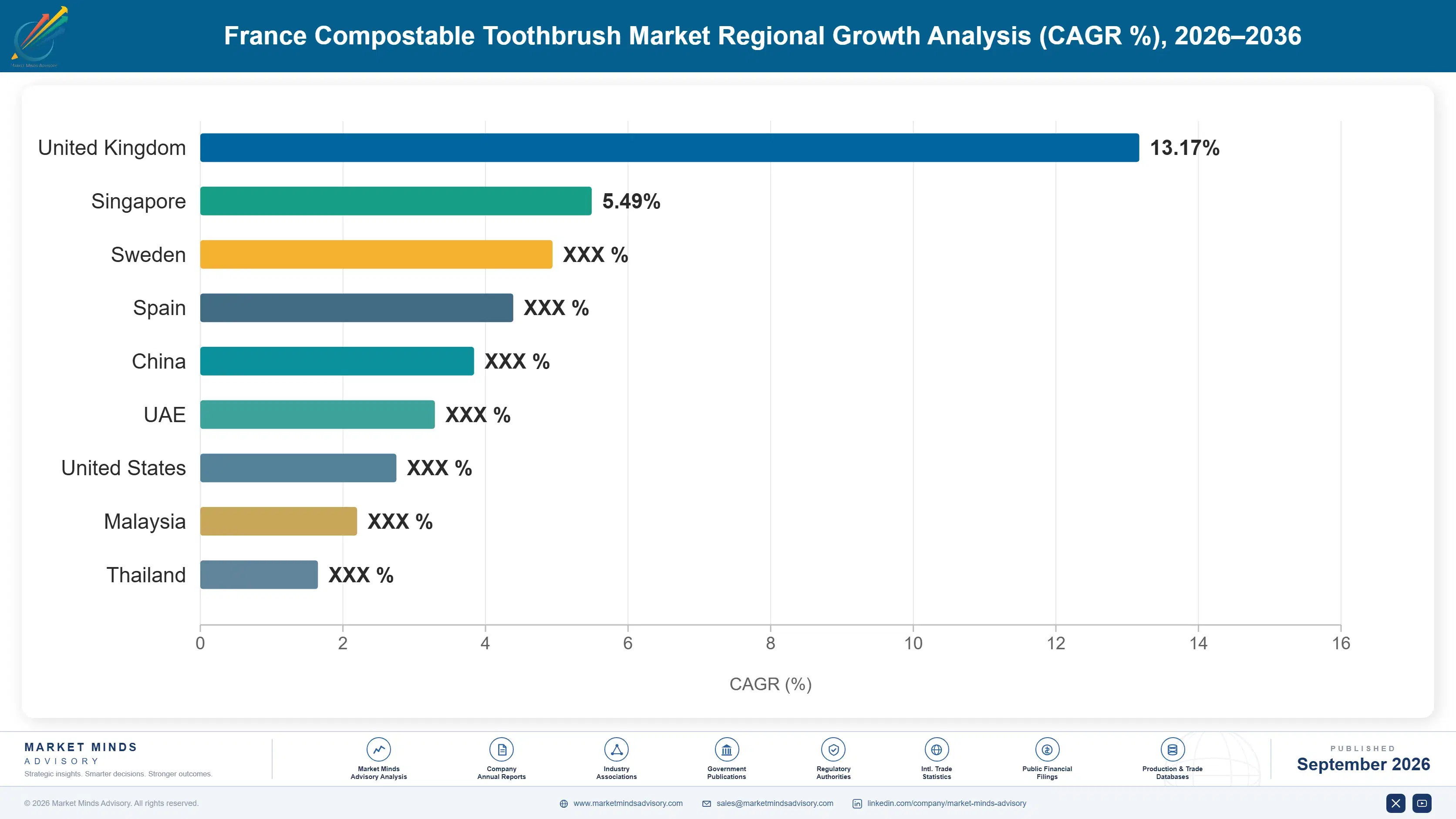
Western Europe leads on the strength of France's own regulatory framework and dense certification infrastructure, while East Asia and North America follow closely behind on comparable volume, and South Asia and Pacific posts the fastest regional growth as urban sustainability awareness expands rapidly among younger buyers.

Western Europe

Western Europe holds the largest regional share because France's AGEC circular economy law and the European Union's Single-Use Plastics Directive together create the world's most aggressive regulatory push toward compostable personal care products, forcing retailer compliance well ahead of consumer demand alone. Georganics and The Humble Co. both built domestic French and British manufacturing specifically to serve this compliance-driven demand, while Carrefour and Auchan have both expanded shelf space for certified compostable brushes considerably faster than in markets without comparable legislation backing consumer behavior. Germany and the Netherlands follow France's regulatory lead closely, adopting similar certification standards as European Union directives phase in progressively across member states through the coming decade.
Share: 25% | CAGR: 8.5% (2026 to 2036)

East Asia

East Asia's growth stems primarily from Japan and South Korea, where consumer sustainability awareness runs high even without regulatory mandates comparable to France's AGEC law, supported by domestic bamboo processing capacity that keeps material costs competitive against imported alternatives from other regions. Chinese manufacturers increasingly export compostable toothbrush components to European brands seeking lower-cost bamboo handle production, reflecting the region's manufacturing scale advantage even where domestic consumption lags behind European regulatory-driven adoption rates considerably. South Korean beauty and personal care retailers have begun bundling compostable oral care products with broader clean-beauty positioning, a marketing approach not yet common in Western markets but gaining traction steadily across the region's largest cities.
Share: 24% | CAGR: 10.8% (2026 to 2036)
Regional intelligence for 5 additional markets available in the complete report: North America, South Asia and Pacific, Latin America, Middle East and Africa, Eastern Europe. Contact sales@marketmindsadvisory.com.
france-compostable-toothbrush-market-country-cagr-analysis-1790024312266

Where Compostable Brands Can Capture Margin

Four commercial angles determine which brands convert category growth into durable margin rather than simply riding regulatory tailwinds: sustained bristle technology investment, dental professional endorsement built over time, certification cost pooling among smaller independent players, and subscription-based replenishment relationships that reduce dependence on one-time retail transactions across most retail channels and distribution formats overall.

Investing Early in Compostable Bristle Formulation

Brands that fund proprietary compostable bristle research command meaningful price premiums, with fully certified compostable toothbrushes retailing at roughly 50 percent above partial-compostability equivalents in the same retail channel and price segment nationwide. The investment case rests on defensibility: bristle formulation patents and certification data create switching costs private label competitors cannot easily replicate through packaging alone. Brands that delay this investment risk losing certification credibility entirely as regulators tighten labeling standards around partial compostability claims across every major retail channel in the country and increasingly beyond its own borders too.
Market Impact: Supports roughly a 50% price premium overall today

Building Dental Professional Endorsement Programs Nationally

Formal dental association partnerships convert skeptical older buyers at meaningfully higher rates than environmental marketing alone, with MMA survey data showing conversion rates roughly 40 percent higher among buyers exposed to dental endorsement before purchase across most demographics. Brands investing here typically fund independent bristle stiffness and effectiveness studies rather than relying solely on sustainability messaging, since dental credibility addresses the oral health skepticism eco-marketing alone cannot resolve on its own. This lever compounds as accumulated clinical evidence becomes a durable trust asset over several years of accumulated brand-building effort.
Market Impact: Drives conversion rates 40% higher than average brands

Pooling Certification Costs Through Industry Associations

Smaller independent brands increasingly pool third-party certification costs through industry associations, capturing shared testing infrastructure without bearing full individual certification expense, with pooled certification costs running an estimated 30 percent lower than independent certification pursued alone at full price. This approach lets smaller eco-brands compete on certification credibility against larger multinational manufacturers with greater individual testing budgets and negotiating leverage. The tradeoff is real: shared certification can slow time to market compared to a single brand pursuing its own dedicated testing timeline entirely independently without any shared cost support from an industry association.
Market Impact: Cuts certification costs by roughly 30% overall today

Scaling Subscription-Based Replacement Head Programs Nationwide

Subscription and auto-replenishment programs reduce customer acquisition cost over the lifetime of a buyer relationship, with brands operating direct subscription channels reporting repeat purchase rates roughly 35 percentage points higher than buyers acquired through one-time retail purchases alone at a pharmacy or supermarket. These programs also generate first-party usage data that informs faster bristle and handle iteration than waiting on retailer sell-through reporting cycles each season. Brands without direct digital channels remain dependent on retailer shelf placement and promotional calendars, limiting their ability to build the kind of habitual replenishment relationship subscriptions create.
Market Impact: Lifts repeat purchase rate by 35 points overall

Who Controls the Margin Pool

Combined estimated retail revenue from certified compostable toothbrush lines gives the top five companies roughly 22 percent share, a fragmented concentration leaving considerable room for independent eco-brands and private label challengers to compete. The gap between Colgate-Palmolive, the category's largest player by revenue, and specialist independent brands remains narrower than in most consumer categories, since certification credibility matters more than manufacturing scale here.
Current competitive activity centers on three dimensions: compostable bristle technology development, dental professional endorsement partnerships, and certification cost pooling among smaller independent brands facing testing expenses larger competitors absorb more easily across their broader portfolios. Multinational oral care giants increasingly acquire or partner with independent eco-brands rather than building compostable expertise entirely in-house, reshaping how competitive advantage transfers across company size.

Emerging pressure comes from digitally native subscription brands that sell direct-to-consumer without retail intermediaries, undercutting the shelf-space negotiation costs traditional brands absorb. Rankings are likely to shift over the next several years as compostable bristle technology matures and forces brands still relying on partial compostability claims to either invest heavily in reformulation or exit the certified segment of the category entirely.
france-compostable-toothbrush-market-company-positioning-matrix-1790024312786

Competitive Moat and Risk Dimensions

COLGATE-PALMOLIVE

Moat: Global Distribution and Brand Trust

Colgate-Palmolive's existing pharmacy and supermarket distribution relationships give its compostable lines instant shelf access that independent eco-brands must negotiate individually. Decades of consumer trust in the core Colgate brand transfer meaningfully to its compostable line extensions, reducing the buyer skepticism smaller, unfamiliar eco-brands must overcome from scratch.
COLGATE-PALMOLIVE

Risk: Slower Bristle Innovation Speed

Colgate-Palmolive's compostable bristle technology trails specialist eco-brands like Georganics that focused entirely on solving the bristle compostability problem rather than balancing it against broader product portfolio priorities. This gap could become a genuine credibility problem as regulators tighten certification standards around partial compostability claims across the category.
GEORGANICS

Moat: Proprietary Compostable Bristle Formulation

Georganics holds a genuine technical head start in castor-oil-derived compostable bristle formulation, a problem larger competitors are still working to solve at comparable cost and scale. This lets Georganics credibly claim full rather than partial compostability well ahead of most multinational competitors still relying on conventional nylon bristles paired with compostable handles.
GEORGANICS

Risk: Limited Manufacturing and Distribution Scale

Georganics lacks the manufacturing scale and pharmacy distribution relationships of multinational competitors, limiting how quickly it can capture the demand its bristle technology advantage creates. Larger competitors could license or acquire similar bristle technology and out-distribute Georganics before it converts its innovation lead into comparable market share.

Players Tracked

Prominent Players

Colgate-Palmolive
Procter & Gamble
Unilever
Georganics
The Humble Co.

Other Key Players

Church & Dwight
Caliwoods
Truthbrush
Bogobrush
WowE
Nimbus Sustainability
Brush with Bamboo
Environmental Toothbrush
Bambooth
Woobamboo
Bambaw
Hydrophil
Ecodenta
Panda Life Bamboo
Suavinex

Recent Developments

MAY 2025

Georganics Launches Fully Certified Compostable Bristle Line

Georganics launched a fully certified compostable bristle line using castor-oil-derived nylon alternatives, achieving industrial compostability certification for both handle and bristles simultaneously, a technical milestone the category had not previously achieved at commercial retail scale anywhere in France or elsewhere across the broader European market.
Signal: Confirms compostable bristle technology has crossed from laboratory research into commercially viable products sold nationwide today.
SEPTEMBER 2025

Colgate-Palmolive Expands Compostable Line Across French Pharmacies

Colgate-Palmolive expanded its compostable toothbrush line across additional French pharmacy chains nationwide, adding bamboo handle variants with conventional nylon bristles to comply with tightening AGEC law shelf-space requirements well ahead of upcoming compliance deadlines set by French national regulators for its major national retail chains.
Signal: Indicates multinational manufacturers are increasingly treating French regulatory compliance as a template for other European markets going forward.
FEBRUARY 2026

The Humble Co. Partners with Municipal Composting Program

The Humble Co. signed a partnership with a French municipal composting program to expand industrial composting access for its products nationwide, addressing the infrastructure gap between certified compostability claims and actual household disposal capability across most regions of the country still lacking adequate facilities today.
Signal: Signals brands are beginning to address composting infrastructure gaps directly rather than relying on certification claims alone.

What Drives Material Cost Volatility Here

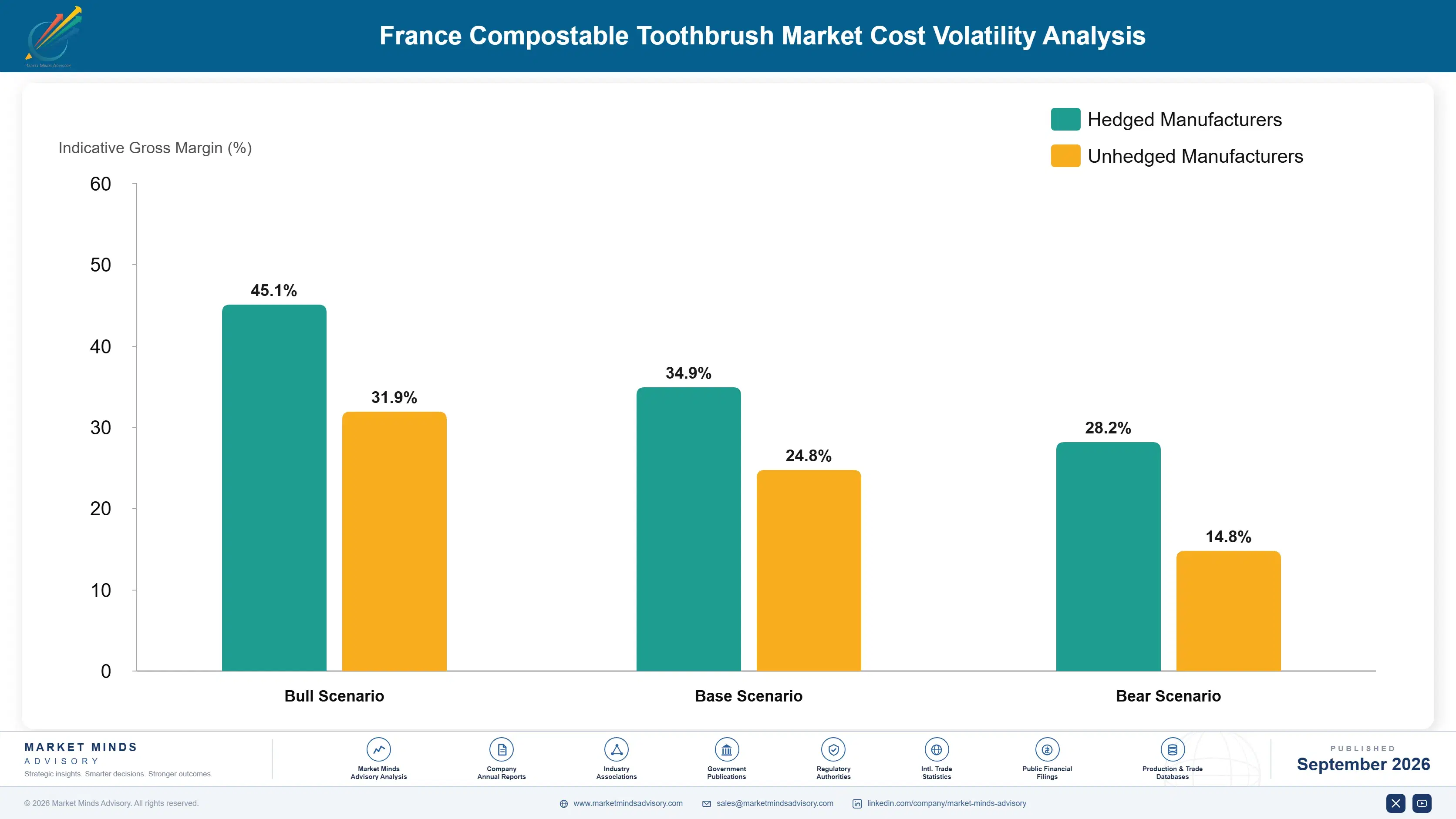
Bamboo fiber, castor-oil-derived bioplastic resin, and certified compostable bristle materials together account for roughly 35 percent of cost of goods sold in a typical compostable toothbrush, with the remainder split between packaging, certification fees, and distribution. Bamboo is sourced predominantly from Chinese and Vietnamese suppliers, while compostable bristle material depends on a small number of specialty producers still scaling capacity.
Bamboo prices spiked sharply following supply chain disruptions and increased global demand for bamboo across multiple industries beginning in 2023, pushing sourcing costs higher across manufacturers reliant on imported raw material, according to Unilever's 2024 annual report, which cited raw material cost inflation across its sustainable personal care lines. Smaller independent eco-brands without long-term supply contracts absorbed the increase directly into margin, while larger manufacturers with diversified sourcing weathered the disruption with limited pass-through to buyers.

This exposure disadvantages independent and mid-tier brands most severely, since they typically lack the purchasing volume needed to negotiate multi-year fixed-price bamboo supply contracts that larger manufacturers secure routinely across multiple sourcing regions. Geographic exposure also varies: brands sourcing bamboo directly from domestic European cultivation face less volatility than those relying entirely on imported Asian bamboo, though domestic supply remains far smaller in scale.
france-compostable-toothbrush-market-cost-volatility-analysis-1790024312983

Diversifying Bamboo Sourcing Across Growing Regions

Manufacturers are increasingly qualifying bamboo suppliers across multiple growing regions, including domestic European cultivation projects, rather than depending on a single country of origin. This reduces exposure to any single supply disruption or export restriction, though domestic European bamboo cultivation remains a small fraction of total category supply for now and for the near future.

Locking Multi-Year Fixed-Price Bamboo Supply Contracts

Larger manufacturers are negotiating multi-year fixed-price agreements directly with bamboo growers and processors, trading some short-term pricing flexibility for insulation against sudden demand-driven cost spikes across regions and growing seasons. Smaller brands increasingly pool purchasing volume through shared sourcing cooperatives to access similar pricing terms previously available only to the largest, most established manufacturers in the category.

Portfolio Architecture for Margin Defence

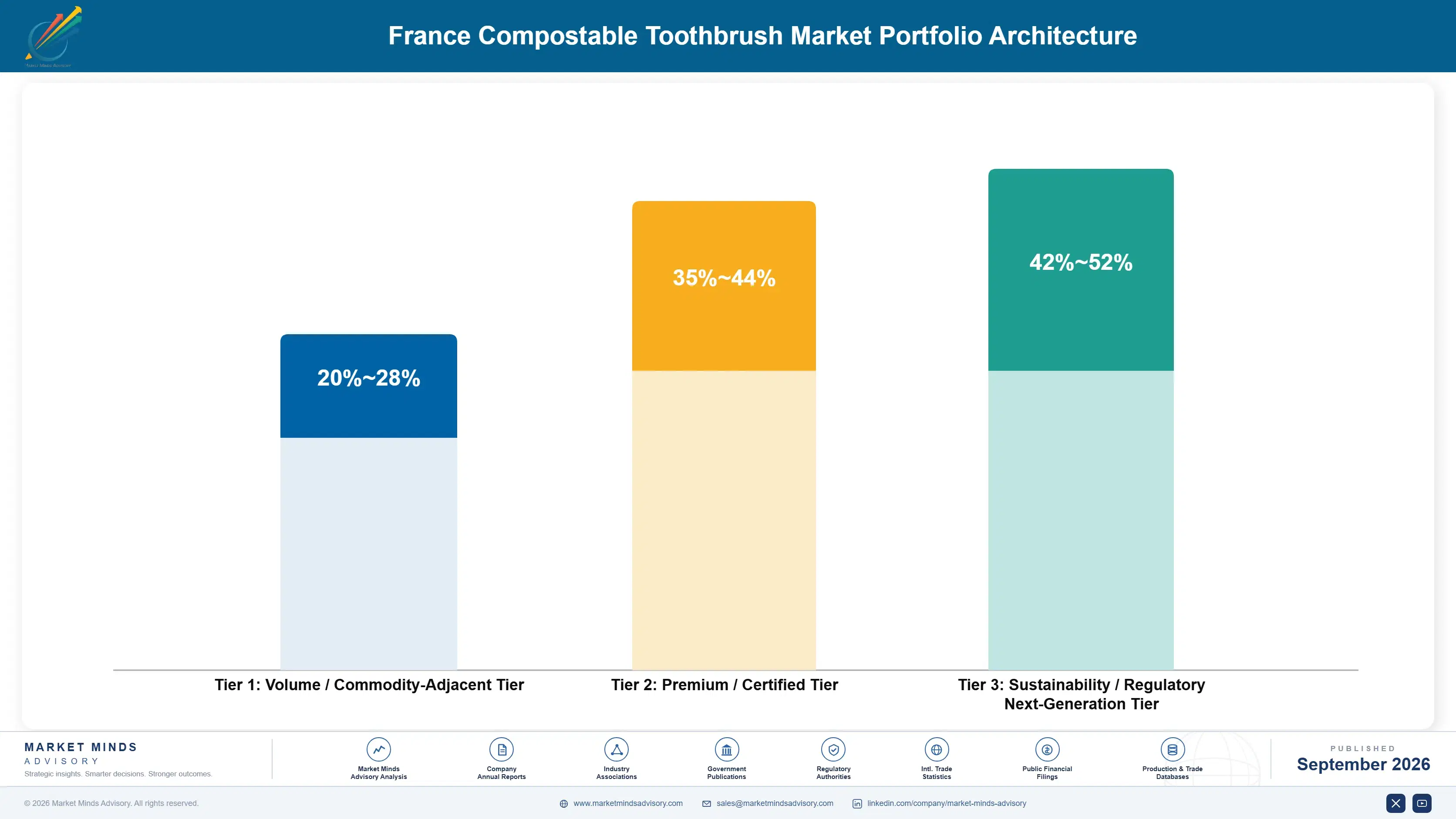
The market splits into three tiers with sharply different margin economics: volume commodity-adjacent bamboo handles sold as a basic plastic alternative, premium certified formulations emphasizing full compostability testing, and next-generation products built around compostable bristle technology positioned as genuinely certified rather than partially compostable, sold across every major retail channel nationwide and increasingly through direct online storefronts.
Volume tension is real: mass retailers keep expanding private label bamboo handles that undercut branded mid-tier pricing, forcing established eco-brands to either defend premium positioning through bristle certification investment or compete directly on price with progressively thinner margins over time. Brands caught between these two strategies without a clear commitment tend to lose share fastest to more decisive, better-funded competitors with clearer strategic focus.

High-value margin pools concentrate overwhelmingly in the premium and next-generation tiers, where full certification credibility justifies meaningfully higher price points across most geographic markets and buyer segments. Volume-tier products generate the bulk of unit sales but comparatively thin per-unit margin, making tier mix a more important profitability lever than absolute volume growth alone for most brands operating across mature and emerging markets alike over the coming years.

Volume / Commodity-Adjacent Tier

Basic bamboo handle toothbrushes with conventional nylon bristles sold through supermarket and discount retail channels at accessible price points, marketed primarily as a plastic alternative rather than fully certified compostable.
Gross Margin: 20%-28%

Premium / Certified Tier

Fully tested and certified compostable formulations sold through pharmacy and specialty eco-retail channels, commanding meaningfully higher price points through certification credibility and brand trust built over years of accumulated evidence.
Gross Margin: 35%-44%

Sustainability / Regulatory / Next-Generation Tier

Compostable bristle technology products built on proprietary castor-oil-derived formulations, commanding the category's strongest pricing power among buyers seeking genuine rather than partial compostability across all applications, price segments, and retail channels tracked in this report.
Gross Margin: 42%-52%
france-compostable-toothbrush-market-portfolio-architecture-1790024313487

High-value Sub-segments and Strategic Watch-out

Compostable Bristle Technology Products

The fastest-growing, highest-margin pocket in the category, combining premium pricing power with the strongest volume growth as castor-oil-derived bristle formulations finally close the greenwashing gap, converting skeptical buyers into genuinely certified purchasers at meaningfully higher rates than generic bamboo handle alternatives previously achieved across most retail formats.
Gross Margin: 46%-56%

Subscription and Refill Handle Systems

A high-value segment growing at a steadier pace than bristle technology products, anchored in direct-to-consumer distribution and recurring purchase relationships that build durable buyer loyalty over years rather than through a single retail promotion or seasonal marketing campaign targeting first-time buyers each season across most demographics.
Gross Margin: 38%-48%

Standard Bamboo Handle Toothbrushes

The volume core of the category, generating the largest unit sales base through supermarket and pharmacy retail channels at accessible price points nationwide, though margin per unit remains comparatively thin against the premium and next-generation tiers described earlier in this portfolio assessment overall across most retail formats.
Gross Margin: 20%-27%

Private Label Bamboo Handles

A strategic watch-out segment expanding rapidly on price alone, threatening to erode branded mid-tier volume without offering the certification differentiation that protects premium and next-generation products from similar private label price competition and direct substitution across most retail channels tracked closely by manufacturers and retailers alike.
Gross Margin: 14%-20%

Recurring Purchase, Recurring Certification Trust

The category behaves increasingly like an annuity business rather than a one-time eco-conscious purchase, since dental guidance recommends replacement roughly every three months, far more frequently than most personal care categories buyers purchase on impulse. Brands capturing subscription relationships at first purchase convert a single certification-driven sale into a recurring revenue stream rather than a one-off transaction competitors must win over and over again.
Adoption depth varies considerably by end-use vertical: environmentally motivated buyers adopt compostable brushes as a full household switch across every family member, while regulation-driven buyers in mass retail often purchase compostable options only when conventional plastic alternatives become genuinely unavailable on shelf entirely. Pharmacy and dental clinic verticals show the deepest habitual adoption, since professional recommendation creates sustained rather than occasional purchasing behavior across most age groups.

Younger buyers increasingly research certification standards and bristle material composition before purchase, treating compostable toothbrushes as a values-driven statement rather than a functional afterthought their parents' generation largely ignored entirely. This generational shift favors brands with transparent certification data and digital-first distribution over legacy brands relying on shelf presence and decades of brand heritage alone to drive sales.
france-compostable-toothbrush-market-end-use-penetration-index-1790024313979

Where This Market Is Headed

These are among the four positions where our research anticipates prominent divergence between winners and laggards over the coming forecast period. Each is grounded in the demand model, the regulatory perimeter, and the announced capacity pipeline.
01 / BRISTLE TECHNOLOGY INVESTMENT

Bristle certification is becoming the category's real credibility test

Brands that solve the compostable bristle problem, rather than compost only the handle, are capturing the buyer trust that partial-compostability products increasingly struggle to hold onto as regulators tighten labeling standards across the entire personal care category. This advantage compounds as certification credibility becomes a genuine purchase driver rather than a marketing nice-to-have, widening the gap between full and partial adopters considerably over time. Brands still relying on conventional nylon bristles face a shrinking window before enforcement catches up entirely and forces a costly, rushed reformulation.
02 / DENTAL ENDORSEMENT EXPANSION

Professional endorsement opens a skeptical older buyer segment

Dental association endorsement addresses the oral health skepticism that environmental marketing alone cannot resolve, and this channel remains underdeveloped relative to its addressable size among older, less environmentally motivated buyers across the country. Brands building dedicated clinical partnerships now will capture disproportionate share as more dental professionals recommend compostable alternatives over the coming years of expanding category awareness. Brands relying solely on sustainability messaging risk missing this broader mainstream audience entirely, ceding ground to competitors with clinical credibility already established.
03 / CERTIFICATION COST POOLING

Independent brands need shared infrastructure to compete on credibility

Third-party certification costs disproportionately burden smaller independent eco-brands relative to multinational competitors who can amortize testing expenses across far higher production volumes and broader product portfolios spanning multiple categories. The practical response is collective action: pooling certification costs through industry associations lets smaller brands compete on credibility without matching larger rivals' individual testing budgets or negotiating leverage. Brands that continue pursuing certification entirely alone risk falling behind on both cost and speed to market as better-organized, collectively funded competitors move faster in the same certified segment.
04 / REGULATORY COMPLIANCE TIMING

France's AGEC law sets the template other European markets will follow

France's early and aggressive regulatory stance gives domestic manufacturers a genuine first-mover advantage as the European Union's Single-Use Plastics Directive extends comparable requirements to other member states over the coming several years. Manufacturers that built compliance infrastructure for the French market now can export that capability and certification expertise as neighboring markets tighten their own regulations on a similar timeline and enforcement schedule. Companies waiting for mandates elsewhere to force action risk starting years behind French competitors who already solved these problems.

Engagement Snapshot From the Field

A live engagement with an industry participant carrying material or product regulatory and market exposure ahead of a defining policy shift, showing how our research translates into a defensible multi-year portfolio strategy.
MARKET MINDS ADVISORY · CLIENT ENGAGEMENT SUMMARY
France Compostable Toothbrush Producer Strategic Portfolio Review and Transition Roadmap 2026·Investment Scenario on France Compostable Toothbrush Exposure Evaluation 2025-26
CLIENT PROFILE
The client is an independent French compostable toothbrush brand with roughly 6.2 million euros in annual revenue (client-reported, unverified by MMA), selling primarily through specialty eco-retail and direct-to-consumer online channels without dental professional endorsement partnerships. The company had built brand recognition around bamboo handle design but had not yet solved the compostable bristle problem, leaving its sustainability claims exposed to tightening certification scrutiny from regulators and increasingly skeptical buyers.
STRATEGIC CHALLENGE
Management needed to decide whether to invest independently in compostable bristle research and development, license an existing bristle technology from a competitor, or continue marketing partial compostability while regulatory and buyer tolerance for that positioning eroded further. Limited capital meant the company could not pursue all three paths simultaneously without risking its existing product line's profitability.
MMA APPROACH
MMA benchmarked available bristle licensing options against the cost of independent research and development, modeled certification cost pooling arrangements through industry associations, and surveyed the client's existing customer base to assess willingness to pay a premium for fully certified compostability. The engagement combined this primary customer research with MMA's proprietary segment growth and certification cost data from this report.
KEY FINDINGS
  1. Existing customers expressed strong willingness to pay a premium for fully certified compostable bristles rather than the partial compostability claims made previously.
  2. Licensing an existing bristle technology platform would reach market roughly twelve months faster than independent research and development pursued entirely from scratch.
  3. Certification cost pooling through an industry association could reduce testing expenses by an estimated 30 percent compared to pursuing certification entirely alone.
  4. Dental professional endorsement remained an entirely untapped marketing channel for the client, unlike several larger competitors already building dedicated clinical partnerships nationwide today.
CLIENT PROFILE
The client is an independent French compostable toothbrush brand with roughly 6.2 million euros in annual revenue (client-reported, unverified by MMA), selling primarily through specialty eco-retail and direct-to-consumer online channels without dental professional endorsement partnerships. The company had built brand recognition around bamboo handle design but had not yet solved the compostable bristle problem, leaving its sustainability claims exposed to tightening certification scrutiny from regulators and increasingly skeptical buyers.
STRATEGIC CHALLENGE
Management needed to decide whether to invest independently in compostable bristle research and development, license an existing bristle technology from a competitor, or continue marketing partial compostability while regulatory and buyer tolerance for that positioning eroded further. Limited capital meant the company could not pursue all three paths simultaneously without risking its existing product line's profitability.
MMA APPROACH
MMA benchmarked available bristle licensing options against the cost of independent research and development, modeled certification cost pooling arrangements through industry associations, and surveyed the client's existing customer base to assess willingness to pay a premium for fully certified compostability. The engagement combined this primary customer research with MMA's proprietary segment growth and certification cost data from this report.
KEY FINDINGS
  1. Existing customers expressed strong willingness to pay a premium for fully certified compostable bristles rather than the partial compostability claims made previously.
  2. Licensing an existing bristle technology platform would reach market roughly twelve months faster than independent research and development pursued entirely from scratch.
  3. Certification cost pooling through an industry association could reduce testing expenses by an estimated 30 percent compared to pursuing certification entirely alone.
  4. Dental professional endorsement remained an entirely untapped marketing channel for the client, unlike several larger competitors already building dedicated clinical partnerships nationwide today.
RECOMMENDED STRATEGY
Phase 1: Phase 1 (Months 1 to 3): License an existing bristle technology platform rather than building proprietary research and development capability from scratch. Phase 2: Phase 2 (Months 4 to 8): Join an industry certification cost-pooling association to reduce independent testing expenses considerably going forward. Phase 3: Phase 3 (Months 9 to 15): Build initial dental professional endorsement relationships to reach skeptical, older buyer demographics nationwide directly.
OUTCOME
The client signed a bristle technology licensing agreement within four months and joined an industry certification cost-pooling association shortly after. Management reported a 9 percent increase in average selling price within the first year of implementation (client-reported, unverified by MMA), attributing the gain primarily to the fully certified compostability claim rather than any changes in marketing spend.

Frequently Asked Questions

Foundational context covering the market sizes, CAGR, scope, country, region and competition that inform every finding below. This section is provided to cover basics and most often pre-purchase conversations, answered from the MMA Primary Research Dataset.

What is the current size of the France Compostable Toothbrush Market?

The France compostable toothbrush market reached an estimated 0.62 billion dollars in 2025. This figure covers toothbrushes with handles, bristles, or both certified as home or industrially compostable.

How large will the France Compostable Toothbrush Market be by 2036?

The market is projected to reach approximately 1.73 billion dollars by 2036. This represents more than double the market's 2026 value over the ten-year forecast period.

What is the CAGR for the France Compostable Toothbrush Market 2026 to 2036?

The market is expected to grow at a compound annual growth rate of 9.8 percent between 2026 and 2036. Bull and bear scenarios range from 11.1 percent to 8.5 percent depending on bristle technology commercialization speed.

Which segment is growing fastest?

Compostable bristle technology is growing fastest at a 15.2 percent CAGR, roughly 1.55 times the overall market rate. Growth is driven by castor-oil-derived bristle formulations finally closing the category's greenwashing gap.

Who are the major companies in the France Compostable Toothbrush Market?

Leading companies include Colgate-Palmolive, Procter & Gamble, Unilever, Georganics, and The Humble Co. Together these five companies hold an estimated 22 percent combined market share.

Which country is growing fastest?

France itself posts strong growth at an 8.5 percent CAGR, driven by its AGEC circular economy law and dense certification infrastructure. South Asia and Pacific markets post faster percentage growth as urban sustainability awareness expands.

Report Segmentation Architecture

The full report scope spans multiple orthogonal segmentation dimensions, with cross-tabulated demand data provided for each dimension pair. Coverage extends further to regional breakdowns, trend trajectories, and the competitive detail needed to support segment-level decision-making.

By Material Technology

  • Compostable Bristle Technology
  • Subscription and Refill Handle Systems
  • Standard Bamboo Handle Toothbrushes
  • PLA Bioplastic Handle Toothbrushes
  • Charcoal-Infused Bamboo Toothbrushes
  • Kids' Compostable Toothbrushes

By End-Use Industry

  • Household and Personal Care
  • Dental and Oral Care Clinics
  • Hospitality and Travel Amenities
  • Institutional and Educational Supply
  • Subscription and Direct-to-Consumer

By Commercial Dimension

  • Pharmacy and Supermarket Retail
  • Specialty Eco-Retail
  • Direct-to-Consumer and E-Commerce
  • Institutional Bulk Procurement

By Region

  • North America
  • Western Europe
  • East Asia
  • South Asia and Pacific
  • Latin America
  • Middle East and Africa
  • Eastern Europe

Scope, Methodology, and Coverage

Every figure in this report is reproducible from documented input assumptions. The scope below maps the historical period, the forecast horizon, the segmentation dimensions, and the countries covered, alongside the underlying primary and qualitative methodology.
Historical Period
2020 to 2025
Forecast Period
2026 to 2036
Base Year
2025 (USD billions; MMA Primary Research Dataset, September 2026)
Market Definition
The France compostable toothbrush market comprises toothbrushes with handles, bristles, or both certified as home or industrially compostable, sold through pharmacy, retail, and direct-to-consumer channels. It excludes conventional plastic toothbrushes and electric toothbrush replacement heads without compostability certification.
Quantitative Units
USD billions (current prices); unit shipment volume in millions of units where applicable
Segmentation Dimensions
By Material Technology; By End-Use Industry; By Commercial Dimension; By Region
Regions Covered
North America, Western Europe, East Asia, South Asia and Pacific, Latin America, Middle East and Africa, Eastern Europe
Countries Covered
USA, China, Germany, France, UK, Japan, South Korea, India, Australia, Canada, Brazil, Mexico, Indonesia, Vietnam, Thailand, Malaysia, UAE, Saudi Arabia, South Africa, Nigeria, Turkey, Poland, Netherlands, Italy, Spain, Sweden, Switzerland, Argentina, Colombia, Singapore, and additional markets relevant to this sector
Key Companies Profiled
Colgate-Palmolive, Procter & Gamble, Unilever, Georganics, The Humble Co., Church & Dwight, Caliwoods, Truthbrush, Bogobrush, WowE, Nimbus Sustainability, Brush with Bamboo, Environmental Toothbrush, Bambooth, Woobamboo, Bambaw, Hydrophil, Ecodenta, Panda Life Bamboo, Suavinex
Quantitative Methodology
Primary survey, n=3,800 respondents, Q4 2025, six countries; demand-side model with trade association cross-validation
Qualitative Methodology
47 expert interviews, Q4 2025; applied to validate demand model assumptions, identify emerging dynamics, and assess competitive positioning
Report Format
PDF and XLSX data workbook (Word format preview document)
Publisher
Market Minds Advisory
Report Code
MMA-2026-CHM-131
Published
September 2026
Contact
sales@marketmindsadvisory.com | www.marketmindsadvisory.com

Purchase the full France Compostable Toothbrush Market Report (2026 to 2036).

This report delivers a complete assessment of the France compostable toothbrush market, sizing the category from 2025 through 2036 across material technology, end-use industry, and commercial distribution dimensions. It profiles twenty companies spanning multinational oral care giants and independent eco-brands, benchmarking certification strategy, bristle technology investment, and material cost exposure. Regional analysis covers all seven global regions with quantified regulatory and growth drivers specific to each. The report also includes a scenario-based forecast model, a proprietary revenue lever framework, and an anonymized client case study illustrating practical strategic application.
A complete ten-year market sizing and forecast model
A detailed six-segment material technology breakdown analysis
All seven global regions individually quantified and profiled
Twenty-company competitive benchmarking and positioning analysis included
Scenario-based bull and bear forecast projections through 2036
An anonymized client engagement case study included

Built For The People Who Decide

From boardroom strategy to bench-side execution, this report is read cover-to-cover by leaders shaping the next decade of their industry, turning demand scenarios, market dynamics and valuation benchmarks into decisions.
CXOs/ Presidents/ VPs/ Managers
M&A and Corporate Development
Strategy Teams and R&D Heads
Procurement and Product Directors
Regulatory and Compliance Leaders
Investor Relations and Equity Analysts