Market Minds Advisory
France Car Insurance Market

France Car Insurance Market: Acquisition Cost, Policy Tenure and the Retail Book That Only Pays From Year Three

A retail product where winning the customer costs more than the first year earns, sold into a legal framework that lets anybody walk away after twelve months without paying anything at all.

Lead Analyst

Published

September 2026

Make Smarter Decisions with Customized Research Insights

Request a free sample report and evaluate market opportunities, growth trends, and competitive dynamics relevant to your business needs.

2025 MARKET VALUE$17.2BMarket Size 2025
2036 FORECAST VALUE$26.5BBase Case , 2026 to 2036
CAGR 2026 TO 20364.0 %Bull 5.2% / Bear 2.8%
INCREMENTAL OPPORTUNITY$8.6BNet 10- year value creation
EXPANSION MULTIPLE1.48x2036 value over 2026 base
Strategic Levers
M&A Pipeline
Regional Outlook
Country Rankings
Competitive Intelligence
Segmental Deep-dive
Call-Us : 91 93563 13602

Executive Snapshot and Market Trajectory

Winning a French car insurance customer now costs more than the first policy year earns, which means the retail book only turns profitable somewhere around year three. Every participant knows this and almost none of them say it aloud. Nobody in the market advertises that fact.
The tension sits between acquisition and tenure. Comparison platforms originate roughly 31% of new business and charge accordingly, so a policy written through that channel carries an acquisition cost near EUR 118 against an average premium of about EUR 630. Average tenure runs 5.4 years across the market, which sounds comfortable until you separate the members who joined a mutual in their thirties from the shoppers who arrived through an aggregator quote last spring.
Loi Hamon is what makes the arithmetic uncomfortable. Any policyholder may cancel after twelve months at no cost, with the incoming insurer handling the paperwork, so a book acquired at price is a book that leaves at price. The bonus-malus coefficient, fixed by decree rather than by underwriters, removes most of the pricing freedom that might otherwise defend a renewal against a cheaper aggregator quote sitting on screen.
Market Definition
Gross written premium for compulsory third-party liability and voluntary damage cover on private passenger cars registered to individuals and households in France. This is the retail consumer product only. Commercial fleets, light commercial vehicles, heavy goods vehicles, motorcycles, agricultural machinery and licence-free quadricycles fall outside scope, as do standalone breakdown subscriptions and dealer mechanical warranty.
Base Year Value
$17.2B in 2025 (MMA Primary Research Dataset, August 2026)
Forecast Period
2026 to 2036, eleven discrete annual values
CAGR
4.0% base case. Bull 5.2%. Bear 2.8%.
Fastest Growth Segment
Usage-Based and Pay-Per-Kilometre Cover: 6.0% CAGR
Fastest Growth Country
India: 6.1% CAGR
Fastest Growth Region
South Asia and Pacific: 6.1% CAGR
Largest Region
Western Europe: 89% of 2025 global value
Market Leaders
Covea, AXA France, Macif, MAIF and Groupama lead on private car gross written premium in France. Source: France Assureurs and company annual reports, MMA Analysis.
Primary Survey
n=3,800 procurement and R&D decision-makers, Q4 2025, six countries
Methodology
Demand-side build-up, cross-validated against public data, 47 expert interviews

France Car Insurance Market Forecast Scenarios

france-car-insurance-market-size-forecast-scenario-1787917237823
The 2020 to 2025 stretch broke into two halves. Lockdown suppressed frequency so sharply that several mutuals returned premium to members during 2020, then traffic normalised while repair severity climbed and the surplus evaporated inside eighteen months. Premium grew at a historical rate near 3.0%, held down by competitive restraint on a compulsory product that attracts political comment whenever its price moves at all.
Three mechanisms carry the base case. Tariff correction continues at four to six points annually while carriers rebuild margin lost to repair inflation, which most guide toward completion around 2028. Usage-based and pay-per-kilometre cover expands from a small base as low-mileage urban households find the standard tariff punishes them. And comprehensive penetration keeps rising with vehicle values, since a car worth EUR 30,000 is rarely insured third-party only by anybody sensible.
The bull catalyst is acquisition economics improving, either because aggregator commission compresses under competitive pressure or because direct brands convert enough traffic to bypass the channel entirely. The bear risk is a churn acceleration: any visible market-wide increase drives shopping behaviour, and a book that never reaches year three never repays what it cost to acquire in the first place.

The Private Car Policy That Pays Late Or Never

France insures roughly 39 million private cars under a compulsory liability requirement written into the Code des assurances, so demand is fixed and the only competition is over who holds which policy. That produces a retail market where acquisition spend, not underwriting judgement, has become the dominant commercial variable. Carriers compete for a customer base that cannot grow, through channels charging for every transfer.
MARKET CONCENTRATION CR558%Share of private car premium held by leaders
AVERAGE ANNUAL PREMIUMEUR 630Mean private car policy cost across all cover
POLICY ACQUISITION COSTEUR 118Marketing and commission spend per newly written policy
AVERAGE CUSTOMER TENURE5.4 yearsMean holding period before a policyholder switches insurer
COMPREHENSIVE COVER SHARE64%Portion of private car policies written on comprehensive terms
COMPARISON SITE ORIGINATION31%New business arriving through price aggregator platforms nationally
The bonus-malus coefficient shapes pricing more than any actuary does. A driver earns a 5% reduction for each claim-free year down to a floor of 0.50, and pays a 25% surcharge for each at-fault claim, all fixed by decree, not by the insurer. Underwriters differentiate on base tariff, cover breadth and assistance quality, because the largest single multiplier applied to any French car premium is entirely outside their control.
Young drivers carry the other regulated distortion. The surprime jeune conducteur permits a surcharge of up to 100% in the first year, decaying across three years of claim-free driving, which makes new drivers expensive to insure and expensive to keep. They also shop harder than anybody. That produces a cohort with poor loss experience and short tenure: hard to price, easy to lose money on.
"French car insurers spend most of their competitive energy buying customers from each other through platforms that take a cut of every move. The industry has built an expensive circulation system and calls it a market."
Director, Retail Personal Lines Practice · MMA Financial Services and Insurance Practice · August 2026

Market Trends

Low Mileage Households Reject The Standard Tariff

Urban households driving under 8,000 kilometres a year have worked out that they subsidise the annual commuter, and pay-per-kilometre products have grown from almost nothing on that realisation alone. The proposition is simple: a reduced base premium plus a per-kilometre charge, verified by telematics or by declared odometer readings. Adoption remains concentrated in Paris, Lyon and Bordeaux where car use is genuinely occasional. Carriers offering it capture the best risks in the book, and those who do not are left holding a pool that has quietly deteriorated. That pool gets worse every year.
Market Impact: Adds 5% annual premium increases
Electric Vehicles Break The Established Severity Assumptions

Battery electric cars now account for close to a fifth of new registrations and they behave differently in a claim. Damage near the battery pack frequently triggers a total loss where an equivalent combustion car would have been repaired, because inspection protocols and the salvage value of a suspect pack both work against repair. Repairer certification requirements narrow the available network too. Insurers pricing electric vehicles off combustion loss tables are underpricing severity while congratulating themselves on the lower accident frequency. The frequency gain is real and the severity penalty is larger than anybody modelled.
Market Impact: Lifts premium mix 3 points

Market Opportunities and Growth Drivers

Repair Cost Inflation Forces Sustained Tariff Correction

Average private car premium has risen four to six points annually since 2023 as carriers respond to repair severity that outran the tariff for several years running. Sensor-laden bumpers, camera-mounted windscreens and the calibration procedures that follow every replacement have all pushed the cost of an ordinary collision well above what the pricing assumed. Mutual boards resisted the correction longest because members are also owners, and they are now moving as well. Nobody enjoys raising the price of something compulsory. Members notice, and they say so at the annual general meeting every single year.
Market Impact: Costs EUR 118 per policy

Comprehensive Penetration Rises With Average Vehicle Value

Cover mix shifts as the parc gets more expensive. Comprehensive terms now apply to roughly 64% of private car policies, up steadily as average transaction prices climbed and as more households finance or lease rather than buy outright, since both arrangements effectively require damage cover. That mix shift lifts average premium without any tariff movement at all, which is the only painless growth available in this market. It also raises claims cost, because a comprehensive policy pays for damage a liability-only policy simply does not. That is a cost nobody priced for.
Market Impact: Fixes 25% at-fault surcharge

Market Restraints and Challenges

Acquisition Cost Exceeds First Year Underwriting Margin

A policy originated through a comparison platform costs close to EUR 118 in commission and marketing against an average premium near EUR 630, which no first-year underwriting margin covers. The root cause is a compulsory product with no unmet demand, so growth can only come from taking somebody else's customer through a channel that charges for the transfer. Carriers mitigate by building direct brands, bundling home and car to raise switching cost, and pricing renewal cohorts to reward tenure rather than punish it quietly. None of it makes the first year pay.
Market Impact: Reaches 9% of urban policies

Bonus Malus Removes Most Pricing Discretion From Underwriters

The coefficient de reduction-majoration is set by decree and applies identically across every insurer in France, moving 5% a year for claim-free driving and 25% for each at-fault claim. Its root cause is a consumer protection design intended to make premiums comparable and behaviour-linked. Commercially it means the largest multiplier on any policy is common property, so differentiation falls to base tariff and cover breadth. Mitigation runs through assistance quality, multi-vehicle household discounts and telematics overlays that operate alongside rather than instead of it. The coefficient itself will not change.
Market Impact: Raises severity 24% per claim
3 additional market trends, 4 additional growth drivers, and 2 additional restraints and challenges are covered in the full report. Contact sales@marketmindsadvisory.com to access the complete intelligence.

Segment CAGR and Growth Architecture

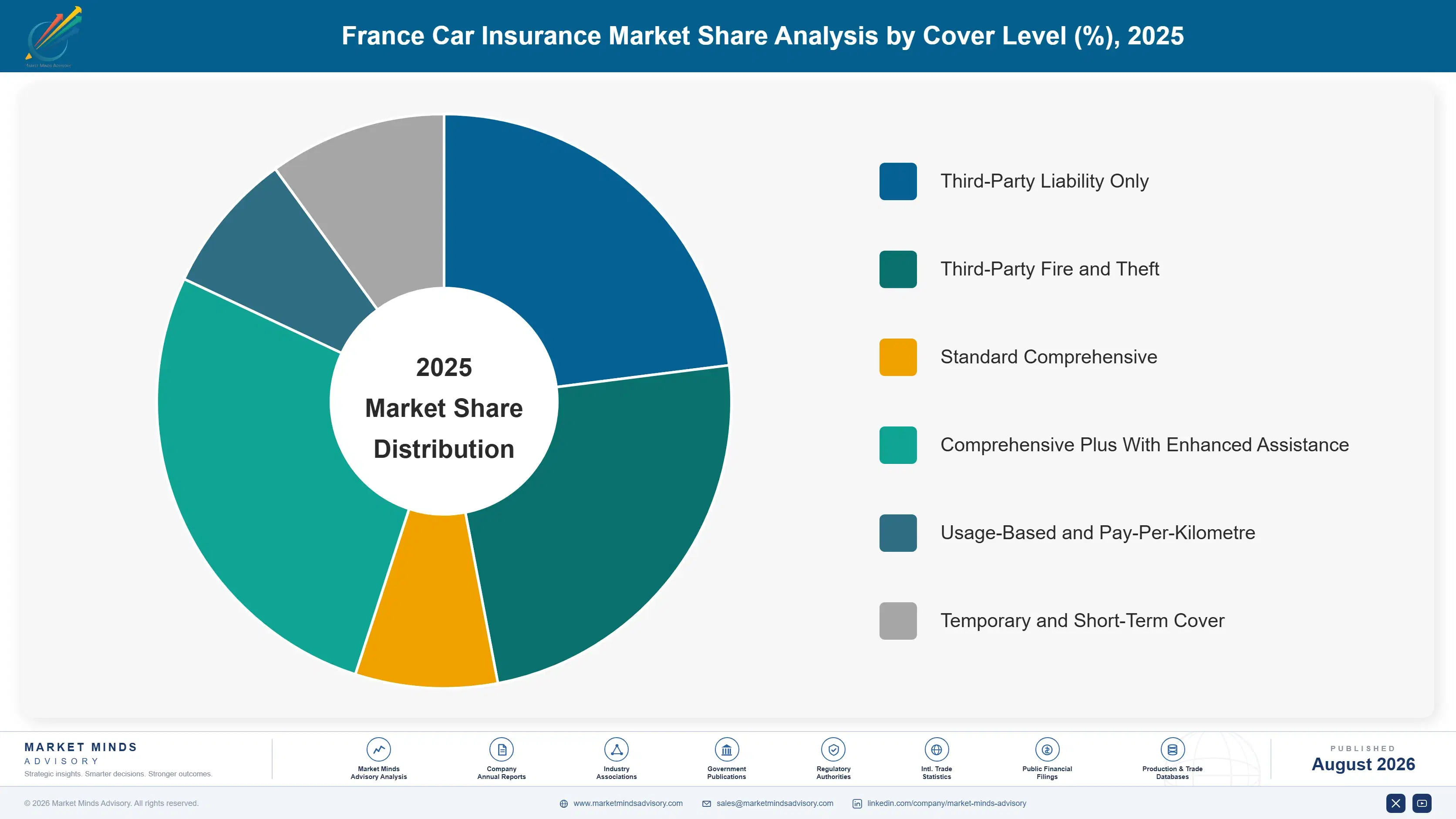
Segmentation follows cover level, since that is the axis on which a French private car policy is actually bought, priced and compared. Six cover tiers describe the retail product completely, running from bare compulsory liability through comprehensive terms to the usage-based structures now taking share from both ends of that long-established range at once.
france-car-insurance-market-market-share-analysis-1787917238361

Usage-Based and Pay-Per-Kilometre Cover

The fastest segment grows at 6.0%, half again the market rate of 4.0%, and it exists because low-mileage households finally noticed they were subsidising everybody else. Structure varies between a reduced base premium with a per-kilometre charge and a straight declared-mileage band, verified either by telematics or by photographed odometer readings at renewal. Urban buyers dominate, particularly in Paris and Lyon where a car sits parked most weekdays. The commercial attraction for the insurer is selection rather than pricing: customers who choose this product are self-identifying as low exposure, so the segment recruits the best risks in the market and leaves the standard tariff pool measurably worse than it was.
CAGR 6.0%

Comprehensive Plus With Enhanced Assistance

Enhanced comprehensive grows at 4.8% and carries the best margin in the conventional range. The product adds nil-excess options, replacement vehicle guarantees, zero-kilometre roadside assistance and personal effects cover on top of standard comprehensive terms, and buyers compare it far less aggressively than they compare base cover. That is the whole commercial point. A household that has chosen enhanced assistance is buying reassurance rather than price, which lengthens tenure and softens the renewal conversation considerably. The risk is that assistance claims are frequent, visible and expensive to service, so the margin depends entirely on the network contract sitting behind the promise rather than on the premium that anybody actually charged for it.
CAGR 4.8%
Full segment breakdown across 6 segments available in the complete report.

Regional Architecture and Country Demand Map

The market is French by definition and virtually all premium is written domestically. Other regions appear through repair parts supply, offshore policy administration, reinsurance capacity and the overseas operations of French-headquartered groups, none of which generate a single euro of premium counted within this scope.

North America

Share falls below the standard band because private car premium is written where the car is registered and every car in this report is French. What arrives from North America is reinsurance capacity, catastrophe modelling and the analytics software several carriers use for pricing and reserving. Private car books cede less than property portfolios do, but hail and flood accumulation on parked vehicles attaches to treaties partly placed with United States and Bermudian reinsurers, and those treaties have repriced upward since 2023. The vendor software licences are a growing expense line that nobody discusses with policyholders at any point. Policyholders never see any of it and would not care if they did.
Share: 3% | CAGR: 3.6% (2026 to 2036)

Western Europe

Effectively the whole market sits here, far above the standard band, for the definitional reason that this report measures French private car premium. Around 39 million cars generate it through a distribution structure with no real parallel among neighbours: mutual insurers hold the largest share, bancassurance arms attached to Credit Agricole and Credit Mutuel have taken meaningful ground, and comparison platforms now originate close to a third of new business. Cross-border relevance is genuine at the margins, since a French policy responds to accidents anywhere in the European Economic Area under the Motor Insurance Directive framework. No neighbouring market shares this shape, and every imported retail playbook has failed here for reasons participants understand perfectly well.
Share: 89% | CAGR: 3.0% (2026 to 2036)
Regional intelligence for 5 additional markets available in the complete report: East Asia, South Asia and Pacific, Latin America, Middle East and Africa, Eastern Europe. Contact sales@marketmindsadvisory.com.
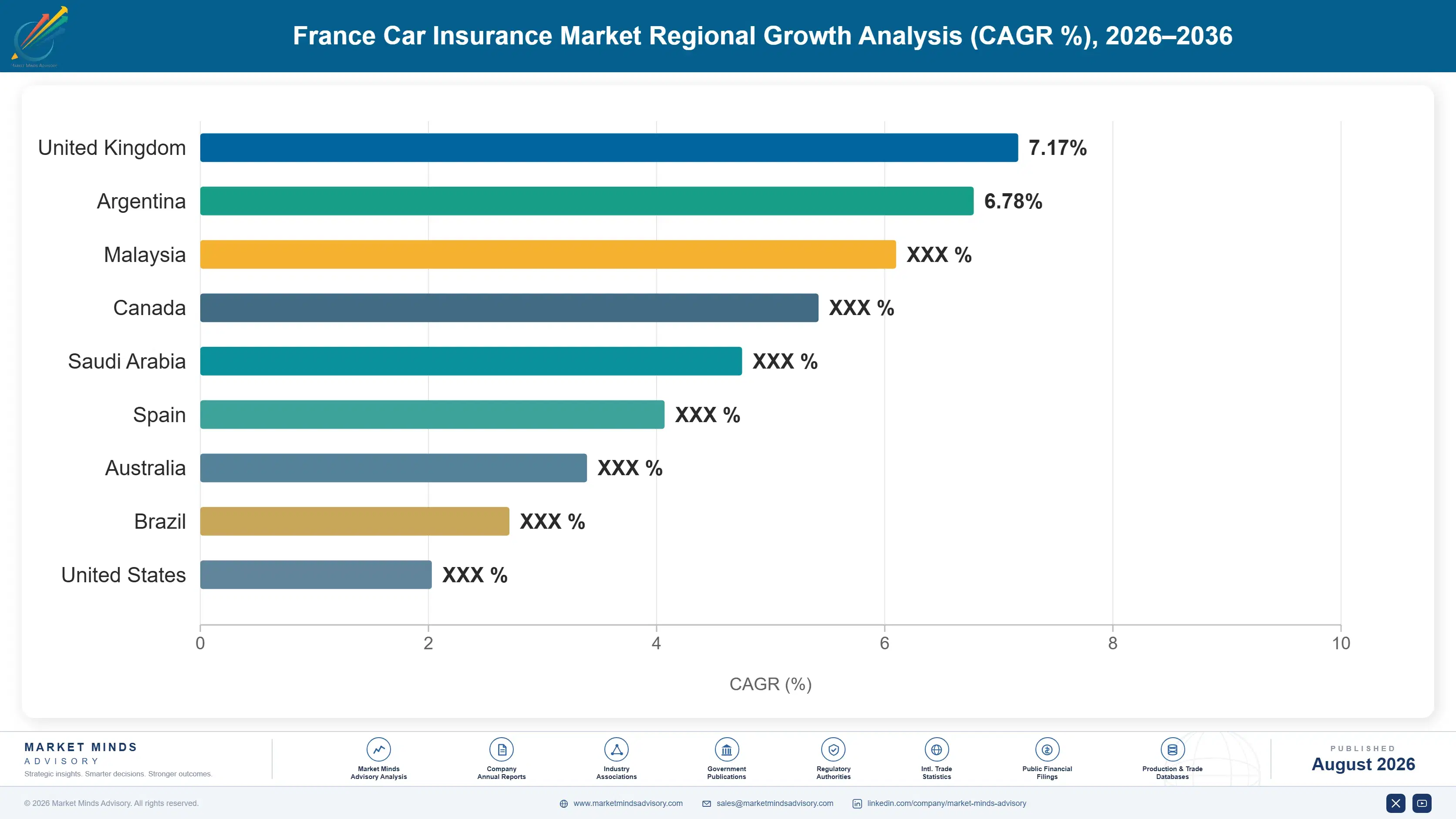
france-car-insurance-market-country-cagr-analysis-1787917238872

Making The Retail Car Book Pay

Four levers work on the tenure problem rather than the tariff problem. Acquisition channel mix, bundling, usage-based recruitment and renewal cohort sequencing each extend the period over which a policy repays what it cost to win, which is where retail car profitability is genuinely decided in this particular market, whatever the tariff discussion suggests.

Rebuild Direct Origination Away From Aggregators

A policy written through a comparison platform carries acquisition cost near EUR 118 against a EUR 630 average premium, while a direct-originated policy typically lands between EUR 40 and EUR 60 depending on brand spend. The difference is roughly nine points of first-year margin on every policy moved across. Building direct traffic requires sustained brand investment that shows no return for several years, which is precisely why most participants keep paying commission instead. Carriers that made the investment early now hold a cost position competitors cannot reach by any tactical means at all.
Market Impact: Saves roughly EUR 60 on each originated policy

Bundle Home And Car To Extend Tenure

A household holding both car and home cover with the same insurer churns at roughly half the rate of a car-only customer, because cancelling means replacing two products rather than one and the comparison work multiplies accordingly. That tenure extension is worth more than any discount required to create it. The bundling discount typically runs 8% to 12% across the pair, against a retention improvement that carries the relationship well past the year three break-even point. Mutuals hold a natural advantage here and have used it far less aggressively than bancassurance competitors have.
Market Impact: Halves churn for an 8% to 12% discount

Recruit Low Mileage Risks Through Usage Pricing

Pay-per-kilometre products do not primarily make money on the pricing mechanism. They make money on selection, because a household choosing to be measured is telling the insurer something the standard tariff cannot see. Books built this way show loss ratios running 10 to 14 points better than the equivalent conventional cohort, and the segment grows at 6.0% against a market rate of 4.0%. The competitive danger is symmetrical: every carrier that declines to offer it retains a standard pool that quietly worsens as the better risks leave for somebody else.
Market Impact: Improves the cohort loss ratio by 12 points

Sequence Renewal Increases By Switching Propensity

Applying a uniform increase on one date creates a visible spike, an aggregator traffic surge and a churn event against a book where average tenure is only 5.4 years. Spreading the identical aggregate increase across cohorts, weighted toward policies with the lowest measured switching propensity, delivers the same premium while retaining roughly three to four additional points of the book. The work is actuarial and systems-based rather than commercial, so it costs almost nothing beyond effort, and remarkably few French carriers currently do it with any rigour. Remarkably few of them do.
Market Impact: Retains around 4 additional points of the book

Who Controls the Margin Pool

Concentration is moderate by European standards. The five largest underwriters hold around 58% of private car premium, a lower figure than the total motor market shows because retail is where digital direct brands and comparison platforms have made the most ground. The leading group sits closer to the next tier than in commercial motor, and mutual structure limits consolidation because member-owned insurers cannot be bought.
Three dimensions define current activity. Acquisition cost efficiency is first and most consequential: a carrier paying EUR 60 to originate competes against one paying EUR 118. Cover breadth is the second, with enhanced assistance packages carrying margin that base comprehensive cannot. Claims network control is third, setting what a repair costs. Almost nobody holds a genuine advantage across more than one.

The pressure is coming from below. Digital direct brands without branch networks carry expense ratios several points lighter, and Loi Hamon hands them a permanent recruiting window. Usage-based propositions are separately draining the best risks out of standard pools. Rankings move against any carrier combining a heavy expense base with no usage-based offering, because those weaknesses compound rather than coexist.
france-car-insurance-market-company-positioning-matrix-1787917239396

Competitive Moat and Risk Dimensions

COVEA

Moat: Three brands, shared claims infrastructure

MAAF, MMA and GMF reach genuinely different customer groups while sharing a single claims handling and parts sourcing operation, which delivers repair volume no competitor matches and the negotiating leverage that comes with it. The brands do not cannibalise each other because their distribution and positioning differ. Replicating the position would mean acquiring three mutual insurers simultaneously.
COVEA

Risk: Member governance delays repricing

Member-owned governance makes visible tariff correction politically difficult in a way it never is for a listed insurer, and Covea moved later than several competitors when repair inflation first appeared in the results. The structure that shields it from acquisition also shields members from price signals. Margin recovery therefore takes longer and costs more once it finally begins.
AXA FRANCE

Moat: Dual brand pricing architecture

Operating Direct Assurance alongside the main AXA France book lets the group compete at aggregator price points without contaminating the tariff or the agent relationship, a capability most French competitors lack. Group capital absorbs a poor accident year without the solvency strain a standalone mutual would face. Few participants hold both the low-cost brand and the balance sheet together.
AXA FRANCE

Risk: Agent network expense burden

The traditional agent distribution the main brand depends on carries an expense ratio that digital-only competitors do not have, and every point of expense is a point unavailable for price competitiveness in a channel where price decides everything. Reducing the network means dismantling relationships built over decades. The alternative is a permanent cost handicap in the volume retail segment.

Players Tracked

Prominent Players

Covea
AXA France
Macif
MAIF
Groupama

Other Key Players

Allianz France
Generali France
Matmut
Pacifica
Assurances du Credit Mutuel
Abeille Assurances
Direct Assurance
L'olivier Assurance
Amaguiz
Leocare
Eurofil
Sogessur
Suravenir Assurances
Mutuelle de Poitiers Assurances
Thelem Assurances

Recent Developments

SEPTEMBER 2021

Aema Groupe completed its acquisition of Aviva France

Aema Groupe, formed from Macif and Aesio, completed the acquisition of Aviva France and subsequently rebranded the business as Abeille Assurances. This was an acquisition rather than a joint venture or merger, and it moved a substantial private car book into mutual ownership on a permanent basis.
Signal: Mutual consolidation remains the only realistic route to scale in a market where members cannot be bought individually.
NOVEMBER 2023

Storms Ciaran and Domingos generated concentrated vehicle claims

Two successive windstorms crossed France within days, producing falling tree and debris damage to parked private cars across Brittany and the northern coast alongside far larger property losses. France Assureurs put combined insured damage across all lines in the billions of euros, with comprehensive motor carrying a meaningful portion.
Signal: Parked vehicle accumulation is a real exposure that ordinary frequency modelling on private car books consistently understates.
APRIL 2024

Paper insurance certificate withdrawn across the country

France abolished the windscreen green certificate and moved verification entirely to the Fichier des Vehicules Assures, a national database queried by roadside checks and automated number plate systems. This was administrative reform enacted by the state, not any commercial arrangement between insurers or their distribution partners.
Signal: Uninsured driving becomes automatically detectable, which alters enforcement economics considerably more than it alters retail underwriting practice.

What A Private Car Claim Actually Costs

Claims cost divides into three uneven components on a private car book. Bodily injury indemnity runs near 44% of the total and settles against court-linked compensation schedules. Vehicle repair covering parts, paint and labour accounts for roughly 43%, with parts alone near 45% of that figure, sourced heavily from East Asian manufacturers. Assistance, replacement vehicles and handling expense make up the balance.
The 2021 to 2023 semiconductor shortage remains the clearest illustration available. Control modules and sensors became unobtainable, repair times stretched from days into weeks, and replacement vehicle days per claim rose sharply while cars waited on parts. AXA and Covea both disclosed elevated claims cost in their annual reports across that period. Parts cost more and the delay cost more again, and neither was recoverable within a tariff already fixed for that policy year.

Exposure varies by book composition, and that variation is the competitive mechanism. A carrier weighted toward recent, sensor-heavy and increasingly electric vehicles carries far higher severity per claim than one weighted toward older cars. Digital direct brands writing younger, cheaper vehicles hold a cost advantage they never engineered. Mutuals with long-tenure members buying new cars sit in the opposite position entirely.
france-car-insurance-market-cost-volatility-analysis-1787917239592

Contracted repair network with alternative parts terms

Directing claims into an approved network that accepts alternative parts sourcing, fixed labour rates and repair duration commitments converts the 2023 legislative reform into an actual saving on the loss line. Repairers accept those terms in exchange for guaranteed volume. Carriers without sufficient claims throughput cannot obtain comparable conditions on any terms at all.

Electric vehicle repair certification and salvage recovery

Battery pack damage triggers total loss decisions far more often than the equivalent combustion repair would, largely because inspection protocols are conservative and salvage markets for suspect packs are thin. Building certified repair capacity and structured battery salvage recovery reduces write-off frequency materially. It requires capital investment years ahead of the volume that eventually justifies it.

Early rehabilitation intervention on bodily injury files

Injury claims settle faster and cheaper when medical and vocational rehabilitation begins early rather than after litigation has started. The saving comes from reduced loss of earnings heads of damage rather than from contesting liability at any point. It needs handlers with medical training and a willingness to spend money years before settlement arrives.

Portfolio Architecture for Margin Defence

The retail car portfolio separates by margin logic rather than by vehicle type. Standard comprehensive and liability-only cover form the commodity core: fully price-transparent, shopped annually through aggregators, and running close to breakeven for most participants through the current repair inflation cycle. Carriers retain it because claims scale and parts sourcing terms depend on volume, not because the business itself earns anything worth reporting.
Margin concentrates where comparison is difficult. Enhanced assistance packages, multi-vehicle household arrangements and usage-based products all carry pricing the aggregator screen cannot rank cleanly, which is precisely why they earn. The tension is that these sit at the top and the edges of a book whose bulk is commodity, so a carrier chasing margin exclusively loses the volume its claims economics rest on. Nobody has resolved that trade and nobody is likely to.

The valuable pools are forming around measurement. Usage-based cover, telematics-verified low mileage and electric vehicle specific products all carry margins the standard tariff cannot approach, and each one recruits customers who are self-selecting as better risks. That advantage persists only while competitors decline to offer the same thing, which will not be indefinitely.

Volume / Commodity-Adjacent

Liability-only and standard comprehensive cover sold through aggregators and branch networks. Completely price-transparent, shopped annually under Loi Hamon, and running near breakeven across the current cycle. Held for claims scale rather than for margin.
Gross Margin: 1-4%

Premium / Certified

Enhanced comprehensive with assistance guarantees, nil-excess options and multi-vehicle household arrangements. Range spans four points because assistance network contract terms differ sharply between carriers, and that contract determines the margin far more than the premium charged does.
Gross Margin: 6-10%

Sustainability / Regulatory / Next-Generation

Usage-based, pay-per-kilometre and electric vehicle specific propositions. Range spans six points because segment loss data remains thin and pricing accuracy differs greatly between carriers with dedicated tables and those extrapolating from conventional experience.
Gross Margin: 9-15%
france-car-insurance-market-portfolio-architecture-1787917240085

High-value Sub-segments and Strategic Watch-out

Usage-Based Pay-Per-Kilometre Cover

High value and high growth at 6.0%, recruiting low mileage urban households who self-identify as better risks. Margin comes from selection rather than pricing. The four point range reflects genuine dispersion in how carriers verify declared mileage. The verification method accounts for the whole difference here.
Gross Margin: 12-16%

Comprehensive Plus With Assistance

High value with moderate growth at 4.8%. Buyers compare it far less aggressively than base cover, which lengthens tenure and softens renewals. Margin depends almost entirely on the assistance network contract sitting behind the promise made. The premium charged matters considerably less than that contract does.
Gross Margin: 8-11%

Standard Comprehensive Cover

The volume core and the reason claims scale exists at all. Shopped annually, ranked on price by aggregators, and priced against repair severity that outran the tariff for four consecutive years across essentially every participant in the market. No participant can realistically leave it behind.
Gross Margin: 1-4%

Young Driver Surcharge Cohort

The strategic watch-out rather than a growth pool. Surcharges reaching 100% in the first year make new drivers expensive to insure, they shop harder than any other group, and the loss experience rarely justifies the acquisition spend involved. Most carriers simply price it and quietly hope.
Gross Margin: Variable

Why Car Policies Renew Themselves

Compulsory cover creates annuity economics few consumer products enjoy. Every registered car must carry third-party liability under the Code des assurances, enforcement now runs automatically through the national vehicle database, and the penalties for driving uninsured are severe enough to keep evasion limited. Premium therefore arrives every year regardless of satisfaction, brand preference or economic conditions, which is why no participant exited the line despite several years of poor underwriting results.
Stickiness differs enormously across the customer base and the averages conceal it. Mutual members who joined in their thirties and hold home cover alongside the car routinely stay for fifteen years or more. Aggregator-originated single-product customers frequently leave at the first renewal that shows an increase. Bundled households churn at roughly half the rate of car-only ones, which is the single most reliable retention finding in French personal lines.

Buyer profiles are shifting in ways the tariff has not caught up with. Younger urban households increasingly own no car, or own one they barely drive, arriving through usage-based products rather than standard cover. Older policyholders remain with the mutual they joined decades ago and rarely shop at all. No French carrier currently serves both ends of that spectrum convincingly.
france-car-insurance-market-end-use-penetration-index-1787917240581

Where Retail Car Margin Sits

These are among the four positions where our research anticipates prominent divergence between winners and laggards over the coming forecast period. Each is grounded in the demand model, the regulatory perimeter, and the announced capacity pipeline.
01 / ACQUISITION CHANNEL ECONOMICS

Build direct origination or accept permanent margin transfer

A comparison platform policy costs close to EUR 118 to acquire against an average premium near EUR 630, while direct origination lands between EUR 40 and EUR 60 depending on how much brand spend already exists. That difference amounts to roughly nine points of first-year margin on every policy moved across the divide. Direct traffic takes years of investment before it returns anything at all, which is exactly why most participants keep paying the commission instead of ever building it themselves.
02 / TENURE EXTENSION DISCIPLINE

Bundle the household before the aggregator reaches it

Households holding both car and home cover with one insurer churn at roughly half the rate of car-only customers, because cancelling means replacing two products and doing the comparison work twice over. The discount required to create that bundle typically runs 8% to 12% across the pair, which costs considerably less than the retention it actually buys across a book averaging 5.4 years of tenure. Mutual insurers hold the natural advantage here and have used it remarkably little to date.
03 / RISK SELECTION MECHANICS

Usage pricing recruits better risks, not just lower premiums

Pay-per-kilometre cover grows at 6.0%, half again the market rate of 4.0%, and the commercial value sits in selection rather than in the pricing mechanism that everybody notices first. Households choosing to be measured are disclosing something the standard tariff genuinely cannot see, and books built this way run 10 to 14 loss ratio points better than the conventional equivalent. Carriers declining to offer it are left holding a standard pool that quietly deteriorates as the better risks leave for somebody else.
04 / RENEWAL SEQUENCING PRACTICE

Stagger increases by switching propensity, not by calendar date

A uniform increase applied on a single date produces a visible price spike, an aggregator traffic surge and a churn event against a book where average tenure is only 5.4 years to start with anyway. Spreading the identical aggregate move across cohorts weighted by measured switching propensity delivers the same premium while retaining three to four additional points of the book. The work is actuarial and systems-based, costing almost nothing beyond effort, and hardly anybody in France does it rigorously.

Engagement Snapshot From the Field

A live engagement with an industry participant carrying material or product regulatory and market exposure ahead of a defining policy shift, showing how our research translates into a defensible multi-year portfolio strategy.
MARKET MINDS ADVISORY · CLIENT ENGAGEMENT SUMMARY
France Car Insurance Producer Strategic Portfolio Review and Transition Roadmap 2026·Investment Scenario on France Car Insurance Exposure Evaluation 2025-26
CLIENT PROFILE
A French direct personal lines insurer writing private car cover predominantly through digital channels and comparison platforms, holding a mid-market position by premium and growing policy count faster than the market average. The business had built genuine scale in origination but had never established whether the policies it acquired stayed long enough to repay what winning them had actually cost the company.
STRATEGIC CHALLENGE
Management could see policy count rising and combined ratio deteriorating at the same time, and could not reconcile the two. The board needed to know whether the problem was underwriting quality, acquisition spend, or a tenure profile too short to amortise either. Existing reporting measured both variables but never connected them to each other.
MMA APPROACH
MMA built a cohort profitability model tracing each acquisition vintage from origination through four renewal cycles, attributing acquisition cost, claims experience and cancellation timing to the cohort that generated them. Expert interviews with aggregator platforms, direct marketing agencies and retention specialists established the channel cost benchmarks and the retention responses genuinely achievable at the client's scale.
KEY FINDINGS
  1. Aggregator-originated cohorts reached cumulative break-even in month 34 on average, while roughly 41% of those policies cancelled before month 30 arrived at all.
  2. Single-product customers churned at more than twice the rate of bundled households, yet the client marketed home cover to fewer than one in six car policyholders.
  3. Uniform renewal increases applied every January produced a measurable cancellation spike, concentrated among exactly the tenure cohorts closest to becoming profitable at last.
  4. The lowest mileage quintile of the book was being priced identically to the highest, which was steadily driving the best risks toward usage-based competitors.
CLIENT PROFILE
A French direct personal lines insurer writing private car cover predominantly through digital channels and comparison platforms, holding a mid-market position by premium and growing policy count faster than the market average. The business had built genuine scale in origination but had never established whether the policies it acquired stayed long enough to repay what winning them had actually cost the company.
STRATEGIC CHALLENGE
Management could see policy count rising and combined ratio deteriorating at the same time, and could not reconcile the two. The board needed to know whether the problem was underwriting quality, acquisition spend, or a tenure profile too short to amortise either. Existing reporting measured both variables but never connected them to each other.
MMA APPROACH
MMA built a cohort profitability model tracing each acquisition vintage from origination through four renewal cycles, attributing acquisition cost, claims experience and cancellation timing to the cohort that generated them. Expert interviews with aggregator platforms, direct marketing agencies and retention specialists established the channel cost benchmarks and the retention responses genuinely achievable at the client's scale.
KEY FINDINGS
  1. Aggregator-originated cohorts reached cumulative break-even in month 34 on average, while roughly 41% of those policies cancelled before month 30 arrived at all.
  2. Single-product customers churned at more than twice the rate of bundled households, yet the client marketed home cover to fewer than one in six car policyholders.
  3. Uniform renewal increases applied every January produced a measurable cancellation spike, concentrated among exactly the tenure cohorts closest to becoming profitable at last.
  4. The lowest mileage quintile of the book was being priced identically to the highest, which was steadily driving the best risks toward usage-based competitors.
RECOMMENDED STRATEGY
Phase 1: Phase one: shift renewal increases from a single January application to cohort-sequenced timing weighted by modelled switching propensity across the whole book. Phase 2: Phase two: launch a systematic home cover cross-sell into the existing car base, targeting cohorts approaching their second renewal decision point. Phase 3: Phase three: build a declared-mileage product to retain the low exposure quintile before usage-based competitors recruit it away from the book permanently.
OUTCOME
The client reported first-year retention improving by 5.2 points and cohort break-even moving forward by roughly seven months (client-reported, unverified by MMA). Cross-sell penetration rose from 16% to 27% of the car base within three quarters. Acquisition spend was held flat throughout, which management had set as a binding condition on the entire programme.

Frequently Asked Questions

Foundational context covering the market sizes, CAGR, scope, country, region and competition that inform every finding below. This section is provided to cover basics and most often pre-purchase conversations, answered from the MMA Primary Research Dataset.

What is the current size of the France Car Insurance Market?

The market is valued at USD 17.2 billion in 2025, measured as gross written premium on private passenger cars registered to individuals and households in France. Commercial and fleet motor sits outside this scope.

How large will the France Car Insurance Market be by 2036?

MMA forecasts USD 26.48 billion by 2036, up from USD 17.89 billion in 2026. That represents incremental premium of USD 8.59 billion and an expansion multiple of 1.48 times.

What is the CAGR for the France Car Insurance Market 2026 to 2036?

The base case CAGR is 4.0%, with a bull case of 5.2% and a bear case of 2.8%. Growth comes from tariff correction and cover mix rather than from any increase in the insured car population.

Which segment is growing fastest?

Usage-based and pay-per-kilometre cover grows at 6.0%, half again the market rate of 4.0%. Low mileage urban households drive the adoption, and they bring better than average loss experience with them.

Who are the major companies in the France Car Insurance Market?

Covea, AXA France, Macif, MAIF and Groupama lead on private car gross written premium, holding around 58% between them. Comparison platforms originate close to a third of all new business written.

Which country is growing fastest?

India grows fastest at 6.1%, reflecting expanding offshore policy administration and actuarial support rather than premium written outside France. Every car in this market is insured domestically without exception.

Report Segmentation Architecture

The full report scope spans multiple orthogonal segmentation dimensions, with cross-tabulated demand data provided for each dimension pair. Coverage extends further to regional breakdowns, trend trajectories, and the competitive detail needed to support segment-level decision-making.

By Cover Level

  • Third-Party Liability Only
  • Third-Party Fire and Theft
  • Standard Comprehensive
  • Comprehensive Plus With Enhanced Assistance
  • Usage-Based and Pay-Per-Kilometre
  • Temporary and Short-Term Cover

By End-Use Industry

  • Urban Single-Vehicle Households
  • Suburban Multi-Vehicle Households
  • Rural Households
  • Young and Newly Licensed Drivers
  • Retired and Low Mileage Drivers
  • Leased and Financed Vehicle Households

By Commercial Dimension

  • Comparison Platform Origination
  • Direct Digital Brands
  • Mutual Membership Networks
  • Bancassurance Distribution
  • Tied Agent Networks
  • Dealer and Affinity Point of Sale

By Region

  • North America
  • Western Europe
  • East Asia
  • South Asia and Pacific
  • Latin America
  • Middle East and Africa
  • Eastern Europe

Scope, Methodology, and Coverage

Every figure in this report is reproducible from documented input assumptions. The scope below maps the historical period, the forecast horizon, the segmentation dimensions, and the countries covered, alongside the underlying primary and qualitative methodology.
Historical Period
2020 to 2025
Forecast Period
2026 to 2036
Base Year
2025 (USD billions; MMA Primary Research Dataset, August 2026)
Market Definition
Gross written premium for compulsory third-party liability and voluntary damage cover on private passenger cars registered to individuals and households in France, covering all cover levels from liability-only through comprehensive and usage-based structures. This is the retail consumer product exclusively. Commercial fleet, light commercial vehicle, heavy goods, motorcycle, agricultural and licence-free quadricycle cover are excluded, as are standalone breakdown subscriptions and dealer mechanical warranty products.
Quantitative Units
USD billions, gross written premium
Segmentation Dimensions
Cover level, household type, commercial distribution dimension, region
Regions Covered
North America, Western Europe, East Asia, South Asia and Pacific, Latin America, Middle East and Africa, Eastern Europe
Countries Covered
France, with cross-border claims exposure across the European Economic Area, Morocco and Tunisia
Key Companies Profiled
Covea, AXA France, Macif, MAIF, Groupama, Allianz France, Generali France, Matmut, Pacifica, Direct Assurance
Quantitative Methodology
Primary survey, n=3,800 respondents, Q4 2025, six countries; demand-side model with trade association cross-validation
Qualitative Methodology
47 expert interviews, Q4 2025; applied to validate demand model assumptions, identify emerging dynamics, and assess competitive positioning
Report Format
PDF and XLSX data workbook (Word format preview document)
Publisher
Market Minds Advisory
Report Code
MMA-2026-TEC-351
Published
August 2026
Contact
sales@marketmindsadvisory.com | www.marketmindsadvisory.com

Purchase the full France Car Insurance Market Report (2026 to 2036).

The full report treats French private car insurance as a retail acquisition business rather than an underwriting one, and shows where the margin actually sits. It models cohort economics from origination through four renewal cycles, quantifying the point at which an aggregator-originated policy repays what it cost to win. Segment analysis covers all six cover levels, with particular attention to usage-based products and the risk selection advantage they create for early movers. Competitive assessment ranks twenty participants on private car gross written premium. Regional coverage addresses parts supply, offshore administration and reinsurance as genuine cost transmission channels into a domestic book.
Six cover level segmentation with growth rates
Cohort break-even modelling by acquisition channel
Twenty participant assessment on private car premium
Bundling and retention response benchmarks by cohort
Usage-based selection advantage quantified against standard cohorts
Electric vehicle severity differential against combustion books

Built For The People Who Decide

From boardroom strategy to bench-side execution, this report is read cover-to-cover by leaders shaping the next decade of their industry, turning demand scenarios, market dynamics and valuation benchmarks into decisions.
CXOs/ Presidents/ VPs/ Managers
M&A and Corporate Development
Strategy Teams and R&D Heads
Procurement and Product Directors
Regulatory and Compliance Leaders
Investor Relations and Equity Analysts