Market Minds Advisory
Fragranced Personal Care Products Market

Fragranced Personal Care Products Market: Fragranced Personal Care Products Market. Scent as a Strategic Growth Lever

Perfume houses and mass beauty conglomerates race to reformulate signature scents around IFRA allergen caps while premium fragrance layering and personalized scent subscription models reshape how buyers discover and repurchase across price tiers worldwide.

Lead Analyst

Published

September 2026

Make Smarter Decisions with Customized Research Insights

Request a free sample report and evaluate market opportunities, growth trends, and competitive dynamics relevant to your business needs.

2025 MARKET VALUE$42.6BMarket Size 2025
2036 FORECAST VALUE$88.8BBase Case , 2026 to 2036
CAGR 2026 TO 20366.9 %Bull 8.2% / Bear 5.6%
INCREMENTAL OPPORTUNITY$43.2BNet 10- year value creation
EXPANSION MULTIPLE1.95x2036 value over 2026 base
Strategic Levers
M&A Pipeline
Regional Outlook
Country Rankings
Competitive Intelligence
Segmental Deep-dive
Call-Us : 91 93563 13602

Executive Snapshot and Market Trajectory.

Scent has become a deliberate purchase driver rather than an afterthought, with buyers layering fragranced lotions, hair mist, and body wash around a signature perfume rather than choosing unscented alternatives across nearly every personal care category on store shelves and online marketplaces alike today.
Premium fine fragrance and fragranced skincare crossover products are pulling disproportionate revenue growth, concentrated among younger buyers in East Asian beauty markets who treat scent discovery as a recurring social media driven purchase occasion rather than a seasonal gift category alone. Mass retailers are responding with expanded fragrance layering ranges built around flagship scent families, chasing the same repeat-purchase behavior prestige houses have long captured from independent competitors.
Mass beauty conglomerates and independent niche perfume houses compete on distinctly different terms, as IFRA allergen regulation and clean-label reformulation pressure reshape which fragrance houses can supply compliant formulations at scale across every major retail channel worldwide. Independent niche houses increasingly outsource compliant formulation to specialty fragrance and flavor manufacturers, narrowing the technical gap that once separated them from mass conglomerates entirely, while still commanding premium shelf positioning, pricing power, and long-term buyer trust.
Market Definition
The fragranced personal care products market covers scented body wash, lotion, deodorant, hair care, and fine fragrance sold through mass, prestige, and direct-to-consumer channels. It excludes unscented personal care formulations and home fragrance products such as candles and diffusers.
Base Year Value
$42.6B in 2025 (MMA Primary Research Dataset, September 2026)
Forecast Period
2026 to 2036, eleven discrete annual values
CAGR
6.9% base case. Bull 8.2%. Bear 5.6%.
Fastest Growth Segment
Fine Fragrance and Scent Layering: 9.4% CAGR
Fastest Growth Country
South Korea: 8.6% CAGR
Fastest Growth Region
South Asia and Pacific: 8.9% CAGR
Largest Region
East Asia: 29% of 2025 global value
Market Leaders
L'Oreal, Estee Lauder Companies, Coty Inc., Unilever, Procter & Gamble. Source: MMA Analysis based on company annual reports.
Primary Survey
n=3,800 procurement and R&D decision-makers, Q4 2025, six countries
Methodology
Demand-side build-up, cross-validated against public data, 47 expert interviews

Fragranced Personal Care Products Market Forecast Scenarios

fragranced-personal-care-products-market-size-forecast-scenario-1790015528394
Between 2020 and 2025, fragranced personal care demand recovered unevenly from pandemic-era travel retail collapse before accelerating sharply as prestige fragrance houses expanded body care lines and mass retailers widened scented product assortments across nearly every shelf category and price tier worldwide, with East Asian markets leading the recovery pace by a wide margin over Western peers.
The base case rests on three commercial mechanisms operating together: prestige houses extending signature scent families into body care and home adjacent categories, mass retailers using fragrance layering ranges to lift average basket size, and East Asian beauty markets sustaining outsized repeat-purchase rates among younger scent-conscious consumers across social platforms. Together these mechanisms support steady double-digit growth in premium segments even as mass commodity fragrance growth moderates toward single digits region by region.
The bull case rests on personalized scent subscription models scaling faster than expected among younger East Asian buyers seeking curated discovery experiences at accessible price points. The bear case centers on IFRA allergen restrictions tightening faster than reformulation pipelines can absorb, forcing costly product discontinuations across mass and prestige tiers alike over the next several forecast years.

Scent as Strategic Purchase Driver

Fragrance has moved from a finishing touch to a primary purchase driver across personal care categories, as buyers increasingly select body wash, lotion, and deodorant based on scent family rather than functional claims alone. This shift is converging with rising disposable income across East Asian beauty markets and social media driven scent discovery culture among younger consumers globally, reshaping how brands prioritize fragrance development budgets and category launch timelines each calendar year.
MARKET CONCENTRATIONCR5 34%top five players hold moderate combined market share
AVERAGE SELLING PRICE$18.40blended mass and prestige unit price across channels
TOP PRODUCING COUNTRYFrance 22%share of global fine fragrance compound export output
TRADE INTENSITY41%finished fragrance volume crossing international borders each year
FRAGRANCE COMPOUND COST SHARE16% COGSaromatic compound input share of total production cost
REPLACEMENT CYCLE5 weeksaverage repurchase interval for signature fine fragrance bottles
Commercially, prestige houses are extending signature scent families into body care and home adjacent categories to lift lifetime customer value, while mass retailers widen scented assortments to compete on emotional differentiation rather than price alone. Independent niche perfume houses increasingly outsource compliant formulation to specialty manufacturers, narrowing their technical gap against larger conglomerates while retaining distinct creative positioning and brand storytelling advantages.
Over the next decade, IFRA allergen regulation and clean-label reformulation pressure will separate fragrance houses that can supply compliant formulations at scale from those that cannot, while personalized scent subscription models test whether digital discovery can sustain premium repeat-purchase behavior beyond early adopter segments and into mainstream mass retail channels worldwide.
"Scent has quietly become the highest-margin lever in personal care, and most companies are still pricing it like an afterthought rather than the primary reason buyers reach for one bottle over another."
Director, Beauty and Personal Care Practice · MMA Chemicals and Materials Practice · September 2026

Market Trends

IFRA Allergen Reformulation Wave Accelerates Industry-Wide

The International Fragrance Association's 51st amendment tightened restricted-use levels for eight common allergens including oakmoss and citral, forcing houses to reformulate roughly 30 percent of active fine fragrance SKUs within a single compliance cycle. Large conglomerates with dedicated compliance labs are absorbing the reformulation cost faster than independent houses reliant on outsourced perfumers, widening the technical gap between mass and niche segments. Retailers are increasingly requiring supplier compliance certificates before restocking shelf space, adding a new gatekeeping layer that favors vertically integrated fragrance manufacturers over smaller regional formulators lacking in-house testing.
Market Impact: Lifts regional spend 8% yearly
Personalized Scent Subscription Models Scale Rapidly

Direct-to-consumer scent discovery subscriptions grew from a niche category to an estimated 4.2 million active subscribers across major East Asian and North American markets, offering curated sample sets tied to algorithmic scent-family matching. Prestige houses are launching branded subscription programs to capture first-party purchase data and build repeat-purchase habits earlier in a customer's fragrance history than traditional department store counter sampling ever allowed. The model also lowers customer acquisition cost relative to paid social advertising, making it attractive to mid-tier houses competing against larger marketing budgets from established global conglomerates and regional challengers.
Market Impact: Restores 20% of revenue

Market Opportunities and Growth Drivers

Rising East Asian Beauty Spending Per Capita

South Korean and Chinese per-capita beauty spending grew roughly 8 percent annually over the past three years, with fragranced personal care capturing an increasing share as buyers move beyond skincare basics into scent layering routines popularized through short-form video content. Domestic Korean beauty conglomerates are launching fragrance sub-brands specifically targeting this behavior, while multinational houses expand regional research centers to develop scent profiles calibrated to local preference data rather than relying solely on established European perfumery traditions alone. This localized development approach is shortening product launch cycles across the region considerably.
Market Impact: Adds $3,000 per SKU cycle

Travel Retail Recovery Restores Prestige Volume

Global air passenger volume surpassed pre-pandemic levels by early 2025, restoring duty-free fragrance sales that had represented nearly 20 percent of prestige fragrance house revenue before pandemic-era travel restrictions collapsed the channel almost entirely. Airport retailers are expanding fragrance counter footprint and adding exclusive travel-retail-only scent variants to capture impulse purchases from a recovering base of international travelers passing through major hub airports daily. This channel recovery is particularly pronounced on East Asia to North America routes, where duty-free spend per passenger has returned to historical norms faster than other travel corridors.
Market Impact: Displaces roughly 12% of prestige sales

Market Restraints and Challenges

Allergen Compliance Cost Burden on Smaller Houses

Independent perfume houses face escalating compliance costs as IFRA restricted-substance lists expand, since third-party safety testing and reformulation for a single fine fragrance SKU can run several thousand dollars per compliance cycle. The root cause is fragmented regulatory tracking capacity: smaller houses lack dedicated compliance staff that larger conglomerates maintain in-house, forcing them to rely on slower external consultants. The commercial impact shows up as delayed product launches and occasional temporary SKU discontinuation. Several independent houses are now pooling compliance resources through shared industry consortiums to spread testing costs across multiple smaller brands collectively.
Market Impact: Forces reformulation across 30% of SKUs

Counterfeit Fragrance Volume Undermines Prestige Pricing

Counterfeit fine fragrance volume is estimated at roughly 12 percent of the legitimate prestige market in several East Asian and Middle Eastern retail corridors, rooted in weak cross-border enforcement and high margins on replicating recognizable bottle designs. The commercial impact includes direct revenue leakage and brand dilution when consumers unknowingly purchase counterfeit product through informal marketplaces instead of authorized retail channels. Prestige houses are mitigating exposure through blockchain-based authentication codes on premium bottle lines and closer partnership with e-commerce platforms to delist unauthorized sellers before counterfeit listings gain meaningful search visibility across major online marketplaces.
Market Impact: Reaches 4.2 million active subscribers
3 additional market trends, 2 additional growth drivers, and 4 additional restraints and challenges are covered in the full report. Contact sales@marketmindsadvisory.com to access the complete intelligence.

Segment CAGR and Growth Architecture

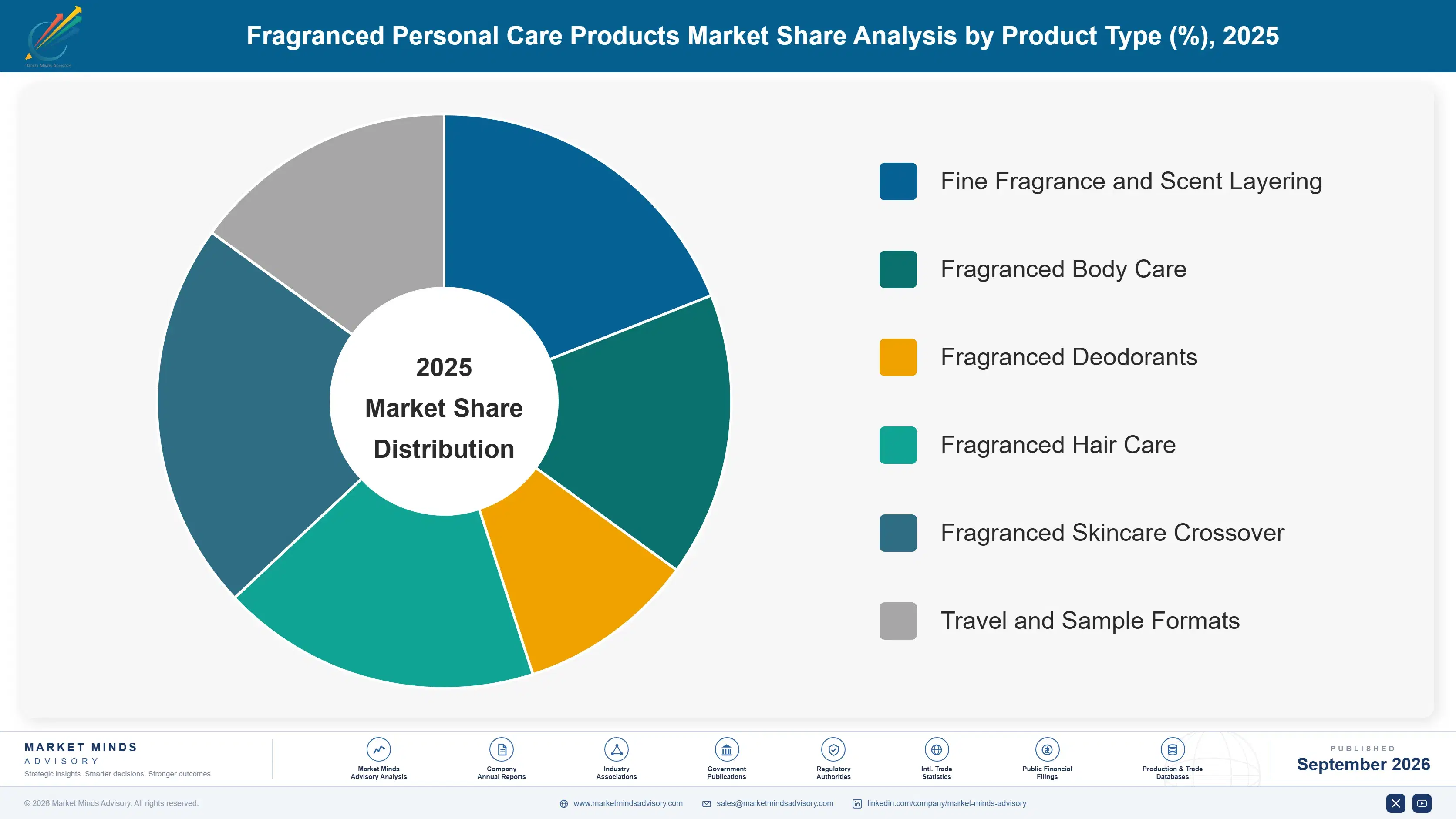
Segmentation follows product type, the dimension buyers actually shop by across mass and prestige retail channels alike worldwide. Fine fragrance, fragranced body care, fragranced hair care, fragranced deodorants, fragranced skincare crossover, and travel or sample formats each carry distinct margin structures, purchase frequency, and channel dynamics worth tracking separately across the forecast period ahead.
fragranced-personal-care-products-market-market-share-analysis-1790015528958

Fine Fragrance and Scent Layering

Fine fragrance and scent layering leads segment growth as buyers move beyond single signature scents toward curated fragrance wardrobes built from complementary eau de parfum and eau de toilette concentrations. East Asian buyers in particular are driving layering behavior, purchasing three to four fragrance formats simultaneously rather than a single bottle, a pattern amplified by short-form video content demonstrating layering techniques. Prestige houses are responding with smaller-format bottles priced for experimentation, lowering the barrier to trying additional scent families beyond a buyer's established signature fragrance. This behavior is proving durable rather than a passing trend, sustaining repeat purchase cycles considerably shorter than traditional single-bottle fragrance buying patterns of prior decades.
CAGR 9.4%

Fragranced Skincare Crossover

Fragranced skincare crossover, spanning scented serums, body oils, and moisturizers marketed on both efficacy and scent experience, is capturing buyers who previously treated fragrance and skincare as entirely separate purchase decisions. Korean and Japanese skincare brands pioneered this crossover, embedding signature scent notes into treatment products to build brand recognition beyond active ingredient claims alone. Western prestige skincare brands are following this playbook, launching scented product lines that command premium pricing over unscented equivalents from the same formulation family. The crossover format also creates cross-selling opportunities between skincare and fine fragrance divisions within the same conglomerate, lifting average customer lifetime value meaningfully across both product categories and purchase occasions simultaneously each year.
CAGR 8.6%
Full segment breakdown across 6 segments available in the complete report.

Regional Architecture and Country Demand Map

East Asia leads global share on China and South Korea's beauty market scale and social-driven scent culture, followed by North America and Western Europe's mature prestige fragrance bases. South Asia and Pacific grows fastest as younger buyers rapidly adopt scent layering purchase behavior across major cities.

North America

North America's fragranced personal care demand centers on scent layering culture spreading from prestige department store counters into mass retail, with roughly 26 percent of global revenue tied to a mature but still-expanding prestige fragrance base. Clean beauty positioning drives much of recent product launch activity, as brands reformulate around allergen-free and phthalate-free claims to satisfy increasingly ingredient-conscious buyers shopping through both specialty retail and direct-to-consumer subscription channels. Canadian demand tracks closely with US patterns, though at smaller absolute scale. Retail consolidation among specialty beauty chains has concentrated prestige fragrance distribution into fewer but larger-format stores, giving houses with strong wholesale relationships a meaningful advantage over independent brands seeking shelf placement nationwide.
Share: 26% | CAGR: 6.6% (2026 to 2036)

Western Europe

Western Europe remains the historical center of fine fragrance craftsmanship, anchored by French and Italian perfume houses whose heritage brand equity commands premium pricing even as regional growth trails faster-expanding Asian markets. Grasse-region aromatic compound suppliers continue supplying the majority of the world's prestige fragrance concentrates, giving European houses a durable sourcing advantage in raw material access most competitors elsewhere cannot replicate easily. German and British mass retailers are expanding fragranced body care assortments to compete with prestige counter experiences, narrowing the experiential gap between department store and drugstore fragrance shopping. Regulatory leadership on allergen labeling, driven by EU cosmetics regulation, continues to set the compliance benchmark other regions follow.
Share: 22% | CAGR: 5.3% (2026 to 2036)
Regional intelligence for 5 additional markets available in the complete report: East Asia, South Asia and Pacific, Latin America, Middle East and Africa, Eastern Europe. Contact sales@marketmindsadvisory.com.
fragranced-personal-care-products-market-country-cagr-analysis-1790015529484

Where Fragrance Margin Actually Concentrates

Four levers separate fragrance houses capturing outsized margin from those competing purely on volume: scent layering range extension, subscription-driven discovery, travel retail exclusives, and skincare crossover formulation. Each shifts revenue toward higher-margin repeat purchase behavior rather than one-off transactional bottle sales across mass and prestige retail channels alike worldwide, compounding customer lifetime value considerably over several purchase cycles.

Expand Scent Layering Product Ranges Strategically

Houses building complementary layering ranges around a signature scent, body wash, lotion, and hair mist in the same fragrance family, lift average basket value by an estimated 35 percent versus single-bottle purchases. Prestige houses report layering range customers return roughly twice as often as single-product buyers, since each repurchase cycle covers a different format within the collection rather than one bottle lasting several months at a time. Mass retailers are adopting the same architecture at lower price points, translating a prestige merchandising tactic into accessible category growth across broader income segments and demographics nationwide.
Market Impact: Lifts average basket value by roughly 35% per order

Build Branded Discovery Subscription Programs at Scale

Branded subscription programs offering curated sample sets ahead of full-size purchase convert an estimated 22 percent of trial subscribers into full-price repeat buyers within six months, compared to single-digit conversion from traditional counter sampling methods used historically. The model also generates first-party preference data that houses use to calibrate future scent development, reducing costly product failures at full launch scale considerably across every product line. Mid-tier houses lacking large marketing budgets find subscription acquisition costs meaningfully lower than paid social advertising, making the channel disproportionately valuable for smaller competitors chasing prestige-level growth.
Market Impact: Converts 22% of trial subscribers into repeat buyers

Capture Travel Retail Exclusive Fragrance Formats

Travel-retail-only scent variants and limited-edition duty-free packaging capture impulse purchases from international travelers, with airport fragrance counters generating per-square-foot revenue roughly 3 times standard mall retail locations across most major hub airports worldwide. As global passenger volume has fully recovered to pre-pandemic levels, houses investing in dedicated travel retail development teams are recapturing channel revenue faster than competitors treating the channel as a secondary afterthought entirely. Exclusive formats also generate scarcity-driven demand among active collectors, supporting resale market activity that reinforces brand desirability well beyond the original point of sale transaction itself.
Market Impact: Generates roughly 3 times mall retail revenue per foot

Develop Fragranced Skincare Crossover Product Lines

Scented serums and body oils marketed on both efficacy and fragrance experience command price premiums averaging 18 percent over unscented equivalents from the same formulation family, while also opening cross-sell pathways into fine fragrance for skincare-first customers across every major retail channel. Korean and Japanese brands pioneering this approach report meaningfully higher customer lifetime value among crossover buyers compared to single-category purchasers overall. Western prestige skincare houses are now following this playbook, recognizing that scent-based differentiation can justify premium pricing where active ingredient claims alone increasingly fail to do so.
Market Impact: Commands an 18% pricing premium over unscented equivalents

Who Controls the Margin Pool

Ranked on global revenue from fragranced personal care product sales, the market carries a CR5 near 34 percent, with L'Oreal and Estee Lauder Companies leading by a meaningful margin over Coty, Unilever, and Procter & Gamble across most tracked geographies. The gap between the top two and the rest of the field reflects deeper prestige fragrance portfolio breadth rather than mass-market manufacturing scale alone.
Current competitive activity centers on scent layering range extensions, IFRA compliance investment, and selective acquisition of independent niche fragrance houses to capture younger prestige buyers across key growth markets. Several conglomerates are also building direct-to-consumer subscription platforms in-house rather than partnering with third-party discovery services, seeking to own first-party scent preference data outright rather than share it with intermediaries.

Emerging pressure comes from Korean and Chinese domestic beauty conglomerates entering fragrance through existing skincare distribution networks, plus independent houses gaining share through digitally native marketing that bypasses traditional department store counters entirely. Rankings could shift meaningfully if East Asian domestic players continue converting skincare customer bases into fragrance buyers faster than Western incumbents can respond with comparable regional product development and localized scent profiles.
fragranced-personal-care-products-market-company-positioning-matrix-1790015530003

Competitive Moat and Risk Dimensions

L'OREAL

Moat: Broadest Multi-Tier Brand Portfolio

L'Oreal operates across mass, premium, and luxury fragrance tiers simultaneously through owned and licensed brands, letting it capture buyers migrating between price points without losing them to competitors entirely. This portfolio breadth also spreads reformulation compliance costs across a far larger revenue base than smaller single-tier competitors can match.
L'OREAL

Risk: Licensed Brand Renewal Dependency

A meaningful share of L'Oreal's fragrance revenue depends on licensed designer and celebrity brand agreements that require periodic renewal negotiation, exposing the company to potential loss of flagship product lines if licensing terms shift unfavorably or a partner brand chooses a competing manufacturer at contract renewal.
ESTEE LAUDER COMPANIES

Moat: Deep Prestige Distribution Relationships

Estee Lauder maintains long-standing wholesale relationships with prestige department stores and specialty beauty retailers built over several decades, giving its fragrance brands preferential shelf placement and counter space that newer entrants struggle to secure regardless of product quality or marketing investment levels committed to launch campaigns.
ESTEE LAUDER COMPANIES

Risk: Heavy Travel Retail Channel Exposure

Estee Lauder's fragrance revenue carries above-average exposure to travel retail and duty-free channels, making quarterly results more sensitive to international air travel disruption than competitors with more balanced channel mixes across domestic mass and prestige retail formats spanning multiple continents and full economic cycles over time.

Players Tracked

Prominent Players

L'Oreal
Estee Lauder Companies
Coty Inc.
Unilever
Procter & Gamble

Other Key Players

Shiseido Company
LVMH (Parfums Christian Dior)
Puig
Interparfums Inc.
Revlon Inc.
Beiersdorf AG
Kao Corporation
Amorepacific Corporation
LG Household & Health Care
Natura &Co
Chanel Limited
Clarins Group
Mary Kay Inc.
Yves Rocher
Perfumania Holdings

Recent Developments

FEBRUARY 2026

L'Oreal Launches AI-Driven Scent Layering Recommendation Platform

L'Oreal launched a digital platform recommending personalized scent layering combinations across its owned and licensed fragrance brands, aiming to lift cross-brand basket size among prestige counter customers worldwide. The launch responds directly to social media driven layering trends gaining rapid traction among younger East Asian buyers this year.
Signal: Signals major conglomerates are formalizing scent layering behavior into structured, data-driven digital recommendation tools used industry-wide
OCTOBER 2025

Estee Lauder Companies Acquires Independent Niche Fragrance House

Estee Lauder Companies acquired a mid-sized independent niche fragrance house known for digitally native marketing and strong younger-buyer engagement, adding roughly 40 new retail door placements across North America and Europe within the first quarter alone. The acquisition strengthens the company's presence in the fast-growing niche prestige segment considerably.
Signal: Signals prestige conglomerates are increasingly buying digitally native growth rather than building it entirely internally themselves
MAY 2026

Amorepacific Expands Fragrance Sub-Brand Into Southeast Asian Retail

Amorepacific expanded its Korean fragrance sub-brand into Southeast Asian mass and specialty retail channels, entering Vietnam and the Philippines for the first time this year with dedicated launch marketing campaigns. The expansion builds directly on the company's existing skincare distribution relationships already established across the region.
Signal: Signals Korean beauty conglomerates are converting existing skincare footholds into meaningful, durable fragrance market share gains

Natural Aromatic Ingredient Exposure

Aromatic compounds and fragrance concentrates account for roughly 16 percent of finished product cost of goods sold, sourced from a concentrated base of global fragrance and flavor houses headquartered largely in Switzerland and France, with natural botanical extracts sourced from India, Madagascar, and Indonesia feeding downstream compounding and bottling operations across most producing regions worldwide throughout the entire calendar year and forecast period.
Natural vanilla and sandalwood extract prices spiked sharply during 2023 after Madagascar cyclone damage disrupted vanilla bean harvests, a volatility event documented in company annual reports from major fragrance and flavor houses, forcing several mid-tier fragrance brands to reformulate around synthetic substitutes within a single production cycle and renegotiate longer-term supply contracts with alternative sourcing regions to reduce future exposure to comparable weather-driven disruption events.

Vertically integrated conglomerates with long-term supply contracts absorb natural ingredient volatility more easily than independent niche houses purchasing on shorter-term spot arrangements, widening the cost gap between large and small players during price spikes considerably. Geographic exposure also varies, since European houses maintain deeper compound supplier relationships than newer Asian entrants still building comparable sourcing networks and long-term contracts.
fragranced-personal-care-products-market-cost-volatility-analysis-1790015530200

Dual Sourcing Across Natural and Synthetic Inputs

Fragrance houses are formulating dual-pathway recipes that can shift between natural and synthetic sandalwood and vanilla inputs without changing the finished scent profile customers recognize and expect at purchase. This flexibility lets compounders substitute during natural ingredient shortages while maintaining consistent product quality and avoiding costly full reformulation cycles under time pressure from retail partners.

Long-Term Supply Contracts With Origin Cooperatives

Larger conglomerates are signing multi-year supply agreements directly with vanilla and sandalwood origin cooperatives in Madagascar and India, bypassing volatile spot markets entirely for core ingredient volumes each season. These contracts lock in pricing and volume commitments years ahead, insulating houses from seasonal weather disruption that smaller competitors purchasing spot remain fully exposed to.

Portfolio Architecture for Margin Defence

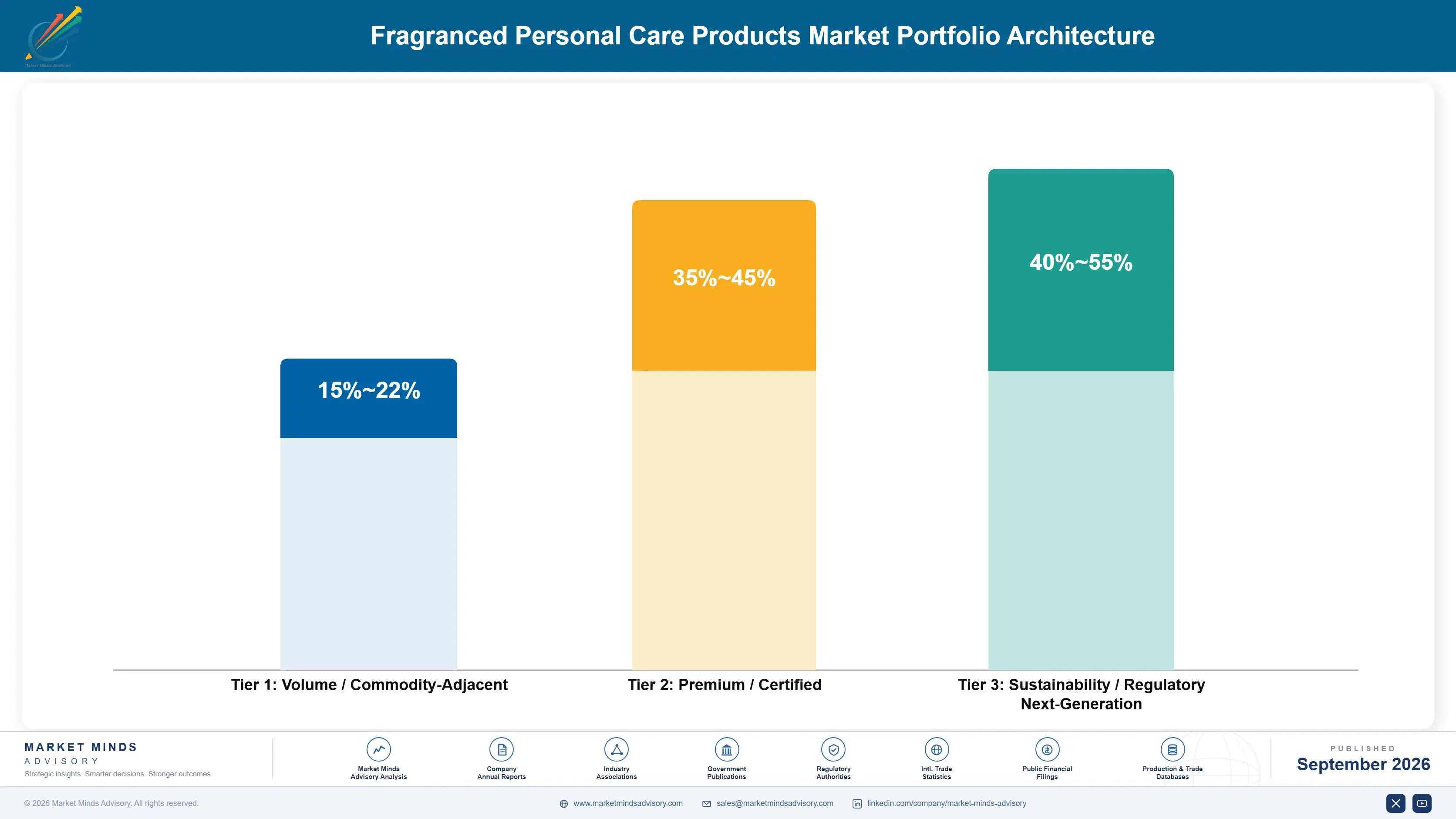
Fragranced personal care splits into three tiers by margin structure: mass-market commodity fragrance products sold on price and shelf visibility, premium fragrance lines commanding brand and formulation premiums, and next-generation sustainability-focused lines built around clean-label and naturally derived ingredient claims that appeal to younger, ingredient-conscious buyers across most retail formats. Volume commodity fragrance carries gross margins typically between 15 and 22 percent across most mass retail channels.
Premium fragrance lines, including licensed designer and celebrity collaboration products, command gross margins of 35 to 45 percent, reflecting brand equity and packaging investment buyers pay for beyond raw formulation cost alone. Fine fragrance and niche prestige scent lines sit at the top of the value pool, often exceeding 50 percent gross margin given limited production runs and strong collector demand worldwide.

The tension between volume and premium tiers shapes capital allocation heavily, since scaling niche prestige fragrance requires deliberate scarcity rather than manufacturing expansion alone across every product line and market. High-value pools concentrate in East Asian prestige counters and North American travel retail exclusives, where buyers consistently pay meaningfully more for limited-availability formats and packaging design.

Volume / Commodity-Adjacent

Mass-market fragranced body wash, deodorant, and entry fragrance sold primarily on price and shelf visibility across grocery and drugstore channels, competing heavily on promotional cadence and private-label substitution pressure from retailers.
Gross Margin: 15-22%

Premium / Certified

Licensed designer and celebrity collaboration fragrance lines sold through specialty and department store channels, commanding brand equity premiums beyond raw formulation and packaging cost, supported by dedicated counter staff and sampling programs.
Gross Margin: 35-45%

Sustainability / Regulatory / Next-Generation

Clean-label, naturally derived, and IFRA-forward reformulated fragrance lines targeting ingredient-conscious buyers, alongside niche prestige scents produced in limited, scarcity-driven runs that command outsized collector attention, resale value, and secondary market interest.
Gross Margin: 40-55%
fragranced-personal-care-products-market-portfolio-architecture-1790015530705

High-value Sub-segments and Strategic Watch-out

Fine Fragrance and Scent Layering

The fastest-growing and highest-margin segment, driven by East Asian layering culture and younger buyers building curated fragrance wardrobes rather than a single signature scent, sustaining premium repeat-purchase economics that outpace conventional single-bottle fine fragrance buying patterns considerably across nearly every major prestige and mass retail channel tracked.
Gross Margin: 45-55%

Fragranced Skincare Crossover

A high-value, moderately fast-growing segment combining efficacy claims with scent experience, pioneered by Korean and Japanese brands and increasingly adopted by Western prestige skincare houses seeking clear differentiation beyond standard active ingredient marketing claims alone across specialty, department store, and direct-to-consumer subscription retail channels worldwide.
Gross Margin: 35-45%

Fragranced Body Care

The volume core of the market, spanning lotion, body wash, and deodorant sold at accessible price points across mass retail, anchoring overall category revenue even as growth concentrates elsewhere in premium formats and layering-driven purchase occasions each season across most developed and emerging retail markets.
Gross Margin: 15-22%

Synthetic Fragrance Substitution Pressure

A strategic watch-out as regulatory scrutiny and cost pressure push some mass formulators toward cheaper synthetic aroma chemicals, risking gradual erosion of the natural-ingredient premium positioning some brands rely on to justify pricing above commodity alternatives across mass and mid-tier retail segments over the coming decade.
Gross Margin: n/a

Repeat Purchase Loyalty Economics

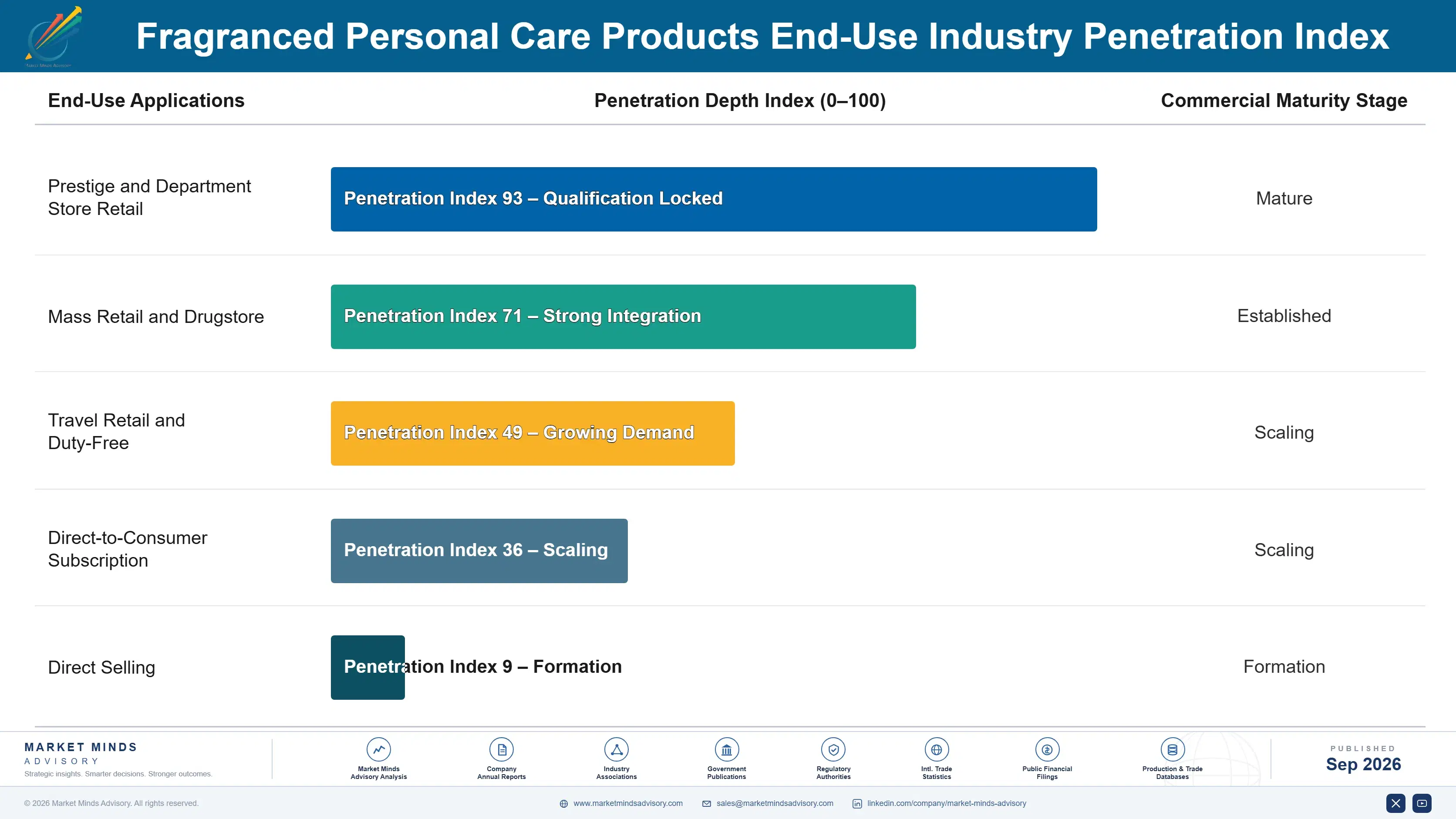
Fragranced personal care purchasing follows recurring replenishment cycles rather than one-time capital decisions, with signature fragrance repurchase intervals averaging roughly five weeks among regular buyers, generating steadier revisit revenue than most other discretionary beauty categories track across comparable forecast periods and buyer cohorts worldwide, particularly within established prestige counter relationships built carefully over multiple purchase years.
Adoption depth varies by vertical. Fine fragrance buyers show the deepest brand loyalty once a signature scent is established, often repurchasing the identical bottle for years without switching to any competing formulation, while fragranced body care buyers switch between brands and scent families far more readily, chasing seasonal launches and promotional pricing rather than maintaining consistent formulation loyalty across purchase occasions, price tiers, and retail channels.

Generational buyer shifts favor scent layering and fragrance wardrobes over single signature scent loyalty, as younger buyers raised on social media driven discovery treat fragrance as an expressive, frequently rotated category rather than the fixed lifetime choice older generations traditionally maintained for decades across most Western and East Asian markets alike, reshaping brand loyalty economics considerably for houses planning long-term customer retention strategy.
fragranced-personal-care-products-market-end-use-penetration-index-1790015531198

Priority Moves for Fragrance Leaders

These are among the four positions where our research anticipates prominent divergence between winners and laggards over the coming forecast period. Each is grounded in the demand model, the regulatory perimeter, and the announced capacity pipeline.
01 / SCENT LAYERING INVESTMENT

Build Structured Layering Ranges Around Flagship Scents

Scent layering behavior is proving durable rather than a passing social media trend, with East Asian buyers already purchasing three to four complementary formats per fragrance family across prestige and mass counters alike. Houses that build structured layering ranges around flagship scents capture disproportionately higher basket value and repeat purchase frequency than competitors selling standalone bottles at single price points. Waiting to formalize layering ranges risks ceding this margin-rich behavior entirely to faster-moving prestige and mass competitors already investing heavily.
02 / COMPLIANCE CAPABILITY BUILDING

Invest in In-House IFRA Reformulation Capacity Now

IFRA allergen restrictions are tightening on a predictable multi-year cycle, and houses without dedicated in-house reformulation capability face repeated costly delays and temporary SKU discontinuation each amendment cycle across their most valuable product lines and flagship scent families. Building compliance capacity now, rather than relying on slower external consultants, positions a house to reformulate faster than competitors and preserve shelf space during transition periods across every retail channel. Independent houses that skip this investment risk losing retailer trust over successive compliance cycles ahead.
03 / EAST ASIAN MARKET ENTRY

Prioritize East Asian Distribution Over Legacy Western Growth

East Asia already commands the largest regional share and is growing faster than every other tracked region, driven by China and South Korea's beauty market scale and social-driven scent culture spreading rapidly across platforms, cities, and demographics. Houses over-indexed on legacy Western distribution risk ceding share to domestic Chinese and Korean conglomerates entering fragrance through existing skincare networks and loyal customer bases already built. Prioritizing East Asian distribution investment now captures growth before domestic competitors fully consolidate their early advantage.
04 / SKINCARE CROSSOVER DEVELOPMENT

Develop Fragranced Skincare Lines Before Rivals Do

Fragranced skincare crossover already commands the second-fastest segment growth rate and carries meaningful pricing premiums over unscented equivalents from the same formulation family sold through comparable retail channels, customer segments, and geographic markets. Houses developing crossover lines now can capture customers before competitors fully replicate the Korean and Japanese playbook pioneering the category across international prestige and mass markets. Delaying this investment risks losing crossover customers to brands that move first and establish scent-based differentiation as a lasting competitive advantage.

Engagement Snapshot From the Field

A live engagement with an industry participant carrying material or product regulatory and market exposure ahead of a defining policy shift, showing how our research translates into a defensible multi-year portfolio strategy.
MARKET MINDS ADVISORY · CLIENT ENGAGEMENT SUMMARY
Fragranced Personal Care Products Producer Strategic Portfolio Review and Transition Roadmap 2026·Investment Scenario on Fragranced Personal Care Products Exposure Evaluation 2025-26
CLIENT PROFILE
The client is a mid-tier prestige fragrance house operating primarily in North America and Western Europe, with annual revenue of approximately $340 million (client-reported, unverified by MMA). The company built its reputation on a handful of signature fine fragrance lines but had seen limited category expansion beyond fragrance into adjacent body care over the preceding decade.
STRATEGIC CHALLENGE
The client faced stagnating growth as prestige competitors expanded into scent layering ranges and fragranced skincare crossover, categories the client had not entered. Younger buyers increasingly viewed the brand as a single-bottle purchase rather than a scent collection, limiting basket size and repeat purchase frequency relative to faster-growing peers across nearly every tracked channel.
MMA APPROACH
MMA conducted primary interviews with 40 prestige fragrance buyers across three cities to map layering behavior and crossover purchase intent, benchmarked against five competitor layering range architectures already in market. The engagement modeled expected basket lift and margin impact under three portfolio expansion scenarios before recommending a phased rollout sequence.
KEY FINDINGS
  1. Buyers who purchased a second product within the same scent family returned to the brand roughly twice as often as single-bottle buyers.
  2. Layering range adoption was highest among buyers under 35, who accounted for 60 percent of trial purchases in benchmarked competitor launches nationwide.
  3. Fragranced body care line extensions carried gross margins 8 to 10 points below fine fragrance but drove meaningfully higher purchase frequency overall.
  4. Competitors with formalized layering ranges reported average basket value roughly 30 percent above the client's current single-bottle purchase pattern across most markets.
CLIENT PROFILE
The client is a mid-tier prestige fragrance house operating primarily in North America and Western Europe, with annual revenue of approximately $340 million (client-reported, unverified by MMA). The company built its reputation on a handful of signature fine fragrance lines but had seen limited category expansion beyond fragrance into adjacent body care over the preceding decade.
STRATEGIC CHALLENGE
The client faced stagnating growth as prestige competitors expanded into scent layering ranges and fragranced skincare crossover, categories the client had not entered. Younger buyers increasingly viewed the brand as a single-bottle purchase rather than a scent collection, limiting basket size and repeat purchase frequency relative to faster-growing peers across nearly every tracked channel.
MMA APPROACH
MMA conducted primary interviews with 40 prestige fragrance buyers across three cities to map layering behavior and crossover purchase intent, benchmarked against five competitor layering range architectures already in market. The engagement modeled expected basket lift and margin impact under three portfolio expansion scenarios before recommending a phased rollout sequence.
KEY FINDINGS
  1. Buyers who purchased a second product within the same scent family returned to the brand roughly twice as often as single-bottle buyers.
  2. Layering range adoption was highest among buyers under 35, who accounted for 60 percent of trial purchases in benchmarked competitor launches nationwide.
  3. Fragranced body care line extensions carried gross margins 8 to 10 points below fine fragrance but drove meaningfully higher purchase frequency overall.
  4. Competitors with formalized layering ranges reported average basket value roughly 30 percent above the client's current single-bottle purchase pattern across most markets.
RECOMMENDED STRATEGY
Phase 1: Phase 1 (Months 1 to 4): Launch a three-product layering range around the brand's top-selling signature scent, targeting existing loyal customers first. Phase 2: Phase 2 (Months 5 to 9): Expand layering architecture across two additional scent families based on Phase 1 conversion and basket data. Phase 3: Phase 3 (Months 10 to 14): Introduce a fragranced skincare crossover pilot line, applying Phase 1 and 2 customer preference data collected.
OUTCOME
Within 14 months of the phased rollout, the client reported average basket value up approximately 27 percent among layering range purchasers and a measurable increase in repeat purchase frequency versus the prior single-bottle baseline (client-reported, unverified by MMA). The client also reported securing two new prestige retail wholesale accounts partly attributed to the expanded product range.

Frequently Asked Questions

Foundational context covering the market sizes, CAGR, scope, country, region and competition that inform every finding below. This section is provided to cover basics and most often pre-purchase conversations, answered from the MMA Primary Research Dataset.

What is the current size of the Fragranced Personal Care Products Market?

The global fragranced personal care products market reached approximately $42.6 billion in 2025. This figure covers scented body wash, lotion, deodorant, hair care, and fine fragrance sold across mass, prestige, and direct-to-consumer channels worldwide.

How large will the Fragranced Personal Care Products Market be by 2036?

The market is projected to reach approximately $88.75 billion by 2036, roughly 1.95 times its 2026 value. Growth is led by fine fragrance and fragranced skincare crossover segments expanding fastest across East Asian markets.

What is the CAGR for the Fragranced Personal Care Products Market 2026 to 2036?

The market is forecast to grow at a compound annual growth rate of 6.9 percent between 2026 and 2036. Bull and bear scenarios range from 8.2 percent to 5.6 percent depending on regulatory and adoption factors.

Which segment is growing fastest?

Fine fragrance and scent layering is the fastest-growing segment at a 9.4 percent CAGR, roughly 1.36 times the overall market rate. Fragranced skincare crossover follows closely as the second-fastest segment at 8.6 percent.

Who are the major companies in the Fragranced Personal Care Products Market?

Leading companies include L'Oreal, Estee Lauder Companies, Coty Inc., Unilever, and Procter & Gamble. Together these five players hold a combined market share of roughly 34 percent, ranked on global fragranced product revenue.

Which country is growing fastest?

South Korea is the fastest-growing country market at an 8.6 percent CAGR, driven by K-beauty content and scent layering culture. This outpaces the broader East Asian regional average of 7.9 percent.

Report Segmentation Architecture

The full report scope spans multiple orthogonal segmentation dimensions, with cross-tabulated demand data provided for each dimension pair. Coverage extends further to regional breakdowns, trend trajectories, and the competitive detail needed to support segment-level decision-making.

By Product Type

  • Fine Fragrance and Scent Layering
  • Fragranced Body Care
  • Fragranced Deodorants
  • Fragranced Hair Care
  • Fragranced Skincare Crossover
  • Travel and Sample Formats

By End-Use Industry

  • Prestige and Department Store Retail
  • Mass Retail and Drugstore
  • Travel Retail and Duty-Free
  • Direct-to-Consumer Subscription
  • Direct Selling

By Commercial Dimension

  • Prestige Price Tier
  • Mass Price Tier
  • Certified and Clean-Label Positioning
  • Licensed Brand Partnership

By Region

  • North America
  • Western Europe
  • East Asia
  • South Asia and Pacific
  • Latin America
  • Middle East and Africa
  • Eastern Europe

Scope, Methodology, and Coverage

Every figure in this report is reproducible from documented input assumptions. The scope below maps the historical period, the forecast horizon, the segmentation dimensions, and the countries covered, alongside the underlying primary and qualitative methodology.
Historical Period
2020 to 2025
Forecast Period
2026 to 2036
Base Year
2025 (USD billions; MMA Primary Research Dataset, September 2026)
Market Definition
The fragranced personal care products market comprises scented body wash, lotion, deodorant, hair care, and fine fragrance sold through mass, prestige, and direct-to-consumer channels. It excludes unscented personal care formulations, home fragrance products such as candles and diffusers, and aromatic ingredient sales to third-party formulators.
Quantitative Units
USD billions (current prices); unit volume in million bottles where applicable
Segmentation Dimensions
By Product Type; By End-Use Industry; By Commercial Dimension; By Region
Regions Covered
North America, Western Europe, East Asia, South Asia and Pacific, Latin America, Middle East and Africa, Eastern Europe
Countries Covered
USA, China, Germany, France, UK, Japan, South Korea, India, Australia, Canada, Brazil, Mexico, Indonesia, Vietnam, Thailand, Malaysia, UAE, Saudi Arabia, South Africa, Nigeria, Turkey, Poland, Netherlands, Italy, Spain, Sweden, Switzerland, Argentina, Colombia, Singapore, and additional markets relevant to this sector
Key Companies Profiled
L'Oreal, Estee Lauder Companies, Coty Inc., Unilever, Procter & Gamble, Shiseido Company, LVMH (Parfums Christian Dior), Puig, Interparfums Inc., Revlon Inc., Beiersdorf AG, Kao Corporation, Amorepacific Corporation, LG Household & Health Care, Natura &Co, Chanel Limited, Clarins Group, Mary Kay Inc., Yves Rocher, Perfumania Holdings
Quantitative Methodology
Primary survey, n=3,800 respondents, Q4 2025, six countries; demand-side model with trade association cross-validation
Qualitative Methodology
47 expert interviews, Q4 2025; applied to validate demand model assumptions, identify emerging dynamics, and assess competitive positioning
Report Format
PDF and XLSX data workbook (Word format preview document)
Publisher
Market Minds Advisory
Report Code
MMA-2026-CHM-118
Published
September 2026
Contact
sales@marketmindsadvisory.com | www.marketmindsadvisory.com

Purchase the full Fragranced Personal Care Products Market Report (2026 to 2036).

The full report delivers a comprehensive analysis of the global fragranced personal care products market, spanning fine fragrance, fragranced body care, hair care, deodorants, and skincare crossover segments across all seven world regions. It includes detailed competitive profiling of 20 major players, ten-year forecast modeling through 2036, and country-level demand analysis across major producing and consuming markets. The report examines IFRA regulatory dynamics, scent layering and subscription business model trends, and input cost exposure across the fragrance value chain. Buyers receive segmentation data across product type, end-use channel, and commercial positioning suitable for strategic planning and competitive benchmarking.
Ten-year market sizing and forecast model
Twenty-company competitive profiling and benchmarking analysis
Seven-region demand and growth trend analysis
IFRA allergen regulatory impact and compliance assessment
Product-type segmentation with detailed margin data
Anonymized client case study and strategy playbook

Built For The People Who Decide

From boardroom strategy to bench-side execution, this report is read cover-to-cover by leaders shaping the next decade of their industry, turning demand scenarios, market dynamics and valuation benchmarks into decisions.
CXOs/ Presidents/ VPs/ Managers
M&A and Corporate Development
Strategy Teams and R&D Heads
Procurement and Product Directors
Regulatory and Compliance Leaders
Investor Relations and Equity Analysts