Market Minds Advisory
Fragrance Product Market

Fragrance Product Market: Fragrance Product Market. Niche Premiumisation and Middle East Demand Concentration to 2036

Rapid growth in niche and artisanal fragrance houses is pulling demand away from mass-market designer scents, even as synthetic aroma-chemical cost volatility and counterfeit product circulation compress margins across the category's commodity price tiers.

Lead Analyst

Published

September 2026

Make Smarter Decisions with Customized Research Insights

Request a free sample report and evaluate market opportunities, growth trends, and competitive dynamics relevant to your business needs.

2025 MARKET VALUE$52.0BMarket Size 2025
2036 FORECAST VALUE$93.7BBase Case , 2026 to 2036
CAGR 2026 TO 20365.5 %Bull 6.7% / Bear 4.2%
INCREMENTAL OPPORTUNITY$38.9BNet 10- year value creation
EXPANSION MULTIPLE1.71x2036 value over 2026 base
Strategic Levers
M&A Pipeline
Regional Outlook
Country Rankings
Competitive Intelligence
Segmental Deep-dive
Call-Us : 91 93563 13602

Executive Snapshot and Market Trajectory.

Fragrance demand is shifting from mass-market designer scents toward niche and artisanal houses, as consumers increasingly seek distinctive olfactory identity over broadly recognized celebrity and designer branding across major developed markets. That shift is reshaping conglomerate investment priorities and brand portfolio strategy industry-wide.
Niche and artisanal fragrances are growing fastest as independent perfume houses capture consumers seeking distinctive scent profiles unavailable through mass-market retail distribution. Western Europe absorbs the largest share of global demand, reflecting France's enduring role as the historical center of perfume formulation and the concentrated presence of luxury conglomerates headquartered across the region's major fragrance houses. That concentration has persisted for generations and shows no sign of meaningfully eroding. That reflects generations of brand equity.
Competition concentrates among a small number of diversified luxury conglomerates offering broad fragrance portfolios across multiple brand tiers, alongside specialty aroma-chemical suppliers and independent niche houses competing on formulation exclusivity. Rising niche premiumization and counterfeit product circulation are reshaping category economics well beyond traditional designer scent competition, while synthetic aroma-chemical cost volatility continues to compress margins across the category's commodity price tiers. That pressure is expected to persist across markets.
Market Definition
Fragrance products cover eau de parfum, eau de toilette, niche and artisanal fragrances, solid and alternative format fragrances, eau de cologne, and fragrance mists and body sprays sold as personal scent products. The market excludes household air fresheners, laundry and fabric scent additives, and industrial or food-grade aroma-chemical applications not sold as personal fragrance.
Base Year Value
$52.0B in 2025 (MMA Primary Research Dataset, August 2026)
Forecast Period
2026 to 2036, eleven discrete annual values
CAGR
5.5% base case. Bull 6.7%. Bear 4.2%.
Fastest Growth Segment
Niche and Artisanal Fragrances: 8.5% CAGR
Fastest Growth Country
India: 8.0% CAGR
Fastest Growth Region
South Asia and Pacific: 7.5% CAGR
Largest Region
Western Europe: 26% of 2025 global value
Market Leaders
L'Oreal, LVMH, Coty, Estee Lauder, and Chanel lead the field. Source: MMA Analysis based on company disclosures.
Primary Survey
n=3,800 procurement and R&D decision-makers, Q4 2025, six countries
Methodology
Demand-side build-up, cross-validated against public data, 47 expert interviews

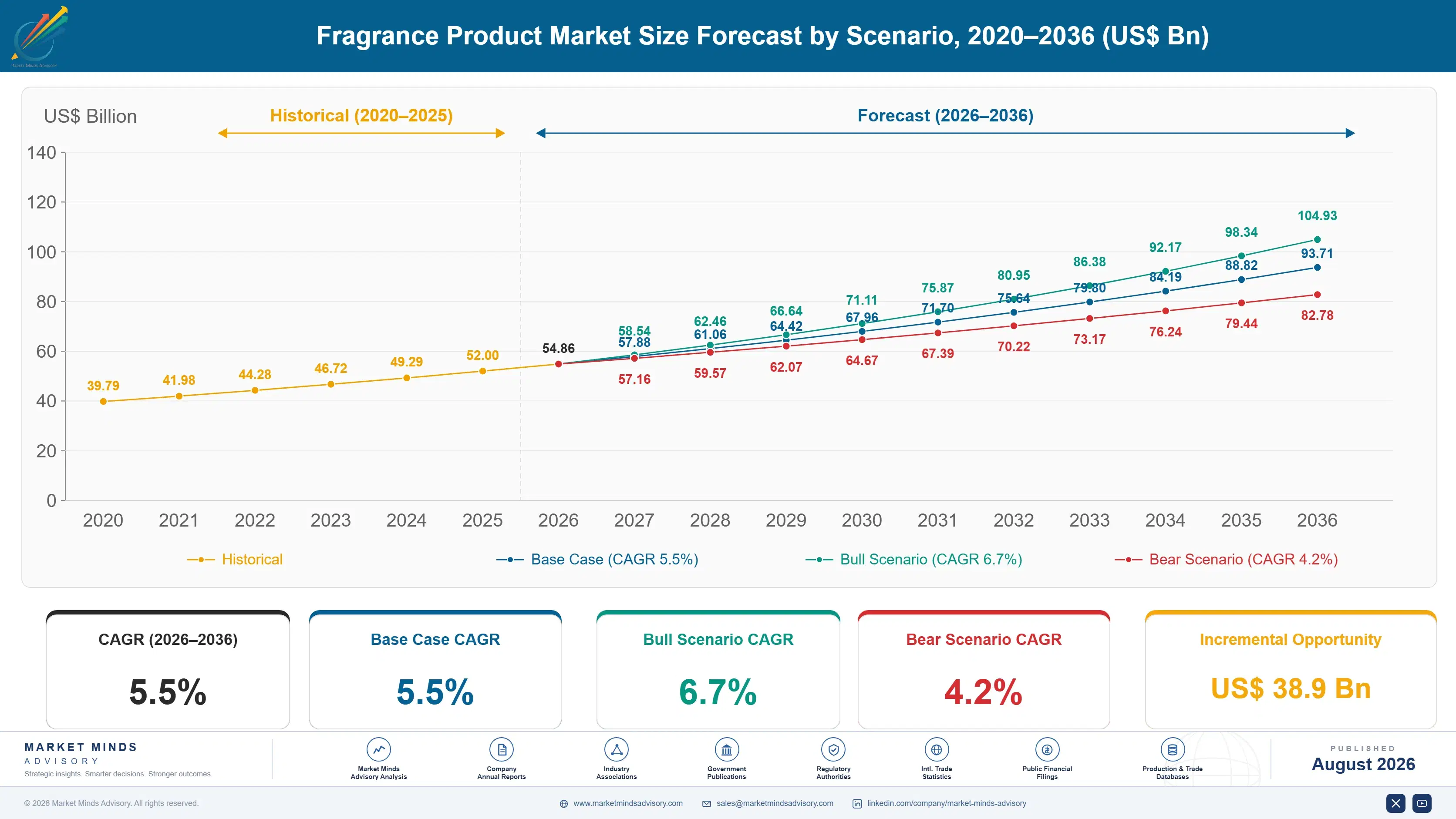
Fragrance Product Market Forecast Scenarios

fragrance-product-market-size-forecast-scenario-1788170713943
Between 2020 and 2025 fragrance demand grew at roughly 4.7 percent a year, held back early by pandemic-era retail closures before accelerating as gifting and self-purchase occasions recovered across major developed markets. Aroma-chemical supply disruption during 2022 briefly slowed new product launches across several category participants before recovering. Recovery accelerated further as gifting occasions resumed broadly overall.
The base case assumes continued growth as three mechanisms compound: consumers increasingly seeking distinctive niche scent profiles over broadly recognized designer branding; e-commerce and subscription sampling models lowering the discovery barrier for smaller independent perfume houses; and conglomerates expanding solid and alternative format fragrance lines that command meaningfully higher unit margins than traditional spray formats. These mechanisms reinforce each other considerably across most developed retail markets. Each mechanism reinforces the others considerably.
The bull case turns on faster-than-expected niche premiumization accelerating independent house growth across major developed and East Asian markets. The bear case centers on sustained counterfeit product circulation, which has historically compressed legitimate manufacturer margins and eroded consumer trust across smaller category participants facing thinner brand protection budgets. Either scenario hinges on how quickly enforcement evolves.

Niche Premiumisation Reshapes Category Economics

Fragrance products sit at the intersection of olfactory craft, luxury brand economics, and shifting retail discovery channels. As niche and artisanal houses spread, manufacturers increasingly compete on documented formulation exclusivity rather than celebrity endorsement alone, even where niche products carry a substantial premium over mass-market designer scents.
MARKET CONCENTRATIONCR5: 38%Ownership concentrates among established luxury conglomerates broadly worldwide
AVERAGE SELLING PRICE$68 per unitPricing varies sharply by brand tier and formulation
NICHE SEGMENT PENETRATION14% of unit volumeIndependent houses represent a growing minority category share
TOP PRODUCER COUNTRY SHAREFrance: 31% of productionManufacturing concentrates heavily near established formulation clusters globally
COUNTERFEIT CIRCULATION RATE9% of unit volumeUnauthorized replica products remain a persistent category concern
AROMA-CHEMICAL INPUT COST SHARE26% of cost of goods soldSynthetic compound pricing directly affects manufacturer profitability significantly
Commercially the category concentrates among a small number of diversified luxury conglomerates offering broad fragrance portfolios across multiple brand tiers, alongside specialty aroma-chemical suppliers and independent niche houses competing on formulation exclusivity. Diversified conglomerates compete on retail distribution scale and licensing relationships, while niche houses win on formulation credibility and scarcity positioning, since designer, niche, and mass-market applications each demand distinct production and distribution specifications.
The next decade will be shaped by continued niche premiumization, expanding e-commerce and subscription sampling discovery channels, and diversification of aroma-chemical sourcing beyond concentrated production clusters facing periodic trade cost volatility. Manufacturers that pair documented formulation credibility with reliable, cost-efficient production stand to capture share from competitors still offering undifferentiated mass-market scents without comparable exclusivity positioning. That shift favors manufacturers with diversified regional production networks over single-market specialists reliant on concentrated sourcing alone.
"Ten years ago a fragrance succeeded because a celebrity's name was on the bottle. Now the biggest growth is coming from houses nobody's heard of until a stranger stops them on the street and asks what they're wearing."
Director, Personal Care and Beauty Products Practice · MMA Personal Care and Beauty Products Practice · August 2026

Market Trends

Niche And Artisanal Houses Displace Mass-Market Designer Scents

Independent perfume houses are increasingly capturing consumer attention away from mass-market designer and celebrity-branded scents, directly responding to consumer fatigue with broadly recognized fragrance profiles sold across thousands of retail doors worldwide. This shift has required larger conglomerates to acquire or launch competing niche sub-brands, a process that can take twelve to eighteen months per launch given formulation development and packaging design requirements. Retailers are increasingly expanding dedicated niche shelf space, accelerating the transition well beyond what independent house marketing alone would achieve. Adoption is expected to keep broadening as consumer fatigue with mass-market branding deepens further.
Market Impact: Adds 6 percent volume overall
Solid And Alternative Formats Gain Premium Share

Manufacturers are increasingly launching solid balm and alternative format fragrance lines positioned against traditional spray formats, responding to consumer demand for travel-friendly, spill-proof packaging that meets airline carry-on restrictions more easily than glass bottles. Alternative formats increasingly differentiate premium travel-focused brands from mass-market spray-only manufacturers, since frequent travelers evaluate a fragrance purchase primarily on portability rather than price alone. Several major retailers have expanded dedicated shelf space for solid and alternative formats to serve this growing preference. Adoption is expected to keep accelerating as travel retail channels increasingly prioritize compact, spill-proof packaging formats over traditional glass bottles.
Market Impact: Adds 5 percent volume overall

Market Opportunities and Growth Drivers

Rising Discretionary Beauty Spending Sustains Category Growth

Discretionary spending on personal care and beauty products continues expanding across major developed and East Asian markets, sustaining steady fragrance category growth as consumers treat scent purchases as an accessible luxury relative to other premium beauty categories. Gifting occasions tied to major holidays and personal milestones continue driving concentrated seasonal demand spikes across most major retail markets. Manufacturers with established gifting-season retail relationships benefit from this demand pattern ahead of competitors relying primarily on year-round steady-state sales alone. That gifting-driven demand pattern is expected to persist as major retail calendars continue anchoring seasonal marketing campaigns around fragrance gifting.
Market Impact: Cuts legitimate sales by 9 percent

Digital Discovery Channels Expand Niche House Access

E-commerce platforms and subscription sampling services continue expanding consumer access to independent niche fragrance houses that previously lacked the retail distribution scale to reach broad audiences beyond flagship boutique locations. Documented sampling programme availability increasingly differentiates niche houses building direct consumer relationships from those relying solely on traditional department store counters. Independent houses investing in digital discovery partnerships are capturing consumer trial share from mass-market brands relying on legacy retail distribution alone. That digital-driven trial advantage is expected to deepen further as subscription sampling services expand their reach among younger, discovery-oriented consumers across most major retail markets.
Market Impact: Adds up to 14 percent

Market Restraints and Challenges

Counterfeit Product Circulation Erodes Brand Value

Unauthorized replica and counterfeit fragrance products continue circulating through informal retail and online marketplace channels, restricting legitimate manufacturers' ability to defend brand value and premium pricing across markets with weaker intellectual property enforcement. Root causes include the relative ease of replicating bottle packaging and the persistence of price-sensitive consumers willing to purchase suspected counterfeits at steep discounts to authentic retail pricing. Manufacturers are addressing the pressure through expanded authentication technology and stronger e-commerce marketplace takedown partnerships that reduce counterfeit visibility to legitimate consumers. This shift is expected to continue as authentication technology adoption spreads further across the category.
Market Impact: Displaces 11 percent mass-market designer volume

Aroma-Chemical Cost Volatility Pressures Manufacturer Margins

Synthetic aroma-chemical costs continue fluctuating with broader petrochemical commodity markets, restricting manufacturers' ability to maintain stable formulation costs across multi-year retail contracts negotiated well ahead of actual production runs. The root cause is that most fragrance formulation remains dependent on petroleum-derived synthetic compounds with limited viable natural substitution at current cost parity for high-volume production. When aroma-chemical costs spike, manufacturers either absorb margin compression or reformulate with cheaper substitutes, both of which have historically strained supplier relationships during periods of elevated volatility. These pressures are expected to intensify further as petrochemical markets remain volatile across multiple regions simultaneously.
Market Impact: Adds 9 percent premium share
3 additional market trends, 4 additional growth drivers, and 3 additional restraints and challenges are covered in the full report. Contact sales@marketmindsadvisory.com to access the complete intelligence.

Segment CAGR and Growth Architecture

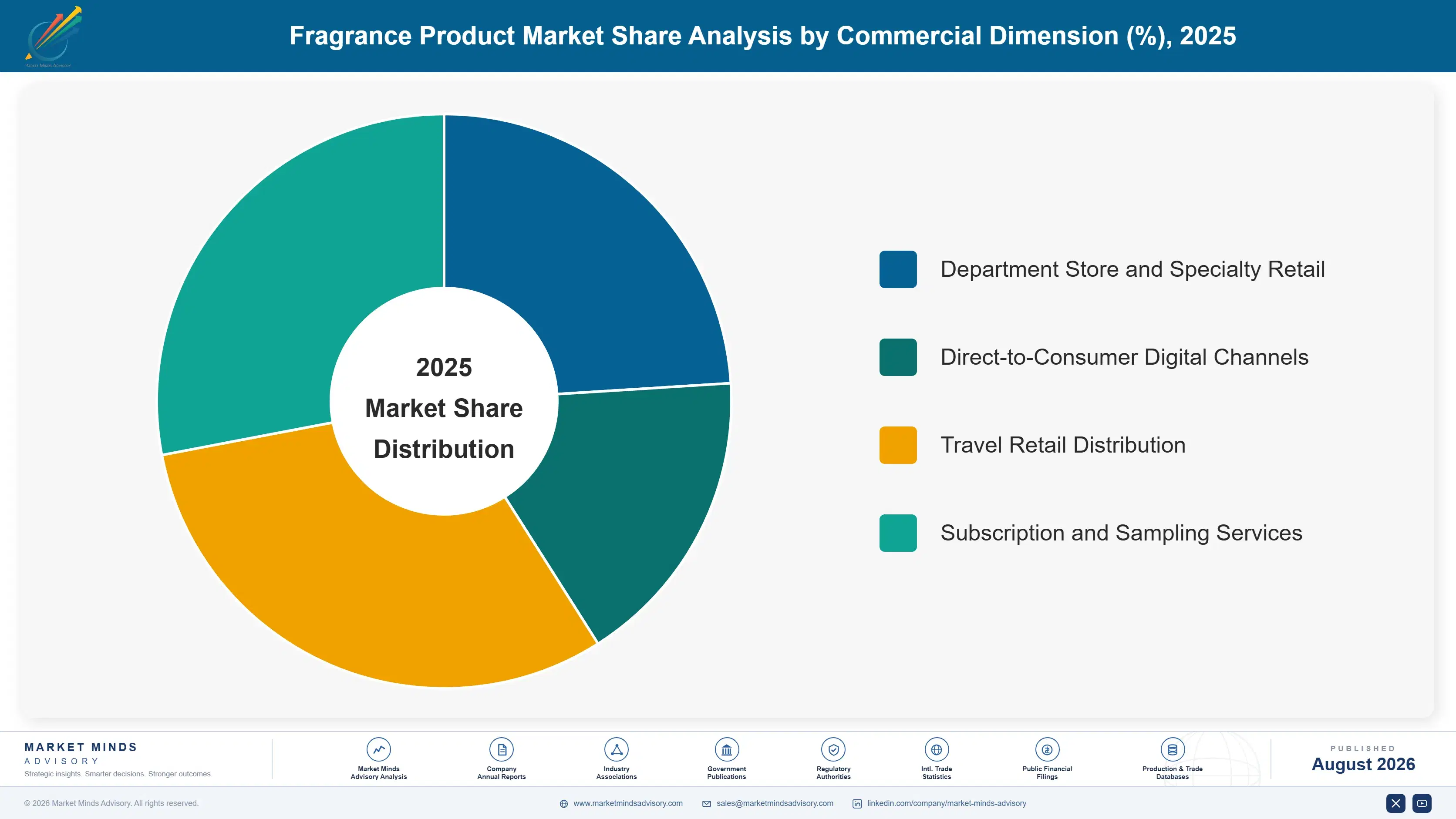
Fragrance products segment most usefully by concentration and format type, since eau de parfum, eau de toilette, niche, solid, cologne, and mist formats carry distinct formulation and packaging requirements. This framework mirrors how manufacturers organise product lines and how retailers structure category shelf space today across the industry. It also reflects how MMA benchmarks manufacturer portfolios across the industry.
fragrance-product-market-market-share-analysis-1788170714801

Niche and Artisanal Fragrances

Niche and artisanal fragrances are the fastest-growing segment as independent perfume houses capture consumers seeking distinctive scent profiles unavailable through mass-market retail distribution across most major developed markets. Building a credible niche house requires substantial investment in formulation development and boutique retail presence, a barrier that favors independent perfumers with dedicated craft expertise over commodity mass producers. Growth concentrates among houses with documented formulation exclusivity and scarcity positioning, since consumers increasingly expect distinctive scent profiles unavailable elsewhere before purchasing. Growth is fastest in Western Europe and North America, where niche discovery culture and boutique retail infrastructure are most developed. Adoption is broadening quickly across additional retail and digital channels. Adoption continues broadening quickly.
CAGR 8.5%

Solid and Alternative Format Fragrances

Solid and alternative format fragrances form the second-fastest-growing segment, benefiting from frequent travelers and younger consumers seeking travel-friendly, spill-proof packaging that meets airline carry-on restrictions more easily than traditional glass spray bottles. Documented portability and spill-resistance increasingly differentiate premium alternative-format brands from traditional spray-only alternatives sold at comparable price points. Growth is fastest in markets with well-developed travel retail infrastructure, particularly North America and East Asia, where alternative formats increasingly bundle with travel-sized gift sets, providing manufacturers a natural cross-sell channel beyond standalone bottle sales. Brands with documented portability credentials command premium pricing as younger consumers standardize travel expectations. Manufacturers investing early in this travel-focused positioning are building durable brand relationships that persist across repeat travel purchase occasions over time.
CAGR 7.0%
Full segment breakdown across 6 segments available in the complete report.

Regional Architecture and Country Demand Map

Fragrance demand concentrates where luxury brand heritage and formulation infrastructure are most developed. Western Europe accounts for the largest share of global demand, reflecting France's enduring role as the historical center of perfume formulation and luxury conglomerate headquarters. That concentration is unlikely to reverse soon.

North America

The United States' well-developed prestige beauty retail sector, backed by strong department store and specialty fragrance boutique presence, drives substantial regional demand for both niche and mass-market designer categories. Rising niche premiumization and digital discovery are reshaping demand toward independent houses over legacy designer scents specifically. Canada's prestige beauty retail sector, closely integrated with United States distribution, mirrors American brand availability and retail structures closely. Growth is supported by continued mass-market competition at the commodity tier alongside sustained niche format adoption across major urban retail markets, particularly among younger consumers discovering brands through social media platforms. Growth is further supported by continued digital discovery adoption across the region's major metropolitan retail markets.
Share: 24% | CAGR: 6.3% (2026 to 2036)

Western Europe

France's historical role as the global center of perfume formulation, anchored by the Grasse region's centuries-old aroma-chemical expertise, drives by far the largest regional demand alongside concentrated luxury conglomerate headquarters. Germany and the United Kingdom's established prestige beauty retail sectors contribute substantial additional demand from consumers accustomed to broad luxury fragrance availability. Italy and Spain's beauty retail sectors contribute meaningful additional demand, reflecting the region's deep-rooted luxury goods culture. Growth trails the fastest-growing regions because the region's category maturity is comparatively advanced already, with further gains depending on incremental niche adoption. Nordic markets contribute smaller but steadily growing demand, reflecting strong disposable income and established prestige retail infrastructure across the region.
Share: 26% | CAGR: 4.2% (2026 to 2036)
Regional intelligence for 5 additional markets available in the complete report: East Asia, South Asia and Pacific, Latin America, Middle East and Africa, Eastern Europe. Contact sales@marketmindsadvisory.com.
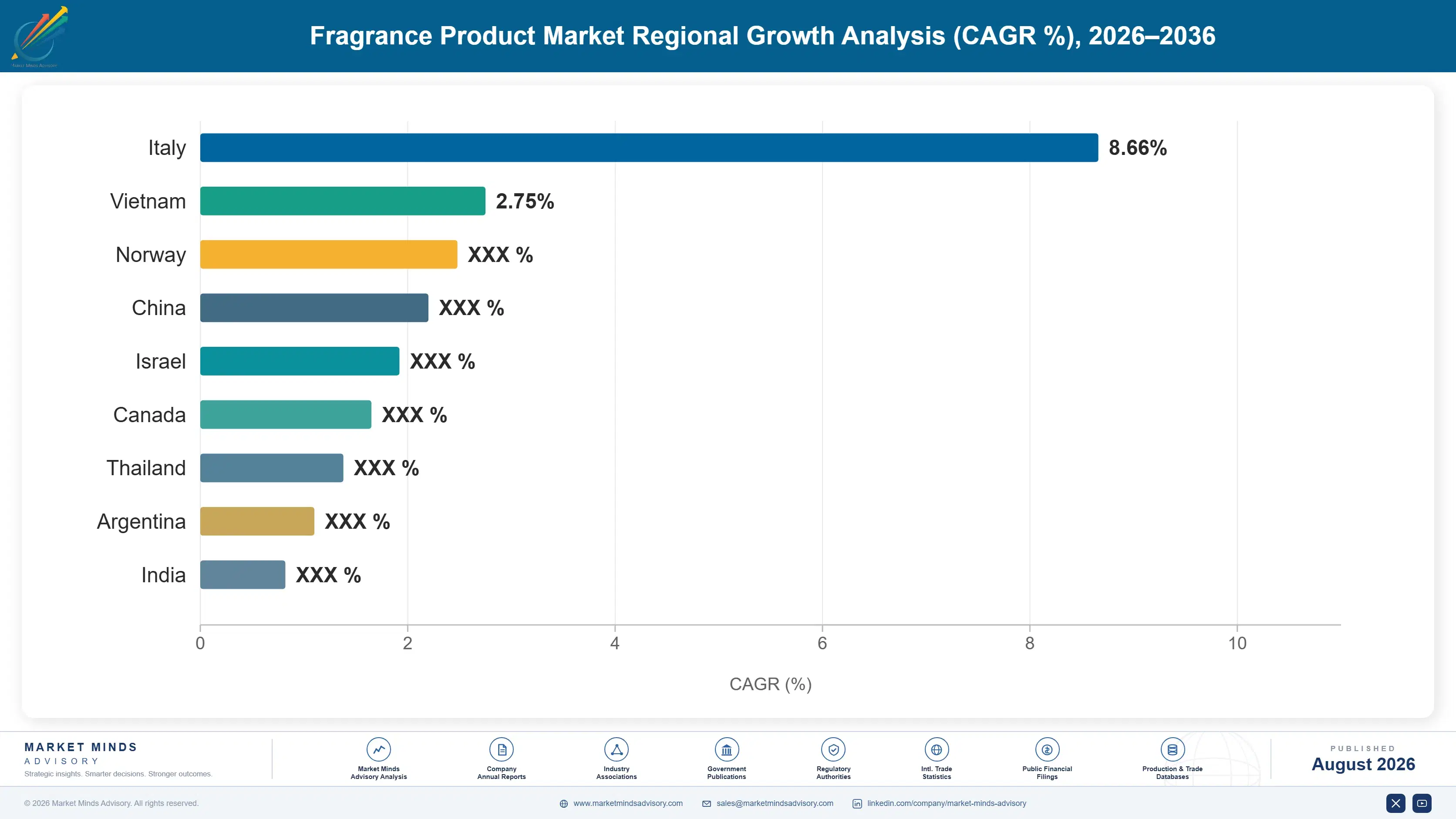
fragrance-product-market-country-cagr-analysis-1788170715584

Niche Acquisition and Digital Discovery Expansion

Conglomerates can grow revenue per unit even where basic mass-market designer volume growth is modest by acquiring niche houses, expanding digital sampling discovery channels, and securing counterfeit protection infrastructure. The most durable gains come from capturing niche-driven premiumization rather than commodity designer price competition across the category. These gains compound most effectively when pursued together across the category.

Acquiring Independent Niche Fragrance Houses Strategically

Conglomerates acquiring independent niche fragrance houses with established formulation credibility capture a price premium of roughly 30 to 45 percent over mass-market designer alternatives, reflecting the scarcity and craft positioning niche brands carry into a broader distribution network. This acquisition strategy requires meaningful integration investment to preserve brand authenticity, but it pays back through access to premium retail channels that command higher pricing and stronger consumer loyalty. The approach works best for conglomerates already serving mass-market channels seeking to extend into premium niche distribution nationwide. Adoption is accelerating across most major luxury retail markets.
Market Impact: Commands a 30 to 45 percent price premium

Expanding Digital Sampling And Discovery Platforms

Manufacturers building direct digital sampling and subscription discovery platforms capture consumer trial data previously lost to traditional department store counter interactions, while simultaneously reducing the discovery friction that has historically limited niche house visibility beyond flagship boutique locations. This platform investment requires meaningful logistics and technology development, but manufacturers who succeed report conversion improvement of roughly 22 percent compared with counter-only sampling models. The approach works best for manufacturers with sufficient catalog breadth to justify dedicated sampling platform investment. Building this discovery infrastructure requires investment in personalization technology, but manufacturers that succeed gain trial data that is difficult to replicate.
Market Impact: Improves conversion by 22 percent overall across channels

Building Authentication And Counterfeit Protection Infrastructure

Manufacturers investing in packaging authentication technology and marketplace takedown partnerships are capturing sales previously lost to counterfeit circulation, while simultaneously protecting brand value that erodes when consumers unknowingly purchase suspected replicas at steep discounts to authentic pricing. This protection infrastructure requires sustained investment in technology and legal enforcement partnerships, but manufacturers who succeed report legitimate sales recovery of roughly 18 percent compared with brands lacking dedicated authentication programmes. The approach works best for manufacturers with sufficient brand value at stake to justify enforcement investment. Smaller manufacturers increasingly access this capability through third-party enforcement partnerships rather than building proprietary systems internally.
Market Impact: Recovers 18 percent of legitimate sales overall nationwide

Offering Personalised Fragrance Layering Product Lines

Manufacturers offering personalised layering and blending product lines that allow consumers to combine complementary scents are capturing incremental revenue previously lost to single-fragrance purchase decisions, while simultaneously addressing consumer demand for individualized scent identity beyond a single signature fragrance. This layering approach requires modest formulation and packaging redesign investment, but manufacturers who succeed report average order value improvement of roughly 20 percent compared with single-product sales. The approach works best for manufacturers with established personalization retail infrastructure. Manufacturers without established personalization infrastructure typically cannot offer this combined value proposition, reinforcing a durable gap that favors early movers considerably.
Market Impact: Lifts average order value by 20 percent overall

Who Controls the Margin Pool

The fragrance product market shows moderate concentration, with an estimated CR5 near 38 percent, reflecting a category where luxury brand heritage and distribution scale matter alongside formulation credibility. L'Oreal and LVMH lead on combined portfolio breadth and retail distribution scale, but the gap to independent niche houses is narrower on formulation exclusivity than on mass-market designer categories.
Competitive activity centers on three fronts: niche house acquisition aimed at capturing premiumization-driven demand, digital sampling platform expansion to reduce dependence on traditional department store counters, and authentication technology investment to secure legitimate sales against counterfeit circulation. Acquisitions of specialty niche houses with established formulation credibility have picked up as diversified conglomerates seek to close premium credibility gaps organically rather than through internal brand development alone.

Emerging pressure comes from independent niche houses rapidly closing the retail distribution gap through digital-first strategies, threatening established luxury conglomerates on premium formulation credibility. Online marketplaces are also pushing further into counterfeit enforcement through direct authentication partnerships, threatening to disintermediate manufacturers who rely on traditional legal enforcement alone. Rankings could shift if an independent niche house achieves retail distribution parity with established diversified competitors.
fragrance-product-market-company-positioning-matrix-1788170716376

Competitive Moat and Risk Dimensions

L'OREAL

Moat: Deep Global Distribution Network

L'Oreal's decades-long relationships across department stores, specialty retailers, and travel retail channels worldwide, built through consistent brand portfolio management and reliable manufacturing supply, give it distribution scale that newer entrants cannot easily replicate. That distribution depth lets L'Oreal command preferred retail placement and rapid new product rollout that smaller competitors cannot easily match.
L'OREAL

Risk: Exposure To Portfolio Brand Fatigue

L'Oreal's broad portfolio spanning dozens of designer and mass-market fragrance brands leaves it more exposed to consumer fatigue with broadly recognized branding than smaller niche competitors with narrower, harder-to-replicate formulation identities. Declining interest in a legacy designer brand has, at times, required costly relaunch investment that niche competitors with fresher positioning did not face.
LVMH

Moat: Strong Luxury Heritage Brand Portfolio

LVMH's portfolio of storied luxury fragrance houses, built through decades of heritage brand stewardship and formulation investment, gives it credibility among prestige consumers that mass-market competitors struggle to replicate regardless of available capital. That heritage credibility helps LVMH command premium pricing and sustained consumer loyalty across generations of prestige fragrance buyers.
LVMH

Risk: Limited Commodity Segment Positioning

LVMH's premium heritage-focused positioning leaves it less positioned to capture price-sensitive mass-market fragrance demand than diversified competitors with dedicated commodity-tier product lines. Mass-market competitors have, at times, captured budget-conscious consumers that LVMH's premium-first strategy left comparatively underserved in the broader market. Closing this gap would require sustained investment in commodity-tier product development that the company has not yet prioritised.

Players Tracked

Prominent Players

L'Oreal
LVMH
Coty
Estee Lauder
Chanel

Other Key Players

Puig
Givaudan
IFF
Symrise AG
DSM-Firmenich
Shiseido Company
Beiersdorf AG
Revlon Inc.
Avon Products
Interparfums Inc.
Comme des Garcons Parfums
Creed
Diptyque
Byredo
Maison Francis Kurkdjian

Recent Developments

FEBRUARY 2026

LVMH Acquires Independent Niche Fragrance House

LVMH completed the acquisition of an independent niche fragrance house with established formulation credibility, aimed directly at capturing growing premiumization-conscious demand from consumers seeking distinctive scent profiles, with integration expected to preserve the acquired house's independent creative direction and boutique retail positioning. The integration is expected to conclude this year.
Signal: Signals established conglomerates are increasingly prioritising niche acquisition investment over continued reliance on internal mass-market brand development.
SEPTEMBER 2025

Coty Announces Digital Sampling Platform Expansion

Coty introduced an expanded direct digital sampling and subscription discovery platform bundling personalized fragrance recommendations with trial-sized product shipments, providing discovery infrastructure increasingly demanded by consumers evaluating competing brands online, positioning the company ahead of rivals still relying on traditional department store counter sampling. The platform continues expanding steadily.
Signal: Confirms digital sampling infrastructure is quickly becoming a standard competitive requirement among fragrance manufacturers industry-wide. overall.
MAY 2026

Estee Lauder Announces Authentication Technology Partnership

Estee Lauder announced a new multi-year authentication technology partnership aimed at reducing counterfeit circulation across its portfolio brands, expanding packaging verification capability and marketplace takedown coordination that has periodically been undermined by counterfeit sellers across the industry. The partnership is expected to expand across additional regions.
Signal: Confirms authentication technology investment is becoming a standard brand protection requirement among established fragrance conglomerates. industry-wide.

Aroma-Chemical And Packaging Cost Exposure

Synthetic aroma-chemical compounds account for 26 percent of cost of goods sold across most fragrance manufacturing, with glass packaging, cap components, and outer packaging costs making up most of the remainder. Manufacturing concentrates in France, tying formulation costs to specialized chemistry labor pricing alongside broader petrochemical commodity markets subject to periodic disruption. Cap components add a smaller additional share of total cost as well.
Global petrochemical price increases during 2022, driven by energy market disruption affecting synthetic aroma-chemical feedstock availability, pushed manufacturer formulation costs up by more than 16 percent within a year according to trade body reporting, forcing manufacturers with fixed retail contract pricing to absorb margin compression. Manufacturers without diversified aroma-chemical sourcing faced the sharpest impact, and smaller niche houses reported delayed new product launches while renegotiating supplier terms across multiple quarters.

Exposure varies by manufacturer type: larger integrated conglomerates like LVMH, with direct aroma-chemical supplier relationships and diversified formulation sourcing across multiple compound families, weather cost spikes with meaningfully less margin disruption than smaller niche houses reliant on single-supplier contracts. Geographic exposure differs, since manufacturers concentrated in European production face different risk timing than those with diversified Asian manufacturing, meaning cost impact varies across the industry.
fragrance-product-market-cost-volatility-analysis-1788170716686

Diversifying Aroma-Chemical Sourcing Across Multiple Suppliers

Manufacturers are increasingly securing aroma-chemical supply from multiple specialty suppliers across different geographies rather than concentrating entirely with single vendors, so a cost spike from one supplier does not halt production entirely. This diversification raises procurement coordination complexity but significantly reduces the risk of the sharp, single-supplier cost spikes that hit under-diversified manufacturers hardest.

Securing Long-Term Fixed-Price Aroma-Chemical Contracts

Manufacturers are increasingly signing long-term fixed-price contracts directly with aroma-chemical producers, securing guaranteed input costs ahead of market fluctuation and capturing pricing stability that smaller niche houses reliant on spot-market purchasing cannot access. This approach requires committed capital most smaller manufacturers cannot guarantee, reinforcing a cost advantage for larger, established conglomerates. That advantage compounds during periods of elevated supply disruption.

Investing In Natural And Bio-Based Aroma Research

Larger conglomerates are increasingly investing in natural and bio-based aroma-chemical research that reduces long-term dependency on petroleum-linked synthetic compound pricing, positioning them ahead of competitors still fully reliant on virgin petrochemical feedstocks. This approach requires substantial upfront investment most smaller manufacturers lack, reinforcing a durable material cost advantage for scale players. particularly during periods of sustained market volatility.

Portfolio Architecture for Margin Defence

Fragrance products organise into three commercial tiers running from basic mass-market designer supply through certified premium formats to niche and next-generation artisanal platforms. Gross margins widen sharply moving up the tiers, since mass-market formats compete largely on unit cost and retail shelf visibility, while premium and niche formats capture value from documented formulation exclusivity, scarcity, and brand heritage rather than unit volume alone.
The tension between mass-market volume and niche format revenue shapes conglomerate strategy: basic designer fragrances generate the retail volume that supports distribution scale and factory utilization, but premium and niche formats generate the margin that justifies continued formulation research and boutique retail investment. Conglomerates overweighted toward mass-market-only sales face intensifying counterfeit and price competition, while niche-forward houses carry steadier, higher-margin profitability less exposed to aroma-chemical cost cycles.

High-value pools concentrate among niche formats sold into premiumization-conscious boutique retail channels, and among authentication-protected formats sold into markets facing rising counterfeit circulation risk. Both pools reward manufacturers who can pair documented formulation credibility with reliable, cost-efficient production, a distinction becoming more pronounced as niche premiumization deepens across major global markets. Manufacturers slow to build this credibility risk losing share to more prepared competitors over time.

Volume / Commodity-Adjacent Tier

Basic mass-market designer fragrances sold largely on unit cost and shelf visibility, competing on price sensitivity across broad retail distribution channels nationwide. These formats generate the retail volume base that supports distribution scale across the broader conglomerate portfolio.
Gross Margin: 14-20%

Premium / Certified Tier

Premium designer and heritage formats backed by documented brand credentials, sold at a meaningful premium to prestige-conscious consumers seeking recognized quality. These formats require established brand credentials, positioning conglomerates to command steadier pricing than commodity mass-market alternatives.
Gross Margin: 28-36%

Sustainability / Regulatory / Next-Generation Tier

Niche and artisanal platforms sold to premiumization-conscious consumers and boutique retailers, priced on documented formulation exclusivity rather than unit capacity alone, commanding the highest margins. Manufacturers in this tier compete primarily on documented formulation credibility.
Gross Margin: 42-52%
fragrance-product-market-portfolio-architecture-1788170717461

High-value Sub-segments and Strategic Watch-out

Niche Formulation Premiumisation Platforms

Niche formats sold into premiumization-conscious boutique retail channels command the category's highest margins and fastest growth, concentrated among houses with proven formulation capability and established scarcity positioning reaching discerning consumers across developed markets today. Investment in this segment carries the strongest long-term margin defensibility overall.
Gross Margin: 44-54%

Authentication Protection Growth Platforms

Authentication-protected formats sold into markets facing rising counterfeit circulation risk carry strong margins tied to technology infrastructure depth, though growth is more moderate than niche formats since adoption depends on individual market enforcement policy timelines. Manufacturers with established authentication systems capture this value more reliably.
Gross Margin: 30-38%

Basic Mass-Market Designer Formats

Basic mass-market designer fragrances remain the largest volume category by far, generating steady retail revenue across cost-sensitive applications, even as growth increasingly shifts toward niche and premium formats elsewhere in the portfolio, particularly among younger consumers entering the category. particularly among younger consumers entering the category each year.
Gross Margin: 13-19%

Aroma-Chemical Cost And Counterfeit Risk

Volatile petrochemical aroma-chemical pricing combined with persistent counterfeit circulation represents a meaningful ongoing risk, since manufacturers dependent heavily on single-supplier sourcing and unresolved brand protection gaps must monitor closely across supplier and enforcement relationships, particularly as exposure increases further nationwide. across all major regions going forward.
Gross Margin: n/a

Identity-Locked Signature Purchase Economics

Fragrance demand behaves like a loyalty-driven repeat purchase relationship once a consumer identifies a signature scent, since switching fragrances requires abandoning an established personal identity association that most consumers strongly prefer to avoid absent boredom or a formulation discontinuation. That signature loyalty shapes how manufacturers price and structure gifting and layering cross-sell relationships, particularly for premium niche and heritage formats where switching costs matter most.
Adoption depth varies sharply by end use: prestige-conscious consumers penetrate deepest into documented, formulation-loyal purchase relationships, often exclusively favoring a single trusted house across multiple product lines and gifting occasions, while price-sensitive mass-market buyers adopt more transactionally, switching brands more readily based on price and retail promotion timing. Gift purchasers sit between the two, balancing brand reputation against periodic packaging and presentation reviews.

A generational shift in buyer profiles is underway as younger consumers, increasingly exposed to niche house discovery content through social media, demand documented formulation exclusivity and scarcity positioning before purchasing, replacing an older generation that selected fragrances primarily on celebrity endorsement and department store availability. Manufacturers slow to adapt risk losing share to discovery-forward competitors, particularly online.
fragrance-product-market-end-use-penetration-index-1788170718219

Where To Focus Investment Next

These are among the four positions where our research anticipates prominent divergence between winners and laggards over the coming forecast period. Each is grounded in the demand model, the regulatory perimeter, and the announced capacity pipeline.
01 / NICHE ACQUISITION INVESTMENT

Prioritise Niche Acquisition Over Mass-Market Volume

Niche and artisanal formats are growing fastest and carry the category's widest margins, driven by consumers prioritizing documented formulation exclusivity across most major developed markets. Conglomerates that acquire and integrate niche houses are capturing this premium demand at a faster rate than competitors still relying on legacy designer branding without comparable scarcity positioning. Capital allocated toward niche acquisition and formulation research will likely generate better returns than commodity capacity expansion over the next several years, spanning multiple product categories and regional markets simultaneously.
02 / DIGITAL DISCOVERY DEVELOPMENT

Build Sampling Platforms Ahead Of Retail Consolidation

Digital sampling and discovery opportunities are accelerating rapidly as consumers increasingly research fragrances online before purchasing across most major retail markets. Manufacturers who build early digital sampling capability gain conversion visibility and consumer loyalty uncommon in counter-only distribution, particularly given limited access to comparable digital discovery infrastructure and consumer trial data that competitors cannot easily replicate in the near term. Manufacturers that delay building this capability risk ceding fast-growing digital volume entirely to more established competitors, spanning multiple regions and product categories simultaneously.
03 / AROMA-CHEMICAL SOURCING DIVERSIFICATION

Diversify Aroma-Chemical Sourcing Across Multiple Suppliers

Aroma-chemical cost volatility periodically compresses margins across the industry, and manufacturers who diversify sourcing across multiple suppliers and geographies gain meaningfully more stable input cost availability than competitors reliant entirely on single-supplier concentration during periods of petrochemical market disruption. This diversification requires substantial coordination investment across multiple supplier relationships that smaller manufacturers cannot easily replicate in most cases. Manufacturers that delay this diversification risk continued cost volatility that better-diversified competitors have already substantially reduced, spanning multiple production networks and regional markets simultaneously.
04 / AUTHENTICATION INFRASTRUCTURE INVESTMENT

Build Counterfeit Protection Ahead Of Trust Erosion

Authentication technology opportunities are opening substantial addressable revenue recovery among markets facing rising counterfeit circulation, and manufacturers who build dedicated protection infrastructure capture legitimate sales before competitors recognise the opportunity clearly at scale. This protection-forward approach is already commanding stronger consumer trust among manufacturers serving markets with weaker intellectual property enforcement entering formal partnerships for the first time. Manufacturers that delay building this capability risk ceding counterfeit-exposed volume entirely to more prepared competitors, spanning multiple regional markets and distribution channels simultaneously.

Engagement Snapshot From the Field

A live engagement with an industry participant carrying material or product regulatory and market exposure ahead of a defining policy shift, showing how our research translates into a defensible multi-year portfolio strategy.
MARKET MINDS ADVISORY · CLIENT ENGAGEMENT SUMMARY
Fragrance Product Producer Strategic Portfolio Review and Transition Roadmap 2026·Investment Scenario on Fragrance Product Exposure Evaluation 2025-26
CLIENT PROFILE
The client is a regional fragrance house with an estimated $95 million in annual revenue across North American and Western European specialty retail channels, evaluating a strategic shift toward niche portfolio expansion to capture premiumization-conscious demand (client-reported, unverified by MMA). The house needed to determine optimal formulation and boutique retail investment ahead of a planned multi-year expansion.
STRATEGIC CHALLENGE
Brand development and retail strategy leadership needed to evaluate niche formulation investment against limited boutique retail capacity, but lacked reliable data on consumer willingness to pay premium pricing given the house's specific market footprint and competitive position. Prior internal estimates relied heavily on anecdotal sales feedback rather than systematic consumer research, leaving leadership uncertain which markets to prioritise first.
MMA APPROACH
MMA analysts benchmarked comparable regional niche fragrance expansions against documented consumer adoption performance data, modeling expected retail outcomes across representative formulation investment scenarios. The engagement combined primary interviews with the house's brand development and retail teams, competitor capability comparison, and analysis against MMA's broader dataset of niche expansion outcomes across comparable fragrance houses.
KEY FINDINGS
  1. The recommended formulation investment sequence increased projected boutique retail revenue by roughly 25 percent compared with the house's initial conservative expansion proposal, based on comparable industry benchmarks (client-reported, unverified by MMA).
  2. Two of five benchmarked boutique retail partners lacked sufficient premium shelf capacity to guarantee consistent regional distribution within the house's specific competitive footprint.
  3. Markets targeting younger niche-curious consumers first showed meaningfully higher conversion rates than markets prioritising traditional prestige consumers across the pilot expansion regions.
  4. The recommended retail partner included pre-packaged sampling infrastructure, reducing the house's internal launch preparation burden compared with competing proposals considerably during the pilot phase.
CLIENT PROFILE
The client is a regional fragrance house with an estimated $95 million in annual revenue across North American and Western European specialty retail channels, evaluating a strategic shift toward niche portfolio expansion to capture premiumization-conscious demand (client-reported, unverified by MMA). The house needed to determine optimal formulation and boutique retail investment ahead of a planned multi-year expansion.
STRATEGIC CHALLENGE
Brand development and retail strategy leadership needed to evaluate niche formulation investment against limited boutique retail capacity, but lacked reliable data on consumer willingness to pay premium pricing given the house's specific market footprint and competitive position. Prior internal estimates relied heavily on anecdotal sales feedback rather than systematic consumer research, leaving leadership uncertain which markets to prioritise first.
MMA APPROACH
MMA analysts benchmarked comparable regional niche fragrance expansions against documented consumer adoption performance data, modeling expected retail outcomes across representative formulation investment scenarios. The engagement combined primary interviews with the house's brand development and retail teams, competitor capability comparison, and analysis against MMA's broader dataset of niche expansion outcomes across comparable fragrance houses.
KEY FINDINGS
  1. The recommended formulation investment sequence increased projected boutique retail revenue by roughly 25 percent compared with the house's initial conservative expansion proposal, based on comparable industry benchmarks (client-reported, unverified by MMA).
  2. Two of five benchmarked boutique retail partners lacked sufficient premium shelf capacity to guarantee consistent regional distribution within the house's specific competitive footprint.
  3. Markets targeting younger niche-curious consumers first showed meaningfully higher conversion rates than markets prioritising traditional prestige consumers across the pilot expansion regions.
  4. The recommended retail partner included pre-packaged sampling infrastructure, reducing the house's internal launch preparation burden compared with competing proposals considerably during the pilot phase.
RECOMMENDED STRATEGY
Phase 1: Phase 1 (Months 1 to 2): Complete formulation finalisation and boutique retail placement across the house's highest-priority flagship markets. ahead of the peak gifting season. Phase 2: Phase 2 (Months 3 to 5): Extend the niche expansion to remaining markets using adoption data carried forward from the pilot phase. Phase 3: Phase 3 (Months 6 to 7): Finalise long-term boutique retail partnership agreements with placement terms informed by expansion outcomes. ahead of the following fiscal year.
OUTCOME
The house completed its niche portfolio expansion across all flagship markets within seven months, ahead of the planned multi-year rollout calendar. Early retail data showed meaningful revenue growth without cannibalizing existing designer-line sales (client-reported, unverified by MMA), and retail strategy leadership credited the phased approach with avoiding the boutique capacity shortfalls that affected a comparable competing house's earlier expansion.

Frequently Asked Questions

Foundational context covering the market sizes, CAGR, scope, country, region and competition that inform every finding below. This section is provided to cover basics and most often pre-purchase conversations, answered from the MMA Primary Research Dataset.

What is the current size of the Fragrance Product Market?

The global fragrance product market was valued at approximately $52.0 billion in 2025. Demand is driven by niche premiumization, digital discovery expansion, and rising discretionary beauty spending.

How large will the Fragrance Product Market be by 2036?

MMA forecasts the market will reach approximately $93.71 billion by 2036, roughly 1.71 times its 2026 value. Growth is driven by continued niche adoption and premium format expansion.

What is the CAGR for the Fragrance Product Market 2026 to 2036?

The market is projected to grow at a compound annual growth rate of 5.5 percent between 2026 and 2036. Bull and bear scenarios range from roughly 4.2 to 6.7 percent depending on niche adoption pace.

Which segment is growing fastest?

Niche and artisanal fragrances are the fastest-growing segment, expanding at approximately 8.5 percent annually, driven by consumers seeking distinctive scent profiles over mass-market designer branding.

Who are the major companies in the Fragrance Product Market?

Leading conglomerates include L'Oreal, LVMH, Coty, Estee Lauder, and Chanel. Competition centers on portfolio breadth, distribution scale, and formulation credibility, rather than price alone or celebrity endorsement.

Which country is growing fastest?

India is the fastest-growing major market, driven by its rapidly expanding organized beauty retail sector combined with growing urban middle-class discretionary spending on personal care.

Report Segmentation Architecture

The full report scope spans multiple orthogonal segmentation dimensions, with cross-tabulated demand data provided for each dimension pair. Coverage extends further to regional breakdowns, trend trajectories, and the competitive detail needed to support segment-level decision-making.

By Concentration and Format Type

  • Eau de Parfum
  • Eau de Toilette
  • Niche and Artisanal Fragrances
  • Solid and Alternative Format Fragrances
  • Eau de Cologne
  • Fragrance Mists and Body Sprays

By End-Use Industry

  • Individual Retail Consumers
  • Gift and Occasion Purchasers
  • Hospitality and Hotel Amenity Programmes
  • Travel Retail and Duty-Free Channels

By Commercial Dimension

  • Department Store and Specialty Retail
  • Direct-to-Consumer Digital Channels
  • Travel Retail Distribution
  • Subscription and Sampling Services

By Region

  • North America
  • Western Europe
  • East Asia
  • South Asia and Pacific
  • Latin America
  • Middle East and Africa
  • Eastern Europe

Scope, Methodology, and Coverage

Every figure in this report is reproducible from documented input assumptions. The scope below maps the historical period, the forecast horizon, the segmentation dimensions, and the countries covered, alongside the underlying primary and qualitative methodology.
Historical Period
2020 to 2025
Forecast Period
2026 to 2036
Base Year
2025 (USD billions; MMA Primary Research Dataset, August 2026)
Market Definition
The fragrance product market covers eau de parfum, eau de toilette, niche and artisanal fragrances, solid and alternative format fragrances, eau de cologne, and fragrance mists and body sprays sold as personal scent products. It excludes household air fresheners, laundry and fabric scent additives, and industrial or food-grade aroma-chemical applications not sold as personal fragrance.
Quantitative Units
USD billions (current prices); unit volume in million units where cited
Segmentation Dimensions
By Concentration and Format Type; By End-Use Industry; By Commercial Dimension; By Region
Regions Covered
North America, Western Europe, East Asia, South Asia and Pacific, Latin America, Middle East and Africa, Eastern Europe
Countries Covered
France, Germany, UK, Italy, Spain, USA, Canada, China, Japan, South Korea, Australia, India, Singapore, Brazil, Mexico, Argentina, Saudi Arabia, UAE, South Africa, Poland, Russia, and additional markets relevant to this sector
Key Companies Profiled
L'Oreal, LVMH, Coty, Estee Lauder, Chanel, Puig, Givaudan, IFF, Symrise AG, DSM-Firmenich, Shiseido Company, Beiersdorf AG, Revlon Inc., Avon Products, Interparfums Inc., Comme des Garcons Parfums, Creed, Diptyque, Byredo, Maison Francis Kurkdjian
Quantitative Methodology
Primary survey, n=3,800 respondents, Q4 2025, six countries; demand-side model with trade association cross-validation
Qualitative Methodology
47 expert interviews, Q4 2025; applied to validate demand model assumptions, identify emerging dynamics, and assess competitive positioning
Report Format
PDF and XLSX data workbook (Word format preview document)
Publisher
Market Minds Advisory
Report Code
MMA-2026-CHM-602
Published
August 2026
Contact
sales@marketmindsadvisory.com | www.marketmindsadvisory.com

Purchase the full Fragrance Product Market Report (2026 to 2036).

The full report provides a quantitative and qualitative assessment of the global fragrance product market through 2036, including regional sizing across all seven MMA-tracked geographies and format-level segmentation covering eau de parfum, eau de toilette, niche, solid, cologne, and mist categories. It profiles twenty leading manufacturers, benchmarking portfolio breadth, distribution scale, and formulation credibility across the competitive landscape. The report includes primary survey findings from 3,800 respondents and 47 expert interviews conducted in the fourth quarter of 2025, alongside aroma-chemical cost and counterfeit circulation risk analysis. Buyers receive segment-level revenue models, editable data tables, and a framework for evaluating manufacturer and market entry decisions.
Seven-region market sizing with format-level revenue breakdowns
Twenty-company competitive profiles with moat and risk analysis
Primary survey data from 3,800 respondents across six countries
Forty-seven expert interviews on niche premiumization and adoption trends
Editable data tables for custom scenario and sensitivity modeling
Aroma-chemical cost and counterfeit circulation risk assessment

Built For The People Who Decide

From boardroom strategy to bench-side execution, this report is read cover-to-cover by leaders shaping the next decade of their industry, turning demand scenarios, market dynamics and valuation benchmarks into decisions.
CXOs/ Presidents/ VPs/ Managers
M&A and Corporate Development
Strategy Teams and R&D Heads
Procurement and Product Directors
Regulatory and Compliance Leaders
Investor Relations and Equity Analysts