Market Minds Advisory
Formaldehyde-Free Resin Market

Formaldehyde-Free Resin Market: Press Cycle Economics, Substitute Chemistry Trade-Offs, and Lignin That Never Behaves Twice

Panel makers do not compare resin prices, they compare press cycles. A binder costing three times more but running the press faster wins, and one running it slower loses whatever it saves.

Lead Analyst

Bilal Shaikh

Published

September 2026

Make Smarter Decisions with Customized Research Insights

Request a free sample report and evaluate market opportunities, growth trends, and competitive dynamics relevant to your business needs.

2025 MARKET VALUE$3.8BMarket Size 2025
2036 FORECAST VALUE$9.2BBase Case , 2026 to 2036
CAGR 2026 TO 20368.4 %Bull 9.6% / Bear 7.2%
INCREMENTAL OPPORTUNITY$5.1BNet 10- year value creation
EXPANSION MULTIPLE2.24x2036 value over 2026 base
Strategic Levers
M&A Pipeline
Regional Outlook
Country Rankings
Competitive Intelligence
Segmental Deep-dive
Call-Us : 91 93563 13602

Executive Snapshot and Market Trajectory

Every substitute for formaldehyde chemistry works and every one of them costs something else. Isocyanate binders stick to press platens, soy adhesives struggle with moisture, bio-acrylics need more heat, and lignin behaves differently every time a pulp mill changes anything. There is no clean swap available to anybody.
Commercial advantage belongs to formulators who protect the customer's press cycle rather than those who quote the lowest binder price, because a 12% change in press time costs a panel plant far more than the resin ever does. Lignin-based resins grow fastest at 13.4%, roughly 1.60 times the market. East Asia holds the largest position at 31% of value, above the standard band, on concentrated wood panel manufacture.
Concentration sits at roughly 46% for the top five, held by application knowledge and press trial capability rather than by chemistry anybody could not synthesise. Substitute binders carry a 180% cost premium on a solids basis. Only 41% of global panel output sits in jurisdictions with emission limits, which bounds how far the substitution reaches. Panel makers outside those jurisdictions have shown essentially no voluntary appetite for paying the premium at all.
Market Definition
The market comprises binder and adhesive systems formulated without added formaldehyde and supplied to panel, insulation, abrasive, and textile manufacturers, covering polymeric MDI binders, soy and protein-based adhesives, polyvinyl acetate and emulsion adhesives, bio-acrylic and polycarboxylic acid binders, lignin-based resins, and tannin or other bio-phenolic resins. Value is measured at resin formulator level. Conventional urea, phenol, and melamine formaldehyde resins, formaldehyde scavengers added to conventional systems, finished panels and insulation products, and construction adhesives sold at retail fall outside scope.
Base Year Value
$3.8B in 2025 (MMA Primary Research Dataset, August 2026)
Forecast Period
2026 to 2036, eleven discrete annual values
CAGR
8.4% base case. Bull 9.6%. Bear 7.2%.
Fastest Growth Segment
Lignin-Based Resins: 13.4% CAGR
Fastest Growth Country
Vietnam: 11.4% CAGR
Fastest Growth Region
South Asia and Pacific: 10.6% CAGR
Largest Region
East Asia: 31% of 2025 global value
Market Leaders
Hexion, Arclin, BASF, Huntsman, and Dow lead on formaldehyde-free binder supply revenue. Source: company annual reports and MMA Analysis, July 2026.
Primary Survey
n=3,800 procurement and R&D decision-makers, Q4 2025, six countries
Methodology
Demand-side build-up, cross-validated against public data, 47 expert interviews

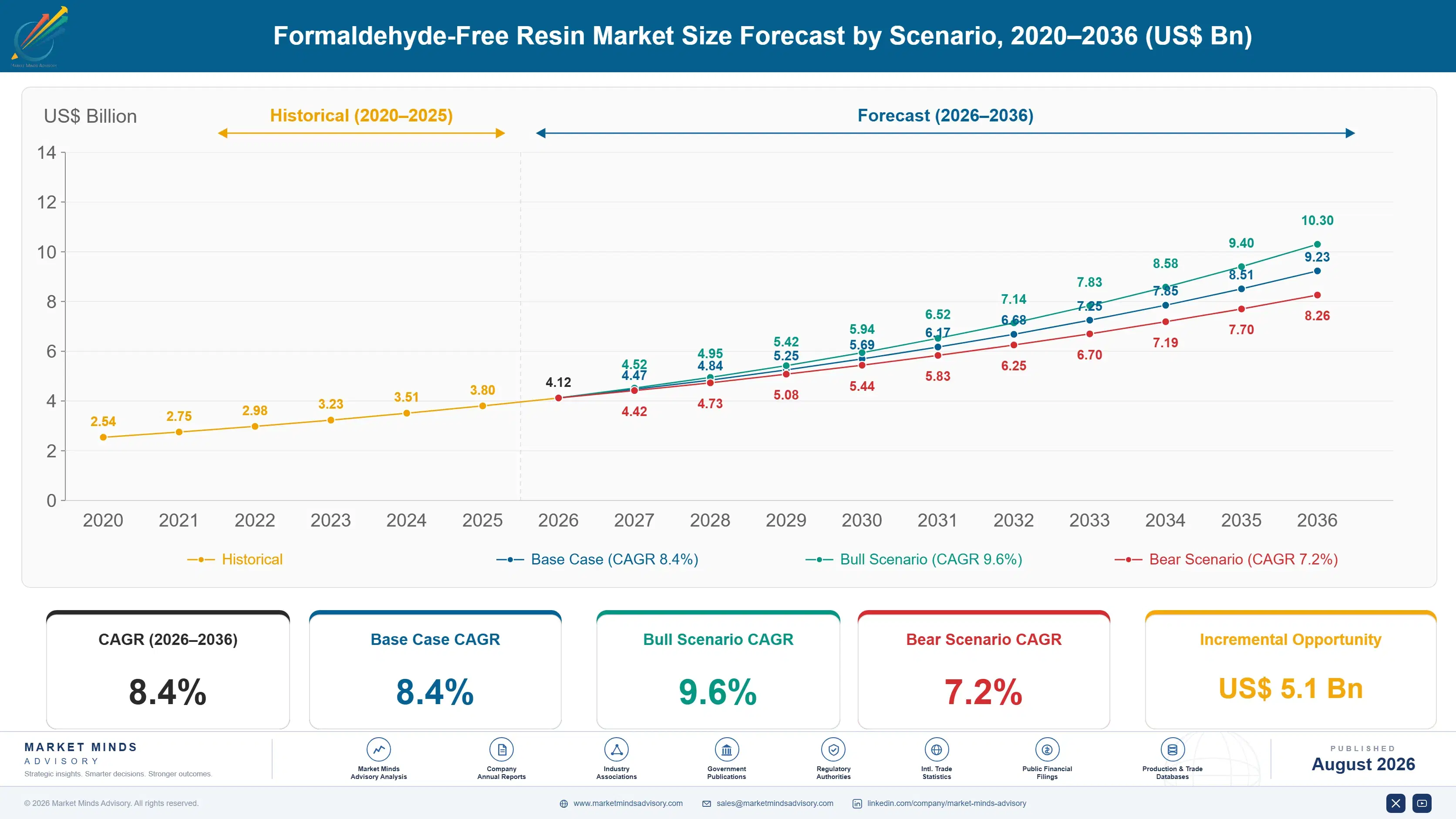
Formaldehyde-Free Resin Market Forecast Scenarios

formaldehyde-free-resin-market-size-forecast-scenario-1787551444822
Growth between 2020 and 2025 followed regulation almost exactly. Emission limits in North America tightened under federal rules that had previously applied only in California, European panel standards moved downward again, and Asian exporters serving both markets converted production to comply. Panel makers switched where they had to and nowhere else. The 7.0% historical rate reflects compliance-driven conversion rather than any voluntary preference for the substitute chemistries involved.
The 8.4% base case rests on three mechanisms. Emission limits keep ratcheting downward across major jurisdictions rather than holding at current levels, converting further panel output each time. Green building certification schemes reward formaldehyde-free specification independently of any regulation. And insulation manufacturers continue moving bio-acrylic binder deeper into product ranges after finding the marketing value exceeded the formulation cost. None of the three requires panel makers to want any of this.
The 9.6% bull case assumes further regulatory tightening in Asia while lignin chemistry finally reaches consistent commercial performance. The 7.2% bear case reflects panel industry margin pressure resisting a 180% binder cost premium, regulatory timetables slipping under industry pressure, and lignin variability continuing to defeat every attempt at reliable commercial-scale formulation. The regulatory timetable governs both cases more than chemistry does.

The Press Cycle Decides Everything

Panel manufacturers do not evaluate binders on price and formulators who present price comparisons lose the conversation immediately. A particleboard press is the constraint on plant throughput, and a binder that adds 12% to cure time removes 12% of annual output from a facility whose fixed costs do not move at all. That arithmetic dwarfs a resin price difference every time somebody actually runs it.
TOP-FIVE CONCENTRATION46%Combined share of binder supply held by leading formulators
RESIN COST PREMIUM180%Uplift over conventional formaldehyde binder on a solids basis
PRESS CYCLE IMPACT12%Change in panel press time against conventional resin systems
WOOD PANEL APPLICATION SHARE58%Portion of volume entering particleboard, fibreboard, and plywood manufacture
REGULATED MARKET PENETRATION41%Share of panel output in jurisdictions with emission limits
BINDER COST SHARE23%Portion of panel manufacturing cost attributable to the binder
Each substitute chemistry brings a genuine trade-off rather than a clean win. Polymeric isocyanate binders perform superbly and adhere to press platens, requiring release agents and careful housekeeping, and they carry their own occupational exposure profile. Soy adhesives work well in interior plywood and less well where moisture matters. Bio-acrylics cure at higher temperatures. None of these is a straight swap.
Regulation bounds the whole market rather than driving it indefinitely. Only 41% of global panel output sits in jurisdictions with binding emission limits, and panel makers outside those markets have shown almost no voluntary appetite for a 180% binder cost premium. Growth therefore follows the regulatory perimeter, which is expanding but at a pace set by legislatures rather than by chemistry.
"A formulator arrives with a technically excellent binder and a spreadsheet showing cost per cubic metre, and the plant manager is thinking about press cycles and platen cleaning downtime. Those are different conversations. The ones who win have spent a week in the plant before quoting anything at all."
Practice Director, Adhesives, Binders and Wood-Based Panels · MMA Adhesives and Binder Systems Practice · August 2026

Market Trends

Emission Limits Ratchet Rather Than Settling at a Level

Regulators in North America, Europe, and increasingly Asia have moved formaldehyde emission limits downward repeatedly rather than setting a threshold and leaving it, which converts a further slice of panel production with each revision. Exporters serving those markets convert whole production lines rather than segregating output, since running two systems through one press is impractical. Around 41% of global panel output now sits inside a limit regime. Each ratchet is a demand event that formulators can see coming years in advance. Conversion is a dated event rather than a gradual trend anywhere it happens.
Market Impact: Vietnam growing fastest at 11.4%
Insulation Makers Extend Bio-Acrylic Binder Across Ranges

Mineral and glass wool producers who introduced bio-based binder on premium lines found the marketing value and specifier response exceeded the formulation cost difference, and have extended it through mainstream product ranges since. Higher cure temperature raises energy consumption in the curing oven, which is a real cost nobody advertises. The colour change from brown phenolic to a lighter binder also became a visible product signal customers recognise. Bio-acrylic binders grow at 10.6% against a market rate of 8.4%. Installers and specifiers now read that colour as an attribute rather than as an incidental production difference.
Market Impact: Certification adds 9% of demand

Market Opportunities and Growth Drivers

Asian Exporters Convert Lines to Reach Western Markets

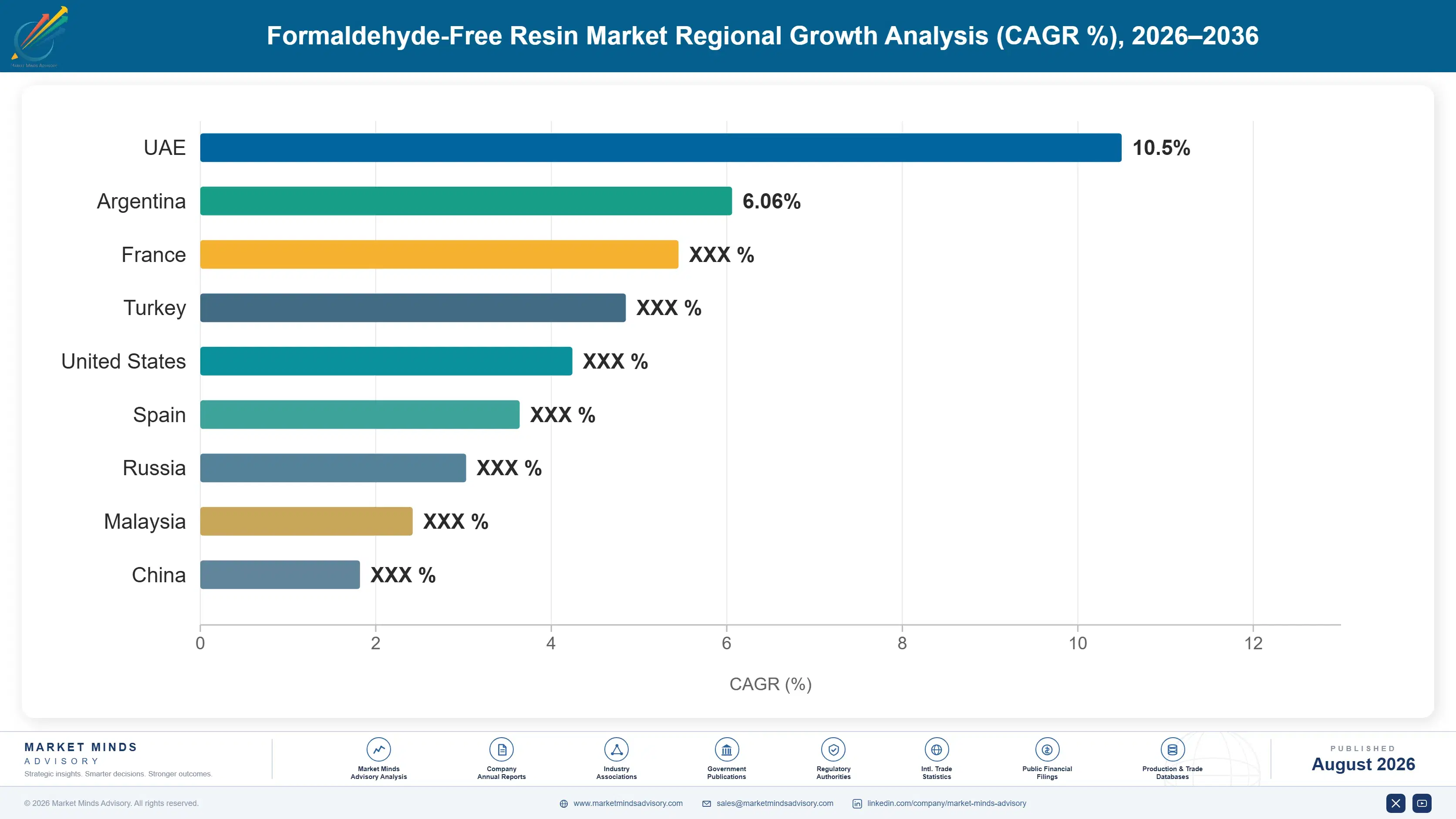
Vietnamese, Malaysian, and Chinese panel and furniture producers selling into North America and Europe must meet emission limits set in those destinations, and conversion happens at the production line rather than the shipment. Vietnam grows fastest of any country at 11.4% precisely because its furniture export industry expanded while those limits tightened simultaneously. Conversion economics differ from domestic markets, since the cost premium is recovered in an export price rather than absorbed against local competition that never converted. Tropical species such as rubberwood also behave differently with substitute binders than temperate softwood does.
Market Impact: Binder is 23% of panel cost

Green Building Certification Rewards Specification Independently

Building certification schemes award points for low-emitting interior materials regardless of what local regulation requires, which creates demand in jurisdictions where no legal limit applies at all. Commercial developers pursuing certification specify compliant panels and insulation as a matter of routine now. That pull comes from the specifier rather than the panel maker, which changes who a formulator should be talking to. It also supports pricing that a purely regulatory conversion never generates for anybody. Formulators reaching architects and certification consultants directly are addressing the party actually willing to fund the conversion.
Market Impact: Lignin grows 13.4% from tiny base

Market Restraints and Challenges

Panel Margins Cannot Absorb a 180% Binder Premium

Particleboard and fibreboard are commodity products made on thin margins, and binder already represents 23% of manufacturing cost before any substitution. A 180% premium on that line is simply not absorbable without either a regulatory requirement or a customer paying for it. The root cause is that the substitute chemistries are genuinely more expensive to make. Formulators mitigate by reducing application rates through better distribution, by protecting press throughput, and by targeting product ranges where the panel carries a premium already. Nothing about the substitute chemistries is likely to get materially cheaper within the forecast period.
Market Impact: Limits now cover 41% of output

Lignin Variability Defeats Formulation at Commercial Production Scale

Lignin is phenolic, abundant, and generated as a by-product of pulping, which should make it an obvious phenol-formaldehyde replacement. It is not, because kraft, organosolv, and sulphonate lignins behave differently, and even one mill's output varies with wood species and cooking conditions. The root cause is that lignin is a class of materials rather than a compound. Formulators mitigate through fractionation and standardisation steps, through blending across sources, and by designing formulations tolerant of variation rather than requiring consistency nobody can supply. Pulp mills have no commercial reason to solve this problem themselves.
Market Impact: Bio-acrylic binders grow at 10.6%
4 additional market trends, 3 additional growth drivers, and 2 additional restraints and challenges are covered in the full report. Contact sales@marketmindsadvisory.com to access the complete intelligence.

Segment CAGR and Growth Architecture

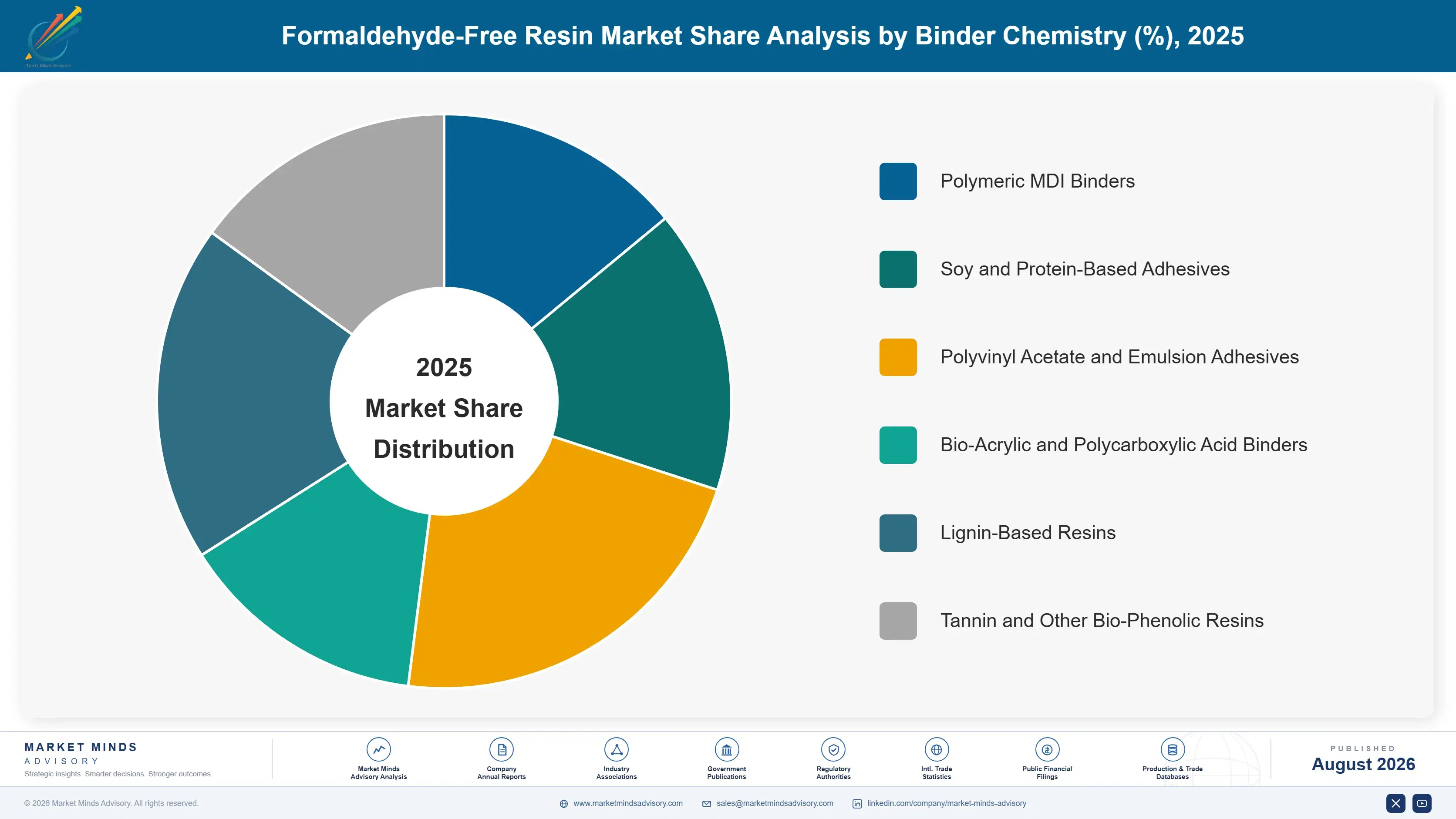
Segmentation follows binder chemistry, because each system carries a distinct cure behaviour, cost position, performance limit, and handling requirement inside the customer's process. Six chemistries cover commercial supply, and the divide between petrochemical substitutes that work today and bio-based routes still solving consistency matters more commercially than any comparison of bond strength between them.
formaldehyde-free-resin-market-market-share-analysis-1787551445356

Lignin-Based Resins

The fastest chemistry at 13.4%, roughly 1.60 times the market, from a base that remains genuinely small in commercial terms. Lignin is phenolic and available as a pulping by-product in enormous quantity, which makes it the obvious candidate to replace phenol-formaldehyde in exterior panels and laminates. The obstacle is consistency: kraft, organosolv, and lignosulfonate materials behave differently, and a single mill's output shifts with wood species and cooking conditions. Fractionation and blending help. Nobody has yet demonstrated reliable commercial-scale performance across varying feedstock without extensive reformulation each time. Nordic pulp producers with both feedstock access and technical capability are furthest advanced, though even they have not demonstrated a formulation that survives normal upstream variation.
CAGR 13.4%

Tannin and Other Bio-Phenolic Resins

Second fastest at 11.2%, using condensed tannins extracted from bark and other plant sources as phenolic building blocks in place of petroleum-derived phenol. Performance in interior panels is genuinely good and exterior durability improves with hardener selection and formulation work. Feedstock supply is the practical limit, since commercial tannin extraction sits in relatively few locations and competes with leather tanning and other established uses. Cost sits above conventional phenolic and below lignin development spending. Regional supply concentration makes freight a more significant factor than the chemistry alone would suggest. Bark availability follows forestry and sawmilling activity rather than adhesive demand, which introduces a supply rhythm formulators have limited influence over.
CAGR 11.2%
Full segment breakdown across 6 segments available in the complete report.

Regional Architecture and Country Demand Map

Regional shares follow wood panel and insulation manufacture weighted by whether local emission regulation applies at all. East Asia sits above the standard band for the reason stated below, and every other region falls inside its range throughout. Production volume on its own predicts very little here at all.

North America

Federal emission rules extended what had been a Californian requirement across the whole country, which converted a large share of domestic panel production and every import route serving it. Hexion, Arclin, and Georgia-Pacific Chemicals hold deep formulator positions with panel producers. Soy-based plywood adhesives originated commercially here and remain more widely used than anywhere else. Green building certification adds specification pull beyond regulation. Growth of 8.2% reflects a largely converted domestic industry now moving toward the bio-based chemistries rather than only away from formaldehyde. Press trial capability rather than formulation breadth separates suppliers here, since domestic panel producers have already converted and now shop the binder annually on cost per cubic metre.
Share: 24% | CAGR: 8.2% (2026 to 2036)

Western Europe

Panel emission standards have tightened repeatedly and the region's manufacturers converted earlier than most, which means growth now comes from chemistry substitution within the compliant category rather than from initial conversion. Mineral wool insulation producers here pioneered bio-acrylic binder and extended it across mainstream ranges. BASF, Prefere Resins, and Metadynea hold established positions. Lignin research is furthest advanced, supported by Nordic pulp producers with feedstock and technical capability. Growth of 6.8% is the slowest anywhere because the easy conversion has already happened. Bio-acrylic curing energy is a genuine cost here given industrial electricity prices, and several insulation producers have quietly reconsidered how far down the range they extend it. Nobody advertises that calculation.
Share: 22% | CAGR: 6.8% (2026 to 2036)
Regional intelligence for 5 additional markets available in the complete report: East Asia, South Asia and Pacific, Latin America, Middle East and Africa, Eastern Europe. Contact sales@marketmindsadvisory.com.
formaldehyde-free-resin-market-country-cagr-analysis-1787551445875

Four Moves Worth Real Capital

Advantage here comes from protecting the customer's throughput, following the regulatory perimeter rather than chasing it, and solving consistency problems bio-based chemistry has not yet answered. Four moves justify capital across the forecast period, and the first reframes what a panel maker is actually buying. Two of the four involve talking to somebody new.

Sell press cycle protection, not binder pricing

A particleboard press governs plant throughput, and a binder adding 12% to cure time removes 12% of annual output from a facility whose fixed costs do not change at all. That loss dwarfs the resin price difference every time somebody actually calculates it, and it also works the other way where a binder cures faster. Formulators who run press trials and quantify throughput effects in the plant's own terms compete on ground where a 180% price premium stops mattering. A week spent in the plant before quoting is worth more than any formulation improvement made in a laboratory.
Market Impact: Protects against a 12% loss of plant throughput

Follow the regulatory perimeter years ahead

Emission limits ratchet downward rather than settling, and each revision converts a further slice of the 59% of global panel output still outside any limit regime. Timetables are published well in advance and consultation periods are public. Formulators tracking them can position with panel producers before conversion becomes urgent, when the customer has time for trials rather than a compliance deadline. Arriving after the deadline means competing on availability against whoever prepared properly beforehand. Panel producers converting under time pressure choose whoever has already run trials on their press, which makes early positioning worth considerably more than any pricing advantage.
Market Impact: Targets the 59% of panel output still unregulated

Engineer formulations tolerant of lignin variation

Lignin grows at 13.4% and remains commercially marginal because kraft, organosolv, and sulphonate materials behave differently and single-mill output shifts with wood species and cooking conditions. Everybody is trying to standardise the feedstock. The more practical route is designing formulations that tolerate variation rather than requiring consistency no pulp mill can supply, which turns the problem from a supply chain question into a chemistry one that formulators are equipped to solve. Nordic pulp producers are furthest advanced on the feedstock side and still cannot deliver consistency, which suggests the answer sits with the formulator rather than the supplier.
Market Impact: Addresses a segment currently growing 13.4% each year

Reach specifiers rather than only panel buyers

Green building certification creates demand in jurisdictions with no regulation at all, and that pull originates with architects and developers rather than with panel procurement. Certification-driven demand already adds around 9% of volume and supports pricing that compliance conversion never does. Formulators selling exclusively to panel manufacturers are addressing the buyer who resists the premium, rather than the specifier who is willing to pay for it in the finished building. Certification consultants and architecture practices are reachable through entirely different commercial channels from panel procurement, and almost nobody in this industry has built them properly.
Market Impact: Certification pull already adds 9% of total demand

Who Controls the Margin Pool

Concentration sits at roughly 46% for the top five on binder supply revenue, held by application engineering and press trial capability rather than by chemistry anybody with a reactor could not make. Hexion and Arclin hold the deepest wood panel formulator relationships in North America. BASF and Huntsman bring isocyanate positions and formulation breadth, and Dow competes across emulsion and acrylic chemistries into insulation and panel markets simultaneously.
Competition runs on three dimensions. Press trial and application support is the first, because a binder that damages throughput loses regardless of its bond performance. Chemistry breadth is the second, since no single substitute suits every panel type or moisture exposure. Regulatory tracking is the third, and it determines who arrives before a conversion deadline rather than after it.

Pressure is building from two directions. Bio-based specialists with lignin, tannin, and protein chemistry are entering from outside the traditional resin industry entirely. Panel producers in unregulated markets show no appetite for the premium at all. Rankings will shift toward formulators combining application depth with genuine bio-based capability rather than toward whoever holds conventional resin scale. Reactor capacity defends nothing at all in this business.
formaldehyde-free-resin-market-company-positioning-matrix-1787551446400

Competitive Moat and Risk Dimensions

HEXION

Moat: Wood panel application engineering depth

Hexion works inside panel plants on press trials, application rates, and cure profiles rather than supplying to a specification sheet, which is where a binder either protects throughput or quietly destroys it. That capability took decades of plant-level experience to build across many wood species and press configurations. Panel producers converting under a deadline call whoever already knows their line.
HEXION

Risk: Conventional resin portfolio weight

A substantial part of the business remains conventional formaldehyde chemistry facing progressive regulatory displacement in every major market. Managing that decline while funding bio-based development competes for the same capital and management attention. Specialists entering with lignin, tannin, and protein chemistry carry no legacy portfolio to defend and can position purely around where demand is heading.
BASF

Moat: Isocyanate integration and chemistry breadth

BASF produces polymeric isocyanate upstream and formulates across acrylic, emulsion, and bio-based routes, which lets it match chemistry to the panel type and moisture exposure rather than pushing one system everywhere. Isocyanate integration also secures the cost position on the substitute that performs best technically. Few competitors can offer that range from a single qualified supplier relationship.
BASF

Risk: Isocyanate exposure profile scrutiny

Polymeric isocyanate solves the formaldehyde problem and introduces its own occupational exposure considerations, platen adhesion requiring release agents, and handling requirements that panel plants find genuinely demanding. Regulatory attention to isocyanates is increasing in several jurisdictions. A substitute that trades one exposure question for another is vulnerable if that scrutiny sharpens further.

Players Tracked

Prominent Players

Hexion
Arclin
BASF
Huntsman
Dow

Other Key Players

Wacker Chemie
Celanese
Solenis
Ashland
Metadynea
Prefere Resins
Georgia-Pacific Chemicals
Sumitomo Bakelite
Nan Ya Plastics
Advachem
Borregaard
Stora Enso
Kraton
Cargill
Kaneka

Recent Developments

FEBRUARY 2025

Panel producer selects binder on press throughput evidence

A European particleboard manufacturer awarded a formaldehyde-free binder contract to the supplier demonstrating the shortest press cycle in plant trials, despite a higher quoted price per tonne than two competing systems. Annual throughput modelling made the comparison entirely one-sided in practice. Price never entered the decision.
Signal: Throughput evidence taken from plant trials now decides awards that quoted binder pricing used to settle
JUNE 2025

Insulation maker extends bio-acrylic binder to mainstream ranges

A mineral wool producer moved bio-acrylic binder from premium lines into its mainstream product range, citing specifier response and certification points that exceeded the additional formulation and curing energy cost. Product colour change had become a recognised signal to installers and specifiers alike. Volume followed within months.
Signal: Binder choice is becoming a visible product attribute rather than the invisible manufacturing decision it always was
NOVEMBER 2025

Lignin binder trial fails on feedstock variability

A commercial-scale lignin binder trial at a fibreboard plant was suspended after performance varied substantially between deliveries from the same pulp mill, traced to changes in wood species and cooking conditions upstream. Reformulation for each delivery proved commercially impractical at production scale. The programme has not resumed.
Signal: Feedstock variability rather than the chemistry itself remains the binding obstacle to any commercial lignin adhesive use

What the Substitute Actually Costs

Isocyanate monomer dominates polymeric MDI binder cost at roughly 61% of formulation, supplied by a concentrated group of producers with limited alternatives. Acrylic monomers and polycarboxylic acid precursors carry bio-acrylic systems at 48%. Soy protein isolate and modified starch feedstocks track agricultural commodity pricing directly. Lignin and tannin feedstocks are cheap and inconsistent, so processing and standardisation rather than raw material dominate their cost structures entirely.
Isocyanate pricing moved sharply through 2022 and 2023 on European energy costs and plant outages, and formulators holding annual panel supply agreements absorbed most of it directly. BASF and Huntsman both discussed isocyanate cost pressure and pricing actions in their reporting for those years. Soy protein pricing moved independently on agricultural markets, which gave formulators with both chemistries a natural hedge that single-chemistry competitors did not hold.

Exposure divides on chemistry mix and contract structure rather than on scale. Formulators weighted toward isocyanate carry concentrated monomer exposure they cannot hedge, against panel customers who resist any price increase on a line already at 23% of their manufacturing cost. Bio-based systems carry agricultural or processing exposure that moves on entirely different cycles. Breadth across chemistries is a genuine cost defence as well.
formaldehyde-free-resin-market-cost-volatility-analysis-1787551446595

Hold breadth across unrelated feedstock chemistries

Isocyanate, acrylic, and agricultural protein feedstocks move on cycles that rarely coincide, so a formulator carrying all three absorbs input shocks that a single-chemistry competitor passes on or eats entirely. Breadth also lets the commercial team match chemistry to the panel type rather than defending one system everywhere. The development cost is real and the hedge is genuine.

Reduce application rate through better distribution

Binder at 23% of panel manufacturing cost is applied at rates set partly by distribution quality, and improved blending and spray systems deliver equivalent bond performance at lower addition. That reduces the effective premium without changing the chemistry at all. It requires application engineering inside the customer's plant, which is exactly what wins the business anyway.

Index panel supply agreements to monomer references

Annual binder contracts priced firm against isocyanate monomer that moves on energy costs and plant outages transfer the whole exposure to the formulator. Indexation to published references removes it. Panel producers resist initially and accept it once shown that every alternative supplier carries the identical exposure and will price it in somewhere regardless. Nobody accepts it first time.

Portfolio Architecture for Margin Defence

Margin architecture follows whether the customer had a choice. Compliance-driven conversion in regulated markets earns modestly, because the panel maker resents the premium and shops the chemistry hard once the deadline passes. Certification-driven and premium product specification earns considerably more, since the specifier rather than the manufacturer is paying. Bio-based chemistries with genuine performance advantages earn best, where they work reliably at all.
The volume and premium tension is really about who the formulator talks to. Panel procurement compares cost per cubic metre and treats binder as an unwelcome line item. Architects, developers, and brand owners pursuing certification treat formaldehyde-free specification as a product attribute worth paying for. Formulators reaching only the first group are negotiating with the party least willing to fund the conversion they are selling. Very few formulators have built the second relationship at all.

High-value pools concentrate in press-cycle-protective formulations backed by plant trial evidence, certification-driven specification demand, and any bio-based chemistry that solves consistency before competitors do. Each is defended by application knowledge or formulation capability rather than by reactor capacity, which is the one thing every competitor in this market already has. Plant-level knowledge is what actually separates the returns here.

Volume / Commodity-Adjacent Tier

Standard formaldehyde-free binders supplied into compliance-converted panel production where the manufacturer resents the premium. Competition runs on cost per cubic metre once the conversion deadline has passed. Very little defends the position.
Gross Margin: 16%-25%

Premium / Certified Tier

Formulations engineered around a specific plant's press cycle, wood species, and moisture requirements with trial evidence attached. Throughput protection justifies pricing that quoted comparison never would. The range reflects wide variation in application engineering depth.
Gross Margin: 28%-42%

Sustainability / Regulatory / Next-Generation Tier

Bio-based lignin, tannin, and protein chemistries plus certification-specified systems where the specifier rather than the panel maker is paying. Consistency capability and specifier relationships both defend pricing. The range is wide because bio-based commercial maturity varies enormously.
Gross Margin: 34%-50%
formaldehyde-free-resin-market-portfolio-architecture-1787551447101

High-value Sub-segments and Strategic Watch-out

Press-Cycle-Engineered Formulations

A binder adding 12% to cure time removes the same share of annual output from a plant whose fixed costs never move, which makes throughput evidence worth more than any quoted price comparison ever manages. A week spent in the plant beats any laboratory formulation improvement.
Gross Margin: 30%-42%

Certification-Driven Specification

Green building schemes create demand where no regulation applies at all, and the specifier paying for it resists the premium far less than panel procurement does. Roughly 9% of demand already originates this way. Architects and certification consultants sit in an entirely different commercial channel altogether.
Gross Margin: 34%-46%

Variation-Tolerant Bio-Based Systems

Lignin grows at 13.4% and remains commercially marginal on consistency alone. Formulations designed to tolerate feedstock variation rather than demand consistency solve a problem no pulp mill is going to solve instead. Nordic producers are furthest advanced on feedstock and still cannot deliver reliable consistency at scale.
Gross Margin: 36%-50%

Post-Deadline Compliance Supply

The strategic watch-out. Once a panel maker has converted under regulatory pressure, the binder becomes an unwelcome 23% cost line shopped annually against every formulator with a comparable specification sheet. Nothing about the chemistry itself protects the position once that compliance deadline has actually passed.
Gross Margin: 16%-25%

How Conversions Actually Happen

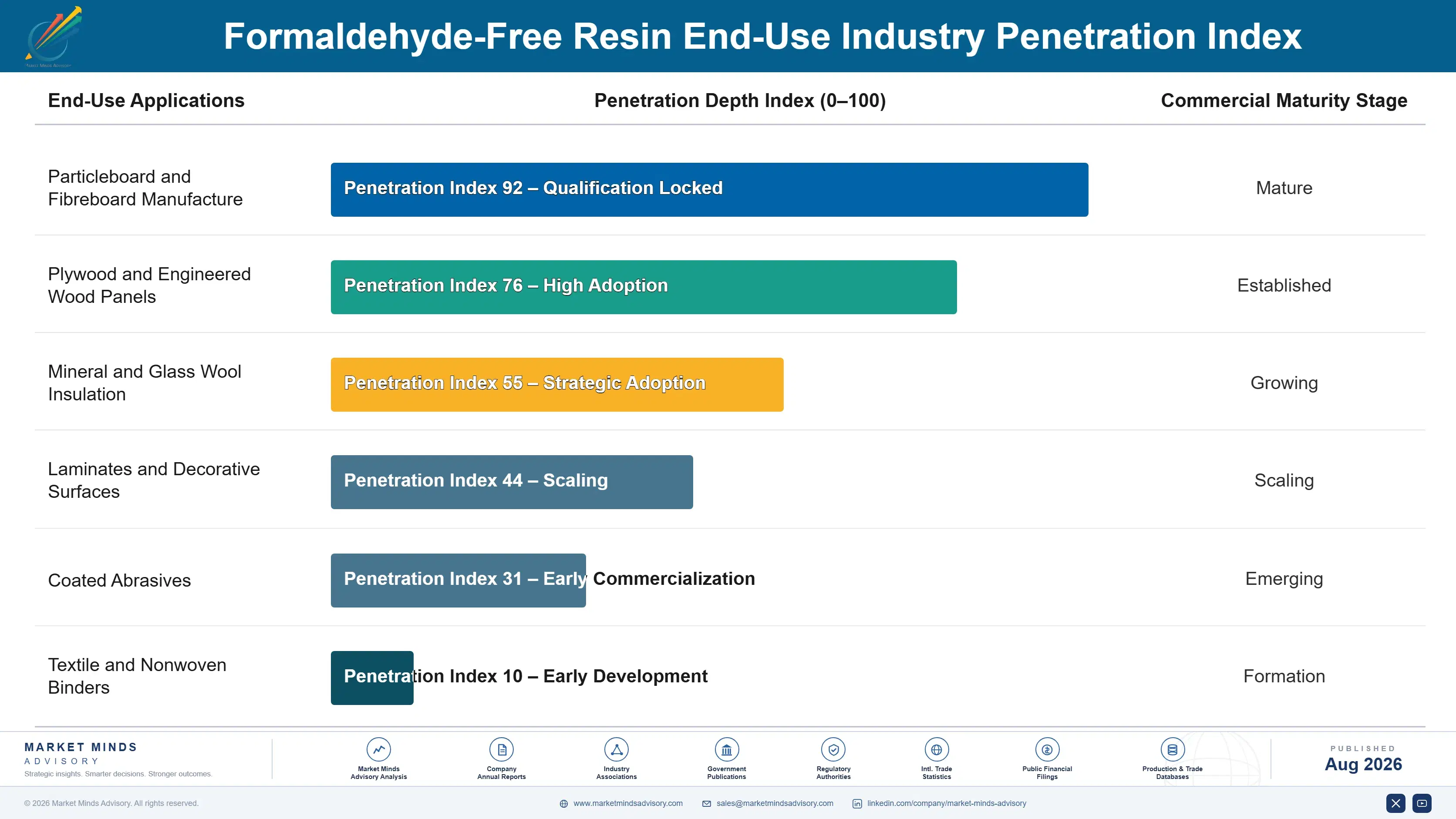
Demand arrives in two shapes that require entirely different selling. Compliance conversion is a dated event: a regulation takes effect, a panel producer must convert a line by then, and the formulator who has already run trials on that press wins while the others quote into a decision that was made months earlier. Certification-driven demand arrives continuously through specifiers who never speak to a panel manufacturer and simply require the attribute in the finished building.
Stickiness depends on how the binder was chosen. A formulation engineered around a specific press, wood species, and moisture requirement holds because reoptimising costs the plant trial time and risk. A drop-in compliance binder holds until the next annual negotiation. Certification-specified systems hold for the project and confer nothing beyond it. Nothing else in the relationship holds past a renewal date.

The deciding buyer inside a panel plant is production rather than procurement, whatever the purchase order says. Production managers care about press cycles, platen cleaning, and whether the line runs. Formulators presenting cost per cubic metre to a buyer are answering a question that the person who actually decides never asked them. That mismatch costs awards on almost every converted line.
formaldehyde-free-resin-market-end-use-penetration-index-1787551447589

What Wins the Conversion

These are among the four positions where our research anticipates prominent divergence between winners and laggards over the coming forecast period. Each is grounded in the demand model, the regulatory perimeter, and the announced capacity pipeline.
01 / THROUGHPUT EVIDENCE SELLING

Run the press trial before quoting anything

A particleboard press governs total plant throughput, and a binder adding 12% to cure time removes the same proportion of annual output from a facility whose fixed costs do not move at all in response. That loss dwarfs any resin price difference the moment somebody actually calculates it properly, and the effect works in the supplier's favour where a formulation cures faster. Formulators who run plant trials and quantify throughput in the customer's own terms compete where a 180% premium simply stops mattering.
02 / REGULATORY PERIMETER TRACKING

Arrive before the deadline, not after it

Emission limits ratchet downward repeatedly rather than settling at any level, and each revision converts a further slice of the 59% of global panel output still sitting outside any limit regime at all today. Consultation periods and implementation timetables are public and clearly visible years ahead of the compliance date itself arriving. Formulators who position with panel producers early get trial time and a considered decision, while those arriving at the deadline compete on availability against whoever prepared properly well beforehand.
03 / VARIATION-TOLERANT FORMULATION DESIGN

Design around lignin variability rather than fighting it

Lignin-based resins grow at 13.4% and stay commercially marginal because kraft, organosolv, and sulphonate materials behave differently while a single mill's output shifts with wood species and cooking conditions further upstream again. Almost everybody in this field is attempting to standardise the feedstock, which asks pulp producers to solve a problem they have no commercial reason to address. Designing formulations that tolerate variation converts a supply chain problem into a chemistry problem formulators are actually actually equipped to solve themselves.
04 / SPECIFIER CHANNEL DEVELOPMENT

Sell to the party willing to pay

Green building certification creates formaldehyde-free demand in jurisdictions where no legal limit currently applies whatsoever, and that pull originates with architects, developers, and brand owners rather than with panel procurement departments anywhere. Certification-driven volume already contributes around 9% of total demand and supports pricing that compliance conversion never generates for anybody at all. Formulators selling exclusively to panel manufacturers are negotiating with the one party in the chain least willing to fund what they are actually trying to sell them.

Engagement Snapshot From the Field

A live engagement with an industry participant carrying material or product regulatory and market exposure ahead of a defining policy shift, showing how our research translates into a defensible multi-year portfolio strategy.
MARKET MINDS ADVISORY · CLIENT ENGAGEMENT SUMMARY
Formaldehyde-Free Resin Producer Strategic Portfolio Review and Transition Roadmap 2026·Investment Scenario on Formaldehyde-Free Resin Exposure Evaluation 2025-26
CLIENT PROFILE
A North American adhesive formulator with formaldehyde-free binder revenue near USD 118 million (client-reported, unverified by MMA), supplying panel and insulation manufacturers with isocyanate and emulsion systems. No bio-based chemistry existed in the portfolio, application engineering was limited, and margin had compressed for three consecutive years running. Specifier engagement had never once been attempted anywhere.
STRATEGIC CHALLENGE
Converted panel customers were shopping the binder annually against competitors with comparable specification sheets, treating it as an unwelcome cost line rather than a technical choice. Two lignin-capable entrants had won development work the client could not bid on. No specifier relationships existed anywhere in the business. Press trials were treated as a cost.
MMA APPROACH
MMA analysed win and loss patterns against press trial involvement, modelled throughput effects of competing binder systems in customer plant terms, and assessed bio-based capability build against licensing options. Forty-seven expert interviews with panel production managers, procurement teams, architects, and certification consultants established who genuinely decides each purchase. Twelve customer plants were visited during the engagement.
KEY FINDINGS
  1. Every account retained at full margin had involved the client running press trials in the plant, and every account lost on price had been quoted from a specification sheet without any trial.
  2. Production managers rather than procurement made the effective decision in eleven of twelve plants examined, and the client's commercial team had never met most of them.
  3. Certification-driven specification was creating demand at two regional panel customers that neither the client nor its competitors had recognised or attempted to serve properly.
  4. Both lost lignin development projects had been awarded on tolerance to feedstock variation rather than on peak performance, which nobody in the client's technical team had understood.
CLIENT PROFILE
A North American adhesive formulator with formaldehyde-free binder revenue near USD 118 million (client-reported, unverified by MMA), supplying panel and insulation manufacturers with isocyanate and emulsion systems. No bio-based chemistry existed in the portfolio, application engineering was limited, and margin had compressed for three consecutive years running. Specifier engagement had never once been attempted anywhere.
STRATEGIC CHALLENGE
Converted panel customers were shopping the binder annually against competitors with comparable specification sheets, treating it as an unwelcome cost line rather than a technical choice. Two lignin-capable entrants had won development work the client could not bid on. No specifier relationships existed anywhere in the business. Press trials were treated as a cost.
MMA APPROACH
MMA analysed win and loss patterns against press trial involvement, modelled throughput effects of competing binder systems in customer plant terms, and assessed bio-based capability build against licensing options. Forty-seven expert interviews with panel production managers, procurement teams, architects, and certification consultants established who genuinely decides each purchase. Twelve customer plants were visited during the engagement.
KEY FINDINGS
  1. Every account retained at full margin had involved the client running press trials in the plant, and every account lost on price had been quoted from a specification sheet without any trial.
  2. Production managers rather than procurement made the effective decision in eleven of twelve plants examined, and the client's commercial team had never met most of them.
  3. Certification-driven specification was creating demand at two regional panel customers that neither the client nor its competitors had recognised or attempted to serve properly.
  4. Both lost lignin development projects had been awarded on tolerance to feedstock variation rather than on peak performance, which nobody in the client's technical team had understood.
RECOMMENDED STRATEGY
Phase 1: Phase one: rebuild the commercial approach around plant press trials with production managers, replacing specification sheet quoting on every account that permits it. Phase 2: Phase two: develop lignin and tannin formulations designed explicitly for feedstock variation tolerance rather than for peak performance under ideal consistency. Phase 3: Phase three: build direct specifier engagement with architects and certification consultants, creating pull demand that panel procurement cannot negotiate away.
OUTCOME
The client reversed two account losses within a year by running press trials it had previously skipped. A variation-tolerant lignin formulation entered plant testing, specifier engagement began at three architecture practices, and blended gross margin improved 7.6 percentage points (client-reported, unverified by MMA). Two further plant trials are scheduled.

Frequently Asked Questions

Foundational context covering the market sizes, CAGR, scope, country, region and competition that inform every finding below. This section is provided to cover basics and most often pre-purchase conversations, answered from the MMA Primary Research Dataset.

What is the current size of the Formaldehyde-Free Resin Market?

The market was valued at USD 3.8 billion in 2025, rising to an estimated USD 4.12 billion in 2026. East Asia holds the largest regional share at 31% of value.

How large will the Formaldehyde-Free Resin Market be by 2036?

MMA forecasts USD 9.23 billion by 2036 under the base case, an expansion multiple of 2.24 times the 2026 value. That represents USD 5.11 billion of incremental value.

What is the CAGR for the Formaldehyde-Free Resin Market 2026 to 2036?

The base case CAGR is 8.4%, with a bull case of 9.6% and a bear case of 7.2%. The spread reflects uncertainty over regulatory timetables and panel industry margins.

Which segment is growing fastest?

Lignin-based resins grow fastest at 13.4%, roughly 1.60 times the market rate, from a genuinely small base. Tannin and bio-phenolic resins follow at 11.2% on bark-derived feedstock.

Who are the major companies in the Formaldehyde-Free Resin Market?

Hexion, Arclin, BASF, Huntsman, and Dow lead, holding roughly 46% between them. Application engineering and press trial capability rather than chemistry sustain that concentration rather than any manufacturing advantage.

Which country is growing fastest?

Vietnam grows fastest at 11.4%, as its furniture export industry expanded while destination market emission limits tightened simultaneously. Conversion happens at the production line rather than by shipment.

Report Segmentation Architecture

The full report scope spans multiple orthogonal segmentation dimensions, with cross-tabulated demand data provided for each dimension pair. Coverage extends further to regional breakdowns, trend trajectories, and the competitive detail needed to support segment-level decision-making.

By Binder Chemistry

  • Polymeric MDI Binders
  • Soy and Protein-Based Adhesives
  • Polyvinyl Acetate and Emulsion Adhesives
  • Bio-Acrylic and Polycarboxylic Acid Binders
  • Lignin-Based Resins
  • Tannin and Other Bio-Phenolic Resins

By End-Use Industry

  • Particleboard and Fibreboard Manufacture
  • Plywood and Engineered Wood Panels
  • Mineral and Glass Wool Insulation
  • Laminates and Decorative Surfaces
  • Coated Abrasives
  • Textile and Nonwoven Binders

By Customer Type

  • Integrated Panel Manufacturers
  • Export-Oriented Panel Producers
  • Insulation Manufacturers
  • Furniture and Interior Fit-Out Brands
  • Architects and Certification Specifiers

By Region

  • North America
  • Western Europe
  • East Asia
  • South Asia and Pacific
  • Latin America
  • Middle East and Africa
  • Eastern Europe

Scope, Methodology, and Coverage

Every figure in this report is reproducible from documented input assumptions. The scope below maps the historical period, the forecast horizon, the segmentation dimensions, and the countries covered, alongside the underlying primary and qualitative methodology.
Historical Period
2020 to 2025
Forecast Period
2026 to 2036
Base Year
2025 (USD billions; MMA Primary Research Dataset, August 2026)
Market Definition
The market comprises binder and adhesive systems formulated without added formaldehyde and supplied to panel, insulation, abrasive, and textile manufacturers, covering polymeric MDI binders, soy and protein-based adhesives, polyvinyl acetate and emulsion adhesives, bio-acrylic and polycarboxylic acid binders, lignin-based resins, and tannin or other bio-phenolic resins. Value is measured at resin formulator level across compliance, certification, and premium product applications. Conventional urea, phenol, and melamine formaldehyde resins, formaldehyde scavengers added to conventional systems, finished panels and insulation products, and construction adhesives sold at retail fall outside scope.
Quantitative Units
USD billions (current prices); thousand tonnes of binder solids supplied annually; USD per tonne by chemistry on a solids basis
Segmentation Dimensions
By Binder Chemistry; By End-Use Industry; By Customer Type; By Region
Regions Covered
North America, Western Europe, East Asia, South Asia and Pacific, Latin America, Middle East and Africa, Eastern Europe
Countries Covered
China, Vietnam, Malaysia, Indonesia, Thailand, Japan, South Korea, India, Australia, New Zealand, United States, Canada, Mexico, Germany, France, Italy, Spain, Austria, Sweden, Finland, Belgium, Poland, Romania, Latvia, Czechia, Brazil, Chile, Argentina, Saudi Arabia, South Africa
Key Companies Profiled
Hexion, Arclin, BASF, Huntsman, Dow, Wacker Chemie, Celanese, Solenis, Ashland, Metadynea, Prefere Resins, Georgia-Pacific Chemicals, Sumitomo Bakelite, Nan Ya Plastics, Advachem, Borregaard, Stora Enso, Kraton, Cargill, Kaneka
Quantitative Methodology
Primary survey, n=3,800 respondents, Q4 2025, six countries; demand-side model with trade association cross-validation
Qualitative Methodology
47 expert interviews, Q4 2025; applied to validate demand model assumptions, identify emerging dynamics, and assess competitive positioning
Report Format
PDF and XLSX data workbook (Word format preview document)
Publisher
Market Minds Advisory
Report Code
MMA-2026-CHM-396
Published
August 2026
Contact
sales@marketmindsadvisory.com | www.marketmindsadvisory.com

Purchase the full Formaldehyde-Free Resin Market Report (2026 to 2036).

The full report sizes formaldehyde-free binder demand across six chemistries, six end-use industries, and seven regions with 2026 to 2036 forecasts under base, bull, and bear cases. It models press cycle effects as plant throughput cost rather than as a technical property, since that is how panel producers genuinely evaluate binder systems. Competitive profiles cover twenty formulators assessed consistently on binder supply revenue, application engineering depth, and bio-based capability. Cost analysis traces isocyanate, acrylic, and agricultural feedstock exposure by chemistry. Commercial guidance addresses throughput selling, regulatory tracking, variation-tolerant formulation, and specifier channel development.
Six binder chemistries sized separately by region
Press cycle effects modelled as plant throughput cost
Emission limit timetables tracked across major jurisdictions
Certification-driven demand separated from compliance conversion
Lignin feedstock variability assessed against formulation approaches
Binder cost share compared across panel product categories

Built For The People Who Decide

From boardroom strategy to bench-side execution, this report is read cover-to-cover by leaders shaping the next decade of their industry, turning demand scenarios, market dynamics and valuation benchmarks into decisions.
CXOs/ Presidents/ VPs/ Managers
M&A and Corporate Development
Strategy Teams and R&D Heads
Procurement and Product Directors
Regulatory and Compliance Leaders
Investor Relations and Equity Analysts