Market Minds Advisory
Form Fill Seal (FFS) Machine Market

Form Fill Seal (FFS) Machine Market: A Capex Cycle Driven By Film, Not By Volume

Recyclable mono-material film seals at different temperatures and different speeds than the laminates it replaces. Packaging regulation has therefore become a machine replacement driver, arriving disguised as an ordinary capital equipment cycle.

Lead Analyst

Bilal Shaikh

Published

September 2026

Make Smarter Decisions with Customized Research Insights

Request a free sample report and evaluate market opportunities, growth trends, and competitive dynamics relevant to your business needs.

2025 MARKET VALUE$16.2BMarket Size 2025
2036 FORECAST VALUE$28.3BBase Case , 2026 to 2036
CAGR 2026 TO 20365.2 %Bull 6.4% / Bear 4.0%
INCREMENTAL OPPORTUNITY$11.2BNet 10- year value creation
EXPANSION MULTIPLE1.66x2036 value over 2026 base
Strategic Levers
M&A Pipeline
Regional Outlook
Country Rankings
Competitive Intelligence
Segmental Deep-dive
Call-Us : 91 93563 13602

Executive Snapshot and Market Trajectory

A form fill seal machine makes the package on the line itself, which means the machine decision is really a film decision in disguise. Change the film and the sealing jaws, dwell temperatures, and achievable line speed all change with it, sometimes well beyond what the installed machine can hold.
The market reaches USD 16.2 billion in 2025 and compounds at 5.2% to USD 28.29 billion by 2036. Aseptic form fill seal machines grow fastest at 7.8%, exactly 1.50 times the market rate, substituting for cold chain in liquid dairy, beverage, and sterile pharmaceutical filling. East Asia holds 30% of value, reflecting Chinese food and pharmaceutical packaging capital spending rather than any advantage in machine building capability. Europe builds it; Asia installs it.
Concentration sits at 34% across the top five, with European builders holding the high-speed and aseptic tiers while regional assemblers across Asia compete hard on price for standard vertical machines. Two forces now set the replacement cycle rather than one. Recyclable mono-material film runs differently from the laminates it replaces, and changeover time has quietly become the operating metric that decides most purchases.
Market Definition
The form fill seal machine market covers packaging machinery that forms a package from flat film or sheet, fills it with product, and seals it in a continuous or intermittent process on a single line. Scope spans vertical, horizontal, thermoform, multi-lane stick pack and sachet, and aseptic architectures, together with associated parts, service, and upgrade revenue. Blow-fill-seal for parenteral containers, filling machines for pre-made rigid containers, cartoning, case packing, palletising, and film production are excluded.
Base Year Value
$16.2B in 2025 (MMA Primary Research Dataset, August 2026)
Forecast Period
2026 to 2036, eleven discrete annual values
CAGR
5.2% base case. Bull 6.4%. Bear 4.0%.
Fastest Growth Segment
Aseptic Form Fill Seal Machines: 7.8% CAGR
Fastest Growth Country
India: 8.4% CAGR
Fastest Growth Region
South Asia and Pacific: 7.5% CAGR
Largest Region
East Asia: 30% of 2025 global value
Market Leaders
Syntegon Technology, IMA Group, GEA Group, Multivac, Coesia. Source: MMA Primary Research Dataset, July 2026.
Primary Survey
n=3,800 procurement and R&D decision-makers, Q4 2025, six countries
Methodology
Demand-side build-up, cross-validated against public data, 47 expert interviews

Form Fill Seal (FFS) Machine Market Forecast Scenarios

form-fill-seal-ffs-machine-market-size-forecast-scenario-1787297929385
Machine orders through 2020 and 2021 were driven by pantry loading and by a sudden shift toward single-serve and retail formats away from foodservice packs. That pulled capital spending forward. Orders then fell sharply through 2023 as interest rates rose and food manufacturers deferred projects. A 4.1% historical CAGR averages a demand pull-forward against a deferral cycle that has only recently begun to release.
Three mechanisms carry the 5.2% base case. Mono-material film conversion is the largest, since recyclable structures seal at different temperatures and speeds and frequently exceed what an installed machine can hold. Changeover economics are the second, as SKU proliferation makes tool-less servo changeover worth a substantial price premium. And aseptic capacity is the third, replacing chilled distribution across dairy and beverage in markets where cold chain remains expensive or unreliable.
The 6.4% bull case rests on packaging waste regulation extending recyclable-format requirements into major Asian markets, which would force machine conversion across an installed base several times the European one. The 4.0% bear case is food manufacturer capital discipline: with a typical machine working eighteen years, deferring replacement another two costs nothing visible and postpones a great deal of spending.

The Machine Follows The Film

The package does not exist until the machine makes it, which is what separates this equipment from every filler that receives a pre-made container. Sealing is a thermal process with narrow tolerances, and film structure sets those tolerances. A laminate with an aluminium barrier and a polyethylene seal layer behaves nothing like a mono-material polypropylene structure at the same jaw temperature and the same dwell time.
TOP FIVE CONCENTRATION34%European builders and regional assemblers occupy quite different tiers
MONO-MATERIAL RETROFIT COST22%Share of new machine price to convert an existing line
TYPICAL LINE SPEED220 packs/minOutput of a modern vertical machine on free-flowing product
CHANGEOVER TIME REDUCTION70%Cut achievable with tool-less servo changeover against manual methods
SERVICE REVENUE SHARE28%Portion of builder revenue from parts, service and upgrades
MACHINE SERVICE LIFE18 yearsTypical working life before replacement rather than another rebuild
That is why packaging regulation shows up as capital spending. Recyclable mono-material films seal in a narrower window, tolerate less heat, and often run slower unless the machine has servo-controlled jaws and precise temperature management. Converting an installed line costs roughly 22% of a new machine when it is possible at all, and on older mechanically driven equipment it frequently is not possible.
Changeover has quietly become the number that decides purchases. A plant running eight or ten formats through one line loses more output to format changes than to any mechanical fault, and tool-less servo changeover cuts that time by around 70%. Machines with it cost substantially more and pay back on availability alone, which is an easier business case than throughput.
"Buyers tell me they are purchasing speed. Then you look at the line and it runs at seventy percent of rated output because somebody is changing forming tubes twice a shift. The machine that wins is almost never the fastest one."
Director, Packaging Machinery And Automation Practice · MMA Industrial Equipment

Market Trends

Mono-Material Film Conversion Forces Machine Replacement Decisions

Recyclable mono-material structures seal within a narrower thermal window than the multi-layer laminates they replace, tolerate less heat before distortion, and frequently run slower on machinery designed around the older films. Converting an existing line costs roughly 22% of a new machine where the base equipment allows it, and on older mechanically driven machines it often does not. Packaging waste regulation therefore arrives on the capital expenditure line rather than on the materials line, which most food manufacturers did not plan for at all and cannot easily absorb in a single budget year.
Market Impact: Shelf life extended 9 months

Changeover Time Overtakes Rated Speed In Purchase Decisions

SKU proliferation across food and personal care means a single line now runs eight or ten formats, and format changes destroy more available output than mechanical faults ever did. Tool-less servo changeover cuts that time by roughly 70% and turns a two-hour job into roughly twenty minutes of work. Machines properly equipped for it carry a meaningful price premium and justify it on availability rather than throughput, which is an easier case to make to a plant manager who already knows precisely where the lost hours go every single week.
Market Impact: Machines run 16 parallel lanes

Market Opportunities and Growth Drivers

Aseptic Filling Substitutes For Unreliable Cold Chain

Aseptic form fill seal allows dairy, beverage, and liquid nutrition products to reach ambient distribution with shelf life measured in months, which removes refrigerated logistics from the cost structure entirely. In markets where cold chain is expensive, incomplete, or unreliable, that changes distribution reach rather than merely trimming cost. Indian and Southeast Asian dairy processors have installed aseptic capacity specifically to reach rural retail they previously could not serve. The machines cost several times a standard filler and the payback comes from distribution economics rather than from anything happening on the line itself.
Market Impact: Service life exceeds 18 years

Pharmaceutical Sachet And Stick Pack Capacity Keeps Expanding

Oral solid and powder pharmaceutical formats have shifted steadily toward unit-dose sachets and stick packs, driven by dosing accuracy, patient adherence, and packaging cost per dose against blister formats. Multi-lane machines running twelve or sixteen lanes in parallel serve that volume efficiently. Regulatory validation requirements make the machines considerably more expensive than food equivalents and lock the builder into the customer for the equipment's working life. Contract manufacturers across India and Eastern Europe have added substantial capacity on exactly this format, and validation obligations mean they rarely change supplier afterwards.
Market Impact: Pricing 40% to 55% lower

Market Restraints and Challenges

Eighteen Year Machine Life Makes Deferral Almost Free

A well-maintained form fill seal machine works for eighteen years or more, and a plant that defers replacement by two additional years sees no visible penalty on any operating report. The root cause is that mechanical wear is gradual and gets absorbed through rebuilds long before it becomes a failure. Commercially this makes order books extremely sensitive to interest rates and to capital discipline rather than to packaging demand. Participants are mitigating through retrofit and upgrade packages, through service contracts that keep the relationship alive, and through leasing structures that move the decision off the capital budget.
Market Impact: Retrofit costs 22% of machine

Regional Assemblers Undercut European Builders On Standard Machines

Chinese and Indian machine builders now supply standard vertical and horizontal machines at 40% to 55% of European pricing, with mechanical performance adequate for free-flowing products at moderate speeds. The root cause is that the underlying technology on standard formats stopped advancing meaningfully a decade ago. Commercially this has removed the volume tier from European builders almost entirely, and it will not come back. Mitigation runs toward aseptic and validated pharmaceutical machines where regulatory qualification matters, toward service and retrofit revenue, and toward high-speed formats that regional builders cannot yet hold reliably at volume.
Market Impact: Changeover time falls 70 percent
2 additional market trends, 4 additional growth drivers, and 3 additional restraints and challenges are covered in the full report. Contact sales@marketmindsadvisory.com to access the complete intelligence.

Segment CAGR and Growth Architecture

Segmentation follows the machine architecture, because the way a package is formed determines the products it can handle, the film structures it accepts, the speed it reaches, the validation it requires, and which builders can supply it credibly. End-use industry and commercial route are handled in the framework rather than treated as segments here.
form-fill-seal-ffs-machine-market-market-share-analysis-1787297929918

Aseptic Form Fill Seal Machines

Aseptic machines grow fastest at 7.8%, exactly 1.50 times the market rate, sterilising film and product separately and combining them inside a controlled zone so the finished pack reaches ambient distribution with months of shelf life. That removes refrigerated logistics from the cost structure rather than merely reducing it, which is why adoption runs hardest in markets where cold chain is expensive, incomplete, or unreliable. Machines cost several times a standard filler and carry validation requirements that keep the builder engaged for the equipment's working life. Dairy, liquid nutrition, and sterile pharmaceutical filling dominate the installed base today, and Indian and Southeast Asian processors account for much of the current order flow.
CAGR 7.8%

Thermoform Fill Seal Machines

Thermoform fill seal grows at 6.1%, forming a rigid or semi-rigid cavity from sheet, filling it, then sealing a lidding film across the web. Modified atmosphere and vacuum skin packaging both run on this architecture, which keeps this architecture central to fresh meat, cheese, and ready meal packing across every developed market. Mono-material conversion hits this particular segment harder than most others, since barrier performance in a formed cavity is difficult to achieve without multi-layer structures and the sealing window narrows considerably on every conversion. Medical device packaging runs on the same architecture under validated conditions, at far lower speeds and far higher machine prices than any food application would support.
CAGR 6.1%
Full segment breakdown across 5 segments available in the complete report.

Regional Architecture and Country Demand Map

Machine demand follows packaging capital spending rather than machine building capability, and the two sit in quite different places. Europe builds the highest-value equipment while Asia buys most of the volume, and every regional share below reflects where the packing lines are physically installed and running.

East Asia

East Asia holds 30% of value, the largest share of any region, driven by Chinese food processing and pharmaceutical packaging capital spending rather than by any machine building advantage. Domestic builders now supply most standard vertical and horizontal machines at prices European suppliers cannot approach, while imported equipment concentrates in aseptic dairy filling and validated pharmaceutical formats. Japanese builders including Ishida, Omori, and Fuji Machinery hold strong positions in high-speed food machinery both domestically and for export. Korean confectionery and instant noodle packing adds steady replacement volume. Mono-material conversion pressure is limited so far, since no comparable fee structure exists. Growth at 6.0% exceeds the global rate on capacity additions rather than on replacement demand.
Share: 30% | CAGR: 6.0% (2026 to 2036)

South Asia and Pacific

Fastest growth in this forecast sits in South Asia and Pacific at 7.5%, with Indian dairy and pharmaceutical packaging accounting for most of the 12% regional share. Aseptic installation has been driven by dairy processors reaching rural retail without refrigerated distribution, which changes market access rather than merely trimming logistics cost. Indian contract pharmaceutical manufacturers have added multi-lane stick pack and sachet capacity at considerable scale over the past five years. Nichrome and other domestic builders supply much of the standard equipment, while imported machines cover validated pharmaceutical and aseptic dairy work where documentation matters. Australian and Southeast Asian food packing contributes steady but considerably smaller replacement demand across the forecast period.
Share: 12% | CAGR: 7.5% (2026 to 2036)
Regional intelligence for 5 additional markets available in the complete report: Western Europe, North America, Latin America, Middle East and Africa, Eastern Europe. Contact sales@marketmindsadvisory.com.
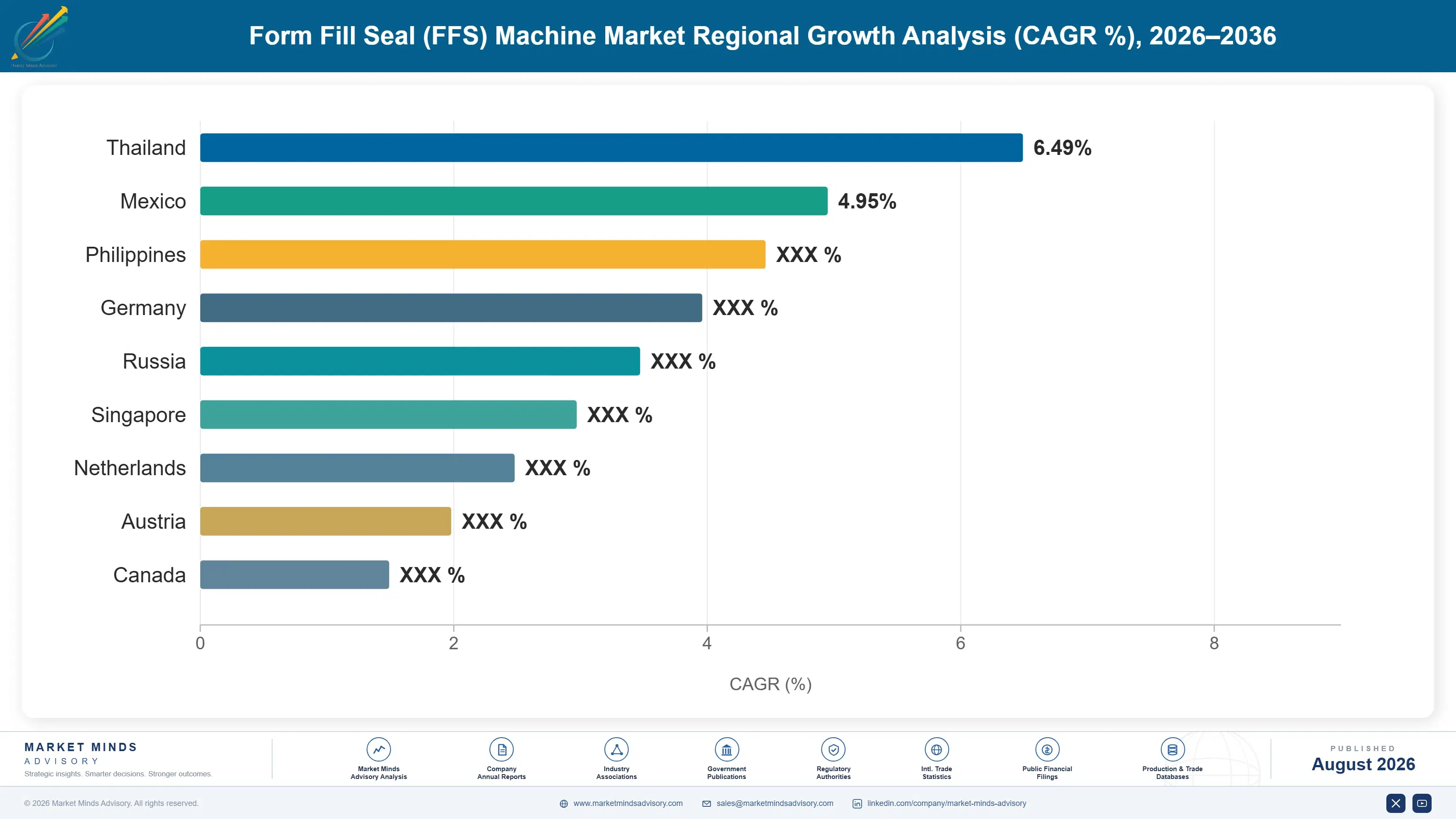
form-fill-seal-ffs-machine-market-country-cagr-analysis-1787297930432

Earning Between The Machine Sales

A machine sold today will not be replaced for eighteen years, so builders who depend on new equipment orders live through every capital deferral their customers make. Service, retrofit, film qualification, and validated pharmaceutical work all earn between those orders. Four levers follow from that, and each one shortens the gap between capital events considerably.

Sell Mono-Material Retrofit Before The Regulation Bites

Converting an installed line to run recyclable film costs roughly 22% of a new machine and covers sealing jaws, temperature control, and often servo drives on older mechanical equipment. Builders who audit a customer's installed base against forthcoming packaging rules and quote conversion programmes ahead of the deadline capture work that would otherwise go to whichever competitor eventually wins the replacement tender. Retrofit margin runs comparable to new machine margin on a small fraction of the engineering effort required, and it resets the service relationship for another decade at least.
Market Impact: Conversion costs 22% of a new machine price

Qualify Films Jointly With Converters And Brands

A new film structure has to be proven on a specific machine at a specific speed before any brand commits to it, and that qualification work sits awkwardly between the film supplier, the brand, and the machine builder. Builders who run joint qualification trials influence which structures become the standard and get themselves specified into the resulting equipment. Trial programmes cost USD 30,000 to USD 80,000 to run and routinely convert into machine orders several hundred times that value across a brand's whole line estate over the following few years.
Market Impact: Trials cost USD 30,000 to 80,000 to run

Price Availability Rather Than Rated Machine Speed

Plants running eight or ten formats lose more output to changeover than to any mechanical fault, and tool-less servo changeover cuts that time by around 70%. Builders selling rated packs per minute are competing on a number that every regional assembler can match on paper for far less money. Builders selling measured overall equipment effectiveness compete on something only they can demonstrate, and it supports a price premium of 25% to 35% on comparable mechanical specification. The proof requires measured site data from existing installations, which incumbent builders already hold and newcomers simply cannot produce.
Market Impact: Supports a price premium of 25% to 35%

Build Validated Pharmaceutical Capability And Keep It

Pharmaceutical sachet and stick pack machines require installation and operational qualification documentation, change control, and audit support that food machinery never touches, and the customer cannot switch supplier without revalidating the whole line. That is worth 30% to 45% higher machine pricing and a service relationship that runs for the full working life of the equipment. Regional assemblers competing hard on standard food machines have not built the quality systems this work demands, and few have tried. Very few builders occupy this tier and fewer still ever leave it voluntarily.
Market Impact: Pricing runs 30% to 45% higher across the tier

Who Controls the Margin Pool

Concentration at 34% across the top five understates how sharply this market has split into tiers that barely compete. European builders hold aseptic, validated pharmaceutical, and high-speed food machinery. Chinese and Indian assemblers hold standard vertical and horizontal formats at 40% to 55% of European pricing. All participants here are compared on measured global revenue from form fill seal equipment and associated service work, which separates dedicated builders from diversified machiner
Competition inside the European tier runs on validation capability, film qualification support, and installed service networks rather than on mechanical specification. Syntegon and IMA both compete hardest in pharmaceutical work where documentation and change control matter more than speed. Multivac and GEA hold strong thermoform and food positions, while Coesia competes through Volpak and related units in horizontal formats. Japanese builders hold high-speed food positions.

Pressure is building from below and from the film side at once. Regional assemblers are moving up into higher speeds and beginning to attempt aseptic work. Meanwhile mono-material conversion gives every builder a reason to revisit its customers' installed base, and whoever gets there first with a credible retrofit programme keeps the eventual replacement order.
form-fill-seal-ffs-machine-market-company-positioning-matrix-1787297930953

Competitive Moat and Risk Dimensions

SYNTEGON TECHNOLOGY

Moat: Validated Pharmaceutical Machine Documentation Depth

Syntegon supplies pharmaceutical packaging lines with the installation and operational qualification documentation, change control, and audit support that regulated customers require, and switching supplier means revalidating an entire line. That documentation depth took decades to build and no regional assembler has attempted it seriously. It converts machine sales into relationships lasting the equipment's full working life.
SYNTEGON TECHNOLOGY

Risk: Exposure To Deferred Capital Spending

Pharmaceutical and food customers both defer machine replacement freely when interest rates rise, and an eighteen year working life means deferral carries no visible operating penalty. The company's order book swings considerably with capital cycles it cannot influence. Service and retrofit revenue cushions the swing but does not come close to offsetting a weak equipment year.
IMA GROUP

Moat: Breadth Across Regulated Packaging Formats

IMA covers sachet, stick pack, thermoform, and adjacent regulated formats through a wide group of specialist units, which lets it supply a pharmaceutical customer's whole packing estate rather than one machine type. That breadth wins line-level projects where single-format builders can only bid on pieces. Cross-selling into an installed customer base is considerably cheaper than winning new accounts.
IMA GROUP

Risk: Complexity Across Acquired Units

Growth through many acquired specialist units leaves overlapping product lines, separate engineering conventions, and service networks that were never designed together. Customers buying across the group encounter inconsistent documentation and parts systems. Integrating that properly is expensive and slow, and competitors with narrower ranges present a simpler proposition to a plant engineering team.

Players Tracked

Prominent Players

Syntegon Technology
IMA Group
GEA Group
Multivac
Coesia

Other Key Players

Ishida
Rovema
ProMach
Barry-Wehmiller
Nichrome India
Uflex
SIG Group
Tetra Pak
Fuji Machinery
Omori Machinery
Viking Masek
Bossar Packaging
PFM Group
Sacmi
Krones

Recent Developments

MARCH 2025

Syntegon Introduces Mono-Material Retrofit Programme For Installed Machines

Syntegon launched a structured retrofit package converting installed vertical and horizontal machines to run recyclable mono-material films, covering sealing jaws, temperature control, and servo upgrades. The programme was developed internally and targets customers facing European packaging waste requirements ahead of their ordinary machine replacement cycles.
Signal: Retrofit revenue arrives years before any replacement order, and it defends the eventual replacement decision too
JULY 2025

Indian Dairy Processor Orders Aseptic Filling Capacity Expansion

A large Indian dairy cooperative ordered additional aseptic form fill seal capacity to extend ambient distribution into rural retail without refrigerated logistics. The award was a competitive equipment procurement rather than any partnership, and the processor cited distribution reach rather than production cost as the commercial justification.
Signal: Aseptic economics rest on distribution access alone rather than on any measurable improvement in line productivity
OCTOBER 2025

Multivac Expands Thermoform Machine Assembly Capacity In Germany

Multivac completed an organic expansion of German thermoform machine assembly capacity, citing order backlog in fresh protein and medical device packaging. The investment was internally funded with no external partner, and the company noted mono-material conversion enquiries had risen materially across its European customer base.
Signal: Organic capacity addition signals real confidence that regulatory conversion demand is durable rather than merely temporary

Servo Drives, Steel And Controls

Servo motors, drives, and motion controllers account for roughly 24% to 32% of build cost on modern machines, sourced from a narrow group of Japanese, German, and increasingly Chinese suppliers. Stainless steel frames, formed components, and sealing tooling add 20% to 26%, tracking regional steel pricing. Programmable controllers, safety systems, and human machine interfaces carry another 12% to 16%, and skilled assembly labour accounts for the balance.
Motion control and semiconductor component lead times stretched severely through 2021 and 2022, with drive deliveries running past fifty weeks and machine builders holding completed frames waiting for controllers. Siemens described extended electronic component constraints in its 2022 annual report. Builders who had qualified only a single control platform could not substitute anything, and the resulting delivery slippage cost order intake rather than merely margin, which is the more damaging outcome.

Exposure separates by control platform strategy rather than by builder size. A builder standardised on a single automation supplier gains engineering efficiency and loses every option when that supplier constrains allocation. Larger groups qualifying two platforms carry higher engineering cost and can switch. Regional assemblers using domestic Chinese drives sit on a different supply curve and were far less affected.
form-fill-seal-ffs-machine-market-cost-volatility-analysis-1787297931152

Qualify A Second Automation Platform Across Core Machine Families

Standardising on one control supplier delivers real engineering efficiency and removes every option during an allocation squeeze. Qualifying a second platform across core machine families costs twelve to eighteen months of engineering effort and carries ongoing documentation overhead, and it converts a hard delivery stop into a commercial choice about which machines get which controls.

Hold Long Lead Component Inventory Against Confirmed Backlog

Drives and controllers with fifty week lead times cannot be bought reactively when an order lands, and building to a forecast that proves wrong strands the capital. Holding inventory sized to confirmed backlog rather than to forecast keeps delivery promises credible without speculative exposure, and delivery reliability wins more orders in this market than price concessions ever do.

Design Sealing Tooling For In-House Manufacture

Sealing jaws and forming tooling are the components most affected by film changes, and outsourcing them puts conversion turnaround in a third party's queue exactly when customers need it fastest. Machining tooling in-house shortens mono-material retrofit delivery from months to weeks, which is the difference between capturing a conversion programme and losing it to a competitor.

Portfolio Architecture for Margin Defence

Margin architecture separates by whether the machine needs documentation. Standard vertical and horizontal food machines earn 16% to 24% for European builders and considerably less against regional assemblers pricing 40% to 55% below them. Validated pharmaceutical and aseptic machines earn 34% to 46%, because qualification documentation, change control, and audit support cannot be assembled quickly and cannot be switched without revalidating an entire line.
The tension is that unit volume sits in the standard tier and margin sits in the validated one, and the standard tier is where European builders are losing ground fastest. Regional assemblers are climbing toward higher speeds and beginning to attempt aseptic work. The defensible ground keeps narrowing, which is why service and retrofit revenue matters more each year than the equipment line suggests.

High-value pools concentrate in parts and service, mono-material retrofit programmes, and validated pharmaceutical work. All three attach to an installed machine rather than to a new order, which is the point given an eighteen year working life. Aseptic carries the widest margin range in the market, because a dairy filling line and a sterile pharmaceutical line share a principle and share nothing else commercially.

Volume / Commodity-Adjacent

Standard vertical and horizontal machines for free-flowing food products at moderate speeds, where regional assemblers compete hard on price and the underlying technology stopped advancing years ago. The eight-point range separates branded European supply from competitive tender work.
Gross Margin: 16% to 24%

Premium / Certified

Validated pharmaceutical machines, aseptic filling systems, and high-speed food equipment where documentation, qualification, and demonstrated availability decide the award. The twelve-point range separates aseptic dairy work from sterile pharmaceutical lines carrying far heavier regulatory obligations and prices.
Gross Margin: 34% to 46%

Sustainability / Regulatory / Next-Generation

Mono-material retrofit programmes, film qualification services, and connected machine monitoring and analytics packages. The twenty-four point range reflects real divergence: hardware retrofit prices near machine economics while qualification and analytics services carry consulting margins.
Gross Margin: 28% to 52%
form-fill-seal-ffs-machine-market-portfolio-architecture-1787297931654

High-value Sub-segments and Strategic Watch-out

Mono-Material Retrofit Programmes

Highest growth and strong margin, converting installed machines for recyclable film at roughly a fifth of new machine cost with a fraction of the engineering effort. Regulation sets the timing rather than the customer, and whoever executes the retrofit usually keeps the eventual replacement order too.
Gross Margin: 38% to 48%

Validated Pharmaceutical Machines

High value with moderate growth, protected by qualification documentation and change control that regional assemblers have not attempted to build. Switching supplier requires revalidating the whole line, which almost nobody does voluntarily. Contract manufacturing capacity additions across India and Eastern Europe drive most of the current order flow.
Gross Margin: 40% to 50%

Standard Vertical Machines

The volume core of this market, and the tier European builders are losing to Chinese and Indian assemblers pricing well below them. Mechanical performance on free-flowing products at moderate speeds is genuinely adequate. Differentiation now rests on service network density rather than on the machine itself.
Gross Margin: 16% to 24%

Mechanically Driven Installed Base

Strategic watch-out. Older mechanically driven machines frequently cannot be converted for mono-material film at any sensible cost, which turns a retrofit conversation into a replacement one. Builders whose installed base skews old face customers deferring the whole decision rather than upgrading anything incrementally, which strands the revenue.
Gross Margin: 12% to 22%

Living Off The Installed Base

The annuity here is the installed machine, not the customer relationship. Parts, service, and upgrades account for around 28% of builder revenue and arrive predictably across an eighteen year working life, while the machine order itself happens roughly once per generation of plant management. Builders who treat service as an after-sales obligation rather than a business give away the only revenue that survives a capital deferral cycle intact.
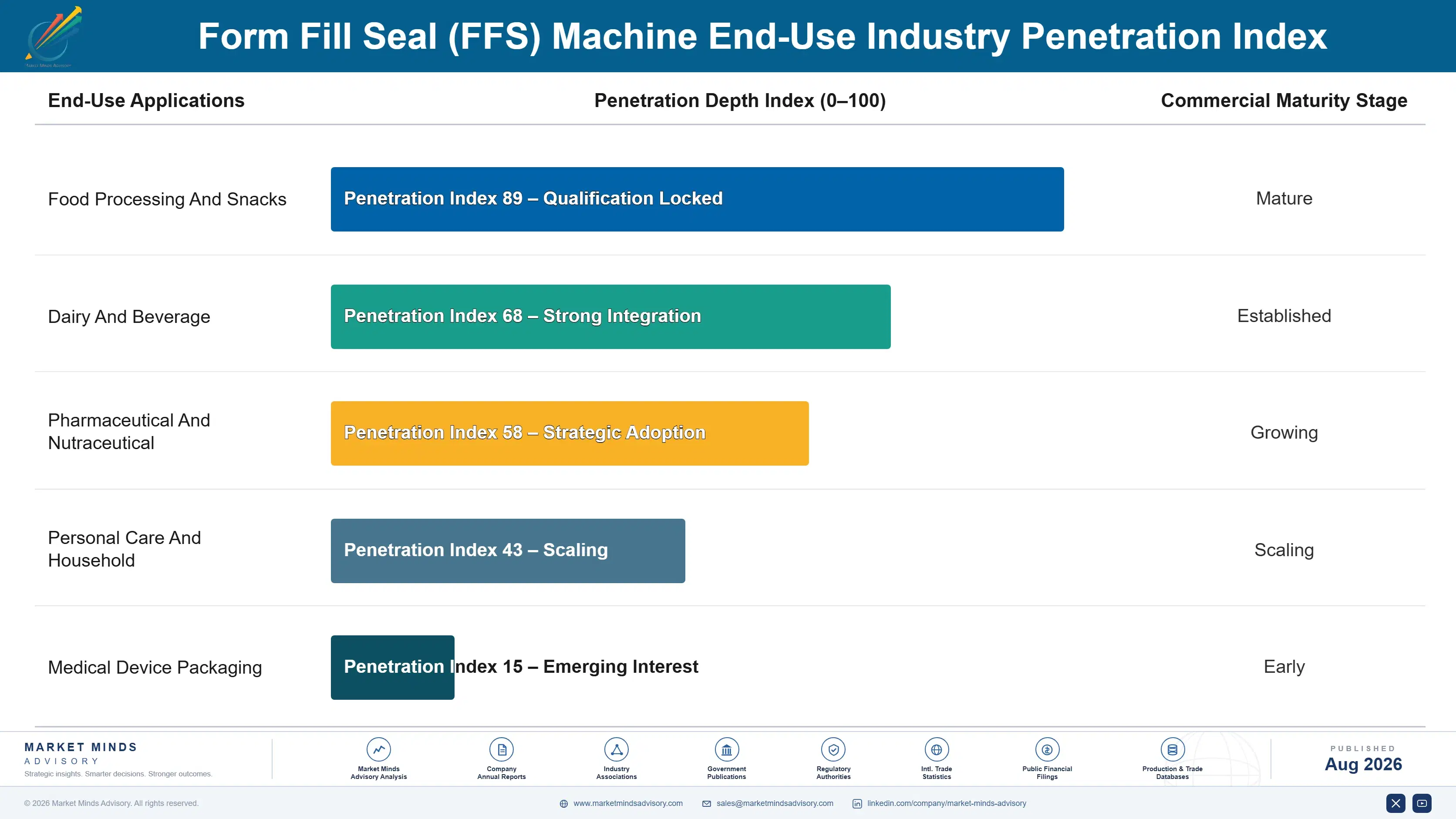
Depth varies sharply by end-use vertical. Pharmaceutical customers are the stickiest by a wide margin, since changing machine supplier means revalidating a line and nobody does that without cause. Aseptic dairy is nearly as durable because sterility performance is proven on the specific installation. Snack and confectionery packing is shallower, with plant engineers comfortable mixing builders across a line. Contract packers are the shallowest, buying on delivered price and switching freely.

Buyer profiles have moved. Machine selection shifted from plant engineers evaluating mechanical specification toward capital committees comparing overall equipment effectiveness and total cost across a plant estate. Packaging development teams now arrive with film structures already chosen. Both changes favour builders who can produce measured availability data from existing installations over those quoting rated speed from a datasheet.
form-fill-seal-ffs-machine-market-end-use-penetration-index-1787297932149

Where We Come Out

These are among the four positions where our research anticipates prominent divergence between winners and laggards over the coming forecast period. Each is grounded in the demand model, the regulatory perimeter, and the announced capacity pipeline.
01 / RETROFIT REVENUE PRIORITY

Convert the installed base before somebody else replaces it

Mono-material film conversion costs roughly a fifth of a new machine and reaches customers who would otherwise not have made any capital decision for another five or six years. Builders who audit installed estates against forthcoming packaging rules and quote conversion programmes early capture margin comparable to new equipment on a fraction of the engineering effort. They also hold the relationship when replacement finally comes, which is the part most builders overlook entirely when they price retrofit work as a low-margin service obligation.
02 / VALIDATED TIER DEFENCE

Documentation is the only barrier regional assemblers respect

Chinese and Indian builders now supply standard vertical and horizontal machines at roughly half European pricing with performance adequate for most free-flowing food applications at moderate speed. What they have not built is the qualification documentation, change control, and audit capability that pharmaceutical customers require before a machine can run product. That gap is worth thirty to forty-five percent higher pricing and a relationship lasting the equipment's full working life, and nothing suggests it will close quickly over this forecast period.
03 / AVAILABILITY SELLING DISCIPLINE

Stop quoting rated speed and start proving uptime

Plants running eight or ten formats lose more output to changeover than to any mechanical failure, yet builders still lead with packs per minute, a number every regional assembler can match on a datasheet without difficulty. Measured overall equipment effectiveness from real installations is something only an incumbent with site data can demonstrate credibly. It supports a premium of twenty-five to thirty-five percent and shifts the whole comparison onto ground that competitors without an installed base cannot reach at all.
04 / FILM QUALIFICATION POSITIONING

Get into the film decision before the machine tender

Every recyclable structure has to be proven on specific equipment at specific speeds before a brand commits, and that qualification work currently falls awkwardly between film supplier, brand, and machine builder with nobody clearly owning it. Builders who run joint qualification trials influence which structures become the standard and get themselves written into the resulting equipment specification. A qualification trial costing tens of thousands of dollars routinely converts into machine orders worth several hundred times that amount across a customer's line estate.

Engagement Snapshot From the Field

A live engagement with an industry participant carrying material or product regulatory and market exposure ahead of a defining policy shift, showing how our research translates into a defensible multi-year portfolio strategy.
MARKET MINDS ADVISORY · CLIENT ENGAGEMENT SUMMARY
Form Fill Seal (FFS) Machine Producer Strategic Portfolio Review and Transition Roadmap 2026·Investment Scenario on Form Fill Seal (FFS) Machine Exposure Evaluation 2025-26
CLIENT PROFILE
A German form fill seal machine builder with roughly EUR 180 million in annual revenue (client-reported, unverified by MMA), supplying vertical and horizontal machines to food and personal care manufacturers across Europe. Around 78% of revenue came from new equipment orders and 22% from parts and service, with an installed base of approximately 4,100 machines the company had never systematically mapped by age or configuration.
STRATEGIC CHALLENGE
New machine orders had fallen for six consecutive quarters as customers deferred capital spending, while Chinese suppliers took an increasing share of standard machine tenders on price. The board wanted to understand whether packaging waste regulation created a genuine retrofit opportunity across the installed base, or whether customers would simply wait and replace machines on their ordinary cycle.
MMA APPROACH
MMA mapped the client's installed base by machine age, drive architecture, and current film structure, interviewed packaging and engineering leads at twenty-six customer sites on conversion timing, and modelled retrofit feasibility and cost against three regulatory scenarios. Competitor retrofit offerings were assessed, and the client's own tooling manufacturing turnaround was benchmarked against the delivery windows customers said they required.
KEY FINDINGS
  1. Roughly 2,600 of the 4,100 installed machines were technically convertible for mono-material film, and the remainder were mechanically driven and effectively beyond economic retrofit.
  2. Twenty-one of the twenty-six customers interviewed had no conversion plan at all and had not been approached by any machine builder about retrofit options.
  3. Outsourced sealing tooling manufacture ran eleven weeks against the six week delivery window customers said would determine which supplier they awarded conversion work to.
  4. Retrofit gross margin modelled at 41% against 19% on standard new machine tenders, on roughly one-sixth of the engineering hours per unit of revenue earned.
CLIENT PROFILE
A German form fill seal machine builder with roughly EUR 180 million in annual revenue (client-reported, unverified by MMA), supplying vertical and horizontal machines to food and personal care manufacturers across Europe. Around 78% of revenue came from new equipment orders and 22% from parts and service, with an installed base of approximately 4,100 machines the company had never systematically mapped by age or configuration.
STRATEGIC CHALLENGE
New machine orders had fallen for six consecutive quarters as customers deferred capital spending, while Chinese suppliers took an increasing share of standard machine tenders on price. The board wanted to understand whether packaging waste regulation created a genuine retrofit opportunity across the installed base, or whether customers would simply wait and replace machines on their ordinary cycle.
MMA APPROACH
MMA mapped the client's installed base by machine age, drive architecture, and current film structure, interviewed packaging and engineering leads at twenty-six customer sites on conversion timing, and modelled retrofit feasibility and cost against three regulatory scenarios. Competitor retrofit offerings were assessed, and the client's own tooling manufacturing turnaround was benchmarked against the delivery windows customers said they required.
KEY FINDINGS
  1. Roughly 2,600 of the 4,100 installed machines were technically convertible for mono-material film, and the remainder were mechanically driven and effectively beyond economic retrofit.
  2. Twenty-one of the twenty-six customers interviewed had no conversion plan at all and had not been approached by any machine builder about retrofit options.
  3. Outsourced sealing tooling manufacture ran eleven weeks against the six week delivery window customers said would determine which supplier they awarded conversion work to.
  4. Retrofit gross margin modelled at 41% against 19% on standard new machine tenders, on roughly one-sixth of the engineering hours per unit of revenue earned.
RECOMMENDED STRATEGY
Phase 1: Phase one: audit the convertible installed base and approach all affected customers with costed conversion programmes ahead of regulatory deadlines. Phase 2: Phase two: bring sealing and forming tooling manufacture fully in-house to cut conversion delivery from eleven weeks down to under six. Phase 3: Phase three: withdraw from open standard machine tenders below a defined price threshold and redeploy engineering onto retrofit and validated work.
OUTCOME
The client audited its installed base within two quarters and converted 340 machines in the following year. Service and retrofit revenue rose from 22% to 37% of group turnover while total revenue grew 6% despite continued weakness in new machine orders, and blended gross margin improved by seven points (client-reported, unverified by MMA).

Frequently Asked Questions

Foundational context covering the market sizes, CAGR, scope, country, region and competition that inform every finding below. This section is provided to cover basics and most often pre-purchase conversations, answered from the MMA Primary Research Dataset.

What is the current size of the Form Fill Seal (FFS) Machine Market?

The global form fill seal machine market reached USD 16.2 billion in 2025, covering vertical, horizontal, thermoform, multi-lane, and aseptic architectures. That figure includes associated parts, service, and upgrade revenue.

How large will the Form Fill Seal (FFS) Machine Market be by 2036?

MMA forecasts USD 28.29 billion by 2036, up from USD 17.04 billion in 2026, an increase of USD 11.25 billion. That represents an expansion multiple of 1.66 times across the forecast period.

What is the CAGR for the Form Fill Seal (FFS) Machine Market 2026 to 2036?

The base case CAGR is 5.2%, with a bull case of 6.4% and a bear case of 4.0%. Historical growth between 2020 and 2025 ran at 4.1%, averaging a pandemic pull-forward against a subsequent capital deferral cycle.

Which segment is growing fastest?

Aseptic form fill seal machines grow fastest at 7.8%, exactly 1.50 times the market rate, by removing refrigerated distribution from the cost structure. Thermoform fill seal machines follow at 6.1%.

Who are the major companies in the Form Fill Seal (FFS) Machine Market?

Syntegon Technology, IMA Group, GEA Group, Multivac, and Coesia lead, together holding 34% of the market. European builders hold the validated and aseptic tiers while regional assemblers take standard machines.

Which country is growing fastest?

India grows fastest at 8.4%, driven by dairy aseptic installation reaching rural retail without refrigerated logistics and by contract pharmaceutical sachet capacity. Domestic builders supply much of the standard equipment.

Report Segmentation Architecture

The full report scope spans multiple orthogonal segmentation dimensions, with cross-tabulated demand data provided for each dimension pair. Coverage extends further to regional breakdowns, trend trajectories, and the competitive detail needed to support segment-level decision-making.

By Machine Architecture

  • Vertical Form Fill Seal
  • Horizontal Form Fill Seal
  • Thermoform Fill Seal
  • Multi-Lane Stick Pack And Sachet
  • Aseptic Form Fill Seal

By End-Use Industry

  • Food Processing And Snacks
  • Dairy And Beverage
  • Pharmaceutical And Nutraceutical
  • Personal Care And Household
  • Medical Device Packaging

By Commercial Dimension

  • New Machine Direct Sales
  • Parts And Service Contracts
  • Retrofit And Upgrade Programmes
  • Contract Packer Supply
  • Distributor And Integrator Channels

By Region

  • East Asia
  • South Asia and Pacific
  • Western Europe
  • North America
  • Latin America
  • Middle East and Africa
  • Eastern Europe

Scope, Methodology, and Coverage

Every figure in this report is reproducible from documented input assumptions. The scope below maps the historical period, the forecast horizon, the segmentation dimensions, and the countries covered, alongside the underlying primary and qualitative methodology.
Historical Period
2020 to 2025
Forecast Period
2026 to 2036
Base Year
2025 (USD billions; MMA Primary Research Dataset, August 2026)
Market Definition
The form fill seal machine market covers packaging machinery that forms a package from flat film or sheet stock, fills it with product, and seals it within a single continuous or intermittent line process. Scope spans vertical, horizontal, thermoform, multi-lane stick pack and sachet, and aseptic architectures, together with associated parts, service, retrofit, and upgrade revenue. Blow-fill-seal machinery for parenteral containers, filling equipment for pre-made rigid containers, cartoning, case packing, palletising, and film production are excluded.
Quantitative Units
USD billions at builder revenue level; machines shipped annually; installed base by architecture.
Segmentation Dimensions
By machine architecture; by end-use industry; by commercial dimension; by region.
Regions Covered
East Asia, South Asia and Pacific, Western Europe, North America, Latin America, Middle East and Africa, Eastern Europe
Countries Covered
United States, Canada, Mexico, Germany, Italy, France, United Kingdom, Netherlands, Spain, Poland, Hungary, China, Japan, South Korea, India, Thailand, Australia, Brazil, Saudi Arabia, South Africa.
Key Companies Profiled
Syntegon Technology, IMA Group, GEA Group, Multivac, Coesia, Ishida, Rovema, ProMach, Barry-Wehmiller, Nichrome India, Uflex, SIG Group, Tetra Pak, Fuji Machinery, Omori Machinery, Viking Masek, Bossar Packaging, PFM Group, Sacmi, Krones.
Quantitative Methodology
Primary survey, n=3,800 respondents, Q4 2025, six countries; demand-side model with trade association cross-validation
Qualitative Methodology
47 expert interviews, Q4 2025; applied to validate demand model assumptions, identify emerging dynamics, and assess competitive positioning
Report Format
PDF and XLSX data workbook (Word format preview document)
Publisher
Market Minds Advisory
Report Code
MMA-2026-CON-771
Published
August 2026
Contact
sales@marketmindsadvisory.com | www.marketmindsadvisory.com

Purchase the full Form Fill Seal (FFS) Machine Market Report (2026 to 2036).

The full MMA report on form fill seal machinery covers architecture, regional, and competitive analysis in detail, with separate treatment of the aftermarket and retrofit economics that sustain builders between capital cycles. It includes mono-material conversion feasibility modelling by drive architecture, changeover and availability benchmarking across installed lines, validated pharmaceutical tier pricing analysis, and regional assembler capability assessment by format. Regional chapters cover twenty countries with packaging capital spending assessed individually. Competitive profiling spans twenty builders compared on a single consistent revenue basis throughout the analysis.
Twenty country regional demand mechanism chapters
Mono-material conversion feasibility modelling by architecture
Changeover and availability benchmarking across installed lines
Validated pharmaceutical tier pricing analysis included
Twenty builder competitive profiles compared consistently
Regional assembler capability assessment by format

Built For The People Who Decide

From boardroom strategy to bench-side execution, this report is read cover-to-cover by leaders shaping the next decade of their industry, turning demand scenarios, market dynamics and valuation benchmarks into decisions.
CXOs/ Presidents/ VPs/ Managers
M&A and Corporate Development
Strategy Teams and R&D Heads
Procurement and Product Directors
Regulatory and Compliance Leaders
Investor Relations and Equity Analysts