Market Minds Advisory
Forged and Casting Component Market

Forged and Casting Component Market: Qualification Lock-In, Energy Cost Position, And A Redistribution Of Content

The press is not the asset. The asset is a part number approved on a customer's production part approval file, which costs eighty-five thousand dollars and eleven months to move anywhere else.

Lead Analyst

David Horsley

Published

September 2026

Make Smarter Decisions with Customized Research Insights

Request a free sample report and evaluate market opportunities, growth trends, and competitive dynamics relevant to your business needs.

2025 MARKET VALUE$296.4BMarket Size 2025
2036 FORECAST VALUE$501.6BBase Case , 2026 to 2036
CAGR 2026 TO 20364.9 %Bull 6.1% / Bear 3.7%
INCREMENTAL OPPORTUNITY$190.7BNet 10- year value creation
EXPANSION MULTIPLE1.61x2036 value over 2026 base
Strategic Levers
M&A Pipeline
Regional Outlook
Country Rankings
Competitive Intelligence
Segmental Deep-dive
Call-Us : 91 93563 13602

Executive Snapshot and Market Trajectory

Switching a forged or cast part to another supplier costs roughly USD 85,000 in requalification and the better part of a year, which is why price pressure in this industry is constant and supplier changes are rare. The market stands at USD 296.4 billion in 2025, growing at 4.9%.
High-pressure die casting grows fastest at 7.6%, about 1.55 times the market rate, as very large aluminium body castings replace dozens of joined parts in battery vehicle platforms. East Asia holds 30% of value on Chinese and Japanese production volume, North America 24%, and Western Europe 20%. Content per vehicle is falling while value per part rises, which is a difficult combination for a tonnage business.
Fragmentation is extreme: the top five hold about 11% between them, because a foundry serves a radius and thousands of them do. Competition turns on qualification position, energy cost, and scrap rate rather than on anything a customer sees. Energy runs 14% to 22% of conversion cost, which decides who survives a price cycle. The suppliers doing well are those who won content on platforms launching now rather than defending content on platforms ending.
Market Definition
The forged and casting component market covers metal parts produced by forging and casting processes and sold as finished or near-net-shape components to equipment and vehicle manufacturers. It spans sand casting, high-pressure die casting, investment casting, closed-die forging, and open-die and ring-rolled forging, in both ferrous and non-ferrous metals. Raw metal and semi-finished mill products, stampings and welded fabrications, powder metallurgy parts, and additively manufactured components are excluded.
Base Year Value
$296.4B in 2025 (MMA Primary Research Dataset, August 2026)
Forecast Period
2026 to 2036, eleven discrete annual values
CAGR
4.9% base case. Bull 6.1%. Bear 3.7%.
Fastest Growth Segment
High-Pressure Die Casting: 7.6% CAGR
Fastest Growth Country
India: 7.6% CAGR
Fastest Growth Region
South Asia and Pacific: 7.0% CAGR
Largest Region
East Asia: 30% of 2025 global value
Market Leaders
Nemak, Howmet Aerospace, Bharat Forge, Georg Fischer, thyssenkrupp. Source: MMA Primary Research Dataset, July 2026.
Primary Survey
n=3,800 procurement and R&D decision-makers, Q4 2025, six countries
Methodology
Demand-side build-up, cross-validated against public data, 47 expert interviews

Forged and Casting Component Market Forecast Scenarios

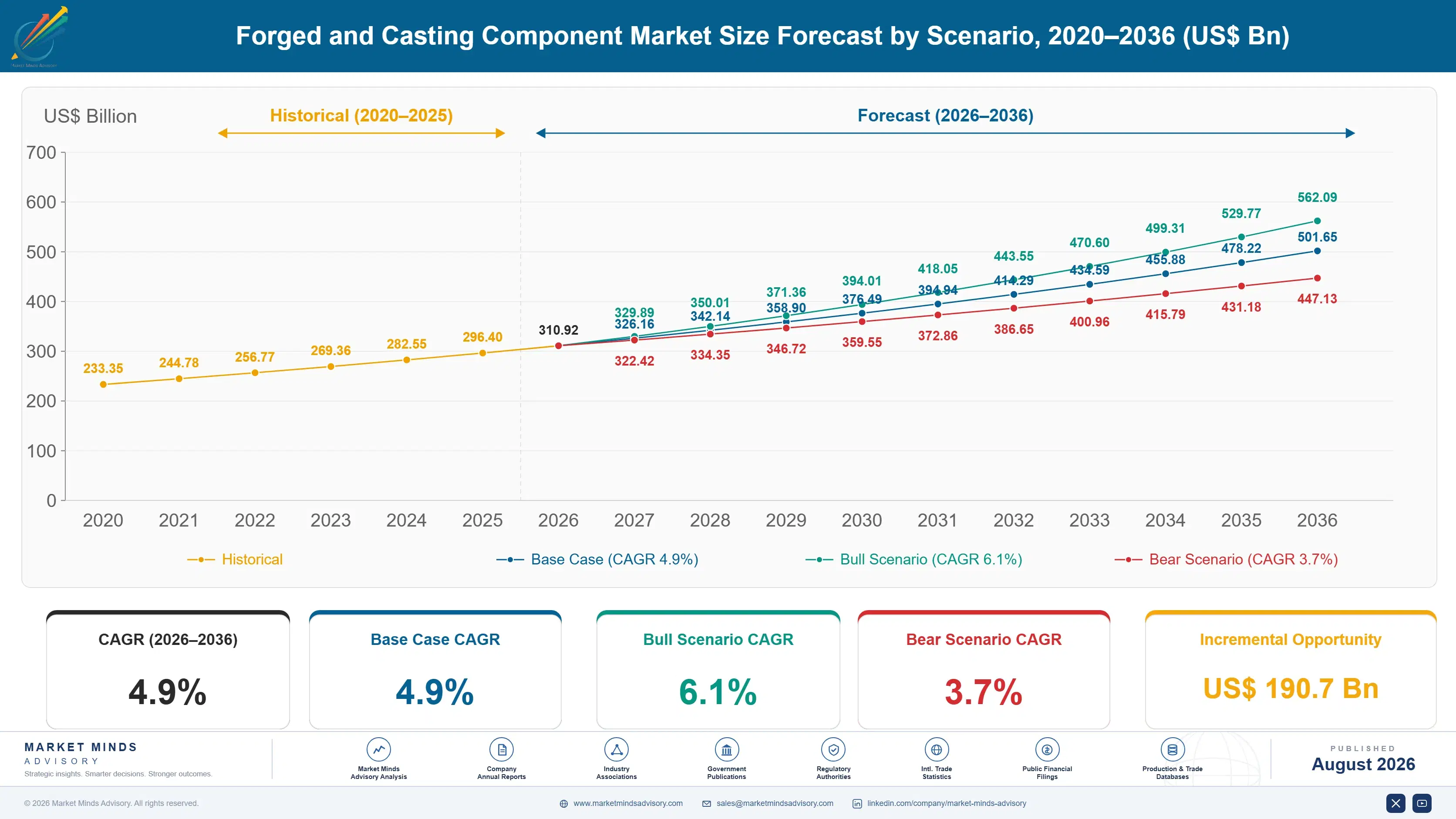
forged-and-casting-component-market-size-forecast-scenario-1787332530423
Two forces pulled against each other between 2020 and 2025. Iron casting content per vehicle fell as combustion platforms wound down, taking engine blocks, crankshafts, and manifolds out of the mix. Aluminium body castings, aerospace investment castings, and wind turbine ring forgings partly replaced it, at higher value per part and lower tonnage. A 3.8% historical CAGR nets a redistribution rather than a trend.
Three mechanisms carry the 4.9% base case. Battery vehicle body castings are the largest, since a single rear underbody casting replaces dozens of joined parts and carries far more value than any of them. Aerospace rates are second, because engine and airframe build recovered against a supply base that shrank and cannot deliver investment castings fast enough. And wind and grid infrastructure keeps adding open-die and ring-rolled forging demand from customers this industry barely served a decade ago.
The 6.1% bull case turns on body casting adoption spreading beyond battery platforms into combustion and hybrid bodies, which several manufacturers are already evaluating on cost alone. The 3.7% bear case is energy, since a European foundry paying four times an American gas price cannot hold its cost position and eventually stops bidding. Neither scenario is about demand.

The Part Number Is Worth More Than The Press

A forged or cast part sold into a vehicle, an aircraft, or a turbine is approved through a production part approval process documenting the tooling, alloy, heat treatment, and dimensional capability of one line. Moving it costs roughly USD 85,000 and most of a year, and on a safety-critical part more. That is why customers push price relentlessly and change suppliers almost never, which explains most of what looks irrational here.
TOP FIVE CONCENTRATION11%Thousands of regional foundries and forges keep participation extremely broad
AVERAGE SELLING PRICEUSD 3.90 per kilogramBlended across ferrous and non-ferrous parts and all processes
PART REQUALIFICATION COSTUSD 85,000Typical cost to move one part number to another supplier
SCRAP AND REWORK RATE4 to 9 percentShare of production rejected or reworked before customer despatch
ENERGY COST SHARE14 to 22 percentMelting and heating energy as a portion of conversion cost
LEADING PRODUCER SHARE39%Production concentrates where energy and labour costs are lowest
Fragmentation follows from freight. A casting weighing thirty kilograms is expensive to ship any distance, so foundries serve a radius and thousands of them exist, which is why the top five hold about 11% of a market this size. Consolidation happens slowly and locally rather than through the large transactions other industries see. Blended price sits near USD 3.90 per kilogram across ferrous and non-ferrous parts.
Energy runs 14% to 22% of conversion cost and scrap runs 4% to 9%, and those two lines decide which suppliers survive a downturn. Melting is the largest energy draw in a foundry and reheating the equivalent in a forge, neither turned down without ruining metallurgy. A supplier two points better on scrap outbids one two points worse without touching price.
"Every foundry owner I meet talks about their furnace. Not one of them opens with how many customer part numbers they hold and what it would cost the customer to move them. The second number is the business. The first is just equipment."
Principal Analyst, Metal Components Practice · MMA Construction and Industrial E

Market Trends

Large Aluminium Body Castings Replace Dozens Of Parts

A single rear underbody casting can replace sixty to eighty stamped and welded parts and the joining operations between them, removing assembly line length, welding robots, and dimensional variation at once. Manufacturers adopted it first on battery platforms where the floor is flat and the packaging permits it. The casting itself is worth far more than any individual part it displaces, and it requires press tonnage, alloy expertise, and thermal management that most die casters simply do not have. That concentrates the work in very few hands and rewrites the supplier map on any platform that adopts it.
Market Impact: Requalification costs about USD 85,
Combustion Content Leaves Faster Than Replacements Arrive

An engine block, cylinder head, crankshaft, connecting rods, exhaust manifold, and transmission housing together represent a substantial mass of iron casting and steel forging per vehicle, and a battery platform carries none of them. What arrives instead is a motor housing, a battery tray, and one or two large body castings, in aluminium, from a different supplier set. Total metal component tonnage per vehicle falls even as value holds up. A grey iron foundry with fifty years of engine block history has no realistic path into an aluminium underbody casting, and both parties know it.
Market Impact: Castings allocated across 18 month

Market Opportunities and Growth Drivers

Qualification Cost Locks Content For A Platform Lifetime

Approving a forged or cast part means documenting the tooling, the alloy chemistry, the heat treatment cycle, and the dimensional capability of one line at one plant, then producing sample parts a customer engineer signs off. Moving it later costs roughly USD 85,000 and eleven months, and on a safety-critical component considerably more. That is why an incumbent holds content for a platform lifetime of seven to twelve years despite annual price negotiation. It is also why the only genuine competitive event in this industry is a new platform sourcing decision, and why losing one hurts for a decade.
Market Impact: Energy runs 14% to 22%

Aerospace Build Rates Outrun A Shrunken Casting Supply Base

Investment casting capacity left the industry during the pandemic and has not come back, because the skilled operators who ran wax and shell lines took other work and the plants that closed did not reopen. Engine and airframe production rates have since recovered and keep climbing against that reduced base, which is why turbine blade and airframe castings run on allocation rather than on order. Customers now qualify second sources they would previously have refused, and they pay for capacity commitments in advance. That is an unusual position for a component supplier to be in.
Market Impact: Scrap runs 4% to 9%

Market Restraints and Challenges

European Energy Cost Removes Foundries From The Bid List

Melting and reheating consume 14% to 22% of conversion cost, and European industrial gas and power have run at multiples of North American levels since 2022, which no operational improvement offsets. The root cause is regional energy market design rather than anything a foundry controls. Commercially it means European suppliers stop being competitive on new sourcing decisions long before they become unprofitable on existing ones, so the damage shows up as content not won rather than as content lost. Suppliers are mitigating with electric melting on contracted renewables, waste heat recovery, and shifting new capacity outside the region.
Market Impact: Replaces 60 to 80 parts

Scrap And Rework Rates Decide Margin Before Price Does

Casting and forging both reject parts, at 4% to 9% of production in normal operation, and every rejected part carries the full cost of metal, energy, labour, and machining already spent on it. The root cause is process variability that no amount of inspection removes, only better control of pouring temperature, die condition, and cooling. Commercially a supplier two points better on scrap can price two points lower and earn the same margin, which is how contracts are actually won. Suppliers are mitigating with process monitoring, die thermal management, and simulation ahead of tooling.
Market Impact: Battery platforms drop 6 iron parts
3 additional market trends, 4 additional growth drivers, and 2 additional restraints and challenges are covered in the full report. Contact sales@marketmindsadvisory.com to access the complete intelligence.

Segment CAGR and Growth Architecture

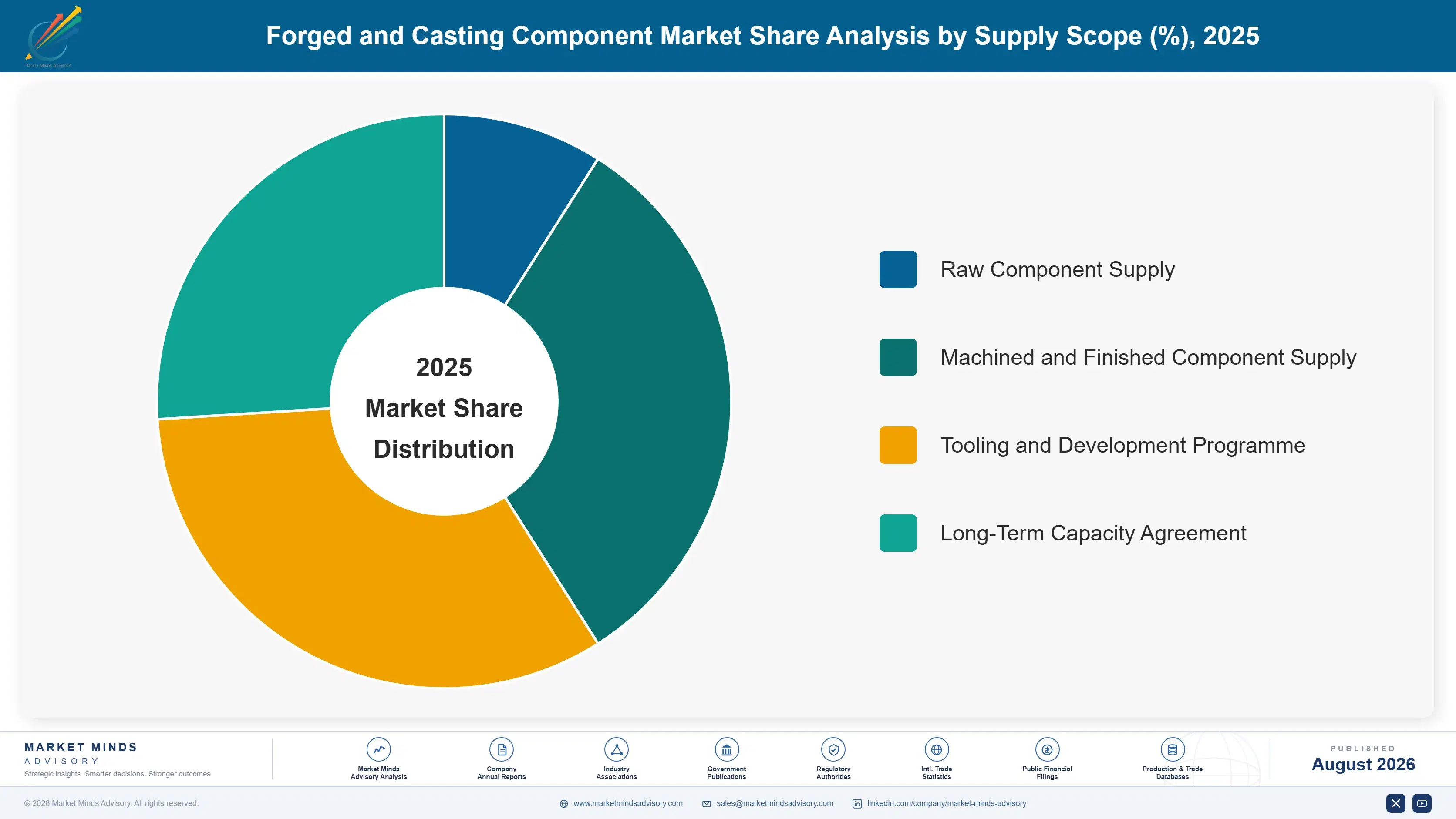
Segmentation follows forming process, because process determines the achievable geometry, the metals available, the tooling cost, the volume at which the economics work, and the customers a supplier can credibly serve. Metal type, end-use industry, and machining scope are handled in the framework and commentary, since each cuts across all five processes rather than defining any one of them.
forged-and-casting-component-market-market-share-analysis-1787332530961

High-Pressure Die Casting

High-pressure die casting grows fastest at 7.6%, about 1.55 times the market rate, on a change in what the process is being asked to make. Large aluminium body castings replace sixty to eighty stamped and welded parts on a battery platform, which removes assembly operations along with the parts themselves. Producing them takes press tonnage far above conventional die casting, alloy formulations that tolerate the section thickness variation, and thermal management that very few casters have solved. Conventional die casting of housings, brackets, and covers continues underneath all of that at a much more ordinary rate. The two halves of this segment have almost nothing in common. Averaging them together hides the whole story.
CAGR 7.6%

Investment Casting

Investment casting grows at 6.2% on an unusual position: demand recovered while supply did not. Capacity left during the pandemic when skilled wax and shell operators found other work and closed plants stayed closed, and aerospace engine and airframe build rates have since climbed against that reduced base. Turbine blades, airframe fittings, and medical implant components all run on allocation rather than to order. Customers are qualifying second sources they would previously have refused and paying for capacity commitments in advance, which is not how this industry normally behaves. Energy and orthopaedic applications add demand from outside aerospace entirely. Scarcity has handed pricing power back to the supplier, which happens rarely.
CAGR 6.2%
Full segment breakdown across 7 segments available in the complete report.

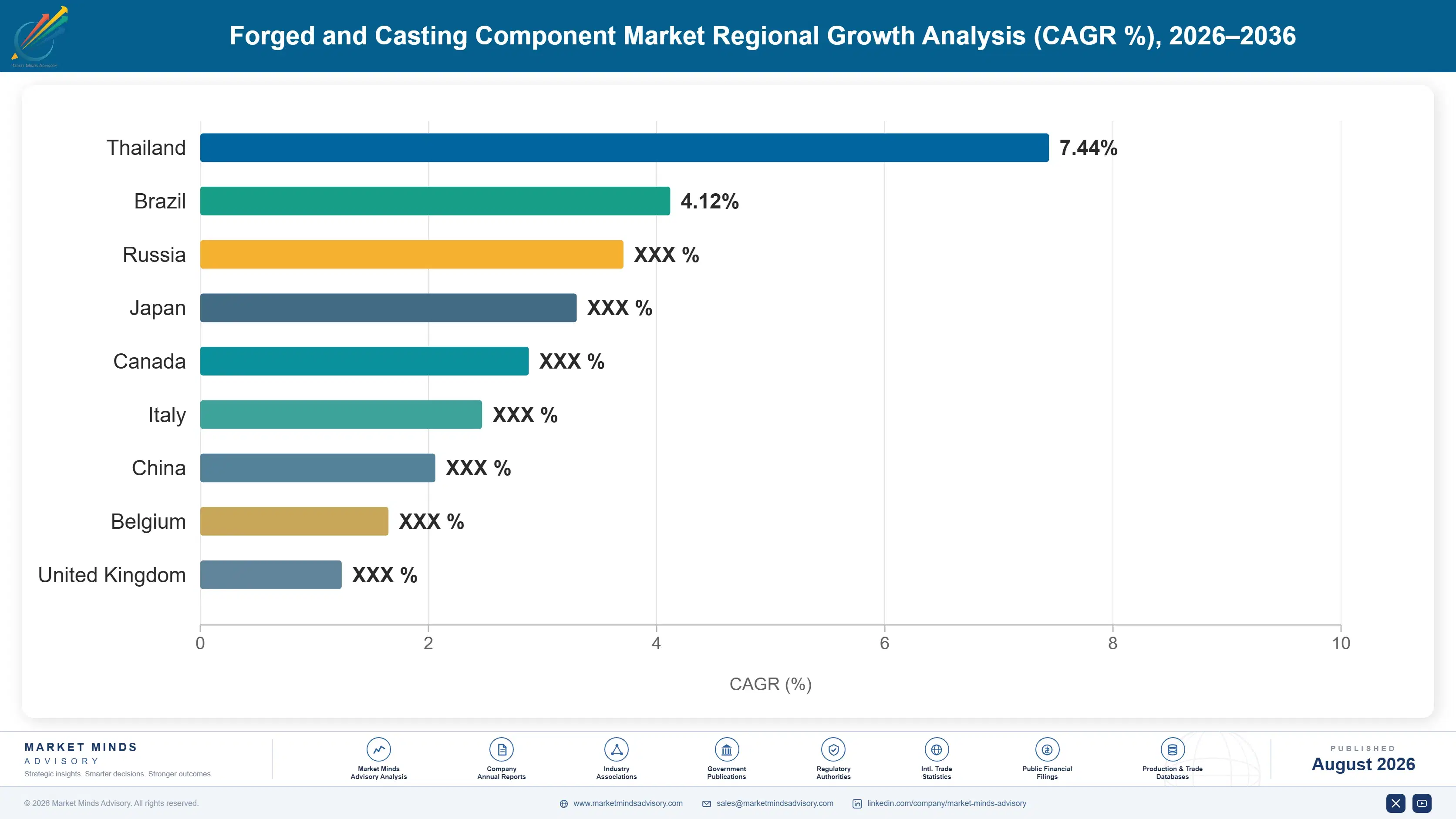
Regional Architecture and Country Demand Map

Regional shares follow where vehicles, machinery, and aircraft are assembled, because a heavy component is expensive to ship and foundries locate near their customers. East Asia leads on manufacturing volume, North America and Western Europe on higher value work. Energy cost is now redrawing that map faster than demand is.

North America

North America holds 24% of value on a mix that is shifting quickly. Iron casting for combustion powertrain remains large across the Midwest and the South but is declining with the platforms it serves, while aluminium body casting capacity for battery vehicles has been built at scale in Michigan, Kentucky, and Tennessee. Aerospace investment casting is concentrated and running on allocation. Industrial gas prices well below European levels give American foundries a cost position they have not enjoyed for decades. Growth at 4.6% sits slightly below the global rate because combustion content is leaving faster than body castings replace it. The energy advantage here is the most consequential recent change of all.
Share: 24% | CAGR: 4.6% (2026 to 2036)

Western Europe

Energy has done more to Western Europe's 20% share than demand ever did. German, Italian, and Spanish foundries hold deep positions in automotive and machinery castings, and their metallurgy and machining capability remains as good as anywhere. Industrial gas and power at multiples of American levels since 2022 has nonetheless removed them from bid lists on new sourcing decisions, and content not won does not show up in a quarterly result until years later. Growth at 3.2% is the slowest of any region. Electric melting on contracted renewables is the only durable answer available. Losing quietly across several years is harder to notice than losing all at once. Capability alone does not win an award.
Share: 20% | CAGR: 3.2% (2026 to 2036)
Regional intelligence for 5 additional markets available in the complete report: East Asia, South Asia and Pacific, Latin America, Middle East and Africa, Eastern Europe. Contact sales@marketmindsadvisory.com.
forged-and-casting-component-market-country-cagr-analysis-1787332531472

Where Component Margin Actually Comes From

Four levers matter here, and none of them is annual price negotiation, which the customer wins regardless. Platform sourcing position, scrap reduction, energy contracting, and machining scope decide the outcome, because those are the variables a supplier controls. A foundry negotiating harder on price without moving any of the four is arguing about a number settled before the meeting.

Win Content At Platform Sourcing, Not At Renegotiation

Requalification costs roughly USD 85,000 and eleven months, which means an incumbent keeps a part for a platform lifetime of seven to twelve years no matter how the annual price conversation goes. The only genuine competitive event is a new platform sourcing decision, and it happens two to three years before the vehicle or machine reaches production. A supplier engaged with the customer's engineering team at that point shapes the part and wins it. One arriving at the request for quotation is bidding against a specification somebody else already influenced. Sourcing decisions are won in engineering, not in procurement.
Market Impact: Content holds for 7 to 12 platform

Cut Scrap Before Cutting Price, Every Time

Scrap and rework run 4% to 9% of production, and every rejected part carries the full metal, energy, labour, and machining cost already spent on it. A supplier two points better on scrap can quote two points below a competitor and earn identical margin, which is how contracts are genuinely won rather than through negotiation skill. Process monitoring, die thermal management, and casting simulation ahead of tooling all move that number and all cost money before any order exists. Most foundries fund a sales visit sooner than a thermal camera, which is the wrong instinct.
Market Impact: Two scrap points buy 2% of quoted p

Contract Energy On Multi-Year Terms, Not Spot

Melting and reheating carry 14% to 22% of conversion cost, and European suppliers discovered in 2022 what an uncontracted exposure of that size does to a bid list. Long-term power purchase agreements on renewable generation, electric induction melting where the metallurgy allows, and waste heat recovery all reduce both the cost and its variance. They also cost capital and commitment in a business that has learned to defer both. The suppliers who signed those agreements before 2022 are the ones still quoting competitively in Europe today. Everybody else is explaining why they did not.
Market Impact: Energy carries 14% to 22% of conver

Take The Machining, Take The Margin

A raw casting or forging sold to a customer who machines it themselves is a commodity priced against every other supplier who can pour or press. The same part machined, inspected, and delivered ready to assemble carries roughly 40% more value and, more importantly, makes the supplier harder to replace, because requalifying a finished part is a bigger exercise than requalifying a raw one. Machining also captures the scrap benefit, since a supplier finishing its own parts learns which casting defects cause machining rejects. Most foundries treat machining as somebody else's business and give away both effects.
Market Impact: Machining adds roughly 40% more val

Who Controls the Margin Pool

Fragmentation is extreme. The top five hold about 11% of a global market this size, because a heavy component is expensive to ship, so foundries serve a radius and thousands of them exist. The gap between leaders and challengers is sourcing position and scrap performance rather than casting capability. All participants here are assessed on one basis, revenue from forged and cast components at selling prices.
Competition runs on four dimensions. Platform sourcing position decides content for seven to twelve years, and it is contested once. Scrap and yield decide who can quote lowest and still make money. Energy cost decides which regions can bid at all, which is a newer factor than most participants had planned for. Machining scope decides how much of the part's value the component supplier keeps.

Two pressures will reshape the supplier map. Battery platforms are removing iron casting content and replacing it with aluminium body castings from a different supplier set entirely, which is redistribution rather than decline. Meanwhile Turkish and Indian suppliers are taking European content on energy and cost position together. Rankings will favour whoever holds aluminium body casting capability alongside a defensible energy contract, and few hold both.
forged-and-casting-component-market-company-positioning-matrix-1787332531994

Competitive Moat and Risk Dimensions

NEMAK

Moat: Aluminium scale and platform position

Nemak holds aluminium casting content across an unusually broad set of vehicle platforms and has invested in the very large press capacity that body castings require, which few competitors have. Mexican production under regional content rules serves North American assembly at a cost position European suppliers cannot approach. Body casting capability arrived before most of the demand did.
NEMAK

Risk: Concentrated in automotive cycles

Almost all revenue depends on vehicle production volumes and platform sourcing decisions taken by a small number of manufacturers, which is a concentrated customer position with limited diversification behind it. Combustion powertrain castings still carry meaningful revenue and are declining. Very large press investment also commits capital against body casting adoption rates that no supplier controls.
HOWMET AEROSPACE

Moat: Aerospace qualification and allocation position

Howmet holds qualified positions on engine and airframe components where approval takes years and the customer has nowhere to go, the strongest incumbency in this industry. Investment casting capacity is scarce and running on allocation, so pricing power sits with the supplier for the first time in a generation. Single crystal turbine blade capability is held by very few firms.
HOWMET AEROSPACE

Risk: Aerospace cycle exposure

Concentration in aerospace means exposure to build rate decisions taken by two airframe manufacturers and a handful of engine makers, and those rates can collapse quickly. Today's allocation position invites customers to qualify second sources, which they are already doing. Capacity added now to relieve scarcity will still be there when the cycle turns and demand is not.

Players Tracked

Prominent Players

Nemak
Howmet Aerospace
Bharat Forge
Georg Fischer
thyssenkrupp

Other Key Players

Fritz Winter
Waupaca Foundry
Ryobi
Ahresty
Aisin
Proterial
CIE Automotive
Ramkrishna Forgings
Sona BLW Precision Forgings
Scot Forge
Ellwood Group
SIFCO Industries
Doosan Enerbility
Japan Steel Works
Farinia Group

Recent Developments

JANUARY 2025

Body casting adoption extends beyond battery platforms

Several vehicle manufacturers extended very large aluminium body casting designs beyond battery platforms into hybrid and combustion vehicle bodies, evaluated on assembly cost rather than electrification. These were design decisions rather than commercial transactions, and they widen a supplier requirement that only a handful of casters currently meet.
Signal: A design decision taken for cost reasons s
JULY 2024

Aerospace customers commit capacity payments to investment casters

Engine and airframe manufacturers began paying investment casting suppliers for reserved capacity ahead of delivery, an arrangement unthinkable a decade ago. These were supply agreements rather than acquisitions or joint ventures, and they reflect a supply base that shrank faster than demand fell and never rebuilt.
Signal: When a customer pays to reserve capacity,
NOVEMBER 2024

Turkish component exporters widen share of European sourcing

Turkish foundries and forges took a larger share of European vehicle and machinery component sourcing, competing on an energy cost position Western European suppliers could not match after 2022. These were competitive share movements rather than corporate transactions, and they concentrate in new platform awards rather than in existing content.
Signal: Share lost at platform sourcing does not a

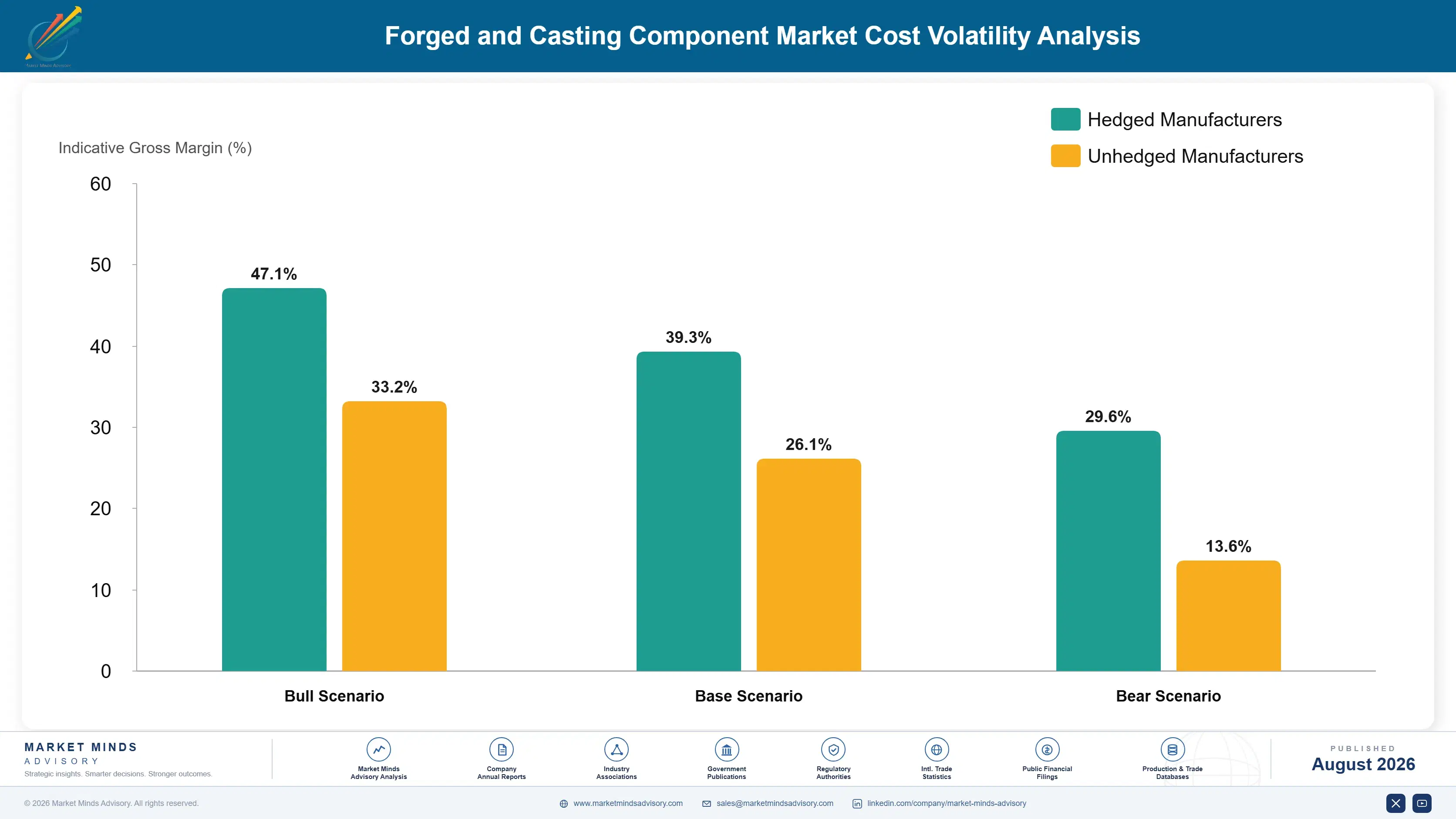
Metal, Energy, Tooling, And Scrap

Metal input dominates and differs by process. Ferrous scrap, pig iron, and alloying elements carry 42% to 56% of a casting's cost, priced against exchange benchmarks. Primary and secondary aluminium runs 48% to 62% for die castings, with a widening premium for low-carbon metal. Energy for melting and reheating adds 14% to 22%. Tooling amortisation and refractories account for the balance.
European industrial gas and power rose to multiples of North American levels through 2022 and stayed elevated, and the IEA documented that constraint. For a foundry with energy at a fifth of conversion cost and no pass-through under a multi-year price agreement, the effect was immediate. Georg Fischer and Nemak both disclosed input cost pressure across those years. Several European plants closed, and the content they held moved to Turkey and Asia.

Every range above exceeds three points because an iron sand casting and an aluminium die casting share no inputs beyond electricity. Exposure separates by metal and region. A ferrous foundry carries scrap price risk it can index but not avoid. An aluminium caster carries a low-carbon premium customers demand and rarely fund. Turkish and Indian suppliers hold energy and labour cost positions European foundries cannot reach operationally.
forged-and-casting-component-market-cost-volatility-analysis-1787332532188

Index part prices to metal, not to inflation

Ferrous scrap carries 42% to 56% of a casting's cost and aluminium up to 62% of a die casting's, both moving on exchanges nobody in this industry influences. A multi-year part price agreement without a metal index is a commodity position neither party intended to create. Indexation is standard practice and still absent from a surprising number of contracts.

Contract power before the exposure becomes visible

Energy carries 14% to 22% of conversion cost and European suppliers learned in 2022 what an uncontracted position that size costs. Multi-year renewable power agreements fix both price and variance, and cost commitment in a business that defers it by habit. Signing one in a calm market is the only version that helps, since nobody offers terms in a crisis.

Simulate the casting before cutting the tooling

Scrap runs 4% to 9% and much of it traces to a geometry or gating decision made before any metal was poured. Casting simulation ahead of tooling costs engineering time once and reduces first-article iterations, scrap rate, and time to qualification together. Foundries that treat it as an optional expense pay for the omission across the whole part life.

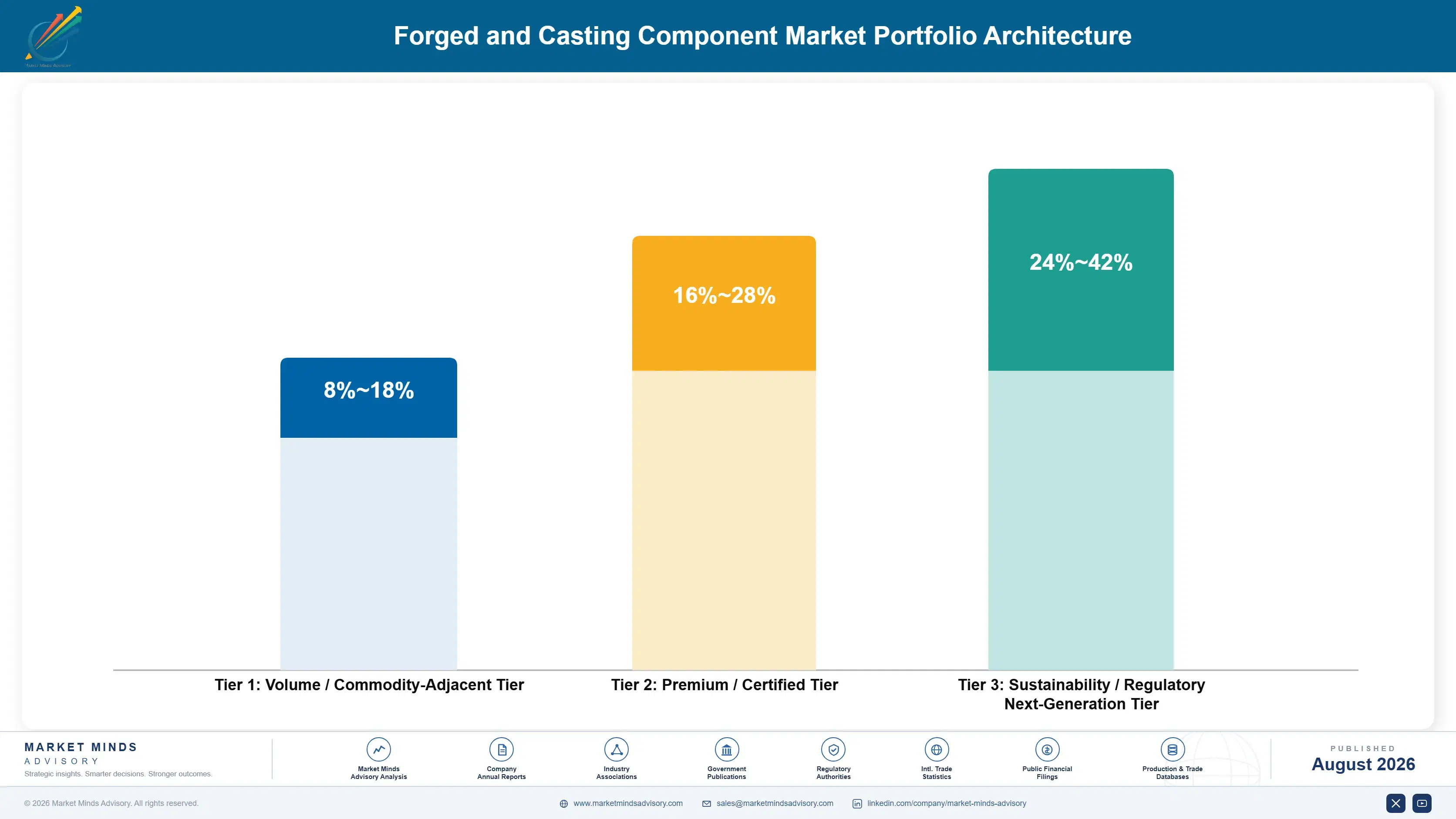
Portfolio Architecture for Margin Defence

Three tiers sit inside this category and the gap between them is wide. Commodity iron and aluminium castings sold on price into machinery and general industry form the volume tier. Qualified automotive and industrial content earns more, because switching costs protect it for a platform lifetime. Aerospace, medical, and energy investment castings and large body castings price highest, since few suppliers qualify at all.
The tension is between tonnage that keeps the furnace running and qualified content that earns money. A furnace and a press are expensive when idle, so foundries take commodity work to hold utilisation and find it sets the cost benchmark everything else is measured against. Suppliers who moved decisively into qualified content usually had to shrink first, which is a board conversation most defer until it is made for them.

High-value pools concentrate where qualification or capability limits competition: aerospace investment castings running on allocation, very large aluminium body castings needing press tonnage almost nobody has, medical implant components, and any part the supplier also machines and delivers finished. The commodity end is general iron and aluminium castings sold by the kilogram, where the buyer compares three quotes and Turkish and Indian suppliers set the level.

Volume / Commodity-Adjacent Tier

Commodity iron and aluminium castings and open-die forgings sold by weight into machinery and general industry. The range is wide because energy and metal cost positions differ enormously between regions on physically identical parts.
Gross Margin: 8-18%

Premium / Certified Tier

Qualified automotive and industrial content held under production part approval, frequently machined and delivered finished. The range is wide because suppliers who machine and control scrap earn very differently from those shipping raw parts at the same price per kilogram.
Gross Margin: 16-28%

Sustainability / Regulatory / Next-Generation Tier

Aerospace and medical investment castings, single crystal turbine components, and very large aluminium body castings. The range is wide because allocation-driven aerospace pricing and contested body casting awards produce entirely different economics inside the same tier.
Gross Margin: 24-42%
forged-and-casting-component-market-portfolio-architecture-1787332532686

High-value Sub-segments and Strategic Watch-out

High-Pressure Die Casting

High value and high growth at 7.6%, the fastest process, because very large aluminium body castings replace sixty to eighty joined parts on a battery platform. Press tonnage, alloy formulation, and thermal management restrict credible supply to very few casters, which is where the pricing power sits.
Gross Margin: 24-42%

Investment Casting

High value with strong growth at 6.2%, running on allocation because capacity left during the pandemic and never returned while aerospace build rates recovered. Customers now pay for reserved capacity, which hands pricing power to the supplier for the first time in a generation. Enjoy it while the cycle lasts.
Gross Margin: 24-42%

Closed-Die Forging

The volume core by revenue at 4.6%, covering crankshafts, gears, axles, and suspension parts where qualification locks content for a platform lifetime. Combustion powertrain content is declining while commercial vehicle, off-highway, and energy forging demand holds up reasonably well. Redistribution rather than decline is what describes it.
Gross Margin: 16-28%

Sand Casting

The strategic watch-out at 3.1%, the largest tonnage process and the slowest growing, carrying iron engine blocks and housings that battery platforms remove entirely. Energy intensity is highest here and pricing lowest, which is the worst combination available in this industry. Managed decline is the honest description.
Gross Margin: 8-18%

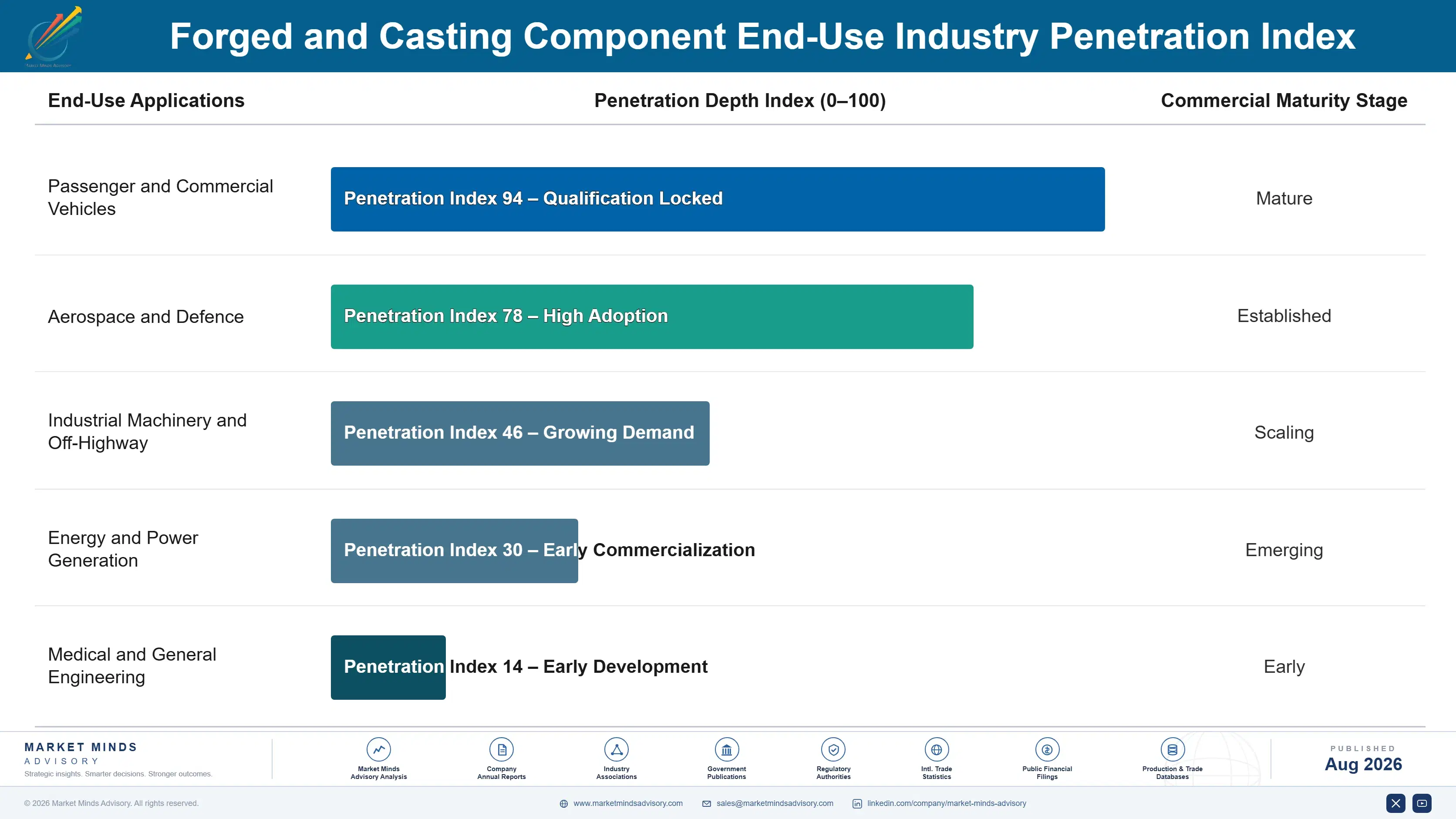
How Component Content Gets Locked

Demand commits at platform sourcing and then repeats every unit for seven to twelve years, because requalifying an approved part costs about USD 85,000 and most of a year. The customer negotiates price annually and wins, but almost never moves the part, which produces a relationship adversarial on price and dependent on delivery. That is the annuity in this business, won once and defended by not failing rather than by selling.
Stickiness varies with how safety-critical the part is. Aerospace and medical components stick hardest, since requalification means regulatory involvement and nobody starts that lightly. Automotive safety parts stick nearly as hard through production part approval discipline. General machinery castings stick least, because the buyer requalifies casually and compares quotes annually. Off-highway and energy sit between, where volumes are low enough that qualification effort looms large.

The buyer has moved from a purchasing manager to a sourcing committee with an engineer and a sustainability analyst in the room. Twenty years ago the conversation was price per kilogram and delivery reliability. Now it includes recycled metal content, embodied carbon per part, and whether the supplier can evidence either. Suppliers still leading with price per kilogram answer the least important question asked.
forged-and-casting-component-market-end-use-penetration-index-1787332533174

Our Call On Forged Components

These are among the four positions where our research anticipates prominent divergence between winners and laggards over the coming forecast period. Each is grounded in the demand model, the regulatory perimeter, and the announced capacity pipeline.
01 / PLATFORM SOURCING FOCUS

The contest happens once, years before production

Requalifying an approved forged or cast part costs roughly USD 85,000 and eleven months, which means the incumbent holds content for a platform lifetime of seven to twelve years regardless of how the annual price negotiation goes. The only genuine competitive event is a new platform sourcing decision taken two to three years before the vehicle or machine reaches production, usually inside the customer's engineering function rather than its procurement one. Suppliers organised to respond to requests for quotation arrive after the part was already shaped by somebody else.
02 / SCRAP RATE DISCIPLINE

Two points of yield beat any negotiation

Scrap and rework consume 4% to 9% of production and every rejected part carries the full metal, energy, labour, and machining cost already spent on it, which makes yield the most controllable determinant of margin here. A supplier two points better on scrap quotes two points lower and earns the same, which is how competitive awards are actually decided rather than through commercial skill. Process monitoring, die thermal management, and simulation ahead of tooling all cost money before any order exists, which is precisely why most foundries defer them.
03 / ENERGY CONTRACT POSITION

Energy decides who gets on the bid list

Melting and reheating carry 14% to 22% of conversion cost, and European suppliers discovered in 2022 that an uncontracted exposure that size does not make you unprofitable first, it makes you uncompetitive on new sourcing decisions while existing content still looks fine. That damage appears as content not won and shows up in a quarterly result several years later, by which point nothing can be done about it. Multi-year renewable power agreements signed in a calm market are the only version of this that works.
04 / MACHINING SCOPE CAPTURE

Ship finished parts, not raw ones

A raw casting or forging is a commodity priced against anybody who can pour or press, while the same part machined, inspected, and delivered ready to assemble carries roughly 40% more value and is meaningfully harder to requalify elsewhere. Machining also closes the feedback loop on scrap, since a supplier finishing its own parts learns which casting defects become machining rejects and fixes them upstream. Most foundries treat machining as somebody else's business and hand away both the margin and the learning at the same time.

Engagement Snapshot From the Field

A live engagement with an industry participant carrying material or product regulatory and market exposure ahead of a defining policy shift, showing how our research translates into a defensible multi-year portfolio strategy.
MARKET MINDS ADVISORY · CLIENT ENGAGEMENT SUMMARY
Forged and Casting Component Producer Strategic Portfolio Review and Transition Roadmap 2026·Investment Scenario on Forged and Casting Component Exposure Evaluation 2025-26
CLIENT PROFILE
A European iron foundry group with roughly USD 410 million in annual revenue engaged MMA as combustion powertrain content began falling out of its order book faster than management had modelled (client-reported, unverified by MMA). Engine blocks, cylinder heads, and manifolds accounted for a substantial majority of tonnage, and every platform carrying them had a published end date.
STRATEGIC CHALLENGE
The board wanted to enter aluminium body castings, which is where the industry conversation had gone. Operations pointed out the company had no aluminium capability, no large press, and no relationship with the customers buying them. Nobody had examined what else the existing iron capability could serve. The decision could only be funded once and needed making before the next platform sourcing round.
MMA APPROACH
MMA modelled the client's tonnage against published platform end dates to establish how fast the decline actually ran. We mapped its metallurgical and machining capability against demand in wind, rail, off-highway, and grid equipment rather than assuming automotive was the only option. We then costed three routes: aluminium entry, iron diversification into industrial end markets, and managed decline with capacity closure.
KEY FINDINGS
  1. Aluminium entry modelled at roughly USD 180 million of capital and six years to a first qualified body casting award, against a decline running considerably faster than that (client-reported, unverified by MMA).
  2. The client's ductile iron metallurgy and large-part machining matched wind turbine hub and rail bogie requirements closely, with only modest process qualification work needed.
  3. Industrial customers accepted longer lead times and smaller volumes than automotive buyers, which suited a plant configuration built for high volume less well than expected.
  4. Two of the client's five plants had no viable route on any option modelled, and delaying that conclusion would cost more than acting on it.
CLIENT PROFILE
A European iron foundry group with roughly USD 410 million in annual revenue engaged MMA as combustion powertrain content began falling out of its order book faster than management had modelled (client-reported, unverified by MMA). Engine blocks, cylinder heads, and manifolds accounted for a substantial majority of tonnage, and every platform carrying them had a published end date.
STRATEGIC CHALLENGE
The board wanted to enter aluminium body castings, which is where the industry conversation had gone. Operations pointed out the company had no aluminium capability, no large press, and no relationship with the customers buying them. Nobody had examined what else the existing iron capability could serve. The decision could only be funded once and needed making before the next platform sourcing round.
MMA APPROACH
MMA modelled the client's tonnage against published platform end dates to establish how fast the decline actually ran. We mapped its metallurgical and machining capability against demand in wind, rail, off-highway, and grid equipment rather than assuming automotive was the only option. We then costed three routes: aluminium entry, iron diversification into industrial end markets, and managed decline with capacity closure.
KEY FINDINGS
  1. Aluminium entry modelled at roughly USD 180 million of capital and six years to a first qualified body casting award, against a decline running considerably faster than that (client-reported, unverified by MMA).
  2. The client's ductile iron metallurgy and large-part machining matched wind turbine hub and rail bogie requirements closely, with only modest process qualification work needed.
  3. Industrial customers accepted longer lead times and smaller volumes than automotive buyers, which suited a plant configuration built for high volume less well than expected.
  4. Two of the client's five plants had no viable route on any option modelled, and delaying that conclusion would cost more than acting on it.
RECOMMENDED STRATEGY
Phase 1: Phase 1 (0 to 10 months): Abandon the aluminium entry and begin qualification work with wind and rail customers at the two strongest plants. Phase 2: Phase 2 (10 to 26 months): Reconfigure those plants for lower volume and larger parts, and expand machining scope on every new award. Phase 3: Phase 3 (26 to 48 months): Close or sell the two plants with no route while combustion volume still gives them residual value.
OUTCOME
The board cancelled the aluminium project and began wind and rail qualification instead, which the chief executive later called the least popular decision available. First industrial awards arrived inside eighteen months, and the client reports machining scope on those parts running well above its automotive average (client-reported, unverified by MMA). One plant closure has completed and one remains under discussion.

Frequently Asked Questions

Foundational context covering the market sizes, CAGR, scope, country, region and competition that inform every finding below. This section is provided to cover basics and most often pre-purchase conversations, answered from the MMA Primary Research Dataset.

What is the current size of the Forged and Casting Component Market?

The global market is valued at USD 296.4 billion in 2025, covering parts produced by sand casting, die casting, investment casting, and forging processes. Raw metal, stampings, and powder metallurgy parts are excluded.

How large will the Forged and Casting Component Market be by 2036?

The market is forecast to reach USD 501.6 billion by 2036 in the base case, about 1.61 times the 2026 level. That represents incremental value of roughly USD 190.7 billion.

What is the CAGR for the Forged and Casting Component Market 2026 to 2036?

The market grows at a 4.9% CAGR in the base case, with bull and bear scenarios at 6.1% and 3.7%. The spread turns on body casting adoption and on regional energy cost positions.

Which segment is growing fastest?

High-pressure die casting grows fastest at 7.6%, about 1.55 times the overall rate, as very large aluminium body castings replace dozens of joined parts. Investment casting follows at 6.2%.

Who are the major companies in the Forged and Casting Component Market?

Leading participants include Nemak, Howmet Aerospace, Bharat Forge, Georg Fischer, and thyssenkrupp. Fragmentation is extreme, with the top five holding about 11% because heavy parts ship badly and foundries serve a radius.

Which country is growing fastest?

India grows fastest at a 7.6% CAGR, as its forging base exports into markets that once supplied it and domestic vehicle production expands. China follows on manufacturing volume.

Report Segmentation Architecture

The full report scope spans multiple orthogonal segmentation dimensions, with cross-tabulated demand data provided for each dimension pair. Coverage extends further to regional breakdowns, trend trajectories, and the competitive detail needed to support segment-level decision-making.

By Forming Process

  • High-Pressure Die Casting
  • Investment Casting
  • Closed-Die Forging
  • Open-Die and Ring-Rolled Forging
  • Sand Casting

By End-Use Industry

  • Passenger and Commercial Vehicles
  • Aerospace and Defence
  • Industrial Machinery and Off-Highway
  • Energy and Power Generation
  • Medical and General Engineering

By Supply Scope

  • Raw Component Supply
  • Machined and Finished Component Supply
  • Tooling and Development Programme
  • Long-Term Capacity Agreement

By Region

  • North America
  • Western Europe
  • East Asia
  • South Asia and Pacific
  • Latin America
  • Middle East and Africa
  • Eastern Europe

Scope, Methodology, and Coverage

Every figure in this report is reproducible from documented input assumptions. The scope below maps the historical period, the forecast horizon, the segmentation dimensions, and the countries covered, alongside the underlying primary and qualitative methodology.
Historical Period
2020 to 2025
Forecast Period
2026 to 2036
Base Year
2025 (USD billions; MMA Primary Research Dataset, August 2026)
Market Definition
The forged and casting component market comprises the manufacture and sale of metal parts formed by casting and forging processes, valued at component selling prices to vehicle manufacturers, equipment builders, aerospace and energy customers, and distributors. It spans sand casting, high-pressure and gravity die casting, investment casting, centrifugal casting, closed-die forging, and open-die and ring-rolled forging, in ferrous and non-ferrous metals, supplied as raw, heat-treated, machined, or fully finished components together with the associated tooling, pattern equipment, and qualification programmes. Raw metal and semi-finished mill products including billet, bar, plate, and extrusions, sheet stampings and press formings, welded and mechanically assembled fabrications, powder metallurgy and metal injection moulded parts, additively manufactured components, and plastic and composite mouldings are excluded. Standalone machining services performed on parts supplied by others sit outside scope.
Quantitative Units
USD billions (current prices); volume in millions of tonnes of components shipped
Segmentation Dimensions
By Forming Process; By End-Use Industry; By Supply Scope; By Region
Regions Covered
North America, Western Europe, East Asia, South Asia and Pacific, Latin America, Middle East and Africa, Eastern Europe
Countries Covered
China, Japan, South Korea, Taiwan, India, USA, Canada, Mexico, Germany, Italy, Spain, France, UK, Austria, Sweden, Switzerland, Turkey, Poland, Czechia, Slovakia, Hungary, Romania, Brazil, Argentina, Colombia, Chile, Saudi Arabia, United Arab Emirates, Egypt, South Africa, Australia, Thailand, Vietnam, Indonesia, Malaysia, and additional markets relevant to this sector
Key Companies Profiled
Nemak, Howmet Aerospace, Bharat Forge, Georg Fischer, thyssenkrupp, Fritz Winter, Waupaca Foundry, Ryobi, Ahresty, Aisin, Proterial, CIE Automotive, Ramkrishna Forgings, Sona BLW Precision Forgings, Scot Forge, Ellwood Group, SIFCO Industries, Doosan Enerbility, Japan Steel Works, Farinia Group
Quantitative Methodology
Primary survey, n=3,800 respondents, Q4 2025, six countries; demand-side model with trade association cross-validation
Qualitative Methodology
47 expert interviews, Q4 2025; applied to validate demand model assumptions, identify emerging dynamics, and assess competitive positioning
Report Format
PDF and XLSX data workbook (Word format preview document)
Publisher
Market Minds Advisory
Report Code
MMA-2026-CON-470
Published
August 2026
Contact
sales@marketmindsadvisory.com | www.marketmindsadvisory.com

Purchase the full Forged and Casting Component Market Report (2026 to 2036).

The full MMA Forged and Casting Component report sizes the market across five forming processes, five end-use industries, four supply scopes, and seven regions through 2036. It profiles 20 participants on a consistent basis of forged and cast component revenue, scoring each on platform sourcing position, scrap and yield performance, energy contract exposure, and machining scope captured. Scenario models quantify how body casting adoption, aerospace build rates, and regional energy costs move both volume and achievable margin. The report also includes content-per-vehicle modelling across powertrain types, energy cost position benchmarking by region, qualification and switching cost analysis, and machining capture rates across the major suppliers.
Five-process and four-scope market sizing to 2036
Twenty-participant benchmark on forged and cast component revenue
Content-per-vehicle modelling across combustion and battery powertrains
Energy cost position benchmarking by region and process
Qualification and switching cost analysis by part class
Machining capture rate benchmarking across the major suppliers

Built For The People Who Decide

From boardroom strategy to bench-side execution, this report is read cover-to-cover by leaders shaping the next decade of their industry, turning demand scenarios, market dynamics and valuation benchmarks into decisions.
CXOs/ Presidents/ VPs/ Managers
M&A and Corporate Development
Strategy Teams and R&D Heads
Procurement and Product Directors
Regulatory and Compliance Leaders
Investor Relations and Equity Analysts