Market Minds Advisory
Food Packaging Film Market

Food Packaging Film Market: Recyclability Regulation Rewrites Converter Roadmaps

Food packaging film demand is splitting sharply between legacy multi-layer barrier structures and recyclable mono-material films as retailer sustainability mandates and extended producer responsibility regulation reshape converter specifications across major markets.

Lead Analyst

Bilal Shaikh

Published

September 2026

Make Smarter Decisions with Customized Research Insights

Request a free sample report and evaluate market opportunities, growth trends, and competitive dynamics relevant to your business needs.

2025 MARKET VALUE$48.5BMarket Size 2025
2036 FORECAST VALUE$96.0BBase Case , 2026 to 2036
CAGR 2026 TO 20366.4 %Bull 7.7% / Bear 5.1%
INCREMENTAL OPPORTUNITY$44.4BNet 10- year value creation
EXPANSION MULTIPLE1.86x2036 value over 2026 base
Strategic Levers
M&A Pipeline
Regional Outlook
Country Rankings
Competitive Intelligence
Segmental Deep-dive
Call-Us : 91 93563 13602

Executive Snapshot and Market Trajectory

Food packaging film sits between two forces pulling in opposite directions: retailers demanding recyclable mono-material structures for sustainability compliance and improved brand perception, and food safety requirements still favoring multi-layer barrier films that resist recycling infrastructure entirely across most current municipal collection systems operating worldwide today and beyond.
Extended producer responsibility regulation across the European Union and several US states, rapid e-commerce and ready-meal packaging growth in East Asia, and rising resin cost volatility together concentrate commercial pressure on converters that have not yet requalified barrier film formulations for mono-material recyclability, particularly across snack, dairy, and frozen food applications where legacy multi-layer structures remain deeply entrenched among established brand owners, retail buyers, and major distribution channel partners globally today.
Amcor, Berry Global, and Sealed Air lead a moderately fragmented competitive field where recyclable film formulation speed is becoming as commercially decisive as converting capacity and long-standing customer relationships, while regional Asian converters expand aggressively into flexible film capacity serving domestic packaged food growth well ahead of most Western competitors currently active in those same fast-growing emerging markets across the wider region, reshaping global sourcing patterns steadily.
Market Definition
The food packaging film market covers flexible plastic and bio-based films used for primary food contact packaging, including barrier, wrapping, and pouch-forming films. Rigid packaging, paperboard cartons, and non-food industrial films are excluded from scope.
Base Year Value
$48.5B in 2025 (MMA Primary Research Dataset, August 2026)
Forecast Period
2026 to 2036, eleven discrete annual values
CAGR
6.4% base case. Bull 7.7%. Bear 5.1%.
Fastest Growth Segment
Recyclable Mono-Material Films: 11.5% CAGR
Fastest Growth Country
China: 8.5% CAGR
Fastest Growth Region
South Asia and Pacific: 8.4% CAGR
Largest Region
East Asia: 30% of 2025 global value
Market Leaders
Amcor, Berry Global, Sealed Air, Mondi Group, Constantia Flexibles. Source: MMA Analysis, July 2026.
Primary Survey
n=3,800 procurement and R&D decision-makers, Q4 2025, six countries
Methodology
Demand-side build-up, cross-validated against public data, 47 expert interviews

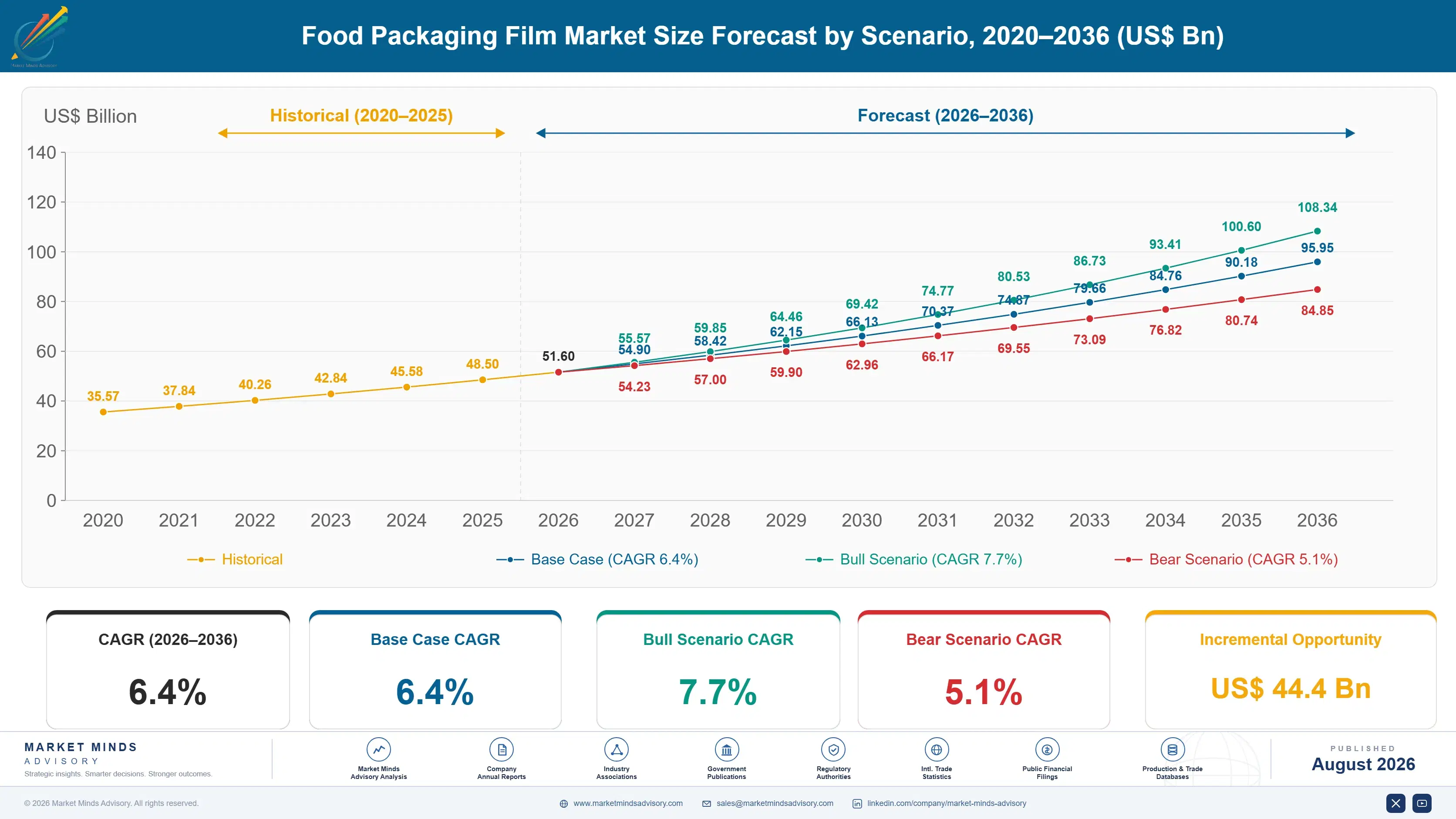
Food Packaging Film Market Forecast Scenarios

food-packaging-film-market-size-forecast-scenario-1787304989470
Food packaging film demand grew steadily but unevenly between 2020 and 2025, with pandemic-driven packaged food and grocery delivery volume pulling growth forward before moderating into a calmer, more regulation-driven pattern by 2024. Sustainability requirements began reshaping converter product roadmaps meaningfully during the back half of the historical period, setting up the recyclability-driven transition now underway across most major food packaging film categories worldwide.
The base case assumes 6.4 percent annual growth through 2036, anchored on three commercial mechanisms: extended producer responsibility fee structures pushing brand owners toward recyclable mono-material film specifications, continued packaged food and ready-meal volume growth across East Asian and South Asian markets, and steady replacement of legacy multi-layer barrier structures as recyclable alternatives close the performance gap on oxygen and moisture barrier properties required for shelf-stable food applications across most major categories.
The bull case centers on faster-than-expected recyclable barrier film performance parity enabling rapid brand owner conversion across snack and frozen categories. The bear case flags resin price volatility and slower-than-planned recycling infrastructure buildout, which could delay mono-material conversion and leave converters running costly dual product lines for longer than currently planned across most regional markets.

Where Recyclability and Barrier Performance Collide

Food packaging film occupies an unusually contested position within flexible packaging: a category where sustainability regulation, food safety requirements, and resin cost economics pull converter product roadmaps in genuinely conflicting directions rather than reinforcing a single clear technology transition. Multi-layer barrier films still dominate categories requiring long shelf life, but brand owners are pushing converters hard toward mono-material recyclable alternatives wherever performan
MARKET CONCENTRATIONCR5 32%Top five producers control roughly a third of global capacity
AVERAGE SELLING PRICEUSD 2.10/kgBlended average price across barrier and mono-material film categories
TOP PRODUCING COUNTRY SHARE34%Share of global film production capacity based in leading country
CAPACITY UTILISATION81%Average converting line operating rate across major regional facilities
TRADE INTENSITY38%Portion of film volume crossing borders versus locally converted
INPUT COST SHARE58%Resin and additive costs as share of total film cost
Regulatory pressure varies sharply by geography. The European Union packaging and packaging waste regulation is forcing the fastest conversion timeline among major markets, with several member states already restricting non-recyclable film formats outright. North American conversion moves more slowly, tied to a patchwork of state-level extended producer responsibility rules rather than a single federal standard, leaving converters managing genuinely different product specifications across their customer base.
East Asian production capacity continues expanding faster than any other region, driven by domestic packaged food growth and increasingly export-oriented converter investment. Resin cost volatility remains the single largest swing factor in converter margin, with polyethylene and polypropylene feedstock pricing tied closely to broader petrochemical cycles that most converters can only partially hedge through long-term supply contracts.
"Every converter says they are close to a recyclable barrier film that performs like the multi-layer version. The ones telling the truth are the ones already losing shelf-stable contracts to slower, more patient competitors."
Director, Packaging and Materials Practice · MMA Packaging / Flexible Food Packa

Market Trends

EU Packaging Waste Regulation Forces Mono-Material Conversion

The European Union Packaging and Packaging Waste Regulation, entering phased implementation through 2030, sets recyclability requirements that effectively disqualify many current multi-layer barrier film formats from continued use in food packaging across member states. Converters serving European brand owners are racing to requalify snack, dairy, and frozen food film structures around mono-material polyethylene or polypropylene formats that meet both barrier performance and recyclability thresholds simultaneously. Early movers report qualification timelines running twelve to eighteen months per product line, creating a genuine capacity bottleneck across converter research and development teams currently.
Market Impact: Retailers target full conversion by
East Asian Packaged Food Growth Drives Capacity Expansion

Rapid growth in packaged food, ready-meal, and e-commerce grocery delivery across China, India, and Southeast Asia is driving sustained flexible film capacity expansion among both domestic and multinational converters operating throughout the region. Several major converters announced new East Asian film production lines during 2024 and 2025, targeting both domestic consumption and export capacity serving nearby markets across Southeast Asia. This regional capacity buildout is shifting global film trade patterns gradually, with East Asian converters increasingly supplying finished film to buyers that previously sourced primarily from European or North American producers.
Market Impact: Online grocery penetration exceeds

Market Opportunities and Growth Drivers

Retailer Sustainability Commitments Push Recyclable Film Adoption

Major grocery retailers across North America and Europe have published packaging sustainability commitments requiring suppliers to shift toward recyclable film formats within defined timelines, several targeting full mono-material conversion for private label products by 2027 or 2028 across most major product categories. This retailer pressure often moves faster than regulatory deadlines, since private label buying teams can simply decline non-compliant packaging formats during supplier negotiation cycles. Brand owners supplying these retailers are consequently prioritizing recyclable film requalification ahead of categories facing less direct commercial pressure from major retail buyers currently.
Market Impact: Resin costs swing 20 to 30%

E-Commerce Grocery Growth Expands Flexible Pouch Demand

Online grocery and ready-meal delivery volume continues expanding steadily across most developed and emerging markets, driving demand for flexible pouch and stand-up bag formats that ship more efficiently than rigid packaging alternatives across most distribution networks and channels. E-commerce-optimized film formats increasingly require puncture resistance and print quality specifications beyond traditional retail shelf packaging, pushing converters toward higher-specification film structures that carry meaningfully better margin than commodity film formats. This channel shift is proving durable rather than temporary, with online grocery penetration continuing to climb steadily across most major markets tracked.
Market Impact: Barrier gap adds 15% cost premium

Market Restraints and Challenges

Resin Price Volatility Compresses Converter Margin

Polyethylene and polypropylene resin prices, which together make up the majority of film raw material cost, have swung by wide margins over recent years, rooted in petrochemical feedstock cycles and periodic regional supply disruption events. This volatility compresses converter margin sharply during price spikes, since most film supply contracts include only partial and lagged resin cost pass-through clauses to brand owner customers. Converters are mitigating exposure through longer-term resin supply agreements and increased use of resin price hedging instruments, though neither approach eliminates margin compression during sudden feedstock cost shocks.
Market Impact: EU rules phase in through 2030

Recyclable Barrier Film Performance Gap Slows Conversion

Recyclable mono-material films still lag multi-layer barrier structures on oxygen and moisture barrier performance for several demanding categories, including long-shelf-life snack and coffee packaging, a gap rooted in the fundamental physics of single-polymer versus multi-polymer barrier layering across most film formats currently in commercial use. This performance shortfall keeps some brand owners running legacy formats past regulatory deadlines while formulation research continues industry-wide. Resin and additive suppliers are mitigating the gap through advanced coating technologies and nanocomposite barrier additives, though these solutions currently add meaningful cost premium versus proven multi-layer structures.
Market Impact: New capacity lines announced throug
4 additional market trends, 4 additional growth drivers, and 4 additional restraints and challenges are covered in the full report. Contact sales@marketmindsadvisory.com to access the complete intelligence.

Segment CAGR and Growth Architecture

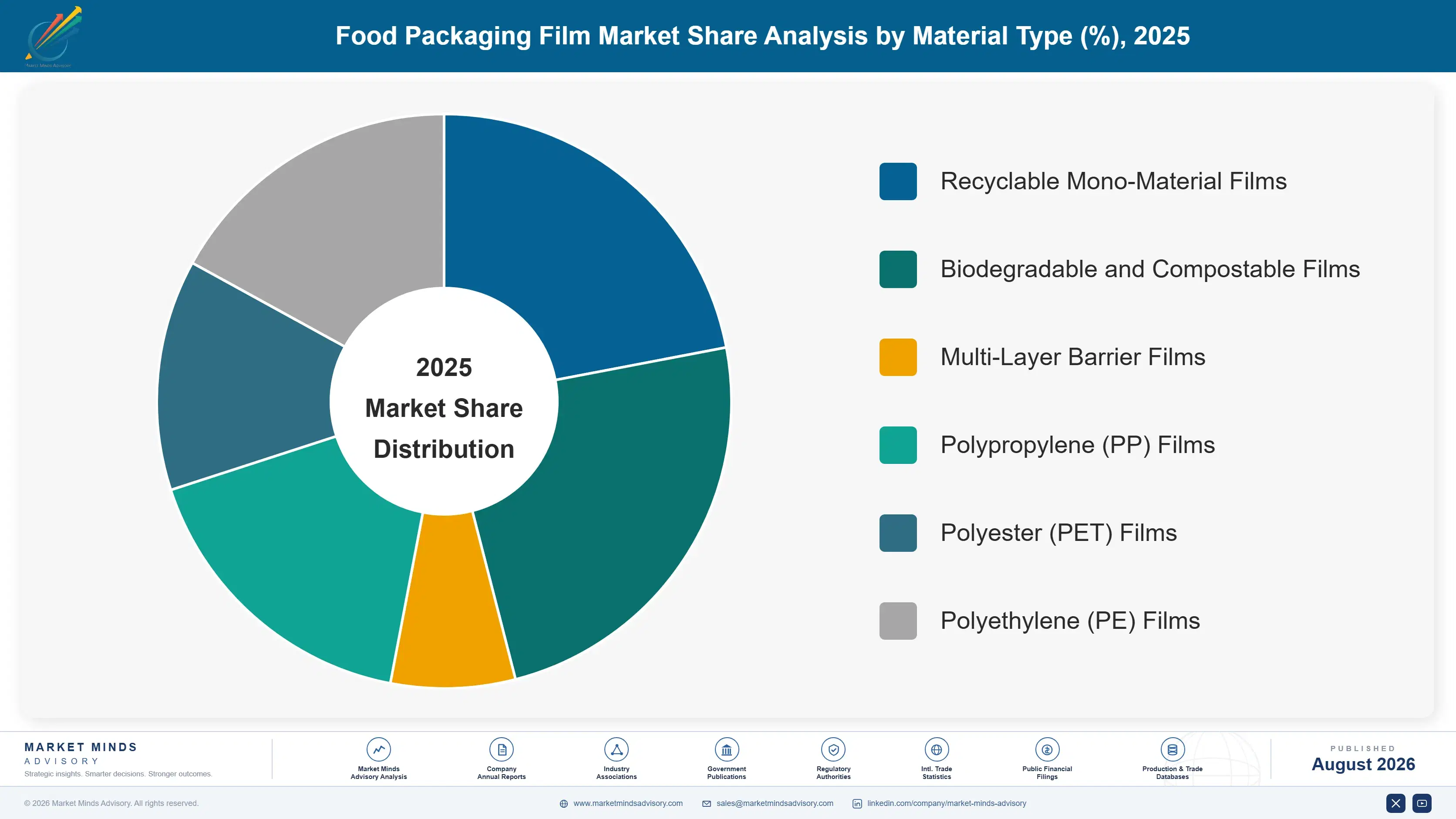
Food packaging film segments by material and structure type across six distinct categories spanning conventional and next-generation formats used across the industry. Recyclable mono-material films and biodegradable and compostable films are the two fastest-growing categories tracked, both expanding well ahead of the broader market as sustainability regulation and retailer commitments reshape converter product roadmaps industry-wide.
food-packaging-film-market-market-share-analysis-1787304990005

Recyclable Mono-Material Films

Recyclable mono-material films, built from single-polymer polyethylene or polypropylene structures rather than mixed-polymer laminates, are converting the fastest share of new film specifications as brand owners respond to extended producer responsibility fee structures and retailer packaging commitments across most major markets. Converters have invested heavily in coating and additive technologies that close the barrier performance gap against legacy multi-layer structures, though qualification remains slower for long-shelf-life categories like coffee and processed meat. Major consumer goods companies have published public timelines committing private label and flagship product lines to mono-material conversion by 2027 or 2028, creating sustained near-term demand that is reshaping converter capital investment priorities across most major film-producing regions worldwide.
CAGR 11.5%

Biodegradable and Compostable Films

Biodegradable and compostable films, derived from polylactic acid, cellulose-based substrates, and other bio-based polymers, remain a smaller but rapidly expanding category driven by food service and premium retail applications where composability offers genuine end-of-life advantage over mechanical recycling infrastructure entirely today. Growth here concentrates disproportionately in Western Europe, where industrial composting infrastructure is more developed than in most other regions, and in premium organic and specialty food categories willing to absorb higher material costs consistently. Barrier performance and cost remain the primary adoption constraints, though several converters have announced expanded compostable film production capacity through 2026 as brand owner demand continues accelerating steadily across the category and beyond current expectations.
CAGR 9.8%
Full segment breakdown across 6 segments available in the complete report.

Regional Architecture and Country Demand Map

Food packaging film production and demand concentrate heavily in East Asia, where China leads global flexible film manufacturing capacity by a wide margin. North America and Western Europe follow on value, while South Asia and Pacific markets post the fastest regional growth off a rapidly expanding packaged food base.

North America

In North America, retailer sustainability commitments and a patchwork of state-level extended producer responsibility rules are driving accelerated conversion toward recyclable mono-material film formats across most major product categories and retail channels. The United States accounts for the large majority of regional volume, with converting capacity concentrated among a handful of major multinational and regional players serving national grocery and food service chains. Canada contributes a smaller but steadily growing share tied to comparable retailer sustainability pressure across similar categories. Resin cost volatility affects North American converter margin more directly than in other regions, given heavier reliance on domestic petrochemical feedstock pricing cycles that fluctuate meaningfully throughout the year and across quarters.
Share: 24% | CAGR: 6.9% (2026 to 2036)

Western Europe

Western Europe faces the most demanding regulatory environment of any region, with the European Union Packaging and Packaging Waste Regulation setting recyclability thresholds that are reshaping converter product lines faster than anywhere else globally and across every category tracked closely. Germany, France, and the United Kingdom together account for the majority of regional volume, with Germany maintaining the largest converting capacity base in the bloc. Industrial composting infrastructure is also more developed here than elsewhere, supporting stronger biodegradable film adoption across premium categories and applications. Growth trails East Asia and South Asia as the market matures, though regulatory-driven product transition sustains steady capital investment across most established converter operations region-wide.
Share: 20% | CAGR: 4.9% (2026 to 2036)
Regional intelligence for 5 additional markets available in the complete report: East Asia, South Asia and Pacific, Latin America, Middle East and Africa, Eastern Europe. Contact sales@marketmindsadvisory.com.
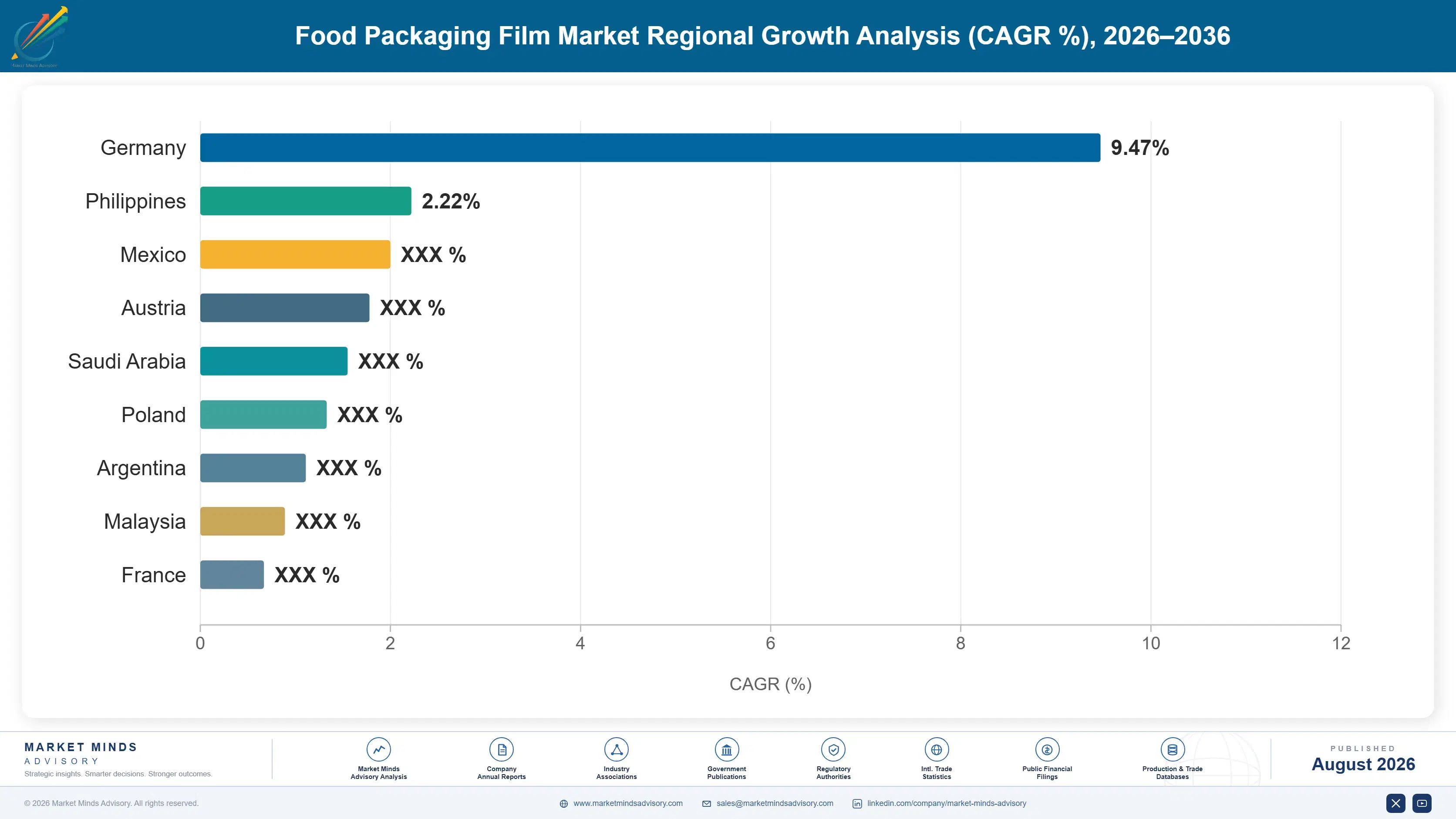
food-packaging-film-market-country-cagr-analysis-1787304990525

Recyclable Format Conversion and Margin Expansion Paths

Food packaging film converters are pursuing several distinct paths to defend and expand margin as commodity film pricing compresses under resin cost pressure and customer negotiating power. Four levers stand out as commercially significant across the forecast period, spanning recyclable format premiums, specialty barrier technology, regional capacity positioning, and long-term supply contract structuring with major brand owners.

Recyclable Format Price Premium Capture Strategy

Converters that have successfully requalified mono-material recyclable film formats are capturing meaningful price premiums over legacy multi-layer structures, with early movers reporting premiums of 8 to 12 percent on qualified recyclable film sales to sustainability-committed brand owners. This premium reflects both genuine formulation investment and scarcity value, since qualification timelines of twelve to eighteen months limit how quickly competitors can match new recyclable offerings. The premium is expected to compress gradually as recyclable formats become the industry standard rather than a differentiator, making early conversion timing commercially important for converters seeking to capture this window.
Market Impact: Recyclable formats command an 8 to

Specialty Barrier Technology Differentiation Investment Strategy

Converters investing in advanced nanocomposite barrier coatings and multi-functional additive technology are commanding higher margin on specialty film grades serving demanding applications like coffee, cheese, and processed meat packaging across most regions. These specialty grades typically carry gross margin 10 to 15 percentage points above commodity film categories, reflecting genuine technical differentiation that competitors cannot easily replicate without comparable research and development investment. This lever matters most for converters with dedicated technical service teams capable of working closely with brand owner packaging engineers on custom formulation projects requiring extended qualification support.
Market Impact: Specialty grades carry 10 to 15 poi

Regional Capacity Positioning Ahead of Demand Growth

Converters establishing new production capacity in South Asia and Southeast Asia ahead of projected packaged food demand growth are capturing first-mover advantage in markets where local converting capacity currently lags domestic consumption growth by a meaningful margin. Early entrants report utilization rates reaching 85 percent within three years of new line startup, well above typical ramp timelines in more mature and already-served regional markets. This approach requires patient capital and local market development investment, but positions converters to capture disproportionate share as regional packaged food consumption continues accelerating through the forecast period ahead.
Market Impact: New lines reach 85% utilization wit

Long-Term Resin-Indexed Supply Contract Structuring Approach

Converters negotiating long-term supply contracts with resin-indexed pricing formulas, rather than fixed pricing renegotiated annually, are reducing margin volatility meaningfully during periods of feedstock cost swings across most product categories. These structured contracts, now covering an estimated 35 percent of major converter volume with large brand owner accounts, pass resin cost changes through on a lagged but predictable schedule rather than absorbing full volatility on the converter side alone. This lever matters most for converters serving high-volume commodity categories where margin compression during resin price spikes has historically been most severe and damaging.
Market Impact: Indexed supply contracts now cover

Who Controls the Margin Pool

Food packaging film carries a CR5 near thirty-two percent, reflecting a genuinely fragmented industry where regional converters compete alongside multinational majors across most product categories. The gap between Amcor, the largest single converter, and the next tier of challengers is meaningful but not overwhelming, since converting capacity itself is relatively replicable with sufficient capital investment.
Current competitive activity plays out across three dimensions: recyclable format requalification races among converters serving sustainability-committed brand owners, capacity expansion into South Asian and Southeast Asian markets ahead of demand growth, and consolidation among smaller regional converters lacking capital to fund recyclable film research and development. Larger converters are also pursuing selective acquisitions of specialty barrier film technology firms to accelerate formulation capability.

Emerging pressure comes from Asian domestic converters expanding export-oriented capacity at costs multinational majors increasingly struggle to match, and from resin producers moving downstream into converting themselves to capture margin previously ceded to independent converters. Rankings could shift meaningfully if regulatory-driven recyclable film qualification speed diverges significantly between leaders, particularly as brand owners increasingly favor converters demonstrating the fastest credible path to full mono-material conversion across their entire packaging portfolio.
food-packaging-film-market-company-positioning-matrix-1787304991042

Competitive Moat and Risk Dimensions

AMCOR

Moat: Global Converting Scale Advantage

Amcor operates the largest global converting footprint among food packaging film producers, spanning dozens of facilities across every major region tracked. This scale lets Amcor serve multinational brand owner accounts requiring consistent film specifications across multiple countries, a capability smaller regional converters cannot easily replicate, while spreading recyclable format research cost across a far larger production base.
AMCOR

Risk: Legacy Multi-Layer Portfolio Exposure

A meaningful share of Amcor's existing film portfolio still relies on multi-layer barrier structures facing regulatory-driven obsolescence in key markets, requiring substantial reformulation investment across many product lines simultaneously. Slower-moving legacy categories could compress margin if recyclable format qualification does not keep pace with tightening European Union and North American state-level regulatory timelines currently in effect.
BERRY GLOBAL

Moat: Vertical Resin Integration Position

Berry Global maintains meaningful backward integration into resin compounding and specialty polymer formulation, giving it more direct control over feedstock cost and formulation speed than converters purchasing resin entirely on the open market. This integration supports faster recyclable format development cycles and provides some natural hedge against resin price volatility affecting less integrated competitors.
BERRY GLOBAL

Risk: Capital Intensity Limits Flexibility

Berry Global's heavy investment in owned resin compounding and converting assets creates meaningful capital intensity that limits flexibility to redirect investment quickly toward emerging film technologies or geographies. Competitors with more asset-light models can sometimes move faster into new specialty categories, while Berry Global must weigh new opportunities against the ongoing cost of maintaining substantial existing fixed asset infrastructure.

Players Tracked

Prominent Players

Amcor
Berry Global
Sealed Air
Mondi Group
Constantia Flexibles

Other Key Players

Sonoco Products
Winpak
Uflex
Cosmo Films
Toray Plastics
Klockner Pentaplast
ProAmpac
Huhtamaki
Coveris
Innovia Films
Jindal Poly Films
Toppan Inc
Dai Nippon Printing
American Packaging Corporation
Glenroy Inc

Recent Developments

MAY 2025

Amcor Completes Recyclable Mono-Material Film Line Expansion in Germany

Amcor completed a capacity expansion at its German converting facility dedicated to recyclable mono-material polyethylene film production, adding new extrusion and coating lines targeting snack and dairy applications. The expansion supports customer requalification ahead of regulation deadlines, reinforcing Amcor position among the fastest movers on recyclable barrier formulation.
Signal: Signals accelerating capital investment in
NOVEMBER 2024

Berry Global Signs Long-Term Resin Supply Agreement With Major Petrochemical Producer

Berry Global signed a long-term resin supply agreement with a major petrochemical producer covering polyethylene and polypropylene feedstock through 2030, including indexed pricing formulas designed to reduce margin volatility during resin cost spikes. The agreement secures feedstock availability for planned recyclable film capacity expansion across facilities.
Signal: Signals converters increasingly prioritizi
FEBRUARY 2025

Sealed Air Acquires Specialty Barrier Coating Technology Firm

Sealed Air completed the acquisition of a specialty barrier coating technology firm, adding nanocomposite additive capability that improves oxygen barrier performance in mono-material recyclable film structures. The acquisition accelerates Sealed Air internal recyclable film development timeline, reducing dependence on third-party coating technology licensing for premium barrier applications.
Signal: Signals continued consolidation as majors

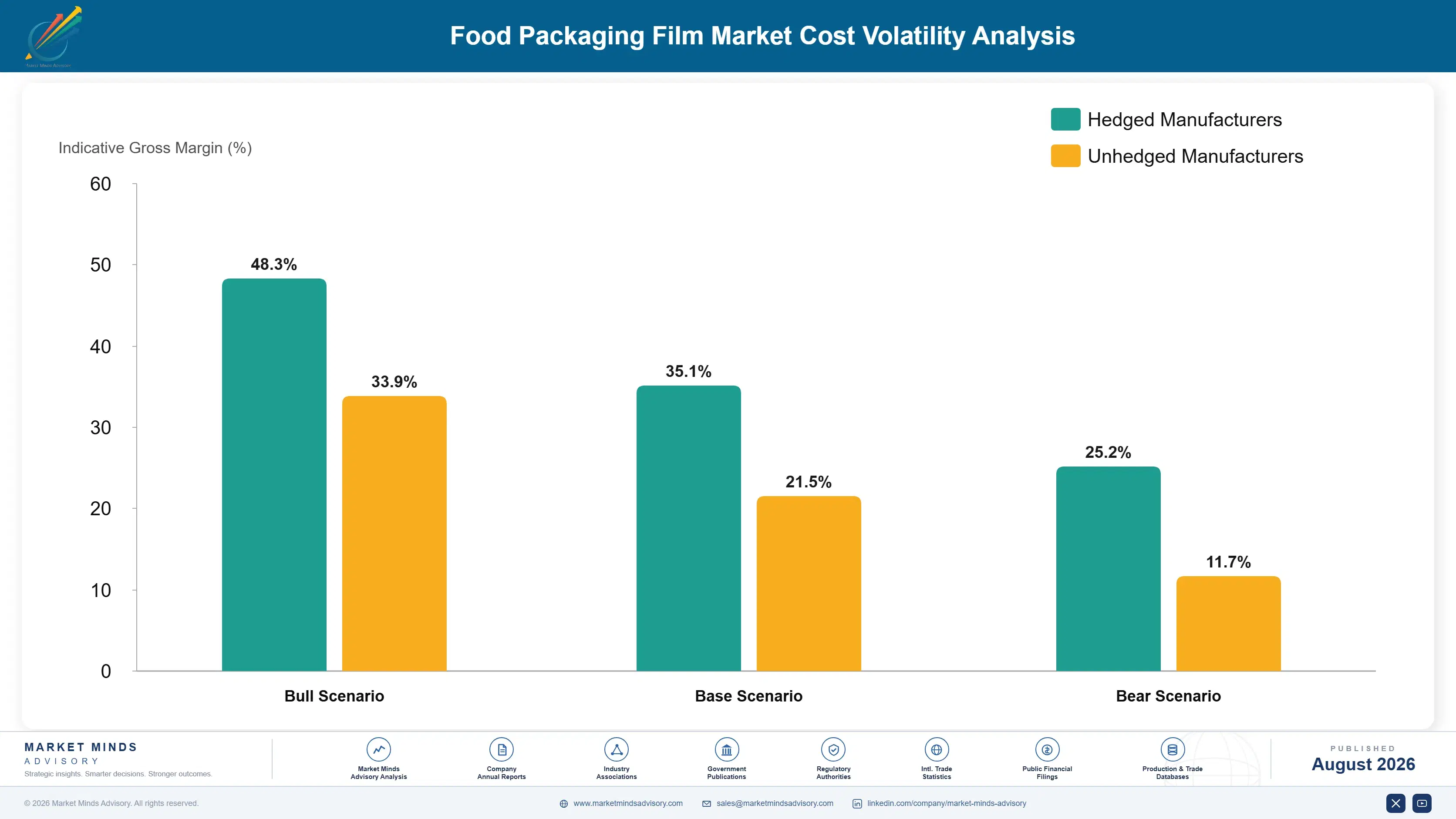
Resin and Petrochemical Feedstock Exposure

Polyethylene and polypropylene resin together represent roughly fifty-five to sixty percent of food packaging film cost of goods sold, making feedstock cost the single largest input across most film categories. These resins derive from ethylene and propylene cracking, sourced predominantly from large petrochemical complexes concentrated in the US Gulf Coast, the Middle East, and increasingly China, creating meaningful geographic concentration risk upstream.
Ethylene and propylene prices spiked sharply during 2021 and 2022 amid pandemic-related supply disruption and Russian energy market dislocation, with EIA data showing US ethylene spot prices roughly doubling within an eighteen-month window before easing through 2023. Several converters disclosed in annual reports that resin cost pass-through lagged the spike by two to three quarters, compressing gross margin meaningfully during the peak volatility period before contract renegotiation restored typical margin levels.

Cost exposure varies by player type and geography. Vertically integrated converters with resin compounding capability absorb volatility more easily than smaller independent converters purchasing resin on spot or short-term contract markets. Geographic exposure also differs: converters sourcing feedstock primarily from Gulf Coast or Middle Eastern petrochemical complexes face different volatility patterns than those relying on Chinese domestic resin production, which has expanded capacity meaningfully in recent years.
food-packaging-film-market-cost-volatility-analysis-1787304991237

Resin-Indexed Long-Term Supply Contracts

Converters are increasingly negotiating multi-year resin supply contracts with indexed rather than fixed pricing, passing feedstock cost changes through on a predictable, lagged schedule rather than absorbing full spot market volatility internally. This reduces margin swings during sudden price spikes and gives finance teams clearer forward visibility into gross margin trajectory across upcoming quarters and planning cycles.

Vertical Integration Into Resin Compounding

Several major converters have expanded backward integration into resin compounding and specialty polymer formulation, capturing margin previously paid to third-party resin suppliers while gaining tighter control over material quality and delivery timing across facilities. This shift requires substantial upfront capital investment but reduces exposure to spot market volatility over multi-year converting asset lifecycles ahead.

Regional Feedstock Sourcing Diversification

Converters are diversifying resin sourcing across multiple geographic feedstock regions, including Gulf Coast, Middle Eastern, and Chinese domestic production, rather than depending on a single petrochemical supply corridor. This reduces exposure to any single region regulatory disruption, weather event, or geopolitical shock, giving procurement teams greater flexibility to shift sourcing quickly during periods of localized supply constraint.

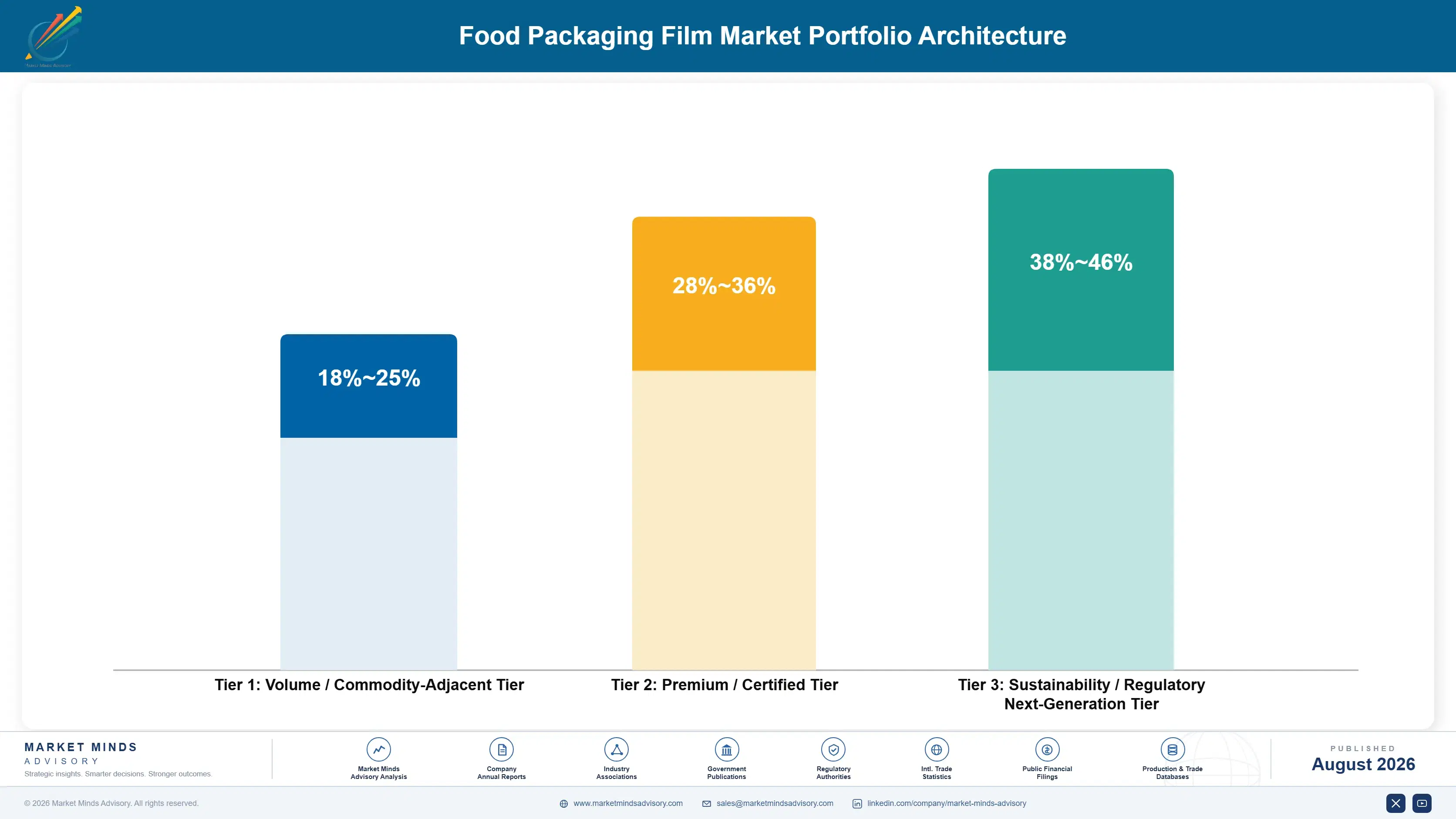
Portfolio Architecture for Margin Defence

Food packaging film portfolios span three margin tiers running from commodity-adjacent polyethylene film through certified recyclable and specialty barrier structures to sustainability-linked next-generation formats including compostable and bio-based films. Gross margin widens considerably moving up the tier structure, driven by formulation differentiation and technical service depth rather than converting capacity or bill of materials differences alone across categories.
Volume tier competition centers on price and basic barrier performance for commodity applications like retail grocery bags and simple wraps, where converting scale and resin purchasing power determine competitiveness more than technical differentiation. Premium tier competition instead centers on recyclable formulation speed, specialty barrier technology, and technical service depth, an entirely different buying calculus that rewards converters with dedicated formulation research capability built over many years of sustained investment.

High-value margin pools concentrate overwhelmingly in the premium and next-generation tiers, where recyclable format premiums and specialty barrier technology generate meaningfully better margin than any commodity film transaction. Converters increasingly steer capital investment and research and development spending toward this upper tier as volume-tier margin continues compressing under sustained resin cost pressure and intensifying price competition from lower-cost regional converters.

Volume / Commodity-Adjacent Tier

Commodity polyethylene and basic multi-layer film targeting price-sensitive grocery bag, simple wrap, and bulk food packaging applications where converting scale and resin cost management matter more than technical differentiation or premium branding.
Gross Margin: 18%-25%

Premium / Certified Tier

Certified recyclable mono-material and specialty barrier films meeting retailer sustainability commitments, typically sold with technical service support to established brand owners across snack, dairy, and processed food categories seeking proven performance.
Gross Margin: 28%-36%

Sustainability / Regulatory / Next-Generation Tier

Compostable, bio-based, and advanced nanocomposite barrier films targeting premium retail and food service applications, positioned ahead of broader regulatory requirements for converters and brand owners prioritizing sustainability leadership over near-term cost.
Gross Margin: 38%-46%
food-packaging-film-market-portfolio-architecture-1787304991743

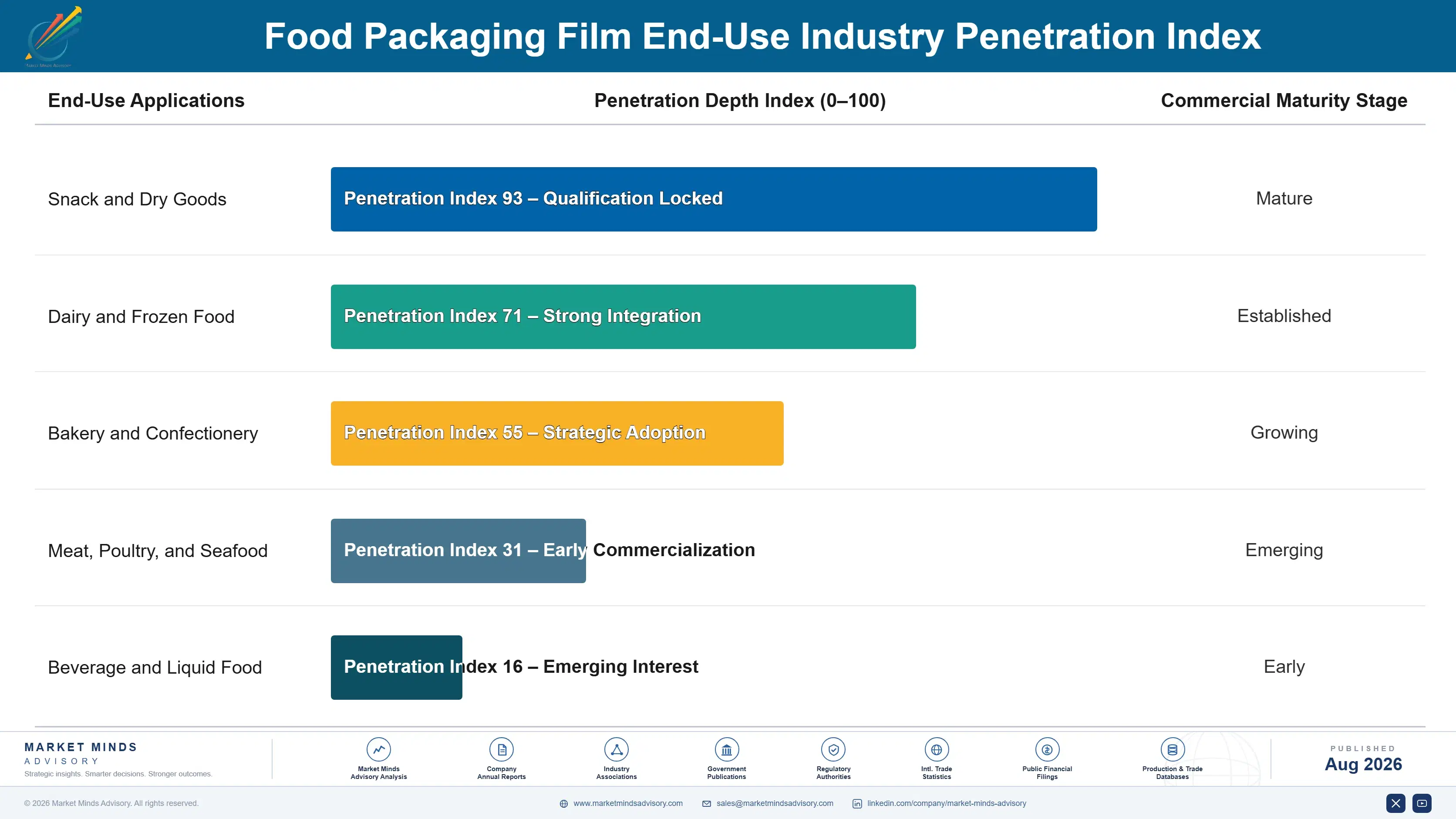
Regulatory Cycles and Customer Retention

Food packaging film demand carries genuine annuity characteristics through multi-year supply contracts with major brand owners, but the underlying economics are shifting as regulatory-driven reformulation cycles force periodic requalification rather than simple volume renewal. Converters increasingly value technical relationship depth over pure price competitiveness, since brand owners switching converters mid-reformulation face meaningful qualification delay and risk across their packaging supp
Adoption depth varies sharply by end-use vertical. Snack and dry goods categories have moved furthest toward recyclable mono-material conversion, since barrier requirements are less demanding than for high-moisture or long-shelf-life products. Dairy, frozen food, and coffee packaging lag considerably, with converters still working through nanocomposite and coating technology development needed to match legacy multi-layer barrier performance in these more demanding food safety and shelf-life categories.

A generational shift in buyer profile is underway as sustainability officers and packaging engineers trained on lifecycle assessment methodology gain purchasing influence within brand owner organizations. This cohort weighs recyclability and carbon footprint credentials alongside traditional cost and performance criteria, reshaping converter selection processes away from pure price negotiation toward genuine formulation partnership evaluated over multi-year planning horizons.
food-packaging-film-market-end-use-penetration-index-1787304992232

Where Food Packaging Film Value Concentrates

These are among the four positions where our research anticipates prominent divergence between winners and laggards over the coming forecast period. Each is grounded in the demand model, the regulatory perimeter, and the announced capacity pipeline.
01 / RECYCLABLE FORMAT INVESTMENT

Accelerate Mono-Material Formulation Ahead of Regulatory Deadlines

Converters that requalify barrier film formulations around recyclable mono-material structures ahead of regulatory deadlines are capturing meaningful price premiums and locking in brand owner relationships before competitors catch up across most major categories. Qualification timelines of twelve to eighteen months mean converters starting reformulation late will miss key retailer sustainability deadlines entirely and face lost accounts. Suppliers that delay this investment risk losing established accounts to faster-moving competitors as extended producer responsibility fee structures make legacy multi-layer formats increasingly costly for brand owners to continue using.
02 / REGIONAL CAPACITY POSITIONING

Build South Asian Capacity Ahead of Demand Acceleration

South Asia and Pacific markets are expanding packaged food consumption faster than most converters currently have local converting capacity to serve profitably at scale across most product categories tracked. Establishing production capacity ahead of demand requires patient multi-year investment but positions converters to capture disproportionate share as regional packaged food and e-commerce grocery growth continues accelerating steadily throughout the forecast period. Converters waiting for demand signals to fully materialize before investing will face a steeper and more expensive path to establishing credible local capacity later.
03 / RESIN COST RISK MANAGEMENT

Structure Indexed Supply Contracts to Reduce Margin Volatility

Resin cost volatility remains the largest swing factor in converter margin, and converters relying primarily on spot market purchasing face meaningfully more earnings volatility than peers using indexed long-term supply agreements across comparable product categories and regions. Structuring contracts with lagged but predictable resin cost pass-through protects margin during sudden feedstock price spikes without requiring converters to absorb full volatility internally. This lever matters most for converters serving high-volume commodity categories where historical margin compression during price shocks has proven most severe and persistent.
04 / SPECIALTY TECHNOLOGY DIFFERENTIATION

Invest in Barrier Coating Technology to Defend Premium Margin

Specialty barrier coating and nanocomposite additive technology increasingly separates converters able to command premium margin from those competing purely on commodity film pricing and converting scale across most product categories tracked closely. This technology gap is widening as demanding categories like coffee and processed meat packaging require performance that basic recyclable formulations still cannot reliably match today. Converters without dedicated technical research capability risk being squeezed between low-cost commodity competitors and technology leaders capturing the most valuable specialty film accounts industry-wide.

Engagement Snapshot From the Field

A live engagement with an industry participant carrying material or product regulatory and market exposure ahead of a defining policy shift, showing how our research translates into a defensible multi-year portfolio strategy.
MARKET MINDS ADVISORY · CLIENT ENGAGEMENT SUMMARY
Food Packaging Film Producer Strategic Portfolio Review and Transition Roadmap 2026·Investment Scenario on Food Packaging Film Exposure Evaluation 2025-26
CLIENT PROFILE
The client is a mid-size snack food brand operating primarily across the United States and Canada, selling through both major grocery retail chains and a growing direct-to-consumer online channel. The company packaging portfolio relied heavily on multi-layer barrier film across its core product lines, with growing pressure from its largest retail customers to demonstrate a credible recyclable packaging transition timeline within the next several years.
STRATEGIC CHALLENGE
Leadership needed to evaluate whether existing recyclable mono-material film options could match current barrier performance for shelf-stable snack products without triggering a shelf life reduction that risked increased spoilage-related returns. The company also lacked internal technical capability to evaluate competing converter formulation claims independently, creating real risk of committing to a supplier whose recyclable film could not perform as promised.
MMA APPROACH
MMA conducted an independent technical and commercial assessment of five candidate converters, benchmarking barrier performance data, formulation qualification timelines, and total packaging cost across a range of recyclable film options. The engagement combined laboratory barrier performance comparison, primary interviews with converter technical teams, and total cost of ownership modeling accounting for both material cost and potential shelf life impact.
KEY FINDINGS
  1. Two of five candidate converters offered recyclable mono-material film formulations matching existing shelf life performance within a five percent margin, based on independent laboratory barrier testing conducted during the engagement.
  2. Recyclable film material costs ran an estimated nine percent higher than the incumbent multi-layer format (client-reported, unverified by MMA), though the client-committed retailer already priced this premium into ongoing shelf placement terms.
  3. Qualification timeline for the selected converter ran approximately fourteen months from formulation approval to full production changeover, longer than the client initial internal planning assumption of nine months.
  4. The selected converter total cost of ownership advantage over three years reached an estimated seven percent (client-reported, unverified by MMA), driven primarily by reduced packaging-related product returns.
CLIENT PROFILE
The client is a mid-size snack food brand operating primarily across the United States and Canada, selling through both major grocery retail chains and a growing direct-to-consumer online channel. The company packaging portfolio relied heavily on multi-layer barrier film across its core product lines, with growing pressure from its largest retail customers to demonstrate a credible recyclable packaging transition timeline within the next several years.
STRATEGIC CHALLENGE
Leadership needed to evaluate whether existing recyclable mono-material film options could match current barrier performance for shelf-stable snack products without triggering a shelf life reduction that risked increased spoilage-related returns. The company also lacked internal technical capability to evaluate competing converter formulation claims independently, creating real risk of committing to a supplier whose recyclable film could not perform as promised.
MMA APPROACH
MMA conducted an independent technical and commercial assessment of five candidate converters, benchmarking barrier performance data, formulation qualification timelines, and total packaging cost across a range of recyclable film options. The engagement combined laboratory barrier performance comparison, primary interviews with converter technical teams, and total cost of ownership modeling accounting for both material cost and potential shelf life impact.
KEY FINDINGS
  1. Two of five candidate converters offered recyclable mono-material film formulations matching existing shelf life performance within a five percent margin, based on independent laboratory barrier testing conducted during the engagement.
  2. Recyclable film material costs ran an estimated nine percent higher than the incumbent multi-layer format (client-reported, unverified by MMA), though the client-committed retailer already priced this premium into ongoing shelf placement terms.
  3. Qualification timeline for the selected converter ran approximately fourteen months from formulation approval to full production changeover, longer than the client initial internal planning assumption of nine months.
  4. The selected converter total cost of ownership advantage over three years reached an estimated seven percent (client-reported, unverified by MMA), driven primarily by reduced packaging-related product returns.
RECOMMENDED STRATEGY
Phase 1: Phase 1 (Months 1 to 3): Complete independent barrier performance testing and total cost of ownership modeling across all five candidate converters and film formulations. Phase 2: Phase 2 (Months 4 to 8): Finalize converter selection and begin formal formulation qualification process, coordinating shelf life validation testing alongside packaging line trials. Phase 3: Phase 3 (Months 9 to 15): Execute phased production changeover across product lines, monitoring shelf life performance and return rates against baseline metrics closely.
OUTCOME
Within fifteen months, the client completed full production changeover to the selected recyclable mono-material film across its core snack product lines, meeting its largest retailer sustainability commitment deadline with several months to spare. Packaging-related product returns declined modestly compared to baseline (client-reported, unverified by MMA), and the retailer relationship strengthened meaningfully following the successful transition.

Frequently Asked Questions

Foundational context covering the market sizes, CAGR, scope, country, region and competition that inform every finding below. This section is provided to cover basics and most often pre-purchase conversations, answered from the MMA Primary Research Dataset.

What is the current size of the Food Packaging Film Market?

The global food packaging film market was valued at 48.5 billion dollars in 2025. This figure covers flexible plastic and bio-based films used for primary food contact packaging worldwide.

How large will the Food Packaging Film Market be by 2036?

MMA forecasts the market will reach 95.95 billion dollars by 2036, nearly doubling in value. Growth is driven primarily by recyclable format conversion and expanding packaged food consumption.

What is the CAGR for the Food Packaging Film Market 2026 to 2036?

The base case CAGR is 6.4 percent annually across the forecast period. Bull and bear scenarios range from 7.7 percent to 5.1 percent depending on regulatory and resin cost dynamics.

Which segment is growing fastest?

Recyclable mono-material films are the fastest-growing segment, expanding at approximately 11.5 percent annually. This is roughly 1.8 times the overall market growth rate, driven by regulatory and retailer pressure.

Who are the major companies in the Food Packaging Film Market?

Leading companies include Amcor, Berry Global, Sealed Air, Mondi Group, and Constantia Flexibles. These five converters hold a combined CR5 near thirty-two percent of the global market.

Which country is growing fastest?

China is the fastest-growing national market, expanding at approximately 8.5 percent annually. This reflects its dominant flexible film manufacturing base and rapidly expanding packaged food consumption.

Report Segmentation Architecture

The full report scope spans multiple orthogonal segmentation dimensions, with cross-tabulated demand data provided for each dimension pair. Coverage extends further to regional breakdowns, trend trajectories, and the competitive detail needed to support segment-level decision-making.

By Material Type

  • Recyclable Mono-Material Films
  • Biodegradable and Compostable Films
  • Multi-Layer Barrier Films
  • Polypropylene (PP) Films
  • Polyester (PET) Films
  • Polyethylene (PE) Films

By End-Use Industry

  • Snack and Dry Goods
  • Dairy and Frozen Food
  • Bakery and Confectionery
  • Meat, Poultry, and Seafood
  • Beverage and Liquid Food

By Commercial Dimension

  • Direct Brand Owner Supply
  • Co-Packer and Contract Manufacturing
  • Retail Private Label Programs
  • E-Commerce and Direct-to-Consumer

By Region

  • North America
  • Western Europe
  • East Asia
  • South Asia and Pacific
  • Latin America
  • Middle East and Africa
  • Eastern Europe

Scope, Methodology, and Coverage

Every figure in this report is reproducible from documented input assumptions. The scope below maps the historical period, the forecast horizon, the segmentation dimensions, and the countries covered, alongside the underlying primary and qualitative methodology.
Historical Period
2020 to 2025
Forecast Period
2026 to 2036
Base Year
2025 (USD billions; MMA Primary Research Dataset, August 2026)
Market Definition
The food packaging film market covers flexible plastic, bio-based, and biodegradable films used for primary food contact packaging, including barrier films, wrapping films, and pouch-forming structures across all material types. Rigid packaging, paperboard cartons, and non-food industrial films are excluded from this scope.
Quantitative Units
USD billions (current prices); film volume in metric tons where applicable
Segmentation Dimensions
By Material Type; By End-Use Industry; By Commercial Dimension; By Region
Regions Covered
North America, Western Europe, East Asia, South Asia and Pacific, Latin America, Middle East and Africa, Eastern Europe
Countries Covered
USA, China, Germany, France, UK, Japan, South Korea, India, Australia, Canada, Brazil, Mexico, Indonesia, Vietnam, Thailand, Malaysia, UAE, Saudi Arabia, South Africa, Nigeria, Turkey, Poland, Netherlands, Italy, Spain, Sweden, Switzerland, Argentina, Colombia, Singapore, and additional markets relevant to this sector
Key Companies Profiled
Amcor, Berry Global, Sealed Air, Mondi Group, Constantia Flexibles, Sonoco Products, Winpak, Uflex, Cosmo Films, Toray Plastics, Klockner Pentaplast, ProAmpac, Huhtamaki, Coveris, Innovia Films, Jindal Poly Films, Toppan Inc, Dai Nippon Printing, American Packaging Corporation, Glenroy Inc
Quantitative Methodology
Primary survey, n=3,800 respondents, Q4 2025, six countries; demand-side model with trade association cross-validation
Qualitative Methodology
47 expert interviews, Q4 2025; applied to validate demand model assumptions, identify emerging dynamics, and assess competitive positioning
Report Format
PDF and XLSX data workbook (Word format preview document)
Publisher
Market Minds Advisory
Report Code
MMA-2026-PAC-520
Published
August 2026
Contact
sales@marketmindsadvisory.com | www.marketmindsadvisory.com

Purchase the full Food Packaging Film Market Report (2026 to 2036).

The full report delivers detailed segment-level revenue forecasts across all six material categories through 2036. It includes country-level breakdowns for the fourteen markets carrying the deepest primary research coverage, alongside a complete competitive benchmarking module covering all twenty profiled companies. Proprietary MMA survey data drawn from 3,800 respondents across six countries supports the demand analysis, complemented by expert interview findings from 47 industry specialists gathered during the fourth quarter of 2025. Buyers also receive editable data tables and a quarterly market monitor update subscription for twelve months following purchase.
Segment-level revenue forecasts across six material categories
Country-level breakdowns for fourteen deeply researched markets
Competitive benchmarking module covering twenty profiled companies
Proprietary survey data from 3,800 respondents worldwide
Expert interview findings from 47 industry specialists
Twelve months of quarterly market monitor updates

Built For The People Who Decide

From boardroom strategy to bench-side execution, this report is read cover-to-cover by leaders shaping the next decade of their industry, turning demand scenarios, market dynamics and valuation benchmarks into decisions.
CXOs/ Presidents/ VPs/ Managers
M&A and Corporate Development
Strategy Teams and R&D Heads
Procurement and Product Directors
Regulatory and Compliance Leaders
Investor Relations and Equity Analysts