Market Minds Advisory
Food Clamshells Market

Food Clamshells Market: Molded Fiber Adoption and the Plastic-Reduction Transition

Tightening single-use plastic restrictions and rising restaurant delivery volume are pushing foodservice operators toward molded fiber and curbside-recyclable clamshells, forcing legacy EPS foam converters to rebuild production lines around compostable material quickly.

Lead Analyst

Bilal Shaikh

Published

September 2026

Make Smarter Decisions with Customized Research Insights

Request a free sample report and evaluate market opportunities, growth trends, and competitive dynamics relevant to your business needs.

2025 MARKET VALUE$9.5BMarket Size 2025
2036 FORECAST VALUE$19.8BBase Case , 2026 to 2036
CAGR 2026 TO 20366.9 %Bull 8.1% / Bear 5.6%
INCREMENTAL OPPORTUNITY$9.6BNet 10- year value creation
EXPANSION MULTIPLE1.95x2036 value over 2026 base
Strategic Levers
M&A Pipeline
Regional Outlook
Country Rankings
Competitive Intelligence
Segmental Deep-dive
Call-Us : 91 93563 13602

Executive Snapshot and Market Trajectory

Food clamshell procurement has shifted from a foodservice cost line item to a sustainability compliance requirement, as restaurant chains and grocers increasingly specify molded fiber and curbside-recyclable formats over EPS foam to meet corporate plastic-reduction targets and tightening state and municipal packaging restrictions.
Molded fiber and compostable clamshells are growing at roughly 1.71x the market average as foodservice operators face expanding EPS foam bans across major metropolitan jurisdictions. East Asia retains the largest revenue base on dense foodservice packaging manufacturing capacity and expanding food delivery volume, while South Asia is compounding fastest as India's growing quick-service restaurant infrastructure pulls demand into the category at an accelerating pace nationwide and across international delivery markets.
Competitive intensity concentrates among five diversified foodservice packaging manufacturers that increasingly bundle molded fiber, rPET, and custom-printed formats into a single sustainability compliance portfolio, leaving smaller regional converters to compete on price for standard uncertified formats. Compostability certification and material sourcing transparency, not clamshell pricing alone, increasingly determine which suppliers win multi-year restaurant chain contracts across the category today. Group purchasing consortiums are beginning to standardize certified clamshell selection across affiliated restaurant networks nationwide and internationally.
Market Definition
The food clamshells market covers hinged-lid foodservice packaging used for takeout, delivery, bakery, deli, and produce applications, spanning molded fiber, rPET, standard plastic, EPS foam, paperboard, and custom-printed formats. Rigid non-hinged food containers and general retail food packaging outside the hinged-lid clamshell format are excluded from market scope.
Base Year Value
$9.5B in 2025 (MMA Primary Research Dataset, August 2026)
Forecast Period
2026 to 2036, eleven discrete annual values
CAGR
6.9% base case. Bull 8.1%. Bear 5.6%.
Fastest Growth Segment
Molded Fiber and Compostable Clamshells: 11.8% CAGR
Fastest Growth Country
China: 11.5% CAGR
Fastest Growth Region
South Asia and Pacific: 8.9% CAGR
Largest Region
East Asia: 30% of 2025 global value
Market Leaders
Pactiv Evergreen Inc, Genpak LLC, Dart Container Corporation, Huhtamaki Oyj, Sabert Corporation. Source: MMA Analysis based on company annual reports.
Primary Survey
n=3,800 procurement and R&D decision-makers, Q4 2025, six countries
Methodology
Demand-side build-up, cross-validated against public data, 47 expert interviews

Food Clamshells Market Forecast Scenarios

food-clamshells-market-size-forecast-scenario-1787305371391
Between 2020 and 2025 the market grew at an estimated 5.9% historical CAGR, accelerating as restaurant delivery volume surged and corporate plastic-reduction commitments broadened across major developed markets throughout the historical period, while regulators steadily tightened single-use plastic and EPS foam restrictions nationwide. Manufacturers investing early in molded fiber capacity captured disproportionate share of this accelerating demand.
The base case assumes 6.9% CAGR through 2036, anchored in three mechanisms: expanding restaurant delivery and takeout volume tied to continued quick-service and fast-casual growth requiring proportional clamshell capacity, rising corporate plastic-reduction commitments sustaining base demand for molded fiber and recyclable formats over EPS foam alternatives, and tightening state and municipal packaging regulation pushing operators toward certified sustainable formats. Custom-printed branded clamshell adoption adds a reinforcing tailwind as fast-casual chains seek packaging differentiation alongside sustainability credentials.
A bull scenario, near 8.1% CAGR, assumes faster EPS foam ban adoption and accelerated restaurant delivery growth pull certified clamshell orders forward across more foodservice categories. The bear case, near 5.6% CAGR, assumes restaurant industry volume growth moderates amid broader economic pressure and operators extend existing plastic clamshell inventory rather than converting to certified formats on the standard replacement cycle.

Plastic-Reduction Mandates Reshape Foodservice Packaging Demand

Three forces are converging on food clamshell demand simultaneously: expanding restaurant delivery and takeout volume requiring proportional clamshell capacity, rising corporate plastic-reduction commitments sustaining base demand for molded fiber and recyclable formats, and tightening state and municipal packaging regulation pushing operators toward certified sustainable formats. Operators that once treated clamshell selection as an interchangeable commodity decision now specify compostability
MARKET CONCENTRATION34%Combined revenue share held by top five clamshell manufacturers
MOLDED FIBER CLAMSHELL ASP$0.14/unitBlended average selling price for a molded fiber clamshell
TOP PRODUCING COUNTRYChinaLeading country for installed food clamshell manufacturing capacity
EPS FOAM BAN COVERAGE42%Share of major metropolitan markets restricting EPS foam sale
PLASTIC-TO-FIBER CONVERSION RATE26%Share of operators who switched from plastic clamshells recently
AVERAGE REORDER CYCLE4-6 wksTypical interval between clamshell reorder cycles for chains
Commercially, the category increasingly resembles a sustainability compliance partnership bundled around compostability certification and custom branding support rather than a transactional clamshell purchase. Restaurant chains and manufacturers commit to multi-year supply agreements spanning molded fiber manufacturing, print customization, and certification documentation, since fragmenting these functions across multiple vendors creates compliance and branding gaps that a unified partnership avoids across the foodservice supply pipeline.
Over the next decade, expect molded fiber and compostable clamshells to keep gaining share within the broader foodservice packaging budget as EPS foam bans expand and manufacturing costs decline, continued consolidation among smaller regional converters unable to fund compostable material development, and growing scrutiny of single-use plastic waste driving faster regulatory tightening cycles across major metropolitan jurisdictions worldwide, particularly among delivery-focused restaurant networks.
"Restaurant operators used to buy whatever clamshell was cheapest that week. Now corporate procurement teams are asking whether the packaging meets the next city's compostability ordinance, because a single failed compliance audit can shut down a delivery contract overnight."
Director, Sustainable Foodservice Packaging Practice · MMA Hinged-Lid Foodservic

Market Trends

Restaurant Chains Mandate Compostable Clamshell Formats

Restaurant chains and delivery platforms are increasingly mandating compostable, molded fiber clamshells across their foodservice packaging specifications, replacing what were historically default EPS foam purchasing decisions built around unit cost alone across most quick-service operations. Each new chain sustainability commitment increasingly requires packaging vendors to demonstrate compostability certification alongside existing production capabilities, a compliance bar that has tightened considerably over the past several years across the industry. Manufacturers completing certified compostable clamshell qualification report meaningfully improved chain contract retention, reinforcing compostable clamshells as the standard specification for new foodservice packaging programme investment nationwide.
Market Impact: Adds 620K tons demand

Custom-Printed Clamshells Become a Delivery Branding Channel

Fast-casual and delivery-focused restaurant brands are increasingly specifying custom-printed clamshells as a branded unboxing touchpoint, replacing what were historically plain packaging purchasing decisions built around function alone across most delivery and takeout categories. Each new brand packaging refresh increasingly requires converters to demonstrate rapid print turnaround alongside existing manufacturing capabilities, a service expectation that has tightened considerably over the past several years across the category. Manufacturers completing expanded digital printing capacity report meaningfully improved brand retention and repeat order volume, reinforcing custom printing as the standard specification for new delivery packaging programme investment across every major restaurant network.
Market Impact: Adds 17% to certified clamshell vol

Market Opportunities and Growth Drivers

Surging Restaurant Delivery Volume Drives Base Demand

Expanding third-party delivery platform adoption and takeout ordering volume across major developed and emerging markets continue driving surging food clamshell demand, proportionally expanding requirements for clamshells capable of maintaining food quality and structural integrity during extended transit times. Manufacturers report that large delivery-focused chains increasingly require dedicated leak-resistant and insulated clamshell formats validated specifically for their delivery radius rather than relying on generic dine-in packaging. This delivery volume growth is expanding the addressable clamshell market well beyond the traditional dine-in categories that historically drove most category demand across the broader foodservice supply chain.
Market Impact: Limits 26% of independent operators

Corporate Plastic-Reduction Commitments Sustain Fiber Demand

Continued expansion of corporate plastic-reduction and net-zero packaging commitments across major restaurant chains and grocery retailers is sustaining steady demand for certified molded fiber and recyclable clamshells required to meet public sustainability disclosure targets across national and regional operations. Chains report that switching to molded fiber clamshells can meaningfully improve packaging recyclability scoring under increasingly standardized municipal and regulatory scorecards that shape procurement decisions. This sustainability commitment growth is expanding the addressable certified clamshell market well beyond the developed markets that historically drove most category demand across the broader foodservice packaging industry and adoption worldwide.
Market Impact: Adds 14% to multi-region compliance

Market Restraints and Challenges

Molded Fiber Cost Premium Slows Small Operator Conversion

Molded fiber clamshells carry a meaningful cost premium over EPS foam and standard plastic alternatives, and the root cause is that compostable fiber manufacturing requires specialized pulping and molding equipment that does not scale down proportionally for smaller production runs the way commodity plastic extrusion does. The commercial impact falls hardest on smaller independent restaurants evaluating conversion, since packaging costs can represent a substantial share of total annual operating budget for lower-volume operators. Manufacturers are mitigating this by offering volume-tiered pricing programmes and shared regional distribution arrangements that lower per-unit cost.
Market Impact: Lifts compostable clamshell adoptio

Regulatory Fragmentation Complicates Multi-Region Compliance Efforts

Food clamshell packaging regulation remains fragmented across different municipal and state jurisdictions, and the root cause is that EPS foam bans, compostability standards, and recyclability labeling requirements vary meaningfully from one jurisdiction to the next, complicating a single packaging format serving every restaurant location simultaneously. The commercial impact falls hardest on multi-state restaurant chains, since maintaining separate certified packaging inventories for different jurisdictions increases both cost and supply chain complexity considerably. Manufacturers are mitigating this by pursuing multi-jurisdiction certification that qualifies a single format across the broadest possible regulatory coverage.
Market Impact: Lifts branded clamshell orders by 2
4 additional market trends, 4 additional growth drivers, and 3 additional restraints and challenges are covered in the full report. Contact sales@marketmindsadvisory.com to access the complete intelligence.

Segment CAGR and Growth Architecture

Segmentation follows material and construction type, the single dimension operators specify against when structuring a food clamshell procurement programme. Molded fiber, rPET, standard plastic, EPS foam, paperboard, and custom-printed formats each serve a distinct packaging function, keeping material and construction dimensions separate across every foodservice category and delivery channel served today.
food-clamshells-market-market-share-analysis-1787305371932

Molded Fiber and Compostable Clamshells

Molded fiber clamshells are manufactured from recycled paper pulp or bagasse and engineered to meet commercial and industrial compostability standards while maintaining structural integrity for hot and cold food applications across dine-in and delivery formats. Adoption is concentrated among restaurant chains and delivery platforms operating in jurisdictions with EPS foam bans or corporate sustainability mandates requiring certified compostable packaging. Growth outpaces the broader market by roughly 1.71x as EPS foam restrictions expand and manufacturing costs continue declining across major production regions. Manufacturers with proven compostability certification and consistent structural performance are capturing outsized share, since qualifying a new molded fiber supplier requires extensive testing most chains are reluctant to repeat without reason.
CAGR 11.8%

Curbside-Recyclable rPET Clamshells

Curbside-recyclable rPET clamshells use post-consumer recycled polyethylene terephthalate to deliver the transparency and durability of standard plastic packaging while qualifying for municipal curbside recycling programmes that molded fiber and EPS foam formats cannot access. Adoption is concentrated among grocery and produce retailers seeking recyclability credentials without sacrificing product visibility for merchandising purposes. Growth remains strong as recycled content mandates expand and retailers increasingly view rPET as a meaningful driver of reduced packaging waste liability. Manufacturers completing expanded recycled content sourcing report meaningfully improved retailer adoption, reinforcing rPET as a standard specification within premium grocery packaging programmes across major retail networks and distribution hubs nationwide.
CAGR 9.5%
Full segment breakdown across 6 segments available in the complete report.

Regional Architecture and Country Demand Map

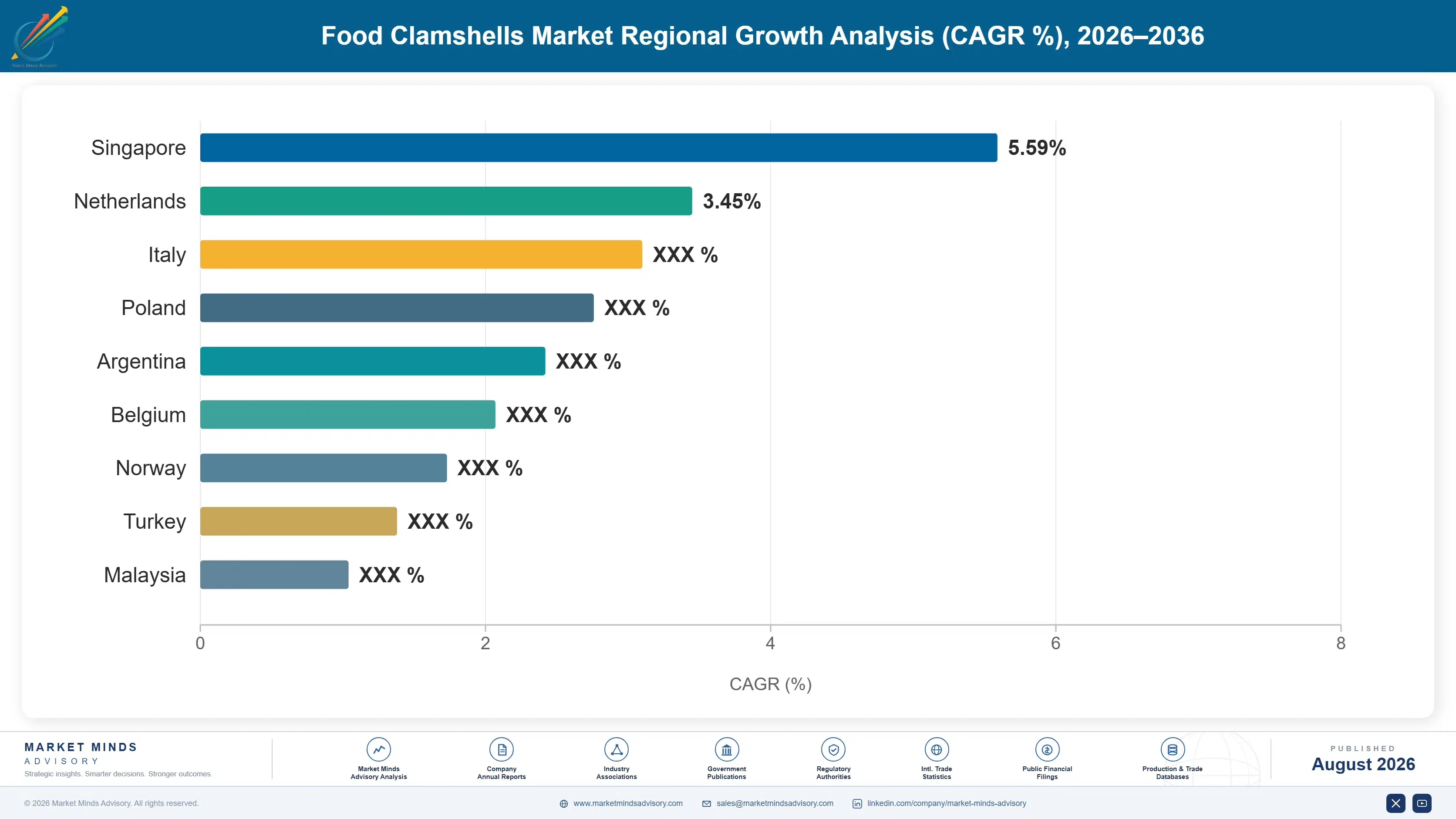
East Asia retains the largest revenue base on dense foodservice packaging manufacturing capacity and expanding food delivery volume, while South Asia is compounding fastest as India's growing quick-service restaurant infrastructure pulls demand into the category nationwide across every major metropolitan and referral hub today.

North America

United States restaurant chains and grocery retailers, concentrated around major metropolitan delivery markets, anchor the region's demand base as expanding third-party delivery volume and corporate plastic-reduction commitments drive proportional certified clamshell demand across the foodservice network. Canadian restaurant chains continue steady certified clamshell adoption tied to established provincial packaging distribution systems covering major regional markets. Tightening state and municipal EPS foam ban coverage across several major metropolitan jurisdictions continues accelerating molded fiber adoption well ahead of many international peer markets facing less regulatory pressure. Growth trails East Asia because the region's foodservice packaging manufacturing base is comparatively smaller relative to production capacity concentrated in Asian markets driving growth elsewhere in the forecast.
Share: 26% | CAGR: 6.6% (2026 to 2036)

Western Europe

German and French foodservice operators, operating under some of the world's strictest single-use plastic regulation, sustain steady demand for both molded fiber and rPET clamshells tied to national and European Union packaging waste directive frameworks. United Kingdom restaurant chains continue expanding certified clamshell adoption tied to post-regulatory divergence compliance requirements covering major industrial and delivery distribution channels. Regional clamshell manufacturers, including several established European foodservice packaging producers, maintain strong domestic penetration built on decades of packaging manufacturing expertise across the region. Regional growth trails East Asia and South Asia as the market's already high certified clamshell penetration limits the incremental upside further regulatory tightening alone can provide relative to less mature markets elsewhere in the forecast.
Share: 20% | CAGR: 5.3% (2026 to 2036)
Regional intelligence for 5 additional markets available in the complete report: East Asia, South Asia and Pacific, Latin America, Middle East and Africa, Eastern Europe. Contact sales@marketmindsadvisory.com.
food-clamshells-market-country-cagr-analysis-1787305372534

Monetizing Certification, Branding, and Distribution Services

Manufacturers are shifting commercial models toward compostability certification support contracts, custom print design services, and multi-facility distribution agreements rather than one-time clamshell sales, since operator demand for compliance assurance now rivals raw pricing as a purchase criterion. This mirrors a broader shift across sustainable packaging categories toward relationship-based commercial structures over transactional unit pricing.

Offering Compostability Certification Support Subscription Programs

Manufacturers are increasingly offering compostability certification support subscriptions that provide ongoing compliance documentation, third-party audit coordination, and regulatory monitoring across a chain's full certified clamshell portfolio, converting what was historically a one-time certification event into recurring annual revenue tied directly to a chain's certified packaging footprint. Manufacturers report subscription attach rates above 42% among chains managing the largest certified packaging portfolios, with renewal rates exceeding 84% once a chain experiences a full certification cycle without a compliance lapse. This renewal assurance increasingly determines vendor selection ahead of raw pricing during large chain contract negotiations.
Market Impact: Lifts recurring revenue share to ro

Bundling Custom Print Design and Turnaround Services

Manufacturers are increasingly bundling custom print design and rapid turnaround services into supply agreements, converting a previously fragmented brand asset development burden into predictable recurring revenue while reducing the risk of a chain facing packaging inconsistency across a seasonal campaign or new menu launch. Bundled design support typically reduces a chain's own creative development workload meaningfully during rapid menu launch cycles across new delivery categories. Manufacturers report design service attach rates rising fastest among fast-casual chains launching seasonal packaging refreshes, with roughly 28% of new contracts now including bundled design.
Market Impact: Cuts brand packaging turnaround tim

Offering Volume-Tiered Regional Distribution Access Programs

Manufacturers with dedicated regional distribution networks are increasingly offering volume-tiered pricing programmes that give smaller independent restaurants a lower cost path to certified clamshell conversion without committing to the large minimum order volumes standard bulk pricing requires. This tiered access path typically reduces a smaller operator's conversion timeline and cost meaningfully compared with standard bulk purchase requirements, with tiered programmes now supporting roughly 23% of total new certified clamshell conversions completed annually. Manufacturers report tiered programme attach rates rising fastest among independent operators seeking certification without significant capital investment or committed budget.
Market Impact: Cuts conversion cost by roughly 27

Structuring Multi-Facility Certified Supply Agreements Broadly

Manufacturers are increasingly structuring multi-year certified supply agreements that extend consistent compostability certification and pricing across a chain's entire national distribution network rather than negotiating each region independently, giving restaurant chains consistent compliance standards across every operating location served today and going forward. Chains report cost of ownership reductions of roughly 17% once supply standardization eliminates the redundant vendor management overhead multiple incompatible certification standards previously required across the network. Manufacturers with proven multi-facility certified supply track records spanning dozens of locations are capturing outsized share of these agreements ahead of smaller competitors.
Market Impact: Cuts network-wide procurement cost

Who Controls the Margin Pool

The top five manufacturers hold roughly 34% combined share, a moderate concentration reflecting both the certification and manufacturing scale barriers limiting smaller converter participation and the fragmented base of localized producers serving regional foodservice corridors. The gap between leading manufacturers and smaller regional converters is widening as large restaurant chains restrict shortlists to companies with demonstrated compostability certification and distribution capability.
Current competitive activity centers on three fronts: molded fiber capacity expansion targeting expanding EPS foam ban coverage, digital print capacity investment supporting brand customization services, and volume-tiered distribution programme development supporting smaller operator conversion. Several regional converters are pursuing partnerships with established compostable material suppliers rather than building internal fiber processing capability independently, a faster but margin-diluting route to category participation.

Emerging pressure comes from Chinese and Indian converters moving up the value chain from basic uncertified plastic formats into certified molded fiber and rPET systems sold initially to domestic restaurant chains but increasingly targeting export markets as certification credentials accumulate. Rankings among the top five could shift if a leader fails to close its compostability certification or distribution reach gap, since chains increasingly evaluate compliance depth ahead of price during large contract decisions.
food-clamshells-market-company-positioning-matrix-1787305373513

Competitive Moat and Risk Dimensions

PACTIV EVERGREEN INC

Moat: Deep multi-format manufacturing scale

Pactiv Evergreen's decades of accumulated multi-format manufacturing scale across molded fiber, plastic, and paperboard give it durable credibility among restaurant chains who weigh proven supply reliability heavily, since qualifying a new packaging supplier without comparable manufacturing history carries meaningful continuity risk. That credibility compounds with every additional certified facility Pactiv Evergreen brings into its network.
PACTIV EVERGREEN INC

Risk: Slower niche regional response

Pactiv Evergreen's scale and broad manufacturing footprint can slow its response to niche regional certification requests that smaller specialized converters serve more quickly, occasionally costing it accounts among chains prioritizing rapid custom certification support over comprehensive national network convenience. That responsiveness gap is unlikely to close soon.
GENPAK LLC

Moat: Strong molded fiber technology depth

Genpak's long-standing investment in molded fiber and compostable material technology gives it a design-in advantage with chains seeking a partner that already understands compostability compliance nuance rather than building that expertise from scratch. That material science depth compounds with every additional certification cycle Genpak completes across new jurisdictions.
GENPAK LLC

Risk: Limited international distribution depth

Genpak's international distribution and warehousing footprint remain comparatively less developed than global specialists, occasionally requiring it to partner with regional distributors for the fastest replenishment cycles rather than offering a fully native solution, ceding some margin and account control to partners abroad. That gap is unlikely to close soon.

Players Tracked

Prominent Players

Pactiv Evergreen Inc
Genpak LLC
Dart Container Corporation
Huhtamaki Oyj
Sabert Corporation

Other Key Players

Anchor Packaging LLC
World Centric
Eco-Products Inc
Novolex Holdings LLC
Fabri-Kal Corporation
D&W Fine Pack LLC
WestRock Company
Detpak Pty Ltd
BioPak Pty Ltd
Vegware Ltd
Placon Corporation
Inline Plastics Corp
Berry Global Inc
Sealed Air Corporation
Coveris Holdings SA

Recent Developments

AUGUST 2025

Pactiv Evergreen Commissions New Molded Fiber Production Line

Pactiv Evergreen commissioned a new dedicated production line for molded fiber clamshells, adding meaningful capacity to address surging demand from restaurant chains navigating expanding EPS foam ban coverage across major metropolitan jurisdictions and delivery markets nationwide. The expansion targets both existing chain relationships and new delivery programmes launching next year.
Signal: Confirms molded fiber capacity expansion r
NOVEMBER 2025

Genpak Signs Multi-Facility Certified Supply Agreement

Genpak signed a multi-year certified supply standardization agreement with a major national restaurant chain, covering consistent compostability certification and direct distribution across dozens of affiliated restaurant locations worldwide. The agreement is a supply arrangement rather than a joint venture or acquisition, extending Genpak's multi-facility presence considerably.
Signal: Highlights supply standardization bundling
FEBRUARY 2026

Dart Container Acquires Regional Compliance Documentation Software Provider

Dart Container completed the acquisition of a regional compliance documentation software provider, strengthening its digital certification tracking capability and expanding its ability to support chains navigating multi-jurisdiction regulatory requirements across every market. The deal reinforces Dart Container's positioning across the broader food clamshells market worldwide and beyond.
Signal: Signals continued consolidation of special

Recycled Fiber and Resin Cost Exposure

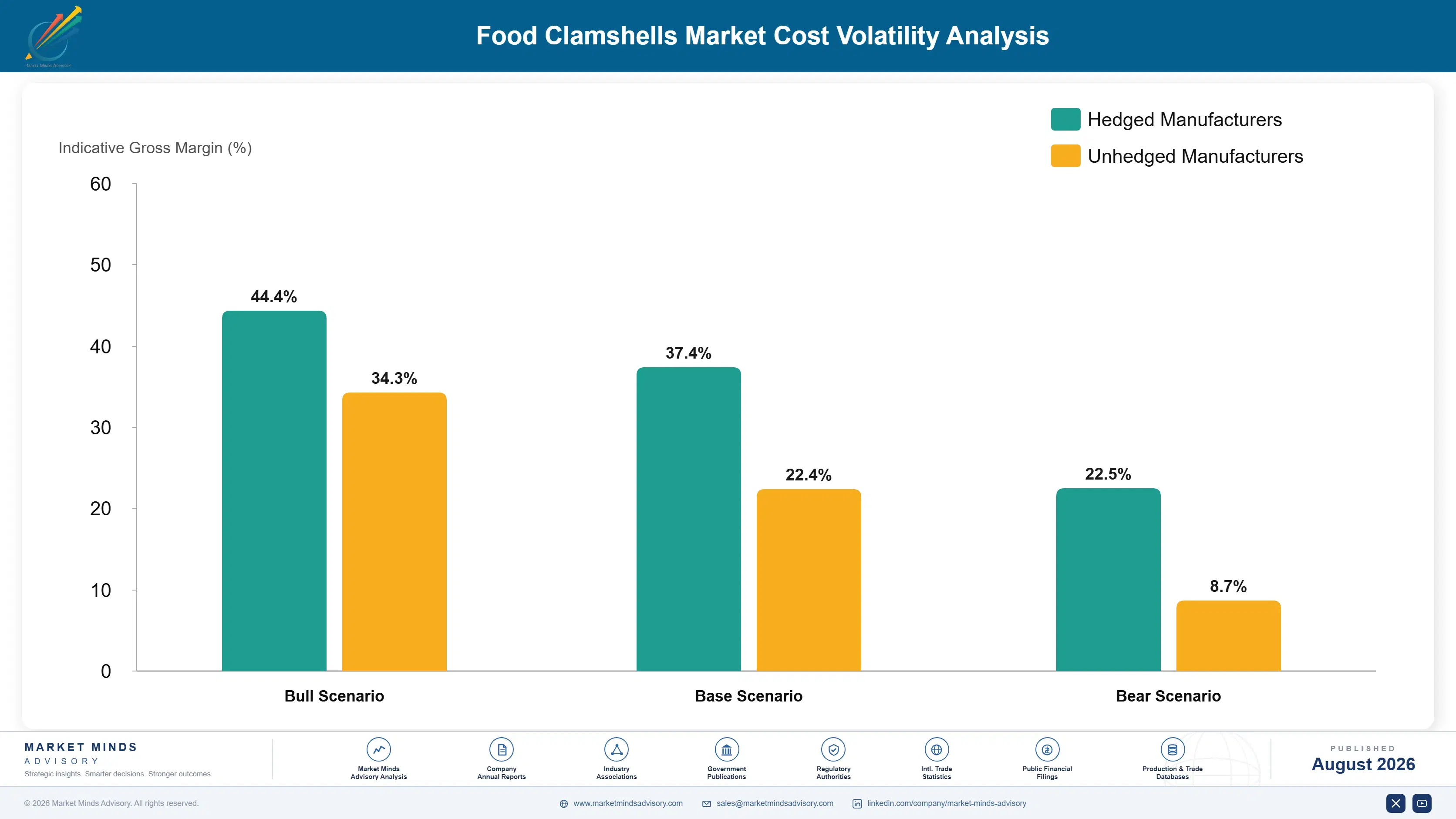
Recycled paper pulp, bagasse fiber, and PET and PP resin together represent an estimated 46 to 56% of food clamshell cost of goods sold across most manufacturers. Recycled paper pulp supply for molded fiber formats remains concentrated among a small number of qualified pulp processors, creating a narrower supply base than most broader packaging categories rely upon for comparable production inputs.
Pulp and resin price volatility during 2021 and 2022 significantly raised food clamshell manufacturing costs broadly, and several manufacturers flagged the disruption in annual reports as a persistent cost pressure affecting multiple foodservice packaging categories simultaneously across the sector. Several manufacturers disclosed that recycled pulp lead times stretched beyond fifteen weeks during the tightest period, forcing some smaller converters to delay shipments or substitute costlier secondary market fiber to maintain existing chain supply commitments.

Smaller regional converters carry disproportionate exposure to these input swings since they lack the purchasing scale to negotiate multi-year fixed pricing directly with pulp and resin suppliers that the top five manufacturers secure more easily through established relationships. This gap is widest for converters dependent entirely on merchant material purchases, leaving them more vulnerable to margin compression during price spikes across the category.
food-clamshells-market-cost-volatility-analysis-1787305373837

Long-Term Pulp and Resin Supply Contracts

Leading manufacturers now lock multi-year pricing directly with pulp and resin suppliers serving their primary production facilities, avoiding the spot market cost volatility that stretched lead times beyond fifteen weeks during the 2021 to 2022 shortage and protecting production schedules against chain supply disruption across major markets worldwide throughout sustained periods of material constraint affecting the wider industry.

Vertical Integration Into Pulp Processing Capacity

Top five manufacturers increasingly build internal pulp processing and molding facilities rather than relying entirely on third-party pulp suppliers, smoothing production timelines and insulating supply from the material sourcing volatility smaller regional converters remain exposed to directly, a practice that has become standard procurement policy since molded fiber demand accelerated considerably across the industry and among smaller producers.

Diversified Material Sourcing Across Multiple Suppliers

Manufacturers without full vertical integration are increasingly qualifying multiple pulp and resin suppliers across different geographic regions, reducing exposure to any single supplier's cost increases or production disruptions and giving manufacturers greater negotiating leverage during periodic material pricing renewal discussions across the broader supply chain network spanning multiple continents, regulatory jurisdictions, and currency zones.

Portfolio Architecture for Margin Defence

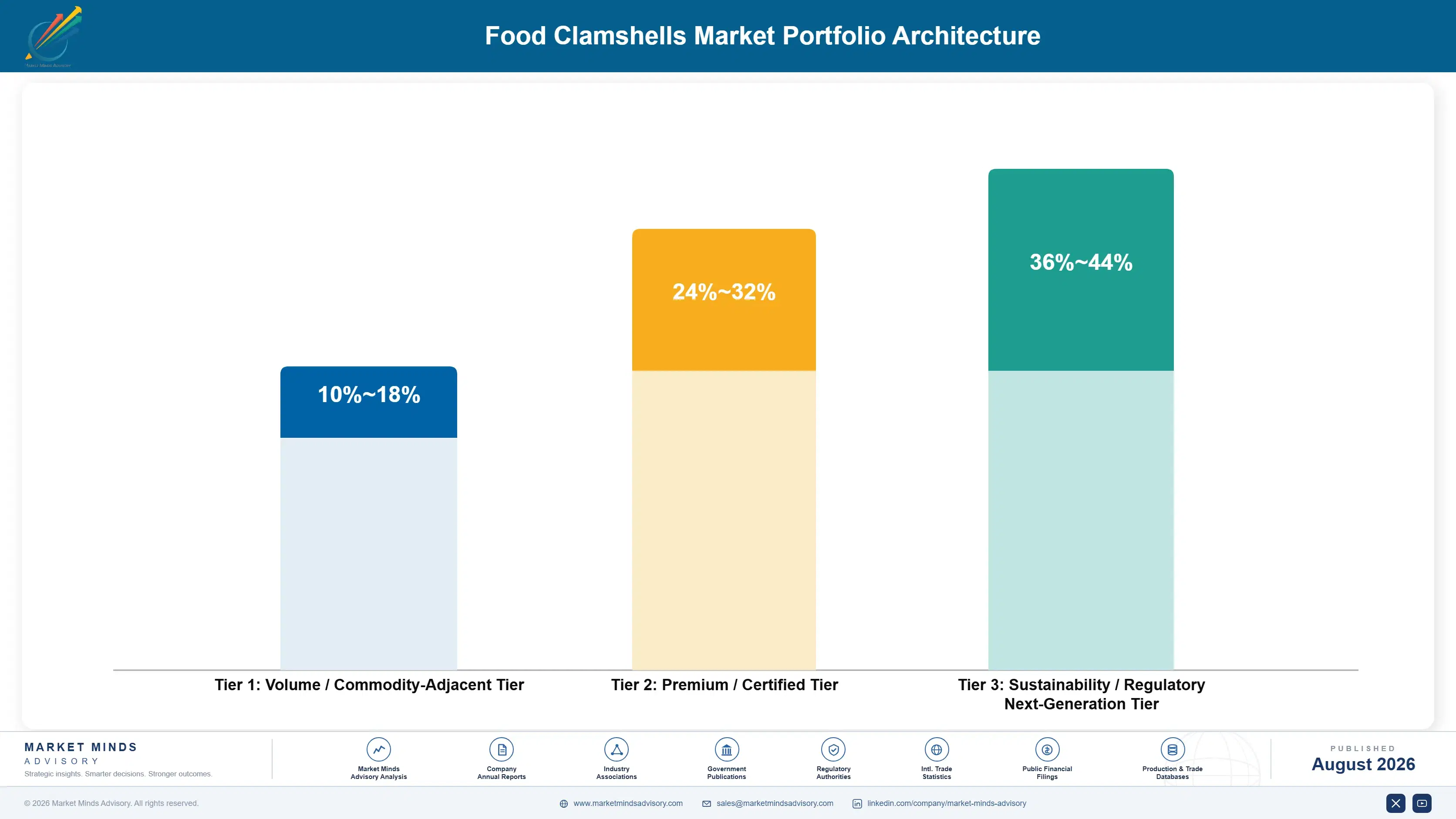
Portfolio architecture splits across three tiers: entry priced standard plastic and EPS foam clamshells competing largely on cost, certified rPET and paperboard clamshells carrying compliance value that commands a durable price premium, and next generation molded fiber and custom-printed formats bundled with certification and design services. Gross margins widen moving up this ladder as certification and manufacturing barriers concentrate hardest at entry.
The volume versus premium tension is sharpest in standard EPS foam and plastic clamshells, where regional competition has compressed prices fastest, pushing established manufacturers to defend share through certification and branding bundling rather than matching commodity pricing directly on clamshell cost alone. Molded fiber and custom-printed formats retain the strongest pricing power because certification investment and multi-year design relationships discourage chains from switching mid-contract, a dynamic strengthening as mandates broaden.

High value margin pools concentrate in molded fiber and custom-printed formats paired with continuous certification and design service contracts, where recurring revenue and high switching costs together support gross margins well above the portfolio average. Manufacturers are prioritizing capital toward this tier even though it remains a minority of total unit volume shipped across the broader portfolio today, betting the mix shifts decisively within the decade ahead.

Volume / Commodity-Adjacent Tier

Basic standard EPS foam and plastic clamshells competing primarily on unit price against regional converters, with limited service attach and thin per-unit margins across most transactions and smaller accounts nationwide.
Gross Margin: 10-18%

Premium / Certified Tier

Certified rPET and paperboard clamshells serving grocery and brand-sensitive foodservice applications, where recyclability certification and print quality support durable pricing across the industry and every managed account and region.
Gross Margin: 24-32%

Sustainability / Regulatory / Next-Generation Tier

Molded fiber and custom-printed clamshells bundled with compostability certification, design support, and distribution services, sold on recurring compliance assurance value rather than clamshell pricing alone, increasingly the default specification across large chains.
Gross Margin: 36-44%
food-clamshells-market-portfolio-architecture-1787305374656

Certification Contracts Anchor Recurring Chain Revenue

Food clamshell economics function increasingly like an annuity once a certified supply relationship is established, since compostability certification renewal, design service subscriptions, and periodic documentation renewal generate recurring revenue for years after the initial supply agreement closes. This recurring layer now represents a growing share of total category revenue and is the primary reason manufacturers compete aggressively on initial chain placement even at thin entry tier margi
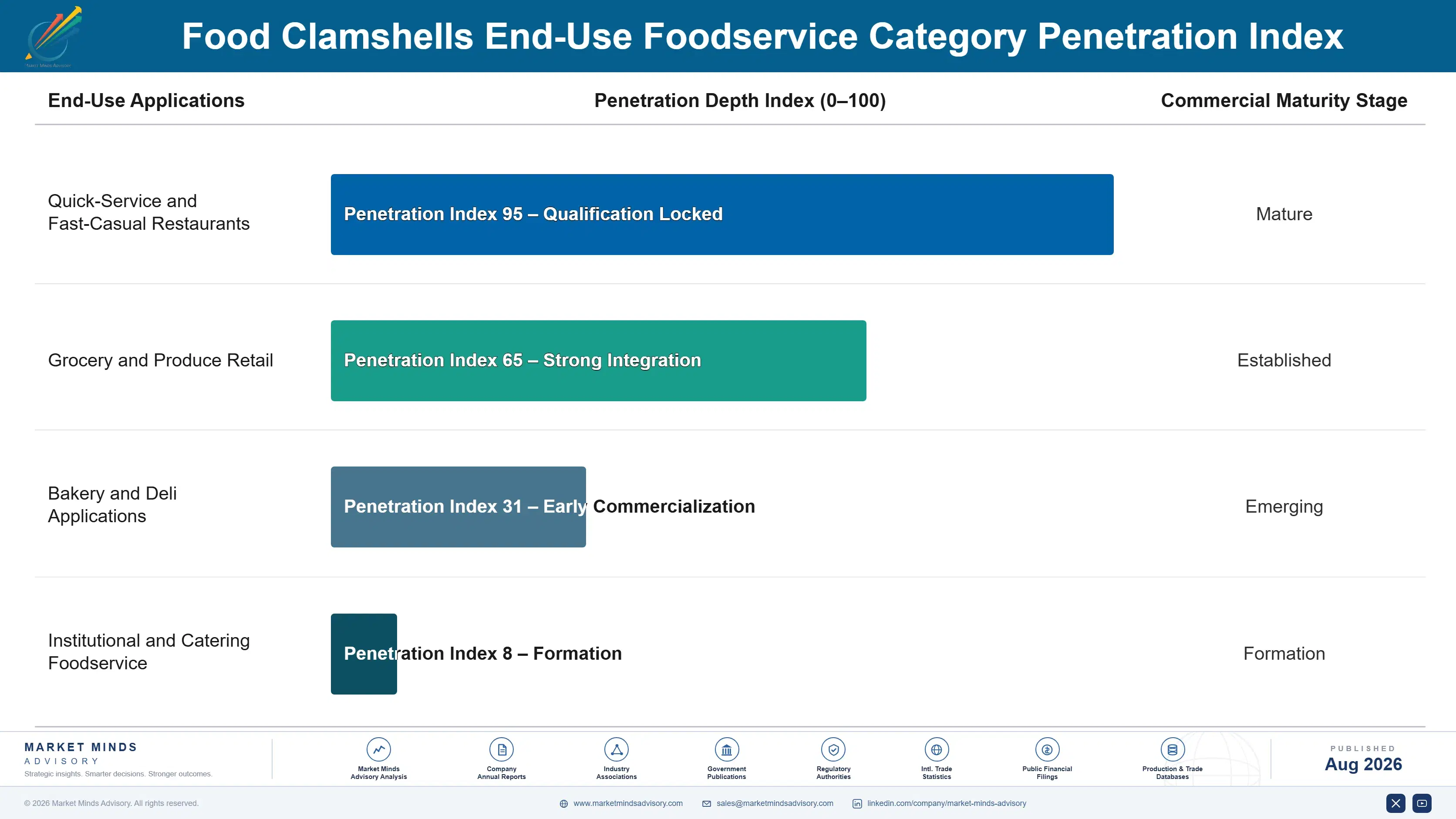
Adoption depth varies sharply by end use vertical. Large national restaurant chains run near saturated certified clamshell coverage and generate mostly renewal demand, while smaller regional chains and independent operators are still building out first time certified clamshell coverage, generating a different mix of new installation revenue layered on the maturing replacement base.

Buyer profiles are shifting generationally as packaging procurement officers who trained primarily on modern sustainability and brand experience frameworks increasingly influence purchasing decisions alongside veteran operations staff who remember when clamshell selection was a straightforward single-criterion cost decision. This is accelerating demand for manufacturers with strong certification and design documentation capability even among buyers who historically evaluated clamshells purely on unit cost and delivery reliability alone.
food-clamshells-market-end-use-penetration-index-1787305375445

Where Clamshell Strategy Should Focus

These are among the four positions where our research anticipates prominent divergence between winners and laggards over the coming forecast period. Each is grounded in the demand model, the regulatory perimeter, and the announced capacity pipeline.
01 / MOLDED FIBER CAPACITY INVESTMENT

Prioritize compostability depth over marginal unit pricing

Unit pricing has become a secondary consideration across most large restaurant chain procurement decisions, no longer the primary differentiator given expanding EPS foam ban coverage across every major metropolitan jurisdiction. Chains now evaluate compostability certification and molded fiber supply depth ahead of marginal price savings that once justified switching suppliers on their own. Manufacturers that continue competing primarily on standard clamshell pricing risk losing share to fiber-focused rivals bundling certification, design, and distribution services into a single recurring relationship that is harder to unwind once established.
02 / SERVICE MONETIZATION STRATEGY

Shift commercial models toward certification and design revenue

Standard clamshell margins will keep compressing as regional converters gain share at the entry tier of the category across most emerging markets. Manufacturers that convert compostability certification, print design, and volume-tiered distribution into contracted recurring revenue will outperform peers still pricing primarily around one-time clamshell sales alone. This shift also raises chain switching costs meaningfully, since replacing a certified supplier requires displacing an entrenched, multi-year compliance and design relationship built over years of accumulated brand and regulatory trust across every managed location.
03 / REGIONAL GROWTH PRIORITIZATION

Weight investment toward South Asia and East Asia over mature markets

South Asia and East Asia are compounding faster than Western Europe on both share and CAGR, driven by expanding foodservice manufacturing capacity, rising delivery export volume, and first time certified clamshell access across previously underserved regional restaurant networks. Manufacturers weighting manufacturing and design investment toward these regions ahead of competitors will capture a disproportionate share of new delivery volume revenue. Mature markets, running mostly on replacement demand, simply cannot replicate that category of growth at comparable scale or rate over the coming decade of forecast activity.
04 / EPS CONVERSION RESPONSE

Expand volume-tiered distribution ahead of demand

The gap between rising corporate plastic-reduction commitments and available volume-tiered distribution access represents a substantial growth opportunity that most manufacturers are not yet equipped to capture efficiently given the specialized logistics infrastructure required for smaller operator conversion. Manufacturers that invest early in dedicated tiered programmes will be better positioned to capture accounts without the extended capital justification timelines currently limiting some competitors. Manufacturers ignoring this opportunity risk ceding conversion revenue to competitors who have already solved the distribution access problem.

Engagement Snapshot From the Field

A live engagement with an industry participant carrying material or product regulatory and market exposure ahead of a defining policy shift, showing how our research translates into a defensible multi-year portfolio strategy.
MARKET MINDS ADVISORY · CLIENT ENGAGEMENT SUMMARY
Food Clamshells Producer Strategic Portfolio Review and Transition Roadmap 2026·Investment Scenario on Food Clamshells Exposure Evaluation 2025-26
CLIENT PROFILE
The client is a multinational quick-service restaurant chain operating across multiple international markets and delivery channels, reporting annual packaging procurement spending in the tens of millions of dollars across its network (client-reported, unverified by MMA). Its existing sourcing relied on fragmented regional EPS foam suppliers with inconsistent recyclability documentation across its global distribution and franchise network.
STRATEGIC CHALLENGE
Facing tightening corporate plastic-reduction targets and rising municipal regulatory scrutiny across multiple jurisdictions, chain leadership sought to convert the majority of clamshell volume to certified molded fiber packaging within twelve months, while avoiding any disruption to existing delivery schedules across every active location worldwide and regional franchise partner network.
MMA APPROACH
MMA benchmarked five candidate molded fiber suppliers against compostability certification depth, custom print capability, and total cost of ownership over a five year horizon, then modeled conversion sequencing to minimize delivery disruption across the client's highest volume metropolitan markets during the phased plastic-to-fiber transition programme currently under review by procurement and sustainability leadership teams.
KEY FINDINGS
  1. Three of five candidate suppliers evaluated could not demonstrate consistent multi-region certification coverage across all of the client's active markets reviewed at all.
  2. Conversion to certified molded fiber reduced projected annual plastic packaging volume by 37% versus continued EPS foam sourcing across comparable order volumes, based on modeling completed during evaluation (client-reported, unverified by MMA).
  3. Centralizing certification documentation was projected to cut compliance administrative workload meaningfully across the client's global franchise network, according to internal operations modeling completed by the client.
  4. Markets facing the most imminent EPS foam ban deadlines carried the highest near term conversion priority, reprioritizing the client's original sequencing considerably ahead of the initial twelve month plan.
CLIENT PROFILE
The client is a multinational quick-service restaurant chain operating across multiple international markets and delivery channels, reporting annual packaging procurement spending in the tens of millions of dollars across its network (client-reported, unverified by MMA). Its existing sourcing relied on fragmented regional EPS foam suppliers with inconsistent recyclability documentation across its global distribution and franchise network.
STRATEGIC CHALLENGE
Facing tightening corporate plastic-reduction targets and rising municipal regulatory scrutiny across multiple jurisdictions, chain leadership sought to convert the majority of clamshell volume to certified molded fiber packaging within twelve months, while avoiding any disruption to existing delivery schedules across every active location worldwide and regional franchise partner network.
MMA APPROACH
MMA benchmarked five candidate molded fiber suppliers against compostability certification depth, custom print capability, and total cost of ownership over a five year horizon, then modeled conversion sequencing to minimize delivery disruption across the client's highest volume metropolitan markets during the phased plastic-to-fiber transition programme currently under review by procurement and sustainability leadership teams.
KEY FINDINGS
  1. Three of five candidate suppliers evaluated could not demonstrate consistent multi-region certification coverage across all of the client's active markets reviewed at all.
  2. Conversion to certified molded fiber reduced projected annual plastic packaging volume by 37% versus continued EPS foam sourcing across comparable order volumes, based on modeling completed during evaluation (client-reported, unverified by MMA).
  3. Centralizing certification documentation was projected to cut compliance administrative workload meaningfully across the client's global franchise network, according to internal operations modeling completed by the client.
  4. Markets facing the most imminent EPS foam ban deadlines carried the highest near term conversion priority, reprioritizing the client's original sequencing considerably ahead of the initial twelve month plan.
RECOMMENDED STRATEGY
Phase 1: Phase 1 (Months 1-4): Complete technical and certification evaluation of the three highest-scoring candidate suppliers identified through careful independent review. Phase 2: Phase 2 (Months 5-9): Execute supplier conversion across the highest regulatory ban risk metropolitan markets in strict priority sequence today. Phase 3: Phase 3 (Months 10-12): Finalize global supplier standardization and centralized compliance documentation dashboard fully enabled for sustainability and procurement leadership.
OUTCOME
The chain completed clamshell conversion across all priority markets within the twelve month window and reported meaningfully improved sustainability audit outcomes during subsequent internal reviews (client-reported, unverified by MMA). Corporate leadership gained centralized certification visibility previously unavailable across its distributed global franchise and distribution network.

Frequently Asked Questions

Foundational context covering the market sizes, CAGR, scope, country, region and competition that inform every finding below. This section is provided to cover basics and most often pre-purchase conversations, answered from the MMA Primary Research Dataset.

What is the current size of the Food Clamshells Market?

The global food clamshells market reached an estimated $9.5 billion in 2025. Growth is driven by rising corporate plastic-reduction commitments and expanding restaurant delivery volume worldwide.

How large will the Food Clamshells Market be by 2036?

The market is projected to reach approximately $19.8 billion by 2036, roughly 1.95 times its 2026 value. Molded fiber clamshells drive most of the added value across the category.

What is the CAGR for the Food Clamshells Market 2026 to 2036?

The base case CAGR is 6.9% through 2036. Bull and bear scenarios range from roughly 5.6% to 8.1%, depending on EPS foam ban adoption pace and delivery volume growth.

Which segment is growing fastest?

Molded fiber and compostable clamshells lead at an 11.8% CAGR, about 1.71x the overall market rate. Growth is concentrated among restaurant chains facing expanding EPS foam ban coverage.

Who are the major companies in the Food Clamshells Market?

Pactiv Evergreen, Genpak, Dart Container, Huhtamaki, and Sabert lead the category. Combined, the top five suppliers hold roughly 34% of global revenue on a consistent basis.

Which country is growing fastest?

China leads country level growth at an estimated 11.5% CAGR. Expanding foodservice packaging manufacturing and food delivery volume are driving demand across the region's industrial base.

Report Segmentation Architecture

The full report scope spans multiple orthogonal segmentation dimensions, with cross-tabulated demand data provided for each dimension pair. Coverage extends further to regional breakdowns, trend trajectories, and the competitive detail needed to support segment-level decision-making.

By Material and Construction Type

  • Molded Fiber and Compostable Clamshells
  • Curbside-Recyclable rPET Clamshells
  • Standard PET and PP Plastic Clamshells
  • EPS Foam Clamshells
  • Paperboard and Coated Paper Clamshells
  • Custom-Printed and Branded Clamshells

By End-Use Foodservice Category

  • Quick-Service and Fast-Casual Restaurants
  • Grocery and Produce Retail
  • Bakery and Deli Applications
  • Institutional and Catering Foodservice

By Commercial Dimension

  • Direct Manufacturer Supply Agreements
  • Distributor and Wholesale Channels
  • Certification and Design Service Contracts
  • Volume-Tiered Regional Distribution Programs

By Region

  • North America
  • Western Europe
  • East Asia
  • South Asia and Pacific
  • Latin America
  • Middle East and Africa
  • Eastern Europe

Scope, Methodology, and Coverage

Every figure in this report is reproducible from documented input assumptions. The scope below maps the historical period, the forecast horizon, the segmentation dimensions, and the countries covered, alongside the underlying primary and qualitative methodology.
Historical Period
2020 to 2025
Forecast Period
2026 to 2036
Base Year
2025 (USD billions; MMA Primary Research Dataset, August 2026)
Market Definition
The food clamshells market covers hinged-lid foodservice packaging used for takeout, delivery, bakery, deli, and produce applications, spanning molded fiber, rPET, standard plastic, EPS foam, paperboard, and custom-printed formats. Rigid non-hinged food containers are excluded from market scope.
Quantitative Units
USD billions (current prices); certified units shipped where disclosed
Segmentation Dimensions
By Material and Construction Type; By End-Use Foodservice Category; By Commercial Dimension; By Region
Regions Covered
North America, Western Europe, East Asia, South Asia and Pacific, Latin America, Middle East and Africa, Eastern Europe
Countries Covered
USA, China, Germany, France, UK, Japan, South Korea, India, Australia, Canada, Brazil, Mexico, Indonesia, Vietnam, Thailand, Malaysia, UAE, Saudi Arabia, South Africa, Nigeria, Turkey, Poland, Netherlands, Italy, Spain, Sweden, Switzerland, Argentina, Colombia, Singapore, and additional markets relevant to this sector
Key Companies Profiled
Pactiv Evergreen Inc, Genpak LLC, Dart Container Corporation, Huhtamaki Oyj, Sabert Corporation, Anchor Packaging LLC, World Centric, Eco-Products Inc, Novolex Holdings LLC, Fabri-Kal Corporation, D&W Fine Pack LLC, WestRock Company, Detpak Pty Ltd, BioPak Pty Ltd, Vegware Ltd, Placon Corporation, Inline Plastics Corp, Berry Global Inc, Sealed Air Corporation, Coveris Holdings SA
Quantitative Methodology
Primary survey, n=3,800 respondents, Q4 2025, six countries; demand-side model with trade association cross-validation
Qualitative Methodology
47 expert interviews, Q4 2025; applied to validate demand model assumptions, identify emerging dynamics, and assess competitive positioning
Report Format
PDF and XLSX data workbook (Word format preview document)
Publisher
Market Minds Advisory
Report Code
MMA-2026-PAC-149
Published
August 2026
Contact
sales@marketmindsadvisory.com | www.marketmindsadvisory.com

Purchase the full Food Clamshells Market Report (2026 to 2036).

The full report delivers a complete quantitative and qualitative assessment of the global food clamshells market through 2036. It includes detailed segmentation by material and construction type, foodservice category, and commercial channel, alongside country level sizing across thirty markets covering every major restaurant and delivery demand center. Competitive profiles cover twenty companies with certification capability, print customization depth, and distribution benchmarking assessed on a consistent revenue basis. Buyers also receive access to the underlying primary survey and expert interview datasets referenced throughout the analysis, along with editable data tables.
Segment level CAGR and sizing tables
Regional and country level market breakdowns
Twenty company competitive profiles and benchmarks
Detailed molded fiber capacity benchmarking matrix
Input cost and supply chain risk analysis
Primary survey and expert interview datasets completely included

Built For The People Who Decide

From boardroom strategy to bench-side execution, this report is read cover-to-cover by leaders shaping the next decade of their industry, turning demand scenarios, market dynamics and valuation benchmarks into decisions.
CXOs/ Presidents/ VPs/ Managers
M&A and Corporate Development
Strategy Teams and R&D Heads
Procurement and Product Directors
Regulatory and Compliance Leaders
Investor Relations and Equity Analysts