Market Minds Advisory
Food Basket Market

Food Basket Market: Fiber Conversion Redraws a Fragmented Category

Plastic-to-fiber conversion regulation across Europe and growing retailer sustainability mandates are pushing produce and foodservice basket packaging toward molded pulp alternatives, forcing plastic-focused manufacturers to invest in fiber molding capability or lose shelf-space contracts entirely.

Lead Analyst

Bilal Shaikh

Published

September 2026

Make Smarter Decisions with Customized Research Insights

Request a free sample report and evaluate market opportunities, growth trends, and competitive dynamics relevant to your business needs.

2025 MARKET VALUE$2.8BMarket Size 2025
2036 FORECAST VALUE$5.7BBase Case , 2026 to 2036
CAGR 2026 TO 20366.6 %Bull 7.9% / Bear 5.3%
INCREMENTAL OPPORTUNITY$2.7BNet 10- year value creation
EXPANSION MULTIPLE1.89x2036 value over 2026 base
Strategic Levers
M&A Pipeline
Regional Outlook
Country Rankings
Competitive Intelligence
Segmental Deep-dive
Call-Us : 91 93563 13602

Executive Snapshot and Market Trajectory

Molded fiber baskets are steadily displacing plastic punnets and trays across produce and foodservice channels, converting what was long a plastic-dominated packaging category into one increasingly defined by fiber conversion investment and retailer sustainability mandates across most major consumer markets worldwide and internationally, in the years just ahead.
Molded fiber produce baskets are the fastest growing category as retailers phase out plastic punnets under tightening single-use plastic regulation, while East Asia commands the largest regional share on the strength of concentrated produce packaging manufacturing capacity and proximity to major fresh produce export and distribution hubs, a manufacturing scale advantage no other region currently matches at comparable cost, delivery speed, or overall production efficiency and reliability nationwide, regionally, and increasingly well beyond.
A fragmented base of regional molders and woven basket producers supplies most foodservice and gift basket demand, while a smaller group of larger fiber packaging manufacturers dominate branded retail produce contracts through direct supermarket chain relationships across major grocery markets nationwide and beyond. Sustainability certification and plastic reduction compliance are increasingly separating well-capitalized fiber converters from smaller traditional basket weavers unable to fund equipment conversion costs.
Market Definition
The food basket market covers rigid and semi-rigid basket-style containers, including molded fiber, woven wicker, plastic, wire mesh, and corrugated formats, used for fresh produce packaging, foodservice bread and table service, and retail gift or hamper packaging. It excludes flexible pouch and film packaging, rigid clamshell trays not styled as baskets, and general shipping cartons not intended for retail display.
Base Year Value
$2.8B in 2025 (MMA Primary Research Dataset, August 2026)
Forecast Period
2026 to 2036, eleven discrete annual values
CAGR
6.6% base case. Bull 7.9%. Bear 5.3%.
Fastest Growth Segment
Molded Fiber (Pulp) Produce Baskets: 10.5% CAGR
Fastest Growth Country
India: 8.6% CAGR
Fastest Growth Region
South Asia and Pacific: 8.6% CAGR
Largest Region
East Asia: 27% of 2025 global value
Market Leaders
Huhtamaki Oyj, Brodrene Hartmann A/S, Pactiv Evergreen Inc, Genpak LLC, Eco-Products Inc. Source: MMA Analysis based on company annual reports and investor filings.
Primary Survey
n=3,800 procurement and R&D decision-makers, Q4 2025, six countries
Methodology
Demand-side build-up, cross-validated against public data, 47 expert interviews

Food Basket Market Forecast Scenarios

food-basket-market-size-forecast-scenario-1787298086400
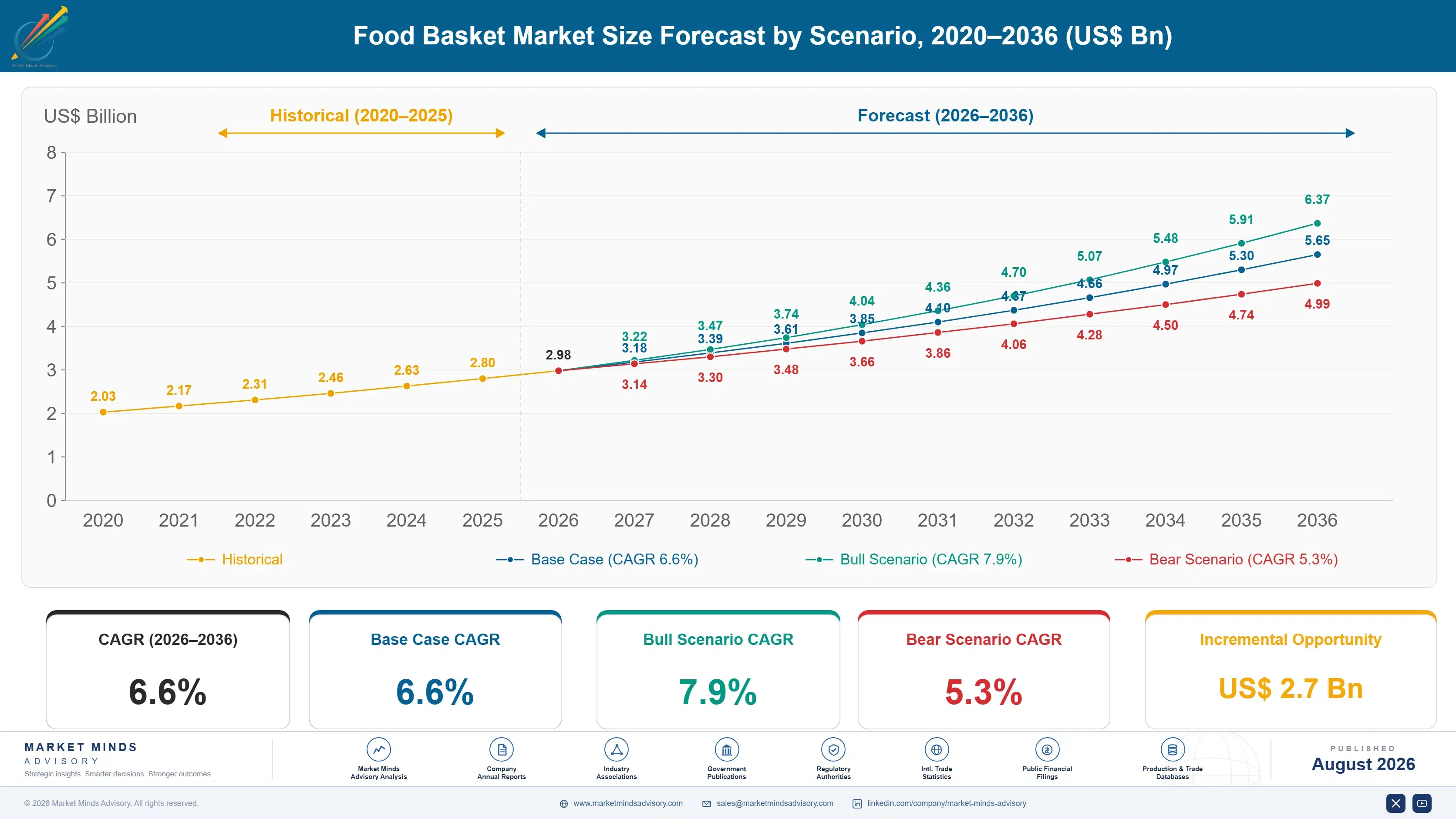
Food basket demand grew steadily from 2020 as fresh produce distribution volume expanded and foodservice recovered from pandemic era closures across most major consumer markets. Molded fiber adoption accelerated from 2022 onward as European plastic reduction directives took fuller effect across the industry. The market grew at a historical rate of roughly 5.8% annually across this period.
The base case rests on three mechanisms: expanding fresh produce distribution volume sustaining baseline basket demand across both mature and rapidly developing retail markets simultaneously, plastic-to-fiber conversion accelerating as regulatory and retailer sustainability mandates tighten across major grocery chains globally throughout the decade ahead, and growing gift basket and foodservice bread basket demand adding incremental volume across specialty retail and hospitality channels worldwide over the full forecast period that lies directly ahead.
The bull case rests on faster than expected plastic punnet phase-out across major retail markets following the pattern the European Union's Single-Use Plastics Directive already set in mature economies. The bear case centers on continued cost pressure from cheaper flexible film alternatives eroding basket volume in price-sensitive commodity produce categories, particularly in developing markets with limited regulatory enforcement.

A Fragmented Category Sorting Into Compliance Tiers

Food baskets occupy a genuinely mundane but increasingly contested corner of consumer packaging, since produce punnets, bread baskets, and gift hampers together represent a category where sustainability regulation is rewriting material choice faster than most other packaging segments across the broader industry today. Molded fiber and paperboard alternatives are steadily displacing plastic across the produce and foodservice sub-segments where regulation applies most directly and consistently.
MARKET CONCENTRATION34% (CR5)Fragmented base spans regional molders and larger fiber packaging manufacturers
AVERAGE BASKET PRICING$0.06-$0.85Reflects material and basket size across product categories broadly
TOP PRODUCING COUNTRYChina, 22% shareLargest single manufacturing hub tied to produce export proximity
MOLDED FIBER ADOPTION41%Share of produce baskets now converted to molded fiber material
INPUT COST SHARE42% of COGSReflects pulp and paperboard costs relative to total production spend
GIFT BASKET SEASONALITY38% Q4 volumeReflects holiday season concentration across gift basket retail sales volume
Demand concentrates wherever produce packaging manufacturing and fresh distribution volume are strongest across a given regional supply chain. East Asia generates the largest procurement volume given its concentrated manufacturing capacity and proximity to major fresh produce export hubs, while North America sustains steady demand through both commodity produce packaging and a genuinely distinct gift basket retail category tied to holiday and corporate gifting culture nationwide.
Over the next decade, plastic reduction compliance and fiber molding capability will matter more than raw manufacturing scale alone, since regulatory transition cost genuinely separates well-capitalized fiber converters from smaller traditional weavers across the broader industry. Manufacturers able to demonstrate compliance credentials and secure long-term retailer contracts are positioned to capture disproportionate share as smaller competitors struggle with conversion costs and financing.
"A produce basket is the last thing a shopper notices and the first thing a sustainability auditor checks. That mismatch is exactly why fiber conversion is happening faster here than in most other packaging categories."
Director, Food Packaging and Retail Containers Practice · MMA Food Packaging and

Market Trends

The Plastic-to-Fiber Conversion Reshapes Produce Packaging

The European Union's Single-Use Plastics Directive and similar regulations emerging across several US states and parts of Asia are pushing produce packaging toward molded fiber and paperboard baskets, a capital-intensive transition that favors well-capitalized manufacturers over smaller regional producers operating on thinner margins. Major grocery retailers are increasingly specifying fiber-based produce baskets as a standard procurement requirement rather than a premium option, converting what was once an optional sustainability upgrade into baseline compliance across most major retail markets. Smaller basket producers unable to fund fiber molding conversion risk losing retailer contracts to better-capitalized competitors.
Market Impact: Adds 1.4 billion baskets annually
E-Commerce Gift Basket Demand Expands Retail Category

Growing e-commerce gift basket and hamper sales, particularly around major holiday periods and corporate gifting occasions, are expanding a genuinely distinct retail category that commands considerably higher per-unit pricing than commodity produce baskets sold through standard grocery channels nationwide today. Online gift basket retailers increasingly specify custom woven or molded designs with premium branding and presentation requirements, a shift that rewards manufacturers able to support smaller production runs and specialty finishing work. Suppliers with flexible manufacturing capability and e-commerce fulfillment partnerships are capturing disproportionate share of this expanding premium demand.
Market Impact: Supports conversion investment worth $340 million

Market Opportunities and Growth Drivers

Expanding Fresh Produce Distribution Sustains Baseline Demand

Growing global fresh produce trade and rising consumer demand for pre-packaged berries, tomatoes, and mushrooms are sustaining baseline basket procurement volume across both mature and developing retail markets, particularly as supermarket chains expand fresh produce section footprint relative to traditional bulk bin displays. Each retailer expanding pre-packaged produce offerings represents a recurring, multi-year basket procurement relationship, since packaging supply contracts typically span several years once a retailer standardizes on basket specifications and suppliers. Manufacturers with established retailer relationships and reliable supply chains are capturing disproportionate share of this steady, recurring demand pool.
Market Impact: Cuts commodity basket share by 6%

Retailer Sustainability Mandates Drive Fiber Conversion Investment

Major grocery retailers across North America and Western Europe are increasingly mandating fiber-based, recyclable produce packaging as a condition of shelf placement, driving substantial conversion investment among suppliers seeking to retain or win retailer contracts under tightening sustainability commitments nationwide. Each retailer adopting a fiber-only produce packaging policy represents a meaningful, immediate shift in supplier qualification requirements, since compliant manufacturers gain preferential access to shelf space that non-compliant competitors simply cannot access regardless of pricing. Manufacturers with established fiber molding capability are capturing disproportionate share of this policy-driven demand pool.
Market Impact: Compresses margins 3 to 5 points

Market Restraints and Challenges

Flexible Film Alternatives Erode Commodity Basket Volume

Flexible film bags and pouches are increasingly displacing rigid baskets in price-sensitive commodity produce categories, particularly in developing markets where cost per unit outweighs sustainability considerations for both retailers and consumers making purchasing decisions. The root cause is that flexible film requires considerably less material and shipping weight than rigid baskets while offering comparable product protection for many commodity produce items, giving cost-conscious retailers a genuine incentive to switch formats where regulation does not mandate otherwise. This erodes basket volume specifically in commodity, price-driven produce categories. Manufacturers are responding by emphasizing recyclability and display advantages that film cannot match.
Market Impact: Lifts molded fiber share to 41%

Pulp and Paperboard Price Volatility Compresses Margins

Wood pulp and recycled paperboard, the primary raw materials in molded fiber basket manufacturing, experience significant price volatility tied to global pulp market cycles and recycled fiber availability, compressing manufacturer margins during periods of rising input cost that cannot always be passed through under existing retailer contracts. The root cause is that most retail supply agreements lock in pricing for twelve to twenty-four month periods, leaving manufacturers exposed to pulp cost increases during the contract term without recourse to renegotiate. This limits profitability during volatile pulp cycles. Manufacturers are responding by negotiating shorter contract terms with cost pass-through clauses.
Market Impact: Expands gift basket category to 22%
3 additional market trends, 4 additional growth drivers, and 2 additional restraints and challenges are covered in the full report. Contact sales@marketmindsadvisory.com to access the complete intelligence.

Segment CAGR and Growth Architecture

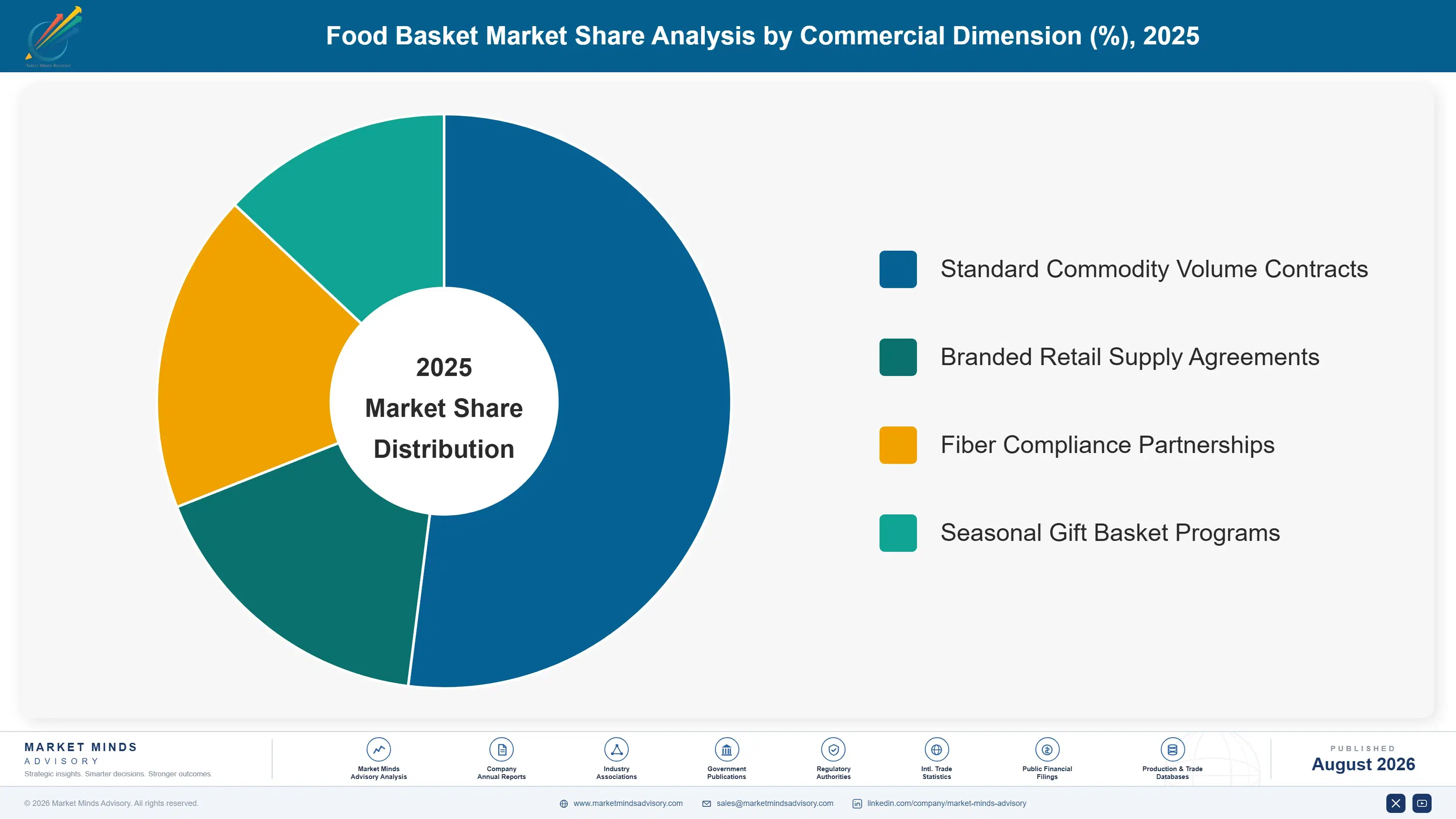
MMA segments the food basket market by product and material type, the classification that most directly determines manufacturing process, pricing tier, and retailer procurement channel across molded fiber, woven wicker, plastic punnet, wire mesh, corrugated tray, and foodservice basket categories, rather than an end-use or application based split across the much broader industry entirely.
food-basket-market-market-share-analysis-1787298086926

Molded Fiber (Pulp) Produce Baskets

Molded fiber produce baskets are growing fastest, at roughly 10.5% annually, as retailers phase out plastic punnets under tightening single-use plastic regulation across the European Union, several US states, and increasingly parts of Asia. Adoption concentrates among major grocery chains implementing formal plastic reduction commitments, where procurement policies increasingly specify fiber-based packaging as a mandatory shelf-placement requirement rather than an optional upgrade. Pricing runs meaningfully higher than legacy plastic punnets, reflecting both the specialized molding equipment investment and the pulp cost that fiber baskets require relative to injection-molded plastic alternatives. Manufacturers with proven fiber molding capability are positioned to capture disproportionate share of new retailer contracts as this category becomes standard procurement practice.
CAGR 10.5%

Corrugated and Paperboard Basket Trays

Corrugated and paperboard basket trays are growing at roughly 8.8% annually, driven by expanding e-commerce grocery delivery and foodservice takeout channels that require lightweight, stackable basket packaging distinct from rigid molded fiber or woven formats sold at traditional retail settings today. Demand concentrates among grocery delivery services and foodservice operators seeking cost-effective, recyclable packaging that meets both protection and sustainability requirements without the higher unit cost molded fiber alternatives typically carry across most channels. This segment commands steady, predictable specifications relative to premium categories, since corrugated tray manufacturing scales efficiently with standard converting equipment, sustaining recurring, high-volume procurement relationships between manufacturers and their expanding e-commerce and foodservice customer base nationwide.
CAGR 8.8%
Full segment breakdown across 6 segments available in the complete report.

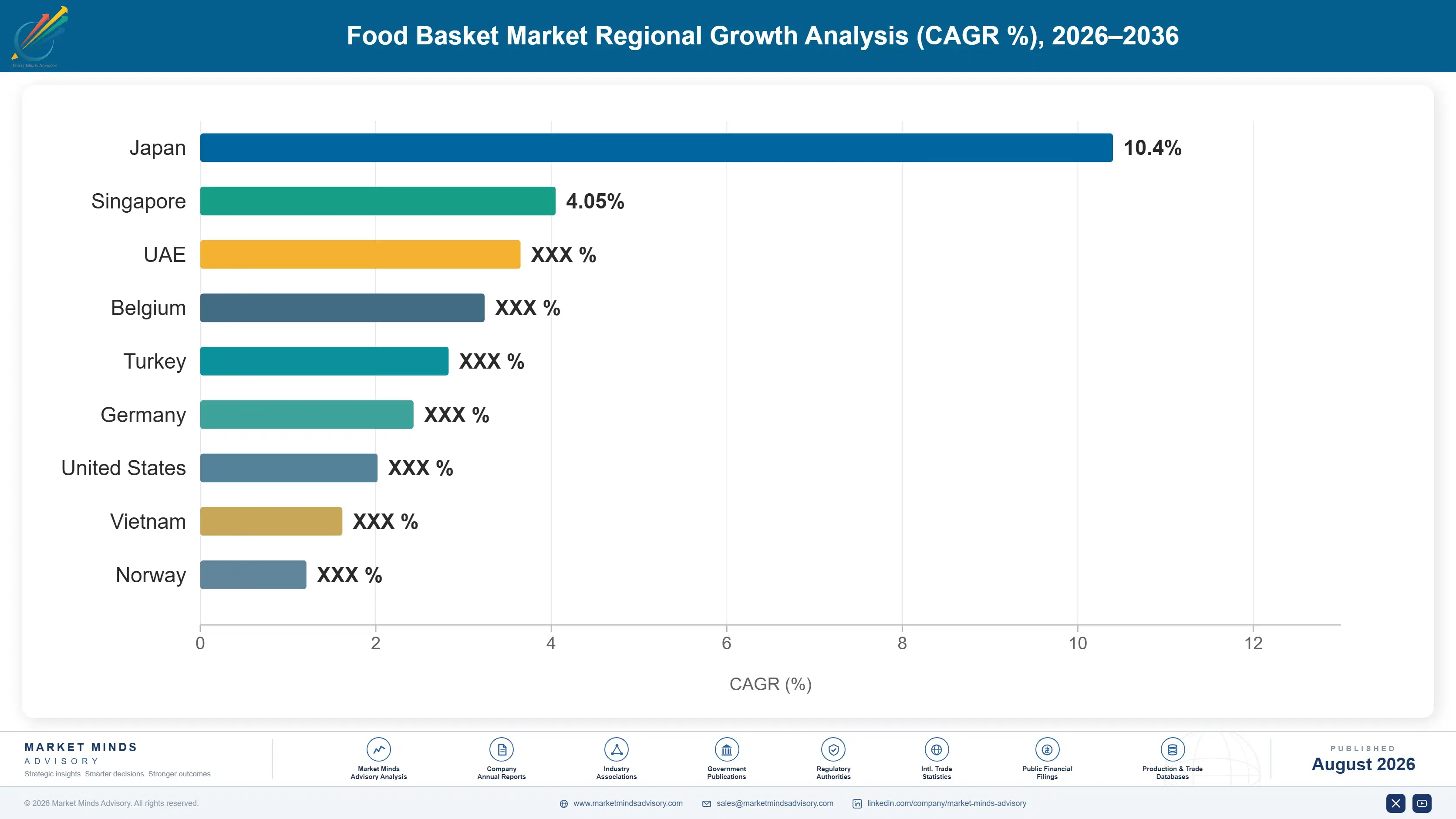
Regional Architecture and Country Demand Map

East Asia holds the largest regional share given its concentrated manufacturing capacity and proximity to major fresh produce export hubs, while South Asia and Pacific grows fastest on expanding retail infrastructure. North America sustains steady demand through both commodity and gift basket retail categories nationwide.

North America

North America's demand is anchored by the United States, where established fresh produce packaging and a genuinely distinct gift basket retail category tied to holiday and corporate gifting culture sustain steady basket procurement volume across major grocery chains and e-commerce gift retailers nationwide and well beyond its own domestic borders and markets today. Retailer sustainability commitments are pushing fiber conversion requirements considerably higher than in most export-oriented Asian markets currently serving bulk commodity produce contracts at scale. Canada's smaller market contributes steady secondary demand concentrated in similar retail categories at comparable specification standards. Mexico's growing produce export industry adds incremental demand skewed toward standard commodity baskets rather than premium fiber or gift categories.
Share: 26% | CAGR: 7.4% (2026 to 2036)

Western Europe

Western Europe's demand centers on Germany, France, and the UK, where the European Union's Single-Use Plastics Directive has driven near universal fiber basket adoption across major grocery retail chains, sustaining steady, compliance-driven procurement volume across the region's produce and foodservice channels nationwide and increasingly beyond. The region grows the slowest of the seven given its plastic-to-fiber transition is already comparatively mature, limiting new demand growth relative to faster expanding Asian and South Asian markets currently under active development and continued expansion. German and French manufacturers maintain deep supply relationships with major retail chains across the entire continent and beyond. Nordic countries contribute smaller but steadily growing demand concentrated in premium fiber and foodservice basket categories nationwide.
Share: 22% | CAGR: 5.1% (2026 to 2036)
Regional intelligence for 5 additional markets available in the complete report: East Asia, South Asia and Pacific, Latin America, Middle East and Africa, Eastern Europe. Contact sales@marketmindsadvisory.com.
food-basket-market-country-cagr-analysis-1787298087438

Moving Beyond the Commodity Basket Sale

Base commodity basket pricing faces steady downward pressure from regional manufacturers competing aggressively on price for standard produce contracts. Suppliers that build fiber molding capability, secure premium gift retail relationships, and expand Southeast Asian manufacturing presence capture considerably better lifetime value than those competing purely on unit price across every major packaging market and distribution channel.

Building Molded Fiber Manufacturing Capability Broadly

Suppliers investing in molded fiber basket development capture disproportionate share of a demand pool commanding pricing 15 to 22% above legacy plastic punnets, where regulatory compliance directly determines whether a manufacturer can win retailer contracts now specifying fiber packaging as a mandatory procurement requirement across major grocery channels nationwide today and beyond. This manufacturing development typically requires twelve to eighteen months of equipment and validation investment, but suppliers that complete it successfully capture durable, multi year retailer contracts that persist across a customer's full procurement cycle and well beyond initial adoption.
Market Impact: Commands pricing 15 to 22% above plastic punnets

Securing Premium Gift Basket Retail Partnerships

Suppliers securing dedicated premium gift basket retail partnerships capture meaningful recurring revenue worth an estimated 25 to 35% above standard produce basket pricing, converting a commodity packaging relationship into a captive specialty design partnership tied to a retailer's seasonal gifting programs across its multi year product development calendar and expanding category strategy. This specialty relationship, difficult for commodity basket sellers to replicate without flexible manufacturing and custom finishing capability, creates durable retailer dependency that extends the commercial relationship well beyond a single season into years of recurring premium basket supply.
Market Impact: Adds 25 to 35% above standard basket pricing

Expanding South Asian Manufacturing Capacity Broadly

Suppliers building dedicated manufacturing capacity in India and Vietnam are capturing disproportionate share of the region's rapidly expanding organized retail demand pool worth an estimated 260 million dollars, positioning closer to fast growing regional produce distribution volume rather than serving the market purely through imports carrying longer lead times and considerably higher landed costs today. This regional capacity investment requires meaningful capital commitment but positions suppliers to capture recurring, multi year retail contracts as regional grocery chains scale operations alongside expanding organized retail investment across many states and countries region wide.
Market Impact: Captures a growing $260M regional demand segment now

Securing Long-Term Retailer Supply Agreements Broadly

Suppliers securing long-term retailer supply agreements are capturing disproportionate share of a demand pool worth an estimated 300 million dollars tied to steady branded produce and foodservice volume across North America and Western Europe, a segment offering predictable, multi year procurement volume that spot market sales rarely provide at comparable scale. This supply agreement relationship requires meaningful pricing and quality investment but positions suppliers to capture recurring, contract anchored procurement across a multi year agreement cycle, a relationship considerably more durable than typical spot market transactions negotiated purely on price.
Market Impact: Captures a growing $300M supply contract demand pool

Who Controls the Margin Pool

The food basket market is fragmented, with a CR5 of roughly 34%. Huhtamaki and Brodrene Hartmann lead a group of molded fiber specialists with a meaningful gap over the next tier of regional woven basket producers and smaller converters competing across produce, gift, and foodservice channels simultaneously in the current market environment.
Competitive activity concentrates on three fronts: molded fiber manufacturing investment tied to tightening plastic reduction regulation, premium gift basket retail partnership expansion that deepens revenue beyond standard produce packaging sales, and South Asian manufacturing expansion tied to expanding organized retail demand across multiple countries. Fiber specialists defend positions through decades of accumulated retailer relationships and molding equipment scale that smaller regional weavers cannot easily replicate quickly.

Emerging pressure comes from regional South and Southeast Asian manufacturers building genuine cost and proximity advantages that established fiber specialists are racing to match through regional partnerships rather than pure price competition. Rankings could shift meaningfully if a regional manufacturer successfully wins a major grocery chain's global fiber conversion contract, demonstrating credible quality and scale that has historically been the primary advantage of established diversified fiber packaging companies with broad manufacturing footprints.
food-basket-market-company-positioning-matrix-1787298087954

Competitive Moat and Risk Dimensions

HUHTAMAKI OYJ

Moat: Broad Global Fiber Molding Scale

Huhtamaki's extensive global molded fiber manufacturing footprint and its long-term supply relationships with major branded retailers allow it to serve customers across multiple regions from a single coordinated account relationship, giving multinational grocery chains a consistency of fiber supply that smaller, single-region converters typically cannot match at comparable scale.
HUHTAMAKI OYJ

Risk: Exposure to Rising Pulp Cost

A meaningful share of Huhtamaki's fiber basket revenue remains exposed to pulp price volatility that cannot always be passed through under existing retailer contracts, requiring continued cost management investment and supplier diversification to offset this margin pressure over time and across future contract renewal cycles.
BRODRENE HARTMANN A/S

Moat: Deep European Molded Fiber Heritage

Brodrene Hartmann's decades of accumulated molded fiber engineering expertise and its established relationships with major European grocery chains give it scientific and manufacturing credibility that newer, less specialized converters without comparable fiber technology history cannot easily replicate, particularly for complex produce packaging programs requiring proven structural consistency.
BRODRENE HARTMANN A/S

Risk: Limited North American Manufacturing Presence

Brodrene Hartmann's manufacturing footprint remains concentrated in Europe, leaving it more exposed to North American retailer sourcing preferences than competitors with established regional manufacturing presence, a gap that could limit its share of the growing US fiber conversion market over the coming several years ahead.

Players Tracked

Prominent Players

Huhtamaki Oyj
Brodrene Hartmann A/S
Pactiv Evergreen Inc
Genpak LLC
Eco-Products Inc

Other Key Players

UFP Technologies Inc
Fabri-Kal Corporation
EnviroPAK Corporation
Vegware Ltd
World Centric LLC
ProAmpac LLC
Sabert Corporation
Solia SAS
International Paper Company
Georgia-Pacific LLC
DS Smith plc
Stora Enso Oyj
Smurfit WestRock plc
Novolex Holdings LLC
Berry Global Group Inc

Recent Developments

MARCH 2025

Huhtamaki Expands Molded Fiber Produce Basket Line

Huhtamaki launched an expanded molded fiber produce basket line engineered for compliance with tightening European and North American plastic reduction mandates, aimed at grocery retailers seeking a single compliant supplier able to meet regulatory requirements across their produce merchandising programs without any additional product substitution nationwide.
Signal: Signals established fiber specialists are increasingly expanding compliant product lines ahead of tightening regulatory deadlines broadly.
JULY 2025

Brodrene Hartmann Expands US Manufacturing Presence

Brodrene Hartmann announced plans to expand its North American manufacturing footprint to better serve growing US retailer demand for molded fiber produce baskets, aimed at reducing shipping lead times and strengthening its overall competitive position against domestically based fiber packaging manufacturers across the wider region.
Signal: Signals European fiber specialists are increasingly investing directly in US capacity to defend growing retailer relationships.
NOVEMBER 2025

World Centric Expands Compostable Gift Basket Line

World Centric expanded its compostable gift basket product line targeting e-commerce and corporate gifting retailers nationwide, aimed at brands seeking fully compostable premium packaging alternatives that differentiate their seasonal gift offerings from conventional woven or plastic basket competitors in an increasingly crowded, competitive retail market.
Signal: Signals smaller sustainability-focused manufacturers are now increasingly targeting premium gift categories to build differentiated positioning broadly.

Wood Pulp and Paperboard Sourcing Risk

Wood pulp and recycled paperboard, sourced primarily from specialized pulp manufacturers in North America, Northern Europe, and increasingly Southeast Asia, account for roughly 38 to 46% of operating cost, given the structural consistency and food-contact safety standards molded fiber manufacturing requires throughout production. Mold tooling and finishing materials contribute a further 14 to 18% of total operating cost.
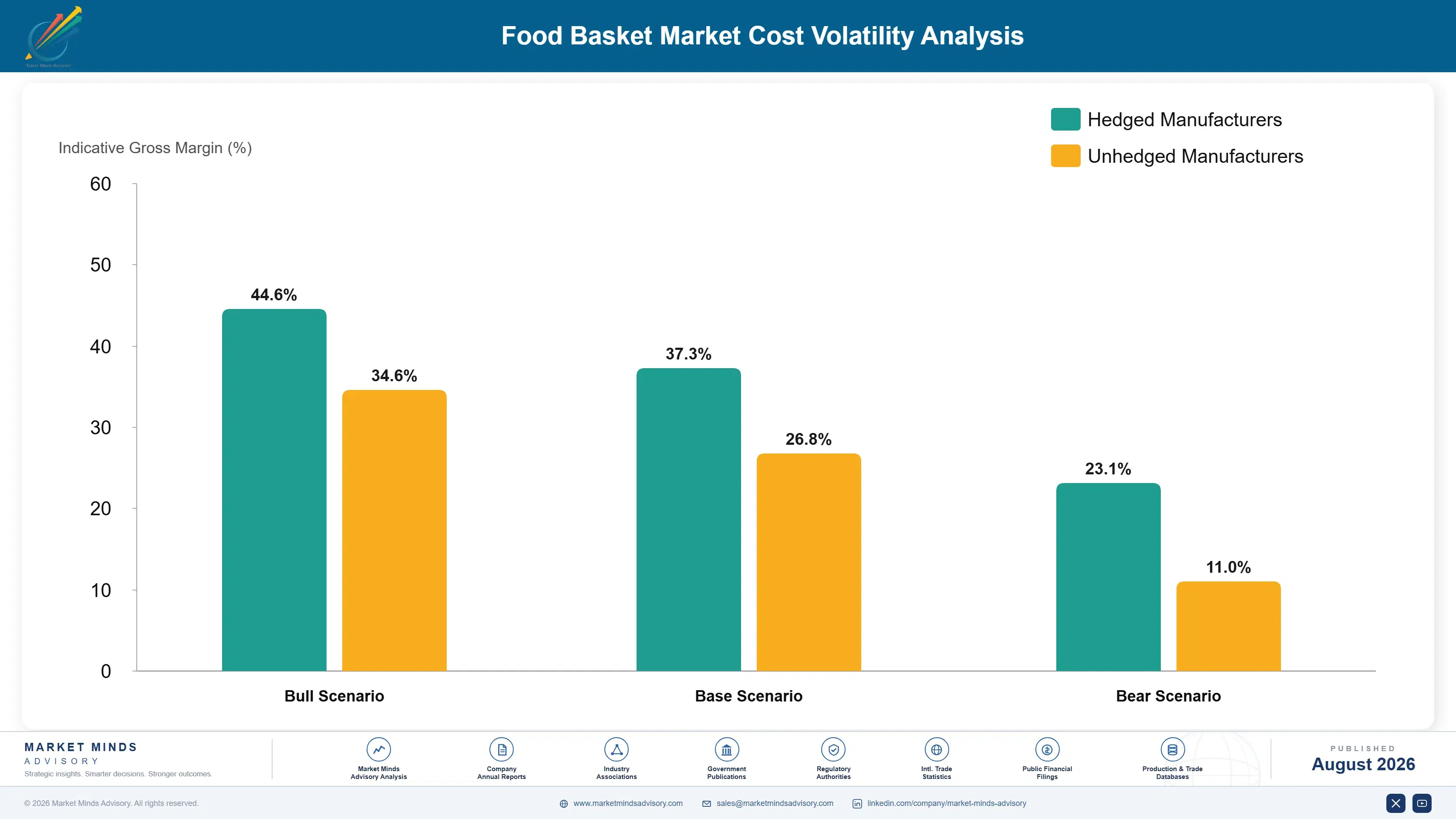
Global pulp prices spiked meaningfully during 2021 and 2022 amid pandemic related supply chain disruption and rising energy costs affecting pulp producers industry wide, pushing input costs up by more than 23% within several months, according to operating cost disclosures in Huhtamaki's 2022 annual report. The disruption prompted several manufacturers to diversify pulp sourcing across multiple regional suppliers and qualify backup mills to reduce future dependency.

Smaller regional basket producers without long term pulp supply agreements face greater cost exposure than larger diversified players like Huhtamaki and Brodrene Hartmann, who negotiate volume based contracts directly with pulp mills. Manufacturers dependent on single source paperboard suppliers face additional exposure to regional pulp capacity constraints, a limitation vertically integrated fiber manufacturers do not share to the same degree today.
food-basket-market-cost-volatility-analysis-1787298088151

Diversifying Pulp Suppliers Across Multiple Regions

Larger manufacturers are increasingly qualifying multiple specialized pulp mills across different geographic regions to reduce dependence on any single supplier relationship, a meaningful undertaking given the strict structural consistency and food-contact safety standards molded fiber baskets always require before formal regulatory clearance for use in active, ongoing retail applications nationwide and across export markets.

Negotiating Volume-Based Pulp Supply Agreements

Larger manufacturers are increasingly negotiating volume based pulp and paperboard supply agreements directly with specialized mills, reducing per unit cost exposure and building predictable pricing structures that protect margin during periods of broader pulp price volatility affecting fiber basket manufacturing costs across the industry more broadly and consistently over multiple future fiscal years and cycles.

Building Regional Manufacturing to Cut Freight Cost

Several manufacturers have established regional production facilities closer to major retail distribution hubs, reducing dependence on long-distance pulp and finished product shipping and building shorter, more resilient supply chains that remain genuinely valuable relative to growing industry wide demand for reliable basket supply across multiple concurrent retail relationships, geographic markets, and distribution channels today.

Portfolio Architecture for Margin Defence

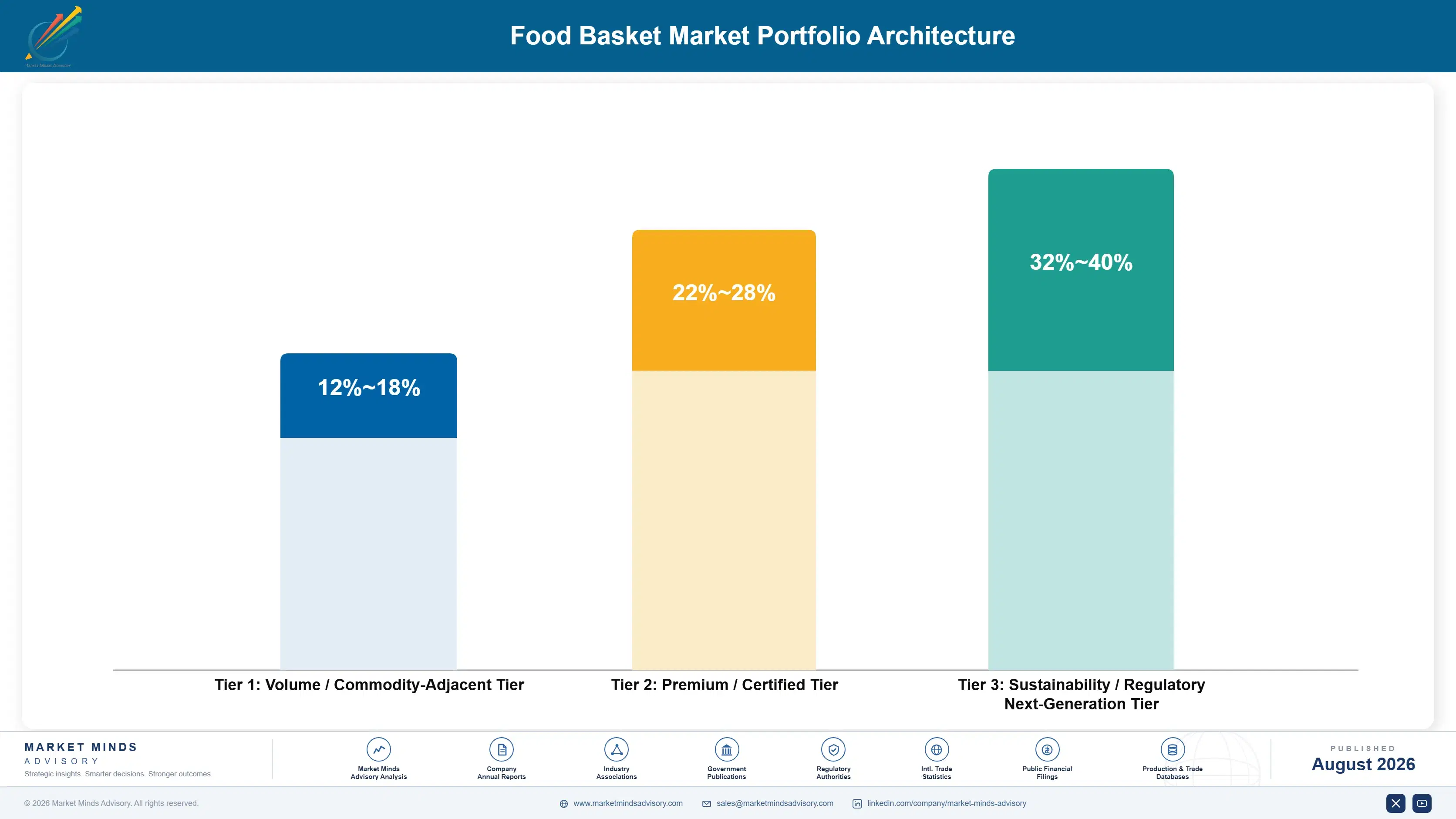
The market splits into three tiers running from commodity plastic and standard woven baskets to premium fiber and gift systems bundled with sustainability certification and branded retail partnerships. Margin concentrates heavily at the top: premium systems paired with fiber compliance and specialty finishing earn gross margins 16 to 24 percentage points above commodity products, reflecting both regulatory investment and branded retail pricing power across the full commercial lifecycle.
Volume and premium tiers pull manufacturers in different strategic directions simultaneously across the industry today and going forward. Regional Asian manufacturers are pushing aggressively into standard commodity categories, compressing margin in segments where established fiber specialists historically earned steady returns, forcing incumbents to defend premium fiber and gift basket segments more aggressively through compliance and design differentiation rather than pricing alone.

High value margin pools concentrate among manufacturers serving retailers through combined fiber compliance, specialty finishing, and long-term supply relationships, since these accounts generate recurring revenue across multiple product categories and expanding seasonal retail programs simultaneously, far exceeding the value of a single commodity transaction and remaining the primary target of every major supplier's account strategy and growth planning today.

Volume / Commodity-Adjacent Tier

Standard plastic punnets and traditional woven wicker baskets sold primarily into price sensitive commodity produce markets, competing on price against a fragmented regional producer base offering comparable products, with thin margins persisting.
Gross Margin: 12-18%

Premium / Certified Tier

Corrugated tray and wire mesh categories sold with regulatory documentation into branded retail and foodservice markets, capturing better margin through demonstrated compliance credentials and broadening retail shelf presence nationwide and beyond.
Gross Margin: 22-28%

Sustainability / Regulatory / Next-Generation Tier

Molded fiber and premium gift basket systems sold with sustainability certification and branded retail partnerships, commanding the highest margin as fiber compliance becomes a baseline competitive requirement across expanding retail markets.
Gross Margin: 32-40%
food-basket-market-portfolio-architecture-1787298088642

High-value Sub-segments and Strategic Watch-out

Molded Fiber Baskets With Retail Compliance

Molded fiber basket systems generating recurring revenue through multi year retailer compliance partnership relationships, growing fastest as plastic reduction mandates make fiber packaging a contractual condition for shelf placement across multiple grocery chains, distribution programs, and rapidly expanding produce categories worldwide today and well beyond.
Gross Margin: 32-40%

Premium Gift Basket Seasonal Retail Programs

Premium gift basket supply tied to expanding e-commerce and corporate gifting demand, expanding steadily as seasonal retail programs require increasingly sophisticated custom design and finishing tailored to each retailer's specific branding and presentation requirements across multiple concurrent seasonal programs and expanding retail distribution networks worldwide.
Gross Margin: 26-34%

Standard Commodity Produce Basket Categories

The largest unit volume segment, serving produce distributors globally that need proven standard baskets without the highest tier's full compliance and specialty finishing cost, forming the steady revenue backbone of most manufacturers' order books across mature and emerging retail markets alike worldwide and across many channels.
Gross Margin: 12-18%

Pulp Supply Facing Persistent Price Volatility

Constrained specialized pulp and paperboard manufacturing capacity facing sustained demand growth from expanding molded fiber conversion, a segment strategic watchers should track closely as material cost volatility intensifies production cost faster than some manufacturers' capacity expansion plans currently anticipate or have adequately prepared for overall.
Gross Margin: 20-26%

From Commodity Sale to Retail Partnership

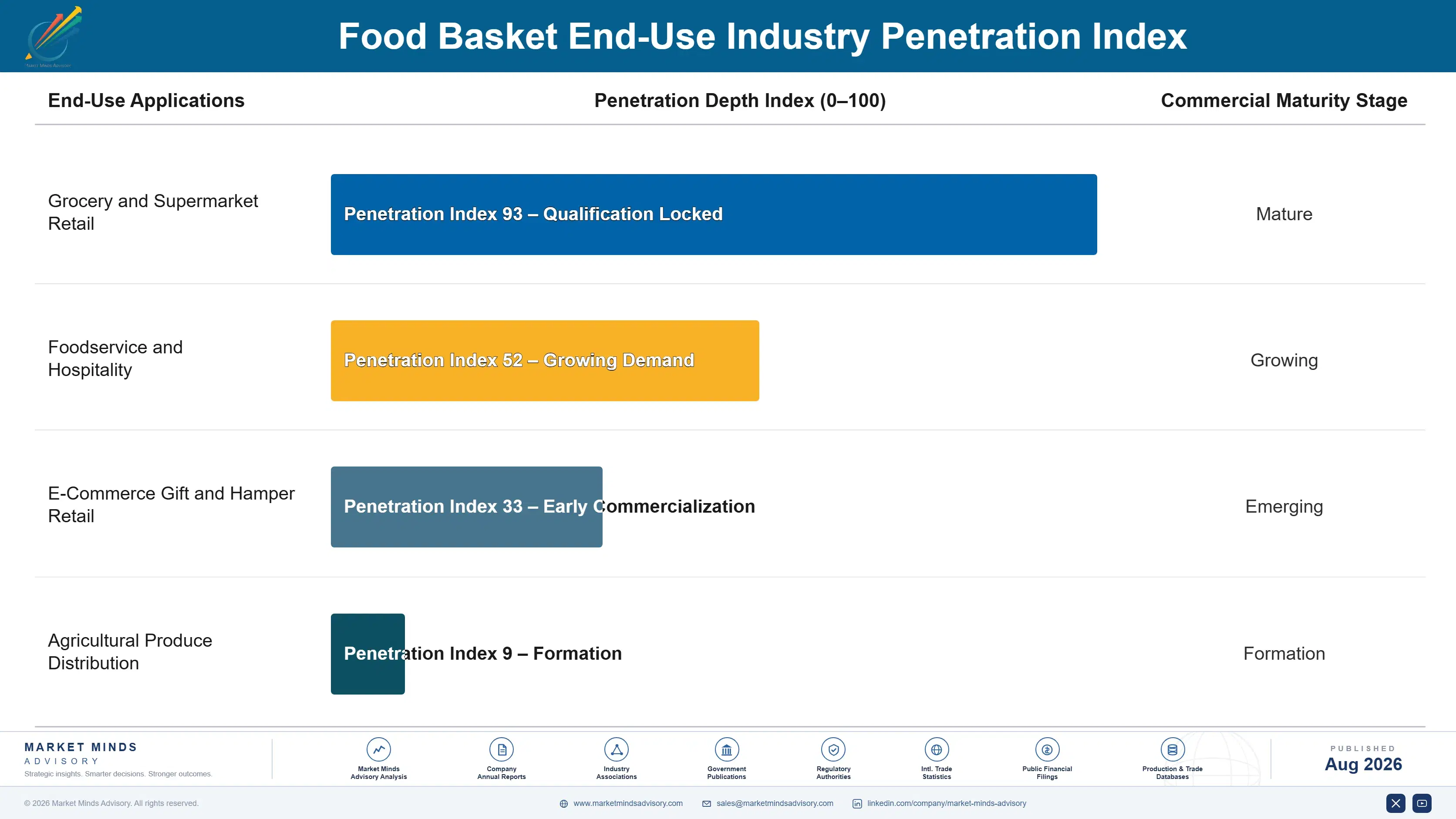
Food basket demand is shifting from a transactional commodity sale toward an ongoing retail partnership as fiber compliance, custom finishing, and multi year supply agreements increasingly extend a supplier's commercial relationship across a retailer's evolving sustainability program rather than a single seasonal order, particularly among suppliers that have successfully bundled compliance and design capability into their core offering rather than just selling standard baskets entirely alone.
Adoption depth varies sharply by end-use vertical. Branded grocery retailers navigating sustainability commitments and fiber compliance engage most deeply with premium supplier partnerships, given the direct brand and regulatory consequences of basket selection at their retail scale. Commodity produce distributors adopt more transactionally, often purchasing whatever basket meets minimum specification at the lowest delivered cost rather than committing to the deeper vendor relationships that characterize branded retail accounts.

A generational shift in buyer profile is underway as sustainability officers and packaging designers, increasingly focused on fiber compliance and recyclability data, join traditional procurement staff in institutional decisions, a change reshaping which supplier capabilities actually win retailer contracts across chains of all sizes and gifting relationships nationwide and increasingly beyond.
food-basket-market-end-use-penetration-index-1787298089129

Where Basket Suppliers Should Focus Next

These are among the four positions where our research anticipates prominent divergence between winners and laggards over the coming forecast period. Each is grounded in the demand model, the regulatory perimeter, and the announced capacity pipeline.
01 / FIBER COMPLIANCE INVESTMENT

Build molded fiber capability before mandates outpace supply

Expanding plastic reduction mandates across major retail markets are driving substantial demand for molded fiber baskets that legacy plastic manufacturers cannot supply without dedicated conversion investment, converting this capability from a specialized niche into an increasingly central procurement requirement across grocery retail contracts. Suppliers still concentrated in plastic risk losing retailer contracts to fiber-compliant competitors already established in this fast growing segment. Moving now, ahead of the point where fiber compliance becomes table stakes, allows suppliers to capture premium positioning before competition intensifies meaningfully further.
02 / PREMIUM GIFT PARTNERSHIP STRATEGY

Build gift retail relationships ahead of e-commerce expansion

E-commerce and corporate gift retailers increasingly seek suppliers capable of flexible manufacturing and custom finishing for premium gift basket categories that commodity producers cannot supply without dedicated investment, creating genuine differentiation opportunity for suppliers willing to build specialty production capability across multiple seasonal and retail channels. Suppliers building dedicated premium partnerships now are positioned to capture disproportionate share of branded shelf space as gift basket e-commerce continues expanding. Waiting until premium capability becomes a universal expectation risks ceding this differentiation opportunity to competitors already investing in specialty manufacturing.
03 / SOUTH ASIAN MANUFACTURING EXPANSION

Build India capacity ahead of organized retail growth

India's organized retail infrastructure continues scaling rapidly as fresh produce packaging adoption expands, creating substantial near term demand for regionally manufactured baskets tied to this growth across the country's major metropolitan grocery chains and expanding secondary city retail markets. Suppliers building dedicated regional manufacturing capacity now are positioned to capture disproportionate share as regional demand accelerates over the coming several years. Waiting until regional demand growth peaks to build this capacity risks ceding early mover advantage to competitors already embedded in ongoing retailer relationships and supply contracts.
04 / LONG-TERM RETAIL CONTRACT DEVELOPMENT

Pursue branded supply agreements ahead of consolidation cycles

Branded grocery retailers continue consolidating procurement decisions across North America and Western Europe as chains seek predictable, multi year basket supply volume that standalone commodity sales rarely match at comparable scale or consistency across most private label markets. Suppliers investing in long-term supply relationships and compliance documentation are positioned to capture disproportionate share of this durable, contract backed demand pool. This relationship investment requires meaningful upfront cost, but the alternative is continued reliance on less predictable spot market sales cycles and volumes.

Engagement Snapshot From the Field

A live engagement with an industry participant carrying material or product regulatory and market exposure ahead of a defining policy shift, showing how our research translates into a defensible multi-year portfolio strategy.
MARKET MINDS ADVISORY · CLIENT ENGAGEMENT SUMMARY
Food Basket Producer Strategic Portfolio Review and Transition Roadmap 2026·Investment Scenario on Food Basket Exposure Evaluation 2025-26
CLIENT PROFILE
The client is a mid-sized regional grocery chain operating forty stores and generating roughly 480 million dollars in annual revenue (client-reported, unverified by MMA) across its fresh produce and bakery departments. The chain had historically sourced produce baskets from three regional plastic suppliers and was evaluating whether transitioning entirely to molded fiber packaging would meet its newly announced sustainability commitments without disrupting existing produce merchandising operations.
STRATEGIC CHALLENGE
Management needed to decide whether a full transition to molded fiber produce baskets justified the cost premium and supplier transition complexity, given genuine uncertainty about whether fiber suppliers could match existing plastic pricing and delivery reliability across all forty stores within the chain's announced sustainability commitment timeline and stakeholder expectations.
MMA APPROACH
MMA benchmarked four molded fiber suppliers against the chain's current plastic supplier pricing and delivery performance, modeled projected procurement cost under a phased transition scenario across all forty stores, and assessed each supplier's manufacturing capacity against the chain's full rollout timeline, produce merchandising requirements, and various store level operational constraints.
KEY FINDINGS
  1. A phased eighteen-month transition showed a projected cost premium of only 9 to 13% above existing plastic basket pricing overall across the chain.
  2. Two candidate fiber suppliers demonstrated manufacturing capacity sufficient to support the chain's full forty-store rollout without any meaningful delivery delays or disruption.
  3. Customer research indicated meaningful positive brand perception impact from the fiber transition among the chain's target demographic segments and loyalty program members.
  4. Produce merchandising teams confirmed fiber baskets required only quite minimal display fixture modification across existing store layouts and formats companywide and immediately.
CLIENT PROFILE
The client is a mid-sized regional grocery chain operating forty stores and generating roughly 480 million dollars in annual revenue (client-reported, unverified by MMA) across its fresh produce and bakery departments. The chain had historically sourced produce baskets from three regional plastic suppliers and was evaluating whether transitioning entirely to molded fiber packaging would meet its newly announced sustainability commitments without disrupting existing produce merchandising operations.
STRATEGIC CHALLENGE
Management needed to decide whether a full transition to molded fiber produce baskets justified the cost premium and supplier transition complexity, given genuine uncertainty about whether fiber suppliers could match existing plastic pricing and delivery reliability across all forty stores within the chain's announced sustainability commitment timeline and stakeholder expectations.
MMA APPROACH
MMA benchmarked four molded fiber suppliers against the chain's current plastic supplier pricing and delivery performance, modeled projected procurement cost under a phased transition scenario across all forty stores, and assessed each supplier's manufacturing capacity against the chain's full rollout timeline, produce merchandising requirements, and various store level operational constraints.
KEY FINDINGS
  1. A phased eighteen-month transition showed a projected cost premium of only 9 to 13% above existing plastic basket pricing overall across the chain.
  2. Two candidate fiber suppliers demonstrated manufacturing capacity sufficient to support the chain's full forty-store rollout without any meaningful delivery delays or disruption.
  3. Customer research indicated meaningful positive brand perception impact from the fiber transition among the chain's target demographic segments and loyalty program members.
  4. Produce merchandising teams confirmed fiber baskets required only quite minimal display fixture modification across existing store layouts and formats companywide and immediately.
RECOMMENDED STRATEGY
Phase 1: Phase 1 (Months 1 to 4): Select two fiber suppliers and pilot the transition across five flagship stores and locations. Phase 2: Phase 2 (Months 5 to 12): Expand the fiber basket rollout to twenty additional stores based on early pilot results. Phase 3: Phase 3 (Months 13 to 18): Complete the transition across all remaining stores and formally retire legacy plastic basket contracts.
OUTCOME
The chain completed its full forty-store fiber basket transition within sixteen months, ahead of the original eighteen month projection (client-reported, unverified by MMA). Customer sustainability perception scores improved measurably following the transition, and the chain has since expanded fiber packaging into its bakery and deli departments.

Frequently Asked Questions

Foundational context covering the market sizes, CAGR, scope, country, region and competition that inform every finding below. This section is provided to cover basics and most often pre-purchase conversations, answered from the MMA Primary Research Dataset.

What is the current size of the Food Basket Market?

The global food basket market was valued at approximately $2.8 billion in 2025. Growth is being driven by plastic-to-fiber conversion and expanding gift basket demand.

How large will the Food Basket Market be by 2036?

The market is projected to reach approximately $5.66 billion by 2036, up from $2.98 billion in 2026. This represents nearly double the market size over the ten-year forecast window.

What is the CAGR for the Food Basket Market 2026 to 2036?

The market is forecast to grow at a CAGR of 6.6% between 2026 and 2036. Bull and bear scenarios range from roughly 5.3% to 7.9%.

Which segment is growing fastest?

Molded fiber produce baskets are the fastest-growing segment, expanding at approximately 10.5% annually as plastic bans accelerate. This is roughly 1.59 times the overall market growth rate.

Who are the major companies in the Food Basket Market?

Leading companies in this space include Huhtamaki, Brodrene Hartmann, Pactiv Evergreen, Genpak, and Eco-Products. Together these five hold roughly 34% of overall global market share.

Which country is growing fastest?

China is currently the fastest-growing single country, reflecting its concentrated produce packaging manufacturing base and scale. Expanding domestic retail infrastructure is accelerating this growth further.

Report Segmentation Architecture

The full report scope spans multiple orthogonal segmentation dimensions, with cross-tabulated demand data provided for each dimension pair. Coverage extends further to regional breakdowns, trend trajectories, and the competitive detail needed to support segment-level decision-making.

By Product and Material Type

  • Molded Fiber (Pulp) Produce Baskets
  • Woven Wicker and Rattan Gift Baskets
  • Plastic Berry and Produce Punnets
  • Wire Mesh Bakery and Display Baskets
  • Corrugated and Paperboard Basket Trays
  • Foodservice Bread and Table Baskets

By End-Use Industry

  • Grocery and Supermarket Retail
  • Foodservice and Hospitality
  • E-Commerce Gift and Hamper Retail
  • Agricultural Produce Distribution

By Commercial Dimension

  • Standard Commodity Volume Contracts
  • Branded Retail Supply Agreements
  • Fiber Compliance Partnerships
  • Seasonal Gift Basket Programs

By Region

  • North America
  • Western Europe
  • East Asia
  • South Asia and Pacific
  • Latin America
  • Middle East and Africa
  • Eastern Europe

Scope, Methodology, and Coverage

Every figure in this report is reproducible from documented input assumptions. The scope below maps the historical period, the forecast horizon, the segmentation dimensions, and the countries covered, alongside the underlying primary and qualitative methodology.
Historical Period
2020 to 2025
Forecast Period
2026 to 2036
Base Year
2025 (USD billions; MMA Primary Research Dataset, August 2026)
Market Definition
The food basket market covers rigid and semi-rigid basket-style containers, including molded fiber, woven wicker, plastic, wire mesh, and corrugated formats, used for fresh produce packaging, foodservice bread and table service, and retail gift or hamper packaging. It excludes flexible pouch and film packaging, rigid clamshell trays not styled as baskets, and general shipping cartons not intended for retail display.
Quantitative Units
USD billions (current prices); unit volume where disclosed
Segmentation Dimensions
By Product and Material Type; By End-Use Industry; By Commercial Dimension; By Region
Regions Covered
North America, Western Europe, East Asia, South Asia and Pacific, Latin America, Middle East and Africa, Eastern Europe
Countries Covered
USA, Canada, Mexico, Germany, France, UK, Sweden, China, Japan, South Korea, India, Vietnam, Indonesia, Australia, Brazil, Colombia, Argentina, Saudi Arabia, UAE, South Africa, Egypt, Nigeria, Turkey, Poland, Czechia, Hungary, Romania, Russia, Netherlands, Italy, Spain, and additional markets relevant to this sector
Key Companies Profiled
Huhtamaki Oyj, Brodrene Hartmann A/S, Pactiv Evergreen Inc, Genpak LLC, Eco-Products Inc, UFP Technologies Inc, Fabri-Kal Corporation, EnviroPAK Corporation, Vegware Ltd, World Centric LLC, ProAmpac LLC, Sabert Corporation, Solia SAS, International Paper Company, Georgia-Pacific LLC, DS Smith plc, Stora Enso Oyj, Smurfit WestRock plc, Novolex Holdings LLC, Berry Global Group Inc
Quantitative Methodology
Primary survey, n=3,800 respondents, Q4 2025, six countries; demand-side model with trade association cross-validation
Qualitative Methodology
47 expert interviews, Q4 2025; applied to validate demand model assumptions, identify emerging dynamics, and assess competitive positioning
Report Format
PDF and XLSX data workbook (Word format preview document)
Publisher
Market Minds Advisory
Report Code
MMA-2026-PAC-342
Published
August 2026
Contact
sales@marketmindsadvisory.com | www.marketmindsadvisory.com

Purchase the full Food Basket Market Report (2026 to 2036).

The full report provides a comprehensive assessment of the global food basket market, including detailed segmentation by product and material type, end-use industry, and commercial dimension across all seven world regions. It profiles twenty leading and emerging manufacturers, benchmarking fiber molding capability, premium gift partnerships, and South Asian manufacturing presence. The analysis includes ten-year forecasts through 2036 under base, bull, and bear scenarios, alongside primary research findings drawn from MMA's survey of 3,800 respondents and 47 expert interviews conducted in the fourth quarter of 2025. A dedicated input cost section examines pulp and paperboard exposure across major manufacturing markets.
Detailed segment-level ten-year forecasts through 2036
Profiles of twenty leading and emerging manufacturers
Regional analysis spanning all seven world regions
Input cost and supply chain risk assessment
Competitive benchmarking on moats and vulnerabilities
Primary survey and expert interview data appendix

Built For The People Who Decide

From boardroom strategy to bench-side execution, this report is read cover-to-cover by leaders shaping the next decade of their industry, turning demand scenarios, market dynamics and valuation benchmarks into decisions.
CXOs/ Presidents/ VPs/ Managers
M&A and Corporate Development
Strategy Teams and R&D Heads
Procurement and Product Directors
Regulatory and Compliance Leaders
Investor Relations and Equity Analysts