

Market Minds Advisory
Folding Boxboard Market

Folding Boxboard Market: Cartonboard Grades and Sustainable Fiber Packaging Substrates

Brand owners are shifting packaging specifications toward certified virgin and barrier-coated boxboard grades as plastic reduction regulation spreads, forcing converters to qualify new substrates while pulp input costs stay volatile across major producing regions worldwide.

Lead Analyst

Bilal Shaikh

Published

September 2026

Make Smarter Decisions with Customized Research Insights

Request a free sample report and evaluate market opportunities, growth trends, and competitive dynamics relevant to your business needs.

2025 MARKET VALUE$38.5BMarket Size 2025
2036 FORECAST VALUE$60.5BBase Case , 2026 to 2036
CAGR 2026 TO 20364.2 %Bull 5.4% / Bear 2.9%
INCREMENTAL OPPORTUNITY$20.4BNet 10- year value creation
EXPANSION MULTIPLE1.51x2036 value over 2026 base
Strategic Levers
M&A Pipeline
Regional Outlook
Country Rankings
Competitive Intelligence
Segmental Deep-dive
Call-Us : 91 93563 13602

Executive Snapshot and Market Trajectory

Brand owners are rewriting packaging specifications to favor certified virgin and barrier-coated boxboard as single-use plastic reduction rules spread across major consumer markets, pushing converters to requalify supply chains built around older board grades entirely. Packaging teams increasingly treat this as a permanent specification change rather than a passing trend.
Food, pharmaceutical, and cosmetics packaging together concentrate the fastest volume growth, while East Asia's converting capacity, anchored by China's export-oriented packaging manufacturing base, keeps pulling production and consumption toward the region faster than any other geography tracked in this study. China's own domestic consumer goods growth reinforces this concentration well beyond what export manufacturing alone would explain, reinforcing East Asia's lead across nearly every packaging category tracked.
A moderately fragmented group of integrated pulp-to-board producers competes against regional converters lacking upstream fiber supply, while recycled fiber cost volatility and tightening extended producer responsibility regulation reshape which grades earn shelf space at major retailers. Producers with integrated fiber supply are best positioned to absorb this volatility while smaller converters increasingly struggle to compete on price alone, widening the gap between integrated majors and fragmented regional rivals across most categories tracked.
Market Definition
This market covers folding boxboard grades including coated recycled board, solid bleached and unbleached sulfate board, white lined chipboard, and specialty barrier-coated variants used in carton and folding box packaging. It excludes corrugated shipping containers and rigid paperboard tube and can packaging.
Base Year Value
$38.5B in 2025 (MMA Primary Research Dataset, August 2026)
Forecast Period
2026 to 2036, eleven discrete annual values
CAGR
4.2% base case. Bull 5.4%. Bear 2.9%.
Fastest Growth Segment
Specialty and Barrier-Coated Boxboard: 7.2% CAGR
Fastest Growth Country
India: 8.6% CAGR
Fastest Growth Region
South Asia and Pacific: 6.3% CAGR
Largest Region
East Asia: 30% of 2025 global value
Market Leaders
Smurfit WestRock plc, Stora Enso Oyj, Metsä Board Corporation, Graphic Packaging International LLC, Nine Dragons Paper Holdings Limited. Source: MMA Analysis based on company annual reports.
Primary Survey
n=3,800 procurement and R&D decision-makers, Q4 2025, six countries
Methodology
Demand-side build-up, cross-validated against public data, 47 expert interviews

Folding Boxboard Market Forecast Scenarios

folding-boxboard-market-size-forecast-scenario-1787305029051
Folding boxboard demand grew at roughly 3.6% annually between 2020 and 2025, as pandemic-driven e-commerce packaging demand offset a slower gradual decline in some traditional retail carton applications across major developed packaging markets tracked closely by industry observers. Overall volume growth remained modest but consistently positive across nearly every year of the historical window measured.
The base case assumes continued brand owner substitution away from plastic clamshell and blister packaging, expanding food service carton demand, and steady East Asian converting capacity investment, sustaining a 4.2% blended annual growth rate through 2036 across most major producing and consuming regions worldwide. Certification premiums and barrier coating capability investment together reinforce this trajectory across most producer portfolios reviewed by MMA analysts through the full forecast horizon ahead worldwide.
A bull scenario assumes faster regulatory plastic reduction mandates accelerate substitution well beyond current expectations. The bear case centers on recycled fiber cost spikes that squeeze converter margins enough to slow capacity investment and delay planned grade conversion projects across several major producing regions. Either scenario would meaningfully reshape which producers lead the category by the end of the forecast period.

Fiber Substitution Reshapes Carton Packaging Demand

Folding boxboard sits at the intersection of packaging regulation, brand sustainability commitment, and pulp commodity economics, with converters increasingly choosing grades based on recyclability credentials as much as historical cost and performance considerations that once dominated purchasing decisions entirely. Regulatory pressure and brand sustainability commitments together now shape purchasing decisions as much as unit cost ever did for many major consumer brands.
MARKET CONCENTRATIONCR5 38%share held by the five largest producers combined globally
AVERAGE SELLING PRICE$920 per tonneblended average across all folding boxboard grades sold
LEADING COUNTRY SHAREChina 19%of global folding boxboard production volume concentrated domestically
MILL UTILISATION RATE84%average global folding boxboard production capacity currently in use
RECYCLED FIBER INPUT SHARE41%of total fiber input sourced from recovered paper streams
TRADE INTENSITY27%of global production volume crossing an international border annually
Commercially, this market splits between integrated producers controlling their own pulp supply and standalone converters buying board on the open market, a clear divide that determines who captures margin when recycled fiber and virgin pulp prices diverge sharply across a given planning cycle. This divide increasingly determines which producers can invest confidently in barrier coating and certification infrastructure going forward.
Over the next decade, plastic reduction regulation, expanding food service and e-commerce carton demand, and growing retailer sustainability scorecard pressure will keep pulling specification toward certified and barrier-coated grades across most major consumer packaged goods categories tracked in this study. Producers slow to adapt risk losing shelf space to faster-moving competitors across nearly every packaged goods category worldwide, as substitution accelerates and regulation tightens further.
"Boxboard used to compete on price per tonne. Now it competes on certification paperwork. The mills that figured that out first are the ones setting the pricing terms today."
Director, Packaging Materials Practice · MMA Packaging Materials Practice

Market Trends

Extended Producer Responsibility Rules Reward Recyclable Board

European Union and several US state extended producer responsibility regulations now assign lower compliance fees to packaging formats with demonstrated recyclability, giving folding boxboard a durable cost advantage over multi-material plastic packaging formats in categories where both remain technically viable substitutes. Over a dozen US states have passed or proposed extended producer responsibility legislation since 2023, each with its own fee schedule that generally favors mono-material fiber packaging over composite plastic alternatives. Brand owners managing packaging costs across multiple jurisdictions are increasingly standardizing on boxboard formats that qualify for the lowest compliance fee tier everywhere they sell products.
Market Impact: Covers 60 plus countries with restr
Barrier Coating Technology Expands Food Contact Applications

New water-based and bio-based barrier coating technologies now let folding boxboard replace plastic-lined cartons in frozen food, ready meal, and liquid packaging applications that previously required a plastic laminate layer to achieve adequate moisture and grease resistance for extended shelf life. Coating suppliers report commercial deployment of these systems has roughly tripled since 2022, as major food brands seek to remove plastic layers to meet corporate sustainability pledges without sacrificing packaging performance. This technology shift is opening entirely new application categories to boxboard converters that previously could not compete against plastic-lined formats at all.
Market Impact: Food service volume up 34 percent

Market Opportunities and Growth Drivers

Global Plastic Packaging Reduction Mandates Expand

Over 60 countries have now implemented some form of single-use plastic packaging restriction, and folding boxboard is the primary fiber-based substitute for clamshells, blister packs, and multi-material pouches across food, cosmetics, and consumer electronics packaging categories. The European Union's packaging and packaging waste regulation sets escalating recycled content and recyclability targets through 2030, directly favoring mono-material fiber packaging over composite plastic formats that are difficult to recycle economically. Brand owners operating across multiple regulated markets are standardizing packaging specifications around boxboard formats that satisfy the strictest applicable jurisdiction, accelerating substitution even in markets without mandatory requirements yet.
Market Impact: Fiber prices swing 40 percent

E-Commerce and Food Service Carton Demand Expansion

Food delivery and e-commerce packaging volume has grown considerably faster than traditional retail carton demand, with quick-service restaurants and meal delivery platforms adopting folding boxboard containers as both a cost-effective and increasingly regulation-compliant packaging format across most major urban delivery markets. Industry data suggests food service carton volume has grown by roughly 34% since 2021, outpacing overall boxboard market growth by a wide margin and shifting converter product mix toward smaller-format, higher-margin specialty cartons. This channel now represents a meaningfully larger share of total demand than it did just five years ago.
Market Impact: Retrofits cost 8 million dollars

Market Restraints and Challenges

Recycled Fiber Price Volatility Squeezes Converter Margins

Recovered paper prices have swung by more than 40% within single calendar years on several occasions since 2021, driven by shifting export policy in major recovered fiber importing countries and fluctuating collection volumes tied to broader economic conditions across major consuming regions. The root cause is a recovered fiber supply chain that remains fragmented and weather-dependent in its collection infrastructure, unlike the more predictable virgin pulp supply chains that larger integrated producers control directly. This volatility disproportionately squeezes standalone converters lacking their own fiber sourcing, since they cannot pass sudden cost spikes through to customers as quickly as vertically integrated.
Market Impact: Cuts compliance fees 30 percent

Plastic Laminate Legacy Infrastructure Slows Full Conversion

Many converters still operate coating lines optimized for plastic laminate application rather than the newer water-based barrier coatings required for fully recyclable board, and retrofitting this equipment requires meaningful capital investment that smaller regional converters often cannot justify given uncertain demand timelines. The underlying cause is that much of the installed coating equipment base was built during an earlier era when plastic lamination was the industry standard rather than a liability, leaving a legacy capital stock poorly matched to current regulatory direction. This creates a genuine competitive disadvantage for converters unable to fund equipment retrofits quickly, ceding faster-growing barrier-coated business.
Market Impact: Triples barrier coating deployment
3 additional market trends, 3 additional growth drivers, and 4 additional restraints and challenges are covered in the full report. Contact sales@marketmindsadvisory.com to access the complete intelligence.

Segment CAGR and Growth Architecture

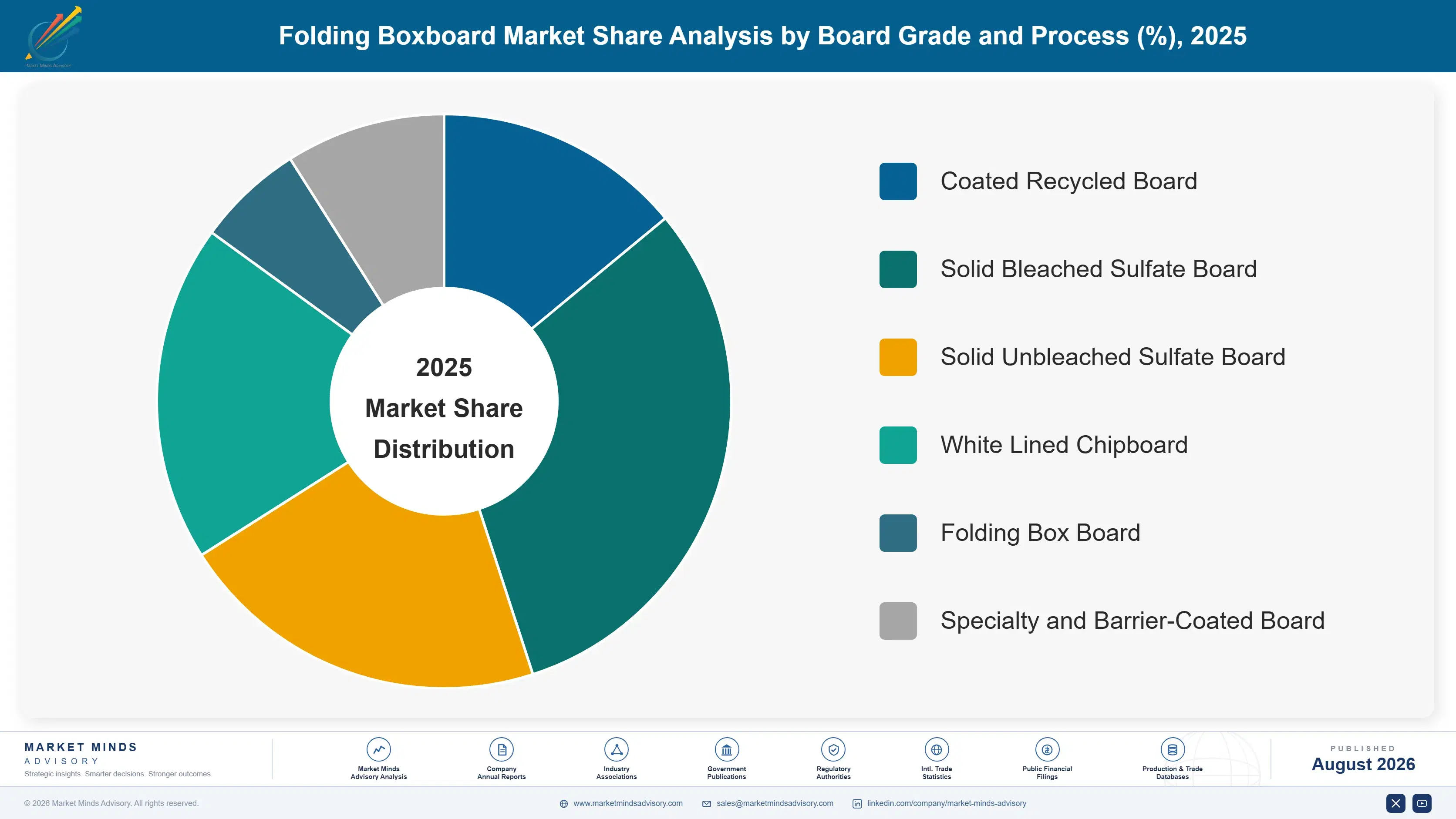
This market segments by board grade and manufacturing process spanning coated recycled board, solid bleached and unbleached sulfate board, white lined chipboard, folding box board, and specialty barrier-coated variants, reflecting how converters and brand owners actually specify substrates for particular packaging applications. This dimension is the one converters and brand owners actually negotiate against when qualifying new suppliers for a.
folding-boxboard-market-market-share-analysis-1787305029627

Specialty and Barrier-Coated Boxboard

Specialty and barrier-coated boxboard is the fastest-growing segment as brand owners seek fiber-based replacements for plastic-lined food and liquid packaging formats that previously required a laminate layer for adequate moisture resistance. Water-based and bio-based coating technologies have matured enough to meet food contact safety requirements while remaining fully recyclable through standard paper recovery streams, unlike the plastic-laminated cartons they replace. This segment commands meaningfully higher average selling prices than commodity board grades, reflecting both the specialized coating technology involved and the premium brand owners are willing to pay to meet sustainability commitments. Converters investing early in barrier coating capability are capturing disproportionate share of this faster-growing, higher-margin business as more food and beverage categories convert away from plastic packaging formats.
CAGR 7.2%

Solid Bleached Sulfate Board

Solid bleached sulfate board is growing fastest among premium virgin fiber grades, driven by pharmaceutical, cosmetics, and premium food packaging applications that require the bright white printing surface and strength characteristics that recycled grades cannot consistently match. Pharmaceutical packaging in particular is expanding steadily as global medicine volumes grow and regulatory serialization requirements demand higher print quality for tamper-evidence and tracking features embedded directly on cartons. This segment carries the strongest brand loyalty among converters, since pharmaceutical and premium cosmetics customers rarely switch board suppliers once a packaging specification passes regulatory and quality qualification processes across multiple jurisdictions and product lines simultaneously, creating durable long-term supply relationships. This durable loyalty gives incumbent suppliers meaningful pricing power within the segment overall.
CAGR 5.8%
Full segment breakdown across 6 segments available in the complete report.

Regional Architecture and Country Demand Map

East Asia leads global production and consumption, anchored by China's export-oriented packaging manufacturing base, while North America and Western Europe follow closely behind on the strength of premium and regulation-driven grade demand, while Latin America and Eastern Europe trail both in absolute volume and in the pace of substitution underway.

North America

The United States anchors regional demand through its large food service and e-commerce carton packaging base, with major integrated producers running pulp-to-board mills concentrated in the southeastern states near abundant softwood fiber supply. Canada contributes a smaller but steady production base, exporting a meaningful share of output to the United States given close proximity and shared regulatory standards across both countries. Extended producer responsibility legislation spreading across additional US states is accelerating brand owner conversion toward recyclable boxboard formats faster than previously expected. Mexico's growing consumer packaged goods manufacturing base is emerging as a secondary demand centre, though it remains reliant on imported board rather than domestic production capacity for now.
Share: 24% | CAGR: 3.5% (2026 to 2036)

Western Europe

Germany and France lead regional demand, reflecting large consumer packaged goods and pharmaceutical manufacturing bases that specify premium virgin fiber board grades extensively across both food and healthcare packaging applications. The European Union's packaging and packaging waste regulation is the single strongest regional demand driver, setting recycled content and recyclability targets that most other regions have not yet matched in stringency. Nordic countries host several of the world's most sophisticated integrated pulp-to-board producers, exporting premium grades across the wider region and internationally. Regional growth trails the global average since substitution away from plastic packaging is already comparatively advanced relative to less regulated markets elsewhere. Southern European converters increasingly import certified board rather than investing in domestic mill upgrades.
Share: 20% | CAGR: 2.5% (2026 to 2036)
Regional intelligence for 5 additional markets available in the complete report: East Asia, South Asia and Pacific, Latin America, Middle East and Africa, Eastern Europe. Contact sales@marketmindsadvisory.com.
folding-boxboard-market-country-cagr-analysis-1787305030150

Certification Premiums and Barrier Coating Expansion

Producers are shifting commercial strategy toward certified sustainable fiber premiums, barrier coating capability expansion, and long-term brand owner supply contracts, capturing more predictable specialty-grade revenue rather than competing purely on commodity board tonnage pricing alone across the industry. This mirrors a broader shift across specialty materials industries toward recurring, relationship-driven commercial models overall today.

Forest Stewardship Certification Chain-of-Custody Premium Pricing Programme

Producers holding Forest Stewardship Council or Programme for the Endorsement of Forest Certification chain-of-custody certification are commanding meaningful price premiums from brand owners required to demonstrate sustainable sourcing under expanding regulatory and retailer scorecard requirements across major consumer markets globally. This lever rewards producers who invested early in certification infrastructure and fiber traceability systems, since certification qualification can take years to complete across a producer's full supply chain. Producers report certified grade premiums adding roughly 14% to average selling price compared to uncertified equivalent board grades sold into the same application categories.
Market Impact: Adds roughly a 14 percent average p

Barrier Coating Capability Investment Expansion Strategy

Producers are investing in water-based and bio-based barrier coating lines to capture faster-growing food and liquid packaging application demand that commands significantly higher margins than commodity uncoated board grades sold into traditional dry goods carton applications. This lever requires meaningful upfront capital investment but locks in multi-year supply relationships with brand owners converting away from plastic-lined packaging formats under mounting regulatory and consumer pressure. Producers with early barrier coating investment report capturing roughly 22% higher margins on coated grades relative to their uncoated board portfolio overall. Producers view this investment as essential to remaining competitive as brand owners keep converting.
Market Impact: Captures roughly 22 percent higher

Direct Long-Term Brand Owner Supply Contracts

Producers are negotiating multi-year supply agreements directly with major consumer packaged goods brand owners rather than selling primarily through converter intermediaries, capturing more stable demand visibility and reducing exposure to short-term spot market pricing volatility that smaller producers remain fully exposed to. This lever strengthens customer relationships considerably, since switching board suppliers requires brand owners to requalify packaging specifications across their full product portfolio, a costly and time-consuming process most prefer to avoid. Producers report long-term contract volume now represents roughly 46% of total specialty grade shipments industry-wide. Producers increasingly view direct brand relationships as the most durable way to.
Market Impact: Covers roughly 46 percent of specia

Recycled Content Traceability Reporting Services Offering

Producers are offering brand owners detailed recycled fiber content traceability and reporting services bundled with board supply, helping customers meet extended producer responsibility documentation requirements that are becoming mandatory across an expanding number of jurisdictions worldwide. This lever generates incremental service revenue beyond the board itself while deepening customer dependency on a single supplier's reporting infrastructure and documentation systems built specifically for regulatory compliance purposes. Producers report this service bundle adding roughly 7% to average account revenue among customers operating across multiple regulated jurisdictions simultaneously. Producers expect demand for this reporting capability to keep growing as more jurisdictions adopt similar.
Market Impact: Adds roughly 7 percent to average a

Who Controls the Margin Pool

The top five producers control roughly 38% of global capacity, a moderate concentration reflecting the capital intensity of integrated pulp-to-board manufacturing alongside a long tail of regional converters without upstream fiber supply, leaving meaningful room for share shifts among mid-tier producers investing in certification and coating capability. Mid-tier producers investing early in certification are the ones most likely to gain share from this dynamic over time.
Current competitive activity centers on forest certification programme expansion, barrier coating line investment to capture food and liquid packaging conversion demand, and direct long-term supply contracting with major brand owners bypassing traditional converter intermediary relationships wherever contract volume justifies the shift. Several producers are also piloting recycled content traceability services to differentiate beyond board pricing alone.

Emerging pressure comes from Southeast Asian mill capacity additions targeting export markets at lower cost, and from smaller specialty producers focused entirely on barrier-coated grades who could capture disproportionate share of the fastest-growing application categories if larger incumbents retrofit coating capacity too slowly relative to demand. Established leaders are responding by accelerating their own barrier coating investment to defend existing brand owner relationships.
folding-boxboard-market-company-positioning-matrix-1787305030661

Competitive Moat and Risk Dimensions

SMURFIT WESTROCK PLC

Moat: Integrated Fiber-to-Box Supply Chain

Smurfit WestRock controls fiber sourcing, pulp production, board manufacturing, and converting under one integrated structure following its 2024 combination, giving it cost and supply reliability advantages that standalone converters buying board on the open market cannot easily replicate across comparable volume and geographic scale. This integration advantage is difficult for standalone converters to replicate without comparable scale.
SMURFIT WESTROCK PLC

Risk: Post-Merger Integration Execution Risk

The company faces meaningful operational risk integrating two large legacy organizations with different regional footprints, technology systems, and customer relationships, and any integration missteps could disrupt customer service levels or delay the cost synergy realization that justified the original combination in the first place. Investors are watching integration milestones closely for early signs of trouble.
STORA ENSO OYJ

Moat: Certified Renewable Fiber Sourcing Base

Stora Enso owns extensive certified Nordic forestland and operates some of the industry's most advanced sustainable fiber sourcing infrastructure, positioning it favorably as brand owners increasingly require documented chain-of-custody certification across their full packaging supply chain under expanding regulatory scrutiny worldwide. Few competitors can match the depth of Stora Enso's certified forestland holdings.
STORA ENSO OYJ

Risk: European Energy Cost Volatility Exposure

Stora Enso's Nordic and Central European manufacturing base carries meaningful exposure to regional energy price volatility, and prolonged energy cost spikes could erode the company's margin advantage relative to competitors with manufacturing capacity concentrated in lower-cost energy markets outside Europe entirely. This exposure has already pressured margins during past European energy price spikes.

Players Tracked

Prominent Players

Smurfit WestRock plc
Stora Enso Oyj
Metsä Board Corporation
Graphic Packaging International LLC
Nine Dragons Paper Holdings Limited

Other Key Players

BillerudKorsnäs AB
Mondi plc
Oji Holdings Corporation
International Paper Company
Klabin S.A.
Sonoco Products Company
DS Smith plc
Packaging Corporation of America
Shandong Sun Paper Industry Joint Stock Co., Ltd.
Lee & Man Paper Manufacturing Limited
Nippon Paper Industries Co., Ltd.
Segezha Group PJSC
Holmen AB
Cascades Inc.
Sappi Limited

Recent Developments

FEBRUARY 2026

Metsä Board Expands Barrier-Coated Capacity in Finland

Metsä Board announced an organic capacity expansion at its Finnish folding boxboard mill to add dedicated barrier coating lines, aimed at meeting rising demand from food and beverage brand owners converting away from plastic-lined packaging formats across European markets. The new lines are expected to reach full production within twelve.
Signal: Signals continued producer confidence that
OCTOBER 2025

Graphic Packaging Signs Multi-Year Supply Agreement With Consumer Goods Major

Graphic Packaging International entered a multi-year direct supply agreement with a major global consumer packaged goods company, bypassing traditional converter intermediaries to secure long-term specialty board volume across several regional markets simultaneously. Financial terms of the multi-year agreement were not disclosed by either party involved.
Signal: Reflects a broader industry shift toward d
MAY 2026

Nine Dragons Paper Acquires Regional Southeast Asian Converter

Nine Dragons Paper completed the acquisition of a mid-sized Southeast Asian folding carton converter, expanding its downstream converting footprint closer to growing regional consumer packaged goods manufacturing demand across several export-oriented economies. Financial terms of the transaction were not disclosed by either company involved in it.
Signal: Indicates growing producer interest in cap

Pulp and Recovered Fiber Cost Exposure

Virgin softwood and hardwood pulp together with recovered paper fiber represent roughly 52% of cost of goods sold for folding boxboard producers, with virgin pulp sourced primarily from North American, Nordic, and Latin American forestry operations and recovered fiber collected through regional municipal recycling infrastructure. Vertically integrated producers face materially less exposure to this concentration than converters buying fiber on the open market.
Global pulp prices spiked sharply during 2021 and 2022 amid supply chain disruption and strong demand recovery, with the International Energy Agency noting energy-intensive pulping process costs remained elevated through much of the period, before prices partially normalized through 2024 and 2025 across most producing regions tracked. Company annual reports from major producers confirm margin pressure was most acute during the second half of this window.

Standalone converters without integrated pulp production face materially higher input cost exposure than vertically integrated producers, who can smooth fiber cost swings across their own forestry and pulping operations. This creates a durable cost disadvantage for smaller converters competing against integrated majors able to absorb volatility internally. Geography also matters, since converters located closer to fiber sourcing regions face smaller logistics cost swings overall.
folding-boxboard-market-cost-volatility-analysis-1787305030856

Vertical Integration Into Pulp Production

Larger producers are acquiring or expanding upstream pulp production capacity to reduce dependency on open market fiber purchases, insulating manufacturing costs from short-term price volatility that standalone converters remain fully exposed to across each planning cycle. This approach has become standard practice among the largest integrated producers globally over the past decade, particularly those with the strongest balance sheets and.

Long-Term Recovered Fiber Supply Agreements

Producers are signing multi-year recovered fiber supply agreements with municipal and commercial recycling operators to stabilize input costs and secure reliable volume, reducing reliance on volatile spot market recovered paper purchases during periods of tight supply. Smaller producers increasingly pursue this strategy too, despite the added contracting complexity involved in doing so, and this trend is expected to keep expanding.

Alternative Fiber Source Qualification Programmes

Some producers are qualifying alternative fiber sources including agricultural residue and faster-growing plantation species to diversify away from traditional softwood pulp dependency, reducing exposure to any single fiber category's price cycle over time. This diversification strategy remains early-stage but is drawing growing research investment across the wider industry, reflecting genuine long-term confidence in continued category volume growth ahead.

Portfolio Architecture for Margin Defence

This market organizes into three commercial tiers spanning commodity recycled board at the volume end, certified virgin fiber and pharmaceutical-grade board occupying the premium middle tier, and barrier-coated next-generation grades capturing the strongest margins at the top of the portfolio architecture overall. Producers increasingly structure pricing and contracting strategy around this three-tier architecture explicitly, revisiting the split each planning cycle across their commercial organ
Volume and premium tiers pull producers in different directions: recycled board sustains converter relationships and base utilisation, while certified and barrier-coated grades deliver materially stronger margins that increasingly determine which producers can fund the capital investment barrier coating capability requires. Most producers now allocate a growing share of capital budget toward the premium and next-generation tiers specifically each year.

The highest-value pools concentrate around barrier-coated specialty grades sold under long-term brand owner contracts, where certification credentials and regulatory compliance documentation together sustain premium pricing power that commodity recycled board simply cannot match across comparable volume in the category. Producers unable to compete in this tier increasingly struggle to sustain category-leading margins over the long term, a gap that widens further with each successive planning cycle across the wider industry.

Volume / Commodity-Adjacent Tier

Coated recycled board sold primarily into dry goods cartons where cost and printability matter more than certification credentials. This tier represents the largest unit volume category by total tonnage shipped across the industry.
Gross Margin: 14-20%

Premium / Certified Tier

Certified virgin fiber board sold into pharmaceutical, cosmetics, and premium food packaging requiring strict quality qualification. Customers in this tier rarely switch suppliers once a specification passes formal qualification review.
Gross Margin: 26-33%

Sustainability / Regulatory / Next-Generation Tier

Barrier-coated specialty grades replacing plastic-lined packaging formats under expanding regulatory and brand sustainability pressure. This tier increasingly determines which producers can fund the capital investment coating capability requires over time.
Gross Margin: 34-41%
folding-boxboard-market-portfolio-architecture-1787305031353

Specification Lock-In Across Brand Portfolios

Board specification functions as an annuity anchor once a brand owner qualifies a packaging supplier: every subsequent production run of that carton design generates recurring board purchases, and switching suppliers requires requalifying packaging performance and regulatory compliance across the entire affected product line. Producers increasingly price initial qualification competitively, specifically to accelerate this downstream recurring purchasing relationship over time.
Adoption depth varies considerably by end-use vertical: pharmaceutical and premium cosmetics brands rarely switch board grades once qualified given strict regulatory requirements, while commodity dry goods categories remain comparatively price-sensitive and willing to switch suppliers for modest cost savings across large volume contracts. Producers tailor commercial and technical support investment differently across each of these distinct end-use verticals, applying that same logic consistently across all regions they serve.

A generational shift is underway as sustainability-focused packaging teams increasingly outrank traditional procurement cost-cutting mandates within major consumer packaged goods organizations, normalizing certified and barrier-coated board as the default specification rather than an exceptional premium choice reserved for flagship products only. Producers are adapting marketing and technical sales investment accordingly to reach this newly influential buyer cohort going forward across the industry.
folding-boxboard-market-end-use-penetration-index-1787305031840

Where Boxboard Economics Are Heading Next

These are among the four positions where our research anticipates prominent divergence between winners and laggards over the coming forecast period. Each is grounded in the demand model, the regulatory perimeter, and the announced capacity pipeline.
01 / GRADE MIX STRATEGY

Certified and coated grades will keep taking share from commodity board

Brand owners converting away from plastic packaging under regulatory pressure are defaulting to certified and barrier-coated boxboard grades, and this substitution shows no sign of reversing given the widening compliance fee gap between recyclable and non-recyclable packaging formats. Commodity recycled board will persist in price-sensitive dry goods applications rather than disappearing entirely from the market. Producers overweighted toward commodity grade revenue face a gradually shrinking core category over the coming decade regardless of overall market growth trends, across nearly every producer portfolio MMA analysts reviewed this cycle.
02 / EAST ASIAN CAPACITY EXPANSION

China will keep extending its lead in production and consumption

China's enormous export-oriented packaging manufacturing base gives it a durable volume advantage that other regions cannot realistically match within the current forecast period, and continued domestic mill investment will keep pulling both production and consumption further toward East Asia. Producers without meaningful East Asian manufacturing or sourcing presence risk losing cost competitiveness against regionally integrated rivals. Expect East Asia's share of global capacity to keep expanding steadily through most of the next decade, reinforcing China's role as the category's single most important growth engine.
03 / BARRIER COATING INVESTMENT TIMING

Early barrier coating investment is becoming a durable competitive advantage

Producers that invested early in water-based and bio-based barrier coating capability are capturing disproportionate share of the fastest-growing food and liquid packaging conversion demand, and this advantage compounds as brand owners lock in multi-year supply contracts with qualified suppliers. Producers still relying on legacy plastic laminate coating lines risk permanently ceding this business to better-capitalized competitors. Expect further consolidation among producers unable to fund coating capacity retrofits at sufficient scale and speed, particularly those still relying on legacy plastic laminate coating lines.
04 / FIBER SOURCING RESILIENCE

Vertical integration into fiber supply will separate winners from laggards

Producers with integrated pulp production or long-term recovered fiber supply agreements are far better positioned to absorb input cost volatility than standalone converters exposed to spot market pricing swings that can exceed 40% within a single year. This resilience advantage becomes more valuable as certification and traceability requirements add further complexity to fiber sourcing decisions across the industry. Expect fiber sourcing strategy to become an increasingly explicit differentiator in how brand owners select long-term packaging suppliers, rather than a secondary operational consideration handled purely at the plant level.

Engagement Snapshot From the Field

A live engagement with an industry participant carrying material or product regulatory and market exposure ahead of a defining policy shift, showing how our research translates into a defensible multi-year portfolio strategy.
MARKET MINDS ADVISORY · CLIENT ENGAGEMENT SUMMARY
Folding Boxboard Producer Strategic Portfolio Review and Transition Roadmap 2026·Investment Scenario on Folding Boxboard Exposure Evaluation 2025-26
CLIENT PROFILE
The client is a global food and beverage company with an extensive folding carton packaging portfolio spanning frozen foods, snacks, and beverages, generating annual boxboard procurement spend of approximately $185 million (client-reported, unverified by MMA). Leadership sought guidance on converting its remaining plastic-lined cartons to fully recyclable barrier-coated alternatives ahead of tightening regulatory deadlines across all facilities under review.
STRATEGIC CHALLENGE
The client operated packaging lines across a dozen manufacturing facilities globally, each with different plastic-lined carton specifications, and leadership was uncertain how to sequence a conversion programme without disrupting production continuity or exceeding available capital budget allocated for packaging transformation initiatives while maintaining consistent product quality across all facilities given tight capital budget constraints.
MMA APPROACH
MMA's team benchmarked the client's current packaging portfolio against available barrier-coated board suppliers, modeled regulatory compliance timelines across the client's key selling markets, and prioritized conversion sequencing based on regulatory urgency and production line retrofit complexity at each manufacturing facility evaluated to present to the client's executive leadership team ahead of the board review.
KEY FINDINGS
  1. Four of twelve manufacturing facilities faced regulatory compliance deadlines within eighteen months, making them the clear priority for barrier coating conversion investment first.
  2. Consolidating board sourcing to fewer qualified barrier-coated suppliers reduced projected per-tonne procurement costs by roughly 11% compared to the client's fragmented existing supplier base.
  3. Two candidate suppliers lacked sufficient barrier coating capacity to meet the client's full projected volume, requiring a phased multi-supplier sourcing strategy rather than full consolidation.
  4. Early conversion facilities saw measurable improvement in retailer sustainability scorecard ratings within six months of completing their packaging transition programme at each converted facility studied.
CLIENT PROFILE
The client is a global food and beverage company with an extensive folding carton packaging portfolio spanning frozen foods, snacks, and beverages, generating annual boxboard procurement spend of approximately $185 million (client-reported, unverified by MMA). Leadership sought guidance on converting its remaining plastic-lined cartons to fully recyclable barrier-coated alternatives ahead of tightening regulatory deadlines across all facilities under review.
STRATEGIC CHALLENGE
The client operated packaging lines across a dozen manufacturing facilities globally, each with different plastic-lined carton specifications, and leadership was uncertain how to sequence a conversion programme without disrupting production continuity or exceeding available capital budget allocated for packaging transformation initiatives while maintaining consistent product quality across all facilities given tight capital budget constraints.
MMA APPROACH
MMA's team benchmarked the client's current packaging portfolio against available barrier-coated board suppliers, modeled regulatory compliance timelines across the client's key selling markets, and prioritized conversion sequencing based on regulatory urgency and production line retrofit complexity at each manufacturing facility evaluated to present to the client's executive leadership team ahead of the board review.
KEY FINDINGS
  1. Four of twelve manufacturing facilities faced regulatory compliance deadlines within eighteen months, making them the clear priority for barrier coating conversion investment first.
  2. Consolidating board sourcing to fewer qualified barrier-coated suppliers reduced projected per-tonne procurement costs by roughly 11% compared to the client's fragmented existing supplier base.
  3. Two candidate suppliers lacked sufficient barrier coating capacity to meet the client's full projected volume, requiring a phased multi-supplier sourcing strategy rather than full consolidation.
  4. Early conversion facilities saw measurable improvement in retailer sustainability scorecard ratings within six months of completing their packaging transition programme at each converted facility studied.
RECOMMENDED STRATEGY
Phase 1: Phase 1 (Months 1-6): Convert the four highest regulatory-urgency facilities first, using two pre-qualified barrier-coated board suppliers with sufficient existing capacity. Phase 2: Phase 2 (Months 7-15): Qualify two additional suppliers to expand available barrier-coated capacity ahead of converting the remaining facilities under long-term volume commitments. Phase 3: Phase 3 (Months 16-24): Complete conversion across all remaining facilities, consolidating volume toward the best-performing suppliers identified during phases one and two.
OUTCOME
The client completed conversion at all priority facilities within the recommended timeline, avoiding regulatory penalties and reporting a 9% reduction in blended packaging procurement costs alongside improved retailer sustainability ratings across its portfolio (client-reported, unverified by MMA) within the first year following full programme completion.

Frequently Asked Questions

Foundational context covering the market sizes, CAGR, scope, country, region and competition that inform every finding below. This section is provided to cover basics and most often pre-purchase conversations, answered from the MMA Primary Research Dataset.

What is the current size of the Folding Boxboard Market?

The global folding boxboard market was valued at approximately $38.5 billion in 2025. This includes coated recycled board, virgin fiber board, and specialty barrier-coated grades used in carton packaging.

How large will the Folding Boxboard Market be by 2036?

The market is projected to reach approximately $60.53 billion by 2036. This reflects continued substitution away from plastic packaging under expanding regulatory pressure under continued plastic substitution and regulatory pressure worldwide.

What is the CAGR for the Folding Boxboard Market 2026 to 2036?

The market is expected to grow at a compound annual growth rate of 4.2% between 2026 and 2036. This reflects steady demand from food, pharmaceutical, and e-commerce carton applications.

Which segment is growing fastest?

Specialty and barrier-coated boxboard is the fastest-growing segment, expanding at approximately 7.2% annually. This reflects brand owner substitution away from plastic-lined food and liquid packaging formats.

Who are the major companies in the Folding Boxboard Market?

Leading companies include Smurfit WestRock plc, Stora Enso Oyj, Metsä Board Corporation, Graphic Packaging International LLC, and Nine Dragons Paper Holdings Limited. Together they account for roughly 38% of global capacity.

Which country is growing fastest?

India is the fastest-growing major market at an estimated 8.6% CAGR, driven by rapidly expanding fast-moving consumer goods and packaged food consumption nationwide across its rapidly expanding retail and food service channels.

Report Segmentation Architecture

The full report scope spans multiple orthogonal segmentation dimensions, with cross-tabulated demand data provided for each dimension pair. Coverage extends further to regional breakdowns, trend trajectories, and the competitive detail needed to support segment-level decision-making.

By Board Grade and Process

  • Coated Recycled Board
  • Solid Bleached Sulfate Board
  • Solid Unbleached Sulfate Board
  • White Lined Chipboard
  • Folding Box Board
  • Specialty and Barrier-Coated Board

By End-Use Industry

  • Food and Beverage Packaging
  • Pharmaceutical Packaging
  • Cosmetics and Personal Care
  • Consumer Electronics
  • Tobacco Products

By Commercial Dimension

  • Direct Brand Owner Contracts
  • Converter Intermediary Sales
  • Export-Oriented Supply
  • Domestic Regional Supply

By Region

  • North America
  • Western Europe
  • East Asia
  • South Asia and Pacific
  • Latin America
  • Middle East and Africa
  • Eastern Europe

Scope, Methodology, and Coverage

Every figure in this report is reproducible from documented input assumptions. The scope below maps the historical period, the forecast horizon, the segmentation dimensions, and the countries covered, alongside the underlying primary and qualitative methodology.
Historical Period
2020 to 2025
Forecast Period
2026 to 2036
Base Year
2025 (USD billions; MMA Primary Research Dataset, August 2026)
Market Definition
This report covers folding boxboard grades including coated recycled board, solid bleached and unbleached sulfate board, white lined chipboard, and specialty barrier-coated variants used specifically in carton and folding box packaging applications. It excludes corrugated shipping containers, rigid paperboard tubes and cans, and molded fiber packaging formats.
Quantitative Units
USD billions (current prices); production volume in metric tonnes; average selling price per tonne
Segmentation Dimensions
By Board Grade and Process; By End-Use Industry; By Commercial Dimension; By Region
Regions Covered
North America, Western Europe, East Asia, South Asia and Pacific, Latin America, Middle East and Africa, Eastern Europe
Countries Covered
USA, China, Germany, France, UK, Japan, South Korea, India, Australia, Canada, Brazil, Mexico, Indonesia, Vietnam, Thailand, Malaysia, UAE, Saudi Arabia, South Africa, Nigeria, Turkey, Poland, Netherlands, Italy, Spain, Sweden, Switzerland, Argentina, Colombia, Singapore, and additional markets relevant to this sector
Key Companies Profiled
Smurfit WestRock plc, Stora Enso Oyj, Metsä Board Corporation, Graphic Packaging International LLC, Nine Dragons Paper Holdings Limited, BillerudKorsnäs AB, Mondi plc, Oji Holdings Corporation, International Paper Company, Klabin S.A., Sonoco Products Company, DS Smith plc, Packaging Corporation of America, Shandong Sun Paper Industry Joint Stock Co., Ltd., Lee & Man Paper Manufacturing Limited, Nippon Paper Industries Co., Ltd., Segezha Group PJSC, Holmen AB, Cascades Inc., Sappi Limited
Quantitative Methodology
Primary survey, n=3,800 respondents, Q4 2025, six countries; demand-side model with trade association cross-validation
Qualitative Methodology
47 expert interviews, Q4 2025; applied to validate demand model assumptions, identify emerging dynamics, and assess competitive positioning
Report Format
PDF and XLSX data workbook (Word format preview document)
Publisher
Market Minds Advisory
Report Code
MMA-2026-PAC-115
Published
August 2026
Contact
sales@marketmindsadvisory.com | www.marketmindsadvisory.com

Purchase the full Folding Boxboard Market Report (2026 to 2036).

The full report provides detailed grade-level segmentation, converter and brand owner procurement pattern analysis, and country-level regulatory tracking across all seven regions covered in this study. It includes producer-level competitive benchmarking based on certification programmes and barrier coating capability. Subscribers receive quarterly updates tracking new extended producer responsibility regulation and pulp price movements as they occur. A companion dataset provides production volume estimates by grade and region for detailed market sizing purposes Custom data requests beyond the standard deliverable scope are available through a dedicated analyst contact.
Grade-level segmentation breakdown by application type
Converter and brand owner procurement analysis
Country-level regulatory tracking and update service
Producer competitive benchmarking scorecards and comparisons
Quarterly regulatory and pulp price updates
Production volume dataset by grade and region

Built For The People Who Decide

From boardroom strategy to bench-side execution, this report is read cover-to-cover by leaders shaping the next decade of their industry, turning demand scenarios, market dynamics and valuation benchmarks into decisions.
CXOs/ Presidents/ VPs/ Managers
M&A and Corporate Development
Strategy Teams and R&D Heads
Procurement and Product Directors
Regulatory and Compliance Leaders
Investor Relations and Equity Analysts