Market Minds Advisory
Fluoropolymer Film Market

Fluoropolymer Film Market: PFAS Regulation, the Backsheet That May Disappear, and Qualification Nobody Can Rush

Solar backsheets take 39% of this market and glass-glass module designs are quietly deleting the application. Meanwhile European regulators are deciding whether fluoropolymers count as the substances they so closely resemble.

Lead Analyst

Bilal Shaikh

Published

September 2026

Make Smarter Decisions with Customized Research Insights

Request a free sample report and evaluate market opportunities, growth trends, and competitive dynamics relevant to your business needs.

2025 MARKET VALUE$2.6BMarket Size 2025
2036 FORECAST VALUE$5.6BBase Case , 2026 to 2036
CAGR 2026 TO 20367.2 %Bull 8.4% / Bear 6.0%
INCREMENTAL OPPORTUNITY$2.8BNet 10- year value creation
EXPANSION MULTIPLE2.00x2036 value over 2026 base
Strategic Levers
M&A Pipeline
Regional Outlook
Country Rankings
Competitive Intelligence
Segmental Deep-dive
Call-Us : 91 93563 13602

Executive Snapshot and Market Trajectory

Two things hang over this market and neither is competitive. European regulators are deciding whether fluoropolymers fall inside a universal restriction on the substance class they belong to, and glass-glass solar modules are removing the backsheet that takes 39% of volume. Neither of them is a competitor's doing.
Commercial advantage belongs to producers positioned in applications where no alternative material performs at all rather than those supplying volume that a design change can delete, because the solar backsheet was exactly that kind of volume. ETFE film grows fastest at 9.6%, roughly 1.33 times the market. East Asia holds the largest position at 34% of value, above the standard band, on module and film manufacture concentrated there.
Concentration is high at roughly 58% for the top five, sustained by fluorine chemistry that very few companies operate and qualification cycles running 31 months. Glass-glass designs already cover 58% of new module capacity. Producers weighted toward backsheet supply are watching an application disappear underneath them. What remains is a portfolio of small, difficult applications where no alternative material works at all, and that is a considerably better business than the tonnage ever was.
Market Definition
The market comprises fluoropolymer films supplied to industrial, electronic, energy, and construction users, covering PVDF film, ETFE film, PTFE film and skived tape, FEP film, PFA film, and PVF film. Value is measured at film producer level. Fluoropolymer resin sold as pellet or powder, fluoropolymer coatings and dispersions applied as liquids, fluoroelastomers, tubing and moulded components, non-fluorinated barrier films, and finished modules or laminates fall outside scope.
Base Year Value
$2.6B in 2025 (MMA Primary Research Dataset, August 2026)
Forecast Period
2026 to 2036, eleven discrete annual values
CAGR
7.2% base case. Bull 8.4%. Bear 6.0%.
Fastest Growth Segment
ETFE Film: 9.6% CAGR
Fastest Growth Country
India: 10.4% CAGR
Fastest Growth Region
South Asia and Pacific: 9.4% CAGR
Largest Region
East Asia: 34% of 2025 global value
Market Leaders
Chemours, Daikin Industries, AGC, Syensqo, and Saint-Gobain Performance Plastics lead on fluoropolymer film supply revenue. Source: company annual reports and MMA Analysis, July 2026.
Primary Survey
n=3,800 procurement and R&D decision-makers, Q4 2025, six countries
Methodology
Demand-side build-up, cross-validated against public data, 47 expert interviews

Fluoropolymer Film Market Forecast Scenarios

fluoropolymer-film-market-trends-size-forecast-scenario-1787551406619
Between 2020 and 2025 solar module manufacture expanded enormously and pulled backsheet film with it, then began removing the application through glass-glass designs that need no backsheet at all. European regulators opened a universal restriction proposal covering the whole substance class. Producers enjoyed volume growth while watching two existential questions develop. The 5.9% historical rate averages a boom and a warning happening at once.
The 7.2% base case rests on three mechanisms. Semiconductor and electronics manufacture keeps expanding into purity requirements only fluoropolymers meet, at pricing that reflects the absence of alternatives. Architectural ETFE continues growing on stadium, transport, and atrium projects where lightweight transparency has no substitute. And release film consumption in composites and circuit board lamination grows with those industries directly, unaffected by any design change elsewhere. None of the three depends on solar module volumes at all.
The 8.4% bull case assumes regulators exempt high molecular weight fluoropolymers from the universal restriction while electronics demand accelerates. The 6.0% bear case reflects a restriction capturing fluoropolymers in Europe, glass-glass module penetration continuing past current levels, and Chinese producers taking share in applications where qualification barriers prove lower than incumbents assumed. The regulatory decision alone could move the outcome.

Two Questions Nobody Controls

The regulatory question is genuinely unresolved rather than merely uncomfortable. Fluoropolymers meet the broad definition of the substance class European regulators propose restricting, and industry argues they belong outside it because high molecular weight material is not bioavailable or mobile in the way small fluorinated molecules are. That argument is credible and it is still being decided. Manufacturing emissions from polymerisation aids are a separate and more defensible criticism.
TOP-FIVE CONCENTRATION58%Combined share of film supply held by leading producers
AVERAGE REALISED PRICEUSD 42 per kilogramBlended across polymer types and film thickness grades
SOLAR APPLICATION SHARE39%Portion of volume entering photovoltaic module backsheet manufacture
GLASS-GLASS MODULE PENETRATION58%Share of new module capacity omitting a backsheet entirely
FLUORSPAR COST SHARE24%Portion of production cost traced to upstream mineral feedstock
QUALIFICATION CYCLE LENGTH31 monthsTypical approval period before a new film reaches production
The solar question is arithmetic rather than argument. Backsheets take 39% of film volume, and glass-glass module construction, which uses a second sheet of glass instead, already covers 58% of new manufacturing capacity. That design wins on durability, bifacial output, and increasingly on cost. Producers who built capacity around backsheet demand are watching an application close rather than shrink.
Everything else in this market is defended by the absence of alternatives. Semiconductor wet chemical handling, high-temperature release films, architectural membranes, and chemical process linings all use fluoropolymers because nothing else survives the conditions. Qualification cycles running 31 months protect those positions further. That is where the durable business sits, and it looks nothing like the solar volume that made the last decade comfortable.
"Producers describe a diversified portfolio and then you look at the volume and it is backsheet, backsheet, backsheet with some interesting things attached. The interesting things are the actual business. The backsheet was a decade-long windfall that module designers are now quietly withdrawing."
Practice Director, Performance Polymers and Electronic Materials · MMA High-Performance Polymer Films Practice · August 2026

Market Trends

Glass-Glass Module Design Removes the Backsheet Application

Replacing a polymer backsheet with a second sheet of glass improves module durability, enables bifacial energy capture, and increasingly costs less as thin glass supply has expanded. That design already covers 58% of new manufacturing capacity and continues gaining. Backsheets take 39% of fluoropolymer film volume, so this is not a share shift between suppliers but the closure of an application. Producers who added capacity through the solar boom face utilisation problems that no commercial effort resolves at all. Utilisation on lines built for backsheet volume is the immediate consequence and it arrives faster than most planning assumed.
Market Impact: Qualification runs 31 months long
Universal PFAS Restriction Threatens European Market Access

European regulators are considering a restriction covering the entire fluorinated substance class, which by the broad definition includes fluoropolymers regardless of their molecular weight or mobility. Industry argues high molecular weight polymers belong outside it, and the argument has genuine scientific support. The outcome is not yet decided. Producers are meanwhile eliminating fluorosurfactants from polymerisation, since manufacturing emissions are the more defensible criticism and removing them strengthens the case for the polymers themselves. Customers evaluating substitution during the uncertainty respond to documented emissions data rather than to industry position papers, which changes what a producer must be able to show.
Market Impact: ETFE film grows at 9.6% annually

Market Opportunities and Growth Drivers

Semiconductor Purity Requirements Admit No Substitute

Wet chemical handling in advanced semiconductor fabrication requires materials that contribute no extractable metals or particles at parts-per-trillion levels, and PFA and PTFE are essentially the only options available. Pricing reflects that absence of alternatives rather than any production cost, and qualification runs 31 months before a film reaches production. Advanced node capacity expansion across Taiwan, Korea, the United States, and Japan keeps pulling volume. This is small-tonnage, extremely high-value business that no design change threatens. Dual sourcing decisions driven by supply security rather than pricing are now starting years ahead of any actual requirement.
Market Impact: Fluorspar is 24% of production cost

Architectural ETFE Wins Projects Nothing Else Can Serve

ETFE membrane roofs and facades deliver high light transmission at a fraction of glass weight, resist weathering for decades, and shed dirt without cleaning, which makes them the only practical answer for large-span stadium, transport, and atrium structures. Each project is bespoke, engineered, and priced accordingly. ETFE grows at 9.6%, the fastest polymer type here, and the volumes are modest against solar while the value per kilogram is far higher. Project pipelines run years ahead of installation. Engineering support and decades of weathering evidence matter more to the specifier than any material property comparison does.
Market Impact: Chinese share exceeds 22% globally

Market Restraints and Challenges

Fluorspar Supply Concentration Constrains the Whole Chain

Every fluoropolymer traces back to fluorspar, and supply is concentrated in China, Mexico, and a small number of other origins with limited alternatives. Feedstock represents roughly 24% of production cost and pricing has moved sharply on Chinese export policy and environmental enforcement. The root cause is geology rather than any market failure. Producers mitigate through long-term supply agreements, through hydrofluoric acid integration where it exists, and by recovering and recycling fluorinated process streams that were previously discarded entirely. No financial instrument hedges fluorspar, which leaves contracting and integration as the only available responses.
Market Impact: Glass-glass covers 58% of capacity

Chinese Producers Advance Into Qualified Applications

Dongyue, Juhua, and Shanghai 3F have moved beyond commodity grades into applications Western producers assumed were protected by qualification difficulty. The root cause is that qualification is a time barrier rather than a capability barrier, and time passes. Incumbents mitigate by concentrating on semiconductor and medical applications where approval cycles and liability exposure are longest, by holding architectural project relationships that depend on engineering support, and by competing on supply security that regulatory uncertainty makes valuable. Producers relying on qualification difficulty alone are defending a barrier that erodes at a completely predictable rate.
Market Impact: Restriction threatens 19% of demand
4 additional market trends, 3 additional growth drivers, and 2 additional restraints and challenges are covered in the full report. Contact sales@marketmindsadvisory.com to access the complete intelligence.

Segment CAGR and Growth Architecture

Segmentation follows polymer type, because each fluoropolymer carries a distinct combination of melting behaviour, optical clarity, chemical resistance, and cost that determines which applications it can serve. Six types cover commercial supply, and the divide between volume applications a design change can delete and specified applications with no alternative matters more than any property comparison.
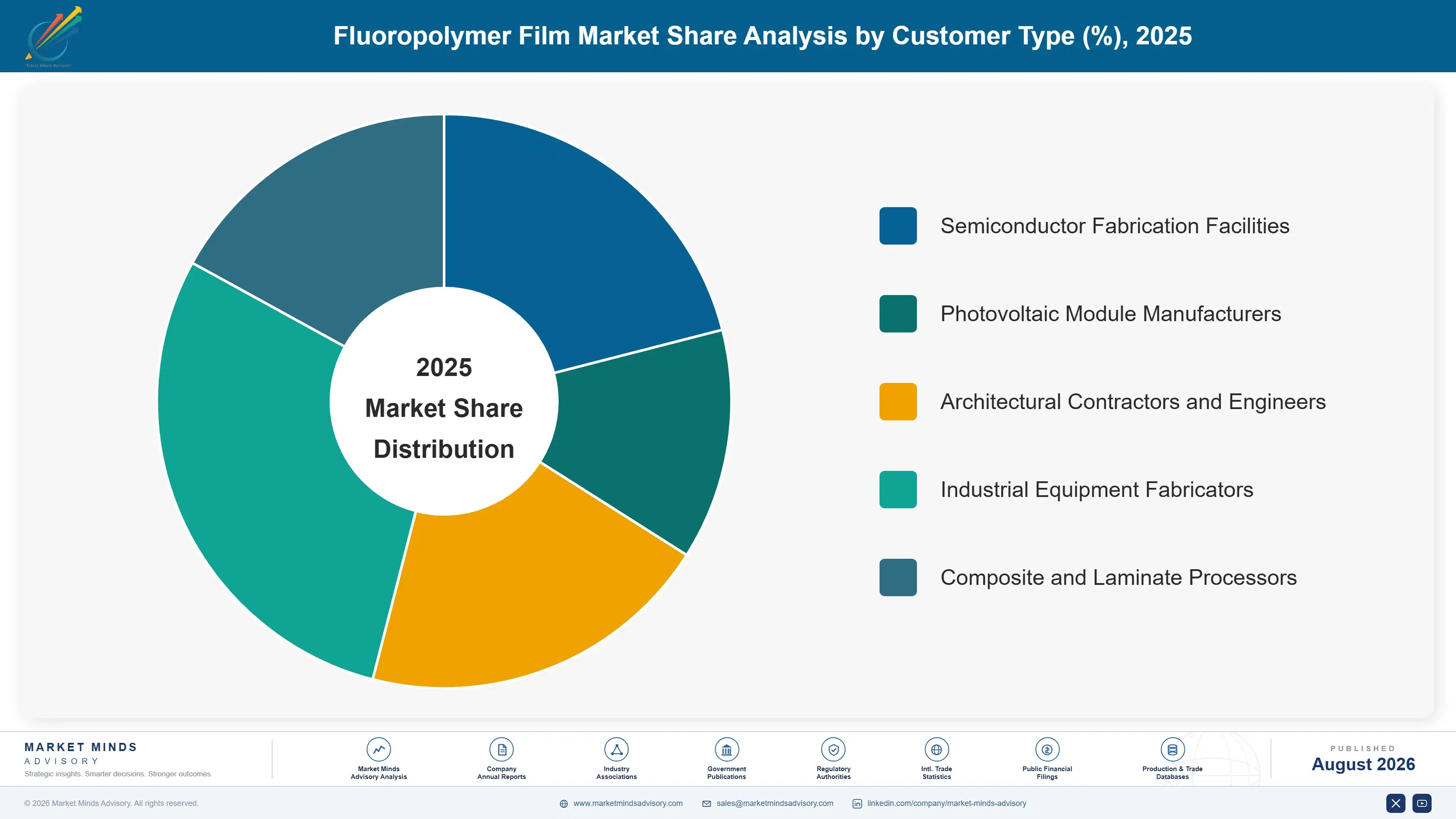
fluoropolymer-film-market-trends-market-share-analysis-1787551407171

ETFE Film

The fastest type at 9.6%, roughly 1.33 times the market, serving architectural membrane roofs and facades where high light transmission at a fraction of glass weight has no practical substitute. Large-span stadium, transport terminal, and atrium projects specify it for exactly that reason, and each installation is engineered rather than supplied off a roll. Weathering resistance across decades and self-cleaning surface behaviour both matter to the specifier. Volumes are modest against solar backsheet tonnage while value per kilogram runs far higher. Project pipelines are visible years ahead of installation dates. Fabrication tolerances, welding of panels, and long-term tensioning behaviour all sit with the specialist installer rather than the film producer, which shapes how the value divides.
CAGR 9.6%

PVDF Film

Second fastest at 8.4%, and the type carrying the most exposure to how solar module design develops from here. PVDF backsheets protect module rear surfaces across twenty-five year field lives, and glass-glass construction removes that requirement entirely on the 58% of new capacity now using it. Growth continues because module volumes are still expanding fast enough to offset penetration. PVDF also serves lithium battery separator coating, chemical process linings, and architectural coatings, and those applications face no comparable design threat at all. Battery separator coating in particular has grown quickly enough to absorb some of the capacity that backsheet decline releases, though qualification with cell manufacturers takes its own considerable time.
CAGR 8.4%
Full segment breakdown across 6 segments available in the complete report.

Regional Architecture and Country Demand Map

Regional shares follow fluoropolymer production capacity and the electronics, solar, and construction demand it serves. East Asia sits above the standard band for the reason stated below, and every other region falls inside its range across the forecast period. Production and consumption barely overlap anywhere outside Asia.

North America

Semiconductor fabrication expansion under domestic manufacturing incentives is pulling the highest-value film demand anywhere, since wet chemical handling at advanced nodes admits no substitute material and pricing reflects that. Chemours and Saint-Gobain operate significant regional capacity with deep qualification histories. Aerospace composite release film demand is substantial and technically demanding. Solar module manufacture has grown under domestic content rules, though new lines increasingly use glass-glass construction that needs no backsheet. Growth of 7.0% depends on semiconductor capacity conversion rather than on any solar volume at all. Regulatory pressure here has been directed at manufacturing emissions and legacy contamination rather than at the polymers themselves, which is a materially different position from the European one.
Share: 22% | CAGR: 7.0% (2026 to 2036)

Western Europe

Regulatory uncertainty over the proposed universal restriction shapes commercial planning here more than demand does, with customers in several industries evaluating substitution options they would not otherwise consider. Syensqo and Arkema hold established production positions and are actively engaged in the regulatory process. Architectural ETFE demand is strong, with European engineering practices leading membrane structure design globally. Chemical process and pharmaceutical equipment lining demand is steady. Growth of 5.6% is the slowest anywhere, held back by regulatory hesitation rather than by any underlying application weakness. Producers here have converted to surfactant-free polymerisation earlier than elsewhere, since documented manufacturing evidence is what customers ask for during a restriction process that remains genuinely unresolved.
Share: 19% | CAGR: 5.6% (2026 to 2036)
Regional intelligence for 5 additional markets available in the complete report: East Asia, South Asia and Pacific, Latin America, Middle East and Africa, Eastern Europe. Contact sales@marketmindsadvisory.com.
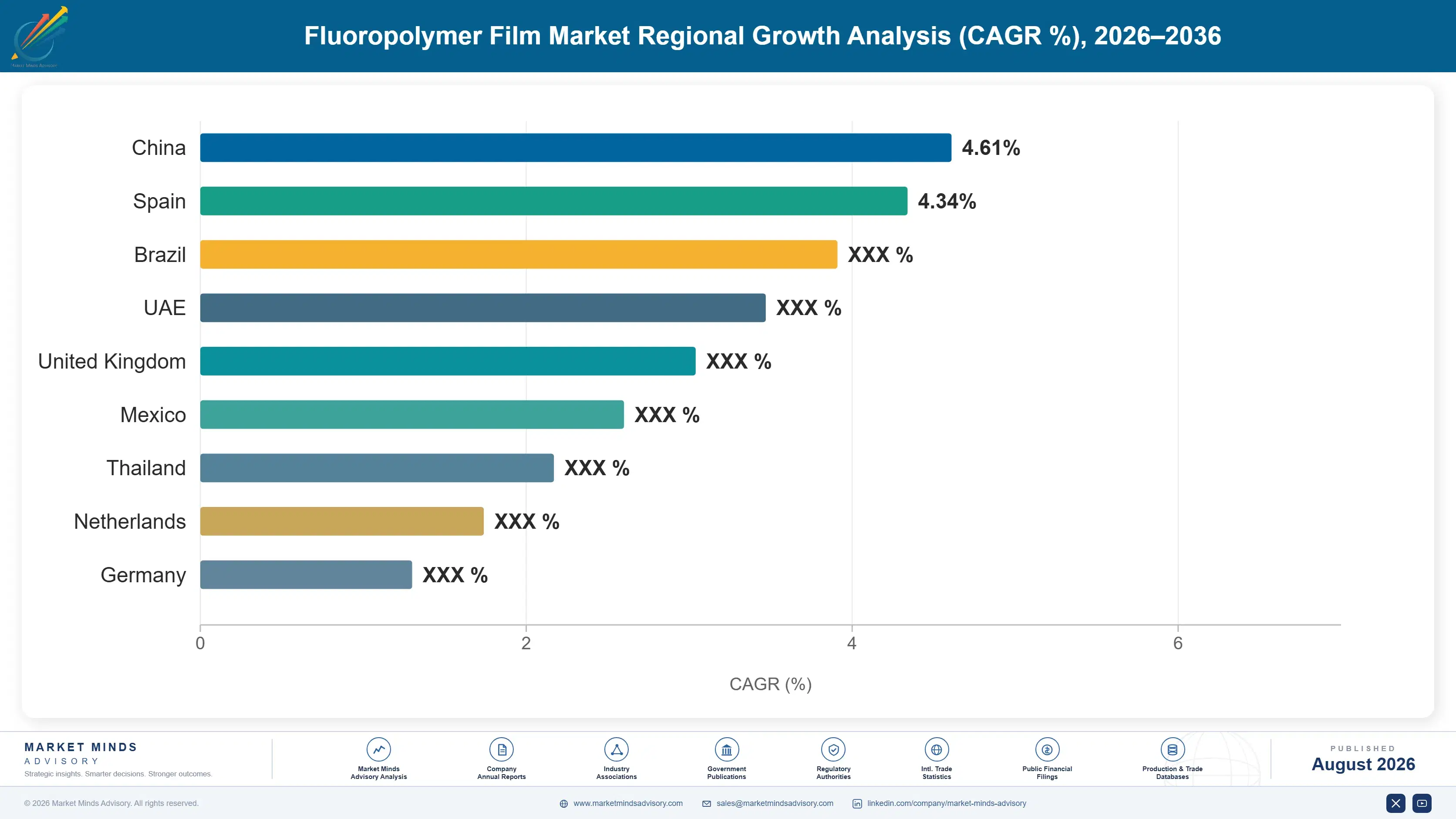
fluoropolymer-film-market-trends-country-cagr-analysis-1787551407693

Four Moves Against Two Threats

Advantage here comes from occupying applications where no alternative material works, from qualification cycles competitors cannot compress, and from getting ahead of a regulatory decision nobody controls. Four moves justify capital across the forecast period, and the first addresses the volume that is genuinely disappearing. The first is also the most urgent by some distance.

Reallocate capacity away from solar backsheet exposure

Glass-glass module construction already covers 58% of new capacity and removes the backsheet entirely rather than switching suppliers, which means the 39% of film volume in that application is closing rather than shifting. Producers who added lines through the solar boom face utilisation problems no sales effort resolves. Converting capacity toward release films, chemical linings, and battery separator coating takes engineering work and qualification time, and starting after the utilisation gap opens is considerably too late. Battery separator coating and chemical lining both absorb capacity, and qualification with those customers runs shorter than semiconductor approval does by a wide margin.
Market Impact: Reduces exposure across 39% of total film volume

Concentrate on applications with no material alternative

Semiconductor wet chemical handling, high-temperature release films, and architectural membranes all use fluoropolymers because nothing else survives the conditions, which puts pricing on scarcity rather than on production cost. Qualification cycles running 31 months protect those positions from anybody arriving later. Volume per application is small and value per kilogram is several times commodity film. Producers organised around tonnage rather than around irreplaceability are measuring the wrong thing entirely across their whole portfolio. Semiconductor approval takes around 31 months and architectural work runs through structural engineers years before delivery, so both require starting well ahead of any revenue.
Market Impact: Protected by qualification cycles running 31 full months

Eliminate fluorosurfactants before regulators require it

Manufacturing emissions from polymerisation aids are the most defensible criticism of this industry and the easiest to remove, and eliminating them strengthens the argument that high molecular weight polymers belong outside a universal restriction. Producers who have already converted can document it rather than promise it. Customers evaluating substitution during regulatory uncertainty respond to evidence rather than position papers. The conversion costs process development and it removes an argument the industry cannot otherwise answer. Conversion typically takes 18 to 24 months of process development, and customers evaluating substitution have already begun switching on documentation grounds alone.
Market Impact: Defends the 19% of demand under regulatory review

Secure fluorspar supply through the whole chain

Every fluoropolymer traces to fluorspar concentrated in China, Mexico, and few other origins, and feedstock represents around 24% of production cost with pricing driven by Chinese export policy rather than by any market mechanism. Long-term supply agreements, hydrofluoric acid integration, and recovery of fluorinated process streams all reduce that exposure. Producers buying spot into a concentrated upstream market are running a position they never chose and cannot hedge through any financial instrument. Recovery of fluorinated process streams adds a further route that was ignored while feedstock was cheap and now pays back inside a few years.
Market Impact: Addresses the 24% of production cost sitting upstream

Who Controls the Margin Pool

Concentration is high at roughly 58% for the top five on film supply revenue, sustained by fluorine chemistry that very few companies operate safely and by qualification histories accumulated over decades. Chemours and Daikin lead across the broadest polymer ranges. AGC holds strong positions in ETFE and electronic films, Syensqo brings European production and regulatory engagement, and Saint-Gobain is strong in converted and engineered film products.
Competition runs on three dimensions. Application irreplaceability is the first, since pricing follows the absence of alternatives rather than any cost structure. Qualification history is the second, protecting positions through cycles measured in years. Regulatory positioning is the third, because customers evaluating substitution during uncertainty choose suppliers who can document rather than promise. Cost position barely enters the conversation at all.

Pressure is building from two directions that neither incumbents nor challengers control. Regulatory decisions in Europe will determine whether large parts of this market remain accessible there. Chinese producers keep advancing into qualified applications as time erodes barriers that were always temporal. Rankings will shift toward producers holding irreplaceable applications and clean manufacturing evidence together. Neither of those pressures responds to anything a commercial team does.
fluoropolymer-film-market-trends-company-positioning-matrix-1787551408220

Competitive Moat and Risk Dimensions

CHEMOURS

Moat: Fluorine chemistry integration and breadth

Chemours operates the upstream fluorine chemistry alongside polymer and film production, which secures feedstock in a chain where fluorspar concentration creates genuine supply risk for anybody buying in. Product breadth across PTFE, PFA, FEP, and PVDF reaches customers needing several materials from one qualified source. Decades of qualification history across semiconductor and industrial applications are not purchasable.
CHEMOURS

Risk: Legacy chemistry liability exposure

Historical fluorosurfactant use carries litigation and remediation exposure that shapes how regulators and customers view the company independently of current manufacturing practice. That association complicates the industry argument that modern fluoropolymer production belongs outside a universal restriction. Competitors without the same history can make the case more comfortably, whatever the technical merits happen to be.
AGC

Moat: ETFE and electronic film leadership

AGC holds the strongest position in ETFE architectural membrane and in electronic films for semiconductor and display manufacture, both applications where alternatives do not exist and pricing reflects it. Architectural projects require engineering support and decade-long weathering evidence that a materials supplier alone cannot provide. Electronic qualification histories across Japanese, Korean, and Taiwanese fabs are equally hard to approach.
AGC

Risk: Limited solar volume offset

Lower exposure to solar backsheet volume protected AGC from the glass-glass transition, and it also means less tonnage to absorb fixed costs across fluorine chemistry that carries substantial fixed investment. Specialised positions deliver excellent margins on modest volume. Scaling into higher-tonnage applications means competing where Chinese producers have already established genuine cost positions.

Players Tracked

Prominent Players

Chemours
Daikin Industries
AGC
Syensqo
Saint-Gobain Performance Plastics

Other Key Players

3M
Arkema
Gujarat Fluorochemicals
Zeus Industrial Products
Nitto Denko
Polyflon
Textile Coated International
Rogers Corporation
Guarniflon
Shanghai 3F New Materials
Dongyue Group
Juhua Group
Vector Foiltec
Taconic
Markel Corporation

Recent Developments

FEBRUARY 2025

Module manufacturer converts remaining lines to glass-glass

A large photovoltaic manufacturer converted its remaining backsheet module lines to glass-glass construction, citing durability warranty terms, bifacial output, and thin glass costs that had fallen below polymer backsheet equivalents. The change removed the application rather than switching between film suppliers. Supplier pricing was never discussed.
Signal: Backsheet demand is closing rather than shifting, which no supplier relationship or pricing response can address
JUNE 2025

Producer completes fluorosurfactant-free polymerisation conversion

A fluoropolymer producer completed conversion of its polymerisation processes to surfactant-free routes across all film grades, publishing emissions data alongside the announcement. Customers evaluating substitution under regulatory uncertainty had specifically requested documented evidence rather than commitments about future practice. Independent verification by a third party followed shortly.
Signal: Documented manufacturing change is what customers now accept during regulatory uncertainty, rather than any industry position statement
NOVEMBER 2025

Semiconductor fab qualifies alternative film supplier after 31 months

An advanced node fabrication facility completed qualification of a second fluoropolymer film supplier for wet chemical handling, a process that had run for thirty-one months from initial evaluation. Supply security under regulatory uncertainty rather than pricing had driven the dual sourcing decision entirely. Cost was not a factor.
Signal: Qualification timelines make supply diversification a multi-year project that customers are now starting well in advance

What Sits Behind the Kilogram

Fluorspar-derived feedstock accounts for roughly 24% of production cost, traced through hydrofluoric acid and monomer synthesis to mineral supply concentrated in China, Mexico, and a handful of other origins. Energy for polymerisation and film extrusion takes a further 21%, and fluoropolymer processing runs at temperatures well above conventional polymers. Emissions abatement and process safety absorb 14%. Skilled operating labour and qualification maintenance carry most of the remainder.
Fluorspar and hydrofluoric acid pricing moved sharply through 2022 and 2023 on Chinese export policy and environmental enforcement rather than on any demand signal, and producers without upstream integration absorbed it directly. Chemours and Daikin both discussed feedstock cost pressure in their reporting for those years. European energy costs compounded the problem regionally, since fluoropolymer extrusion is genuinely energy intensive compared with commodity film production.

Exposure divides on integration and application mix rather than on scale. Producers operating their own fluorine chemistry carry feedstock risk as an internal transfer rather than a purchase. Those buying monomer face concentrated upstream pricing they cannot hedge. Application mix matters equally: semiconductor and architectural film prices on scarcity and absorbs input movement comfortably, while backsheet film competing against glass has no headroom at all.
fluoropolymer-film-market-trends-cost-volatility-analysis-1787551408415

Integrate or contract long term into fluorine chemistry

Feedstock at 24% of production cost traces to a concentrated mineral supply with pricing driven by Chinese export policy rather than any market mechanism, and no financial instrument hedges it. Upstream integration removes the exposure entirely and long-term supply agreements reduce it substantially. Producers buying monomer spot are running an unhedged commodity position they never deliberately chose to hold.

Recover and reprocess fluorinated waste streams

Fluorinated process streams and off-specification material were historically discarded, and recovery routes now exist that return usable fluorine into the chain at costs well below fresh feedstock. The environmental argument runs alongside the economic one, which matters considerably during regulatory scrutiny. Capital requirements are moderate and the payback improves each time fluorspar pricing moves upward again.

Weight the portfolio toward scarcity-priced applications

Semiconductor, architectural, and release film applications price on the absence of alternatives and absorb feedstock and energy movement without difficulty. Backsheet film competing against glass has no headroom whatsoever and every input increase lands on margin directly. Mix shift is the only input cost defence that also addresses the application closure happening simultaneously in solar.

Portfolio Architecture for Margin Defence

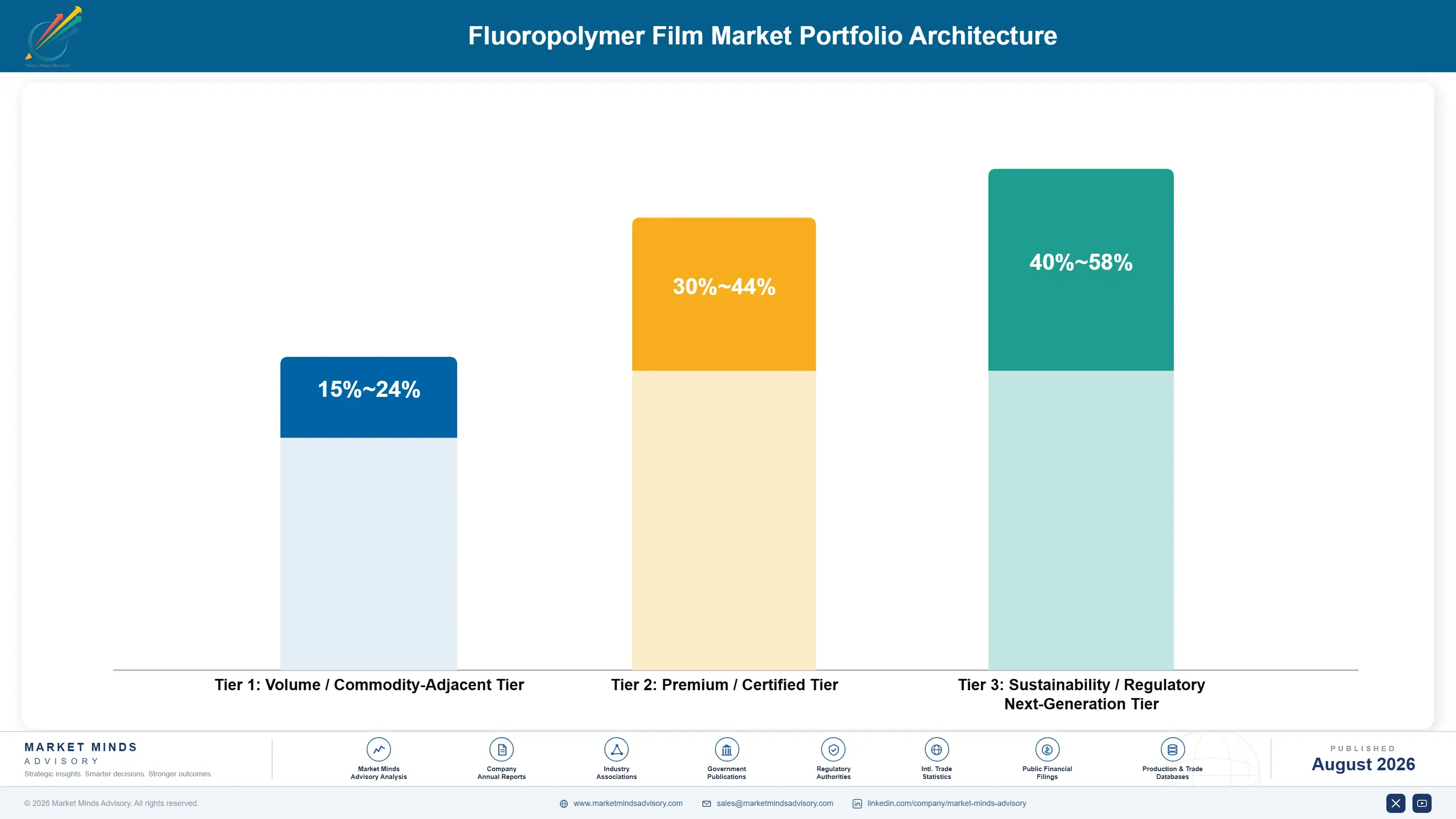
Margin architecture follows whether an alternative material exists, and in fluoropolymers the answer is usually no, which explains pricing that looks indefensible on a cost basis. Solar backsheet film is the exception: it competes against a sheet of glass and prices accordingly. Semiconductor, architectural, and release applications price on scarcity. Chemical lining sits between, defended by performance rather than by any absolute absence of options.
The volume and premium tension is unusually stark because the volume is disappearing. Backsheet supply provided tonnage that loaded capacity and made fixed cost absorption comfortable across the last decade. Glass-glass construction is removing it. What remains is a portfolio of small, high-value, difficult applications that returns better margins on considerably less throughput, which is a genuinely awkward transition for anybody with recently built capacity.

High-value pools concentrate in semiconductor handling films, architectural ETFE with engineering support attached, and release films locked into customer process qualifications. Each is defended by qualification history, application knowledge, or the simple absence of any substitute, which is a far better position than tonnage ever provided in this industry. Tonnage was never the right measure in this business.

Volume / Commodity-Adjacent Tier

Solar backsheet film and general industrial grades competing against non-fluorinated alternatives or, in solar, against glass itself. Pricing has no headroom and the application is closing rather than merely contested.
Gross Margin: 15%-24%

Premium / Certified Tier

Release films for composite and circuit board lamination, chemical process linings, and wire insulation tapes where performance requirements exclude alternatives. Process qualification defends the position. The range reflects wide variation between application severities.
Gross Margin: 30%-44%

Sustainability / Regulatory / Next-Generation Tier

Semiconductor handling films, architectural ETFE with engineering support, and surfactant-free grades documented against regulatory scrutiny. Scarcity and qualification history both defend pricing. The range is wide because semiconductor and architectural economics differ completely.
Gross Margin: 40%-58%
fluoropolymer-film-market-trends-portfolio-architecture-1787551408912

High-value Sub-segments and Strategic Watch-out

Semiconductor Handling Films

Priced on the absence of any alternative at parts-per-trillion purity, protected by qualification cycles running 31 months, and pulled by advanced node capacity expansion across four regions simultaneously. Volume is small and value enormous. No design change anywhere currently threatens this particular application at all.
Gross Margin: 44%-58%

Architectural ETFE Membranes

Growing at 9.6% on large-span projects where lightweight transparency has no practical substitute at all. Each installation is engineered rather than supplied, and project pipelines are visible years ahead of any delivery. Engineering support and long weathering evidence matter more than any material property comparison.
Gross Margin: 38%-50%

Process-Qualified Release Films

Composite and circuit board lamination processes qualify a specific film and then rarely revisit it, which makes the consumable repeat business unusually durable. No design change elsewhere threatens the application at all. Qualification runs long and then holds until the customer itself changes its own process.
Gross Margin: 32%-44%

Solar Backsheet Supply

The strategic watch-out. Glass-glass construction covers 58% of new module capacity and removes the backsheet rather than switching suppliers, so the 39% of volume sitting here is closing rather than contested. Producers who added lines during the solar boom now face utilisation problems no pricing resolves.
Gross Margin: 15%-24%

How Film Gets Designed In

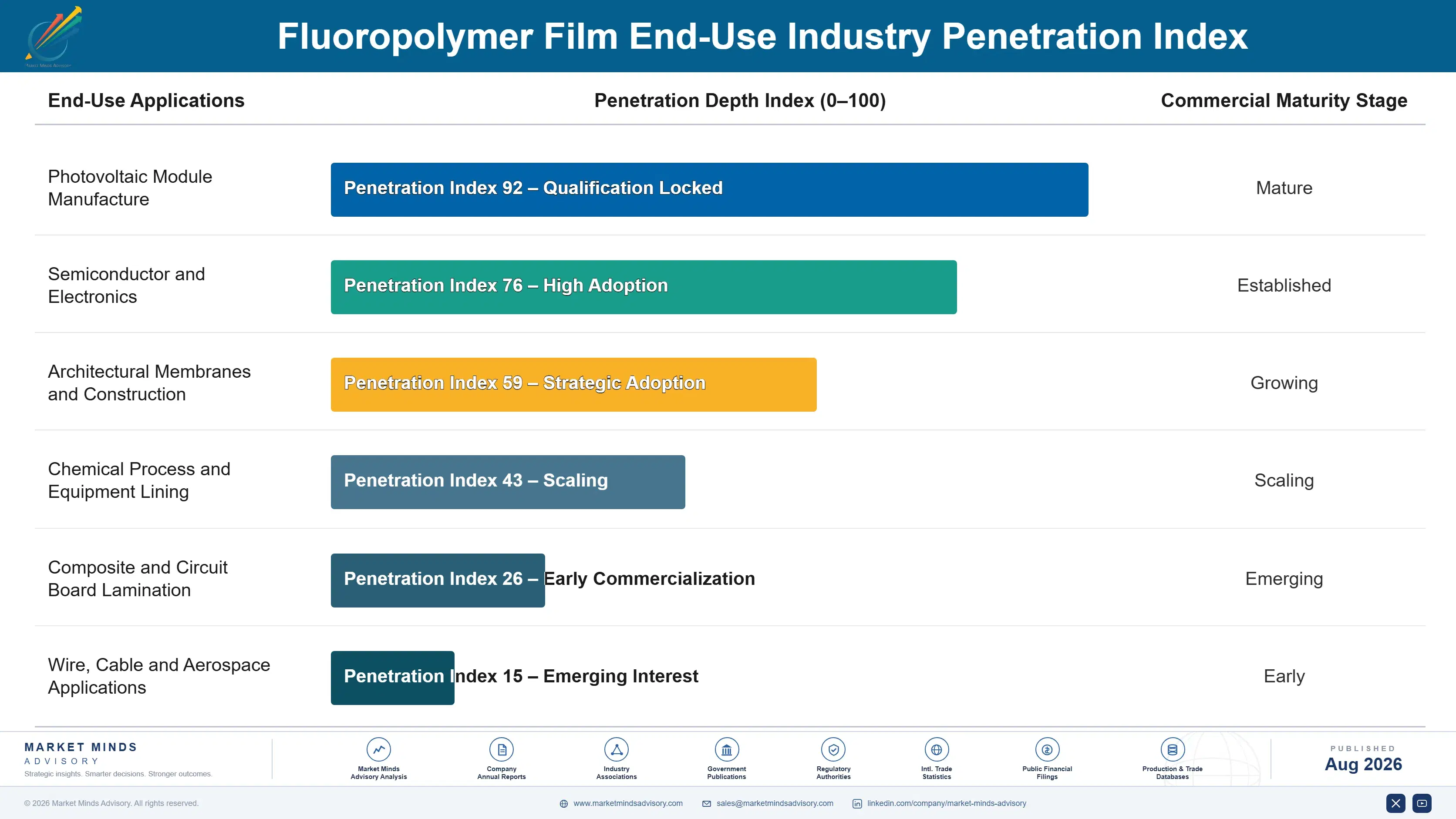
Demand reaches producers through qualification rather than through purchasing, which is unusual for a material sold by the kilogram. A semiconductor fab, composite manufacturer, or module maker evaluates a film against process conditions over a period measured in months or years, writes it into a specification, and then buys it repeatedly without revisiting the choice. Architectural projects work differently again, running through structural engineers and facade consultants years before any material ships anywhere.
Stickiness follows the qualification depth almost exactly. Semiconductor approvals hold for the life of a process node. Release film qualifications hold until the customer changes its own process. Architectural specifications hold through the project and confer nothing afterwards. Solar backsheet supply held until the module designers removed the component altogether. Nothing about the film itself created any of that durability.

The deciding buyer sits in process engineering rather than procurement across almost every application here. Those people evaluate extractables, thermal performance, and dimensional stability, and they are considerably more interested in supply continuity under regulatory uncertainty than in unit pricing. Producers selling on price into that conversation are answering a question nobody asked them. Supply continuity is what those conversations are actually about now.
fluoropolymer-film-market-trends-end-use-penetration-index-1787551409399

Where the Business Survives

These are among the four positions where our research anticipates prominent divergence between winners and laggards over the coming forecast period. Each is grounded in the demand model, the regulatory perimeter, and the announced capacity pipeline.
01 / BACKSHEET EXPOSURE REDUCTION

Move capacity before the utilisation gap opens

Glass-glass module construction already covers fully 58% of new photovoltaic manufacturing capacity and removes the polymer backsheet completely rather than moving it between competing suppliers at all. That closes the application holding 39% of fluoropolymer film volume, and no commercial effort or pricing response addresses an application that no longer exists anywhere. Converting lines toward release films, chemical linings, and battery separator coating requires engineering work and qualification time, so beginning after utilisation falls is considerably too late by then.
02 / APPLICATION IRREPLACEABILITY POSITIONING

Sell where nothing else survives the conditions

Semiconductor wet chemical handling, high-temperature release films, and architectural membranes all specify fluoropolymers because no other material tolerates the conditions at all, which puts pricing on scarcity rather than on any production cost basis whatsoever. Qualification cycles running roughly 31 months then genuinely protect those positions against anybody arriving at any point afterwards. Volume per application is small and value per kilogram runs several times commodity film, so producers still measuring themselves on tonnage are tracking exactly the wrong number entirely.
03 / MANUFACTURING EMISSIONS EVIDENCE

Document the conversion, do not promise it

Polymerisation aid emissions are the most defensible criticism of fluoropolymer manufacture and also the easiest to remove, and eliminating them strengthens the industry argument that high molecular weight polymers sit outside a universal restriction of the class. Producers who have already converted can publish emissions data rather than describe intentions, which is what customers evaluating substitution under regulatory uncertainty actually want to see. Process development costs money and it removes an argument the industry otherwise has no good answer to at all.
04 / FEEDSTOCK CHAIN SECURITY

Own or contract the fluorine, never buy spot

Every fluoropolymer traces back to fluorspar concentrated in China, Mexico, and a small number of other origins, with feedstock representing roughly 24% of production cost and pricing driven by export policy rather than by any market mechanism anybody can influence. No financial instrument hedges that exposure at all. Upstream integration removes it entirely, long-term agreements reduce it substantially, and producers buying monomer on spot terms are carrying a commodity position they never deliberately decided to take on in the first place.

Engagement Snapshot From the Field

A live engagement with an industry participant carrying material or product regulatory and market exposure ahead of a defining policy shift, showing how our research translates into a defensible multi-year portfolio strategy.
MARKET MINDS ADVISORY · CLIENT ENGAGEMENT SUMMARY
Fluoropolymer Film Producer Strategic Portfolio Review and Transition Roadmap 2026·Investment Scenario on Fluoropolymer Film Exposure Evaluation 2025-26
CLIENT PROFILE
An Asian fluoropolymer film producer with revenue near USD 240 million (client-reported, unverified by MMA), supplying solar backsheet film alongside smaller volumes of chemical lining and release grades. Backsheet represented the substantial majority of tonnage, semiconductor qualification had never been pursued, and capacity had been expanded twice during the solar boom. Application diversification had never been funded.
STRATEGIC CHALLENGE
Glass-glass module conversion at two major customers had removed a large volume commitment with eighteen months of notice, leaving new capacity underutilised and no qualified alternative application to redirect it toward. Feedstock was purchased rather than integrated. Regulatory uncertainty was raising questions from European customers the business could not answer with evidence.
MMA APPROACH
MMA modelled backsheet volume decline against glass-glass penetration rates by module manufacturer, assessed qualification timelines and capital requirements for release film and semiconductor applications, and evaluated feedstock contracting options. Forty-seven expert interviews with module designers, semiconductor process engineers, composite manufacturers, and regulatory specialists established where demand genuinely persists. Line conversion costs were estimated for each candidate application.
KEY FINDINGS
  1. Backsheet volume decline was running ahead of the client's own projections, since glass-glass conversion decisions at module makers were being taken faster than announcements suggested.
  2. Release film for composite lamination required modest equipment modification and around eighteen months of customer qualification, making it the fastest available conversion for existing lines.
  3. Semiconductor qualification would take at least thirty-one months and substantial cleanroom investment, but the pricing available justified beginning immediately rather than after the backsheet decline completed.
  4. European customers were asking for documented polymerisation emissions data the client could not supply, and two had already begun evaluating alternative suppliers on that basis alone.
CLIENT PROFILE
An Asian fluoropolymer film producer with revenue near USD 240 million (client-reported, unverified by MMA), supplying solar backsheet film alongside smaller volumes of chemical lining and release grades. Backsheet represented the substantial majority of tonnage, semiconductor qualification had never been pursued, and capacity had been expanded twice during the solar boom. Application diversification had never been funded.
STRATEGIC CHALLENGE
Glass-glass module conversion at two major customers had removed a large volume commitment with eighteen months of notice, leaving new capacity underutilised and no qualified alternative application to redirect it toward. Feedstock was purchased rather than integrated. Regulatory uncertainty was raising questions from European customers the business could not answer with evidence.
MMA APPROACH
MMA modelled backsheet volume decline against glass-glass penetration rates by module manufacturer, assessed qualification timelines and capital requirements for release film and semiconductor applications, and evaluated feedstock contracting options. Forty-seven expert interviews with module designers, semiconductor process engineers, composite manufacturers, and regulatory specialists established where demand genuinely persists. Line conversion costs were estimated for each candidate application.
KEY FINDINGS
  1. Backsheet volume decline was running ahead of the client's own projections, since glass-glass conversion decisions at module makers were being taken faster than announcements suggested.
  2. Release film for composite lamination required modest equipment modification and around eighteen months of customer qualification, making it the fastest available conversion for existing lines.
  3. Semiconductor qualification would take at least thirty-one months and substantial cleanroom investment, but the pricing available justified beginning immediately rather than after the backsheet decline completed.
  4. European customers were asking for documented polymerisation emissions data the client could not supply, and two had already begun evaluating alternative suppliers on that basis alone.
RECOMMENDED STRATEGY
Phase 1: Phase one: begin release film qualification with composite manufacturers immediately, since it converts existing lines fastest and requires the least capital investment. Phase 2: Phase two: commit cleanroom capital and start semiconductor qualification now, accepting the thirty-one month timeline rather than waiting for backsheet volumes to fall further. Phase 3: Phase three: convert polymerisation to surfactant-free routes and publish emissions data, answering the European customer questions with evidence rather than commitments.
OUTCOME
The client qualified release film with two composite manufacturers within sixteen months and redirected a full line. Semiconductor qualification began, polymerisation conversion completed at one site, and blended gross margin improved 7.3 percentage points despite falling backsheet volume (client-reported, unverified by MMA). A second line conversion is under evaluation.

Frequently Asked Questions

Foundational context covering the market sizes, CAGR, scope, country, region and competition that inform every finding below. This section is provided to cover basics and most often pre-purchase conversations, answered from the MMA Primary Research Dataset.

What is the current size of the Fluoropolymer Film Market?

The market was valued at USD 2.6 billion in 2025, rising to an estimated USD 2.79 billion in 2026. East Asia holds the largest regional share at 34% of value.

How large will the Fluoropolymer Film Market be by 2036?

MMA forecasts USD 5.59 billion by 2036 under the base case, an expansion multiple of 2.0 times the 2026 value. That represents USD 2.8 billion of incremental value.

What is the CAGR for the Fluoropolymer Film Market 2026 to 2036?

The base case CAGR is 7.2%, with a bull case of 8.4% and a bear case of 6.0%. The spread reflects uncertainty over PFAS regulation and glass-glass module penetration.

Which segment is growing fastest?

ETFE film grows fastest at 9.6%, roughly 1.33 times the market rate, on architectural membrane projects. PVDF film follows at 8.4% despite backsheet exposure to glass-glass module conversion.

Who are the major companies in the Fluoropolymer Film Market?

Chemours, Daikin Industries, AGC, Syensqo, and Saint-Gobain Performance Plastics lead, holding roughly 58% between them. Fluorine chemistry capability and qualification history sustain that concentration rather than any manufacturing cost advantage.

Which country is growing fastest?

India grows fastest at 10.4%, on domestic fluoropolymer production expansion and solar module assembly under production-linked incentives. Gujarat Fluorochemicals has built genuine international capability there.

Report Segmentation Architecture

The full report scope spans multiple orthogonal segmentation dimensions, with cross-tabulated demand data provided for each dimension pair. Coverage extends further to regional breakdowns, trend trajectories, and the competitive detail needed to support segment-level decision-making.

By Polymer Type

  • PVDF Film
  • ETFE Film
  • PTFE Film and Skived Tape
  • FEP Film
  • PFA Film
  • PVF Film

By End-Use Industry

  • Photovoltaic Module Manufacture
  • Semiconductor and Electronics
  • Architectural Membranes and Construction
  • Chemical Process and Equipment Lining
  • Composite and Circuit Board Lamination
  • Wire, Cable and Aerospace Applications

By Customer Type

  • Semiconductor Fabrication Facilities
  • Photovoltaic Module Manufacturers
  • Architectural Contractors and Engineers
  • Industrial Equipment Fabricators
  • Composite and Laminate Processors

By Region

  • North America
  • Western Europe
  • East Asia
  • South Asia and Pacific
  • Latin America
  • Middle East and Africa
  • Eastern Europe

Scope, Methodology, and Coverage

Every figure in this report is reproducible from documented input assumptions. The scope below maps the historical period, the forecast horizon, the segmentation dimensions, and the countries covered, alongside the underlying primary and qualitative methodology.
Historical Period
2020 to 2025
Forecast Period
2026 to 2036
Base Year
2025 (USD billions; MMA Primary Research Dataset, August 2026)
Market Definition
The market comprises fluoropolymer films supplied to industrial, electronic, energy, and construction users, covering PVDF film, ETFE film, PTFE film and skived tape, FEP film, PFA film, and PVF film. Value is measured at film producer level across photovoltaic, semiconductor, architectural, chemical process, and lamination applications. Fluoropolymer resin sold as pellet or powder, fluoropolymer coatings and dispersions applied as liquids, fluoroelastomers, tubing and moulded components, non-fluorinated barrier films, and finished modules or laminates fall outside scope.
Quantitative Units
USD billions (current prices); thousand tonnes of film produced annually; USD per kilogram by polymer type and thickness grade
Segmentation Dimensions
By Polymer Type; By End-Use Industry; By Customer Type; By Region
Regions Covered
North America, Western Europe, East Asia, South Asia and Pacific, Latin America, Middle East and Africa, Eastern Europe
Countries Covered
China, Japan, South Korea, Taiwan, India, Singapore, Malaysia, Australia, Thailand, United States, Canada, Mexico, Germany, France, Belgium, Italy, Netherlands, United Kingdom, Spain, Switzerland, Poland, Czechia, Hungary, Brazil, Chile, Argentina, Saudi Arabia, United Arab Emirates, Qatar, South Africa
Key Companies Profiled
Chemours, Daikin Industries, AGC, Syensqo, Saint-Gobain Performance Plastics, 3M, Arkema, Gujarat Fluorochemicals, Zeus Industrial Products, Nitto Denko, Polyflon, Textile Coated International, Rogers Corporation, Guarniflon, Shanghai 3F New Materials, Dongyue Group, Juhua Group, Vector Foiltec, Taconic, Markel Corporation
Quantitative Methodology
Primary survey, n=3,800 respondents, Q4 2025, six countries; demand-side model with trade association cross-validation
Qualitative Methodology
47 expert interviews, Q4 2025; applied to validate demand model assumptions, identify emerging dynamics, and assess competitive positioning
Report Format
PDF and XLSX data workbook (Word format preview document)
Publisher
Market Minds Advisory
Report Code
MMA-2026-CHM-372
Published
August 2026
Contact
sales@marketmindsadvisory.com | www.marketmindsadvisory.com

Purchase the full Fluoropolymer Film Market Report (2026 to 2036).

The full report sizes fluoropolymer film demand across six polymer types, six end-use industries, and seven regions with 2026 to 2036 forecasts under base, bull, and bear cases. It models solar backsheet decline against glass-glass module penetration explicitly, since that application closure is the largest single variable in the market. Competitive profiles cover twenty producers assessed consistently on film supply revenue, fluorine chemistry integration, and qualification history. Cost analysis traces fluorspar, energy, and abatement exposure by integration position. Commercial guidance addresses backsheet reallocation, irreplaceability positioning, emissions documentation, and feedstock chain security.
Six polymer types sized separately by region
Backsheet volume modelled against glass-glass module penetration
PFAS restriction scenarios assessed by application and jurisdiction
Qualification cycle lengths mapped across major end-use industries
Fluorspar supply concentration traced through the production chain
Surfactant-free conversion status tracked by producer and site

Built For The People Who Decide

From boardroom strategy to bench-side execution, this report is read cover-to-cover by leaders shaping the next decade of their industry, turning demand scenarios, market dynamics and valuation benchmarks into decisions.
CXOs/ Presidents/ VPs/ Managers
M&A and Corporate Development
Strategy Teams and R&D Heads
Procurement and Product Directors
Regulatory and Compliance Leaders
Investor Relations and Equity Analysts