Market Minds Advisory
Fluoroelastomer Market

Fluoroelastomer Market: Semiconductor Demand and PFAS Regulatory Navigation

Semiconductor fabrication expansion and electric vehicle battery seal specifications are pulling fluoroelastomer demand toward higher-purity, lower-extractable grades as PFAS regulatory scrutiny simultaneously forces producers to defend the chemistry's continued industrial indispensability.

Lead Analyst

Bilal Shaikh

Published

September 2026

Make Smarter Decisions with Customized Research Insights

Request a free sample report and evaluate market opportunities, growth trends, and competitive dynamics relevant to your business needs.

2025 MARKET VALUE$4.9BMarket Size 2025
2036 FORECAST VALUE$9.1BBase Case , 2026 to 2036
CAGR 2026 TO 20365.8 %Bull 7.0% / Bear 4.6%
INCREMENTAL OPPORTUNITY$3.9BNet 10- year value creation
EXPANSION MULTIPLE1.75x2036 value over 2026 base
Strategic Levers
M&A Pipeline
Regional Outlook
Country Rankings
Competitive Intelligence
Segmental Deep-dive
Call-Us : 91 93563 13602

Executive Snapshot and Market Trajectory

PFAS regulatory scrutiny is colliding directly with irreplaceable performance requirements in semiconductor and EV battery sealing applications, forcing fluoroelastomer producers to defend essential-use exemptions while simultaneously investing in lower-extractable, next-generation formulations across most major end-use industries and regulatory jurisdictions worldwide and internationally.
Commercial demand concentrates around semiconductor fabrication equipment seals and electric vehicle battery and thermal management systems, where fluoroelastomer's chemical and heat resistance has no viable near-term substitute at comparable cost across most applications and industries. East Asia, anchored by Taiwan and China's semiconductor and EV manufacturing base, commands the largest consumption share worldwide, while North America and Western Europe compete on regulatory compliance formulation and aerospace-grade specification depth across their respective markets and supply chains.
Competitive intensity remains high given concentrated production among a handful of specialty fluoropolymer producers, since fluorine chemistry manufacturing carries substantial capital and environmental compliance barriers to entry across most jurisdictions and producing regions. Tightening PFAS restriction proposals across the European Union and United States are reshaping which producers can sustain supply continuity, favoring those with diversified low-extractable formulation portfolios over generic commodity grade producers competing purely on price.
Market Definition
The Fluoroelastomer Market covers FKM and related fluorine-based synthetic rubber compounds used in seals, O-rings, and gaskets requiring chemical and thermal resistance. It excludes fluoropolymer resins such as PTFE and PVDF used in non-elastomeric applications.
Base Year Value
$4.9B in 2025 (MMA Primary Research Dataset, August 2026)
Forecast Period
2026 to 2036, eleven discrete annual values
CAGR
5.8% base case. Bull 7.0%. Bear 4.6%.
Fastest Growth Segment
Semiconductor and Electronics Grade Fluoroelastomers: 9.4% CAGR
Fastest Growth Country
Vietnam: 7.5% CAGR
Fastest Growth Region
South Asia and Pacific: 7.8% CAGR
Largest Region
East Asia: 29% of 2025 global value
Market Leaders
Chemours, Daikin Industries, Solvay, AGC Inc., HaloPolymer. Source: MMA Analysis based on company annual reports.
Primary Survey
n=3,800 procurement and R&D decision-makers, Q4 2025, six countries
Methodology
Demand-side build-up, cross-validated against public data, 47 expert interviews

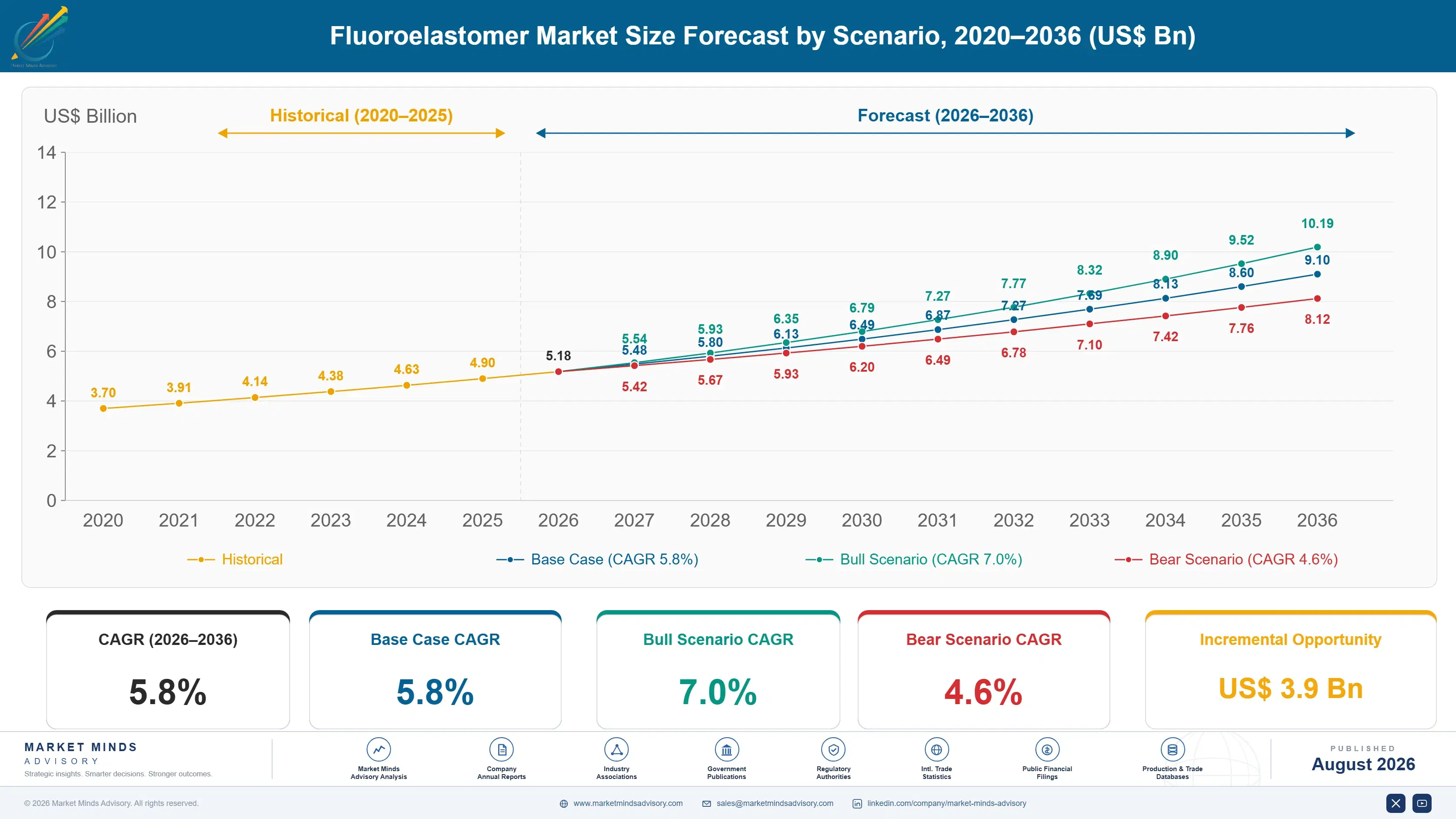
Fluoroelastomer Market Forecast Scenarios

fluoroelastomer-market-size-forecast-scenario-1787550785603
Fluoroelastomer demand grew steadily between 2020 and 2025, tracking semiconductor capital expenditure cycles and electric vehicle production ramp-up across major manufacturing regions worldwide, with automotive and industrial seal applications providing a stable demand base beneath these higher-growth end markets each year across most major producing and consuming regions nationwide, internationally, and across supply chains. Growth remained resilient even amid broader cycles.
The base case rests on three commercial mechanisms: continued semiconductor fabrication capacity expansion requiring specialized high-purity sealing compounds across new fab construction worldwide, electric vehicle battery and thermal management system growth pulling incremental demand for heat and chemical-resistant seals, and tightening industrial emissions and process chemical standards raising minimum performance specifications across oil and gas and chemical processing applications. Together these mechanisms sustain mid-single-digit volume growth even as PFAS regulatory pressure raises compliance costs.
The bull case centers on accelerated semiconductor fab construction pulling forward high-purity fluoroelastomer demand faster than currently modeled across major manufacturing hubs and supply chains. The bear case centers on aggressive PFAS restriction enactment in Europe or the United States without adequate essential-use exemptions, which would materially disrupt supply continuity and compress addressable market volume across most major consuming industries.

Purity Specification and Regulatory Compliance Economics

Three forces converge on this market at once: semiconductor fabrication capacity expansion requiring specialized high-purity, low-extractable sealing compounds across new fab construction worldwide and internationally each year, electric vehicle battery thermal management growth pulling incremental demand for heat and chemical-resistant seals, and tightening PFAS regulatory scrutiny forcing producers to simultaneously defend essential-use exemptions and invest in next-generation formulations across most major consuming industries and regulatory jurisdictions.
MARKET CONCENTRATIONCR5 58%Combined share held by top five fluoroelastomer producers
AVERAGE SELLING PRICE$22 per kilogramBlended average price across standard and semiconductor-grade formulations
TOP COUNTRY SHAREChina 24%Share held by the largest single national consuming market
SEMICONDUCTOR GRADE SHARE19%Share of volume tied to semiconductor fabrication equipment sealing
TRADE INTENSITY48%Share of global production volume moving across borders annually
FLUORSPAR FEEDSTOCK COST SHARE34%Primary fluorine input cost as share of total COGS
Commercially, the market increasingly rewards producers who can document low-extractable purity credentials alongside consistent chemical resistance performance, since semiconductor customers now screen suppliers on trace metal and ionic contamination levels before price across most major accounts and long-term supply agreements. Producers without semiconductor-grade qualification face persistently thinner margins competing purely on commodity automotive and industrial seal volume against Chinese producers scaling aggressively across most global markets and export corridors.
Over the next decade, differentiation will concentrate around low-extractable formulation chemistry and PFAS regulatory compliance documentation rather than raw production capacity, as semiconductor and EV specification tightening continues raising the bar for premium contract eligibility across most major producing regions worldwide, particularly among fabrication equipment and battery component suppliers, and their broader supply networks.
"Fluoroelastomer isn't a commodity anymore in the segments that matter; a chip fab won't even open the drum unless it comes with a full extractables report attached."
Director, Specialty Chemicals and Materials Practice · MMA Chemicals and Materials Practice · August 2026

Market Trends

Semiconductor Fab Expansion Drives Ultra-Pure Seal Demand

Global semiconductor fabrication capacity investment continues expanding as governments in the United States, Taiwan, South Korea, and the European Union subsidize domestic chip production under national security and supply chain resilience programs. Each new fab requires substantial volumes of ultra-high-purity fluoroelastomer seals for process chambers, gas delivery systems, and wafer handling equipment, where trace metal and ionic contamination tolerances are far stricter than general industrial applications require. This has created a distinct premium product category commanding significantly higher margins than standard automotive or industrial grade fluoroelastomer, and qualification cycles for new semiconductor equipment suppliers typically run well over a year.
Market Impact: EV seal content up 20 percent

PFAS Essential-Use Exemption Debate Reshapes Regulatory Risk

Regulatory bodies in the European Union and several United States jurisdictions are actively debating essential-use exemptions for fluoroelastomers within broader PFAS restriction proposals, recognizing the chemistry's near-irreplaceable role in semiconductor, aerospace, and energy applications across most major industrial sectors. Industry trade associations have submitted extensive technical documentation arguing for continued exemption status, while environmental advocacy groups push for tighter restrictions regardless of substitution difficulty or economic impact. The outcome of these ongoing regulatory processes will materially determine long-run addressable market size and compliance cost structure for every producer serving regulated markets.
Market Impact: Aerospace premiums near 25 percent

Market Opportunities and Growth Drivers

Electric Vehicle Battery Thermal Management Expands Seal Demand

Electric vehicle battery packs and thermal management systems require fluoroelastomer seals capable of withstanding sustained exposure to coolant chemicals and elevated operating temperatures over the vehicle's operational life, a demanding application profile that has grown substantially alongside EV production volume worldwide and across most manufacturing regions. Battery pack designs increasingly incorporate more sealing points per vehicle than comparable combustion engine platforms, multiplying fluoroelastomer content per unit produced. Major automakers have signed multi-year supply agreements with qualified fluoroelastomer suppliers to secure capacity ahead of planned EV production ramp-up across multiple vehicle platforms and manufacturing regions.
Market Impact: Compliance costs may add 15 percent

Aerospace and Defense Specification Tightening Lifts Premium Demand

Aerospace and defense procurement standards continue tightening around fluoroelastomer performance specifications for fuel system and hydraulic seals, particularly for next-generation aircraft programs requiring extended service intervals and higher temperature tolerance than legacy platforms currently in service across most major fleets. Qualified aerospace-grade fluoroelastomer suppliers command substantial pricing premiums over standard industrial grades given the extensive testing and certification investment required to achieve qualified supplier status across multiple aircraft programs. Continued commercial aircraft production backlogs and defense spending increases across multiple countries are sustaining this premium demand segment well into the coming decade.
Market Impact: China supplies over 60 percent

Market Restraints and Challenges

PFAS Restriction Proposals Threaten Long-Run Supply Continuity

Proposed broad-based PFAS restrictions in the European Union and several United States states could, without adequate essential-use exemptions, force fluoroelastomer producers to halt sales into regulated jurisdictions or face substantial compliance and reformulation costs. The root cause is regulatory frameworks that classify all per- and polyfluoroalkyl substances similarly regardless of the substantial performance and persistence differences between fluoroelastomers and other PFAS categories such as short-chain surfactants. Producers and trade associations are mitigating this by funding independent scientific studies distinguishing fluoroelastomer risk profiles and lobbying for essential-use exemption language in final regulatory text.
Market Impact: Fab-grade demand grew 14 percent

Fluorspar Feedstock Supply Concentration Creates Cost Exposure

Fluorspar, the primary mineral feedstock for fluorine chemistry production, is sourced from a geographically concentrated supply base dominated by China, creating exposure to export policy changes and trade restrictions that could disrupt input availability for producers outside China entirely. The root cause is limited economically viable fluorspar reserves outside a handful of producing countries, with substantial new mine development requiring many years of permitting and capital investment. Producers are responding by securing long-term supply contracts and, in some cases, investing directly in fluorspar mining joint ventures to reduce feedstock dependency.
Market Impact: Compliance costs rose 12 percent
4 additional market trends, 3 additional growth drivers, and 3 additional restraints and challenges are covered in the full report. Contact sales@marketmindsadvisory.com to access the complete intelligence.

Segment CAGR and Growth Architecture

Segmentation follows end-use application and purity tier, since procurement decisions increasingly hinge on contamination specification and application-specific performance rather than base polymer chemistry alone across most jurisdictions, customer segments, and industry verticals. Six segments span standard automotive sealing grades through ultra-high-purity semiconductor formulations engineered for trace contamination control across most major end-use industries worldwide.
fluoroelastomer-market-market-share-analysis-1787550786135

Semiconductor and Electronics Grade Fluoroelastomers

Semiconductor and electronics-grade fluoroelastomers, formulated to meet strict trace metal and ionic contamination limits required for fabrication equipment seals, are the fastest-growing segment as global semiconductor capacity investment continues expanding across the United States, Taiwan, South Korea, and the European Union each successive year and budget cycle. These formulations command significantly higher average selling prices than standard grades, reflecting both the specialized purification processes required and the lengthy qualification cycles that create durable customer relationships once achieved. Producers serving this segment must maintain dedicated clean production lines separate from standard commodity manufacturing to avoid cross-contamination, a capital investment that creates a meaningful barrier protecting incumbent suppliers from new entrant competition nationwide.
CAGR 9.4%

EV Battery and Thermal Management Grade

Electric vehicle battery and thermal management-grade fluoroelastomers, engineered for sustained coolant chemical exposure and elevated temperature tolerance, are growing nearly as fast as semiconductor-grade formulations as global EV production volume continues expanding across major automotive manufacturing regions worldwide, internationally, and across most vehicle platforms each successive year. These formulations require specific compatibility testing against battery coolant chemistries that vary by automaker platform, creating qualification requirements distinct from traditional automotive powertrain sealing applications and legacy specification standards. Contract structures here favor suppliers who can commit to multi-year capacity reservations aligned with automaker production ramp-up schedules, since battery program timelines are typically set years in advance of vehicle launch and market entry.
CAGR 8.6%
Full segment breakdown across 6 segments available in the complete report.

Regional Architecture and Country Demand Map

East Asia's semiconductor and EV manufacturing scale makes it the largest regional consumer of fluoroelastomer by volume worldwide each successive year and budget cycle. North America and Western Europe compete on regulatory compliance formulation and aerospace-grade specification depth across their networks, supply chains, and account relationships.

North America

North America's fluoroelastomer demand is increasingly anchored by domestic semiconductor fabrication capacity expansion under CHIPS Act incentives, which has pulled substantial new fab construction and associated ultra-high-purity sealing material demand into the United States over the past several years and across multiple states. Aerospace and defense procurement, concentrated heavily in this region, sustains premium-grade demand independent of broader industrial cycles given long-term government contracting relationships and extended aircraft production programs. PFAS regulatory uncertainty at both federal and state levels creates meaningful compliance planning complexity for producers serving this market, with several states pursuing restrictions ahead of any final federal regulatory framework, creating a genuinely fragmented compliance landscape across jurisdictions and industries.
Share: 27% | CAGR: 5.9% (2026 to 2036)

Western Europe

Western Europe's fluoroelastomer market operates under the most stringent PFAS regulatory scrutiny of any region tracked in this report, with the European Chemicals Agency actively evaluating broad restriction proposals that could reshape the addressable market considerably depending on final essential-use exemption scope and implementation timeline over the coming years and decade. Germany and France anchor regional demand through their large automotive and industrial equipment manufacturing bases, both increasingly specifying documented low-extractable formulations ahead of anticipated regulatory tightening. Aerospace manufacturing clusters in France and the United Kingdom sustain steady premium-grade demand, supported by long-standing qualified supplier relationships that new entrants find difficult to displace given lengthy aerospace certification timelines and testing requirements.
Share: 20% | CAGR: 4.3% (2026 to 2036)
Regional intelligence for 5 additional markets available in the complete report: East Asia, South Asia and Pacific, Latin America, Middle East and Africa, Eastern Europe. Contact sales@marketmindsadvisory.com.
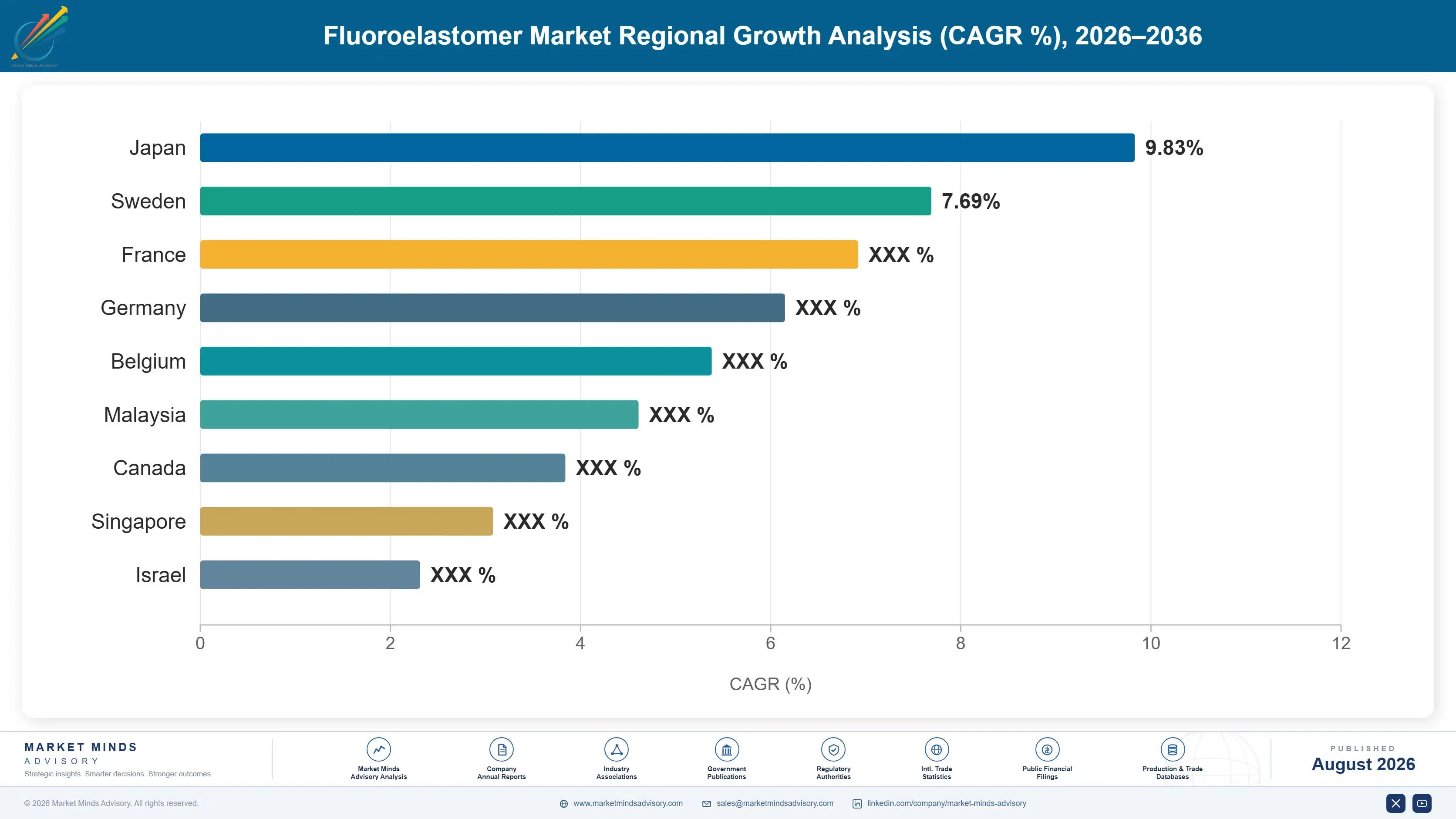
fluoroelastomer-market-country-cagr-analysis-1787550786639

Where Fluoroelastomer Producers Can Capture Margin

Fluoroelastomer margins compress on commodity automotive and industrial grades competing purely on price against Chinese producers, so durable revenue growth increasingly depends on purity certification, application-specific qualification, and PFAS compliance positioning rather than volume alone across the category. Four paths stand out across semiconductor qualification, EV programs, aerospace grades, and regulatory compliance leadership for producers investing ahead of demand.

Pursue Semiconductor Fab Equipment Qualification Now

Producers who invest in ultra-high-purity production lines and pursue formal qualification with semiconductor equipment manufacturers capture pricing power that commodity producers cannot match, since fab customers screen suppliers on trace contamination data before price enters the conversation at all in most negotiations and account reviews across the industry. Early movers report price premiums of roughly 40 to 60 percent on semiconductor-grade volume versus standard automotive grades, and qualification investment also creates multi-year customer lock-in once a supplier passes a fab's extensive extractables testing protocol and audit process across most fabrication sites.
Market Impact: Adds 40 to 60 percent price premium now

Secure Multi-Year EV Battery Program Supply Agreements

Producers who commit early to multi-year supply agreements aligned with automaker EV battery program timelines secure predictable volume years ahead of production launch, since battery program specification and supplier qualification typically lock in during vehicle development well before manufacturing begins in earnest across most global platforms, regions, and vehicle categories. This approach has delivered volume visibility and gross margin stability that spot-market commodity sales cannot match, particularly valuable given the multi-year capital planning cycles fluoroelastomer producers require to expand purpose-built capacity ahead of demand and production launch schedules. This locks in roughly 3 to 5 years of predictable purchase volume.
Market Impact: Secures 3 to 5 years of predictable volume

Expand Aerospace and Defense-Grade Certification Portfolio

Producers who pursue aerospace and defense qualified supplier status command meaningfully higher margins than standard industrial grade sales, since these accounts prioritize extensive testing documentation and long-term supply reliability over pure price competition across the account base, program lifecycle, renewal cycle, and contract term. Qualification requires sustained investment in certification testing infrastructure, but qualified suppliers typically retain multi-year contracts commanding price premiums of 25 to 35 percent over commodity-grade sales given the extensive barrier to entry certification represents for potential competitors entering the market. This barrier alone protects roughly 25 percent of category margin.
Market Impact: Commands a 25 to 35 percent premium now

Lead PFAS Regulatory Compliance and Documentation Strategy

Producers who proactively fund independent scientific research and build comprehensive regulatory compliance documentation infrastructure position themselves to retain market access even as PFAS restrictions tighten, while less-prepared competitors risk market exclusion in regulated jurisdictions and account bases nationwide, internationally, and across most major product categories and customer segments. This approach protects an estimated 15 to 20 percent of revenue exposed to potential European Union and United States regulatory restriction, converting regulatory risk into a durable competitive moat against less-prepared rivals across most major markets and product lines. This protection compounds further as restrictions phase in.
Market Impact: Protects 15 to 20 percent of total revenue

Who Controls the Margin Pool

The fluoroelastomer market is highly concentrated, with CR5 near 58 percent measured on revenue, since fluorine chemistry manufacturing requires substantial capital investment and specialized environmental compliance capability that few new entrants can economically justify. The gap between the top five producers and mid-tier regional challengers is wider than in most specialty chemical categories.
Current competitive activity centers on three dimensions: semiconductor fab equipment qualification racing to secure ultra-high-purity contracts ahead of competitors, PFAS regulatory compliance investment positioning producers to retain market access as restrictions tighten, and vertical integration into fluorspar feedstock supply to reduce exposure to Chinese export policy changes. Producers are also expanding aerospace and defense qualified supplier status to capture durable premium contracts.

Emerging pressure comes from Chinese producers who continue expanding domestic capacity and gradually building semiconductor-grade qualification credentials to contest premium accounts previously dominated by established Western and Japanese producers. Rankings are most likely to shift as PFAS regulatory outcomes finalize in major jurisdictions and as semiconductor fab construction continues its geographic diversification, rewarding producers who invested early in regulatory compliance and multi-region production capacity over those competing purely on price.
fluoroelastomer-market-company-positioning-matrix-1787550787158

Competitive Moat and Risk Dimensions

CHEMOURS

Moat: Established Viton Brand Qualification

Chemours' Viton brand carries decades of established semiconductor and aerospace qualification history that competitors cannot quickly replicate, giving it deep specification relationships embedded in customer equipment designs across multiple generations. Its scale in fluorine chemistry manufacturing also supports continued investment in low-extractable next-generation formulations ahead of most competitors.
CHEMOURS

Risk: PFAS Litigation Exposure

Chemours faces significant ongoing PFAS litigation exposure unrelated to fluoroelastomer specifically, creating financial and reputational risk that could affect capital allocation toward fluoroelastomer capacity expansion and research investment. Regulatory scrutiny of the broader Chemours PFAS portfolio also creates headline risk that could indirectly affect customer perception of its fluoroelastomer products.
DAIKIN INDUSTRIES

Moat: Vertical Feedstock Integration

Daikin Industries' vertical integration from fluorspar feedstock through finished fluoroelastomer production gives it cost and supply security advantages that non-integrated competitors cannot match, particularly valuable given fluorspar's concentrated Chinese supply base. Its strong position in the Japanese and broader Asian semiconductor supply chain also supports durable regional demand.
DAIKIN INDUSTRIES

Risk: Conglomerate Priority Dilution

Daikin's fluoroelastomer business operates within a much larger diversified industrial conglomerate, potentially receiving less dedicated capital allocation priority than a standalone specialty producer might direct toward the category. Geographic concentration in Asian manufacturing also creates exposure to regional supply chain disruption or trade policy shifts affecting cross-border shipments.

Players Tracked

Prominent Players

Chemours
Daikin Industries
Solvay
AGC Inc.
HaloPolymer

Other Key Players

3M (Fluoroelastomer Legacy Assets)
Dyneon (3M)
Gujarat Fluorochemicals
China Bluestar
Zhonghao Chenguang Research Institute
Shandong Dongyue
Kureha Corporation
Unimatec
Freudenberg Sealing Technologies
Parker Hannifin (Precision Sealing)
Trelleborg Sealing Solutions
James Walker Group
Eriks
Precision Polymer Engineering
Greene Tweed

Recent Developments

MARCH 2026

Chemours Expands Semiconductor-Grade Production Capacity

Chemours announced expansion of its low-extractable Viton semiconductor-grade production capacity at its United States facility, targeting growing domestic fab demand ahead of anticipated CHIPS Act-supported capacity additions across multiple states, manufacturing regions, downstream supply chain partners, equipment vendors, and fabrication customers nationwide, internationally, and across export markets.
Signal: Signals CHIPS Act-driven fab construction is directly translating into semiconductor-grade sealing material capacity investment across the industry.
SEPTEMBER 2025

Daikin Diversifies Fluorspar Feedstock Sourcing

Daikin Industries signed a multi-year fluorspar supply agreement with a mining partner outside China, diversifying its feedstock sourcing base ahead of anticipated Chinese export policy tightening and reducing single-country supply concentration risk across its production network, manufacturing facilities, downstream customer base, and long-term strategic planning worldwide.
Signal: Signals producers are actively diversifying fluorspar feedstock sourcing to reduce dependence on concentrated Chinese supply chains nationwide.
JUNE 2026

Solvay Qualifies New Aerospace-Grade Formulation

Solvay completed qualification of a new aerospace-grade fluoroelastomer formulation with a major commercial aircraft manufacturer, expanding its certified product portfolio for next-generation aircraft fuel system applications requiring extended service intervals and higher temperature tolerance than legacy formulations previously allowed across the broader fleet and production programs.
Signal: Signals aerospace qualification cycles remain a durable barrier protecting established suppliers from new market entrants effectively today.

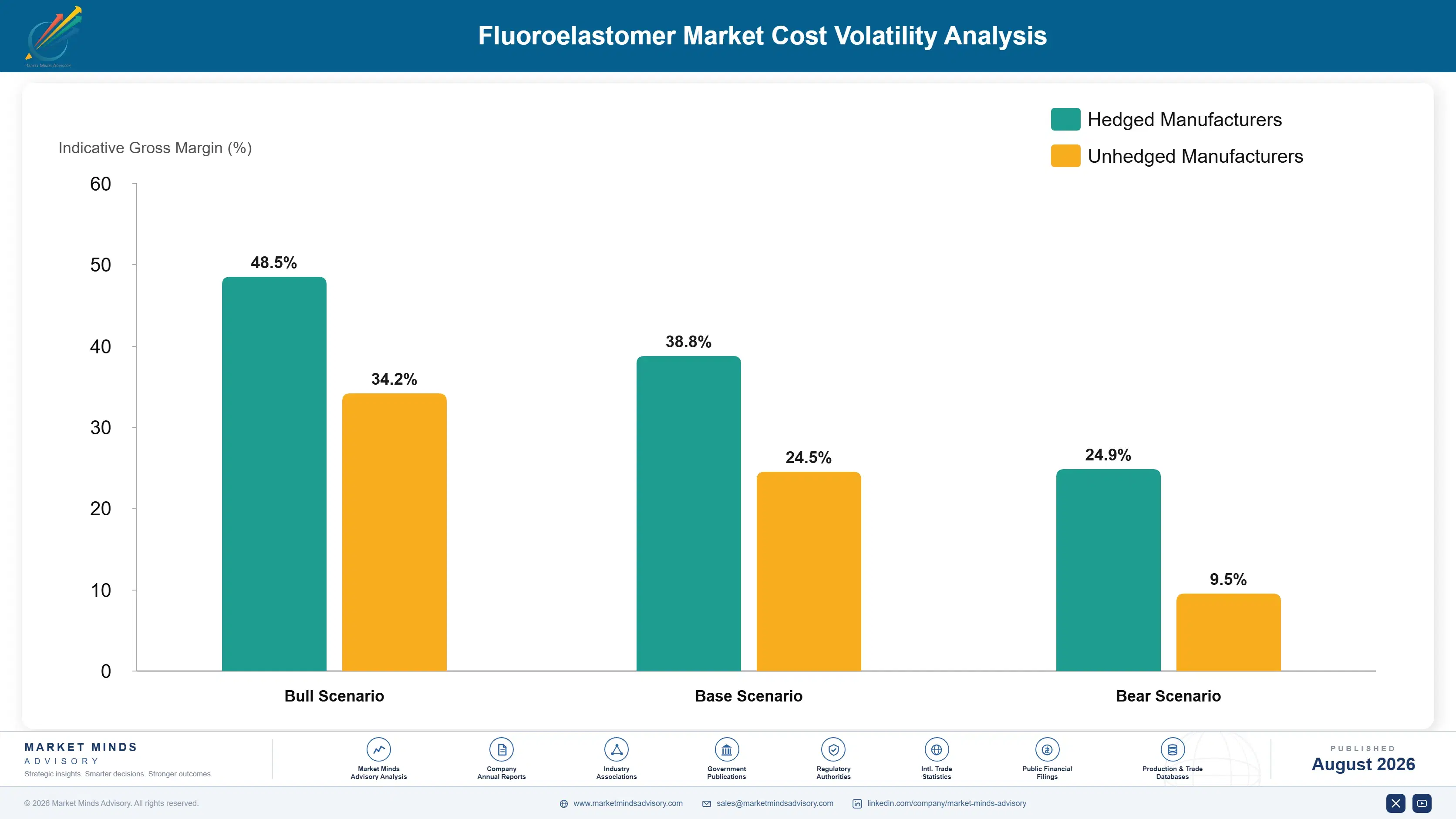
Fluorspar Feedstock and Energy Cost Exposure

Fluorspar and related fluorine feedstock chemicals account for roughly 34 to 38 percent of fluoroelastomer cost of goods sold, sourced predominantly from mines and processing facilities in China, Mexico, and South Africa across most major producing countries. Energy consumed in the polymerization process adds further meaningful cost weight given the intensive processing required for high-purity grades.
Fluorspar prices spiked sharply during 2023 as Chinese export quota tightening, tied to domestic environmental enforcement and strategic resource policy, constrained available supply for international buyers just as semiconductor and EV demand pulled fluoroelastomer consumption higher across most major markets. The EIA noted that fluorine chemistry production is particularly energy-intensive, compounding cost pressure during this period as global energy prices also remained elevated, squeezing producer margins across the industry and its broader supply chain.

Producers without vertically integrated fluorspar supply, such as smaller regional manufacturers, carry heavier exposure than large integrated players such as Daikin, who capture margin at both the feedstock and polymer production stages of manufacturing. This gap widens meaningfully during price spikes, pushing smaller producers toward long-term supply agreements or geographic diversification away from Chinese-dominated feedstock sources.
fluoroelastomer-market-cost-volatility-analysis-1787550787353

Secure Captive Fluorspar Supply Outside China

Producers are increasingly securing captive or long-term contracted fluorspar feedstock supply outside China rather than relying on the open market, reducing exposure to export policy changes or trade disruption events across the broader supply chain. This approach requires substantial upfront capital or long-term commitment but has measurably reduced margin volatility during recent tight-supply periods.

Diversify Feedstock Sourcing Across Multiple Countries

Some producers are diversifying feedstock sourcing across multiple countries including Mexico and South Africa rather than relying solely on Chinese fluorspar, reducing single-country concentration risk in their broader supply chain and production network worldwide and long-term. This has proven particularly valuable given ongoing geopolitical trade tension affecting Chinese export policy predictability and long-term planning cycles.

Lock In Multi-Year Feedstock Supply Agreements

Producers are negotiating multi-year feedstock supply agreements with priority allocation clauses ahead of anticipated semiconductor and EV demand growth, trading some pricing flexibility for guaranteed volume access during future tight-supply periods across the industry and its supply base. This has proven particularly valuable for producers serving customers with firm delivery deadlines and qualification requirements attached.

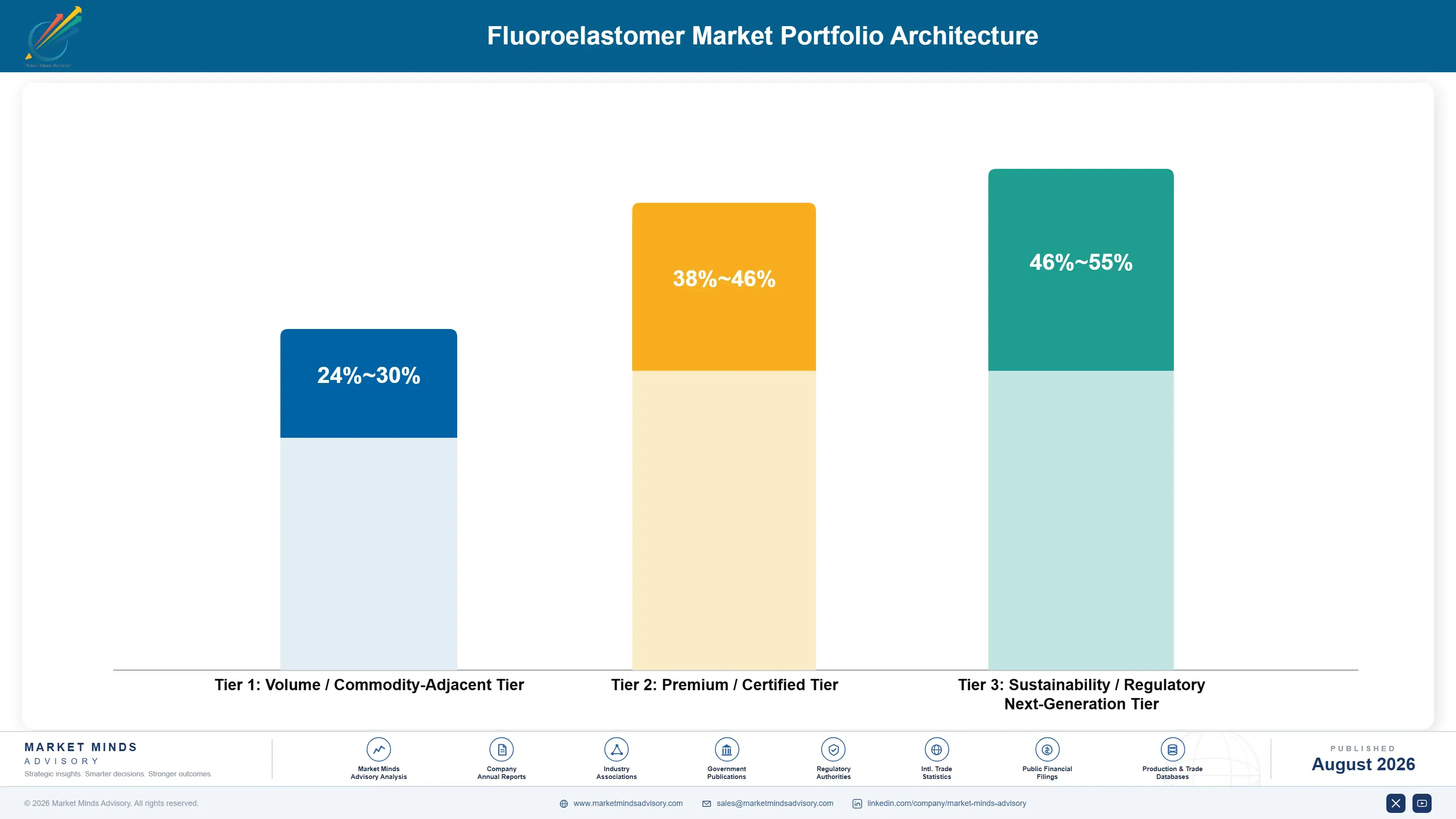
Portfolio Architecture for Margin Defence

Fluoroelastomer portfolios span three tiers running from standard automotive and industrial grades through certified aerospace and specialty formulations to next-generation semiconductor and PFAS-compliant grades, with gross margins widening substantially as products move up this ladder toward purity and certification value across most producer tiers nationwide and internationally each year, budget cycle, and planning horizon.
The tension between volume and premium positioning defines producer strategy: standard automotive grades keep plants running at scale but margins there compress steadily as Chinese capacity additions intensify competition among mid-tier producers nationwide and internationally each successive year and budget cycle. Semiconductor and aerospace-grade tiers require sustained capital investment in ultra-purity production infrastructure and certification testing that smaller producers often cannot sustain without established qualification history and customer relationships.

High-value margin pools concentrate most heavily around semiconductor fab-grade and aerospace-certified formulations, where producers can charge documented premiums for purity and testing depth rather than competing purely on volume or price alone across most major accounts. This concentration is likely to deepen further as semiconductor fab construction and PFAS compliance requirements broaden across additional jurisdictions and product categories over the coming several years.

Volume / Commodity-Adjacent Tier

Standard automotive and industrial grade fluoroelastomers sold largely on price into general sealing applications across broad regional accounts without specialty purity or certification requirements attached to the purchase order or contract.
Gross Margin: 24-30%

Premium / Certified Tier

Certified aerospace, defense, and industrial specialty grades validated for specific performance applications, sold to accounts requiring documented testing and qualified supplier status maintained over multiple years, contract renewals, and program cycles.
Gross Margin: 38-46%

Sustainability / Regulatory / Next-Generation Tier

Ultra-high-purity semiconductor fab-grade and PFAS-compliant next-generation formulations bundled with extractables documentation, targeting accounts facing the most stringent contamination and regulatory requirements in the industry, its supply base, and its downstream customers.
Gross Margin: 46-55%
fluoroelastomer-market-portfolio-architecture-1787550787855

High-value Sub-segments and Strategic Watch-out

Semiconductor Fab-Grade Formulations

Semiconductor fab-grade fluoroelastomers represent the highest-growth, highest-margin segment, combining premium pricing with durable multi-year qualification lock-in that standard commodity sales cannot replicate across comparable accounts nationwide and internationally each successive year, budget cycle, and long-term customer relationship. Momentum here shows little sign of slowing anytime soon.
Gross Margin: 46-55%

Aerospace and Defense-Certified Grades

Aerospace and defense-certified grades offer strong margins with somewhat slower adoption, dependent on lengthy qualification cycles and aircraft program development timelines that vary considerably across manufacturers, platforms, contract renewal periods, government procurement schedules, and defense budget appropriations nationwide. Program timelines vary but stay predictably long.
Gross Margin: 40-48%

Standard Automotive/Industrial Grades

Standard automotive and industrial grades remain the volume core of the market, sustaining plant utilization and customer relationships even as margins compress under Chinese producer competition nationwide and internationally each successive budget year, planning cycle, and account renewal period. Utilization stays high despite margin pressure.
Gross Margin: 24-30%

Legacy PFAS-Restricted Formulations

Legacy PFAS-restricted formulations face uncertain long-run viability as regulatory scrutiny tightens, warranting close monitoring for producers still reliant on unmodified legacy chemistry for meaningful revenue and market access going forward into future planning cycles, budget reviews, and strategic reassessments. Producers are watching this segment very closely.
Gross Margin: 16-22%

Recurring Qualification Lock-In Economics

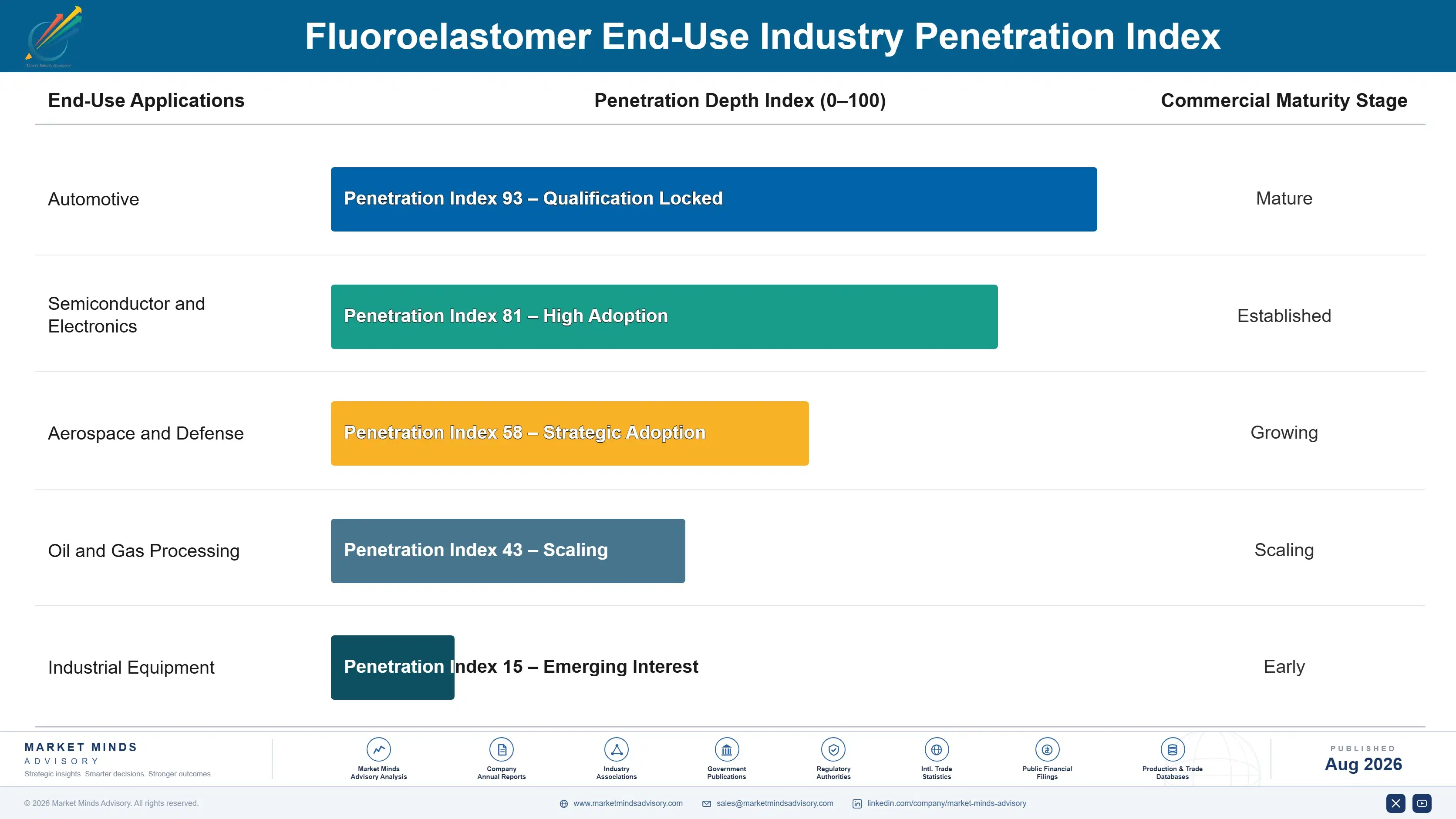
Fluoroelastomer revenue resembles a recurring qualified-supplier relationship rather than a one-time sale, since customers who complete extensive qualification testing rarely re-qualify alternative suppliers absent a compelling performance or supply reliability failure, creating stable multi-year repeat-order demand tied to production volume rather than discrete capital purchase cycles. This annuity character is strongest in semiconductor and aerospace accounts, where qualification investment discourages supplier switching absent a serious quality failure.
Adoption depth varies by end-use vertical: semiconductor and aerospace customers show the deepest specification lock-in, since requalifying an alternative supplier carries meaningful engineering and testing cost that most customers prefer to avoid. Standard automotive and industrial customers switch suppliers more readily based primarily on price and delivery reliability, since specification tolerances are looser and requalification costs are correspondingly lower. Electric vehicle battery customers sit between these extremes, retaining more supplier flexibility.

Generational shifts are underway as procurement decisions move from pure cost-per-kilogram evaluation toward regulatory compliance and supply chain resilience officers weighing PFAS exposure and feedstock concentration risk, changing who fluoroelastomer producers must sell to and how supply contracts get structured across premium accounts, long-term relationships, and renewal cycles.
fluoroelastomer-market-end-use-penetration-index-1787550788341

Strategic Priorities for Fluoroelastomer Producers

These are among the four positions where our research anticipates prominent divergence between winners and laggards over the coming forecast period. Each is grounded in the demand model, the regulatory perimeter, and the announced capacity pipeline.
01 / SEMICONDUCTOR QUALIFICATION STRATEGY

Build Fab-Grade Qualification Capability Ahead of Demand

Producers competing purely on standard automotive price will lose ground to those who built semiconductor fab-grade qualification capability ahead of continued fab construction expansion across most major markets. Qualification, not raw production scale, is becoming the deciding factor for the market's highest-margin accounts across most major semiconductor manufacturing regions and account relationships. MMA recommends investing in ultra-high-purity production capability now, even at meaningful upfront cost, since qualification lead times run over a year and latecomers risk permanent exclusion from fab supplier panels.
02 / FEEDSTOCK RISK MANAGEMENT

Diversify Fluorspar Feedstock Sourcing Now

Producers heavily exposed to Chinese fluorspar feedstock remain persistently vulnerable to export policy shifts that vertically integrated or geographically diversified competitors largely avoid across their broader supply chains and production networks. This exposure will only grow as geopolitical trade tension persists and China continues tightening strategic resource export policy across multiple critical mineral categories and jurisdictions. MMA recommends pursuing feedstock diversification or long-term supply agreements now, since producers who wait risk locking in unfavorable terms during the next supply disruption cycle.
03 / EV PROGRAM QUALIFICATION

Secure Battery Program Supply Agreements Early

Electric vehicle battery program qualification represents a durable growth opportunity that most standard-grade producers have not yet fully captured, despite EV production volume continuing to expand steadily across major manufacturing regions and vehicle platforms. Battery program supplier qualification locks in years ahead of vehicle launch, meaning producers who commit early hold durable advantages over later entrants competing for the same automaker relationships. MMA recommends prioritizing battery program supply agreements ahead of demand, since automakers prefer established, proven suppliers over new entrants.
04 / REGULATORY COMPLIANCE LEADERSHIP

Lead PFAS Compliance Rather Than React to It

PFAS regulatory outcomes remain the single largest source of uncertainty facing this market, and most producers are treating compliance investment as a defensive cost rather than a competitive opportunity worth pursuing proactively. Producers who fund independent scientific research and build thorough compliance documentation infrastructure will retain market access longer than less-prepared competitors as restrictions tighten. MMA recommends treating regulatory compliance leadership as core strategy rather than a reactive cost center, since it will increasingly determine which producers retain access to regulated markets.

Engagement Snapshot From the Field

A live engagement with an industry participant carrying material or product regulatory and market exposure ahead of a defining policy shift, showing how our research translates into a defensible multi-year portfolio strategy.
MARKET MINDS ADVISORY · CLIENT ENGAGEMENT SUMMARY
Fluoroelastomer Producer Strategic Portfolio Review and Transition Roadmap 2026·Investment Scenario on Fluoroelastomer Exposure Evaluation 2025-26
CLIENT PROFILE
The client is a mid-size specialty seal and gasket manufacturer supplying fluoroelastomer components primarily to industrial and automotive customers across North America. Facing increasing customer requests for semiconductor-adjacent sealing applications and growing PFAS regulatory uncertainty affecting its primary feedstock suppliers, the client lacked a clear strategy for whether to pursue semiconductor-grade qualification or focus resources on defending its existing automotive and industrial customer base.
STRATEGIC CHALLENGE
The client needed to determine whether semiconductor-grade qualification investment would generate sufficient return given the multi-year qualification timeline and substantial upfront capital requirement, or whether resources were better directed toward defending existing accounts against PFAS-related feedstock supply risk. Limited capital meant the client could not pursue both strategies simultaneously at full scale.
MMA APPROACH
MMA benchmarked the client's technical capabilities against semiconductor qualification requirements, modeled the return on investment for qualification versus feedstock diversification spending, and assessed which of the client's existing customers carried the most significant PFAS supply risk exposure. The engagement combined primary interviews with the client's largest customers and semiconductor equipment manufacturer procurement contacts.
KEY FINDINGS
  1. Semiconductor-grade qualification would require an estimated 18 to 24 months and substantial capital investment (client-reported, unverified by MMA), a timeline exceeding the client's originally planned two-year strategic horizon significantly.
  2. Two of the client's five largest accounts, representing over 35 percent (client-reported, unverified by MMA) of revenue, sourced feedstock through suppliers with meaningful Chinese fluorspar concentration risk.
  3. A phased approach prioritizing feedstock diversification first, followed by selective semiconductor qualification pursuit, delivered better near-term risk reduction than pursuing qualification immediately with limited capital.
  4. Early conversations with semiconductor equipment manufacturer procurement contacts revealed qualification requirements more stringent than the client's initial internal assumptions, reshaping the investment case materially.
CLIENT PROFILE
The client is a mid-size specialty seal and gasket manufacturer supplying fluoroelastomer components primarily to industrial and automotive customers across North America. Facing increasing customer requests for semiconductor-adjacent sealing applications and growing PFAS regulatory uncertainty affecting its primary feedstock suppliers, the client lacked a clear strategy for whether to pursue semiconductor-grade qualification or focus resources on defending its existing automotive and industrial customer base.
STRATEGIC CHALLENGE
The client needed to determine whether semiconductor-grade qualification investment would generate sufficient return given the multi-year qualification timeline and substantial upfront capital requirement, or whether resources were better directed toward defending existing accounts against PFAS-related feedstock supply risk. Limited capital meant the client could not pursue both strategies simultaneously at full scale.
MMA APPROACH
MMA benchmarked the client's technical capabilities against semiconductor qualification requirements, modeled the return on investment for qualification versus feedstock diversification spending, and assessed which of the client's existing customers carried the most significant PFAS supply risk exposure. The engagement combined primary interviews with the client's largest customers and semiconductor equipment manufacturer procurement contacts.
KEY FINDINGS
  1. Semiconductor-grade qualification would require an estimated 18 to 24 months and substantial capital investment (client-reported, unverified by MMA), a timeline exceeding the client's originally planned two-year strategic horizon significantly.
  2. Two of the client's five largest accounts, representing over 35 percent (client-reported, unverified by MMA) of revenue, sourced feedstock through suppliers with meaningful Chinese fluorspar concentration risk.
  3. A phased approach prioritizing feedstock diversification first, followed by selective semiconductor qualification pursuit, delivered better near-term risk reduction than pursuing qualification immediately with limited capital.
  4. Early conversations with semiconductor equipment manufacturer procurement contacts revealed qualification requirements more stringent than the client's initial internal assumptions, reshaping the investment case materially.
RECOMMENDED STRATEGY
Phase 1: Phase 1 (Months 1-6): Complete a full feedstock supply chain risk assessment and diversify sourcing away from China-concentrated fluorspar suppliers entirely. Phase 2: Phase 2 (Months 7-14): Begin selective semiconductor qualification pursuit with the highest-potential equipment manufacturer accounts identified during the initial assessment. Phase 3: Phase 3 (Months 15-24): Complete qualification testing fully and formalize new long-term supply agreements with newly qualified semiconductor equipment accounts.
OUTCOME
The client successfully diversified feedstock sourcing away from China-concentrated suppliers within the first phase, reducing supply risk exposure across two-thirds of its account base (client-reported, unverified by MMA). Selective semiconductor qualification pursuit, rather than an all-in commitment, preserved capital while still positioning the client for an estimated 20 percent revenue opportunity (client-reported, unverified by MMA) in premium accounts.

Frequently Asked Questions

Foundational context covering the market sizes, CAGR, scope, country, region and competition that inform every finding below. This section is provided to cover basics and most often pre-purchase conversations, answered from the MMA Primary Research Dataset.

What is the current size of the Fluoroelastomer Market?

The Fluoroelastomer Market was valued at approximately $4.9 billion globally in 2025. This figure covers FKM and related fluorine-based synthetic rubber compounds used in seals, O-rings, and gaskets.

How large will the Fluoroelastomer Market be by 2036?

MMA projects the market will reach approximately $9.1 billion by 2036. This represents a 1.75 times expansion from the 2026 base of $5.2 billion over the ten-year forecast period.

What is the CAGR for the Fluoroelastomer Market 2026 to 2036?

The market is forecast to grow at a 5.8 percent compound annual growth rate between 2026 and 2036. Bull and bear scenarios range from 4.6 to 7.0 percent depending on PFAS regulatory outcomes.

Which segment is growing fastest?

Semiconductor and electronics-grade fluoroelastomers are the fastest-growing segment, expanding at 9.4 percent annually. This outpaces the overall market by roughly 1.6 times, driven by fab construction.

Who are the major companies in the Fluoroelastomer Market?

Leading companies include Chemours, Daikin Industries, Solvay, AGC Inc., and HaloPolymer. These five players hold a combined CR5 near 58 percent measured on revenue across the category.

Which country is growing fastest?

Vietnam leads country-level growth at approximately 7.5 percent annually, ahead of the broader South Asia and Pacific regional average. This reflects rapidly expanding electronics manufacturing investment.

Report Segmentation Architecture

The full report scope spans multiple orthogonal segmentation dimensions, with cross-tabulated demand data provided for each dimension pair. Coverage extends further to regional breakdowns, trend trajectories, and the competitive detail needed to support segment-level decision-making.

By Application Grade

  • Standard Automotive Grade
  • Industrial Sealing Grade
  • Semiconductor/Electronics Grade
  • Aerospace/Defense Grade
  • EV Battery/Thermal Grade
  • PFAS-Compliant Next-Generation Grade

By End-Use Industry

  • Automotive
  • Semiconductor and Electronics
  • Aerospace and Defense
  • Oil and Gas Processing
  • Industrial Equipment

By Commercial Dimension

  • Qualified Long-Term Supply
  • Spot Market
  • Regulatory-Compliant Certified Supply
  • Distributor Channel

By Region

  • North America
  • Western Europe
  • East Asia
  • South Asia and Pacific
  • Latin America
  • Middle East and Africa
  • Eastern Europe

Scope, Methodology, and Coverage

Every figure in this report is reproducible from documented input assumptions. The scope below maps the historical period, the forecast horizon, the segmentation dimensions, and the countries covered, alongside the underlying primary and qualitative methodology.
Historical Period
2020 to 2025
Forecast Period
2026 to 2036
Base Year
2025 (USD billions; MMA Primary Research Dataset, August 2026)
Market Definition
The Fluoroelastomer Market covers FKM and related fluorine-based synthetic rubber compounds used in seals, O-rings, and gaskets requiring chemical and thermal resistance. It excludes fluoropolymer resins such as PTFE and PVDF used in non-elastomeric applications.
Quantitative Units
USD billions (current prices); metric tonnes shipped (thousands)
Segmentation Dimensions
By Application Grade; By End-Use Industry; By Commercial Dimension; By Region
Regions Covered
North America, Western Europe, East Asia, South Asia and Pacific, Latin America, Middle East and Africa, Eastern Europe
Countries Covered
USA, China, Germany, France, UK, Japan, South Korea, India, Australia, Canada, Brazil, Mexico, Indonesia, Vietnam, Thailand, Malaysia, UAE, Saudi Arabia, South Africa, Nigeria, Turkey, Poland, Netherlands, Italy, Spain, Sweden, Switzerland, Argentina, Colombia, Singapore, and additional markets relevant to this sector
Key Companies Profiled
Chemours, Daikin Industries, Solvay, AGC Inc., HaloPolymer, 3M (Fluoroelastomer Legacy Assets), Dyneon (3M), Gujarat Fluorochemicals, China Bluestar, Zhonghao Chenguang Research Institute, Shandong Dongyue, Kureha Corporation, Unimatec, Freudenberg Sealing Technologies, Parker Hannifin (Precision Sealing), Trelleborg Sealing Solutions, James Walker Group, Eriks, Precision Polymer Engineering, Greene Tweed
Quantitative Methodology
Primary survey, n=3,800 respondents, Q4 2025, six countries; demand-side model with trade association cross-validation
Qualitative Methodology
47 expert interviews, Q4 2025; applied to validate demand model assumptions, identify emerging dynamics, and assess competitive positioning
Report Format
PDF and XLSX data workbook (Word format preview document)
Publisher
Market Minds Advisory
Report Code
MMA-2026-CHM-104
Published
August 2026
Contact
sales@marketmindsadvisory.com | www.marketmindsadvisory.com

Purchase the full Fluoroelastomer Market Report (2026 to 2036).

The full Fluoroelastomer Market report delivers a comprehensive 200-plus page analysis covering detailed segmentation by application grade, end-use industry, and commercial dimension alongside country-level sizing across all seven tracked regions. It includes in-depth competitive profiles of twenty producers, quantified fluorspar feedstock cost risk analysis, and scenario-based forecasts through 2036. Subscribers also receive access to underlying primary survey and expert interview datasets. Quarterly update briefings cover PFAS regulatory and semiconductor demand developments across major producing regions, and custom segmentation cuts are available on request for enterprise subscribers.
Country-level market sizing across 30 countries
Twenty profiled fluoroelastomer producers included worldwide
PFAS regulatory exposure scoring by jurisdiction
Fluorspar feedstock cost benchmarking data included
Quarterly market update subscription access included
Custom segmentation cuts available on request

Built For The People Who Decide

From boardroom strategy to bench-side execution, this report is read cover-to-cover by leaders shaping the next decade of their industry, turning demand scenarios, market dynamics and valuation benchmarks into decisions.
CXOs/ Presidents/ VPs/ Managers
M&A and Corporate Development
Strategy Teams and R&D Heads
Procurement and Product Directors
Regulatory and Compliance Leaders
Investor Relations and Equity Analysts