Market Minds Advisory
Flue Gas Desulfurization System Market

Flue Gas Desulfurization System Market: Emissions Control Systems for Coal-Fired Power and Industrial Combustion

Asian coal capacity additions and tightening industrial SO2 limits are sustaining flue gas desulfurization demand even as Western coal retirements shrink the installed base suppliers once counted on for retrofit revenue.

Lead Analyst

Bilal Shaikh

Published

September 2026

Make Smarter Decisions with Customized Research Insights

Request a free sample report and evaluate market opportunities, growth trends, and competitive dynamics relevant to your business needs.

2025 MARKET VALUE$8.6BMarket Size 2025
2036 FORECAST VALUE$15.0BBase Case , 2026 to 2036
CAGR 2026 TO 20365.2 %Bull 6.4% / Bear 4.0%
INCREMENTAL OPPORTUNITY$6.0BNet 10- year value creation
EXPANSION MULTIPLE1.66x2036 value over 2026 base
Strategic Levers
M&A Pipeline
Regional Outlook
Country Rankings
Competitive Intelligence
Segmental Deep-dive
Call-Us : 91 93563 13602

Executive Snapshot and Market Trajectory

Western coal plant retirements are shrinking the retrofit market suppliers built their businesses around, forcing a rapid pivot toward Asian new-build capacity and aftermarket service revenue instead of the large new-system contracts that once anchored order books across most major global equipment suppliers and their regional partners.
Wet limestone-gypsum FGD systems remain the primary growth engine, with China and India anchoring both new coal capacity additions and mandatory retrofit programs on existing fleets facing tightening emissions deadlines across multiple provinces and states nationwide. Aftermarket parts and retrofit services are expanding steadily as the global installed base ages and utilities extend plant life rather than build new capacity in mature markets, adding a second durable revenue pool for established suppliers.
Competition remains concentrated among a handful of scaled EPC and equipment suppliers capable of delivering large wet FGD systems, though numerous regional players compete for smaller industrial and aftermarket contracts across fragmented service territories. Rising limestone and reagent costs alongside tightening emissions standards are forcing smaller suppliers to specialize in service niches rather than compete directly on new system delivery against scaled global rivals with deeper capital reserves.
Market Definition
This report covers the global market for flue gas desulfurization systems, including wet limestone-gypsum, dry sorbent injection, and semi-dry scrubber technology used to remove sulfur dioxide from coal-fired power plant and industrial combustion exhaust. It excludes selective catalytic reduction systems targeting nitrogen oxides.
Base Year Value
$8.6B in 2025 (MMA Primary Research Dataset, August 2026)
Forecast Period
2026 to 2036, eleven discrete annual values
CAGR
5.2% base case. Bull 6.4%. Bear 4.0%.
Fastest Growth Segment
Wet Limestone-Gypsum FGD Systems: 6.5% CAGR
Fastest Growth Country
India: 8.0% CAGR
Fastest Growth Region
South Asia and Pacific: 7.5% CAGR
Largest Region
East Asia: 39% of 2025 global value
Market Leaders
GE Vernova, Mitsubishi Heavy Industries Ltd., Babcock & Wilcox Enterprises Inc., FLSmidth & Co. A/S, Andritz AG. Source: MMA Primary Research, July 2026.
Primary Survey
n=3,800 procurement and R&D decision-makers, Q4 2025, six countries
Methodology
Demand-side build-up, cross-validated against public data, 47 expert interviews

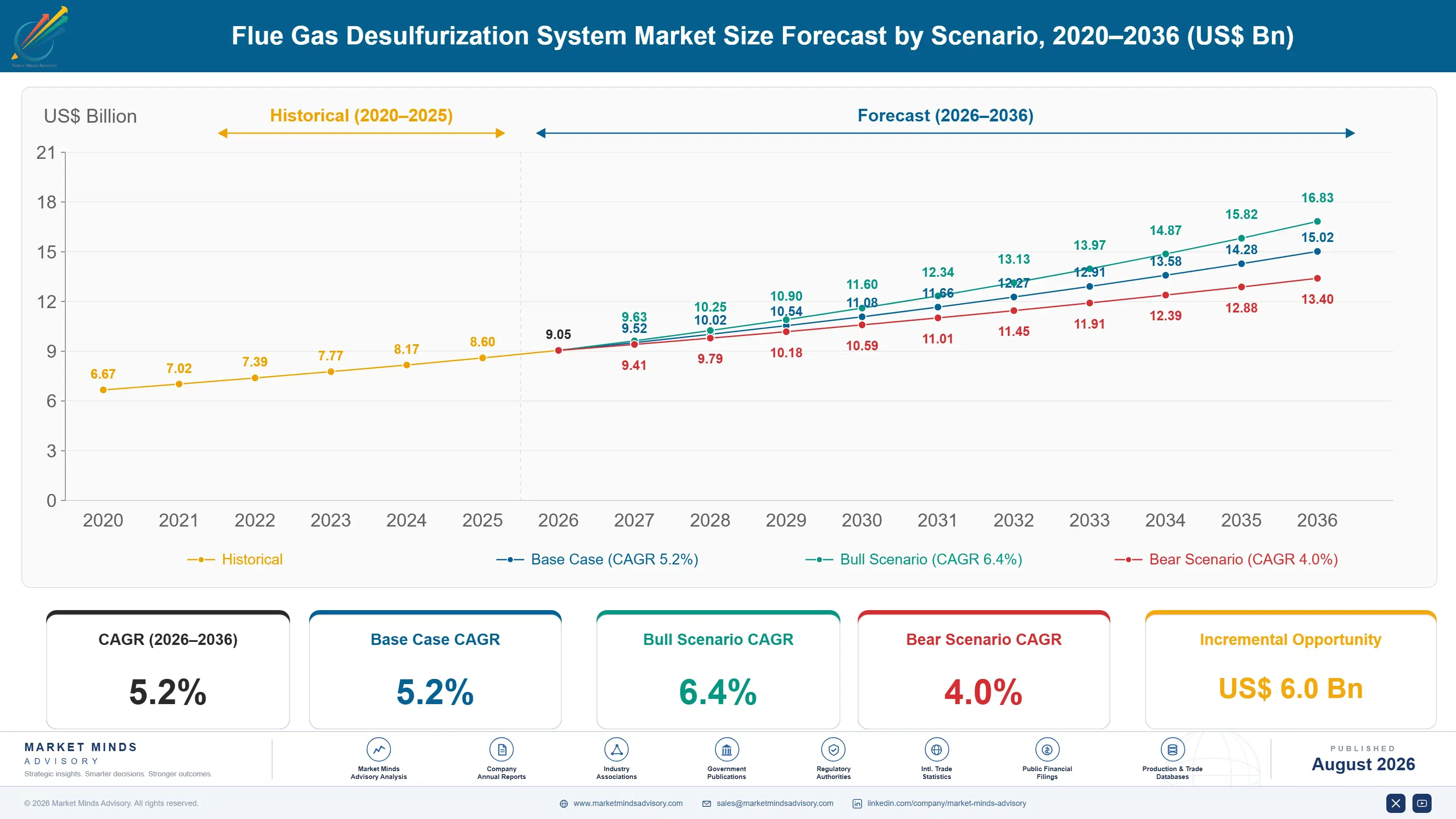
Flue Gas Desulfurization System Market Forecast Scenarios

flue-gas-desulfurization-system-market-size-forecast-scenario-1787551019239
FGD system demand grew at an estimated 4.5% annual pace between 2020 and 2025, a period shaped by accelerating Western coal retirements offsetting continued Asian new-build capacity additions across several major markets. Chinese and Indian retrofit mandates on existing coal fleets added meaningful volume even as new-system orders in North America and Western Europe slowed to nearly zero across most regional markets.
The base case assumes 5.2% compound annual growth through 2036, driven by three commercial mechanisms: continued Asian coal capacity additions requiring new wet limestone-gypsum systems across expanding power grids, tightening industrial SO2 limits across manufacturing sectors beyond power generation including cement and steel, and expanding aftermarket parts and retrofit services as the global installed base ages steadily. Western markets contribute primarily service revenue rather than new-system demand throughout the forecast period.
A bull scenario of 6.4% growth assumes accelerated Asian coal capacity additions alongside faster industrial SO2 compliance enforcement across emerging manufacturing economies and stricter regional standards. The bear case of 4.0% reflects the risk that renewable energy displacement of coal capacity in Asia accelerates faster than currently anticipated, shrinking the new-build pipeline suppliers depend on for growth.

A Market Splitting Between New Build and Aging Fleet Service

FGD systems sit at an unusual inflection point: the Western installed base that once drove steady retrofit revenue is retiring faster than it can be replaced by new orders, while Asian coal capacity keeps expanding despite mounting renewable energy competition across multiple grid regions. Suppliers built around one demand pattern are now scrambling to serve a fundamentally different geography with different customer expectations and margins.
MARKET CONCENTRATIONCR5 45%Top five EPC suppliers hold nearly half of category revenue
AVERAGE SYSTEM PRICE$85M/unitReflects boiler size, technology choice, and site engineering complexity
TOP PRODUCING COUNTRY SHAREChina 34%Anchored by dominant coal fleet size and equipment manufacturing base
INSTALLED BASE AGE14 yearsAging systems increasingly require major component overhaul and replacement
TRADE INTENSITY22% exportedReflects concentrated equipment manufacturing serving global project markets
REAGENT COST SHARE38% of COGSLimestone and lime reagent costs dominate ongoing operating expense structure
Wet limestone-gypsum technology remains the dominant choice for large utility-scale installations given its proven removal efficiency and lower operating cost at scale, though dry sorbent injection continues gaining share in smaller industrial applications where capital cost matters more than marginal removal performance and footprint. This technology bifurcation is reshaping which suppliers win which contracts and how they price competing bids.
Aftermarket parts and service revenue is becoming the more durable business line as the global installed base ages past initial design life, requiring major component overhauls that new-system suppliers with established service networks are best positioned to capture across their existing customer relationships and regional footprint. Suppliers without service infrastructure are increasingly locked out of this growing, higher-margin revenue stream entirely.
"The FGD story isn't about new systems anymore, it's about who owns the service contracts on plants built two decades ago. That's where the real, defensible margin lives now."
Director, Emissions Control Systems Practice · MMA Construction and Industrial Equipment Practice · August 2026

Market Trends

Aftermarket Service Revenue Overtaking New System Sales

As the global installed base of FGD systems ages past its typical 15 to 20 year initial design life, aftermarket parts and major component overhaul revenue is growing faster than new-system sales for the first time in the category's history. Several leading suppliers now report service revenue exceeding 40% of total FGD segment revenue, up meaningfully from a decade ago when new systems dominated order books. This shift is reshaping supplier strategy toward building long-term service relationships with utility customers rather than competing purely on new-system price, a transition that rewards suppliers with established regional service infrastructure.
Market Impact: Adds 40 gigawatts annually
India's Retrofit Mandate Creating a New Demand Wave

India's environmental regulator has extended compliance deadlines for FGD retrofit installation across the country's coal fleet multiple times, but enforcement is now tightening meaningfully as utilities face mounting pressure to complete installations before the latest deadline arrives across every affected state. More than 300 coal units still lack FGD systems entirely, representing a substantial multi-year order backlog that is only now beginning to convert into signed contracts. Suppliers with established Indian manufacturing or local partnership capability are positioned to capture a disproportionate share of this delayed but substantial demand wave.
Market Impact: Covers facilities within 3 years

Market Opportunities and Growth Drivers

Asian Coal Capacity Additions Sustaining New System Demand

China and India together continue commissioning new coal-fired power capacity even as both countries expand renewable generation simultaneously, with combined new coal capacity additions exceeding 40 gigawatts annually in recent years across both markets and their respective grid expansion programs. Nearly all new coal units in these markets require FGD systems from commissioning under current environmental regulation, directly translating capacity growth into equipment orders for scaled suppliers. This demand pattern is expected to persist through much of the forecast period even as the pace of new coal additions gradually moderates over time.
Market Impact: Removes 100 gigawatts of coal capacity

Industrial SO2 Limits Tightening Beyond Power Generation

Cement, steel, and refining industries face tightening sulfur dioxide discharge limits across major manufacturing economies worldwide, extending FGD system demand well beyond traditional power generation customers into industrial combustion applications across multiple sectors and geographies. Several countries have introduced industrial SO2 limits over the past three years that require retrofit installation on facilities previously exempt from utility-grade emissions standards and enforcement regimes that governed only power plants historically. This diversification is providing suppliers a meaningful demand pool less correlated with power sector investment cycles and electricity demand growth specifically. Adoption continues across major markets.
Market Impact: Reagent costs climb more than 15%

Market Restraints and Challenges

Coal Plant Retirements Shrinking Western Order Books

Coal-fired power plant retirements across North America and Western Europe have accelerated as utilities shift toward natural gas and renewable generation, directly shrinking the retrofit market that historically anchored supplier revenue in these regions. The root cause is economic: aging coal plants facing FGD retrofit capital requirements often make more financial sense to retire than upgrade given competing generation economics. More than 100 gigawatts of Western coal capacity has retired over the past decade, eliminating equipment orders permanently. Suppliers are responding by pivoting toward aftermarket service revenue and Asian new-build markets to offset the sustained decline in Western new-system demand.
Market Impact: Service revenue exceeds 40% of segment

Reagent Cost Volatility Squeezing Operating Margins

Limestone and lime reagent costs, which represent a substantial share of ongoing FGD operating expense, have risen meaningfully as mining and processing costs increase across major producing regions. The root cause is straightforward: reagent supply is regionally concentrated, and transportation costs for bulk mineral inputs rise quickly with distance from quarry sites. Reagent costs have climbed more than 15% over the past two years at several major installations. Utilities are responding by negotiating longer-term reagent supply contracts and, in some cases, qualifying alternative sorbent chemistry to reduce dependence on any single reagent source.
Market Impact: Covers more than 300 coal units
4 additional market trends, 3 additional growth drivers, and 3 additional restraints and challenges are covered in the full report. Contact sales@marketmindsadvisory.com to access the complete intelligence.

Segment CAGR and Growth Architecture

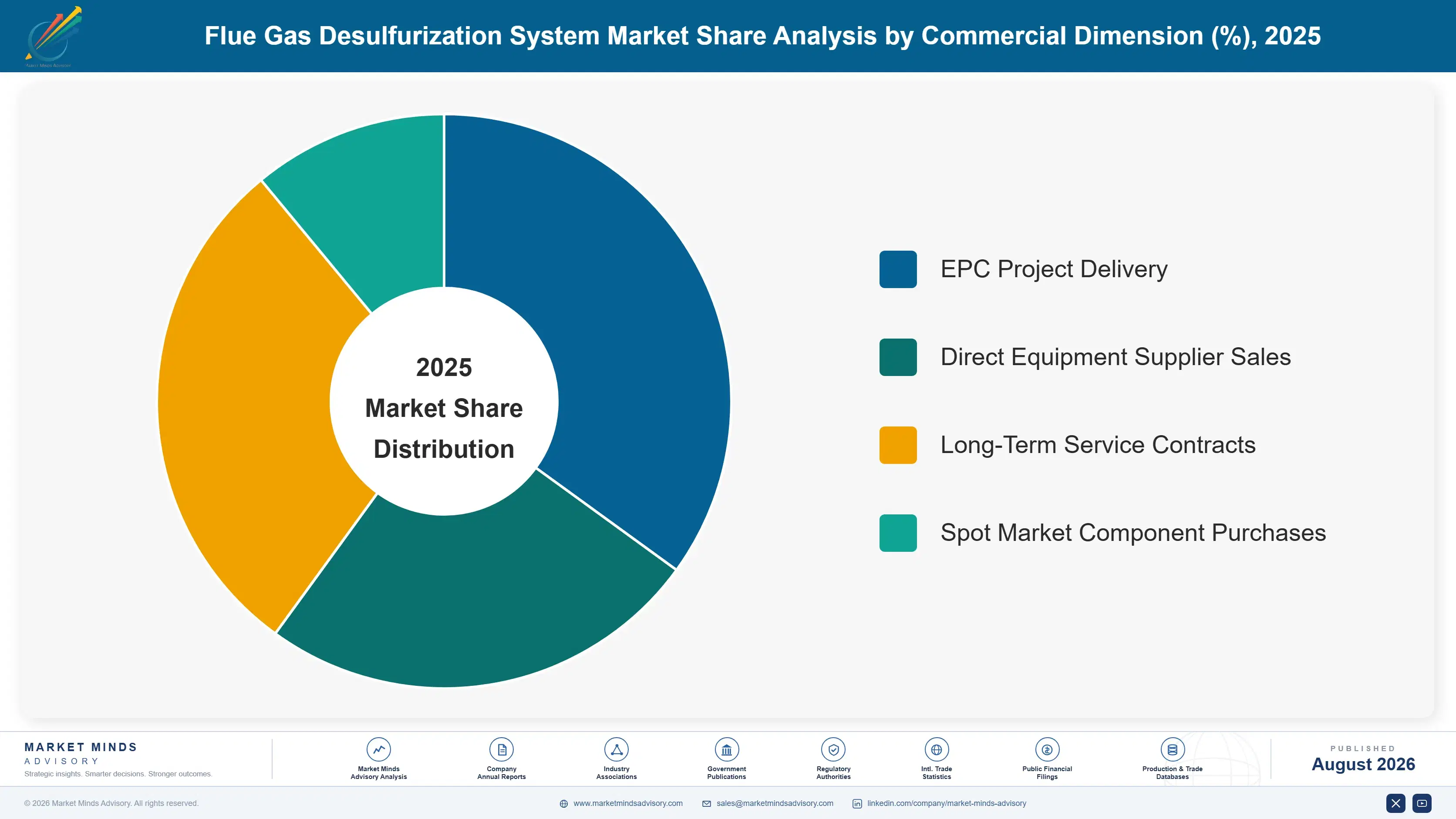
FGD system demand splits across six technology-based segments defined by scrubbing chemistry rather than end-use industry alone. Wet limestone-gypsum systems and aftermarket parts and retrofit services lead growth, followed by dry sorbent injection, semi-dry spray dryer absorbers, seawater FGD, and regenerable FGD systems, each with distinct capital and operating cost profiles across project types.
flue-gas-desulfurization-system-market-market-share-analysis-1787551019776

Wet Limestone-Gypsum FGD Systems

Wet limestone-gypsum systems represent the largest and fastest-growing segment, remaining the preferred technology for large utility-scale coal units given proven removal efficiency exceeding 95% and favorable operating economics at scale across most major markets and grid configurations. China and India anchor demand as both countries continue commissioning new coal capacity requiring FGD systems from initial construction under current environmental regulation and permitting requirements. The gypsum byproduct also generates secondary revenue for utilities selling it into wallboard and cement manufacturing, improving overall project economics meaningfully across the plant's operating life. This segment's growth rate exceeds the overall market by roughly 1.25 times, reflecting sustained Asian coal capacity expansion across multiple grid regions.
CAGR 6.5%

Aftermarket Parts and Retrofit Services

Aftermarket parts and retrofit services form the second-fastest-growing segment as the global installed base ages past initial design life, requiring major component overhauls and system upgrades to maintain removal efficiency and regulatory compliance across aging fleets worldwide and multiple ownership structures spanning public and private utilities. Suppliers with established service networks and long-standing utility relationships are capturing an increasing share of total category revenue as new-system orders slow meaningfully in mature Western markets facing accelerating coal retirements and grid transition pressure. This segment is becoming the more durable, less cyclical revenue base for suppliers navigating declining Western new-build activity and shrinking order backlogs industry-wide each successive year. Growth prospects remain favorable industry-wide.
CAGR 6.0%
Full segment breakdown across 7 segments available in the complete report.

Regional Architecture and Country Demand Map

East Asia and South Asia and Pacific together dominate FGD demand, reflecting the concentration of global coal-fired power capacity in China and India specifically. North America and Western Europe have shrunk meaningfully as coal retirements accelerate, leaving both regions below their standard historical share bands.

North America

US demand centers almost entirely on aftermarket parts and retrofit services for an aging coal fleet, with new-system orders having slowed to near zero as utilities retire coal capacity rather than invest in emissions upgrades across most regional grids. The region's share sits below the standard North America band because coal plant retirements have shrunk the addressable market faster than any other major region, a genuine multi-decade shift unique to mature grids transitioning toward gas and renewables, justifying the below-band allocation here. Canadian demand tracks a similar pattern at a smaller scale, concentrated around remaining coal-fired provinces. Suppliers with established service networks are capturing the bulk of remaining revenue as new-system opportunities continue disappearing across the region.
Share: 15% | CAGR: 3.7% (2026 to 2036)

Western Europe

German and UK utilities represent the largest remaining regional demand, concentrated almost entirely in aftermarket service and decommissioning-adjacent work as the bloc's coal fleet approaches near-total retirement under climate policy commitments made over the past decade. The region's share sits below the standard Western Europe band because coal phase-out commitments have proceeded further here than in any other major region, a policy-driven contraction justifying the below-band allocation. Andritz AG's European operations anchor remaining service supply alongside several smaller regional specialists. Growth trails the global average as the addressable market continues shrinking toward a service-only business over the coming decade. Sustainability reporting requirements are adding further pressure on remaining coal operators.
Share: 13% | CAGR: 3.2% (2026 to 2036)
Regional intelligence for 5 additional markets available in the complete report: East Asia, South Asia and Pacific, Latin America, Middle East and Africa, Eastern Europe. Contact sales@marketmindsadvisory.com.
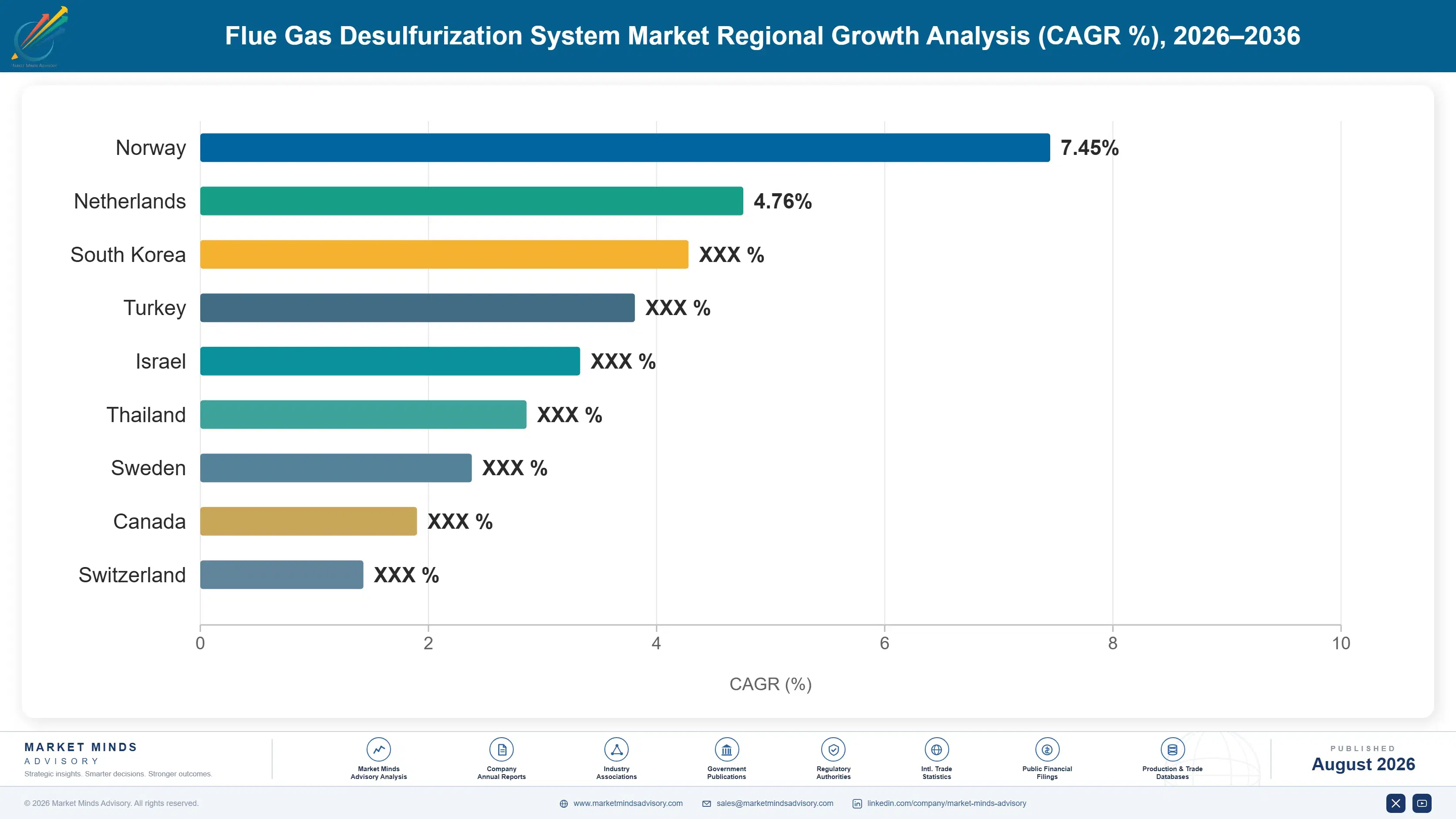
flue-gas-desulfurization-system-market-country-cagr-analysis-1787551020294

Building Value Beyond New System Sales

FGD system suppliers face a genuinely bifurcated demand environment where pricing power depends more on service infrastructure and Asian market access than on new-system engineering capability alone across the category. The levers below outline where suppliers can realistically defend and expand margin over the next several years despite shrinking Western new-build activity and volatile reagent costs.

Expanding Aftermarket Service Network Coverage Globally

Suppliers that build dense regional service networks capture recurring, high-margin aftermarket revenue as the global installed base ages past initial design life and requires major component overhauls across multiple ownership structures. Service revenue now exceeds 40% of total FGD segment revenue at several leading suppliers, a share that keeps climbing as new-system orders slow in mature Western markets facing accelerating coal retirements. Early movers on service network expansion are locking in long-term utility relationships that competitors entering later will struggle to displace given switching costs tied to plant-specific technical knowledge.
Market Impact: Captures roughly 40 percent of segment revenue overall

Establishing Indian Manufacturing and Partnership Capability

Suppliers that establish local manufacturing or joint venture partnerships in India position themselves to capture a disproportionate share of the country's multi-year retrofit backlog covering more than 300 coal units still lacking FGD systems entirely across every affected state. Local presence also reduces delivered cost versus imported equipment, a meaningful advantage in a price-sensitive market facing tight utility capital budgets and compressed compliance timelines. Suppliers without Indian manufacturing presence risk losing this substantial demand wave to better-positioned regional and domestic competitors already building local capability and partnerships. These partnerships also build lasting local goodwill.
Market Impact: Targets more than 300 pending coal units nationwide

Diversifying Into Industrial SO2 Compliance Applications

Suppliers expanding beyond power generation into cement, steel, and refining industrial applications capture demand less correlated with power sector investment cycles and coal capacity trends specifically across most regions. Industrial customers value suppliers offering smaller-scale, faster-installation systems suited to individual production lines rather than utility-scale power plant configurations requiring far larger capital outlays and longer lead times. Several countries have introduced industrial SO2 limits over the past three years, and this diversification strategy is providing suppliers a growing, regulation-driven demand pool that helps offset declining Western power sector new-system orders.
Market Impact: Adds demand tied to 3 years of new rules

Securing Long-Term Limestone and Reagent Supply Agreements

Suppliers and utilities that lock multi-year limestone and lime reagent supply agreements insulate operating costs from the volatility that has pushed reagent prices up more than 15% over the past two years at several major installations across multiple regions and ownership structures. Forward contracting also strengthens supplier relationships with utility customers seeking predictable, budgetable operating costs across multi-decade plant operating horizons and capital planning cycles. Suppliers offering reagent supply chain management as a bundled service are differentiating from pure equipment-only competitors. Predictability benefits both suppliers and utility budgets alike. Adoption continues expanding across utility operators.
Market Impact: Cuts reagent cost volatility by roughly 15 percent

Who Controls the Margin Pool

The top five FGD system suppliers hold roughly 45% of category revenue, a meaningful concentration reflecting the technical complexity and capital scale required to deliver large utility installations across major markets worldwide. The gap between scaled global EPC suppliers with established Asian manufacturing and numerous smaller regional players focused purely on service work is widening as new-system contracts concentrate among fewer, larger competitors capable of bearing project risk.
Current competitive activity centers on three dimensions: expanding aftermarket service network coverage to capture recurring revenue from an aging installed base worldwide, establishing Indian manufacturing and partnership capability ahead of the country's compressed retrofit wave, and diversifying into industrial SO2 compliance applications beyond traditional power generation customers. Suppliers investing across multiple dimensions simultaneously are pulling ahead of narrower competitors betting on a single lever.

Emerging pressure is coming from Chinese and Indian domestic equipment manufacturers scaling capacity to serve their own rapidly expanding markets, gradually reducing historical Western supplier dominance in new-system delivery worldwide. Rankings are most likely to shift among smaller Western suppliers lacking either Asian manufacturing presence or diversified industrial customer relationships, both increasingly necessary for long-term survival in this category.
flue-gas-desulfurization-system-market-company-positioning-matrix-1787551020809

Competitive Moat and Risk Dimensions

GE VERNOVA

Moat: Broad Global Service Network

GE Vernova's dense global service network built over decades of new-system installations gives it aftermarket revenue coverage that smaller regional competitors cannot match, generating recurring, high-margin income even as new-system orders slow across mature Western power markets and shrinking coal fleets nationwide and internationally today.
GE VERNOVA

Risk: Legacy Western Fleet Exposure

GE Vernova's substantial historical exposure to Western coal fleet service contracts leaves it more vulnerable than Asia-focused competitors to the accelerating pace of coal plant retirements, which permanently eliminate the service revenue base those installations once generated across multiple long-standing utility accounts and regions worldwide.
MITSUBISHI HEAVY INDUSTRIES LTD.

Moat: Deep Asian Manufacturing Presence

Mitsubishi Heavy Industries' established manufacturing and engineering presence across China, India, and Southeast Asia gives it cost and delivery advantages in the region driving most global new-system demand growth, a position Western-only competitors cannot easily replicate quickly without meaningful capital investment and years of relationship building.
MITSUBISHI HEAVY INDUSTRIES LTD.

Risk: Cyclical New-Build Revenue Exposure

Mitsubishi Heavy Industries' revenue mix remains more weighted toward new-system sales than some competitors with larger service businesses, leaving it more exposed to cyclical swings in Asian coal capacity investment tied to broader energy policy and renewable competition trends across several national markets and grids.

Players Tracked

Prominent Players

GE Vernova
Mitsubishi Heavy Industries Ltd.
Babcock & Wilcox Enterprises Inc.
FLSmidth & Co. A/S
Andritz AG

Other Key Players

Doosan Enerbility Co., Ltd.
Hitachi Zosen Corporation
Thermax Limited
BHEL (Bharat Heavy Electricals Limited)
China Everbright Environment Group Limited
Wuhan Kaidi Electric Power Co., Ltd.
Fuel Tech, Inc.
Ducon Technologies Inc.
Marsulex Environmental Technologies
CECO Environmental Corp.
Valmet Corporation
Sumitomo Heavy Industries, Ltd.
Longking Environmental Protection Co., Ltd.
Chiyoda Corporation
Dongfang Electric Corporation

Recent Developments

FEBRUARY 2026

Mitsubishi Heavy Industries Expands Indian Manufacturing Facility

Mitsubishi Heavy Industries announced expansion of its Indian manufacturing facility for FGD system components, targeting the country's accelerating retrofit mandate covering several hundred coal units still lacking compliant emissions control equipment this year and the next across multiple states, utilities, and grid operators nationwide. Timing matters.
Signal: Confirms established suppliers are actively racing to build local capability ahead of India's compressed retrofit wave.
SEPTEMBER 2025

GE Vernova Signs Long-Term Service Agreement with Major Utility

GE Vernova signed a long-term aftermarket service agreement with a major utility operator covering multiple coal-fired plants, securing recurring revenue as the installed base ages past initial design life across the utility's regional generation fleet this decade and into the following one as well, extending years forward.
Signal: Shows leading suppliers are increasingly prioritizing service contract lock-in as new-system orders keep slowing. Timing matters here.
MAY 2025

Andritz AG Expands Industrial SO2 Compliance Product Line

Andritz AG launched a new industrial-scale FGD product line targeting cement, steel, and refining customers facing tightening sulfur dioxide discharge limits, expanding beyond its traditional power generation customer base into faster-growing industrial applications this cycle and beyond into the following year's much broader product roadmap.
Signal: Indicates suppliers are increasingly diversifying into industrial applications to offset weaker power sector orders overall. Trends confirm this.

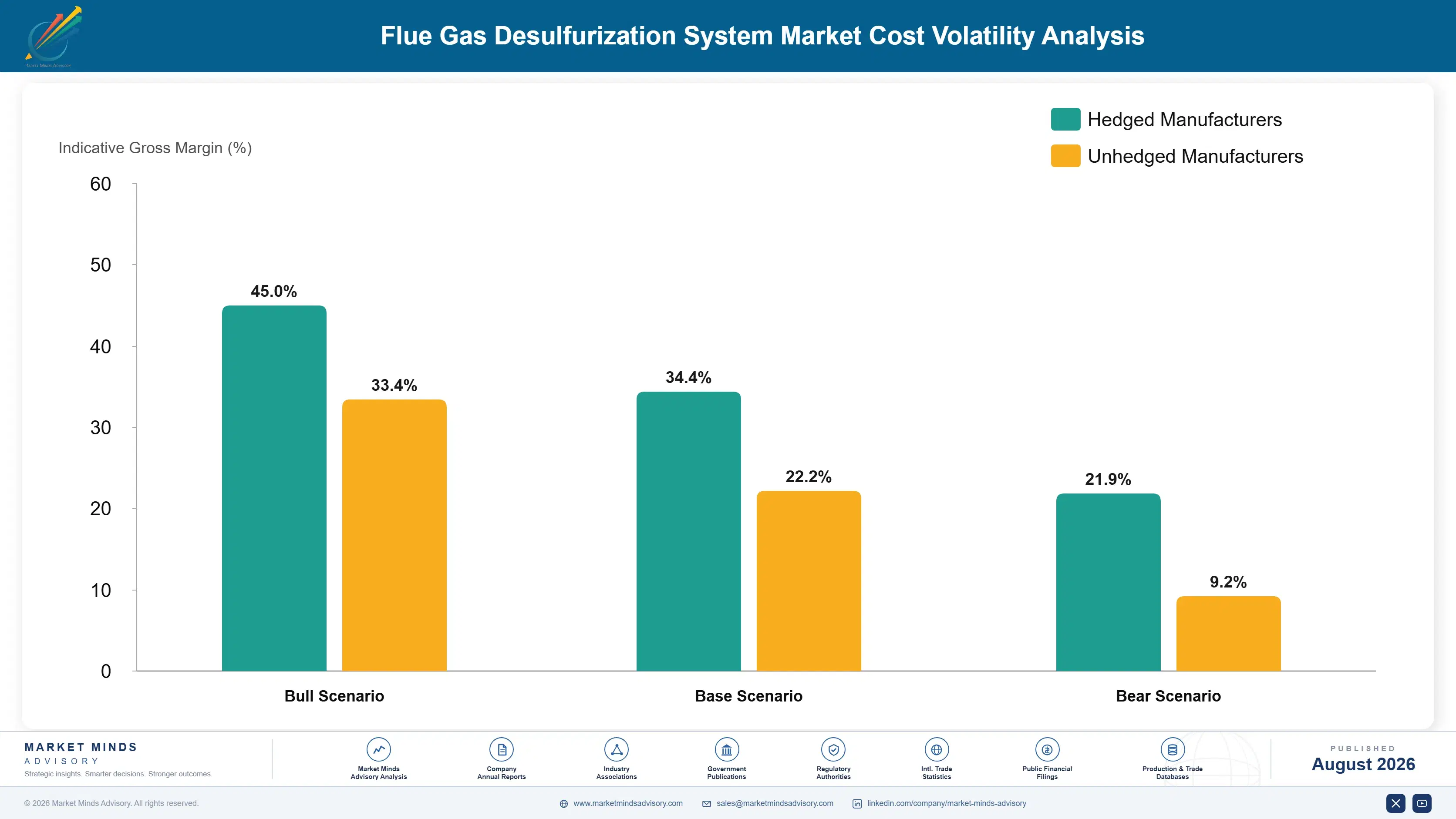
Reagent and Steel Component Cost Exposure

Limestone or lime reagent, structural steel components, and specialty alloy internals together account for an estimated 38% of FGD system operating cost of goods sold across the installed base, with labor and energy making up most of the remainder. Reagent supply originates from regional quarries near each installation, while steel and alloy components draw on global commodity markets subject to broader industrial demand swings.
Reagent costs climbed more than 15% over a twenty-four-month span through late 2025 as mining and processing costs increased across major producing regions worldwide and transportation expenses rose in parallel, according to US Geological Survey mineral commodity data. Utilities without long-term reagent contracts absorbed the increase directly, and several operators reported budget overruns significant enough to defer planned maintenance activities across multiple facilities and fiscal years.

The competitive disadvantage mechanism is direct: utilities sourcing reagent exclusively from spot markets face repricing risk that operators with long-term supply contracts avoid entirely across their operating fleet. Exposure varies by player type, with larger utilities typically holding stronger supplier relationships and reagent contracts than smaller regional operators purchasing opportunistically on the spot market. and current market position.
flue-gas-desulfurization-system-market-cost-volatility-analysis-1787551021003

Long-Term Reagent Supply Contracting

Utilities and suppliers are increasingly locking multi-year limestone and lime reagent purchase agreements directly with regional quarry operators, trading some pricing flexibility for predictable operating budgets that support long-term maintenance planning across multi-decade plant horizons, capital cycles, regulatory compliance timelines, and generational asset management strategies. Adoption keeps expanding among utilities. nationwide. and beyond.

Alternative Sorbent Chemistry Qualification

Some utilities are qualifying alternative sorbent chemistry, including sodium-based reagents, to reduce dependence on limestone supply chains facing regional cost pressure and transportation constraints, particularly at facilities distant from quarry sources, rail infrastructure, bulk shipping terminals, and regional distribution hubs serving multiple plants. Interest keeps growing among operators. broadly. and expanding steadily.

Regional Reagent Sourcing Diversification

Larger utility operators with multiple plants are diversifying reagent sourcing across several regional quarries rather than depending on a single supplier, reducing exposure to localized mining disruptions or transportation bottlenecks affecting any one source, region, supplier relationship, or logistics provider over time and across seasons. Coverage keeps expanding across networks. nationwide. and beyond.

Portfolio Architecture for Margin Defence

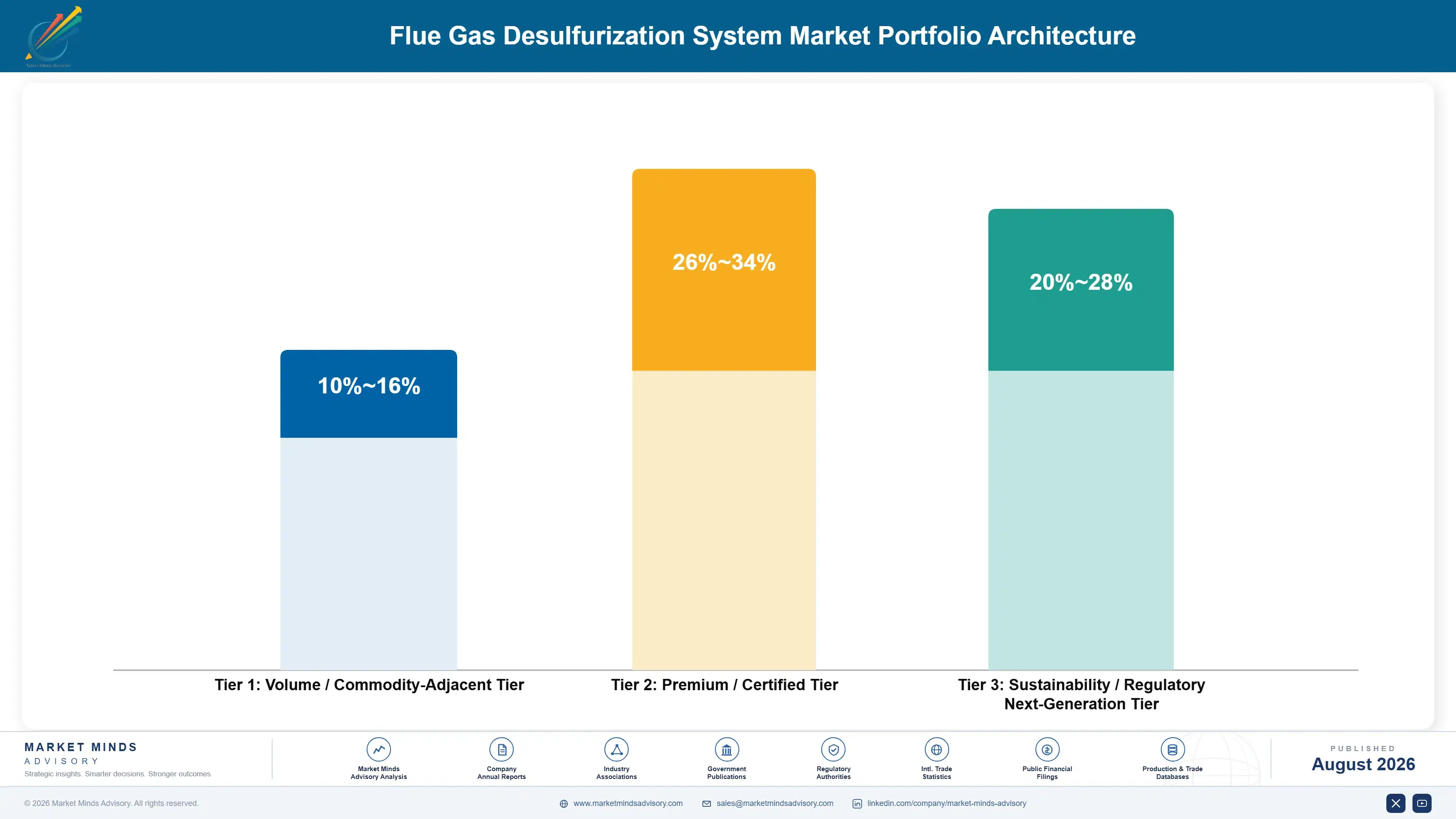
FGD system margin economics divide across three tiers driven primarily by application scale and service commitment rather than raw equipment complexity alone. Volume commodity-adjacent new-system installations carry thin margins under intense competitive bidding among numerous qualified suppliers, while long-term aftermarket service contracts command substantially wider margins reflecting recurring revenue and switching costs tied to plant-specific technical knowledge accumulated over years of operation.
The volume versus premium tension mirrors the broader industrial equipment pattern: new-system suppliers compete primarily on price and delivery timeline against numerous qualified bidders competing for the same limited project pipeline, while service suppliers compete instead on relationship depth and technical documentation that utilities cannot easily substitute away from once established. Switching costs favor incumbents meaningfully in service contracts, since new providers require extensive plant-specific technical onboarding before earning customer trust.

High-value margin pools concentrate in long-term aftermarket service contracts and industrial SO2 compliance applications, where relationship depth and technical documentation limit competitive entry to established suppliers with proven track records across multiple installations. Indian retrofit market entry, though capital intensive upfront, is emerging as a meaningful third pool given the scale of the pending compliance backlog and the multi-decade service revenue it will eventually generate.

Volume / Commodity-Adjacent Tier

New-system installations for standard utility-scale coal units compete primarily on price and delivery timeline against numerous qualified bidders with broadly comparable technical capability and project experience across regions. and equipment vendors.
Gross Margin: 10-16%

Premium / Certified Tier

Long-term aftermarket service contracts covering major component overhaul command durable pricing power once established, given the plant-specific technical knowledge competitors cannot easily replicate quickly or affordably at scale. over many years.
Gross Margin: 26-34%

Sustainability / Regulatory / Next-Generation Tier

Industrial SO2 compliance systems and Indian retrofit market entry earn a meaningful premium from customers facing tightening regulation and compressed compliance timelines ahead of upcoming enforcement deadlines nationwide and beyond.
Gross Margin: 20-28%
flue-gas-desulfurization-system-market-portfolio-architecture-1787551021520

High-value Sub-segments and Strategic Watch-out

Aftermarket Component Overhaul Services

The highest-value, fastest-growing pool as the global installed base ages past initial design life worldwide; suppliers with established service networks are capturing outsized margin expansion relative to the broader category, a gap widening each successive year of fleet aging. Suppliers without service networks fall further behind.
Gross Margin: 28-36%

Indian Retrofit Market Entry

Large and growing steadily as India's compressed compliance backlog converts into signed contracts across multiple states and utility operators; margins remain solid though not yet at aftermarket-service premiums given competitive new-system bidding dynamics. Local manufacturing presence increasingly determines contract outcomes. across key growth states. overall.
Gross Margin: 18-25%

Standard Utility-Scale New Systems

The volume core of the category, providing stable baseline revenue but limited margin expansion potential given intense competitive bidding among numerous qualified global and regional suppliers chasing the same limited project pipeline. Margin pressure continues intensifying across most regions. Consolidation among smaller bidders seems increasingly likely.
Gross Margin: 10-15%

Western Coal Retirement Exposure Risk

A strategic watch-out as accelerating coal plant retirements permanently eliminate both new-system and service revenue at affected facilities; suppliers overexposed to Western coal fleets face a sustained, multi-year revenue decline with no clear replacement. Diversification remains the only credible mitigation available. Regional rebalancing takes years to fully execute.
Gross Margin: 6-12%

Plant Lifecycle Service Lock-In Economics

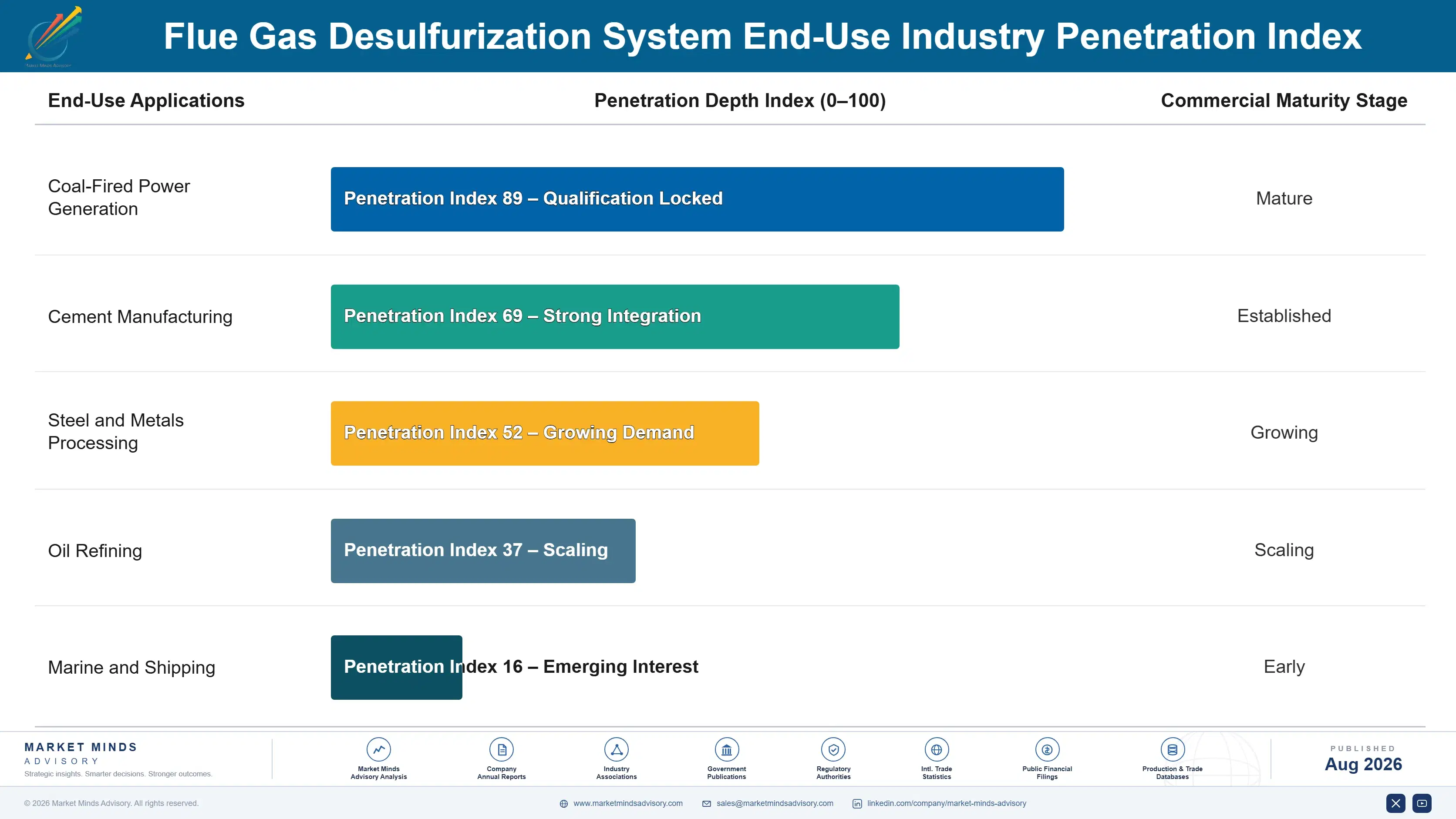
FGD system revenue behaves closer to an annuity than a transactional equipment sale once a system is commissioned at a plant and enters continuous operation. Utilities rarely switch service suppliers without a compelling cost or performance reason, since a new provider requires extensive plant-specific technical onboarding and carries operational risk that plant managers prefer to avoid across multi-decade operating horizons and generational leadership transitions.
Adoption stickiness varies meaningfully by end-use vertical. Power generation utilities exhibit the deepest lock-in given multi-decade plant operating horizons and safety-critical system documentation tied to the original equipment supplier, while industrial customers switch suppliers more readily on price alone given shorter facility operating cycles and simpler system configurations. New-build Asian coal projects sit between the two, constrained by initial supplier qualification requirements.

Buyer profiles are shifting generationally as procurement teams increasingly include sustainability and regulatory compliance specialists alongside traditional engineering managers, changing how FGD supplier selection gets evaluated during plant planning and budgeting cycles. Younger engineering leads entering purchasing decisions weigh service network depth and long-term reliability more heavily than predecessors did, gradually reshaping which suppliers win new plant and retrofit contracts across both established and emerging markets.
flue-gas-desulfurization-system-market-end-use-penetration-index-1787551022085

Priorities for FGD System Suppliers

These are among the four positions where our research anticipates prominent divergence between winners and laggards over the coming forecast period. Each is grounded in the demand model, the regulatory perimeter, and the announced capacity pipeline.
01 / SERVICE NETWORK PRIORITY

Expand aftermarket service coverage before installed base peaks

Suppliers should expand aftermarket service network coverage now, since recurring, high-margin revenue from an aging installed base is becoming the category's most durable growth pool across nearly every operating region worldwide. Early movers on service infrastructure lock in long-term utility relationships that later entrants struggle to displace given plant-specific technical knowledge requirements accumulated over years of operation and multiple maintenance cycles. Suppliers still relying purely on new-system sales will keep losing ground as Western new-build activity continues shrinking toward near zero.
02 / INDIAN MARKET ENTRY URGENCY

Build Indian manufacturing capability ahead of the retrofit wave

Suppliers should establish local manufacturing or partnership capability in India now, since the country's compressed compliance backlog covering hundreds of coal units represents a multi-year demand wave only now converting into signed contracts across multiple states and utility operators. Local presence reduces delivered cost and demonstrates commitment that Indian utilities increasingly favor over pure import relationships lacking local accountability and technical support presence. Suppliers without local capability risk losing this substantial demand to better-positioned regional competitors already building domestic capacity.
03 / INDUSTRIAL DIVERSIFICATION STRATEGY

Diversify into industrial SO2 compliance beyond power generation

Suppliers heavily dependent on power generation customers should actively diversify into cement, steel, and refining industrial applications now, since this demand pool is less correlated with coal capacity investment cycles and broader power sector volatility across most markets. Industrial customers value smaller-scale, faster-installation systems that differ meaningfully from utility-scale configurations and require different sales relationships and technical expertise entirely. Suppliers that build this capability early will be better positioned when power sector orders inevitably soften further across most major markets.
04 / REAGENT CONTRACTING DISCIPLINE

Formalize long-term reagent contracts before the next cost spike

Utilities and suppliers should lock multi-year reagent supply agreements now, since limestone and lime costs have already climbed more than 15% and show no sign of stabilizing given rising mining and transportation costs across producing regions worldwide and beyond. Forward contracting protects operating budgets and strengthens long-term customer relationships built around predictable, budgetable maintenance planning over multi-decade horizons and capital cycles that span entire plant lifetimes. Operators still buying reagent on the spot market will keep absorbing avoidable cost shocks each recurring cycle.

Engagement Snapshot From the Field

A live engagement with an industry participant carrying material or product regulatory and market exposure ahead of a defining policy shift, showing how our research translates into a defensible multi-year portfolio strategy.
MARKET MINDS ADVISORY · CLIENT ENGAGEMENT SUMMARY
Flue Gas Desulfurization System Producer Strategic Portfolio Review and Transition Roadmap 2026·Investment Scenario on Flue Gas Desulfurization System Exposure Evaluation 2025-26
CLIENT PROFILE
The client is a regional utility operator running several coal-fired plants approaching the end of their FGD systems' initial design life, sourcing aftermarket parts and service from the original equipment supplier under an aging, non-competitive contract structure. Facing rising reagent costs and deferred maintenance backlogs, the client engaged MMA to evaluate its service sourcing options before renewing multi-year contracts.
STRATEGIC CHALLENGE
The client's single-source service arrangement left it with no competitive pricing leverage whatsoever, and rising reagent costs combined with deferred component overhauls had created a maintenance backlog threatening compliance with tightening emissions standards across multiple facilities and generating units simultaneously this operating year and the following fiscal cycle as well.
MMA APPROACH
MMA benchmarked the client's service arrangement against category leaders on reagent contracting practice, service network coverage, and component overhaul pricing, then carefully modeled the full cost and reliability impact of competitively re-bidding its aftermarket service contracts across multiple qualified suppliers, facilities, generating units, and every regional service territory under review.
KEY FINDINGS
  1. The client's single-source service contract carried pricing roughly 20% above competitively bid rates observed at comparably sized utility operators in the same region.
  2. Deferred component overhauls at two facilities risked emissions compliance violations within eighteen months absent immediate corrective maintenance investment and funding. and budgets.
  3. Competitively re-bidding service contracts would have secured multi-year reagent supply agreements included as part of the winning proposal terms and pricing. and pricing terms.
  4. Suppliers with established regional service networks quoted response times roughly 30% faster than the client's incumbent single-source provider overall and industry-wide. overall today.
CLIENT PROFILE
The client is a regional utility operator running several coal-fired plants approaching the end of their FGD systems' initial design life, sourcing aftermarket parts and service from the original equipment supplier under an aging, non-competitive contract structure. Facing rising reagent costs and deferred maintenance backlogs, the client engaged MMA to evaluate its service sourcing options before renewing multi-year contracts.
STRATEGIC CHALLENGE
The client's single-source service arrangement left it with no competitive pricing leverage whatsoever, and rising reagent costs combined with deferred component overhauls had created a maintenance backlog threatening compliance with tightening emissions standards across multiple facilities and generating units simultaneously this operating year and the following fiscal cycle as well.
MMA APPROACH
MMA benchmarked the client's service arrangement against category leaders on reagent contracting practice, service network coverage, and component overhaul pricing, then carefully modeled the full cost and reliability impact of competitively re-bidding its aftermarket service contracts across multiple qualified suppliers, facilities, generating units, and every regional service territory under review.
KEY FINDINGS
  1. The client's single-source service contract carried pricing roughly 20% above competitively bid rates observed at comparably sized utility operators in the same region.
  2. Deferred component overhauls at two facilities risked emissions compliance violations within eighteen months absent immediate corrective maintenance investment and funding. and budgets.
  3. Competitively re-bidding service contracts would have secured multi-year reagent supply agreements included as part of the winning proposal terms and pricing. and pricing terms.
  4. Suppliers with established regional service networks quoted response times roughly 30% faster than the client's incumbent single-source provider overall and industry-wide. overall today.
RECOMMENDED STRATEGY
Phase 1: Phase one: competitively re-bid aftermarket service contracts across qualified regional suppliers, prioritizing the facilities with the most urgent compliance risk. Phase 2: Phase two: negotiate bundled reagent supply agreements as part of the new service contracts to lock in predictable operating costs. Phase 3: Phase three: establish performance benchmarks and response time requirements in future contracts to maintain competitive service quality standards long-term. long-term.
OUTCOME
The client re-bid its service contracts and secured pricing roughly 18% below its prior single-source arrangement (client-reported, unverified by MMA) while addressing its deferred maintenance backlog within the following operating year across all affected facilities, generating units, and regional service territories under its full jurisdiction.

Frequently Asked Questions

Foundational context covering the market sizes, CAGR, scope, country, region and competition that inform every finding below. This section is provided to cover basics and most often pre-purchase conversations, answered from the MMA Primary Research Dataset.

What is the current size of the Flue Gas Desulfurization System Market?

The global FGD system market reached an estimated USD 8.6 billion in 2025. Growth is driven by Asian coal capacity additions and expanding aftermarket service demand worldwide.

How large will the Flue Gas Desulfurization System Market be by 2036?

MMA projects the market will reach approximately USD 15.02 billion by 2036. This represents nearly a 1.66 times expansion from 2026 levels over the forecast decade.

What is the CAGR for the Flue Gas Desulfurization System Market 2026 to 2036?

The market is projected to grow at a 5.2% compound annual growth rate between 2026 and 2036. Bull and bear scenarios range from 4.0% to 6.4% depending on Asian coal capacity trends.

Which segment is growing fastest?

Wet Limestone-Gypsum FGD Systems is the fastest-growing segment, expanding at a 6.5% CAGR. That is roughly 1.25 times the overall market growth rate, driven by Asian new-build capacity.

Who are the major companies in the Flue Gas Desulfurization System Market?

Leading suppliers include GE Vernova, Mitsubishi Heavy Industries, Babcock & Wilcox, FLSmidth, and Andritz AG. These five companies together hold roughly 45% of category revenue.

Which country is growing fastest?

India leads regional growth at an 8.0% CAGR, driven by its accelerating FGD retrofit mandate on existing coal fleets. Hundreds of pending coal units reinforce this position through 2036.

Report Segmentation Architecture

The full report scope spans multiple orthogonal segmentation dimensions, with cross-tabulated demand data provided for each dimension pair. Coverage extends further to regional breakdowns, trend trajectories, and the competitive detail needed to support segment-level decision-making.

By Primary Market Dimension

  • Wet Limestone-Gypsum FGD Systems
  • Dry Sorbent Injection Systems
  • Semi-Dry Spray Dryer Absorbers
  • Seawater FGD Systems
  • Regenerable FGD Systems
  • Aftermarket Parts and Retrofit Services

By End-Use Industry

  • Coal-Fired Power Generation
  • Cement Manufacturing
  • Steel and Metals Processing
  • Oil Refining
  • Marine and Shipping

By Commercial Dimension

  • EPC Project Delivery
  • Direct Equipment Supplier Sales
  • Long-Term Service Contracts
  • Spot Market Component Purchases

By Region

  • North America
  • Western Europe
  • East Asia
  • South Asia and Pacific
  • Latin America
  • Middle East and Africa
  • Eastern Europe

Scope, Methodology, and Coverage

Every figure in this report is reproducible from documented input assumptions. The scope below maps the historical period, the forecast horizon, the segmentation dimensions, and the countries covered, alongside the underlying primary and qualitative methodology.
Historical Period
2020 to 2025
Forecast Period
2026 to 2036
Base Year
2025 (USD billions; MMA Primary Research Dataset, August 2026)
Market Definition
This report covers the global market for flue gas desulfurization systems, including wet limestone-gypsum, dry sorbent injection, and semi-dry scrubber technology used to remove sulfur dioxide from coal-fired power plant and industrial combustion exhaust. It excludes selective catalytic reduction systems targeting nitrogen oxides.
Quantitative Units
USD billions (current prices); installed capacity in gigawatts where applicable
Segmentation Dimensions
By Primary Market Dimension; By End-Use Industry; By Commercial Dimension; By Region
Regions Covered
North America, Western Europe, East Asia, South Asia and Pacific, Latin America, Middle East and Africa, Eastern Europe
Countries Covered
USA, China, Germany, France, UK, Japan, South Korea, India, Australia, Canada, Brazil, Mexico, Indonesia, Vietnam, Thailand, Malaysia, UAE, Saudi Arabia, South Africa, Nigeria, Turkey, Poland, Netherlands, Italy, Spain, Sweden, Switzerland, Argentina, Colombia, Singapore, and additional markets relevant to this sector
Key Companies Profiled
GE Vernova, Mitsubishi Heavy Industries Ltd., Babcock & Wilcox Enterprises Inc., FLSmidth & Co. A/S, Andritz AG, Doosan Enerbility Co., Ltd., Hitachi Zosen Corporation, Thermax Limited, BHEL (Bharat Heavy Electricals Limited), China Everbright Environment Group Limited, Wuhan Kaidi Electric Power Co., Ltd., Fuel Tech, Inc., Ducon Technologies Inc., Marsulex Environmental Technologies, CECO Environmental Corp., Valmet Corporation, Sumitomo Heavy Industries, Ltd., Longking Environmental Protection Co., Ltd., Chiyoda Corporation, Dongfang Electric Corporation
Quantitative Methodology
Primary survey, n=3,800 respondents, Q4 2025, six countries; demand-side model with trade association cross-validation
Qualitative Methodology
47 expert interviews, Q4 2025; applied to validate demand model assumptions, identify emerging dynamics, and assess competitive positioning
Report Format
PDF and XLSX data workbook (Word format preview document)
Publisher
Market Minds Advisory
Report Code
MMA-2026-CON-129
Published
August 2026
Contact
sales@marketmindsadvisory.com | www.marketmindsadvisory.com

Purchase the full Flue Gas Desulfurization System Market Report (2026 to 2036).

The full report provides a comprehensive assessment of the global FGD system market, covering historical performance from 2020 through 2025 and detailed ten-year forecasts through 2036. It segments the market by technology type, end-use industry, and commercial channel, and profiles twenty leading suppliers with benchmarking across service network coverage, Asian manufacturing presence, and technical capability. Regional chapters cover all seven world regions with country-level detail for major producing and consuming markets, including China, India, and the United States. Clients also receive underlying data tables and a live analyst briefing upon request.
Ten-year global market sizing and forecast model
Segment-level CAGR and market share breakdowns
Twenty-company competitive benchmarking and profiling database
Seven-region demand growth and pricing analysis
Reagent and steel component cost exposure assessment
Direct analyst briefing and underlying data table access

Built For The People Who Decide

From boardroom strategy to bench-side execution, this report is read cover-to-cover by leaders shaping the next decade of their industry, turning demand scenarios, market dynamics and valuation benchmarks into decisions.
CXOs/ Presidents/ VPs/ Managers
M&A and Corporate Development
Strategy Teams and R&D Heads
Procurement and Product Directors
Regulatory and Compliance Leaders
Investor Relations and Equity Analysts