Market Minds Advisory
Flow Wrap Packaging Market

Flow Wrap Packaging Market: Recyclability Economics in a Barrier Performance Transition

Brand owner packaging mandates are forcing flow wrap film converters to replace multi-layer barrier laminates with recyclable mono-material structures, even though newer films still trail incumbent barrier performance on moisture-sensitive products.

Lead Analyst

Bilal Shaikh

Published

September 2026

Make Smarter Decisions with Customized Research Insights

Request a free sample report and evaluate market opportunities, growth trends, and competitive dynamics relevant to your business needs.

2025 MARKET VALUE$8.4BMarket Size 2025
2036 FORECAST VALUE$15.9BBase Case , 2026 to 2036
CAGR 2026 TO 20366.0 %Bull 7.0% / Bear 5.0%
INCREMENTAL OPPORTUNITY$7.0BNet 10- year value creation
EXPANSION MULTIPLE1.79x2036 value over 2026 base
Strategic Levers
M&A Pipeline
Regional Outlook
Country Rankings
Competitive Intelligence
Segmental Deep-dive
Call-Us : 91 93563 13602

Executive Snapshot and Market Trajectory

Packaging sustainability mandates have moved from marketing claim to hard specification requirement across snack, bakery, and confectionery categories, and converters unable to deliver recyclable flow wrap film at existing barrier performance and cost are increasingly losing shelf space to competitors who solved that trade-off first.
Recyclable mono-material film is pulling demand fastest, since brand owners committed to 2025 and 2030 packaging recyclability targets are actively requalifying suppliers who cannot yet match legacy multi-layer barrier performance in a single-polymer structure. East Asia anchors the largest share of global flow wrap film demand, driven by China's enormous snack and confectionery manufacturing base, while European converters lead the technical transition toward recyclable structures given the region's earliest and strictest extended producer responsibility regulation.
Competitive position tracks recyclable film technology depth more than manufacturing scale alone, since brand owners increasingly disqualify suppliers who cannot document recyclability certification alongside barrier performance data. Amcor and Sealed Air lead on film science investment, but regional converters across China and India are scaling fast, competing aggressively on price in categories where recyclability requirements remain less strictly enforced than in Europe and North America.
Market Definition
The flow wrap packaging market covers horizontal and vertical form-fill-seal flow wrap film and pre-formed flow wrap pouches used to package snack, bakery, confectionery, and personal care products in a continuous overwrap format. It excludes flow wrap machinery, rigid packaging formats, and shrink film not applied through a flow wrap process.
Base Year Value
$8.4B in 2025 (MMA Primary Research Dataset, August 2026)
Forecast Period
2026 to 2036, eleven discrete annual values
CAGR
6.0% base case. Bull 7.0%. Bear 5.0%.
Fastest Growth Segment
Compostable and Bio-Based Flow Wrap Film: 10.5% CAGR
Fastest Growth Country
China: 7.8% CAGR
Fastest Growth Region
South Asia and Pacific: 8.0% CAGR
Largest Region
East Asia: 30% of 2025 global value
Market Leaders
Amcor plc, Sealed Air Corporation, Mondi plc, Constantia Flexibles Group GmbH, Berry Global Group, Inc. Source: MMA Analysis based on company annual reports.
Primary Survey
n=3,800 procurement and R&D decision-makers, Q4 2025, six countries
Methodology
Demand-side build-up, cross-validated against public data, 47 expert interviews

Flow Wrap Packaging Market Forecast Scenarios

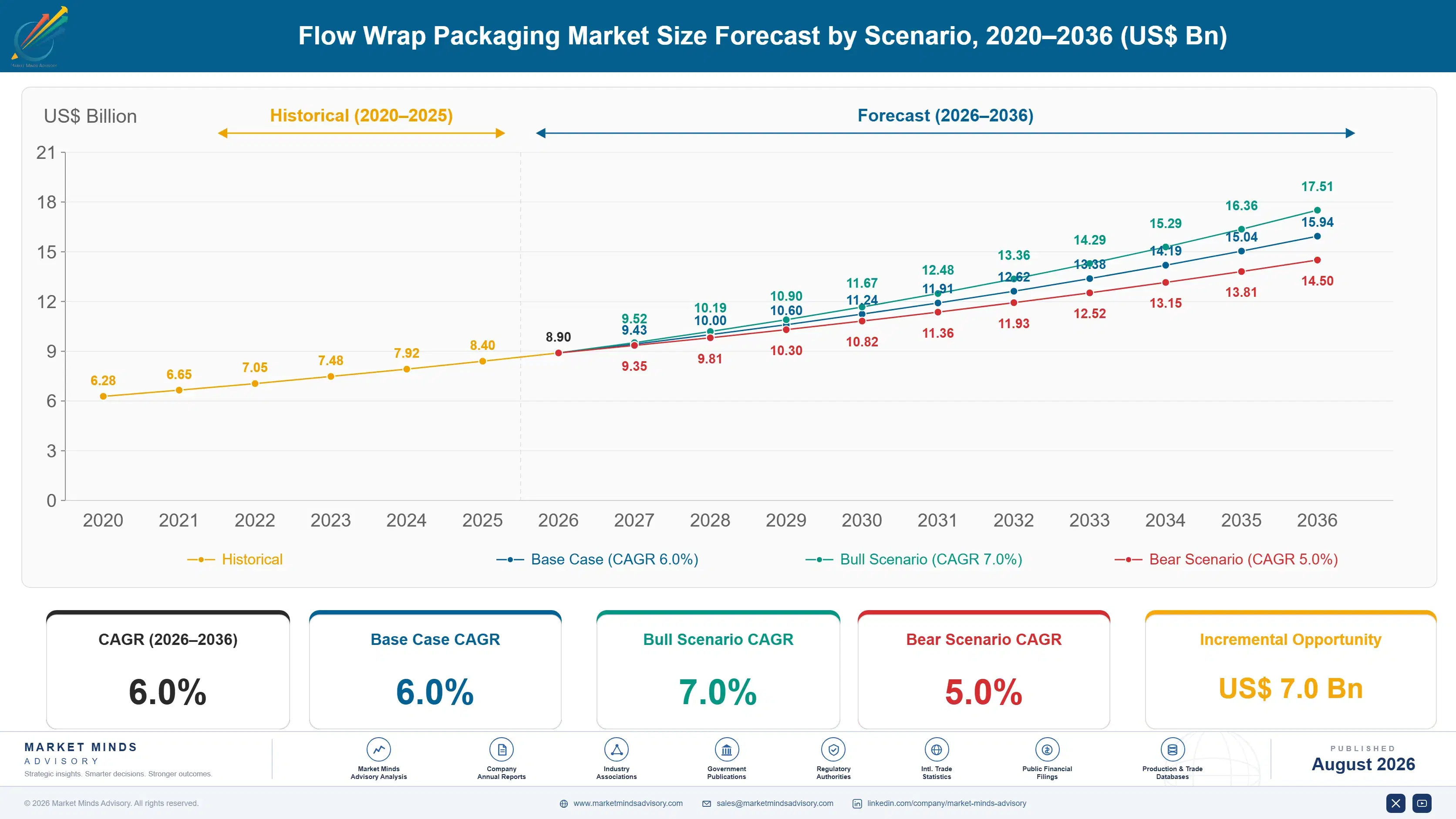
flow-wrap-packaging-market-size-forecast-scenario-1787300730186
Between 2020 and 2025 the market grew at an estimated 5.4% CAGR, a period marked by pandemic-driven packaged snack demand followed by a slower stretch as raw material cost inflation squeezed converter margins and brand owners delayed sustainability-driven reformulation. Growth steadied once resin prices normalized and brand owners resumed active packaging redesign programs targeting recyclability commitments.
The base case assumes 6.0% CAGR through 2036, driven by three mechanisms: brand owner recyclability commitments forcing conversion from multi-layer barrier laminates to mono-material structures, rising packaged snack and bakery consumption across East Asia and South Asia as urban convenience food spending expands, and extended producer responsibility regulation across Europe that increasingly penalizes non-recyclable packaging formats with direct compliance fees. Together these mechanisms sustain growth even as mature Western markets approach packaged food volume saturation.
The bull case, 7.0% CAGR, assumes faster brand owner reformulation timelines pull recyclable film conversion forward across major categories simultaneously. The bear case, 5.0% CAGR, reflects the risk that recyclable mono-material films remain unable to match legacy barrier performance for moisture-sensitive products, forcing brand owners to delay full conversion and keep dual film lines running longer than currently planned.

Recyclability Transition and Barrier Performance Trade-offs

Flow wrap film sits at the center of an unusually public packaging debate, since the wrapper itself has become a visible proxy for brand sustainability commitment in a way few other packaging formats experience directly. Converters increasingly compete on documented recyclability certification and life-cycle assessment data alongside traditional metrics like barrier performance and cost, which has meaningfully lengthened qualification timelines for any new film structure entering commercial use
MARKET CONCENTRATION (CR5)36%Moderately fragmented despite several large global film converters
AVERAGE SELLING PRICE$3.20/kgRecyclable mono-material film commands a meaningful price premium
TOP PRODUCING COUNTRY SHAREChina, 19%reflects large domestic snack and confectionery packaging demand
CAPACITY UTILIZATION76%Film extrusion lines run comfortably below full nameplate output
TRADE INTENSITY41% cross-borderSubstantial film volume still moves across national borders
FEEDSTOCK COST SHARE58%Polymer resin inputs dominate total film production cost
Commercially, the category splits between mature, highly optimized multi-layer barrier film serving moisture- and oxygen-sensitive products, and a rapidly growing recyclable mono-material segment still working through real performance trade-offs on shelf-life extension. Converters exposed to both segments are managing an unusually complex dual product roadmap, qualifying new recyclable structures while continuing to defend legacy barrier film volume that still represents the bulk of category revenue today across most established markets.
The next decade favors converters who can close the barrier performance gap in recyclable mono-material structures fastest, since brand owners increasingly treat recyclability as non-negotiable regardless of any remaining shelf-life trade-off versus legacy film, and regulators across most major markets are moving firmly in the same direction.
"The interesting tension here isn't sustainability versus cost, it's sustainability versus shelf life. Converters who solve barrier performance in a single-polymer film get to set the price for the entire recyclable segment."
Director, Packaging and Materials Science Practice · MMA Packaging / Flexible Fi

Market Trends

Brand Owner Recyclability Commitments Reshape Film Specification

Major consumer packaged goods companies including Nestlé, Mondelez, and Unilever have committed to making the substantial majority of their plastic packaging recyclable, reusable, or compostable by 2025 or 2030, and flow wrap film represents one of the largest remaining non-recyclable packaging categories across their snack and confectionery portfolios. This is compressing qualification timelines for recyclable mono-material film suppliers, since brand owners now need documented recyclability certification alongside barrier performance data before approving any new film structure for production. Converters who cannot yet match legacy barrier performance in a recyclable structure risk losing shelf space to competitors who already have.
Market Impact: Adds $8 per ton compliance fee
Paper-Based Flow Wrap Gains Ground in Select Categories

Paper-based flow wrap film, once considered technically unsuitable for most high-speed packaging lines given its lower seal integrity and moisture resistance, has improved meaningfully through new coating technology and is now gaining real traction in dry snack and confectionery categories where extended barrier performance matters less. Mondi and other converters have introduced paper-based lines specifically targeting biscuit, cracker, and bar categories where brand owners want to move away from plastic entirely rather than simply switching to a recyclable plastic alternative. Adoption remains limited to lower-moisture applications for now, though converters keep investing to widen that reach.
Market Impact: Lifts Asian volume roughly 14 percent

Market Opportunities and Growth Drivers

European Extended Producer Responsibility Fees Penalize Film

European Union member states are increasingly implementing extended producer responsibility fee structures that charge brand owners meaningfully higher compliance fees for non-recyclable packaging formats compared to certified recyclable alternatives, directly monetizing the sustainability gap between legacy multi-layer barrier film and newer mono-material structures. France and Italy have moved furthest on differentiated fee schedules, and other member states are following as the EU's broader packaging and packaging waste regulation framework phases in across the bloc through the late 2020s. This gives brand owners a direct, quantifiable financial incentive to convert flow wrap specifications beyond pure marketing or reputational considerations alone.
Market Impact: Shortens shelf life by 15 percent

Rising Packaged Snack Consumption Across South and East Asia

Urban convenience food consumption is expanding rapidly across China, India, and Southeast Asia as rising incomes and busier lifestyles shift consumer spending toward packaged snacks, biscuits, and confectionery that rely heavily on flow wrap formats for individual and multi-pack presentation. Domestic and multinational snack manufacturers are expanding production capacity across the region to meet this demand, and each new production line requires qualified flow wrap film supply matched to local high-speed packaging equipment. This sustains flow wrap film demand growth well beyond what mature Western markets, where packaged snack volume has largely plateaued, can generate on their own.
Market Impact: Recycled resin costs 35 percent more

Market Restraints and Challenges

Recyclable Films Still Trail Barrier Performance Benchmarks

Recyclable mono-material flow wrap films, while improving steadily, still generally cannot match the oxygen and moisture barrier performance of legacy multi-layer laminates for the most sensitive products, including high-fat snacks prone to oxidative rancidity and baked goods sensitive to moisture migration. The cause is a genuine materials science constraint: multi-layer laminates achieve superior barrier performance by combining different polymers with complementary properties, difficult to replicate within a single recyclable polymer family. Converters are mitigating this through advanced coating technology and modified atmosphere packaging that partially compensates, though full parity remains a multi-year research target.
Market Impact: Adds $410 million recyclable film demand

Recycled Content Availability Constrains Film Scale-Up Plans

Many recyclable mono-material flow wrap structures rely on post-consumer recycled polymer content to meet brand owner sustainability targets, but food-grade recycled polymer supply remains genuinely scarce relative to demand, since flexible film recycling infrastructure lags far behind that for rigid formats like bottles. The cause is that flexible film collection and sorting infrastructure has historically been far less developed than bottle recycling systems, leaving a persistent gap between recycled content commitments and available qualified feedstock. Converters are mitigating this by investing directly in film recycling infrastructure and chemical recycling partnerships.
Market Impact: Paper-based film share up 6 points
3 additional market trends, 2 additional growth drivers, and 2 additional restraints and challenges are covered in the full report. Contact sales@marketmindsadvisory.com to access the complete intelligence.

Segment CAGR and Growth Architecture

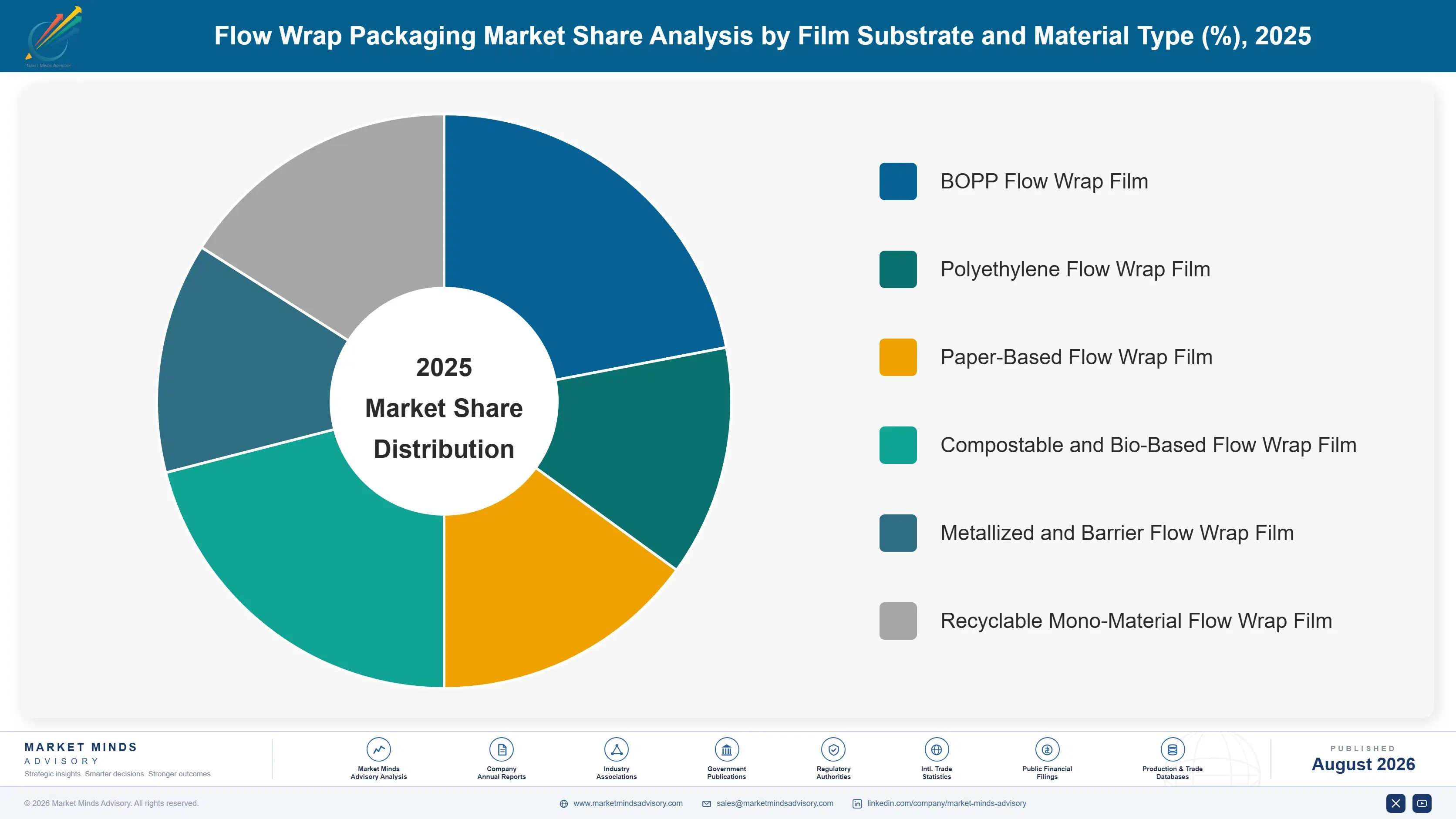
MMA segments the flow wrap packaging market by film substrate and material chemistry, the dimension that determines recyclability classification, barrier performance, and where brand owners can specify a structure against their sustainability commitments. This framing separates legacy multi-layer barrier film from single-polymer recyclable structures and emerging paper-based alternatives competing for the same shelf space.
flow-wrap-packaging-market-market-share-analysis-1787300730722

Compostable and Bio-Based Flow Wrap Film

Compostable and bio-based flow wrap film is growing fastest as a small but expanding group of brand owners, particularly in premium and organic snack categories, pursue compostability rather than conventional plastic recyclability as their sustainability pathway. This segment remains the smallest in absolute volume of the six segments MMA tracks, but early adoption momentum and premium positioning are driving the steepest percentage growth in the category. Compostable film faces genuine technical constraints around barrier performance and cost that currently limit it to premium, lower-volume applications rather than mainstream mass-market packaging. Converters including Taghleef Industries and several specialized bio-based film startups are investing heavily here, betting that certification standards and composting infrastructure will mature enough to support wider adoption.
CAGR 10.5%

Recyclable Mono-Material Flow Wrap Film

Recyclable mono-material film forms the second-fastest-growing segment, pulled directly by brand owner recyclability commitments and tightening European extended producer responsibility fee structures that financially penalize non-recyclable packaging formats. Unlike compostable film, mono-material structures fit within existing plastic recycling infrastructure, which makes them the more scalable near-term pathway for most mainstream snack and confectionery brand owners pursuing 2025 and 2030 sustainability targets across their global portfolios. Amcor and Mondi currently hold the deepest recyclable mono-material film technology, having invested years in closing the barrier performance gap against legacy multi-layer laminates. Adoption is fastest in dry snack categories and slower in high-fat or moisture-sensitive products where the barrier performance gap remains most commercially significant today.
CAGR 8.8%
Full segment breakdown across 6 segments available in the complete report.

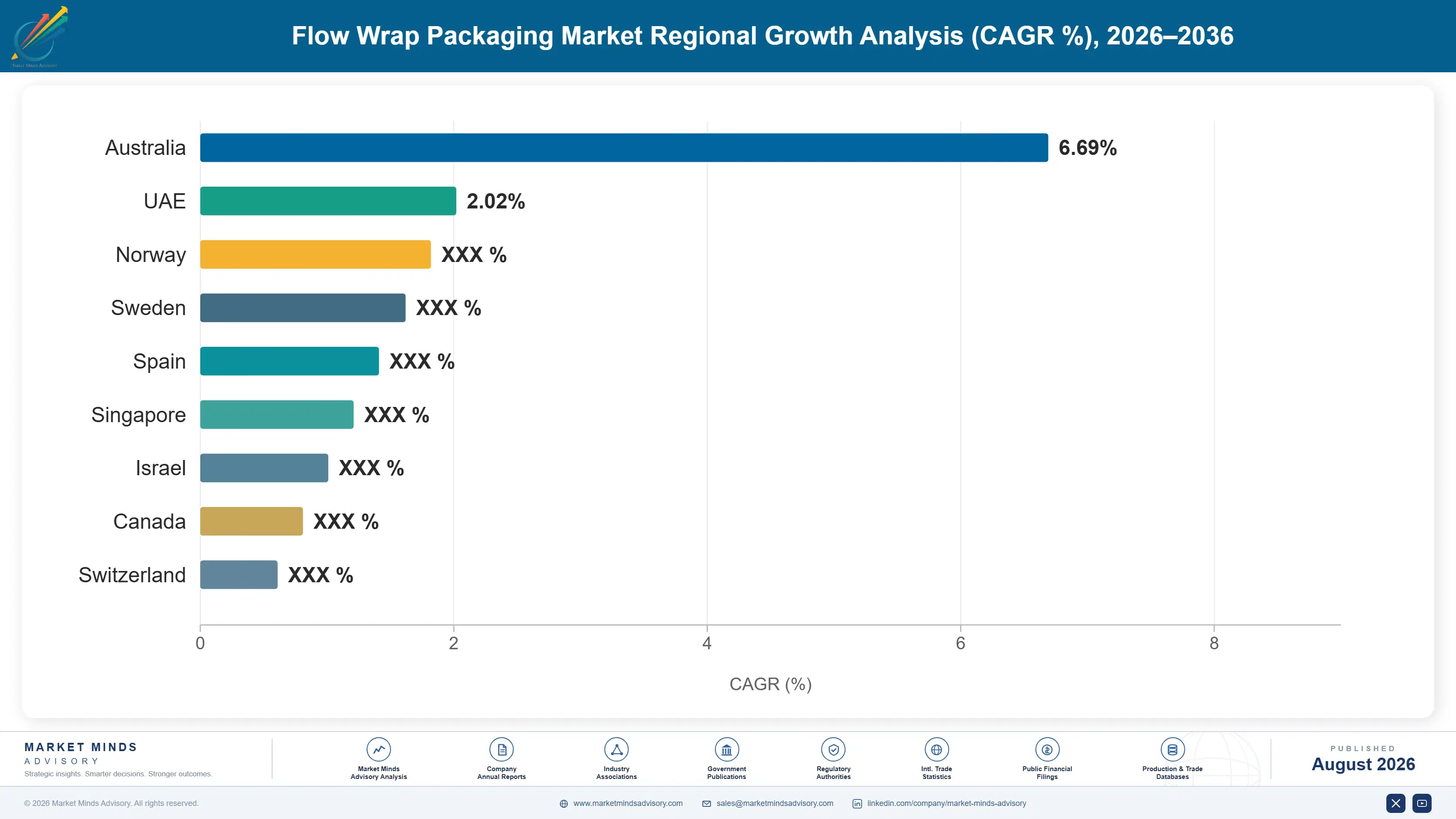
Regional Architecture and Country Demand Map

Flow wrap film demand concentrates where packaged snack manufacturing volume is highest. East Asia leads on China's enormous snack and confectionery production base, Western Europe anchors the technical transition toward recyclable film given its strictest regulation, and North America follows on mature but steady packaged food demand.

North America

North America's flow wrap film market is large but comparatively mature, tracking steady rather than explosive growth as packaged snack and confectionery volume has largely plateaued across established product categories. Brand owner sustainability commitments from companies including Mondelez and General Mills are driving recyclable mono-material film adoption, though state-level extended producer responsibility legislation, still emerging state by state rather than at the federal level, creates a more fragmented regulatory push than Europe's unified framework provides. US converters maintain strong domestic manufacturing capacity serving both branded and private-label snack producers, and the region's well-developed cold chain and retail infrastructure supports continued steady demand for both legacy barrier film and newer recyclable structures across most channels.
Share: 24% | CAGR: 5.7% (2026 to 2036)

Western Europe

Western Europe leads the global technical transition toward recyclable flow wrap film, driven by the EU's packaging and packaging waste regulation framework and increasingly differentiated extended producer responsibility fees that financially penalize non-recyclable formats across every member state. German, French, and UK brand owners have moved fastest on recyclable film conversion, and European converters including Mondi and Constantia Flexibles maintain the deepest recyclable film qualification portfolios globally as a direct result. Growth trails East Asia's faster-expanding packaged food volume, but Western Europe sets the technical standard other regions increasingly follow as global brand owners standardize packaging specifications across their worldwide portfolios rather than maintaining separate regional recipes for each individual market.
Share: 19% | CAGR: 4.5% (2026 to 2036)
Regional intelligence for 5 additional markets available in the complete report: East Asia, South Asia and Pacific, Latin America, Middle East and Africa, Eastern Europe. Contact sales@marketmindsadvisory.com.
flow-wrap-packaging-market-country-cagr-analysis-1787300731239

Monetizing the Recyclable Film Technology Transition

Converters are shifting from commodity film sales toward transition-led commercial models: premium pricing for certified recyclable structures, co-development partnerships that lock in brand owner specification before competitors qualify, recycled content supply agreements that secure scarce feedstock well ahead of mandates, and technical qualification support that shortens a customer's path to fully compliant packaging overall.

Premium Pricing for Certified Recyclable Structures

Converters increasingly price certified recyclable mono-material film at a meaningful premium over legacy multi-layer barrier film, reflecting the technical investment required to close the barrier performance gap and brand owners' willingness to pay for documented compliance with their sustainability commitments. This premium is most defensible where brand owners face the most direct regulatory or reputational pressure, particularly European brands facing differentiated extended producer responsibility fees on non-compliant packaging. Recyclable mono-material film currently commands premiums of 15 to 25 percent over comparable legacy barrier film, a gap converters expect to narrow only gradually as technology matures further.
Market Impact: Commands a 15 to 25 percent price premium

Co-Development Partnerships That Lock In Specification

Leading converters increasingly co-develop recyclable film structures directly with major brand owners, embedding their specific formulation into the brand owner's packaging specification before competitors even begin qualification testing on an alternative structure. This front-loads engineering investment but creates a durable, multi-year revenue relationship difficult for a competitor to dislodge once a specification names a particular converter's proprietary film by design, effectively locking out rivals for the contract's full duration. Mondi's paper-based partnerships with major biscuit and cracker brands illustrate the model, locking in supply agreements running 3 years or longer per relationship on average.
Market Impact: Locks in supply agreements running 3-plus years typically

Recycled Content Supply Agreements Securing Scarce Feedstock

Facing genuine scarcity in food-grade post-consumer recycled polymer supply, several converters are signing long-term supply agreements directly with recycling infrastructure operators and chemical recycling ventures, securing feedstock access 2 to 3 years ahead of when brand owner recycled content mandates fully phase in. This positions converters with secured feedstock to win recyclable film contracts that competitors without comparable supply agreements cannot fulfill reliably at scale. Early movers report these agreements now insulate them from most of the roughly 35 percent cost premium recycled resin still commands over virgin material today.
Market Impact: Secures feedstock supply 2 to 3 years ahead

Technical Qualification Support Shortening Compliance Timelines

Converters increasingly bundle technical qualification support, including line trial coordination and recyclability certification documentation, with recyclable film sales, recognizing that brand owners' internal qualification processes are themselves a genuine bottleneck regardless of how ready the film technology actually is. This shifts the converter's value proposition toward accelerating a brand owner's path to compliant packaging, which resonates given the regulatory and reputational deadlines most brand owners face today across their portfolios. Suppliers offering this bundled support report qualification cycles running roughly 3 months shorter and correspondingly higher win rates on new specification decisions.
Market Impact: Cuts brand qualification cycles by 3 full months

Who Controls the Margin Pool

CR5 sits at 36 percent, moderate concentration reflecting a category where several large global converters compete alongside a long tail of regional specialists serving local snack and confectionery manufacturers. Amcor and Sealed Air lead on recyclable film technology depth and barrier performance science respectively, and the gap to mid-tier challengers is real but narrowing as regional Asian converters scale investment quickly.
Current activity centers on three fronts: qualification of recyclable mono-material film structures against tightening brand owner and regulatory specifications, expansion of recycled content supply agreements to secure scarce feedstock ahead of mandate phase-ins, and geographic capacity expansion into East and South Asia where packaged snack volume growth continues outpacing mature Western markets by a wide margin.

Emerging pressure comes from Chinese and Indian converters extending domestic manufacturing scale into export markets across Southeast Asia, the Middle East, and Africa, competing aggressively on price in categories where recyclability requirements remain less strictly enforced than in Europe. Expect ranking shifts as these challengers win a growing share of standard barrier film contracts, gradually pushing established Western leaders to compete harder on recyclable film technology and brand co-development rather than manufacturing cost alone.
flow-wrap-packaging-market-company-positioning-matrix-1787300731762

Competitive Moat and Risk Dimensions

AMCOR PLC

Moat: Global Recyclable Film Portfolio Scale

Amcor's combined global flexible packaging footprint, expanded substantially through its 2019 Bemis acquisition, gives it recyclable mono-material film manufacturing capacity across more regions simultaneously than any single competitor can currently match. This scale lets Amcor co-develop recyclable structures with multinational brand owners once and deploy the resulting specification across multiple regional markets.
AMCOR PLC

Risk: Bemis Merger Integration Complexity

Amcor's 2019 Bemis acquisition created a very large combined flexible packaging business, and ongoing portfolio rationalization and systems integration have periodically slowed response time on smaller, flow wrap-specific customer requests relative to more narrowly focused specialist competitors. Competitors argue this occasionally creates openings to win contracts with customers frustrated by slower decision cycles.
SEALED AIR CORPORATION

Moat: Cryovac Barrier Film Technology Depth

Sealed Air's Cryovac brand barrier film technology, built on decades of accumulated packaging science research, delivers strong shelf-life extension performance that remains difficult for newer entrants to replicate quickly in either legacy or recyclable film structures. This technical depth gives Sealed Air a credible position defending high-barrier categories even as the broader category shifts toward recyclable alternatives.
SEALED AIR CORPORATION

Risk: Narrower Recyclable Film Portfolio Depth

Sealed Air's recyclable mono-material film lineup remains less developed than Amcor's broader portfolio, risking share loss in categories where brand owners increasingly mandate recyclability as a baseline requirement rather than a differentiated premium option. Competitors with deeper recyclable film qualification portfolios already in place are winning a growing share of new brand owner specification decisions.

Key Players

Amcor plc
Sealed Air Corporation
Mondi plc
Constantia Flexibles Group GmbH
Berry Global Group, Inc.

Others

Huhtamaki Oyj
Coveris Holdings S.A.
ProAmpac LLC
Winpak Ltd.
Uflex Ltd.
Cosmo Films Limited
Toray Plastics (America), Inc.
Taghleef Industries
CCL Industries Inc.
Jindal Poly Films Ltd.
Klöckner Pentaplast Group
Sonoco Products Company
Glenroy, Inc.
TC Transcontinental
Novolex Holdings LLC

Recent Developments

MAY 2025

Amcor Launches Recyclable Mono-Material Flow Wrap Platform

Amcor launched a new recyclable mono-material flow wrap film platform targeting snack and confectionery brand owners pursuing 2025 packaging recyclability commitments, featuring improved barrier performance intended to narrow the historical gap between recyclable and legacy multi-layer structures for moisture-sensitive product categories specifically across its global customer base.
Signal: Signals established converters racing to close the barrier performance gap before brand owner qualification deadlines fully arrive.
SEPTEMBER 2025

Mondi Signs Multi-Year Supply Agreement With Global Snack Brand

Mondi signed a multi-year supply agreement with a major global snack brand to provide paper-based flow wrap film across multiple biscuit and cracker product lines, reflecting the brand owner's move away from plastic packaging entirely rather than toward a recyclable plastic alternative across its portfolio.
Signal: Shows some brand owners choosing paper substitution over recyclable plastic as their preferred sustainability pathway forward.
DECEMBER 2025

Constantia Flexibles Acquires Regional Asian Flow Wrap Converter

Constantia Flexibles acquired a regional Asian flow wrap film converter with established manufacturing capacity and domestic snack brand relationships, expanding its production footprint closer to the region's fastest-growing packaged food demand and reducing reliance on imported film shipped from its existing European manufacturing facilities across the continent.
Signal: Extends Constantia's Asian manufacturing footprint precisely as regional packaged snack volume growth outpaces mature Western markets.

Polymer Resin Sourcing and Price Risk

Polyethylene, polypropylene, and other polymer resin inputs account for an estimated 58 percent of production cost for flow wrap film, with the remainder split between coating materials, printing inks, and manufacturing labor. Resin supply concentrates among a relatively small number of major global petrochemical producers, exposing film converters to broader crude oil and naphtha price cycles well beyond their direct control.
Polymer resin prices spiked sharply in 2021 and 2022 following pandemic-related supply disruption and subsequent energy cost volatility linked to the war in Ukraine, according to IEA petrochemical market reporting, before moderating through 2023 and 2024 as capacity additions eased the earlier tightness. Converters without long-term resin supply agreements absorbed the spike directly into thinning margins, while larger converters with dedicated procurement desks and forward-purchased inventory smoothed the impact considerably.

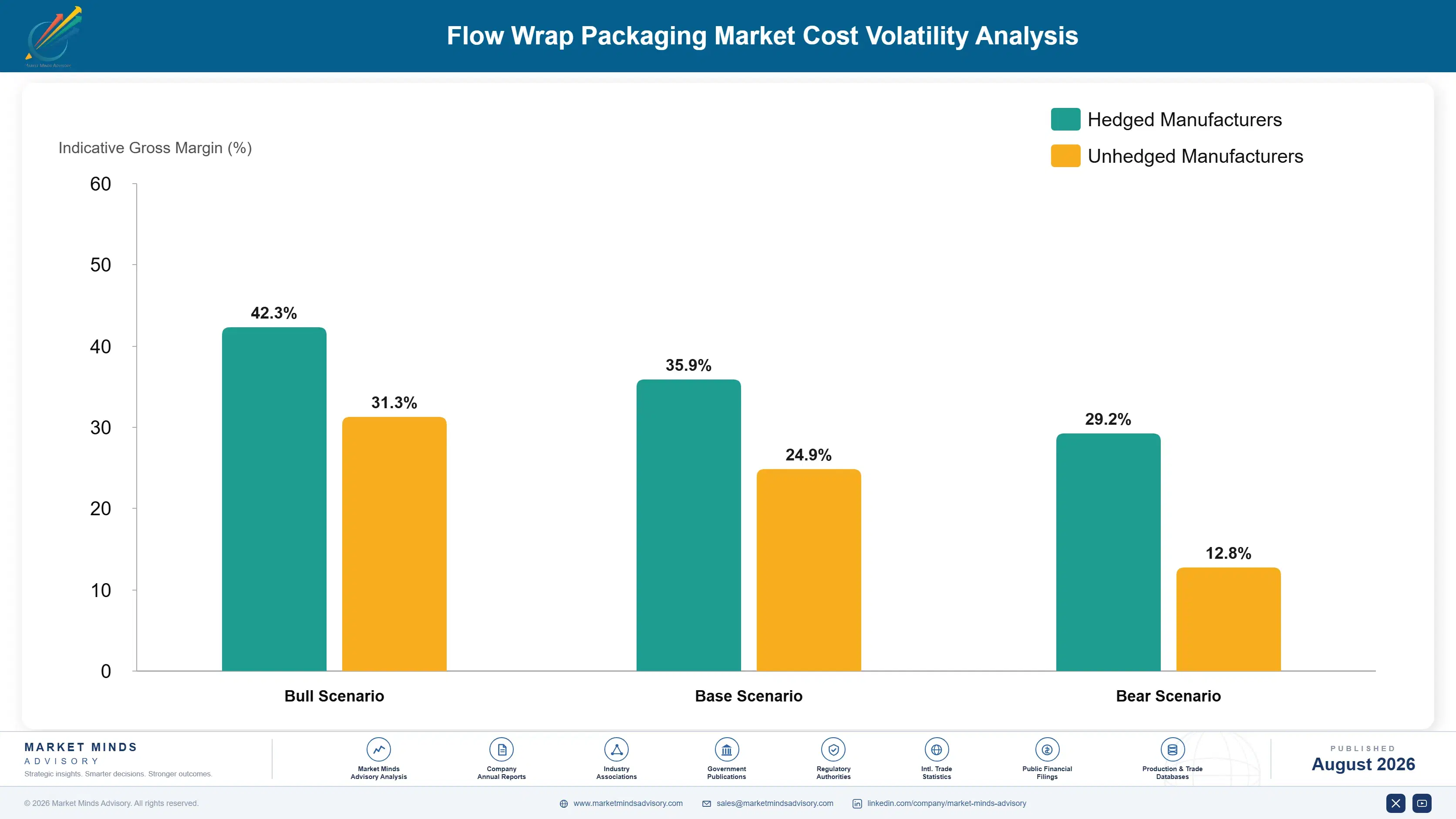
Exposure varies by player type: large diversified converters with dedicated resin procurement and hedging capability absorbed price volatility better than smaller regional converters buying resin on shorter-term spot contracts. Geographic exposure also differs, since European converters faced steeper energy cost pass-through during the 2022 crisis than Asian and North American competitors with cheaper regional energy and, in some cases, domestic resin production.
flow-wrap-packaging-market-cost-volatility-analysis-1787300731957

Long-Term Resin Supply Agreements With Producers

Larger converters are signing multi-year resin supply agreements directly with petrochemical producers, securing volume and smoothing input costs even during periods of broader market volatility. This requires committing to minimum purchase volumes that smaller regional converters often cannot absorb given their comparatively limited order visibility and working capital relative to larger diversified global competitors.

Resin Price Hedging Through Futures Contracts

Several larger converters now hedge a portion of forecasted resin requirements through exchange-traded futures contracts, smoothing cost volatility even though this requires treasury capability most smaller regional converters lack entirely. This has become a meaningful differentiator during recent resin price swings, letting hedged converters hold pricing steadier for customers than unhedged competitors forced into frequent price list revisions.

Recycled Content Substitution to Reduce Virgin Exposure

Several converters are increasing recycled polymer content in film formulations where technically feasible, reducing exposure to virgin resin price volatility while simultaneously advancing brand owner sustainability commitments in a single reformulation effort. Recycled content currently commands a price premium over virgin resin given scarcity, but converters expect that premium to narrow as recycling infrastructure investment scales over the coming years.

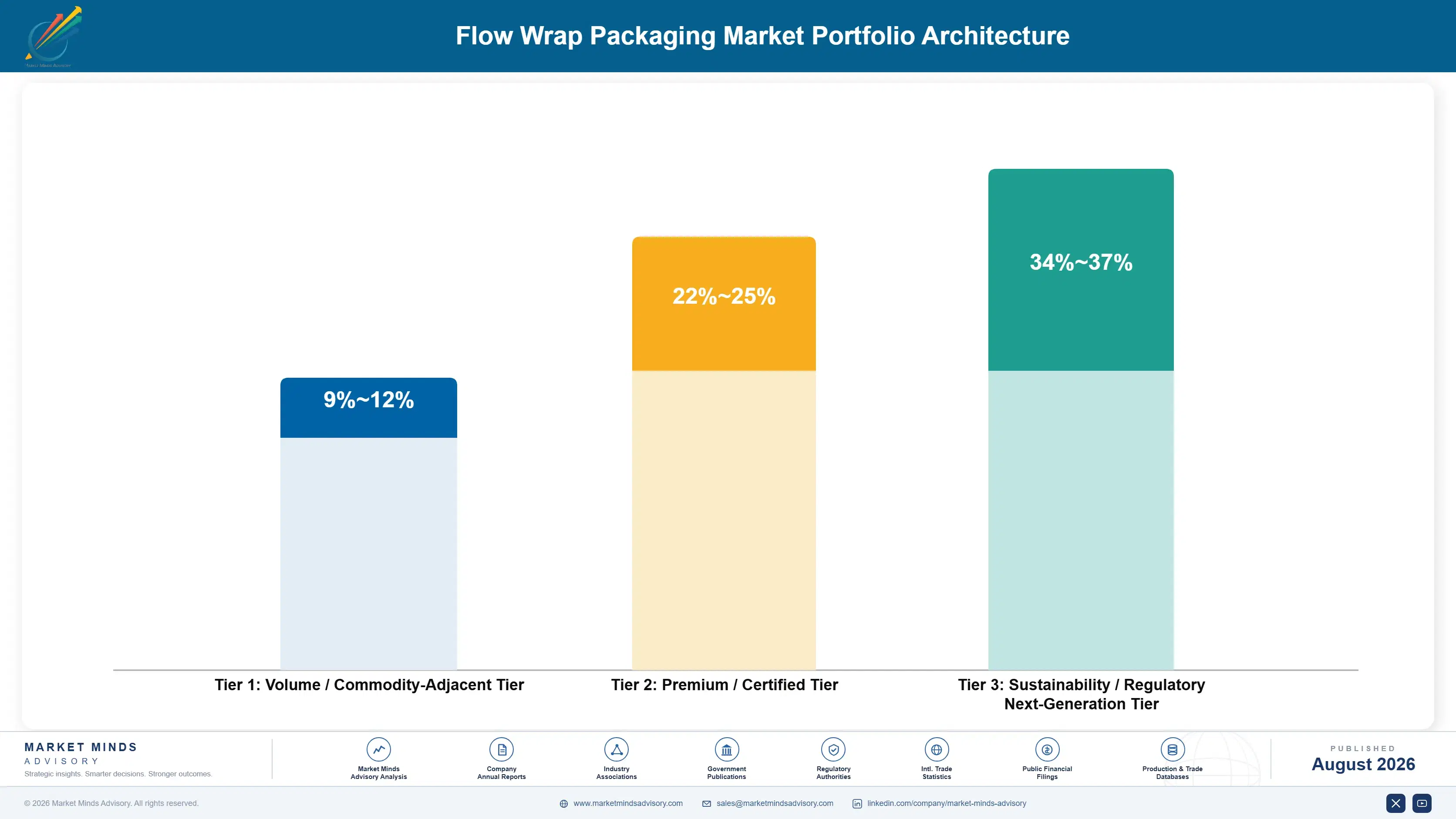
Portfolio Architecture for Margin Defence

The category splits into three tiers with distinct margin profiles. Commodity multi-layer barrier film, sold on price for standard snack and confectionery packaging, generates the thinnest margins despite representing the bulk of total volume. Premium certified recyclable film commands materially better margins tied to technology and certification investment rather than raw material cost. The sustainability tier, covering compostable and advanced recycled-content structures, carries the highest
Volume and premium tiers pull converters toward different investments. Commodity film volume rewards scale and distribution reach, favoring diversified global converters who spread fixed costs across a broad flexible packaging portfolio beyond flow wrap. Premium and next-generation tiers reward sustained materials science investment in recyclable and compostable film technology, favoring converters willing to commit years of R&D to closing the barrier gap that still separates newer structures from legacy film.

High-value pools concentrate in recyclable and compostable film specified by brand owners under direct regulatory or reputational pressure, where technology scarcity, not cost, increasingly sets pricing power. Converters positioned there capture disproportionate margin relative to volume share, a pattern MMA expects to persist while barrier performance parity remains the binding constraint on full-scale recyclable film adoption.

Volume / Commodity-Adjacent Tier

Standard multi-layer barrier film sold largely on price and reliability for mainstream snack, bakery, and confectionery packaging where recyclability certification is not yet a hard specification requirement for the brand owner.
Gross Margin: 9-12%

Premium / Certified Tier

Certified recyclable mono-material flow wrap film sold into brand owner programs requiring documented sustainability compliance alongside acceptable barrier performance for moderately sensitive product categories across most established consumer markets today.
Gross Margin: 22-25%

Sustainability / Regulatory / Next-Generation Tier

Compostable film and advanced high-recycled-content structures developed for premium and regulatory-leading brand owners pursuing sustainability positioning beyond standard plastic recyclability requirements alone across their entire global product portfolio and supply base.
Gross Margin: 34-37%
flow-wrap-packaging-market-portfolio-architecture-1787300732453

High-value Sub-segments and Strategic Watch-out

Compostable and Bio-Based Flow Wrap Film

Compostable film commands the category's highest margins as a small group of premium brand owners pursue compostability rather than conventional recyclability as their sustainability pathway. Technical and infrastructure constraints currently limit scale, but early adoption momentum and premium positioning are driving the steepest percentage growth of any segment MMA tracks.
Gross Margin: 36-40%

Recyclable Mono-Material Barrier Film

Recyclable mono-material film carries strong, improving margins tied to certification and technology investment rather than scarcity alone, growing steadily as brand owners convert mainstream categories toward recyclable specifications across their portfolios. Growth is more moderate than compostable film since the supplier base here is comparatively less constrained today.
Gross Margin: 23-26%

Standard Multi-Layer Barrier Film

This segment anchors category volume across mainstream snack and confectionery packaging, delivering thin but dependable margins on high, recurring order volumes tied to established brand relationships built over many years of steady supply. Growth tracks broader packaged food output rather than the sustainability transition specifically.
Gross Margin: 10-13%

Non-Certified Legacy Film Converters

Converters without a credible recyclable film roadmap face growing exclusion risk as brand owners increasingly disqualify suppliers who cannot document sustainability compliance, a risk that has intensified meaningfully over the past two years and shows no sign of easing anytime soon across most product categories.
Gross Margin: 4-7%

Specification-Locked Brand Relationships

Once a converter's film structure clears a brand owner's packaging specification and line qualification process, it typically remains locked in for years, since requalifying an alternative structure requires costly line trials and shelf-life testing that brand owners rarely pursue without a compelling reason to switch. This gives converters who win the initial specification durable, multi-year revenue difficult for competitors to dislodge without a genuine price or performance advantage.
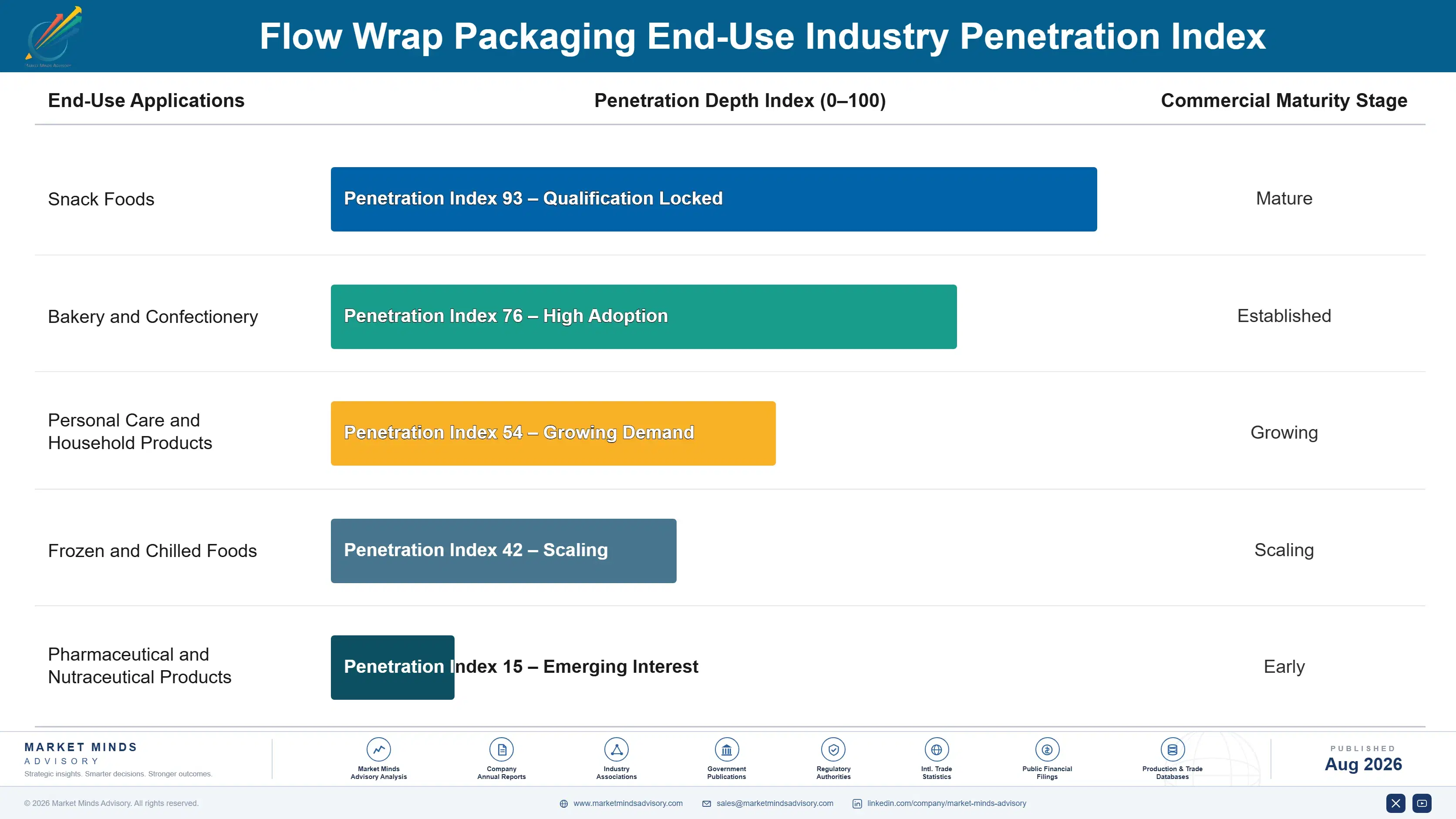
Adoption depth varies by end-use vertical. Confectionery and premium snack brands have moved fastest toward recyclable and compostable film, since their customer base skews toward sustainability-conscious buyers willing to accept modest trade-offs. Bakery and high-fat snack categories adopt more cautiously, since barrier performance directly affects shelf life and quality in ways consumers notice immediately, making brand owners understandably reluctant to compromise performance for sustainability credentials alone.

Buyer profiles are shifting generationally as sustainability and packaging teams, increasingly staffed by professionals hired for environmental compliance expertise, gain real influence over film specification decisions that procurement teams previously controlled largely on cost grounds. This opens real doors for converters who can demonstrate strong recyclability credentials, even against incumbents with deep legacy cost and reliability relationships that carry comparatively less weight with these newer decision-makers.
flow-wrap-packaging-market-end-use-penetration-index-1787300732941

Where the Recyclable Transition Rewards

These are among the four positions where our research anticipates prominent divergence between winners and laggards over the coming forecast period. Each is grounded in the demand model, the regulatory perimeter, and the announced capacity pipeline.
01 / RECYCLABLE FILM INVESTMENT

Close the barrier performance gap before mandates fully bite

Brand owner recyclability commitments are converting from voluntary marketing pledges into hard specification requirements enforced through active supplier requalification programs across nearly every major snack and confectionery category. Converters who have not closed the barrier performance gap between recyclable and legacy multi-layer film risk losing shelf space to competitors who solved that trade-off first, since brand owners increasingly treat recyclability as non-negotiable regardless of any remaining performance compromise. MMA expects converters who delay this investment now to find themselves locked out of the fastest-growing, highest-margin segment of this category.
02 / RECYCLED FEEDSTOCK SECURITY

Secure recycled polymer supply before scarcity gets materially worse

Food-grade recycled polymer supply remains genuinely scarce relative to brand owner recycled content commitments, and that scarcity will intensify as more brand owners' 2025 and 2030 sustainability targets fully phase in across their global packaging portfolios simultaneously. Converters who have signed long-term supply agreements with recycling infrastructure operators are positioned to win contracts that competitors without secured feedstock simply cannot fulfill reliably at scale, regardless of their film formulation technology. MMA views feedstock security as an increasingly decisive competitive advantage independent of pure film science capability alone.
03 / PAPER SUBSTITUTION POSITIONING

Some brand owners are skipping recyclable plastic entirely for paper

A meaningful subset of brand owners, particularly in biscuit, cracker, and dry snack categories, are choosing paper-based flow wrap film as their sustainability pathway rather than converting to recyclable plastic, a trend MMA expects to keep growing selectively rather than becoming the dominant pathway. Converters with credible paper-based capability, including improved coating technology addressing historical seal integrity limitations, are winning meaningful new specification decisions where extended barrier performance matters comparatively less. MMA views paper substitution as a durable niche rather than a mainstream replacement for recyclable plastic film.
04 / REGIONAL MANUFACTURING POSITIONING

Build Asian capacity now before local converters close the gap

Packaged snack and confectionery volume growth across China, India, and Southeast Asia continues meaningfully outpacing mature Western markets, and domestic converters there are scaling manufacturing capacity and technical capability quickly enough to challenge established Western suppliers on price and, increasingly, quality. Western converters who delay building direct regional manufacturing presence risk ceding the fastest-growing volume in the category to domestic competitors who understand local requirements more intimately. MMA expects the next several years to determine which converters successfully defend Asian growth versus ceding it to regional challengers permanently.

Engagement Snapshot From the Field

A live engagement with an industry participant carrying material or product regulatory and market exposure ahead of a defining policy shift, showing how our research translates into a defensible multi-year portfolio strategy.
MARKET MINDS ADVISORY · CLIENT ENGAGEMENT SUMMARY
Flow Wrap Packaging Producer Strategic Portfolio Review and Transition Roadmap 2026·Investment Scenario on Flow Wrap Packaging Exposure Evaluation 2025-26
CLIENT PROFILE
The client is a multinational confectionery brand with several billion dollars in annual revenue (client-reported, unverified by MMA), operating manufacturing facilities across North America and Europe and distributing branded products through major grocery and mass retail channels worldwide. The company had committed publicly to making the substantial majority of its packaging recyclable by 2025, but its flow wrap film supplier base remained concentrated among legacy barrier film specialists.
STRATEGIC CHALLENGE
Facing an approaching public sustainability deadline and growing retailer pressure to demonstrate packaging progress, the client needed to requalify flow wrap film across more than forty SKUs spanning multiple confectionery categories with varying barrier requirements. Initial pilot conversions to recyclable film on high-fat products showed measurably reduced shelf life, risking product quality complaints and the client's ability to meet its public commitment on schedule.
MMA APPROACH
MMA conducted a comparative technology and capability assessment across five recyclable film converters, benchmarking documented barrier performance, recycled content sourcing security, and co-development responsiveness. The engagement produced a segmented conversion roadmap sequencing SKUs by barrier performance sensitivity, prioritizing lower-risk dry categories first to build internal packaging team expertise before tackling the highest-fat, most shelf-life-sensitive products carrying the greatest technical risk.
KEY FINDINGS
  1. Barrier performance gaps between recyclable and legacy film varied significantly by product fat content, with high-fat products showing the steepest shelf-life reduction after conversion.
  2. Converters with dedicated recycled content supply agreements delivered more consistent recyclable film availability than competitors relying primarily on spot-market recycled polymer purchasing.
  3. Co-development partnerships with converters willing to share formulation risk produced measurably better barrier performance outcomes than standard off-the-shelf recyclable film purchases offered generically.
  4. Sequencing SKU conversion by barrier sensitivity allowed the packaging team to build genuine internal expertise before tackling the most technically demanding, highest-risk product categories.
CLIENT PROFILE
The client is a multinational confectionery brand with several billion dollars in annual revenue (client-reported, unverified by MMA), operating manufacturing facilities across North America and Europe and distributing branded products through major grocery and mass retail channels worldwide. The company had committed publicly to making the substantial majority of its packaging recyclable by 2025, but its flow wrap film supplier base remained concentrated among legacy barrier film specialists.
STRATEGIC CHALLENGE
Facing an approaching public sustainability deadline and growing retailer pressure to demonstrate packaging progress, the client needed to requalify flow wrap film across more than forty SKUs spanning multiple confectionery categories with varying barrier requirements. Initial pilot conversions to recyclable film on high-fat products showed measurably reduced shelf life, risking product quality complaints and the client's ability to meet its public commitment on schedule.
MMA APPROACH
MMA conducted a comparative technology and capability assessment across five recyclable film converters, benchmarking documented barrier performance, recycled content sourcing security, and co-development responsiveness. The engagement produced a segmented conversion roadmap sequencing SKUs by barrier performance sensitivity, prioritizing lower-risk dry categories first to build internal packaging team expertise before tackling the highest-fat, most shelf-life-sensitive products carrying the greatest technical risk.
KEY FINDINGS
  1. Barrier performance gaps between recyclable and legacy film varied significantly by product fat content, with high-fat products showing the steepest shelf-life reduction after conversion.
  2. Converters with dedicated recycled content supply agreements delivered more consistent recyclable film availability than competitors relying primarily on spot-market recycled polymer purchasing.
  3. Co-development partnerships with converters willing to share formulation risk produced measurably better barrier performance outcomes than standard off-the-shelf recyclable film purchases offered generically.
  4. Sequencing SKU conversion by barrier sensitivity allowed the packaging team to build genuine internal expertise before tackling the most technically demanding, highest-risk product categories.
RECOMMENDED STRATEGY
Phase 1: Phase 1 (Months 1-3): Benchmark five recyclable film converters on documented barrier performance, recycled content sourcing security, and co-development responsiveness capability. Phase 2: Phase 2 (Months 4-9): Convert lower-risk, dry-category SKUs to recyclable film first, building internal packaging expertise before advancing to higher-fat products. Phase 3: Phase 3 (Months 10-14): Complete conversion of remaining high-fat SKUs using co-developed film formulations, finalizing recyclability certification documentation ahead of the deadline.
OUTCOME
The client converted 38 of 43 targeted SKUs to certified recyclable flow wrap film ahead of its public 2025 deadline, with the remaining five extended pending further barrier performance development (client-reported, unverified by MMA). Shelf-life reduction on converted high-fat products reportedly averaged less than half of initial pilot results following co-development refinement (client-reported, unverified by MMA).

Frequently Asked Questions

Foundational context covering the market sizes, CAGR, scope, country, region and competition that inform every finding below. This section is provided to cover basics and most often pre-purchase conversations, answered from the MMA Primary Research Dataset.

What is the current size of the Flow Wrap Packaging Market?

The global flow wrap packaging market is valued at $8.4 billion in 2025. It is forecast to reach $8.9 billion in 2026 as recyclable film conversion accelerates.

How large will the Flow Wrap Packaging Market be by 2036?

MMA forecasts the market will reach $15.94 billion by 2036, nearly double its 2026 value. Recyclable film conversion and Asian packaged snack growth both drive that expansion.

What is the CAGR for the Flow Wrap Packaging Market 2026 to 2036?

The base case CAGR is 6.0 percent across the 2026 to 2036 forecast period. Bull and bear scenarios range from 5.0 to 7.0 percent depending on conversion timing.

Which segment is growing fastest?

Compostable and bio-based flow wrap film is growing fastest at a 10.5 percent CAGR, ahead of every other segment. That is roughly 1.75 times the overall market growth rate.

Who are the major companies in the Flow Wrap Packaging Market?

Leading converters include Amcor, Sealed Air, Mondi, Constantia Flexibles, and Berry Global. Together they hold an estimated 36 percent of a moderately fragmented global market.

Which country is growing fastest?

China is the fastest-growing major market, expanding at an estimated 7.8 percent CAGR overall. Growth is driven by expanding packaged snack and confectionery manufacturing capacity.

Report Segmentation Architecture

The full report scope spans multiple orthogonal segmentation dimensions, with cross-tabulated demand data provided for each dimension pair. Coverage extends further to regional breakdowns, trend trajectories, and the competitive detail needed to support segment-level decision-making.

By Film Substrate and Material Type

  • BOPP Flow Wrap Film
  • Polyethylene Flow Wrap Film
  • Paper-Based Flow Wrap Film
  • Compostable and Bio-Based Flow Wrap Film
  • Metallized and Barrier Flow Wrap Film
  • Recyclable Mono-Material Flow Wrap Film

By End-Use Industry

  • Snack Foods
  • Bakery and Confectionery
  • Personal Care and Household Products
  • Frozen and Chilled Foods
  • Pharmaceutical and Nutraceutical Products

By Commercial Dimension

  • Branded Manufacturer Direct Supply
  • Private Label Converting Contracts
  • Co-Packer Distribution
  • Regional Converter Distribution

By Region

  • North America
  • Western Europe
  • East Asia
  • South Asia and Pacific
  • Latin America
  • Middle East and Africa
  • Eastern Europe

Scope, Methodology, and Coverage

Every figure in this report is reproducible from documented input assumptions. The scope below maps the historical period, the forecast horizon, the segmentation dimensions, and the countries covered, alongside the underlying primary and qualitative methodology.
Historical Period
2020 to 2025
Forecast Period
2026 to 2036
Base Year
2025 (USD billions; MMA Primary Research Dataset, August 2026)
Market Definition
This report defines the flow wrap packaging market as film substrates and pre-formed pouches engineered for horizontal and vertical form-fill-seal flow wrap applications across snack, bakery, confectionery, and personal care categories. It excludes flow wrap machinery, rigid packaging formats, and shrink film applied through processes other than continuous flow wrap overwrap.
Quantitative Units
USD billions (current prices); metric tons of film volume where applicable
Segmentation Dimensions
By Film Substrate and Material Type; By End-Use Industry; By Commercial Dimension; By Region
Regions Covered
North America, Western Europe, East Asia, South Asia and Pacific, Latin America, Middle East and Africa, Eastern Europe
Countries Covered
USA, China, Germany, France, UK, Japan, South Korea, India, Australia, Canada, Brazil, Mexico, Indonesia, Vietnam, Thailand, Malaysia, UAE, Saudi Arabia, South Africa, Nigeria, Turkey, Poland, Netherlands, Italy, Spain, Sweden, Switzerland, Argentina, Colombia, Singapore, and additional markets relevant to this sector
Key Companies Profiled
Amcor plc, Sealed Air Corporation, Mondi plc, Constantia Flexibles Group GmbH, Berry Global Group, Inc., Huhtamaki Oyj, Coveris Holdings S.A., ProAmpac LLC, Winpak Ltd., Uflex Ltd., Cosmo Films Limited, Toray Plastics (America), Inc., Taghleef Industries, CCL Industries Inc., Jindal Poly Films Ltd., Klöckner Pentaplast Group, Sonoco Products Company, Glenroy, Inc., TC Transcontinental, Novolex Holdings LLC
Quantitative Methodology
Primary survey, n=3,800 respondents, Q4 2025, six countries; demand-side model with trade association cross-validation
Qualitative Methodology
47 expert interviews, Q4 2025; applied to validate demand model assumptions, identify emerging dynamics, and assess competitive positioning
Report Format
PDF and XLSX data workbook (Word format preview document)
Publisher
Market Minds Advisory
Report Code
MMA-2026-PAC-104
Published
August 2026
Contact
sales@marketmindsadvisory.com | www.marketmindsadvisory.com

Purchase the full Flow Wrap Packaging Market Report (2026 to 2036).

The full report provides a comprehensive assessment of the global flow wrap packaging market, including detailed sizing and ten-year forecasts across all seven regions and six film substrate segments. It profiles twenty leading converters, benchmarking recyclable film technology, recycled content sourcing security, and manufacturing footprint across the five largest players in particular. The analysis includes primary research drawn from MMA's Q4 2025 survey of 3,800 packaging and brand owner respondents across six countries and 47 expert interviews with packaging technology and procurement leaders. Regional sections cover regulatory timelines, resin sourcing risk, and competitive dynamics specific to each market, supported by a standalone input cost and mitigation framework.
Ten-year market sizing and growth forecasts
Profiles of twenty leading flow wrap converters
Regional recyclability regulation and demand analysis
Polymer resin sourcing risk and mitigation framework
Primary survey data from 3,800 industry respondents
Forty-seven expert interviews with packaging technology leaders

Built For The People Who Decide

From boardroom strategy to bench-side execution, this report is read cover-to-cover by leaders shaping the next decade of their industry, turning demand scenarios, market dynamics and valuation benchmarks into decisions.
CXOs/ Presidents/ VPs/ Managers
M&A and Corporate Development
Strategy Teams and R&D Heads
Procurement and Product Directors
Regulatory and Compliance Leaders
Investor Relations and Equity Analysts