Market Minds Advisory
Floor Screeds Market

Floor Screeds Market: Drying Time as Critical Path, Heat Pump Pull, and the Labour That Stopped Arriving

A traditional screed dries at roughly one day per millimetre, which puts a 75-day wait on the critical path of a building programme. That arithmetic is worth vastly more than the material.

Lead Analyst

Bilal Shaikh

Published

September 2026

Make Smarter Decisions with Customized Research Insights

Request a free sample report and evaluate market opportunities, growth trends, and competitive dynamics relevant to your business needs.

2025 MARKET VALUE$12.8BMarket Size 2025
2036 FORECAST VALUE$22.4BBase Case , 2026 to 2036
CAGR 2026 TO 20365.2 %Bull 6.4% / Bear 4.0%
INCREMENTAL OPPORTUNITY$8.9BNet 10- year value creation
EXPANSION MULTIPLE1.66x2036 value over 2026 base
Strategic Levers
M&A Pipeline
Regional Outlook
Country Rankings
Competitive Intelligence
Segmental Deep-dive
Call-Us : 91 93563 13602

Executive Snapshot and Market Trajectory

Nobody on a construction site cares what a screed costs per square metre. They care that a traditional one dries at about a day per millimetre, which turns a 75 millimetre layer into a 75-day hole in the programme before any flooring can go down. Material price barely registers.
Commercial advantage belongs to manufacturers selling programme time rather than material, because a screed that dries in days instead of months is worth far more than the price difference between them. Calcium sulphate flowing screed grows fastest at 8.6%, roughly 1.65 times the market. East Asia holds the largest position at 30% of value on construction volume no other region approaches at present.
Concentration sits at roughly 32% for the top five, held by technical support and specification presence rather than by any difficulty in mixing cement and sand. Heat pump installation is pulling flowing screed demand directly, since 37% of new residential screed now sits over pipework. Moisture causes 62% of claims. Liability for those sits with the flooring contractor rather than the screed manufacturer, which distorts how the risk actually gets discussed on site.
Market Definition
The market comprises screed materials supplied for levelling and finishing floor substrates, covering traditional sand-cement screed, modified cementitious screed, calcium sulphate flowing screed, self-levelling smoothing compounds, resin and epoxy screeds, and lightweight or insulating screeds. Value is measured at manufacturer level on material supplied. Structural concrete slabs, floor finishes including tile, timber, vinyl and carpet, adhesives and grouts sold separately, underfloor heating pipework and manifolds, and screeding contractor labour fall outside scope.
Base Year Value
$12.8B in 2025 (MMA Primary Research Dataset, August 2026)
Forecast Period
2026 to 2036, eleven discrete annual values
CAGR
5.2% base case. Bull 6.4%. Bear 4.0%.
Fastest Growth Segment
Calcium Sulphate Flowing Screed: 8.6% CAGR
Fastest Growth Country
India: 8.4% CAGR
Fastest Growth Region
South Asia and Pacific: 7.4% CAGR
Largest Region
East Asia: 30% of 2025 global value
Market Leaders
Sika, Mapei, Saint-Gobain Weber, Ardex, and Knauf lead on screed material supply revenue. Source: company annual reports and MMA Analysis, July 2026.
Primary Survey
n=3,800 procurement and R&D decision-makers, Q4 2025, six countries
Methodology
Demand-side build-up, cross-validated against public data, 47 expert interviews

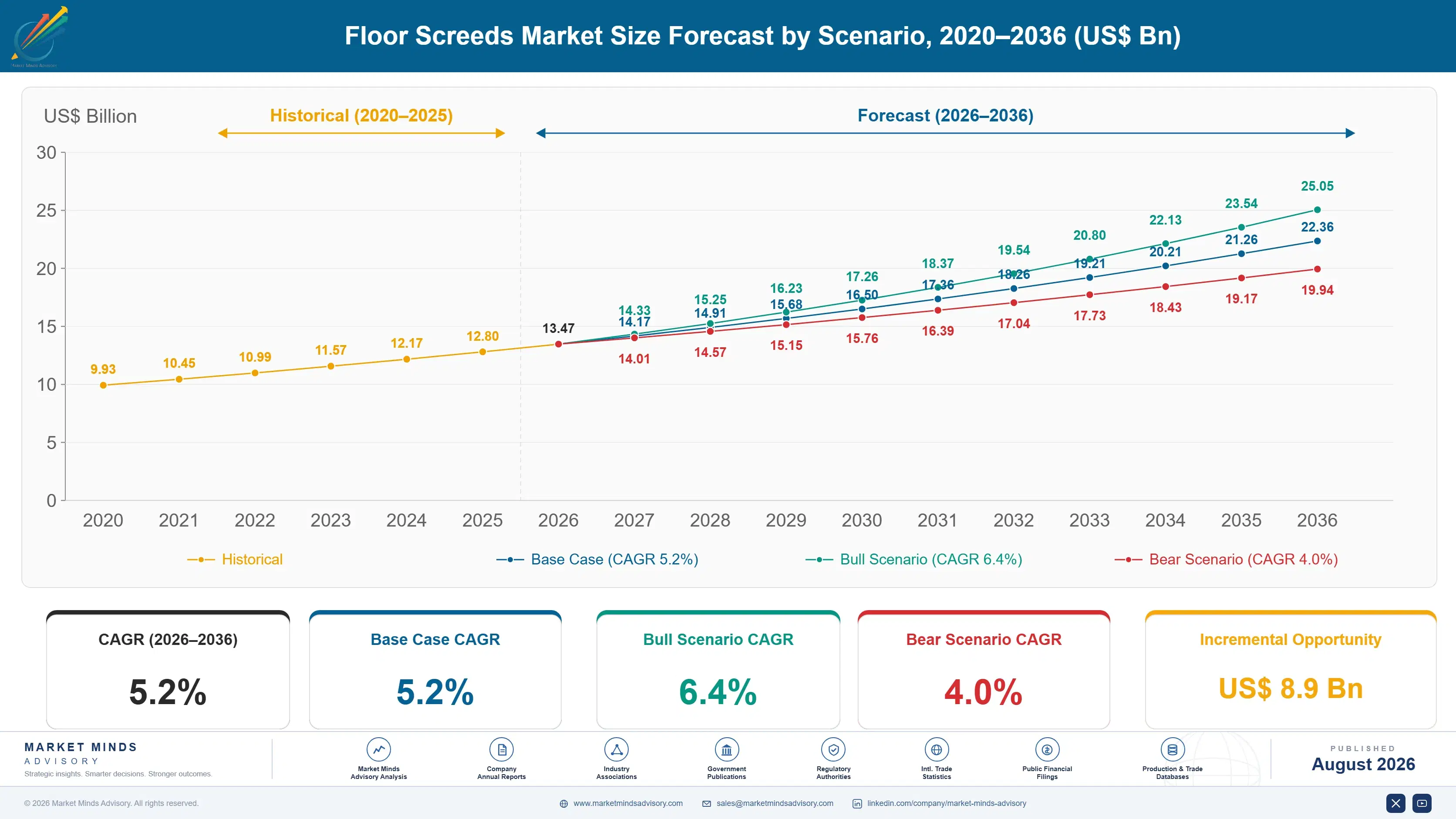
Floor Screeds Market Forecast Scenarios

floor-screeds-market-trends-size-forecast-scenario-1787551386553
Between 2020 and 2025 construction volumes swung sharply while the mix inside them shifted steadily toward faster systems. Skilled screeding labour continued disappearing across developed markets, and pumped flowing screeds spread because fewer people could lay the traditional kind rather than because anybody preferred the chemistry. Heat pump installation began pulling thin-section screed demand upward. The 4.2% historical rate reflects a mix improvement running underneath fairly weak construction volume.
The 5.2% base case rests on three mechanisms. Heat pump adoption requires low flow temperatures and large emitter surfaces, which means underfloor heating and the thin conductive screeds that encapsulate it. Skilled screeding labour keeps shrinking, which favours pumped systems that cover far more floor per crew day. And hygiene-driven resin flooring keeps expanding across food, pharmaceutical, and healthcare buildings under audit requirements. None of the three depends on new housing volumes recovering.
The 6.4% bull case assumes heat pump installation accelerates on subsidy and building regulation across Europe and North America together. The 4.0% bear case reflects residential construction weakness persisting, interest rates deferring commercial fit-out programmes, and installer unfamiliarity with calcium sulphate systems producing enough failures to slow the substitution that drives most of the mix improvement.

Programme Time in a Bag

Drying is the entire commercial argument and material cost is close to irrelevant beside it. A traditional sand-cement screed releases moisture at roughly one day per millimetre of thickness, so a 75 millimetre layer holds up every moisture-sensitive floor finish for two and a half months. Fast-drying and calcium sulphate systems compress that to days. On a programme where each week costs real money, nobody is comparing bag prices.
TOP-FIVE CONCENTRATION32%Combined share of screed material supply held by leading manufacturers
DRYING TIME PER MILLIMETRE1 dayWaiting period before moisture-sensitive floor finishes can be laid
INSTALLED COST PER METREUSD 21Typical delivered and applied cost across common screed systems
PUMPED APPLICATION RATE1,400 square metresDaily coverage achieved by a flowing screed crew
MOISTURE FAILURE SHARE62%Portion of screed related claims caused by residual moisture
UNDERFLOOR HEATING ATTACHMENT37%Share of new residential screed laid over heating pipework
Labour availability drives the substitution as much as chemistry does. A pumped flowing screed crew covers around 1,400 square metres a day where traditional hand-laid work manages a fraction of it, and the skilled screeders who lay the traditional kind are retiring faster than anybody is replacing them. Contractors are switching because they cannot staff the alternative, which is a different reason from the one manufacturers usually pitch.
Moisture also causes 62% of screed-related claims, almost always because a finish went down before the substrate was dry enough. Liability sits with the contractor who laid the flooring rather than the manufacturer who supplied the screed, which distorts how the risk gets discussed. Manufacturers offering moisture testing, forced drying protocols, and documented guarantees remove an argument nobody enjoys having.
"Specifiers write screed into a drawing as a thickness and a strength class, and then the programme falls apart because nobody costed the drying. The manufacturers making money in this market stopped selling material years ago and started selling weeks back to the main contractor instead."
Practice Director, Construction Chemicals and Building Envelope · MMA Construction Chemicals and Building Materials Practice · August 2026

Market Trends

Heat Pump Adoption Pulls Thin Conductive Screed Demand

Heat pumps run efficiently only at low flow temperatures, which requires large emitter surfaces, which in practice means underfloor heating rather than radiators. That puts pipework inside a screed layer that has to conduct heat well and respond quickly, favouring thin calcium sulphate systems over thick cementitious ones. Around 37% of new residential screed now sits over heating pipework. Calcium sulphate flowing screed grows at 8.6%, the fastest here, and the connection to heating policy is direct rather than incidental. Building energy regulation publishes these timetables years ahead of the demand.
Market Impact: Removes 75 days from programmes
Skilled Screeding Labour Disappears Across Developed Markets

Laying a traditional sand-cement screed by hand is physically punishing skilled work, and the trade is ageing out faster than anybody is replacing it across Europe, North America, and Australia. A pumped flowing screed crew covers roughly 1,400 square metres a day with fewer people and less skill. Contractors are switching because they cannot resource the alternative rather than because they prefer the material. That substitution runs independently of any technical or commercial argument manufacturers happen to be making. Nothing about that substitution reverses if construction volumes recover, because the workforce is not coming back.
Market Impact: Resin screeds grow at 7.8%

Market Opportunities and Growth Drivers

Programme Compression Values Drying Above Material Cost

Main contractors running fixed completion dates treat screed drying as a critical path item, and traditional systems releasing moisture at about a day per millimetre put months into a programme that fast-drying alternatives remove almost entirely. The material price difference is trivial beside the value of the weeks recovered. Specifiers who write thickness and strength class without costing drying create problems that surface far later. Manufacturers selling programme time rather than bags are having a completely different conversation. Very few technical sales teams are equipped to build that argument in a contractor's own cost terms.
Market Impact: Moisture causes 62% of claims

Hygiene Regulation Expands Jointless Resin Flooring

Food processing, pharmaceutical manufacture, and healthcare buildings require jointless, chemical-resistant, cleanable floors that withstand thermal shock, aggressive cleaning agents, and audit inspection. Resin and epoxy screeds deliver that where cementitious systems cannot, and customer audits increasingly specify them explicitly rather than leaving the choice open. The segment grows at 7.8% against a market rate of 5.2%. Installation requires trained applicators and controlled conditions, which limits who can serve it and supports pricing accordingly. Cementitious systems are excluded on cleanability and chemical resistance grounds rather than on any cost comparison, which removes price from the decision entirely.
Market Impact: Residential drives 44% of volume

Market Restraints and Challenges

Installer Unfamiliarity Produces Calcium Sulphate Failures

Anhydrite screeds behave differently from cementitious ones: they cannot go in permanently wet areas, they form a surface laitance that has to be sanded off, and they need different primers and adhesives underneath the finish. Installers applying cement-screed habits produce failures that get blamed on the material. The root cause is training rather than chemistry. Manufacturers mitigate through applicator certification programmes, through primer and adhesive systems sold as a package, and through site technical support at first fix. A single high-profile failure costs more in reputation than an entire certification programme does to run.
Market Impact: Heating pipework under 37% of screed

Residential Construction Weakness Removes Volume Directly

New housing completions drive the largest single share of screed demand, and higher interest rates have deferred residential programmes across most developed markets simultaneously. The root cause is financing cost rather than anything about the product. Manufacturers mitigate through refurbishment and renovation channels where existing floors need levelling over old substrates, through commercial and industrial resin applications that follow different cycles, and by targeting heat pump retrofit work that continues under subsidy regardless of new build activity. Renovation demand is far steadier than new build and most manufacturers underweight it badly.
Market Impact: Pumped crews cover 1,400 metres daily
4 additional market trends, 3 additional growth drivers, and 2 additional restraints and challenges are covered in the full report. Contact sales@marketmindsadvisory.com to access the complete intelligence.

Segment CAGR and Growth Architecture

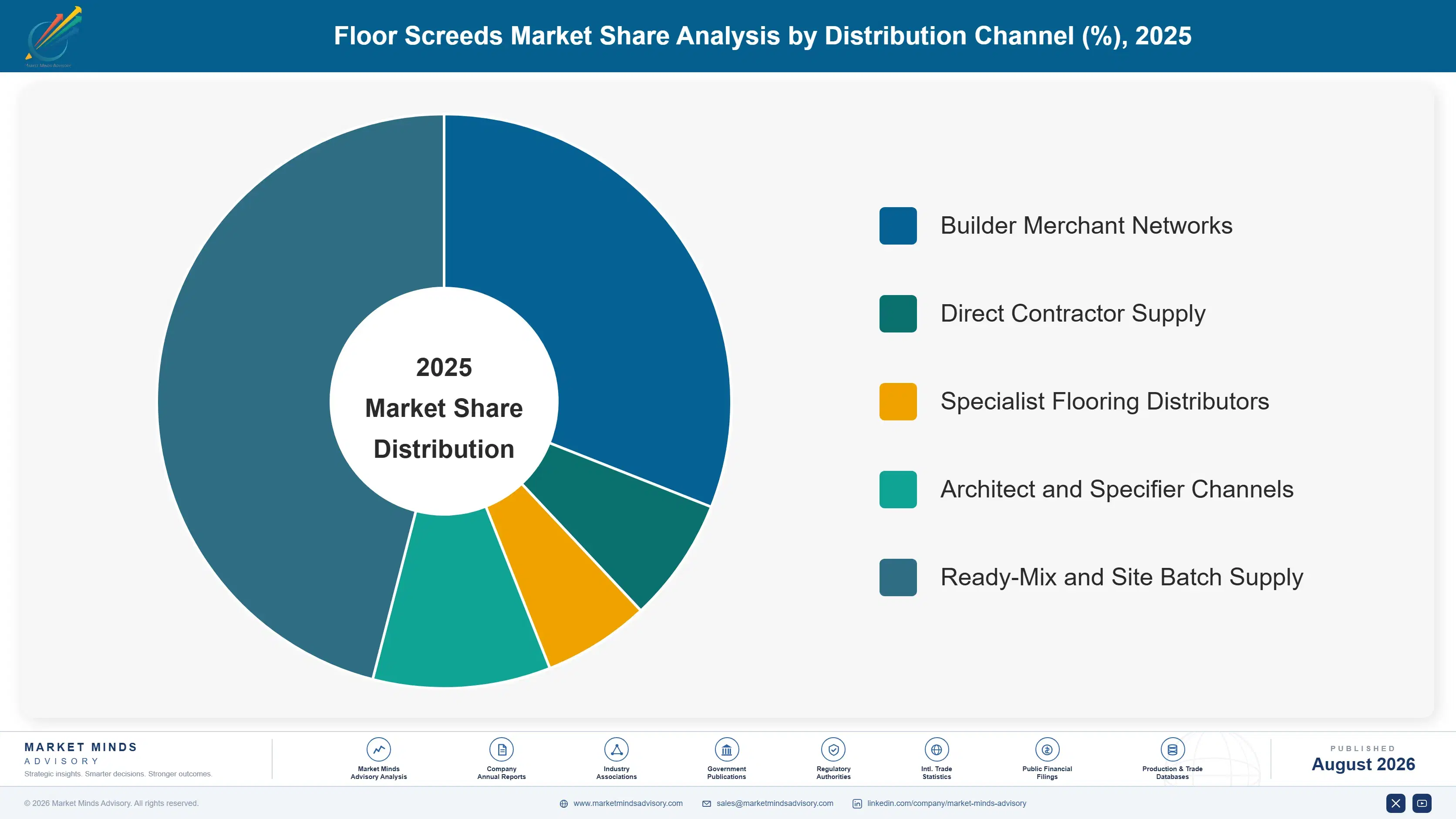
Segmentation follows screed system type, because binder chemistry determines drying behaviour, application method, thickness, and which substrates and finishes a system can serve. Six types cover commercial supply, and the divide between systems that dry in days and those that dry in months matters more commercially than any difference in compressive strength between them.
floor-screeds-market-trends-market-share-analysis-1787551387124

Calcium Sulphate Flowing Screed

The fastest system at 8.6%, roughly 1.65 times the market, and the direct beneficiary of heat pump policy across Europe and increasingly North America. Anhydrite binder allows thin sections that conduct heat well and respond quickly, which is exactly what underfloor heating needs, and pumped application covers ground far faster than hand laying. Drying runs in days rather than months. The constraints are real: no permanently wet areas, surface laitance requiring removal, and different primer and adhesive systems that installers used to cement screeds get wrong regularly. Manufacturers packaging primer and adhesive alongside the screed itself remove most of the failures that installer habit would otherwise create on site regularly.
CAGR 8.6%

Resin and Epoxy Screeds

Second fastest at 7.8%, serving food processing, pharmaceutical manufacture, healthcare, and heavy industrial floors that need jointless, chemically resistant, cleanable surfaces surviving thermal shock and aggressive washdown. Customer audits increasingly specify these explicitly rather than leaving the flooring choice open to a contractor. Installation demands trained applicators, controlled temperature and humidity, and substrate preparation far beyond what cementitious work requires. That difficulty limits who can serve the market and supports pricing several times cementitious systems on a comparable area basis. Thermal shock from washdown cycles, forklift traffic, and aggressive cleaning chemistry all attack the floor differently, and formulations differ accordingly between food, pharmaceutical, and heavy industrial specifications. Substrate preparation is where most installations go wrong.
CAGR 7.8%
Full segment breakdown across 6 segments available in the complete report.

Regional Architecture and Country Demand Map

Regional shares follow construction activity weighted by how much of it uses engineered screed systems rather than site-mixed sand and cement. All seven regions fall inside the standard bands, with East Asia leading on sheer building volume across the period. Site-mixed practice absorbs enormous volume that nobody captures.

North America

Self-levelling smoothing compounds dominate here far more than elsewhere, since commercial fit-out and renovation over existing substrates is a larger share of activity than new residential construction. Ardex, Mapei, and Laticrete hold strong specification positions with flooring contractors. Underfloor heating penetration remains well below European levels, which limits calcium sulphate demand despite growing heat pump installation. Industrial and food processing resin flooring is substantial and audit-driven. Growth of 5.0% depends on commercial construction recovering rather than on any change in system preference across the region. Moisture testing before flooring installation is more formalised here than in most regions, which reduces claims but also lengthens programmes where traditional screeds were specified without thought.
Share: 22% | CAGR: 5.0% (2026 to 2036)

Western Europe

Underfloor heating is standard in new residential construction across Germany, the Nordics, and the Netherlands, which makes calcium sulphate flowing screed the default rather than an alternative in those markets. Heat pump mandates and building regulation reinforce that directly. Skilled screeding labour has disappeared fastest here, accelerating pumped system adoption independently of chemistry preference. Knauf, Saint-Gobain Weber, Anhydritec, and Uzin Utz hold deep technical positions. Growth of 3.8% is the slowest anywhere, held back by weak residential completions rather than by any lack of specification appetite. Applicator certification is furthest developed here as well, since manufacturers learned early that calcium sulphate failures attach to the product brand rather than to the installer.
Share: 22% | CAGR: 3.8% (2026 to 2036)
Regional intelligence for 5 additional markets available in the complete report: East Asia, South Asia and Pacific, Latin America, Middle East and Africa, Eastern Europe. Contact sales@marketmindsadvisory.com.
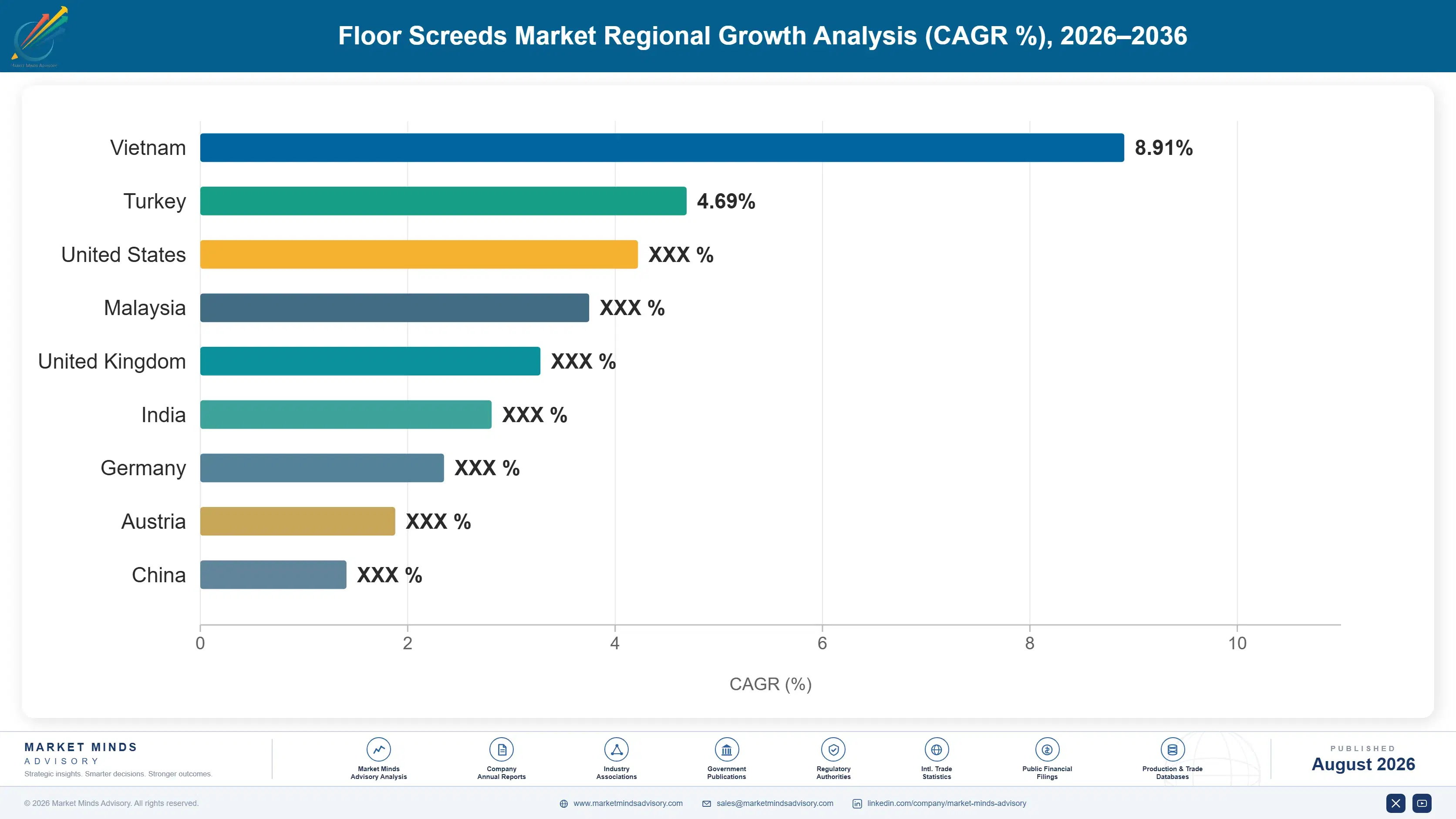
floor-screeds-market-trends-country-cagr-analysis-1787551387642

Four Moves Worth Real Capital

Advantage here comes from selling programme weeks rather than material, from following heating policy into thin-section systems, and from removing the failure risk contractors are actually worried about. Four moves justify capital across the forecast period, and the first reframes what this product is being bought for. The rest follow once that reframing has happened.

Quantify drying time as recovered programme weeks

Traditional screed dries at roughly one day per millimetre, which puts 75 days into a programme that a fast system removes almost entirely, and every one of those weeks costs a main contractor real money in preliminaries and finance. Material price difference is trivial beside that. Manufacturers who model the programme saving for a specific project, in the contractor's own cost terms, are selling something entirely different from bags. Very few technical sales teams are equipped to have that conversation properly. Preliminaries, finance, and handover penalties are the numbers that matter to them.
Market Impact: Recovers as much as 75 days of programme

Follow heat pump policy into thin-section systems

Heat pumps need low flow temperatures and large emitter surfaces, which means underfloor heating, which means thin conductive screed encapsulating pipework. Around 37% of new residential screed already sits over heating pipes and calcium sulphate systems grow at 8.6% because of it. Manufacturers tracking building energy regulation and heat pump subsidy schedules can position ahead of demand rather than responding to it. This is a policy-driven market where the timetable is published years in advance. Subsidy schedules and building regulation timetables are published well in advance, which makes this one of the few genuinely forecastable demand shifts available.
Market Impact: Serves the 37% of screed over heating pipework

Certify installers before failures reach the material

Calcium sulphate screeds fail when installers apply cementitious habits: wrong primer, laitance left in place, wet area misuse. Moisture already causes 62% of claims and every failure gets blamed on the product rather than the practice. Applicator certification, packaged primer and adhesive systems, and site support at first fix cost less than the reputational damage from a single high-profile failure. Manufacturers treating training as a cost centre are funding their competitors' reputation without realising it. Certification also gives the sales organisation a reason to be on site at first fix, which is where the relationship with the applicator actually forms.
Market Impact: Addresses the 62% of claims driven by moisture

Build resin capability for audited hygiene floors

Food processing, pharmaceutical, and healthcare customers specify jointless chemical-resistant floors explicitly in audit documentation rather than leaving the choice to a contractor. Resin screeds grow at 7.8% and price at several times cementitious systems on comparable area. Trained applicators and controlled installation conditions limit who can serve it, which is exactly why the pricing holds. Manufacturers with only cementitious portfolios watch that specification arrive and have nothing whatsoever to quote against it. Trained applicators and controlled installation conditions are the barrier, and building both takes years that a competitor cannot compress by spending more money.
Market Impact: Resin system demand is growing at 7.8% yearly

Who Controls the Margin Pool

Concentration sits at roughly 32% for the top five on screed material supply, held by specification presence and technical support rather than by any barrier to mixing cement and sand. Sika and Mapei lead on breadth across cementitious, self-levelling, and resin systems. Saint-Gobain Weber and Knauf hold strong European positions with calcium sulphate depth. Ardex is particularly strong in self-levelling compounds and flooring contractor relationships.
Competition runs on three dimensions. Specification presence with architects and main contractors is the first, and it decides what gets written into a drawing before any pricing happens. Technical support and applicator training is the second, since failures attach to brands rather than to practice. Resin capability is the third, and it separates manufacturers who can answer an audit specification from those who cannot.

Pressure is building from two directions. Site-mixed sand and cement still takes enormous volume in developing markets that manufacturers capture nothing from. Regional cement producers offer basic bagged systems at prices international manufacturers cannot match. Rankings will shift toward those holding resin capability and applicator networks rather than toward whoever bags the most cementitious material. Binder cost is the one thing regional producers will always win on.
floor-screeds-market-trends-company-positioning-matrix-1787551388163

Competitive Moat and Risk Dimensions

SIKA

Moat: Breadth across every screed chemistry

Sika supplies cementitious, calcium sulphate, self-levelling, and resin systems from one organisation, which means a specifier or contractor can solve an entire floor build-up without changing supplier or accepting compatibility risk between products. That breadth reaches audited hygiene applications and heat pump residential work equally. Technical support depth is what converts specification presence into orders on site.
SIKA

Risk: Site-mixed practice in growth markets

The fastest-growing construction markets still lay enormous screed volumes as site-mixed sand and cement, which Sika captures no value from whatsoever regardless of its technical capability. Converting that practice requires quality expectations and labour economics to shift rather than any product argument. Regional cement producers offering basic bagged systems occupy the intermediate ground at prices Sika cannot match.
ARDEX

Moat: Flooring contractor relationship depth

Ardex built its position with the flooring contractors who actually lay the finish and who carry the liability when a floor fails, rather than with architects who specify and move on. Those contractors reorder constantly and recommend what has not failed them before. Self-levelling leadership sits exactly where renovation and fit-out work concentrates in developed markets.
ARDEX

Risk: Limited resin portfolio depth

Audited hygiene flooring in food, pharmaceutical, and healthcare buildings specifies resin systems explicitly, and that segment grows at 7.8% against a market rate well below it. Competitors with full resin capability answer those specifications while Ardex has less to offer against them. Building applicator networks and formulation depth in resin takes years and competes against established specialist positions.

Players Tracked

Prominent Players

Sika
Mapei
Saint-Gobain Weber
Ardex
Knauf

Other Key Players

Master Builders Solutions
Fosroc
Bostik
Tarmac
Uzin Utz
Wacker Chemie
Kerakoll
Laticrete
Pidilite Industries
Sto SE
Cemex
Holcim
Flowcrete
Etex
Anhydritec

Recent Developments

FEBRUARY 2025

Contractor specifies fast-drying screed on programme grounds

A main contractor on a residential development specified a fast-drying calcium sulphate system after modelling the programme saving against traditional screed drying at roughly a day per millimetre. Material cost was considerably higher and the finance saving on the shortened programme dwarfed it entirely. Nobody argued.
Signal: Programme cost modelling rather than material pricing is now increasingly deciding which screed system gets specified
JUNE 2025

Manufacturer bundles primer and adhesive with anhydrite screed

A European screed manufacturer began supplying calcium sulphate screed only alongside its own primer and adhesive system, after installer errors using cementitious products underneath finishes produced a run of failures attributed to the screed itself in every case. Warranty terms were changed to match the new arrangement.
Signal: Packaging the full build-up is becoming a defence against failures caused by installer habit rather than material
OCTOBER 2025

Food processor audit specifies resin flooring across all sites

A multinational food manufacturer wrote jointless resin flooring into its supplier audit requirements across every processing site, removing contractor discretion over floor system selection entirely. Cementitious alternatives were excluded on cleanability and chemical resistance grounds rather than on any cost basis. Contractors lost the choice entirely.
Signal: Audit documentation is now specifying floor chemistry directly, which removes the contractor from the decision altogether

What Fills the Bag

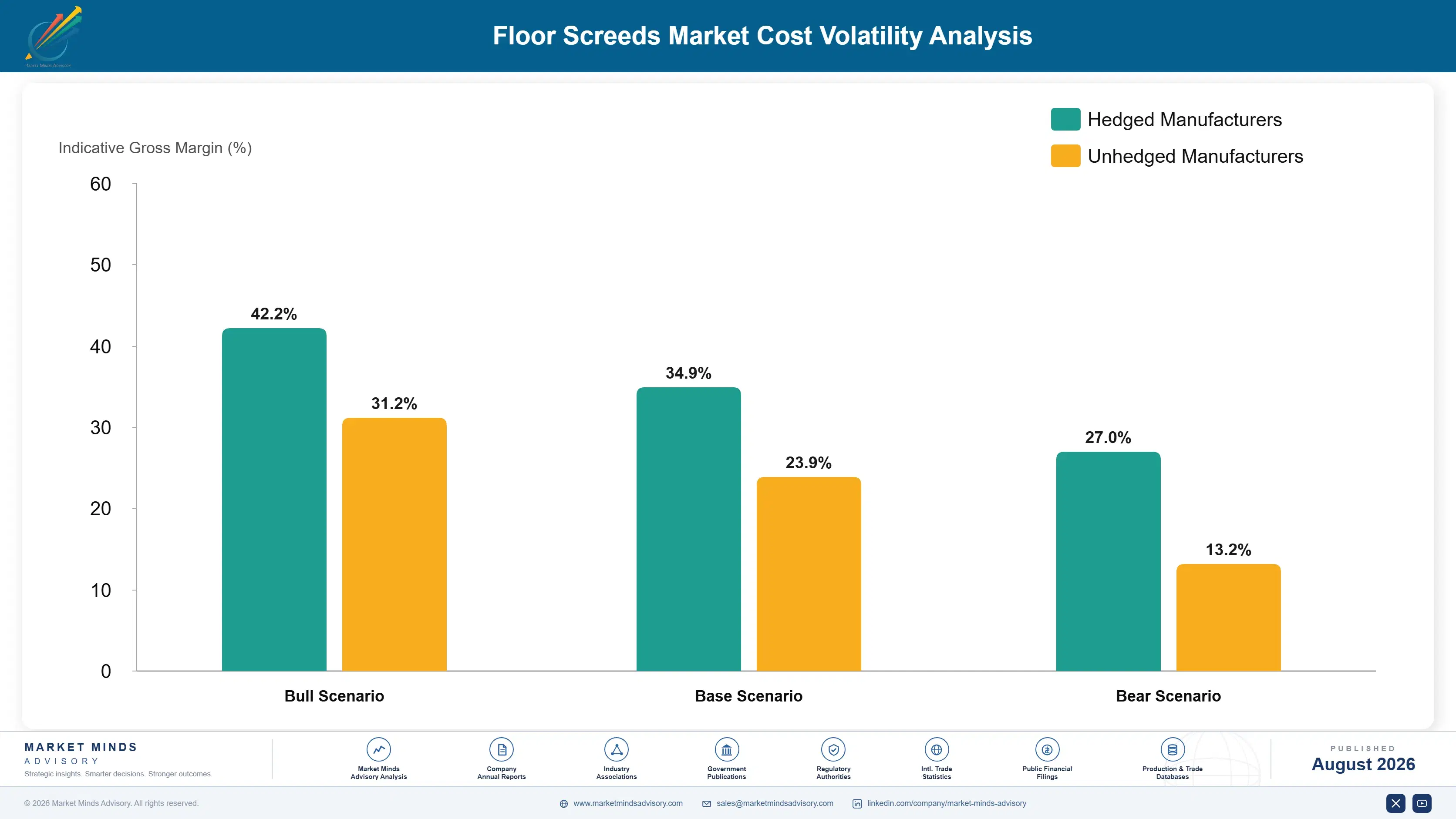
Cement and calcium sulphate binders represent roughly 34% of material cost, sourced from regional producers since binder freight economics are unforgiving. Graded aggregate and sand take a further 22% and are almost entirely local. Polymer additives, plasticisers, and retarders absorb 17% despite tiny loadings, because the chemistry is expensive. Resin systems invert this entirely, with epoxy and polyurethane binders dominating their own cost structure.
Cement pricing moved with energy costs through 2022 and 2023, and European producers faced carbon costs that North American and Asian competitors did not carry at all. Sika and Holcim both discussed input cost pressure and pricing recovery in their reporting for those years. Epoxy resin pricing moved separately on bisphenol and epichlorohydrin availability, which affected the resin screed portfolio far more than anything cementitious.

Exposure divides on product mix and freight radius rather than on scale. Cementitious bagged products carry heavy binder and aggregate cost against thin margins and cannot travel far, so regional cost position decides everything. Resin systems carry expensive chemistry, much better margins, and freight tolerance that lets a plant serve a whole continent. Manufacturers weighted entirely toward cementitious work have the least room when binder costs move.
floor-screeds-market-trends-cost-volatility-analysis-1787551388359

Index bagged product pricing to cement references

Binder at 34% of material cost moves on energy and carbon pricing that no manufacturer controls, and annual builder merchant agreements routinely fix bag prices across that exposure. Indexation to published cement references transfers the risk where it belongs. Merchants facing identical exposure through every alternative supplier accept it more readily than commercial teams usually anticipate they will.

Shift portfolio weight toward resin systems

Resin screeds carry expensive chemistry and margins several times cementitious equivalents, which absorbs input movement that bagged products simply cannot. They also tolerate freight, so one plant serves a far larger area. Mix shift is the most effective cost defence available here and it happens to point at the faster-growing part of the market anyway.

Source aggregate within a tight delivery radius

Graded sand and aggregate at 22% of material cost are heavy, cheap, and available almost everywhere, which makes any freight paid on them close to pure waste. Manufacturers running national supply agreements on aggregate frequently discover the haulage exceeds the material value. Local sourcing per plant costs qualification effort once and saves continuously afterwards.

Portfolio Architecture for Margin Defence

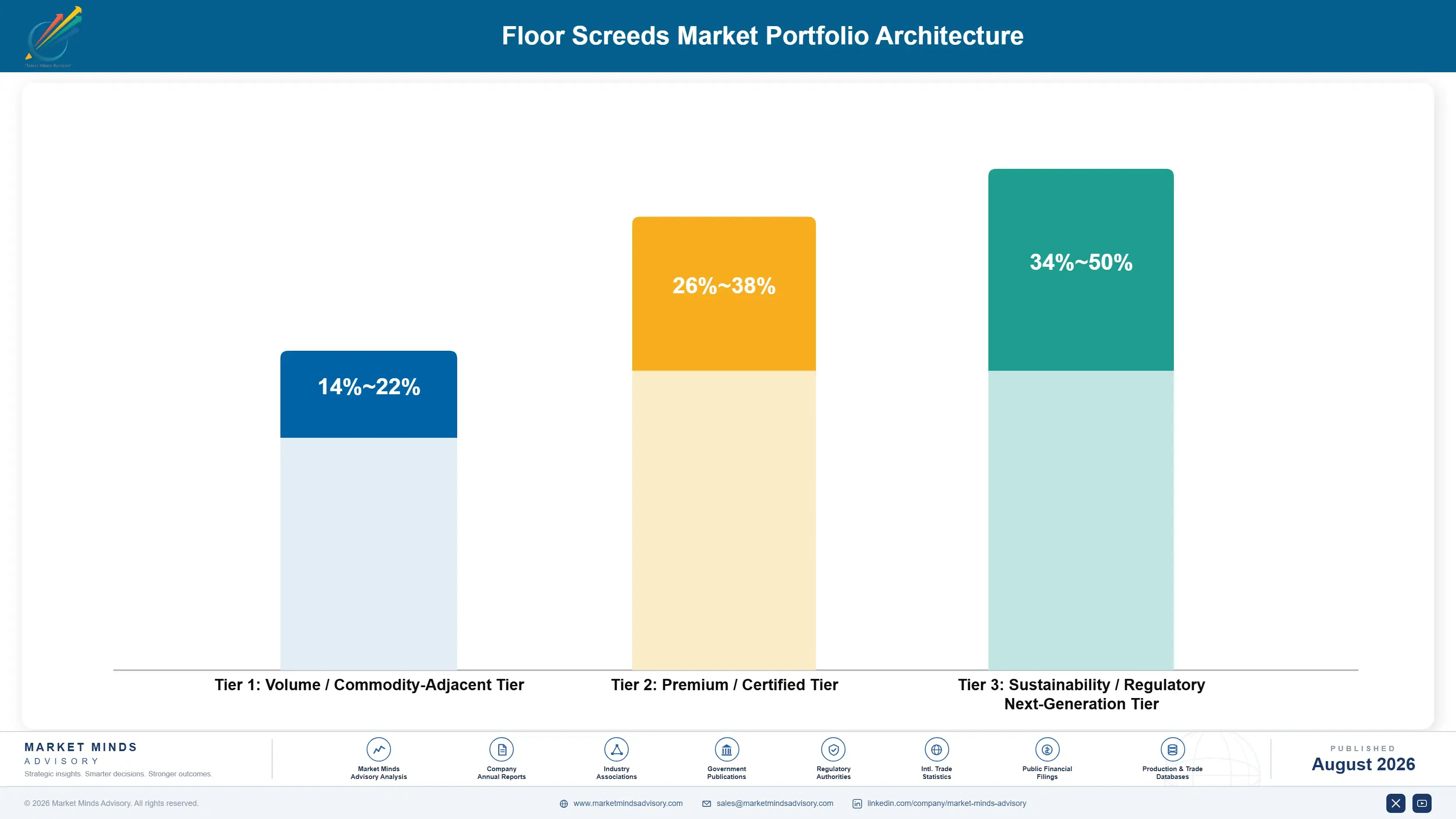
Margin architecture separates chemistry that anybody can approximate from chemistry that requires trained application. Traditional and basic bagged cementitious screed competes against site-mixed sand and cement on price and earns very little. Calcium sulphate and fast-drying systems earn considerably more because they sell programme time rather than material. Resin systems earn most, since audited hygiene specifications name them and trained applicators are genuinely scarce.
The volume and premium tension is really a question about freight. Cementitious bagged products are heavy, cheap, and cannot travel, which forces regional manufacturing and caps what any plant can serve. Resin systems carry enough value per kilogram to cross a continent from one facility. Manufacturers organised around bagged tonnage find their plant network expensive and their margins thin in exactly the same places.

High-value pools concentrate in resin systems answering audit specifications, calcium sulphate positions built on heat pump policy, and applicator certification networks that keep failures away from the brand. Each is defended by formulation, training investment, or specification presence rather than by binder cost, which regional producers will always win on eventually. Bagged tonnage has stopped being a useful measure of anything.

Volume / Commodity-Adjacent Tier

Traditional and basic bagged cementitious screed competing against site-mixed sand and cement on delivered price. Freight economics force regional manufacturing and cap the addressable radius. Very little in the chemistry defends anything here.
Gross Margin: 14%-22%

Premium / Certified Tier

Calcium sulphate flowing screeds, fast-drying cementitious systems, and self-levelling compounds sold on programme time and application speed rather than material properties. The range reflects wide differences between residential and commercial project economics.
Gross Margin: 26%-38%

Sustainability / Regulatory / Next-Generation Tier

Resin and epoxy systems specified in hygiene audit documentation, and low-carbon binder formulations answering embodied emission requirements. Trained applicators and formulation depth both defend position. The range is wide because resin and low-carbon economics differ substantially.
Gross Margin: 34%-50%
floor-screeds-market-trends-portfolio-architecture-1787551388857

High-value Sub-segments and Strategic Watch-out

Audited Hygiene Resin Systems

Growing at 7.8% because food, pharmaceutical, and healthcare audit documentation now names resin flooring explicitly rather than leaving contractors any discretion. Trained applicators and controlled installation conditions limit who can serve it at all. Cementitious alternatives are excluded on cleanability grounds rather than on any price basis.
Gross Margin: 36%-50%

Heat Pump Driven Calcium Sulphate

Growing at 8.6% on a policy timetable published years ahead, since heat pumps need underfloor heating and underfloor heating needs thin conductive screed. Some 37% of new residential screed already sits over pipework. Regulation timetables are published years ahead, which makes this a genuinely forecastable demand shift.
Gross Margin: 28%-38%

Applicator Certification Networks

Moisture causes 62% of claims and calcium sulphate failures almost always trace to installers applying cementitious habits. Certification and packaged primer systems cost far less than one high-profile failure does in reputation. Site support at first fix is also where the applicator relationship genuinely forms.
Gross Margin: 26%-36%

Basic Bagged Cementitious Screed

The strategic watch-out. Competing against site-mixed sand and cement that manufacturers capture nothing from, hauled at costs that eat the margin, and undercut by regional cement producers everywhere they operate. Freight on heavy, cheap material then then eats whatever margin the binder cost had left behind.
Gross Margin: 14%-22%

How Screed Gets Onto a Drawing

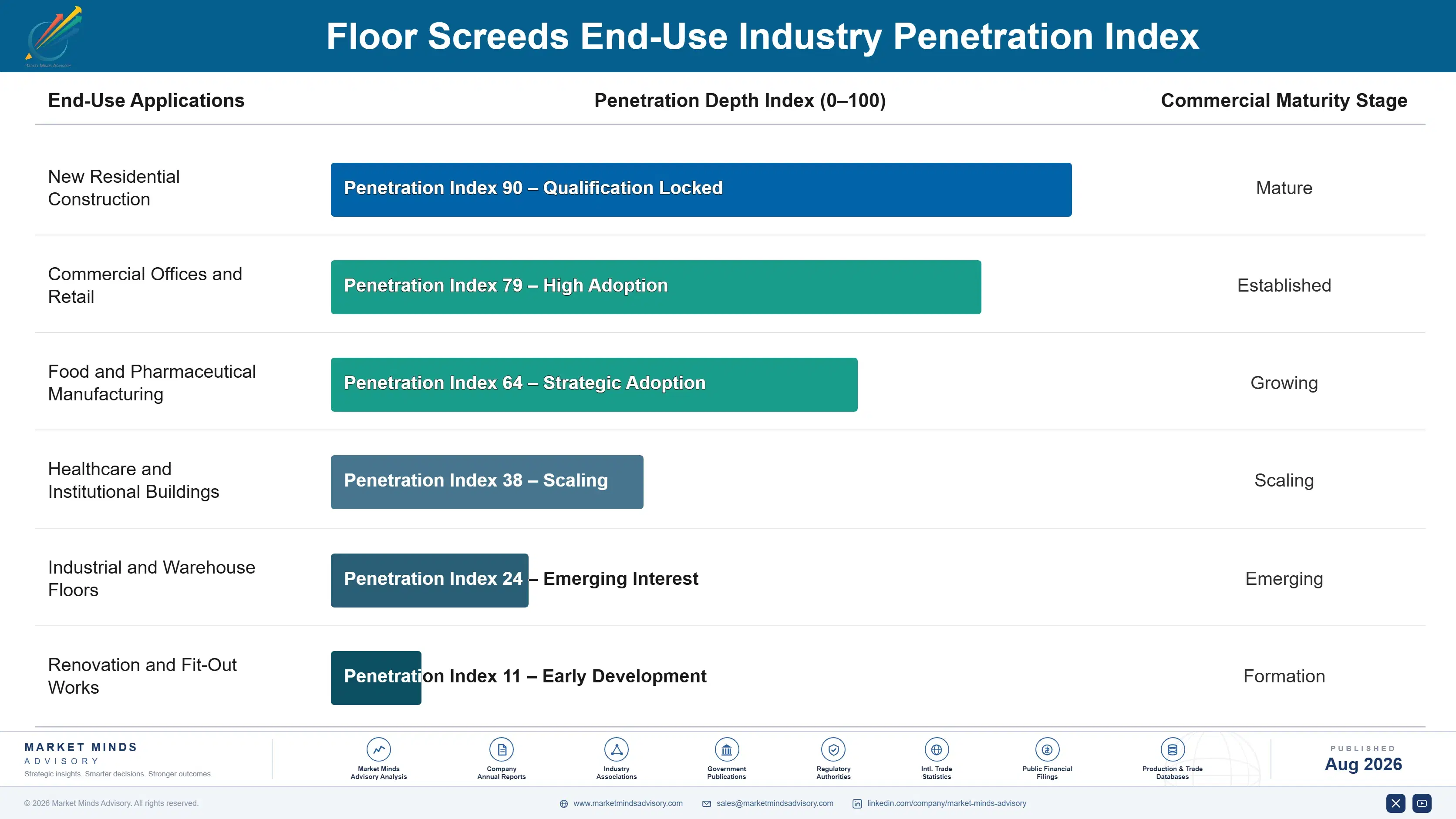
Demand originates in three places and only one of them involves a purchase order. Architects and engineers write screed into a specification as a thickness, strength class, and sometimes a named system, frequently without costing the drying implications at all. Main contractors then discover the programme consequence and either accept it or substitute. Flooring contractors, who carry the liability when a floor fails, hold strong preferences about what they will lay over. All three have to be persuaded separately.
Stickiness varies with who was convinced. A named system in an audit document holds absolutely, since the customer removed contractor discretion deliberately. Specification by an architect holds until value engineering finds it. Flooring contractor preference holds through habit and liability memory, which is durable but invisible to anybody selling upward.

The deciding buyer has been moving from the architect toward the main contractor's programme function, because drying time affects the completion date and completion dates carry penalties. Those people evaluate weeks rather than square metre rates. Manufacturers still pitching technical properties to specifiers are addressing a decision somebody else now overrides routinely. That override happens on almost every project of any size.
floor-screeds-market-trends-end-use-penetration-index-1787551389344

What Actually Gets Specified

These are among the four positions where our research anticipates prominent divergence between winners and laggards over the coming forecast period. Each is grounded in the demand model, the regulatory perimeter, and the announced capacity pipeline.
01 / PROGRAMME TIME SELLING

Price the weeks, not the square metres

Traditional screed releases moisture at roughly one day per millimetre of thickness, which puts around 75 days into a construction programme that fast-drying systems remove almost entirely from the critical path altogether. Every one of those weeks costs a main contractor real money in preliminaries, finance, and delayed handover penalties that dwarf any material price difference between the two systems involved. Manufacturers who model that saving in the contractor's own cost terms are selling something completely different from bagged material entirely.
02 / HEATING POLICY ALIGNMENT

Follow heat pump rules into thin screed systems

Heat pumps operate efficiently only at low flow temperatures, which requires large emitter surfaces, which in practice means underfloor heating encapsulated in a thin conductive screed layer above it. Around 37% of new residential screed already sits over heating pipework and calcium sulphate systems grow at 8.6% directly because of exactly that connection. Building energy regulation and heat pump subsidy timetables are published years ahead, so manufacturers can position for this demand rather than merely responding once it has already arrived.
03 / APPLICATOR TRAINING INVESTMENT

Certify installers before the failures arrive

Calcium sulphate screeds fail when installers apply cementitious habits to them: the wrong primer, laitance left unsanded, or use in permanently wet areas the binder simply cannot tolerate at all. Moisture already causes 62% of screed-related claims and every single failure attaches to the product brand rather than to the installation practice that actually caused it in the first place. Applicator certification, packaged primer and adhesive systems, and site support at first fix all cost far less than a single high-profile failure does.
04 / HYGIENE RESIN CAPABILITY

Answer the audit specification or lose it

Food processing, pharmaceutical, and healthcare customers now write jointless resin flooring directly into supplier audit documentation, removing contractor discretion over the system entirely and excluding cementitious alternatives on cleanability and chemical resistance grounds. Resin screeds grow at 7.8% and price at several times cementitious systems on comparable area, protected by trained applicators and controlled installation conditions that very few competitors actually hold. Manufacturers with only cementitious portfolios watch that specification arrive with nothing at all to quote against it at all.

Engagement Snapshot From the Field

A live engagement with an industry participant carrying material or product regulatory and market exposure ahead of a defining policy shift, showing how our research translates into a defensible multi-year portfolio strategy.
MARKET MINDS ADVISORY · CLIENT ENGAGEMENT SUMMARY
Floor Screeds Producer Strategic Portfolio Review and Transition Roadmap 2026·Investment Scenario on Floor Screeds Exposure Evaluation 2025-26
CLIENT PROFILE
A European construction chemicals manufacturer with screed revenue near EUR 165 million (client-reported, unverified by MMA), supplying bagged cementitious and self-levelling systems through builder merchants and flooring contractors. Calcium sulphate capability was licensed rather than owned, resin systems were absent, and margins had declined for four consecutive years running. Programme selling had never been attempted.
STRATEGIC CHALLENGE
Regional cement producers were undercutting bagged cementitious products on price the client could not match against their binder cost position. Two audited food processing projects had specified resin flooring the business could not supply. Technical selling still addressed architects rather than the main contractors deciding on programme grounds. Substitution rates had never been measured.
MMA APPROACH
MMA analysed specification and substitution outcomes across two hundred completed projects, modelled programme cost savings from fast-drying systems in contractor terms, and assessed resin capability build against licensing or acquisition. Forty-seven expert interviews with architects, main contractor programme managers, flooring contractors, and food industry auditors established where decisions genuinely get made.
KEY FINDINGS
  1. Roughly a third of specifications naming the client's products had been substituted at construction stage, and almost every substitution traced to a programme decision the client never saw.
  2. The licensed calcium sulphate arrangement carried no applicator training component, and installer failures using cementitious primers were being attributed to the client's brand.
  3. Every audited hygiene project reviewed had specified resin flooring by name in customer documentation, and the client had never been invited to quote on any of them.
  4. Flooring contractors laying over the client's screeds valued moisture testing support far above product properties, and no competitor in the region was offering it systematically.
CLIENT PROFILE
A European construction chemicals manufacturer with screed revenue near EUR 165 million (client-reported, unverified by MMA), supplying bagged cementitious and self-levelling systems through builder merchants and flooring contractors. Calcium sulphate capability was licensed rather than owned, resin systems were absent, and margins had declined for four consecutive years running. Programme selling had never been attempted.
STRATEGIC CHALLENGE
Regional cement producers were undercutting bagged cementitious products on price the client could not match against their binder cost position. Two audited food processing projects had specified resin flooring the business could not supply. Technical selling still addressed architects rather than the main contractors deciding on programme grounds. Substitution rates had never been measured.
MMA APPROACH
MMA analysed specification and substitution outcomes across two hundred completed projects, modelled programme cost savings from fast-drying systems in contractor terms, and assessed resin capability build against licensing or acquisition. Forty-seven expert interviews with architects, main contractor programme managers, flooring contractors, and food industry auditors established where decisions genuinely get made.
KEY FINDINGS
  1. Roughly a third of specifications naming the client's products had been substituted at construction stage, and almost every substitution traced to a programme decision the client never saw.
  2. The licensed calcium sulphate arrangement carried no applicator training component, and installer failures using cementitious primers were being attributed to the client's brand.
  3. Every audited hygiene project reviewed had specified resin flooring by name in customer documentation, and the client had never been invited to quote on any of them.
  4. Flooring contractors laying over the client's screeds valued moisture testing support far above product properties, and no competitor in the region was offering it systematically.
RECOMMENDED STRATEGY
Phase 1: Phase one: rebuild technical selling around programme cost modelling for main contractors, since substitution decisions are taken there rather than at specification stage. Phase 2: Phase two: add applicator certification and packaged primer systems to the calcium sulphate offer, removing failures currently attributed to the client's material. Phase 3: Phase three: acquire or license genuine resin capability to answer audit specifications in food, pharmaceutical, and healthcare projects the business cannot currently reach.
OUTCOME
The client cut specification substitution measurably within a year through programme cost modelling with three major contractors. Applicator certification reduced attributed failures, a resin licensing agreement was concluded, and blended gross margin improved 6.1 percentage points (client-reported, unverified by MMA). Moisture testing support is being rolled out regionally.

Frequently Asked Questions

Foundational context covering the market sizes, CAGR, scope, country, region and competition that inform every finding below. This section is provided to cover basics and most often pre-purchase conversations, answered from the MMA Primary Research Dataset.

What is the current size of the Floor Screeds Market?

The market was valued at USD 12.8 billion in 2025, rising to an estimated USD 13.47 billion in 2026. East Asia holds the largest regional share at 30% of value.

How large will the Floor Screeds Market be by 2036?

MMA forecasts USD 22.36 billion by 2036 under the base case, an expansion multiple of 1.66 times the 2026 value. That represents USD 8.89 billion of incremental value.

What is the CAGR for the Floor Screeds Market 2026 to 2036?

The base case CAGR is 5.2%, with a bull case of 6.4% and a bear case of 4.0%. The spread reflects uncertainty over residential construction and heat pump adoption pace.

Which segment is growing fastest?

Calcium sulphate flowing screed grows fastest at 8.6%, roughly 1.65 times the market rate, driven by underfloor heating. Resin and epoxy screeds follow at 7.8%.

Who are the major companies in the Floor Screeds Market?

Sika, Mapei, Saint-Gobain Weber, Ardex, and Knauf lead, holding roughly 32% between them. Specification presence and technical support sustain that position rather than manufacturing barriers.

Which country is growing fastest?

India grows fastest at 8.4%, as commercial construction and organised residential development shift from site-mixed practice toward bagged engineered systems on rising quality expectations. Domestic manufacturers and international suppliers both compete there.

Report Segmentation Architecture

The full report scope spans multiple orthogonal segmentation dimensions, with cross-tabulated demand data provided for each dimension pair. Coverage extends further to regional breakdowns, trend trajectories, and the competitive detail needed to support segment-level decision-making.

By Screed System Type

  • Traditional Sand-Cement Screed
  • Modified Cementitious Screed
  • Calcium Sulphate Flowing Screed
  • Self-Levelling Smoothing Compounds
  • Resin and Epoxy Screeds
  • Lightweight and Insulating Screeds

By End-Use Industry

  • New Residential Construction
  • Commercial Offices and Retail
  • Food and Pharmaceutical Manufacturing
  • Healthcare and Institutional Buildings
  • Industrial and Warehouse Floors
  • Renovation and Fit-Out Works

By Distribution Channel

  • Builder Merchant Networks
  • Direct Contractor Supply
  • Specialist Flooring Distributors
  • Architect and Specifier Channels
  • Ready-Mix and Site Batch Supply

By Region

  • North America
  • Western Europe
  • East Asia
  • South Asia and Pacific
  • Latin America
  • Middle East and Africa
  • Eastern Europe

Scope, Methodology, and Coverage

Every figure in this report is reproducible from documented input assumptions. The scope below maps the historical period, the forecast horizon, the segmentation dimensions, and the countries covered, alongside the underlying primary and qualitative methodology.
Historical Period
2020 to 2025
Forecast Period
2026 to 2036
Base Year
2025 (USD billions; MMA Primary Research Dataset, August 2026)
Market Definition
The market comprises screed materials supplied for levelling and finishing floor substrates, covering traditional sand-cement screed, modified cementitious screed, calcium sulphate flowing screed, self-levelling smoothing compounds, resin and epoxy screeds, and lightweight or insulating screeds. Value is measured at manufacturer level on material supplied across new build, industrial, and renovation applications. Structural concrete slabs, floor finishes including tile, timber, vinyl and carpet, adhesives and grouts sold separately, underfloor heating pipework and manifolds, damp proof membranes, and screeding contractor labour fall outside scope.
Quantitative Units
USD billions (current prices); million tonnes of screed material supplied annually; USD per square metre installed by system type
Segmentation Dimensions
By Screed System Type; By End-Use Industry; By Distribution Channel; By Region
Regions Covered
North America, Western Europe, East Asia, South Asia and Pacific, Latin America, Middle East and Africa, Eastern Europe
Countries Covered
China, Japan, South Korea, India, Australia, Indonesia, Vietnam, Thailand, Germany, France, United Kingdom, Netherlands, Italy, Spain, Sweden, Denmark, Belgium, Austria, Poland, Czechia, Romania, United States, Canada, Mexico, Brazil, Chile, Colombia, Saudi Arabia, United Arab Emirates, South Africa
Key Companies Profiled
Sika, Mapei, Saint-Gobain Weber, Ardex, Knauf, Master Builders Solutions, Fosroc, Bostik, Tarmac, Uzin Utz, Wacker Chemie, Kerakoll, Laticrete, Pidilite Industries, Sto SE, Cemex, Holcim, Flowcrete, Etex, Anhydritec
Quantitative Methodology
Primary survey, n=3,800 respondents, Q4 2025, six countries; demand-side model with trade association cross-validation
Qualitative Methodology
47 expert interviews, Q4 2025; applied to validate demand model assumptions, identify emerging dynamics, and assess competitive positioning
Report Format
PDF and XLSX data workbook (Word format preview document)
Publisher
Market Minds Advisory
Report Code
MMA-2026-CON-218
Published
August 2026
Contact
sales@marketmindsadvisory.com | www.marketmindsadvisory.com

Purchase the full Floor Screeds Market Report (2026 to 2036).

The full report sizes floor screed material demand across six system types, six end-use categories, and seven regions with 2026 to 2036 forecasts under base, bull, and bear cases. It models drying time as programme cost rather than a technical property, since that is how substitution decisions are actually taken on site. Competitive profiles cover twenty manufacturers assessed consistently on screed material revenue, specification presence, and applicator network depth. Cost analysis traces binder, aggregate, and polymer exposure against freight radius by product type. Commercial guidance addresses programme selling, heating policy alignment, applicator certification, and hygiene resin capability.
Six screed system types sized separately by region
Drying time modelled as recoverable construction programme cost
Heat pump policy timetables mapped against calcium sulphate demand
Moisture-related claim causes analysed across failure categories
Applicator training coverage assessed by manufacturer and region
Freight radius economics compared between cementitious and resin systems

Built For The People Who Decide

From boardroom strategy to bench-side execution, this report is read cover-to-cover by leaders shaping the next decade of their industry, turning demand scenarios, market dynamics and valuation benchmarks into decisions.
CXOs/ Presidents/ VPs/ Managers
M&A and Corporate Development
Strategy Teams and R&D Heads
Procurement and Product Directors
Regulatory and Compliance Leaders
Investor Relations and Equity Analysts