Market Minds Advisory
Flight Data Recording (FDR) Market

Flight Data Recording (FDR) Market: Flight Data Recording Market: Recorder Classes, Certification Barriers and Monitoring Economics 2026 to 2036

The recorder everybody has heard of gets read a handful of times a year across the whole world. The one nobody mentions is read tens of thousands of times every single day.

Lead Analyst

Published

September 2026

Make Smarter Decisions with Customized Research Insights

Request a free sample report and evaluate market opportunities, growth trends, and competitive dynamics relevant to your business needs.

2025 MARKET VALUE$1.7BMarket Size 2025
2036 FORECAST VALUE$3.7BBase Case , 2026 to 2036
CAGR 2026 TO 20367.4 %Bull 8.7% / Bear 6.2%
INCREMENTAL OPPORTUNITY$1.9BNet 10- year value creation
EXPANSION MULTIPLE2.04x2036 value over 2026 base
Strategic Levers
M&A Pipeline
Regional Outlook
Country Rankings
Competitive Intelligence
Segmental Deep-dive
Call-Us : 91 93563 13602

Executive Snapshot and Market Trajectory.

The crash protected recorder is a regulatory obligation read after accidents that almost never happen. The quick access recorder produces data after every flight and feeds the monitoring that prevents them. One is famous and commercially quiet. The other is where growth sits.
The market reaches USD 1.83 billion in 2026 and USD 3.74 billion by 2036, a 2.04 times expansion at 7.4%. Quick access and wireless recorders grow at 11.1%, half again the market rate of 7.4%, on daily flight data monitoring rather than on accident investigation. North America holds 30% of system and service revenue on the largest combined fleet anywhere, and India compounds fastest at 13.8%. Fleet growth rather than replacement drives that entirely.
Five suppliers hold 76% of system and service revenue, making this among the most concentrated aerospace equipment categories anywhere at all. Crash survivability certification takes around 38 months and very few organisations will fund it. Honeywell, L3Harris Technologies, Collins Aerospace, Curtiss-Wright and Safran hold approvals accumulated over decades that no software entrant has ever attempted to obtain, despite the value having moved into the data. Nobody has challenged that position.
Market Definition
This report covers flight data recording systems and the monitoring services built on them: quick access and wireless data recorders, cockpit image recorders, deployable emergency recorders, combined voice and data recorders, flight data acquisition and interface units, and lightweight recorders for rotorcraft and general aviation. It excludes air traffic surveillance systems, aircraft health monitoring for maintenance alone, avionics displays and navigation equipment, ground based radar, and accident investigation services.
Base Year Value
$1.7B in 2025 (MMA Primary Research Dataset, September 2026)
Forecast Period
2026 to 2036, eleven discrete annual values
CAGR
7.4% base case. Bull 8.7%. Bear 6.2%.
Fastest Growth Segment
Quick Access And Wireless Data Recorders: 11.1% CAGR
Fastest Growth Country
India: 13.8% CAGR
Fastest Growth Region
South Asia and Pacific: 9.6% CAGR
Largest Region
North America: 30% of 2025 global value
Market Leaders
Honeywell, L3Harris Technologies, Collins Aerospace, Curtiss-Wright and Safran lead on flight data recording system and service revenue. Source: MMA Analysis.
Primary Survey
n=3,800 procurement and R&D decision-makers, Q4 2025, six countries
Methodology
Demand-side build-up, cross-validated against public data, 47 expert interviews

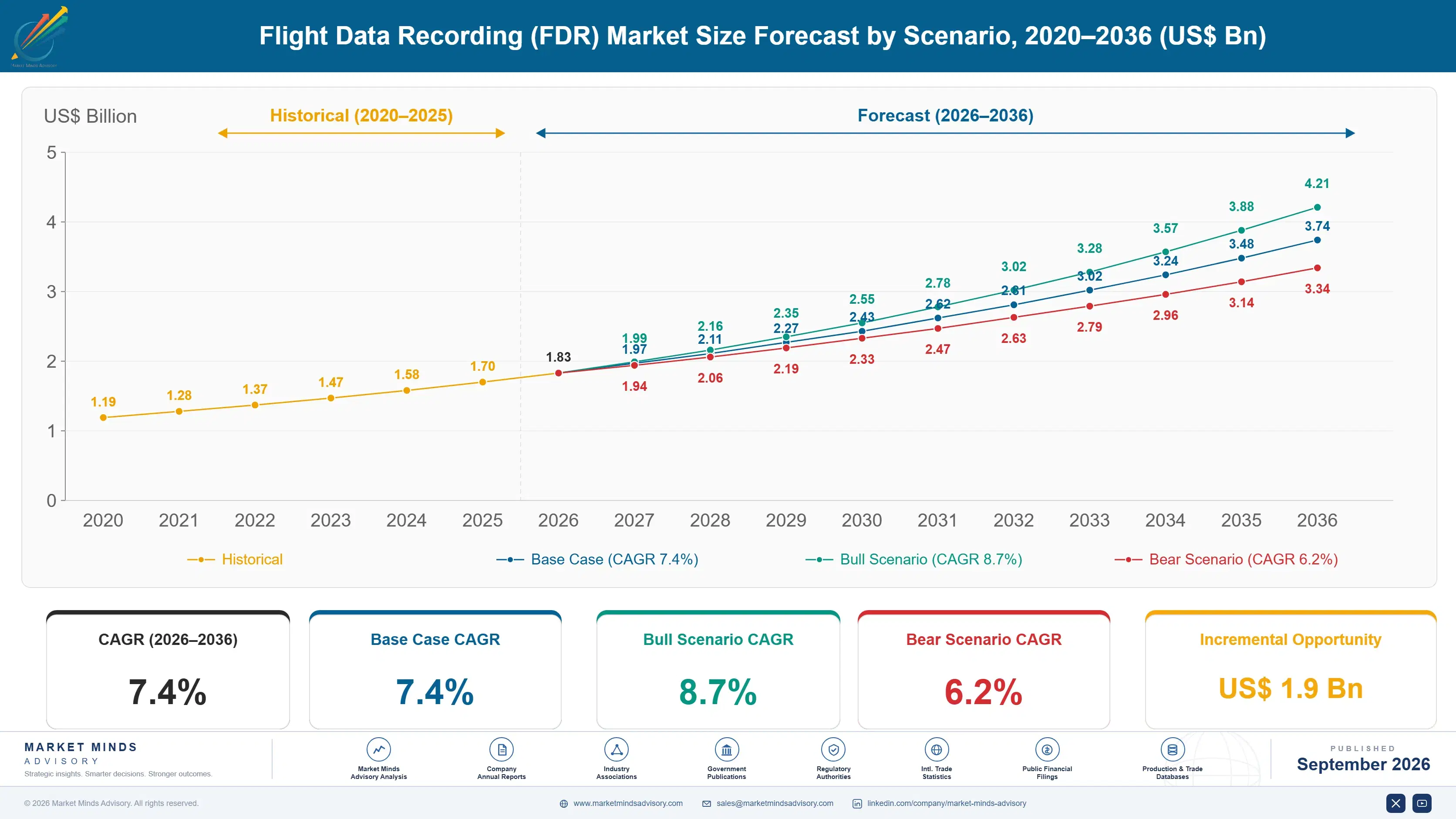
Flight Data Recording (FDR) Market Forecast Scenarios

flight-data-recording-fdr-market-size-forecast-scenario-1789991989282
Between 2020 and 2025 the category compounded at 6.3%, and two unrelated forces shaped it. Aircraft deliveries fell sharply and recovered slowly, which suppressed new installation demand for several years. Retrofit mandates covering recording duration, deployable recorders and underwater locator performance continued regardless, because those requirements attach to aircraft already flying rather than to anything being built.
The base case holds 7.4% on three mechanisms. Flight data monitoring is expanding from large airlines into regional operators, business aviation and rotorcraft where insurers now expect it, which drives quick access recorder fitment rather than crash recorder replacement. Fleet growth across South Asia adds mandated equipment on every delivery. And cockpit image recorder requirements are advancing through regulatory consultation across several jurisdictions after repeated investigation recommendations over many years.
The bull case at 8.7% assumes cockpit image recording is mandated rather than recommended, which would trigger a retrofit programme across an enormous installed fleet. The bear case at 6.2% is aircraft delivery rates slipping again: with recorder service life near 24 years, replacement demand alone cannot support growth when new installation volume falls away from the equation.

The Recorder Nobody Talks About

The famous product is the commercially quiet one. A crash protected recorder must survive around 3,400 G of deceleration, fire and deep immersion, and it exists to be read after an accident that almost never occurs. It is a regulatory obligation with a service life near 24 years and a certification barrier taking 38 months to clear. The quick access recorder alongside it produces around 1.2 gigabytes after every single flight.
TOP FIVE CONCENTRATION76%Highly concentrated by crash survivability certification barriers more than anything
RECORDER SERVICE LIFE24 yearsTypical time in service before mandated replacement or upgrade
CRASH SURVIVABILITY IMPACT3,400 GDeceleration a protected memory module must withstand fully intact
DAILY FLIGHT DATA VOLUME1.2 gigabytesParameters recorded per aircraft across a typical operating day
EXCEEDANCE REVIEW BACKLOG17 daysTime between a recorded event and safety team review
CERTIFICATION PROGRAMME DURATION38 monthsFrom design freeze to approval for a protected recorder
That certification barrier is the whole competitive structure of this industry. Demonstrating survivability and obtaining approval is a multi-year exercise very few organisations will fund against a market this size, which is why five suppliers hold 76% of it. It also explains why no software company has entered from the data side, despite the commercial value having moved decisively into the analysis rather than the recording.
Monitoring programmes only work if somebody acts, and the binding constraint is analyst capacity rather than data availability. Recorded exceedances currently wait around 17 days for safety team review at a typical operator, by which point the crew has flown fifty more sectors. A programme generating more events than the safety organisation can examine is producing documented liability rather than improved safety outcomes.
"Everybody knows what the orange box is for and almost nobody knows what the other box does. One of them gets opened after a tragedy. The other one tells an airline that three of its crews are consistently descending too fast into the same airport."
Director, Aerospace Systems and Flight Safety Practice · MMA Technology Practice · September 2026

Market Trends

Monitoring Programmes Moved Beyond The Large Airlines

Flight data monitoring was confined to major carriers for two decades because analysis capability and recorder fitment both cost more than smaller operators could justify. Insurers now expect it across regional airlines, business aviation and rotorcraft operations, and wireless quick access recorders removed the manual data retrieval that made small fleet programmes impractical. That segment compounds at 11.1% against 7.4% for the market, and the demand is fitment into aircraft already flying rather than equipment on new deliveries. Insurance rather than regulation is doing most of the work here. Nothing about that was planned by anybody.
Market Impact: India compounds at 13.8% annually

Certification Depth Keeps New Entrants Entirely Out

A crash protected recorder must demonstrate survival through around 3,400 G of deceleration, sustained fire and deep immersion, and certification runs about 38 months from design freeze. Very few organisations will fund that against a market of this size, which gives five suppliers 76% of it and has done for decades. The commercial consequence is that value migrating into data analysis has not attracted software entrants, because the analysis is difficult to separate from the recorder that generates it and the recorder cannot be built without the approval. The barrier has held for decades unchallenged.
Market Impact: Image recorders compound at 9.6%

Market Opportunities and Growth Drivers

Fleet Expansion Adds Mandated Equipment On Every Delivery

Recording equipment is mandatory on commercial aircraft, so fleet growth converts directly into installations without any adoption decision being required from anybody. India compounds at 13.8%, ahead of every other country, on order books and delivery schedules that no other market approaches at present. Each aircraft carries a combined recorder, an acquisition unit and increasingly a quick access recorder alongside them. That demand is entirely predictable years ahead from published delivery schedules, which distinguishes it from almost everything else in this category. Nothing else in this market is that predictable.
Market Impact: Review lags around 17 days

Image Recording Advances Through Regulatory Consultation

Accident investigators have repeatedly recommended cockpit image recording where voice and parameter data left investigations unable to determine what crew were actually looking at. Several jurisdictions now have that in active consultation, and pilot representative bodies oppose it firmly on privacy and misuse grounds. Image recorders compound at 9.6% on early adoption ahead of any mandate. If a requirement arrives it triggers retrofit across an enormous installed fleet, which is why suppliers are certifying products against a rule that does not yet exist anywhere. Certification takes 38 months, so waiting for a rule means missing the retrofit entirely.
Market Impact: Recorders serve about 24 years

Market Restraints and Challenges

Analyst Capacity Rather Than Data Limits Safety Value

Recorded exceedances wait around 17 days for safety team review at a typical operator, by which point the crew involved has flown many more sectors and the operational context has gone. The root cause is that monitoring programmes were sold on data collection while the review work stayed manual and the safety organisation stayed the same size. Commercially this caps what operators will pay, since more data without more analysts produces documented liability. Mitigation runs through automated triage, exceedance prioritisation and routing directly to flight operations rather than through safety.
Market Impact: Quick access recorders compound at 11.1%

Long Service Life Suppresses Replacement Demand Entirely

A recorder remains in service around 24 years and is replaced when regulation obliges it rather than when it fails, so the installed base turns over very slowly regardless of technology improvement. The root cause is that the equipment does almost nothing during normal operation and therefore does not wear out in any way an operator notices. Commercially this makes growth dependent on new deliveries and regulatory change. Mitigation runs through quick access and wireless products that operators choose to fit rather than being obliged to. Choice rather than obligation is where growth now sits.
Market Impact: Certification runs about 38 months
3 additional market trends, 4 additional growth drivers, and 2 additional restraints and challenges are covered in the full report. Contact sales@marketmindsadvisory.com to access the complete intelligence.

Segment CAGR and Growth Architecture

Segmentation follows recorder class, since what a device records determines whether regulation mandates it and how often anybody reads what it captures. Six classes cover the market: quick access and wireless recorders, cockpit image recorders, deployable emergency recorders, lightweight rotorcraft recorders, flight data acquisition units, and combined voice and data recorders. Aircraft category is a separate dimension.
flight-data-recording-fdr-market-market-share-analysis-1789991989886

Quick Access And Wireless Data Recorders

Quick access and wireless recorders grow at 11.1%, half again the market rate of 7.4%, because they are read constantly while the crash recorder beside them is read almost never. Each aircraft generates around 1.2 gigabytes of parameter data daily, and wireless offload removed the manual card retrieval that made monitoring programmes impractical for anybody without a large engineering organisation. Insurers now expect flight data monitoring across regional airlines, business aviation and rotorcraft operations. The fitment is largely into aircraft already flying rather than onto new deliveries, which is a completely different sales motion from mandated equipment supplied at manufacture. Insurers rather than regulators drive it. Fitment reaches aircraft already flying rather than new deliveries.
CAGR 11.1%

Cockpit Image Recorders

Cockpit image recorders compound at 9.6% on adoption ahead of any mandate that currently exists. Accident investigators have recommended them repeatedly, in cases where voice and parameter data still left an investigation unable to establish what the crew were actually looking at during critical moments. Pilot representative bodies oppose them firmly on privacy grounds and on concerns about misuse in disciplinary proceedings, which has slowed regulatory progress considerably in every jurisdiction where consultation has opened. Suppliers are certifying products against a rule that does not yet exist, because a mandate would trigger retrofit across an enormous installed fleet almost overnight. Nobody is certain a mandate will ever actually arrive. Suppliers certify regardless.
CAGR 9.6%
Full segment breakdown across 6 segments available in the complete report.

Regional Architecture and Country Demand Map

North America holds 30% of system and service revenue on the largest combined commercial and general aviation fleet anywhere, by a considerable margin. South Asia and Pacific grows fastest at 9.6%, because that is where fleets are expanding rather than simply being replaced on schedule.

North America

North America takes 30% of system and service revenue on a fleet that is larger than any other region's by a wide margin once general aviation is counted properly. Well over two hundred thousand general aviation aircraft operate here, and lightweight recorder requirements reaching that fleet represent a volume opportunity no other region offers. Honeywell, L3Harris Technologies, Collins Aerospace and Curtiss-Wright all manufacture here and hold certification portfolios accumulated across decades. Accident investigation recommendations originating here shape requirements worldwide. Growth at 6.4% sits below the global rate on a mature fleet with slow replacement. Lightweight recorder requirements reaching general aviation represent a volume opportunity no other region can offer anybody.
Share: 30% | CAGR: 6.4% (2026 to 2036)

East Asia

Twenty-two percent of system and service revenue reaches East Asia, at the band floor, on fleet size and delivery volume across Chinese, Japanese and Korean carriers. Chinese fleet expansion continues at a pace few other markets match, and domestic aircraft programmes carry recording equipment that is increasingly supplied locally rather than imported. Japanese and Korean operators run mature flight data monitoring programmes with analyst organisations to support them properly. Growth at 8.4% sits above the global rate on continued deliveries. Regulatory alignment with international standards means requirements arrive here without local variation. Domestic aircraft programmes increasingly carry locally supplied recording equipment rather than imported systems. International standards apply here without local variation at all.
Share: 22% | CAGR: 8.4% (2026 to 2036)
Regional intelligence for 5 additional markets available in the complete report: Western Europe, South Asia and Pacific, Latin America, Middle East and Africa, Eastern Europe. Contact sales@marketmindsadvisory.com.
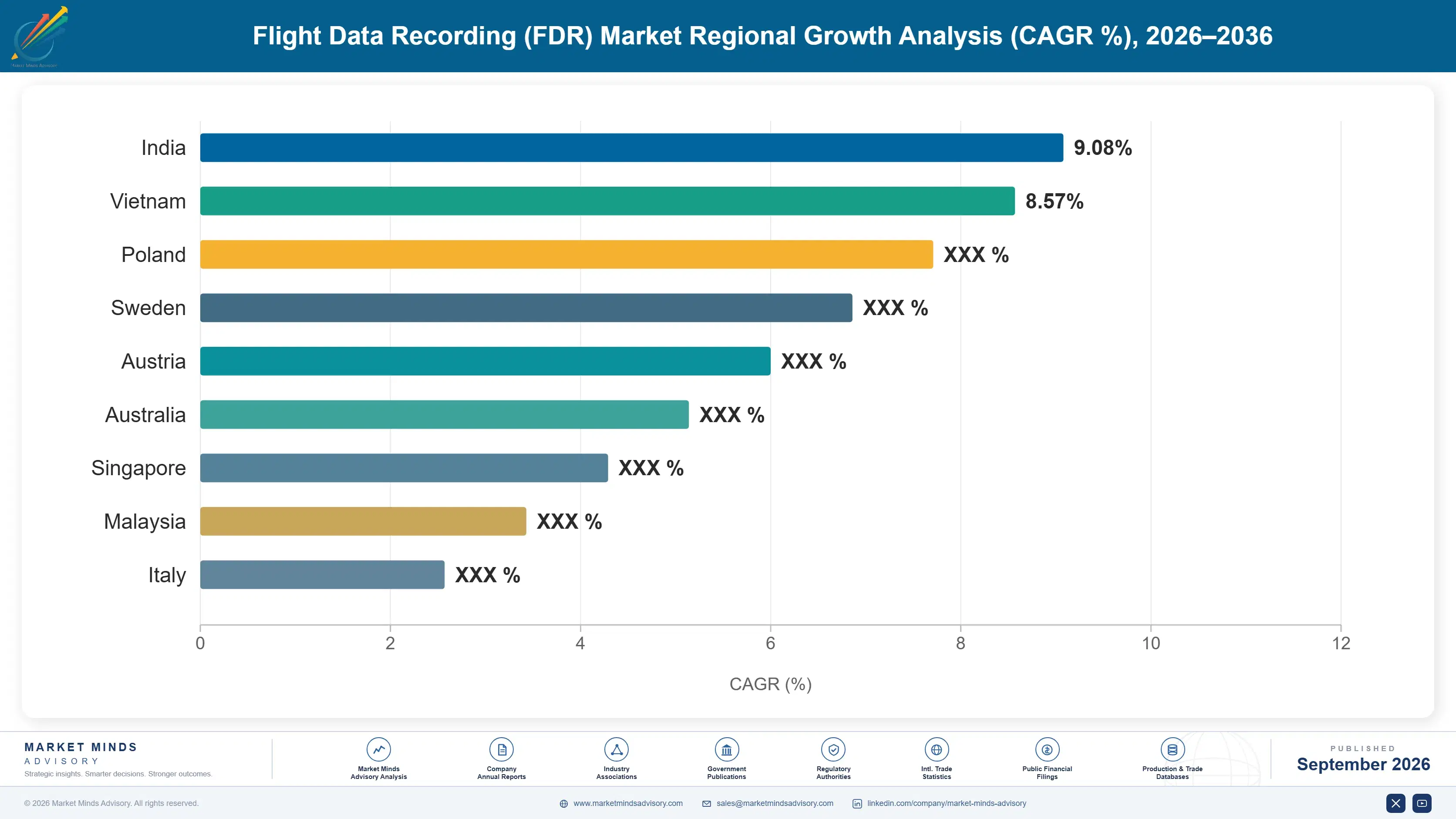
flight-data-recording-fdr-market-country-cagr-analysis-1789991990421

Where This Market Actually Grows

The mandated product carries a twenty four year service life and no adoption decision attached at all, the discretionary product is where operators actually choose, and certification keeps the supplier group at five. Each of the four levers below works with that structure rather than pretending the famous product is the commercially interesting one.

Sell The Recorder Operators Choose To Fit

A combined voice and data recorder is mandated, replaced roughly every 24 years and involves no operator decision at all beyond compliance. A quick access recorder is optional, produces around 1.2 gigabytes after every flight and gets fitted because an operator or an insurer wants monitoring. That segment compounds at 11.1% while the mandated one grows at 3.2%, and it reaches aircraft already flying rather than waiting for deliveries. Suppliers organised around certification and manufacture keep treating the optional product as an accessory rather than as the growth. That is a coverage failure rather than a product one.
Market Impact: Optional recorders compound at 11.1% each single year

Solve The Analyst Bottleneck, Not The Data Gap

Recorded exceedances wait around 17 days for safety review at a typical operator, and adding more parameters or more aircraft makes that worse rather than better. The constraint is analyst capacity and it has been for years while vendors kept selling data volume. Automated triage that prioritises exceedances by genuine risk, and routes routine ones to flight operations rather than to a safety department, converts a monitoring programme from documented liability into something that changes behaviour. Very few suppliers sell against that constraint at all. Data volume was never the constraint here.
Market Impact: Backlogs near 17 days cap all the value

Certify Image Recorders Before Any Mandate Exists

Investigators have repeatedly recommended cockpit image recording and several jurisdictions have it in active consultation, while pilot bodies oppose it firmly on privacy and misuse grounds. Certification takes around 38 months from design freeze, so a supplier starting when a rule arrives misses the retrofit wave entirely. Image recorders compound at 9.6% on voluntary adoption alone. Certifying against a rule that does not yet exist is uncomfortable to justify and it is the only way to be ready if one arrives. Voluntary adoption is already running ahead of it. Discomfort is the price of readiness.
Market Impact: A 38 month certification precedes every possible mandate

Follow Fleet Growth Rather Than Fleet Size

Recording equipment is mandatory, so every delivered aircraft carries it without any adoption decision, and delivery schedules are published years ahead. India compounds at 13.8% on order books that exceed any other market, while mature fleets replace equipment roughly every 24 years and generate very little. Suppliers organised around installed base relationships in established markets are covering the slowest demand available. The fastest is visible in published order books and requires reaching operators before their first delivery arrives. Reaching operators before their first delivery arrives is the whole discipline, and published order books make that entirely possible.
Market Impact: India compounds at 13.8% on pure fleet growth

Who Controls the Margin Pool

Five suppliers hold 76% of flight data recording system and service revenue, making this among the most concentrated aerospace equipment categories anywhere. Crash survivability certification runs around 38 months and very few organisations will fund it against a market this size. Honeywell, L3Harris Technologies, Collins Aerospace, Curtiss-Wright and Safran hold approvals accumulated across decades that no entrant has attempted to match. All participants are assessed on system and service revenue.
Competition on mandated equipment runs on aircraft manufacturer relationships rather than on product, since recorders are specified at the airframe level and operators receive what the aircraft carries. Retrofit and optional equipment is a genuinely different contest fought with operators directly, where monitoring capability and data services matter considerably more than survivability specifications that every certified product already meets by definition anyway.

Rankings shift with the monitoring services layer rather than with hardware, since that is where operators are choosing rather than complying. The second pressure would be a cockpit image mandate, which would trigger retrofit across an enormous fleet and reward whichever suppliers certified their products before any rule actually existed to certify against at all.
flight-data-recording-fdr-market-company-positioning-matrix-1789991990945

Competitive Moat and Risk Dimensions

HONEYWELL

Moat: Airframe Specification Position

Honeywell equipment is specified into aircraft at the airframe level, so operators receive it without making any selection and replacement follows the same specification decades later. That position was established through aircraft programme relationships built across generations of airframes. A competitor with a superior product still needs the airframe manufacturer to change a specification that has worked for twenty years.
HONEYWELL

Risk: Optional Equipment Distance

Growth sits in quick access recorders and monitoring services that operators choose rather than receive, and those are sold to flight safety and operations departments rather than through airframe programmes. A position built on manufacturer specification provides no particular advantage in that conversation. The optional segment compounds at 11.1% while the mandated one grows at 3.2%.
CURTISS-WRIGHT

Moat: Certification Portfolio Breadth

Curtiss-Wright holds crash survivability approvals across recorder types and aircraft categories accumulated over decades, each representing a 38 month certification programme and considerable expense. That portfolio is the market access, since operators and manufacturers select only from approved equipment. Assembling comparable breadth from a standing start is a decade of work that no entrant has been willing to fund.
CURTISS-WRIGHT

Risk: Narrow Category Concentration

A business concentrated in recording equipment depends on aircraft deliveries and regulatory change, with a 24 year service life suppressing replacement demand between those events. There is no adjacent product line to carry the company through a delivery slowdown. Diversification into monitoring services means competing on software capability rather than on certification depth.

Players Tracked

Prominent Players

Honeywell
L3Harris Technologies
Collins Aerospace
Curtiss-Wright
Safran

Other Key Players

Leonardo
Universal Avionics
Astronautics Corporation of America
Teledyne Controls
Thales
GE Aerospace
Meggitt
Flight Data Systems
Appareo Systems
DAC International
Aerobytes
Skytrac
Latecoere
ACR Electronics
Garmin

Recent Developments

MARCH 2025

Teledyne Controls Extends Wireless Data Offload Across Aircraft Types

Teledyne Controls extended wireless quick access data offload capability across additional aircraft types, an organic product development rather than an acquisition or joint venture. Each aircraft generates around 1.2 gigabytes of parameter data daily, and wireless retrieval removes the manual card handling that made monitoring impractical for smaller operators.
Signal: Removing the retrieval step opened monitoring to operators who could never once have staffed it before.
SEPTEMBER 2024

Curtiss-Wright Certifies Cockpit Image Recorder Ahead Of Requirements

Curtiss-Wright completed certification of a cockpit image recording product ahead of any mandate requiring it, an organic development rather than any transaction. Investigators have repeatedly recommended image recording, and certification runs around 38 months from design freeze, so waiting for a rule means missing the resulting retrofit entirely.
Signal: Certifying against a rule that does not exist is uncomfortable and it is the only way to be ready.
JUNE 2025

Honeywell Adds Automated Exceedance Triage To Monitoring Services

Honeywell added automated exceedance prioritisation to its flight data monitoring services, an organic engineering development rather than a partnership or merger. Recorded events wait around 17 days for safety team review at a typical operator, and adding aircraft or parameters makes that backlog worse rather than better.
Signal: Analyst capacity rather than data availability has been the binding constraint in this category for years.

What A Certified Recorder Costs

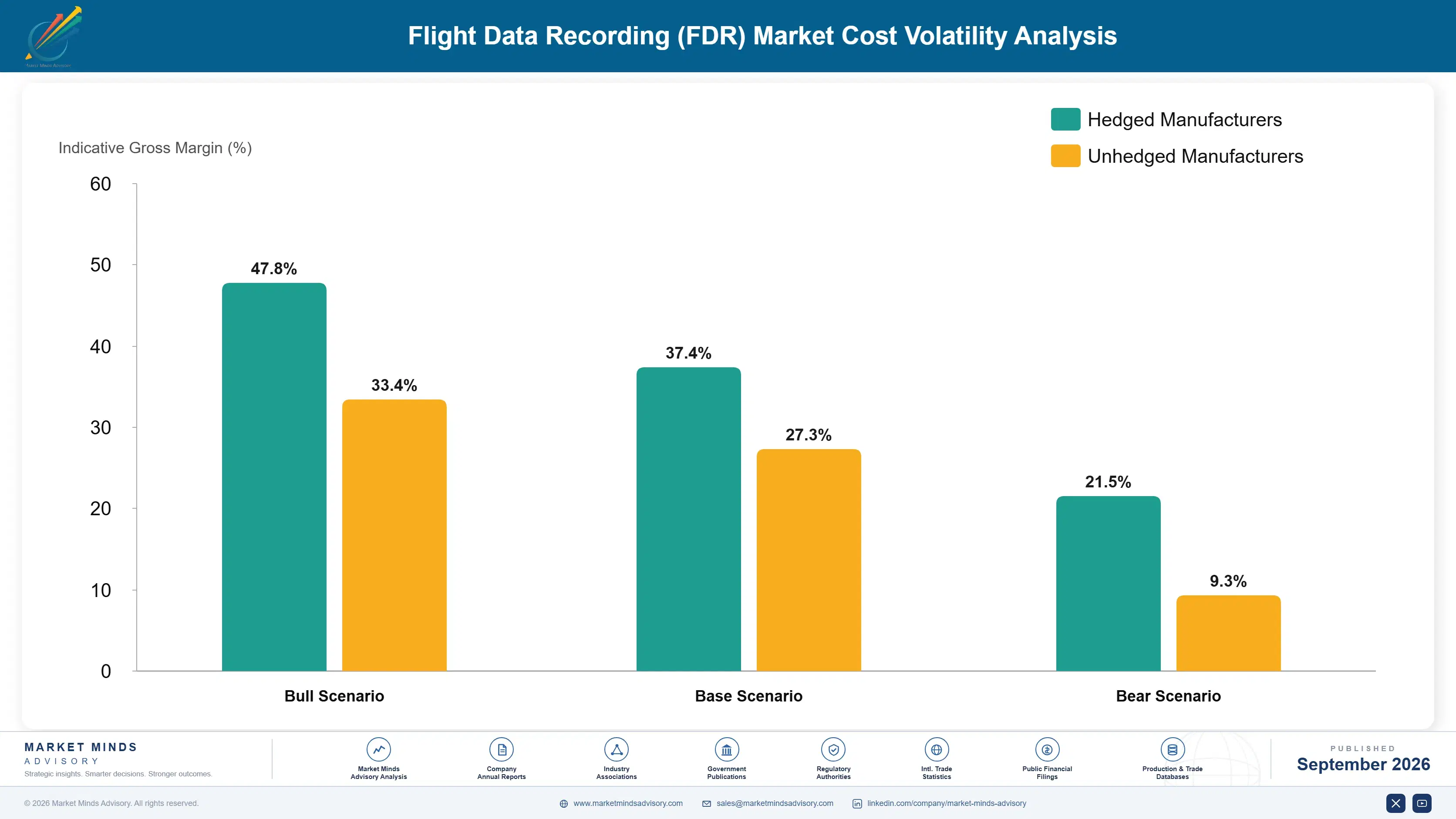
Crash protected memory module construction accounts for roughly 29% of recorder cost, covering thermal insulation, armoured housing and the sealing that survives immersion. Electronics and data acquisition carry around 22%, which is modest because the computing requirement is genuinely light. Certification amortisation absorbs about 24% and is the largest single item on most products. Assembly, test and support take the remaining balance.
Aerospace qualified component availability tightened through 2022 and 2023, and low volume recorder production competed against far larger avionics programmes for the same parts. Honeywell Annual Report 2024 and Curtiss-Wright Annual Report 2024 both record supply chain and certification costs as operating variables across their avionics businesses. Suppliers on long term airframe agreements absorbed increases directly, since equipment priced into an aircraft programme does not reprice for years afterwards.

The competitive disadvantage mechanism is certification amortisation rather than manufacturing cost. A 38 month approval programme costs the same whether a supplier ships hundreds of units or tens of thousands, so volume determines what that investment costs per recorder. Exposure concentrates among any entrant attempting to build a position from nothing, which is precisely why five suppliers have held 76% of this market for decades without serious challenge.
flight-data-recording-fdr-market-cost-volatility-analysis-1789991991142

Certify One Platform Across Multiple Recorder Variants

Certification amortisation runs around 24% of recorder cost and a 38 month programme costs the same regardless of eventual volume. Architecting a common protected module and acquisition platform so one approval covers combined, deployable and lightweight variants spreads that investment far wider. The discipline is design architecture rather than certification expertise, and engineering teams treat approval as downstream.

Share Aerospace Component Sourcing With Larger Programmes

Recorder production runs at volumes far below other avionics programmes and competes for the same qualified components at considerably worse pricing. Aligning component selection with higher volume avionics lines inside the same organisation, or with partner programmes, improves both availability and cost. Suppliers specifying unique parts for a low volume product pay twice for being different.

Sell Monitoring Services Against The Hardware Margin

Recorder hardware carries heavy certification amortisation and a 24 year replacement cycle that generates very little recurring revenue between installations. Monitoring services attached to the same aircraft produce annual income with no certification burden and margins that hardware cannot approach. Suppliers treating services as an accessory to hardware have that relationship the wrong way round.

Portfolio Architecture for Margin Defence

Margin architecture separates on whether the operator chose the product or received it. Combined voice and data recorders and acquisition units earn least, since both are specified at airframe level, priced into aircraft programmes and replaced on a compliance schedule. Deployable and lightweight recorders sit in the middle. Quick access recorders, image recorders and monitoring services earn most, because each is a decision rather than an obligation.
The volume versus premium tension is between two entirely different customers inside the same operator. An airframe programme specifies mandated equipment years before delivery and prices it into the aircraft. A flight safety department buys monitoring capability from an operating budget and judges it on whether events get reviewed. Suppliers built for the first customer consistently underestimate how differently the second one buys and how much faster.

High-value pools concentrate in monitoring services and in image recording, and neither is reached through airframe specification. Monitoring services require analytics and a relationship with flight safety organisations that hardware suppliers rarely hold. Image recording requires certifying against a rule that does not exist yet. Both sit outside the airframe programme process that built every incumbent position in this industry.

Volume / Commodity-Adjacent

Combined voice and data recorders and flight data acquisition units, specified at airframe level and priced into aircraft programmes on compliance schedules. The eight point spread separates suppliers holding airframe specification positions from those competing for retrofit and replacement work at considerably worse pricing.
Gross Margin: 24% to 32%

Premium / Certified

Deployable emergency recorders and lightweight rotorcraft and general aviation recorders, sold on certification against specific requirements and installation practicality. The twelve point spread tracks how much of a supplier's volume arrives through mandated retrofit programmes rather than through discretionary operator purchases negotiated individually.
Gross Margin: 38% to 50%

Sustainability / Regulatory / Next-Generation

Quick access recorders, cockpit image recorders and flight data monitoring services, each chosen by an operator rather than received with an aircraft. The fourteen point spread reflects how much recurring service revenue a supplier attaches, which decides whether the relationship generates income between installations.
Gross Margin: 54% to 68%
flight-data-recording-fdr-market-portfolio-architecture-1789991991650

High-value Sub-segments and Strategic Watch-out

Quick Access And Wireless Data Recorders

Grows at 11.1% because it is read after every flight while the crash recorder beside it is read almost never at all. The fourteen point spread reflects attached service revenue. Insurers rather than regulators are doing most of the work driving this fitment. Choice rather than obligation.
Gross Margin: 54% to 68%

Cockpit Image Recorders

Grows at 9.6% on voluntary adoption ahead of any mandate, while pilot bodies oppose it firmly on privacy and misuse grounds everywhere. The fourteen point spread reflects certification timing. A mandate would trigger retrofit across an enormous installed fleet almost immediately. Nobody knows whether a rule arrives.
Gross Margin: 54% to 68%

Deployable Emergency Recorders

Grows at 8.2% on requirements covering over water operations where recovering a fixed recorder from deep ocean has repeatedly proved impossible. The twelve point spread reflects retrofit programme access. Investigation experience rather than any commercial argument drove this requirement into existence. Deep ocean recovery repeatedly failed.
Gross Margin: 38% to 50%

Combined Voice And Data Recorders

Grows at 3.2%, slowest of the six classes, on a mandated product with a 24 year service life and no operator decision attached to it whatsoever. The eight point spread reflects airframe positions. This is the product everybody has heard of and nobody chooses. Famous and commercially very quiet.
Gross Margin: 24% to 32%

Why These Positions Hold So Long

The annuity is airframe specification rather than any operator relationship. Equipment specified into an aircraft type is fitted to every unit built and replaced with the same part decades later, because changing a specification means requalifying an installation nobody has any reason to touch. A service life near 24 years means the supplier chosen for an airframe programme holds that fleet for most of its life.
Depth varies by how the equipment was acquired. Mandated recorders arriving with the aircraft are effectively permanent, since operators have no reason to change them and certification makes alternatives limited anyway. Monitoring services are the opposite: an operator dissatisfied with exceedance review or data handling moves supplier at contract renewal without touching any hardware at all. That is genuinely competitive ground in an industry with very little of it.

The buyer differs completely between the two halves and most suppliers reach only one. An airframe programme office specifies mandated equipment years before an aircraft flies, on certification and integration criteria. A flight safety manager buys monitoring from an operating budget and judges it on whether events get reviewed usefully. Suppliers organised around airframe relationships are absent from where growth actually is.
flight-data-recording-fdr-market-end-use-penetration-index-1789991992158

Where The Growth Actually Is

These are among the four positions where our research anticipates prominent divergence between winners and laggards over the coming forecast period. Each is grounded in the demand model, the regulatory perimeter, and the announced capacity pipeline.
01 / OPTIONAL PRODUCT FOCUS

Sell What Operators Choose To Buy

A combined voice and data recorder is mandated, carries a service life near 24 years and involves no operator decision beyond straightforward compliance with an existing requirement. A quick access recorder is optional, produces around 1.2 gigabytes after every single flight and gets fitted because an operator or its insurer wants a monitoring programme. That optional segment compounds at 11.1% while the mandated one grows at 3.2%, and suppliers organised entirely around certification and manufacture keep treating it as an accessory.
02 / ANALYST BOTTLENECK SOLVING

Fix The Review, Not The Recording

Recorded exceedances wait around 17 days for safety team review at a typical operator, and adding more parameters or more aircraft to a programme makes that backlog worse rather than better in every case. The binding constraint has been analyst capacity for years while vendors carried on selling data volume against it. Automated triage prioritising by genuine risk, with routine events routed to flight operations rather than to a safety department, converts documented liability into something that changes crew behaviour.
03 / PRE-MANDATE CERTIFICATION TIMING

Approve The Product Before The Rule

Accident investigators have repeatedly recommended cockpit image recording and several jurisdictions have it in active consultation, while pilot representative bodies oppose it firmly on privacy and misuse grounds. Certification takes around 38 months from design freeze, so any supplier beginning when a rule arrives has already missed the resulting retrofit wave entirely. Image recorders compound at 9.6% on voluntary adoption alone, and certifying against a requirement that does not yet exist anywhere is the only way to be ready for one.
04 / DELIVERY PIPELINE COVERAGE

Follow Order Books, Not Installed Fleets

Recording equipment is mandatory, so every delivered aircraft carries it without any adoption decision being taken by anybody, and delivery schedules are published years in advance for anyone who reads them. India compounds at 13.8% on order books exceeding any other market, while mature fleets replace equipment roughly every 24 years and generate very little demand between those points. Suppliers organised around installed base relationships in established markets are covering the slowest demand available anywhere, while the fastest sits visible in published order books.

Engagement Snapshot From the Field

A live engagement with an industry participant carrying material or product regulatory and market exposure ahead of a defining policy shift, showing how our research translates into a defensible multi-year portfolio strategy.
MARKET MINDS ADVISORY · CLIENT ENGAGEMENT SUMMARY
Flight Data Recording (FDR) Producer Strategic Portfolio Review and Transition Roadmap 2026·Investment Scenario on Flight Data Recording (FDR) Exposure Evaluation 2025-26
CLIENT PROFILE
An Asian regional airline group operating 74 aircraft across three carriers, running a flight data monitoring programme required by its insurer for four years. Exceedance review was running weeks behind and the safety department had requested additional analysts twice without success. The group had also been quoted for a monitoring platform upgrade that would increase recorded parameters substantially.
STRATEGIC CHALLENGE
The safety department wanted more analysts and believed better data would improve outcomes. Finance had declined the headcount twice and questioned what the existing programme delivered. The vendor proposed more parameters and more aircraft coverage. Nobody had asked whether adding data to a programme already weeks behind on review would improve safety or simply enlarge an unreviewed backlog.
MMA APPROACH
MMA measured exceedance review latency and outcome across eighteen months, tracing which recorded events produced any operational change and which were closed without action. We assessed how many exceedances a triage rule could safely deprioritise, and modelled the parameter expansion against existing review capacity. The work drew on 47 expert interviews conducted in Q4 2025 with carriers, suppliers and flight safety specialists.
KEY FINDINGS
  1. Exceedance review latency averaged 23 days against a category norm near 17, and 8 in 10 reviewed events were closed with no action taken at all.
  2. Adding the proposed parameters would have increased exceedance volume by roughly 3 times against review capacity that had not changed in four years.
  3. Automated triage could have deprioritised around 60% of events safely, since those categories had never once produced an operational change (client-reported, unverified by MMA).
  4. The events that genuinely did change crew behaviour clustered in 4 exceedance categories, and none of them required any of the proposed additional parameters.
CLIENT PROFILE
An Asian regional airline group operating 74 aircraft across three carriers, running a flight data monitoring programme required by its insurer for four years. Exceedance review was running weeks behind and the safety department had requested additional analysts twice without success. The group had also been quoted for a monitoring platform upgrade that would increase recorded parameters substantially.
STRATEGIC CHALLENGE
The safety department wanted more analysts and believed better data would improve outcomes. Finance had declined the headcount twice and questioned what the existing programme delivered. The vendor proposed more parameters and more aircraft coverage. Nobody had asked whether adding data to a programme already weeks behind on review would improve safety or simply enlarge an unreviewed backlog.
MMA APPROACH
MMA measured exceedance review latency and outcome across eighteen months, tracing which recorded events produced any operational change and which were closed without action. We assessed how many exceedances a triage rule could safely deprioritise, and modelled the parameter expansion against existing review capacity. The work drew on 47 expert interviews conducted in Q4 2025 with carriers, suppliers and flight safety specialists.
KEY FINDINGS
  1. Exceedance review latency averaged 23 days against a category norm near 17, and 8 in 10 reviewed events were closed with no action taken at all.
  2. Adding the proposed parameters would have increased exceedance volume by roughly 3 times against review capacity that had not changed in four years.
  3. Automated triage could have deprioritised around 60% of events safely, since those categories had never once produced an operational change (client-reported, unverified by MMA).
  4. The events that genuinely did change crew behaviour clustered in 4 exceedance categories, and none of them required any of the proposed additional parameters.
RECOMMENDED STRATEGY
Phase 1: Phase one: decline the parameter expansion, since the programme cannot review the events it already generates from the current recording set. Phase 2: Phase two: deploy automated triage so the four categories that change behaviour reach flight operations within days rather than weeks. Phase 3: Phase three: report review latency and action rate to the board alongside exceedance counts, which measure activity rather than any safety outcome.
OUTCOME
The group declined the expansion and deployed triage against the existing parameter set (client-reported, unverified by MMA). Review latency fell from over three weeks to under four days on the categories that matter and no additional analysts were required. Review latency and action rate are now board reported metrics, which is the change that outlasted the engagement.

Frequently Asked Questions

Foundational context covering the market sizes, CAGR, scope, country, region and competition that inform every finding below. This section is provided to cover basics and most often pre-purchase conversations, answered from the MMA Primary Research Dataset.

What is the current size of the Flight Data Recording (FDR) Market?

Global value reaches USD 1.83 billion in 2026, measured as flight data recording system and service revenue across six recorder classes. The 2025 base is USD 1.7 billion.

How large will the Flight Data Recording (FDR) Market be by 2036?

System and service revenue reaches USD 3.74 billion by 2036, an increase of USD 1.91 billion over the forecast period. That represents 2.04 times expansion from the 2026 base.

What is the CAGR for the Flight Data Recording (FDR) Market 2026 to 2036?

The base case runs at 7.4% annually, with a bull case at 8.7% if cockpit image recording is mandated rather than recommended and a bear case at 6.2% if aircraft delivery rates slip again.

Which segment is growing fastest?

Quick access and wireless data recorders grow at 11.1%, half again the market rate of 7.4%. They are read after every flight while the crash recorder beside them is read almost never.

Who are the major companies in the Flight Data Recording (FDR) Market?

Honeywell, L3Harris Technologies, Collins Aerospace, Curtiss-Wright and Safran lead on system and service revenue, together holding 76%. Teledyne Controls, Universal Avionics and Appareo Systems hold smaller positions.

Which country is growing fastest?

India leads at 13.8%, because carrier order books and delivery schedules exceed any other market and every aircraft arrives with mandated recording equipment. Vietnam and Indonesia follow.

Report Segmentation Architecture

The full report scope spans multiple orthogonal segmentation dimensions, with cross-tabulated demand data provided for each dimension pair. Coverage extends further to regional breakdowns, trend trajectories, and the competitive detail needed to support segment-level decision-making.

By Recorder Class

  • Quick Access And Wireless Data Recorders
  • Cockpit Image Recorders
  • Deployable Emergency Recorders
  • Lightweight Recorders For Rotorcraft And General Aviation
  • Flight Data Acquisition And Interface Units
  • Combined Voice And Data Recorders

By End-Use Industry

  • Commercial Passenger Airlines
  • Regional And Turboprop Operators
  • Business And Corporate Aviation
  • Rotorcraft And Offshore Operations
  • Cargo And Freight Airlines
  • General Aviation And Training

By Commercial Dimension

  • Airframe Programme Specification
  • Retrofit And Modification Supply
  • Direct Operator Procurement
  • Monitoring Service Subscription
  • Maintenance Organisation Channel
  • Regulatory Mandate Driven Replacement

By Region

  • North America
  • Western Europe
  • East Asia
  • South Asia and Pacific
  • Latin America
  • Middle East and Africa
  • Eastern Europe

Scope, Methodology, and Coverage

Every figure in this report is reproducible from documented input assumptions. The scope below maps the historical period, the forecast horizon, the segmentation dimensions, and the countries covered, alongside the underlying primary and qualitative methodology.
Historical Period
2020 to 2025
Forecast Period
2026 to 2036
Base Year
2025 (USD billions; MMA Primary Research Dataset, September 2026)
Market Definition
This report covers flight data recording systems and the monitoring services built on them: quick access and wireless data recorders, cockpit image recorders, deployable emergency recorders, combined voice and data recorders, flight data acquisition and interface units, and lightweight recorders for rotorcraft and general aviation. It excludes air traffic surveillance systems, aircraft health monitoring for maintenance alone, avionics displays and navigation equipment, ground based radar, and accident investigation services.
Quantitative Units
USD millions, system and service revenue basis; equipped aircraft; recorder service life in years; daily recorded data volume in gigabytes; exceedance review latency in days.
Segmentation Dimensions
Recorder class; operator and aircraft category; commercial procurement route; geography across seven regions.
Regions Covered
North America, Western Europe, East Asia, South Asia and Pacific, Latin America, Middle East and Africa, Eastern Europe
Countries Covered
United States, Canada, Mexico, Brazil, Chile, Colombia, United Kingdom, France, Germany, Italy, Spain, Poland, Czechia, China, Japan, South Korea, India, Indonesia, Australia, United Arab Emirates.
Key Companies Profiled
Honeywell, L3Harris Technologies, Collins Aerospace, Curtiss-Wright, Safran, Leonardo, Universal Avionics, Teledyne Controls, Thales, GE Aerospace, Meggitt, Flight Data Systems, Appareo Systems, Skytrac, Garmin.
Quantitative Methodology
Primary survey, n=3,800 respondents, Q4 2025, six countries; demand-side model with trade association cross-validation
Qualitative Methodology
47 expert interviews, Q4 2025; applied to validate demand model assumptions, identify emerging dynamics, and assess competitive positioning
Report Format
PDF and XLSX data workbook (Word format preview document)
Publisher
Market Minds Advisory
Report Code
MMA-2026-TEC-591
Published
September 2026
Contact
sales@marketmindsadvisory.com | www.marketmindsadvisory.com

Purchase the full Flight Data Recording (FDR) Market Report (2026 to 2036).

This report sizes the global flight data recording market from 2026 to 2036 across six recorder classes, six operator categories and seven regions. It explains why the famous crash recorder is the commercially quiet product while the quick access recorder beside it compounds at 11.1%, how a 38 month certification barrier keeps five suppliers holding 76% of the market, and why exceedance review latency near 17 days caps what monitoring programmes deliver. Cost composition is sourced to company annual reports, with certification amortisation analysed as the concentration driver. Regional analysis explains why India compounds at 13.8%.
Six recorder classes sized through to 2036
Certification barriers modelled as the concentration mechanism
Recorder cost composition drawn from company annual filings
Twenty named suppliers assessed on system revenue
Four revenue levers with quantified commercial impact
Anonymised regional airline monitoring engagement included in full

Built For The People Who Decide

From boardroom strategy to bench-side execution, this report is read cover-to-cover by leaders shaping the next decade of their industry, turning demand scenarios, market dynamics and valuation benchmarks into decisions.
CXOs/ Presidents/ VPs/ Managers
M&A and Corporate Development
Strategy Teams and R&D Heads
Procurement and Product Directors
Regulatory and Compliance Leaders
Investor Relations and Equity Analysts