Market Minds Advisory
Flexible Packaging Paper Market

Flexible Packaging Paper Market: Plastic Substitution, Barrier Innovation, and Recyclable Format Conversion

Food brands are converting flexible plastic pouches to coated kraft paper as EU single-use plastic rules and retailer sustainability mandates make recyclable paper packaging the default specification rather than a premium marketing claim.

Lead Analyst

Bilal Shaikh

Published

September 2026

Make Smarter Decisions with Customized Research Insights

Request a free sample report and evaluate market opportunities, growth trends, and competitive dynamics relevant to your business needs.

2025 MARKET VALUE$14.5BMarket Size 2025
2036 FORECAST VALUE$31.9BBase Case , 2026 to 2036
CAGR 2026 TO 20367.4 %Bull 8.7% / Bear 6.1%
INCREMENTAL OPPORTUNITY$16.3BNet 10- year value creation
EXPANSION MULTIPLE2.04x2036 value over 2026 base
Strategic Levers
M&A Pipeline
Regional Outlook
Country Rankings
Competitive Intelligence
Segmental Deep-dive
Call-Us : 91 93563 13602

Executive Snapshot and Market Trajectory

Retailer sustainability mandates, not consumer demand alone, are now forcing brand owners to specify recyclable paper packaging over flexible plastic film, and converters that qualified barrier-coated paper formats two years ago are winning contracts that plastic-only competitors can no longer bid on at all today.
China and India together produce and consume more flexible packaging paper than any other region, pulling coated kraft and barrier laminate demand toward Asian converters even as Mondi, Smurfit WestRock, and Stora Enso compete for the same European retail contracts. Paper-based barrier laminates are the fastest-growing product class, still smaller than standard kraft paper today but critical to replacing the plastic film layers that gave flexible pouches their moisture and grease resistance.
Five suppliers, Mondi, Smurfit WestRock, International Paper, Stora Enso, and BillerudKorsnäs, hold roughly 42 percent of global flexible packaging paper revenue, a concentration built on decades of paper mill capacity that newer entrants cannot easily replicate. The EU's Packaging and Packaging Waste Regulation and equivalent national plastic bans are pulling paper conversion forward on brand owners' packaging redesign calendars well beyond what cost economics alone would have funded.
Market Definition
The flexible packaging paper market covers kraft paper, greaseproof and glassine paper, machine-glazed paper, and coated barrier laminate formats used in food, industrial, and consumer flexible packaging applications. It excludes rigid paperboard cartons, corrugated shipping containers, and plastic film packaging that has not been substituted with a paper-based structure.
Base Year Value
$14.5B in 2025 (MMA Primary Research Dataset, August 2026)
Forecast Period
2026 to 2036, eleven discrete annual values
CAGR
7.4% base case. Bull 8.7%. Bear 6.1%.
Fastest Growth Segment
Paper-Based Barrier Laminates: 9.6% CAGR
Fastest Growth Country
India: 10.4% CAGR
Fastest Growth Region
South Asia and Pacific: 9.6% CAGR
Largest Region
East Asia: 28% of 2025 global value
Market Leaders
Mondi Group, Smurfit WestRock, International Paper, Stora Enso, BillerudKorsnäs. Source: MMA Analysis based on company annual reports and investor filings.
Primary Survey
n=3,800 procurement and R&D decision-makers, Q4 2025, six countries
Methodology
Demand-side build-up, cross-validated against public data, 47 expert interviews

Flexible Packaging Paper Market Forecast Scenarios

flexible-packaging-paper-market-size-forecast-scenario-1787300017210
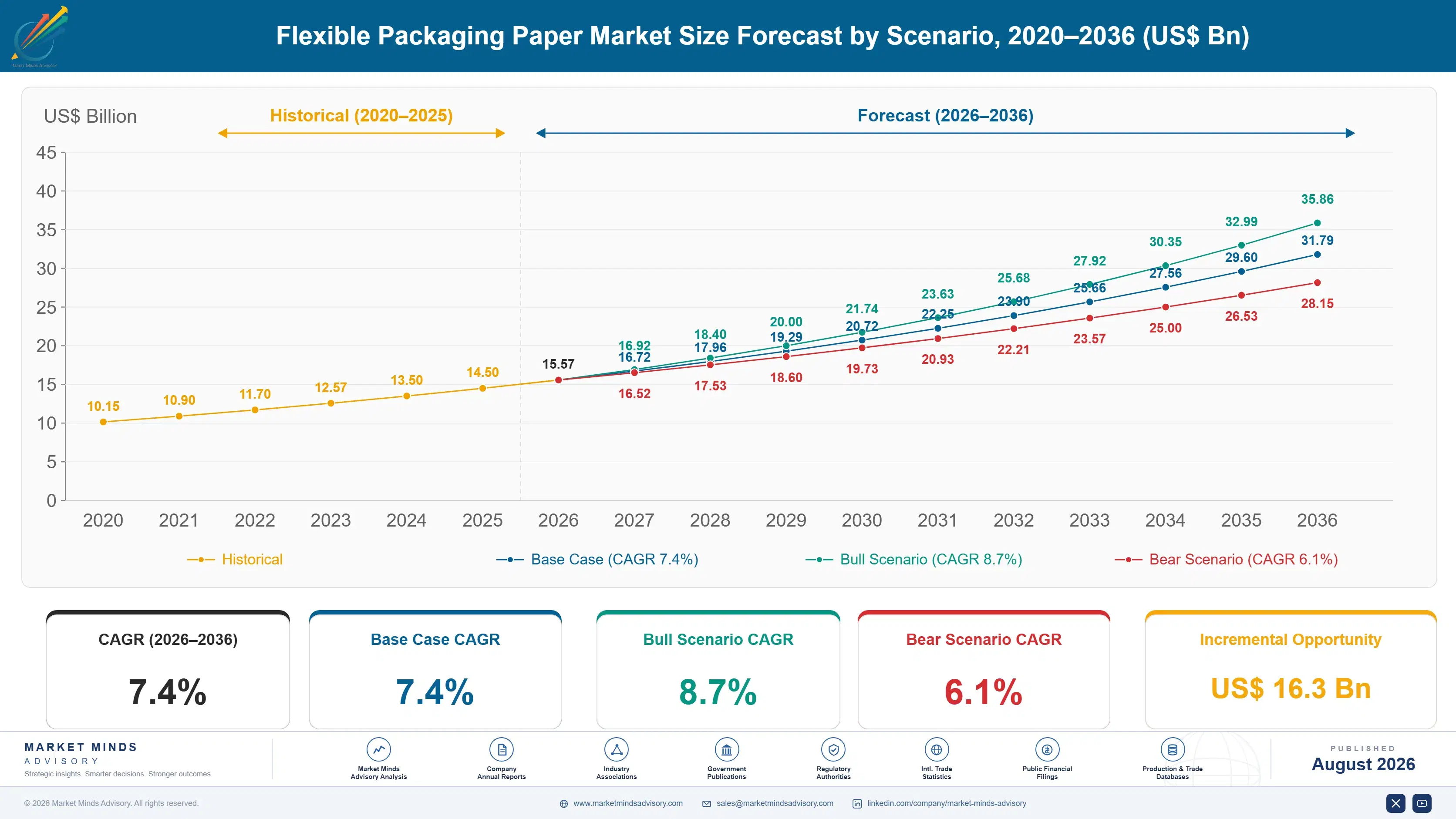
Flexible packaging paper demand grew steadily from 2020 through 2025 as the EU's single-use plastics directive and early national bans in France and Italy pushed brand owners to begin qualifying paper alternatives for pouches and wraps. Conversion accelerated only after 2022 once barrier-coating technology matured enough for food contact use, and the segment grew at roughly a 6.4 percent historical compound rate.
MMA's base case assumes 7.4 percent compound growth through 2036, anchored in three mechanisms. First, the EU's Packaging and Packaging Waste Regulation is forcing brand owners to eliminate non-recyclable plastic laminates from flexible packaging formats across member states. Second, retailer sustainability commitments from Walmart, Tesco, and Carrefour are pulling paper conversion forward even in markets without binding regulation yet. Third, barrier-coating technology improvements are widening the range of food categories that paper packaging can now serve without plastic film lamination.
A bull scenario near 8.7 percent follows if additional EU member states adopt binding plastic laminate bans ahead of the current regulatory timeline. The bear case near 6.1 percent materialises if barrier-coating costs stay elevated long enough that brand owners delay conversion projects, extending plastic film's cost advantage in price-sensitive categories longer than currently expected.

Plastic Substitution Reshapes Packaging Specification

Flexible packaging paper has moved from a niche sustainability claim into a mainstream specification requirement almost overnight, and that shift is reshaping how brand owners plan packaging redesign cycles. Formats that would have stayed on plastic film for another product generation are being converted early because retailers and regulators increasingly treat non-recyclable laminates as a delisting risk rather than a design choice left entirely to the brand. That calculus is compressing packag
MARKET CONCENTRATION42%Five suppliers hold a meaningful but not dominant combined share
AVERAGE PAPER COST$1,850/tonneReflects coated barrier grade pricing over standard kraft paper
ASIA PRODUCTION SHARE46%China and India together lead global converting capacity growth
PULP COST SHARE58%Virgin and recycled pulp inputs dominate total production cost
PLASTIC SUBSTITUTION RATE29%Share of eligible flexible formats now converted to paper
TRADE INTENSITYModerateFinished paper rolls ship regionally before final pouch conversion
Commercial activity concentrates in coated kraft paper and barrier laminates, where proprietary coating formulations and food-contact certification give the five largest suppliers durable technical advantages. Paper pouches and stand-up bag formats remain a smaller but fast-scaling category, increasingly specified directly by brand owners rather than left to converters to recommend after the fact.
The next decade will be shaped less by pulp sourcing innovation than by how fast barrier-coating technology can match plastic film's moisture and grease performance across more food categories. Suppliers that can certify a barrier coating for a new food category first capture disproportionate share of that category's conversion wave before competitors catch up.
"Nobody asks for paper packaging because it is cheaper. They ask for it because the alternative just got delisted from three major retail chains."
Director, Sustainable Packaging and Paper Materials Practice · MMA Sustainable P

Market Trends

EU Packaging Waste Regulation Forces Plastic Laminate Elimination

The European Union's Packaging and Packaging Waste Regulation sets recyclability requirements that most multi-layer plastic laminates used in flexible pouches cannot meet without redesign, pushing brand owners toward mono-material paper structures that pass recyclability testing under the new framework. Converters report that packaging redesign requests have accelerated since the regulation's implementation timeline became fixed, with some categories facing compliance deadlines within the current three-year window. Mondi and Smurfit WestRock both report that customers specify paper-based barrier solutions during initial product briefs rather than as a later-stage sustainability retrofit, a shift in how packaging decisions get made.
Market Impact: Adds 11pp to retailer-driven conversion volume
Barrier Coating Technology Widens Eligible Food Categories

Water-based and bio-based barrier coating formulations have improved enough over the past several years to match plastic film's moisture and grease resistance for an expanding range of food categories, including some frozen and high-fat products that paper packaging could not previously serve reliably. Suppliers including BillerudKorsnäs and Stora Enso have both launched next-generation coating platforms targeting these previously plastic-only categories, betting that early certification wins position them for the next wave of conversion projects. Food safety certification for new coating formulations takes considerable time, keeping the pace of category expansion gradual rather than immediate.
Market Impact: Supports a 6-9% price premium on-pack

Market Opportunities and Growth Drivers

Retailer Sustainability Mandates Push Conversion Ahead of Regulation

Major retailers including Walmart, Tesco, and Carrefour have published packaging sustainability commitments that require suppliers to eliminate non-recyclable plastic laminates from private-label and branded products, pulling paper conversion forward even in markets without binding regulation. Suppliers that fail to offer a qualified paper alternative risk losing retail shelf space rather than facing a compliance fine, which has proven a stronger commercial motivator than regulatory penalty structures. Smaller brand owners without dedicated packaging teams rely on converters like Mondi and Smurfit WestRock to manage qualification on their behalf, extending the driver's reach past the largest branded manufacturers.
Market Impact: Excludes roughly 22% of eligible SKUs

Consumer Willingness to Pay Supports Premium Paper Positioning

Consumer research consistently shows a meaningful segment of shoppers willing to pay a modest premium for visibly recyclable paper packaging over plastic film, giving brand owners a commercial justification for conversion costs beyond pure regulatory compliance. Premium food and personal care categories have moved fastest on this dynamic, since their customer base skews toward the demographic most responsive to sustainability packaging claims on pack. Mainstream and value-tier categories are converting more slowly, since price-sensitive consumers respond less strongly to the sustainability premium and brand owners face tighter cost constraints on packaging redesign investment in those segments specifically.
Market Impact: Adds 12-18% cost versus plastic film

Market Restraints and Challenges

Barrier Performance Gap Limits High-Moisture Category Conversion

Paper-based barrier coatings fall short of plastic film's moisture and oxygen barrier performance for high-fat, high-moisture, and long-shelf-life food categories, and the root cause is chemistry: bio-based coating formulations that satisfy recyclability requirements have not yet matched the barrier density that petroleum-based plastic films achieve at comparable coating weight. That performance gap keeps some categories, including certain frozen foods and long-life snacks, on plastic packaging despite brand owner willingness to convert. Suppliers including Stora Enso and BillerudKorsnäs are mitigating the gap by developing multi-layer paper-based barrier systems that combine several coating technologies, closing the performance gap category by category.
Market Impact: Adds 9pp to paper conversion volume

Higher Unit Cost Slows Value-Tier Category Adoption

Coated barrier paper costs more per unit than the plastic film it replaces, and the root cause lies in the manufacturing process: paper substrates require additional coating passes and slower line speeds than plastic film extrusion, adding cost that brand owners in price-sensitive categories struggle to absorb without passing it to consumers. That cost gap slows conversion in value-tier and private-label categories where margin is already thin, even as premium categories convert readily. Converters including Mondi are mitigating the gap by investing in faster coating line technology, though cost parity with plastic remains some years away.
Market Impact: Expands eligible categories by roughly 18%
3 additional market trends, 4 additional growth drivers, and 2 additional restraints and challenges are covered in the full report. Contact sales@marketmindsadvisory.com to access the complete intelligence.

Segment CAGR and Growth Architecture

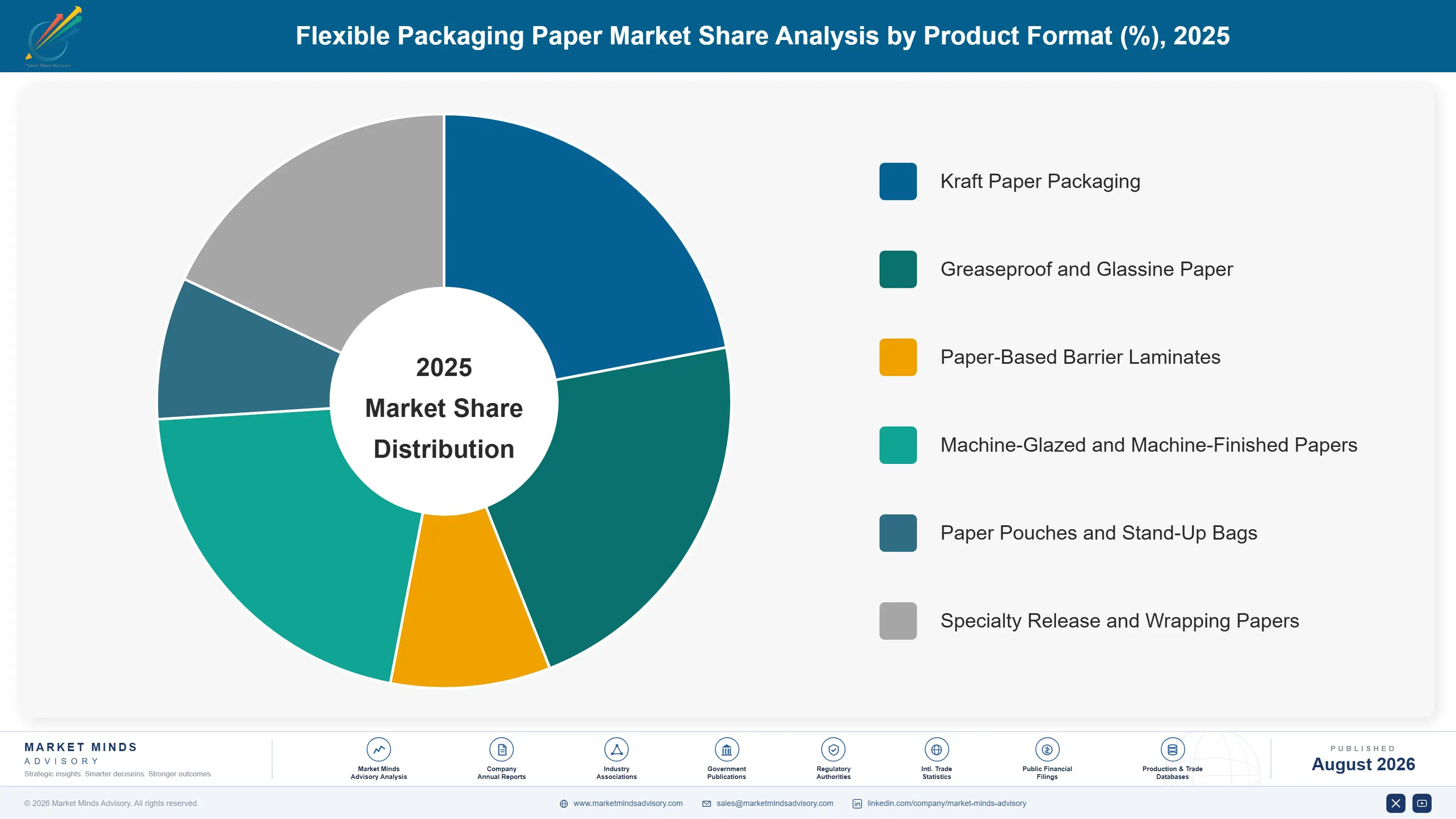
MMA segments the flexible packaging paper market by product format, the classification converters and brand owners actually specify and qualify against, rather than by end application or barrier technology alone. Six formats cover the addressable market, each with distinct coating requirements, converting processes, and food-contact certification pathways across food, industrial, and consumer packaging categories.
flexible-packaging-paper-market-market-share-analysis-1787300017749

Paper-Based Barrier Laminates

Paper-based barrier laminates, which combine kraft paper substrates with water-based or bio-based coatings to replace plastic film layers, are growing fastest because they address the recyclability requirements that plastic-laminated pouches cannot meet under the EU's Packaging and Packaging Waste Regulation. Stora Enso and BillerudKorsnäs both dominate this segment given their coating research investment and the food-contact certification track record that newer entrants find difficult to replicate. Certification timelines for new coating formulations remain a bottleneck, since food safety authorities require testing before approving a coating for direct food contact use. Growth here is expected to broaden as coating technology matures enough to serve high-moisture and high-fat categories that remain plastic-dependent today, expanding the segment's addressable base beyond its current footprint.
CAGR 9.6%

Paper Pouches and Stand-Up Bags

Paper pouches and stand-up bags are the second-fastest-growing format as brand owners increasingly specify paper structures directly during product development rather than defaulting to flexible plastic pouches and converting later. Mondi and Smurfit WestRock have both expanded dedicated pouch-converting capacity to meet this direct-specification demand, recognising that early involvement in product development captures more design and margin than retrofitting an existing plastic format afterward. Smaller regional converters without pouch-specific tooling face growing pressure to invest or cede this format to larger competitors with established capacity. Growth here tracks closely with how fast brand owners redesign core product lines rather than with overall packaging volume growth alone. This shift is pulling capacity investment toward pouch-specific tooling.
CAGR 8.8%
Full segment breakdown across 6 segments available in the complete report.

Regional Architecture and Country Demand Map

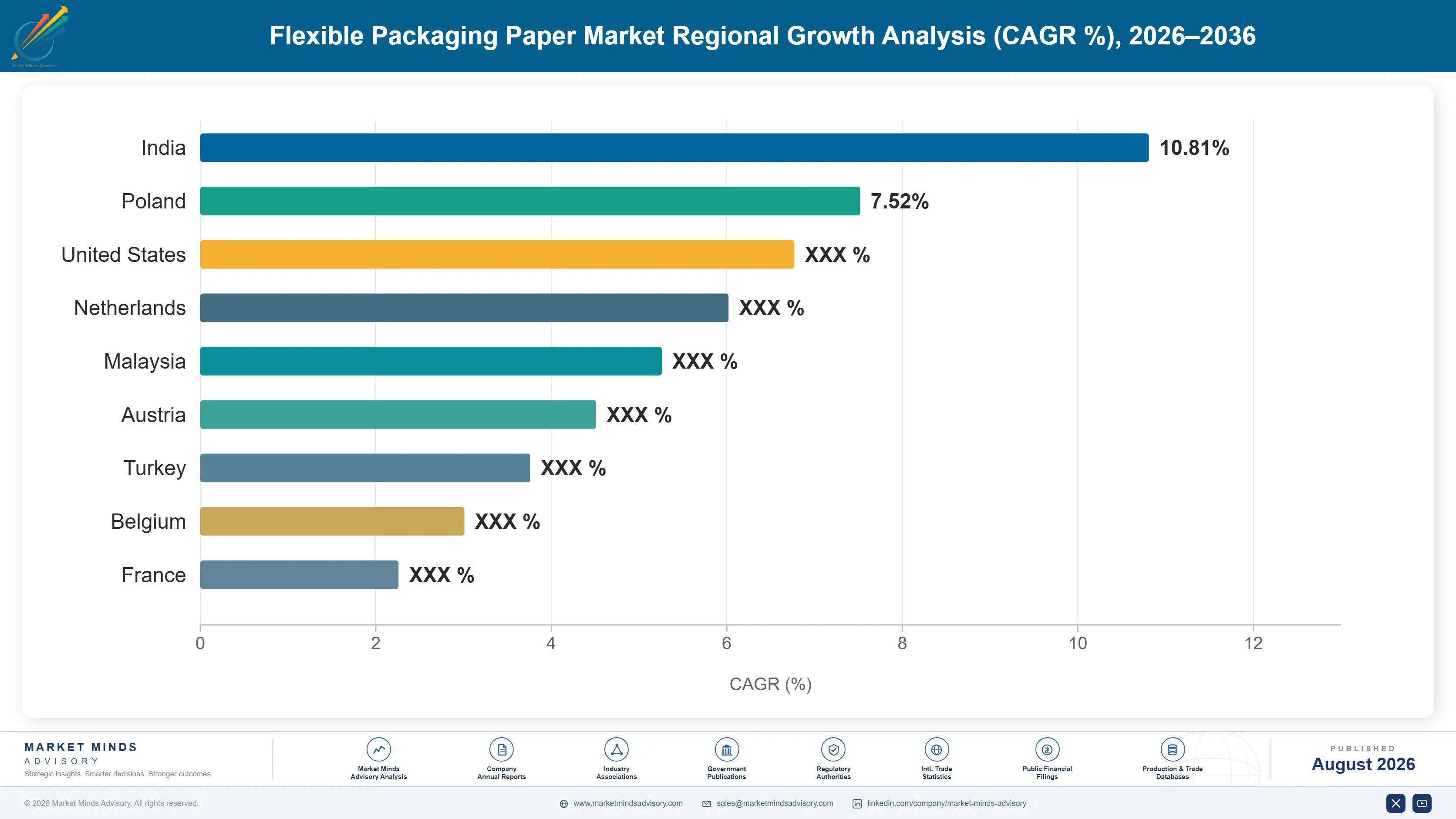
East Asia leads flexible packaging paper demand as China and India's food and consumer goods volumes outpace the rest of the world combined, while Western Europe retains the deepest regulatory pressure and barrier-coating technology base. South Asia and Pacific is scaling fastest behind India's rapid FMCG packaging growth.

North America

The United States' major food and consumer packaged goods brands are converting flexible pouches to paper formats behind retailer sustainability commitments from Walmart and Target, even though binding federal plastic packaging regulation remains less developed than the EU's framework. International Paper and Georgia-Pacific both maintain substantial domestic converting capacity, giving North American brand owners faster access to qualification support than importing paper structures from overseas suppliers would allow. Canadian provincial extended producer responsibility programmes are adding a second regulatory pressure layer distinct from the US federal approach, while Mexican manufacturing nearshoring is gradually building demand for paper packaging tied to expanding consumer goods production serving the US market from newly established facilities.
Share: 22% | CAGR: 7.4% (2026 to 2036)

Western Europe

Germany and France anchor Western European demand, both having implemented national plastic packaging restrictions ahead of the EU's broader Packaging and Packaging Waste Regulation timeline, giving Mondi and BillerudKorsnäs's European converting operations a head start on qualification work other regions are only beginning. The UK's extended producer responsibility scheme adds packaging-weight-based fees that specifically favour lighter paper structures over plastic film, accelerating conversion economics beyond what recyclability requirements alone would drive. The Nordic region's paper mill base, anchored by Stora Enso and BillerudKorsnäs's home operations, gives Nordic brand owners the shortest supply chain and fastest access to new coating technology as it becomes commercially available. Belgium's specialty converting sector, small in scale, exports coating know-how to larger neighbouring producers.
Share: 24% | CAGR: 5.9% (2026 to 2036)
Regional intelligence for 5 additional markets available in the complete report: East Asia, South Asia and Pacific, Latin America, Middle East and Africa, Eastern Europe. Contact sales@marketmindsadvisory.com.
flexible-packaging-paper-market-country-cagr-analysis-1787300018265

Certification Speed and Barrier Coating Premiums

Suppliers extract value less through paper tonnage pricing than through certification speed for new barrier coatings, involvement in brand owners' product development process, and capturing premium categories ahead of competitors qualifying formulations. The levers below describe how each part of the value chain captures its share of the plastic substitution wave underway across food and consumer packaging.

Fast Certification Captures First-Mover Category Share

Suppliers that certify a new barrier coating formulation for a specific food category fastest capture a disproportionate share of that category's conversion wave, since brand owners rarely re-qualify a working paper structure once committed to a supplier's certified formulation. Stora Enso and BillerudKorsnäs both report that categories where they achieved first certification carry higher win rates in subsequent competitive bids, roughly 35 percent higher than categories where they certified second or later. This first-mover dynamic makes certification speed a strategic priority rather than a technical milestone, pulling research investment toward the food categories with the largest remaining plastic-packaged volume.
Market Impact: Wins roughly 35% higher category win rates overall

Direct Product Development Involvement Locks In Supply

Converters that embed technical teams into brand owners' product development process, rather than waiting for a finished packaging specification to bid against, capture more design influence and a higher share of the resulting supply contract. Mondi and Smurfit WestRock have both expanded dedicated technical account teams to support this earlier engagement model, recognising that packaging specifications set during development are harder for competitors to dislodge later. This approach requires more upfront technical investment than reactive bidding, but suppliers report that development-stage relationships convert to supply contracts at a rate roughly 40 percent higher than competitive tenders.
Market Impact: Converts at a 40% higher rate than open tenders

Premium Category Positioning Commands Durable Price Advantage

Suppliers positioned in premium food and personal care categories, where consumer willingness to pay for visible sustainability claims is strongest, command 15 to 20 percent higher per-tonne pricing than suppliers competing purely in value-tier and private-label categories. BillerudKorsnäs and Mondi have both prioritised premium category relationships because pricing power there proves durable across multiple contract renewal cycles, unlike value-tier categories where price competition remains intense regardless of sustainability positioning. This category selection strategy increasingly determines supplier profitability more than raw manufacturing efficiency does, rewarding suppliers that build category-specific brand relationships over those competing purely on cost.
Market Impact: Commands a 15-20% price premium in premium categories

Retailer Compliance Deadlines Create Urgent Switching Windows

Suppliers positioned to support brand owners facing imminent retailer delisting deadlines for non-compliant plastic packaging capture urgent, less price-sensitive conversion projects that carry meaningfully better terms than routine competitive bidding cycles. Converters including International Paper and Smurfit WestRock have both built rapid-response qualification teams specifically to serve brand owners under compliance time pressure, recognising that speed matters more than price in these urgent switching situations. Brand owners facing a hard retailer deadline typically pay a premium of roughly 10 to 15 percent above standard project pricing in exchange for accelerated qualification and guaranteed capacity allocation ahead of the deadline.
Market Impact: Commands a 10-15% premium on urgent compliance projects

Who Controls the Margin Pool

Five suppliers, Mondi, Smurfit WestRock, International Paper, Stora Enso, and BillerudKorsnäs, hold roughly 42 percent of global flexible packaging paper revenue, a concentration built on decades of paper mill capacity and coating investment. The gap to challengers like Sappi and Nordic Paper narrows in specialty formats, particularly glassine and release papers, where mill scale matters less than in kraft and barrier laminate production.
Current competitive activity centres on three fronts: racing to certify new barrier coating formulations for previously plastic-only food categories, embedding technical teams into brand owners' product development processes to capture supply before formal bidding begins, and expanding pouch-converting capacity to meet direct-specification demand. Suppliers are investing in faster coating line technology to narrow the cost gap between paper and plastic film in value-tier categories.

Emerging pressure comes from regional Asian converters expanding coating capacity to serve domestic FMCG demand, competing on speed and cost for standard kraft formats rather than premium barrier laminates. Rankings are most likely to shift in barrier laminates, where certification track record rather than raw mill capacity determines competitive position, leaving room for suppliers that move fastest on food-contact approval to gain share from slower-moving incumbents.
flexible-packaging-paper-market-company-positioning-matrix-1787300018786

Competitive Moat and Risk Dimensions

MONDI GROUP

Moat: Deep Barrier Coating Certification Portfolio

Mondi has certified barrier coating formulations across more food categories than most rivals, giving brand owners a broader menu of pre-approved paper structures to choose from without commissioning new certification work. That accumulated certification portfolio, built over years of dedicated R&D investment, is difficult for newer entrants to replicate quickly across a comparable category range.
MONDI GROUP

Risk: Cost Disadvantage Versus Regional Rivals

Mondi's European manufacturing footprint carries higher energy and labour costs than regional Asian converters now qualifying comparable kraft paper capacity, leaving Mondi more exposed to cost-based competition in standard, less differentiated formats. If Asian converters keep closing the quality gap in commodity kraft paper, Mondi's cost disadvantage could narrow its addressable share in that specific segment.
STORA ENSO

Moat: Integrated Nordic Pulp Base

Stora Enso's ownership of Nordic pulp and paper mills gives it direct control over raw material costs and coating line capacity that converters without integrated pulp sourcing cannot match, providing a durable cost and supply-security advantage during periods of pulp price volatility. That integration is difficult and capital-intensive for pure converters to replicate at comparable scale.
STORA ENSO

Risk: Slower Expansion Into Asian Markets

Stora Enso has expanded more cautiously into Asian converting capacity than some competitors, leaving it comparatively less positioned to capture the region's fastest-growing FMCG packaging demand. Competitors with earlier Asian manufacturing investment are capturing share in a region increasingly central to global category growth. Closing that gap will require faster overseas investment than Stora Enso has historically pursued.

Players Tracked

Prominent Players

Mondi Group
Smurfit WestRock
International Paper
Stora Enso
BillerudKorsnäs

Other Key Players

Sappi
Nordic Paper
Ahlstrom
Delfort Group
Schoeller Technocell
Metsä Board
UPM-Kymmene
Georgia-Pacific
Sonoco Products
Huhtamaki
ProAmpac
Amcor
Mayr-Melnhof Karton
Segezha Group
Glatfelter

Recent Developments

MARCH 2026

Mondi Launches New Barrier Coating Platform for Frozen Food

Mondi launched a next-generation barrier coating platform specifically certified for frozen food applications in March 2026, extending paper packaging into a category that had previously remained largely plastic-dependent due to moisture barrier requirements. The launch followed several years of dedicated coating research targeting the frozen food segment's demanding performance specifications.
Signal: Confirms that barrier coating innovation is steadily closing the performance gap with plastic film across categories.
OCTOBER 2025

Stora Enso and Major European Retailer Sign Packaging Supply Agreement

Stora Enso signed a multi-year supply agreement with a major European retailer in October 2025, committing to convert the retailer's private-label flexible packaging portfolio to paper-based structures ahead of the EU's Packaging and Packaging Waste Regulation compliance deadline. It represents one of the largest retailer conversion commitments recorded.
Signal: Signals that major retailers are increasingly locking in supply relationships years ahead of binding compliance deadlines.
JULY 2025

Smurfit WestRock Expands Pouch-Converting Capacity in Poland

Smurfit WestRock commissioned expanded pouch-converting capacity at its Polish facility in July 2025, adding dedicated production lines for paper-based stand-up pouches serving Central and Eastern European FMCG customers. The expansion positions Smurfit WestRock to capture growing direct-specification demand from brand owners entering the regional market.
Signal: Marks continued investment in pouch-specific capacity as demand keeps shifting from raw paper toward finished converted formats.

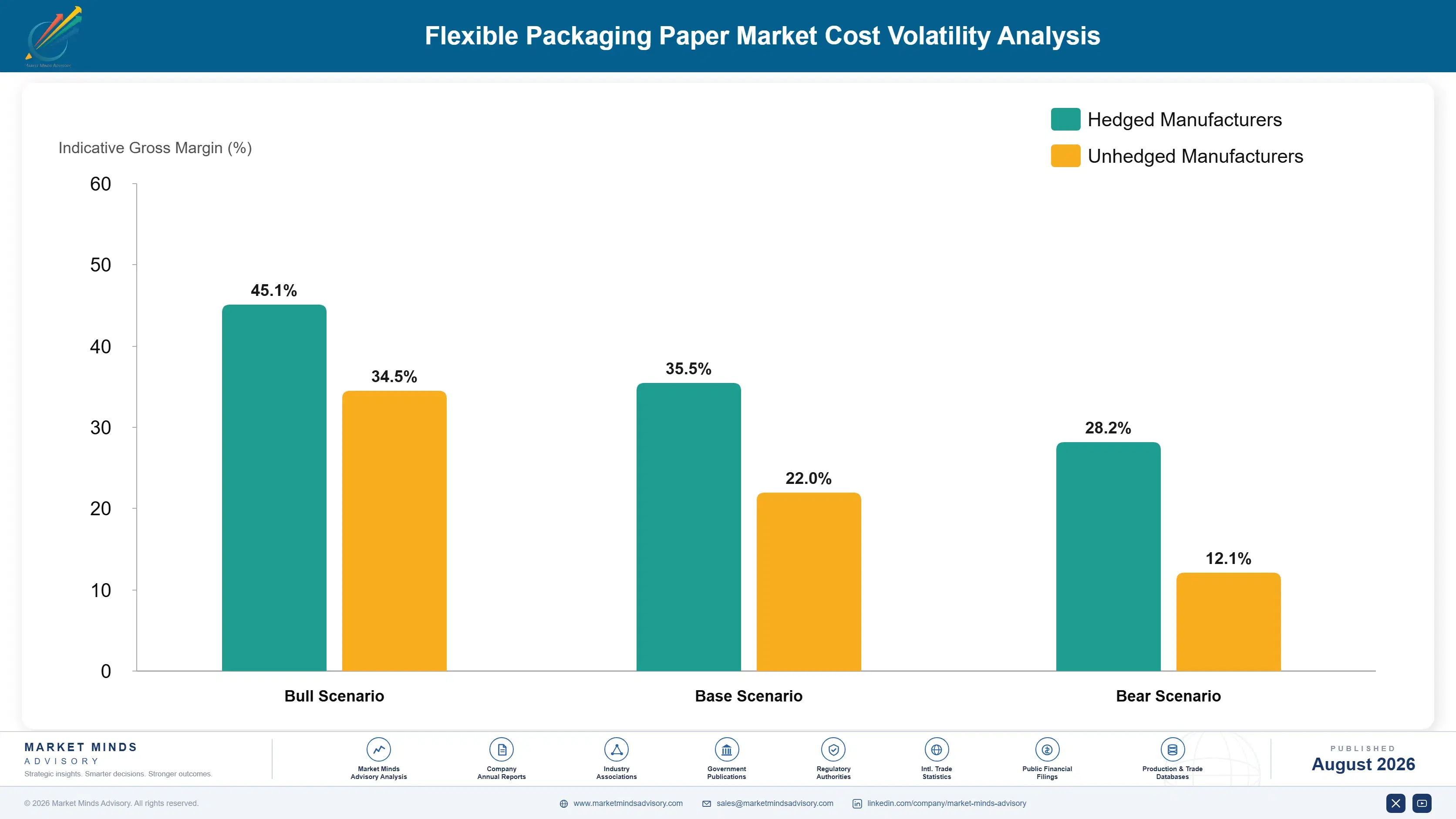
Pulp and Energy Cost Exposure

Virgin and recycled pulp represents the single largest cost input for flexible packaging paper, accounting for roughly 44 percent of finished paper cost, sourced from a global pulp market concentrated in Brazil, Scandinavia, and North America. Energy costs for paper mill operations and coating line drying add meaningful secondary exposure, particularly for European converters facing higher industrial energy prices than North American or Asian competitors.
European natural gas prices spiked following the 2022 disruption to Russian pipeline supply, and Mondi's fiscal year 2022 annual report cited elevated energy costs as a direct constraint on paper mill margins across its European operations. Converters responded by accelerating investment in energy efficiency upgrades and, in some cases, alternative fuel sources for mill operations, reducing exposure to natural gas price volatility that had represented a meaningful and unhedged cost risk.

Vertically integrated suppliers with their own pulp mills, including Stora Enso and International Paper, absorb pulp price volatility more predictably than converters who purchase market pulp at spot prices during periods of tight availability. That gap gives integrated suppliers a durable cost-stability advantage over smaller specialty converters, particularly during the pulp price cycles that periodically squeeze margins across the broader paper packaging industry.
flexible-packaging-paper-market-cost-volatility-analysis-1787300018980

Energy Efficiency Investment Across Mill Operations

Leading suppliers are investing in energy efficiency upgrades and alternative fuel sources for paper mill and coating line operations, reducing exposure to natural gas price volatility that disrupted European margins following the 2022 supply shock. This investment carries meaningful upfront capital cost but reduces long-term exposure to energy price spikes that periodically squeeze converter margins across the industry.

Long-Term Pulp Supply Agreements With Producers

Larger converters are signing multi-year pulp supply agreements directly with producers in Brazil and Scandinavia to lock in volume and pricing ahead of market cycles, trading some flexibility for supply certainty. Smaller converters without comparable purchasing scale remain more exposed to spot market pulp price volatility, reinforcing the cost advantage of the largest suppliers.

Vertical Integration Into Pulp Production Capacity

Some suppliers are acquiring or expanding their own pulp production capacity to reduce reliance on market pulp purchases entirely, converting a variable cost exposure into a more predictable internal supply chain. This integration strategy requires significant capital investment but has historically proven most valuable during periods of pulp price volatility that squeeze non-integrated competitors' margins hardest.

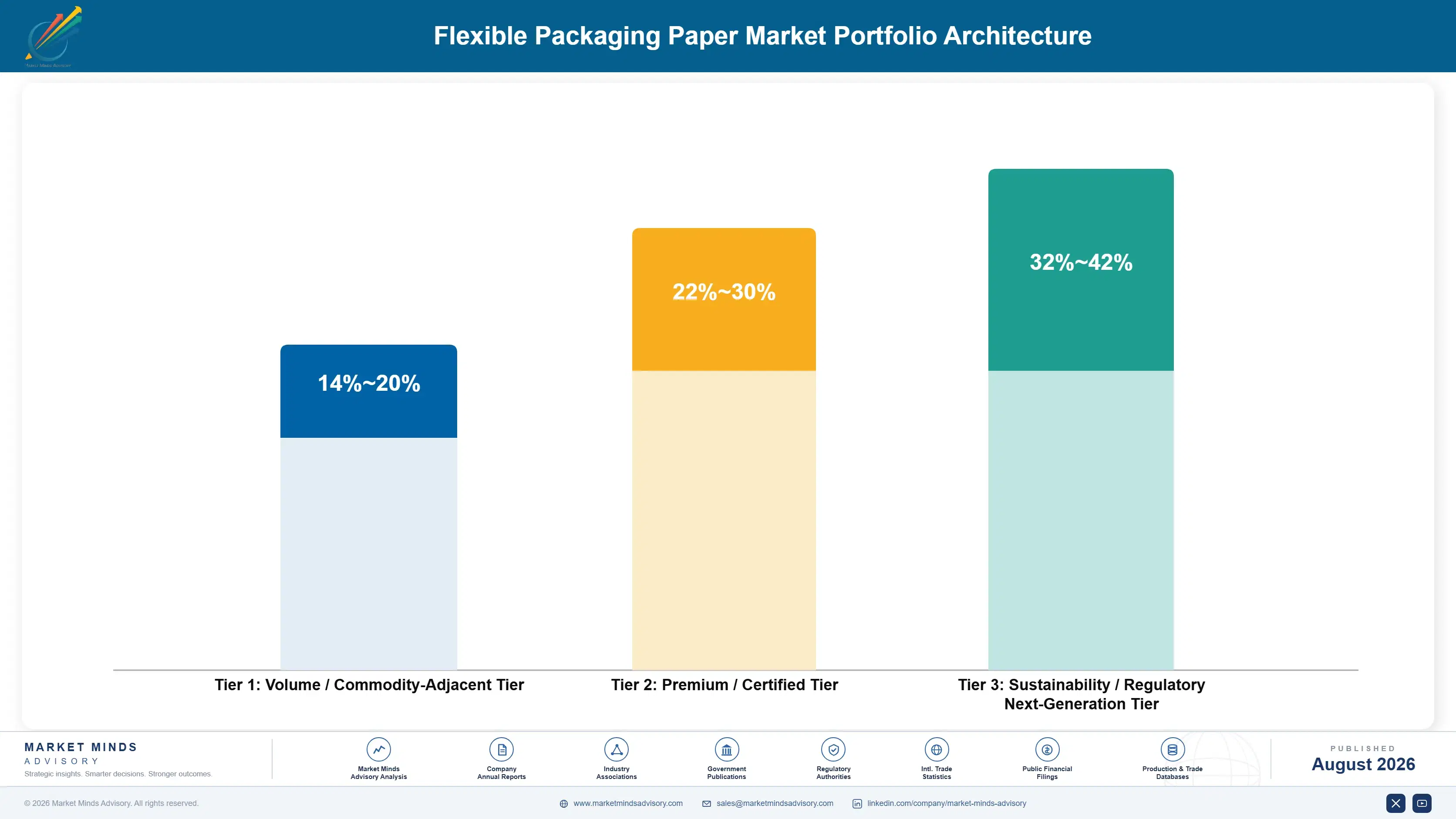
Portfolio Architecture for Margin Defence

Flexible packaging paper suppliers operate across three margin tiers built around coating complexity and certification depth rather than tonnage volume. Commodity-adjacent standard kraft paper sits at the volume base, coated barrier laminates and certified specialty formats occupy the middle at firmer margins, and next-generation bio-based barrier systems and premium category-specific formulations sit at the top, commanding premium pricing that few standard kraft producers can match. Most establ
The volume-premium tension plays out most visibly in how suppliers allocate scarce coating line capacity: every hour spent coating standard kraft paper is an hour not spent on higher-margin barrier laminate production, so suppliers increasingly prioritise premium formats even when it means ceding standard kraft volume to regional competitors willing to compete purely on price.

High-value margin pools concentrate in certified barrier laminates for previously plastic-only categories and in premium category-specific formulations carrying strong consumer sustainability appeal, both of which command pricing closer to specialty coating economics than to commodity paper manufacturing. Suppliers that can move a customer from standard kraft supply into a certified barrier laminate relationship capture meaningfully more of total account value.

Volume / Commodity-Adjacent Tier

Standard kraft paper and uncoated formats sold at scale into routine flexible packaging applications, priced close to established paper manufacturing benchmarks with limited technical differentiation. This tier competes mainly on mill efficiency and delivered price.
Gross Margin: 14-20%

Premium / Certified Tier

Coated barrier laminates and certified specialty formats requiring food-contact approval and proven performance guarantees, commanding a defensible premium given the certification investment behind each qualified formulation. Buyers weigh certification track record heavily.
Gross Margin: 22-30%

Sustainability / Regulatory / Next-Generation Tier

Next-generation bio-based barrier systems and premium category-specific formulations carrying the deepest research investment and technical support, sold primarily into brand owners' highest-visibility sustainability-focused product lines. Pricing power here remains strong.
Gross Margin: 32-42%
flexible-packaging-paper-market-portfolio-architecture-1787300019475

High-value Sub-segments and Strategic Watch-out

Bio-Based High-Barrier Coating Systems

Bio-based barrier coating systems carry the category's highest margins and fastest growth, driven by brand owners seeking fully compostable packaging structures that go beyond standard recyclability requirements toward genuinely plastic-free positioning across premium food and personal care categories. Early movers here are capturing outsized brand launch share.
Gross Margin: 32-42%

Certified Food-Contact Barrier Laminates

Certified barrier laminates carry strong margins and steady growth, anchored in multi-year supply relationships that renew predictably as brand owners expand certified formats across additional product lines within their existing portfolio. Suppliers with the deepest certification libraries renew these relationships almost automatically each contract cycle.
Gross Margin: 26-34%

Standard Kraft Paper Formats

Standard uncoated kraft paper remains the category's volume anchor, growing steadily with overall packaging output but carrying commodity-level margins that make it a scale rather than profit driver for most established suppliers. Suppliers defend this tier mainly to preserve scale and distribution reach rather than margin.
Gross Margin: 14-20%

Asian Regional Converting Capacity

Regional Asian converters expanding kraft paper capacity represent a long-term competitive threat to established suppliers' pricing power, particularly as domestic FMCG brand owners increasingly favour lower-cost regional suppliers over premium European incumbents. European suppliers slow to respond risk ceding meaningful volume to lower-cost regional entrants.
Gross Margin: 16-24%

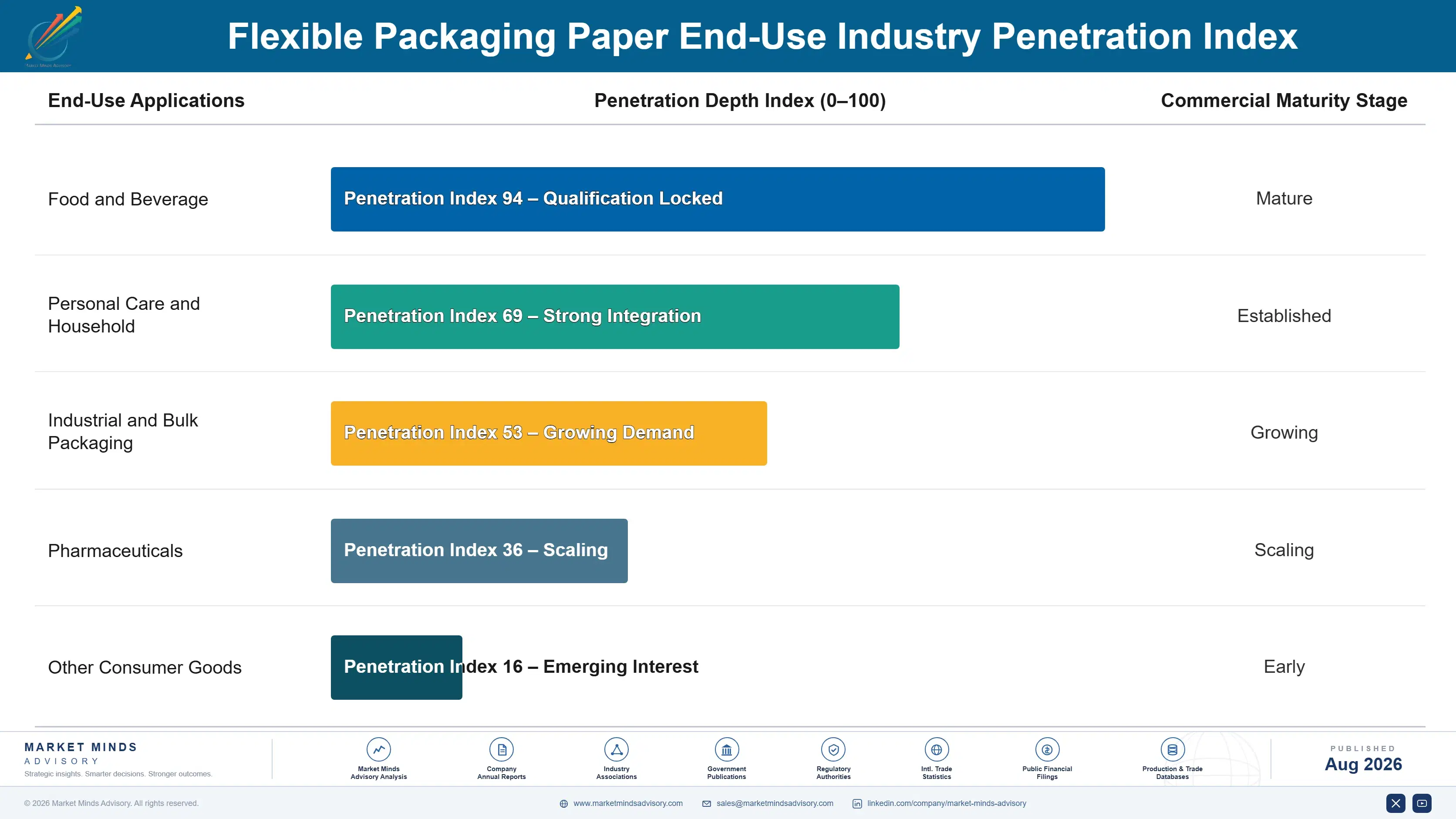
From Compliance Retrofit to Design Default

Flexible packaging paper purchasing is shifting from a compliance-driven retrofit decision toward a design-stage default that resembles an ongoing product development partnership more than a series of one-time packaging redesign transactions. Suppliers that embed technical teams into brand owners' product development process lock in specification influence early, while brand owners increasingly treat paper as the starting assumption for new product packaging rather than an alternative considered
Adoption depth varies sharply by product category. Premium food and personal care brands show the deepest reliance on paper packaging, since their customer base responds most strongly to visible sustainability positioning on pack. Value-tier and private-label categories show shallower, more cost-driven adoption, converting primarily when regulation or retailer delisting deadlines force the decision rather than proactively ahead of any binding requirement.

A generational shift among brand packaging teams is reinforcing the trend. Younger packaging engineers trained during the recent plastic substitution wave treat paper-first design as standard practice, while veteran teams accustomed to plastic-default specification are adapting more slowly, occasionally delaying paper conversion until forced by a retailer deadline or regulatory requirement. That generational gap is narrowing gradually as sustainability training becomes standard across packaging engineering programmes.
flexible-packaging-paper-market-end-use-penetration-index-1787300019963

Where MMA Sees the Real Opportunity

These are among the four positions where our research anticipates prominent divergence between winners and laggards over the coming forecast period. Each is grounded in the demand model, the regulatory perimeter, and the announced capacity pipeline.
01 / CERTIFICATION SPEED PRIORITY

Race to certify barrier coatings for high-value categories first

Suppliers that certify barrier coating formulations for previously plastic-only food categories fastest capture a disproportionate share of that category's entire conversion wave, since brand owners rarely re-qualify a working paper structure once committed. This positioning matters more than competing purely on paper tonnage pricing, since certification track record, not mill capacity, increasingly determines which supplier wins premium category contracts. MMA recommends prioritising certification investment in high-value, currently plastic-dependent categories over incremental standard kraft capacity expansion in the current three-year window.
02 / PRODUCT DEVELOPMENT INTEGRATION

Embed technical teams into brand owners' development process

Converters that embed technical teams directly into brand owners' product development process, rather than waiting to bid against a finished specification, are converting development-stage relationships to supply contracts at meaningfully higher rates than competitive tenders achieve across nearly every category. Suppliers still relying on traditional reactive bidding are ceding this earlier-engagement advantage to competitors already restructuring their entire commercial teams around the model. MMA views development-stage engagement capability as the highest-return near-term investment available within the category over the next three years.
03 / ASIAN CAPACITY INVESTMENT

Build converting capacity in China and India now

China and India together generate more flexible packaging paper demand than any other region, and suppliers without meaningful Asian converting capacity face a genuinely difficult path to capturing this volume regardless of European certification leadership or brand relationships. Regional Asian converters are closing the quality gap in standard kraft paper faster than expected, narrowing the window for established suppliers to establish a durable regional position. MMA recommends prioritising Asian capacity investment ahead of competitors still weighing whether the region merits dedicated manufacturing commitment.
04 / PREMIUM CATEGORY FOCUS

Prioritise premium categories over value-tier price competition

Premium food and personal care categories support meaningfully higher and more durable pricing than value-tier and private-label categories, where price competition remains intense regardless of sustainability positioning or certification quality. Suppliers spread thin across both premium and value-tier categories consistently capture less total margin than suppliers that concentrate capacity and technical investment on premium relationships specifically. MMA recommends deliberately deprioritising value-tier volume growth in favour of premium category depth wherever capacity constraints force suppliers to choose meaningfully between the two paths forward.

Engagement Snapshot From the Field

A live engagement with an industry participant carrying material or product regulatory and market exposure ahead of a defining policy shift, showing how our research translates into a defensible multi-year portfolio strategy.
MARKET MINDS ADVISORY · CLIENT ENGAGEMENT SUMMARY
Flexible Packaging Paper Producer Strategic Portfolio Review and Transition Roadmap 2026·Investment Scenario on Flexible Packaging Paper Exposure Evaluation 2025-26
CLIENT PROFILE
The client is a multinational food and snack brand operating across fifteen European markets, selling several flagship product lines still packaged in multi-layer plastic laminate pouches facing upcoming EU recyclability compliance deadlines. The company reported annual packaging spend in the low hundreds of millions of dollars (client-reported, unverified by MMA) and had not yet identified a qualified paper-based alternative for its highest-volume product lines.
STRATEGIC CHALLENGE
The client faced compliance deadlines across multiple product lines simultaneously, but its highest-volume products required barrier performance that available paper structures had not yet been certified to deliver reliably at scale. Management needed a prioritisation and supplier qualification strategy that protected compliance timelines without compromising product freshness or shelf-life performance across its most commercially important lines.
MMA APPROACH
MMA's engagement team benchmarked available barrier coating technologies against the client's freshness and shelf-life requirements, interviewed paper suppliers to assess certification timelines, and modelled conversion cost and risk across three qualification scenarios. The team recommended a qualification strategy that prioritised the client's highest-volume, lowest-barrier-complexity product lines first while allocating technical resources to co-develop coating solutions for its demanding remaining lines.
KEY FINDINGS
  1. Two of the client's five priority product lines had a fully qualified paper alternative already available (client-reported, unverified by MMA), while the remaining three required dedicated coating development work.
  2. Suppliers offering direct co-development support delivered meaningfully faster qualification timelines, reducing the client's total time to compliant packaging by several extra months.
  3. Consumer testing showed no significant preference difference between paper and plastic packaging for products where barrier performance remained visually and functionally comparable to shoppers.
  4. Early supplier engagement during the qualification process reduced total conversion cost compared with the client's historical practice of finalising specifications before requesting supplier bids.
CLIENT PROFILE
The client is a multinational food and snack brand operating across fifteen European markets, selling several flagship product lines still packaged in multi-layer plastic laminate pouches facing upcoming EU recyclability compliance deadlines. The company reported annual packaging spend in the low hundreds of millions of dollars (client-reported, unverified by MMA) and had not yet identified a qualified paper-based alternative for its highest-volume product lines.
STRATEGIC CHALLENGE
The client faced compliance deadlines across multiple product lines simultaneously, but its highest-volume products required barrier performance that available paper structures had not yet been certified to deliver reliably at scale. Management needed a prioritisation and supplier qualification strategy that protected compliance timelines without compromising product freshness or shelf-life performance across its most commercially important lines.
MMA APPROACH
MMA's engagement team benchmarked available barrier coating technologies against the client's freshness and shelf-life requirements, interviewed paper suppliers to assess certification timelines, and modelled conversion cost and risk across three qualification scenarios. The team recommended a qualification strategy that prioritised the client's highest-volume, lowest-barrier-complexity product lines first while allocating technical resources to co-develop coating solutions for its demanding remaining lines.
KEY FINDINGS
  1. Two of the client's five priority product lines had a fully qualified paper alternative already available (client-reported, unverified by MMA), while the remaining three required dedicated coating development work.
  2. Suppliers offering direct co-development support delivered meaningfully faster qualification timelines, reducing the client's total time to compliant packaging by several extra months.
  3. Consumer testing showed no significant preference difference between paper and plastic packaging for products where barrier performance remained visually and functionally comparable to shoppers.
  4. Early supplier engagement during the qualification process reduced total conversion cost compared with the client's historical practice of finalising specifications before requesting supplier bids.
RECOMMENDED STRATEGY
Phase 1: Phase 1 (Months 1 to 5): Convert the two already-qualified product lines immediately, securing early compliance wins and supplier relationship depth. Phase 2: Phase 2 (Months 6 to 14): Co-develop barrier coating solutions for the three remaining lines with priority suppliers, sequencing by compliance deadline urgency. Phase 3: Phase 3 (Months 15 to 20): Complete qualification and rollout for the final product lines, consolidating supplier relationships across the full portfolio.
OUTCOME
Following the engagement, the client reported completing compliance conversion for all five priority product lines within its regulatory deadline window while avoiding the freshness performance issues it had feared (client-reported, unverified by MMA). The co-development approach reduced conversion cost relative to the client's budget and established supplier relationships the client has extended to additional product lines.

Frequently Asked Questions

Foundational context covering the market sizes, CAGR, scope, country, region and competition that inform every finding below. This section is provided to cover basics and most often pre-purchase conversations, answered from the MMA Primary Research Dataset.

What is the current size of the Flexible Packaging Paper Market?

The global flexible packaging paper market reached approximately $15.6 billion in 2026. Demand is concentrated in barrier laminate conversion driven by EU plastic packaging regulation and retailer sustainability mandates.

How large will the Flexible Packaging Paper Market be by 2036?

MMA projects the market will reach approximately $31.9 billion by 2036. That represents more than a doubling of 2026 revenue across the ten-year forecast period.

What is the CAGR for the Flexible Packaging Paper Market 2026 to 2036?

The base case compound annual growth rate is 7.4 percent. Bull and bear scenarios range from roughly 6.1 percent to 8.7 percent depending on regulatory and technology developments.

Which segment is growing fastest?

Paper-based barrier laminates are growing fastest, at roughly 1.3 times the overall market rate. EU recyclability regulation and retailer sustainability mandates are the primary drivers behind that outperformance.

Who are the major companies in the Flexible Packaging Paper Market?

Mondi Group, Smurfit WestRock, International Paper, Stora Enso, and BillerudKorsnäs lead the market. Together they hold roughly 42 percent of global flexible packaging paper revenue.

Which country is growing fastest?

India is the fastest-growing major market, driven by rapid FMCG packaging growth and both domestic and export-linked plastic restrictions. Its flexible packaging paper demand is expanding at roughly 10.4 percent annually.

Report Segmentation Architecture

The full report scope spans multiple orthogonal segmentation dimensions, with cross-tabulated demand data provided for each dimension pair. Coverage extends further to regional breakdowns, trend trajectories, and the competitive detail needed to support segment-level decision-making.

By Product Format

  • Kraft Paper Packaging
  • Greaseproof and Glassine Paper
  • Paper-Based Barrier Laminates
  • Machine-Glazed and Machine-Finished Papers
  • Paper Pouches and Stand-Up Bags
  • Specialty Release and Wrapping Papers

By End-Use Industry

  • Food and Beverage
  • Personal Care and Household
  • Industrial and Bulk Packaging
  • Pharmaceuticals
  • Other Consumer Goods

By Commercial Dimension

  • Raw Paper Supply
  • Converted Pouch and Bag Formats
  • Co-Development and Certification Services
  • Private-Label and Brand-Direct Contracts

By Region

  • North America
  • Western Europe
  • East Asia
  • South Asia and Pacific
  • Latin America
  • Middle East and Africa
  • Eastern Europe

Scope, Methodology, and Coverage

Every figure in this report is reproducible from documented input assumptions. The scope below maps the historical period, the forecast horizon, the segmentation dimensions, and the countries covered, alongside the underlying primary and qualitative methodology.
Historical Period
2020 to 2025
Forecast Period
2026 to 2036
Base Year
2025 (USD billions; MMA Primary Research Dataset, August 2026)
Market Definition
The flexible packaging paper market covers kraft paper, greaseproof and glassine paper, machine-glazed paper, and coated barrier laminate formats used in food, industrial, and consumer flexible packaging applications. It excludes rigid paperboard cartons, corrugated shipping containers, and plastic film packaging that has not been substituted with a paper-based structure.
Quantitative Units
USD billions (current prices); metric tonnes of finished paper output where applicable
Segmentation Dimensions
By Product Format; By End-Use Industry; By Commercial Dimension; By Region
Regions Covered
North America, Western Europe, East Asia, South Asia and Pacific, Latin America, Middle East and Africa, Eastern Europe
Countries Covered
USA, China, Germany, France, UK, Japan, South Korea, India, Australia, Canada, Brazil, Mexico, Indonesia, Vietnam, Thailand, Malaysia, UAE, Saudi Arabia, South Africa, Nigeria, Turkey, Poland, Netherlands, Italy, Spain, Sweden, Switzerland, Argentina, Colombia, Singapore, and additional markets relevant to this sector
Key Companies Profiled
Mondi Group, Smurfit WestRock, International Paper, Stora Enso, BillerudKorsnäs, Sappi, Nordic Paper, Ahlstrom, Delfort Group, Schoeller Technocell, Metsä Board, UPM-Kymmene, Georgia-Pacific, Sonoco Products, Huhtamaki, ProAmpac, Amcor, Mayr-Melnhof Karton, Segezha Group, Glatfelter
Quantitative Methodology
Primary survey, n=3,800 respondents, Q4 2025, six countries; demand-side model with trade association cross-validation
Qualitative Methodology
47 expert interviews, Q4 2025; applied to validate demand model assumptions, identify emerging dynamics, and assess competitive positioning
Report Format
PDF and XLSX data workbook (Word format preview document)
Publisher
Market Minds Advisory
Report Code
MMA-2026-PAC-108
Published
August 2026
Contact
sales@marketmindsadvisory.com | www.marketmindsadvisory.com

Purchase the full Flexible Packaging Paper Market Report (2026 to 2036).

The full report delivers a complete quantitative and qualitative assessment of the global flexible packaging paper market across all seven regions. It includes detailed country-level sizing for the fifteen largest food and consumer goods packaging markets, full profiles of all twenty companies named in the competitive landscape, and a complete database of corporate developments tracked over the trailing eighteen months. Analysts provide segment-by-segment margin benchmarking derived from primary interviews with forty-seven packaging materials experts, alongside a plastic packaging regulation tracker covering major jurisdictions. Buyers receive access to underlying data tables and a ninety-minute analyst briefing call included with purchase.
Country-level sizing for fifteen major producing markets
Full profiles of all twenty companies profiled
Plastic packaging regulation tracker across major jurisdictions
Segment-level margin benchmarking from primary expert interviews
Eighteen-month corporate development and contract tracking database
Ninety-minute analyst briefing call included with purchase

Built For The People Who Decide

From boardroom strategy to bench-side execution, this report is read cover-to-cover by leaders shaping the next decade of their industry, turning demand scenarios, market dynamics and valuation benchmarks into decisions.
CXOs/ Presidents/ VPs/ Managers
M&A and Corporate Development
Strategy Teams and R&D Heads
Procurement and Product Directors
Regulatory and Compliance Leaders
Investor Relations and Equity Analysts