Market Minds Advisory
Flexible Packaging Market

Flexible Packaging Market: The Format That Wins On Everything Except Recyclability

A commercial reading of films and pouches, where the lightest format wins every freight and material comparison, and then loses the only argument that regulators have decided to care about.

Lead Analyst

Bilal Shaikh

Published

September 2026

Make Smarter Decisions with Customized Research Insights

Request a free sample report and evaluate market opportunities, growth trends, and competitive dynamics relevant to your business needs.

2025 MARKET VALUE$172.4BMarket Size 2025
2036 FORECAST VALUE$327.3BBase Case , 2026 to 2036
CAGR 2026 TO 20366.0 %Bull 7.1% / Bear 4.9%
INCREMENTAL OPPORTUNITY$144.5BNet 10- year value creation
EXPANSION MULTIPLE1.79x2036 value over 2026 base
Strategic Levers
M&A Pipeline
Regional Outlook
Country Rankings
Competitive Intelligence
Segmental Deep-dive
Call-Us : 91 93563 13602

Executive Snapshot and Market Trajectory

Flexible packaging uses less material, ships lighter, and wastes less product than any rigid alternative. It also cannot be recycled in most collection systems, and regulators have decided that single failing outweighs every advantage the format holds on every other measure. Nothing else about the format is in dispute.
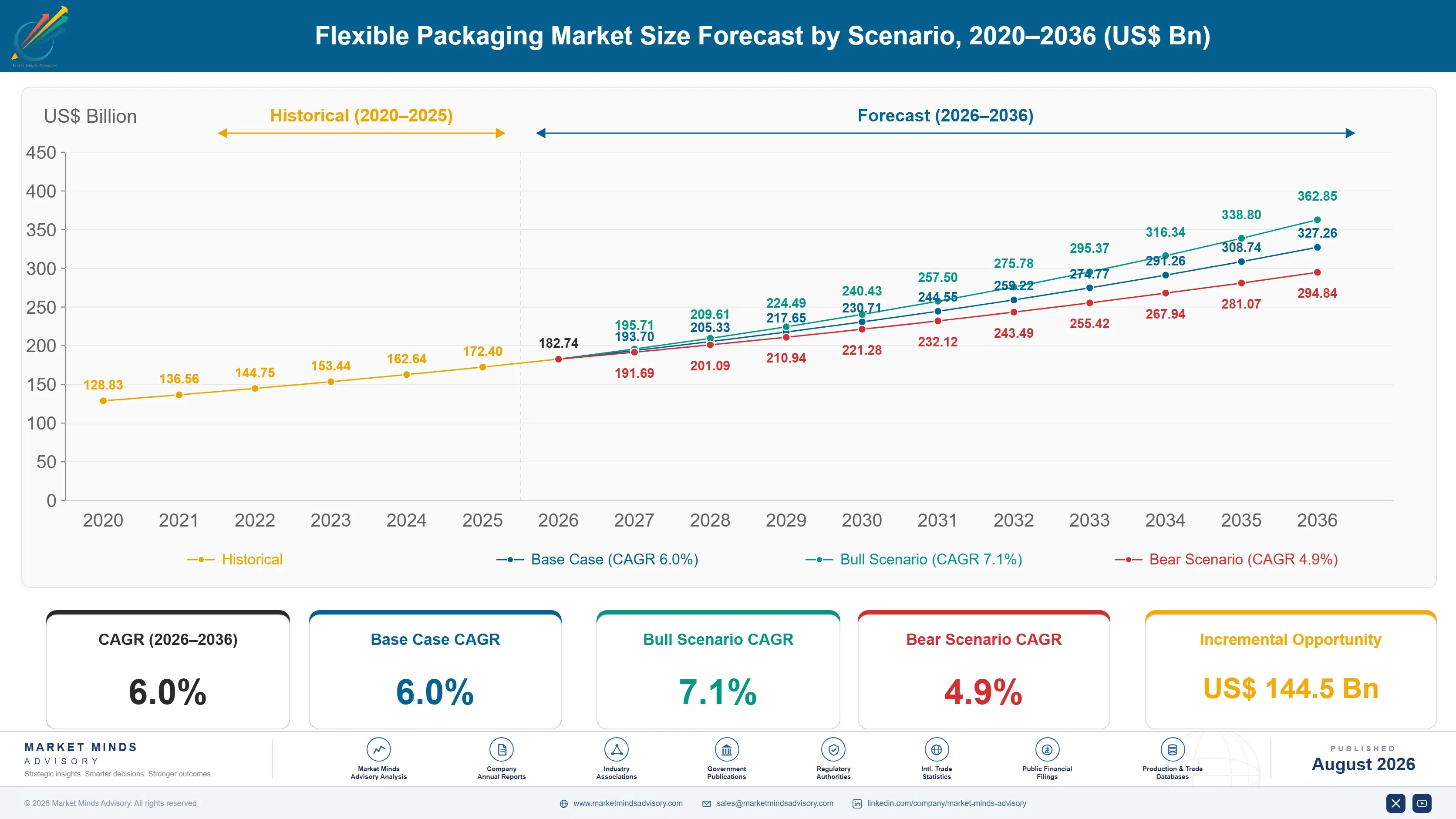
The market stands at USD 172.4 billion in 2025 and reaches USD 327.26 billion by 2036 at a 6.0% CAGR. Recyclable mono-material films grow fastest at 13.4%, about 2.23 times the overall rate, as converters race to solve the one problem the category cannot argue its way out of. East Asia holds 30% of value on food processing volume, while India posts the quickest national growth at 10.2% on sachet and pouch demand.
Fragmentation is extreme, with the top five holding roughly 21% of converted revenue and thousands of regional converters below them. Two forces are now pulling hard against each other. Flexible formats keep winning on material efficiency, freight, and shelf life against every rigid comparison, while design-for-recycling rules and modulated fees penalise precisely the multi-layer constructions that deliver those advantages. Converters holding recyclable structures are now reaching previously closed accounts.
Market Definition
The flexible packaging market covers converted non-rigid packaging formats that take shape from their contents, spanning printed and laminated films, stand-up pouches and flat pouches, sachets and stick packs, bags and sacks, and recyclable mono-material film structures. Functional barrier layers and active components sold as a separate performance category, rigid containers and closures, corrugated and fibre transit packaging, compostable materials sold on disposal characteristics, and filling and sealing machinery are excluded.
Base Year Value
$172.4B in 2025 (MMA Primary Research Dataset, August 2026)
Forecast Period
2026 to 2036, eleven discrete annual values
CAGR
6.0% base case. Bull 7.1%. Bear 4.9%.
Fastest Growth Segment
Recyclable Mono-Material Films: 13.4% CAGR
Fastest Growth Country
India: 10.2% CAGR
Fastest Growth Region
South Asia and Pacific: 8.2% CAGR
Largest Region
East Asia: 30% of 2025 global value
Market Leaders
Amcor, Constantia Flexibles, Mondi, Huhtamaki, Sealed Air. Source: MMA Analysis based on company annual reports.
Primary Survey
n=3,800 procurement and R&D decision-makers, Q4 2025, six countries
Methodology
Demand-side build-up, cross-validated against public data, 47 expert interviews

Flexible Packaging Market Forecast Scenarios

flexible-packaging-market-size-forecast-scenario-1787324546444
Growth from 2020 to 2025 compounded near 4.8%, and resin pricing rather than volume produced most of the value movement. Pandemic buying lifted packaged food volumes through 2021, then normalised. Polymer and energy costs rose hard through 2022 and converters passed them on with a lag that squeezed margin badly. Underneath all of it, format conversion from rigid continued steadily because the material and freight arithmetic never stopped favouring film.
Three mechanisms carry the base case to 6.0%. First, format conversion: flexible packaging uses substantially less material than rigid equivalents and ships at a fraction of the volume, which wins on cost and carbon simultaneously. Second, mono-material redesign, as converters rebuild multi-layer structures into recyclable single-polymer films that satisfy design criteria without losing performance. Third, emerging market packaged food penetration, where sachets and small pouches serve affordability in ways no rigid format matches.
The bull case at 7.1% assumes mono-material structures reach performance parity broadly and collection systems begin accepting film, which would remove the category's only real weakness. The bear case at 4.9% assumes design-for-recycling criteria exclude most current constructions, modulated fees keep rising, and brand owners retreat toward rigid formats that recycle within systems that already exist everywhere.

Why The Best Format Keeps Losing The Argument

Three forces set demand. Format conversion from rigid provides the growth, since a pouch uses a fraction of the material a jar or bottle needs and ships at a fraction of the volume. Packaged food penetration provides the emerging market base, particularly sachets serving affordability. And regulation pulls the other way, penalising exactly the laminated constructions that deliver the performance the format is chosen for.
MARKET CONCENTRATIONCR5: 21%Among the most fragmented converting industries in any packaging category
MATERIAL WEIGHT ADVANTAGE5 to 10 timesRigid packaging weight against a flexible equivalent holding identical contents
FILM COLLECTION RATEAbout 6%Flexible packaging recovered through household collection systems in Europe
RESIN COST SHAREAbout 56%Polymer as a portion of converted flexible packaging cost
MONO-MATERIAL SHAREAbout 19%Structures built from a single recyclable polymer family today
PRINT CHANGEOVER TIME20 to 60 minutesPress downtime between jobs that decides short-run economics
The commercial character is set by resin and press time. Polymer accounts for roughly 56% of converted cost, so film pricing follows petrochemical markets more closely than anything a converter controls. Press changeover takes 20 to 60 minutes, which makes short runs expensive and long runs profitable, and that single constraint shapes which customers a converter can serve economically. Digital printing is beginning to change it at the shorter end.
The next decade turns on two things. Whether mono-material films reach genuine performance parity with laminated structures, since the barrier compromise is real and shelf life matters more to a brand owner than a recyclability claim. And whether collection systems begin accepting film, because recovery near 6% in Europe means a recyclable pouch is still not recycled in practice, which regulators have noticed.
"Flexible wins on material, freight, food waste, and carbon, and loses on the one thing anyone legislated. The industry spent years making that argument to people who had already stopped listening, and only started redesigning when the fee schedule arrived."
Director, Flexible Packaging and Converting Practice · MMA Packaging / Flexible

Market Trends

Mono-Material Redesign Races Against Recycling Criteria

European design-for-recycling criteria and modulated producer fees both penalise multi-layer laminates that combine polyethylene, polypropylene, and aluminium in structures no sorting system can separate. Converters have responded by rebuilding those constructions from a single polymer family, using oriented polyethylene, coated grades, and machine-direction orientation to recover the stiffness and barrier the laminate provided. Mono-material structures now represent roughly 19% of the market and grow at 13.4%. The compromise is real: barrier performance and heat resistance both remain below the laminates being replaced, which limits the categories where substitution actually works today.
Market Impact: Rigid weighs 10 times more

Collection Systems Still Do Not Accept The Film

A recyclable pouch that nobody collects is not recycled, and household recovery of flexible packaging in Europe remains near 6% despite years of design improvement. The root problem is sorting infrastructure built for rigid containers, where lightweight film blows off the line, contaminates paper streams, and carries too little material value to justify separate handling. Several jurisdictions have introduced kerbside film collection and store drop-off schemes with mixed results. Until recovery rates rise, design-for-recycling compliance delivers a regulatory tick rather than an environmental outcome, which regulators have begun saying openly.
Market Impact: Sachets serve 3 billion consumers

Market Opportunities and Growth Drivers

Format Conversion Wins Every Material Comparison

A stand-up pouch uses five to ten times less material than a rigid container holding identical contents, ships at a fraction of the volume, and requires far less energy to produce and transport. Food waste reduction adds a further advantage, since barrier films extend shelf life on products that would otherwise spoil. Those arguments have driven steady conversion from cans, jars, and bottles across pet food, coffee, snacks, and household products for two decades. The arithmetic has not changed, which is why conversion continues even while regulation pushes the other way.
Market Impact: Criteria exclude 58% of structures

Sachet Economics Serve Affordability In Emerging Markets

Single-use sachets let consumers buy shampoo, detergent, or seasoning in quantities matched to daily income rather than monthly budgets, which is what makes branded goods accessible at all across much of South Asia, Southeast Asia, and Africa. Volume in these formats is enormous and growing with organised retail penetration. The commercial appeal for brand owners is trial and reach rather than margin per unit. Waste management authorities dislike sachets intensely because they are small, low value, and almost never collected, which is a tension the category has not begun to resolve.
Market Impact: Resin is 56% of converted cost

Market Restraints and Challenges

Design Criteria Penalise The Structures That Perform

Multi-layer laminates deliver the barrier, seal integrity, and machinability that make flexible packaging work, and they are precisely what design-for-recycling criteria exclude. The root cause is that co-extruded and adhesive-laminated layers cannot be separated at any economic cost, so the whole item is rejected by sorting systems. Commercially this leaves converters choosing between performance and compliance on every specification. Participants are responding with mono-material redesign, thin inorganic barrier coatings that avoid a separate polymer layer, and paper-based structures with removable film components. None of those has yet matched laminate performance across every demanding category.
Market Impact: Mono-material reaches 19% share

Resin Pricing Passes Through Slowly And Painfully

Polymer represents roughly 56% of converted cost and moves on petrochemical markets that no converter influences, while customer contracts typically reprice quarterly or annually. The root cause is a fragmented converting industry with no pricing power against consolidated brand owners. Commercially this means margin compresses whenever resin rises and expands whenever it falls, largely independent of operating performance. Converters mitigate through indexation clauses tied to published polymer benchmarks, shorter contract terms, resin hedging where liquidity permits, and mix shifts toward printed and converted value that resin affects less. None of those protections apply without renegotiating the contract at award.
Market Impact: Film recovery near 6% only
4 additional market trends, 3 additional growth drivers, and 2 additional restraints and challenges are covered in the full report. Contact sales@marketmindsadvisory.com to access the complete intelligence.

Segment CAGR and Growth Architecture

Segmentation follows converted format, a single product logic describing the physical form the packaging takes. Each format carries its own converting process, print requirement, filling equipment, and recyclability position, so commercial position tracks the format rather than the product inside it. End-use industry and sales channel appear separately within the framework as distinct dimensions.
flexible-packaging-market-market-share-analysis-1787324547060

Recyclable Mono-Material Films

Recyclable mono-material films grow fastest at 13.4%, about 2.23 times the overall 6.0% rate, and regulation rather than performance explains all of it. Building a structure from a single polymer family, usually polyethylene or polypropylene, allows sorting systems to recognise and process it where a laminate combining several materials cannot be separated at any cost. Oriented polyethylene, machine-direction orientation, and specialist coated grades recover much of the stiffness and barrier the laminate provided. The compromise is genuine, since heat resistance and oxygen barrier both sit below multi-layer equivalents, which restricts substitution to categories where shelf life requirements permit it. Roughly 19% of the market has converted so far, and most of the substitution remains ahead.
CAGR 13.4%

Stand-Up Pouches and Flat Pouches

Stand-up pouches and flat pouches grow at 7.8%, the second-fastest format, and they are the vehicle through which most rigid-to-flexible conversion actually happens. A pouch replaces a can, jar, or bottle using a fraction of the material while offering resealability, print area, and shelf presence that plain film bags never delivered. Pet food, coffee, baby food, and household products have all converted substantially. Filling line investment is the practical constraint, since a brand owner moving from rigid to pouch must replace equipment rather than adjust it, which makes the decision a capital project rather than a packaging specification change and slows adoption considerably in categories where existing lines still have life.
CAGR 7.8%
Full segment breakdown across 5 segments available in the complete report.

Regional Architecture and Country Demand Map

Packaged food production and retail formats together set this distribution, with converting located close to filling because film freight is cheap but service response is not. East Asia leads on processing volume, while Western Europe holds value share above volume share on regulatory-driven specification. South Asia grows quickest.

North America

North America holds 25% of value on a large packaged food base and pet food volumes that have converted to pouches faster than any other category. Extended producer responsibility is arriving state by state through Oregon, Colorado, California, and Maine, though design criteria are less prescriptive than European equivalents and fee modulation is still developing. Store drop-off film collection exists at scale but recovery remains poor, which leaves recyclability claims difficult to substantiate. Resin availability is better and cheaper than anywhere given domestic gas-based ethylene capacity. Growth of 5.6% reflects continued rigid conversion against regulation that has not yet bitten as hard as in Europe. Pet food conversion in particular still has room to run.
Share: 25% | CAGR: 5.6% (2026 to 2036)

Western Europe

Design criteria rather than demand define this market entirely. Western Europe holds 22% of value, with the packaging regulation setting design-for-recycling requirements that most current laminated structures cannot satisfy, and modulated fees charging heavily for those that fail. Mono-material conversion is consequently furthest advanced here, and Constantia Flexibles, Amcor, and Mondi all operate substantial European converting capacity working on it. Collection remains the unresolved problem, with film recovery near 6% despite the redesign effort. Energy costs since 2022 have also disadvantaged European extrusion against Asian and American production. Growth of 4.4% is the slowest of the seven, reflecting flat consumption and genuine regulatory friction. The mono-material redesign work is genuine and expensive to complete.
Share: 22% | CAGR: 4.4% (2026 to 2036)
Regional intelligence for 5 additional markets available in the complete report: East Asia, South Asia and Pacific, Latin America, Middle East and Africa, Eastern Europe. Contact sales@marketmindsadvisory.com.
flexible-packaging-market-country-cagr-analysis-1787324547572

Where Film Converters Actually Defend Margin

Selling printed film by the tonne against a thousand regional converters is how margin disappeared over three decades. The four moves below shift earnings toward ground price competition cannot reach: mono-material capability ahead of the deadline, resin indexation, digital print at the short-run end, and the filling line investment that locks a customer for a decade.

Qualify Mono-Material Structures Before Customers Ask

Design-for-recycling criteria exclude most current laminated constructions and modulated fees charge heavily for those that fail, so every brand owner will need mono-material alternatives on a fixed timetable. Qualification takes months per structure and per filling line, which means the converter holding a validated option when the customer moves captures the conversion outright. Mono-material grows at 13.4% against a market at 6.0% and sits at roughly 19% of structures today. Starting when asked means arriving after the decision has already been made elsewhere. Customers with the largest fee exposure are moving first.
Market Impact: Mono-material grows at 13.4% agains

Index Every Contract To Published Polymer Benchmarks

Resin represents roughly 56% of converted cost and moves on petrochemical markets no converter influences, while contracts repricing quarterly or annually leave margin exposed to swings that have nothing to do with operating performance. Indexation clauses tied to published benchmarks convert that into a mechanical adjustment. Brand owners resist them, though they concede more readily on technically differentiated structures than on commodity film, which is another argument for shifting mix toward mono-material and specialist work. The clause is easier to win at award than to introduce later, when the customer has already budgeted a fixed price for the year.
Market Impact: Resin drives roughly 56% of total c

Deploy Digital Print At The Short-Run End

Press changeover takes 20 to 60 minutes on conventional gravure and flexographic lines, which makes short runs uneconomic and pushes converters toward the long-run commodity work where price competition is fiercest. Digital printing removes changeover almost entirely, opening seasonal, regional, and promotional runs that conventional presses cannot serve profitably. Those jobs carry considerably better margin because few competitors can quote them. The investment is real but it reaches customers and volumes the conventional press base cannot serve at all. Payback depends on winning enough short-run work to fill the line, a commercial question rather than a technical one.
Market Impact: Changeover runs 20 to 60 minutes pe

Get Into The Filling Line Conversion Decision

A brand owner moving from rigid to pouch must replace filling equipment rather than adjust it, which makes the switch a capital project rather than a packaging specification change. The converter involved in that decision shapes the format, the film structure, and the supply relationship for the life of the line, typically a decade or more. Those arriving afterwards quote against a specification somebody else wrote. Commercial resource belongs with packaging engineering and capital planning rather than with procurement. Filling lines run 10 years or more, so the specification set at installation carries a decade of volume with it.
Market Impact: Filling line decisions hold for 10

Who Controls the Margin Pool

Fragmentation is extreme: the top five hold roughly 21% of converted revenue, and thousands of regional converters operate beneath a handful of multinational groups. The gap between leaders and challengers is one of technical capability and multinational reach rather than print quality, which is widely held. All participants are assessed on one basis, revenue from converted flexible packaging formats, excluding functional barrier layers sold separately and rigid or fibre-based packaging.
Competition runs along four lines. First, mono-material capability, since every brand owner faces the same design deadline and validated alternatives are scarce. Second, multinational consistency, because global brand owners want identical specification produced across regions. Third, resin purchasing scale, which sets the floor on more than half of converted cost. Fourth, service response, as converters sit close to filling operations and short lead times decide reorders.

Pressure is building from two directions. Design-for-recycling criteria are reopening specifications that incumbency had closed for years, which lets challengers with qualified mono-material structures into accounts they could not previously reach. Meanwhile rigid formats are winning back categories on recyclability grounds despite losing every material comparison. Rankings should favour converters with mono-material capability and indexed contracts over those competing on printed film price alone.
flexible-packaging-market-company-positioning-matrix-1787324548093

Competitive Moat and Risk Dimensions

AMCOR

Moat: Global consistency and technical depth

Amcor produces flexible packaging to consistent specification across dozens of countries, which multinational brand owners require and regional converters cannot offer at any price. Its materials science capability across barrier films and mono-material development is deeper than almost any competitor holds. Resin purchasing scale sets a cost floor on more than half of converted cost that smaller converters cannot approach.
AMCOR

Risk: Laminate exposure and fee escalation

A substantial share of the portfolio consists of multi-layer laminates that design-for-recycling criteria exclude and modulated fees penalise heavily across European markets. Converting the installed specification base to mono-material requires customer requalification at their pace rather than the supplier's. Regional converters also undercut significantly on straightforward printed film where global consistency carries no premium at all.
CONSTANTIA FLEXIBLES

Moat: European mono-material development

Constantia Flexibles has invested heavily in recyclable mono-material structures ahead of European design deadlines, which positions it well as brand owners face requalification across their portfolios. Strength in pharmaceutical and food applications where barrier and compliance both matter provides technically defensible positions. European manufacturing proximity supports the service response that filling operations genuinely require.
CONSTANTIA FLEXIBLES

Risk: European cost base and demand

European energy and conversion costs sit well above Asian and American production on comparable film, which limits competitiveness outside the region entirely. Revenue leans on European packaged food consumption that has been persistently flat while regulation raises specification cost. Private equity ownership also creates pressure toward near-term margin that competes with the development investment mono-material leadership actually requires.

Players Tracked

Prominent Players

Amcor
Constantia Flexibles
Mondi
Huhtamaki
Sealed Air

Other Key Players

Berry Global
Sonoco Products
ProAmpac
Coveris
Uflex
Wipak
Schur Flexibles
Toppan Holdings
Dai Nippon Printing
Winpak
Glenroy
TC Transcontinental
Printpack
Cosmo Films
Taghleef Industries

Recent Developments

FEBRUARY 2025

European packaging regulation sets design-for-recycling criteria

The regulation entering force established design-for-recycling requirements phased across subsequent years, with criteria that most current multi-layer flexible laminates cannot satisfy in their existing form. This was European legislation taking effect rather than any commercial transaction, and it fixed deadlines converters must now requalify structures against.
Signal: Fixed design deadlines now reopen specific
SEPTEMBER 2024

Mono-material polyethylene structures reach broader commercial launch

Additional recyclable mono-material film structures moved into commercial production across food and household categories, using oriented polyethylene and coating technology to recover barrier lost by removing laminate layers. These were product commercialisations rather than transactions, and they extended substitution into categories previously considered too demanding.
Signal: Each category proven expands the addressab
JUNE 2024

European film collection schemes report persistent low recovery

Reporting on household and store drop-off collection of flexible packaging across several European markets showed recovery remaining well below rigid container rates despite design improvements and expanded collection points. This was performance reporting rather than regulation, and it highlighted the gap between recyclable design and actual recycling.
Signal: Recyclable design without collection deliv

Polymer Resin, Aluminium Foil, Inks, Energy

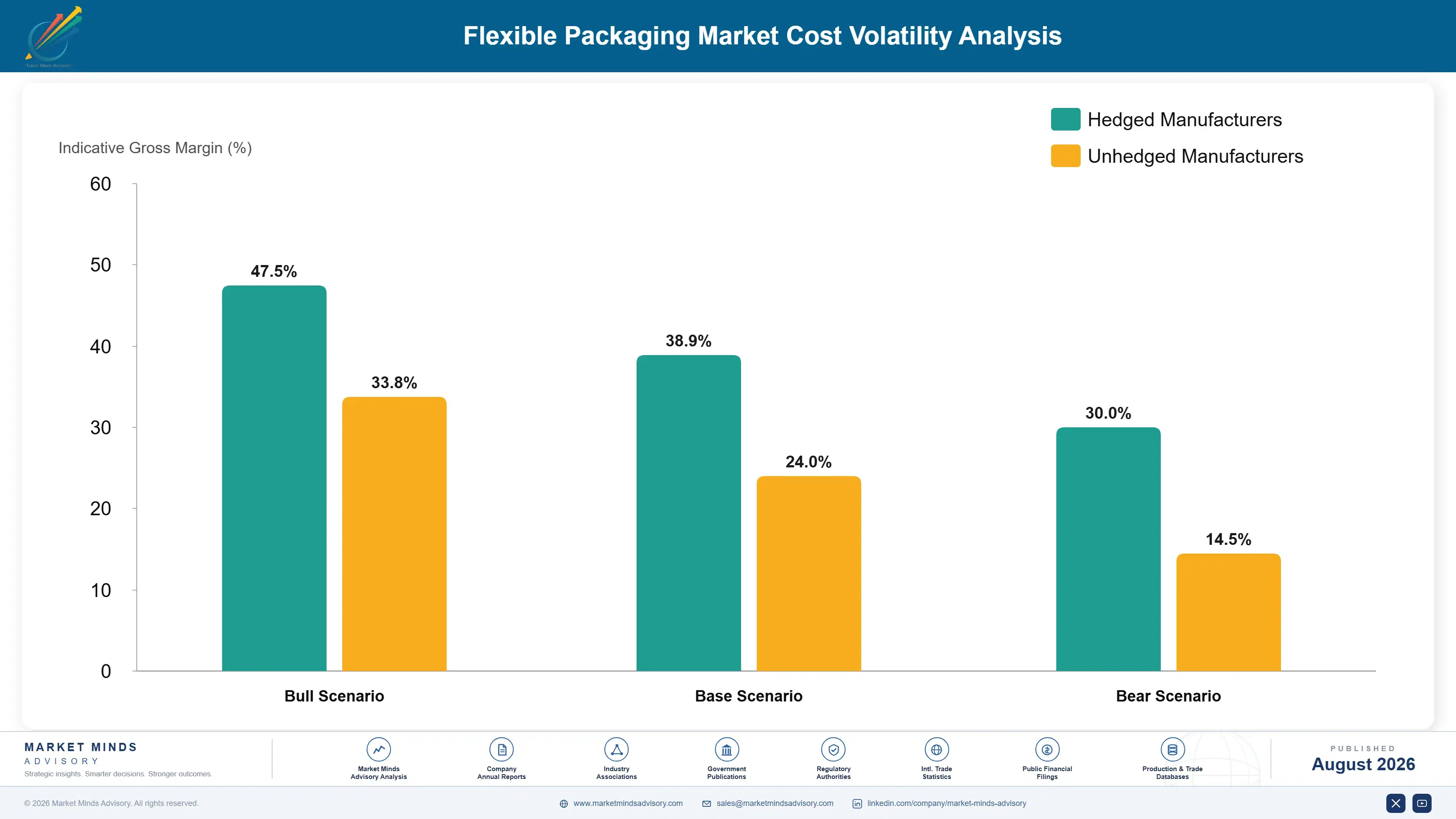
Polymer dominates this cost sheet more completely than in any other packaging category. Resin accounts for roughly 56% of converted cost, purchased on contracts indexed to naphtha or ethane by region. Aluminium foil and metallised layers add 9% to 15% where laminates use them. Inks, adhesives, and solvents contribute 8% to 13%, and extrusion and lamination energy a further 7% to 12% rising with layer count.
The 2022 European energy crisis hit converters through both resin and conversion simultaneously. Gas-linked feedstock costs lifted polymer prices while extrusion and lamination energy multiplied, with IEA analysis recording European industrial gas at several times prior-year levels. Amcor and Mondi both disclosed energy cost pressure across 2022 reporting. Converters on annual contracts absorbed most of it, since brand owners resisted mid-term escalation on volumes committed to retailers.

Exposure separates by contract structure and geography, not by size. A converter with resin indexation passes the largest cost element through mechanically, while one quoting fixed prices carries the full swing across the contract term. Geography compounds it, since American converters buy ethane-based polyethylene at costs European naphtha-based production cannot approach. That gap is why European converters have moved toward technically differentiated structures where resin matters less.
flexible-packaging-market-cost-volatility-analysis-1787324548287

Index converting contracts to published resin benchmarks

Polymer is over half of converted cost and moves on petrochemical markets no converter influences, so fixed pricing across a contract term is a margin gamble rather than a commercial position. Indexation clauses agreed at award convert that into a mechanical adjustment. Brand owners resist them, though they concede more readily on differentiated structures than on commodity film.

Reduce layer count through coating rather than lamination

Each lamination pass adds adhesive, solvent, energy, and yield loss to the substrate. Thin inorganic or dispersion coatings deliver comparable barrier in a fraction of the thickness, cutting both material and conversion cost while improving recyclability. Coating line investment is substantial and throughput is lower than lamination, so the saving only appears above a volume threshold many converters never reach.

Qualify multiple resin grades for every running structure

A structure validated against one supplier's grade leaves the converter exposed to that supplier's outages, allocations, and pricing decisions entirely. Qualifying two or three interchangeable grades costs testing time once and creates negotiating position permanently. Brand owners increasingly require supply continuity planning anyway following recent disruptions, which makes the internal case for the work considerably easier.

Portfolio Architecture for Margin Defence

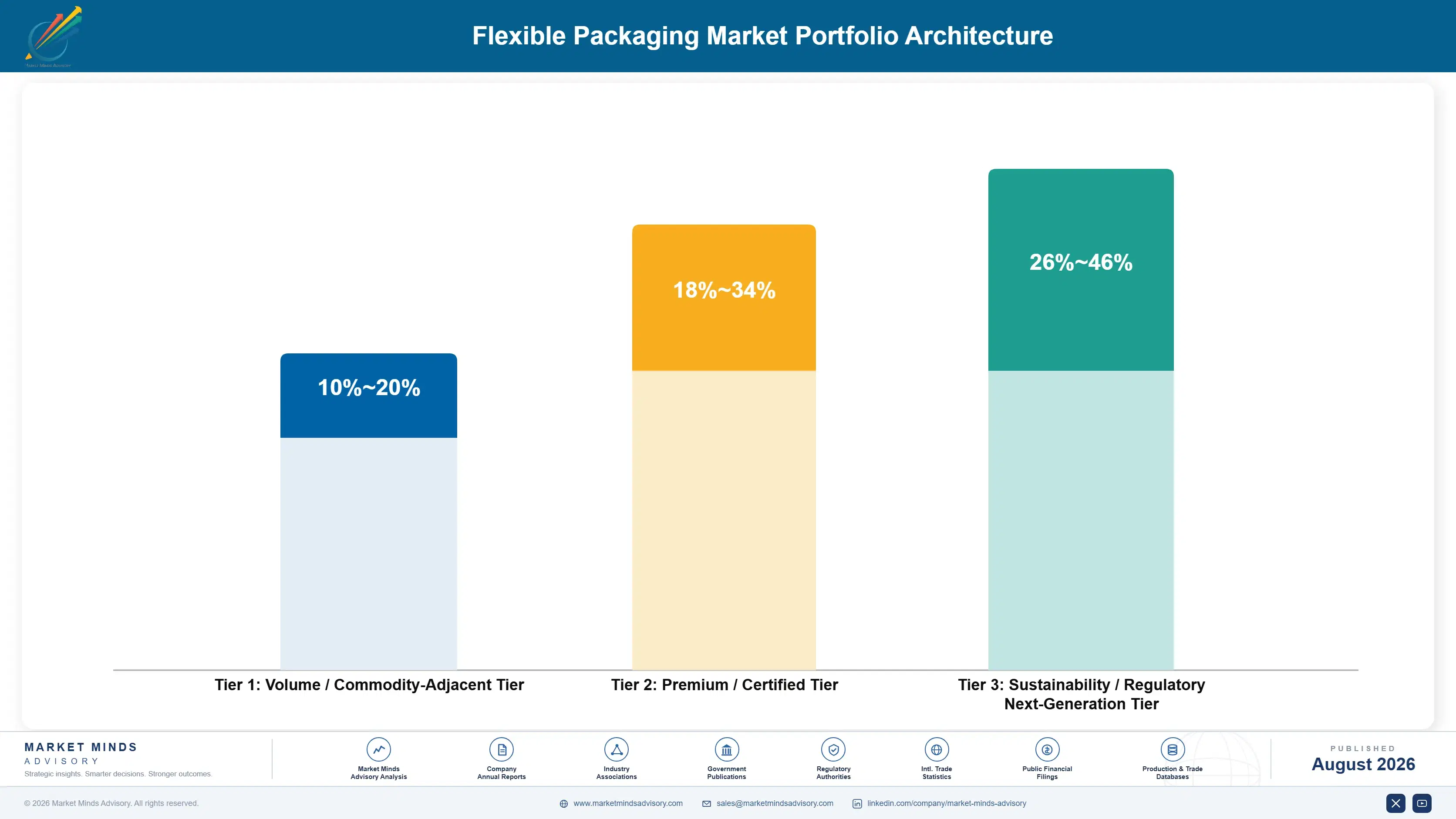
The portfolio splits into three tiers with different economics. Plain and simply printed film is the volume tier, competing on delivered price against every converter, with margin set by resin indexation and press utilisation. Pouches and complex formats earn more because tooling, filling line qualification, and print quality narrow the field. Mono-material structures and specialist barrier work price against a compliance deadline, not a competing quote.
The tension runs between commodity film that fills presses and converted formats that earn the return. Plain film keeps extrusion and printing capacity loaded, covers the fixed cost of expensive presses, and maintains the relationships through which everything else sells. Yet it competes on delivered price against neighbours running identical equipment. Converters handling this well run commodity volume for utilisation while directing capital toward mono-material capability, coating, and digital print.

High-value pools concentrate where qualification or capability limits competition: mono-material structures validated on the customer's filling lines, pharmaceutical and medical films carrying regulatory approval, digital print serving runs conventional presses cannot, and formats tied to filling equipment the converter specified. All four escape the price-per-thousand comparison. Plain printed polyethylene film sits at the other end, competing against every converter within service distance.

Volume / Commodity-Adjacent Tier

Plain and simply printed films, basic bags, and standard sacks sold on delivered price per thousand. The range is wide because resin indexation and press utilisation determine everything, and converters without indexation carry swings they cannot control.
Gross Margin: 10-20%

Premium / Certified Tier

Stand-up pouches, complex converted formats, high-quality print work, and films carrying pharmaceutical or food contact approval. The range is wide because tooling and qualification protect pricing while print competition varies enormously by region.
Gross Margin: 18-34%

Sustainability / Regulatory / Next-Generation Tier

Recyclable mono-material structures, inorganic barrier coatings, digital print for short runs, and paper-based hybrid formats. The range is wide because mono-material prices against a compliance deadline while digital print still carries unrecovered equipment cost.
Gross Margin: 26-46%
flexible-packaging-market-portfolio-architecture-1787324548792

High-value Sub-segments and Strategic Watch-out

Recyclable Mono-Material Films

High value and high growth at 13.4%, the fastest format, driven entirely by design criteria rather than by any performance improvement. Barrier and heat resistance both sit below the laminates being replaced, which restricts substitution to categories where shelf life requirements genuinely permit it. Substitution is still early.
Gross Margin: 28-46%

Stand-Up Pouches and Flat Pouches

High value with strong growth at 7.8%, the vehicle through which most rigid-to-flexible conversion happens across pet food, coffee, and household products. Filling line investment is the practical constraint, since conversion is a capital project rather than a specification change. Adoption follows capital cycles rather than packaging decisions.
Gross Margin: 20-36%

Printed and Laminated Films

The volume core by a wide margin, growing at 4.8% and squeezed between resin pricing on one side and design-for-recycling exclusion on the other. Steady in tonnage but facing modulated fees that make the best-performing structures the most expensive to place. Tonnage holds; value does not follow it.
Gross Margin: 10-20%

Sachets and Stick Packs

The strategic watch-out, growing at 7.2% on emerging market affordability that no rigid format replicates at any price. Waste authorities dislike them intensely because they are small, low value, and almost never collected, and several jurisdictions have attempted restrictions. Enforcement has so far been limited and inconsistent.
Gross Margin: 14-28%

How Film Specifications Actually Hold

Demand commits at filling line qualification and repeats as production runs. A film validated on a customer's sealing and forming equipment has proven it runs at line speed without wrinkling, sealing poorly, or stopping the line, and requalifying an alternative risks downtime worth more than any price saving. That protects incumbents. Design-for-recycling deadlines are the first force in years reopening those specifications, which is why challengers with qualified mono-material structures are su
Stickiness varies sharply by format complexity. Pharmaceutical and medical films stick hardest, since regulatory submissions reference the specific structure. Pouches stick through tooling and filling line qualification together. Complex printed laminates stick through brand approval and colour matching. Plain film sticks least of all, moving on price at every tender to whichever converter within service distance quotes lowest that quarter.

Buyer profiles have moved from packaging technologists specifying on performance toward procurement running reverse auctions and sustainability teams applying design criteria. The reverse auction damaged this industry by treating printed film as a pure commodity. Design criteria are now pulling the other way, since a structure that fails recyclability cannot be bought at any price, which restores technical conversations reduced to unit cost for years.
flexible-packaging-market-end-use-penetration-index-1787324549279

Our Call On Flexible Packaging

These are among the four positions where our research anticipates prominent divergence between winners and laggards over the coming forecast period. Each is grounded in the demand model, the regulatory perimeter, and the announced capacity pipeline.
01 / RECYCLABILITY BEATS EFFICIENCY

One failing outweighs every advantage the format holds

Flexible packaging uses five to ten times less material than rigid equivalents, ships at a fraction of the volume, and cuts food waste through better barrier, yet design-for-recycling criteria and modulated fees penalise it on the single measure regulators chose to legislate. Two decades of arguing the material case moved almost nothing. Converters should stop making the efficiency argument and start qualifying compliant structures, because on most accounts the decision is already being taken in rooms where the converter is not present.
02 / QUALIFICATION WINS CONVERSIONS

Holding a validated structure when the customer moves

Every brand owner in Europe faces the same design deadline and mono-material qualification takes months per structure and per filling line, which means the converter with a validated option ready captures the conversion outright. Mono-material grows at 13.4% against a market at 6.0% and covers only about 19% of structures today, so most of the conversion is still ahead. Starting development only when a customer asks means arriving after the specification has already been written by somebody else, on terms set elsewhere.
03 / RESIN SETS THE MARGIN

Fixed pricing on a commodity input is a gamble

Polymer represents roughly 56% of converted cost and moves on petrochemical markets no converter influences, while contracts repricing quarterly or annually leave margin swinging for reasons unrelated to operating performance. A fragmented converting industry with thousands of participants has no pricing power against consolidated brand owners to recover it afterwards. Indexation clauses agreed at contract award are the only reliable protection, and brand owners concede them more readily on differentiated structures than on commodity film, where an alternative supplier is a phone call away.
04 / COLLECTION UNDERMINES COMPLIANCE

A recyclable pouch nobody collects is not recycled

Household recovery of flexible packaging in Europe remains near 6% despite years of design improvement, because sorting infrastructure built for rigid containers cannot handle lightweight film that blows off sorting lines and contaminates paper streams. Design-for-recycling compliance therefore delivers a regulatory tick rather than an environmental outcome, and regulators reviewing the schemes have begun saying so openly. Converters should expect collection requirements to follow design requirements within this decade, and should engage with scheme operators and municipalities before that arrives rather than after.

Engagement Snapshot From the Field

A live engagement with an industry participant carrying material or product regulatory and market exposure ahead of a defining policy shift, showing how our research translates into a defensible multi-year portfolio strategy.
MARKET MINDS ADVISORY · CLIENT ENGAGEMENT SUMMARY
Flexible Packaging Producer Strategic Portfolio Review and Transition Roadmap 2026·Investment Scenario on Flexible Packaging Exposure Evaluation 2025-26
CLIENT PROFILE
A global food brand owner selling across nineteen markets engaged MMA as European design-for-recycling deadlines approached across its flexible portfolio. The client reported roughly 280 active film specifications, of which internal review suggested about 64% would fail the criteria, and no requalification programme beyond a handful of pilot structures (client-reported, unverified by MMA). Fee exposure was rising annually on every failing specification.
STRATEGIC CHALLENGE
Requalifying 280 specifications on filling lines across nineteen markets exceeded available technical capacity by a wide margin, and the incumbent converters had proposed like-for-like mono-material swaps without addressing whether shelf life would hold. Meanwhile modulated fees were rising annually on every non-compliant structure. The board needed a sequence rather than a portfolio-wide programme it could not staff.
MMA APPROACH
MMA ranked every specification by fee exposure and requalification difficulty rather than treating them uniformly, which internal planning had not attempted. We tested whether mono-material alternatives held shelf life in the categories that mattered most, rather than accepting supplier assurances. We then assessed converter capability on validated structures already running elsewhere rather than on development claims.
KEY FINDINGS
  1. Roughly 22% of specifications carried about 61% of total fee exposure, making a sequenced programme feasible where a uniform one was not (client-reported, unverified by MMA).
  2. Mono-material alternatives held shelf life in eleven of fourteen tested categories, with the three failures concentrated in high-oxygen-sensitivity products where laminate barrier remains necessary.
  3. Two converters already had validated structures running on comparable filling lines elsewhere, cutting requalification time by roughly half against development from scratch.
  4. Collection rates meant the converted structures would not actually be recycled in most markets, which the client chose to state publicly rather than obscure (client-reported, unverified by MMA).
CLIENT PROFILE
A global food brand owner selling across nineteen markets engaged MMA as European design-for-recycling deadlines approached across its flexible portfolio. The client reported roughly 280 active film specifications, of which internal review suggested about 64% would fail the criteria, and no requalification programme beyond a handful of pilot structures (client-reported, unverified by MMA). Fee exposure was rising annually on every failing specification.
STRATEGIC CHALLENGE
Requalifying 280 specifications on filling lines across nineteen markets exceeded available technical capacity by a wide margin, and the incumbent converters had proposed like-for-like mono-material swaps without addressing whether shelf life would hold. Meanwhile modulated fees were rising annually on every non-compliant structure. The board needed a sequence rather than a portfolio-wide programme it could not staff.
MMA APPROACH
MMA ranked every specification by fee exposure and requalification difficulty rather than treating them uniformly, which internal planning had not attempted. We tested whether mono-material alternatives held shelf life in the categories that mattered most, rather than accepting supplier assurances. We then assessed converter capability on validated structures already running elsewhere rather than on development claims.
KEY FINDINGS
  1. Roughly 22% of specifications carried about 61% of total fee exposure, making a sequenced programme feasible where a uniform one was not (client-reported, unverified by MMA).
  2. Mono-material alternatives held shelf life in eleven of fourteen tested categories, with the three failures concentrated in high-oxygen-sensitivity products where laminate barrier remains necessary.
  3. Two converters already had validated structures running on comparable filling lines elsewhere, cutting requalification time by roughly half against development from scratch.
  4. Collection rates meant the converted structures would not actually be recycled in most markets, which the client chose to state publicly rather than obscure (client-reported, unverified by MMA).
RECOMMENDED STRATEGY
Phase 1: Phase 1 (0 to 8 months): Rank all specifications by fee exposure and requalify the highest-exposure structures first rather than working alphabetically. Phase 2: Phase 2 (8 to 24 months): Award conversion work to converters holding validated structures already running on comparable lines elsewhere. Phase 3: Phase 3 (24 to 36 months): Retain laminates in the three oxygen-sensitive categories and engage scheme operators on collection directly.
OUTCOME
The client requalified the highest-exposure specifications within two years and cut modulated fee exposure by roughly 44% without a shelf life failure. Awarding work to converters with proven structures rather than development promises halved the timeline, and the three retained laminate categories were defended openly on shelf life grounds (client-reported, unverified by MMA).

Frequently Asked Questions

Foundational context covering the market sizes, CAGR, scope, country, region and competition that inform every finding below. This section is provided to cover basics and most often pre-purchase conversations, answered from the MMA Primary Research Dataset.

What is the current size of the Flexible Packaging Market?

The global flexible packaging market is valued at USD 172.4 billion in 2025, covering printed and laminated films, pouches, sachets, bags and sacks, and recyclable mono-material structures. Functional barrier layers and rigid packaging are excluded.

How large will the Flexible Packaging Market be by 2036?

The market is forecast to reach USD 327.26 billion by 2036 in the base case, about 1.79 times the 2026 level. That represents incremental value of roughly USD 144.52 billion across the decade.

What is the CAGR for the Flexible Packaging Market 2026 to 2036?

The market grows at a 6.0% CAGR in the base case, with bull and bear scenarios at 7.1% and 4.9%. The spread turns mainly on mono-material performance parity and whether collection systems accept film.

Which segment is growing fastest?

Recyclable mono-material films grow fastest at 13.4%, about 2.23 times the overall rate, driven entirely by design-for-recycling criteria rather than performance. Stand-up and flat pouches follow at 7.8%.

Who are the major companies in the Flexible Packaging Market?

Leading converters include Amcor, Constantia Flexibles, Mondi, Huhtamaki, and Sealed Air. Fragmentation is extreme, with the top five holding roughly 21% of converted revenue above thousands of regional converters.

Which country is growing fastest?

India grows fastest at a 10.2% CAGR, because single-use sachets make branded goods accessible to consumers buying against daily income. Indonesia and Vietnam follow on comparable affordability formats.

Report Segmentation Architecture

The full report scope spans multiple orthogonal segmentation dimensions, with cross-tabulated demand data provided for each dimension pair. Coverage extends further to regional breakdowns, trend trajectories, and the competitive detail needed to support segment-level decision-making.

By Converted Format

  • Printed and Laminated Films
  • Stand-Up Pouches and Flat Pouches
  • Sachets and Stick Packs
  • Bags and Sacks
  • Recyclable Mono-Material Films

By End-Use Industry

  • Food and Snacks
  • Beverages and Liquids
  • Pet Food and Animal Nutrition
  • Personal Care and Household
  • Pharmaceutical and Medical

By Sales Channel

  • Direct Contract To Brand Owner
  • Contract Packer and Co-Manufacturer
  • Packaging Distributor and Trade
  • Retailer Own-Label Supply

By Region

  • North America
  • Western Europe
  • East Asia
  • South Asia and Pacific
  • Latin America
  • Middle East and Africa
  • Eastern Europe

Scope, Methodology, and Coverage

Every figure in this report is reproducible from documented input assumptions. The scope below maps the historical period, the forecast horizon, the segmentation dimensions, and the countries covered, alongside the underlying primary and qualitative methodology.
Historical Period
2020 to 2025
Forecast Period
2026 to 2036
Base Year
2025 (USD billions; MMA Primary Research Dataset, August 2026)
Market Definition
The flexible packaging market comprises the conversion and first sale of non-rigid primary packaging formats that take their shape from the contents, valued at converter selling prices to brand owners, packers, and distributors. It spans printed and laminated films, stand-up pouches and flat pouches, sachets and stick packs, bags and sacks, and recyclable mono-material film structures, together with the printing, laminating, coating, and converting operations that produce them. Functional barrier layers, active components, and intelligent packaging elements sold as a separate performance category, rigid containers and closures, corrugated and fibre-based transit packaging, compostable materials sold on their disposal characteristics rather than their format, labels supplied separately from the pack, and filling, forming, and sealing machinery are excluded.
Quantitative Units
USD billions (current prices); converted volume in million tonnes and square metres where applicable
Segmentation Dimensions
By Converted Format; By End-Use Industry; By Sales Channel; By Region
Regions Covered
North America, Western Europe, East Asia, South Asia and Pacific, Latin America, Middle East and Africa, Eastern Europe
Countries Covered
USA, China, Germany, France, UK, Japan, South Korea, India, Australia, Canada, Brazil, Mexico, Indonesia, Vietnam, Thailand, Malaysia, UAE, Saudi Arabia, South Africa, Nigeria, Turkey, Poland, Netherlands, Italy, Spain, Sweden, Switzerland, Argentina, Colombia, Singapore, and additional markets relevant to this sector
Key Companies Profiled
Amcor, Constantia Flexibles, Mondi, Huhtamaki, Sealed Air, Berry Global, Sonoco Products, ProAmpac, Coveris, Uflex, Wipak, Schur Flexibles, Toppan Holdings, Dai Nippon Printing, Winpak, Glenroy, TC Transcontinental, Printpack, Cosmo Films, Taghleef Industries
Quantitative Methodology
Primary survey, n=3,800 respondents, Q4 2025, six countries; demand-side model with trade association cross-validation
Qualitative Methodology
47 expert interviews, Q4 2025; applied to validate demand model assumptions, identify emerging dynamics, and assess competitive positioning
Report Format
PDF and XLSX data workbook (Word format preview document)
Publisher
Market Minds Advisory
Report Code
MMA-2026-PAC-239
Published
August 2026
Contact
sales@marketmindsadvisory.com | www.marketmindsadvisory.com

Purchase the full Flexible Packaging Market Report (2026 to 2036).

The full MMA Flexible Packaging report sizes the market across five converted formats, five end-use industries, four sales channels, and seven regions through 2036. It profiles 20 converters on a consistent basis of converted flexible packaging revenue, scoring each on mono-material capability, multinational consistency, resin purchasing scale, and service response. Scenario models quantify how design-for-recycling criteria, resin pricing, and collection rates move both volume and achievable margin by format. The report also includes specification requalification exposure modelling, mono-material shelf life performance benchmarking by category, resin indexation contract comparison, and film collection rate tracking across major schemes for converters and brand owners.
Five-format and four-channel market sizing to 2036
Twenty-converter benchmark on converted flexible packaging revenue
Specification requalification exposure modelling by fee and difficulty
Mono-material shelf life performance benchmarking across product categories
Resin indexation contract structure comparison against fixed pricing
Film collection rate tracking across major recovery schemes

Built For The People Who Decide

From boardroom strategy to bench-side execution, this report is read cover-to-cover by leaders shaping the next decade of their industry, turning demand scenarios, market dynamics and valuation benchmarks into decisions.
CXOs/ Presidents/ VPs/ Managers
M&A and Corporate Development
Strategy Teams and R&D Heads
Procurement and Product Directors
Regulatory and Compliance Leaders
Investor Relations and Equity Analysts