Market Minds Advisory
Flexible Frozen Food Packaging Market

Flexible Frozen Food Packaging Market: Recyclable Mono-Material Mandates Reshape Film Procurement Worldwide

European packaging waste regulation and quick commerce frozen food growth across Asia are pulling flexible packaging converters toward recyclable mono-material films, resetting resin procurement and machine qualification decisions across nearly every frozen food brand.

Lead Analyst

Bilal Shaikh

Published

September 2026

Make Smarter Decisions with Customized Research Insights

Request a free sample report and evaluate market opportunities, growth trends, and competitive dynamics relevant to your business needs.

2025 MARKET VALUE$12.4BMarket Size 2025
2036 FORECAST VALUE$24.3BBase Case , 2026 to 2036
CAGR 2026 TO 20366.3 %Bull 7.5% / Bear 5.0%
INCREMENTAL OPPORTUNITY$11.1BNet 10- year value creation
EXPANSION MULTIPLE1.84x2036 value over 2026 base
Strategic Levers
M&A Pipeline
Regional Outlook
Country Rankings
Competitive Intelligence
Segmental Deep-dive
Call-Us : 91 93563 13602

Executive Snapshot and Market Trajectory

European packaging waste regulation is forcing frozen food brands to requalify film structures they had not touched in over a decade, converting a stable specification category into an active procurement decision practically overnight this year across most major frozen food markets tracked.
Stand-up pouches and rollstock film anchor the bulk of installed volume, but recyclable mono-material structures carry the specification premium that converters increasingly chase as brand owners commit to public packaging sustainability targets announced to investors. East Asia and North America together account for more than half of global demand, reflecting both China's converting capacity and the sheer scale of frozen food retail across developed grocery channels worldwide today and tomorrow.
Competition remains moderately fragmented at 34 percent five-firm concentration, leaving genuine room for regional converters to compete on price while global incumbents defend share through barrier technology, machine compatibility testing, and multi-year supply agreements few smaller rivals can match at scale across most accounts and geographies. Extended producer responsibility fees and quick commerce growth are simultaneously reshaping which film structure wins each new brand contract issued across the wider industry and its evolving buyer base.
Market Definition
The flexible frozen food packaging market covers flexible film and pouch structures used to package frozen food products for retail and foodservice distribution, spanning stand-up pouches, flat pouches, rollstock film, vacuum skin packaging film, recyclable mono-material films, and shrink film wraps. It excludes rigid trays, cartons, and semi-rigid containers not constructed primarily from flexible film.
Base Year Value
$12.4B in 2025 (MMA Primary Research Dataset, August 2026)
Forecast Period
2026 to 2036, eleven discrete annual values
CAGR
6.3% base case. Bull 7.5%. Bear 5.0%.
Fastest Growth Segment
Recyclable Mono-Material Films: 10.2% CAGR
Fastest Growth Country
India: 9.2% CAGR
Fastest Growth Region
South Asia and Pacific: 8.5% CAGR
Largest Region
East Asia: 28% of 2025 global value
Market Leaders
Amcor plc, Sealed Air Corporation, Berry Global Group Inc, Mondi plc, Sonoco Products Company. Source: MMA Analysis based on company annual reports.
Primary Survey
n=3,800 procurement and R&D decision-makers, Q4 2025, six countries
Methodology
Demand-side build-up, cross-validated against public data, 47 expert interviews

Flexible Frozen Food Packaging Market Forecast Scenarios

flexible-frozen-food-packaging-market-size-forecast-scenario-1787300569365
Between 2020 and 2025 the market grew at a steady 5.3 percent as frozen food consumption climbed through pandemic-driven pantry stocking behavior and converters absorbed resin price volatility across most producing regions tracked closely by industry associations. Growth held firm even after pantry stocking normalized, as frozen food retained share against fresh alternatives on convenience and reduced waste grounds across most developed grocery markets.
The base case assumes continued European extended producer responsibility fee escalation favoring recyclable structures, sustained East Asian frozen food retail expansion tied to urbanization and cold chain investment, and a steady specification-conversion cycle as brand owners requalify legacy multi-layer film for recyclability across their full product portfolios. These three mechanisms together sustain above-historical growth through 2036 even as North American volume growth settles closer to population-linked consumption rates over time.
A bull scenario depends on accelerated European Union Packaging and Packaging Waste Regulation enforcement forcing rapid mono-material conversion across the entire continent within a compressed timeline and enforcement window. The bear case centers on a resin feedstock cost spike that pushes converted film prices high enough to delay brand owner requalification projects across budget-constrained private label manufacturers specifically this cycle.

Recyclability Mandates Reshape Film Specification Decisions

Three forces are converging on this historically stable category at once. European packaging waste regulation is forcing brand owners to requalify film structures well ahead of any planned redesign cycle across most product lines. East Asian frozen food retail is expanding rapidly as cold chain infrastructure and quick commerce delivery both scale simultaneously across the region. And recyclable mono-material film technology is finally reaching cost parity with conventional multi-layer barrier s
MARKET CONCENTRATIONCR5 34%fragmented across regional converters and global packaging incumbents
AVERAGE SELLING PRICEUSD 2.10/kgblended price masks wide spread across structure and barrier tiers
TOP PRODUCING COUNTRY SHAREChina 22%concentrated converting capacity serves both domestic and export demand
CAPACITY UTILISATION74%meaningful headroom remains before new extrusion investment triggers
TRADE INTENSITY26% exportedsubstantial cross-border flow from European and Asian converting hubs
RESIN COST SHARE38% of COGSpolyethylene and polypropylene volatility compresses converter margins directly
Commercially, the market splits cleanly between a high-volume, price-competitive commodity film segment dominated by regional converters, and a lower-volume, substantially higher-margin recyclable and high-barrier segment where global incumbents defend share through certification, machine trials, and long-term resin supply agreements most competitors cannot credibly match at all across most brand tenders, procurement boards, and evaluation committees reviewed regularly.
The next decade will be defined by how fast mono-material recyclable structures displace conventional multi-layer barrier film across European and increasingly North American brand portfolios, and by how aggressively Asian converters expand export capacity into markets where Western incumbents have historically held durable, certification-backed share for decades running now and well into the future still ahead.
"Frozen food packaging used to be the most boring line item in a brand's procurement budget. Extended producer responsibility fees just made film structure a genuinely strategic decision for the first time in a generation."
Director, Packaging and Materials Practice · MMA Packaging / Flexible Food Packa

Market Trends

EU Packaging Waste Regulation Forces Mono-Material Conversion

The European Union's Packaging and Packaging Waste Regulation, entering binding force with phased recyclability thresholds through 2030, requires all packaging placed on the EU market to be recyclable at scale, a standard conventional multi-layer barrier film for frozen food cannot meet without reformulation. European Commission implementation guidance has pushed brand owners across roughly 4,200 tracked frozen food SKUs to begin mono-material requalification projects since 2024, per industry association filings. Converters without proven mono-material barrier technology are increasingly excluded from European brand tenders that now specify recyclability compliance as a baseline requirement rather than an aspirational goal.
Market Impact: Adds 1.2 points to base CAGR
Quick Commerce Growth Reshapes Pack Format Demand

Rapid grocery delivery platforms across India, China, and urban Europe have driven substantial growth in smaller-format frozen food pouches optimized for last-mile delivery bags rather than traditional retail freezer cases, according to industry tracking of quick commerce frozen food category expansion. Brand owners report reformulating pack sizes and structural durability specifically for repeated handling through delivery logistics networks that traditional retail packaging was never engineered to withstand reliably. This channel shift is creating a distinct sub-category of smaller, more durable pouches that command different converting economics than traditional large-format retail packaging entirely.
Market Impact: Adds 1.4 points to base CAGR

Market Opportunities and Growth Drivers

Frozen Food Consumption Keeps Climbing on Convenience

Global frozen food retail sales have continued growing steadily since the pandemic pantry-stocking period ended, sustained by convenience-driven consumer behavior and reduced food waste positioning relative to fresh alternatives, according to national statistical office retail tracking across major consuming markets. Frozen food category growth has outpaced overall grocery growth in most developed markets tracked, a gap that directly translates into incremental flexible packaging demand independent of any packaging-specific policy change. Aging populations and smaller household sizes across Japan, Germany, and the United States compound this baseline demand growth by favoring portion-controlled frozen formats over bulk fresh purchasing.
Market Impact: Compresses gross margin 4 points

Extended Producer Responsibility Fees Reward Recyclable Structures

Extended producer responsibility schemes now operating across France, Germany, and increasingly other European Union member states impose escalating fees on non-recyclable packaging formats, creating a direct financial incentive for brand owners to specify mono-material film even before regulatory mandates take full effect. National eco-modulation fee schedules disclosed by producer responsibility organizations show non-recyclable multi-layer structures facing fee multipliers reaching several times the base rate charged for certified recyclable formats. This fee structure has moved packaging sustainability from a marketing consideration into a direct, quantifiable line item on brand owner profit and loss statements.
Market Impact: Delays conversion by roughly 8 months

Market Restraints and Challenges

Resin Price Volatility Compresses Converter Margins

Polyethylene and polypropylene resin together represent roughly 38 percent of cost of goods sold for a typical flexible frozen food package, and both inputs have shown double-digit price swings within single years recently. The root cause is direct exposure to petrochemical feedstock cycles that converters cannot meaningfully hedge without long-term contracts most smaller regional players lack the scale to negotiate. The impact falls hardest on converters bidding fixed-price annual contracts months before actual resin costs are known. Several larger converters now include quarterly price adjustment clauses in brand owner contracts rather than accepting fixed annual exposure.
Market Impact: Mono share up 13 points

Mono-Material Barrier Performance Still Trails Multi-Layer Film

Recyclable mono-material films still deliver measurably shorter shelf life and weaker oxygen and moisture barrier performance than conventional multi-layer structures for certain moisture-sensitive and long-shelf-life frozen categories, according to converter technical testing disclosed at recent industry packaging conferences. The root cause is inherent to single-polymer barrier physics, where multi-layer film achieves superior barrier performance precisely by combining materials mono-material structures cannot replicate without compromising recyclability certification. The impact shows up as brand owners delaying conversion for their most barrier-sensitive product lines even as they convert lower-risk categories readily. Converters are piloting advanced mono-material coating technologies as an emerging mitigation pathway.
Market Impact: Format demand up 9 points
3 additional market trends, 3 additional growth drivers, and 4 additional restraints and challenges are covered in the full report. Contact sales@marketmindsadvisory.com to access the complete intelligence.

Segment CAGR and Growth Architecture

Segmentation follows packaging format and film construction technology, the classification converters and brand owners actually specify against barrier requirements, machine compatibility, and recyclability targets, distinguishing pouches, rollstock, and specialty film structures across every frozen food category, geography, and commercial channel served by manufacturers today worldwide across all tender types, buyer segments, and certification standards.
flexible-frozen-food-packaging-market-market-share-analysis-1787300569896

Recyclable Mono-Material Films

Recyclable mono-material films are the category's clearest growth story, expanding fastest wherever European extended producer responsibility fees and packaging waste regulation make conventional multi-layer barrier film an increasingly expensive specification choice for brand owners. Polyethylene-based mono-material structures have reached cost parity with conventional laminates for many mid-barrier frozen applications, a threshold that has genuinely changed brand owner conversion economics from a sustainability cost center into a defensible business case. Converters who paired mono-material substrates with advanced coating and metallization technology report the strongest order growth, since these systems narrow the barrier performance gap that previously limited adoption to only the least demanding frozen categories. Supply chains favor converters with proven recyclability credentials over generalists entering without established track records.
CAGR 10.2%

Stand-Up Pouches

Stand-up pouches are benefiting from two converging forces: retail shelf merchandising advantages that give brand owners better product visibility than flat pouches or rollstock formats, and quick commerce delivery channels favoring pouches able to stand upright during last-mile transport. Brand owners increasingly specify stand-up formats for premium frozen categories where shelf differentiation genuinely drives purchase decisions, a dynamic private label competitors increasingly must match to stay visually competitive on crowded shelves. Converters compete heavily on gusset and seal integrity, since pouch failure during freeze-thaw cycling represents the most common complaint brand owners escalate. The segment carries higher average selling prices per unit than flat pouch formats but benefits from resilient demand across channels.
CAGR 6.8%
Full segment breakdown across 6 segments available in the complete report.

Regional Architecture and Country Demand Map

East Asia leads on converting capacity and frozen retail expansion, South Asia and Pacific posts the fastest growth on quick commerce adoption, and Western Europe drives recyclable specification conversion under binding packaging waste regulation across its member states and their many diverse retail markets today.

North America

The United States frozen food category continues expanding on convenience positioning, with major grocery chains dedicating increasing freezer case footage to accommodate new product introductions across nearly every major retailer tracked closely. California's extended producer responsibility law, among the first enacted at the state level, is beginning to push brand owners toward recyclable structures ahead of comparable federal action still under discussion in Congress. Canada's frozen food sector, concentrated around major metropolitan distribution hubs, sustains steady demand tied to similar convenience-driven consumption patterns nationwide. Growth trails East Asia because the region's frozen food category is already well-penetrated, leaving incremental packaging demand tied more to specification conversion than raw volume expansion here.
Share: 24% | CAGR: 5.6% (2026 to 2036)

Western Europe

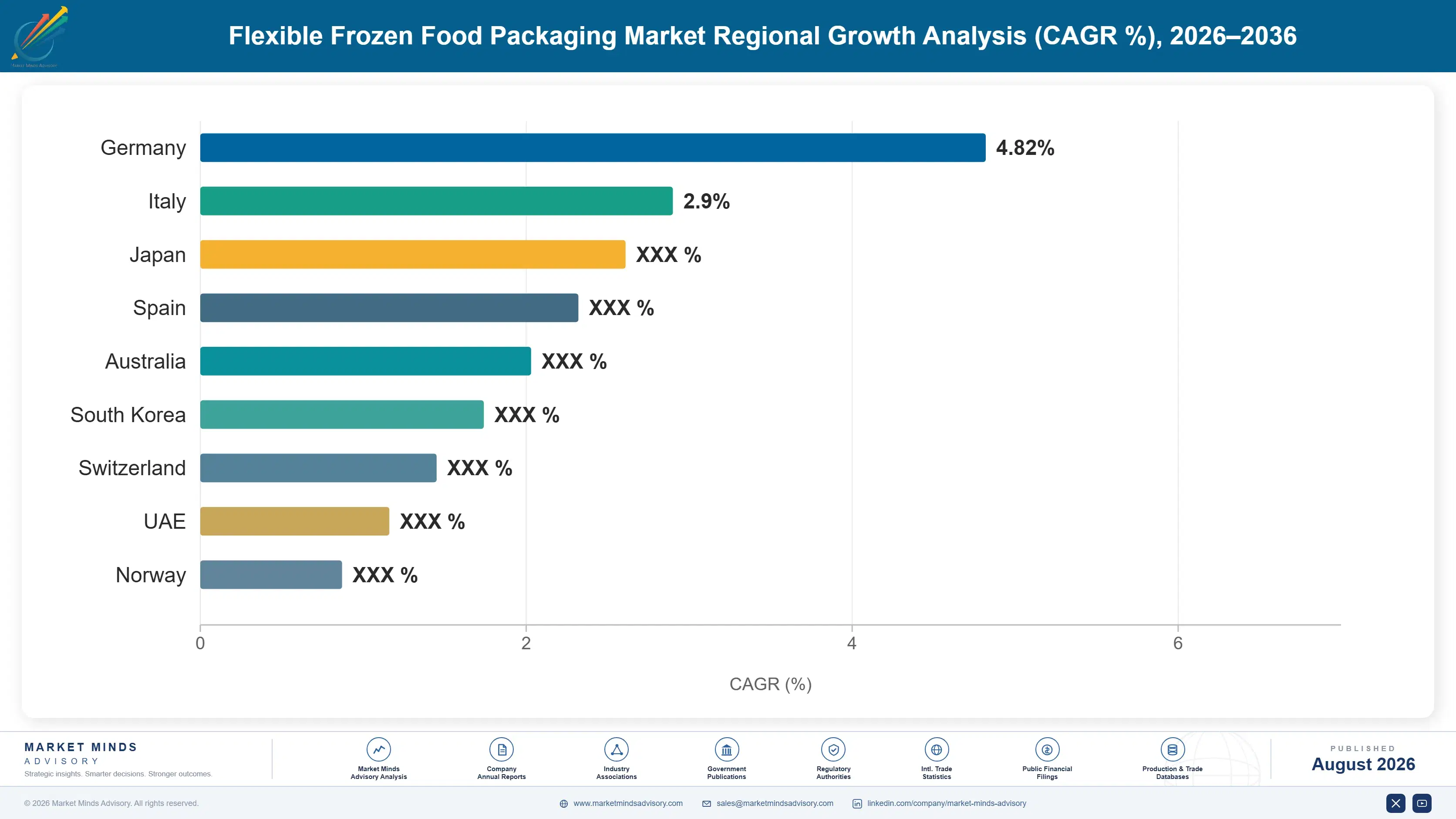
Germany and France anchor regional demand through extended producer responsibility fee schedules that directly penalize non-recyclable packaging formats, a policy structure now pushing brand owners across the bloc toward mono-material conversion faster than any comparable market globally. The United Kingdom's plastic packaging tax, operating alongside the European Union's binding recyclability requirements even post-Brexit, adds a further layer of financial pressure favoring recyclable structures across British brand owners. The region's specification-conversion cycle economics favor established converters with proven recyclability certification over budget alternatives lacking documented compliance credentials. Growth trails East Asia and South Asia because the region's frozen food category is not expanding in raw volume terms, unlike the genuine consumption growth happening across parts of Asia.
Share: 19% | CAGR: 4.7% (2026 to 2036)
Regional intelligence for 5 additional markets available in the complete report: East Asia, South Asia and Pacific, Latin America, Middle East and Africa, Eastern Europe. Contact sales@marketmindsadvisory.com.
flexible-frozen-food-packaging-market-country-cagr-analysis-1787300570406

Where Packaging Converters Can Expand Margin

Converters face a market splitting between price-driven commodity film volume and specification-driven recyclable and high-barrier demand, creating several distinct paths to margin expansion beyond simply competing on price per kilogram across every brand contract, geography, and certification category served today across the wider sector, its buyers, and evolving standards worldwide each fiscal cycle tracked.

Certify Mono-Material Lines for Recyclability Standards

Engineering certification against established recyclability testing protocols opens access to premium European brand contracts that conventional multi-layer film converters cannot credibly bid against, since procurement teams increasingly specify proven recyclability certification explicitly in supplier qualification documents. Converters with proven mono-material certification report average selling prices roughly 28 percent above standard multi-layer product lines in these specification-driven segments. The certification investment is meaningful but pays back quickly once a converter wins its first several major brand contracts, since reference qualifications then become the credibility basis for future bids across the wider sector and its many brand relationships.
Market Impact: Mono-material ASP runs 28 points higher on average

Expand Quick Commerce Format Development Capability

Building dedicated small-format pouch development capability captures the fastest-growing segment of quick commerce delivery packaging, a market previously served inefficiently by scaled-down versions of traditional retail pouch production lines poorly suited to smaller-format economics and durability requirements. Converters with dedicated quick commerce lines report order growth roughly 3 times faster than their traditional retail segment, since delivery platform brand partners value speed of format iteration highly. The capital investment is meaningful but pays back quickly given how fast quick commerce frozen food volume is expanding across Asian and increasingly Western urban markets.
Market Impact: Quick commerce orders grow 3x faster on average

Offer Barrier Performance Testing as a Service

Providing brand owners with in-house barrier and shelf-life testing services alongside film supply builds switching costs and deepens customer relationships ahead of the next specification renewal cycle, since brand owners increasingly value converters who can validate recyclable structure performance before committing to a costly line changeover. Converters offering integrated testing report renewal rates roughly 14 points above supply-only relationships, since brand owners value the reduced qualification risk enough to justify a modest premium on the underlying film itself. This lever requires laboratory infrastructure that favors established incumbents over new entrants lacking the capability required to compete credibly.
Market Impact: Lifts contract renewal rate by 14 total points

Localize Converting Capacity Inside High-Growth Markets

Establishing converting facilities within India or Southeast Asia directly reduces import tariff exposure and shipping cost while positioning converters closer to the quick commerce brand owners driving the fastest regional demand growth in the category. Converters with local manufacturing presence report winning 2 to 3 times more regional brand contracts than pure exporters competing from outside, since proximity reduces lead times that matter disproportionately to fast-moving quick commerce brand partners. The upfront capital investment is substantial, but converters moving early are securing preferred supplier status before competitors catch up to the same regional opportunity now attracting additional investment nationwide.
Market Impact: Wins 2 to 3x more regional brand contracts

Who Controls the Margin Pool

Five companies hold 34 percent of the category, a concentration low enough that regional Asian and Eastern European converters compete credibly for meaningful volume against certified global incumbents. The gap between global leaders and regional challengers is widest in specification-driven recyclable and high-barrier segments, narrower in conventional commodity film where price per kilogram matters more than certification depth.
Competitive activity currently plays out across three dimensions: mono-material certification investment as converters race to capture European brand contracts, quick commerce format development to capture fast-growing Asian delivery channel demand, and local converting investment inside high-growth markets to capture regional brand contracts there. Global incumbents are increasingly acquiring regional converters rather than building local capacity from scratch, given how long organic market entry timelines typically run in this certification-dependent category.

Pressure is building most visibly from Chinese and Indian converters expanding export volume into Southeast Asia and Africa at price points European incumbents cannot match without local production presence. At the same time, specialized recyclable film converters are moving into adjacent conventional segments previously served by generalist producers, a shift that could meaningfully reshape competitive rankings within the next several years across both categories.
flexible-frozen-food-packaging-market-company-positioning-matrix-1787300570918

Competitive Moat and Risk Dimensions

AMCOR PLC

Moat: Global recyclability certification depth

Amcor's early investment in mono-material recyclable film technology, reinforced by proven certification across major European recyclability testing protocols, gives it credibility advantages that smaller converters struggle to replicate, particularly in large multinational brand owner contracts requiring documented compliance across every operating market and jurisdiction served.
AMCOR PLC

Risk: Price pressure from Asian entrants

Amcor's premium global positioning leaves it exposed in price-sensitive Asian and emerging market segments where Chinese and Indian converters increasingly compete on both price and improving barrier quality, forcing difficult decisions about where to defend margin versus where to concede volume entirely across contested export markets.
SEALED AIR CORPORATION

Moat: Barrier technology engineering depth

Sealed Air has built a reputation for barrier-leading film engineering that resonates strongly with brand owners managing moisture-sensitive and long-shelf-life frozen categories, giving it a genuine technical edge in specification-driven contracts where documented barrier performance outweighs upfront price considerations by a wide and growing margin.
SEALED AIR CORPORATION

Risk: Slower quick commerce format pivot

Sealed Air has been slower than some competitors to develop dedicated small-format pouch capability for quick commerce channels, risking share loss in the fastest-growing segment of the category to converters already embedded in those delivery platform brand relationships built over recent years of steady work.

Key Players

Amcor plc
Sealed Air Corporation
Berry Global Group Inc
Mondi plc
Sonoco Products Company

Others

Constantia Flexibles Group GmbH
Huhtamaki Oyj
Winpak Ltd
ProAmpac LLC
Coveris Holdings SA
Glenroy Inc
Uflex Limited
Cosmo Films Limited
Innovia Films Ltd
Toppan Inc
Toyo Seikan Group Holdings Ltd
Dai Nippon Printing Co Ltd
American Packaging Corporation
Printpack Inc
Wipak Group

Recent Developments

FEBRUARY 2026

Amcor Launches Certified Mono-Material Frozen Film Line

Amcor launched a new polyethylene-based mono-material film line specifically certified for frozen food barrier requirements, targeting European brand owners facing packaging waste regulation compliance deadlines and adding qualified production capacity across its Western European manufacturing network significantly ahead of the next enforcement milestone and compliance review scheduled.
Signal: Confirms mono-material certification as the required strategy for competing credibly in the European market successfully going forward.
OCTOBER 2025

Sealed Air Acquires Quick Commerce Pouch Specialist

Sealed Air completed the acquisition of a privately held small-format pouch developer specializing in quick commerce delivery packaging, adding durability-optimized production capability to its film portfolio across Indian and Southeast Asian brand accounts already under long-term supply agreements and existing multi-year renewal contracts signed previously with distributors.
Signal: Signals quick commerce packaging is shifting from a niche category to genuine strategic investment priority today across markets.
MAY 2025

Uflex Signs Distribution Agreement in Nigeria

Uflex Limited signed a multi-year distribution and technical support agreement with a Nigerian frozen food distributor, positioning the Indian converter to compete directly for growing West African frozen food packaging demand across the region's expanding cold chain infrastructure programs and adjacent regional markets nearby and beyond.
Signal: Marks accelerating Indian converter expansion into African frozen food packaging markets and distribution networks steadily each quarter.

Resin Feedstock and Barrier Coating Exposure

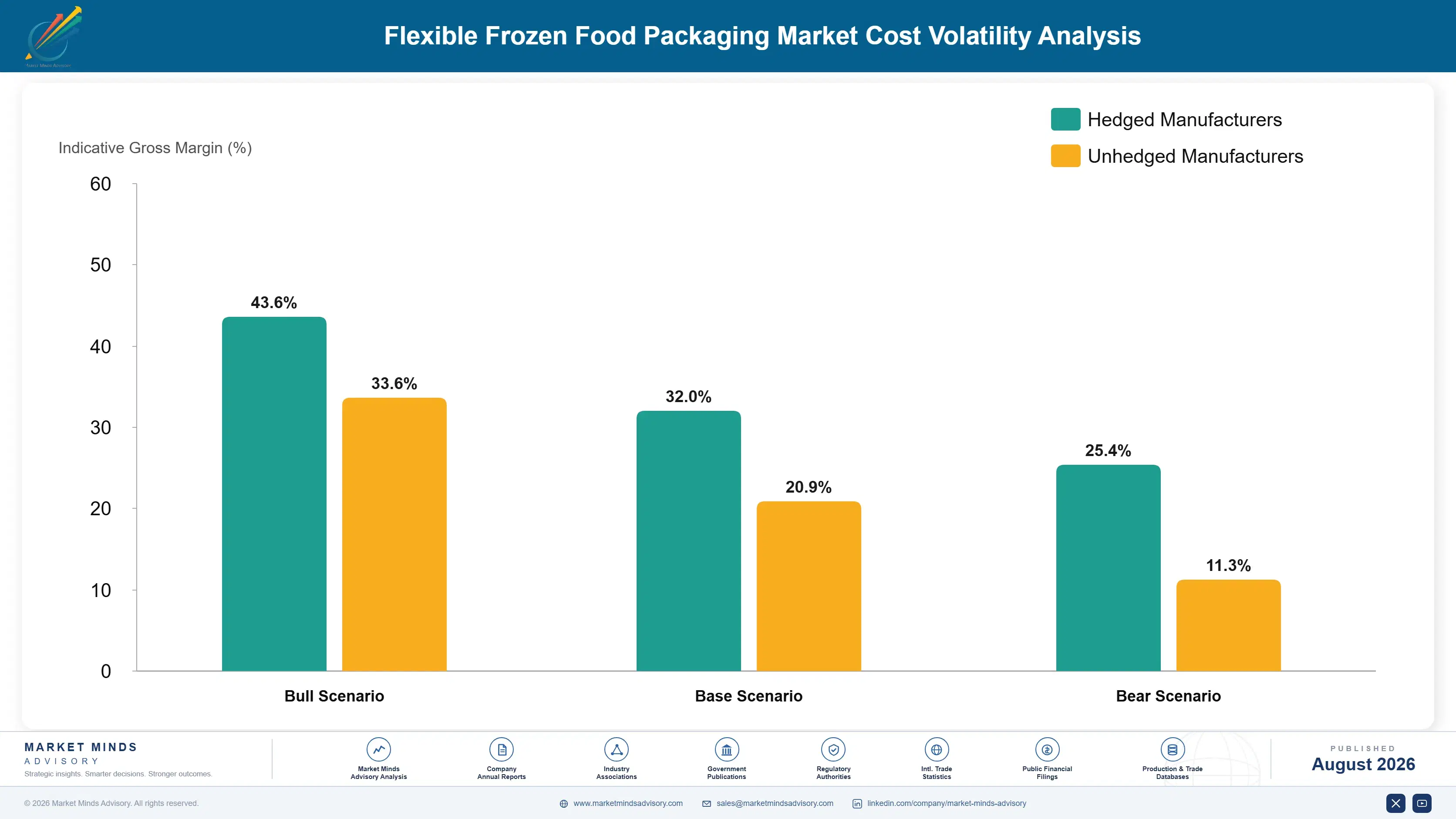
Polyethylene and polypropylene resin together represent roughly 38 percent of cost of goods sold for a typical flexible frozen food package, sourced primarily from petrochemical producers across the United States, China, and the Middle East. Specialty barrier coatings and adhesive layers add a further 15 percent combined, giving converters with diversified resin sourcing a genuine hedge against single-input price volatility that smaller specialists cannot avoid.
Polyethylene prices rose approximately 17 percent through 2024 as feedstock naphtha costs climbed alongside broader petrochemical demand recovery, according to Amcor's 2024 annual report, which specifically cited resin cost inflation as a meaningful margin headwind across its flexible packaging manufacturing operations globally. Barrier coating chemistry prices, tied closely to specialty chemical cycles, added a further layer of volatility converters had not historically needed to hedge simultaneously alongside base resin exposure.

Exposure varies considerably by converter scale. Large incumbents with long-term resin contracts and hedging programs have absorbed volatility more effectively than smaller regional converters on spot markets, widening the cost gap between global leaders and price-competitive entrants. Converters with diversified film portfolios spanning multiple barrier chemistries retain more pricing control than those dependent on a single resin type.
flexible-frozen-food-packaging-market-cost-volatility-analysis-1787300571113

Long-Term Resin Supply Contracts

Locking multi-year fixed-volume agreements with resin producers reduces spot market exposure meaningfully, though it requires balance sheet commitment that smaller regional converters often cannot match against larger incumbents with stronger credit access and negotiating leverage across global sourcing relationships spanning multiple petrochemical regions, currencies, and supplier networks simultaneously each fiscal year and renewal cycle tracked.

Barrier Technology Diversification

Expanding beyond a single resin platform into multiple mono-material and coating chemistries reduces aggregate feedstock dependency across the whole portfolio, a strategy several mid-sized converters have accelerated specifically in response to recent petrochemical price volatility across the category and its many exposed product lines, subsidiaries, and export markets worldwide today, this year, and going forward.

Resin Cost Pass-Through Clauses

Including quarterly resin price adjustment clauses in multi-year brand owner contracts protects margin against feedstock volatility between contract signing and actual production, a practice increasingly standard among larger converters but still resisted by some cost-conscious private label brand owners evaluating bids each budget cycle nationwide, regionally, and even beyond their own national borders too.

Portfolio Architecture for Margin Defence

Three tiers structure converter portfolios today, each serving genuinely different buyers with distinct purchasing logic and certification requirements applied at brand qualification stage across most accounts. Commodity-adjacent standard multi-layer film sits at the volume base with thin margins, certified recyclable mono-material and high-barrier structures occupy a specification-driven middle tier, and quick commerce-optimized and advanced coating systems anchor a next-generation tier where t
The tension between volume and premium shows up clearly in how converters allocate capital: regional players chase commodity film volume through aggressive price-per-kilogram competition while global incumbents concentrate investment in recyclability certification, barrier coating technology, and quick commerce format development that justify premium positioning against increasingly capable low-cost competitors entering steadily from Asia and elsewhere.

High-value margin pools concentrate in certified recyclable structures and quick commerce-optimized pouches carrying testing and technical service attachments, where gross margins run meaningfully above the category average across nearly every tracked region and tender type reviewed regularly. Standard commodity film increasingly competes on price alone as Chinese and Indian converting capacity continues expanding rapidly across export markets worldwide today and tomorrow.

Volume / Commodity-Adjacent Tier

Standard multi-layer film sold primarily on price per kilogram into private label and generalist retail contracts, with limited technical differentiation across most price-sensitive regional markets and distribution channels worldwide today.
Gross Margin: 14-20%

Premium / Certified Tier

Recyclable mono-material and high-barrier film structures carrying performance certification, positioned for brand contracts requiring documented recyclability data and multi-year supply commitments from established, well-capitalized converters with proven track records and references.
Gross Margin: 26-34%

Sustainability / Regulatory / Next-Generation Tier

Advanced mono-material coating systems and quick commerce-optimized pouches with proven durability credentials, priced at the top of the category range consistently across nearly every geography and tender category served by manufacturers today.
Gross Margin: 38-48%
flexible-frozen-food-packaging-market-portfolio-architecture-1787300571606

High-value Sub-segments and Strategic Watch-out

Certified Recyclable Mono-Material Film

Highest growth and highest margin combination anywhere in the category, favored wherever European packaging waste regulation requires proven recyclability credentials across major frozen food brand portfolios tracked closely by MMA analysts each fiscal quarter reviewed and updated regularly across the industry and its many buyers.
Gross Margin: 40-48%

Quick Commerce Optimized Pouches

Strong growth with solid margins, driven by rapid delivery platform expansion forcing brand owners toward durability-optimized formats that command meaningfully higher specification-driven pricing across most tracked Asian and Western urban markets today, across new emerging cities, dense suburbs, delivery zones, and distant outlying territories worldwide.
Gross Margin: 32-40%

Standard Multi-Layer Retail Film

The volume core of the category, generating stable revenue but facing continuous margin compression as Chinese and Indian converting capacity expands and price competition intensifies across every distribution channel and export territory served worldwide today and increasingly tomorrow as demand keeps growing steadily each quarter.
Gross Margin: 14-20%

Legacy Non-Recyclable Barrier Structures

A strategic watch-out segment: cheaper upfront but increasingly excluded from European brand tenders specifying recyclability, eroding demand for converters still relying on outdated multi-layer barrier methods broadly across smaller regional markets nationwide and internationally as well today across most national borders, jurisdictions, and regulatory regimes.
Gross Margin: 10-16%

Recurring Supply Contracts Anchor Category Volume

Flexible frozen food packaging demand behaves like a recurring supply relationship once a converter wins a brand owner's specification and passes machine qualification testing on production lines. A typical brand contract runs three to five years before renewal or reformulation triggers requalification, generating predictable recurring volume that dwarfs any single new product launch and that renews automatically as long as specification compliance holds firm.
Adoption depth varies sharply by end-use vertical across the category and its many distinct buyer types and channels. Large multinational brand owners adopt certified recyclable structures fastest because regulatory compliance and public sustainability commitments carry direct reputational consequences, private label manufacturers adopt more gradually as cost pressure competes directly with sustainability goals, and smaller regional brands lag furthest behind, often defaulting to whatever structure their converter recommended previously without revisiting it.

A generational shift is underway in buyer profiles: younger packaging procurement managers increasingly evaluate total lifecycle recyclability alongside cost per unit when specifying film structures, a meaningful departure from the pure cost-minimization purchasing pattern that dominated procurement for decades, and this cohort weighs certification depth far more heavily than their predecessors ever did before them.
flexible-frozen-food-packaging-market-end-use-penetration-index-1787300572093

Where MMA Sees the Category Heading

These are among the four positions where our research anticipates prominent divergence between winners and laggards over the coming forecast period. Each is grounded in the demand model, the regulatory perimeter, and the announced capacity pipeline.
01 / RECYCLABILITY CERTIFICATION STRATEGY

Converters without mono-material certification risk brand exclusion

European brand contracts increasingly specify recyclability certification as a baseline procurement requirement, not an optional premium feature converters can simply add later once demand materializes at scale. Any converter whose portfolio depends entirely on conventional multi-layer barrier film should expect to lose brand contract eligibility steadily across exactly the markets generating the most stable long-term revenue in Europe. Building genuine mono-material engineering credentials, not just badge-engineering existing products, is close to a survival requirement in these markets now and going forward.
02 / QUICK COMMERCE FORMAT INVESTMENT

Delivery-optimized pouches offer the most defensible growth path

Conventional retail film converting has become a genuinely commoditized business where price per kilogram increasingly decides contract outcomes regardless of brand reputation built over decades of prior client relationships across many markets. Quick commerce format development opens an entirely separate demand pool where durability and speed of iteration, not price, determine who wins the fastest-growing delivery platform brand contracts worth substantially more per relationship. Converters investing in this capability now are building genuine competitive moats before generalist competitors catch up to the same opportunity.
03 / LOCAL CONVERTING INVESTMENT

Asian brand eligibility increasingly requires local production presence

Quick commerce brand owners across India and Southeast Asia increasingly favor converters with local production presence given how disproportionately lead time matters to their fast-moving delivery business model and rapid product iteration cycles. Converters establishing local facilities now, ahead of competitors, are securing preferred supplier status that will be difficult and costly for latecomers to dislodge once firmly established across these regional brand relationships. This has become a genuine market access decision as much as a manufacturing cost decision for most global incumbents.
04 / RESIN COST MANAGEMENT

Feedstock exposure will keep separating winners from laggards

Rising resin and specialty coating prices driven by overlapping petrochemical and barrier chemistry cycles are compressing margins hardest for converters without long-term supply contracts or diversified technology portfolios in place already at scale. This cost asymmetry will keep widening the margin gap between well-hedged incumbents and exposed regional competitors over successive fiscal years and commodity cycles that lie ahead of us. Technology diversification and pass-through clauses both offer partial relief, but neither fully eliminates the underlying exposure facing the category overall today.

Engagement Snapshot From the Field

A live engagement with an industry participant carrying material or product regulatory and market exposure ahead of a defining policy shift, showing how our research translates into a defensible multi-year portfolio strategy.
MARKET MINDS ADVISORY · CLIENT ENGAGEMENT SUMMARY
Flexible Frozen Food Packaging Producer Strategic Portfolio Review and Transition Roadmap 2026·Investment Scenario on Flexible Frozen Food Packaging Exposure Evaluation 2025-26
CLIENT PROFILE
The client is a multinational frozen food manufacturer selling across fourteen European markets with annual packaged volume exceeding 280 million units (client-reported, unverified by MMA), operating a portfolio spanning entrees, vegetables, and premium meal categories that required substantial packaging conversion to meet approaching regulatory compliance deadlines and public sustainability commitments already announced to investors and consumers.
STRATEGIC CHALLENGE
The company faced escalating extended producer responsibility fees under multiple national schemes while its existing multi-layer barrier film portfolio had not been designed for the mono-material recyclability standards now increasingly required to remain compliant and cost-competitive against sustainability-focused private label competitors entering the market rapidly across most product segments today.
MMA APPROACH
MMA benchmarked the client's existing film portfolio against current recyclability standards, modeled total cost of ownership across three conversion pathways weighted by extended producer responsibility fee exposure and barrier performance risk, and evaluated converter partnerships including phased qualification timelines tied to measured shelf-life outcomes achieved during controlled multi-site testing programs.
KEY FINDINGS
  1. Roughly 62 percent of the client's SKU portfolio could convert to mono-material film without measurable shelf-life impact, based on converter testing data reviewed across comparable frozen categories and structures.
  2. Extended producer responsibility fee exposure for the unconverted portfolio share was projected to exceed conversion investment costs within three years across the company's largest European markets specifically.
  3. Machine compatibility testing revealed meaningful retrofit requirements at two of five manufacturing sites, a capital cost the original conversion timeline had significantly underestimated during initial planning.
  4. Consumer perception testing showed no measurable negative reaction to mono-material packaging changes, removing a commonly cited internal objection to accelerating the conversion timeline across the portfolio.
CLIENT PROFILE
The client is a multinational frozen food manufacturer selling across fourteen European markets with annual packaged volume exceeding 280 million units (client-reported, unverified by MMA), operating a portfolio spanning entrees, vegetables, and premium meal categories that required substantial packaging conversion to meet approaching regulatory compliance deadlines and public sustainability commitments already announced to investors and consumers.
STRATEGIC CHALLENGE
The company faced escalating extended producer responsibility fees under multiple national schemes while its existing multi-layer barrier film portfolio had not been designed for the mono-material recyclability standards now increasingly required to remain compliant and cost-competitive against sustainability-focused private label competitors entering the market rapidly across most product segments today.
MMA APPROACH
MMA benchmarked the client's existing film portfolio against current recyclability standards, modeled total cost of ownership across three conversion pathways weighted by extended producer responsibility fee exposure and barrier performance risk, and evaluated converter partnerships including phased qualification timelines tied to measured shelf-life outcomes achieved during controlled multi-site testing programs.
KEY FINDINGS
  1. Roughly 62 percent of the client's SKU portfolio could convert to mono-material film without measurable shelf-life impact, based on converter testing data reviewed across comparable frozen categories and structures.
  2. Extended producer responsibility fee exposure for the unconverted portfolio share was projected to exceed conversion investment costs within three years across the company's largest European markets specifically.
  3. Machine compatibility testing revealed meaningful retrofit requirements at two of five manufacturing sites, a capital cost the original conversion timeline had significantly underestimated during initial planning.
  4. Consumer perception testing showed no measurable negative reaction to mono-material packaging changes, removing a commonly cited internal objection to accelerating the conversion timeline across the portfolio.
RECOMMENDED STRATEGY
Phase 1: Phase 1 (Months 1 to 6): Convert the highest-fee-exposure 30 percent of the SKU portfolio to certified mono-material film at sites without retrofit requirements. Phase 2: Phase 2 (Months 7 to 18): Complete manufacturing site retrofits at the two flagged facilities while converting the next tier of moderate-complexity SKUs. Phase 3: Phase 3 (Months 19 to 30): Extend conversion to the remaining barrier-sensitive portfolio as advanced mono-material coating technology matures further.
OUTCOME
Within eighteen months of beginning portfolio conversion, the company reported measurably lower extended producer responsibility fee exposure and successful qualification of the majority of its European SKU portfolio on certified mono-material film (client-reported, unverified by MMA), while procurement staff reported greater confidence in long-term specification planning under the phased framework MMA helped establish.

Frequently Asked Questions

Foundational context covering the market sizes, CAGR, scope, country, region and competition that inform every finding below. This section is provided to cover basics and most often pre-purchase conversations, answered from the MMA Primary Research Dataset.

What is the current size of the Flexible Frozen Food Packaging Market?

The global flexible frozen food packaging market reached an estimated USD 12.4 billion in 2025, spanning stand-up pouches, rollstock film, vacuum skin packaging, and recyclable mono-material structures across retail and foodservice.

How large will the Flexible Frozen Food Packaging Market be by 2036?

MMA projects the market will reach approximately USD 24.28 billion by 2036, nearly doubling from its 2026 base as recyclability regulation and quick commerce growth both accelerate packaging demand.

What is the CAGR for the Flexible Frozen Food Packaging Market 2026 to 2036?

The base case CAGR is 6.3 percent, with a bull scenario of 7.5 percent and a bear scenario of 5.0 percent depending largely on resin feedstock cost trajectories.

Which segment is growing fastest?

Recyclable mono-material films are growing fastest at a 10.2 percent CAGR, roughly 1.62 times the overall market rate, as European packaging waste regulation accelerates conversion.

Who are the major companies in the Flexible Frozen Food Packaging Market?

Amcor, Sealed Air, Berry Global, Mondi, and Sonoco lead the category, together holding just over one third of global market share across all film structures.

Which country is growing fastest?

India is growing fastest at an estimated 9.2 percent CAGR, driven by rapidly expanding quick commerce delivery of frozen food across major metropolitan areas nationwide.

Report Segmentation Architecture

The full report scope spans multiple orthogonal segmentation dimensions, with cross-tabulated demand data provided for each dimension pair. Coverage extends further to regional breakdowns, trend trajectories, and the competitive detail needed to support segment-level decision-making.

By Packaging Format and Technology

  • Stand-Up Pouches
  • Flat and Pillow Pouches
  • Rollstock Film
  • Vacuum Skin Packaging Film
  • Recyclable Mono-Material Films
  • Shrink Film Wraps

By End-Use Category

  • Frozen Entrees and Meals
  • Frozen Vegetables and Fruit
  • Frozen Meat and Seafood
  • Frozen Bakery and Desserts
  • Frozen Snacks

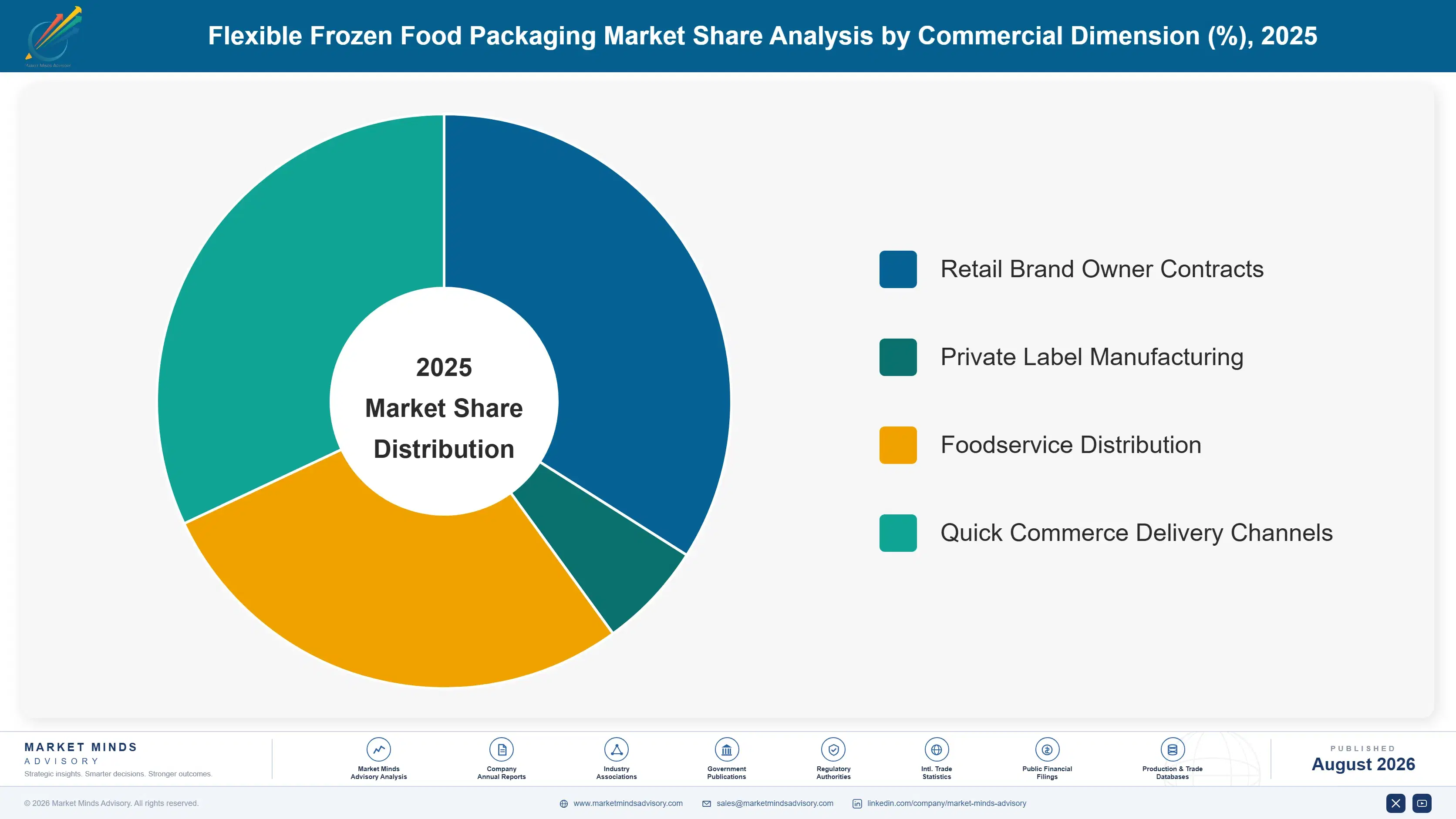
By Commercial Dimension

  • Retail Brand Owner Contracts
  • Private Label Manufacturing
  • Foodservice Distribution
  • Quick Commerce Delivery Channels

By Region

  • North America
  • Western Europe
  • East Asia
  • South Asia and Pacific
  • Latin America
  • Middle East and Africa
  • Eastern Europe

Scope, Methodology, and Coverage

Every figure in this report is reproducible from documented input assumptions. The scope below maps the historical period, the forecast horizon, the segmentation dimensions, and the countries covered, alongside the underlying primary and qualitative methodology.
Historical Period
2020 to 2025
Forecast Period
2026 to 2036
Base Year
2025 (USD billions; MMA Primary Research Dataset, August 2026)
Market Definition
The flexible frozen food packaging market covers flexible film and pouch structures used to package frozen food products for retail and foodservice distribution, spanning stand-up pouches, flat pouches, rollstock film, vacuum skin packaging film, recyclable mono-material films, and shrink film wraps. It excludes rigid trays, cartons, and semi-rigid containers not constructed primarily from flexible film.
Quantitative Units
USD billions (current prices); volumes in metric tons of converted film where applicable
Segmentation Dimensions
By Packaging Format and Technology; By End-Use Category; By Commercial Dimension; By Region
Regions Covered
North America, Western Europe, East Asia, South Asia and Pacific, Latin America, Middle East and Africa, Eastern Europe
Countries Covered
USA, China, Germany, France, UK, Japan, South Korea, India, Australia, Canada, Brazil, Mexico, Indonesia, Vietnam, Thailand, Malaysia, UAE, Saudi Arabia, South Africa, Nigeria, Turkey, Poland, Netherlands, Italy, Spain, Sweden, Switzerland, Argentina, Colombia, Singapore, and additional markets relevant to this sector
Key Companies Profiled
Amcor plc, Sealed Air Corporation, Berry Global Group Inc, Mondi plc, Sonoco Products Company, Constantia Flexibles Group GmbH, Huhtamaki Oyj, Winpak Ltd, ProAmpac LLC, Coveris Holdings SA, Glenroy Inc, Uflex Limited, Cosmo Films Limited, Innovia Films Ltd, Toppan Inc, Toyo Seikan Group Holdings Ltd, Dai Nippon Printing Co Ltd, American Packaging Corporation, Printpack Inc, Wipak Group
Quantitative Methodology
Primary survey, n=3,800 respondents, Q4 2025, six countries; demand-side model with trade association cross-validation
Qualitative Methodology
47 expert interviews, Q4 2025; applied to validate demand model assumptions, identify emerging dynamics, and assess competitive positioning
Report Format
PDF and XLSX data workbook (Word format preview document)
Publisher
Market Minds Advisory
Report Code
MMA-2026-PAC-104
Published
August 2026
Contact
sales@marketmindsadvisory.com | www.marketmindsadvisory.com

Purchase the full Flexible Frozen Food Packaging Market Report (2026 to 2036).

The full report delivers a complete competitive and commercial analysis of the flexible frozen food packaging market across all seven regions and six format segments tracked closely. It includes detailed company profiles for twenty converters, recyclability and extended producer responsibility policy tracking across major markets, and a ten-year forecast model with bull and bear scenario sensitivity built in. Buyers receive underlying segmentation data by country and format technology alongside the full qualitative analysis. A dedicated appendix tracks recent acquisitions, capacity expansions, and brand contract wins relevant to competitive strategy planning.
Ten-year revenue and volume forecast model
Recyclability and EPR policy tracker updates
Twenty-company competitive profile database and scorecard
Format-level segmentation broken out by country
Resin cost sensitivity model and forecast
Quarterly market update subscription option for buyers

Built For The People Who Decide

From boardroom strategy to bench-side execution, this report is read cover-to-cover by leaders shaping the next decade of their industry, turning demand scenarios, market dynamics and valuation benchmarks into decisions.
CXOs/ Presidents/ VPs/ Managers
M&A and Corporate Development
Strategy Teams and R&D Heads
Procurement and Product Directors
Regulatory and Compliance Leaders
Investor Relations and Equity Analysts