Market Minds Advisory
Flexible Colored PU Foams Market

Flexible Colored PU Foams Market: Grade Identification, Yellowing Chemistry, and the Recycling Problem Colour Creates

Colour in flexible foam is a manufacturing control, not decoration. Assembly lines use it to stop the wrong density reaching the wrong product, and pigment loading fights the exotherm the whole way.

Lead Analyst

Bilal Shaikh

Published

September 2026

Make Smarter Decisions with Customized Research Insights

Request a free sample report and evaluate market opportunities, growth trends, and competitive dynamics relevant to your business needs.

2025 MARKET VALUE$3.1BMarket Size 2025
2036 FORECAST VALUE$5.8BBase Case , 2026 to 2036
CAGR 2026 TO 20365.8 %Bull 7.0% / Bear 4.6%
INCREMENTAL OPPORTUNITY$2.5BNet 10- year value creation
EXPANSION MULTIPLE1.76x2036 value over 2026 base
Strategic Levers
M&A Pipeline
Regional Outlook
Country Rankings
Competitive Intelligence
Segmental Deep-dive
Call-Us : 91 93563 13602

Executive Snapshot and Market Trajectory

Most people assume coloured foam is about appearance. Inside a furniture or mattress plant it is a control system: colour tells an operator which density is in front of them, and that stops the wrong grade reaching the wrong product entirely. Appearance is very much a secondary benefit here.
Commercial advantage belongs to producers who hold shade consistency across a production run rather than those who simply add pigment, because bun-to-bun variance is what customers actually reject material for. Light-stable coloured foam grows fastest at 10.2%, roughly 1.76 times the market. East Asia holds the largest position at 32% of value, above the standard band, on furniture, mattress, and footwear manufacture concentrated there.
Concentration is low at roughly 26% for the top five, since foam is expensive to ship and regional converters serve nearby manufacturers effectively. Colour earns about 18% over natural grades. Aromatic systems yellow visibly after 260 hours of light exposure, which is why light-stable chemistry commands what it does. Extended producer responsibility rules are meanwhile penalising coloured foam for contaminating the rebond streams that recover only a fraction of the production scrap generated.
Market Definition
The market comprises flexible polyurethane foam produced with integral colour, covering conventional coloured slabstock, high-resilience coloured foam, viscoelastic coloured foam, coloured reticulated and filtration foam, moulded coloured foam, and light-stable coloured foam. Value is measured at foam producer level. Uncoloured flexible foam, rigid polyurethane foam and insulation board, surface-printed or laminated foam coloured after production, pigment and masterbatch supply sold separately, latex and other non-polyurethane foams, and finished furniture or mattress assembly fall outside scope.
Base Year Value
$3.1B in 2025 (MMA Primary Research Dataset, August 2026)
Forecast Period
2026 to 2036, eleven discrete annual values
CAGR
5.8% base case. Bull 7.0%. Bear 4.6%.
Fastest Growth Segment
Light-Stable Coloured Foam: 10.2% CAGR
Fastest Growth Country
Vietnam: 9.4% CAGR
Fastest Growth Region
South Asia and Pacific: 8.0% CAGR
Largest Region
East Asia: 32% of 2025 global value
Market Leaders
Carpenter Co, Recticel, Woodbridge Group, FXI, and Vitafoam lead on coloured flexible foam production revenue. Source: company annual reports and MMA Analysis, July 2026.
Primary Survey
n=3,800 procurement and R&D decision-makers, Q4 2025, six countries
Methodology
Demand-side build-up, cross-validated against public data, 47 expert interviews

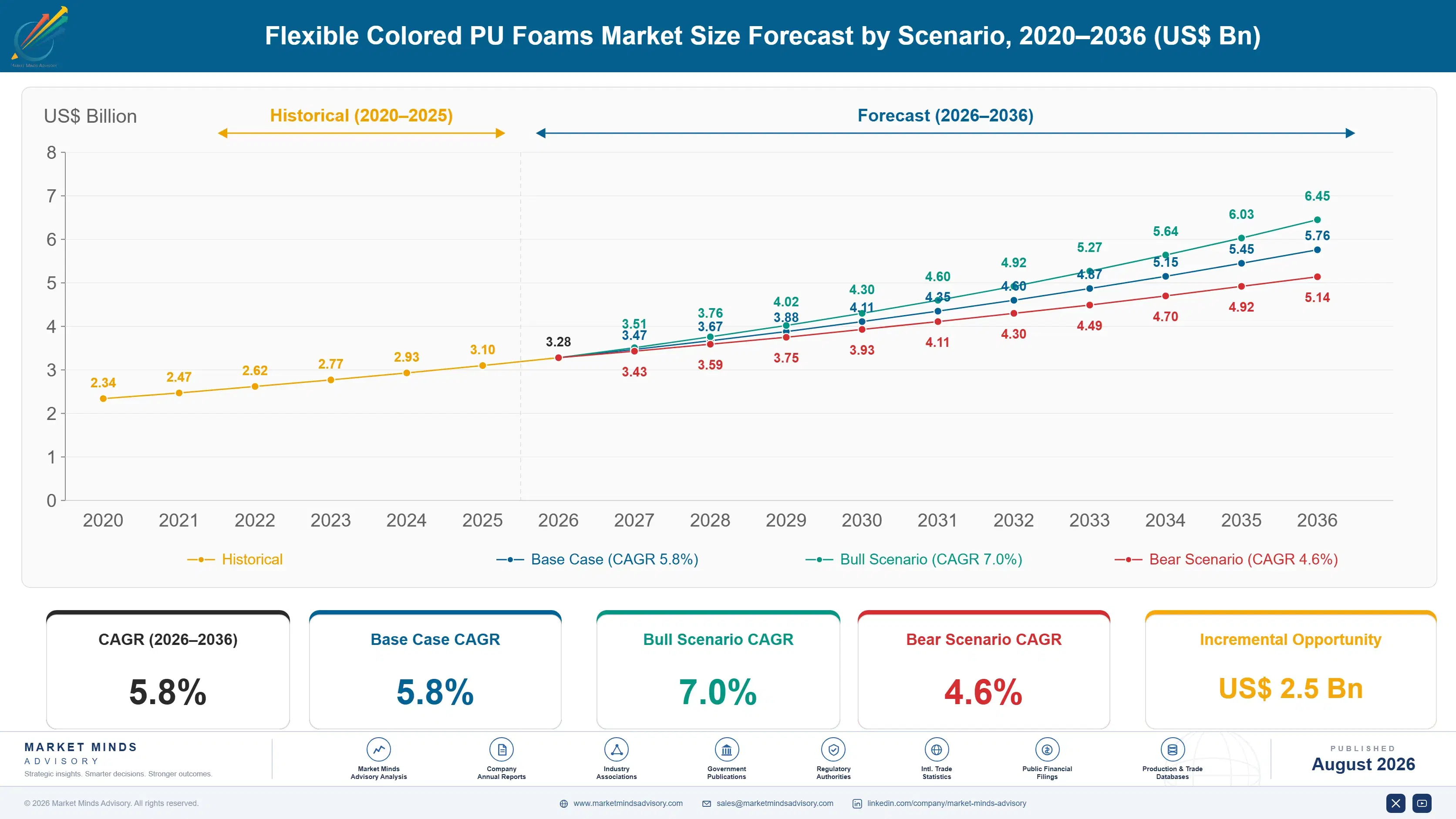
Flexible Colored PU Foams Market Forecast Scenarios

flexible-colored-pu-foams-market-trends-size-forecast-scenario-1787551367186
Between 2020 and 2025 furniture and mattress demand swung hard, first upward through a furnishing boom and then down as spending shifted back toward services. Coloured grades held better than natural through both movements, because the applications using colour are specified rather than commodity. Isocyanate and polyol pricing moved violently on energy costs. The 4.8% historical rate reflects a specified product riding out a cycle that hurt commodity foam more.
The 5.8% base case rests on three mechanisms. Cosmetic applicator, filtration, and packaging applications continue growing and each specifies colour functionally rather than aesthetically. Light-stable chemistry keeps expanding as manufacturers tire of pale products yellowing in showrooms and warehouses. And grade identification through colour is spreading across furniture and mattress plants as automation makes visual verification more valuable, not less. None of the three requires furniture demand to recover in any particular way.
The 7.0% bull case assumes light-stable formulation costs fall enough to reach mainstream furniture applications rather than remaining a premium specification. The 4.6% bear case reflects furniture demand weakness persisting, extended producer responsibility rules penalising coloured foam for its poor rebond recovery, and pigment cost increases squeezing an 18% premium that was never especially wide.

Colour as a Process Control

Adding colour to flexible foam is harder than it sounds because the pigment goes into the polyol stream and then sits inside a violently exothermic reaction. Loading above roughly 0.8% starts interfering with catalyst activity, cell structure, and core temperature. Get it wrong and the bun scorches, the cells collapse, or the shade drifts from top to bottom of a block that a customer will cut into a thousand identical parts.
TOP-FIVE CONCENTRATION26%Combined share of coloured foam output held by leading producers
COLOUR PREMIUM OVER NATURAL18%Uplift realised over equivalent uncoloured flexible foam grades
PIGMENT LOADING RATE0.8%Typical addition by weight into the polyol stream
BUN-TO-BUN COLOUR VARIANCE2.4 delta ETypical shade deviation achieved across a production run
LIGHT STABILITY FAILURE POINT260 hoursExposure before visible yellowing on conventional aromatic foam systems
REBOND RECOVERY RATE44%Portion of production scrap successfully recovered into rebonded product
Consistency rather than colour is what gets material rejected. A furniture manufacturer receiving buns at 2.4 delta E variance can work with it; one receiving visible shade steps between deliveries cannot, because the parts end up in the same visible assembly. That control problem is the actual product being sold, and it explains why the 18% premium over natural grades survives despite pigment costing almost nothing.
Yellowing is the unresolved problem underneath the whole category. Aromatic isocyanates, which is essentially all conventional flexible foam chemistry, discolour under ultraviolet light within around 260 hours of exposure. A white or pastel foam sitting in a lit showroom turns visibly yellow. Light-stable systems solve it at considerably higher cost, and that gap is where the fastest growth sits.
"Customers describe a colour complaint and what they actually have is a process complaint. Pigment is cheap and consistent pigment dispersion through an exothermic reaction at production speed is not, and the producers who understand that difference charge for it while everyone else argues about shade cards."
Practice Director, Polymer Foams and Cellular Materials · MMA Polyurethane Foams and Cellular Materials Practice · August 2026

Market Trends

Light-Stable Chemistry Answers a Long-Tolerated Failure

Conventional flexible foam uses aromatic isocyanates that yellow under ultraviolet exposure within roughly 260 hours, so a pale product in a lit showroom or a warehouse skylight discolours visibly well before it reaches a customer. Manufacturers tolerated this for decades because the alternatives cost too much. Aliphatic systems and improved stabiliser packages have narrowed that gap enough to reach premium furniture, medical, and cosmetic applications. Light-stable foam grows at 10.2%, fastest here, and the constraint is now cost rather than any technical question. Nobody in the industry complained about it for years.
Market Impact: East Asia holds 32% of value
Automated Assembly Increases the Value of Visual Grade Coding

Furniture and mattress plants running mixed grades through automated cutting and assembly rely on colour to prevent a 28 kilogram density part reaching a product specified for something else. Vision systems read colour more reliably than they read a printed label on a porous surface. That makes the coding function more valuable as automation increases rather than less, which several producers had assumed would go the other way. Colour coding is now specified in supply agreements rather than agreed informally between production managers. Several producers had expected exactly the opposite to happen.
Market Impact: Filtration grades grow at 7.4%

Market Opportunities and Growth Drivers

Asian Furniture and Footwear Manufacture Concentrates Demand

China, Vietnam, and Indonesia together manufacture the majority of the world's upholstered furniture and athletic footwear, and both use coloured flexible foam heavily for grade identification and for visible components. Vietnam grows fastest of any country at 9.4% as footwear and furniture production continues shifting there. East Asia holds 32% of value, above the standard regional band, on manufacturing concentration rather than consumption. Foam ships poorly, so producers follow the assembly plants rather than the end consumers. Producers who stayed with Chinese assembly clusters are watching customers relocate beyond their delivered-cost radius.
Market Impact: Recovery falls below 44% recycled

Functional Colour Applications Grow Faster Than Decorative Ones

Cosmetic applicators, colour-graded filtration media, electrostatic-safe packaging foam, and medical positioning products all specify colour for a functional reason rather than an aesthetic one, and none of them treats it as optional. Filtration grades in particular use colour to identify pore size on parts that look otherwise identical. Reticulated and filtration foam grows at 7.4% against a market rate of 5.8%. These applications also tolerate higher pricing, since the colour is doing work the customer can point to. Colour tolerance requirements are correspondingly stricter, since a shade error there implies a specification error rather than a cosmetic one.
Market Impact: Loading limited near 0.8% weight

Market Restraints and Challenges

Colour Ruins the Rebond and Recycling Route

Production trim and post-consumer foam are normally shredded and rebonded into carpet underlay and similar products, and colour carries straight through into a material buyers expect to look uniform. Recovery rates near 44% fall further where mixed colours are involved. The root cause is that pigment cannot be separated from the polymer at any sensible cost. Producers mitigate by segregating colour streams at the plant, by directing coloured scrap toward applications where appearance does not matter, and by pursuing chemical recycling routes that destroy the pigment along with everything else.
Market Impact: Yellowing appears after 260 hours

Pigment Interferes With an Exothermic Reaction

Loading above roughly 0.8% by weight begins affecting catalyst activity, cell structure, and core temperature inside a reaction that is already close to scorching itself. Deep shades therefore require loadings that push against the process rather than sitting neutrally within it. The root cause is chemistry rather than equipment. Producers mitigate through pigment chemistries selected for catalyst compatibility, through dispersion systems that achieve colour strength at lower loading, and by accepting shade limitations rather than forcing depth the foam formulation cannot carry. Deep shades are simply not available at every density.
Market Impact: Coding prevents 28 kilogram misplacement
4 additional market trends, 3 additional growth drivers, and 2 additional restraints and challenges are covered in the full report. Contact sales@marketmindsadvisory.com to access the complete intelligence.

Segment CAGR and Growth Architecture

Segmentation follows foam product type, because cell structure, resilience, and formulation chemistry determine which applications a grade serves and how colour behaves within it. Six types cover commercial supply, and the divide between conventional aromatic systems that yellow and light-stable chemistry that does not matters more commercially than any distinction between densities. Density matters far less than chemistry.
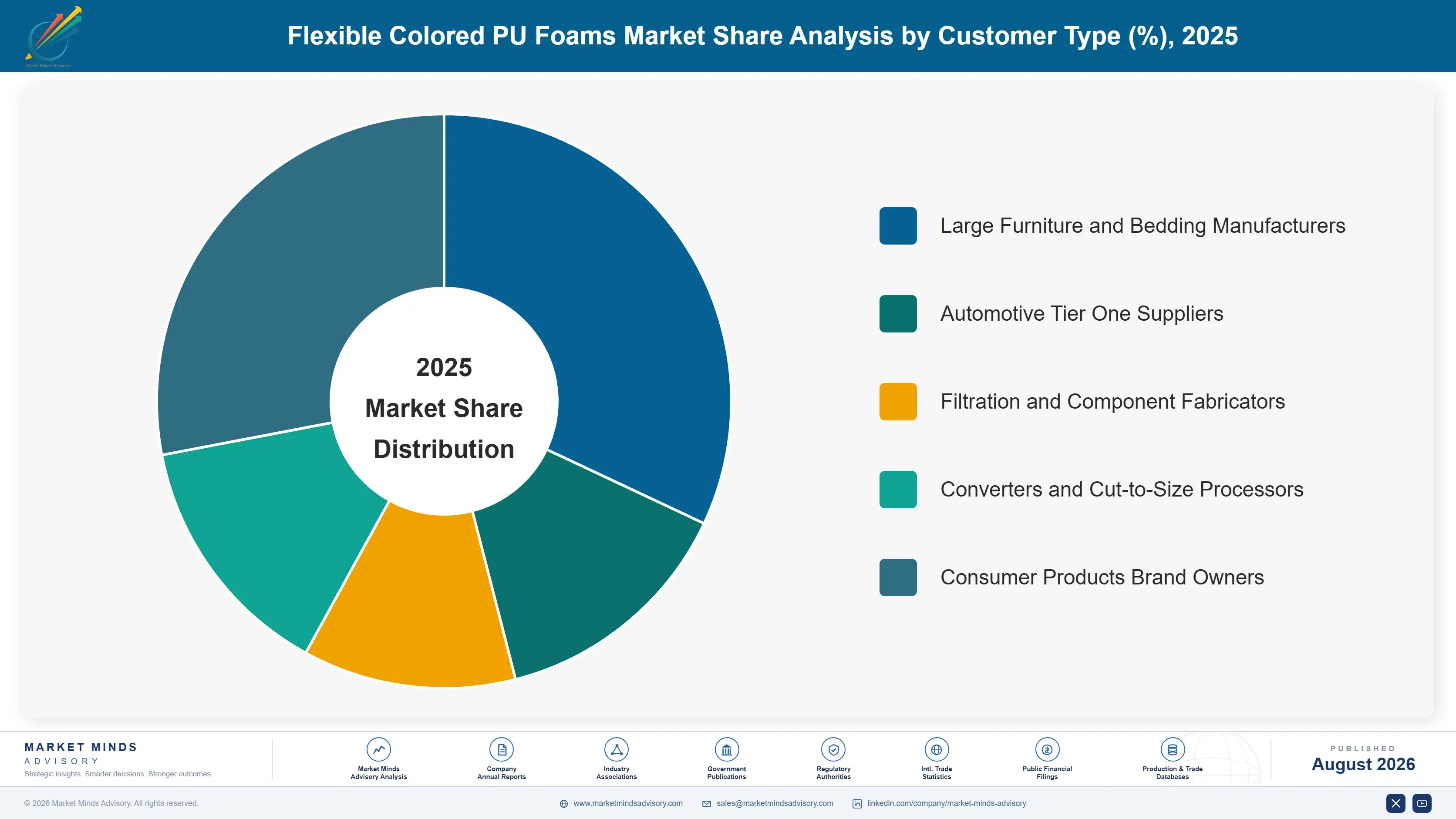
flexible-colored-pu-foams-market-trends-market-share-analysis-1787551367717

Light-Stable Coloured Foam

The fastest type at 10.2%, roughly 1.76 times the market, and the answer to a defect the industry lived with for decades. Aliphatic isocyanate systems and advanced stabiliser packages resist the ultraviolet yellowing that turns pale conventional foam visibly discoloured after around 260 hours of exposure. Premium furniture, medical devices, cosmetic applicators, and anything displayed under lighting drive the demand. Raw material cost remains considerably above conventional aromatic chemistry, which currently confines it to applications where visible discolouration is genuinely unacceptable rather than merely unwelcome. Formulation cost rather than technical capability is the binding constraint now. Producers without the formulation lose those applications outright rather than competing on price for them.
CAGR 10.2%

Coloured Reticulated and Filtration Foam

Second fastest at 7.4%, using colour to identify pore size and grade on parts that would otherwise look identical to an operator or an assembly line. Reticulation removes the cell windows to leave an open skeletal structure, and the colour has to survive that additional process without shifting or streaking. Air filtration, liquid filtration, acoustic applications, and horticultural media all specify these grades. Pricing tolerates more than decorative applications do, since the colour performs an identifiable function. Consistency requirements are stricter than in furniture, because a shade error implies a specification error. Horticultural and acoustic buyers add volume at lower tolerance, which gives producers a useful blend of demanding and forgiving business in the same grade family.
CAGR 7.4%
Full segment breakdown across 6 segments available in the complete report.

Regional Architecture and Country Demand Map

Regional shares follow furniture, mattress, and footwear manufacturing rather than consumption, because flexible foam ships badly and producers locate near assembly plants. East Asia sits above the standard band for reasons stated below, and every other region falls inside its range. Consumption maps poorly onto production everywhere here.

North America

Mattress and upholstered furniture manufacture drives most demand, with colour used extensively for density and firmness identification across plants running many grades simultaneously. Carpenter, FXI, and Future Foam operate regional networks close to their customers, since freight on a low-density product limits how far foam travels economically. Cosmetic applicator and medical positioning applications add higher-value volume at tighter colour tolerance. Automotive interior foam contributes steadily. Growth of 5.6% depends on furniture and bedding demand recovering rather than on any shift in how colour is specified across the region. Light-stable grades reach premium furniture and medical customers here, though mainstream bedding manufacturers still treat visible yellowing as an acceptable property of the material.
Share: 22% | CAGR: 5.6% (2026 to 2036)

Western Europe

Furniture manufacture has consolidated considerably and much upholstery assembly has moved eastward, which caps regional foam demand regardless of design trends. What remains is weighted toward specification-driven applications: medical, automotive interiors, filtration, and premium furniture where light stability genuinely matters. Recticel and Eurofoam hold established positions with technical depth. Extended producer responsibility rules on mattresses and furniture are furthest advanced here, which puts real pressure on coloured foam given its poor rebond recovery. Growth of 4.4% is the slowest anywhere, reflecting manufacturing migration more than any demand weakness. Light-stable chemistry has reached further into mainstream applications here than anywhere else, since retail display conditions and premium positioning both make yellowing commercially visible.
Share: 19% | CAGR: 4.4% (2026 to 2036)
Regional intelligence for 5 additional markets available in the complete report: East Asia, South Asia and Pacific, Latin America, Middle East and Africa, Eastern Europe. Contact sales@marketmindsadvisory.com.
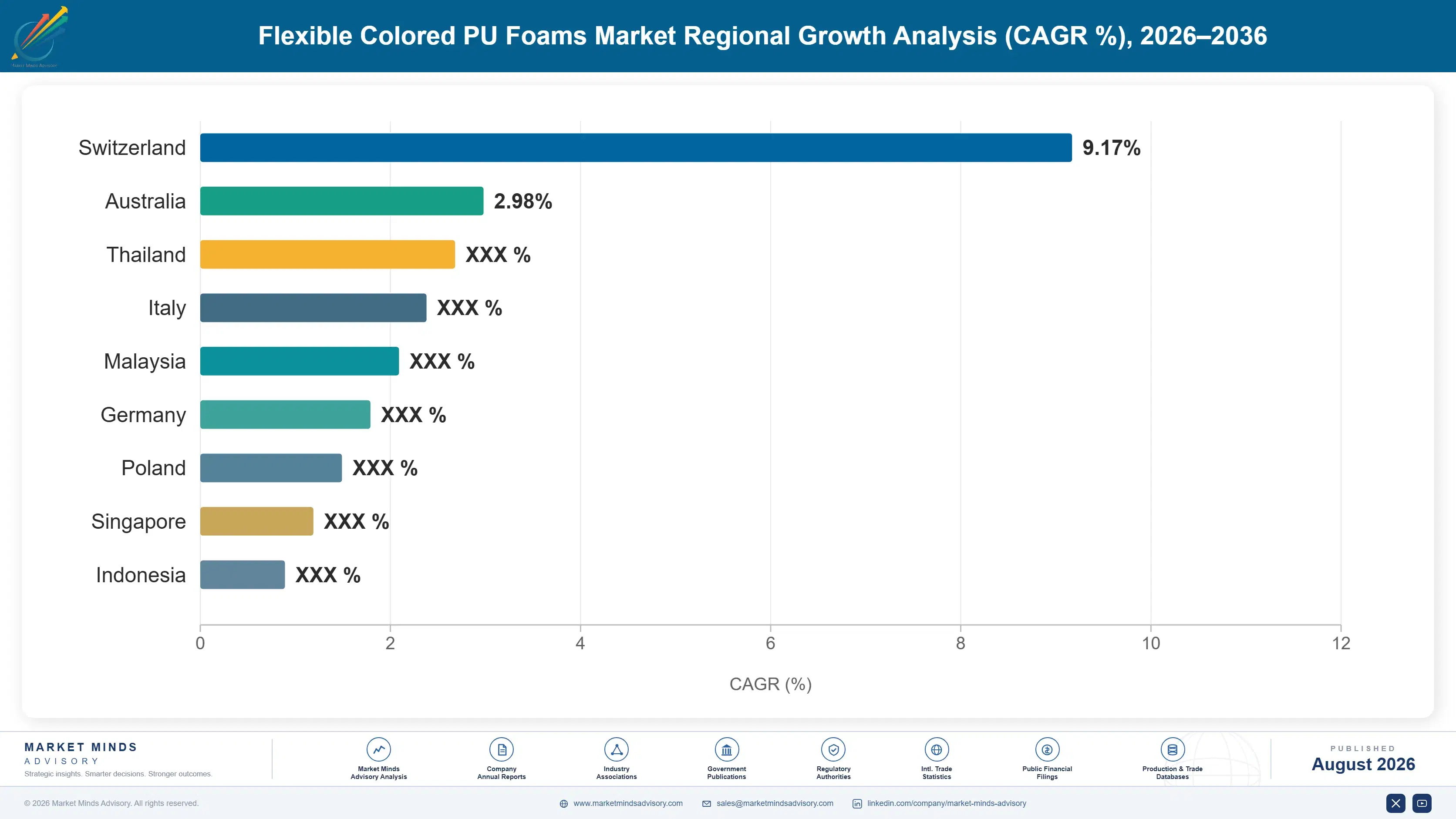
flexible-colored-pu-foams-market-trends-country-cagr-analysis-1787551368234

Four Moves Worth Real Capital

Advantage here comes from process control rather than pigment, from chemistry that solves a defect the industry stopped complaining about, and from applications where colour does identifiable work. Four moves justify capital across the forecast period, and the first is what customers are genuinely paying the premium for. Pigment cost is almost irrelevant to any of them.

Sell shade consistency rather than colour matching

Customers reject foam for variance between deliveries far more often than for missing a shade target, because parts from different buns end up visible in the same assembly. Holding 2.4 delta E across a production run is a process control achievement rather than a formulation one, requiring dispersion discipline, metering accuracy, and exotherm management. That capability is what sustains the 18% premium over natural grades. Producers competing on shade cards while their variance drifts are arguing about the wrong specification entirely. Metering accuracy and dispersion residence time are usually where the problem actually lives.
Market Impact: Sustains the entire 18% premium over natural grades

Build light-stable capability for displayed products

Aromatic foam yellows visibly after roughly 260 hours of ultraviolet exposure, which means pale products discolour in showrooms and warehouses before customers ever take delivery. Light-stable systems cost considerably more and grow at 10.2%, the fastest here. Premium furniture, medical, and cosmetic buyers already accept the price where visible discolouration is unacceptable. Producers without the formulation lose those applications entirely and keep explaining a defect they could have engineered around instead. Raw material cost is the remaining barrier rather than any technical question, and it has narrowed enough that mainstream furniture is now within reach for the first time.
Market Impact: The fastest grade is growing at 10.2% yearly

Target functional colour over decorative colour

Filtration grade identification, electrostatic-safe packaging, cosmetic applicators, and medical positioning all specify colour for reasons the customer can point to, which supports pricing that decorative applications never sustain. Reticulated and filtration foam grows at 7.4% against a market rate of 5.8%. Consistency requirements are stricter, since a shade error implies a specification error rather than a cosmetic one. Producers serving furniture alone are competing in the part of this market where colour is easiest to treat as optional. Qualification with a filtration or medical customer takes time and then holds, which is the opposite of how furniture accounts behave.
Market Impact: Functional grade demand is growing at 7.4% annually

Segregate colour streams before regulation forces it

Coloured trim contaminates rebond feedstock, and recovery rates near 44% fall further once mixed shades enter the stream, which extended producer responsibility rules are beginning to penalise directly. Segregating by colour at the plant costs handling discipline and storage rather than capital. Producers who organise this ahead of the rules keep their scrap saleable and can document recovery rates that customers under the same obligations increasingly ask about before placing any business. One rebond processor has already refused mixed-colour material outright, and others are expected to follow as their own customers tighten uniformity requirements.
Market Impact: Protects a 44% recovery rate on production scrap

Who Controls the Margin Pool

Concentration is low at roughly 26% for the top five on coloured foam output, and freight economics rather than any failure of consolidation explain it. Foam is bulky and light, so a regional plant beside an assembly cluster beats a distant producer on delivered cost regardless of scale. Carpenter operates the broadest North American network. Recticel holds European technical depth, Woodbridge is strong in automotive, FXI covers multiple applications, and Vitafoam anchors African supply.
Competition runs on three dimensions. Process control is the first and it decides shade consistency, which is what customers actually reject material for. Formulation capability is the second, particularly on light-stable and specialised grades. Proximity is the third and it is close to absolute, because delivered cost on a low-density product falls apart over distance.

Pressure is building from two directions. Extended producer responsibility rules are penalising coloured foam for contaminating rebond streams that recover only 44% of scrap. Regional producers in Asia and Eastern Europe compete effectively wherever assembly capacity has relocated. Rankings will shift toward producers holding light-stable capability and clean colour segregation rather than toward whoever runs the most slabstock lines.
flexible-colored-pu-foams-market-trends-company-positioning-matrix-1787551368755

Competitive Moat and Risk Dimensions

CARPENTER CO

Moat: Regional network beside customers

Carpenter operates plants positioned close to furniture and bedding assembly clusters, which matters enormously on a product where freight cost rises fast with distance and low density makes every truck expensive. That network is genuinely hard to replicate, since it requires capital in many locations rather than scale in one. Proximity also supports the delivery frequency grade-coded scheduling depends on.
CARPENTER CO

Risk: Furniture demand cycle exposure

Heavy weighting toward mattress and upholstered furniture ties results directly to a consumer durables cycle that swung violently through the past five years and remains difficult to forecast. Specification-driven applications in filtration, medical, and cosmetics hold up considerably better through downturns. Building position in those requires colour tolerance and formulation capability beyond what furniture customers have ever demanded.
RECTICEL

Moat: Formulation depth across specialised grades

Recticel brings genuine formulation capability across light-stable systems, reticulated grades, and technically specified applications where colour has to survive additional processing without shifting. That depth reaches customers whose alternatives are limited, rather than competing purely on delivered cost. European regulatory experience also positions it well as extended producer responsibility rules spread into other regions.
RECTICEL

Risk: European manufacturing migration

Much upholstered furniture assembly has relocated from Western Europe toward Poland, Romania, and Asia, which erodes the customer base sitting inside Recticel's strongest regional footprint. Following that capacity means competing against regional producers on their own delivered-cost terms. Technical differentiation matters less to a high-volume assembly plant than proximity and price do.

Players Tracked

Prominent Players

Carpenter Co
Recticel
Woodbridge Group
FXI
Vitafoam

Other Key Players

Future Foam
Sekisui Chemical
Rogers Corporation
Armacell
Eurofoam
Sheela Foam
INOAC Corporation
Nitto Denko
Zotefoams
UFP Technologies
Flexible Foam Products
Pacific Urethanes
Caligen Foam
Corpura
Otto Bock Kunststoff

Recent Developments

MARCH 2025

Furniture manufacturer writes colour coding into supply agreement

An upholstered furniture producer formalised density colour coding as a contractual supply requirement after automated cutting equipment misidentified grades read from printed labels on porous foam surfaces. Vision systems proved considerably more reliable reading integral colour than any surface marking method tested. Printed labels were abandoned entirely.
Signal: Automation is now making colour coding contractually specified rather than the informal plant convention it always was
JULY 2025

Producer commercialises light-stable grade for showroom furniture

A European foam producer launched a light-stable coloured grade aimed at furniture displayed under retail lighting, where conventional aromatic systems yellow visibly within a few hundred hours of exposure. Pricing sits well above conventional foam and early adoption came entirely from premium brands. Volume remains small so far.
Signal: Yellowing is being treated as a solvable defect rather than an accepted property of flexible foam
NOVEMBER 2025

Recycler declines mixed-colour foam scrap stream

A rebond processor stopped accepting mixed-colour production trim, citing contamination of carpet underlay output that customers expect to look uniform. Foam producers were asked to segregate by colour at source or accept materially reduced pricing on the scrap stream. Segregation costs handling discipline rather than capital.
Signal: Colour segregation is becoming a condition of scrap saleability rather than merely an optional handling discipline

What the Bun Actually Costs

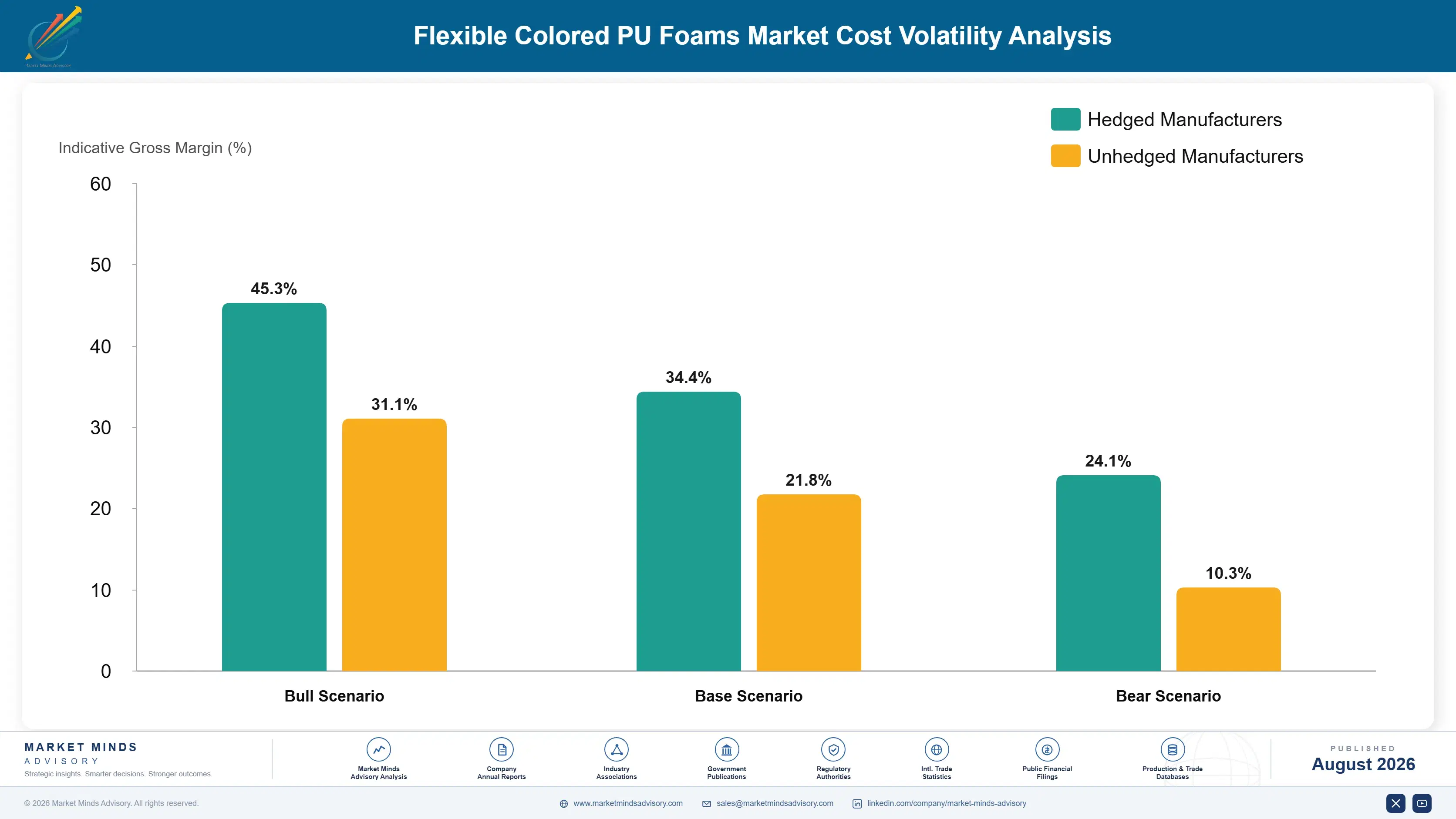
Polyol represents roughly 38% of production cost and isocyanate a further 29%, both derived from petrochemical feedstocks and supplied by a concentrated group including BASF, Covestro, Dow, and Wanhua. Pigment and colourant systems account for only about 4% despite defining the product commercially. Catalysts, surfactants, and auxiliaries take 7%. Energy, labour, and conversion absorb the remainder across cutting and handling operations.
Polyol and isocyanate pricing moved violently through 2021 and 2022 on feedstock and energy costs, and European producers faced the worst of it while Asian competitors saw far smaller increases. Recticel and Carpenter both discussed raw material cost pressure and pricing recovery in their reporting for those years. Pigment supply was largely unaffected, which meant the colour premium held in absolute terms while the base cost underneath it swung considerably.

Exposure divides on contract structure and region rather than on scale. Producers on quarterly indexed pricing with furniture customers passed most feedstock movement through. Those on annual agreements with large bedding accounts absorbed it entirely. European producers additionally carried energy costs that Asian and North American competitors simply did not face, which is part of why assembly capacity kept relocating during the period.
flexible-colored-pu-foams-market-trends-cost-volatility-analysis-1787551368949

Index foam pricing to published isocyanate references

Polyol and isocyanate together represent 67% of production cost and move on petrochemical cycles no producer controls, yet annual agreements with large accounts routinely fix foam pricing regardless. Quarterly indexation to published references transfers that volatility where it belongs. Customers facing the same exposure on every alternative supplier accept it more readily than commercial teams generally expect them to.

Achieve colour strength at lower pigment loading

Loading above roughly 0.8% by weight starts interfering with catalyst activity and cell structure, so dispersion quality rather than pigment quantity is what delivers shade depth without damaging the foam. Better dispersion systems reach the same colour at lower loading, which improves both process stability and cost. The pigment saving is minor and the process benefit is not.

Site production beside the assembly customers

Flexible foam is bulky and light, so freight cost rises steeply with distance and a truck carries very little value. Regional plants beside furniture, bedding, and footwear clusters beat distant producers on delivered cost regardless of manufacturing scale. This is why concentration stays near 26% and why following relocated assembly capacity matters more than expanding any existing site.

Portfolio Architecture for Margin Defence

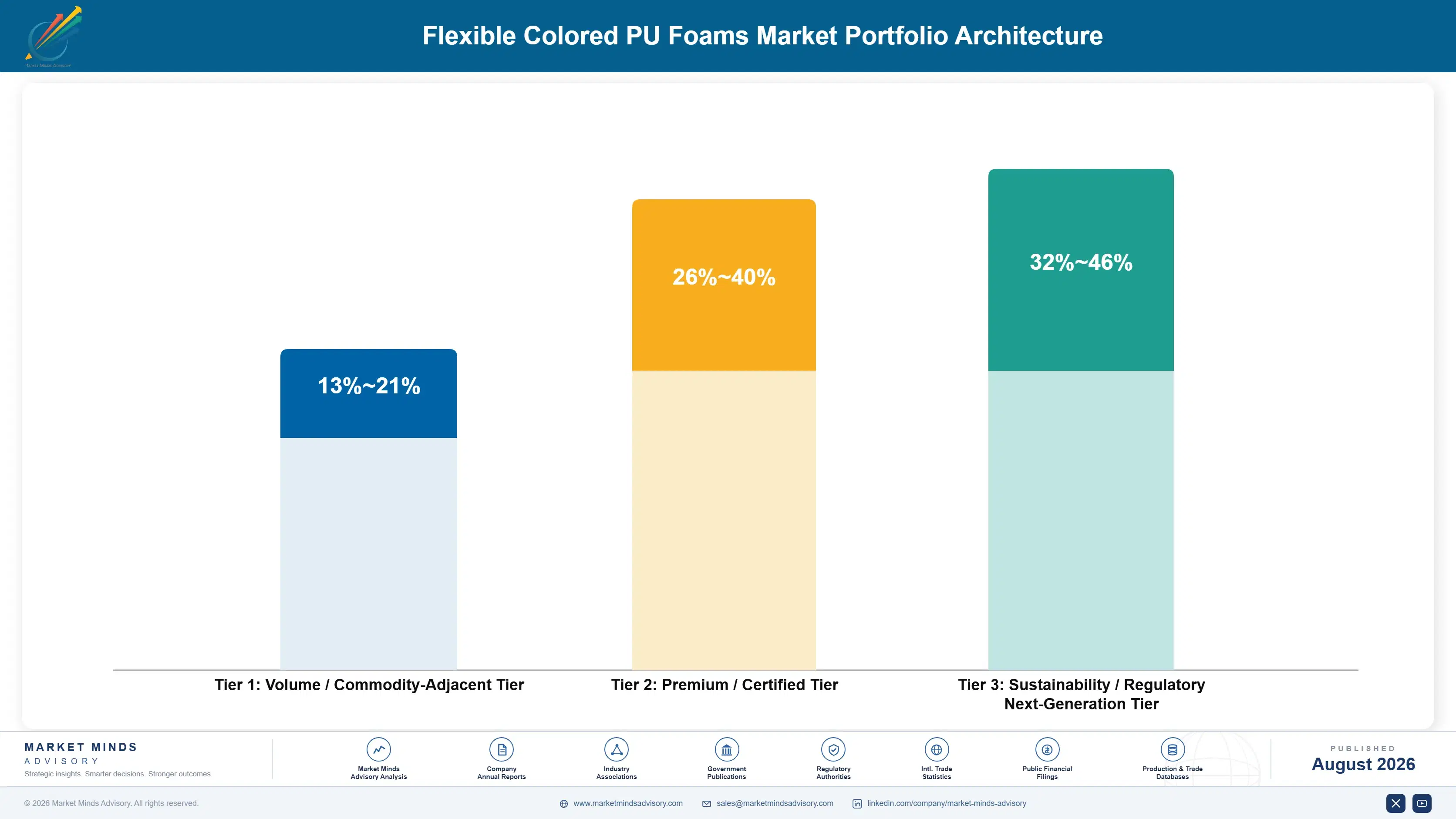
Margin architecture follows what colour is doing rather than how much of it there is. Decorative colour in commodity furniture foam earns barely above natural grades, because the customer treats it as a preference and shops on delivered price. Functional colour identifying filtration grades or packaging classes earns considerably more. Light-stable chemistry earns most, since it solves a visible defect competitors cannot engineer around cheaply.
The volume and premium tension sits between furniture and everything else. Furniture and bedding provide the tonnage that keeps slabstock lines loaded and the margins that make accountants uncomfortable. Filtration, cosmetic, medical, and packaging applications provide a fraction of the volume at several times the return. Producers organised entirely around furniture find their capacity utilisation excellent and their profitability disappointing. Utilisation and profitability are two different conversations here.

High-value pools concentrate in light-stable grades, functional colour identification in filtration and packaging, and shade consistency good enough that customers stop inspecting deliveries. Each is defended by formulation or process control rather than by scale, which is why concentration remains low while returns differ substantially between producers running similar equipment. Equipment tells you almost nothing about which producers are earning anything.

Volume / Commodity-Adjacent Tier

Conventional coloured slabstock into furniture and bedding where colour is preference or basic grade marking. Delivered cost decides outcomes and regional proximity beats scale. The premium over natural grades is genuinely thin here.
Gross Margin: 13%-21%

Premium / Certified Tier

Reticulated filtration grades, electrostatic-safe packaging, cosmetic applicator foam, and medical positioning products where colour identifies a specification. Tolerance requirements are stricter and pricing reflects it. The range spans several quite different application economics.
Gross Margin: 26%-40%

Sustainability / Regulatory / Next-Generation Tier

Light-stable systems resisting ultraviolet yellowing, and colour-segregated production supporting rebond recovery under producer responsibility rules. Formulation cost and handling discipline both defend position. The range is wide because light-stable and circularity economics differ completely.
Gross Margin: 32%-46%
flexible-colored-pu-foams-market-trends-portfolio-architecture-1787551369444

High-value Sub-segments and Strategic Watch-out

Light-Stable Coloured Grades

Growing at 10.2% by solving ultraviolet yellowing that appears within roughly 260 hours on conventional aromatic systems. Formulation cost rather than technical capability now limits how far down into mainstream furniture it reaches. Premium furniture buyers already accept the price wherever visible discolouration is genuinely unacceptable.
Gross Margin: 34%-46%

Functional Identification Grades

Filtration pore size marking, electrostatic packaging classes, and medical positioning all specify colour for reasons a customer can point to, which supports pricing decorative applications never sustain. Tolerance requirements are correspondingly stricter. Qualification with these customers takes real time and then holds for years afterwards.
Gross Margin: 28%-40%

Colour-Segregated Scrap Streams

Recovery near 44% falls further once mixed shades contaminate rebond feedstock, and producer responsibility rules are beginning to penalise that directly. Segregation costs handling discipline rather than capital and keeps scrap saleable. One rebond processor has already refused mixed-colour material outright, and others will follow.
Gross Margin: 24%-34%

Commodity Furniture Slabstock

The strategic watch-out. Colour adds a thin premium over natural, delivered cost decides every award, and regional producers beside the assembly plants hold advantages that no manufacturing scale overcomes at any distance. Following relocated assembly capacity matters considerably more than expanding any single existing site.
Gross Margin: 13%-21%

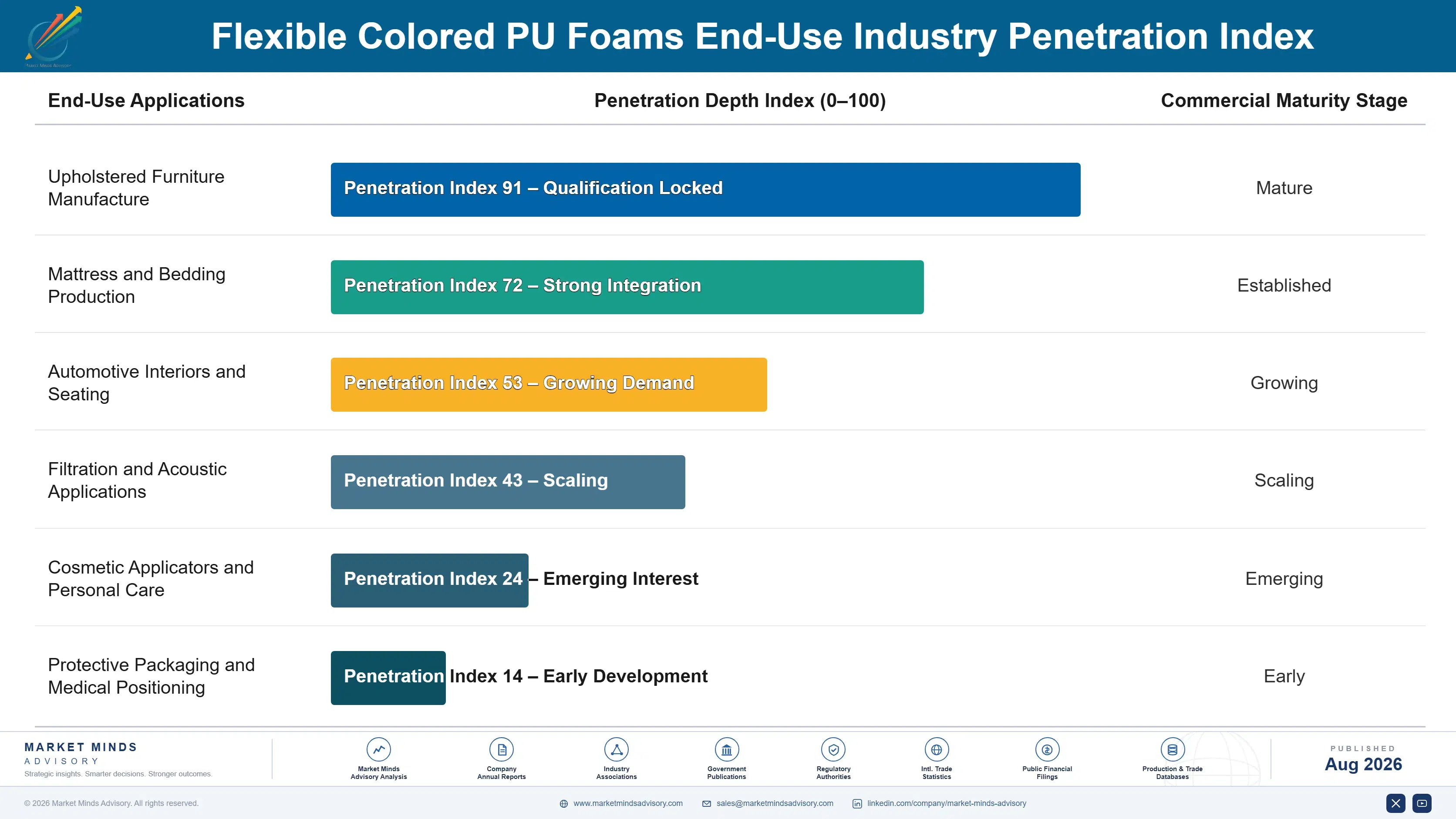
How Foam Volume Gets Placed

Demand reaches producers through relationships shaped almost entirely by geography. A furniture or bedding plant buys from foam suppliers within economic freight distance, which is usually a handful of options, and switches between them on delivered price and delivery reliability. Specification-driven customers in filtration, medical, and cosmetics buy on formulation capability and colour tolerance, will accept longer freight to get it, and change suppliers rarely because requalification costs them more than the foam does.
Stickiness follows tolerance requirements almost exactly. Medical and cosmetic customers hold through qualification. Filtration customers hold through grade identification conventions written into their own documentation. Furniture and bedding accounts hold until a nearer plant quotes lower, which happens whenever new capacity opens. Nothing about the foam itself holds a furniture account in place.

The deciding buyer differs sharply by application. Furniture procurement compares delivered cost per cubic metre and little else. Filtration and medical buyers involve technical functions who test colour stability, tolerance, and processing behaviour before anything gets specified. Producers selling the same way to both are winning one and losing the other every time. The same sales approach cannot serve both conversations credibly at once.
flexible-colored-pu-foams-market-trends-end-use-penetration-index-1787551369933

Where the Returns Sit

These are among the four positions where our research anticipates prominent divergence between winners and laggards over the coming forecast period. Each is grounded in the demand model, the regulatory perimeter, and the announced capacity pipeline.
01 / SHADE CONSISTENCY CONTROL

Sell variance discipline, not colour matching

Customers reject coloured foam for variation between deliveries far more often than for missing a shade target, because parts cut from different buns end up visible together in the same finished assembly. Holding around 2.4 delta E across a full production run is a process control achievement involving dispersion discipline, metering accuracy, and exotherm management rather than any formulation cleverness. That capability is what actually sustains the 18% premium over natural grades, and producers arguing about shade cards are debating the wrong specification.
02 / LIGHT STABILITY FORMULATION

Engineer out the yellowing everybody stopped mentioning

Conventional aromatic foam chemistry discolours visibly under ultraviolet exposure within roughly 260 hours, which means pale products yellow in showrooms and lit warehouses well before a customer ever takes delivery of them. Light-stable systems solve it at higher raw material cost and grow at 10.2%, the fastest rate in this market by a wide margin. Premium furniture, medical, and cosmetic buyers already pay for it where visible discolouration is genuinely unacceptable, and producers without the formulation simply lose those applications altogether.
03 / FUNCTIONAL COLOUR POSITIONING

Chase colour that does identifiable work

Filtration pore size marking, electrostatic-safe packaging classification, cosmetic applicators, and medical positioning products all specify colour for reasons the customer can point to directly, which supports pricing that decorative furniture applications have never once sustained. Reticulated and filtration grades grow at 7.4% against a market rate of 5.8% across everything else in this market. Tolerance requirements are stricter because a shade error there implies a specification error, and that difficulty is exactly what keeps competitors from following the move easily.
04 / COLOUR STREAM SEGREGATION

Sort scrap before the rules require it

Coloured production trim contaminates rebond feedstock that buyers expect to look uniform, and recovery rates near 44% fall further once mixed shades enter the stream at any point in the process. Extended producer responsibility rules are beginning to penalise exactly that, and one rebond processor has already refused mixed-colour material outright. Segregating by shade at the plant costs handling discipline and storage rather than capital, and it keeps scrap saleable while giving customers the recovery documentation they increasingly ask to see.

Engagement Snapshot From the Field

A live engagement with an industry participant carrying material or product regulatory and market exposure ahead of a defining policy shift, showing how our research translates into a defensible multi-year portfolio strategy.
MARKET MINDS ADVISORY · CLIENT ENGAGEMENT SUMMARY
Flexible Colored PU Foams Producer Strategic Portfolio Review and Transition Roadmap 2026·Investment Scenario on Flexible Colored PU Foams Exposure Evaluation 2025-26
CLIENT PROFILE
A European flexible polyurethane foam producer with revenue near EUR 190 million (client-reported, unverified by MMA), running slabstock lines supplying coloured and natural grades to furniture and bedding manufacturers. No light-stable capability existed, filtration and medical business was minimal, and shade complaints had risen for three consecutive years running. Colour was treated as a formulation question throughout.
STRATEGIC CHALLENGE
Furniture assembly customers were relocating eastward while regional competitors quoted below the client's delivered cost on remaining accounts. Shade variance complaints were being answered with formulation changes that did not address the problem. A rebond processor had begun discounting the client's mixed-colour scrap sharply. No filtration or medical qualification had ever been attempted.
MMA APPROACH
MMA traced shade variance to process rather than formulation causes across production records, sized filtration and medical opportunities within economic freight distance, and modelled light-stable capability against premium furniture demand. Forty-seven expert interviews with furniture buyers, filtration manufacturers, medical device makers, and rebond processors established what each application genuinely requires.
KEY FINDINGS
  1. Shade variance traced almost entirely to pigment metering accuracy and dispersion residence time rather than to formulation, and three years of reformulation work had addressed neither.
  2. Filtration and medical customers within economic freight distance were importing coloured grades from further away, because no regional producer offered the colour tolerance those applications require.
  3. The rebond discount on mixed-colour scrap already exceeded what segregated storage and handling would cost annually, and producer responsibility rules would widen that gap further.
  4. Two premium furniture brands had specified light-stable foam from a competitor after showroom samples yellowed, and the client had never been told why it lost the business.
CLIENT PROFILE
A European flexible polyurethane foam producer with revenue near EUR 190 million (client-reported, unverified by MMA), running slabstock lines supplying coloured and natural grades to furniture and bedding manufacturers. No light-stable capability existed, filtration and medical business was minimal, and shade complaints had risen for three consecutive years running. Colour was treated as a formulation question throughout.
STRATEGIC CHALLENGE
Furniture assembly customers were relocating eastward while regional competitors quoted below the client's delivered cost on remaining accounts. Shade variance complaints were being answered with formulation changes that did not address the problem. A rebond processor had begun discounting the client's mixed-colour scrap sharply. No filtration or medical qualification had ever been attempted.
MMA APPROACH
MMA traced shade variance to process rather than formulation causes across production records, sized filtration and medical opportunities within economic freight distance, and modelled light-stable capability against premium furniture demand. Forty-seven expert interviews with furniture buyers, filtration manufacturers, medical device makers, and rebond processors established what each application genuinely requires.
KEY FINDINGS
  1. Shade variance traced almost entirely to pigment metering accuracy and dispersion residence time rather than to formulation, and three years of reformulation work had addressed neither.
  2. Filtration and medical customers within economic freight distance were importing coloured grades from further away, because no regional producer offered the colour tolerance those applications require.
  3. The rebond discount on mixed-colour scrap already exceeded what segregated storage and handling would cost annually, and producer responsibility rules would widen that gap further.
  4. Two premium furniture brands had specified light-stable foam from a competitor after showroom samples yellowed, and the client had never been told why it lost the business.
RECOMMENDED STRATEGY
Phase 1: Phase one: fix pigment metering accuracy and dispersion residence time on existing lines, and stop pursuing formulation answers to a process control problem. Phase 2: Phase two: qualify colour tolerance for filtration and medical applications within freight distance, targeting customers currently importing from considerably further away. Phase 3: Phase three: develop light-stable capability aimed at premium furniture accounts, and segregate colour streams ahead of the tightening producer responsibility requirements now arriving.
OUTCOME
The client cut shade variance measurably within two quarters through metering and dispersion changes alone. Two filtration customers qualified, segregated scrap recovered its previous pricing, and blended gross margin improved 5.7 percentage points (client-reported, unverified by MMA). Light-stable development entered formulation trials at the same site shortly afterwards.

Frequently Asked Questions

Foundational context covering the market sizes, CAGR, scope, country, region and competition that inform every finding below. This section is provided to cover basics and most often pre-purchase conversations, answered from the MMA Primary Research Dataset.

What is the current size of the Flexible Colored PU Foams Market?

The market was valued at USD 3.1 billion in 2025, rising to an estimated USD 3.28 billion in 2026. East Asia holds the largest regional share at 32% of value.

How large will the Flexible Colored PU Foams Market be by 2036?

MMA forecasts USD 5.76 billion by 2036 under the base case, an expansion multiple of 1.76 times the 2026 value. That represents USD 2.48 billion of incremental value.

What is the CAGR for the Flexible Colored PU Foams Market 2026 to 2036?

The base case CAGR is 5.8%, with a bull case of 7.0% and a bear case of 4.6%. The spread reflects uncertainty over furniture demand and producer responsibility rules.

Which segment is growing fastest?

Light-stable coloured foam grows fastest at 10.2%, roughly 1.76 times the market rate, by resisting ultraviolet yellowing. Reticulated and filtration grades follow at 7.4% on pore size identification.

Who are the major companies in the Flexible Colored PU Foams Market?

Carpenter Co, Recticel, Woodbridge Group, FXI, and Vitafoam lead, holding roughly 26% between them. Freight economics keep concentration low because regional plants beat distant producers.

Which country is growing fastest?

Vietnam grows fastest at 9.4%, as athletic footwear and furniture assembly continues relocating there from China. Foam producers follow that assembly capacity because freight limits distant supply.

Report Segmentation Architecture

The full report scope spans multiple orthogonal segmentation dimensions, with cross-tabulated demand data provided for each dimension pair. Coverage extends further to regional breakdowns, trend trajectories, and the competitive detail needed to support segment-level decision-making.

By Foam Product Type

  • Conventional Coloured Slabstock Foam
  • High-Resilience Coloured Foam
  • Viscoelastic Coloured Foam
  • Coloured Reticulated and Filtration Foam
  • Moulded Coloured Foam
  • Light-Stable Coloured Foam

By End-Use Industry

  • Upholstered Furniture Manufacture
  • Mattress and Bedding Production
  • Automotive Interiors and Seating
  • Filtration and Acoustic Applications
  • Cosmetic Applicators and Personal Care
  • Protective Packaging and Medical Positioning

By Customer Type

  • Large Furniture and Bedding Manufacturers
  • Automotive Tier One Suppliers
  • Filtration and Component Fabricators
  • Converters and Cut-to-Size Processors
  • Consumer Products Brand Owners

By Region

  • North America
  • Western Europe
  • East Asia
  • South Asia and Pacific
  • Latin America
  • Middle East and Africa
  • Eastern Europe

Scope, Methodology, and Coverage

Every figure in this report is reproducible from documented input assumptions. The scope below maps the historical period, the forecast horizon, the segmentation dimensions, and the countries covered, alongside the underlying primary and qualitative methodology.
Historical Period
2020 to 2025
Forecast Period
2026 to 2036
Base Year
2025 (USD billions; MMA Primary Research Dataset, August 2026)
Market Definition
The market comprises flexible polyurethane foam produced with integral colour, covering conventional coloured slabstock, high-resilience coloured foam, viscoelastic coloured foam, coloured reticulated and filtration foam, moulded coloured foam, and light-stable coloured foam. Value is measured at foam producer level across furniture, automotive, filtration, personal care, packaging, and medical applications. Uncoloured flexible foam, rigid polyurethane foam and insulation board, surface-printed or laminated foam coloured after production, pigment and masterbatch supply sold separately, latex and other non-polyurethane foams, and finished furniture or mattress assembly fall outside scope.
Quantitative Units
USD billions (current prices); thousand tonnes of coloured foam produced annually; USD per cubic metre by grade and density
Segmentation Dimensions
By Foam Product Type; By End-Use Industry; By Customer Type; By Region
Regions Covered
North America, Western Europe, East Asia, South Asia and Pacific, Latin America, Middle East and Africa, Eastern Europe
Countries Covered
China, Vietnam, Indonesia, Japan, South Korea, Thailand, India, Malaysia, Australia, United States, Canada, Mexico, Germany, Belgium, Netherlands, France, Italy, Spain, United Kingdom, Denmark, Poland, Romania, Czechia, Hungary, Brazil, Argentina, Chile, Saudi Arabia, Egypt, South Africa
Key Companies Profiled
Carpenter Co, Recticel, Woodbridge Group, FXI, Vitafoam, Future Foam, Sekisui Chemical, Rogers Corporation, Armacell, Eurofoam, Sheela Foam, INOAC Corporation, Nitto Denko, Zotefoams, UFP Technologies, Flexible Foam Products, Pacific Urethanes, Caligen Foam, Corpura, Otto Bock Kunststoff
Quantitative Methodology
Primary survey, n=3,800 respondents, Q4 2025, six countries; demand-side model with trade association cross-validation
Qualitative Methodology
47 expert interviews, Q4 2025; applied to validate demand model assumptions, identify emerging dynamics, and assess competitive positioning
Report Format
PDF and XLSX data workbook (Word format preview document)
Publisher
Market Minds Advisory
Report Code
MMA-2026-CHM-359
Published
August 2026
Contact
sales@marketmindsadvisory.com | www.marketmindsadvisory.com

Purchase the full Flexible Colored PU Foams Market Report (2026 to 2036).

The full report sizes coloured flexible polyurethane foam demand across six product types, six end-use industries, and seven regions with 2026 to 2036 forecasts under base, bull, and bear cases. It separates decorative colour from functional grade identification, since the two support entirely different pricing and are bought by different people inside the same customer. Competitive profiles cover twenty producers assessed consistently on coloured foam output revenue, formulation capability, and regional plant coverage. Cost analysis traces polyol, isocyanate, and pigment exposure against contract pricing structures. Commercial guidance addresses shade consistency, light stability, functional positioning, and colour stream segregation.
Six foam product types sized separately by region
Decorative colour separated from functional grade identification
Ultraviolet yellowing thresholds tested across aromatic systems
Rebond recovery rates modelled against colour contamination
Freight economics mapped as delivered-cost radius by region
Pigment loading limits assessed against exotherm and cell structure

Built For The People Who Decide

From boardroom strategy to bench-side execution, this report is read cover-to-cover by leaders shaping the next decade of their industry, turning demand scenarios, market dynamics and valuation benchmarks into decisions.
CXOs/ Presidents/ VPs/ Managers
M&A and Corporate Development
Strategy Teams and R&D Heads
Procurement and Product Directors
Regulatory and Compliance Leaders
Investor Relations and Equity Analysts