Market Minds Advisory
Flexible Barrier Films for Electronics Market

Flexible Barrier Films for Electronics Market: Flexible Barrier Films for Electronics Market: Defect Economics, Yield Pass-Through and Volumes That Arrived Late 2026 to 2036

A single pinhole across a square metre ruins the film, so yield rather than chemistry sets the price. Suppliers who priced on materials cost have been losing money on every good roll.

Lead Analyst

Published

September 2026

Make Smarter Decisions with Customized Research Insights

Request a free sample report and evaluate market opportunities, growth trends, and competitive dynamics relevant to your business needs.

2025 MARKET VALUE$1.4BMarket Size 2025
2036 FORECAST VALUE$4.8BBase Case , 2026 to 2036
CAGR 2026 TO 203611.5 %Bull 12.8% / Bear 10.2%
INCREMENTAL OPPORTUNITY$3.2BNet 10- year value creation
EXPANSION MULTIPLE3.00x2036 value over 2026 base
Strategic Levers
M&A Pipeline
Regional Outlook
Country Rankings
Competitive Intelligence
Segmental Deep-dive
Call-Us : 91 93563 13602

Executive Snapshot and Market Trajectory.

A single pinhole across a square metre ruins the whole film, which means yield rather than chemistry sets the price in this business. Suppliers who costed their product on materials have been losing money on every good roll they ship. Materials are only about 23% of finished cost.
The market reaches USD 1.6 billion in 2026 and USD 4.8 billion by 2036, a 3.00 times expansion at 11.5% annually. Ultra-high barrier encapsulation films grow at 17.3%, half again the market rate of 11.5%, because flexible display encapsulation tolerates moisture ingress at levels no other application demands. East Asia holds 47% of consumption value, far above the usual band, on display manufacturing concentration. Supply is now the binding constraint.
Five suppliers hold 66% of consumption value, and the position rests on achieved yield rather than on any formulation advantage anybody holds. 3M, Toppan, Dai Nippon Printing, Mitsubishi Chemical and Amcor lead. Defect rate at web width is what separates a profitable line from an expensive one here. Reaching approved supply at a panel maker takes around 17 months of the customer's own process testing. Concentration has held steady across a full decade now.
Market Definition
This report covers flexible barrier films supplied into electronics manufacturing: ultra-high barrier encapsulation films for flexible displays and organic light emitting devices, moderate barrier films for flexible photovoltaic modules, transparent conductive barrier laminates, barrier films for flexible printed electronics and sensors, edge sealing and lamination adhesive films, and protective release liners supplied with them. It excludes rigid glass encapsulation, food and pharmaceutical packaging films, display polariser and optical films without barrier function, deposition equipment, and finished display or module assemblies.
Base Year Value
$1.4B in 2025 (MMA Primary Research Dataset, September 2026)
Forecast Period
2026 to 2036, eleven discrete annual values
CAGR
11.5% base case. Bull 12.8%. Bear 10.2%.
Fastest Growth Segment
Ultra-High Barrier Encapsulation Films: 17.3% CAGR
Fastest Growth Country
India: 18.7% CAGR
Fastest Growth Region
South Asia and Pacific: 13.6% CAGR
Largest Region
East Asia: 47% of 2025 global value
Market Leaders
3M, Toppan, Dai Nippon Printing, Mitsubishi Chemical and Amcor lead on flexible barrier film consumption value in electronics. Source: MMA Analysis.
Primary Survey
n=3,800 procurement and R&D decision-makers, Q4 2025, six countries
Methodology
Demand-side build-up, cross-validated against public data, 47 expert interviews

Flexible Barrier Films for Electronics Market Forecast Scenarios

flexible-barrier-films-for-electronics-market-size-forecast-scenario-1790000758088
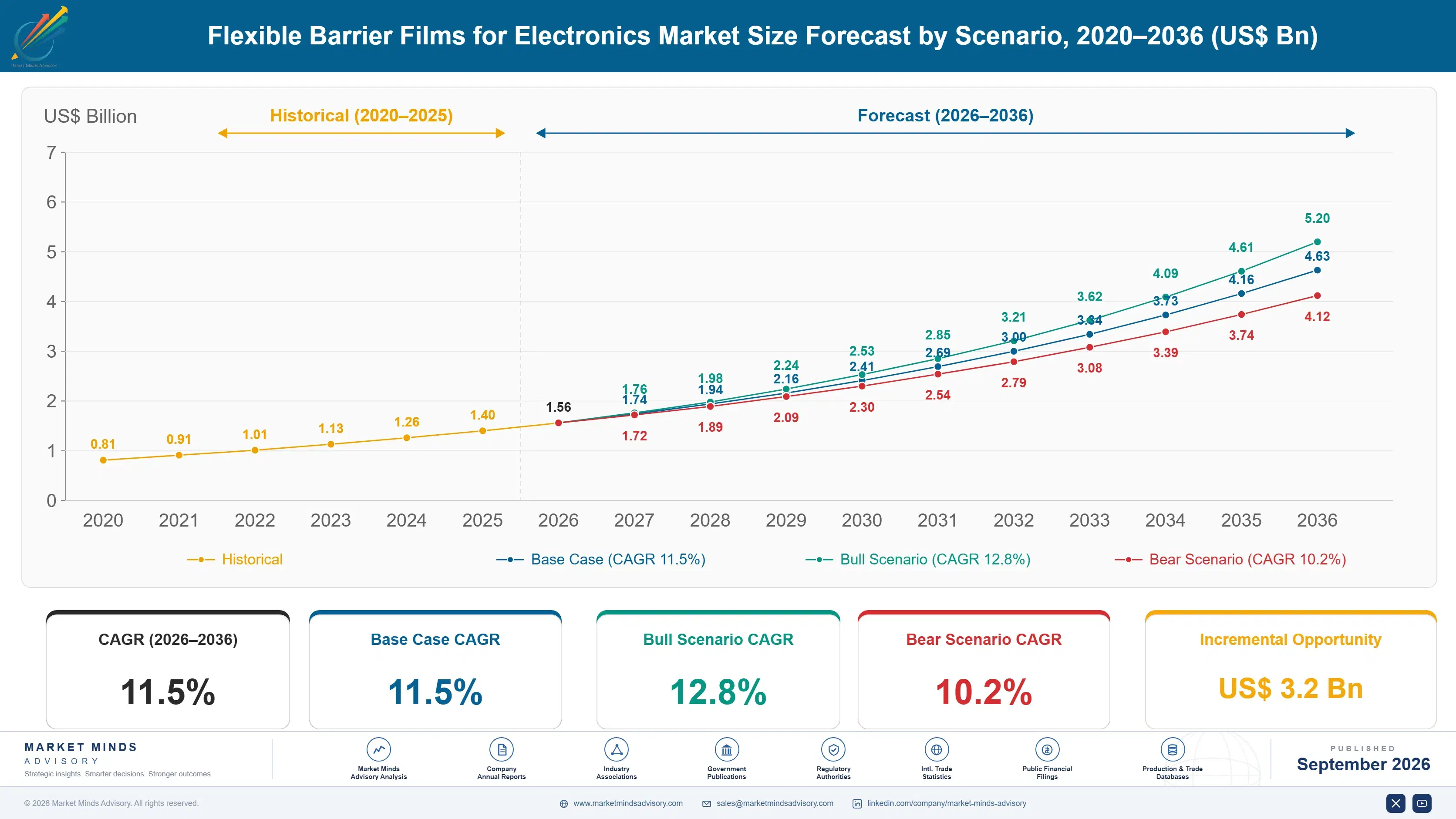
Between 2020 and 2025 the category compounded at 10.3%, and the disappointment was in timing rather than direction. Foldable device volumes arrived considerably later and smaller than the display roadmaps of the previous decade had promised. Suppliers who built capacity against those roadmaps carried it half-empty for years, and several exited before the volumes they had planned for finally began to appear.
The base case holds 11.5% on three mechanisms. Foldable and rollable display volumes are now genuinely growing rather than being forecast, which converts announced demand into shipped rolls. Flexible photovoltaic deployment keeps expanding into building-integrated and portable applications that rigid modules cannot serve. And printed electronics in sensing and medical applications keep requiring barrier performance that ordinary laminates do not reach at any price. Those three mechanisms run largely independently of one another.
The bull case at 12.8% assumes rollable and stretchable display formats reach commercial volume, since those require barrier films under mechanical stress that current encapsulation only partly addresses. The bear case at 10.2% is display capacity discipline, where panel makers slow flexible line additions and the film demand behind them softens well below what installed capacity was built to serve.

Yield Sets The Price

This is a defect business dressed as a chemistry business. Achieved yield on ultra-high barrier film runs near 58% of coated web area, and a single pinhole across a square metre renders that section unusable regardless of how good the formulation is. Materials account for only about 23% of finished cost, so materials-based pricing misses the number that matters.
TOP FIVE CONCENTRATION66%Held by suppliers who reached commercial yield before their competitors
ULTRA-HIGH BARRIER YIELD58%Coated web area passing inspection at the tightest permeation specification
MATERIALS COST SHARE23%Raw material content as a proportion of finished film cost
QUALIFICATION PERIOD17 monthsFrom sample submission to approved supply at a panel maker
WEB WIDTH STANDARD1,500 millimetresTypical coating width where defect economics become genuinely punishing
ENCAPSULATION SHARE OF PANEL9%Barrier film contribution to flexible display panel material cost
Qualification is the other thing customers underestimate. Reaching approved supply at a panel maker takes around 17 months from sample submission, because the film has to survive the customer's own process rather than a laboratory test. That period gates entry more effectively than any patent position, and it explains why five suppliers hold 66% of a market whose underlying chemistry is reasonably well understood across the industry.
Demand finally arrived, several years after it was promised. Foldable and rollable display volumes are growing rather than being forecast, and ultra-high barrier encapsulation films grow at 17.3% against 11.5% for the market. Barrier film represents around 9% of flexible panel material cost, which is small enough that panel makers will pay for reliability and large enough that they notice when a supplier cannot deliver it.
"Everybody in this business talks about permeation rates and the customers only really care about how many metres they can use. I have watched suppliers with better barrier performance lose contracts to competitors whose yield was ten points higher. The specification is the entry ticket, not the argument."
Director, Advanced Materials and Electronics Films Practice · MMA Chemicals and Materials Practice · September 2026

Market Trends

Defect Yield Rather Than Permeation Decides Contracts

Achieved yield on ultra-high barrier film runs near 58% of coated web area, and a single pinhole across a square metre renders that section unusable whatever the formulation achieves in a laboratory. Materials account for only around 23% of finished cost, so pricing on materials plus margin misprices the product badly. Suppliers with better permeation performance and lower yield lose contracts to competitors whose defect rate is simply better, and the customers are entirely right to choose that way. Yield improvement comes from accumulated process learning on the specific line rather than from equipment specification.
Market Impact: India compounds at 18.7% yearly

Volumes Arrived Years After The Roadmaps Promised

Foldable device volumes appeared considerably later and smaller than display roadmaps of the previous decade had projected, and suppliers who built capacity against those roadmaps carried it half-empty for years. Several exited before the demand they had planned for finally materialised. That history has made the surviving suppliers cautious about capacity, which now constrains supply as volumes genuinely grow. Ultra-high barrier encapsulation films grow at 17.3% against 11.5% for the market on demand that is real rather than announced. Supply is now the constraint rather than demand, which reverses the position this industry held for most of the past decade.
Market Impact: Barrier is 9% of panel cost

Market Opportunities and Growth Drivers

Flexible Display Capacity Additions Concentrate In Asia

India compounds at 18.7%, ahead of every other market, as domestic display and electronics assembly capacity is built rather than merely maintained, and barrier film demand follows panel capacity directly. East Asia already holds 47% of consumption value on the same mechanism operating at far larger scale. Suppliers positioned with panel makers in those markets reach qualification decisions years before the capacity produces anything, which is when qualification has to happen. Qualification decisions taken years ahead of production determine who supplies a line for its whole life, which is why proximity to new capacity matters so much commercially.
Market Impact: Qualification consumes 17 months

Printed Electronics Demand Barrier Performance At Scale

Printed sensors, medical patches and flexible logic increasingly require barrier performance that ordinary laminates cannot reach at any price, because the active layers degrade on contact with moisture. Those applications buy in smaller volumes than displays but qualify faster and accept higher pricing per square metre. Barrier film represents around 9% of flexible panel material cost, and considerably more in printed electronics where the substrate is a larger share of the finished product. Those customers also qualify in months rather than the year and a half panel makers take, which changes the cash profile of entering this market entirely.
Market Impact: Yield holds at just 58%

Market Restraints and Challenges

Qualification Timelines Delay Every Revenue Decision

Reaching approved supply at a panel maker takes around 17 months from sample submission, because the film must survive the customer's own process rather than any laboratory protocol. The root cause is that barrier failure shows up as panel failure months later, so customers test exhaustively. Commercially this delays revenue well beyond capacity investment. Mitigation runs through qualification on pilot lines before volume capacity is committed, through multi-customer sample programmes, and through printed electronics applications that qualify considerably faster. None of those shortens the panel maker's own testing; they fund the waiting period from somewhere else.
Market Impact: Yield runs near 58% of web

Capacity Investment Precedes Demand By Years

Coating capacity for ultra-high barrier film must be committed years before the panel volumes it serves actually arrive, and the previous cycle punished suppliers who did exactly that. The root cause is that panel roadmaps have historically overstated flexible display adoption timing considerably. Commercially this leaves capacity either idle or short. Mitigation runs through shared coating lines serving multiple barrier grades, through toll coating arrangements, and through capacity commitments tied to customer volume guarantees. The previous cycle taught the surviving suppliers caution, and that caution is now what constrains supply as volumes finally grow.
Market Impact: Encapsulation grows at 17.3%
3 additional market trends, 4 additional growth drivers, and 2 additional restraints and challenges are covered in the full report. Contact sales@marketmindsadvisory.com to access the complete intelligence.

Segment CAGR and Growth Architecture

Segmentation follows barrier grade and application function, since each carries quite different permeation requirements, achievable yield and qualification burden. Six classes cover the market: ultra-high barrier encapsulation films, transparent conductive barrier laminates, printed electronics barrier substrates, photovoltaic barrier films, edge sealing and lamination adhesive films, and protective release liners. Substrate chemistry and channel are separate dimensions handled elsewhere.
flexible-barrier-films-for-electronics-market-market-share-analysis-1790000758633

Ultra-High Barrier Encapsulation Films

Ultra-high barrier encapsulation films grow at 17.3%, half again the market rate of 11.5%, because flexible display encapsulation tolerates moisture ingress at levels no other application anywhere demands. Achieved yield runs near 58% of coated web area, and a single pinhole across a square metre ruins that section whatever the formulation achieves under test. That yield gap is what separates suppliers commercially rather than any permeation difference, and it is why five participants hold 66% of a market whose underlying chemistry is reasonably well understood across the whole industry. Defect control comes from production learning on a specific line rather than from equipment specification. Incumbency is consequently difficult to attack on chemistry alone.
CAGR 17.3%

Printed Electronics Barrier Substrates

Printed electronics barrier substrates compound at 14.6% because printed sensors, medical patches and flexible logic all degrade on contact with moisture and ordinary laminates cannot protect them at any price. These applications buy in far smaller volumes than displays, which suits suppliers who cannot reach display-scale coating widths at acceptable defect rates. They also qualify considerably faster than panel makers do and accept higher pricing per square metre, which makes them the practical entry route for suppliers building toward encapsulation credentials over several years. Revenue from those applications funds the qualification period rather than the balance sheet doing it, which is the difference between entrants who survive and those who run short.
CAGR 14.6%
Full segment breakdown across 6 segments available in the complete report.

Regional Architecture and Country Demand Map

East Asia holds 47% of consumption value, far above the usual band, because flexible display and electronics assembly capacity concentrates there to a degree no other materials market matches. North America follows at 18% on printed electronics and photovoltaic demand. India compounds fastest at 18.7% on new domestic capacity.

East Asia

East Asia takes 47% of consumption value, far above the 30% band ceiling, because flexible display and electronics assembly capacity concentrates here to a degree that no other advanced materials market matches at all. South Korean and Chinese panel makers between them consume the majority of ultra-high barrier film produced worldwide, and their qualification decisions effectively set supplier positions globally. Toppan, Dai Nippon Printing and Mitsubishi Chemical all supply from within the region. Growth at 12.4% runs above the global rate on panel capacity additions rather than any pricing movement. Domestic film producers are qualifying at those panel makers, which reaches the largest consuming customers directly. Proximity now decides marginal awards.
Share: 47% | CAGR: 12.4% (2026 to 2036)

North America

North America accounts for 18% of consumption value, weighted toward printed electronics, medical patches and flexible photovoltaic applications rather than display encapsulation. Those applications qualify considerably faster than panel makers do and accept higher pricing per square metre, which suits suppliers without display-scale coating capability. 3M supplies from here into both domestic and Asian customers. Growth at 11.9% sits above the global rate on printed electronics and medical applications rather than on any display manufacturing, which is minimal here. Regional buyers qualify considerably faster than panel makers do, which makes this the practical entry market for suppliers building toward encapsulation credentials over several years. Display encapsulation demand here is negligible.
Share: 18% | CAGR: 11.9% (2026 to 2036)
Regional intelligence for 5 additional markets available in the complete report: Western Europe, South Asia and Pacific, Latin America, Middle East and Africa, Eastern Europe. Contact sales@marketmindsadvisory.com.
flexible-barrier-films-for-electronics-market-country-cagr-analysis-1790000759155

Where Barrier Film Margin Sits

Defect yield rather than permeation performance decides contracts, qualification gates entry for well over a year, and the previous capacity cycle punished everybody who built ahead of demand. The four levers below follow those conditions rather than any argument about barrier chemistry, which is broadly understood. Each addresses a commercial condition rather than a technical one.

Price On Yielded Area, Not Materials Cost

Materials account for only around 23% of finished film cost while achieved yield on ultra-high barrier runs near 58% of coated web area. A supplier pricing on materials plus a margin is charging for roughly half the web it actually consumed and discovers the shortfall slowly across a contract. Pricing on yielded square metres rather than input cost is the single correction that turns a loss-making encapsulation line into a profitable one for most participants. A line at 58% yield writes off nearly half of everything it coats before anything ships.
Market Impact: Yield now runs near just 58% of web

Qualify On Pilot Lines Before Committing Capacity

Reaching approved supply at a panel maker takes around 17 months from sample submission, and the previous cycle punished suppliers who committed volume capacity against roadmaps that slipped repeatedly. Qualifying from pilot coating removes the timing risk almost entirely. Capacity then follows a qualified position rather than preceding a hoped-for one, which is the reverse of how most of this industry approached the last decade and paid for it. Pilot capacity costs a fraction of a commercial line and carries the same qualification weight with customers. Capacity then follows qualification.
Market Impact: Qualification now consumes a full 17 long months

Enter Through Printed Electronics Before Display Encapsulation

Printed sensors and medical patches qualify considerably faster than panel makers do, buy in smaller volumes and accept higher pricing per square metre. Barrier film represents around 9% of flexible panel material cost and considerably more of a printed electronics product. Suppliers building toward encapsulation credentials earn from those applications during the years qualification takes, rather than funding qualification entirely from balance sheet as most new entrants attempt to. Printed electronics customers qualify in under 6 months against the year and a half panel makers take. Balance sheet funding runs out first.
Market Impact: Barrier now carries a full 9% of panel cost

Share Coating Lines Across Multiple Barrier Grades

Coating capacity for ultra-high barrier film must be committed years ahead of the panel volumes it serves, and dedicating a line to one grade leaves it idle whenever that demand slips. Lines configured across encapsulation, photovoltaic and printed electronics grades carry utilisation through the timing gaps. The changeover cost is real, and it is considerably smaller than the cost of running a dedicated line at half capacity for several years. Line depreciation and vacuum operation absorb around 29% of cost whether or not the line is actually running. Changeover cost is comparatively small.
Market Impact: Materials are now only 23% of total cost

Who Controls the Margin Pool

Five suppliers hold 66% of flexible barrier film consumption value, and that position rests on achieved yield and qualification history rather than on any formulation advantage. 3M, Toppan, Dai Nippon Printing, Mitsubishi Chemical and Amcor lead. All participants are assessed on flexible barrier film consumption value in electronics applications rather than on broader materials or packaging businesses they also operate. Concentration has held through a decade in which the underlying chemistry was widely documented, which tells you what actually protects position.
Competition runs on defect rate at commercial web width and on qualification position far more than on stated permeation performance, which converges across serious suppliers. The second dimension is capacity discipline, because the previous cycle rewarded caution and several participants who built against display roadmaps exited before the volumes eventually arrived. Stated permeation performance competes a distant third.

Pressure is emerging from Chinese film producers qualifying at domestic panel makers, which reaches the largest consuming customers directly. Rankings shift where panel capacity is added and where printed electronics volumes grow, particularly across India, China and Western Europe over the coming decade. Suppliers operating at distance from panel capacity carry the most exposure to that qualification shift.
flexible-barrier-films-for-electronics-market-company-positioning-matrix-1790000759678

Competitive Moat and Risk Dimensions

3M

Moat: Coating Defect Control

3M holds coating and web handling capability delivering defect rates competitors have struggled to match at commercial width, and achieved yield near 58% separates a profitable encapsulation line from a loss-making one. That capability came from decades of precision coating across unrelated products. Competitors with equivalent chemistry and worse yield lose contracts they should win.
3M

Risk: Display Proximity Gap

Panel makers concentrate in East Asia and increasingly qualify domestic film producers who sit closer to their lines and respond faster to process issues. Qualification favours proximity once technical parity is reached. A supplier operating at distance from where 47% of consumption sits carries a disadvantage that coating capability alone does not offset over time.
TOPPAN

Moat: Panel Maker Qualification

Toppan holds qualification positions at the East Asian panel makers consuming most ultra-high barrier film produced worldwide, and those positions took around 17 months each to establish. Proximity to customer lines allows process issues to be resolved in days rather than shipments. Competitors must displace a qualified supplier rather than merely demonstrate a better film in a laboratory comparison.
TOPPAN

Risk: Domestic Competitor Entry

Chinese film producers are qualifying at domestic panel makers who consume a growing share of global volume, and those customers have policy as well as commercial reasons to prefer them. Qualification history protects existing positions and not new programme awards. Where panel capacity additions concentrate in China, incumbency reaches a smaller share of the growth than of the base.

Players Tracked

Prominent Players

3M
Toppan
Dai Nippon Printing
Mitsubishi Chemical
Amcor

Other Key Players

Toray Industries
Teijin
Kolon Industries
SKC
LG Chem
Sumitomo Chemical
Nitto Denko
Wacker Chemie
Coveme
Hanwha Solutions
Shanghai Huajing
Jiangsu Sidike
Tekra
Celplast Metallized Products
FlexEnable Materials

Recent Developments

MARCH 2025

Panel Makers Qualify Domestic Barrier Film Producers

Chinese panel makers qualified additional domestic barrier film producers for flexible display encapsulation, a supply qualification development rather than any corporate transaction. Qualification takes around 17 months from sample submission, and proximity to customer lines allows process issues to be resolved in days rather than across shipment cycles.
Signal: Qualification favours proximity once technical parity is reached, which incumbency alone does not offset at all.
SEPTEMBER 2024

Foldable Display Volumes Finally Reach Planned Levels

Foldable device shipments reached volumes that display roadmaps had projected several years earlier, a demand development rather than any corporate event. Suppliers who built capacity against the original timing carried it half-empty for years, and several exited before the volumes they had planned for actually materialised.
Signal: Capacity built against display roadmaps has historically arrived several years before the demand behind it did.
JUNE 2025

Printed Medical Electronics Expand Barrier Substrate Demand

Printed medical patch and flexible sensing manufacturers expanded barrier substrate procurement, an application development rather than any acquisition. Those applications qualify considerably faster than panel makers do, buy smaller volumes and accept higher pricing per square metre, which suits suppliers lacking display-scale coating width capability entirely.
Signal: Faster-qualifying applications fund the several years that display encapsulation qualification actually takes to complete properly today.

What A Barrier Film Costs

Raw materials including polymer substrate, barrier precursors and adhesives absorb roughly 23% of finished film cost, which is low for a materials product and explains why pricing on materials misleads. Coating line depreciation and vacuum system operation take around 29%. Yield loss absorbs about 27% on ultra-high barrier grades, and inspection, slitting and packaging take the remaining balance.
Specialty polymer substrate availability tightened through 2022 and 2023 as optical film demand competed for the same high clarity grades that barrier applications require. Toray Industries Annual Report 2024 and Mitsubishi Chemical Annual Report 2024 both record substrate availability and coating utilisation among principal operating variables. Suppliers holding multi-year substrate agreements maintained qualification-critical consistency that competitors buying on spot could not match at all. Substrate variation invalidates a qualification outright.

The competitive disadvantage mechanism is yield loss rather than materials price. A supplier at 58% yield writes off nearly half of everything it coats, while one operating ten points higher carries a cost structure competitors cannot approach through purchasing improvements. Exposure concentrates among newer entrants, since yield improvement comes from accumulated process learning on the specific line rather than from equipment specification or formulation quality.
flexible-barrier-films-for-electronics-market-cost-volatility-analysis-1790000759874

Improve Defect Yield Before Anything Else In The Process

Yield loss absorbs about 27% of ultra-high barrier film cost while raw materials take only around 23%, which makes defect reduction worth more than any purchasing programme could deliver. Improvement comes from accumulated process learning on the specific line rather than from equipment or formulation. That makes early production volume valuable in itself, independent of whether it is sold profitably.

Contract Specialty Substrate Supply Across Multiple Years

Polymer substrate is the largest single materials input and competes with optical film demand for the same high clarity grades from very few producers. Multi-year agreements secure both allocation and the batch consistency that qualification depends on. Substrate variation invalidates a qualification that took around 17 months to obtain, which makes spot purchasing far more expensive than its price suggests.

Configure Coating Lines For Multiple Barrier Grades

Coating line depreciation and vacuum operation absorb around 29% of cost regardless of whether the line runs, and dedicating capacity to one grade leaves it idle whenever that demand slips. Lines configured across encapsulation, photovoltaic and printed electronics grades hold utilisation through the timing gaps. Changeover cost is real and considerably smaller than running dedicated capacity at half load.

Portfolio Architecture for Margin Defence

Margin architecture separates on achievable yield rather than on formulation difficulty. Protective release liners and edge sealing films earn least, since both are conventional converting products competing on price. Photovoltaic barrier films sit above on volume and moderate specification. Ultra-high barrier encapsulation, printed electronics substrates and transparent conductive laminates earn most, because each combines punishing defect requirements with qualification barriers that take years.
The volume versus premium tension runs between display encapsulation and specialist applications, which reward opposite capacity behaviour entirely. Display encapsulation requires wide coating lines committed years before demand and punishes anybody whose timing is wrong. Specialist applications accept narrower width, qualify faster and pay more per square metre. Suppliers funding display capacity from specialist margin have the sequence right, and most attempt it the other way.

High-value pools concentrate in ultra-high barrier encapsulation and in printed electronics substrates, and neither is reached through formulation capability, which is broadly understood. Encapsulation requires defect control at commercial web width accumulated through production learning. Printed electronics requires qualification against application-specific degradation modes. Both explain why five suppliers hold 66% while the underlying chemistry is documented in the open literature.

Volume / Commodity-Adjacent

Protective release liners and edge sealing and lamination adhesive films, both conventional converting products competing largely on price against numerous suppliers. The eleven point spread separates converters running lines at high utilisation from those carrying capacity against uncertain film volumes.
Gross Margin: 18% to 29%

Premium / Certified

Photovoltaic barrier films and transparent conductive barrier laminates, where moderate permeation requirements and volume economics determine selection rather than the extreme specifications encapsulation demands. The thirteen point spread tracks achieved yield across each supplier's coating lines at commercial width.
Gross Margin: 34% to 47%

Sustainability / Regulatory / Next-Generation

Ultra-high barrier encapsulation films and printed electronics barrier substrates, each combining punishing defect requirements with qualification barriers taking well over a year. The sixteen point spread reflects defect control accumulated through production learning rather than equipment specification.
Gross Margin: 52% to 68%
flexible-barrier-films-for-electronics-market-portfolio-architecture-1790000760386

High-value Sub-segments and Strategic Watch-out

Ultra-High Barrier Encapsulation Films

Grows at 17.3% as foldable and rollable display volumes finally arrive after years of delay. The sixteen point spread reflects defect control at commercial width. Yield near 58% is what separates profitable lines from expensive ones here. Supply is now the binding constraint. Volumes finally arrived.
Gross Margin: 52% to 68%

Printed Electronics Barrier Substrates

Grows at 14.6% because printed sensors and medical patches degrade on moisture contact and ordinary laminates cannot protect them. The sixteen point spread reflects application qualification depth. These customers qualify faster and pay more per square metre. Entry route for most new suppliers. Qualification runs far shorter.
Gross Margin: 52% to 68%

Photovoltaic Barrier Films

Grows at 11.8% on building-integrated and portable module applications that rigid glass encapsulation cannot serve at all. The thirteen point spread reflects coating yield. Specification is far less punishing than display encapsulation demands. Volume economics matter more than extreme permeation performance here. Rigid glass cannot serve these.
Gross Margin: 34% to 47%

Protective Release Liners And Edge Sealing

Grows at 6.2%, slowest of the six classes, as conventional converting products competing on price against numerous capable suppliers. The eleven point spread reflects line utilisation. Volume follows barrier film shipments rather than driving any demand itself. Numerous converters compete for it. Pricing is the whole argument.
Gross Margin: 18% to 29%

Why Qualification Holds Supply

The annuity here is qualification rather than any supply contract. A film approved at a panel maker supplies that programme for its production life, and reaching approval took around 17 months of the customer's own process testing rather than laboratory demonstration. Displacing a qualified supplier means asking a customer to repeat that work for a benefit that has to be substantial. Most customers decline.
Depth varies by how close the supplier sits to the customer's line. A film producer able to resolve a process issue in days holds a position that a distant supplier shipping across an ocean cannot match on responsiveness. Panel makers concentrate in East Asia, which is 47% of consumption, and proximity matters increasingly once technical parity is reached. That geography is why domestic qualification is now the main competitive movement.

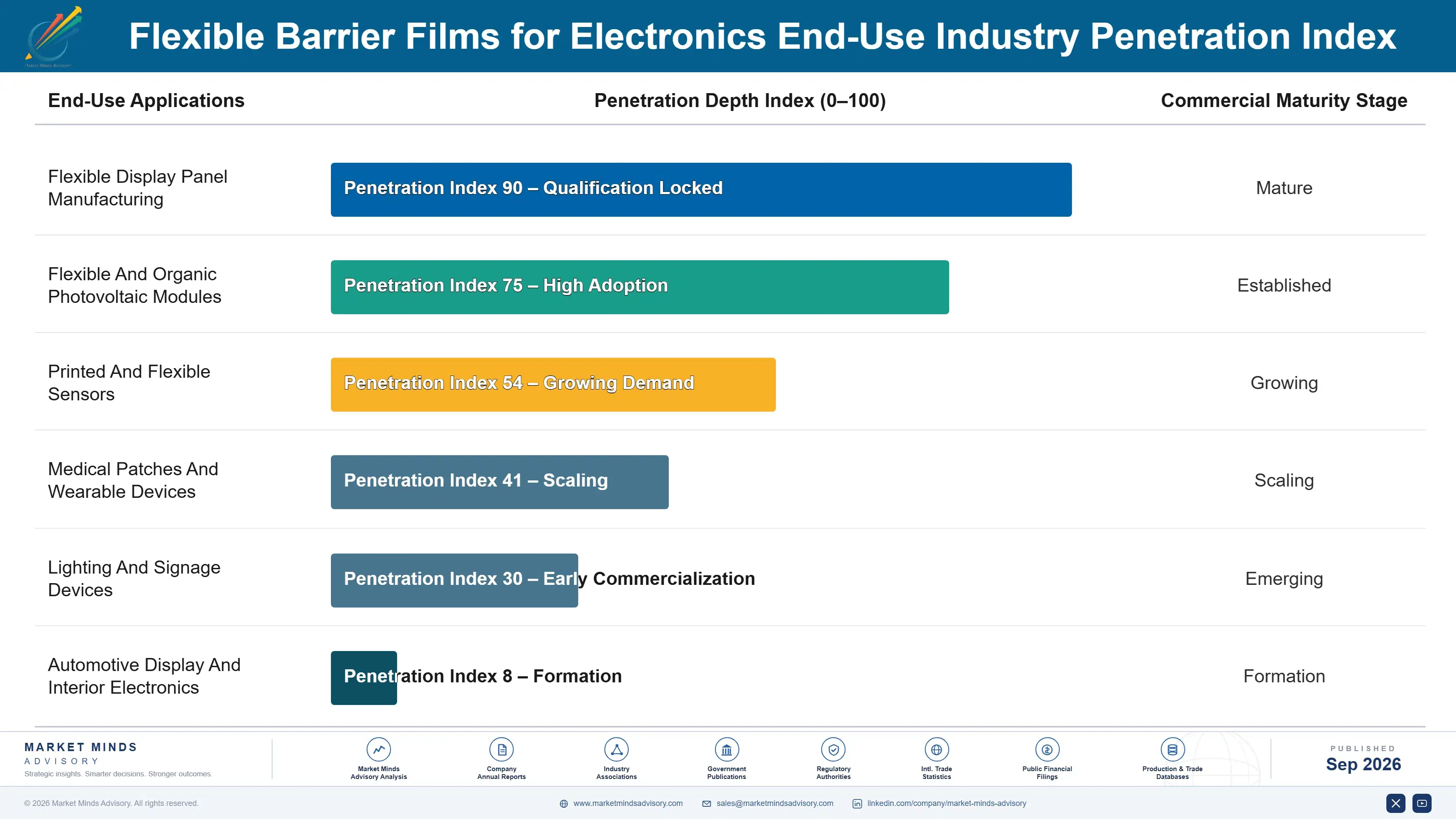
The buyer has changed less than the technology has. A display process engineer evaluated permeation rate and adhesion against a specification sheet. A panel manufacturing manager evaluates usable metres delivered and how fast a defect excursion gets resolved. A printed electronics developer evaluates whether the film survives a specific degradation mode. The second buyer holds most of the volume and thinks almost entirely in yield.
flexible-barrier-films-for-electronics-market-end-use-penetration-index-1790000760877

What Wins Film Contracts

These are among the four positions where our research anticipates prominent divergence between winners and laggards over the coming forecast period. Each is grounded in the demand model, the regulatory perimeter, and the announced capacity pipeline.
01 / YIELD PRICING CORRECTION

Charge For Usable Metres, Not Materials

Materials account for only around 23% of finished film cost while achieved yield on ultra-high barrier runs near 58% of coated web area, so a supplier pricing on materials plus margin is charging for roughly half the web it consumed. That shortfall appears slowly and only across a full contract, by which point the pricing is established. Pricing on yielded square metres is the single correction that turns a loss-making encapsulation line profitable for most participants in this category attempting encapsulation supply.
02 / CAPACITY TIMING DISCIPLINE

Qualify First, Then Build The Line

Reaching approved supply at a panel maker takes around 17 months, and the previous cycle punished every supplier who committed volume capacity against display roadmaps that slipped repeatedly by years. Qualifying from pilot coating removes almost all of that timing risk at modest cost. Capacity then follows a qualified position rather than preceding a hoped-for one, which reverses how most of this industry approached the last decade and paid heavily for the mistake, carrying half-empty lines for years afterwards and at considerable cost.
03 / APPLICATION ENTRY SEQUENCING

Earn From Sensors While Qualifying Displays

Printed sensors and medical patches qualify considerably faster than panel makers, buy smaller volumes and accept materially higher pricing per square metre than display encapsulation ever will. Suppliers building toward encapsulation credentials can earn from those applications during the years that panel qualification actually takes. Most new entrants instead fund the whole qualification period from balance sheet and run short before the display revenue arrives, and run short before display revenue ever arrives, which is the most common way entrants fail here.
04 / LINE CONFIGURATION FLEXIBILITY

Run Several Grades On One Line

Coating line depreciation and vacuum operation absorb around 29% of cost whether or not the line is running, and dedicating capacity to a single grade leaves it idle whenever that particular demand slips. Lines configured across encapsulation, photovoltaic and printed electronics grades hold utilisation through the timing gaps this industry produces reliably. Changeover cost is real and far smaller than half-loaded dedicated capacity across several years of half-loaded dedicated capacity carried across several years of uncertain demand against uncertain display timing.

Engagement Snapshot From the Field

A live engagement with an industry participant carrying material or product regulatory and market exposure ahead of a defining policy shift, showing how our research translates into a defensible multi-year portfolio strategy.
MARKET MINDS ADVISORY · CLIENT ENGAGEMENT SUMMARY
Flexible Barrier Films for Electronics Producer Strategic Portfolio Review and Transition Roadmap 2026·Investment Scenario on Flexible Barrier Films for Electronics Exposure Evaluation 2025-26
CLIENT PROFILE
A specialty coating producer with genuine ultra-high barrier formulation capability, holding no panel maker qualification and losing money on every encapsulation roll it shipped to early customers. Management believed the problem was pricing pressure from incumbents and had approved a further price reduction to win volume it hoped would fix the economics. Nobody had recosted on yielded area.
STRATEGIC CHALLENGE
Sales wanted lower pricing to win a reference panel maker. Operations wanted a wider coating line to reach display-scale width. Nobody had reconciled the cost per usable square metre against the price being quoted, and the company had committed to two customer sample programmes that would consume most of the coming year's pilot capacity.
MMA APPROACH
MMA rebuilt the product costing on yielded rather than coated area, and traced actual defect rates by line and web width. We compared qualification timelines and pricing across display encapsulation and printed electronics applications, and modelled entry through the faster-qualifying route. Work drew on 47 expert interviews conducted in Q4 2025 with panel makers, film converters and printed electronics manufacturers.
KEY FINDINGS
  1. Costing had been built on coated area rather than yielded area, understating true unit cost by roughly 40% at the achieved defect rate.
  2. Every encapsulation roll shipped lost money at the quoted price, and the proposed reduction would have deepened the loss on higher volume.
  3. Printed electronics customers qualified in under 6 months and accepted pricing well above display encapsulation levels for comparable film (client-reported, unverified by MMA).
  4. A wider coating line would have raised defect counts before process learning caught up, which the capital case had not accounted for at all.
CLIENT PROFILE
A specialty coating producer with genuine ultra-high barrier formulation capability, holding no panel maker qualification and losing money on every encapsulation roll it shipped to early customers. Management believed the problem was pricing pressure from incumbents and had approved a further price reduction to win volume it hoped would fix the economics. Nobody had recosted on yielded area.
STRATEGIC CHALLENGE
Sales wanted lower pricing to win a reference panel maker. Operations wanted a wider coating line to reach display-scale width. Nobody had reconciled the cost per usable square metre against the price being quoted, and the company had committed to two customer sample programmes that would consume most of the coming year's pilot capacity.
MMA APPROACH
MMA rebuilt the product costing on yielded rather than coated area, and traced actual defect rates by line and web width. We compared qualification timelines and pricing across display encapsulation and printed electronics applications, and modelled entry through the faster-qualifying route. Work drew on 47 expert interviews conducted in Q4 2025 with panel makers, film converters and printed electronics manufacturers.
KEY FINDINGS
  1. Costing had been built on coated area rather than yielded area, understating true unit cost by roughly 40% at the achieved defect rate.
  2. Every encapsulation roll shipped lost money at the quoted price, and the proposed reduction would have deepened the loss on higher volume.
  3. Printed electronics customers qualified in under 6 months and accepted pricing well above display encapsulation levels for comparable film (client-reported, unverified by MMA).
  4. A wider coating line would have raised defect counts before process learning caught up, which the capital case had not accounted for at all.
RECOMMENDED STRATEGY
Phase 1: Phase one: recost every product on yielded square metres and withdraw quotes that lose money, since volume worsens rather than fixes the position. Phase 2: Phase two: enter through printed electronics customers who qualify in under six months and pay more, funding the display qualification period. Phase 3: Phase three: defer the wider coating line until defect rates on the existing width justify it rather than committing capital against hope.
OUTCOME
The producer recosted on yielded area, withdrew loss-making quotes and entered through printed electronics customers instead (client-reported, unverified by MMA). Contribution turned positive within two quarters, and the display qualification programme continued funded by specialist revenue. Yielded-area costing is now standard on every quote, which is the change that outlasted the engagement.

Frequently Asked Questions

Foundational context covering the market sizes, CAGR, scope, country, region and competition that inform every finding below. This section is provided to cover basics and most often pre-purchase conversations, answered from the MMA Primary Research Dataset.

What is the current size of the Flexible Barrier Films for Electronics Market?

Global value reaches USD 1.6 billion in 2026, measured as barrier film consumption value in electronics applications. The 2025 base was USD 1.4 billion on the same basis.

How large will the Flexible Barrier Films for Electronics Market be by 2036?

The market reaches USD 4.8 billion by 2036, an increase of USD 3.2 billion across the forecast period. That represents 3.00 times expansion from the 2026 base.

What is the CAGR for the Flexible Barrier Films for Electronics Market 2026 to 2036?

The base case runs at 11.5% annually, with a bull case at 12.8% if rollable and stretchable formats reach volume and a bear case at 10.2% if panel makers slow flexible capacity additions.

Which segment is growing fastest?

Ultra-high barrier encapsulation films grow at 17.3%, half again the market rate of 11.5%. Flexible display encapsulation tolerates moisture ingress at levels no other application demands.

Who are the major companies in the Flexible Barrier Films for Electronics Market?

3M, Toppan, Dai Nippon Printing, Mitsubishi Chemical and Amcor lead on consumption value, holding 66% between them. Toray Industries and Kolon Industries hold smaller positions.

Which country is growing fastest?

India leads at 18.7%, as domestic display and electronics assembly capacity is built rather than maintained and film demand follows panel capacity. Vietnam and China follow.

Report Segmentation Architecture

The full report scope spans multiple orthogonal segmentation dimensions, with cross-tabulated demand data provided for each dimension pair. Coverage extends further to regional breakdowns, trend trajectories, and the competitive detail needed to support segment-level decision-making.

By Barrier Grade And Application Function

  • Ultra-High Barrier Encapsulation Films
  • Printed Electronics Barrier Substrates
  • Transparent Conductive Barrier Laminates
  • Photovoltaic Barrier Films
  • Edge Sealing And Lamination Adhesive Films
  • Protective Release Liners

By End-Use Industry

  • Flexible Display Panel Manufacturing
  • Flexible And Organic Photovoltaic Modules
  • Printed And Flexible Sensors
  • Medical Patches And Wearable Devices
  • Lighting And Signage Devices
  • Automotive Display And Interior Electronics

By Commercial Dimension

  • Direct Panel Maker Supply
  • Converter And Laminator Channel
  • Toll Coating Arrangements
  • Development And Sample Programmes
  • Original Equipment Manufacturer Specification
  • Distributor And Regional Agent Supply

By Region

  • North America
  • Western Europe
  • East Asia
  • South Asia and Pacific
  • Latin America
  • Middle East and Africa
  • Eastern Europe

Scope, Methodology, and Coverage

Every figure in this report is reproducible from documented input assumptions. The scope below maps the historical period, the forecast horizon, the segmentation dimensions, and the countries covered, alongside the underlying primary and qualitative methodology.
Historical Period
2020 to 2025
Forecast Period
2026 to 2036
Base Year
2025 (USD billions; MMA Primary Research Dataset, September 2026)
Market Definition
This report covers flexible barrier films supplied into electronics manufacturing: ultra-high barrier encapsulation films for flexible displays and organic light emitting devices, moderate barrier films for flexible photovoltaic modules, transparent conductive barrier laminates, barrier films for printed electronics and sensors, edge sealing and lamination adhesive films, and protective release liners. It excludes rigid glass encapsulation, packaging films, optical films without barrier function, deposition equipment, and finished display assemblies.
Quantitative Units
USD millions, barrier film consumption value in electronics; square metres of yielded film shipped; achieved yield as a percentage of coated web area; qualification periods in months; materials share of finished cost; barrier share of panel material cost.
Segmentation Dimensions
Barrier grade and application function; end-use industry; commercial supply route; geography across seven regions.
Regions Covered
North America, Western Europe, East Asia, South Asia and Pacific, Latin America, Middle East and Africa, Eastern Europe
Countries Covered
South Korea, China, Japan, Taiwan, Singapore, India, Vietnam, Australia, Germany, France, Netherlands, United Kingdom, Italy, Poland, Czechia, United States, Canada, Brazil, Israel, United Arab Emirates.
Key Companies Profiled
3M, Toppan, Dai Nippon Printing, Mitsubishi Chemical, Amcor, Toray Industries, Teijin, Kolon Industries, SKC, LG Chem, Sumitomo Chemical, Nitto Denko, Wacker Chemie, Coveme, Celplast Metallized Products.
Quantitative Methodology
Primary survey, n=3,800 respondents, Q4 2025, six countries; demand-side model with trade association cross-validation
Qualitative Methodology
47 expert interviews, Q4 2025; applied to validate demand model assumptions, identify emerging dynamics, and assess competitive positioning
Report Format
PDF and XLSX data workbook (Word format preview document)
Publisher
Market Minds Advisory
Report Code
MMA-2026-CHM-121
Published
September 2026
Contact
sales@marketmindsadvisory.com | www.marketmindsadvisory.com

Purchase the full Flexible Barrier Films for Electronics Market Report (2026 to 2036).

This report sizes the global flexible barrier films for electronics market from 2026 to 2036 across six barrier grades, six industries and seven regions. It explains why achieved yield near 58% of coated web area rather than permeation performance decides which suppliers win contracts. Materials accounting for only around 23% of finished cost is analysed as the reason materials-based pricing has left suppliers losing money on shipped rolls. Qualification periods around 17 months are examined as the barrier that keeps five suppliers holding 66% of the market. Regional analysis explains why East Asia holds 47% of consumption value.
Six barrier film grades sized through to 2036
Defect yield economics quantified against materials cost
Qualification periods analysed as a competitive barrier
Twenty named suppliers assessed on consumption value
Four revenue levers with quantified commercial impact
Anonymised film producer entry engagement documented in full

Built For The People Who Decide

From boardroom strategy to bench-side execution, this report is read cover-to-cover by leaders shaping the next decade of their industry, turning demand scenarios, market dynamics and valuation benchmarks into decisions.
CXOs/ Presidents/ VPs/ Managers
M&A and Corporate Development
Strategy Teams and R&D Heads
Procurement and Product Directors
Regulatory and Compliance Leaders
Investor Relations and Equity Analysts