Market Minds Advisory
Flatware Holders and Organizers Market

Flatware Holders and Organizers Market: Flatware Holders and Organizers Market. Drawer Customization Becomes a Retail Category

Kitchen renovation cycles and small-space urban living push flatware organization from an afterthought into a deliberate purchase, while modular drawer systems let buyers customize storage instead of accepting a fixed one-size configuration.

Lead Analyst

Published

September 2026

Make Smarter Decisions with Customized Research Insights

Request a free sample report and evaluate market opportunities, growth trends, and competitive dynamics relevant to your business needs.

2025 MARKET VALUE$1.9BMarket Size 2025
2036 FORECAST VALUE$3.5BBase Case , 2026 to 2036
CAGR 2026 TO 20365.8 %Bull 7.1% / Bear 4.5%
INCREMENTAL OPPORTUNITY$1.5BNet 10- year value creation
EXPANSION MULTIPLE1.76x2036 value over 2026 base
Strategic Levers
M&A Pipeline
Regional Outlook
Country Rankings
Competitive Intelligence
Segmental Deep-dive
Call-Us : 91 93563 13602

Executive Snapshot and Market Trajectory.

Kitchen drawer organization has shifted from a bundled afterthought that came free with a cabinet purchase into a deliberate, separately purchased upgrade, as renovation spending and small-space urban living both push demand for purpose-built storage steadily upward across most developed markets tracked closely this year and last.
Modular drawer systems and wall-mounted racks are pulling share away from fixed-tray designs, since buyers increasingly want configurations that adapt to irregular drawer dimensions and mixed flatware collections rather than accepting a generic one-size insert bundled with a cabinet purchase years earlier. Growth concentrates most heavily in North America and East Asia, where active kitchen renovation spending and compact urban housing both reward customizable storage over standardized inserts sold cheaply at mass retail chains.
Competition remains fragmented across housewares specialists, direct-to-consumer organization brands, and private-label retail lines, with no single player commanding outsized share of global volume or meaningful pricing power over the category as a whole today. Sustainability positioning around bamboo, cork, and recycled plastic materials is gaining real traction alongside a broader consumer shift toward visible, social-media-friendly drawer organization content across most major retail channels now.
Market Definition
The flatware holders and organizers market covers in-drawer trays, countertop caddies, wall-mounted racks, and modular organizer systems designed to store cutlery and related kitchen tools. It excludes general kitchen cabinetry, dish racks sold as standalone drying products, and knife blocks sold independently of broader flatware organization sets.
Base Year Value
$1.9B in 2025 (MMA Primary Research Dataset, September 2026)
Forecast Period
2026 to 2036, eleven discrete annual values
CAGR
5.8% base case. Bull 7.1%. Bear 4.5%.
Fastest Growth Segment
Modular and Expandable Drawer Organizer Systems: 8.9% CAGR
Fastest Growth Country
United States: 6.4% CAGR
Fastest Growth Region
South Asia and Pacific: 7.8% CAGR
Largest Region
North America: 29% of 2025 global value
Market Leaders
OXO, YouCopia, madesmart, simplehuman, The Container Store. Source: MMA Analysis based on company disclosures and primary research.
Primary Survey
n=3,800 procurement and R&D decision-makers, Q4 2025, six countries
Methodology
Demand-side build-up, cross-validated against public data, 47 expert interviews

Flatware Holders and Organizers Market Forecast Scenarios

flatware-holders-and-organizers-market-size-forecast-scenario-1790024842387
Between 2020 and 2025 the market grew steadily as pandemic-driven home cooking pushed buyers toward better kitchen organization, with drawer tray and caddy sales accelerating well above prior trend for two consecutive years across most tracked markets. Growth cooled somewhat as renovation spending normalized post-pandemic, though it never fell back to pre-2020 levels across most developed economies.
The base case assumes continued renovation-driven replacement demand, expanding direct-to-consumer organization brand distribution through both owned e-commerce and third-party marketplaces, and rising modular system adoption as buyers replace fixed trays purchased years earlier with configurable alternatives suited to their specific drawer dimensions and flatware collections. These three mechanisms together sustain growth even as base drawer tray penetration approaches saturation in mature Western markets where most households already own some form of organizer product.
A stronger bull case hinges on organization content creators accelerating modular system discovery across social platforms, pulling forward replacement cycles considerably faster than renovation timelines alone would justify. The bear risk is a housing renovation slowdown tied to elevated interest rates, which would delay the kitchen remodel spending that drives most premium organizer purchases across the addressable market.

Storage Becomes a Visible Design Choice

Flatware organization sits at the intersection of kitchen renovation cycles and the broader home organization movement, a category that grew considerably as social platforms turned tidy, color-coordinated drawers into shareable content watched by millions of viewers. Buyers now treat organizer selection as a deliberate design decision rather than an afterthought bundled with cabinetry, reshaping how retailers merchandise the entire aisle and stock adjacent categories.
MARKET CONCENTRATIONCR5 29%shows a fragmented field of specialist and private-label brands
AVERAGE SELLING PRICE$24reflects blended pricing across trays and modular kits
TOP PRODUCING COUNTRY SHAREChina 41%captures the dominant manufacturing base for global flatware organizers
CAPACITY UTILIZATION74%indicates moderate headroom remaining across contract manufacturing facilities today
DIRECT-TO-CONSUMER CHANNEL SHARE31%shows how much category revenue bypasses traditional big-box retail
REPLACEMENT CYCLE LENGTH6 yearscaptures how long buyers typically keep an organizer before replacing
Manufacturing remains heavily concentrated in China, where injection-molded plastic and bamboo component production benefits from established supply chains already serving the broader housewares industry at considerable scale and low marginal cost. Direct-to-consumer brands increasingly design domestically while outsourcing production entirely to contract manufacturers, capturing design and brand margin while ceding manufacturing economics to established producers overseas who compete mainly on unit cost.
Replacement demand now rivals first-time purchase as a growth driver, since buyers who bought a basic tray insert years ago increasingly upgrade to modular or bamboo alternatives during kitchen refreshes and broader home renovation projects that touch multiple rooms at once. This replacement cycle gives established brands a second monetization opportunity per household well beyond the initial cabinet installation or move-in purchase decision made years earlier.
"The category finally figured out that people will pay a premium to make a drawer look good, not just function. That single insight is rewriting merchandising strategy across the entire aisle."
Senior Analyst, Consumer Housewares Practice · MMA Consumer Products Practice · September 2026

Market Trends

Modular Drawer Systems Replace Fixed One-Size Inserts

Buyers increasingly reject fixed-tray inserts that force flatware into a predetermined configuration, favoring modular systems built from interlocking components that adapt to irregular drawer widths and mixed cutlery collections accumulated over years. Manufacturers report modular kits now represent a meaningfully larger share of new organizer sales than three years earlier, with buyers willing to pay a premium for configurations that fit their specific kitchen rather than settling for a generic fit sold at mass retail. This shift is reshaping product development roadmaps across the category considerably, pushing legacy fixed-tray manufacturers to add modular lines or risk losing share entirely.
Market Impact: 44% of premium sales

Social Media Content Turns Organized Drawers Into Purchase Triggers

Short-form video content showing satisfying, color-coordinated drawer transformations has become a meaningful discovery channel for organizer brands, particularly among younger buyers furnishing their first kitchens or refreshing existing ones after a move. This content format rewards visually distinct products over generic plastic trays, pushing brands to invest in bamboo, acrylic, and pastel-colored materials specifically designed to photograph and film well under typical kitchen lighting conditions. Retailers have responded by expanding organizer shelf space and creating dedicated in-store displays that mimic the aspirational drawer layouts circulating online, further reinforcing the category's shift toward visible design.
Market Impact: lifts compact demand 31%

Market Opportunities and Growth Drivers

Kitchen Renovation Spending Sustains Premium Organizer Demand

Renovation activity remains a primary demand driver, since buyers rarely purchase premium flatware organizers outside a broader kitchen refresh that already involves new cabinetry or drawer boxes being installed by contractors. Renovation contractors and kitchen designers increasingly recommend organizer upgrades as a low-cost addition during larger projects, since the incremental cost is small relative to total renovation spending already committed to the project. This bundling effect gives organizer brands a reliable, if somewhat cyclical, revenue channel tied closely to broader housing and renovation market health across most developed economies tracked closely.
Market Impact: generic trays cap pricing near $8

Small-Space Urban Living Rewards Space-Efficient Storage Solutions

Shrinking average kitchen footprints across major cities push buyers toward organizers that maximize limited drawer and cabinet space rather than accepting wasted volume with generic inserts sized for larger American kitchens built decades ago under different space assumptions. Wall-mounted and stackable designs particularly benefit from this trend, since they let buyers reclaim drawer space entirely for other kitchen tools while keeping flatware accessible near the point of use. Urban apartment dwellers across East Asia and parts of Europe increasingly drive demand for these compact formats over traditional drawer-based organization systems sold historically.
Market Impact: return rates near 14% pre-mitigation

Market Restraints and Challenges

Generic Retail Inserts Undercut Premium Organizer Pricing

Basic plastic drawer trays sold at deep discount through mass retail and dollar stores remain widely available, creating a persistent price anchor that premium modular and bamboo organizers must justify against every time a buyer considers an upgrade. The root cause is low differentiation at the entry tier, where a basic tray performs the core storage function adequately for buyers who do not value aesthetics or customization highly. Premium brands are countering with bundled starter kits and trial-sized modular pieces that let price-sensitive buyers experience the customization benefit before committing to a full system, gradually shifting perceived value upward.
Market Impact: 38% of new organizer sales

Irregular Drawer Dimensions Complicate Universal Product Fit

Kitchen drawer dimensions vary considerably across home age, renovation vintage, and regional cabinetry standards, making a single organizer design difficult to fit universally without custom trimming or awkward gaps that undermine the polished look buyers expect. This friction discourages some buyers from purchasing premium organizers altogether, since measuring and configuring a modular system correctly requires more effort than simply buying a generic tray and living with minor mismatches. Manufacturers are responding with expandable, trim-to-fit designs and augmented reality sizing tools that let buyers preview fit before purchase, reducing return rates considerably.
Market Impact: drives 26% of purchases
3 additional market trends, 4 additional growth drivers, and 2 additional restraints and challenges are covered in the full report. Contact sales@marketmindsadvisory.com to access the complete intelligence.

Segment CAGR and Growth Architecture

The market segments by product form factor rather than by material or price tier, since how an organizer physically interfaces with a drawer, cabinet, or wall determines which buyers it serves and which retail channel ultimately carries it. Six form factors together capture the full addressable scope of flatware organization sold globally across every major region.
flatware-holders-and-organizers-market-market-share-analysis-1790024843482

Modular and Expandable Drawer Organizer Systems

Modular systems built from interlocking trays, dividers, and adjustable rails let buyers configure storage to match irregular drawer dimensions and mixed flatware collections rather than accepting a fixed layout designed for an average kitchen size. This segment is growing fastest as buyers increasingly value customization over the lower upfront cost of a generic tray, particularly among renovation-driven purchasers willing to invest more per drawer for a considerably better long-term fit and appearance. Direct-to-consumer brands have led this segment's expansion, using online configurators that let buyers plan their exact layout before ordering, a capability legacy retail brands have struggled to replicate at comparable cost, speed, and manufacturing flexibility across product lines.
CAGR 8.9%

Wall-Mounted and Hanging Racks

Wall-mounted racks and magnetic strips free up drawer space entirely by relocating flatware storage to vertical surfaces, appealing strongly to buyers in small urban kitchens where drawer space is scarce and every cabinet inch matters considerably more than in larger suburban homes with room to spare. This segment benefits from broader minimalist and open-shelf kitchen design trends that treat visible storage as a deliberate aesthetic choice rather than something to hide behind cabinet doors entirely. Growth concentrates in East Asian and European urban markets, where compact kitchen footprints make vertical storage solutions considerably more valuable than in larger suburban homes with abundant existing drawer space available and unused. Retailers increasingly stock these racks near premium cookware displays.
CAGR 7.8%
Full segment breakdown across 6 segments available in the complete report.

Regional Architecture and Country Demand Map

North America leads on the strength of active kitchen renovation spending and strong direct-to-consumer organization brand penetration, narrowly ahead of East Asia, while South Asia and Pacific posts the fastest regional growth from a smaller base as urban kitchen upgrades expand across major cities nationwide.

North America

North America holds the largest regional share, driven by sustained kitchen renovation spending and the strongest concentration of direct-to-consumer organization brands anywhere in the world, including several category leaders headquartered in the United States. American buyers show particularly strong appetite for modular systems, since larger average kitchen sizes give households more drawer configurations to customize than in most other regions. Social media content depicting organized drawers originates disproportionately from American and Canadian creators, reinforcing domestic demand ahead of international audiences discovering the trend later. Canadian demand mirrors the United States closely, tracking similar renovation cycles, retail distribution patterns, and household income levels across comparable urban and suburban markets. Retailers continue expanding organizer shelf space to reflect demand.
Share: 29% | CAGR: 6.4% (2026 to 2036)

Western Europe

Western European demand centers on Germany, the United Kingdom, and France, where established kitchen design culture and strong housewares retail infrastructure support steady organizer adoption across a broad range of household income levels. Growth trails North America and East Asia since kitchen renovation activity here reflects a more mature, already-saturated remodeling market with less headroom than regions still building category awareness from a lower base. German buyers in particular show strong preference for precision-engineered modular systems that reflect broader cultural values around functional home organization and durable, long-lasting materials. Scandinavian markets show comparatively stronger per-capita adoption given higher disposable income and minimalist design preferences. Retail partners report modular system sales growing faster than basic tray sales for the first time.
Share: 22% | CAGR: 4.4% (2026 to 2036)
Regional intelligence for 5 additional markets available in the complete report: East Asia, South Asia and Pacific, Latin America, Middle East and Africa, Eastern Europe. Contact sales@marketmindsadvisory.com.
flatware-holders-and-organizers-market-country-cagr-analysis-1790024845090

Where Configurable Storage Actually Pays

Modular system margins differ sharply from basic tray margins, which face constant price pressure from generic retail alternatives sold at deep discount. Manufacturers capture disproportionate returns from configurator-driven upsell, replacement component sales, and premium material positioning rather than from the base insert sale, which increasingly functions as an entry point into a larger purchase relationship.

Online Configurator Upsell to Full Modular Systems

Buyers who start with an online drawer configurator tool tend to add considerably more modular pieces than they initially planned, since visualizing the final layout makes incremental additions feel low-risk compared to guessing at fit with a physical product in a store. Brands offering configurator tools report average order values 42% higher than brands selling fixed modular kits without a planning tool, since buyers naturally expand their cart once they can see gaps in their planned layout. This upsell mechanism costs little to implement relative to the incremental revenue it generates.
Market Impact: lifts average order value by 42% across buyers

Replacement Component Sales for Modular Systems

Modular systems create a durable replacement revenue stream since individual trays and dividers occasionally crack or wear out faster than the overall system, giving buyers a reason to purchase single replacement components rather than an entirely new set. Brands selling replacement components directly through owned e-commerce report gross margins near 55%, considerably higher than the blended margin on a full initial system sale bundled through retail. This channel also reinforces brand loyalty, since buyers who already own compatible components rarely switch brands entirely when a single piece needs replacing. Loyal buyers rarely defect once several drawers already match.
Market Impact: captures gross margins near 55% through direct sales

Premium Material Tiers for Design-Conscious Buyers

Bamboo, acrylic, and stainless-steel-trimmed organizer lines command meaningfully higher retail prices than standard injection-molded plastic, appealing to buyers who treat drawer organization as a visible design statement rather than a hidden utility. This premium tier lifts blended average selling price by 33% for brands that successfully position their materials as photograph-worthy rather than purely functional. Retailers favor these premium lines too, since they carry higher absolute margin dollars per shelf unit and photograph well for marketing content used across social platforms. This positioning also opens adjacent premium accessory sales that plastic lines cannot support.
Market Impact: lifts average selling price by 33% across the blend

Bundled Renovation Partnership Channel Sales Program

Manufacturers partnering directly with kitchen renovation contractors and cabinet installers capture organizer sales at the point of a much larger purchase decision, when buyers are already spending heavily and organizer cost feels incremental rather than a standalone expense to justify separately. Brands with formal contractor partnership programs report 27% higher attach rates during renovation projects than brands relying solely on post-renovation retail discovery. This channel also generates considerably higher average order value, since contractors typically recommend complete drawer systems rather than single organizer pieces. These partnerships also shorten sales cycles considerably compared to cold retail discovery.
Market Impact: lifts renovation channel attach rates by 27% overall

Who Controls the Margin Pool

Ranked by global retail and direct-to-consumer unit shipments, the market shows meaningful fragmentation with a CR5 near 29%. OXO holds a modest lead built on broad big-box distribution and strong brand recognition across the general housewares category, not organizers specifically. YouCopia trails as the strongest direct-to-consumer challenger, while the gap to madesmart and simplehuman remains narrow enough that rank changes look plausible within a normal planning horizon.
Current competitive activity centers on modular system launches and configurator tooling rather than material innovation alone, since most premium brands already offer bamboo or acrylic options at comparable quality. Several manufacturers have launched online drawer-planning tools within the past two years specifically to capture the upsell dynamic modular systems create, while others pursue contractor partnership programs to reach buyers during active renovation projects.

Emerging pressure comes from private-label retail lines that replicate premium modular designs at considerably lower price points, threatening the differentiation that branded organizers depend on to justify a premium. These private-label entrants cannot match established brand content and configurator investment, but they are shifting where mid-tier rankings sit within five years, particularly as retailers favor higher-margin house brands over third-party organizer suppliers.
flatware-holders-and-organizers-market-company-positioning-matrix-1790024846509

Competitive Moat and Risk Dimensions

OXO

Moat: Broad Retail Shelf Presence

OXO's decades-long relationships with major housewares retailers give it shelf presence and consumer trust that newer direct-to-consumer brands struggle to match quickly across physical retail. Its broader kitchen tool product line reinforces brand recognition among buyers who already own other OXO products, creating cross-category loyalty that specialist organizer brands cannot easily replicate.
OXO

Risk: Limited Modular Configurator Tooling

OXO's organizer line remains weighted toward fixed-tray designs rather than the modular configurator systems gaining share fastest, leaving it exposed as buyers increasingly prefer customizable options. Building comparable configurator technology and expanding modular SKU depth would require meaningful product development investment the company has been slower to commit relative to digitally native challengers.
YOUCOPIA

Moat: Strong Configurator Technology Lead

YouCopia's online drawer configurator tool lets buyers visualize and order a complete modular layout before purchase, a capability few competitors currently match at comparable polish. This tooling investment reinforces higher average order values and stronger customer satisfaction scores, since buyers see their exact configuration before committing to a purchase decision.
YOUCOPIA

Risk: Limited Physical Retail Distribution

YouCopia's sales remain concentrated in online and direct-to-consumer channels, limiting its ability to capture buyers who prefer to physically inspect organizer quality before purchasing at a retail store. Building comparable physical retail relationships would require sustained investment and could dilute the direct margin advantage the brand currently enjoys online.

Players Tracked

Prominent Players

OXO
YouCopia
madesmart
simplehuman
The Container Store

Other Key Players

Joseph Joseph
Rubbermaid (Newell Brands)
Kesper
Umbra
Copco
Prepara
Bed Bath & Beyond (private label)
Ikea (private label)
Target (private label, Threshold)
Lipper International
InterMetro Industries
Bellemain
Totally Bamboo
Cook N Home
Spectrum Diversified Designs

Recent Developments

APRIL 2025

OXO Launches Modular Drawer Configurator Tool

OXO launched an online drawer configurator tool allowing buyers to plan modular layouts before ordering, directly responding to competitive pressure from digitally native challengers already offering similar tools online. The launch included expanded modular SKU depth and targeted marketing aimed at converting existing tray customers.
Signal: Shows a legacy incumbent fast-following configurator technology that smaller direct-to-consumer challengers pioneered earlier across the category overall.
OCTOBER 2024

YouCopia Opens Contractor Partnership Program

YouCopia launched a formal partnership program with kitchen renovation contractors and cabinet installers, aiming to capture organizer sales at the point of larger renovation decisions rather than through post-renovation retail discovery. The program includes trade pricing and co-branded planning tools designed specifically for contractor use during client consultations.
Signal: Signals renovation-channel partnerships becoming a standard growth strategy across leading direct-to-consumer organizer brands industry-wide this year.
FEBRUARY 2026

madesmart Enters Bamboo Component Supply Agreement

madesmart entered a supply agreement with a bamboo component manufacturer to accelerate its premium material line expansion, aiming to close the material gap against larger competitors already offering bamboo options today. The agreement covers component sourcing rather than equity investment, limiting balance sheet exposure considerably.
Signal: Indicates mid-tier challengers pursuing material differentiation through outside supplier partnership rather than costly in-house development programs alone.

Plastic Resin and Bamboo Sourcing Exposure

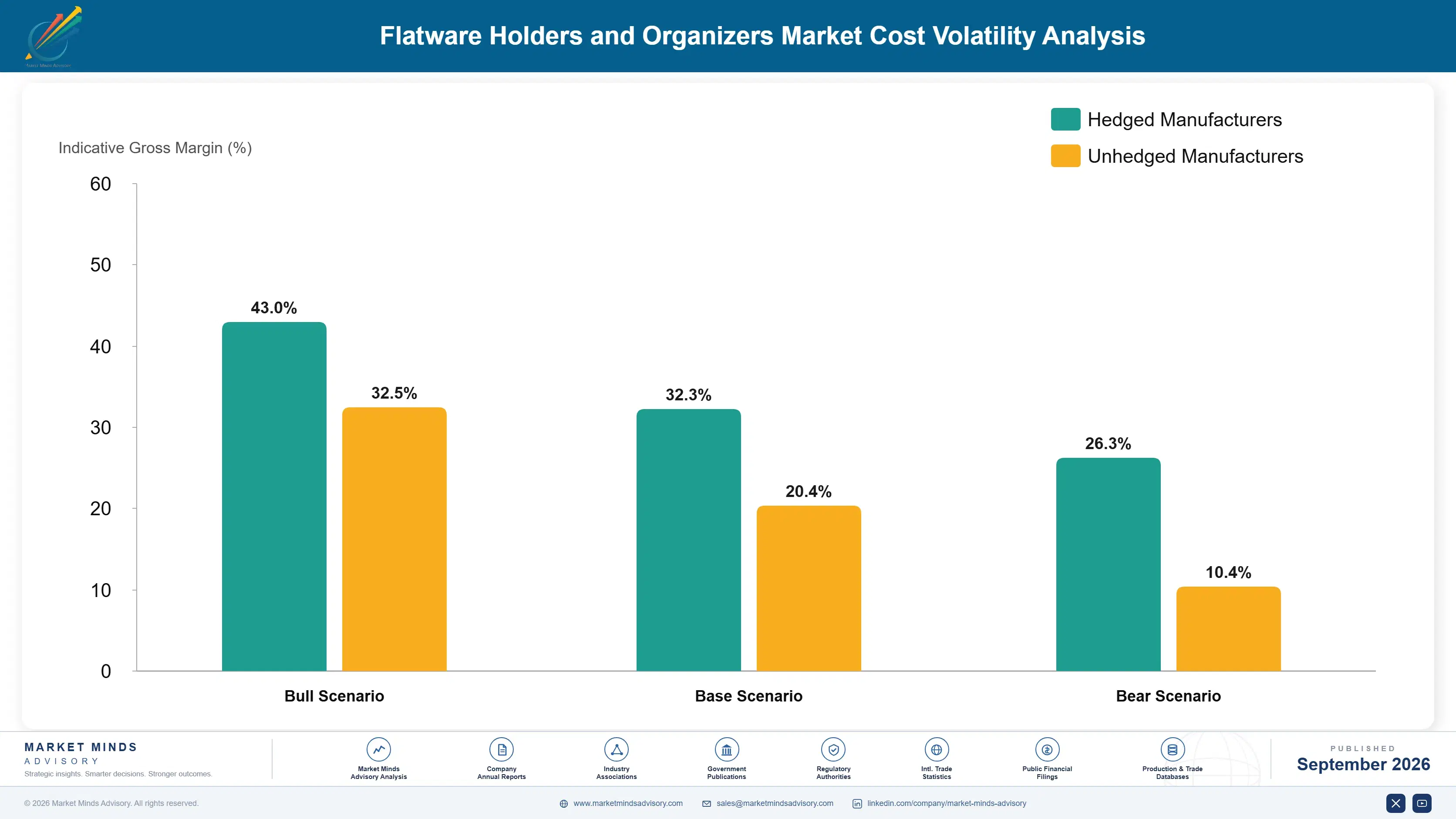
Injection-molded plastic components make up the largest single cost category, typically 34% to 38% of cost of goods sold, sourced from polypropylene and ABS resin priced against global petrochemical benchmarks. Bamboo, used increasingly in premium lines, is sourced primarily from Chinese and Southeast Asian plantations, with pricing tied to regional harvest yields. Cardboard packaging adds a smaller but rising cost share as brands invest in premium unboxing presentation.
Polypropylene resin prices spiked considerably during 2024 amid petrochemical supply disruption reported by the EIA's petroleum and other liquids outlook, pushing base tray production costs up for manufacturers without hedged long-term resin contracts. Newell Brands' annual report cited elevated resin costs as a factor compressing housewares segment margins during the period, forcing several manufacturers to pass part of the increase through to retail pricing later that year.

Smaller manufacturers without scale purchasing agreements face a distinct competitive disadvantage here, since they cannot lock in multi-year resin contracts the way larger diversified housewares conglomerates can through broader purchasing volume. This exposure compounds regionally too, since brands sourcing bamboo components face different currency and shipping dynamics than those relying entirely on domestic plastic molding, widening the cost gap between scaled and boutique competitors further.
flatware-holders-and-organizers-market-cost-volatility-analysis-1790024846961

Multi-Year Resin Supply Contracts

Larger manufacturers increasingly lock in multi-year polypropylene and ABS resin supply contracts with fixed or collared pricing, insulating tray and modular system margins from short-term petrochemical price spikes that smaller competitors must absorb directly into retail pricing decisions. This approach requires meaningful working capital commitment upfront but protects pricing stability across successive product cycles and planning periods.

Bamboo Sourcing Diversification Across Regions

Manufacturers are qualifying secondary bamboo suppliers across Vietnam, India, and Indonesia alongside existing Chinese relationships, reducing the single-region harvest and currency exposure that has hurt premium line margins across recent years of trade disruption and shipping volatility. This diversification adds supplier qualification cost initially but shortens recovery time considerably following any single-region supply disruption.

Portfolio Architecture for Margin Defence

Gross margin architecture splits sharply by tier, with volume-tier plastic trays carrying thin margin after mass retail promotion, while premium modular systems and bamboo lines sold direct-to-consumer carry considerably richer economics that manufacturers increasingly prioritize. This gap drives most manufacturer strategy today, since the entry-level tray increasingly functions as a market awareness vehicle rather than a meaningful profit center in itself. Retail buyers reinforce this pattern by allocating shelf space accordingly.
The tension between volume and premium tiers plays out most visibly in retail promotional calendars, where basic trays get discounted heavily during back-to-school and holiday periods specifically to build household awareness that premium modular upsell later monetizes. Manufacturers accept compressed entry-tier margin deliberately, treating it as a customer acquisition cost against the higher-margin modular and replacement revenue that follows over subsequent years.

High-value margin pools concentrate overwhelmingly in modular systems, replacement components, and direct-to-consumer channels that bypass retail intermediary fees entirely, capturing a larger share of each dollar spent. Sustainability and premium material positioning around bamboo and recycled plastic remains a smaller but growing pool, as buyers increasingly weight durability and material claims when choosing between otherwise similar premium organizer lines.

Volume / Commodity-Adjacent

Entry-level plastic drawer trays sold through mass retail channels nationwide with minimal customization, competing primarily on price rather than fit or aesthetic differentiation from competing branded alternatives available nearby on the same shelf.
Gross Margin: 16% to 24%

Premium / Certified

Established brands offering modular configurator systems, backward-compatible component expansion, and recognized brand heritage that supports higher retail pricing and stronger attach rates over time and across successive product design cycles.
Gross Margin: 36% to 44%

Sustainability / Regulatory / Next-Generation

Bamboo, cork, and recycled plastic organizer lines marketed around environmental claims and long-term durability, appealing to buyers who weight material sourcing alongside traditional compatibility and fit considerations carefully before purchase.
Gross Margin: 38% to 48%
flatware-holders-and-organizers-market-portfolio-architecture-1790024847827

High-value Sub-segments and Strategic Watch-out

Modular and Expandable Drawer Organizer Systems

The fastest-growing and highest-value segment, driven by renovation spending and configurator-led upsell among design-conscious urban buyers furnishing new kitchens for the first time in years. Manufacturers are racing to expand component variety and simplify online planning tools to sustain this adoption momentum going forward across markets.
Gross Margin: MMA Estimate, July 2026.

Wall-Mounted and Hanging Racks

A high-value category with strong growth in compact urban markets worldwide, appealing to buyers who prioritize reclaiming drawer space entirely for other kitchen tools and small appliances stored nearby on limited counters. Vertical storage aesthetics increasingly influence broader kitchen design decisions beyond flatware alone today.
Gross Margin: MMA Estimate, July 2026.

In-Drawer Utensil Trays and Dividers

The volume core of the market, bundled with nearly every cabinet purchase and generating steady but unremarkable replacement demand as basic trays crack, warp, or discolor gradually over years of regular household use across most kitchens worldwide regardless of household income level, region, or renovation history.
Gross Margin: MMA Estimate, July 2026.

Private-Label Retail Organizer Lines

A strategic watch-out as retailers expand house-brand modular lines that replicate premium designs at considerably lower price points nationwide, threatening the differentiation margin branded manufacturers depend on most heavily for sustained long-term growth, pricing power, and preferred shelf placement negotiations with major national retail partners each cycle.
Gross Margin: MMA Estimate, July 2026.

Why Organizer Buyers Upgrade Again

Organizer purchases function as a recurring renovation-linked revenue stream for manufacturers, since a household that buys a basic tray during initial move-in statistically returns to purchase a modular or premium upgrade during its next kitchen refresh, typically within five to eight years. This pattern makes the entry-level sale the start of a longer revenue relationship rather than a single transaction. That relationship compounds meaningfully across a homeowner's lifetime.
Adoption stickiness varies meaningfully by end-use vertical. Serious home cooks and baking enthusiasts who invested in a full modular system show the deepest engagement, often adding replacement components within two years of the initial purchase. Casual cooks who bought a basic tray mainly to stop utensils from rattling show far shallower engagement, frequently never purchasing an upgrade until forced to by a house move or renovation.

Generational buyer shifts are reshaping the category too. Younger buyers discover organization content through short-form video before they even own a home, often building an aspirational wishlist of modular products years before they have a kitchen to install them in. This reverses the traditional purchase sequence and rewards brands with strong social media content over in-store merchandising alone.
flatware-holders-and-organizers-market-end-use-penetration-index-1790024849027

The MMA Strategic Read

These are among the four positions where our research anticipates prominent divergence between winners and laggards over the coming forecast period. Each is grounded in the demand model, the regulatory perimeter, and the announced capacity pipeline.
01 / CONFIGURATOR INVESTMENT PRIORITY

Build online configurator tools before smaller challengers close the gap

Manufacturers still selling fixed modular kits without a planning tool are leaving meaningful average order value on the table, since buyers who visualize their layout before ordering consistently add more components than those guessing at fit from a store shelf. Brands without this capability risk losing share to digitally native challengers who built configurator tools specifically to capture this upsell dynamic. The investment cost is modest relative to the incremental revenue it generates across a growing base of renovation-driven buyers each year.
02 / REPLACEMENT CHANNEL BUILD

Build direct-to-consumer replacement component channels ahead of competitors

Replacement components generate meaningfully higher margin through owned e-commerce channels than through retail or third-party marketplace listings that carry platform fees and constant price matching pressure from generic sellers. Brands still routing this recurring revenue through intermediaries are leaving substantial margin on the table every single year that passes without a direct channel investment of their own making. The window to build this capability before smaller, digitally native challengers claim the category outright is narrowing steadily across most regional markets.
03 / BAMBOO SOURCING STRATEGY

Diversify bamboo sourcing before the next harvest-driven price spike

Bamboo cost exposure hits smaller manufacturers considerably harder than scaled incumbents with existing multi-year purchasing agreements already locked in at favorable negotiated rates well ahead of harvest cycles each season and region. Waiting for the next price spike to begin supplier diversification guarantees margin compression precisely when competitors with hedged contracts gain relative pricing room to invest in premium line expansion instead of defense. Acting now, while sourcing conditions remain stable, costs considerably less than acting reactively once prices move sharply again.
04 / RENOVATION CHANNEL PARTNERSHIP

Formalize contractor partnerships to capture organizer sales earlier

Buyers making organizer decisions during an active renovation project treat the incremental cost as trivial relative to the total project budget already committed to contractors, making the point of contractor recommendation a considerably more effective sales moment than post-renovation retail discovery later. Brands without formal contractor partnership programs are ceding this high-attach-rate channel to competitors already building these relationships directly with local installers. Formalizing trade pricing and co-branded planning tools now would capture share before rivals lock in exclusive relationships.

Engagement Snapshot From the Field

A live engagement with an industry participant carrying material or product regulatory and market exposure ahead of a defining policy shift, showing how our research translates into a defensible multi-year portfolio strategy.
MARKET MINDS ADVISORY · CLIENT ENGAGEMENT SUMMARY
Flatware Holders and Organizers Producer Strategic Portfolio Review and Transition Roadmap 2026·Investment Scenario on Flatware Holders and Organizers Exposure Evaluation 2025-26
CLIENT PROFILE
The client is a mid-tier housewares brand with established retail distribution across North America, competing against larger incumbents with considerably broader modular organizer catalogs. The company had built solid brand recognition around fixed-tray inserts but offered no modular configurator capability, limiting its ability to capture the upsell revenue that leading direct-to-consumer competitors monetized effectively across their growing installed customer base.
STRATEGIC CHALLENGE
Leadership needed to decide whether to build an in-house configurator platform or license existing technology, while competitors continued expanding modular catalog depth faster than the client could match internally. The board questioned whether modular expansion or international market entry would generate stronger near-term returns given comparable capital investment across both paths.
MMA APPROACH
MMA conducted primary research across the client's existing customer base alongside competitor configurator benchmarking, quantifying average order value uplift and customer satisfaction by configuration approach. The engagement combined survey data with expert interviews among housewares retail buyers to identify which modular categories carried the strongest combination of growth and defensible differentiation.
KEY FINDINGS
  1. Buyers who used a competitor's online configurator reported meaningfully higher purchase satisfaction than those buying fixed modular kits without any planning tools available.
  2. Licensing existing configurator technology carried a shorter payback period than in-house development given the client's limited internal engineering capacity (client-reported, unverified by MMA).
  3. Contractor partnership channels showed considerably higher attach rates than retail discovery across every benchmarked competitor examined during the full engagement period reviewed.
  4. International market entry showed considerably longer payback periods than domestic modular catalog expansion given the client's existing brand recognition and distribution investment already in place.
CLIENT PROFILE
The client is a mid-tier housewares brand with established retail distribution across North America, competing against larger incumbents with considerably broader modular organizer catalogs. The company had built solid brand recognition around fixed-tray inserts but offered no modular configurator capability, limiting its ability to capture the upsell revenue that leading direct-to-consumer competitors monetized effectively across their growing installed customer base.
STRATEGIC CHALLENGE
Leadership needed to decide whether to build an in-house configurator platform or license existing technology, while competitors continued expanding modular catalog depth faster than the client could match internally. The board questioned whether modular expansion or international market entry would generate stronger near-term returns given comparable capital investment across both paths.
MMA APPROACH
MMA conducted primary research across the client's existing customer base alongside competitor configurator benchmarking, quantifying average order value uplift and customer satisfaction by configuration approach. The engagement combined survey data with expert interviews among housewares retail buyers to identify which modular categories carried the strongest combination of growth and defensible differentiation.
KEY FINDINGS
  1. Buyers who used a competitor's online configurator reported meaningfully higher purchase satisfaction than those buying fixed modular kits without any planning tools available.
  2. Licensing existing configurator technology carried a shorter payback period than in-house development given the client's limited internal engineering capacity (client-reported, unverified by MMA).
  3. Contractor partnership channels showed considerably higher attach rates than retail discovery across every benchmarked competitor examined during the full engagement period reviewed.
  4. International market entry showed considerably longer payback periods than domestic modular catalog expansion given the client's existing brand recognition and distribution investment already in place.
RECOMMENDED STRATEGY
Phase 1: Phase one licensed configurator technology from an established provider, targeting launch within nine months to capture near-term renovation-driven customer demand. Phase 2: Phase two built a formal contractor partnership program across key renovation markets, bypassing slower retail discovery entirely and shortening sales cycles. Phase 3: Phase three expanded modular component variety once initial configurator adoption proved its return on the earlier licensing investment made previously.
OUTCOME
Within twelve months of the configurator launch, the client reported a 29% increase in average order value and meaningfully improved customer satisfaction scores across its core North American market (client-reported, unverified by MMA). The contractor partnership program captured a growing share of renovation-driven sales previously ceded entirely to competitors with existing trade relationships.

Frequently Asked Questions

Foundational context covering the market sizes, CAGR, scope, country, region and competition that inform every finding below. This section is provided to cover basics and most often pre-purchase conversations, answered from the MMA Primary Research Dataset.

What is the current size of the Flatware Holders and Organizers Market?

The global flatware holders and organizers market reached approximately 1.9 billion dollars in 2025. Growth is driven by kitchen renovation spending and rising modular system adoption among existing households.

How large will the Flatware Holders and Organizers Market be by 2036?

The market is projected to reach approximately 3.53 billion dollars by 2036. This reflects sustained modular system expansion and steady replacement demand across established regional markets.

What is the CAGR for the Flatware Holders and Organizers Market 2026 to 2036?

The market is forecast to grow at a 5.8% compound annual growth rate between 2026 and 2036. Modular and expandable systems are expected to grow considerably faster than this overall average.

Which segment is growing fastest?

Modular and expandable drawer organizer systems are the fastest-growing segment, expanding at roughly 8.9% annually. That is well above the overall market's projected growth rate through 2036.

Who are the major companies in the Flatware Holders and Organizers Market?

Leading companies in this market include OXO, YouCopia, and madesmart, alongside simplehuman and The Container Store. These five brands together hold a CR5 near 29% of global shipments.

Which country is growing fastest?

The United States is the fastest-growing major national market, expanding at approximately 6.4% annually. Renovation spending and strong direct-to-consumer brand penetration continue driving domestic adoption.

Report Segmentation Architecture

The full report scope spans multiple orthogonal segmentation dimensions, with cross-tabulated demand data provided for each dimension pair. Coverage extends further to regional breakdowns, trend trajectories, and the competitive detail needed to support segment-level decision-making.

By Product Form Factor

  • Modular and Expandable Drawer Organizer Systems
  • Wall-Mounted and Hanging Racks
  • In-Drawer Utensil Trays and Dividers
  • Countertop Flatware Caddies and Holders
  • Cabinet and Cupboard-Mounted Organizers
  • Dish Rack Integrated Flatware Holders

By End-Use Setting

  • Residential Home Kitchens
  • Rental and Multi-Family Housing
  • Hospitality and Foodservice Operators
  • New Home Construction and Builder Supply
  • Renovation and Remodeling Projects

By Commercial Dimension

  • Retail Channel Sales
  • Direct-to-Consumer E-Commerce
  • Contractor and Renovation Partnership Sales
  • Private-Label Retail Sales

By Region

  • North America
  • Western Europe
  • East Asia
  • South Asia and Pacific
  • Latin America
  • Middle East and Africa
  • Eastern Europe

Scope, Methodology, and Coverage

Every figure in this report is reproducible from documented input assumptions. The scope below maps the historical period, the forecast horizon, the segmentation dimensions, and the countries covered, alongside the underlying primary and qualitative methodology.
Historical Period
2020 to 2025
Forecast Period
2026 to 2036
Base Year
2025 (USD billions; MMA Primary Research Dataset, September 2026)
Market Definition
The flatware holders and organizers market covers in-drawer trays, countertop caddies, wall-mounted racks, and modular organizer systems designed to store cutlery and related kitchen tools. It excludes general kitchen cabinetry, standalone dish drying racks, and knife blocks sold independently of broader flatware organization sets.
Quantitative Units
USD billions (current prices); unit shipment volume where applicable
Segmentation Dimensions
By Product Form Factor; By End-Use Setting; By Commercial Dimension; By Region
Regions Covered
North America, Western Europe, East Asia, South Asia and Pacific, Latin America, Middle East and Africa, Eastern Europe
Countries Covered
USA, China, Germany, France, UK, Japan, South Korea, India, Australia, Canada, Brazil, Mexico, Indonesia, Vietnam, Thailand, Malaysia, UAE, Saudi Arabia, South Africa, Nigeria, Turkey, Poland, Netherlands, Italy, Spain, Sweden, Switzerland, Argentina, Colombia, Singapore, and additional markets relevant to this sector
Key Companies Profiled
OXO, YouCopia, madesmart, simplehuman, The Container Store, Joseph Joseph, Rubbermaid (Newell Brands), Kesper, Umbra, Copco, Prepara, Bed Bath & Beyond (private label), Ikea (private label), Target (private label, Threshold), Lipper International, InterMetro Industries, Bellemain, Totally Bamboo, Cook N Home, Spectrum Diversified Designs
Quantitative Methodology
Primary survey, n=3,800 respondents, Q4 2025, six countries; demand-side model with trade association cross-validation
Qualitative Methodology
47 expert interviews, Q4 2025; applied to validate demand model assumptions, identify emerging dynamics, and assess competitive positioning
Report Format
PDF and XLSX data workbook (Word format preview document)
Publisher
Market Minds Advisory
Report Code
MMA-2026-CON-116
Published
September 2026
Contact
sales@marketmindsadvisory.com | www.marketmindsadvisory.com

Purchase the full Flatware Holders and Organizers Market Report (2026 to 2036).

This report delivers a complete quantitative and qualitative assessment of the global flatware holders and organizers market through 2036, built on primary survey and expert interview data. It covers segmentation by product form factor, end-use setting, and commercial dimension, alongside detailed regional analysis across all seven world regions. Competitive profiling covers twenty companies spanning established housewares brands and emerging digitally native challengers competing for configurator leadership. The report also includes base, bull, and bear forecast scenarios, input cost exposure analysis, and strategic recommendations for portfolio tier positioning and revenue lever prioritization.
Ten-year market sizing and forecast to 2036
Six-category product form factor segmentation analysis
Full seven-region demand and growth breakdown
Twenty-company competitive profiling and market positioning
Input cost exposure and mitigation strategy review
Strategic revenue lever and portfolio tier analysis

Built For The People Who Decide

From boardroom strategy to bench-side execution, this report is read cover-to-cover by leaders shaping the next decade of their industry, turning demand scenarios, market dynamics and valuation benchmarks into decisions.
CXOs/ Presidents/ VPs/ Managers
M&A and Corporate Development
Strategy Teams and R&D Heads
Procurement and Product Directors
Regulatory and Compliance Leaders
Investor Relations and Equity Analysts