Market Minds Advisory
Flat Steel Market

Flat Steel Market: Electrification Redraws a Mature Commodity

Electric vehicle and grid electrification demand is quietly pulling flat steel producers toward electrical and coated grades even as the industry's mature hot-rolled base grows at little more than global industrial output.

Lead Analyst

Bilal Shaikh

Published

September 2026

Make Smarter Decisions with Customized Research Insights

Request a free sample report and evaluate market opportunities, growth trends, and competitive dynamics relevant to your business needs.

2025 MARKET VALUE$485.0BMarket Size 2025
2036 FORECAST VALUE$731.0BBase Case , 2026 to 2036
CAGR 2026 TO 20363.8 %Bull 4.9% / Bear 2.6%
INCREMENTAL OPPORTUNITY$227.6BNet 10- year value creation
EXPANSION MULTIPLE1.45x2036 value over 2026 base
Strategic Levers
M&A Pipeline
Regional Outlook
Country Rankings
Competitive Intelligence
Segmental Deep-dive
Call-Us : 91 93563 13602

Executive Snapshot and Market Trajectory

Flat steel is a mature bulk commodity growing roughly in line with global industrial output overall, but electrical and coated grades tied to electric vehicles and grid infrastructure are growing meaningfully faster than the hot-rolled base that still dominates total volume. That divide is reshaping investment priorities considerably.
East Asia holds the largest regional share by a wide margin, reflecting China's position as the world's dominant steel producer alongside substantial downstream automotive and appliance manufacturing capacity. Electrical and specialty flat steel is growing fastest of any product category as electric vehicle motor and grid transformer demand expands. India is growing fastest of any single country, driven by rapidly expanding domestic steel production and automotive manufacturing capacity.
The competitive field is fragmented globally, with the top five producers holding roughly a third of global supply despite China's national production dominance being spread across numerous domestic producers. Producers with genuine electrical and coated-grade capability are capturing disproportionate margin as automotive and grid customers increasingly specify higher-value flat steel grades. Rankings could shift meaningfully as producers redirect capacity toward these higher-margin qualified grades. Producers without qualification depth struggle to defend share in premium accounts.
Market Definition
The flat steel market covers hot-rolled coil and sheet, cold-rolled coil and sheet, galvanized and coated steel, steel plate, tin plate, and electrical and specialty flat steel sold for automotive, construction, appliance, packaging, and machinery manufacturing applications. It excludes long steel products such as bars, rods, rails, and structural sections, which are sold as a separate product category, and finished fabricated steel components.
Base Year Value
$485.0B in 2025 (MMA Primary Research Dataset, August 2026)
Forecast Period
2026 to 2036, eleven discrete annual values
CAGR
3.8% base case. Bull 4.9%. Bear 2.6%.
Fastest Growth Segment
Electrical and Specialty Flat Steel: 5.8% CAGR
Fastest Growth Country
India: 6.3% CAGR
Fastest Growth Region
South Asia and Pacific: 5.8% CAGR
Largest Region
East Asia: 30% of 2025 global value
Market Leaders
China Baowu Steel Group, ArcelorMittal, Nippon Steel Corporation, POSCO Holdings, and Nucor Corporation lead global supply. Source: MMA Analysis based on company annual reports.
Primary Survey
n=3,800 procurement and R&D decision-makers, Q4 2025, six countries
Methodology
Demand-side build-up, cross-validated against public data, 47 expert interviews

Flat Steel Market Forecast Scenarios

flat-steel-market-trends-size-forecast-scenario-1787551584576
Between 2020 and 2025, flat steel demand grew at an estimated 3.2% annually as automotive and construction production recovered from pandemic-era disruption even as European producers faced mounting energy cost pressure that constrained regional output. Baowu and ArcelorMittal both maintained production discipline through the period amid volatile regional demand conditions. Customers reported growing satisfaction with supply reliability.
MMA's base case projects 3.8% annual growth to 2036 on three mechanisms: continued electric vehicle production growth driving demand for electrical and specialty coated flat steel grades, sustained grid infrastructure investment requiring electrical steel for transformer and generator applications, and steady construction and appliance manufacturing demand across expanding emerging markets. Indian domestic steel production expansion is adding a fourth, smaller growth channel through new capacity investment. Renewable energy generator manufacturing is emerging as a smaller fifth growth contributor across the category.
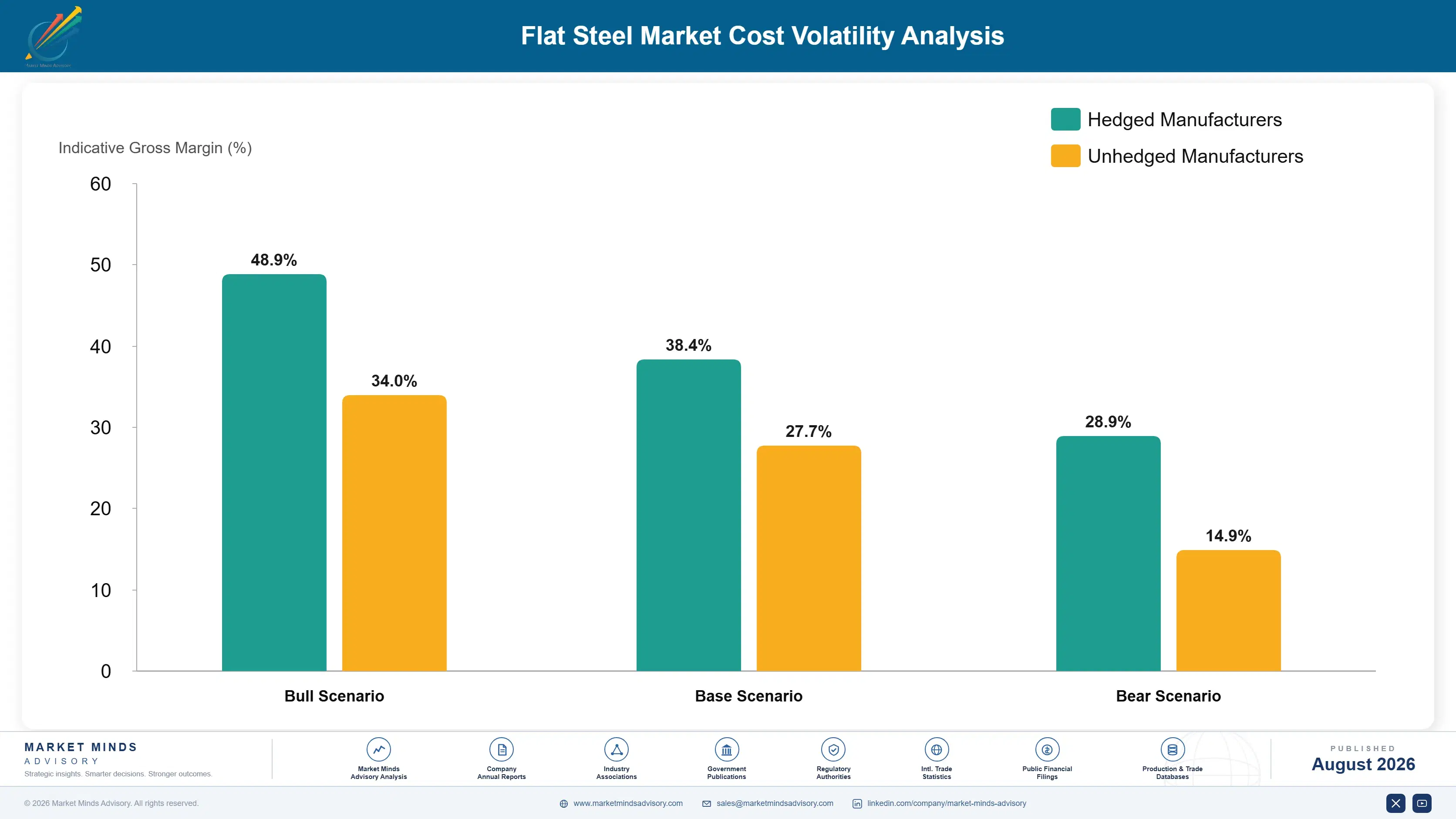
A bull catalyst comes from faster-than-expected electric vehicle and grid electrification investment accelerating demand for higher-value coated and electrical steel grades. The bear risk is Chinese overcapacity: if Chinese domestic steel production continues exceeding domestic demand, export volume could depress global pricing further, compressing margins for producers across every other major producing region. Producers are hedging via qualified grade diversification.

Electrification Reshapes a Mature Commodity

Flat steel is about as mature and unglamorous as industrial commodities get, yet it remains the physical foundation underneath nearly every car body, appliance cabinet, and building facade produced anywhere in the world today. Few commodities remain this invisible to consumers while carrying this much strategic weight for automotive and grid electrification programs.
MARKET CONCENTRATION32%Top five producers hold roughly a third of global supply
AVERAGE SELLING PRICE$780/tonneReflects blended pricing across hot-rolled and coated grades
TOP PRODUCING COUNTRYChinaLargest global steel production and downstream consumption base
CAPACITY UTILIZATION74%Overcapacity in several regions constrains pricing power broadly
FEEDSTOCK COST SHARE56% of COGSIron ore and coking coal dominate total production input cost
TRADE INTENSITY28% exportedMore than a quarter of finished volume crosses borders
Commercially, grade specification increasingly separates the highest-margin producers from commodity volume competitors. Automotive and grid customers specify electrical and coated steel by documented magnetic performance and corrosion resistance, while construction and appliance customers still buy largely on price for standard hot-rolled and cold-rolled grades. Producers serving both markets effectively run two very different commercial operations. Producers that blur this distinction risk delivering steel that either overshoots cost targets or undershoots performance requirements entirely.
Over the next decade, expect electrical and coated grades to grow meaningfully faster than standard hot-rolled volume, since most margin upside comes from electric vehicle and grid electrification demand rather than growth in general construction and appliance steel consumption. Producers investing in electrical-grade capability are best positioned to capture this expanding, higher-value demand. Producers still weighted heavily toward standard hot-rolled volume risk losing the highest-margin part of future contracts to better-prepared rivals.
"Steel is the one material nobody thinks about until an electric motor needs a very specific magnetic grade nobody was making at scale five years ago. That's where the real pricing power in this commodity has quietly moved."
Director, Primary Flat-Rolled Metal Products Practice · MMA Primary Flat-Rolled Metal Products Practice · August 2026

Market Trends

Electric Vehicle Production Expands Electrical Steel Demand

Automakers are increasingly specifying electrical steel for traction motor laminations as electric vehicle production scales across major automotive markets, a grade requiring meaningfully more precise magnetic performance than conventional flat steel. Nippon Steel and POSCO have both expanded electrical steel production capacity over the past two years specifically to serve this growing motor manufacturing demand. At least a dozen major automotive platforms have adopted expanded electrical steel content since 2023, and producers report this grade now commands meaningfully higher pricing than standard hot-rolled equivalent material. This trend is expected to continue as additional platforms adopt similar magnetic performance requirements.
Market Impact: Sustains 5%+ grid-linked demand growth
Chinese Export Capacity Pressures Global Pricing

Chinese domestic steel production capacity continues exceeding domestic demand, pushing substantial export volume into global markets and pressuring pricing for producers across every other major producing region. Baowu and other Chinese producers have both maintained elevated export volume over the past two years despite periodic government efforts to curb overcapacity. At least several major steel-producing economies have imposed new trade protection measures since 2023, and producers report this trade tension is reshaping regional pricing dynamics considerably. Industry analysts expect this trade tension to continue reshaping global steel pricing dynamics further.
Market Impact: Sustains 4%+ baseline annual growth

Market Opportunities and Growth Drivers

Grid Infrastructure Investment Sustains Electrical Demand

Continued grid infrastructure investment across multiple major economies pursuing renewable energy integration and electrification sustains steady demand for electrical steel used in transformer and generator core construction. Industry data show grid infrastructure investment has grown considerably across major economies over the past several years, directly supporting electrical steel demand growth. Producers report this application provides meaningful commercial stability underpinning the broader electrical grade segment's growth trajectory. Producers expect this grid-linked demand to continue growing steadily as renewable integration deepens across additional major markets and economies. Suppliers report order backlogs have lengthened accordingly.
Market Impact: Compresses margins 12%+ in exposed markets

Emerging Market Construction Sustains Baseline Demand

Rising construction activity across several emerging markets continues expanding baseline demand for standard flat steel used in building facades, roofing, and structural cladding applications, sustaining steady growth independent of any single region's electrification pace. Trade data show construction activity has grown considerably across major emerging economies over the past several years, directly supporting flat steel demand growth. Producers report this baseline demand provides meaningful commercial stability underpinning the broader category's overall growth trajectory. Producers expect this baseline demand to remain the category's most stable contributor for the foreseeable future ahead.
Market Impact: Adds 18%+ cost disadvantage versus peers

Market Restraints and Challenges

Chinese Overcapacity Compresses Global Steel Margins

Chinese domestic steel production capacity substantially exceeds domestic demand, and the root cause is that decades of state-supported capacity expansion built production scale beyond what China's own construction and manufacturing sectors can now absorb as domestic growth moderates. This overcapacity forces excess volume into export markets at prices that compress margins for producers across every other major producing region regardless of their own cost efficiency. Producers in markets without trade protection measures face the steepest margin exposure. Producers are mitigating this by pursuing trade protection measures and shifting toward higher-value electrical and coated grades less exposed to commodity pricing pressure.
Market Impact: Commands 25%+ premium for electrical grade

European Energy Costs Undermine Production Competitiveness

Elevated European electricity and natural gas costs following the continental energy crisis have undermined the competitiveness of energy-intensive steel production relative to producers in lower-cost energy markets, and the root cause is that European industrial energy pricing remains persistently higher than in major competing production regions given the continent's energy import dependence. This cost disadvantage has already driven several production curtailments and threatens further capacity losses if energy prices remain elevated. Producers are mitigating this by pursuing renewable energy power purchase agreements to reduce long-term energy cost exposure. Some producers are also lobbying for expanded renewable energy infrastructure investment.
Market Impact: Compresses non-Chinese pricing 12%+
3 additional market trends, 4 additional growth drivers, and 3 additional restraints and challenges are covered in the full report. Contact sales@marketmindsadvisory.com to access the complete intelligence.

Segment CAGR and Growth Architecture

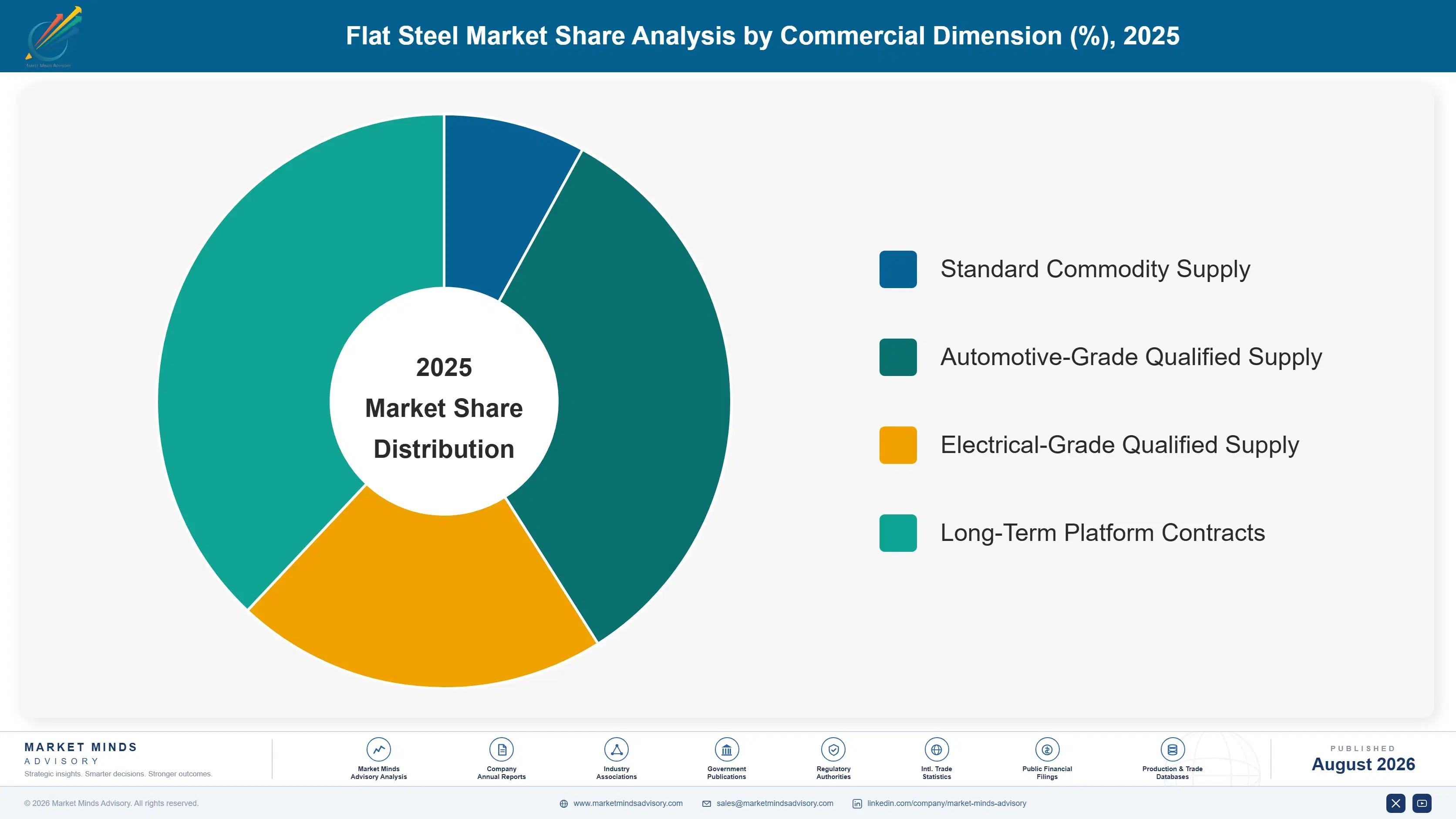
The flat steel market is segmented by product type, the classification that determines processing requirements, end-use pathway, and margin structure: hot-rolled, cold-rolled, galvanized and coated, plate, tin plate, and electrical and specialty flat steel each carry distinct commercial profiles. Upstream mining and downstream fabrication sit in separate discussions entirely, each requiring distinct analysis. each entirely.
flat-steel-market-trends-market-share-analysis-1787551585137

Electrical and Specialty Flat Steel

Electrical and specialty flat steel is the fastest-growing segment as electric vehicle motor production and grid transformer manufacturing expand demand for precisely engineered magnetic steel grades. Nippon Steel and POSCO both dominate this segment through decades of accumulated metallurgical expertise that newer entrants struggle to replicate quickly given extended automotive and utility qualification timelines. Automakers and utilities increasingly specify steel by documented magnetic performance and core loss characteristics rather than accepting generic electrical-grade claims, reflecting growing engineering sophistication. Production costs remain meaningfully above standard hot-rolled material, but automotive and grid qualification premiums more than compensate producers with genuine electrical-grade metallurgical capability. Buyers increasingly expect multi-year supply roadmaps aligned with their own platform production plans.
CAGR 5.8%

Galvanized and Coated Steel

Galvanized and coated steel is scaling steadily as automotive and construction customers increasingly specify corrosion-resistant coated grades over standard uncoated flat steel for extended service life applications. ArcelorMittal and Nucor both maintain established coating line infrastructure that specialty electrical-focused producers have not developed to the same degree. Automotive manufacturers increasingly specify coated steel by documented corrosion resistance duration rather than accepting generic galvanized claims, reflecting growing vehicle warranty and durability expectations. Pricing commands a meaningful premium over standard hot-rolled equivalents, reflecting the specialized coating line investment required for this application. Buyers increasingly request documented multi-cycle testing before finalizing large-scale supply agreements with any single producer. This documentation burden favors larger, established coating-focused producers.
CAGR 5.2%
Full segment breakdown across 6 segments available in the complete report.

Regional Architecture and Country Demand Map

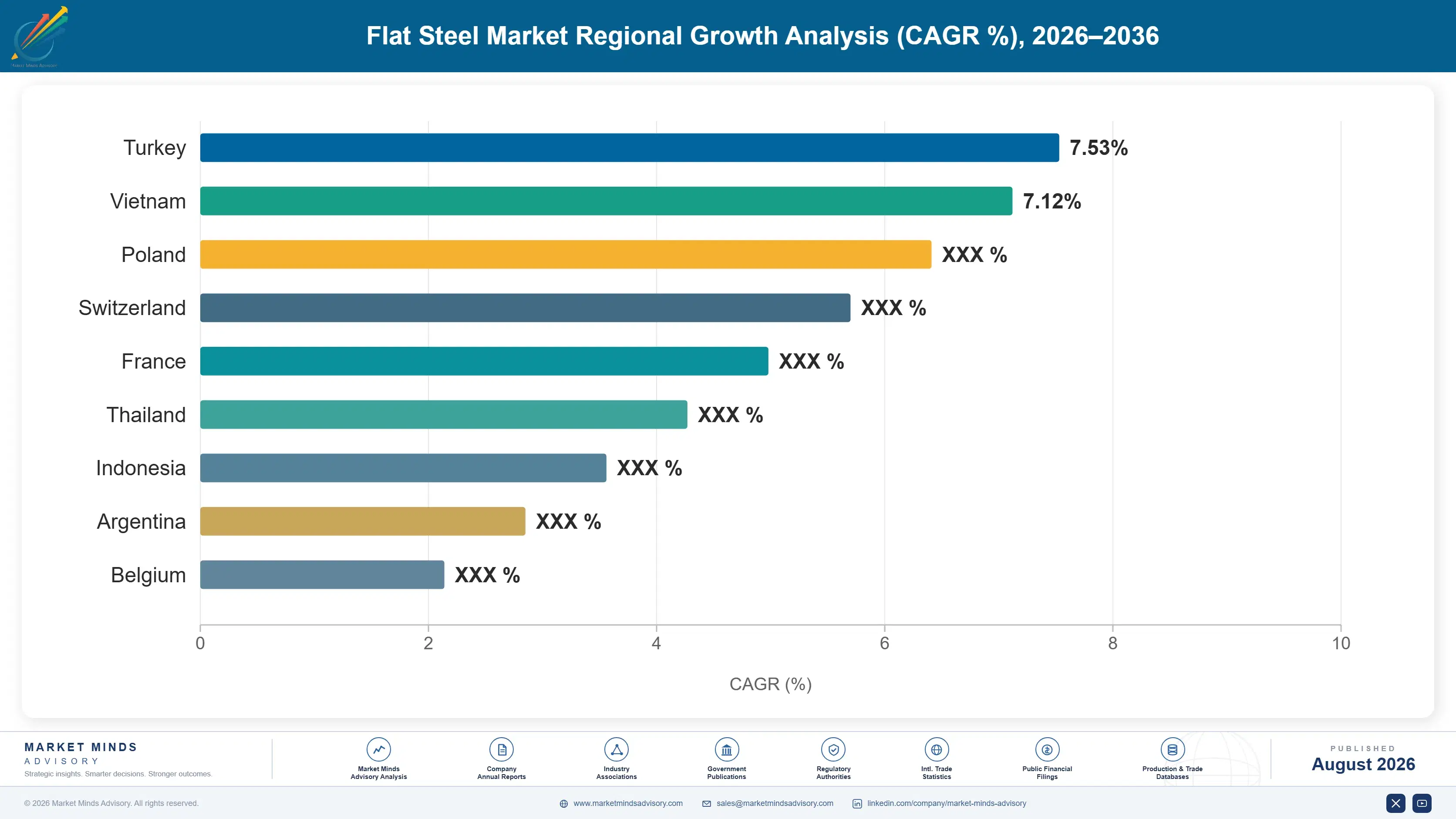
East Asia leads the global flat steel market by a wide margin, reflecting China's position as the world's dominant steel producer alongside substantial downstream automotive and appliance manufacturing capacity, while North America follows on the strength of its electric vehicle production growth. Trade policy shifts continue reshaping demand.

East Asia

China anchors regional demand and supply through its position as the world's dominant steel producer, with Baowu maintaining the largest single production base supplying both domestic automotive and appliance manufacturers and substantial export volume worldwide. Japan maintains the world's deepest concentration of electrical steel metallurgical expertise, with Nippon Steel and JFE Steel both headquartered domestically. South Korea's POSCO adds substantial additional production capacity serving both regional and global export markets. Regional growth outpaces every other region because both automotive electrification and downstream manufacturing capacity continue expanding rapidly across the region's major economies. Government manufacturing and export policy support continues reinforcing this concentrated regional production advantage across multiple provinces. Vietnam adds modest incremental demand as regional manufacturing expands.
Share: 30% | CAGR: 4.8% (2026 to 2036)

North America

The United States drives most of the region's demand through its substantial automotive manufacturing base, increasingly incorporating electrical and coated steel grades for electric vehicle production. Nucor and Cleveland-Cliffs both maintain extensive domestic production and technical support infrastructure supplying automotive, construction, and appliance customers simultaneously. Canada's smaller steel production sector contributes modest additional demand through established supply chain integration. Growth here is accelerating as electric vehicle production increasingly supplements the region's traditionally mixed automotive and construction demand base. Government critical minerals and infrastructure funding programs continue reinforcing this expanding domestic investment structure across multiple states. Suppliers increasingly maintain dedicated engineering teams supporting both automotive and construction customers across major production centers nationwide.
Share: 22% | CAGR: 3.3% (2026 to 2036)
Regional intelligence for 5 additional markets available in the complete report: Western Europe, South Asia and Pacific, Latin America, Middle East and Africa, Eastern Europe. Contact sales@marketmindsadvisory.com.
flat-steel-market-trends-country-cagr-analysis-1787551585645

Where Producers Can Capture Margin

Margin capture in flat steel increasingly depends on electrical and coated-grade metallurgical capability rather than raw hot-rolled manufacturing volume alone. Producers that can deliver documented magnetic performance, corrosion resistance credentials, and faster automotive qualification support are commanding meaningfully better pricing than producers competing purely on standard commodity steel cost. Standard-only producers increasingly struggle to defend pricing here.

Investing in Electrical-Grade Metallurgical Capability Now

Producers that invest in electrical-grade metallurgical capability addressing electric vehicle motor and grid transformer requirements are capturing premium pricing from customers facing limited qualified supplier options. Nippon Steel's expanded electrical-grade capability, upgraded in 2024, reportedly commands a 25 to 35 percent price premium over standard hot-rolled equivalent material. Producers without dedicated electrical-grade capability are increasingly partnering with metallurgical research institutions to access comparable expertise. Few competitors match this depth. Purchasing committees at leading automakers now routinely request this specific metallurgical documentation before finalizing agreements. Few competitors match this depth of metallurgical research quickly.
Market Impact: Commands a 25 to 35 percent price premium

Developing Advanced Coating Line Investment Programs

Producers that invest in advanced coating line capability addressing automotive corrosion resistance requirements are capturing premium pricing from manufacturers seeking documented durability performance beyond standard galvanized specifications. Advanced-coated material reportedly commands a 15 to 25 percent price premium over standard galvanized equivalent material of comparable volume. This coating investment requires substantial capital expenditure that smaller producers often cannot justify. That advantage compounds over time. Automakers increasingly cite this coating documentation when selecting among otherwise comparable qualified producers. That trust compounds meaningfully across successive product generations over time. Few match this reach.
Market Impact: Commands a 15 to 25 percent price premium

Building Accelerated Automotive Qualification Programs Now

Producers that offer accelerated qualification support programs, including joint testing partnerships and dedicated technical liaison teams, are capturing premium positioning among automakers seeking faster supplier onboarding without compromising metallurgical qualification rigor. Accelerated qualification programs reportedly reduce customer onboarding timeline by 20 to 30 percent compared with standard qualification processes. This support infrastructure requires sustained technical investment that smaller producers often cannot justify. Automakers increasingly view this speed as central when evaluating competing steel producers for platform programs. That trust compounds meaningfully across successive qualification cycles over many years. Few match this speed.
Market Impact: Cuts qualification timeline by 20 to 30 percent

Expanding Renewable Energy Power Purchase Agreements

Producers that secure renewable energy power purchase agreements are capturing premium positioning among customers seeking documented low-carbon supply chain credentials alongside cost stability benefits. Renewable-powered producers reportedly maintain 20 to 30 percent more stable production costs through energy price volatility cycles than producers relying entirely on spot market energy purchasing. This energy strategy requires sustained capital investment that smaller producers often cannot justify. Customers increasingly favor producers with established renewable sourcing over spot-market-dependent alternatives. That trust compounds meaningfully across successive contract renewal cycles over multiple years. Few competitors match this depth of energy strategy expertise quickly.
Market Impact: Improves cost stability by 20 to 30 percent

Who Controls the Margin Pool

Five producers hold roughly a third of global supply on a production-volume basis, reflecting a market where China's national production dominance remains spread across numerous domestic producers rather than concentrated within a single company, alongside major non-Chinese producers competing on specialized grade capability. The gap between producers with genuine electrical and coated-grade capability and those competing purely on standard hot-rolled volume is widening as automotive and grid customers tighten specification requirements. That gap makes electrical and coated-grade capability disproportionately important across the industry.
Current competitive activity centers on three fronts: electrical-grade metallurgical capability investment to capture electric vehicle motor demand, advanced coating line investment to serve automotive corrosion resistance requirements, and renewable energy sourcing to manage European energy cost exposure. Nippon Steel and ArcelorMittal have both announced meaningful investment in these fronts over the past two years.

Emerging pressure is coming from Chinese producers expanding export capacity at lower cost, threatening the competitive position established Western and Japanese producers have historically held in commodity grades. Rankings could shift meaningfully over the next several years if Chinese overcapacity continues depressing global pricing faster than non-Chinese producers can shift toward higher-margin electrical and coated grades.
flat-steel-market-trends-company-positioning-matrix-1787551586163

Competitive Moat and Risk Dimensions

CHINA BAOWU STEEL GROUP

Moat: Largest Global Production Scale

China Baowu Steel Group maintains the largest global production scale in the industry, built through decades of state-supported capacity investment and consolidation across multiple domestic production facilities. That scale gives Baowu cost advantages that smaller, more fragmented competitors cannot easily replicate given the capital investment required to match comparable production volume.
CHINA BAOWU STEEL GROUP

Risk: Exposure to Domestic Overcapacity

China Baowu Steel Group's substantial domestic production capacity exposes the company to overcapacity pressure as Chinese construction and manufacturing demand growth moderates relative to installed production capacity. A sustained domestic demand slowdown could compress Baowu's margins more than competitors with smaller, more export-diversified production bases.
NIPPON STEEL CORPORATION

Moat: Deepest Electrical Steel Metallurgical Expertise

Nippon Steel Corporation maintains the deepest electrical steel metallurgical expertise in the industry, built through decades of continuous research spanning automotive and grid infrastructure magnetic steel applications. That expertise gives Nippon Steel trusted-supplier relationships with automakers and utilities that newer competitors cannot easily replicate without years of accumulated qualification data.
NIPPON STEEL CORPORATION

Risk: Exposure to Domestic Cost Structure

Nippon Steel Corporation's substantial domestic Japanese production base exposes the company to a higher domestic cost structure relative to Chinese and other lower-cost Asian competitors producing comparable commodity steel grades. This cost gap could constrain Nippon Steel's competitiveness in standard commodity grades even as its electrical-grade position remains strong.

Players Tracked

Prominent Players

China Baowu Steel Group
ArcelorMittal
Nippon Steel Corporation
POSCO Holdings
Nucor Corporation

Other Key Players

JFE Steel Corporation
Tata Steel Limited
Hyundai Steel
Cleveland-Cliffs Inc
United States Steel Corporation
Steel Authority of India
JSW Steel Limited
Ansteel Group
HBIS Group
Shagang Group
ThyssenKrupp Steel Europe
Severstal
NLMK Group
voestalpine AG
Gerdau S.A.

Recent Developments

FEBRUARY 2024

Nippon Steel Expands Electrical-Grade Production Capacity

Nippon Steel Corporation expanded its electrical-grade steel production capacity in February 2024, targeting growing electric vehicle motor manufacturer demand for precisely engineered magnetic steel grades across multiple major automotive platforms pursuing electrification. Automakers welcomed the expansion as further evidence of improved supply reliability options across the industry.
Signal: Signals established electrical steel producers are investing well ahead of confirmed motor demand acceleration across markets worldwide.
SEPTEMBER 2023

ArcelorMittal Expands Advanced Coating Line Capacity

ArcelorMittal expanded its advanced coating line production capacity in September 2023, targeting growing automotive manufacturer demand for documented corrosion resistance performance beyond standard galvanized specification requirements across multiple vehicle platforms. Early customer feedback has been broadly positive across pilot qualification programs and equipment testing. Adoption is expected to expand further.
Signal: Signals coated-grade demand is emerging as a genuine competitive differentiator beyond standard steel performance metrics today.
JANUARY 2025

Nucor Announces Renewable Energy Agreement

Nucor Corporation announced an expanded renewable energy power purchase agreement in January 2025, targeting reduced long-term energy cost exposure across its domestic production operations amid continued energy market volatility affecting broader industry cost structures. Industry observers view the agreement as strategically significant for future cost stability.
Signal: Signals energy cost management is emerging as a genuine competitive differentiator for steel producers across Europe.

Iron Ore and Coking Coal Cost Exposure

Iron ore and coking coal together account for roughly fifty-six percent of total production cost, reflecting the core blast furnace steelmaking requirements shared across hot-rolled and higher-value coated and electrical grade production alike. Iron ore pricing tracks global mining supply and Chinese demand conditions, while coking coal costs track separate metallurgical coal commodity cycles affecting the broader steelmaking industry.
Iron ore and coking coal prices rose meaningfully during 2021 and 2022 following broader commodity market disruption, according to trade association reporting and company annual disclosures, increasing steel production costs across the industry. Producers without long-term feedstock supply contracts faced the steepest cost increases, since securing alternative sourcing requires extended commercial negotiation before substitution becomes feasible at meaningful scale. Several producers reported similar cost trends in subsequent quarterly earnings disclosures publicly.

Smaller producers relying on open-market feedstock purchases carry meaningfully more cost exposure than larger, vertically integrated producers like Baowu or ArcelorMittal, which control substantial mining assets directly. This exposure disadvantage compounds for producers competing on price against integrated competitors with deeper sourcing relationships and greater negotiating scale across their broader mining and steelmaking portfolios. This exposure compounds further given the additional scale advantages integrated producers hold globally.
flat-steel-market-trends-cost-volatility-analysis-1787551586357

Diversify Iron Ore Sourcing Across Countries

Larger producers are qualifying iron ore supply from multiple producing countries simultaneously rather than relying on a single source, reducing the odds that one country's supply disruption cuts total feedstock availability. This diversification adds procurement complexity but has measurably reduced cost volatility for adopters. Smaller producers often lack the purchasing scale to secure comparable supplier terms.

Negotiate Long-Term Coking Coal Supply Agreements

Producers are negotiating longer-term supply agreements with coking coal mining operators, reducing exposure to spot market price volatility affecting the broader metallurgical coal mining sector. This requires sustained supplier relationship management over multiple years of continued engagement. Smaller producers often lack the negotiating leverage to secure comparable long-term contract terms. This requires sustained supplier relationship management.

Invest in Vertically Integrated Mining Assets

Larger producers are investing directly in iron ore and coking coal mining assets, reducing dependence on third-party suppliers entirely for a meaningful portion of total requirements. This approach requires substantial capital investment but has improved overall cost resilience for producers that pursued it. Larger producers benefit most from this approach given existing capital resources and expertise.

Portfolio Architecture for Margin Defence

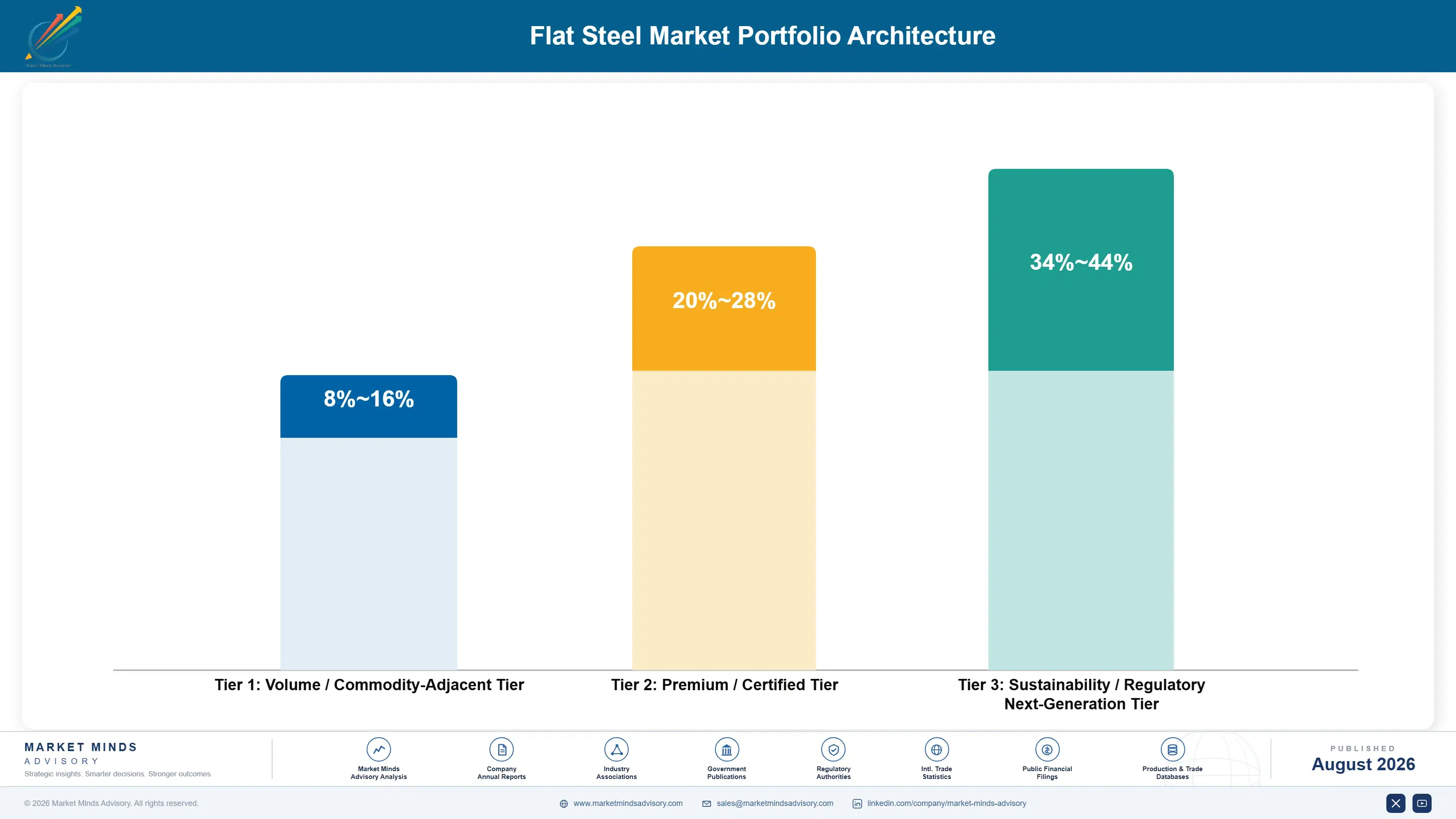
Producers in this market operate a three-tier portfolio spanning standard hot-rolled and cold-rolled steel sold largely on price into mainstream construction and appliance customers, galvanized and coated grades commanding premium pricing from automotive customers, and electrical and specialty flat steel positioned for the highest-margin electric vehicle and grid infrastructure accounts. Gross margins vary sharply across these tiers, from modest levels on standard hot-rolled material to well above thirty-five percent on qualified electrical-grade steel.
The volume versus premium tension is intensifying as more producers chase electrical and coated-grade margins, but standard hot-rolled and cold-rolled steel still represents the overwhelming majority of shipped volume and remains essential for meeting global construction and appliance manufacturing demand. Producers that abandon standard volume too quickly risk underutilizing capacity built for broad industrial scale.

High-value margin pools concentrate specifically in electrical steel sold to electric vehicle and grid customers and in advanced coated grades sold to automotive manufacturers. Standard hot-rolled and cold-rolled steel remains the volume anchor but carries thinner margins as Chinese export capacity intensifies price competition globally. Manufacturers positioned only in the middle premium tier increasingly face pressure from both higher-margin and lower-cost directions simultaneously.

Volume / Commodity-Adjacent Tier

Standard hot-rolled and cold-rolled steel sold primarily on price into mainstream construction and appliance customers with established specifications. Price competition among established producers remains intense across this segment globally. particularly among cost-sensitive construction and appliance buyers.
Gross Margin: 8-16%

Premium / Certified Tier

Galvanized and advanced coated steel sold into automotive customers, commanding premium pricing through documented corrosion resistance performance. Buyers select producers here mainly based on documented performance data and delivery reliability quality.
Gross Margin: 20-28%

Sustainability / Regulatory / Next-Generation Tier

Electrical and specialty flat steel positioned for electric vehicle and grid accounts paying the category's highest per-tonne prices for verified magnetic performance. Purchasing decisions here center on documented metallurgical credentials rather than cost alone.
Gross Margin: 34-44%
flat-steel-market-trends-portfolio-architecture-1787551586857

High-value Sub-segments and Strategic Watch-out

Electrical and Specialty Flat Steel

Electrical steel is capturing the highest margins in the category as electric vehicle and grid demand expands, and established producers are defending this premium positioning through accumulated metallurgical credentials competitors cannot easily replicate. Automakers and utilities increasingly drive purchasing preference toward producers with proven metallurgical track records.
Gross Margin: 34-44%

Advanced Coated Automotive Steel

Advanced coated steel is gaining share as automotive corrosion resistance requirements tighten, though documented performance credibility remains concentrated among a small number of established producers. Growing durability requirements continue to strengthen interest in this documented approach. Expect continued certification investment to accelerate across the broader industry landscape.
Gross Margin: 20-28%

Standard Hot-Rolled and Cold-Rolled Steel

Standard steel sold into mainstream construction and appliance customers remains the category's volume core, anchored by established relationships but facing intensifying Chinese export pricing pressure. Established scale advantages continue sustaining steady global demand within this dominant segment. Expect price competition here to intensify as Chinese export volume continues expanding further.
Gross Margin: 8-16%

European Energy-Intensive Legacy Capacity

Legacy European production capacity facing persistently elevated energy costs continues losing competitiveness against lower-cost Asian producers, a segment operators should actively reallocate away from. Operators still tolerating this category face growing competitiveness and closure risk. Expect further closures as energy costs remain persistently elevated across the continent.
Gross Margin: 2-6%

Platform Contracts Meet Construction Cycles

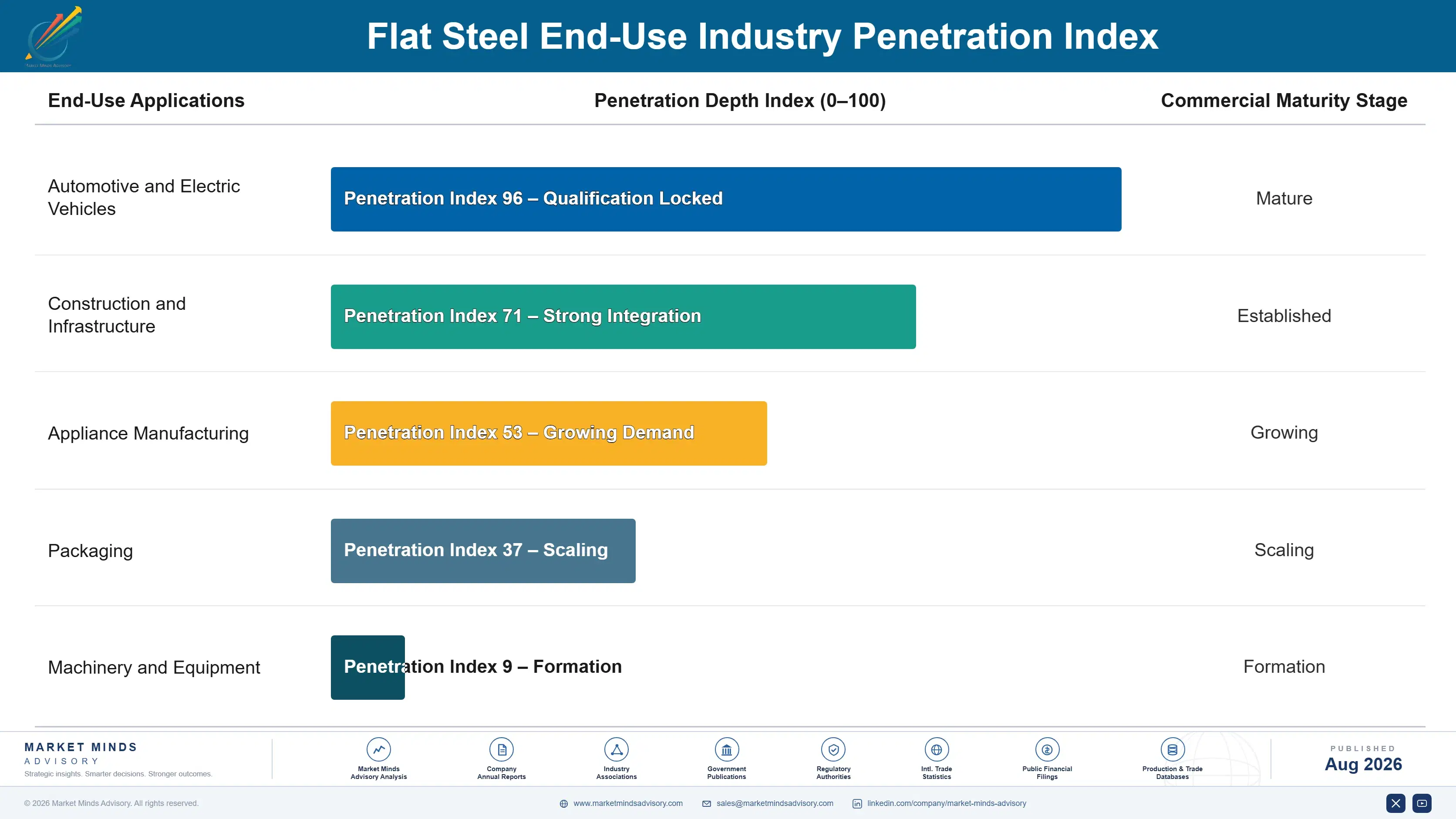
Flat steel demand behaves like a long-term platform relationship in the automotive segment, because automakers typically qualify a specific electrical or coated steel supplier across an entire vehicle platform's multi-year production run rather than switching suppliers opportunistically. That structure gives incumbent producers durable, multi-year revenue visibility once a platform contract is won, though it also means losing an initial contract locks a competitor out of that platform's full production lifecycle.
Adoption depth varies sharply by end-use vertical. Automotive and grid customers adopt new electrical and coated steel suppliers relatively cautiously given extended metallurgical qualification requirements, while construction and appliance customers move considerably faster, switching suppliers whenever price or availability considerations favor doing so without meaningful qualification burden. Appliance manufacturers fall somewhere between these two extremes, balancing cost sensitivity against growing performance documentation expectations.

Generational buyer shifts are visible mainly among newer electric vehicle platform engineering teams building magnetic performance requirements directly into supplier qualification criteria, while legacy construction buyers remain anchored to established commodity suppliers they consider adequate given the absence of comparable specification pressure in their end markets. This generational divide will likely widen further as electrification and sustainability documentation requirements expand across additional industrial categories industry-wide.
flat-steel-market-trends-end-use-penetration-index-1787551587342

Where Flat Steel Value Concentrates

These are among the four positions where our research anticipates prominent divergence between winners and laggards over the coming forecast period. Each is grounded in the demand model, the regulatory perimeter, and the announced capacity pipeline.
01 / ELECTRICAL-GRADE METALLURGICAL INVESTMENT

Invest in electrical-grade capability ahead of EV scaling

Electric vehicle motor production continues expanding, and producers with documented electrical-grade metallurgical capability are capturing this premium demand fastest. Nippon Steel has already demonstrated meaningful commercial traction with its expanded electrical-grade capability, confirming genuine automaker demand exists for this specialized expertise. MMA recommends producers without comparable electrical-grade capability invest in it now, before electric vehicle production scaling consolidates around already-established metallurgical leaders across additional automotive platforms worldwide over the next several years of accelerating electric vehicle production growth across nearly every major automotive market worldwide.
02 / ADVANCED COATING LINE INVESTMENT

Build coating capability ahead of durability requirement tightening

Automotive manufacturers continue tightening corrosion resistance and durability specification requirements, and producers with advanced coating line capability are capturing this premium demand fastest. ArcelorMittal has already demonstrated meaningful commercial traction through its expanded coating capacity, confirming genuine automaker demand exists for documented performance. MMA recommends producers without comparable coating capability invest in it now, before established competitors further consolidate this fast-growing, higher-margin automotive segment across additional platform generations still under active development across major automotive manufacturing markets currently pursuing electrification worldwide.
03 / AUTOMOTIVE QUALIFICATION ACCELERATION

Build qualification support ahead of platform expansion

Automakers continue expanding electric vehicle platform lineups, and producers offering accelerated qualification support are winning new supplier relationships fastest. Early movers in qualification support are positioned to define the onboarding standard other competitors will eventually need to match. MMA recommends producers without comparable qualification infrastructure invest in it now, while this advantage remains underdeveloped across much of the fragmented supplier base competing for these fast-growing electric vehicle and grid infrastructure accounts across multiple regions and expanding application categories over time.
04 / RENEWABLE ENERGY SOURCING STRATEGY

Secure renewable energy agreements ahead of continued volatility

European energy cost pressure continues threatening production competitiveness, and producers with renewable energy power purchase agreements are maintaining more stable production economics accordingly. Nucor has already demonstrated meaningful commercial traction through its expanded renewable energy agreement, confirming genuine value in this energy strategy. MMA recommends producers without comparable renewable sourcing invest in it now, before continued volatility further erodes production margins relative to lower-cost Asian and North American production regions currently expanding capacity aggressively year after year across the industry.

Engagement Snapshot From the Field

A live engagement with an industry participant carrying material or product regulatory and market exposure ahead of a defining policy shift, showing how our research translates into a defensible multi-year portfolio strategy.
MARKET MINDS ADVISORY · CLIENT ENGAGEMENT SUMMARY
Flat Steel Producer Strategic Portfolio Review and Transition Roadmap 2026·Investment Scenario on Flat Steel Exposure Evaluation 2025-26
CLIENT PROFILE
The client is a mid-sized North American automotive Tier 1 supplier generating an estimated one hundred twenty million dollars in annual steel component revenue (client-reported, unverified by MMA), supplying stamped body panels to several electric vehicle platform customers. The client faced a decision about whether to transition its steel sourcing toward advanced coated grades for enhanced corrosion resistance.
STRATEGIC CHALLENGE
A major automaker customer indicated it was evaluating enhanced corrosion resistance warranty requirements for an upcoming electric vehicle platform, creating competitive pressure for the client to secure advanced coated steel supply or risk losing the qualification opportunity to a competitor already sourcing comparable material within the available program timeline. Losing this qualification would have meaningfully reduced the client's revenue within a single fiscal year.
MMA APPROACH
MMA conducted a structured evaluation of advanced coated steel sourcing options from three potential suppliers, benchmarking documented corrosion resistance data, pricing structure, and qualification timeline against the client's platform program schedule and existing sourcing relationship economics. Findings were presented directly to the client's executive leadership team for final sourcing decisions.
KEY FINDINGS
  1. The automaker customer's enhanced warranty specification required documented corrosion resistance data that the client's existing standard galvanized supplier could not readily provide.
  2. Switching to advanced coated steel added a meaningful cost premium but met the platform qualification requirement within the available program timeline. within the available program timeline
  3. One of the three evaluated suppliers could not provide sufficient documented performance data to support the client's qualification timeline requirements within budget.
  4. The client's successful transition reportedly preserved its position on the automaker's platform and opened discussion for additional platforms requiring similar grades (client-reported, unverified by MMA).
CLIENT PROFILE
The client is a mid-sized North American automotive Tier 1 supplier generating an estimated one hundred twenty million dollars in annual steel component revenue (client-reported, unverified by MMA), supplying stamped body panels to several electric vehicle platform customers. The client faced a decision about whether to transition its steel sourcing toward advanced coated grades for enhanced corrosion resistance.
STRATEGIC CHALLENGE
A major automaker customer indicated it was evaluating enhanced corrosion resistance warranty requirements for an upcoming electric vehicle platform, creating competitive pressure for the client to secure advanced coated steel supply or risk losing the qualification opportunity to a competitor already sourcing comparable material within the available program timeline. Losing this qualification would have meaningfully reduced the client's revenue within a single fiscal year.
MMA APPROACH
MMA conducted a structured evaluation of advanced coated steel sourcing options from three potential suppliers, benchmarking documented corrosion resistance data, pricing structure, and qualification timeline against the client's platform program schedule and existing sourcing relationship economics. Findings were presented directly to the client's executive leadership team for final sourcing decisions.
KEY FINDINGS
  1. The automaker customer's enhanced warranty specification required documented corrosion resistance data that the client's existing standard galvanized supplier could not readily provide.
  2. Switching to advanced coated steel added a meaningful cost premium but met the platform qualification requirement within the available program timeline. within the available program timeline
  3. One of the three evaluated suppliers could not provide sufficient documented performance data to support the client's qualification timeline requirements within budget.
  4. The client's successful transition reportedly preserved its position on the automaker's platform and opened discussion for additional platforms requiring similar grades (client-reported, unverified by MMA).
RECOMMENDED STRATEGY
Phase 1: Phase 1 (Weeks 1 to 4): Benchmark three advanced coated steel suppliers against performance data, cost, and timeline requirements. and existing capacity data Phase 2: Phase 2 (Weeks 5 to 8): Validate documented performance data against the automaker's specific platform warranty requirements. and the automaker's specific requirement Phase 3: Phase 3 (Weeks 9 to 14): Finalize supplier agreement, complete qualification testing, and confirm production readiness. ahead of the platform deadline
OUTCOME
The client successfully transitioned to advanced coated steel and preserved its position on the automaker's platform within the required timeline (client-reported, unverified by MMA). The successful transition also opened discussion for additional platforms requiring similar coated steel grades. The successful transition also strengthened the client's standing among other automakers evaluating suppliers.

Frequently Asked Questions

Foundational context covering the market sizes, CAGR, scope, country, region and competition that inform every finding below. This section is provided to cover basics and most often pre-purchase conversations, answered from the MMA Primary Research Dataset.

What is the current size of the Flat Steel Market?

The global flat steel market is valued at approximately $485.00 billion in 2025. Growth is driven by electric vehicle production alongside sustained grid electrification investment worldwide.

How large will the Flat Steel Market be by 2036?

MMA projects the market will reach approximately $731.03 billion by 2036, roughly 1.5 times its 2026 base value. Electrical and specialty flat steel will account for a growing share of that expansion.

What is the CAGR for the Flat Steel Market 2026 to 2036?

The market is expected to grow at a compound annual growth rate of 3.8% between 2026 and 2036. Bull and bear scenarios range from 2.6% to 4.9% depending on Chinese overcapacity conditions.

Which segment is growing fastest?

Electrical and specialty flat steel is the fastest-growing segment, expanding at roughly 5.8% annually, about 1.5 times the overall market rate. Electric vehicle motor demand is the primary driver.

Who are the major companies in the Flat Steel Market?

China Baowu Steel Group, ArcelorMittal, Nippon Steel Corporation, POSCO Holdings, and Nucor Corporation lead global supply. The top five producers together hold roughly a third of global supply.

Which country is growing fastest?

India is growing fastest, driven by rapidly expanding domestic steel production and automotive manufacturing capacity nationwide. Government manufacturing incentive programs continue reinforcing this growth further.

Report Segmentation Architecture

The full report scope spans multiple orthogonal segmentation dimensions, with cross-tabulated demand data provided for each dimension pair. Coverage extends further to regional breakdowns, trend trajectories, and the competitive detail needed to support segment-level decision-making.

By Product Type

  • Hot-Rolled Coil and Sheet
  • Cold-Rolled Coil and Sheet
  • Galvanized and Coated Steel
  • Steel Plate
  • Tin Plate and Packaging Steel
  • Electrical and Specialty Flat Steel

By End-Use Industry

  • Automotive and Electric Vehicles
  • Construction and Infrastructure
  • Appliance Manufacturing
  • Packaging
  • Machinery and Equipment

By Commercial Dimension

  • Standard Commodity Supply
  • Automotive-Grade Qualified Supply
  • Electrical-Grade Qualified Supply
  • Long-Term Platform Contracts

By Region

  • North America
  • Western Europe
  • East Asia
  • South Asia and Pacific
  • Latin America
  • Middle East and Africa
  • Eastern Europe

Scope, Methodology, and Coverage

Every figure in this report is reproducible from documented input assumptions. The scope below maps the historical period, the forecast horizon, the segmentation dimensions, and the countries covered, alongside the underlying primary and qualitative methodology.
Historical Period
2020 to 2025
Forecast Period
2026 to 2036
Base Year
2025 (USD billions; MMA Primary Research Dataset, August 2026)
Market Definition
The flat steel market covers hot-rolled coil and sheet, cold-rolled coil and sheet, galvanized and coated steel, steel plate, tin plate, and electrical and specialty flat steel sold for automotive, construction, appliance, packaging, and machinery manufacturing applications. It excludes long steel products such as bars, rods, rails, and structural sections, which are sold as a separate product category, and finished fabricated steel components.
Quantitative Units
USD billions (current prices); million metric tons produced annually where applicable
Segmentation Dimensions
By Product Type; By End-Use Industry; By Commercial Dimension; By Region
Regions Covered
North America, Western Europe, East Asia, South Asia and Pacific, Latin America, Middle East and Africa, Eastern Europe
Countries Covered
USA, Canada, China, Japan, South Korea, Germany, France, Austria, UK, India, Australia, Vietnam, Indonesia, Brazil, Mexico, Argentina, Saudi Arabia, UAE, South Africa, Poland, Russia, Czech Republic, Hungary, and additional markets relevant to this sector
Key Companies Profiled
China Baowu Steel Group, ArcelorMittal, Nippon Steel Corporation, POSCO Holdings, Nucor Corporation, JFE Steel Corporation, Tata Steel Limited, Hyundai Steel, Cleveland-Cliffs Inc, United States Steel Corporation, Steel Authority of India, JSW Steel Limited, Ansteel Group, HBIS Group, Shagang Group, ThyssenKrupp Steel Europe, Severstal, NLMK Group, voestalpine AG, Gerdau S.A.
Quantitative Methodology
Primary survey, n=3,800 respondents, Q4 2025, six countries; demand-side model with trade association cross-validation
Qualitative Methodology
47 expert interviews, Q4 2025; applied to validate demand model assumptions, identify emerging dynamics, and assess competitive positioning
Report Format
PDF and XLSX data workbook (Word format preview document)
Publisher
Market Minds Advisory
Report Code
MMA-2026-CHM-508
Published
August 2026
Contact
sales@marketmindsadvisory.com | www.marketmindsadvisory.com

Purchase the full Flat Steel Market Report (2026 to 2036).

This report delivers a complete assessment of the global flat steel market across all major product types, end-use industries, and geographic regions through 2036. It includes competitive profiling of twenty companies and segmentation distinguishing hot-rolled, cold-rolled, coated, plate, tin plate, and electrical flat steel. Regional demand modeling spans all seven MMA-covered geographies. Buyers will find quantified forecasts for market size, segment growth, and regional CAGR alongside analysis of Chinese overcapacity, European energy cost exposure, and iron ore cost dynamics. A dedicated revenue lever framework identifies four specific commercial actions producers can take to capture margin as electrification demand accelerates.
Twenty-company competitive profiling with moat and risk analysis
Seven-region demand model with justified share and CAGR bands
Product-type segmentation across six MECE categories
Quantified revenue lever framework for margin capture strategies
Iron ore and coking coal cost exposure analysis
Anonymized case study on automotive steel grade transition

Built For The People Who Decide

From boardroom strategy to bench-side execution, this report is read cover-to-cover by leaders shaping the next decade of their industry, turning demand scenarios, market dynamics and valuation benchmarks into decisions.
CXOs/ Presidents/ VPs/ Managers
M&A and Corporate Development
Strategy Teams and R&D Heads
Procurement and Product Directors
Regulatory and Compliance Leaders
Investor Relations and Equity Analysts