Market Minds Advisory
Flat Panel X-Ray Detectors Market

Flat Panel X-Ray Detectors Market: Dose Efficiency as the Real Purchasing Filter

Hospitals now specify wireless flat panel detectors to complete overdue CR-to-DR conversion programs, veterinary and dental clinics expand portable detector capacity, and manufacturers without FDA clearance lose multi-year hospital procurement contracts outright.

Lead Analyst

David Horsley

Published

September 2026

Make Smarter Decisions with Customized Research Insights

Request a free sample report and evaluate market opportunities, growth trends, and competitive dynamics relevant to your business needs.

2025 MARKET VALUE$3.8BMarket Size 2025
2036 FORECAST VALUE$9.6BBase Case , 2026 to 2036
CAGR 2026 TO 20368.8 %Bull 10.1% / Bear 7.5%
INCREMENTAL OPPORTUNITY$5.5BNet 10- year value creation
EXPANSION MULTIPLE2.32x2036 value over 2026 base
Strategic Levers
M&A Pipeline
Regional Outlook
Country Rankings
Competitive Intelligence
Segmental Deep-dive
Call-Us : 91 93563 13602

Executive Snapshot and Market Trajectory

Radiology procurement teams increasingly treat dose efficiency and workflow speed as the deciding purchasing factor rather than image resolution alone, since certified dose data now determines which detectors actually qualify for hospital capital budgets across most major imaging departments simultaneously and without costly requalification delay across every affected imaging suite.
Wireless flat panel detectors lead growth at 12.5%, roughly 1.42 times the overall rate, as hospitals complete overdue computed radiography to digital radiography conversion programs that fixed installations cannot address across mobile and point-of-care settings. North America now holds the largest regional share at 28%, driven by strong hospital capital budgets and rapid digital conversion investment across the region's dense imaging infrastructure base and its aging installed detector fleet nearing simultaneous end of life.
Competitive intensity stays elevated at 52% held by five suppliers, since FDA and CE certification requirements and panel manufacturing scale concentrate share more tightly than most other medical device categories, though dozens of regional specialists still compete on price in lower-acuity settings. Buyers increasingly select suppliers on documented dose efficiency rather than resolution specifications alone across most major hospital procurement decisions.
Market Definition
Base Year Value
$3.8B in 2025 (MMA Primary Research Dataset, August 2026)
Forecast Period
2026 to 2036, eleven discrete annual values
CAGR
8.8% base case. Bull 10.1%. Bear 7.5%.
Fastest Growth Segment
Wireless Flat Panel Detectors: 12.5% CAGR
Fastest Growth Country
China: 10.2% CAGR
Fastest Growth Region
South Asia and Pacific: 10.8% CAGR
Largest Region
North America: 28% of 2025 global value
Market Leaders
Primary Survey
n=3,800 procurement and R&D decision-makers, Q4 2025, six countries
Methodology
Demand-side build-up, cross-validated against public data, 47 expert interviews

Flat Panel X-Ray Detectors Market Forecast Scenarios

flat-panel-x-ray-detectors-market-size-forecast-scenario-1787301934157
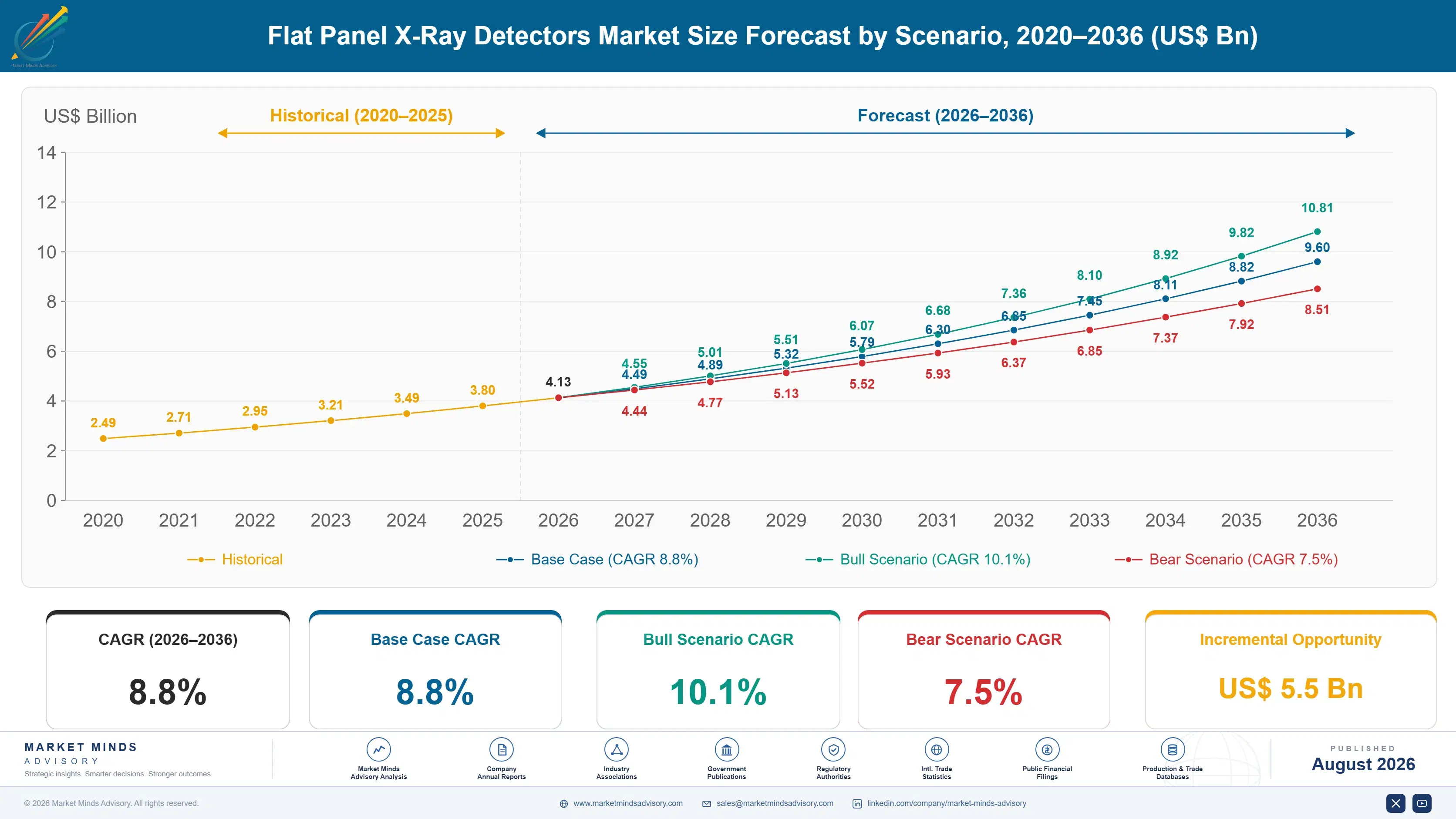
Between 2020 and 2025 the market grew at an estimated 7.8% annually, as pandemic-driven hospital capital investment and accelerating CR-to-DR conversion programs pushed procurement teams toward digital detector upgrades faster than the industry's typical multi-year replacement cycle would otherwise dictate across most major healthcare systems worldwide, a pace that held steady even through supply chain disruption.
Three mechanisms carry the base case to 8.8%. First, hospitals worldwide keep completing overdue CR-to-DR conversion programs as computed radiography systems reach end of life and require full digital replacement across every affected imaging suite. Second, veterinary and dental clinics keep expanding portable detector adoption as point-of-care imaging scales across outpatient settings. Third, industrial and security screening applications keep adding detector demand as non-destructive testing standards tighten across manufacturing sectors worldwide.
The bull case at 10.1% assumes accelerating hospital capital spending across additional major healthcare systems pulls forward detector replacement faster than currently planned by most procurement teams. The bear case at 7.5% assumes budget-constrained hospital capital programs delay planned equipment upgrades, slowing the pace of new detector installation and replacement demand growth across affected facilities and their broader capital budgets.

Dose Efficiency as the Real Purchasing Filter

Flat panel X-ray detectors sit at the center of diagnostic imaging economics for any facility replacing film-based or computed radiography systems, since certified dose efficiency increasingly determines which detectors a radiology director can actually justify against patient safety and hospital capital budgets. Documented workflow speed and dose data, not raw resolution alone, increasingly separates competing suppliers across most major hospital procurement decisions and every subsequent capit
MARKET CONCENTRATION (CR5)52%Five suppliers hold elevated share across certified panel field
DETECTIVE QUANTUM EFFICIENCY65 to 80 percentTypical certified dose efficiency range across current product generations
TOP PRODUCING COUNTRY SHARE22%United States supplies largest share of installed detector manufacturing capacity
PRODUCT REPLACEMENT CYCLE7 to 10 yearsTypical interval before detectors require full replacement or recalibration
AMORPHOUS SILICON COST SHARE30-40% of COGSSemiconductor panel inputs weigh heavily on production costs currently
TRADE INTENSITY46% cross-borderFinished detectors frequently cross borders before final hospital installation
Commercially, the category behaves like a specialized regulatory clearance business wrapped inside a broader medical device supply relationship. Suppliers maintain FDA and CE certification data across dozens of detector configurations simultaneously, which locks hospital systems into suppliers holding the specific clearances their target facilities require rather than encouraging panel-by-panel shopping on price. Switching detector suppliers requires costly facility-specific requalification testing and updated clinical documentation.
Over the next decade, expect wireless and CMOS-based detectors to keep displacing conventional fixed amorphous silicon panels as point-of-care and mobile imaging demands intensify across major healthcare systems worldwide. Veterinary, dental, and industrial non-destructive testing applications will keep driving the sharpest adoption activity as certification and dose efficiency requirements tighten further across the coming decade and beyond as regulatory bodies raise minimum dose efficiency thresholds.
"Resolution gets a detector on the shortlist. The dose the patient actually absorbs is what wins the hospital committee vote."
Director, Medical Imaging and Diagnostic Devices Practice · MMA Medical Devices

Market Trends

Wireless Detector Adoption Accelerates Point-of-Care Imaging

Hospitals and outpatient clinics are increasingly specifying wireless flat panel detectors to enable portable and point-of-care imaging that fixed installations cannot serve, particularly for bedside, emergency department, and mobile imaging applications. The US FDA's continued clearance of new wireless detector models has pushed several hospital systems toward formal wireless fleet budgeting rather than continued reliance on fixed installations requiring dedicated imaging rooms. Canon and Varex Imaging have both expanded wireless product lines specifically to meet this accelerating point-of-care transition. The shift is turning detector specification into a workflow design decision as much as an image quality one.
Market Impact: Adds 8,000 systems needing replacem

CR-to-DR Conversion Sustains Hospital Replacement Demand

Hospitals still running computed radiography systems face mounting pressure to complete full digital conversion as CR cassette processing infrastructure ages and manufacturer support winds down across major equipment vendors and their regional service networks. China's continued hospital digitalization investment under national healthcare modernization programs has expanded the installed base of facilities requiring certified detector replacement across major provincial hospital systems and their affiliated outpatient clinics. Suppliers with established hospital procurement relationships are capturing disproportionate share of this expanding conversion-driven demand across every major healthcare region and hospital tier worldwide today.
Market Impact: Adds 16% outpatient clinic installs

Market Opportunities and Growth Drivers

Aging CR Fleets Require Simultaneous Digital Replacement

Computed radiography systems installed during the last major hospital digitalization wave are now reaching end of manufacturer support simultaneously, creating a replacement wave concentrated within a relatively narrow window across mature healthcare systems worldwide. Hospital systems facing simultaneous end-of-support events across multiple departments increasingly consolidate replacement programs with a single supplier to secure fleet-wide dose data and simplify clinical training across every affected department. Suppliers with strong hospital service networks are capturing disproportionate share of this concentrated replacement demand as facility operators prioritize continuity across every affected imaging suite and shift schedule.
Market Impact: Requires 4 to 8 million

Veterinary and Dental Clinic Expansion Sustains Demand

Global veterinary and dental clinic capacity continues expanding as outpatient care volume grows across most major healthcare economies, and each new or upgraded clinic requires baseline digital imaging infrastructure to support point-of-care diagnosis regardless of practice size or specialty. The continued expansion of dental service organizations and veterinary hospital chains has expanded the installed base of clinics requiring certified detector infrastructure across major outpatient care regions and their surrounding referral networks. Suppliers with established outpatient distribution networks are capturing disproportionate share of this expanding infrastructure-driven demand across every major producing region worldwide.
Market Impact: Delays upgrades 2 to 3 years

Market Restraints and Challenges

Regulatory Clearance Costs Limit Smaller Supplier Entry

Bringing a new flat panel detector design to FDA and CE regulatory clearance requires extensive clinical validation and dose testing across multiple imaging protocols, a cost burden smaller specialty manufacturers often cannot justify against uncertain approval timelines. The root cause is evidentiary rigor: regulators require increasingly comprehensive clinical safety and dose efficiency data before granting clearance, a standard that has risen considerably as patient safety scrutiny intensifies. That cost structure concentrates the highest-value certified portfolio among a handful of well-capitalized suppliers. Suppliers are responding by pursuing shared clinical trial consortiums to distribute validation costs.
Market Impact: Converts 28% of new installs

Hospital Capital Budget Cycles Delay Replacement Decisions

Hospital capital equipment budgets typically follow multi-year planning cycles that constrain when detector replacement can actually proceed, even when clinical need or aging equipment risk would otherwise justify immediate upgrade. The root cause is budget allocation competition: hospital finance committees must weigh detector replacement against other capital priorities competing for the same limited budget, and imaging equipment rarely wins priority over higher-visibility clinical programs. That dynamic delays replacement well past the point where dose efficiency data alone would justify the investment. Suppliers are responding by offering financing and equipment-as-a-service contract structures.
Market Impact: Adds 12,000 hospital conversions ye
3 additional market trends, 4 additional growth drivers, and 2 additional restraints and challenges are covered in the full report. Contact sales@marketmindsadvisory.com to access the complete intelligence.

Segment CAGR and Growth Architecture

Segmentation follows detector technology and form factor, a single classification logic spanning amorphous silicon indirect conversion, amorphous selenium direct conversion, CMOS, wireless, fixed, and dual-energy flat panel detectors. Each variant carries distinct conversion architecture, certification pathway, and clinical application context, so commercial position tracks panel engineering rather than end-use setting alone across every facility.
flat-panel-x-ray-detectors-market-market-share-analysis-1787301934691

Wireless Flat Panel Detectors

Wireless flat panel detectors grow fastest at 12.5%, about 1.42 times the overall market rate, as hospitals complete overdue CR-to-DR conversion programs that fixed installations cannot address across mobile, emergency department, and point-of-care settings. Adoption concentrates first in facilities where bedside and portable imaging demand exceeds what dedicated imaging rooms can efficiently serve, and veterinary and dental practices are increasingly following given comparable portability requirements across their treatment settings. Suppliers with proven wireless certification data are capturing disproportionate share of new facility installations as procurement teams increasingly specify wireless capability explicitly in purchasing requirements, particularly across the United States, China, and the broader North American and East Asian hospital systems.
CAGR 12.5%

CMOS Flat Panel Detectors

CMOS flat panel detectors grow second-fastest overall at 11.0%, driven by superior spatial resolution and radiation hardness that make them increasingly preferred for dental, mammography, and specialty imaging applications requiring the finest possible achievable image detail available today. Facility operators expanding specialty imaging programs increasingly specify CMOS technology as the baseline choice for high-resolution diagnostic applications rather than an alternative to conventional amorphous silicon panels, since the resolution advantage widens considerably at higher magnification and finer diagnostic detail levels. Suppliers offering integrated CMOS detector systems with advanced image processing software are capturing share from conventional panel specialists, since specialty imaging customers increasingly prefer a single accountable vendor for the complete diagnostic workflow.
CAGR 11.0%
Full segment breakdown across 6 segments available in the complete report.

Regional Architecture and Country Demand Map

North America leads at 28% of global value on strong hospital capital budgets and rapid digital conversion investment across its dense imaging base, followed by East Asia at 26% and Western Europe at 20% on established radiology infrastructure demand. Remaining regions account for the balance of demand.

North America

The United States accounts for most of the region's overall demand, where strong hospital capital budgets alongside FDA clearance requirements shape which detector technology radiology directors actually specify across most major healthcare systems. Medicare and private insurance reimbursement incentives have pushed several hospital networks toward accelerated CR-to-DR conversion, sustaining elevated replacement volume across major metropolitan health systems. Canada's hospital and veterinary sectors both follow comparable regulatory patterns at smaller absolute scale, anchored by its own certification framework. Growth of 9.5% outpaces the global rate as digital conversion investment and aging fleet replacement compound across an already substantial installed customer base spanning multiple care settings and their extensive existing radiology infrastructure nationwide.
Share: 28% | CAGR: 9.5% (2026 to 2036)

Western Europe

Germany and France host substantial hospital infrastructure supporting detector demand across the European Union's stringent Medical Device Regulation framework, which requires extensive clinical documentation before granting equipment certification across all member states simultaneously. Italy's hospital and dental sectors sustain steady demand tied to established radiology supplier relationships built over multiple decades. The United Kingdom maintains comparable certification requirements following its departure from the European Union's centralized regulatory system, creating some duplicative approval burden for suppliers serving both markets separately. Growth of 7.2% trails the global average because the region's hospital base, while technically sophisticated, has already driven most feasible digital conversion activity across mature accounts and long-established hospital supplier relationships built over decades.
Share: 20% | CAGR: 7.2% (2026 to 2036)
Regional intelligence for 5 additional markets available in the complete report: East Asia, South Asia and Pacific, Latin America, Middle East and Africa, Eastern Europe. Contact sales@marketmindsadvisory.com.
flat-panel-x-ray-detectors-market-country-cagr-analysis-1787301935210

Where Detector Suppliers Can Defend Margin

Suppliers can defend margin against commoditized panel pricing in several distinct ways beyond simply selling more units into a growing hospital base. The three levers below identify genuine commercial advantage: dose efficiency documentation leadership, bundled wireless fleet packages, and clinical workflow integration support across regulated hospital and outpatient accounts worldwide, from major health systems to dental clinics.

Lead Certified Dose Efficiency Documentation Now

Suppliers with the most comprehensive documented dose efficiency data across a broad range of clinical protocols capture premium pricing of 18% to 28% over competitors with less rigorous clinical testing, since radiology directors increasingly specify minimum dose efficiency thresholds before approving procurement. This advantage compounds as patient safety standards tighten worldwide, since suppliers with the deepest clinical data libraries can respond to new hospital specification requests faster than competitors starting validation from scratch. Canon and Varex Imaging have both built durable dose efficiency leadership that smaller regional competitors cannot quickly replicate.
Market Impact: Commands a durable 18 to 28 percent

Bundle Wireless Fleet Management With Detector Sales

Hospital IT and radiology departments increasingly want a single accountable vendor for complete wireless detector fleet management spanning battery monitoring, image workflow, and predictive maintenance, rather than sourcing hardware and fleet software separately from different specialists. Suppliers offering bundled packages can charge premiums of 15% to 25% over hardware-only competitors, since customers value avoiding the integration risk of mismatched fleet platforms across multiple vendors and hospital IT systems. Trixell and Vieworks have both built durable bundling advantages across dozens of hospital configurations that smaller specialists cannot quickly replicate across comparable hospital configurations and IT environments.
Market Impact: Commands a durable 15 to 25 percent

Offer Embedded Clinical Workflow Integration Services

Manufacturers moving beyond selling standalone detectors toward embedded clinical workflow integration, spanning PACS connectivity, staff training, and post-installation performance monitoring under a single contract, capture engineering and service fees that a component-only sale never reaches. This shift matters most for large hospital systems undergoing complete digital conversion, where integration support can add 25% to 40% above the equipment's standalone list price. It also deepens the customer relationship ahead of the next fleet refresh, since the original integrator typically wins the follow-on contract a decade or more later across the full facility.
Market Impact: Adds 25 to 40 percent to integratio

Who Controls the Margin Pool

Concentration stays elevated at 52% held by the top five suppliers, evaluated on revenue from flat panel detector product lines specifically. Canon and Varex Imaging lead on certification breadth and hospital relationship depth, while Trixell, Vieworks, and DRTECH compete across different application specialties and regional footprints. The gap between leader and challenger is meaningful but not decisive, since hospital systems often qualify multiple suppliers per fleet.
Competitive activity currently runs along three dimensions. Certified dose efficiency documentation matters most, as suppliers race to demonstrate the strongest clinical safety data across every imaging protocol radiology directors recognize. Bundled wireless fleet packaging runs a close second, as hospital IT departments increasingly want a single accountable vendor. Embedded clinical workflow integration is the third, converting standalone hardware sales into deeper hospital relationships.

Pressure is building from two directions. Chinese domestic manufacturers are scaling rapidly and narrowing the technology gap on conventional amorphous silicon designs, threatening incumbents' share in price-sensitive emerging markets. Meanwhile CMOS specialists are commercializing novel sensor architectures that could eventually challenge conventional detector suppliers on resolution and radiation hardness. Rankings will shift toward suppliers combining defensible certification portfolios with genuine bundling innovation.
flat-panel-x-ray-detectors-market-company-positioning-matrix-1787301935735

Competitive Moat and Risk Dimensions

CANON INC.

Moat: Broadest Clinical Certification Portfolio

Canon maintains FDA and CE certified detector designs across more clinical applications than any other supplier, giving it breadth that smaller regional competitors cannot match while also letting it serve multinational hospital systems seeking a single supplier across all target facilities. That certification depth took decades to build and cannot be quickly replicated.
CANON INC.

Risk: Exposure to Trial Cost Inflation

Canon's certification-heavy business model makes it more exposed than smaller competitors to rising clinical trial and validation costs, which keep climbing as patient safety scrutiny intensifies. That cost inflation pressures margin on lower-volume certified configurations specifically, a persistent cost trend affecting specialty medical device suppliers broadly across the industry.
VAREX IMAGING CORPORATION

Moat: Integrated X-Ray Component Manufacturing Scale

Varex Imaging's integrated X-ray tube and imaging component manufacturing base gives it cross-selling advantages that pure-play detector specialists cannot match, letting it bundle detectors into broader imaging system contracts while maintaining meaningful margin across its diversified product lines and adjacent medical imaging categories it manufactures at meaningful scale worldwide.
VAREX IMAGING CORPORATION

Risk: Detectors a Smaller Portfolio Slice

Detectors represent a relatively small segment within Varex Imaging's much larger diversified imaging component portfolio, meaning specialized competitors sometimes out-innovate the company on detector-specific technology since their entire engineering focus concentrates there exclusively, without the competing internal capital priorities the broader portfolio must constantly balance.

Players Tracked

Prominent Players

Canon Inc.
Varex Imaging Corporation
Trixell S.A.S.
Vieworks Co., Ltd.
DRTECH Corporation

Other Key Players

Konica Minolta Inc.
FUJIFILM Holdings Corporation
Carestream Health Inc.
iRay Technology Co., Ltd.
Analogic Corporation
Rayence Co., Ltd.
Teledyne DALSA Inc.
Thales Group
Detection Technology Plc
Hamamatsu Photonics K.K.
Perkin Elmer Inc.
Samsung Electronics Co., Ltd.
Shimadzu Corporation
CareRay Digital Medical Technology Co., Ltd.
AJAT Oy

Recent Developments

APRIL 2026

Canon launches next-generation wireless detector for emergency department imaging

Canon received FDA clearance for a new wireless flat panel detector specifically engineered for emergency department and bedside imaging applications, expanding its certified product portfolio ahead of tightening point-of-care imaging demand. This was a regulatory clearance milestone, not a corporate transaction, extending Canon's wireless product roadmap significantly.
Signal: Shows leading suppliers continuing to inve
NOVEMBER 2025

Varex Imaging acquires specialty CMOS detector technology developer

Varex Imaging acquired a privately held CMOS detector technology developer specializing in high-resolution dental and mammography imaging for an undisclosed sum. The acquisition was a full corporate purchase, not a licensing arrangement or joint venture, giving Varex direct ownership of the underlying CMOS sensor technology and its intellectual property.
Signal: Indicates suppliers increasingly prefer ow
FEBRUARY 2025

Trixell signs supply agreement with major hospital network operator

Trixell entered a multi-year supply agreement to provide flat panel detectors to a major regional hospital network operator completing fleet-wide CR-to-DR conversion across several facilities. The arrangement was a supply agreement, not an acquisition or joint venture, extending Trixell's hospital customer relationships meaningfully across the network's regional service area.
Signal: Signals hospital networks increasingly pri

Semiconductor Supply Sets the Cost Ceiling

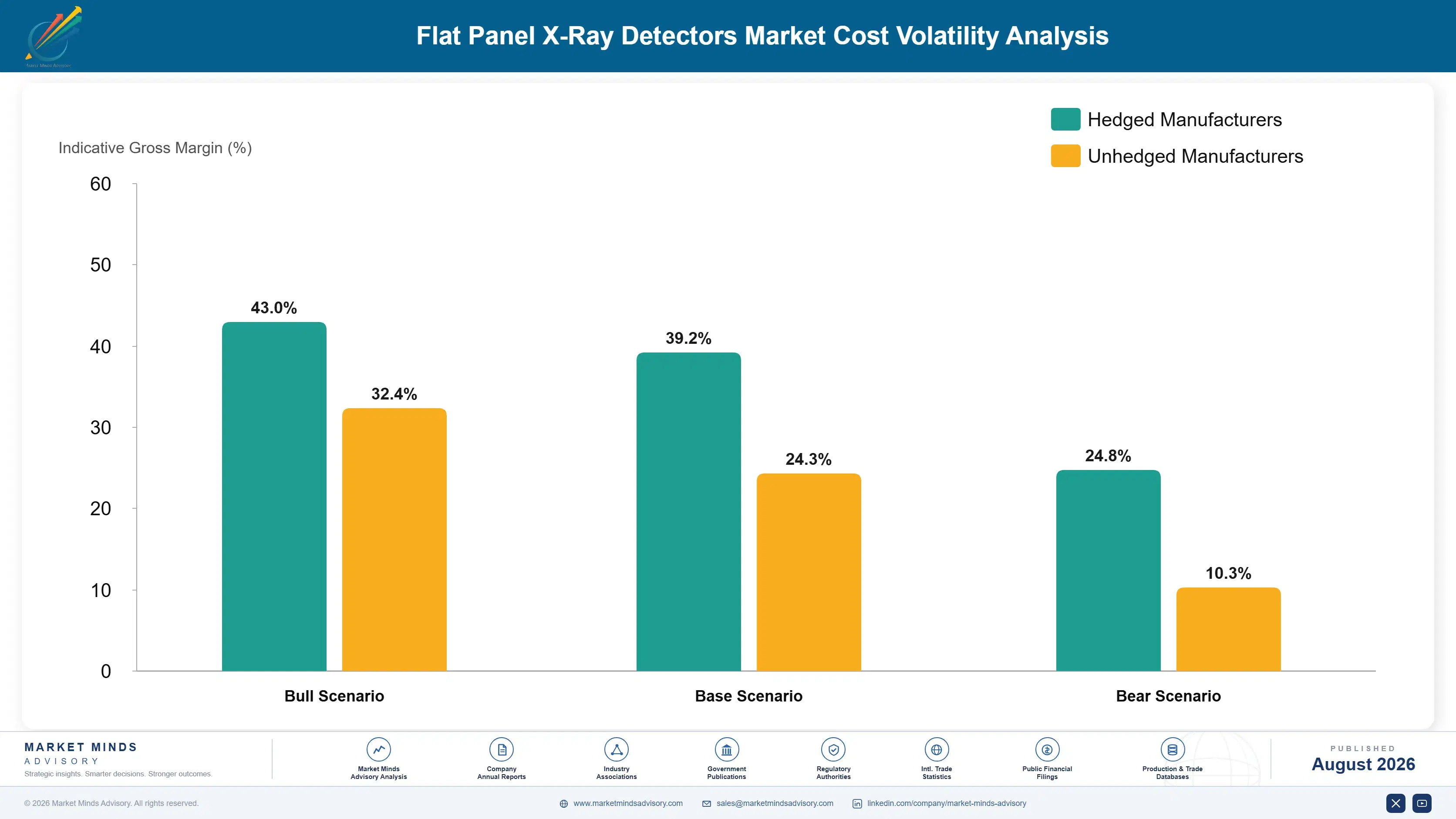
Amorphous silicon and selenium semiconductor materials together account for roughly 30% to 40% of detector product COGS, sourced primarily from specialty semiconductor producers in Japan, the United States, and South Korea. Precision glass substrates and certification testing add a further 16% to 22%, reflecting the accredited third-party validation every new detector configuration requires before commercial release.
Specialty semiconductor material prices rose meaningfully through 2024 as global demand for imaging and display panels competed directly with broader electronics uses for the same specialty coating capacity, according to trade data. Canon's 2024 annual report disclosed higher input costs attributable to semiconductor and glass substrate inflation, noting that raw material costs rose meaningfully faster than the company could pass through to hospital customers without meaningful margin compression across its imaging product segment specifically.

Smaller specialty detector manufacturers carry more exposure than the largest diversified suppliers, since they lack the purchasing scale to negotiate favorable long-term semiconductor supply contracts. Suppliers sourcing materials from a concentrated set of producers face additional exposure to capacity and price volatility, while diversified suppliers absorb volatility more predictably across their broader, globally diversified supply chain relationships.
flat-panel-x-ray-detectors-market-cost-volatility-analysis-1787301935932

Lock Semiconductor Pricing Through Annual Contracts

Specialty semiconductor materials are the largest single volatile input across most detector product lines and increasingly competed for by broader display and electronics demand worldwide. Annual supply agreements with fixed or collared pricing, common practice among larger diversified suppliers, smooth quarter-to-quarter volatility and let commercial teams quote hospital contracts with genuine confidence rather than repricing against spot markets.

Diversify Semiconductor Sourcing Across Producers

Reliance on a single semiconductor material producer concentrates both price and availability risk unnecessarily across an entire detector product line and customer base. Qualifying secondary suppliers across multiple regions, even at modestly higher unit cost, protects continuity when any single producer faces capacity outage or a sudden demand spike from competing electronics sectors expanding simultaneously.

Portfolio Architecture for Margin Defence

The portfolio splits into three tiers with meaningful margin separation tied to certification depth and detector architecture. Volume tier products carry standard fixed amorphous silicon panels for conventional radiography applications, competing largely on price against a crowded field of regional suppliers. Premium certified products carry wireless and CMOS systems backed by documented dose efficiency data. Sustainability products, including dual-energy and AI-integrated detector systems, attr
The tension between volume and premium runs through nearly every supplier's product roadmap. Volume products fund the manufacturing scale premium products eventually depend on, yet volume margins keep compressing as Chinese manufacturers scale aggressively on conventional fixed-panel designs. Suppliers that under-invest in premium certification breadth risk commoditization within their own category, while those chasing premium exclusively struggle to fund the manufacturing base needed to serve routine hospital demand.

High-value margin pools concentrate specifically in wireless and CMOS systems where certification depth and documented dose performance carry the largest commercial stakes, and where certification breadth commands genuine pricing power. Conventional fixed amorphous silicon detectors generate steadier volume but thinner margin, since that segment competes against a wider set of lower-cost regional suppliers with adequate but unremarkable certification differentiation.

Volume / Commodity-Adjacent Tier

Standard fixed amorphous silicon panels for conventional radiography applications, competing largely on price against a crowded field of regional suppliers offering broadly comparable certification coverage and image quality across the industry.
Gross Margin: 18-28%

Premium / Certified Tier

Wireless and CMOS detector systems backed by documented dose efficiency data and formal hospital qualification, commanding meaningful pricing premiums over fixed equivalents across major regulated markets and multinational hospital accounts.
Gross Margin: 32-45%

Sustainability / Regulatory / Next-Generation Tier

Dual-energy and AI-integrated detector systems still scaling across specialty imaging and diagnostic applications, targeting clinical outcomes conventional detectors simply cannot achieve under current and anticipated future standards worldwide across every regulated market.
Gross Margin: 36-52%
flat-panel-x-ray-detectors-market-portfolio-architecture-1787301936436

The Annuity Behind Every Replacement

Detector demand behaves like an annuity once a hospital commits to a specific supplier's certification data and clinical workflow integration, since switching vendors requires costly facility-specific requalification testing and updated clinical documentation across every affected imaging suite. That structure rewards incumbency heavily: a supplier that wins the initial installation contract keeps the customer relationship through multiple replacement cycles unless a competitor demonstrates a me
Adoption stickiness varies meaningfully by end-use vertical once a supplier's detector is qualified into a facility's clinical workflow. Hospital systems rarely switch detector suppliers mid-contract because requalifying certification against a new vendor risks clinical workflow interruption during testing, so switching costs run high. Veterinary and dental clinics show similar loyalty tied to established equipment relationships, while general industrial NDT applications switch more readily since specifications are less exacting and price competition dominates purchasing decisions.

Buyer profiles are shifting generationally as hospital procurement teams increasingly favor suppliers offering digital fleet monitoring and predictive maintenance data over those selling hardware alone. Younger radiology administrators trained on connected hospital systems expect equipment that reports its own condition, a preference reshaping which suppliers win replacement contracts as incumbent decision-makers retire.
flat-panel-x-ray-detectors-market-end-use-penetration-index-1787301936928

What Suppliers Should Do Next

These are among the four positions where our research anticipates prominent divergence between winners and laggards over the coming forecast period. Each is grounded in the demand model, the regulatory perimeter, and the announced capacity pipeline.
01 / DOSE DOCUMENTATION STRATEGY

Build the deepest certified dose efficiency library before rivals

Buyers now pay a documented premium for certified dose efficiency rather than raw resolution alone, and that premium is widening as radiology directors increasingly specify minimum dose thresholds before approving procurement across every affected imaging budget. Suppliers without comprehensive clinical data will find themselves squeezed into commodity price competition, where ten points of margin separate documented leaders from untested followers across most hospital accounts. The investment case favors clinical testing depth over manufacturing scale alone, particularly for suppliers targeting large multi-site accounts.
02 / WIRELESS FLEET POSITIONING

Bundle wireless fleet management ahead of integration mandates

Hospital IT departments increasingly want a single accountable vendor for complete wireless detector fleet management rather than sourcing hardware and fleet software separately from different specialists across their imaging departments and connected clinical systems. Suppliers without bundling capability increasingly lose bids among hospitals standardizing on integrated fleet platforms, regardless of individual component quality on either side of the sale. Those building bundled offerings now, ahead of rivals still selling components separately, will capture disproportionate share as integration mandates spread across every major regulated market.
03 / CHINA CONVERSION POSITIONING

Expand distribution across China's hospital digitalization program now

China's continued hospital digitalization investment and its expanding provincial healthcare infrastructure are creating a predictable demand wave that rewards suppliers who establish certification depth ahead of conversion programs coming online rather than scrambling once hospitals are already committed elsewhere and contractually locked in. Hospital systems facing conversion deadlines cannot wait for new supplier qualification to complete elsewhere, which means late-moving suppliers miss the premium pricing window entirely regardless of eventual component performance. Suppliers positioning now will capture disproportionate share of this expanding demand.
04 / CLINICAL INTEGRATION POSITIONING

Offer embedded clinical workflow integration to capture full value

Engineering capacity for embedded clinical workflow integration has repeatedly struggled to keep pace with sudden demand spikes when hospital conversion programs take effect, creating temporary shortages that reward suppliers who invested in integration capacity ahead of the wave rather than reactively scrambling once demand materializes. Suppliers with pre-positioned integration teams can capture premium project pricing during conversion cycles, since hospitals facing deadlines cannot wait for capacity elsewhere. Suppliers investing ahead of the next conversion wave will capture disproportionate share of available project work.

Engagement Snapshot From the Field

A live engagement with an industry participant carrying material or product regulatory and market exposure ahead of a defining policy shift, showing how our research translates into a defensible multi-year portfolio strategy.
MARKET MINDS ADVISORY · CLIENT ENGAGEMENT SUMMARY
Flat Panel X-Ray Detectors Producer Strategic Portfolio Review and Transition Roadmap 2026·Investment Scenario on Flat Panel X-Ray Detectors Exposure Evaluation 2025-26
CLIENT PROFILE
A regional North American hospital network operating eight facilities across three states, providing acute care and outpatient diagnostic imaging services to a mixed urban and rural patient population. The client generated approximately 420 million dollars in annual revenue (client-reported, unverified by MMA) and faced mounting pressure to complete CR-to-DR conversion across its remaining computed radiography installations.
STRATEGIC CHALLENGE
The client needed to select detector suppliers for a fleet-wide digital conversion program across eight facilities while minimizing imaging downtime during installation across multiple simultaneous departments and shift schedules. Leadership also questioned whether to prioritize established suppliers offering full dose efficiency documentation depth or evaluate lower-cost alternatives with narrower certified clinical data.
MMA APPROACH
MMA conducted supplier benchmarking across five detector vendors using primary interviews with radiology directors and hospital IT staff, alongside analysis of certified dose efficiency data and installation downtime requirements for each candidate system. The engagement mapped total cost of ownership across a ten-year operating horizon rather than upfront equipment price alone.
KEY FINDINGS
  1. Two of five candidate suppliers lacked sufficient certified dose efficiency data for the client's specific imaging protocols, narrowing realistic options considerably ahead of the deadline.
  2. The leading candidate's wireless technology eliminated a costly room renovation the client's prior fixed-panel plan would have otherwise required across every facility.
  3. Bundled fleet monitoring and detector packages reduced total installation project time by roughly 22 percent (client-reported, unverified by MMA) compared with separate sourcing.
  4. A phased facility-by-facility conversion approach, prioritizing the facility with the oldest CR equipment first, reduced clinical disruption considerably compared with simultaneous conversion.
CLIENT PROFILE
A regional North American hospital network operating eight facilities across three states, providing acute care and outpatient diagnostic imaging services to a mixed urban and rural patient population. The client generated approximately 420 million dollars in annual revenue (client-reported, unverified by MMA) and faced mounting pressure to complete CR-to-DR conversion across its remaining computed radiography installations.
STRATEGIC CHALLENGE
The client needed to select detector suppliers for a fleet-wide digital conversion program across eight facilities while minimizing imaging downtime during installation across multiple simultaneous departments and shift schedules. Leadership also questioned whether to prioritize established suppliers offering full dose efficiency documentation depth or evaluate lower-cost alternatives with narrower certified clinical data.
MMA APPROACH
MMA conducted supplier benchmarking across five detector vendors using primary interviews with radiology directors and hospital IT staff, alongside analysis of certified dose efficiency data and installation downtime requirements for each candidate system. The engagement mapped total cost of ownership across a ten-year operating horizon rather than upfront equipment price alone.
KEY FINDINGS
  1. Two of five candidate suppliers lacked sufficient certified dose efficiency data for the client's specific imaging protocols, narrowing realistic options considerably ahead of the deadline.
  2. The leading candidate's wireless technology eliminated a costly room renovation the client's prior fixed-panel plan would have otherwise required across every facility.
  3. Bundled fleet monitoring and detector packages reduced total installation project time by roughly 22 percent (client-reported, unverified by MMA) compared with separate sourcing.
  4. A phased facility-by-facility conversion approach, prioritizing the facility with the oldest CR equipment first, reduced clinical disruption considerably compared with simultaneous conversion.
RECOMMENDED STRATEGY
Phase 1: Phase one: convert the facility with the oldest CR equipment first using the leading wireless and monitoring bundle identified during benchmarking. Phase 2: Phase two: complete conversions across the remaining seven facilities, carefully sequencing all installation work around planned maintenance windows to limit downtime. Phase 3: Phase three: establish an internal fleet tracking process to flag future replacement needs well before end of life approaches at any site.
OUTCOME
The network completed fleet-wide digital conversion across all eight facilities within the planned twenty-four-month window, avoiding any unplanned imaging suspension, and the bundled approach reduced total conversion cost meaningfully compared with the client's prior facility-by-facility procurement history (client-reported, unverified by MMA). The fleet tracking process is now flagging future replacement needs earlier.

Frequently Asked Questions

Foundational context covering the market sizes, CAGR, scope, country, region and competition that inform every finding below. This section is provided to cover basics and most often pre-purchase conversations, answered from the MMA Primary Research Dataset.

What is the current size of the Flat Panel X-Ray Detectors Market?

The global flat panel X-ray detectors market reached 3.8 billion dollars in 2025, with hospital and outpatient diagnostic imaging applications accounting for most of that demand base.

How large will the Flat Panel X-Ray Detectors Market be by 2036?

The market is projected to reach 9.61 billion dollars by 2036, representing a 2.32 times expansion over the eleven-year forecast period driven by CR-to-DR conversion demand.

What is the CAGR for the Flat Panel X-Ray Detectors Market 2026 to 2036?

The market is forecast to grow at an 8.8% compound annual rate, with bull and bear scenarios ranging from 10.1% to 7.5% depending on hospital capital spending pace.

Which segment is growing fastest?

Wireless flat panel detectors lead at a 12.5% CAGR, roughly 1.42 times the overall market rate, as hospitals complete overdue CR-to-DR conversion programs across every care setting.

Who are the major companies in the Flat Panel X-Ray Detectors Market?

Canon, Varex Imaging, Trixell, Vieworks, and DRTECH Corporation all lead this field today, together holding roughly 52% of global output on a consistent revenue basis.

Which country is growing fastest?

China leads national growth at an estimated 10.2% CAGR, driven by continued hospital digitalization investment under national healthcare modernization programs across every major provincial system.

Report Segmentation Architecture

The full report scope spans multiple orthogonal segmentation dimensions, with cross-tabulated demand data provided for each dimension pair. Coverage extends further to regional breakdowns, trend trajectories, and the competitive detail needed to support segment-level decision-making.

By Primary Market Dimension

  • Amorphous Silicon Indirect Conversion Detectors
  • Amorphous Selenium Direct Conversion Detectors
  • CMOS Flat Panel Detectors
  • Wireless Flat Panel Detectors
  • Fixed Flat Panel Detectors
  • Dual-Energy Flat Panel Detectors

By End-Use Industry

  • Hospitals and Health Systems
  • Dental and Veterinary Clinics
  • Diagnostic Imaging Centers
  • Industrial Non-Destructive Testing
  • Security Screening

By Commercial Dimension

  • Direct Hospital Contract Sales
  • Distributor and Wholesale Sales
  • Embedded Clinical Integration Services
  • OEM Component Supply

By Region

  • North America
  • Western Europe
  • East Asia
  • South Asia and Pacific
  • Latin America
  • Middle East and Africa
  • Eastern Europe

Scope, Methodology, and Coverage

Every figure in this report is reproducible from documented input assumptions. The scope below maps the historical period, the forecast horizon, the segmentation dimensions, and the countries covered, alongside the underlying primary and qualitative methodology.
Historical Period
2020 to 2025
Forecast Period
2026 to 2036
Base Year
2025 (USD billions; MMA Primary Research Dataset, August 2026)
Market Definition
This report covers flat panel X-ray detectors used for digital radiography in hospital, outpatient, veterinary, dental, and industrial imaging applications, including amorphous silicon, amorphous selenium, and CMOS conversion technologies. It includes wireless and fixed form factors across all clinical and industrial imaging uses. It excludes X-ray tube generators, computed radiography cassette systems, and standalone PACS software sold without accompanying detector hardware.
Quantitative Units
USD billions (current prices); unit shipment volume where applicable
Segmentation Dimensions
By Primary Market Dimension; By End-Use Industry; By Commercial Dimension; By Region
Regions Covered
North America, Western Europe, East Asia, South Asia and Pacific, Latin America, Middle East and Africa, Eastern Europe
Countries Covered
USA, China, Germany, France, UK, Japan, South Korea, India, Australia, Canada, Brazil, Mexico, Indonesia, Vietnam, Thailand, Malaysia, UAE, Saudi Arabia, South Africa, Nigeria, Turkey, Poland, Netherlands, Italy, Spain, Sweden, Switzerland, Argentina, Colombia, Singapore, and additional markets relevant to this sector
Key Companies Profiled
Canon Inc.; Varex Imaging Corporation; Trixell S.A.S.; Vieworks Co., Ltd.; DRTECH Corporation; Konica Minolta Inc.; FUJIFILM Holdings Corporation; Carestream Health Inc.; iRay Technology Co., Ltd.; Analogic Corporation; Rayence Co., Ltd.; Teledyne DALSA Inc.; Thales Group; Detection Technology Plc; Hamamatsu Photonics K.K.; Perkin Elmer Inc.; Samsung Electronics Co., Ltd.; Shimadzu Corporation; CareRay Digital Medical Technology Co., Ltd.; AJAT Oy
Quantitative Methodology
Primary survey, n=3,800 respondents, Q4 2025, six countries; demand-side model with trade association cross-validation
Qualitative Methodology
47 expert interviews, Q4 2025; applied to validate demand model assumptions, identify emerging dynamics, and assess competitive positioning
Report Format
PDF and XLSX data workbook (Word format preview document)
Publisher
Market Minds Advisory
Report Code
MMA-2026-MED-304
Published
August 2026
Contact
sales@marketmindsadvisory.com | www.marketmindsadvisory.com

Purchase the full Flat Panel X-Ray Detectors Market Report (2026 to 2036).

The full report provides complete segmentation data across all six detector technology segments, detailed profiles of the top twenty market participants, and country-level analysis across all seven global regions covered by this study. It includes a proprietary MMA dose efficiency index built from primary survey data collected across forty-seven expert interviews conducted throughout the fourth quarter of 2025. Buyers also receive quarterly market updates through the end of 2026. Direct analyst access is included for methodology questions or custom data requests specific to their strategic priorities.
Full seven-region CAGR and market share breakdown
Twenty-company competitive profile database included in full
Segment-level pricing and gross margin analysis
Semiconductor input cost exposure tracking model
Quarterly market update subscription through 2026
Direct analyst access for custom data queries

Built For The People Who Decide

From boardroom strategy to bench-side execution, this report is read cover-to-cover by leaders shaping the next decade of their industry, turning demand scenarios, market dynamics and valuation benchmarks into decisions.
CXOs/ Presidents/ VPs/ Managers
M&A and Corporate Development
Strategy Teams and R&D Heads
Procurement and Product Directors
Regulatory and Compliance Leaders
Investor Relations and Equity Analysts