Market Minds Advisory
Flame Proof Lighting Market

Flame Proof Lighting Market: Trends and Insights 2026 to 2036

Oil refineries, chemical plants, and coal mines are replacing decades-old explosion-proof fixtures with LED alternatives that cut energy use in half, forcing certification-heavy manufacturers to requalify entire product lines faster than usual replacement cycles allow.

Lead Analyst

Bilal Shaikh

Published

September 2026

Make Smarter Decisions with Customized Research Insights

Request a free sample report and evaluate market opportunities, growth trends, and competitive dynamics relevant to your business needs.

2025 MARKET VALUE$3.8BMarket Size 2025
2036 FORECAST VALUE$7.6BBase Case , 2026 to 2036
CAGR 2026 TO 20366.5 %Bull 7.8% / Bear 5.2%
INCREMENTAL OPPORTUNITY$3.5BNet 10- year value creation
EXPANSION MULTIPLE1.88x2036 value over 2026 base
Strategic Levers
M&A Pipeline
Regional Outlook
Country Rankings
Competitive Intelligence
Segmental Deep-dive
Call-Us : 91 93563 13602

Executive Snapshot and Market Trajectory

Flame proof lighting has shifted from a niche safety compliance purchase to a genuine energy efficiency opportunity, as LED alternatives finally match the certification and durability standards that hazardous locations have always demanded from every single fixture installed across a facility over its operating life.
LED explosion-proof luminaires are the fastest-growing category, expanding well ahead of legacy fluorescent and high-intensity discharge designs, as facility operators chase energy savings that fluorescent fixtures in hazardous zones never delivered efficiently. China's massive coal mining sector and dominant lighting manufacturing base concentrate demand heavily in East Asia, alongside significant Middle Eastern oil and gas installation activity today. Certification renewal cycles drive replacement demand in distinct waves tied to regulatory review periods.
Competitive dynamics favor manufacturers with established certification credentials across multiple hazardous zone classifications, since facility operators rarely switch suppliers mid-project once a fixture passes site-specific safety approval and formal inspection across the entire facility today. Retrofit conversion kits that let facilities upgrade legacy fixtures without full replacement are becoming a genuine revenue category rather than an afterthought accessory line for most established manufacturers serving hazardous location markets worldwide.
Market Definition
The flame proof lighting market covers explosion-proof and intrinsically safe luminaires certified for hazardous locations in oil and gas, chemical processing, and mining facilities. It excludes standard industrial lighting not rated for hazardous zone classification and non-lighting safety equipment.
Base Year Value
$3.8B in 2025 (MMA Primary Research Dataset, August 2026)
Forecast Period
2026 to 2036, eleven discrete annual values
CAGR
6.5% base case. Bull 7.8%. Bear 5.2%.
Fastest Growth Segment
LED Explosion-Proof Luminaires: 9.1% CAGR
Fastest Growth Country
India: 8.5% CAGR
Fastest Growth Region
South Asia and Pacific: 8.5% CAGR
Largest Region
East Asia: 34% of 2025 global value
Market Leaders
Leading suppliers: Eaton, R. STAHL, Emerson, Hubbell, and Dialight. Source: MMA Primary Research Dataset, July 2026.
Primary Survey
n=3,800 procurement and R&D decision-makers, Q4 2025, six countries
Methodology
Demand-side build-up, cross-validated against public data, 47 expert interviews

Flame Proof Lighting Market Forecast Scenarios

flame-proof-lighting-market-trends-size-forecast-scenario-1787550876602
Between 2020 and 2025 the market grew at an estimated 5.7% annually as oil and gas capital expenditure recovered unevenly from pandemic-era project delays while LED conversion accelerated gradually, though early years saw many facilities sticking with familiar fluorescent designs rather than committing to newer LED alternatives across most industrial sectors and geographies worldwide during that period.
The base case assumes 6.5% annual growth through 2036, anchored in three commercial mechanisms: continued LED conversion across aging hazardous location installations, China's expanding coal mining and chemical processing capacity requiring certified fixtures, and India's growing industrial and oil and gas infrastructure investment pulling replacement demand higher across the entire forecast period ahead. LED explosion-proof luminaires carry the base case forward fastest, reflecting where energy efficiency pressure concentrates most heavily.
The bull case, 7.8%, assumes faster global industrial capital expenditure recovery than currently projected, pulling forward both new installation and retrofit demand across multiple hazardous location categories simultaneously. The bear case, 5.2%, reflects a scenario where oil and gas capital expenditure growth slows relative to current projections, dampening both new facility construction and the pace of LED conversion industry-wide.

LED Conversion Turns Compliance Into Efficiency Gains

LED conversion now covers 55% to 65% of the installed hazardous location fixture base, a meaningfully higher share than five years ago, since energy savings finally justify the certification cost of switching from legacy fluorescent and high-intensity discharge designs. Facilities that once viewed flame proof lighting as a fixed compliance cost now treat LED retrofit projects as a genuine capital efficiency opportunity with measurable payback periods.
TOP-5 MANUFACTURER CONCENTRATION46%Reflects a market split among established hazardous location lighting specialists
AVERAGE FIXTURE ASP$285 per unitTracks typical pricing for a certified explosion-proof luminaire unit
CHINA PRODUCTION SHARE36%Shows how concentrated global fixture manufacturing capacity has become domestically
LED CONVERSION RATE55% to 65%Captures how much of the base has shifted
HOUSING SHARE OF COGS32% to 40%Indicates how exposed margins are to metal enclosure material costs
CERTIFICATION RENEWAL CYCLE3 to 5 yearsMarks how often facilities typically revalidate hazardous zone fixture approvals
Certification renewal cycles run 3 to 5 years across most hazardous zone classifications, creating a recurring qualification event that favors manufacturers with established regulatory relationships over newer entrants navigating approval processes for the first time. Average selling prices sit around 285 dollars per unit, though full facility retrofit projects covering hundreds of fixtures generate meaningful aggregate contract value per project.
Metal housing and enclosure inputs represent 32% to 40% of cost of goods sold, exposing manufacturer margins to steel and aluminum pricing cycles that vary considerably depending on enclosure design and certification rating requirements. Manufacturers with in-house metal fabrication capability carry a meaningful cost advantage over those subcontracting enclosure production, particularly during periods when metal pricing runs volatile across major producing regions.
"Everyone assumes explosion-proof lighting is a commodity because it just sits in a box on a ceiling. Try telling that to the engineer who has to get every single new fixture recertified for a specific hazardous zone."
Principal Analyst, Industrial Equipment and Safety Systems Practice · MMA Construction and Industrial Equipment Practice · August 2026

Market Trends

LED Conversion Accelerates Across Hazardous Location Facilities

LED fixtures now represent 55% to 65% of the installed hazardous location lighting base, up from roughly 30% just five years ago, as energy savings of 50% or more over legacy fluorescent designs finally justify the certification cost of switching product lines entirely. This conversion wave is creating the fastest order growth MMA tracks anywhere in this market currently, as facility operators replace aging fixtures in coordinated retrofit projects rather than piecemeal individual replacements. Suppliers with validated LED product lines across multiple hazardous zone classifications are capturing the bulk of this conversion demand ahead of competitors still selling legacy technology.
Market Impact: Compliance deadlines phased through 2027
Retrofit Conversion Kits Become a Genuine Revenue Category

Leading manufacturers are increasingly offering retrofit conversion kits that let facilities upgrade legacy fluorescent or high-intensity discharge fixtures to LED without replacing entire enclosures, with kit revenue now representing an estimated 15% to 20% of total supplier revenue at several major firms. This approach lets facility operators capture energy savings without the full recertification burden a complete fixture replacement requires, since the certified enclosure itself remains in place while only the internal lighting element changes. Suppliers with validated kit-based retrofit offerings are winning contracts from cost-conscious facility operators who want efficiency gains without full capital replacement.
Market Impact: Gulf capex exceeds $40 billion annually

Market Opportunities and Growth Drivers

China's Mine Safety Regulations Sustain Certified Fixture Demand

China's revised coal mine safety regulations require certified explosion-proof lighting across all underground and surface hazardous zones, with compliance deadlines phased through 2027 for facilities still operating older, uncertified fixtures installed many decades ago and never properly upgraded. This regulatory framework sustains demand even as some smaller, less efficient coal mines face closure under broader environmental and safety consolidation policy. Domestic Chinese manufacturers with established mine safety certification credentials are capturing the bulk of this compliance-driven demand ahead of international suppliers navigating unfamiliar domestic approval processes for the first time.
Market Impact: Enclosure metal prices swung over 22%

Gulf State Oil and Gas Capex Boom Sustains Demand

Saudi Aramco and other Gulf state national oil companies have announced more than 40 billion dollars in combined annual upstream capital expenditure for 2025, driving new refinery and processing facility construction that requires extensive explosion-proof lighting installation across every hazardous processing zone. Each new facility requires certified fixtures across dozens of distinct hazardous zone classifications, directly translating capital expenditure into lighting demand regardless of which specific project timeline slips or accelerates. Suppliers with established Gulf state relationships and regional certification credentials are capturing the bulk of this demand ahead of newer entrants.
Market Impact: 12 to 18 month certification timelines

Market Restraints and Challenges

Metal Enclosure Cost Volatility Compresses Manufacturer Margins

Steel and aluminum enclosure prices swung by more than 22% between 2023 and 2025, driven by upstream metals market volatility rather than lighting-specific demand shifts. The root cause is that most fixture manufacturers still purchase raw metal stock on the open market rather than under long-term contracts, leaving margins exposed every time metals pricing spikes unexpectedly. The commercial impact falls hardest on smaller manufacturers without pricing power to pass costs through to facility retrofit contracts mid-cycle. Some larger manufacturers are exploring backward integration into metal fabrication to dampen this exposure going forward.
Market Impact: 55% to 65% now LED

Lengthy Certification Process Slows New Entrant Access

New fixture designs typically require twelve to eighteen months of hazardous zone certification testing before winning approval for facility installation, a timeline rooted in the safety-critical nature of explosion-proof applications where failure risk is entirely unacceptable to any facility operator. This restricts new entrants and smaller specialty manufacturers from winning share quickly, even when their fixture performance is genuinely competitive with incumbent suppliers already holding validated certifications. Some new entrants are mitigating this by partnering with established manufacturers who already hold certification standing, borrowing credibility rather than building it independently from scratch.
Market Impact: Kit revenue reaches 15% to 20%
3 additional market trends, 4 additional growth drivers, and 2 additional restraints and challenges are covered in the full report. Contact sales@marketmindsadvisory.com to access the complete intelligence.

Segment CAGR and Growth Architecture

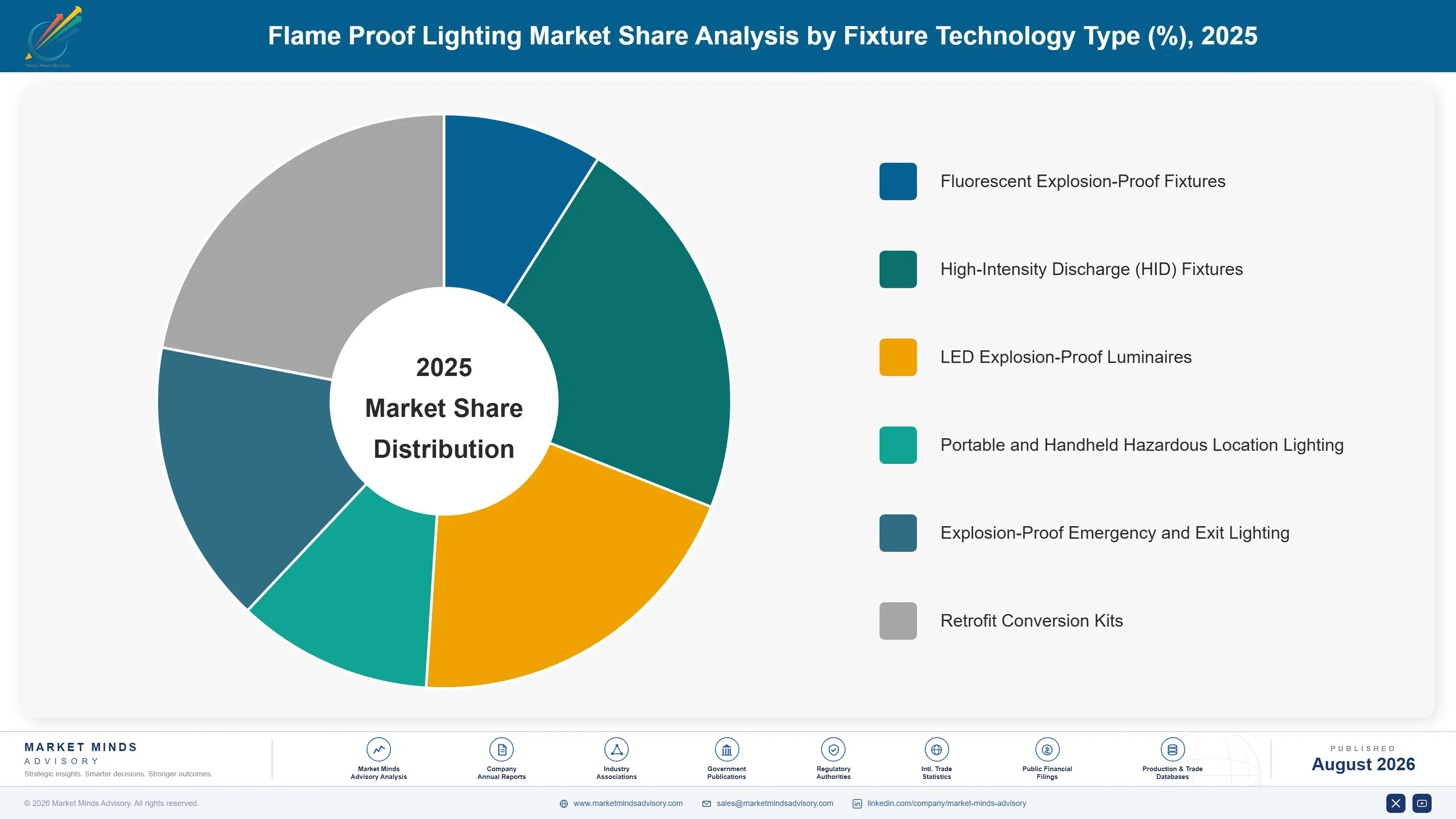
Segmentation follows fixture technology type, the classification facility engineers use when specifying hazardous location equipment, since each technology addresses a distinct light source and thermal profile through fundamentally different certification pathways rather than a shared design or approval process, and each typically involves separate testing protocols and full qualification timelines across all six categories.
flame-proof-lighting-market-trends-market-share-analysis-1787550877162

LED Explosion-Proof Luminaires

LED explosion-proof luminaires are the fastest-growing segment, expanding at 9.1% annually as facility operators chase energy savings that legacy fluorescent and high-intensity discharge fixtures in hazardous zones never delivered efficiently across their operating life or maintenance schedule at any given facility anywhere in the world today and quite consistently. These fixtures require certification testing specific to LED thermal and electrical characteristics, distinct from the approval pathway legacy technologies followed, creating a genuine technical barrier for manufacturers without dedicated LED engineering capability. Demand concentrates heavily in coordinated facility-wide retrofit projects rather than piecemeal individual fixture replacement, since operators increasingly bundle certification and installation costs across an entire facility conversion at once.
CAGR 9.1%

Retrofit Conversion Kits

Retrofit conversion kits, the second-fastest segment at 7.8% annually, let facilities upgrade legacy fluorescent or high-intensity discharge fixtures to LED internals without replacing the certified enclosure itself, avoiding the entire full recertification burden a complete fixture replacement otherwise requires from the facility and its own engineering team, budget, timeline, and lengthy approval process entirely. This approach appeals to facility operators managing tight capital budgets who want energy efficiency gains without the higher cost of full fixture replacement across an entire facility footprint. Growth here reflects a genuine middle-tier adoption path for operators not yet ready to commit to complete fixture replacement but no longer satisfied with legacy fixture energy performance.
CAGR 7.8%
Full segment breakdown across 6 segments available in the complete report.

Regional Architecture and Country Demand Map

Demand concentrates heavily around China's coal mining sector and dominant lighting manufacturing base, with East Asia broadly commanding the largest regional share by a wide margin worldwide today, while North America holds a strong secondary position tied to expanding shale oil and gas production activity.

East Asia

China anchors East Asian demand through the sheer scale of its coal mining sector, still the largest in the world despite years of consolidation and closures, combined with a dominant domestic lighting manufacturing base scaling fastest to serve both local industrial operators and export markets simultaneously, and this dominance pushes the region's share meaningfully above MMA's standard band, a deliberate house-rule deviation reflecting China's genuinely outsized position in both hazardous location demand and fixture production capacity relative to any other region on earth. Japan and South Korea contribute technically sophisticated demand from established chemical and refining operators across the region. Regional growth remains steady as coal mine safety compliance deadlines continue phasing in.
Share: 34% | CAGR: 7.5% (2026 to 2036)

North America

Shale oil and gas production across the Permian Basin and expanding petrochemical capacity along the Gulf Coast anchor most North American demand, alongside ongoing LED conversion projects at legacy refining and chemical processing facilities built many decades ago and still fully operating well today. Domestic and international manufacturers with US distribution and certification testing facilities compete closely for large facility retrofit contracts, since operators increasingly favor suppliers who can guarantee rapid fixture replenishment during active turnaround maintenance windows. LED conversion runs ahead of most other regions here, reflecting the scale of legacy fixture replacement already underway at mature installations nationwide. Canadian oil sands facilities add a smaller, complementary regional contribution.
Share: 26% | CAGR: 6.0% (2026 to 2036)
Regional intelligence for 5 additional markets available in the complete report: Western Europe, South Asia and Pacific, Latin America, Middle East and Africa, Eastern Europe. Contact sales@marketmindsadvisory.com.
flame-proof-lighting-market-trends-country-cagr-analysis-1787550877675

Where Fixture Makers Can Capture Margin

Four commercial levers determine which fixture manufacturers capture disproportionate margin as the market shifts from legacy technology toward LED conversion: expanding into retrofit conversion kits, integrating backward into metal fabrication, localizing manufacturing inside China's rapidly expanding coal sector, and pursuing Gulf state certification partnerships ahead of capital expenditure acceleration across most producing regions worldwide.

Expand Into LED Retrofit Conversion Kit Production

Retrofit conversion kit revenue already represents an estimated 15% to 20% of total supplier revenue at leading firms, letting facility operators capture energy savings without the full recertification burden a complete fixture replacement requires. Suppliers already qualified on standard fixture lines hold a natural advantage entering this adjacent category, since operators prefer consolidating hazardous location material sourcing with fewer, already-trusted suppliers rather than adding new qualification relationships. Entry requires meaningful engineering investment in retrofit-specific thermal and electrical design, but the margin premium justifies that investment for suppliers with existing facility relationships.
Market Impact: Captures share of the 15% to 20% kit segment

Build Backward Integration Into Metal Fabrication

Metal housing and enclosure inputs represent 32% to 40% of cost of goods sold, and manufacturers without in-house fabrication capability remain exposed to spot pricing swings that hit margins hardest during periods of steel and aluminum market volatility across most producing regions. Integrating backward into metal fabrication captures the margin that would otherwise flow to third-party enclosure suppliers while gaining more predictable production costs during periods of broader metals market tightness. This approach requires substantial upfront capital investment but pays back through reduced long-term margin volatility across multiple market cycles.
Market Impact: Shields margins from 32% to 40% total COGS exposure

Localize Manufacturing Inside China's Coal Sector

East Asia holds 34% of global flame proof lighting demand and China's coal mine safety regulations require certified fixtures across all hazardous zones, with compliance deadlines phased through 2027 sustaining demand well beyond typical replacement cycles across the entire country. Suppliers without local production face rising tariff exposure and longer lead times relative to domestic Chinese competitors already established there. Establishing or expanding manufacturing footprint inside China captures a larger share of the world's largest hazardous location fixture market directly, though this lever carries meaningful capital commitment and certification considerations.
Market Impact: Captures share of China's 34% regional demand base

Pursue Gulf State Certification Partnerships Early

Gulf state national oil companies have announced more than 40 billion dollars in combined annual upstream capital expenditure for 2025, driving new refinery construction that requires extensive explosion-proof lighting installation across every hazardous processing zone in the region. Suppliers with established Gulf state relationships and regional certification credentials are capturing the bulk of this demand ahead of newer entrants still navigating unfamiliar regional approval processes for the first time. Building certification partnerships and local distribution relationships now positions suppliers to capture share as this capital expenditure cycle continues through the forecast period.
Market Impact: Captures share of the $40 billion Gulf capex boom

Who Controls the Margin Pool

Concentration is moderate, with a CR5 near 46% on an annual revenue basis and a meaningful gap separating the five established leaders from a substantial tail of regional and specialty manufacturers still building comparable certification breadth, engineering depth, and long-term facility relationships of their own across multiple regions.
Current competitive activity centers on three fronts: expanding LED product lines to capture ongoing conversion demand, building retrofit conversion kit offerings that avoid full recertification burden, and localizing manufacturing inside China to serve the world's largest coal mining and industrial base directly and efficiently. Several manufacturers are also pursuing backward integration into metal fabrication to manage enclosure cost volatility across their global operations.

Emerging pressure comes from Chinese domestic manufacturers scaling production and certification capability fast enough to challenge established Western suppliers on both cost and delivery speed, particularly within China's own coal mining and chemical processing markets. Rankings could shift meaningfully over the next several years if Chinese suppliers close the technical gap on LED thermal engineering the way they have already done in legacy fixture manufacturing scale, a transition several established suppliers are watching closely.
flame-proof-lighting-market-trends-company-positioning-matrix-1787550878197

Competitive Moat and Risk Dimensions

EATON

Moat: Broad Multi-Zone Certification Portfolio

Eaton's Crouse-Hinds brand holds certifications across nearly every hazardous zone classification globally, letting it propose complete facility solutions rather than coordinating separate vendors for different zone requirements. This breadth wins complex multi-zone retrofit contracts that narrower single-classification competitors cannot bid on as a complete package.
EATON

Risk: Slower on Smaller Regional Accounts

Eaton's sales organization is built around large multinational oil and gas accounts and major capital projects, making it comparatively slower to pursue the smaller regional industrial accounts now driving much of India's and Southeast Asia's growth. Nimbler regional specialists focused specifically on these accounts are winning share Eaton's larger deal teams often overlook.
R. STAHL

Moat: Deep European Certification Heritage

R. STAHL has built certification credibility with European industrial operators over many decades of continuous engagement, giving it existing qualification standing that newer entrants lack entirely. This history lets R. STAHL get invited into facility design conversations earlier than competitors without comparable existing trust and regulatory track record.
R. STAHL

Risk: Limited Direct Presence in China

R. STAHL has a comparatively limited direct manufacturing presence in China relative to domestic converters, leaving it more dependent on export shipments to capture the country's massive coal mining and industrial demand growth. This gap in local presence could cost R. STAHL meaningful share as Chinese domestic capacity continues scaling rapidly.

Players Tracked

Prominent Players

Eaton
R. STAHL
Emerson
Hubbell
Dialight

Other Key Players

Glamox
Larson Electronics
Nemalux
Warom Technology
CEAG
Chalmit
Killark
Pauluhn
Bartec Group
Extronics
Multron
Foshan NVC Lighting
Thorn Lighting
Wipro Lighting
FGV Group

Recent Developments

JANUARY 2025

Eaton Expands Crouse-Hinds LED Production Capacity

Eaton announced an expansion of its Crouse-Hinds LED explosion-proof production line in the United States, adding capacity specifically to serve growing petrochemical facility retrofit demand across the entire wider Gulf Coast region. The expansion was an organic capacity addition, not a joint venture or acquisition.
Signal: Confirms established suppliers are now actively prioritizing dedicated LED capacity to meet accelerating retrofit conversion demand.
MAY 2025

Chinese Manufacturer Signs Major Coal Mining Supply Agreement

A leading Chinese fixture manufacturer signed a multi-year supply agreement with a major domestic coal mining conglomerate to provide certified lighting for its continued safety compliance program nationwide and across multiple provinces. The agreement was a direct commercial supply contract, not an equity stake or acquisition.
Signal: Shows domestic Chinese suppliers are securing long-term mining contracts ahead of international competitors entering the market.
SEPTEMBER 2025

R. STAHL Acquires Retrofit Kit Technology Producer

R. STAHL acquired a smaller specialty retrofit kit technology producer to add validated conversion capability to its existing fixture portfolio without building that entire technical capability entirely internally from scratch first. The acquisition closed after a shortened regulatory review given the target's modest revenue scale.
Signal: Confirms acquisition is becoming a faster path into retrofit kits than internal development for established suppliers.

Metal Enclosure and Casting Cost Exposure

Metal housing and enclosure inputs represent 32% to 40% of cost of goods sold for fixture manufacturers, sourced from steel and aluminum casting producers concentrated in China, India, and increasingly Eastern Europe. LED driver and electronic components add a secondary but growing input cost as LED fixtures represent a larger share of total product mix.
Steel and aluminum enclosure prices swung by more than 22% between 2023 and 2025 as upstream metals market volatility moved with broader global commodity pricing cycles largely unrelated to lighting-specific demand shifts. Manufacturers without long-term metal supply contracts absorbed most of this swing directly, compressing gross margins meaningfully during the peak of the disruption before pricing gradually stabilized as metals markets settled into 2025 fully.

Exposure varies meaningfully by player type: manufacturers integrated backward into metal fabrication or holding long-term supply contracts absorb price swings far better than converters purchasing finished castings on the open market, and this gap becomes a genuine competitive disadvantage during volatile pricing periods. Geographic exposure differs too, since Chinese manufacturers sit closer to domestic casting production than European or North American competitors reliant on longer supply chains.
flame-proof-lighting-market-trends-cost-volatility-analysis-1787550878402

Secure Multi-Year Metal Supply Contracts

Negotiating multi-year fixed-price or banded-price metal supply agreements protects margin against the kind of feedstock volatility that hit prices hard through 2024, giving fixture manufacturers genuinely predictable input costs to plan production scheduling and facility contract pricing around well in advance, rather than absorbing spot-market swings directly into gross margin unpredictably every single cycle.

Pursue Backward Integration Into Metal Casting

Larger fixture manufacturers with sufficient balance sheet capacity can integrate backward into metal casting production directly, capturing the margin that would otherwise flow entirely to third-party enclosure suppliers while also gaining much more predictable and genuinely reliable feedstock access during periods of much broader and sustained metals market tightness across the wider industry supply chain.

Diversify Metal Sourcing Across Multiple Geographic Regions

Sourcing metal castings from multiple geographic regions, rather than relying on a single supplier or producing country, reduces exposure to any one region's disruption, whether from trade policy, plant outages, or logistics delays affecting delivery timelines. Manufacturers already doing this reported smoother cost pass-through during the 2024 volatility spike than peers dependent on a single sourcing region.

Portfolio Architecture for Margin Defence

The portfolio splits into three tiers with meaningful margin separation tied to certification complexity rather than raw fixture cost alone. Legacy fluorescent and high-intensity discharge fixtures compete mainly on price and delivery reliability, while LED explosion-proof luminaires command durable premiums tied to energy efficiency certification and thermal engineering guarantees.
The tension between volume hardware and certification premium is sharpening as LED conversion and retrofit kit adoption expand demand for premium and next-generation fixtures faster than legacy fixture demand grows, pulling manufacturer investment toward these higher-margin tiers even though legacy technology remains a meaningful and stable installed base globally. Manufacturers maintaining a foothold across all three tiers preserve optionality, while those chasing only premium contracts risk losing the steady replacement cash flow that legacy fixtures still reliably generate.

High-value margin pools concentrate specifically in LED explosion-proof luminaires and retrofit conversion kits meeting the newest energy efficiency specifications, both requiring genuine thermal and electrical engineering investment that conventional manufacturers must build or acquire rather than simply extend from existing fixture production capability. Legacy fluorescent and high-intensity discharge fixtures, by contrast, remain a large but slower-growing volume base offering thinner, more commoditized margins for most participants going forward.

Volume / Commodity-Adjacent Tier

Legacy fluorescent and high-intensity discharge fixtures sold primarily on price and delivery reliability into mainstream global hazardous location installations without LED efficiency requirements yet, particularly across cost-sensitive markets worldwide today.
Gross Margin: 12%-18%

Premium / Certified Tier

LED explosion-proof luminaires integrated into certified energy efficiency programs commanding durable premiums tied to thermal engineering validation and a proven multi-year track record with industrial and mining buyers worldwide today.
Gross Margin: 22%-30%

Sustainability / Regulatory / Next-Generation Tier

Retrofit conversion kits and next-generation LED thermal systems built specifically for the newest energy efficiency standards emerging across Asia and Europe, representing the most technically demanding corner of the entire product portfolio sold globally.
Gross Margin: 26%-34%
flame-proof-lighting-market-trends-portfolio-architecture-1787550878904

High-value Sub-segments and Strategic Watch-out

LED Explosion-Proof Luminaires

High value with strong growth, tied directly to LED energy efficiency conversion scaling independent of broader mainstream replacement cycles across most industrial segments and price points worldwide today. Thermal engineering validation increasingly decides which supplier wins long-term facility platform contracts across most major operators and regions worldwide.
Gross Margin: 26%-32%

Retrofit Conversion Kits

High value with moderate growth, anchored in retrofit conversion kit platforms where facility operators value proven energy savings over the fastest possible technical iteration across most industrial segments and production regions today. Suppliers here compete on reliability and installed-base track record more than on the newest performance metrics alone.
Gross Margin: 22%-28%

Fluorescent Explosion-Proof Fixtures

The volume core, serving mainstream hazardous location installations across most global markets regardless of LED or retrofit kit adoption pace currently underway across the broader industry today. Steady growth tracks industrial facility count and replacement cycles rather than any specific technology transition emerging across the wider category today.
Gross Margin: 12%-16%

High-Intensity Discharge (HID) Fixtures

The strategic watch-out, facing accelerating price competition as Chinese domestic manufacturers scale production for cost-sensitive industrial segments worldwide across nearly every price tier and geography today. Remaining international supplier volume concentrates in accounts still requiring proven validation history and established track records built over many years.
Gross Margin: 10%-14%

The Certification Annuity in Hazard Lighting

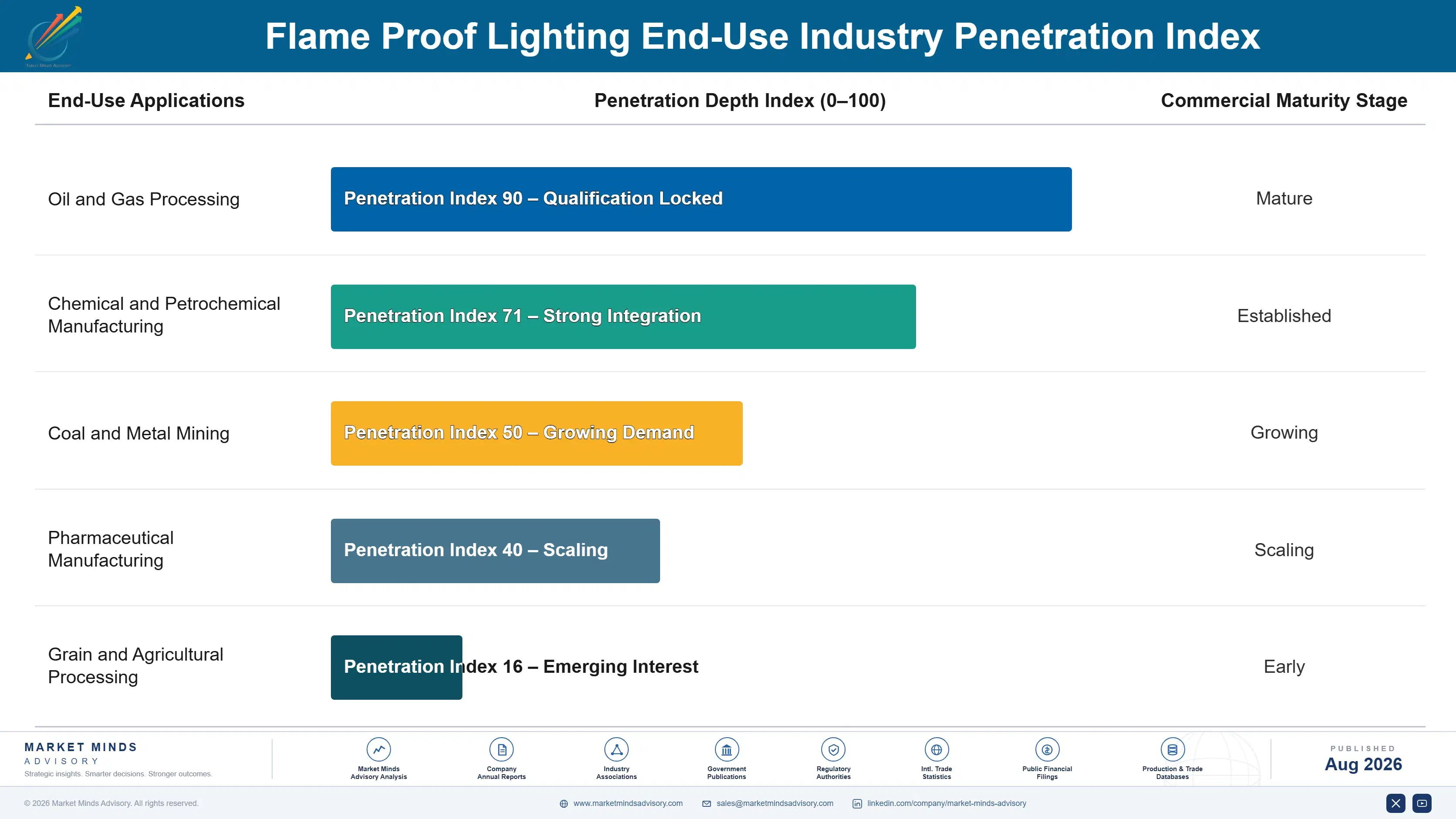
Flame proof lighting revenue behaves like an annuity tied to facility operating life rather than a one-time installation sale, since certified fixtures require periodic recertification and replacement across a facility's multi-decade operating life as safety standards evolve and older equipment ages beyond its rated service interval and warranty coverage.
Adoption depth varies by end-use vertical: oil and gas processing facilities adopted LED conversion earliest given the tightest safety scrutiny and largest capital budgets available for retrofit projects, while smaller chemical processing and mining operations still often rely on legacy fluorescent designs without the added conversion investment built into their capital plans. Portable and handheld hazardous location lighting remains the shallowest vertical, constrained by durability requirements that current LED designs have not yet fully satisfied at meaningful scale.

Buyer profiles are shifting generationally as energy efficiency and sustainability officers, rather than purely safety compliance staff, now approve fixture sourcing decisions inside major industrial operators across most facility types today. This younger buyer cohort weighs total lifecycle energy cost and certification documentation alongside conventional safety metrics, reshaping which suppliers get invited to next-generation facility retrofit bids and long-term development partnerships.
flame-proof-lighting-market-trends-end-use-penetration-index-1787550879406

Priorities for Hazard Lighting Suppliers

These are among the four positions where our research anticipates prominent divergence between winners and laggards over the coming forecast period. Each is grounded in the demand model, the regulatory perimeter, and the announced capacity pipeline.
01 / PRODUCT PORTFOLIO STRATEGY

Prioritize LED capability over legacy fluorescent and HID volume

LED explosion-proof luminaires are growing at 9.1% annually, roughly 1.4 times the overall market's 6.5% pace, and that gap will widen further as facility operators chase energy savings through the entire forecast period through 2036. Suppliers still weighted toward legacy fluorescent and HID designs risk ceding the highest-margin retrofit contracts to competitors who invested early in thermal engineering and certification testing. The near-term priority is securing at least one LED platform win before the next major facility-generation sourcing cycle closes.
02 / REGIONAL MANUFACTURING FOOTPRINT

Expand East Asian production capacity ahead of demand acceleration

East Asia already commands 34% of global flame proof lighting demand and is growing at 7.5% annually, faster than the 6.5% global average, driven by China's coal mine safety regulations and dominant lighting manufacturing base. Suppliers without meaningful East Asian production capacity face longer lead times and tariff exposure that domestic competitors do not carry into contract negotiations. Expanding regional footprint now, rather than after demand fully materializes, preserves negotiating leverage on platform contracts signed over the next several years.
03 / FEEDSTOCK RISK MANAGEMENT

Lock in metal supply contracts before the next price spike

Steel and aluminum enclosure prices swung by more than 22% between 2023 and 2025 as upstream metals market volatility moved with broader commodity cycles largely unrelated to lighting-specific demand shifts across the entire industry. Manufacturers still purchasing metal entirely on the open market remain exposed to the next feedstock shock in exactly the same way, eroding margin unpredictably each time it happens without warning. Securing multi-year contracts or backward integration now protects margin ahead of the next inevitable volatility cycle.
04 / RETROFIT KIT DEVELOPMENT

Build retrofit conversion capability ahead of full replacement demand

Retrofit conversion kit revenue already represents an estimated 15% to 20% of total supplier revenue at leading firms, letting facility operators capture energy savings without the full recertification burden a complete fixture replacement requires from every single facility they operate. Suppliers still organized purely around full fixture replacement risk losing contracts to competitors whose retrofit kits appeal to operators managing tighter capital budgets and shorter approval cycles. Building or acquiring retrofit kit capability now positions suppliers ahead of continued middle-tier segment expansion.

Engagement Snapshot From the Field

A live engagement with an industry participant carrying material or product regulatory and market exposure ahead of a defining policy shift, showing how our research translates into a defensible multi-year portfolio strategy.
MARKET MINDS ADVISORY · CLIENT ENGAGEMENT SUMMARY
Flame Proof Lighting Producer Strategic Portfolio Review and Transition Roadmap 2026·Investment Scenario on Flame Proof Lighting Exposure Evaluation 2025-26
CLIENT PROFILE
The client is a mid-size petrochemical processing operator with annual facility maintenance revenue of approximately 210 million dollars (client-reported, unverified by MMA), operating three plants still relying primarily on legacy fluorescent explosion-proof fixtures across most production areas. The company had not yet committed to a facility-wide LED conversion and was evaluating retrofit kits against full fixture replacement.
STRATEGIC CHALLENGE
Leadership needed to reduce energy costs across all three plants within a constrained capital budget, but internal facilities teams lacked meaningful experience evaluating retrofit kit performance against full fixture replacement options carefully, and management debated whether the certification burden of full replacement justified its higher upfront cost across the portfolio.
MMA APPROACH
MMA combined primary interviews with retrofit kit suppliers and a very detailed total-cost-of-ownership analysis comparing kit conversion against full fixture replacement across recertification timelines, energy savings, and installation labor costs, then modeled which approach delivered the fastest payback given the client's specific facility age and configuration profile across all sites.
KEY FINDINGS
  1. Retrofit kits delivered comparable energy savings to full fixture replacement while avoiding an estimated four months of recertification delay per facility conversion.
  2. Full fixture replacement would have required financing 35% more capital upfront than a kit-based conversion phased across all three plants instead of at once.
  3. Client-reported internal maintenance data (client-reported, unverified by MMA) showed one plant faced higher failure rates than the other two given its older fixture age.
  4. Two competing retrofit kit suppliers offered comparable technical performance, making installation labor cost and warranty terms the deciding selection factors for the client.
CLIENT PROFILE
The client is a mid-size petrochemical processing operator with annual facility maintenance revenue of approximately 210 million dollars (client-reported, unverified by MMA), operating three plants still relying primarily on legacy fluorescent explosion-proof fixtures across most production areas. The company had not yet committed to a facility-wide LED conversion and was evaluating retrofit kits against full fixture replacement.
STRATEGIC CHALLENGE
Leadership needed to reduce energy costs across all three plants within a constrained capital budget, but internal facilities teams lacked meaningful experience evaluating retrofit kit performance against full fixture replacement options carefully, and management debated whether the certification burden of full replacement justified its higher upfront cost across the portfolio.
MMA APPROACH
MMA combined primary interviews with retrofit kit suppliers and a very detailed total-cost-of-ownership analysis comparing kit conversion against full fixture replacement across recertification timelines, energy savings, and installation labor costs, then modeled which approach delivered the fastest payback given the client's specific facility age and configuration profile across all sites.
KEY FINDINGS
  1. Retrofit kits delivered comparable energy savings to full fixture replacement while avoiding an estimated four months of recertification delay per facility conversion.
  2. Full fixture replacement would have required financing 35% more capital upfront than a kit-based conversion phased across all three plants instead of at once.
  3. Client-reported internal maintenance data (client-reported, unverified by MMA) showed one plant faced higher failure rates than the other two given its older fixture age.
  4. Two competing retrofit kit suppliers offered comparable technical performance, making installation labor cost and warranty terms the deciding selection factors for the client.
RECOMMENDED STRATEGY
Phase 1: Phase 1 (Months 1 to 3): Install retrofit kits at the plant facing the highest failure rate and energy cost. Phase 2: Phase 2 (Months 4 to 8): Convert the second and third plants using lessons learned from the completed initial pilot installation. Phase 3: Phase 3 (Months 9 to 10): Complete the facility-wide conversion and consolidate long-term maintenance service contracts across all remaining sites.
OUTCOME
The client completed all three plant conversions within ten months, reducing energy costs by an estimated 28% across the converted fixtures and reporting approximately 1.8 million dollars in annual operational savings (client-reported, unverified by MMA). Leadership credited the total-cost-of-ownership analysis MMA delivered early in the engagement.

Frequently Asked Questions

Foundational context covering the market sizes, CAGR, scope, country, region and competition that inform every finding below. This section is provided to cover basics and most often pre-purchase conversations, answered from the MMA Primary Research Dataset.

What is the current size of the Flame Proof Lighting Market?

The global flame proof lighting market reached an estimated 3.8 billion dollars in 2025. Growth is driven by LED conversion and expanding oil and gas capital expenditure worldwide.

How large will the Flame Proof Lighting Market be by 2036?

MMA projects the market will reach approximately 7.6 billion dollars by 2036. That represents roughly 1.88 times the 2026 market size over the forecast decade.

What is the CAGR for the Flame Proof Lighting Market 2026 to 2036?

The base case CAGR is 6.5% annually across the 2026 to 2036 forecast period. Bull and bear scenarios range from 7.8% to 5.2% depending on capex recovery pace.

Which segment is growing fastest?

LED Explosion-Proof Luminaires are the fastest-growing segment, expanding at 9.1% annually, roughly 1.4 times the overall market rate. This reflects accelerating energy efficiency conversion worldwide.

Who are the major companies in the Flame Proof Lighting Market?

Leading suppliers include Eaton, Emerson, Hubbell, Dialight, and STAHL, evaluated on an annual revenue basis. Together these five suppliers hold an estimated 46% combined share.

Which country is growing fastest?

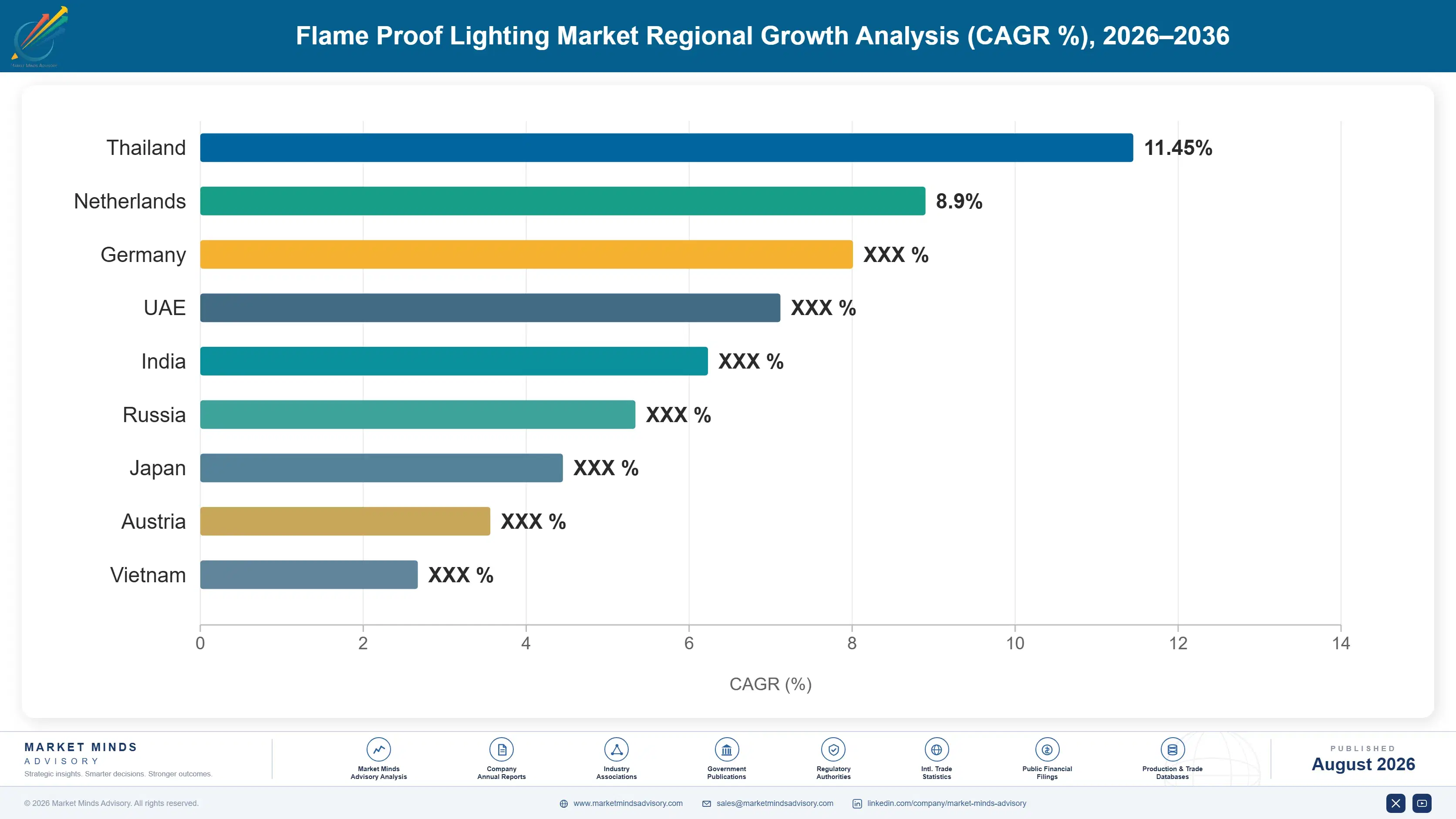
India leads country-level growth at 8.5% annually, outpacing the broader South Asia and Pacific regional average. Expanding chemical processing and oil refining investment drive this acceleration.

Report Segmentation Architecture

The full report scope spans multiple orthogonal segmentation dimensions, with cross-tabulated demand data provided for each dimension pair. Coverage extends further to regional breakdowns, trend trajectories, and the competitive detail needed to support segment-level decision-making.

By Fixture Technology Type

  • Fluorescent Explosion-Proof Fixtures
  • High-Intensity Discharge (HID) Fixtures
  • LED Explosion-Proof Luminaires
  • Portable and Handheld Hazardous Location Lighting
  • Explosion-Proof Emergency and Exit Lighting
  • Retrofit Conversion Kits

By End-Use Industry

  • Oil and Gas Processing
  • Chemical and Petrochemical Manufacturing
  • Coal and Metal Mining
  • Pharmaceutical Manufacturing
  • Grain and Agricultural Processing

By Commercial Dimension

  • New Installation Contracts
  • Retrofit and Upgrade Contracts
  • Distributor and Electrical Wholesale Sales
  • Direct Facility Operator Contracts

By Region

  • East Asia
  • North America
  • Western Europe
  • South Asia and Pacific
  • Latin America
  • Middle East and Africa
  • Eastern Europe

Scope, Methodology, and Coverage

Every figure in this report is reproducible from documented input assumptions. The scope below maps the historical period, the forecast horizon, the segmentation dimensions, and the countries covered, alongside the underlying primary and qualitative methodology.
Historical Period
2020 to 2025
Forecast Period
2026 to 2036
Base Year
2025 (USD billions; MMA Primary Research Dataset, August 2026)
Market Definition
The flame proof lighting market covers explosion-proof and intrinsically safe luminaires certified for hazardous locations in oil and gas, chemical processing, and mining facilities. It excludes standard industrial lighting not rated for hazardous zone classification and non-lighting safety equipment.
Quantitative Units
USD billions (current prices); unit shipment volume in millions where applicable
Segmentation Dimensions
By Fixture Technology Type; By End-Use Industry; By Commercial Dimension; By Region
Regions Covered
East Asia, North America, Western Europe, South Asia and Pacific, Latin America, Middle East and Africa, Eastern Europe
Countries Covered
USA, China, Germany, France, UK, Japan, South Korea, India, Australia, Canada, Brazil, Mexico, Indonesia, Vietnam, Thailand, Malaysia, UAE, Saudi Arabia, South Africa, Nigeria, Turkey, Poland, Netherlands, Italy, Spain, Sweden, Switzerland, Argentina, Colombia, Singapore, and additional markets relevant to this sector
Key Companies Profiled
Eaton, R. STAHL, Emerson, Hubbell, Dialight, Glamox, Larson Electronics, Nemalux, Warom Technology, CEAG, Chalmit, Killark, Pauluhn, Bartec Group, Extronics, Multron, Foshan NVC Lighting, Thorn Lighting, Wipro Lighting, FGV Group
Quantitative Methodology
Primary survey, n=3,800 respondents, Q4 2025, six countries; demand-side model with trade association cross-validation
Qualitative Methodology
47 expert interviews, Q4 2025; applied to validate demand model assumptions, identify emerging dynamics, and assess competitive positioning
Report Format
PDF and XLSX data workbook (Word format preview document)
Publisher
Market Minds Advisory
Report Code
MMA-2026-CON-211
Published
August 2026
Contact
sales@marketmindsadvisory.com | www.marketmindsadvisory.com

Purchase the full Flame Proof Lighting Market Report (2026 to 2036).

This report provides a complete assessment of the global flame proof lighting market across the 2026 to 2036 forecast period, covering sizing, segmentation, and regional demand patterns. It profiles the five leading suppliers and fifteen additional participants on a consistent annual revenue basis, detailing competitive positioning, recent corporate developments, and moat and risk analysis for the top two players. The report also examines input cost exposure, portfolio margin architecture, and revenue lever opportunities tied to LED conversion. A dedicated regional chapter breaks down demand across all seven MMA-tracked regions.
Ten-year global market sizing and CAGR forecast model
Six-segment MECE fixture technology breakdown analysis
Seven-region demand share and growth rate analysis
Twenty-company competitive benchmarking and positioning dataset
Input cost exposure and portfolio margin modeling detail
Anonymized client engagement case study with outcomes

Built For The People Who Decide

From boardroom strategy to bench-side execution, this report is read cover-to-cover by leaders shaping the next decade of their industry, turning demand scenarios, market dynamics and valuation benchmarks into decisions.
CXOs/ Presidents/ VPs/ Managers
M&A and Corporate Development
Strategy Teams and R&D Heads
Procurement and Product Directors
Regulatory and Compliance Leaders
Investor Relations and Equity Analysts