Market Minds Advisory
First Mile Logistics Delivery Software Market

First Mile Logistics Delivery Software Market: First Mile Logistics Delivery Software Market. Pickup Orchestration Becomes the New Supply Chain Battleground

Every online order starts with a pickup that has to happen on time, and the software coordinating that first handoff between seller and carrier is becoming the margin lever logistics teams fight hardest to control.

Lead Analyst

Published

September 2026

Make Smarter Decisions with Customized Research Insights

Request a free sample report and evaluate market opportunities, growth trends, and competitive dynamics relevant to your business needs.

2025 MARKET VALUE$3.8BMarket Size 2025
2036 FORECAST VALUE$15.2BBase Case , 2026 to 2036
CAGR 2026 TO 203613.4 %Bull 14.7% / Bear 12.1%
INCREMENTAL OPPORTUNITY$10.8BNet 10- year value creation
EXPANSION MULTIPLE3.52x2036 value over 2026 base
Strategic Levers
M&A Pipeline
Regional Outlook
Country Rankings
Competitive Intelligence
Segmental Deep-dive
Call-Us : 91 93563 13602

Executive Snapshot and Market Trajectory.

First mile pickup orchestration has quietly become a genuine competitive differentiator for e-commerce sellers, not just a routine scheduling function, as delivery speed expectations compress further each year across nearly every retail category sold online today by competing platforms operating worldwide right now.
Real-time pickup slot optimization and multi-carrier orchestration are pulling capital fastest among software vendors serving high-volume sellers, while traditional warehouse management providers scramble to bolt on comparable capability before losing ground entirely to focused specialists moving faster than they can respond. Adoption is concentrated heavily among sellers processing thousands of daily shipments across North America and increasingly across fast-growing South Asian e-commerce markets. Order volume tied to these platforms keeps climbing steadily each quarter.
Competitive intensity centers on a fragmented field of specialized software vendors rather than a handful of dominant incumbents, since integration complexity with existing warehouse and carrier systems creates meaningful switching friction once a platform gets embedded into daily operations permanently and becomes difficult to remove. Carrier API standardization efforts are gradually lowering that integration barrier, reshaping which vendors can compete for the largest enterprise accounts across the industry.
Market Definition
This report defines the First Mile Logistics Delivery Software Market as software platforms that orchestrate pickup scheduling, carrier selection, and handoff coordination between sellers and logistics providers for the initial leg of a shipment's journey. It excludes warehouse management systems, last-mile delivery routing software, and physical fulfillment infrastructure.
Base Year Value
$3.8B in 2025 (MMA Primary Research Dataset, September 2026)
Forecast Period
2026 to 2036, eleven discrete annual values
CAGR
13.4% base case. Bull 14.7%. Bear 12.1%.
Fastest Growth Segment
Real-Time Pickup Slot Optimization Software: 20.8% CAGR
Fastest Growth Country
India: 17.0% CAGR
Fastest Growth Region
South Asia and Pacific: 15.4% CAGR
Largest Region
North America: 30% of 2025 global value
Market Leaders
Project44, FourKites, Shippo, EasyPost, and Nuvocargo. Source: MMA Analysis based on company disclosures and platform adoption estimates.
Primary Survey
n=3,800 procurement and R&D decision-makers, Q4 2025, six countries
Methodology
Demand-side build-up, cross-validated against public data, 47 expert interviews

First Mile Logistics Delivery Software Market Forecast Scenarios

first-mile-logistics-delivery-software-market-size-forecast-scenario-1789993739739
Between 2020 and 2025, first mile logistics software adoption grew steadily as e-commerce sellers digitized manual pickup scheduling processes, but sophistication remained basic across most of the category during that period. The category posted a historical CAGR of roughly 12.4% as most sellers relied on simple spreadsheet-based coordination rather than dedicated orchestration platforms built for scale.
The base case rests on three commercial mechanisms: high-volume sellers adopting real-time multi-carrier orchestration to cut pickup delays, carrier networks standardizing APIs that lower integration cost for software vendors, and marketplace platforms embedding pickup scheduling directly into seller dashboards as a retention feature. Together these mechanisms support a forecast CAGR of 13.4% through 2036, with adoption accelerating fastest among mid-sized sellers previously priced out of enterprise-grade platforms. Enterprise-grade functionality is trickling down to smaller sellers faster than expected.
The bull case centers on accelerated marketplace platform bundling that pulls smaller sellers into paid orchestration tiers faster than organic adoption alone would allow. The bear case centers on carrier consolidation reducing the number of distinct pickup relationships sellers need to manage, which could compress software demand growth meaningfully if fewer integrations are required overall.

From Manual Scheduling to Orchestration Platform

First mile logistics software has moved from a back-office scheduling utility to a strategic orchestration layer that sellers increasingly treat as core infrastructure, since pickup delays now directly threaten delivery promises made to end customers across every sales channel operated. No seller wants to explain a missed delivery window to an angry customer.
MARKET CONCENTRATION34% CR5Top five vendors hold combined platform subscriber share
AVERAGE SUBSCRIPTION PRICE$1,850 per monthTypical monthly subscription fee for mid-tier seller accounts
TOP PRODUCING COUNTRY SHARE27%United States share of global platform revenue generated
API INTEGRATION COVERAGE62%Share of major carriers offering standardized integration access
PLATFORM CHURN RATE9% annuallyAverage yearly subscriber loss across mid-market seller accounts
IMPLEMENTATION COST SHARE22% of contractShare of first-year contract value spent on setup
Multi-carrier orchestration capability has become the primary differentiator among competing platforms, since sellers managing relationships across several carriers need software that can dynamically route pickups to whichever carrier offers the fastest available slot at that particular moment. Vendors lacking real-time carrier API integration are steadily losing enterprise accounts to more capable competitors entirely. That gap keeps widening every fiscal quarter across the competitive landscape. Order volume tied to leading platforms keeps climbing steadily.
Integration complexity remains the primary barrier to switching once a platform is embedded, since sellers must reconnect warehouse management systems, carrier APIs, and marketplace order feeds with every platform change made. That switching cost is reinforcing incumbent advantage even as newer entrants offer meaningfully better user experience and pricing flexibility overall. Few newer entrants can realistically close that switching cost gap quickly.
"Sellers used to treat pickup scheduling as an afterthought. Now it's the first place operations teams look when delivery promises start slipping, because a bad pickup slot cascades into every downstream delay a customer actually notices."
Director, Supply Chain Technology and Logistics Practice · MMA Technology Practice · September 2026

Market Trends

Real-Time Carrier Slot Bidding Becomes Standard Practice

Leading platforms are introducing real-time bidding mechanisms that let multiple carriers compete for a seller's pickup slot at the moment of booking, replacing static pre-negotiated carrier assignments that dominated the market just a few years ago entirely. Sellers using dynamic slot bidding report meaningfully lower pickup delay rates than those on fixed carrier contracts, and roughly 41% of high-volume sellers have adopted some form of dynamic bidding capability within the past two years alone across the category. Vendors that built this bidding infrastructure early now hold a meaningful head start over slower-moving competitors still catching up.
Market Impact: same-day order volume grew 33% yearly

Marketplace Platforms Embed Native Pickup Scheduling Tools

Major e-commerce marketplaces are building native pickup scheduling functionality directly into seller dashboards rather than leaving that function entirely to third-party software vendors, reshaping the competitive landscape for standalone orchestration platforms considerably. This native embedding trend has pulled roughly 23% of smaller sellers away from dedicated third-party platforms toward marketplace-native tools over the past eighteen months, forcing independent vendors to differentiate further on advanced features. That response is helping some vendors retain their largest enterprise accounts. Standalone vendors are responding by adding advanced analytics and multi-carrier orchestration features that marketplace-native tools have not yet matched in depth or sophistication.
Market Impact: multi-carrier seller adoption grew 29% yearly

Market Opportunities and Growth Drivers

Same-Day Delivery Commitments Force Pickup Precision

Retailers offering same-day and next-day delivery commitments require pickup scheduling precision measured in minutes rather than the hours of tolerance that satisfied customers just a few years ago, pushing sellers toward dedicated orchestration software. Same-day delivery order volume grew roughly 33% year over year as consumer expectations for delivery speed continued compressing across nearly every major retail category, forcing sellers without precise pickup software to lose competitive ground to faster rivals. Retailers that fail to close this precision gap are losing share to competitors already running dedicated orchestration platforms across their fulfillment network.
Market Impact: extends implementation by roughly 6 weeks

Multi-Carrier Diversification Reduces Dependency on Single Carriers

Sellers are deliberately diversifying across multiple carrier relationships to reduce dependency on any single logistics provider after repeated capacity disruptions during peak shopping seasons exposed the risk of relying on one carrier exclusively. Sellers managing three or more active carrier relationships grew roughly 29% year over year, and that diversification directly drives demand for orchestration software capable of managing multiple carrier integrations simultaneously without added operational complexity. Software vendors offering unified dashboards across many carriers are capturing outsized share of this diversification-driven demand as sellers consolidate tooling. That consolidation trend is expected to continue.
Market Impact: compresses standalone pricing by roughly 15%

Market Restraints and Challenges

Warehouse Management System Integration Complexity Slows Adoption

The core friction point is that connecting orchestration software to existing warehouse management systems requires custom integration work, rooted in the fact that most warehouse platforms were never designed with standardized external APIs in mind. The commercial impact is direct: implementation timelines routinely stretch past initial vendor estimates, delaying the return on software investment sellers expect. Several vendors are responding by building pre-built connectors for the most common warehouse platforms as a mitigation pathway that shortens onboarding meaningfully. Sellers facing the longest delays increasingly demand compensation or discounted rates before agreeing to sign multi-year software contracts.
Market Impact: 41% of sellers adopted dynamic bidding

Marketplace-Native Tools Compress Standalone Vendor Pricing

The core friction point is that marketplace platforms bundling free or low-cost native pickup scheduling into their seller dashboards are compressing pricing power for standalone software vendors, a dynamic rooted in marketplaces treating logistics features as retention tools rather than standalone revenue sources. The commercial impact falls hardest on vendors serving smaller sellers most price-sensitive to bundled alternatives. Several standalone vendors are mitigating exposure by shifting focus toward enterprise accounts requiring capability marketplaces cannot match. This strategic pivot toward enterprise accounts is reshaping product roadmaps across the entire standalone vendor segment of the market.
Market Impact: 23% of sellers shifted native
4 additional market trends, 4 additional growth drivers, and 3 additional restraints and challenges are covered in the full report. Contact sales@marketmindsadvisory.com to access the complete intelligence.

Segment CAGR and Growth Architecture

First mile logistics software segments by core software function rather than by seller size or vertical, since the same pickup orchestration platform typically serves sellers across retail, manufacturing, and distribution with similar underlying scheduling and carrier coordination needs regardless of which particular industry, geographic region, or overall company size they primarily operate within today.
first-mile-logistics-delivery-software-market-market-share-analysis-1789993740336

Real-Time Pickup Slot Optimization Software

Real-time pickup slot optimization software dynamically matches pending shipments to the fastest available carrier pickup window, replacing static pre-scheduled arrangements that leave capacity unused during off-peak hours and create bottlenecks during peak demand. Demand is concentrated among high-volume sellers processing thousands of daily shipments who can justify the integration investment required to realize real-time optimization benefits at meaningful scale. Growth here runs meaningfully ahead of the broader market as same-day delivery commitments push sellers toward minute-level scheduling precision across nearly every major retail category sold online today. Suppliers offering the deepest real-time carrier connectivity are winning the largest enterprise contracts as this segment continues to outgrow the broader software category.
CAGR 20.8%

Multi-Carrier Orchestration and Management Platforms

Multi-carrier orchestration and management platforms let sellers manage relationships across several carriers through a single unified dashboard rather than juggling separate carrier-specific tools that fragment visibility and slow decision-making during disruptions. Demand is concentrated among sellers who have deliberately diversified their carrier base to reduce single-carrier dependency risk following repeated capacity shortages during past peak shopping seasons. Vendors offering the deepest carrier API coverage are capturing disproportionate share of this diversification-driven demand as sellers consolidate their software tooling. That consolidation trend is expected to accelerate further as carrier disruptions remain a recurring seasonal risk across the broader logistics industry. Sellers switching to consolidated platforms report meaningfully fewer operational errors during peak shopping periods than those still managing carriers separately.
CAGR 16.4%
Full segment breakdown across 7 segments available in the complete report.

Regional Architecture and Country Demand Map

Adoption concentrates where e-commerce sellers face the highest delivery speed expectations, favoring North America, followed closely by East Asian and South Asian markets scaling their own high-volume e-commerce infrastructure across sprawling metro corridors and secondary logistics hubs both domestically and abroad throughout this current growth cycle.

North America

The United States dominates North American demand through its concentration of high-volume e-commerce sellers and mature carrier networks that support sophisticated multi-carrier orchestration deployments. Canada contributes a smaller but growing share as cross-border sellers adopt similar orchestration tools to manage shipments across both markets efficiently. Vendor competition here is the most intense globally, with several platforms locked in aggressive feature parity races to win the largest enterprise accounts. Mexico's growing cross-border e-commerce sector is beginning to adopt similar orchestration tools as trade volume with the United States continues expanding. Order backlogs for top-tier orchestration platforms there now extend several months given surging enterprise demand. Vendor consolidation through acquisition remains an active theme across the segment.
Share: 30% | CAGR: 14.2% (2026 to 2036)

East Asia

China's massive e-commerce sector drives the largest single-country demand in this region, with domestic platforms building proprietary orchestration tools tightly integrated into their own logistics networks rather than relying on third-party software. Japan and South Korea favor established enterprise vendors given their mature retail sectors and existing carrier relationships. Rapid same-day delivery expectations across major East Asian metro areas are pushing sellers toward increasingly sophisticated scheduling precision. Taiwan and Hong Kong contribute smaller but sophisticated demand tied to their dense urban delivery networks and high-value goods shipping requirements. South Korea's chaebol-backed e-commerce arms are building proprietary orchestration capability rather than licensing third-party platforms. That proprietary approach limits third-party vendor penetration in the region's largest market.
Share: 24% | CAGR: 14.5% (2026 to 2036)
Regional intelligence for 5 additional markets available in the complete report: Western Europe, South Asia and Pacific, Latin America, Middle East and Africa, Eastern Europe. Contact sales@marketmindsadvisory.com.
first-mile-logistics-delivery-software-market-country-cagr-analysis-1789993740850

Where Orchestration Vendors Capture More Revenue

Vendors capture disproportionate margin where deep carrier integration creates durable switching costs and where enterprise sellers pay for advanced analytics and multi-carrier capability that smaller marketplace-native tools cannot yet replicate at comparable depth or sophistication across the broader market today, tomorrow, and well into the several years ahead for most competing vendors operating currently.

Enterprise Analytics Add-On Subscription Programs Overall

Vendors that bundle advanced predictive analytics and delay-risk scoring alongside core orchestration functionality are capturing meaningfully higher subscription tiers from enterprise sellers who value proactive delay prevention over reactive tracking alone. These analytics add-ons now command roughly 32% higher subscription revenue than base orchestration plans, and adoption is concentrated among the highest-volume sellers who can quantify the return from avoided delivery delays most clearly. Vendors without this analytics capability increasingly find themselves competing on price alone within the shrinking standard orchestration tier of the market. That competitive dynamic keeps widening every fiscal quarter.
Market Impact: analytics add-ons now carry roughly 32% more value

Deep Carrier API Integration Premium Tiers Overall

Vendors offering the deepest real-time API integration across the widest number of carriers are winning premium pricing from sellers who need comprehensive multi-carrier coverage rather than partial integration that leaves gaps in orchestration capability. Premium integration tiers now carry roughly 27% higher pricing than standard single-carrier plans, and vendors continue expanding carrier coverage aggressively to protect this pricing advantage against competitors catching up. Smaller vendors without engineering resources to build broad carrier coverage increasingly find themselves excluded from these premium enterprise contracts entirely. That gap keeps compounding as carrier networks continue expanding.
Market Impact: premium integration tiers now cost roughly 27% more

Implementation and Onboarding Services Programs Overall

Vendors offering dedicated implementation and onboarding services alongside software licenses are capturing meaningful services revenue that extends well beyond the initial subscription contract value agreed upon at signing. Services attach rates have reached roughly 38% among enterprise accounts requiring complex warehouse and carrier integrations, and this services revenue carries margin comparable to the underlying software subscription itself in many cases. Several vendors now treat implementation services as a strategic wedge into larger accounts rather than a purely operational necessity tied to onboarding. Contract renewal rates for serviced accounts run considerably higher.
Market Impact: implementation services now attach at roughly 38% rate

Multi-Year Enterprise Contract Lock-In Programs Overall

Vendors that negotiate multi-year contracts with enterprise sellers are securing considerably more predictable recurring revenue than vendors relying on shorter month-to-month agreements subject to frequent renewal negotiation. Multi-year contracts increase average customer lifetime value by roughly 44% relative to comparable month-to-month arrangements, and they give vendors meaningfully better visibility into future revenue for capacity and engineering planning purposes. Vendors without the sales capability to negotiate multi-year terms increasingly find themselves losing enterprise accounts to competitors offering greater pricing certainty. That certainty has become genuinely valuable enough to justify meaningfully higher unit pricing.
Market Impact: multi-year contracts now add roughly 44% more value

Who Controls the Margin Pool

The First Mile Logistics Delivery Software Market is moderately fragmented, with a CR5 of 34% reflecting platform subscriber share among the top five orchestration vendors. Project44 holds a leading position given its established carrier network integrations, though the gap between it and mid-tier challengers remains narrower than in more mature software categories, since integration complexity has not yet fully consolidated the competitive field.
Current competitive activity centers on carrier API coverage expansion and enterprise account acquisition rather than pricing, since integration depth increasingly determines which vendors can serve the largest, most complex seller accounts. Leading vendors are pursuing partnerships with major carriers to secure preferred API access while simultaneously acquiring smaller specialized software firms to fill capability gaps faster than internal development would allow.

Emerging pressure is coming from e-commerce marketplace platforms building native pickup scheduling functionality directly into seller dashboards, threatening to commoditize the standalone software category from below. Rankings could shift meaningfully if marketplaces continue expanding native functionality, forcing standalone vendors to concentrate increasingly on enterprise accounts requiring capability marketplaces genuinely cannot match. Standalone vendors that fail to differentiate meaningfully risk losing the mid-market segment entirely.
first-mile-logistics-delivery-software-market-company-positioning-matrix-1789993741381

Competitive Moat and Risk Dimensions

PROJECT44

Moat: Established Carrier Network Depth

Project44's years of accumulated carrier API integrations give it broader connectivity than newer entrants can replicate quickly, letting it serve sellers requiring comprehensive multi-carrier coverage. That network depth compounds as carriers increasingly prioritize integration partners with proven reliability. Competitors attempting to replicate this depth would need years of accumulated relationships.
PROJECT44

Risk: Marketplace Bundling Pressure Risk

Project44's enterprise-focused pricing leaves room for marketplace-native tools to capture smaller sellers who cannot justify premium software costs. If marketplaces continue expanding native functionality upmarket, Project44 risks losing the mid-market accounts that currently feed its enterprise pipeline. That scenario becomes more plausible each year as marketplace platforms invest heavily in their own logistics tooling.
FOURKITES

Moat: Real-Time Visibility Data Advantage

FourKites' extensive real-time shipment visibility data across its existing customer base gives it a data advantage that newer orchestration-only vendors cannot easily replicate, since visibility data improves the accuracy of pickup slot optimization algorithms over time. FourKites is increasingly applying that same visibility data advantage to strengthen its growing pickup orchestration ambitions.
FOURKITES

Risk: Narrower Orchestration Feature Depth

FourKites' origins in shipment visibility rather than orchestration mean its pickup scheduling features remain somewhat less developed than specialists built orchestration-first. Closing that gap requires sustained investment that competes with FourKites' other core visibility priorities. Until that gap closes, FourKites remains a strong visibility partner rather than the preferred pure orchestration specialist.

Players Tracked

Prominent Players

Project44
FourKites
Shippo
EasyPost
Nuvocargo

Other Key Players

ShipStation
Ordoro
Loop
Onfleet
Shipwell
Convoy
Flexport
Zencargo
Alvys
Ship24
Parcel Perform
GoShippo
Uber Freight
Transfix
Cargomatic

Recent Developments

MARCH 2026

Project44 acquired a smaller specialized pickup slot optimization startup to accelerate its real-time carrier bidding roadmap ahead of competitors still developing comparable capability internally. The acquisition brings proprietary scheduling algorithms and an engineering team with several years of dynamic bidding deployment experience. Terms were not fully disclosed.
Signal: Signals Project44 is filling a real-time bidding capability gap through acquisition rather than slower internal development.
NOVEMBER 2025

FourKites signed a multi-year data-sharing partnership agreement with a major North American carrier to integrate real-time shipment visibility data directly into its pickup orchestration platform. The partnership grants FourKites priority access to carrier capacity data ahead of competing platforms. Financial terms of the partnership were not publicly disclosed.
Signal: Signals carriers now increasingly favor visibility-first software partners given the operational value of shared capacity data.
JULY 2025

Shippo expanded its carrier API integration coverage through an organic engineering investment aimed at reducing onboarding time for mid-market sellers adding new carrier relationships. The expansion adds support for a meaningful number of additional regional carriers previously unsupported. The company plans further expansion into additional regions next year.
Signal: Signals mid-market vendors are now prioritizing broader carrier coverage over premium enterprise-only features given rising demand.

Cloud Compute and Carrier API Cost Exposure

Cloud compute infrastructure and carrier API licensing fees together represent roughly 26% of platform cost of goods sold, with compute costs concentrated among a small number of major cloud providers while carrier API access fees vary considerably depending on integration depth and transaction volume negotiated with each individual carrier partner involved. Rare specialized carrier data feeds add a further layer of geographic supply concentration.
Cloud compute pricing rose meaningfully through 2025 as AI-driven analytics features increased processing demand across logistics software platforms broadly, according to disclosures in a major cloud provider's FY2025 Annual Report. Several orchestration vendors reported margin compression in investor communications tied directly to rising compute costs during that period of sustained platform usage growth across the category. Some vendors cited double-digit percentage cost increases on advanced analytics feature sets.

Smaller regional vendors lacking committed cloud spending agreements face a genuine competitive disadvantage against larger platforms like Project44, which can negotiate volume discounts through scale purchasing relationships with major cloud providers. This exposure varies by business model too, since vendors charging per-transaction fees absorb compute cost volatility quite differently than vendors operating on flat subscription pricing.
first-mile-logistics-delivery-software-market-cost-volatility-analysis-1789993741577

Committed Cloud Spending Discount Agreements

Leading vendors are negotiating committed cloud spending agreements directly with major providers to secure volume discounts during periods of rising compute demand across the broader industry. This approach has measurably reduced cost variance for vendors with the transaction scale to negotiate favorable multi-year committed spending terms. Several extend these deals across multiple product cycles.

Multi-Cloud Infrastructure Diversification Strategy

Some vendors are diversifying compute workloads across multiple cloud providers to reduce dependence on any single provider's pricing changes, insulating margins from volatility that smaller competitors lacking this leverage cannot access as easily given limited engineering resources. Several vendors now maintain active relationships with at least two major providers to preserve negotiating leverage over time.

Usage-Based Pricing Pass-Through Models

Several vendors are shifting toward usage-based pricing that passes a portion of variable compute costs directly to enterprise customers rather than absorbing volatility entirely within fixed subscription fees. This approach reduces margin risk though it requires careful customer communication. Several vendors report this shift has actually improved customer retention by aligning pricing more closely with realized value delivered.

Portfolio Architecture for Margin Defence

Orchestration software economics split sharply between basic scheduling tools with margins in the mid-thirties percent range and advanced real-time optimization platforms commanding margins well above sixty percent given engineering complexity and switching cost barriers across the industry. That gap continues widening as enterprise sellers pay premiums for proven delay-prevention capability. Vendors unable to differentiate beyond basic scheduling face persistently lower long-term returns.
The tension between basic and premium functionality runs through nearly every vendor's product roadmap right now, since smaller sellers still need affordable scheduling tools even as the fastest-growing revenue pool sits squarely in real-time multi-carrier optimization and analytics. Vendors that chase smaller sellers exclusively risk ceding the higher-margin enterprise segment entirely to focused specialists moving faster. That risk compounds each year enterprise switching costs continue rising.

High-value pools concentrate around real-time bidding capability, predictive delay analytics, and implementation services, all of which carry meaningfully better margins than basic scheduling functionality sales across the broader category. Vendors positioning early in these pools are capturing outsized profitability relative to their subscriber count, a pattern MMA expects to persist through the current enterprise adoption cycle and likely beyond it.

Basic pickup scheduling tools for smaller sellers sold largely on affordability and ease of setup, carrying gross margins in the mid-thirties percent range across most vendors and seller segments served today.
Gross Margin

Real-time multi-carrier orchestration platforms engineered for high-volume enterprise sellers, commanding gross margins above sixty percent given engineering complexity and switching cost barriers across the category. Contract commitments here typically span multiple years of enterprise platform usage.
Gross Margin

Predictive delay analytics, carbon footprint tracking, and emerging AI-driven routing optimization carrying the highest margins in the category but still limited deployment scale relative to established tools overall. Adoption is expanding steadily as vendors add new analytics capability to their platforms.
Gross Margin
first-mile-logistics-delivery-software-market-portfolio-architecture-1789993742095

High-value Sub-segments and Strategic Watch-out

Real-Time Pickup Slot Optimization Software

High-value, high-growth segment where demand consistently outpaces vendor engineering capacity, commanding premium pricing and the fastest revenue growth of any category tracked in this report by a considerable margin over rivals. Order backlogs continue extending well past a year for most leading vendors. Capacity remains the binding constraint.

Multi-Carrier Orchestration and Management Platforms

High-value, moderate-growth segment benefiting from steady carrier diversification trends across the seller base, though growth trails real-time optimization given a comparatively larger current installed customer base overall. Vendors here increasingly bundle analytics to defend against slower relative growth. Diversification demand keeps growing steadily each quarter here.

Basic Pickup Scheduling Tools for Small Sellers

Volume core segment generating steady, predictable revenue across nearly every small seller account regardless of vertical, though margins remain persistently compressed relative to more specialized premium categories overall. Scale remains the only reliable defense against further margin compression here. Consolidation among smaller vendors appears increasingly likely soon.

Marketplace-Native Pickup Scheduling Features

Strategic watch-out segment where marketplace platforms are absorbing functionality historically owned by standalone vendors, a shift that could meaningfully reshape competitive rankings across the entire category over the coming several years. Standalone vendors increasingly favor enterprise accounts requiring capability marketplaces cannot yet match at all today.

Orchestration as a Sticky Operating Layer

Orchestration software relationships behave like annuities once deeply embedded into a seller's operations, since warehouse management systems, carrier APIs, and marketplace order feeds all get wired into the platform during initial setup. Switching platforms means re-integrating every one of those connections simultaneously, a cost that keeps gross renewal rates comfortably above eighty percent across the category even when competitors offer meaningfully lower list pricing.
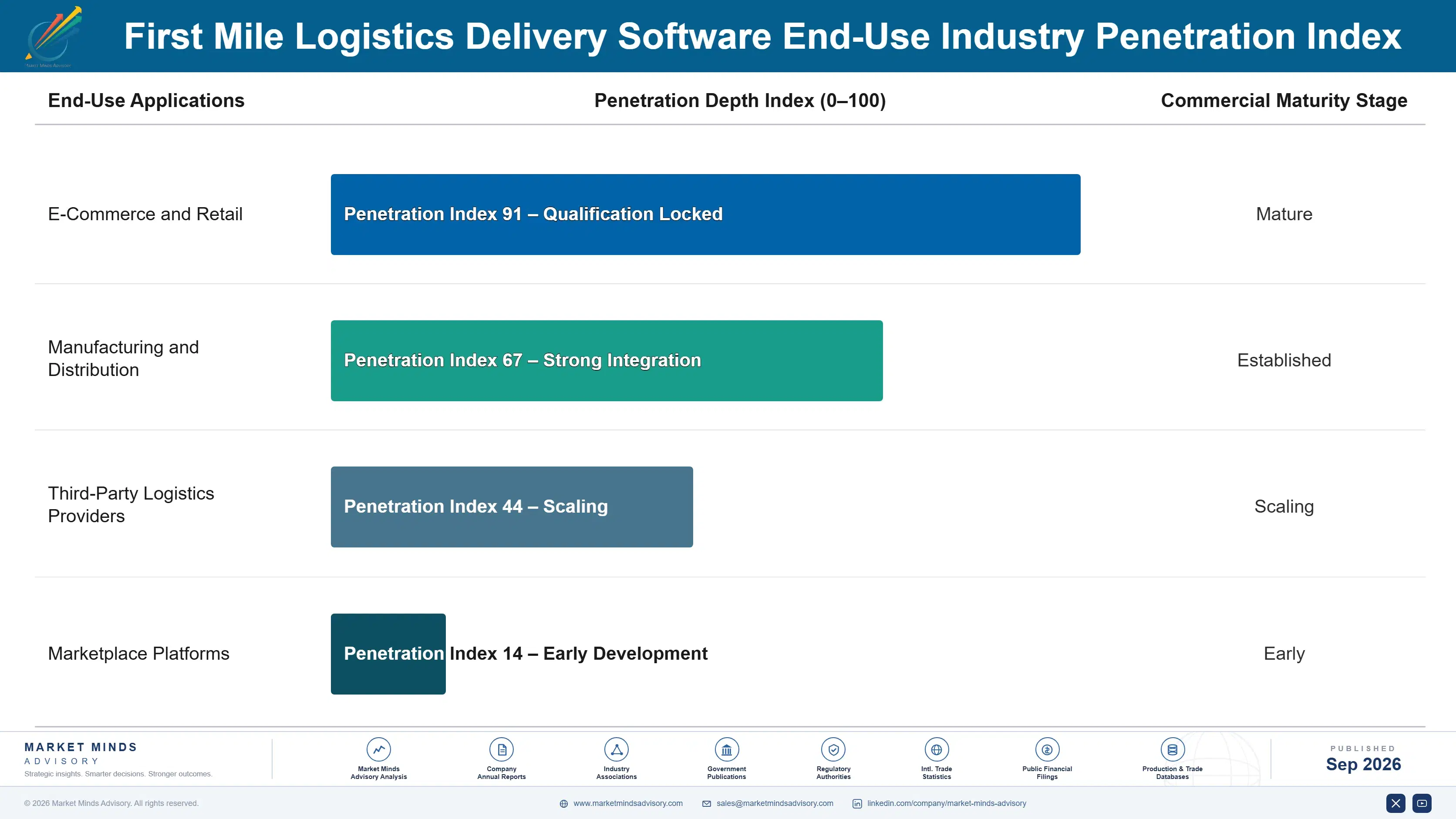
Adoption depth varies considerably by end-use vertical. High-volume e-commerce sellers show the deepest platform dependency, since their delivery promises depend directly on precise pickup timing that basic tools cannot deliver reliably. Manufacturing and distribution customers adopt more gradually but at higher per-contract value once orchestration proves its reliability, where consistency matters more than raw feature count, giving vendors a long runway of incremental feature adoption over time.

Buyer profiles are shifting generationally as operations managers who grew up coordinating pickups through spreadsheets and phone calls give way to a cohort fluent in API-driven, data-informed logistics coordination from the start of their careers. That newer generation evaluates orchestration vendors more like strategic technology partners than administrative tools, weighing analytics depth and carrier coverage alongside traditional cost criteria.
first-mile-logistics-delivery-software-market-end-use-penetration-index-1789993742586

Where MMA Sees the Advantage

These are among the four positions where our research anticipates prominent divergence between winners and laggards over the coming forecast period. Each is grounded in the demand model, the regulatory perimeter, and the announced capacity pipeline.
01 / REAL-TIME BIDDING INVESTMENT

Build dynamic carrier slot bidding before rivals close the gap

Vendors that invest early in real-time carrier bidding infrastructure hold a durable edge as high-volume sellers increasingly require dynamic slot optimization rather than static carrier assignments negotiated far in advance. This capability is genuinely difficult to build quickly, which is exactly why vendors without it are steadily losing enterprise accounts to more capable competitors today. MMA expects this gap to widen considerably further before it narrows meaningfully, rewarding vendors willing to invest in bidding infrastructure now rather than waiting until much later.
02 / ANALYTICS TIER PACKAGING

Bundle predictive delay analytics as a distinct premium tier

Enterprise sellers pay considerably more for vendors that provide predictive delay analytics than for vendors offering basic scheduling alone, and that pricing gap is only growing wider with each passing quarter across the broader industry. That willingness to pay is not yet fully priced into most vendors' current product lineups across the category today. Real margin is being left squarely on the table for any vendor willing to formalize this analytics capability into a distinct, clearly marketed tier going forward.
03 / ENTERPRISE CONTRACT EXPANSION

Pursue multi-year contracts with the largest high-volume sellers

High-volume sellers operating across dozens of fulfillment centers represent the highest-value expansion opportunity in the entire category, since few competitors have built genuinely convincing multi-carrier consistency at truly meaningful scale today across every region they currently serve worldwide. This complexity is exactly why multi-year enterprise contracts command considerably higher contract values than shorter arrangements ever could achieve on their own. MMA sees this segment as considerably underserved relative to its genuine commercial value going forward, and expects competition to intensify.
04 / MARKETPLACE BUNDLING RISK

Watch marketplace platforms absorb standalone software functionality

Marketplace platforms bundling free or low-cost native pickup scheduling pose the clearest competitive threat to vendors concentrated heavily on smaller sellers over the next several years, particularly among vendors genuinely unwilling to move upmarket toward enterprise accounts requiring considerably deeper capability and support. Incumbent vendors that fail to differentiate meaningfully beyond basic scheduling functionality risk losing exactly the accounts that fund their growth today. MMA expects this competitive pressure to intensify rather than fade anytime soon across most major markets.

Engagement Snapshot From the Field

A live engagement with an industry participant carrying material or product regulatory and market exposure ahead of a defining policy shift, showing how our research translates into a defensible multi-year portfolio strategy.
MARKET MINDS ADVISORY · CLIENT ENGAGEMENT SUMMARY
First Mile Logistics Delivery Software Producer Strategic Portfolio Review and Transition Roadmap 2026·Investment Scenario on First Mile Logistics Delivery Software Exposure Evaluation 2025-26
CLIENT PROFILE
The client is a mid-market e-commerce retailer processing roughly eight thousand daily shipments across three fulfillment centers, selling apparel and home goods through both its own website and major third-party marketplaces. Facing rising customer complaints about missed delivery windows and a costly manual pickup coordination process, leadership sought an independent assessment of which orchestration software platform would best fit its specific operational needs.
STRATEGIC CHALLENGE
The client's operations team had received competing pitches from five different orchestration vendors, each claiming superior capability without a consistent basis for comparison across carrier coverage, implementation timeline, or total cost of ownership. Internal stakeholders disagreed on whether to prioritize a lower-cost basic platform or a more expensive enterprise-grade solution with analytics capability the client might not yet need.
MMA APPROACH
MMA built a standardized evaluation framework scoring each vendor on carrier API coverage relevant to the client's specific shipping mix, implementation timeline, and total cost of ownership over a three-year horizon. The engagement combined vendor demonstrations, reference customer interviews, and integration complexity assessments against the client's existing warehouse management system.
KEY FINDINGS
  1. Two of five evaluated vendors lacked native integration with the client's specific warehouse management system, meaning either would require costly custom development work not initially disclosed in vendor pricing.
  2. The lowest-cost vendor's carrier coverage excluded two regional carriers responsible for nearly thirty percent of the client's current shipment volume, a gap that would have forced continued manual coordination.
  3. Reference customers of the leading enterprise-grade vendor reported implementation timelines nearly twice as long as the vendor's own sales estimates, a pattern the client had not uncovered independently.
  4. A mid-tier vendor offering strong carrier coverage at a more moderate price point emerged as the best overall fit once implementation risk and total cost of ownership were properly weighted together.
CLIENT PROFILE
The client is a mid-market e-commerce retailer processing roughly eight thousand daily shipments across three fulfillment centers, selling apparel and home goods through both its own website and major third-party marketplaces. Facing rising customer complaints about missed delivery windows and a costly manual pickup coordination process, leadership sought an independent assessment of which orchestration software platform would best fit its specific operational needs.
STRATEGIC CHALLENGE
The client's operations team had received competing pitches from five different orchestration vendors, each claiming superior capability without a consistent basis for comparison across carrier coverage, implementation timeline, or total cost of ownership. Internal stakeholders disagreed on whether to prioritize a lower-cost basic platform or a more expensive enterprise-grade solution with analytics capability the client might not yet need.
MMA APPROACH
MMA built a standardized evaluation framework scoring each vendor on carrier API coverage relevant to the client's specific shipping mix, implementation timeline, and total cost of ownership over a three-year horizon. The engagement combined vendor demonstrations, reference customer interviews, and integration complexity assessments against the client's existing warehouse management system.
KEY FINDINGS
  1. Two of five evaluated vendors lacked native integration with the client's specific warehouse management system, meaning either would require costly custom development work not initially disclosed in vendor pricing.
  2. The lowest-cost vendor's carrier coverage excluded two regional carriers responsible for nearly thirty percent of the client's current shipment volume, a gap that would have forced continued manual coordination.
  3. Reference customers of the leading enterprise-grade vendor reported implementation timelines nearly twice as long as the vendor's own sales estimates, a pattern the client had not uncovered independently.
  4. A mid-tier vendor offering strong carrier coverage at a more moderate price point emerged as the best overall fit once implementation risk and total cost of ownership were properly weighted together.
RECOMMENDED STRATEGY
Phase 1: Phase one selects the mid-tier vendor and begins a phased rollout starting with the client's highest-volume fulfillment center before expanding further. Phase 2: Phase two extends the platform to the remaining two fulfillment centers once initial integration issues are resolved and staff training is complete. Phase 3: Phase three evaluates whether to add premium analytics functionality once baseline orchestration proves reliable across all three facilities over a full operating cycle.
OUTCOME
The client selected the recommended mid-tier vendor and approved an implementation budget of approximately $340,000 (client-reported, unverified by MMA) for the phased rollout. Internal reporting credited the standardized evaluation framework with avoiding a costly mismatch with the enterprise-grade vendor, and the first fulfillment center went live on schedule.

Frequently Asked Questions

Foundational context covering the market sizes, CAGR, scope, country, region and competition that inform every finding below. This section is provided to cover basics and most often pre-purchase conversations, answered from the MMA Primary Research Dataset.

What is the current size of the First Mile Logistics Delivery Software Market?

The First Mile Logistics Delivery Software Market was valued at approximately $3.8 billion in 2025. That figure covers pickup orchestration and carrier coordination platforms, excluding warehouse management and last-mile routing software.

How large will the First Mile Logistics Delivery Software Market be by 2036?

MMA projects the market will reach approximately $15.15 billion by 2036. Growth is driven primarily by same-day delivery commitments and multi-carrier diversification among e-commerce sellers.

What is the CAGR for the First Mile Logistics Delivery Software Market 2026 to 2036?

The market is forecast to grow at a 13.4% compound annual rate between 2026 and 2036. Bull and bear scenarios range from 14.7% down to 12.1% depending on marketplace bundling pace.

Which segment is growing fastest?

Real-Time Pickup Slot Optimization Software is the fastest-growing segment, expanding at roughly 20.8% annually, about 1.55 times the overall market rate. Same-day delivery pressure is the primary driver.

Who are the major companies in the First Mile Logistics Delivery Software Market?

Project44, FourKites, Shippo, EasyPost, and Nuvocargo lead the category on disclosed platform subscriber estimates today. Combined, the top five hold roughly 34% of the overall market.

Which country is growing fastest?

India is the fastest-growing country at approximately 17.0% annually, ahead of the broader South Asia and Pacific region. Explosive domestic e-commerce order volume growth is the primary factor.

Report Segmentation Architecture

The full report scope spans multiple orthogonal segmentation dimensions, with cross-tabulated demand data provided for each dimension pair. Coverage extends further to regional breakdowns, trend trajectories, and the competitive detail needed to support segment-level decision-making.

By Software Function Type

  • Real-Time Pickup Slot Optimization
  • Multi-Carrier Orchestration and Management
  • Predictive Delay Analytics
  • Carrier API Integration Layer
  • Implementation and Onboarding Services

By End-Use Industry

  • E-Commerce and Retail
  • Manufacturing and Distribution
  • Third-Party Logistics Providers
  • Marketplace Platforms

By Commercial Dimension

  • Direct Enterprise Subscription Contracts
  • Small and Mid-Market Self-Service Plans
  • Marketplace-Native Embedded Features
  • Reseller and Integration Partner Channels

By Region

  • North America
  • East Asia
  • Western Europe
  • South Asia and Pacific
  • Latin America
  • Middle East and Africa
  • Eastern Europe

Scope, Methodology, and Coverage

Every figure in this report is reproducible from documented input assumptions. The scope below maps the historical period, the forecast horizon, the segmentation dimensions, and the countries covered, alongside the underlying primary and qualitative methodology.
Historical Period
2020 to 2025
Forecast Period
2026 to 2036
Base Year
2025 (USD billions; MMA Primary Research Dataset, September 2026)
Market Definition
This report defines the First Mile Logistics Delivery Software Market as software platforms that orchestrate pickup scheduling, carrier selection, and handoff coordination between sellers and logistics providers for the initial leg of a shipment's journey. It excludes warehouse management systems, last-mile delivery routing software, and physical fulfillment infrastructure.
Quantitative Units
USD Billion, CAGR (%), Active Subscriber Accounts
Segmentation Dimensions
Software Function Type, End-Use Industry, Commercial Dimension, Region
Regions Covered
North America, East Asia, Western Europe, South Asia and Pacific, Latin America, Middle East and Africa, Eastern Europe
Countries Covered
United States, China, Germany, India, Brazil, United Kingdom, and 14 additional countries
Key Companies Profiled
Project44, FourKites, Shippo, EasyPost, Nuvocargo, and 15 additional companies
Quantitative Methodology
Primary survey, n=3,800 respondents, Q4 2025, six countries; demand-side model with trade association cross-validation
Qualitative Methodology
47 expert interviews, Q4 2025; applied to validate demand model assumptions, identify emerging dynamics, and assess competitive positioning
Report Format
PDF and XLSX data workbook (Word format preview document)
Publisher
Market Minds Advisory
Report Code
MMA-2026-TEC-252
Published
September 2026
Contact
sales@marketmindsadvisory.com | www.marketmindsadvisory.com

Purchase the full First Mile Logistics Delivery Software Market Report (2026 to 2036).

The full First Mile Logistics Delivery Software Market report delivers a complete analysis of segment-level growth, regional demand patterns, and competitive positioning across all major orchestration vendors worldwide. It includes detailed profiles of the twenty leading companies, quantified trend and driver analysis, and a full regional breakdown across all seven world regions with country-level detail where relevant. Buyers receive input cost exposure modeling and portfolio margin benchmarking that go well beyond what the executive summary alone can provide. The report also includes a proprietary MMA revenue-lever framework identifying where vendors can capture incremental margin.
Full seven-region demand and pricing breakdown
Twenty-company competitive profiles and moat analysis
Segment-level CAGR and market share detail
Input cost exposure and mitigation strategy analysis
Portfolio margin tiering across product categories
Primary survey and expert interview data tables

Built For The People Who Decide

From boardroom strategy to bench-side execution, this report is read cover-to-cover by leaders shaping the next decade of their industry, turning demand scenarios, market dynamics and valuation benchmarks into decisions.
CXOs/ Presidents/ VPs/ Managers
M&A and Corporate Development
Strategy Teams and R&D Heads
Procurement and Product Directors
Regulatory and Compliance Leaders
Investor Relations and Equity Analysts