

Market Minds Advisory
Fire Stopping Material Market

Fire Stopping Material Market: Code Enforcement and Retrofit Compliance Demand

Building code enforcement is tightening across commercial retrofit markets as fire stopping specifications shift toward third-party tested, UL-listed systems, pushing contractors to replace legacy firestop installations ahead of compliance deadlines.

Lead Analyst

Bilal Shaikh

Published

September 2026

Make Smarter Decisions with Customized Research Insights

Request a free sample report and evaluate market opportunities, growth trends, and competitive dynamics relevant to your business needs.

2025 MARKET VALUE$4.4BMarket Size 2025
2036 FORECAST VALUE$7.1BBase Case , 2026 to 2036
CAGR 2026 TO 20364.4 %Bull 5.7% / Bear 3.1%
INCREMENTAL OPPORTUNITY$2.5BNet 10- year value creation
EXPANSION MULTIPLE1.54x2036 value over 2026 base
Strategic Levers
M&A Pipeline
Regional Outlook
Country Rankings
Competitive Intelligence
Segmental Deep-dive
Call-Us : 91 93563 13602

Executive Snapshot and Market Trajectory

Code enforcement intensity, not new construction volume, is now the dominant driver of fire stopping material demand, as jurisdictions increase inspection frequency and insurers require documented UL-listed system compliance across most major commercial building retrofit projects nationwide and internationally each successive year.
Commercial demand concentrates around penetration seals, joint systems, and fire-rated wrap products used in commercial and multifamily construction, where code compliance is mandatory rather than optional across most jurisdictions worldwide. North America commands the largest consumption share worldwide, driven by rigorous IBC and NFPA enforcement and an extensive commercial retrofit backlog, while East Asia and Western Europe compete on new construction volume and EN standard compliance respectively across their regional markets and supply chains.
Competitive intensity remains moderate as specialty chemical manufacturers dominate over generalist building products firms, since UL and EN listing testing represents a meaningful barrier to entry that few new entrants can clear quickly or cheaply and without significant investment or time. Tightening fire safety regulation following several high-profile building fire incidents is reshaping specification requirements, favoring manufacturers with broad tested system libraries over those competing purely on price alone.
Market Definition
The Fire Stopping Material Market covers penetration seals, joint systems, and fire-rated wrap and collar products used to maintain fire and smoke compartmentalization in commercial and multifamily buildings. It excludes passive fireproofing coatings applied to structural steel and active fire suppression systems.
Base Year Value
$4.4B in 2025 (MMA Primary Research Dataset, August 2026)
Forecast Period
2026 to 2036, eleven discrete annual values
CAGR
4.4% base case. Bull 5.7%. Bear 3.1%.
Fastest Growth Segment
Fire-Rated Wrap and Collar Systems: 7.2% CAGR
Fastest Growth Country
India: 7.0% CAGR
Fastest Growth Region
South Asia and Pacific: 6.5% CAGR
Largest Region
North America: 30% of 2025 global value
Market Leaders
Hilti, 3M, Rockwool (Rockfon), STI Firestop, Sika. Source: MMA Analysis based on company annual reports.
Primary Survey
n=3,800 procurement and R&D decision-makers, Q4 2025, six countries
Methodology
Demand-side build-up, cross-validated against public data, 47 expert interviews

Fire Stopping Material Market Forecast Scenarios

fire-stopping-material-market-trends-size-forecast-scenario-1787550762514
Fire stopping material demand grew steadily between 2020 and 2025, tracking commercial construction recovery and gradually tightening building code enforcement across major markets, with retrofit demand becoming an increasingly important growth driver alongside new construction activity each year across most major commercial and multifamily building segments, jurisdictions, regulatory frameworks, and inspection regimes worldwide and internationally.
The base case rests on three commercial mechanisms: increasing insurance requirements for documented UL-listed firestop compliance across commercial building portfolios and account tiers, tightening code enforcement following several high-profile building fire incidents that raised regulatory scrutiny of passive fire protection systems, and continued commercial retrofit activity as aging building stock undergoes renovation and compliance upgrades nationwide. Together these mechanisms sustain steady mid-single-digit volume growth even as new construction activity moderates in some mature markets.
The bull case centers on accelerated regulatory tightening following additional high-profile fire incidents pulling forward retrofit compliance spending faster than currently modeled across major commercial markets and jurisdictions. The bear case centers on a prolonged commercial construction slowdown tied to weaker office and retail development, which would compress new-construction-linked firestop demand across major markets and jurisdictions.

Compliance Enforcement and Retrofit Demand Economics

Three forces converge on this market at once: insurance underwriters increasingly requiring documented UL-listed firestop compliance before renewing commercial property coverage nationwide and internationally, code enforcement intensifying following several high-profile building fire incidents that raised regulatory scrutiny across most major jurisdictions, and an aging commercial building stock creating a substantial retrofit compliance backlog across most major metropolitan markets worldwide.
MARKET CONCENTRATIONCR5 32%Combined share held by top five fire stopping manufacturers
AVERAGE SELLING PRICE$18 per linear footBlended price across sealant, wrap, and collar formats
TOP COUNTRY SHAREUSA 26%Share held by the largest single national consuming market
RETROFIT SHARE OF DEMAND44%Share of volume tied to existing building compliance upgrades
UL LISTED SKU COUNT3,400+Average number of tested system configurations per major manufacturer
SILICONE FEEDSTOCK COST SHARE38%Primary sealant input cost as share of total COGS
Commercially, the market increasingly rewards manufacturers who can offer broad tested system libraries covering diverse penetration and joint configurations, since specifiers and inspectors favor documented UL-listed assemblies over generic sealant products lacking third-party validation and testing data across most jurisdictions. Contractors without proper firestop certification training face growing liability exposure as inspection rigor increases, pushing installation quality and documentation to the forefront of purchasing decisions across most commercial construction and retrofit projects nationwide.
Over the next decade, differentiation will concentrate around tested system breadth, installer training and certification programs, and digital documentation tools that simplify compliance reporting for building owners, rather than raw sealant chemistry alone, as inspection rigor and insurance requirements continue tightening across most major commercial and multifamily building markets worldwide, internationally, and domestically.
"Nobody buys firestop sealant anymore; they buy a tested assembly and the paperwork that proves it holds up, and that paperwork is now worth more than the caulk itself."
Director, Building Products and Materials Practice · MMA Construction and Industrial Equipment Practice · August 2026

Market Trends

Insurance Underwriters Mandate Documented UL-Listed Compliance

Commercial property insurers are increasingly requiring building owners to document UL-listed firestop system compliance as a condition of coverage renewal, particularly for high-value commercial and multifamily properties nationwide and internationally. Several major insurers have introduced firestop compliance audits as part of underwriting reviews, flagging buildings with undocumented or outdated firestop installations for premium surcharges or coverage restrictions. This is pushing building owners to commission comprehensive firestop compliance audits and remediation projects proactively rather than waiting for a code violation citation, creating a meaningful new demand channel beyond traditional new construction specification.
Market Impact: Retrofit demand grew 10 percent

Post-Incident Regulatory Scrutiny Tightens Inspection Standards

Several high-profile building fire incidents in recent years have prompted regulators in multiple jurisdictions to increase inspection frequency and tighten documentation requirements for passive fire protection systems, including firestop penetration seals and joint systems across most major markets and jurisdictions. Building departments in major metropolitan areas have expanded firestop inspection staffing and introduced mandatory third-party verification for certain building classes, directly increasing compliance costs and demand for properly tested and documented systems. This regulatory tightening shows no sign of reversing given continued public and political attention to building fire safety nationwide.
Market Impact: Data center starts up 22 percent

Market Opportunities and Growth Drivers

Aging Commercial Building Stock Drives Retrofit Compliance

A substantial share of commercial and multifamily building stock in mature markets was constructed under older, less stringent fire code standards and now requires firestop system upgrades to meet current requirements during renovation, tenant turnover, or ownership transfer events. Real estate transactions increasingly trigger firestop compliance audits as part of due diligence, since buyers and lenders want documented evidence of passive fire protection compliance before closing. This retrofit-linked demand has grown steadily as building stock ages and transaction volume in commercial real estate remains active across most major metropolitan markets.
Market Impact: Enforcement gaps affect 30 percent

Data Center and Healthcare Construction Requires Premium Systems

Data center and healthcare facility construction, both categories requiring the highest tier of fire and smoke compartmentalization performance, has expanded rapidly and pulled demand toward premium tested firestop systems with the broadest fire rating and smoke sealing performance credentials across most major markets. These facility types typically specify multiple redundant firestop system layers and require more frequent compliance re-verification than standard commercial office space, supporting higher average selling prices per project. Continued data center capacity expansion tied to cloud computing and artificial intelligence infrastructure investment is sustaining this premium demand segment.
Market Impact: Feedstock prices swung over 20 percent

Market Restraints and Challenges

Inconsistent Local Code Enforcement Undermines Compliance Demand

Building code enforcement rigor varies substantially between jurisdictions, and in markets with limited inspection staffing or lax code adoption timelines, firestop compliance frequently goes unenforced despite formal code requirements existing on paper across most jurisdictions. The root cause is chronic underfunding of local building department inspection capacity relative to the volume of construction and renovation activity requiring review. Manufacturers and trade associations are responding by lobbying for stronger enforcement funding and by marketing directly to insurers and property owners who have independent incentive to pursue compliance beyond minimum code requirements.
Market Impact: Adds 10 percent to retrofit demand

Silicone Feedstock Price Volatility Pressures Sealant Margins

Silicone-based sealant formulations, which represent a substantial share of firestop product volume, are exposed to silicone feedstock price volatility tied to polysilicon supply and energy cost cycles that manufacturers cannot always pass through quickly under existing distributor pricing agreements and long-term contract terms. The root cause is a concentrated silicone feedstock supply chain with limited near-term substitution options for manufacturers committed to silicone-based product lines. Manufacturers are mitigating this by diversifying into intumescent and acrylic-based formulations for applications where silicone performance is not strictly required by code or specification. Substitution risk remains modest but is closely watched.
Market Impact: Inspections rose 18 percent since 2023
3 additional market trends, 3 additional growth drivers, and 4 additional restraints and challenges are covered in the full report. Contact sales@marketmindsadvisory.com to access the complete intelligence.

Segment CAGR and Growth Architecture

Segmentation follows product form and installation application, since specification and pricing diverge sharply between sealant-based systems and mechanical wrap or collar devices across most jurisdictions and building types. Six segments span basic caulk-applied penetration seals through fire-rated wrap and collar systems engineered for pipe and cable penetrations across most major building types nationwide and internationally.
fire-stopping-material-market-trends-market-share-analysis-1787550763048

Fire-Rated Wrap and Collar Systems

Fire-rated wrap and collar systems, engineered for pipe, cable, and duct penetrations requiring intumescent expansion performance during fire exposure, are the fastest-growing product segment as data center and healthcare construction expands and specification standards tighten around mechanical penetration protection nationwide and internationally. These systems command significantly higher average selling prices than sealant-based alternatives, reflecting both material cost and the engineered intumescent technology required to maintain fire rating during pipe or cable expansion under heat. Manufacturers serving this segment increasingly bundle installer certification training and digital compliance documentation tools alongside hardware, since inspectors and insurers now expect verifiable installation records for these premium mechanical penetration protection systems across most major accounts.
CAGR 7.2%

Fire-Rated Joint Systems

Fire-rated joint systems, used to maintain compartmentalization at expansion joints and perimeter fire barriers between floors, are growing nearly as fast as wrap and collar systems as high-rise and mixed-use construction activity expands across major metropolitan markets worldwide and beyond their traditional footprint. Joint systems require careful engineering to accommodate building movement while maintaining fire rating performance, and specification typically involves close collaboration between architects, structural engineers, and firestop manufacturers during design development and construction administration. Contract structures here favor manufacturers with strong technical support and engineering documentation capability over pure product suppliers, since architects increasingly specify systems by manufacturer name rather than generic performance criteria alone across most major projects.
CAGR 6.8%
Full segment breakdown across 6 segments available in the complete report.

Regional Architecture and Country Demand Map

North America's rigorous code enforcement and extensive commercial retrofit backlog make it the largest regional market by consumption worldwide each successive year. East Asia and Western Europe follow closely, competing on new construction volume and EN standard compliance respectively across their regional networks and supply chains.

North America

North America's fire stopping demand is anchored by rigorous International Building Code and NFPA enforcement, combined with an extensive backlog of aging commercial and multifamily buildings requiring retrofit compliance upgrades during renovation or ownership transfer events nationwide and across most metropolitan corridors. Insurance underwriters across the United States and Canada increasingly require documented UL-listed system compliance before renewing commercial property coverage, creating a distinct demand channel beyond code-driven new construction specification alone. Data center and healthcare facility construction, both requiring premium tested firestop systems, continues expanding rapidly across major metropolitan corridors, further supporting average selling price growth even where overall volume growth moderates across mature commercial construction markets and regional accounts.
Share: 30% | CAGR: 5.5% (2026 to 2036)

Western Europe

Western Europe's fire stopping market operates under EN standard testing and certification requirements that differ meaningfully from North American UL listing protocols, requiring manufacturers to maintain separate tested system libraries for each regulatory regime across the region and its member states nationwide. Germany, France, and the United Kingdom anchor regional demand through their large commercial construction and renovation markets, both increasingly specifying certified fire-rated wrap and joint systems as standard practice rather than minimum code compliance. Post-Grenfell Tower regulatory tightening across the United Kingdom specifically has accelerated retrofit compliance spending on existing high-rise residential buildings, a dynamic that continues reshaping specification requirements across the broader region and its regulatory bodies.
Share: 22% | CAGR: 2.9% (2026 to 2036)
Regional intelligence for 5 additional markets available in the complete report: East Asia, South Asia and Pacific, Latin America, Middle East and Africa, Eastern Europe. Contact sales@marketmindsadvisory.com.
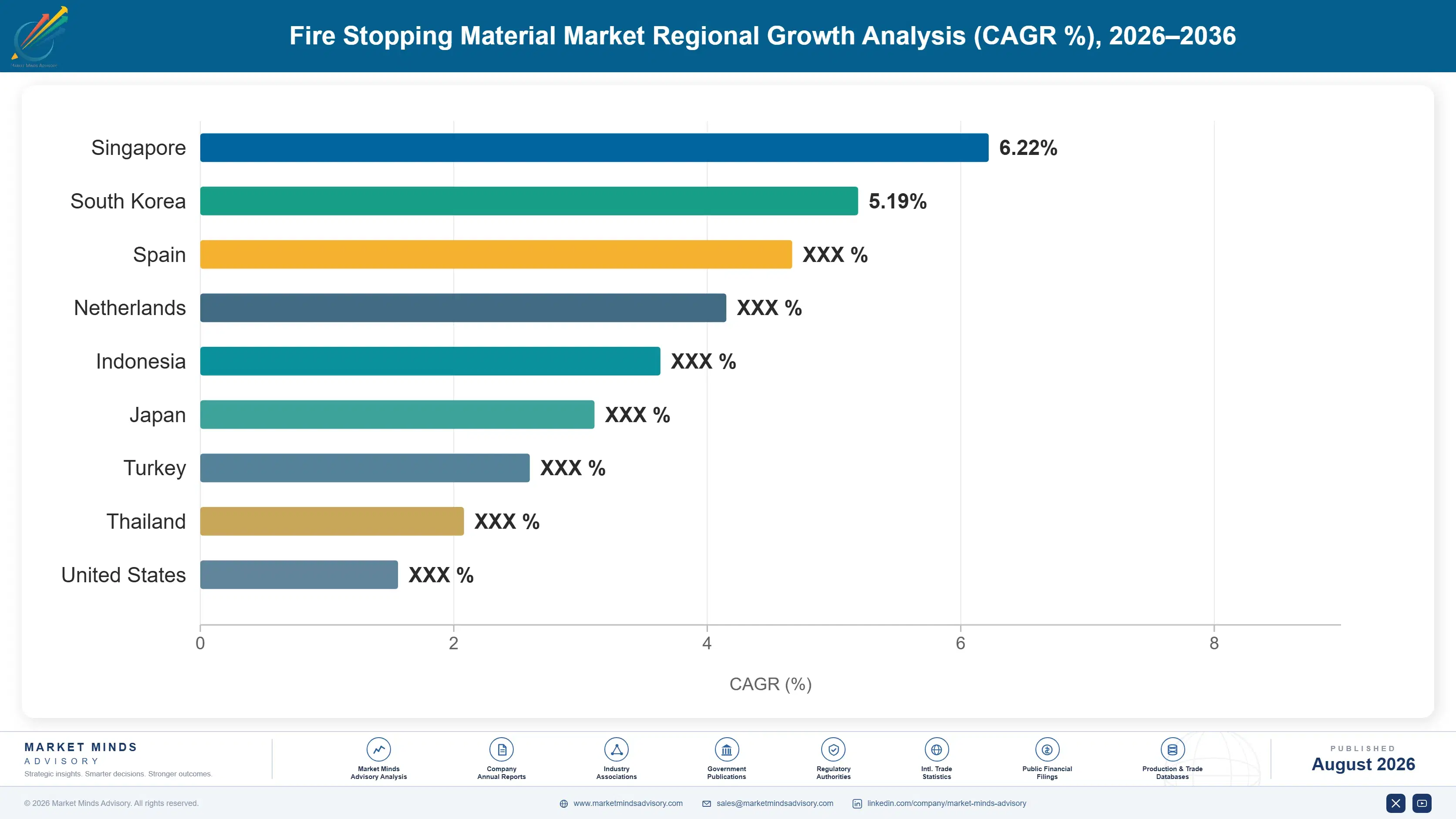
fire-stopping-material-market-trends-country-cagr-analysis-1787550763559

Where Manufacturers Can Capture Additional Margin

Fire stopping margins compress on generic sealant products competing purely on price, so durable revenue growth increasingly depends on documentation, certification breadth, and specialty system engineering rather than volume alone across the category. Four paths stand out across compliance auditing, installer certification, premium systems, and digital documentation for manufacturers investing ahead of demand and regulation.

Offer Firestop Compliance Audit Services Directly

Manufacturers who offer building-wide firestop compliance audit services capture revenue beyond product sales while generating a qualified remediation project pipeline, since audits typically reveal deficiencies requiring the auditing manufacturer's own tested systems for repair and remediation work across the property portfolio. This approach has delivered attach rates where audited buildings convert to remediation projects at meaningfully higher rates than cold outbound sales, and audit fees themselves generate incremental revenue of roughly 8 to 12 percent on top of eventual remediation product sales across most major accounts and building portfolios nationwide.
Market Impact: Adds 8 to 12 percent incremental revenue now

Build Installer Certification and Training Programs

Manufacturers who build formal installer certification and training programs create channel loyalty and reduce liability exposure for contractors and building owners alike, since certified installers are more likely to specify and purchase that manufacturer's tested systems consistently across projects and account relationships nationwide, over time, and across multiple renewal cycles and contract periods. Certification programs also support premium pricing by giving building owners and inspectors confidence in installation quality, with certified-installer projects commanding price premiums of roughly 8 to 10 percent over uncertified competitive bids on comparable scope, complexity, and project timeline.
Market Impact: Commands an 8 to 10 percent price premium

Expand Premium Data Center and Healthcare System Lines

Manufacturers who develop dedicated premium system lines for data center and healthcare applications, requiring the highest tier of fire and smoke compartmentalization performance, command meaningfully higher margins than standard commercial-grade systems across most account types, project categories, and geographic markets nationwide, internationally, and across all major facility classes, construction types, and ownership structures. These facility types typically specify multiple redundant firestop layers and more frequent compliance re-verification, supporting recurring revenue beyond the initial installation and commanding price premiums of 15 to 20 percent over standard commercial system pricing. Retention rates for these accounts stay notably higher.
Market Impact: Commands a 15 to 20 percent price premium

Deploy Digital Compliance Documentation Platforms Now

Manufacturers who deploy digital platforms that generate and store firestop installation documentation automatically address a growing pain point for building owners facing insurance and inspection compliance requirements across their property portfolios, asset base, and management teams nationwide, internationally, and across most major account tiers, building classifications, and ownership structures. This software layer increasingly commands its own subscription revenue stream separate from product sales, with early adopters reporting platform-attached revenue reaching 5 to 8 percent of total account value within a few years of deployment. Adoption is expected to broaden across the industry.
Market Impact: Adds 5 to 8 percent of account value

Who Controls the Margin Pool

The fire stopping material market is moderately concentrated, with CR5 near 32 percent measured on revenue, since UL and EN listing testing represents a meaningful barrier to entry that limits new competitor emergence. The gap between the top five manufacturers and mid-tier regional players is wider than in most building products categories, reflecting the specialized testing and engineering investment required.
Current competitive activity centers on three dimensions: expanding tested system libraries to cover a broader range of penetration and joint configurations, building installer certification programs that create channel loyalty, and developing digital compliance documentation tools that address building owner insurance and inspection requirements. Manufacturers are also expanding compliance audit service offerings to generate qualified remediation project pipelines beyond traditional product sales.

Emerging pressure comes from regional manufacturers in Asia who are gradually building tested system credentials to contest premium accounts previously dominated by established Western manufacturers. Rankings are most likely to shift as insurance-driven compliance auditing expands and as digital documentation platforms become standard expectation rather than differentiator, rewarding manufacturers who invested early in these adjacent service capabilities over those competing purely on tested system breadth alone.
fire-stopping-material-market-trends-company-positioning-matrix-1787550764078

Competitive Moat and Risk Dimensions

HILTI

Moat: Direct Sales and Certification Infrastructure

Hilti's extensive tested system library, combined with its direct sales and installer certification training infrastructure, gives it deep specification relationships with contractors and building owners that generic building products distributors cannot replicate. Its digital compliance documentation platform further locks in customers who value integrated audit trail capability across large building portfolios.
HILTI

Risk: Higher Cost Structure Exposure

Hilti's premium positioning and direct sales model carries higher cost structure than distributor-focused competitors, limiting its competitiveness in price-sensitive segments of the market where generic sealant products still meet minimum code requirements. Economic downturns affecting commercial construction and renovation spending disproportionately affect premium-priced players like Hilti.
3M

Moat: Broad Tested System Portfolio

3M's broad tested system portfolio spanning sealants, wraps, and specialty formulations, combined with its research and development scale, allows it to serve virtually any penetration or joint configuration a specifier might require. Its established brand recognition among architects and engineers supports specification-driven demand independent of price competition.
3M

Risk: Conglomerate Attention Dilution

3M's broader industrial conglomerate structure means fire stopping receives less dedicated management attention and capital allocation priority than it might as a standalone specialty business, potentially slowing responsiveness to market-specific opportunities. Ongoing corporate litigation and restructuring activity elsewhere in the company has periodically created distraction risk for the building products division.

Players Tracked

Prominent Players

Hilti
3M
Rockwool (Rockfon)
STI Firestop
Sika

Other Key Players

CSD Firestop
Nullifire
Promat
Fireseal Products
Firetherm
Unifrax (Alkegen)
GCP Applied Technologies
Balco
A/D Fire Protection Systems
RectorSeal
Metacaulk
Specified Technologies Inc.
Emseal
Johns Manville
Passive Fire Protection Partners

Recent Developments

JANUARY 2026

Hilti Launches Expanded Compliance Documentation Platform

Hilti launched an expanded digital compliance documentation platform integrating installation records directly with building management software, targeting large commercial property portfolios seeking simplified insurance and inspection reporting across multiple building sites, regional markets, and account relationships nationwide, internationally, and across all major commercial asset classes.
Signal: Signals digital compliance documentation is becoming a standard competitive requirement for large commercial property portfolio owners.
AUGUST 2025

3M Introduces Larger-Diameter Wrap System

3M introduced a new fire-rated wrap system rated for larger diameter pipe penetrations, expanding its tested system library to address a specification gap in data center and industrial facility construction where mechanical penetration sizes have grown alongside increasing infrastructure capacity requirements and expanding facility footprints nationwide.
Signal: Signals mechanical penetration sizes are growing as data center and industrial facility infrastructure scales up rapidly.
APRIL 2026

STI Firestop Signs Major Distribution Partnership

STI Firestop signed a distribution partnership agreement with a major North American building products distributor to expand its regional sales coverage, formalizing a relationship that previously operated through smaller independent distributor relationships across scattered metropolitan markets, regional accounts, and secondary distribution channels nationwide and internationally.
Signal: Signals distribution partnerships are consolidating as manufacturers seek broader regional coverage without heavy direct capital investment.

Silicone and Intumescent Chemical Cost Exposure

Silicone and intumescent chemical formulations together account for roughly 38 to 42 percent of fire stopping product cost of goods sold, sourced predominantly from specialty chemical suppliers in the United States, Germany, and China across most major manufacturing regions. Packaging and mineral wool components add further meaningful cost weight for wrap and collar products across most product configurations.
Silicone feedstock prices spiked sharply during 2022 and 2023 as polysilicon supply constraints tied to solar panel demand growth pulled available silicone metal capacity away from industrial sealant applications, tightening supply and pushing input costs well above historical norms for an extended period. The EIA noted that energy-intensive silicon and silicone production is particularly exposed to regional power price volatility, a dynamic that materially affected fire stopping manufacturer input costs across this window.

Smaller regional manufacturers without long-term feedstock supply agreements carry heavier exposure than large players such as Hilti and 3M, who negotiate volume-based contracts that smooth input cost volatility across their broader purchasing scale. This gap widens meaningfully during price spikes, pushing smaller manufacturers toward alternative formulation chemistries or index-linked distributor pricing agreements to protect margins.
fire-stopping-material-market-trends-cost-volatility-analysis-1787550764273

Diversify Silicone and Intumescent Feedstock Sourcing

Manufacturers are increasingly qualifying multiple silicone and intumescent chemical suppliers across different regions rather than relying on a single feedstock relationship, reducing exposure to regional capacity constraints or trade disruption events across the broader supply chain. This approach adds qualification cost and complexity but has measurably reduced input cost volatility during recent tight-supply periods.

Develop Alternative Acrylic Formulation Chemistries

Some manufacturers are developing alternative acrylic and intumescent-only formulations that reduce reliance on silicone feedstock for applications where silicone-specific performance is not strictly required by code, diversifying their exposure across multiple chemistry platforms and supply sources nationwide. This has proven particularly valuable during silicone price spikes tied to competing solar industry demand and capacity constraints.

Lock In Multi-Year Feedstock Supply Agreements

Manufacturers are negotiating multi-year feedstock supply agreements with priority allocation clauses ahead of anticipated demand growth, trading some pricing flexibility for guaranteed volume access during future tight-supply periods across the industry and its broader supplier base. This has proven particularly valuable for manufacturers serving large commercial construction programs with firm delivery deadlines and penalty clauses.

Portfolio Architecture for Margin Defence

Fire stopping product portfolios span three tiers running from generic sealant products through certified tested systems to next-generation premium data center and healthcare formulations, with gross margins widening substantially as products move up this ladder toward specification-driven demand and documentation value across most major manufacturer tiers nationwide and internationally each year.
The tension between volume and premium positioning defines manufacturer strategy: generic sealant products keep plants running at scale but margins there compress steadily as regional entrants add capacity and undercut on price for minimum-compliance applications nationwide and internationally. Certified premium tiers require sustained capital investment in testing, certification, and installer training infrastructure that smaller manufacturers often cannot sustain without established brand recognition and specification relationships already secured.

High-value margin pools concentrate most heavily around data center and healthcare-grade systems paired with digital compliance documentation and installer certification programs, where manufacturers can charge documented premiums for testing breadth and installation quality rather than competing purely on tonnage or linear footage across most major accounts. This concentration is likely to deepen further as insurance-driven compliance auditing broadens across additional jurisdictions and building classes over the coming years.

Volume / Commodity-Adjacent Tier

Generic caulk-applied sealant products sold largely on price into minimum-compliance applications across broad regional accounts without specialty testing documentation requirements attached, serving lower-tier construction, renovation, and maintenance projects nationwide. Testing documentation is minimal or absent.
Gross Margin: 20-26%

Premium / Certified Tier

Certified UL-listed and EN-tested penetration seal and wrap systems validated for specific applications, sold to commercial and multifamily construction accounts requiring documented code compliance and inspection records nationwide and internationally.
Gross Margin: 32-40%

Sustainability / Regulatory / Next-Generation Tier

Premium data center and healthcare-grade systems bundled with digital compliance documentation and installer certification programs, targeting accounts facing the most stringent fire and smoke compartmentalization performance requirements nationwide and internationally.
Gross Margin: 40-48%
fire-stopping-material-market-trends-portfolio-architecture-1787550764767

High-value Sub-segments and Strategic Watch-out

Premium Data Center/Healthcare Systems

Premium data center and healthcare-grade systems represent the highest-growth, highest-margin segment, combining premium pricing with recurring compliance re-verification revenue that standard commercial sealant sales cannot replicate across comparable accounts nationwide and internationally each successive year, budget cycle, renewal period, and account relationship. Adoption keeps accelerating.
Gross Margin: 40-48%

Digital Compliance Documentation Services

Digital compliance documentation and installer certification services offer strong margins with somewhat slower adoption, dependent on building owner technology readiness and insurance program maturity that vary considerably across regions, account types, property portfolio sizes, management sophistication, and adoption timelines nationwide. Timelines vary by account and region.
Gross Margin: 34-42%

Certified UL-Listed Standard Systems

Certified UL-listed penetration seal and joint systems remain the volume core of the market, sustaining plant utilization and specification relationships even as margins compress under regional manufacturer competition nationwide and internationally each successive budget year, planning cycle, renewal period, and account tier. Pricing pressure stays persistent.
Gross Margin: 24-30%

Generic Uncertified Sealant Products

Generic uncertified sealant products face margin erosion as insurance and inspection compliance requirements tighten, warranting close monitoring for manufacturers still reliant on minimum-compliance volume for meaningful revenue and growth going forward into future planning cycles, budget periods, and strategic reviews. Adoption trends remain closely watched.
Gross Margin: 16-22%

Recurring Compliance Audit Economics

Fire stopping revenue resembles a recurring compliance-driven purchase rather than a one-time sale, since buildings require periodic re-inspection and remediation as code standards evolve and insurance requirements tighten, creating stable repeat-order demand tied to building portfolio size rather than discrete capital purchase cycles typical of equipment sales. This annuity character is strongest with owners operating under formal compliance audit programs, where predictable re-verification cycles support long-term manufacturer planning rather than volatile one-time specification demand.
Adoption depth varies by end-use vertical: data center and healthcare facility owners show the deepest specification lock-in, since compliance re-verification requirements are strictest and switching tested system providers mid-project carries meaningful documentation cost that most owners prefer to avoid. General office and retail construction owners switch suppliers more readily based primarily on price and installer availability, since specification tolerances are looser and re-qualification costs are correspondingly lower. Multifamily residential owners sit between these extremes, retaining more supplier flexibility.

Generational shifts are underway as building owner procurement decisions move from pure cost-per-linear-foot evaluation toward risk management and compliance officers weighing insurance and liability exposure, changing who fire stopping manufacturers must sell to and how service contracts get structured across premium accounts.
fire-stopping-material-market-trends-end-use-penetration-index-1787550765262

Strategic Priorities for Fire Stopping Manufacturers

These are among the four positions where our research anticipates prominent divergence between winners and laggards over the coming forecast period. Each is grounded in the demand model, the regulatory perimeter, and the announced capacity pipeline.
01 / COMPLIANCE SERVICE STRATEGY

Launch Compliance Audit Service Offerings Now

Manufacturers competing purely on generic sealant price will lose ground to those who built compliance audit and documentation service capabilities ahead of tightening insurance requirements across most major markets and account portfolios. Insurance-driven demand, not code enforcement alone, is becoming the fastest-growing channel across most major commercial property portfolios and building types nationwide and internationally. MMA recommends launching compliance audit service offerings now, even at modest margin, since audits generate qualified remediation project pipelines that pure product sales cannot replicate.
02 / UNDER-ENFORCED MARKET ACCESS

Market Directly to Insurers in Weak Enforcement Zones

Inconsistent code enforcement across secondary and lower-tier jurisdictions remains a persistent drag on demand that most manufacturers treat as a fixed constraint rather than an addressable opportunity worth pursuing directly and proactively. This gap will only narrow as insurers independently push compliance requirements beyond what local building departments currently enforce across most major markets and jurisdictions. MMA recommends marketing directly to insurers and property owners in under-enforced markets, since this bypasses the enforcement gap entirely rather than waiting for regulatory change to arrive.
03 / PREMIUM SYSTEM QUALIFICATION

Pursue Data Center and Healthcare Accounts Early

Data center and healthcare-grade system qualification represents a durable margin advantage that most standard-grade manufacturers have not yet pursued, despite its meaningfully higher pricing power and recurring re-verification revenue across the account base and customer relationships. Qualification cycles run long, meaning manufacturers who start now will hold multi-year advantages over later entrants competing for the same accounts and customer relationships nationwide. MMA recommends prioritizing tested system breadth investment ahead of demand, since these facility owners prefer established, proven suppliers over new entrants.
04 / DIGITAL PLATFORM INVESTMENT

Develop Digital Compliance Documentation Capability

Digital compliance documentation platforms remain a small but rapidly growing differentiator that most manufacturers are not yet actively developing in their product roadmap or long-term strategy and planning process today. Building owner demand for simplified insurance and inspection reporting will likely accelerate this shift faster than current adoption trends suggest across most major commercial markets and account tiers nationwide. MMA recommends developing or acquiring documentation platform capability proactively now, rather than waiting for competitors to establish the market standard first and capture the available accounts.

Engagement Snapshot From the Field

A live engagement with an industry participant carrying material or product regulatory and market exposure ahead of a defining policy shift, showing how our research translates into a defensible multi-year portfolio strategy.
MARKET MINDS ADVISORY · CLIENT ENGAGEMENT SUMMARY
Fire Stopping Material Producer Strategic Portfolio Review and Transition Roadmap 2026·Investment Scenario on Fire Stopping Material Exposure Evaluation 2025-26
CLIENT PROFILE
The client is a mid-size commercial real estate investment trust managing a portfolio of office and mixed-use properties across several major North American metropolitan markets. Facing new insurance underwriter requirements for documented UL-listed firestop compliance across its entire portfolio ahead of upcoming coverage renewal, the client lacked a comprehensive understanding of its current compliance status across dozens of properties acquired over many years from different prior owners.
STRATEGIC CHALLENGE
The client needed to assess firestop compliance status across its entire property portfolio within a six-month window before insurance renewal, prioritize remediation spending across properties with the most significant deficiencies, and avoid coverage disruption or premium surcharges. Limited internal facilities staff meant the client could not conduct comprehensive audits independently.
MMA APPROACH
MMA coordinated with a certified firestop compliance auditor to conduct portfolio-wide assessments, benchmarked deficiency severity against insurer requirements, and modeled remediation cost and timeline scenarios prioritized by risk exposure and property value. The engagement combined on-site inspection findings with primary interviews with the client's insurance underwriters to clarify specific compliance thresholds.
KEY FINDINGS
  1. Twelve of the client's forty properties, representing over 25 percent (client-reported, unverified by MMA) of portfolio value, had significant firestop documentation gaps requiring immediate remediation attention before renewal.
  2. Deficiency severity correlated strongly with property acquisition date, with properties acquired through portfolio purchases from previous owners showing meaningfully worse documentation than directly developed properties.
  3. A risk-weighted remediation prioritization approach addressing the highest-value and highest-deficiency properties first reduced projected remediation cost by an estimated 20 percent versus a uniform portfolio-wide approach.
  4. Early engagement with insurance underwriters clarified specific compliance thresholds that differed meaningfully from the client's initial internal assumptions, avoiding unnecessary over-remediation spending on lower-priority properties.
CLIENT PROFILE
The client is a mid-size commercial real estate investment trust managing a portfolio of office and mixed-use properties across several major North American metropolitan markets. Facing new insurance underwriter requirements for documented UL-listed firestop compliance across its entire portfolio ahead of upcoming coverage renewal, the client lacked a comprehensive understanding of its current compliance status across dozens of properties acquired over many years from different prior owners.
STRATEGIC CHALLENGE
The client needed to assess firestop compliance status across its entire property portfolio within a six-month window before insurance renewal, prioritize remediation spending across properties with the most significant deficiencies, and avoid coverage disruption or premium surcharges. Limited internal facilities staff meant the client could not conduct comprehensive audits independently.
MMA APPROACH
MMA coordinated with a certified firestop compliance auditor to conduct portfolio-wide assessments, benchmarked deficiency severity against insurer requirements, and modeled remediation cost and timeline scenarios prioritized by risk exposure and property value. The engagement combined on-site inspection findings with primary interviews with the client's insurance underwriters to clarify specific compliance thresholds.
KEY FINDINGS
  1. Twelve of the client's forty properties, representing over 25 percent (client-reported, unverified by MMA) of portfolio value, had significant firestop documentation gaps requiring immediate remediation attention before renewal.
  2. Deficiency severity correlated strongly with property acquisition date, with properties acquired through portfolio purchases from previous owners showing meaningfully worse documentation than directly developed properties.
  3. A risk-weighted remediation prioritization approach addressing the highest-value and highest-deficiency properties first reduced projected remediation cost by an estimated 20 percent versus a uniform portfolio-wide approach.
  4. Early engagement with insurance underwriters clarified specific compliance thresholds that differed meaningfully from the client's initial internal assumptions, avoiding unnecessary over-remediation spending on lower-priority properties.
RECOMMENDED STRATEGY
Phase 1: Phase 1 (Months 1-2): Complete portfolio-wide firestop compliance audits and prioritize all properties by risk exposure and total property value. Phase 2: Phase 2 (Months 3-5): Execute remediation work at all highest-priority properties and engage insurers directly to clarify remaining compliance thresholds. Phase 3: Phase 3 (Month 6): Complete all remaining remediation work fully and finalize documentation ahead of the insurance coverage renewal deadline.
OUTCOME
The client completed remediation across all high-priority properties before its insurance renewal deadline, avoiding coverage disruption and premium surcharges that would have applied otherwise (client-reported, unverified by MMA). The risk-weighted prioritization approach delivered an estimated 20 percent lower total remediation cost (client-reported, unverified by MMA) than the client's originally planned uniform portfolio-wide approach.

Frequently Asked Questions

Foundational context covering the market sizes, CAGR, scope, country, region and competition that inform every finding below. This section is provided to cover basics and most often pre-purchase conversations, answered from the MMA Primary Research Dataset.

What is the current size of the Fire Stopping Material Market?

The Fire Stopping Material Market was valued at approximately $4.4 billion globally in 2025. This figure covers penetration seals, joint systems, and fire-rated wrap and collar products for commercial buildings.

How large will the Fire Stopping Material Market be by 2036?

MMA projects the market will reach approximately $7.1 billion by 2036. This represents a 1.54 times expansion from the 2026 base of $4.6 billion over the ten-year forecast period.

What is the CAGR for the Fire Stopping Material Market 2026 to 2036?

The market is forecast to grow at a 4.4 percent compound annual growth rate between 2026 and 2036. Bull and bear scenarios range from 3.1 to 5.7 percent depending on regulatory tightening.

Which segment is growing fastest?

Fire-rated wrap and collar systems are the fastest-growing segment, expanding at 7.2 percent annually. This outpaces the overall market by roughly 1.6 times, driven by data center and healthcare construction.

Who are the major companies in the Fire Stopping Material Market?

Leading companies include Hilti, 3M, Rockwool, STI Firestop, and Sika. These five players hold a combined CR5 near 32 percent measured on revenue across the category.

Which country is growing fastest?

India leads country-level growth at approximately 7.0 percent annually, ahead of the broader South Asia and Pacific regional average. This reflects rapidly tightening national fire safety regulation.

Report Segmentation Architecture

The full report scope spans multiple orthogonal segmentation dimensions, with cross-tabulated demand data provided for each dimension pair. Coverage extends further to regional breakdowns, trend trajectories, and the competitive detail needed to support segment-level decision-making.

By Product Form

  • Penetration Seals (Sealant)
  • Fire-Rated Wrap and Collar Systems
  • Joint Systems
  • Fire-Rated Board and Panel Systems
  • Intumescent Coatings and Putty
  • Accessory and Ancillary Products

By End-Use Building Type

  • Commercial Office
  • Multifamily Residential
  • Healthcare Facilities
  • Data Centers
  • Industrial and Warehouse

By Commercial Dimension

  • New Construction
  • Retrofit/Renovation
  • Compliance Audit Services
  • Digital Documentation Platforms

By Region

  • North America
  • Western Europe
  • East Asia
  • South Asia and Pacific
  • Latin America
  • Middle East and Africa
  • Eastern Europe

Scope, Methodology, and Coverage

Every figure in this report is reproducible from documented input assumptions. The scope below maps the historical period, the forecast horizon, the segmentation dimensions, and the countries covered, alongside the underlying primary and qualitative methodology.
Historical Period
2020 to 2025
Forecast Period
2026 to 2036
Base Year
2025 (USD billions; MMA Primary Research Dataset, August 2026)
Market Definition
The Fire Stopping Material Market covers penetration seals, joint systems, and fire-rated wrap and collar products used to maintain fire and smoke compartmentalization in commercial and multifamily buildings. It excludes passive fireproofing coatings applied to structural steel and active fire suppression systems.
Quantitative Units
USD billions (current prices); linear feet installed (millions)
Segmentation Dimensions
By Product Form; By End-Use Building Type; By Commercial Dimension; By Region
Regions Covered
North America, Western Europe, East Asia, South Asia and Pacific, Latin America, Middle East and Africa, Eastern Europe
Countries Covered
USA, China, Germany, France, UK, Japan, South Korea, India, Australia, Canada, Brazil, Mexico, Indonesia, Vietnam, Thailand, Malaysia, UAE, Saudi Arabia, South Africa, Nigeria, Turkey, Poland, Netherlands, Italy, Spain, Sweden, Switzerland, Argentina, Colombia, Singapore, and additional markets relevant to this sector
Key Companies Profiled
Hilti, 3M, Rockwool (Rockfon), STI Firestop, Sika, CSD Firestop, Nullifire, Promat, Fireseal Products, Firetherm, Unifrax (Alkegen), GCP Applied Technologies, Balco, A/D Fire Protection Systems, RectorSeal, Metacaulk, Specified Technologies Inc., Emseal, Johns Manville, Passive Fire Protection Partners
Quantitative Methodology
Primary survey, n=3,800 respondents, Q4 2025, six countries; demand-side model with trade association cross-validation
Qualitative Methodology
47 expert interviews, Q4 2025; applied to validate demand model assumptions, identify emerging dynamics, and assess competitive positioning
Report Format
PDF and XLSX data workbook (Word format preview document)
Publisher
Market Minds Advisory
Report Code
MMA-2026-CON-102
Published
August 2026
Contact
sales@marketmindsadvisory.com | www.marketmindsadvisory.com

Purchase the full Fire Stopping Material Market Report (2026 to 2036).

The full Fire Stopping Material Market report delivers a comprehensive 200-plus page analysis covering detailed segmentation by product form, end-use building type, and commercial dimension alongside country-level sizing across all seven tracked regions. It includes in-depth competitive profiles of twenty manufacturers, quantified silicone and intumescent feedstock cost risk analysis, and scenario-based forecasts through 2036. Subscribers also receive access to underlying primary survey and expert interview datasets. Quarterly update briefings cover regulatory and insurance developments across major consuming regions, and custom segmentation cuts are available on request for enterprise subscribers.
Country-level market sizing across 30 countries
Twenty profiled fire stopping manufacturers included
Insurance compliance exposure scoring by region
Silicone feedstock cost benchmarking data included
Quarterly market update subscription access included
Custom segmentation cuts available on request

Built For The People Who Decide

From boardroom strategy to bench-side execution, this report is read cover-to-cover by leaders shaping the next decade of their industry, turning demand scenarios, market dynamics and valuation benchmarks into decisions.
CXOs/ Presidents/ VPs/ Managers
M&A and Corporate Development
Strategy Teams and R&D Heads
Procurement and Product Directors
Regulatory and Compliance Leaders
Investor Relations and Equity Analysts