

Market Minds Advisory
Finishing Chemical for Coated Fabrics Market

Finishing Chemical for Coated Fabrics Market: Surface Finishing Chemistry for Technical and Decorative Coated Textiles

Automotive interior lightweighting and outdoor technical textile growth are pushing coated fabric finishers toward higher-performance chemistry as PFAS restrictions force costly reformulation across major product lines and supplier qualification lists this decade.

Lead Analyst

Bilal Shaikh

Published

September 2026

Make Smarter Decisions with Customized Research Insights

Request a free sample report and evaluate market opportunities, growth trends, and competitive dynamics relevant to your business needs.

2025 MARKET VALUE$1.9BMarket Size 2025
2036 FORECAST VALUE$3.7BBase Case , 2026 to 2036
CAGR 2026 TO 20366.4 %Bull 7.7% / Bear 5.1%
INCREMENTAL OPPORTUNITY$1.7BNet 10- year value creation
EXPANSION MULTIPLE1.86x2036 value over 2026 base
Strategic Levers
M&A Pipeline
Regional Outlook
Country Rankings
Competitive Intelligence
Segmental Deep-dive
Call-Us : 91 93563 13602

Executive Snapshot and Market Trajectory

PFAS restrictions are forcing coated fabric finishers to requalify entire water and stain repellent product lines simultaneously, a reformulation burden few smaller chemistry suppliers can absorb quickly without meaningful outside investment, technical partnership support, or considerably more patience from existing customers already frustrated by repeated delays.
Automotive interior demand is now the primary growth engine, with lightweighting programs favoring coated synthetic fabrics over traditional leather across multiple vehicle segments, trim levels, and price tiers worldwide as automakers pursue weight and cost savings simultaneously. Outdoor and technical textile applications are expanding steadily as consumer demand for weather-resistant, high-performance apparel and equipment grows across developed and emerging markets alike, adding a second durable growth pool that reinforces overall category momentum through the decade.
Competition remains fragmented among numerous specialty chemistry suppliers, though a handful of scaled European and Asian producers dominate PFAS-free reformulation for automotive-grade applications requiring extensive testing and certification across multiple regulatory jurisdictions worldwide. Rising compliance costs and testing requirements are forcing smaller regional finishers to either invest heavily in reformulation or exit technically demanding product categories entirely, reshaping competitive dynamics across the value chain.
Market Definition
This report covers the global market for finishing chemicals applied to coated fabrics, including water and stain repellents, flame retardants, softeners, and UV stabilizers used in automotive, technical textile, and upholstery applications. It excludes the base coating resins and substrate fabrics themselves.
Base Year Value
$1.9B in 2025 (MMA Primary Research Dataset, August 2026)
Forecast Period
2026 to 2036, eleven discrete annual values
CAGR
6.4% base case. Bull 7.7%. Bear 5.1%.
Fastest Growth Segment
Automotive Interior Coated Fabrics: 8.2% CAGR
Fastest Growth Country
China: 7.4% CAGR
Fastest Growth Region
South Asia and Pacific: 8.5% CAGR
Largest Region
East Asia: 28% of 2025 global value
Market Leaders
Archroma Management LLC, Huntsman Corporation, Rudolf GmbH, CHT Group, Pulcra Chemicals GmbH. Source: MMA Primary Research, July 2026.
Primary Survey
n=3,800 procurement and R&D decision-makers, Q4 2025, six countries
Methodology
Demand-side build-up, cross-validated against public data, 47 expert interviews

Finishing Chemical for Coated Fabrics Market Forecast Scenarios

finishing-chemical-for-coated-fabrics-size-forecast-scenario-1787551000889
Finishing chemical demand grew at an estimated 5.6% annual pace between 2020 and 2025, a period shaped by pandemic-driven automotive production disruption followed by a sharp recovery in vehicle output across most major manufacturing regions. Outdoor and technical textile demand held relatively steady throughout the period, providing a stabilizing counterweight to automotive volatility across the broader finishing chemical category.
The base case assumes 6.4% compound annual growth through 2036, driven by three commercial mechanisms: accelerating automotive interior lightweighting favoring coated synthetic fabrics over leather across multiple vehicle segments and price tiers, rising consumer demand for weather-resistant outdoor and technical apparel across developed and emerging markets alike, and mandatory PFAS reformulation forcing repeated requalification cycles that lift chemistry revenue per unit even as underlying fabric volume grows more modestly overall across the category.
A bull scenario of 7.7% growth assumes accelerated automotive lightweighting adoption alongside faster PFAS-free reformulation across major markets and supplier qualification programs. The bear case of 5.1% reflects the risk that automotive production growth slows amid broader macroeconomic softness, delaying the interior fabric volume gains the base case assumes and pushing reformulation timelines out further.

Reformulation Economics Reshaping a Specialty Chemistry Category

Finishing chemistry for coated fabrics sits downstream of two forces pulling in the same direction: PFAS regulatory pressure and rising performance expectations from automotive and outdoor apparel customers demanding more durable, longer-lasting products across every price tier. Both are pushing suppliers toward more sophisticated, better-documented chemistry at a pace few smaller finishers can sustain without meaningful outside partnership support or capital investment.
MARKET CONCENTRATIONCR5 28%Top five suppliers hold under a third of category revenue
AVERAGE SELLING PRICE$4,200/tonReflects finish performance grade and application complexity involved
TOP PRODUCING COUNTRY SHAREChina 26%Anchored by large domestic textile and automotive manufacturing base
CAPACITY UTILIZATION74%Constrained by seasonal fashion cycles and automotive production swings
TRADE INTENSITY34% exportedReflects specialty chemistry trade flows to major manufacturing hubs
REFORMULATION COST SHARE22% of COGSPFAS-free testing and certification burden compliance costs meaningfully
Reformulation away from long-chain PFAS chemistry has consumed a meaningful share of research budgets industry-wide over the past several years, since water and stain repellent performance is genuinely difficult to replicate without fluorochemistry using alternative, non-fluorinated chemistry platforms still under active development. Suppliers that cracked this problem earlier are now capturing premium pricing and faster customer requalification cycles, widening the gap with slower competitors.
Demand is increasingly bifurcated between commodity finishing chemistry serving price-sensitive apparel and furnishing applications, and technically demanding automotive-grade chemistry requiring extensive durability and safety certification before formal supplier approval. Suppliers straddling both tiers capture the widest addressable customer base, though few manage the technical range required to compete credibly in both segments simultaneously without diluting focus on either one.
"The PFAS transition is quietly the biggest reformulation event this industry has seen in decades. Suppliers who solve it well won't just survive, they'll own the next generation of customer contracts."
Director, Textile and Surface Chemistry Practice · MMA Chemicals and Materials Practice · August 2026

Market Trends

PFAS-Free Reformulation Accelerating Across Supplier Base

Major automotive OEMs and apparel brands have set internal deadlines requiring PFAS-free water and stain repellent finishes by 2027 or earlier, pushing suppliers to accelerate reformulation programs that had previously moved at a more measured pace. Several leading chemistry suppliers have already commercialized non-fluorinated alternatives achieving roughly 90% of legacy performance benchmarks, closing much of the historical performance gap that slowed earlier adoption. Brand owners increasingly treat PFAS-free certification as a procurement requirement rather than a differentiator, meaning suppliers without qualified alternatives risk losing existing accounts entirely within the next several product cycles.
Market Impact: Adds 8% annual technical apparel growth
Automotive Lightweighting Favoring Coated Synthetic Fabrics

Automakers are increasingly specifying coated synthetic fabrics over genuine leather across interior trim programs, driven by weight reduction targets tied to electric vehicle range optimization and cost pressure across multiple vehicle segments and price points. Several major automakers have expanded synthetic leather content in new vehicle platforms by 15% or more over the past three years, directly lifting finishing chemistry volume tied to these interior programs. This shift is expected to continue as battery-electric vehicle production scales and range optimization remains a persistent engineering priority across the industry for the foreseeable future.
Market Impact: Ranks among top 3 purchase factors

Market Opportunities and Growth Drivers

Outdoor Apparel Demand Growth Lifting Technical Finishes

Consumer spending on outdoor and technical apparel has grown steadily across developed markets as participation in outdoor recreation activities expands, directly lifting demand for weather-resistant and durable water repellent, breathable, and abrasion-resistant fabric finishes across multiple product categories. Major outdoor apparel brands report technical fabric sales climbing more than 8% annually in several key markets, translating into sustained finishing chemistry demand growth that outpaces broader textile chemical consumption meaningfully. Premiumization within the category is adding further value, as brands increasingly market multi-function finishes commanding higher price points than single-function legacy chemistry.
Market Impact: Consumes 22% of research budgets

Vehicle Interior Premiumization Raising Finish Specifications

Automakers are raising interior finish specifications across trim levels as consumers increasingly evaluate vehicles on cabin quality and tactile experience, pushing coated fabric suppliers toward more sophisticated softening, hand-feel, and durability chemistry across every price segment. Interior quality now ranks among the top purchase considerations for a meaningful share of buyers surveyed across major automotive markets, giving automakers direct incentive to specify premium finishing chemistry even in mid-tier vehicle segments where margins are thinner. This premiumization trend is expected to continue as competition intensifies across increasingly commoditized vehicle platforms worldwide.
Market Impact: Cuts volume 15% in downturns

Market Restraints and Challenges

PFAS Reformulation Cost Burden on Smaller Suppliers

Reformulating an entire finishing chemistry portfolio away from long-chain PFAS chemistry requires substantial research investment, and smaller regional suppliers often lack the capital or technical staff to complete this transition on the timelines major customers now demand. The root cause is straightforward: fluorochemistry performance is genuinely difficult to replicate with alternative chemistry, requiring years of formulation work rather than a simple ingredient swap. Reformulation costs have consumed an estimated 22% of research budgets industry-wide over the past several years. Some smaller suppliers are responding by licensing reformulated chemistry platforms from larger competitors rather than developing alternatives independently.
Market Impact: Achieves 90% of legacy performance

Automotive Production Cyclicality Creating Revenue Risk

Finishing chemistry suppliers with concentrated automotive customer exposure face meaningful revenue volatility tied to vehicle production cycles, which can swing significantly during macroeconomic downturns or supply chain disruptions affecting vehicle assembly lines worldwide each cycle. The root cause is customer concentration: automotive interior programs represent multi-year commitments, but actual chemistry volume tracks vehicle build rates that can fall 15% or more during a downturn cycle without warning or advance notice. Suppliers are responding by diversifying into outdoor apparel and industrial applications to reduce dependence on any single end-use vertical's demand cycle.
Market Impact: Expands synthetic content 15% or more
4 additional market trends, 3 additional growth drivers, and 3 additional restraints and challenges are covered in the full report. Contact sales@marketmindsadvisory.com to access the complete intelligence.

Segment CAGR and Growth Architecture

Finishing chemical demand splits across six application-based segments defined by end-use function rather than chemistry class alone. Automotive interior and outdoor technical textile applications lead growth, followed by upholstery, protective workwear, footwear and apparel, and architectural fabric applications, each with distinct performance, durability, and certification requirements across diverse customer types and international end markets.
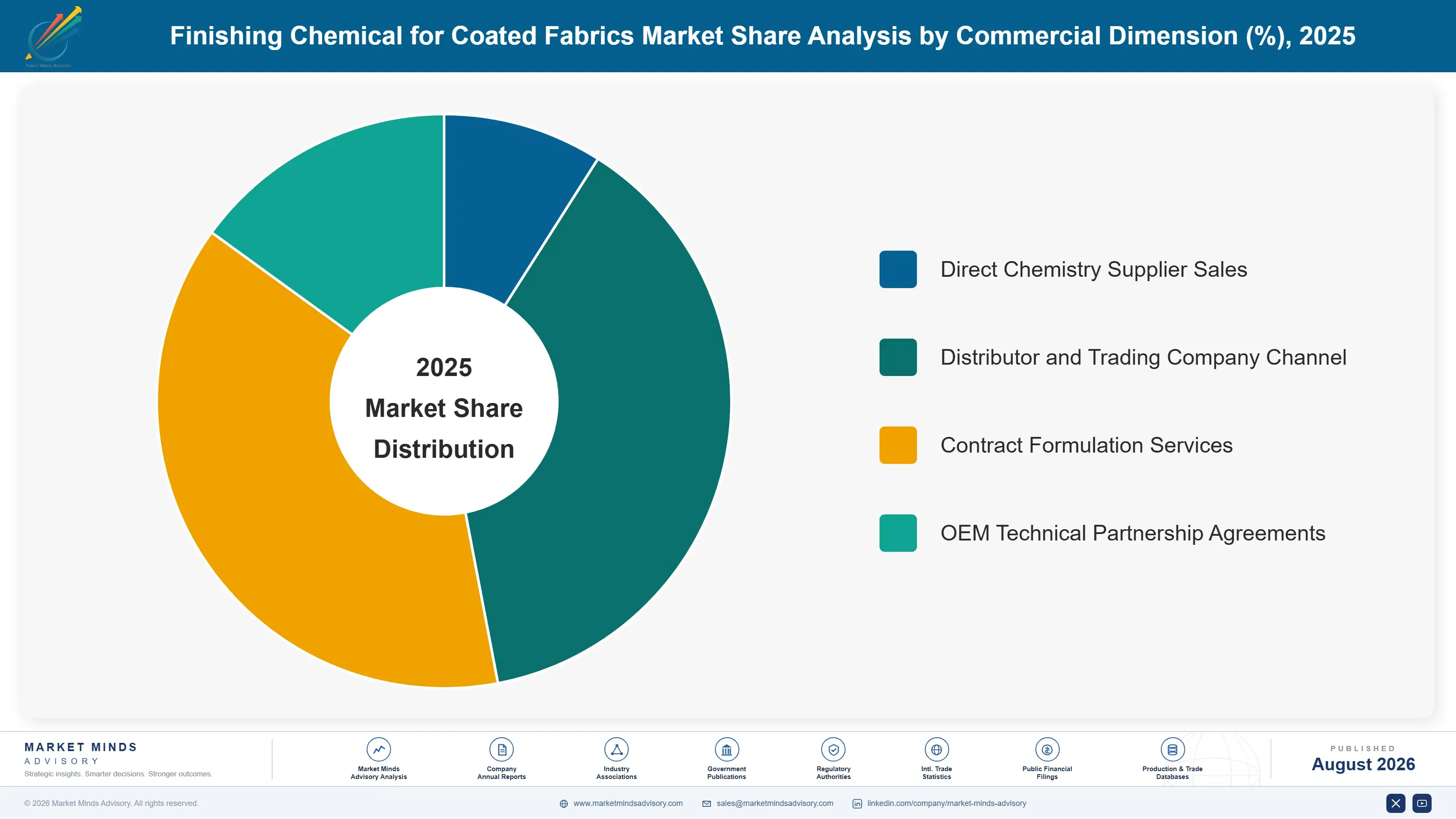
finishing-chemical-for-coated-fabrics-market-share-analysis-1787551001425

Automotive Interior Coated Fabrics

Automotive interior coated fabrics represent the largest and fastest-growing application, driven directly by lightweighting programs favoring synthetic coated fabrics over genuine leather across multiple vehicle segments and price tiers worldwide. Electric vehicle range optimization is reinforcing this shift further, since every kilogram of weight saved on interior trim contributes to overall vehicle efficiency targets automakers now prioritize highly across their product lineups and platforms. Rising interior quality expectations are pushing suppliers toward more sophisticated softening and hand-feel chemistry even in mid-tier trim levels where margins are thinner. This segment's growth rate exceeds the overall market by roughly 1.28 times, reflecting sustained automotive transformation globally across both electric and traditional vehicle platforms.
CAGR 8.2%

Outdoor and Technical Textiles

Outdoor and technical textiles form the second-fastest-growing segment as consumer participation in outdoor recreation activities expands across developed and emerging markets alike, lifting sustained demand for performance apparel and equipment fabrics across every major climate zone worldwide and seasonal buying category. Brand owners are increasingly marketing multi-function finishes combining water repellency, breathability, and abrasion resistance in single products, commanding meaningful price premiums over legacy single-function chemistry that dominated the category previously. PFAS-free reformulation is particularly acute in this segment given direct consumer contact and rising environmental awareness among outdoor apparel buyers specifically, forcing brands to move faster than regulation strictly requires in several key markets and consumer demographics globally. Buyer education continues expanding as certification adoption spreads.
CAGR 7.5%
Full segment breakdown across 7 segments available in the complete report.

Regional Architecture and Country Demand Map

East Asia leads finishing chemical demand, anchored by China's large textile and automotive manufacturing base and export supply chains. North America and Western Europe follow as mature, technically demanding markets, while South Asia and Pacific shows the fastest regional growth off a smaller existing base.

North America

US automotive interior programs and outdoor apparel brands represent the largest regional demand pools, with several major automakers headquartered in Michigan and the Southeast driving concentrated finishing chemistry procurement across multiple assembly plants and supplier tiers. PFAS regulation at both federal and state levels, particularly in California and several Northeastern states, is accelerating reformulation timelines faster than in most other regions globally, forcing suppliers to prioritize US compliance investment. Canadian demand tracks similar automotive and outdoor apparel drivers at smaller scale, concentrated around Ontario's automotive manufacturing corridor. Growth trails East Asia as domestic textile manufacturing capacity remains limited relative to finished goods demand, leaving import dependence for base fabric substrates that constrains local finishing volume.
Share: 24% | CAGR: 5.7% (2026 to 2036)

Western Europe

German and Italian automotive and luxury goods manufacturers lead regional demand, drawing on the region's dense automotive supply chain and high-end fashion industry concentrated in northern Italy and southern Germany specifically. European Union PFAS restrictions under REACH are among the strictest globally, forcing early and comprehensive reformulation across the supplier base well ahead of regulatory deadlines in most other regions. Rudolf GmbH and CHT Group anchor regional chemistry supply alongside several smaller specialty finishers serving niche luxury and technical applications. Growth trails the global average as mature automotive and apparel markets expand more slowly than emerging regions despite strong environmental regulation continuing to drive meaningful reformulation investment. Sustainability certification schemes are gaining traction across several key export categories.
Share: 20% | CAGR: 5.0% (2026 to 2036)
Regional intelligence for 5 additional markets available in the complete report: East Asia, South Asia and Pacific, Latin America, Middle East and Africa, Eastern Europe. Contact sales@marketmindsadvisory.com.
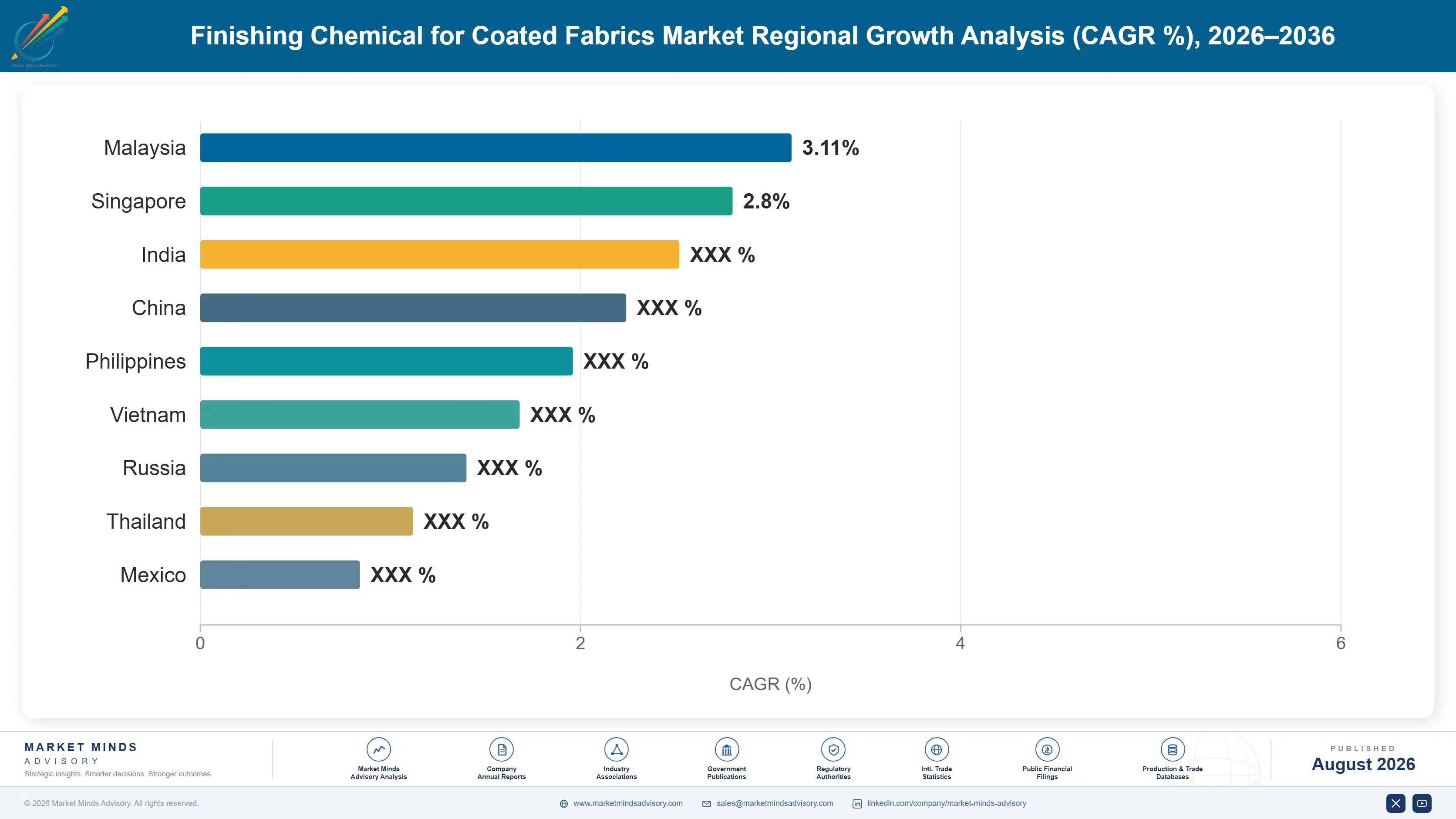
finishing-chemical-for-coated-fabrics-country-cagr-analysis-1787551001946

Capturing Value Through the PFAS Transition

Finishing chemical suppliers face a genuinely reformulation-driven margin environment where pricing power depends more on PFAS-free technical capability and application-specific certification than on raw manufacturing scale alone across the category. The levers below outline where suppliers can realistically defend and expand margin over the next several years despite mounting compliance costs and testing requirements.

Accelerating PFAS-Free Formulation Commercialization Across Product Lines

Suppliers that commercialize PFAS-free water and stain repellent formulations ahead of regulatory deadlines capture premium pricing and faster customer requalification, since brand owners increasingly treat compliant chemistry as a procurement requirement rather than a differentiator worth paying extra for anymore. Early movers achieving 90% or more of legacy fluorochemistry performance are winning accounts from slower competitors still relying on chemistry facing near-term phase-out across major markets and product categories. This technical lead compounds over time, since customer requalification cycles typically lock in supplier relationships for multiple product generations once established.
Market Impact: Captures a 15 to 25 percent pricing premium

Building Direct Automotive OEM Technical Partnerships

Suppliers establishing direct technical relationships with automotive OEM interior design teams capture more durable revenue than those competing purely on price after specifications are already finalized elsewhere in the supply chain and product development process this cycle. These partnerships influence which chemistry gets specified during vehicle platform design, effectively locking in multi-year demand before a program ever reaches formal supplier bidding rounds. Building this influence takes years of technical collaboration, but suppliers with established OEM relationships report win rates roughly 30% higher than transactional competitors chasing the same accounts. OEM trust deepens with each successful program cycle.
Market Impact: Lifts OEM contract win rates by 30 percent

Developing Multi-Function Premium Finish Chemistry Platforms

Suppliers investing in multi-function finishes combining water repellency, flame resistance, and durability in single formulations capture meaningfully wider margins than single-function legacy chemistry sold separately across multiple application steps and processing stages within a customer's production line and broader manufacturing process. This technical investment requires additional formulation expertise, but the resulting product commands premium pricing of 20 to 30% from brand owners seeking simplified supply chains and reduced application costs. Suppliers with qualified multi-function platforms are winning share from competitors still offering only single-function chemistry lines today. Market feedback continues validating this premium chemistry approach.
Market Impact: Commands a 20 to 30 percent margin premium

Expanding Technical Service and Application Support

Suppliers offering hands-on technical application support to smaller regional finishers lacking in-house formulation expertise capture licensing and technical service revenue beyond raw chemistry sales alone across their broader customer base and geographic footprint each fiscal year. This consultative model deepens customer dependency and reduces price sensitivity meaningfully, since switching suppliers mid-application risks quality inconsistency that customers actively want to avoid at all costs and delays. Suppliers with dedicated technical service teams report customer retention rates roughly 25 percentage points higher than transactional competitors. Retention gains compound across renewal cycles over time.
Market Impact: Lifts customer retention by 25 percentage points overall

Who Controls the Margin Pool

The top five finishing chemistry suppliers hold roughly 28% of category revenue, a fragmented concentration reflecting the wide range of application-specific chemistry required across automotive, apparel, and industrial customer segments worldwide. The gap between scaled multinational suppliers with PFAS-free reformulation capability and numerous smaller regional finishers is widening meaningfully as compliance costs mount and customer requirements tighten further.
Current competitive activity centers on three dimensions: accelerating PFAS-free formulation commercialization ahead of regulatory deadlines across major markets, building direct technical relationships with automotive OEM interior design teams that influence platform-level specification decisions, and developing multi-function premium finish platforms that command wider margins than legacy single-function chemistry. Suppliers investing across multiple dimensions simultaneously are pulling ahead of narrower competitors betting on a single lever.

Emerging pressure is coming from Chinese domestic chemistry suppliers scaling capacity to serve both export markets and the country's own rapidly expanding automotive and textile manufacturing base simultaneously. Rankings are most likely to shift among smaller regional finishers lacking either PFAS-free reformulation capability or automotive OEM relationships, both increasingly necessary as customers consolidate purchasing toward fewer, more technically capable suppliers able to meet rising certification demands.
finishing-chemical-for-coated-fabrics-company-positioning-matrix-1787551002456

Competitive Moat and Risk Dimensions

ARCHROMA MANAGEMENT LLC

Moat: Broad PFAS-Free Chemistry Portfolio

Archroma's early and comprehensive investment in PFAS-free water and stain repellent chemistry gives it a technical lead across automotive and apparel applications that slower competitors cannot easily replicate, supporting premium pricing and faster customer requalification cycles industry-wide across several major product categories and end markets globally.
ARCHROMA MANAGEMENT LLC

Risk: Emerging Market Manufacturing Exposure

Archroma's substantial manufacturing footprint across emerging markets exposes it to currency volatility and local regulatory shifts that competitors with more geographically concentrated production networks avoid, occasionally complicating cost consistency across global customer accounts and long-term contract pricing agreements negotiated several years earlier under different conditions.
HUNTSMAN CORPORATION

Moat: Deep Automotive OEM Relationships

Huntsman's decades-long relationships with major automotive OEMs give it established qualification and specification history across interior trim programs that new entrants cannot easily replicate, given the multi-year qualification timeline automotive platforms typically require before any chemistry change is formally approved and adopted across production lines.
HUNTSMAN CORPORATION

Risk: Diversified Portfolio Attention Dilution

Huntsman's finishing chemistry business sits within a much larger diversified chemical portfolio, meaning capital and management attention compete against far larger business units, occasionally leaving the specialty finishing line under-invested relative to dedicated competitors focused solely on this narrower category and specific customer base year over year.

Players Tracked

Prominent Players

Archroma Management LLC
Huntsman Corporation
Rudolf GmbH
CHT Group
Pulcra Chemicals GmbH

Other Key Players

Wacker Chemie AG
Clariant AG
Dow Inc.
Evonik Industries AG
Lubrizol Corporation
Tanatex Chemicals B.V.
Chemial Corporation
Bozzetto Group
Bezema AG
Schill+Seilacher GmbH
Kiri Industries Ltd.
Colourtex Industries Pvt. Ltd.
Sarex Chemicals Pvt. Ltd.
Zibo Fangtai Chemical Co., Ltd.
Kemira Oyj

Recent Developments

FEBRUARY 2026

Archroma Launches PFAS-Free Automotive Finish Line

Archroma launched a new PFAS-free water and stain repellent finish line specifically engineered for automotive interior applications, targeting customers seeking compliant chemistry ahead of tightening regulatory deadlines across major automotive manufacturing regions this year and the following two product development cycles across several vehicle platforms.
Signal: Confirms established suppliers are actively racing to commercialize PFAS-free chemistry ahead of tightening global compliance deadlines.
SEPTEMBER 2025

Huntsman Expands Technical Partnership with Major Automaker

Huntsman expanded its technical partnership with a major automaker to co-develop next-generation interior trim chemistry, deepening its involvement in platform-level specification decisions ahead of upcoming vehicle program launches scheduled over the next several years and multiple design, testing, engineering, and validation review cycles. Both companies see this as strategic.
Signal: Shows leading suppliers deepening OEM relationships to secure long-term specification influence very early in design cycles.
MAY 2025

Rudolf GmbH Expands Outdoor Apparel Chemistry Capacity

Rudolf GmbH expanded production capacity for multi-function outdoor apparel finishing chemistry, targeting rising demand from technical apparel brands seeking combined water repellency and breathability performance across their expanding product lines this season and beyond into several future seasonal collections and export markets. Growth here remains a key priority.
Signal: Indicates suppliers are actively prioritizing outdoor apparel as a growth diversification strategy beyond core automotive markets.

Specialty Feedstock and Reformulation Cost Exposure

Specialty fluorochemical and silicone-based intermediates together account for an estimated 48% of finishing chemistry cost of goods sold, with solvent and processing energy making up most of the remainder of total production cost. Feedstock supply concentrates among a small number of global specialty chemical producers, creating meaningful pricing power for upstream suppliers over downstream finishing chemistry makers across the value chain.
Fluorochemical intermediate prices rose more than 18% over an eighteen-month span through late 2025 as several producers exited long-chain PFAS production ahead of regulatory deadlines, according to American Chemistry Council specialty chemical production data. Finishers without alternative chemistry platforms absorbed the increase directly, and several smaller suppliers reported margin compression severe enough to accelerate PFAS-free reformulation timelines faster than originally planned across their product portfolios and customer commitments.

The competitive disadvantage mechanism is direct: finishers dependent on legacy fluorochemistry face both rising input costs and shrinking customer demand simultaneously, while suppliers with qualified PFAS-free alternatives avoid both pressures. Exposure varies by player type, with larger diversified chemical companies holding more R&D capacity to develop alternatives than smaller specialty finishers dependent on a single legacy chemistry platform.
finishing-chemical-for-coated-fabrics-cost-volatility-analysis-1787551002650

Accelerated Alternative Chemistry Development

Suppliers are investing heavily in non-fluorinated alternative chemistry platforms that reduce dependence on volatile fluorochemical feedstock pricing, trading upfront research investment for long-term input cost stability and regulatory compliance certainty across their broader product portfolio, customer base, and geographic footprint over the coming years and product generations. Adoption keeps expanding steadily each year. and industries.

Long-Term Silicone Intermediate Contracting

Finishers are increasingly negotiating multi-year silicone intermediate supply contracts with specialty chemical producers, reducing exposure to spot market volatility that has repeatedly squeezed unhedged competitors during periods of tight global supply and rising demand across multiple end-use industries, product categories, and geographic markets worldwide and beyond. Contract terms keep improving for buyers. over time.

Shared Reformulation Cost Consortiums

Smaller regional finishers are increasingly pooling reformulation research costs through industry consortiums and shared testing facilities, reducing the individual capital burden of PFAS-free chemistry development that few could realistically absorb independently given limited research budgets, technical staffing constraints, and testing infrastructure access across most regions. Participation keeps growing among smaller finishers. each cycle. overall.

Portfolio Architecture for Margin Defence

Finishing chemical margin economics divide across three tiers driven primarily by application certification requirements rather than raw chemistry complexity alone. Volume commodity-adjacent grades serving general apparel and furnishing applications carry thin margins under intense competition among numerous regional suppliers, while premium PFAS-free automotive-grade chemistry commands substantially wider margins reflecting genuine technical differentiation and steep certification barriers.
The volume versus premium tension is fundamental to the category: commodity finishers compete primarily on price and delivery reliability against numerous regional rivals, while premium suppliers compete instead on technical performance and regulatory documentation that automotive and outdoor apparel customers cannot easily substitute away from once qualified into a production line or platform design. Switching costs favor incumbents meaningfully once a chemistry is specified into a product platform, often for the life of that vehicle generation.

High-value margin pools concentrate in PFAS-free automotive-grade chemistry and multi-function outdoor apparel finishes, where certification requirements and technical performance limit competitive entry to established, technically capable suppliers. Sustainability-linked chemistry platforms, particularly bio-based and non-fluorinated formulations, are emerging as a meaningful third pool as brand owners increasingly market environmental credentials to consumers seeking demonstrably greener product choices.

Volume / Commodity-Adjacent Tier

General apparel and furnishing grade finishing chemistry competes primarily on price and delivery reliability against numerous regional suppliers with limited technical differentiation between competing offerings across most order volumes and customer accounts.
Gross Margin: 14-20%

Premium / Certified Tier

PFAS-free automotive-grade chemistry qualified through extensive testing and certification commands durable pricing power once specified into a production platform that competitors cannot easily displace without lengthy and costly requalification processes.
Gross Margin: 30-38%

Sustainability / Regulatory / Next-Generation Tier

Bio-based and non-fluorinated formulations qualified against tightening PFAS regulation earn a meaningful premium from customers seeking documented environmental credentials ahead of upcoming compliance deadlines across several major jurisdictions worldwide. Adoption keeps rising across export categories.
Gross Margin: 24-32%
finishing-chemical-for-coated-fabrics-portfolio-architecture-1787551003154

High-value Sub-segments and Strategic Watch-out

PFAS-Free Automotive Grade Chemistry

The highest-value, fastest-growing pool as automotive OEMs mandate compliant chemistry across interior programs worldwide and across every trim level; suppliers with qualified formulations are capturing outsized margin expansion relative to the broader category, a gap widening each product cycle and platform refresh. Adoption continues accelerating across every major automotive region.
Gross Margin: 32-40%

Multi-Function Outdoor Apparel Chemistry

Large and growing steadily as brand owners market combined performance finishes to consumers across developed and emerging markets and seasonal collections; margins remain solid though not yet at automotive-grade premiums given more price-competitive dynamics among several capable regional suppliers. Brand differentiation continues driving further chemistry investment.
Gross Margin: 26-34%

General Apparel and Furnishing Chemistry

The volume core of the category, providing stable baseline revenue but limited margin expansion potential given intense regional price competition among numerous commodity chemistry suppliers with comparable technical capability and few real barriers to entry for new competitors. Consolidation pressure continues building among smaller suppliers.
Gross Margin: 14-19%

Legacy Fluorochemistry Phase-Out Risk

A strategic watch-out as regulatory pressure against long-chain PFAS accelerates across major jurisdictions worldwide and enforcement intensifies; suppliers slow to reformulate risk losing qualified positions to competitors with proven alternative chemistry already commercially available at scale. Reformulation timelines vary meaningfully by jurisdiction and customer. overall.
Gross Margin: 8-14%

Platform Qualification Lock-In Economics

Finishing chemistry revenue in regulated automotive applications behaves closer to an annuity than a transactional commodity sale once a formulation clears OEM interior platform qualification and enters series production. Automotive customers rarely requalify a finishing chemistry supplier without a compelling cost or performance reason, since requalification consumes substantial engineering time and carries production risk most customers prefer to avoid entirely across multi-year vehicle programs.
Adoption stickiness varies meaningfully by end-use vertical. Automotive OEM customers exhibit the deepest lock-in given multi-year platform qualification cycles and strict documentation requirements tied to safety and durability standards, while apparel and furnishing customers switch suppliers more readily on price alone given shorter product cycles. Outdoor technical apparel brands sit between the two, constrained by performance certification that customers reference in marketing claims.

Buyer profiles are shifting generationally as procurement teams increasingly include sustainability and compliance specialists alongside traditional purchasing managers, changing how finishing chemistry gets evaluated during product design and supplier selection. Younger engineering and design leads entering purchasing decisions weigh PFAS-free certification and environmental documentation more heavily than predecessors did, gradually reshaping which suppliers win new qualification slots across both automotive and apparel accounts.
finishing-chemical-for-coated-fabrics-end-use-penetration-index-1787551003643

Priorities for Finishing Chemistry Suppliers

These are among the four positions where our research anticipates prominent divergence between winners and laggards over the coming forecast period. Each is grounded in the demand model, the regulatory perimeter, and the announced capacity pipeline.
01 / PFAS REFORMULATION SPEED

Accelerate PFAS-free commercialization ahead of deadlines

Suppliers should prioritize PFAS-free formulation commercialization now, since brand owners increasingly treat compliant chemistry as a procurement requirement rather than a differentiator worth paying extra for across most major product categories. Delaying investment risks ceding qualification slots to competitors already running customer trials at leading automakers and apparel brands this year and into the next. The technical lead protects early movers for years once qualification is secured across multiple product generations, making early commitment the single highest-leverage decision facing suppliers today.
02 / OEM RELATIONSHIP INVESTMENT

Build automotive design-stage specification influence early

Suppliers should invest in direct relationships with automotive OEM interior design teams now, since chemistry specified during platform design effectively locks in multi-year demand before formal supplier bidding ever begins in earnest at any competing account. Building this influence takes years of technical collaboration, so early movers secure a durable head start over competitors still relying purely on price to win business. Waiting risks ceding the most defensible growth pool in the category to more proactive rivals already courting the same design teams.
03 / MULTI-FUNCTION PLATFORM DEVELOPMENT

Develop multi-function finishes to escape commodity pricing

Suppliers should invest in multi-function finish platforms now, since combining water repellency, flame resistance, and durability in single formulations commands meaningfully wider margins than legacy single-function chemistry sold separately across multiple application steps, processing stages, and customer touchpoints throughout the supply chain. This technical investment requires additional formulation expertise but produces durable differentiation that price-only competitors cannot easily match or replicate quickly without similar capability. Suppliers that delay risk remaining confined to increasingly commoditized single-function product lines with shrinking margins each year.
04 / AUTOMOTIVE DIVERSIFICATION STRATEGY

Diversify beyond automotive to reduce cyclicality exposure

Suppliers heavily concentrated in automotive interior accounts should actively diversify into outdoor apparel and industrial applications now, since vehicle production volatility can swing chemistry demand significantly during macroeconomic downturns and unexpected supply chain disruptions across the value chain. Building outdoor apparel and industrial relationships takes years of technical qualification and trust-building with new customers across unfamiliar sales channels. Suppliers that start diversifying early are better positioned when the next automotive downturn inevitably arrives and squeezes concentrated competitors hardest of all.

Engagement Snapshot From the Field

A live engagement with an industry participant carrying material or product regulatory and market exposure ahead of a defining policy shift, showing how our research translates into a defensible multi-year portfolio strategy.
MARKET MINDS ADVISORY · CLIENT ENGAGEMENT SUMMARY
Finishing Chemical for Coated Fabrics Producer Strategic Portfolio Review and Transition Roadmap 2026·Investment Scenario on Finishing Chemical for Coated Fabrics Exposure Evaluation 2025-26
CLIENT PROFILE
The client is a tier-1 automotive interior supplier manufacturing coated fabric components for several major original equipment manufacturers, sourcing finishing chemistry from multiple regional suppliers across its global facility network. Facing tightening PFAS regulation and customer demands for compliant chemistry across all product lines, the client engaged MMA to evaluate its supplier base and reformulation timeline before renewing annual contracts.
STRATEGIC CHALLENGE
Two of the client's four primary finishing chemistry suppliers had no viable PFAS-free alternative ready for automotive-grade certification, risking a costly production gap once new customer specifications took effect at the start of the next model year across multiple vehicle programs, assembly plants, regional markets, supplier tiers, and platform generations simultaneously.
MMA APPROACH
MMA benchmarked the client's supplier base against category leaders on PFAS-free reformulation progress, automotive certification timelines, and technical support capability, then carefully modeled the cost and continuity risk of consolidating toward suppliers with proven compliant chemistry already in commercial production and established long-term customer use across multiple regions and facilities.
KEY FINDINGS
  1. Two of the client's four incumbent suppliers lacked automotive-certified PFAS-free chemistry, exposing roughly 40% of total finishing chemistry spend to compliance risk.
  2. One incumbent supplier's PFAS-free formulation was still eighteen months from automotive certification, well beyond the client's compliance deadline for new vehicle programs.
  3. Suppliers offering certified PFAS-free chemistry quoted premiums of 15 to 20% versus legacy chemistry, but modeled compliance risk avoidance more than offset the incremental cost.
  4. Consolidating toward two certified suppliers reduced projected compliance risk exposure by an estimated 45% across the client's full finishing chemistry spend overall.
CLIENT PROFILE
The client is a tier-1 automotive interior supplier manufacturing coated fabric components for several major original equipment manufacturers, sourcing finishing chemistry from multiple regional suppliers across its global facility network. Facing tightening PFAS regulation and customer demands for compliant chemistry across all product lines, the client engaged MMA to evaluate its supplier base and reformulation timeline before renewing annual contracts.
STRATEGIC CHALLENGE
Two of the client's four primary finishing chemistry suppliers had no viable PFAS-free alternative ready for automotive-grade certification, risking a costly production gap once new customer specifications took effect at the start of the next model year across multiple vehicle programs, assembly plants, regional markets, supplier tiers, and platform generations simultaneously.
MMA APPROACH
MMA benchmarked the client's supplier base against category leaders on PFAS-free reformulation progress, automotive certification timelines, and technical support capability, then carefully modeled the cost and continuity risk of consolidating toward suppliers with proven compliant chemistry already in commercial production and established long-term customer use across multiple regions and facilities.
KEY FINDINGS
  1. Two of the client's four incumbent suppliers lacked automotive-certified PFAS-free chemistry, exposing roughly 40% of total finishing chemistry spend to compliance risk.
  2. One incumbent supplier's PFAS-free formulation was still eighteen months from automotive certification, well beyond the client's compliance deadline for new vehicle programs.
  3. Suppliers offering certified PFAS-free chemistry quoted premiums of 15 to 20% versus legacy chemistry, but modeled compliance risk avoidance more than offset the incremental cost.
  4. Consolidating toward two certified suppliers reduced projected compliance risk exposure by an estimated 45% across the client's full finishing chemistry spend overall.
RECOMMENDED STRATEGY
Phase 1: Phase one: requalify one certified PFAS-free chemistry supplier at the facility facing the nearest compliance deadline, prioritizing continuity of production. Phase 2: Phase two: renegotiate remaining contracts to require documented PFAS-free certification timelines from all retained chemistry suppliers going forward this year. Phase 3: Phase three: consolidate spend toward two certified suppliers offering both compliance and technical support, improving negotiating leverage on future renewals.
OUTCOME
The client avoided a projected production gap at its compliance-constrained facilities and reduced modeled PFAS compliance risk exposure by roughly 45% (client-reported, unverified by MMA) within twelve months of implementing the recommended supplier consolidation strategy across its global facility network and entire vehicle program portfolio.

Frequently Asked Questions

Foundational context covering the market sizes, CAGR, scope, country, region and competition that inform every finding below. This section is provided to cover basics and most often pre-purchase conversations, answered from the MMA Primary Research Dataset.

What is the current size of the Finishing Chemical for Coated Fabrics Market?

The global market reached an estimated USD 1.85 billion in 2025. Growth is driven by automotive interior lightweighting and PFAS-free reformulation demand worldwide this decade.

How large will the Finishing Chemical for Coated Fabrics Market be by 2036?

MMA projects the market will reach approximately USD 3.66 billion by 2036. This represents nearly a 1.86 times expansion from 2026 levels over the forecast decade.

What is the CAGR for the Finishing Chemical for Coated Fabrics Market 2026 to 2036?

The market is projected to grow at a 6.4% compound annual growth rate between 2026 and 2036. Bull and bear scenarios range from 5.1% to 7.7% depending on automotive production trends.

Which segment is growing fastest?

Automotive Interior Coated Fabrics is the fastest-growing segment, expanding at an 8.2% CAGR. That is roughly 1.28 times the overall market growth rate, driven by lightweighting programs.

Who are the major companies in the Finishing Chemical for Coated Fabrics Market?

Leading suppliers include Archroma Management LLC, Huntsman Corporation, Rudolf GmbH, CHT Group, and Pulcra Chemicals. These five companies together hold roughly 28% of category revenue.

Which country is growing fastest?

China leads regional growth at a 7.5% CAGR, anchored by its large textile and automotive manufacturing base. Rising domestic consumer demand reinforces this position through 2036.

Report Segmentation Architecture

The full report scope spans multiple orthogonal segmentation dimensions, with cross-tabulated demand data provided for each dimension pair. Coverage extends further to regional breakdowns, trend trajectories, and the competitive detail needed to support segment-level decision-making.

By Primary Market Dimension

  • Water and Stain Repellent Finishes
  • Flame Retardant Finishes
  • Softening and Hand-Feel Finishes
  • UV and Weather Resistance Finishes
  • Antimicrobial and Odor Control Finishes
  • Adhesion Promoters and Primers

By End-Use Industry

  • Automotive
  • Outdoor and Technical Apparel
  • Upholstery and Furnishing
  • Protective Workwear
  • Footwear

By Commercial Dimension

  • Direct Chemistry Supplier Sales
  • Distributor and Trading Company Channel
  • Contract Formulation Services
  • OEM Technical Partnership Agreements

By Region

  • North America
  • Western Europe
  • East Asia
  • South Asia and Pacific
  • Latin America
  • Middle East and Africa
  • Eastern Europe

Scope, Methodology, and Coverage

Every figure in this report is reproducible from documented input assumptions. The scope below maps the historical period, the forecast horizon, the segmentation dimensions, and the countries covered, alongside the underlying primary and qualitative methodology.
Historical Period
2020 to 2025
Forecast Period
2026 to 2036
Base Year
2025 (USD billions; MMA Primary Research Dataset, August 2026)
Market Definition
This report covers the global market for finishing chemicals applied to coated fabrics, including water and stain repellents, flame retardants, softeners, and UV stabilizers used in automotive, technical textile, and upholstery applications. It excludes the base coating resins and substrate fabrics themselves.
Quantitative Units
USD billions (current prices); metric tons of finishing chemistry where applicable
Segmentation Dimensions
By Primary Market Dimension; By End-Use Industry; By Commercial Dimension; By Region
Regions Covered
North America, Western Europe, East Asia, South Asia and Pacific, Latin America, Middle East and Africa, Eastern Europe
Countries Covered
USA, China, Germany, France, UK, Japan, South Korea, India, Australia, Canada, Brazil, Mexico, Indonesia, Vietnam, Thailand, Malaysia, UAE, Saudi Arabia, South Africa, Nigeria, Turkey, Poland, Netherlands, Italy, Spain, Sweden, Switzerland, Argentina, Colombia, Singapore, and additional markets relevant to this sector
Key Companies Profiled
Archroma Management LLC, Huntsman Corporation, Rudolf GmbH, CHT Group, Pulcra Chemicals GmbH, Wacker Chemie AG, Clariant AG, Dow Inc., Evonik Industries AG, Lubrizol Corporation, Tanatex Chemicals B.V., Chemial Corporation, Bozzetto Group, Bezema AG, Schill+Seilacher GmbH, Kiri Industries Ltd., Colourtex Industries Pvt. Ltd., Sarex Chemicals Pvt. Ltd., Zibo Fangtai Chemical Co., Ltd., Kemira Oyj
Quantitative Methodology
Primary survey, n=3,800 respondents, Q4 2025, six countries; demand-side model with trade association cross-validation
Qualitative Methodology
47 expert interviews, Q4 2025; applied to validate demand model assumptions, identify emerging dynamics, and assess competitive positioning
Report Format
PDF and XLSX data workbook (Word format preview document)
Publisher
Market Minds Advisory
Report Code
MMA-2026-CHM-128
Published
August 2026
Contact
sales@marketmindsadvisory.com | www.marketmindsadvisory.com

Purchase the full Finishing Chemical for Coated Fabrics Market Report (2026 to 2036).

The full report provides a comprehensive assessment of the global finishing chemical market for coated fabrics, covering historical performance from 2020 through 2025 and detailed ten-year forecasts through 2036. It segments the market by chemistry function, end-use industry, and commercial channel, and profiles twenty leading suppliers with benchmarking across PFAS-free reformulation progress, technical capability, and OEM relationships. Regional chapters cover all seven world regions with country-level detail for major producing and consuming markets, including China, the United States, and Germany. Clients also receive underlying data tables and a live analyst briefing upon request.
Ten-year global market sizing and forecast model
Segment-level CAGR and market share breakdowns
Twenty-company competitive benchmarking and profiling database
Seven-region demand growth and pricing analysis
PFAS-free reformulation readiness and certification assessment
Direct analyst briefing and underlying data table access

Built For The People Who Decide

From boardroom strategy to bench-side execution, this report is read cover-to-cover by leaders shaping the next decade of their industry, turning demand scenarios, market dynamics and valuation benchmarks into decisions.
CXOs/ Presidents/ VPs/ Managers
M&A and Corporate Development
Strategy Teams and R&D Heads
Procurement and Product Directors
Regulatory and Compliance Leaders
Investor Relations and Equity Analysts