Market Minds Advisory
Finance Cloud Market

Finance Cloud Market: Finance Cloud Market. Regulatory Confidence Opens the Core Banking Migration

Banks and insurers are migrating core systems to the cloud as regulators clarify data residency rules and hyperscalers earn financial-grade compliance certifications, pushing budget away from decades-old mainframe infrastructure toward elastic platforms.

Lead Analyst

Published

September 2026

Make Smarter Decisions with Customized Research Insights

Request a free sample report and evaluate market opportunities, growth trends, and competitive dynamics relevant to your business needs.

2025 MARKET VALUE$42.5BMarket Size 2025
2036 FORECAST VALUE$134.0BBase Case , 2026 to 2036
CAGR 2026 TO 203611.0 %Bull 12.2% / Bear 9.8%
INCREMENTAL OPPORTUNITY$86.8BNet 10- year value creation
EXPANSION MULTIPLE2.84x2036 value over 2026 base
Strategic Levers
M&A Pipeline
Regional Outlook
Country Rankings
Competitive Intelligence
Segmental Deep-dive
Call-Us : 91 93563 13602

Executive Snapshot and Market Trajectory.

Banks and insurers are finally moving core systems onto cloud infrastructure as regulators clarify data residency rules and hyperscalers earn financial-grade compliance certifications, ending a decade of hesitation rooted in supervisory uncertainty rather than genuine technical readiness across nearly every institution.
Cloud-native core banking replacement drives fastest adoption, since running risk analytics and customer applications on elastic infrastructure meaningfully cuts the multi-year mainframe maintenance cycles that consumed a disproportionate share of technology budgets at large institutions for decades. North America leads deployment given concentrated hyperscaler presence and dense fintech vendor headquarters, while cloud-based financial data analytics increasingly extends beyond core processing into real-time fraud detection that legacy mainframe systems could never support at meaningful scale.
A moderately concentrated group of core banking software vendors competes alongside hyperscaler-native financial services offerings, with regulatory certification depth increasingly separating winners from generalist cloud infrastructure providers lacking financial-grade compliance credentials built specifically for the sector's unique regulatory demands. Data sovereignty requirements across jurisdictions continue to reshape which vendors can deploy identical cloud architectures across multi-country banking operations without extensive regional customization and compliance review work at every deployment stage.
Market Definition
The finance cloud market covers cloud infrastructure, platform, and software services purpose-built for or specifically adopted by banks, insurers, and asset managers to run core systems, risk analytics, and customer-facing applications. It excludes generic enterprise cloud infrastructure without financial services-specific compliance certification or configuration.
Base Year Value
$42.5B in 2025 (MMA Primary Research Dataset, September 2026)
Forecast Period
2026 to 2036, eleven discrete annual values
CAGR
11.0% base case. Bull 12.2%. Bear 9.8%.
Fastest Growth Segment
Cloud-Native Core Banking and Policy Administration Platforms: 16.0% CAGR
Fastest Growth Country
India: 14.5% CAGR
Fastest Growth Region
South Asia and Pacific: 13.5% CAGR
Largest Region
North America: 32% of 2025 global value
Market Leaders
Temenos, FIS, Fiserv, Finastra, nCino
Primary Survey
n=3,800 procurement and R&D decision-makers, Q4 2025, six countries
Methodology
Demand-side build-up, cross-validated against public data, 47 expert interviews

Finance Cloud Market Forecast Scenarios

finance-cloud-market-size-forecast-scenario-1789986233469
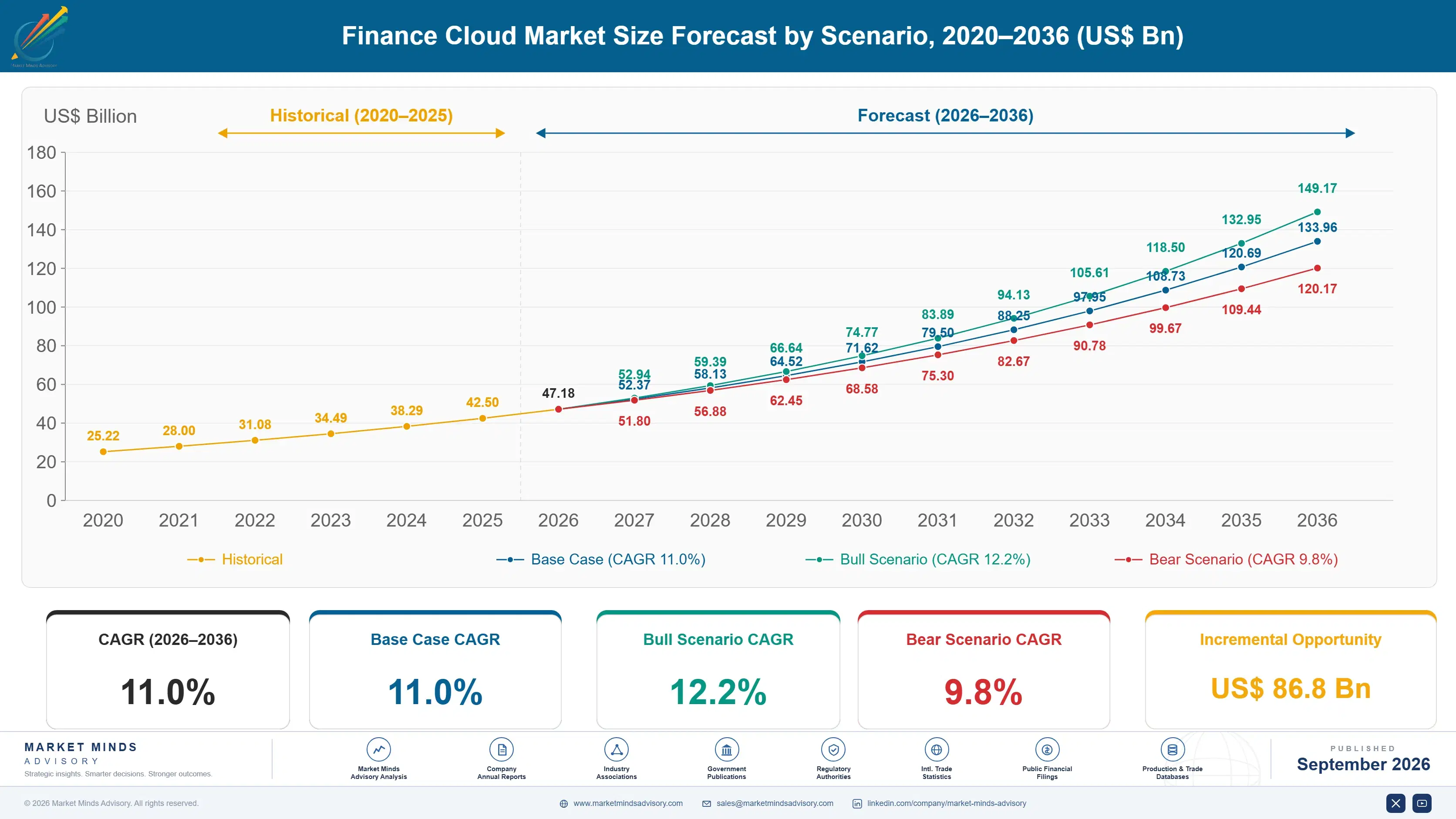
Finance cloud adoption grew cautiously through 2020 to 2023 as regulators worked through data residency and operational resilience concerns before granting broader approval for core system migration across most major markets. Momentum built sharply from 2024 as major jurisdictions finalized cloud outsourcing guidelines, lifting the historical growth rate to roughly 10.0 percent annually across the category.
Base case growth to 2036 rests on three commercial mechanisms: regulatory clarity spreading to additional jurisdictions that previously restricted core banking cloud migration, institutions consolidating fragmented legacy systems onto unified cloud platforms rather than maintaining parallel infrastructure indefinitely, and hyperscalers earning deeper financial-grade certifications that expand which workloads institutions can legally migrate. These mechanisms reinforce each other across different institution types and geographies, sustaining above-average growth without depending on any single dominant catalyst or jurisdiction.
A bull scenario centers on a major regulator formally endorsing cloud-native core banking as the default architecture for new bank charters, which would compress replacement timelines across the industry within a single supervisory cycle. The bear risk is a high-profile cloud outage affecting a systemically important institution, which has historically triggered supervisory reviews that delayed migration decisions industry-wide for a year or more.

Where Regulatory Certification Determines Cloud Vendor Access

Regulatory certification depth has become the primary vendor differentiator, since institutions cannot legally migrate core workloads to a provider lacking jurisdiction-specific compliance credentials regardless of technical capability or pricing advantage. Vendors that once competed narrowly on raw compute pricing now compete on the breadth of financial-grade certifications held across jurisdictions, which shifts investment toward compliance engineering rather than infrastructure scale alone.
MARKET CONCENTRATIONCR5 42%a moderately concentrated base of core banking cloud vendors
AVERAGE MIGRATION COST$18M per mid-size bankcore system replacement versus annual maintenance run rate today
TOP HOSTING COUNTRY SHAREUS 36%concentrated hyperscaler data center capacity supporting financial workloads globally
MULTI-CLOUD ADOPTION RATE54% of large institutionslarge institutions now running workloads across two or more providers
REGULATORY CERTIFICATION LAG18-24 months typicalaverage approval timeline for new cloud-native core banking deployment
CLOUD SPEND SHARE29% of total budgetcloud infrastructure and platform costs versus legacy system maintenance spend
Multi-cloud architecture has become standard practice among large institutions, since concentration risk concerns from supervisors increasingly discourage single-provider dependency for systemically important workloads and functions. Migration cost remains a significant barrier for mid-size institutions, often exceeding eighteen million dollars for a full core system replacement, which keeps smaller banks running hybrid architectures far longer than large institutions with greater capital budgets available.
Integration between cloud-native core systems and third-party fintech applications is becoming a baseline expectation rather than a differentiator, concentrating advantage among vendors who can demonstrate reliable open banking API connectivity across partner networks. Meanwhile several regulators are extending cloud approval frameworks to additional financial products beyond core banking, which could meaningfully expand the addressable workload count within the next several supervisory cycles ahead.
"Every bank CIO says they are cloud-first; most still run the core ledger on a mainframe from the 1980s. The ones actually migrating are the ones who stopped waiting for perfect regulatory certainty and started with the workloads regulators already approved years ago."
Director, Financial Services Technology Practice · MMA Cloud Infrastructure and Platform Services for Financial Institutions Practice · September 2026

Market Trends

Financial-Grade Cloud Certifications Expand Migration Scope

Hyperscalers are earning increasingly specific financial services compliance certifications, covering operational resilience, data residency, and third-party risk management requirements that regulators previously cited as barriers to core system migration. This certification expansion has cut typical regulatory approval timelines for new cloud-native core banking deployments to roughly 18 to 24 months, down meaningfully from the multi-year approval processes common just five years earlier when certification frameworks were far less developed. Institutions in jurisdictions with newly finalized cloud outsourcing guidelines are now moving core workloads that remained on legacy infrastructure through several prior migration attempts.
Market Impact: 65% of budget on mainframe
Multi-Cloud Architecture Becomes Standard Risk Mitigation

Supervisors increasingly discourage single-provider dependency for systemically important banking workloads, pushing large institutions toward multi-cloud architectures that distribute critical functions across two or more hyperscalers to reduce concentration risk exposure and single points of failure. Roughly 54 percent of large institutions now run production workloads across multiple cloud providers, up sharply from a much smaller share when single-provider deployment was standard practice just a few years earlier in most markets. This shift is creating new integration complexity that favors vendors offering cloud-agnostic middleware over those tied to a single hyperscaler's proprietary tooling.
Market Impact: 40+ countries now require open banking

Market Opportunities and Growth Drivers

Legacy Mainframe Maintenance Costs Become Unsustainable

Large institutions running core banking systems on decades-old mainframe infrastructure face rapidly escalating maintenance costs as the specialized COBOL programming talent required to service these systems retires faster than replacement talent enters the workforce, driving hourly contractor rates sharply higher across the industry. Annual mainframe maintenance now consumes roughly 65 percent of many institutions' core system technology budget, leaving minimal capacity for genuine innovation investment. This cost pressure is forcing even historically cautious institutions to commit to multi-year cloud migration roadmaps that would have been unthinkable a decade ago given regulatory hesitation at the time.
Market Impact: Separate deployments add 20-30% to cost

Open Banking Regulation Requires API-Native Infrastructure

Open banking regulations in the European Union, United Kingdom, and increasingly other jurisdictions require banks to expose customer data through standardized APIs to licensed third parties, a requirement that legacy mainframe architecture struggles to support without expensive middleware layers bolted onto decades-old core systems. Cloud-native core banking platforms are built with API connectivity as a foundational design principle rather than an afterthought, giving newly migrated institutions a meaningfully faster path to open banking compliance. Roughly 40 countries now have open banking regulation in force or under active development, expanding the addressable compliance-driven migration opportunity substantially.
Market Impact: Migrations often run 2-3 years late

Market Restraints and Challenges

Data Sovereignty Rules Complicate Multi-Country Deployment

Financial institutions operating across multiple countries face differing data residency requirements governing where customer financial data can physically reside and be processed, since regulators in several major jurisdictions require data to remain within national borders for certain categories of financial information. The root cause is that data sovereignty law developed independently across regions without coordinated international standards for cloud-hosted financial services specifically. This forces institutions to maintain separate regional cloud deployments rather than a single global architecture, raising cost and operational complexity meaningfully. Vendors are mitigating this by building region-specific data residency configurations directly into their core platform architecture.
Market Impact: 18-24 month approval timeline now

Legacy System Migration Complexity Delays Timelines

Migrating decades of accumulated core banking data and business logic to cloud-native architecture requires reconciling inconsistent data formats and undocumented custom code accumulated across generations of technology leadership and multiple prior system modifications. The root cause is that legacy core banking systems were built and modified incrementally over decades without comprehensive documentation standards being enforced consistently. This has caused several major migration projects to run years over their original timeline, damaging vendor references and delaying anticipated cost savings substantially. Leading vendors now mitigate this by offering phased migration approaches that isolate and modernize discrete modules before attempting full core replacement.
Market Impact: 54% of large institutions now multi-cloud
3 additional market trends, 4 additional growth drivers, and 3 additional restraints and challenges are covered in the full report. Contact sales@marketmindsadvisory.com to access the complete intelligence.

Segment CAGR and Growth Architecture

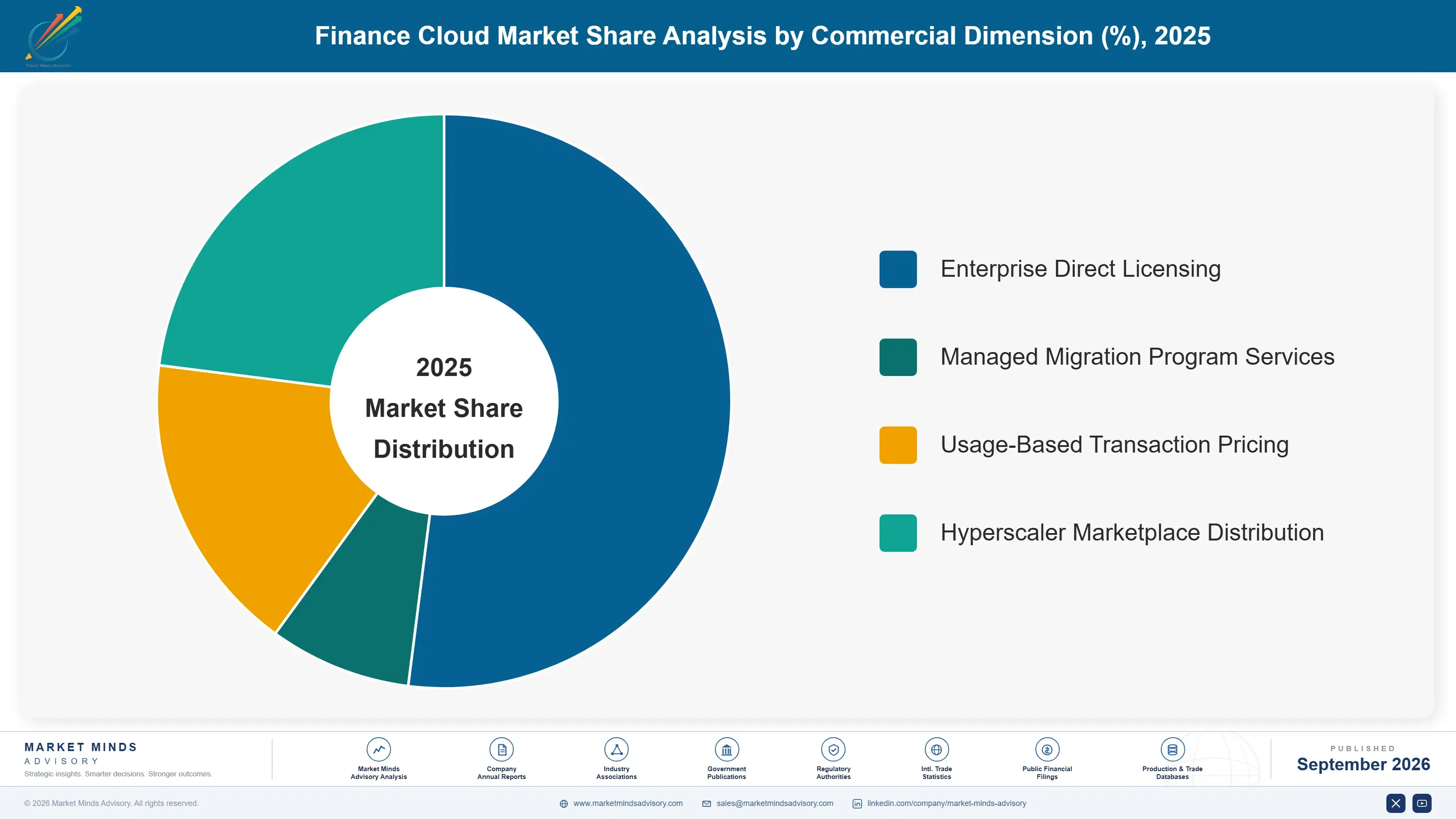
Segmentation follows cloud service function within financial institutions, spanning core banking and policy administration platforms, financial data analytics and AI, payment processing infrastructure, risk and regulatory compliance software, and platform-as-a-service infrastructure, each addressing a genuinely distinct functional layer rather than overlapping customer type, deployment model, or pricing structure categories within this entire broader market.
finance-cloud-market-market-share-analysis-1789986234036

Cloud-Native Core Banking and Policy Administration Platforms

Cloud-native core banking and policy administration platforms lead growth as institutions finally commit to replacing mainframe systems that regulators have historically resisted migrating due to systemic stability concerns now substantially addressed through financial-grade cloud certification frameworks. These platforms handle the fundamental account, transaction, and policy record-keeping functions that sit at the heart of every bank and insurer's operations, making their migration the single highest-stakes decision in any institution's technology roadmap. Large regional banks and mid-size insurers are adopting this segment fastest, since their smaller scale relative to global institutions makes a full core replacement more operationally manageable within a single multi-year program, and vendors report meaningfully faster deployment timelines than global institutions require.
CAGR 16.0%

Cloud-Based Financial Data Analytics and AI Platforms

Cloud-based financial data analytics and AI platforms are the second-fastest growing segment, driven by institutions extracting real-time fraud detection, credit risk scoring, and personalized product recommendations from transaction data that legacy mainframe architecture could never process at comparable speed or scale. These platforms increasingly incorporate large language model capability for customer service automation and internal document processing, extending their value proposition well beyond the traditional statistical risk models that defined earlier generations of financial analytics software. Large banks and asset managers are adopting fastest, since their transaction volume generates enough data to make advanced analytics investment worthwhile relative to the substantial infrastructure cost involved. Vendors embedding generative AI capability earliest are capturing disproportionate new contract share from legacy analytics incumbents.
CAGR 15.0%
Full segment breakdown across 5 segments available in the complete report.

Regional Architecture and Country Demand Map

North America leads today on concentrated hyperscaler headquarters presence and early regulatory clarity, while East Asia follows closely behind on rapid digital banking transformation efforts, and South Asia and Pacific posts the fastest overall regional growth on expanding fintech-driven core banking modernization across the region.

North America

US financial regulators, including the OCC and Federal Reserve, have issued increasingly detailed cloud outsourcing guidance that clarified supervisory expectations earlier than most other major markets, giving domestic institutions a head start on core system migration planning. Major hyperscalers headquartered in the region maintain the deepest financial services compliance certification portfolios globally, reducing the regulatory approval burden for domestic institutions relative to those relying on regional cloud infrastructure elsewhere. Canadian banks are following a similar migration trajectory under comparable regulatory guidance from federal banking supervisors. Large regional and community banks across the country continue driving a substantial share of near-term core banking replacement demand as consolidation accelerates industry-wide. Mexican cross-border institutions are following a comparable adoption curve closely behind.
Share: 32% | CAGR: 11.5% (2026 to 2036)

East Asia

China's largest banks have pursued aggressive digital transformation programs backed by state policy support, though data sovereignty requirements increasingly favor domestic cloud providers over international hyperscalers for core financial workloads specifically. Japan and South Korea are extending cloud adoption into core banking more cautiously, reflecting both conservative institutional culture and thorough regulatory review processes that favor measured migration over rapid wholesale replacement. Digital-only banks launched across the region in recent years have adopted cloud-native architecture from inception, avoiding the legacy migration burden that established institutions face entirely. Component supply chain proximity gives regional cloud infrastructure providers meaningful cost advantages over international competitors. Taiwan and Southeast Asian financial hubs are following a similar cautious path forward.
Share: 24% | CAGR: 12.0% (2026 to 2036)
Regional intelligence for 5 additional markets available in the complete report: Western Europe, South Asia and Pacific, Latin America, Middle East and Africa, Eastern Europe. Contact sales@marketmindsadvisory.com.
finance-cloud-market-country-cagr-analysis-1789986234552

Where Finance Cloud Vendors Should Expand Revenue

Beyond core migration and licensing fees, vendors are building adjacent commercial layers around managed compliance monitoring services, usage-based transaction pricing, data analytics module subscriptions, and multi-year migration program partnerships, each extending overall contract value well past the initial platform license into sustained multi-year account expansion across large and mid-sized financial institutions everywhere worldwide today.

Managed Regulatory Compliance Monitoring Service Programs

Vendors are bundling managed regulatory compliance services alongside core platform licenses, since institutions replacing legacy mainframe systems consistently underestimate the ongoing compliance monitoring burden that cloud-native architecture still requires across every jurisdiction they operate within. These services now generate roughly 20 percent of first-year contract value at several leading vendors, well above the negligible share compliance support represented when cloud migration first began several years ago. Institutions value the reduced regulatory risk enough to accept premium pricing on this layer, and vendors report meaningfully higher renewal rates when compliance monitoring is included as an ongoing managed service.
Market Impact: 20% of first-year contract value from compliance services

Usage-Based Transaction Processing Pricing Structure Tiers

Usage-based transaction processing fees are replacing flat annual licensing for payment and core banking workloads, since institutions with highly variable transaction volume increasingly prefer cost structures that scale directly with actual platform usage rather than paying identical fees during low-volume and peak periods alike. This pricing model now covers roughly 38 percent of new contracts signed industry-wide, up sharply from a negligible share when flat licensing dominated the category just a few years earlier. Vendors offering this flexibility are winning deals against competitors still locked into rigid annual licensing structures that smaller institutions find increasingly difficult to justify.
Market Impact: 38% of new contracts now priced on usage basis

Data Analytics and AI Module Subscriptions

Data analytics and AI module subscriptions layered on top of core banking platforms are commanding premium recurring revenue, since institutions increasingly want real-time fraud detection and personalized product recommendation capability without building these systems independently from scratch. Attach rates for at least one premium analytics module now exceed 42 percent among large institution accounts, up meaningfully from a much smaller share when these modules first launched as standalone add-ons a few years back. Vendors bundling analytics into tiered packages are seeing measurably longer contract terms than those selling core banking as a standalone product alone.
Market Impact: 42% attach rate on analytics modules currently offered

Multi-Year Migration Program Partnership Structures Overall

Multi-year migration program partnerships combining core platform licensing with dedicated professional services teams are opening larger, more complex institutional accounts that vendors previously found too resource-intensive to pursue through standard sales processes alone. These partnership-structured deals have expanded average contract value by roughly 55 percent for vendors pursuing this model, reflecting the substantially larger scope of multi-year migration programs relative to standalone software licensing agreements. Vendors lacking dedicated migration program capability increasingly struggle to compete for the largest institutional accounts against competitors with established program management infrastructure already in place.
Market Impact: 55% larger contracts via migration program partnerships now

Who Controls the Margin Pool

Finance cloud remains moderately concentrated, with the top five vendors holding an estimated 42 percent of the market on an assets-under-management-served basis. Temenos and FIS lead on breadth across core banking deployments, while a meaningful gap separates them from smaller specialist challengers who compete mainly on regional certification depth rather than platform scale.
Current competitive activity centers on three fronts: vendors racing to add large language model capability for customer service and internal document processing, larger platforms acquiring specialist compliance software makers to close regulatory certification gaps rather than building comparable capability internally, and several vendors expanding financial-grade cloud certification portfolios to open access to previously restricted jurisdictions. Pricing pressure has intensified modestly among mid-tier vendors competing for mid-size bank accounts that larger players consider too small to prioritize directly.

Emerging pressure comes from hyperscaler-native financial services offerings entering core banking through direct platform investment rather than partnership with existing software vendors, betting that infrastructure-level integration can substitute for specialized banking domain expertise built over decades. Rankings could shift meaningfully if a major regulator formally endorses a specific cloud architecture standard, since carriers facing forced migration tend to consolidate around whichever platform already meets the new requirement natively.
finance-cloud-market-company-positioning-matrix-1789986235081

Competitive Moat and Risk Dimensions

TEMENOS

Moat: Deepest core banking certification breadth

Temenos holds the broadest portfolio of financial-grade cloud certifications across jurisdictions of any core banking vendor, letting it pursue deals in regulated markets that competitors with narrower certification coverage cannot legally enter, a durable advantage that took years of dedicated compliance investment and regulatory relationship-building to construct.
TEMENOS

Risk: Complex legacy product architecture

Temenos's core platform carries architectural complexity accumulated across decades of acquisitions and product extensions, making implementation projects longer and costlier than newer cloud-native competitors, risking share loss among institutions prioritizing faster deployment timelines over the company's broader functional depth and certification coverage built over many years.
FIS

Moat: Massive installed base

FIS serves a massive installed base of banks and credit unions across core processing, payments, and capital markets functions, creating substantial switching costs that make displacing FIS from an existing account meaningfully harder than winning net-new business at a competitor's expense across comparable institution sizes and complexity levels.
FIS

Risk: Slower cloud-native product transition

FIS has been slower than newer cloud-native competitors to fully modernize its legacy product portfolio, risking share loss among institutions prioritizing genuinely cloud-native architecture over incrementally modernized legacy systems still carrying meaningful technical debt from decades of prior acquisitions and platform development decisions made previously.

Players Tracked

Prominent Players

Temenos
FIS
Fiserv
Finastra
nCino

Other Key Players

Mambu
Thought Machine
Backbase
Salesforce
SAP
Oracle Financial Services
Amazon Web Services
Google Cloud
Microsoft
Zafin
Sopra Banking Software
Intellect Design Arena
EdgeVerve
Broadridge
SS&C Technologies

Recent Developments

FEBRUARY 2026

Temenos Acquires Compliance Automation Startup

Temenos acquired a small regulatory compliance automation startup specializing in cross-jurisdiction reporting, folding the technology directly into its core banking platform rather than continuing to rely on third-party compliance software partners for regulatory reporting capability across its large multi-country institutional customer base and growing pipeline.
Signal: Large core banking vendors are increasingly securing compliance capability through targeted acquisition rather than external partnership.
OCTOBER 2025

FIS Signs Multi-Cloud Infrastructure Partnership

FIS signed a multi-year infrastructure partnership spanning two major hyperscalers to support institutional customers seeking multi-cloud architecture for concentration risk mitigation, replacing an earlier single-provider hosting arrangement that several large institutional customers had specifically flagged as a supervisory concern during recent internal risk reviews conducted last year.
Signal: Core banking vendors are increasingly building multi-cloud capability to directly address these supervisor concentration risk concerns.
MAY 2025

Fiserv Expands Financial-Grade Certification Portfolio

Fiserv announced expanded financial-grade cloud certifications across several additional jurisdictions, aimed at opening access to new institutional customer segments in markets where regulatory approval had previously restricted its core banking platform from competing against locally certified alternative vendors already well established in those specific regions and countries.
Signal: Vendors are investing directly in regulatory certification to expand their addressable jurisdictional footprint even more significantly.

Hyperscaler Compute Pricing Shapes Vendor Margins

Cloud compute, storage, and specialized financial-grade security infrastructure together represent roughly 48 percent of cost of goods sold for finance cloud vendors, notably higher than general enterprise software categories typically face. Compute costs alone account for close to 29 percent, scaling directly with transaction volume rather than remaining fixed as legacy licensed software costs traditionally did.
Hyperscaler compute pricing rose meaningfully during 2022 and 2023, following surging enterprise demand for cloud infrastructure across all industries simultaneously, as documented in major cloud providers' published pricing update announcements during that period across the industry. Vendors serving high-transaction-volume institutional accounts absorbed meaningfully higher compute costs for several consecutive quarters before negotiating improved enterprise agreement terms roughly a year later at more favorable long-term rates.

Smaller vendors lacking scale to negotiate favorable enterprise cloud pricing face a real cost disadvantage against larger competitors like Temenos and FIS, who can spread compute costs across a broader institutional customer base and negotiate volume discounts unavailable to smaller specialists. This dynamic increasingly pushes smaller vendors toward niche regional markets where larger competitors see insufficient contract value to compete aggressively on price alone.
finance-cloud-market-cost-volatility-analysis-1789986235277

Multi-Year Enterprise Cloud Contract Negotiation

Larger vendors are negotiating multi-year enterprise cloud agreements with committed usage volumes in exchange for meaningfully lower per-unit compute pricing, locking in favorable rates before anticipated future price increases across the industry, a strategy smaller vendors lacking comparable committed volume simply cannot replicate on their own without taking on meaningful financial risk exposure over time.

Workload Optimization and Right-Sizing

Vendors are optimizing compute resource allocation across customer workloads, right-sizing infrastructure to actual usage patterns rather than provisioning for theoretical peak capacity constantly, meaningfully reducing wasted compute spend that previously went unnoticed across large multi-tenant institutional deployments running continuously around the clock every single day and night of the entire calendar year without exception.

Reserved Instance and Committed Spend Discounts

Vendors are shifting a larger share of predictable, steady-state workloads onto reserved instance pricing tiers that offer substantial discounts relative to on-demand pricing, reserving on-demand capacity only for genuinely variable or unpredictable transaction volume spikes that reserved capacity simply cannot accommodate efficiently during unexpected demand surges or unusual seasonal traffic peaks each calendar year.

Portfolio Architecture for Margin Defence

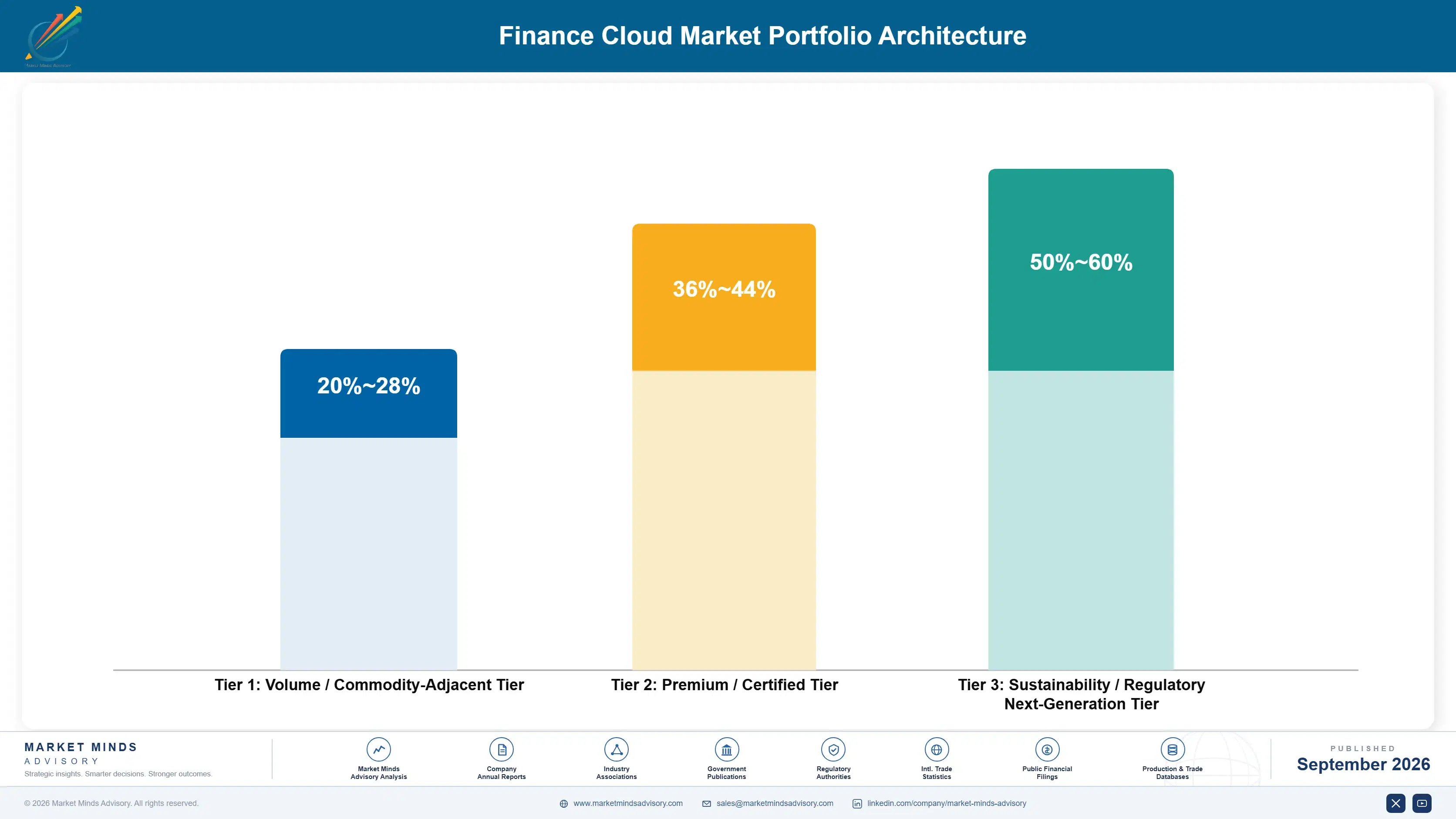
Finance cloud spans three commercial tiers: basic infrastructure-as-a-service hosting at the volume end, certified financial-grade platform-as-a-service offerings meeting regulatory benchmarks in the middle, and fully managed cloud-native core banking suites at the premium top, with gross margins expanding meaningfully from the commodity tier through to next-generation platforms that command significantly higher recurring revenue per institutional account.
Volume-tier infrastructure hosting faces persistent price pressure from institutions treating raw compute as a commoditized utility, while premium managed core banking platforms increasingly capture disproportionate margin as institutions pay for regulatory certification and implementation support rather than infrastructure alone. Vendors straddling both tiers face internal tension allocating engineering resources between defending existing infrastructure accounts and building the next-generation capability premium institutional accounts increasingly demand.

High-value margin pools concentrate heavily around cloud-native core banking replacement and embedded data analytics, where large institutions pay meaningfully more for measurable reductions in mainframe maintenance cost and faster product launch cycles. Smaller vendors without core banking depth remain confined to lower-margin infrastructure hosting work, ceding the fastest-growing and most profitable segment entirely to larger, better-capitalized competitors with deeper regulatory certification budgets. This margin gap widens further each year.

Volume / Commodity-Adjacent Tier

Basic infrastructure-as-a-service hosting serving smaller institutions with minimal financial-grade certification beyond baseline data security requirements and standard cloud provider service level agreements lacking any specialized compliance tooling whatsoever at all.
Gross Margin: 20-28%

Premium / Certified Tier

Certified financial-grade platform-as-a-service offerings meeting specific regulatory benchmarks, providing structured compliance tooling that meaningfully reduces the supervisory approval burden institutions otherwise face during migration to modern cloud infrastructure entirely and completely.
Gross Margin: 36-44%

Sustainability / Regulatory / Next-Generation Tier

Fully managed cloud-native core banking suites combining infrastructure, compliance certification, and embedded analytics into a single platform, commanding the highest per-institution pricing in the category among the largest global customers.
Gross Margin: 50-60%
finance-cloud-market-portfolio-architecture-1789986235782

High-value Sub-segments and Strategic Watch-out

Cloud-Native Core Banking and Policy Administration Platforms

This segment combines the fastest unit growth in the market today with the highest per-institution pricing, as institutions pay premium rates for full core replacement that eliminates mainframe maintenance cost entirely, making it the clearest priority for vendor R&D investment over the next several years.
Gross Margin: 52-60%

Cloud-Based Financial Data Analytics and AI Platforms

Growing quickly on institutions extracting fraud detection and personalization value from transaction data, this segment carries strong margins though slightly below the core banking leader, as vendors increasingly bundle analytics with core platforms to justify premium pricing over standalone tools still available today rather consistently.
Gross Margin: 44-52%

Cloud-Hosted Payment Processing and Transaction Infrastructure

A large installed-base segment growing at a moderate pace, this transaction processing category remains the anchor product most institutions purchase first before considering broader core banking migration, anchoring overall category volume even as growth increasingly shifts toward core replacement products each and every single year.
Gross Margin: 34-42%

Cloud Infrastructure and Platform-as-a-Service for Institutions

Growth here trails the rest of the market, and vendors risk this segment commoditizing further as basic infrastructure hosting becomes a low-margin utility rather than a differentiated product, compressing margins for specialists focused narrowly on undifferentiated infrastructure provisioning services today and consistently going forward each year.
Gross Margin: 18-26%

Why Core Banking Contracts Compound Value

Finance cloud contracts increasingly function as annuity products rather than one-time infrastructure purchases, since compliance monitoring, usage-based transaction fees, and analytics module subscriptions attach to the base platform and recur across an institution's typical ten to fifteen year core banking replacement cycle. Vendors capturing this attached recurring revenue build customer lifetime value multiples well above the original platform license price.
Adoption depth varies meaningfully by institution type: smaller community banks adopt shallowly, migrating individual workloads without full core replacement, while large regional and national banks integrate cloud infrastructure deeply into core processing, risk management, and customer-facing workflows, creating switching costs that keep those institutions within a single vendor's product family across multiple decades of regulatory cycles and technology refresh programs spanning entire careers.

Buyer profiles are shifting generationally as financial institutions increasingly include dedicated cloud strategy and digital transformation officers who evaluate vendor selection through regulatory certification and architecture flexibility criteria rather than pure cost comparisons alone. Younger technology leaders entering these roles expect measurable proof of migration outcomes before commitment, favoring vendors who can demonstrate quantified results over long-standing incumbent relationships built on institutional tenure.
finance-cloud-market-end-use-penetration-index-1789986236274

Priorities for Finance Cloud Vendors Now

These are among the four positions where our research anticipates prominent divergence between winners and laggards over the coming forecast period. Each is grounded in the demand model, the regulatory perimeter, and the announced capacity pipeline.
01 / REGULATORY CERTIFICATION INVESTMENT

Build Certification Breadth Ahead of Demand

Institutions cannot legally migrate core workloads to a provider lacking jurisdiction-specific compliance credentials regardless of technical capability or pricing, making certification breadth the single most durable competitive moat available in this category over the coming decade of continued regulatory maturation across every major jurisdiction worldwide. Vendors who lead with documented certification depth during procurement evaluations close larger institutional contracts meaningfully faster than those emphasizing infrastructure pricing alone. Certification, not raw compute cost, wins the largest institutional accounts in this category today.
02 / RECURRING REVENUE EXPANSION

Build Attached Compliance Services Before Rivals Do

Core platform licensing alone undervalues the ongoing compliance monitoring burden that institutions face across every jurisdiction they operate within, making managed compliance services and usage-based transaction pricing the more durable profit pools within this category over the coming several years of continued regulatory complexity. Vendors that build this layer early capture meaningfully higher customer lifetime value and materially better retention than those still selling infrastructure as a standalone commodity product. Waiting cedes the most profitable accounts to faster-moving, better-prepared competitors.
03 / MULTI-CLOUD ARCHITECTURE READINESS

Support Multi-Cloud Deployment Before It Becomes Mandatory

Supervisors increasingly discourage single-provider dependency for systemically important banking workloads, and vendors lacking genuine multi-cloud portability will increasingly lose large institutional deals regardless of their underlying platform capability or certification depth built over many years of dedicated investment and regulatory relationship management. Building cloud-agnostic architecture now positions vendors ahead of the concentration risk mandates that several regulators are actively drafting for the coming several years across major jurisdictions. This is a near-term engineering priority, not a distant roadmap consideration for later.
04 / LEGACY MIGRATION PROGRAM EXPERTISE

Invest in Phased Migration Capability Now

Full core banking replacement projects routinely run years over their original timeline due to undocumented legacy code and inconsistent data formats accumulated across decades of prior system modifications and organizational technology leadership changes at most large financial institutions across the globe. Vendors offering phased migration approaches that isolate and modernize discrete modules before attempting full replacement are winning larger, more complex institutional accounts than competitors insisting on all-at-once cutover approaches. Migration expertise is becoming as commercially valuable as the platform itself.

Engagement Snapshot From the Field

A live engagement with an industry participant carrying material or product regulatory and market exposure ahead of a defining policy shift, showing how our research translates into a defensible multi-year portfolio strategy.
MARKET MINDS ADVISORY · CLIENT ENGAGEMENT SUMMARY
Finance Cloud Producer Strategic Portfolio Review and Transition Roadmap 2026·Investment Scenario on Finance Cloud Exposure Evaluation 2025-26
CLIENT PROFILE
The client is a mid-size regional bank serving roughly 450,000 retail and small business customers, still running its core deposit and lending systems on a mainframe platform installed in the early 1990s. Annual mainframe maintenance and specialized COBOL contractor costs exceeded $22 million (client-reported, unverified by MMA), consuming a disproportionate share of the bank's total technology budget each year.
STRATEGIC CHALLENGE
The bank's aging mainframe architecture could not support the real-time payment processing and open banking API connectivity that regulators and fintech partnership opportunities increasingly required. Leadership needed a migration strategy that would modernize core systems without disrupting account access for existing customers or triggering the multi-year timeline overruns common in similar full core banking replacement projects industry-wide.
MMA APPROACH
MMA benchmarked the bank's mainframe total cost of ownership against three cloud-native core banking platforms, modeling migration timeline and cost scenarios under both phased and full-replacement approaches. The engagement combined regulatory certification review for each candidate vendor with direct technical evaluation of data migration complexity, given the bank's four decades of accumulated legacy code and undocumented custom modifications.
KEY FINDINGS
  1. Mainframe maintenance costs had grown by a meaningful percentage annually for several consecutive years as specialized COBOL contractor rates continued climbing steadily.
  2. A phased migration approach isolating deposit accounts first reduced projected timeline risk substantially compared to attempting full core replacement all at once.
  3. The bank's undocumented custom code modifications accumulated over four decades required significantly more data reconciliation effort than initially budgeted for the project.
  4. The selected platform's pre-built open banking API layer eliminated a custom development requirement that would have added meaningful cost and timeline risk.
CLIENT PROFILE
The client is a mid-size regional bank serving roughly 450,000 retail and small business customers, still running its core deposit and lending systems on a mainframe platform installed in the early 1990s. Annual mainframe maintenance and specialized COBOL contractor costs exceeded $22 million (client-reported, unverified by MMA), consuming a disproportionate share of the bank's total technology budget each year.
STRATEGIC CHALLENGE
The bank's aging mainframe architecture could not support the real-time payment processing and open banking API connectivity that regulators and fintech partnership opportunities increasingly required. Leadership needed a migration strategy that would modernize core systems without disrupting account access for existing customers or triggering the multi-year timeline overruns common in similar full core banking replacement projects industry-wide.
MMA APPROACH
MMA benchmarked the bank's mainframe total cost of ownership against three cloud-native core banking platforms, modeling migration timeline and cost scenarios under both phased and full-replacement approaches. The engagement combined regulatory certification review for each candidate vendor with direct technical evaluation of data migration complexity, given the bank's four decades of accumulated legacy code and undocumented custom modifications.
KEY FINDINGS
  1. Mainframe maintenance costs had grown by a meaningful percentage annually for several consecutive years as specialized COBOL contractor rates continued climbing steadily.
  2. A phased migration approach isolating deposit accounts first reduced projected timeline risk substantially compared to attempting full core replacement all at once.
  3. The bank's undocumented custom code modifications accumulated over four decades required significantly more data reconciliation effort than initially budgeted for the project.
  4. The selected platform's pre-built open banking API layer eliminated a custom development requirement that would have added meaningful cost and timeline risk.
RECOMMENDED STRATEGY
Phase 1: Phase 1 (Months 1-6): Migrate deposit account processing to the new platform while maintaining parallel mainframe operation for lending systems. Phase 2: Phase 2 (Months 7-14): Migrate lending and credit systems once deposit migration is fully validated, decommissioning mainframe deposit processing entirely and permanently. Phase 3: Phase 3 (Months 15-20): Fully decommission all remaining mainframe infrastructure and launch open banking API connectivity for new fintech partnership opportunities.
OUTCOME
Within twenty months of completing the full migration, the bank reported annual core system maintenance costs declining by roughly 48 percent (client-reported, unverified by MMA), alongside new fintech partnership revenue of approximately $4.2 million annually (client-reported, unverified by MMA) enabled by open banking API connectivity.

Frequently Asked Questions

Foundational context covering the market sizes, CAGR, scope, country, region and competition that inform every finding below. This section is provided to cover basics and most often pre-purchase conversations, answered from the MMA Primary Research Dataset.

What is the current size of the Finance Cloud Market?

The finance cloud market was valued at $42.5 billion in 2025. It is projected to reach $47.18 billion in 2026 as regulatory clarity accelerates core banking migration.

How large will the Finance Cloud Market be by 2036?

The market is projected to reach $133.96 billion by 2036, up from $47.18 billion in 2026. That represents a 2.84 times expansion over the forecast decade.

What is the CAGR for the Finance Cloud Market 2026 to 2036?

The market is projected to grow at an 11.0 percent CAGR between 2026 and 2036. This is up from a historical CAGR of roughly 10.0 percent between 2020 and 2025.

Which segment is growing fastest?

Cloud-native core banking and policy administration platforms lead growth at a 16.0 percent CAGR, roughly 1.45 times the overall market rate. Institutions are finally replacing decades-old mainframe infrastructure at scale.

Who are the major companies in the Finance Cloud Market?

Temenos, FIS, Fiserv, Finastra, and nCino are the five largest participants by institutional deployment basis. Together they hold an estimated 42 percent of the global market.

Which country is growing fastest?

India is the fastest-growing country at a 14.5 percent CAGR, driven by rapid digital banking transformation and government-backed digital infrastructure initiatives. The country's large IT services sector reinforces this trajectory further.

Report Segmentation Architecture

The full report scope spans multiple orthogonal segmentation dimensions, with cross-tabulated demand data provided for each dimension pair. Coverage extends further to regional breakdowns, trend trajectories, and the competitive detail needed to support segment-level decision-making.

By Cloud Service Function

  • Cloud-Native Core Banking and Policy Administration Platforms
  • Cloud-Based Financial Data Analytics and AI Platforms
  • Cloud-Hosted Payment Processing and Transaction Infrastructure
  • Cloud-Based Risk, Compliance, and Regulatory Reporting Software
  • Cloud Infrastructure and Platform-as-a-Service for Institutions
  • Hybrid Cloud Managed Services for Financial Institutions

By End-Use Institution Type

  • Retail and Commercial Banking
  • Insurance and Policy Administration
  • Asset and Wealth Management
  • Capital Markets and Trading
  • Payments and Fintech Providers

By Commercial Dimension

  • Enterprise Direct Licensing
  • Managed Migration Program Services
  • Usage-Based Transaction Pricing
  • Hyperscaler Marketplace Distribution

By Region

  • North America
  • Western Europe
  • East Asia
  • South Asia and Pacific
  • Latin America
  • Middle East and Africa
  • Eastern Europe

Scope, Methodology, and Coverage

Every figure in this report is reproducible from documented input assumptions. The scope below maps the historical period, the forecast horizon, the segmentation dimensions, and the countries covered, alongside the underlying primary and qualitative methodology.
Historical Period
2020 to 2025
Forecast Period
2026 to 2036
Base Year
2025 (USD billions; MMA Primary Research Dataset, September 2026)
Market Definition
The finance cloud market covers cloud infrastructure, platform, and software services purpose-built for or specifically adopted by banks, insurers, and asset managers to run core systems, risk analytics, and customer-facing applications. It excludes generic enterprise cloud infrastructure without financial services-specific compliance certification or configuration.
Quantitative Units
USD billions (current prices); assets under cloud-hosted administration where applicable
Segmentation Dimensions
By Cloud Service Function; By End-Use Institution Type; By Commercial Dimension; By Region
Regions Covered
North America, Western Europe, East Asia, South Asia and Pacific, Latin America, Middle East and Africa, Eastern Europe
Countries Covered
USA, China, Germany, France, UK, Japan, South Korea, India, Australia, Canada, Brazil, Mexico, Indonesia, Vietnam, Thailand, Malaysia, UAE, Saudi Arabia, South Africa, Nigeria, Turkey, Poland, Netherlands, Italy, Spain, Sweden, Switzerland, Argentina, Colombia, Singapore, and additional markets relevant to this sector
Key Companies Profiled
Temenos, FIS, Fiserv, Finastra, nCino, Mambu, Thought Machine, Backbase, Salesforce, SAP, Oracle Financial Services, Amazon Web Services, Google Cloud, Microsoft, Zafin, Sopra Banking Software, Intellect Design Arena, EdgeVerve, Broadridge, SS&C Technologies
Quantitative Methodology
Primary survey, n=3,800 respondents, Q4 2025, six countries; demand-side model with trade association cross-validation
Qualitative Methodology
47 expert interviews, Q4 2025; applied to validate demand model assumptions, identify emerging dynamics, and assess competitive positioning
Report Format
PDF and XLSX data workbook (Word format preview document)
Publisher
Market Minds Advisory
Report Code
MMA-2026-TEC-186
Published
September 2026
Contact
sales@marketmindsadvisory.com | www.marketmindsadvisory.com

Purchase the full Finance Cloud Market Report (2026 to 2036).

This report delivers a comprehensive analysis of the global finance cloud market, spanning service function segmentation, regional demand dynamics, and competitive positioning across twenty profiled companies worldwide. It includes ten-year forecasts through 2036, detailed input cost and margin analysis across three commercial tiers, and revenue diversification strategies for vendors navigating the shift toward cloud-native core banking replacement. The analysis draws on primary survey data, expert interviews, and company disclosures to support procurement, investment, and product strategy decisions. It closes with an anonymized client migration case study illustrating measured cost and revenue outcomes.
Cloud service function segmentation with growth forecasts
Seven-region demand analysis through the 2036 forecast
Competitive benchmarking of twenty profiled global vendors
Input cost and gross margin tier breakdown analysis
Revenue diversification and recurring pricing lever analysis
Anonymized client case study with measured outcomes

Built For The People Who Decide

From boardroom strategy to bench-side execution, this report is read cover-to-cover by leaders shaping the next decade of their industry, turning demand scenarios, market dynamics and valuation benchmarks into decisions.
CXOs/ Presidents/ VPs/ Managers
M&A and Corporate Development
Strategy Teams and R&D Heads
Procurement and Product Directors
Regulatory and Compliance Leaders
Investor Relations and Equity Analysts