Market Minds Advisory
Fiberboard Packaging Market

Fiberboard Packaging Market: Two-Tier Geography, Spread Economics, and the Limits of the Fibre Loop

Fibre wins substitution from plastic because the collection systems already exist and scrap has a positive value, not because a corrugated box protects anything better than the plastic it replaces.

Lead Analyst

Bilal Shaikh

Published

September 2026

Make Smarter Decisions with Customized Research Insights

Request a free sample report and evaluate market opportunities, growth trends, and competitive dynamics relevant to your business needs.

2025 MARKET VALUE$196.0BMarket Size 2025
2036 FORECAST VALUE$308.2BBase Case , 2026 to 2036
CAGR 2026 TO 20364.2 %Bull 5.4% / Bear 3.0%
INCREMENTAL OPPORTUNITY$103.9BNet 10- year value creation
EXPANSION MULTIPLE1.51x2036 value over 2026 base
Strategic Levers
M&A Pipeline
Regional Outlook
Country Rankings
Competitive Intelligence
Segmental Deep-dive
Call-Us : 91 93563 13602

Executive Snapshot and Market Trajectory

Containerboard travels economically in dense rolls while finished boxes are mostly air, so mills serve continents and box plants serve about 250 kilometres. That split explains the industry's entire structure, from mill scale to why consolidation never reaches the converting end. Nothing else in packaging works quite this way.
Micro-flute and litho-laminated board compounds at 6.3%, a full 1.50x the market rate, as retail-ready and direct-to-consumer formats collapse a printed carton and its shipping outer into one structure. East Asia holds the largest share at 32%, above the standard band, because China alone produces and consumes close to two fifths of the world's containerboard and its converting base expanded alongside. Converting capacity expanded alongside the mills.
Concentration is very low at 22%, and box converting is a spread business rather than a manufacturing one, since containerboard represents 62% of what a box costs to make. Recovered fibre content runs at 78%, the highest of any packaging material, and that working collection loop is the substitution argument. A box does not protect better than plastic and in barrier applications protects worse, so substitution follows infrastructure rather than performance.
Market Definition
This market covers fiberboard packaging supplied across consumer, industrial and distribution applications, spanning single wall, double wall and triple wall corrugated board, micro-flute and litho-laminated board, and solid fiberboard, measured at converter revenue for finished packaging. Containerboard and paperboard sold as reels to third parties, folding cartons produced from non-corrugated boxboard, moulded pulp and fibre-formed packaging, paper sacks and bags, recovered paper collection and trading, and packaging machinery are excluded.
Base Year Value
$196.0B in 2025 (MMA Primary Research Dataset, August 2026)
Forecast Period
2026 to 2036, eleven discrete annual values
CAGR
4.2% base case. Bull 5.4%. Bear 3.0%.
Fastest Growth Segment
Micro-Flute and Litho-Laminated Board: 6.3% CAGR
Fastest Growth Country
India: 8.4% CAGR
Fastest Growth Region
South Asia and Pacific: 6.4% CAGR
Largest Region
East Asia: 32% of 2025 global value
Market Leaders
Smurfit Westrock, International Paper, Packaging Corporation of America, Mondi, and Nine Dragons Paper. Source: MMA Primary Research Dataset, July 2026.
Primary Survey
n=3,800 procurement and R&D decision-makers, Q4 2025, six countries
Methodology
Demand-side build-up, cross-validated against public data, 47 expert interviews

Fiberboard Packaging Market Forecast Scenarios

fiberboard-packaging-market-size-forecast-scenario-1787304922628
Growth ran near 3.4% from 2020 to 2025 through a cycle that reversed twice. Online ordering surged and box demand with it, containerboard tightened, and converters passed through price increases with unusual ease. Then demand normalised while capacity additions commissioned during the boom arrived together, and the industry moved from shortage to visible oversupply within about eighteen months across both North American and European markets.
Base case growth of 4.2% rests on three mechanisms. Plastic substitution continues wherever product protection allows, driven by fee modulation and recyclability rules rather than by any performance argument. Online retail keeps adding shipping volume in markets where penetration is still rising. And emerging market consumption growth lifts box demand from a low base, with India compounding at 8.4% as organised retail and online delivery extend well beyond metropolitan areas.
The bull case at 5.4% assumes recyclability regulation tightens fast enough to accelerate plastic substitution across chilled and barrier-sensitive categories that currently resist it. The bear case at 3.0% is a capacity story: containerboard machines commission in very large increments, several are scheduled within the forecast period, and an oversupplied board market compresses the spread that converting margin depends upon entirely.

Fiberboard: Mill Scale Against Local Converting

Two different businesses share one industry name here. Containerboard is made on enormous machines, ships economically as dense reels and trades as an international commodity. Finished boxes are mostly air, and beyond roughly 250 kilometres the freight cost of delivering them overwhelms the margin on making them. Mills operate at continental scale while box plants operate locally, and consolidation never changes that arithmetic.
TOP FIVE CONCENTRATION22%Fragmented at converting despite consolidation among containerboard producers
CONTAINERBOARD COST SHARE62%Board input as proportion of finished box manufacturing cost
RECOVERED FIBRE CONTENT78%Recycled content across fiberboard packaging, highest of any packaging material
BOX PLANT SUPPLY RADIUS250 kmDistance beyond which delivering finished boxes stops making commercial sense
ONLINE RETAIL VOLUME SHARE24%Fiberboard volume consumed by online order fulfilment and delivery
MILL CAPACITY UTILISATION88%Average operating rate across containerboard machines in major producing regions
The consequence is that converting is a spread business. Containerboard represents about 62% of what a box costs to produce, and a converter without mill ownership buys that input at a commodity price it does not set and sells the box into a market where large customers negotiate hard. Integration matters enormously for that reason, and explains why the largest participants own both.
Fibre's substitution advantage is frequently misdescribed. A corrugated box does not protect a product better than plastic, and in moisture or barrier applications it protects considerably worse. What fibre has is a collection system that already exists, recovered content running at 78%, and a scrap value that is positive rather than negative. Recyclability regulation rewards exactly those attributes, which is why fibre keeps taking volume on infrastructure grounds.
"People describe fibre substitution as a sustainability story and it is really an infrastructure story. Old corrugated containers have had a functioning global market for fifty years. Nobody built that for plastic, and regulation is now pricing the difference."
Principal Analyst, Paper Packaging and Fibre Materials Practice · MMA Packaging

Market Trends

Micro-flute collapses the carton and shipper into one

Litho-laminated and micro-flute board carries offset print quality on a corrugated structure, which lets a single pack serve as retail display, shipping container and brand surface simultaneously rather than requiring a printed carton inside a plain outer. Direct-to-consumer and retail-ready formats have both pushed hard in this direction. The segment compounds at 6.3% as brand owners remove a packaging layer entirely, cutting material, handling and extended producer responsibility fees at the same time. Converters without lamination capability cannot bid for the work at all, which makes graphics investment the entry ticket.
Market Impact: Online driving 24% of volume

Recyclability regulation rewards infrastructure rather than performance

Extended producer responsibility fee modulation and recyclability criteria both favour materials with functioning collection systems, and fiberboard already recovers at rates no plastic format approaches, with recycled content at 78%. Substitution therefore proceeds in categories where a box performs adequately rather than where it performs well, and stops where moisture or oxygen barriers are genuinely required. Coatings that solve the barrier problem tend to reintroduce the recyclability problem, which limits how far the substitution can travel. Converters with barrier coating capability capture the marginal cases plain board cannot serve, and those price considerably better.
Market Impact: Substitution across 3 major regions

Market Opportunities and Growth Drivers

Online order fulfilment adds shipping volume in growing markets

Roughly 24% of fiberboard volume now serves online retail fulfilment, and every parcel requires a box that a shop shelf never did. Growth has flattened in mature online markets but continues rising sharply where penetration remains low. India compounds at 8.4% as organised retail and delivery networks extend well beyond metropolitan areas into tier-two and tier-three cities. Right-sizing to reduce dimensional weight charges has become a genuine converter capability rather than a customer request. Retailers now specify pack dimensions against carrier rate cards rather than against shelf presentation, which is a change of buying criterion rather than of preference.
Market Impact: Machines adding 400,000 tonnes each

Plastic substitution proceeds wherever product protection permits

Brand owners are converting secondary packaging, dry goods, confectionery and increasingly chilled formats from plastic to fibre, driven by fee schedules and recyclability criteria rather than by any performance argument. The substitution stops precisely where moisture and oxygen barriers genuinely matter, which excludes a substantial portion of food. Converters with barrier coating capability capture the marginal cases that plain board cannot serve, and those cases carry considerably better pricing than standard converting does. Coatings solving the barrier problem tend to reintroduce the recyclability problem that prompted substitution. Barrier capability captures those marginal cases.
Market Impact: Fibre survives roughly 7 cycles

Market Restraints and Challenges

Containerboard capacity arrives in increments too large to absorb

A new containerboard machine adds several hundred thousand tonnes at once, and several are scheduled across the forecast period in both Asia and North America. The root cause is machine economics: smaller machines are uncompetitive, so capacity cannot be added gradually. Commercial impact is a market that oscillates between shortage and visible oversupply, compressing the board-to-box spread that converting margin depends upon. Participants respond by integrating mills with converting, by taking machine downtime and by exporting surplus board. Unintegrated converters carry the full effect of that cycle without any offsetting mill margin.
Market Impact: Compounding at 6.3% each year

Fibre degrades with every recycling cycle, capping the loop

Cellulose fibres shorten each time paper is recycled, so recovered fibre cannot sustain the system indefinitely and virgin kraft input remains permanently necessary. The root cause is physical rather than economic, which means no collection improvement resolves it. Commercial impact is exposure to virgin pulp pricing and to forestry supply even at 78% recovered content, which many sustainability claims quietly overlook. Participants manage it through fibre blending, strength additives and securing long-term virgin supply positions. Plantation fibre access is a genuine strategic asset for exactly this reason. Sustainability communication rarely mentions it.
Market Impact: Recovered content reaching 78%
4 additional market trends, 3 additional growth drivers, and 2 additional restraints and challenges are covered in the full report. Contact sales@marketmindsadvisory.com to access the complete intelligence.

Segment CAGR and Growth Architecture

Segmentation follows board construction, because construction determines the corrugator setup, the strength and print characteristics achievable, the applications a pack can serve and the price it commands. Five board constructions cover fiberboard packaging supply without overlap. End-use application and pack format cut across every construction at once and are treated here as use attributes rather than segments.
fiberboard-packaging-market-market-share-analysis-1787304923195

Micro-Flute and Litho-Laminated Board

Growing at 6.3%, a full 1.50x the market rate, micro-flute and litho-laminated constructions carry offset print quality on a corrugated structure, letting one pack serve as retail display, shipping container and brand surface at once. Removing an entire packaging layer cuts material cost, handling steps and extended producer responsibility fees together, which is why brand owners pursue it without needing any sustainability argument. Converting requires lamination capability and tighter print registration than standard corrugated work, so it favours converters who have invested in graphics rather than in throughput alone. Brand owners pursue it for cost reasons rather than for any sustainability argument, and the fee saving usually settles the case.
CAGR 6.3%

Single Wall Corrugated Board

Single wall board grows at 4.6% and remains the volume foundation of the entire industry, carrying online fulfilment shipping boxes, grocery outers and the great majority of everyday packaging. Roughly 24% of fiberboard volume now serves online retail, and that channel favours single wall specifically because parcels travel individually rather than palletised. Lightweighting has advanced considerably, with lower basis weight liners achieving strength through flute geometry and improved board combinations. Competition here is purely on delivered cost within a freight radius against converters holding essentially identical economics. Right-sizing to reduce carrier dimensional weight charges has become a genuine converter capability rather than a customer request, and it is now written into online retailer specifications directly.
CAGR 4.6%
Full segment breakdown across 5 segments available in the complete report.

Regional Architecture and Country Demand Map

Regional value tracks where goods are packed rather than where they are consumed, and it tracks containerboard production even more closely, because mills and converting capacity locate together far more often than not. Consumption statistics alone give a misleading picture of where this market's value actually sits.

East Asia

East Asia holds the largest share at 32%. Note: this sits above the standard regional band because China alone produces and consumes close to two fifths of the world's containerboard, supporting both its own consumption and the export manufacturing that packs goods for everywhere else. Nine Dragons, Lee and Man and Shanying operate at mill scale matching anything in the West. The 2021 ban on recovered paper imports permanently rerouted global fibre flows, forcing Chinese mills toward imported recycled pulp and overseas mill investment instead. Japanese and South Korean demand is mature and premium-weighted. Converting remains fragmented across thousands of small plants despite mill scale. Board quality across the smaller plants varies considerably.
Share: 32% | CAGR: 5.2% (2026 to 2036)

North America

Twenty-four per cent of value, growing at 3.6%. The industry is unusually integrated here, with the largest participants owning containerboard mills and box plant networks together, which insulates converting margin from the board price cycle in a way independent converters cannot match. Online fulfilment volume is the highest of any region proportionally. Capacity additions commissioned during the demand surge arrived together afterwards, producing visible oversupply and machine downtime. Consolidation among producers has advanced substantially while converting itself remains constrained by the same freight radius as everywhere. Right-sizing capability has become a genuine differentiator among converters serving online retailers, since carrier dimensional weight charges now shape specification more than shelf presentation does.
Share: 24% | CAGR: 3.6% (2026 to 2036)
Regional intelligence for 5 additional markets available in the complete report: Western Europe, South Asia and Pacific, Latin America, Middle East and Africa, Eastern Europe. Contact sales@marketmindsadvisory.com.
fiberboard-packaging-market-country-cagr-analysis-1787304923717

Where Fiberboard Converters Hold Margin

Containerboard is 62% of what a box costs and its price moves on a commodity cycle converters mostly do not control, while freight caps how far a finished box can travel. Margin therefore depends on integration, on graphics capability, and on getting inside the customer's own operation. Standard converting has no defensible position left.

Integrate mill supply to control the spread

Containerboard represents 62% of box manufacturing cost, so an unintegrated converter is effectively trading a commodity it does not produce against customers who negotiate hard on the finished price. Mill ownership converts that exposure into an internal transfer, which is why the largest participants hold both. Acquiring converting capacity without board supply behind it adds revenue and adds cycle exposure at the same time, and the industry's own consolidation history shows how consistently that combination disappoints. Capital intensity is precisely what makes the position defensible. Few competitors have the capital to follow.
Market Impact: Controls 62% of the total box input

Invest in graphics capability rather than corrugator throughput

Micro-flute and litho-laminated work compounds at 6.3% because it removes a packaging layer entirely, and it requires lamination capability and print registration that throughput-optimised plants do not have. Standard single wall converting competes on delivered cost against neighbours with identical economics, which is a contest nobody wins durably. Graphics capability changes the conversation from price per thousand to what the brand owner saves by eliminating a carton, and that argument holds against cheaper competitors. Brand owners are already running layer elimination programmes independently, so the argument does not need making from scratch.
Market Impact: Captures a segment that is growing

Place converting inside the customer's freight radius

Beyond roughly 250 kilometres the freight cost of delivering finished boxes overwhelms converting margin, which makes plant location a commercial decision rather than an operational one. On-site and wall-to-wall arrangements remove freight entirely and create switching costs no distant competitor can price against. Acquisitions adding plants outside customer radius add revenue without adding any defensibility. Network density beats network size consistently in this business, and the arithmetic has not changed in fifty years. Customers with on-site arrangements rarely retender at all, because switching would require relocating production. Network density beats network size consistently.
Market Impact: Freight economics collapse beyond a

Secure virgin fibre against the recycling loop limit

Cellulose fibres shorten with each recycling pass, so even at 78% recovered content the system needs continuous virgin kraft input and always will. Converters and mills without secure virgin supply positions are exposed to pulp pricing and forestry availability in ways their sustainability communications rarely acknowledge. Plantation fibre access, long-term supply agreements and strength additive capability each address the exposure differently, and Latin American producers with plantation positions hold a genuine advantage here. Sustainability communication in this industry rarely mentions the constraint at all. Strength additives and blending strategy address part of the exposure, and neither removes it.
Market Impact: The fibre loop caps near 7 recyclin

Who Controls the Margin Pool

Concentration is very low at 22% across the top five, measured on annual converter revenue from finished fiberboard packaging, the single basis applied throughout this analysis. Smurfit Westrock and International Paper lead following large transactions that reshaped both companies, with Packaging Corporation of America, Mondi and Nine Dragons Paper holding the remaining leading positions across North America, Europe and China respectively.
Competition runs on two levels that behave quite differently. Containerboard producers compete at continental scale on machine cost position, fibre access and capacity timing, and the market clears as a commodity would. Box converting competes locally on delivered cost, service responsiveness and graphics capability within a freight radius, against a competitive set defined by geography rather than by any strategic choice.

Pressure builds from a direction that consolidation cannot address. Brand owners have consolidated packaging procurement globally while converting remains irreducibly local, so a global negotiation meets a local cost base. Separately, capacity additions scheduled through the forecast period threaten the board-to-box spread that unintegrated converters depend upon. Rankings shift most where a participant holds both mill supply and dense converting networks in the same geography.
fiberboard-packaging-market-company-positioning-matrix-1787304924237

Competitive Moat and Risk Dimensions

SMURFIT WESTROCK

Moat: Integrated mill and converting

Owning containerboard mills alongside dense box plant networks across Europe and the Americas converts the board price cycle from an external exposure into an internal transfer, which is the single most valuable position available in this industry. Network density within customer freight radius supports multi-country supply agreements that regional converters cannot bid against on comparable terms.
SMURFIT WESTROCK

Risk: Merger integration and cycle

Combining two large organisations across different continents carries execution risk over several years, during which competitors face fewer internal distractions. Containerboard capacity additions scheduled through the forecast period threaten pricing across the integrated position. European energy costs remain considerably above competitor levels in North America and Asia.
INTERNATIONAL PAPER

Moat: Containerboard cost position

A large low-cost containerboard mill base with secure virgin fibre access gives International Paper a cost position that recovered-fibre-dependent competitors cannot match through the cycle, particularly when recovered paper pricing moves sharply. Recent European converting acquisition extends the integrated model into a market where regulatory pressure favours fibre substitution most strongly.
INTERNATIONAL PAPER

Risk: Acquisition and capacity exposure

Recent large acquisition activity carries integration execution risk while the underlying board market faces scheduled capacity additions that could compress pricing substantially. Concentration in containerboard leaves the company more exposed to the commodity cycle than converters with broader packaging portfolios. Online fulfilment volume growth has flattened in mature markets.

Players Tracked

Prominent Players

Smurfit Westrock
International Paper
Packaging Corporation of America
Mondi
Nine Dragons Paper

Other Key Players

Georgia-Pacific
Oji Holdings
Nippon Paper Industries
Rengo
Cascades
Sonoco Products
Klabin
Lee and Man Paper
Shanying International
Saica
Prinzhorn Group
Stora Enso
Pratt Industries
Greif
VPK Group

Recent Developments

MARCH 2025

Containerboard capacity additions push utilisation below balanced levels

Further containerboard machine commissioning across North America and Asia lifted supply ahead of demand recovery, an organic capacity cycle rather than any transaction, pushing operating rates down and compressing the spread that unintegrated box converters depend upon for margin. Integrated producers absorbed the movement internally.
Signal: Board capacity arrives in increments far t
AUGUST 2025

Retail-ready micro-flute formats replace carton and outer combinations

Brand owners across food, personal care and household categories accelerated conversion to litho-laminated micro-flute packs that serve as display, shipper and brand surface together, an organic design shift removing an entire packaging layer and its associated fees. Converters without lamination capability could not bid for the work.
Signal: Eliminating a packaging layer beats optimi
DECEMBER 2025

Recovered fibre pricing diverges sharply between producing regions

Recovered paper prices moved apart across regions as Chinese import restrictions continued rerouting global fibre flows toward recycled pulp production and overseas mill investment, leaving recovered fibre abundant in some markets and tight in others simultaneously. Import-dependent mills faced the sharpest cost movement of any producer group.
Signal: A single policy decision has now permanent

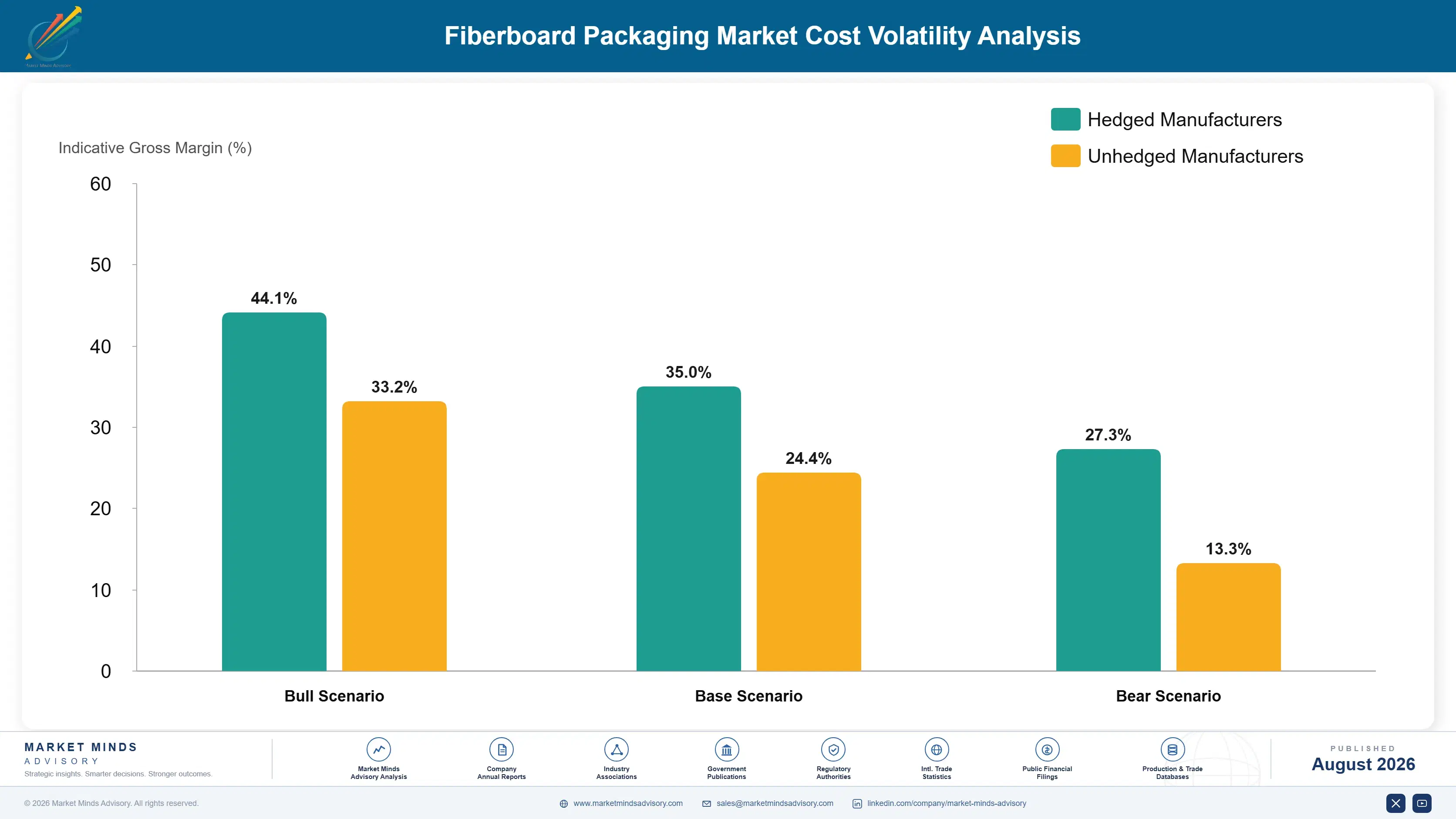
Fibre, Energy and Starch Cost Exposure

Input economics dominate this industry more completely than most. Containerboard accounts for roughly 62% of finished box cost at the converting stage, while at the mill recovered paper and virgin pulp together represent the largest single input alongside energy, which is substantial because containerboard production requires drying enormous quantities of water. Starch adhesive, ink and pallet costs make up most of the remainder at converting.
European energy costs through 2022 and 2023 hit containerboard mills severely, since drying paper is energy intensive by physics rather than by process design and consumption per tonne cannot easily be reduced. The International Energy Agency documented industrial gas price movements across that period, and several European machines took extended downtime rather than run at a loss. Producer reports recorded both the pass-through achieved and the volume lost to imported board.

Exposure varies most by integration and by fibre position. Integrated producers transfer board internally and carry mill input cost directly, while independent converters carry board price exposure without any offsetting mill margin, which decides profitability through the cycle. Geography compounds it: producers with plantation fibre in Latin America and recovered fibre abundance in North America hold cost positions that import-dependent mills cannot approach.
fiberboard-packaging-market-cost-volatility-analysis-1787304924431

Integrate board supply rather than buying through the cycle

Containerboard at 62% of box cost makes an independent converter a commodity trader whether it intends to be. Mill ownership converts that into an internal transfer and stabilises margin across the cycle. Board price movement then becomes an internal accounting question rather than a margin event. The capital requirement is substantial, which is exactly why the position stays defensible.

Secure long-term energy contracts for drying-intensive operations

Paper drying consumes energy in proportions that no process improvement materially reduces, and European mills discovered how exposed that leaves them when gas pricing moved. Long-term power purchase agreements, biomass cogeneration from mill residues and heat recovery each address part of it. None closes a cost gap of the magnitude that emerged, but together they reduce the volatility considerably.

Blend virgin and recovered fibre against strength requirements

Recovered fibre shortens with each cycle and cannot sustain strength specifications indefinitely, so virgin input is permanently required regardless of collection performance. Blending strategy, strength additives and lightweighting through flute geometry together let producers meet specification at lower total fibre cost. Producers without any virgin position depend entirely on a recovered market whose pricing moves sharply.

Portfolio Architecture for Margin Defence

Margin architecture here separates on switching cost rather than on board grade. Standard single wall boxes bid against nearby converters with identical economics earn very little, because within a freight radius the offer is essentially the same and price is the only variable. Constructions requiring specific tooling, print registration or performance qualification earn considerably better. On-site and wall-to-wall arrangements earn best, because they remove freight and competition together.
The volume against premium tension runs along customer size rather than product tier. Large brand owners and online retailers buy enormous single wall volumes on tender at prices that reflect their negotiating position, and they represent a manageable customer count with predictable demand. Smaller regional customers pay more per thousand but require considerably more service per unit of revenue. Converters serving only one group are exposed to a concentration they cannot influence.

High-value pools concentrate around graphics and proximity. Litho-laminated micro-flute work, barrier-coated constructions serving categories plain board cannot, and converting located inside a customer's own operation all command pricing that standard work does not. Commodity single wall converting, whatever the volume attached, competes on delivered cost against a competitive set that geography rather than strategy determines, and that pressure never eases.

Volume / Commodity-Adjacent Tier

Standard single wall and double wall shipping cases bid on delivered cost against converters within the same freight radius holding essentially identical economics, where price is the only variable customers actually compare.
Gross Margin: 10-18%

Premium / Certified Tier

Constructions requiring dedicated tooling, print registration, food contact certification or strength qualification, protected by requalification cost and lead time that customers under production pressure decline to accept. Specification inertia holds these positions for years.
Gross Margin: 20-30%

Sustainability / Regulatory / Next-Generation Tier

Litho-laminated micro-flute formats and barrier-coated constructions serving categories plain board cannot reach, commanding premium because they remove a packaging layer or open substitution that would otherwise be impossible. Very few converters currently hold both capabilities.
Gross Margin: 26-40%
fiberboard-packaging-market-portfolio-architecture-1787304924935

Line-Linked Volume and Requalification Inertia

Fiberboard demand behaves like a manufacturing annuity once a specification is qualified. A box runs on a specific packing line, consumption tracks the customer's production volume directly, and orders arrive continuously rather than in cycles. The converter supplying a qualified specification earns revenue requiring no repeated selling, and volume follows the customer's own fortunes rather than any purchasing decision made afterwards.
Stickiness depends almost entirely on what qualification involved. Constructions needing dedicated tooling, print plates, line trials or food contact validation hold for years, because requalification costs production time that manufacturers under pressure will not surrender. Plain shipping cases requalify within weeks and are retendered accordingly. On-site converting arrangements are stickiest of all, since the plant physically sits inside the customer's operation and cannot be replaced without moving it.

Buyer profiles have broadened in ways that matter commercially. Packaging technologists once specified constructions and procurement executed against them, and global procurement organisations now negotiate multi-country agreements against converters who remain irreducibly local. Online retailers represent a distinct profile again, buying enormous single wall volumes on dimensional and cost criteria alone. Regulatory affairs has entered the decision in Europe and increasingly overrules both of the others.
fiberboard-packaging-market-end-use-penetration-index-1787304925422

Where Fiberboard Strategy Must Land

These are among the four positions where our research anticipates prominent divergence between winners and laggards over the coming forecast period. Each is grounded in the demand model, the regulatory perimeter, and the announced capacity pipeline.
01 / SPREAD CONTROL PRIORITY

Unintegrated converting is commodity trading by another name

Containerboard represents roughly 62% of what a finished box costs to produce, so a converter without mill ownership buys a commodity at a price it does not set and sells into customers who negotiate the finished price hard. Mill ownership converts that external exposure into an internal transfer and stabilises margin through a cycle that keeps repeating. Acquiring converting capacity without any board supply behind it adds revenue and cycle exposure at exactly the same time, which the industry's own consolidation history demonstrates repeatedly.
02 / LAYER ELIMINATION VALUE

Removing a pack beats optimising one every time

Litho-laminated micro-flute constructions let a single pack serve as retail display, shipping container and brand surface at once, which removes a printed carton entirely along with its material, handling and extended producer responsibility fees. The segment compounds at 6.3% for exactly that cost reason rather than for any aesthetic one at all. Converters still competing on price per thousand for standard cases are having a conversation that graphics-capable competitors have already replaced with a total cost argument customers find considerably more persuasive.
03 / FREIGHT RADIUS DISCIPLINE

Plants outside the radius add revenue, not defensibility

Finished boxes are mostly air and beyond roughly 250 kilometres the freight cost of delivering them overwhelms whatever margin was made producing them, which is why the top five converters hold only 22% of an industry worth close to two hundred billion dollars. Acquisitions adding plants outside customer freight radius deliver purchasing scale and very little else of lasting strategic value. On-site and wall-to-wall converting arrangements remove freight and competition together, which nothing else available in this industry manages to achieve.
04 / VIRGIN FIBRE SECURITY

The loop has a physical limit nobody advertises

Cellulose fibres shorten every time paper is recycled, surviving roughly seven passes before becoming unusable, so even recovered content at 78% cannot sustain the system without continuous virgin kraft input arriving from somewhere. That exposure to pulp pricing and forestry availability is real and permanent, and most sustainability communication in this industry quietly declines to mention it. Plantation fibre access and long-term virgin supply agreements are therefore genuine strategic assets rather than the routine procurement arrangements they are usually treated as.

Engagement Snapshot From the Field

A live engagement with an industry participant carrying material or product regulatory and market exposure ahead of a defining policy shift, showing how our research translates into a defensible multi-year portfolio strategy.
MARKET MINDS ADVISORY · CLIENT ENGAGEMENT SUMMARY
Fiberboard Packaging Producer Strategic Portfolio Review and Transition Roadmap 2026·Investment Scenario on Fiberboard Packaging Exposure Evaluation 2025-26
CLIENT PROFILE
An independent corrugated converter operating nine box plants across three European countries without any containerboard mill ownership, supplying food, industrial and online fulfilment customers. Annual revenue was approximately USD 890 million (client-reported, unverified by MMA), weighted heavily toward standard single wall shipping cases with a small litho-laminated capability at one site. Two cycles of board price movement had compressed margin severely.
STRATEGIC CHALLENGE
Board price volatility had compressed margin severely through two cycles because the business bought containerboard externally while integrated competitors transferred it internally, and standard case pricing left no room to absorb the movement. The board needed to decide whether to acquire mill capacity, expand graphics capability, or pursue on-site arrangements with major customers instead.
MMA APPROACH
MMA conducted 47 expert interviews spanning brand owner packaging technologists, procurement directors, regulatory affairs leads, online retailer packaging managers, converting plant managers and containerboard traders across six countries. A quantitative survey of 3,800 respondents established specification authority, requalification behaviour and willingness to pay for layer elimination. We then modelled margin outcomes under mill acquisition, graphics investment and on-site placement against observed board price cycles.
KEY FINDINGS
  1. Brand owners in five of six markets had active programmes to eliminate packaging layers entirely, and valued litho-laminated conversion well above any incremental improvement to a standard case.
  2. Procurement directors treated standard single wall cases as fully interchangeable within a freight radius, and retendered them on price alone without exception across the whole surveyed group.
  3. Customers with on-site converting arrangements had not retendered in several years, and none surveyed regarded switching as practically feasible without relocating production.
  4. Regulatory affairs functions across the European markets surveyed increasingly overruled both packaging technologists and procurement teams on material and pack construction decisions.
CLIENT PROFILE
An independent corrugated converter operating nine box plants across three European countries without any containerboard mill ownership, supplying food, industrial and online fulfilment customers. Annual revenue was approximately USD 890 million (client-reported, unverified by MMA), weighted heavily toward standard single wall shipping cases with a small litho-laminated capability at one site. Two cycles of board price movement had compressed margin severely.
STRATEGIC CHALLENGE
Board price volatility had compressed margin severely through two cycles because the business bought containerboard externally while integrated competitors transferred it internally, and standard case pricing left no room to absorb the movement. The board needed to decide whether to acquire mill capacity, expand graphics capability, or pursue on-site arrangements with major customers instead.
MMA APPROACH
MMA conducted 47 expert interviews spanning brand owner packaging technologists, procurement directors, regulatory affairs leads, online retailer packaging managers, converting plant managers and containerboard traders across six countries. A quantitative survey of 3,800 respondents established specification authority, requalification behaviour and willingness to pay for layer elimination. We then modelled margin outcomes under mill acquisition, graphics investment and on-site placement against observed board price cycles.
KEY FINDINGS
  1. Brand owners in five of six markets had active programmes to eliminate packaging layers entirely, and valued litho-laminated conversion well above any incremental improvement to a standard case.
  2. Procurement directors treated standard single wall cases as fully interchangeable within a freight radius, and retendered them on price alone without exception across the whole surveyed group.
  3. Customers with on-site converting arrangements had not retendered in several years, and none surveyed regarded switching as practically feasible without relocating production.
  4. Regulatory affairs functions across the European markets surveyed increasingly overruled both packaging technologists and procurement teams on material and pack construction decisions.
RECOMMENDED STRATEGY
Phase 1: Phase one: expand litho-laminated capability across two additional plants, targeting the layer elimination programmes that brand owners were already running independently. Phase 2: Phase two: pursue on-site converting arrangements with the three largest customers, removing freight and competition together rather than defending tender share. Phase 3: Phase three: secure multi-year containerboard supply agreements with price formulas rather than acquiring mill capacity outright, given the capital involved.
OUTCOME
The client added litho-laminated capability at two plants, established one on-site converting arrangement and secured formula-based board supply covering most of its requirement (client-reported, unverified by MMA). Blended margin improved by several points within eighteen months, the on-site customer extended its agreement, and standard case tender participation was narrowed deliberately rather than defended.

Frequently Asked Questions

Foundational context covering the market sizes, CAGR, scope, country, region and competition that inform every finding below. This section is provided to cover basics and most often pre-purchase conversations, answered from the MMA Primary Research Dataset.

What is the current size of the Fiberboard Packaging Market?

The global fiberboard packaging market was valued at USD 196.0 billion in 2025, spanning single, double and triple wall corrugated board, micro-flute and litho-laminated constructions, and solid fiberboard. Recovered fibre content averages 78% across the category.

How large will the Fiberboard Packaging Market be by 2036?

MMA forecasts the market at USD 308.17 billion by 2036, expanding 1.51 times from the 2026 base of USD 204.23 billion. That represents roughly USD 103.94 billion of incremental value across the forecast decade.

What is the CAGR for the Fiberboard Packaging Market 2026 to 2036?

The base case compound annual growth rate is 4.2%, with a bull case of 5.4% and a bear case of 3.0%. The bear case assumes containerboard capacity additions compress the board-to-box spread substantially.

Which segment is growing fastest?

Micro-flute and litho-laminated board grows at 6.3%, a full 1.50x the overall market rate. A single pack serves as retail display, shipping container and brand surface, removing an entire packaging layer.

Who are the major companies in the Fiberboard Packaging Market?

Smurfit Westrock, International Paper, Packaging Corporation of America, Mondi and Nine Dragons Paper together hold just 22% of revenue. Freight economics cap how far finished boxes travel, keeping converting irreducibly local and fragmented.

Which country is growing fastest?

India grows fastest at 8.4%, as organised retail and online delivery extend beyond metropolitan areas from a low per capita base. East Asia is the largest region at 32% of value.

Report Segmentation Architecture

The full report scope spans multiple orthogonal segmentation dimensions, with cross-tabulated demand data provided for each dimension pair. Coverage extends further to regional breakdowns, trend trajectories, and the competitive detail needed to support segment-level decision-making.

By Board Construction

  • Single Wall Corrugated Board
  • Double Wall Corrugated Board
  • Triple Wall Corrugated Board
  • Micro-Flute and Litho-Laminated Board
  • Solid Fiberboard

By End-Use Industry

  • Food and Beverage Manufacturing
  • Online Retail and Order Fulfilment
  • Grocery and General Retail Distribution
  • Consumer Electronics and Durables
  • Agriculture and Fresh Produce
  • Industrial and Automotive Components

By Commercial Dimension

  • Direct Manufacturer Supply Agreements
  • On-Site and Wall-to-Wall Converting
  • Distributor and Merchant Channel
  • Online Retailer Tender Procurement
  • Sheet Plant and Trade Supply
  • Design and Pack Development Services

By Region

  • East Asia
  • North America
  • Western Europe
  • South Asia and Pacific
  • Latin America
  • Middle East and Africa
  • Eastern Europe

Scope, Methodology, and Coverage

Every figure in this report is reproducible from documented input assumptions. The scope below maps the historical period, the forecast horizon, the segmentation dimensions, and the countries covered, alongside the underlying primary and qualitative methodology.
Historical Period
2020 to 2025
Forecast Period
2026 to 2036
Base Year
2025 (USD billions; MMA Primary Research Dataset, August 2026)
Market Definition
This market comprises fiberboard packaging supplied across consumer, industrial and distribution applications, measured at converter revenue for finished packaging across direct manufacturer supply agreements, on-site and wall-to-wall converting arrangements, distributor and merchant channels, online retailer tender procurement, sheet plant and trade supply, and packaging design services. Coverage spans single wall, double wall and triple wall corrugated board in all common flute profiles, micro-flute and litho-laminated constructions, and solid fiberboard cases and containers, together with associated die-cut, printed and coated variants. Containerboard, kraftliner and testliner sold as reels to third parties, folding cartons produced from non-corrugated boxboard, moulded pulp and fibre-formed packaging, paper sacks, bags and wraps, recovered paper collection and trading operations, packaging and case erection machinery, and pallets or dunnage fall outside scope.
Quantitative Units
USD millions (current prices); square metres converted by construction; tonnage consumed; average selling price per thousand square metres; recovered fibre content; box plant utilisation
Segmentation Dimensions
By Board Construction; By End-Use Industry; By Commercial Dimension; By Region
Regions Covered
East Asia, North America, Western Europe, South Asia and Pacific, Latin America, Middle East and Africa, Eastern Europe
Countries Covered
China, Japan, South Korea, Taiwan, United States, Canada, Mexico, Germany, France, United Kingdom, Italy, Spain, Netherlands, Belgium, Sweden, India, Australia, Indonesia, Thailand, Vietnam, Philippines, Brazil, Argentina, Colombia, Chile, Saudi Arabia, United Arab Emirates, Egypt, Nigeria, South Africa, Poland, Czechia, Romania, Turkey, and additional markets relevant to fibre packaging analysis
Key Companies Profiled
Smurfit Westrock, International Paper, Packaging Corporation of America, Mondi, Nine Dragons Paper, Georgia-Pacific, Oji Holdings, Nippon Paper Industries, Rengo, Cascades, Sonoco Products, Klabin, Lee and Man Paper, Shanying International, Saica, Prinzhorn Group, Stora Enso, Pratt Industries, Greif, VPK Group
Quantitative Methodology
Primary survey, n=3,800 respondents, Q4 2025, six countries; demand-side model with trade association cross-validation
Qualitative Methodology
47 expert interviews, Q4 2025; applied to validate demand model assumptions, identify emerging dynamics, and assess competitive positioning
Report Format
PDF and XLSX data workbook (Word format preview document)
Publisher
Market Minds Advisory
Report Code
MMA-2026-PAC-311
Published
August 2026
Contact
sales@marketmindsadvisory.com | www.marketmindsadvisory.com

Purchase the full Fiberboard Packaging Market Report (2026 to 2036).

The full MMA report treats fiberboard as the two-tier industry it physically is, quantifying how continental mill economics and local converting freight radius together determine where margin can be held. It sizes five board constructions and seven regions to 2036, modelling converted area, tonnage, pricing, recovered fibre content and plant utilisation separately so that spread exposure can be assessed directly. Competitive assessment covers twenty producers and converters on one consistent revenue basis. Cost exposure is traced through fibre, energy and starch inputs. Four commercial levers and a strategic verdict close the report, grounded in 47 expert interviews and a 3,800-respondent survey.
Five board constructions sized separately through 2036
Board-to-box spread modelled against capacity addition schedules
Freight radius economics mapped across converting plant networks
Twenty producers assessed on one consistent revenue basis
Recovered and virgin fibre balance quantified against strength requirements
Anonymised client engagement with tested strategic recommendations

Built For The People Who Decide

From boardroom strategy to bench-side execution, this report is read cover-to-cover by leaders shaping the next decade of their industry, turning demand scenarios, market dynamics and valuation benchmarks into decisions.
CXOs/ Presidents/ VPs/ Managers
M&A and Corporate Development
Strategy Teams and R&D Heads
Procurement and Product Directors
Regulatory and Compliance Leaders
Investor Relations and Equity Analysts