Market Minds Advisory
Fiber Sorter Market

Fiber Sorter Market: Regulatory Mandate and Sorting Precision Strategy

European Union rules requiring separate textile waste collection are forcing recyclers to install optical sorting lines capable of identifying fiber composition automatically, as manual sorting can no longer keep pace with rising collection volume.

Lead Analyst

David Horsley

Published

September 2026

Make Smarter Decisions with Customized Research Insights

Request a free sample report and evaluate market opportunities, growth trends, and competitive dynamics relevant to your business needs.

2025 MARKET VALUE$0.7BMarket Size 2025
2036 FORECAST VALUE$2.1BBase Case , 2026 to 2036
CAGR 2026 TO 203610.8 %Bull 12.1% / Bear 9.4%
INCREMENTAL OPPORTUNITY$1.4BNet 10- year value creation
EXPANSION MULTIPLE2.80x2036 value over 2026 base
Strategic Levers
M&A Pipeline
Regional Outlook
Country Rankings
Competitive Intelligence
Segmental Deep-dive
Call-Us : 91 93563 13602

Executive Snapshot and Market Trajectory

Fiber sorting has shifted from a manual, low-tech sorting shed task into an automated, sensor-driven industrial process. Near-infrared and hyperspectral optical sorters now identify fiber composition in real time, and recyclers increasingly need that data to route material toward textile-to-textile recycling rather than downcycling or landfill.
AI-enabled robotic picking sorters are growing fastest, pulled by the precision garment-level sorting that chemical and mechanical textile recycling feedstock increasingly requires, expanding roughly 38% faster than the category average. Western Europe retains the largest regional share, supported by the EU's mandatory separate textile collection requirement effective since January 2025 and the extended producer responsibility schemes now funding recycling infrastructure buildout across multiple member states.
Competitive intensity centers on sorting accuracy and throughput speed rather than sorter count alone. TOMRA and Valvan are racing smaller specialists like Refind Technologies and Sesotec to improve fiber-identification accuracy on blended and dark-colored textiles, long the hardest materials to classify accurately. Regulatory pressure, particularly the EU's expanding extended producer responsibility framework and similar collection mandates emerging in France and the Netherlands, is pulling equipment orders forward faster than recycling capacity investment alone would explain.
Market Definition
The Fiber Sorter market covers automated optical, mechanical, and AI-enabled sorting equipment used to classify post-consumer and post-industrial textile and fiber waste by material composition, color, and condition for recycling and reuse channels. It excludes general municipal solid waste sorting equipment not configured for textile-specific material identification and manual sorting labor services.
Base Year Value
$0.7B in 2025 (MMA Primary Research Dataset, August 2026)
Forecast Period
2026 to 2036, eleven discrete annual values
CAGR
10.8% base case. Bull 12.1%. Bear 9.4%.
Fastest Growth Segment
AI-Enabled Robotic Picking Sorters: 14.9% CAGR
Fastest Growth Country
India: 14.2% CAGR
Fastest Growth Region
South Asia and Pacific: 12.8% CAGR
Largest Region
Western Europe: 26% of 2025 global value
Market Leaders
TOMRA Sorting Solutions, Pellenc ST, Stadler Anlagenbau GmbH, Valvan Baling Systems NV, Bollegraaf Recycling Solutions. Source: MMA Analysis based on company annual reports.
Primary Survey
n=3,800 procurement and R&D decision-makers, Q4 2025, six countries
Methodology
Demand-side build-up, cross-validated against public data, 47 expert interviews

Fiber Sorter Market Forecast Scenarios

fiber-sorter-market-size-forecast-scenario-1787301175034
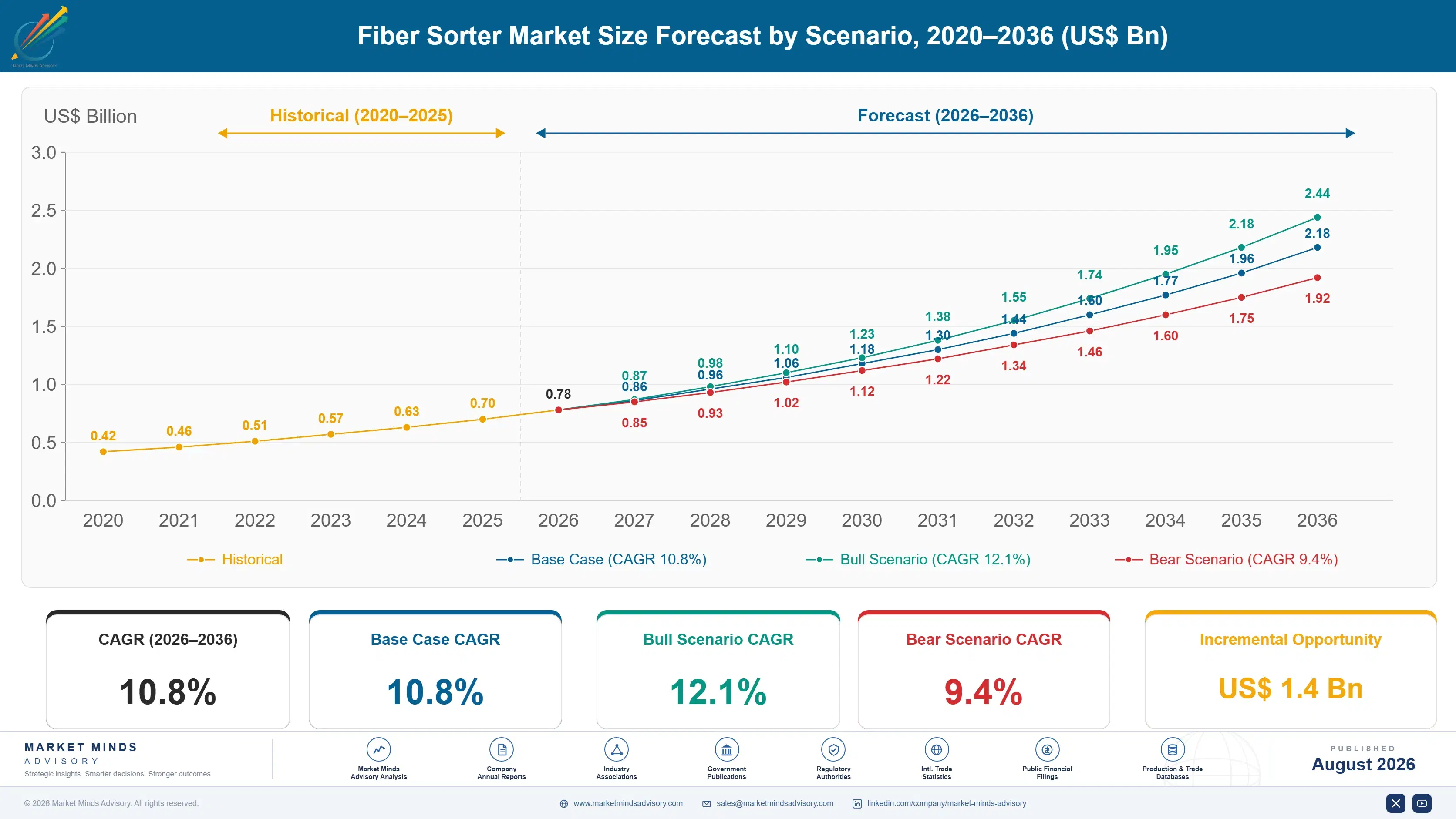
Fiber sorter demand grew unevenly through 2020 to 2025, held back by limited textile recycling infrastructure investment, then accelerated as the EU's mandatory separate textile collection requirement took effect in January 2025 and forced recyclers to invest in automated sorting capacity ahead of the deadline. Equipment order backlogs extended significantly, producing a historical CAGR of 9.5% that understates the acceleration underway.
The base case assumes 10.8% annual growth through 2036, driven by three mechanisms. First, EU extended producer responsibility schemes are funding textile collection and sorting infrastructure buildout across member states beyond the original 2025 collection mandate. Second, chemical and mechanical textile-to-textile recycling capacity expansion requires precisely sorted feedstock by fiber composition, directly increasing sorter throughput demand per tonne of collected material. Third, AI-enabled robotic picking technology is expanding the range of materials sorters can classify accurately, pulling forward equipment replacement cycles ahead of schedule.
The bull case assumes faster EU state EPR implementation and expanding textile-to-textile recycling capacity pull growth toward 12.1%. The bear case centers on slower-than-expected national transposition of EU collection rules and continued reliance on lower-cost manual sorting in cost-constrained markets, pulling growth down toward 9.4% if enforcement of separate collection requirements proves inconsistent across states.

Regulatory Mandate and Sorting Precision Economics

Fiber sorter adoption has become a regulatory compliance decision as much as a productivity one. Recyclers increasingly install automated optical sorting lines because separate textile collection mandates require them to sort collected material by fiber composition for downstream recycling routing, and that compliance requirement now shows up directly in municipal and private recycler capital budgets they track closely.
CR5 CONCENTRATION52%Reflects moderate consolidation among global optical sorting equipment makers
HYPERSPECTRAL SYSTEM PRICE PREMIUM50-70%Premium buyers pay over standard NIR sorting line configurations
EU TEXTILE COLLECTION SHARE44%Share of global separately collected textile waste generated there
FIBER IDENTIFICATION ACCURACY RATE88-96%Typical accuracy range across blended and mixed textile streams
SENSOR COST SHARE38-46%Portion of equipment cost tied to sensors and optics
AVERAGE SORTING LINE THROUGHPUT1.5-4.5 tonnes per hourTypical processing capacity across installed commercial sorting lines
The European Union generates roughly 44% of global separately collected textile waste volume, reflecting both its mandatory collection requirement and its comparatively mature recycling infrastructure relative to other regions still building collection systems. Equipment makers price accordingly, charging meaningfully more for hyperspectral sorting systems sold into EU markets than into cost-constrained regions still relying primarily on manual sorting.
The next decade will reward equipment makers that improve fiber-identification accuracy on blended and dark-colored textiles faster than those still competing purely on throughput speed. Regulatory enforcement intensity, more than raw sorting technology capability, will set the pace of adoption in markets still finalizing national collection mandates. Expect sorting line throughput to keep growing faster than average selling price, compressing per-unit margins even as total category revenue expands steadily across nearly every major recycling market worldwide as collection volume scales.
"A sorting line that can't tell polyester-cotton blends from pure cotton isn't compliant, it's decorative. The EU mandate didn't just require collection, it quietly required accuracy nobody had really needed to deliver at scale before."
Director, Circular Economy and Recycling Equipment Practice · MMA Construction a

Market Trends

AI-Enabled Robotic Picking Improves Garment-Level Sorting

Robotic picking arms guided by computer vision and machine learning can now identify and physically separate individual garments by fiber composition, color, and condition at speeds approaching manual sorting rates while maintaining meaningfully higher classification accuracy on difficult items like blended fabrics. Several equipment makers have moved robotic picking systems from pilot installations into standard commercial product lines since 2023, targeting the highest-value reuse and rewear sorting tier where garment-level precision commands the strongest price premium. Recyclers adopting robotic picking report lower labor cost per tonne than manual sorting lines, even after accounting for capital cost.
Market Impact: Adds order backlogs 2-3 quarters long
EU Extended Producer Responsibility Schemes Fund Sorting Infrastructure

EU member states are rolling out extended producer responsibility schemes that require textile brand owners to fund the cost of collecting and sorting garments, and several national schemes now direct a meaningful share of collected fees toward co-financing sorting infrastructure at municipal and private recycling facilities. This funding mechanism is accelerating purchasing timelines beyond what recyclers could otherwise afford from tipping fees alone, since equipment carries upfront capital cost smaller recyclers previously could not justify. France's EPR scheme, among the longest-running in the EU, is increasingly used as a policy template.
Market Impact: Requires fiber purity above 92% threshold

Market Opportunities and Growth Drivers

EU Separate Textile Collection Mandate Drives Equipment Orders

The EU's requirement that member states establish separate collection systems for textile waste, effective from January 2025, is forcing municipalities and private waste operators to invest in sorting capacity capable of processing this newly formalized collection stream rather than routing it to general municipal solid waste facilities not configured for textile-specific classification. Recyclers report collected textile volume increasing faster than existing manual sorting capacity can process, creating a backlog automated sorting equipment is best positioned to resolve. Equipment makers report order backlogs extending into multi-quarter waits as demand from newly compliant municipalities outpaces available manufacturing capacity.
Market Impact: Capital costs reach US$2-5 million

Textile-to-Textile Recycling Capacity Requires Precise Fiber Sorting

Chemical and mechanical textile-to-textile recycling processes require feedstock sorted precisely by fiber composition, since even small contamination from incompatible fiber types can degrade recycled fiber quality or damage processing equipment, making sorting accuracy a direct input into recycling economics rather than just a logistics step. New chemical recycling facilities coming online across Europe are specifying minimum fiber purity thresholds in their feedstock contracts that only hyperspectral or advanced NIR sorting systems can reliably deliver at commercial volume. This dynamic is pulling sorting equipment demand forward ahead of collection volume growth alone.
Market Impact: Cuts accuracy 15-25% on dark textiles

Market Restraints and Challenges

High Capital Cost Limits Smaller Recycler Access

Hyperspectral and advanced NIR sorting lines carry capital costs that can exceed the annual revenue of many smaller regional recyclers, and financing options remain limited since sorting equipment lacks the resale market depth that helps lenders value collateral for more established equipment categories. The root cause is that the market remains young enough that used equipment resale values are not yet well established, making lenders cautious about extending favorable terms. Smaller recyclers unable to secure financing are responding by pooling capital through regional cooperatives or accessing shared sorting capacity at larger facilities.
Market Impact: Cuts labor cost per tonne 30-40%

Blended and Dark-Colored Textile Sorting Remains Technically Difficult

Blended fabrics combining multiple fiber types and dark-colored or heavily printed textiles remain the hardest materials for optical sensors to classify accurately, since standard near-infrared spectroscopy struggles to distinguish overlapping fiber signatures and dark colors absorb the light wavelengths sensors depend on. The root cause is a fundamental physics limitation of current sensor technology rather than a solvable software problem, meaning accuracy improvements require genuinely new sensor hardware rather than incremental algorithm refinement. Equipment makers are responding by combining multiple sensor types, including hyperspectral imaging alongside near-infrared, and adding machine learning classification models trained on expanding material sample libraries.
Market Impact: Funds 30-50% of costs
3 additional market trends, 4 additional growth drivers, and 3 additional restraints and challenges are covered in the full report. Contact sales@marketmindsadvisory.com to access the complete intelligence.

Segment CAGR and Growth Architecture

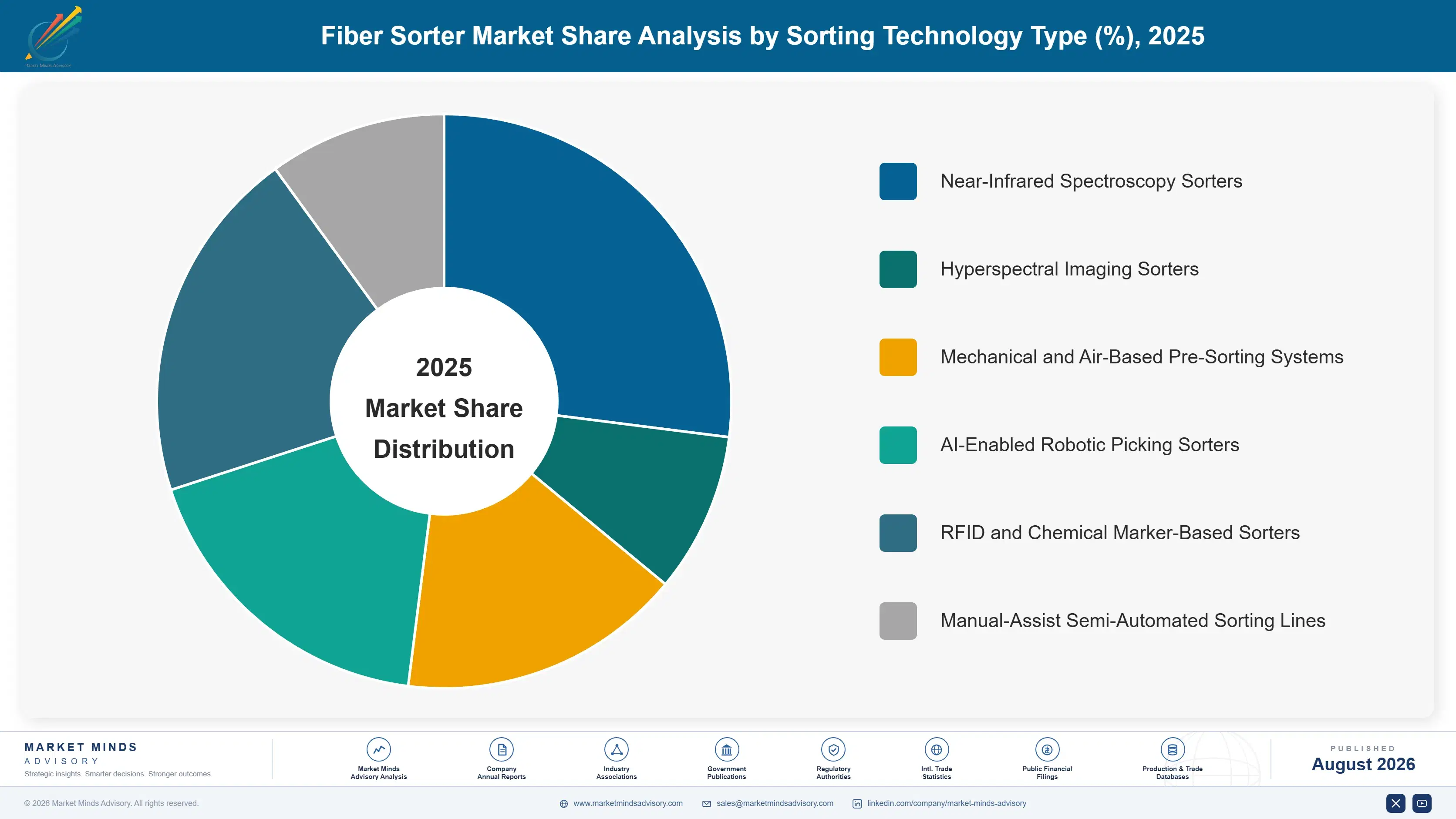
This report segments the fiber sorter market by sorting technology type across near-infrared spectroscopy sorters, hyperspectral imaging sorters, mechanical and air-based pre-sorting systems, AI-enabled robotic picking sorters, RFID and chemical marker-based sorters, and manual-assist semi-automated sorting lines. Technology type was chosen over end-use application because purchasing and financing decisions follow sorting technology capability rather than the specific waste stream processed.
fiber-sorter-market-market-share-analysis-1787301175564

AI-Enabled Robotic Picking Sorters

AI-enabled robotic picking sorters are the fastest-growing category at 14.9% annually, roughly 38% faster than the market average. Garment-level reuse and rewear sorting is the primary demand driver, since robotic picking systems combine computer vision classification with physical separation in a single automated step that manual sorting lines cannot match on both speed and accuracy simultaneously. Recyclers targeting the highest-value resale and rewear market are adopting robotic picking fastest, since garment condition and brand identification, not just fiber composition, determine resale value in that channel specifically. Equipment makers including TOMRA and Pellenc ST are expanding robotic picking product lines aggressively, and installed base remains small enough that early movers are capturing a disproportionate share of new orders industry-wide currently.
CAGR 14.9%

Hyperspectral Imaging Sorters

Hyperspectral imaging sorters, the second-fastest category at 12.8% annually, benefit from their ability to capture far more spectral detail per material sample than standard near-infrared sensors, giving them meaningfully better accuracy on blended fabrics and dark-colored textiles that standard NIR systems struggle to classify reliably. Chemical recycling facilities increasingly specify hyperspectral-sorted feedstock in their supply contracts, since the fiber purity chemical recycling processes require exceeds what standard NIR sorting can consistently deliver at commercial volume. Equipment cost for hyperspectral systems runs 50 to 70% above standard NIR configurations, but recyclers serving offtake contracts increasingly view that premium as a cost of market access. Adoption concentrates among larger recyclers with the capital and offtake volume to justify the investment.
CAGR 12.8%
Full segment breakdown across 6 segments available in the complete report.

Regional Architecture and Country Demand Map

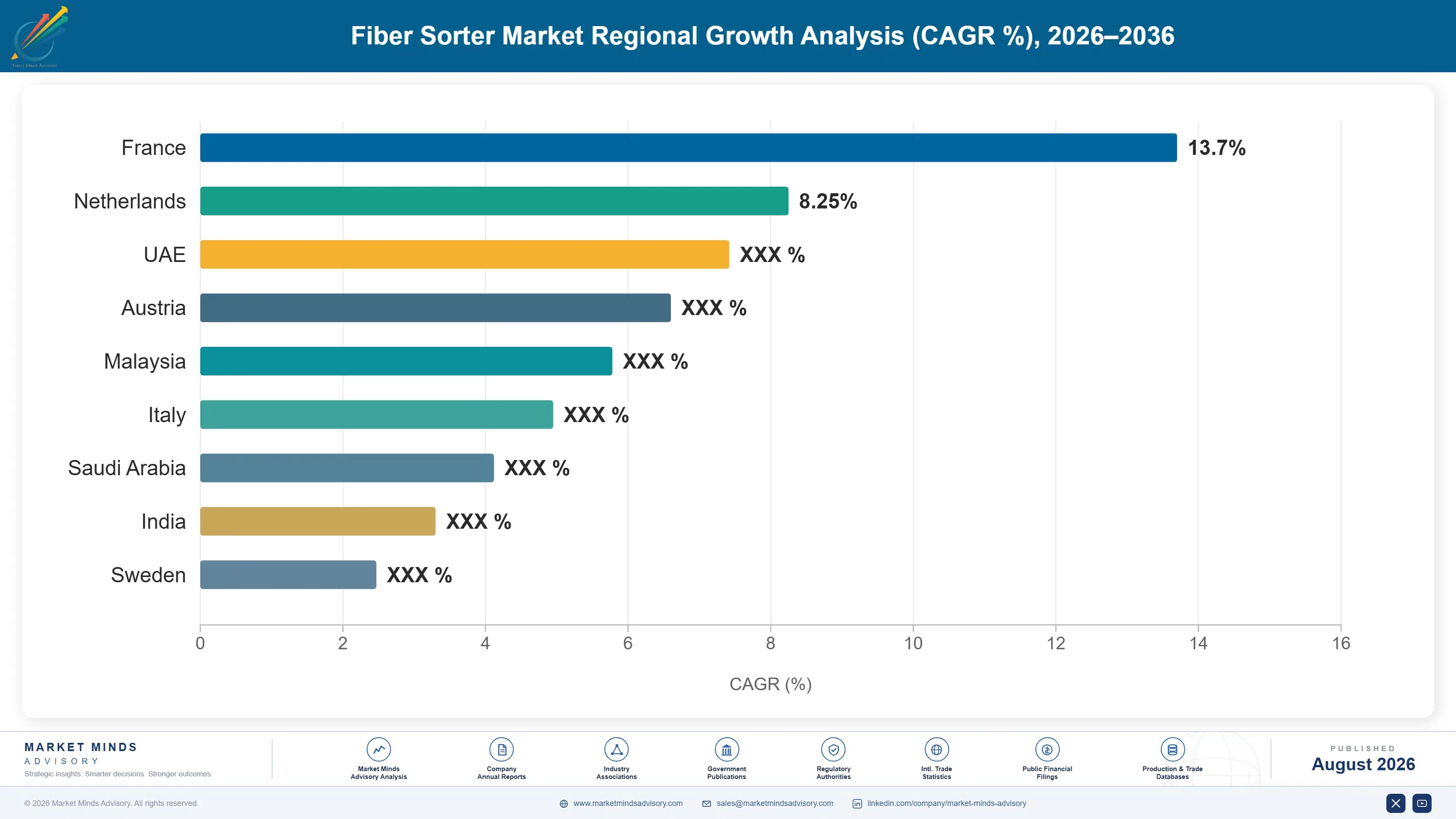
Western Europe retains the largest regional share on regulatory mandate and infrastructure maturity, with South Asia and Pacific expanding fastest as textile waste volume and recycling investment scale. East Asia and North America follow behind, while Latin America, the Middle East and Africa, and Eastern Europe remain earlier-stage markets.

North America

US textile collection remains largely voluntary and fragmented across private and nonprofit collection networks, lacking the unified regulatory mandate driving European equipment demand, though several states including California have advanced textile-specific extended producer responsibility legislation that is beginning to generate comparable investment momentum. Canada's provincial recycling programs are exploring textile-specific collection mandates modeled partly on the EU framework, though implementation remains earlier-stage than in Europe currently. Mexico functions primarily as an export destination for used textiles rather than a formal sorting equipment market, given its still-developing recycling infrastructure and lower domestic collection formalization relative to its northern neighbors, though nearshoring trends are beginning to shift some manufacturing waste sorting investment there as well.
Share: 22% | CAGR: 9.8% (2026 to 2036)

Western Europe

The EU's mandatory separate textile collection requirement, effective since January 2025, and expanding member state extended producer responsibility schemes make Western Europe the most mature and fastest-scaling fiber sorter market globally, with France and the Netherlands running the longest-established national programs other member states increasingly reference. Germany's recycling infrastructure investment is scaling rapidly to meet both domestic collection mandate compliance and growing chemical recycling feedstock demand from newly commissioned facilities. The UK runs a parallel but separate collection framework post-Brexit, generating comparable equipment demand despite falling outside direct EU mandate coverage. Southern European markets including Spain and Italy are scaling collection and sorting infrastructure investment somewhat more slowly than Northern Europe, reflecting later national scheme implementation timelines.
Share: 26% | CAGR: 9.3% (2026 to 2036)
Regional intelligence for 5 additional markets available in the complete report: East Asia, South Asia and Pacific, Latin America, Middle East and Africa, Eastern Europe. Contact sales@marketmindsadvisory.com.
fiber-sorter-market-country-cagr-analysis-1787301176084

Where Fiber Sorter Equipment Margins Concentrate

Margin in this market increasingly sits in sensor technology differentiation, service contracts, and data analytics rather than the base mechanical sorting line alone. Four levers explain most of the gap between equipment makers still competing purely on throughput and price and those capturing recurring revenue across the full equipment lifecycle from installation through ongoing operation.

Differentiating Through Hyperspectral Sensor Technology Investment

Equipment makers offering hyperspectral imaging sensors, which capture more spectral detail than standard near-infrared systems, command a 50 to 70% price premium over standard NIR configurations, since recyclers serving chemical recycling offtake contracts increasingly require the fiber purity accuracy only hyperspectral systems can reliably deliver at commercial volume. This premium reflects genuine technical differentiation rather than brand positioning, since the sensor hardware carries meaningfully higher component cost than standard NIR systems require. Equipment makers without hyperspectral capability are increasingly locked out of the highest-value feedstock contracts, ceding that segment to competitors with more advanced sensor technology.
Market Impact: Commands a 50-70% premium over standard NIR lines

Bundling Service Contracts and Sensor Calibration Support

Recyclers increasingly purchase multi-year service and sensor calibration contracts alongside sorting equipment, since maintaining classification accuracy over time requires periodic recalibration and software updates that most recyclers lack the in-house expertise to perform independently. These service contracts carry margins meaningfully above the equipment sale itself, and attachment rates are rising as recyclers increasingly view ongoing calibration support as essential rather than optional given how directly sorting accuracy affects downstream material sales revenue. Equipment makers with the most extensive service infrastructure report contract renewal rates above 70%, meaningfully higher than smaller competitors lacking comparable field service coverage can typically sustain.
Market Impact: Service contract renewal rates exceed 70% overall industry-wide

Monetizing Sorting Data and Material Composition Analytics

Equipment makers increasingly offer data analytics subscriptions that give recyclers detailed material composition reporting across their sorted output, information that recyclers need to document for extended producer responsibility compliance reporting and to negotiate better pricing with downstream recycling buyers who pay a premium for verified fiber purity data. This data layer carries margins closer to enterprise software than industrial equipment, and attachment rates are rising above 40% as EPR reporting requirements expand across EU states. Equipment makers building proprietary data platforms are creating a switching cost beyond the sorting line, since recyclers build compliance workflows around a platform's data format.
Market Impact: Data subscriptions add 10-15% to account value overall

Expanding Financing Programs for Smaller Recyclers

Equipment makers offering in-house financing or leasing programs capture sales from smaller recyclers who cannot access favorable third-party equipment financing given the fiber sorter market's still-limited resale value data and depreciation history. This financing capability opens a meaningfully larger addressable customer base beyond the largest, best-capitalized recyclers who can pay cash or secure conventional financing independently, and equipment makers report that financed sales carry better overall account economics once interest income is included alongside the equipment margin itself. Manufacturers without financing capability are increasingly losing smaller recycler accounts, roughly 25% of the market, to competitors willing to structure creative terms.
Market Impact: Financed sales expand the addressable market by 25%+

Who Controls the Margin Pool

CR5 concentration sits at 52%, reflecting moderate consolidation among established optical sorting equipment makers. TOMRA and Valvan lead on installed base and sensor technology depth, but the gap to challengers including Pellenc ST and Stadler has narrowed as hyperspectral and robotic picking technology becomes available through smaller specialists pursuing focused development.
Competitive activity plays out on three fronts. Sensor technology upgrades, particularly hyperspectral imaging adoption, are the most visible, with nearly every major equipment maker now offering or developing a hyperspectral configuration. Service and data analytics bundling is the second front, where TOMRA and Valvan use their broad installed base to defend recurring revenue. Financing and leasing programs are the third front, where equipment makers compete to win smaller recycler accounts that cash-constrained buyers cannot otherwise access.

Pressure is building from two directions rankings have not caught up with. Refind Technologies has moved from a Swedish regional specialist into a genuine European competitor specifically through its textile-focused sorting platform, taking share from larger generalist sorting equipment makers in EU markets. Chinese domestic manufacturers are simultaneously expanding into conventional NIR sorting categories in export markets, competing on price against established distribution networks that took decades to build.
fiber-sorter-market-company-positioning-matrix-1787301176607

Competitive Moat and Risk Dimensions

TOMRA SORTING SOLUTIONS

Moat: Broadest Global Service Network

TOMRA's global service and installation network, the deepest in the optical sorting industry, gives it response time and parts availability advantages that smaller competitors cannot match in most markets worldwide, letting it guarantee uptime commitments to large recyclers that competitors with thinner service coverage simply cannot offer credibly.
TOMRA SORTING SOLUTIONS

Risk: Broad Portfolio Dilutes Textile Focus

TOMRA's sorting portfolio spans plastics, metals, paper, and food alongside textiles, meaning textile-specific sensor development competes internally for engineering resources against larger, more established sorting categories that have historically generated far more company revenue and carried greater internal priority for annual capital investment allocation decisions.
VALVAN BALING SYSTEMS NV

Moat: Pioneer Textile Sorting Technology

Valvan's Fibersort technology, developed specifically for textile fiber composition sorting rather than adapted from general waste sorting equipment, gives it a technical head start and deep textile-specific expertise that generalist sorting equipment makers entering the category later cannot easily replicate at comparable depth or speed.
VALVAN BALING SYSTEMS NV

Risk: Limited Scale Outside Core Europe

Valvan's installed base and service network remain concentrated in Western Europe, leaving it more exposed to competitors with broader global service infrastructure as textile sorting demand expands into North America, Asia, and other regions where Valvan currently has limited direct presence and fewer established local partnerships.

Players Tracked

Prominent Players

TOMRA Sorting Solutions
Pellenc ST
Stadler Anlagenbau GmbH
Valvan Baling Systems NV
Bollegraaf Recycling Solutions

Other Key Players

CP Group LLC
Machinex Industries Inc.
Van Dyk Recycling Solutions
Steinert GmbH
Bühler Sortex Ltd.
Refind Technologies AB
Wieland Textiles B.V.
Comber Technologies S.r.l.
Sesotec GmbH
Andritz AG
Eldan Recycling A/S
Lindner-Recyclingtech GmbH
Kiverco Ltd.
Vecoplan AG
Guidetti S.r.l.

Recent Developments

MARCH 2025

TOMRA Expands Sensor Manufacturing Capacity

TOMRA completed an organic capacity expansion at its sensor manufacturing facility to add dedicated hyperspectral imaging component production lines, responding to rising demand from recyclers seeking chemical recycling-grade fiber purity accuracy and shorter delivery lead times on new sorting line orders across European and export markets.
Signal: Signals TOMRA is committing manufacturing capital to hyperspectral technology rather than treating it as a niche configuration.
JULY 2025

Valvan Signs Supply Agreement With European Municipal Collection Consortium

Valvan signed a multi-year supply agreement with a consortium of European municipalities to provide sorting equipment and technical support across their newly established textile collection programs, replacing a prior fragmented procurement approach with a single qualified supplier relationship covering multiple facilities and future expansion phases.
Signal: Confirms that municipal collection programs are increasingly consolidating equipment procurement toward fewer qualified suppliers across the region.
NOVEMBER 2025

Pellenc ST Acquires AI Vision Robotic Sorting Startup

Pellenc ST acquired a specialist AI vision and robotic picking startup to strengthen its garment-level sorting capability and accelerate its robotic picking product roadmap, adding machine learning engineering talent it previously lacked in-house for rapid feature development and faster commercial deployment across its broader product line.
Signal: Indicates equipment makers are increasingly building robotic picking capability through acquisition rather than slower internal development timelines alone.

Sensor and Optics Component Exposure

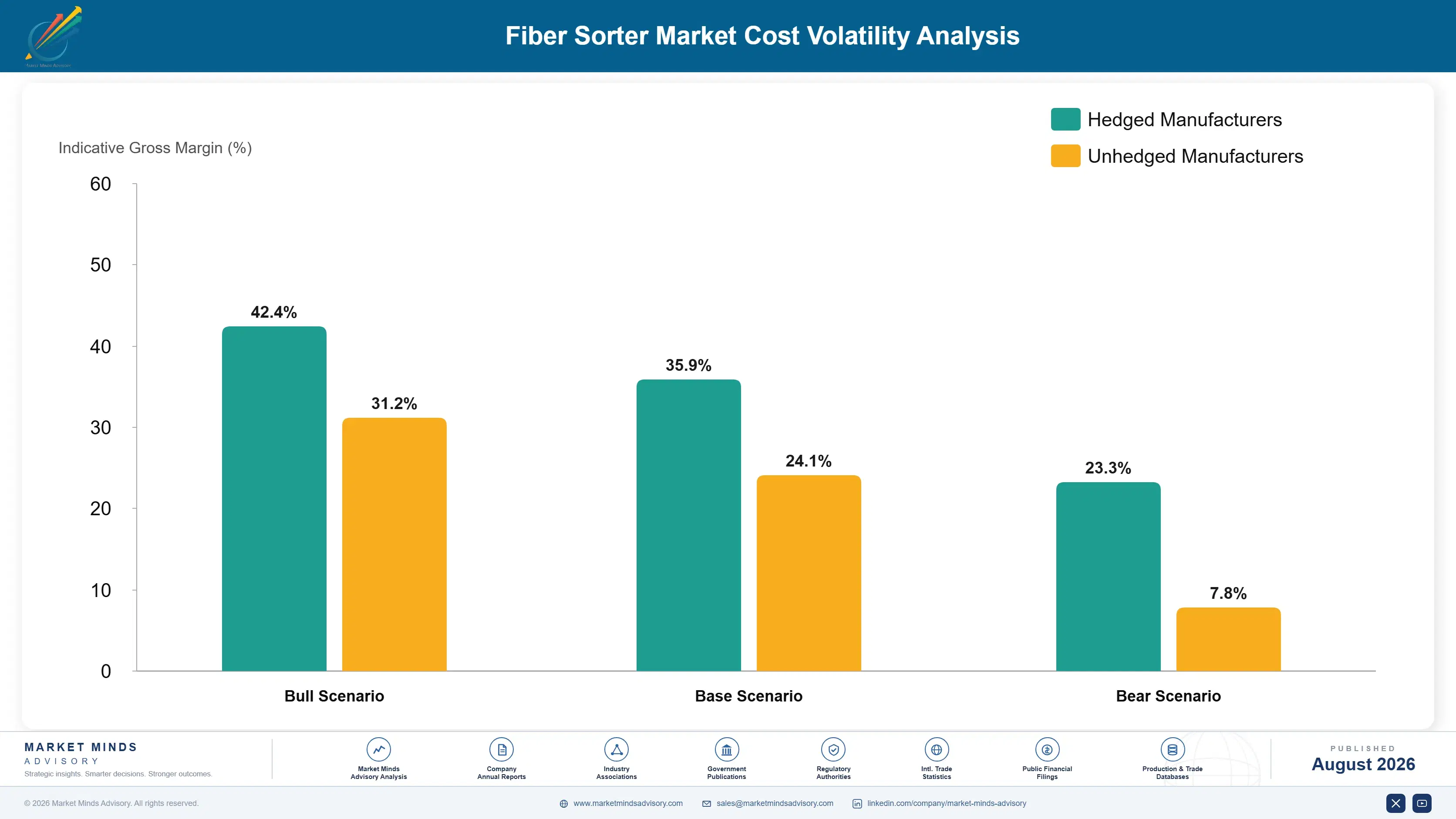
Sensors, optics, and specialized imaging components account for 38 to 46% of fiber sorter manufacturing cost, with mechanical conveying and separation hardware making up most of the remainder. Hyperspectral and advanced NIR sensor components are sourced from a small number of specialized optics and semiconductor suppliers, while mechanical components draw on a broader industrial equipment supply base.
Specialized optics and semiconductor sensor component prices rose more than 20% within three quarters during 2022 as broader semiconductor supply chain disruption spilled into specialty imaging component availability, according to company annual report disclosures from major equipment makers. That constraint forced several manufacturers to extend delivery lead times on new orders and, in some cases, redesign sensor configurations around available component alternatives, an unusual engineering compromise for equipment where sensor performance directly determines classification accuracy.

Scale manufacturers like TOMRA negotiate sensor and optics supply contracts across their full global sorting equipment portfolio, giving them better pricing than smaller specialists buying at lower volumes. Manufacturers with in-house sensor development capability carry a durable technology and cost advantage over competitors relying entirely on third-party sensor suppliers, reshaping which equipment makers can credibly compete on hyperspectral configurations.
fiber-sorter-market-cost-volatility-analysis-1787301176802

Qualifying Multiple Sensor Component Suppliers

Manufacturers are qualifying sensor and optics component suppliers across multiple regions rather than relying on a single specialized supplier, reducing exposure to any single supplier's capacity constraints or quality issues. This adds supplier qualification complexity but has measurably reduced delivery delays passed through to recycler customers during recent semiconductor supply disruptions and demand spikes.

Locking Multi-Year Sensor Component Contracts

Larger manufacturers are negotiating multi-year fixed-price sensor and optics supply agreements directly with component makers, trading some upside if prices fall for protection against sudden spikes tied to broader semiconductor market volatility. Smaller manufacturers without comparable purchasing volume typically cannot access these terms and remain more exposed to spot component pricing swings throughout the year.

Building In-House Sensor Development Capability

Several manufacturers are building in-house sensor and optics development capability rather than relying entirely on third-party component suppliers, trading upfront research investment for long-run control over sensor performance and component cost. Smaller manufacturers without comparable capital access typically cannot pursue this path and remain dependent on third-party sensor technology availability and negotiated pricing terms.

Portfolio Architecture for Margin Defence

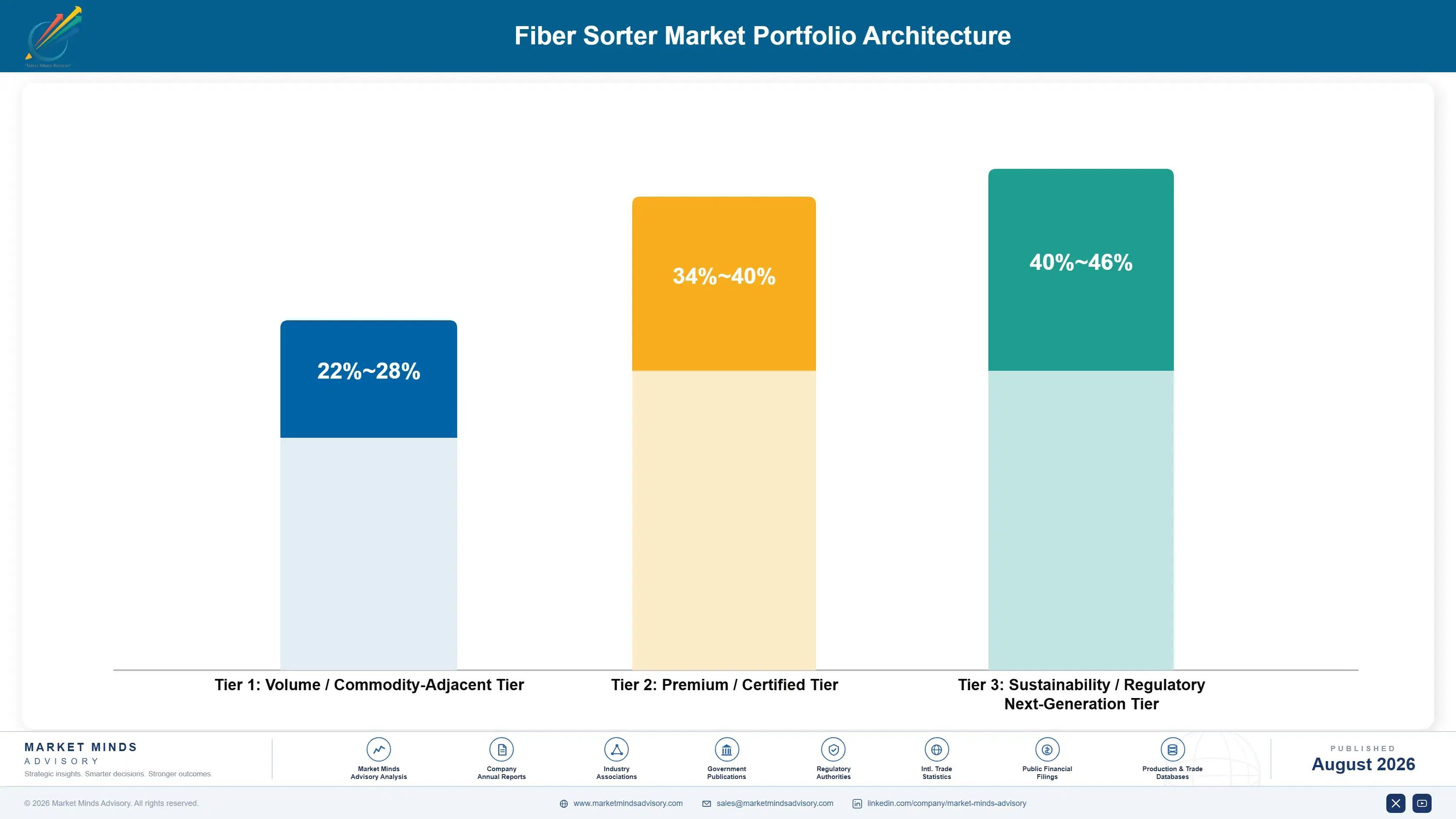
Portfolio economics split into three tiers. Volume commodity-adjacent equipment, primarily standard NIR sorting lines without advanced sensor configurations, runs on modest margins driven by intense price competition among established manufacturers and increasingly capable regional competitors. Premium and certified equipment, carrying hyperspectral sensors and validated fiber purity performance data, commands meaningfully better margins because recyclers pay for the accuracy needed to access ch
The tension between volume and premium runs deep, since municipal and cost-constrained recyclers want the lowest acquisition cost per line while chemical recycling-oriented recyclers increasingly demand the fiber purity accuracy that only premium-tier hyperspectral configurations deliver consistently. TOMRA and Valvan manage this by maintaining separate standard and premium product lines, letting recycler customers choose configuration based on their specific offtake contract requirements.

High-value pools concentrate in hyperspectral and robotic picking platforms, where sensor technology scarcity and chemical recycling contract requirements both support pricing power that ordinary commodity sorting equipment cannot replicate. Capital is flowing fastest into sensor technology development and robotic picking commercialization, as manufacturers race to establish the technology position that will define premium equipment competitiveness through the next decade.

Volume / Commodity-Adjacent Tier

Standard near-infrared sorting lines without hyperspectral sensors or robotic picking capability, priced primarily on throughput and unit cost, competing mainly on service network reach and basic reliability across high-volume municipal and mixed-waste sorting facilities.
Gross Margin: 22-28%

Premium / Certified Tier

Hyperspectral sorting systems bundled with validated fiber purity performance data and service contracts that chemical recycling-oriented recyclers value for offtake contract eligibility and predictable classification accuracy across their operating life.
Gross Margin: 34-40%

Sustainability / Regulatory / Next-Generation Tier

AI-enabled robotic picking and next-generation sensor platforms addressing garment-level reuse sorting and expanding regulatory compliance data requirements, where technology scarcity and early-mover advantage both support the strongest pricing power in the category.
Gross Margin: 40-46%
fiber-sorter-market-portfolio-architecture-1787301177310

High-value Sub-segments and Strategic Watch-out

Chemical Recycling-Grade Hyperspectral Systems

Expanding chemical recycling feedstock contracts and rising fiber purity requirements make this segment both technically necessary and commercially validated, commanding sustained pricing power even as competing sensor technologies gradually close the accuracy gap across the broader premium equipment category over the next several years of adoption.
Gross Margin: 42-48%

Service and Calibration Support Contracts

Recurring service and sensor calibration revenue is growing steadily as recyclers standardize on premium sorting platforms requiring ongoing accuracy maintenance, commanding a durable subscription-like revenue premium even though capital equipment volume growth trails the fastest sensor technology segments by a considerable and steadily widening margin.
Gross Margin: 55-62%

Standard NIR Sorting Lines

Conventional near-infrared sorting lines remain the largest unit-volume segment by far, competing mainly on throughput and price rather than technology differentiation, with margins compressed by intense competition among established and increasingly capable regional equipment manufacturers expanding their export volume into new markets and territories each year.
Gross Margin: 20-26%

Legacy Mechanical Pre-Sorting Systems

Older mechanical and air-based pre-sorting systems without optical classification capability face rising obsolescence risk as recyclers adopt sensor-based sorting, and manufacturers with heavy legacy exposure risk losing accounts to optical sorting competitors faster than they can convert their product lines to newer sensor-based configurations at scale.
Gross Margin: 12-18%

How Fiber Sorter Demand Recurs

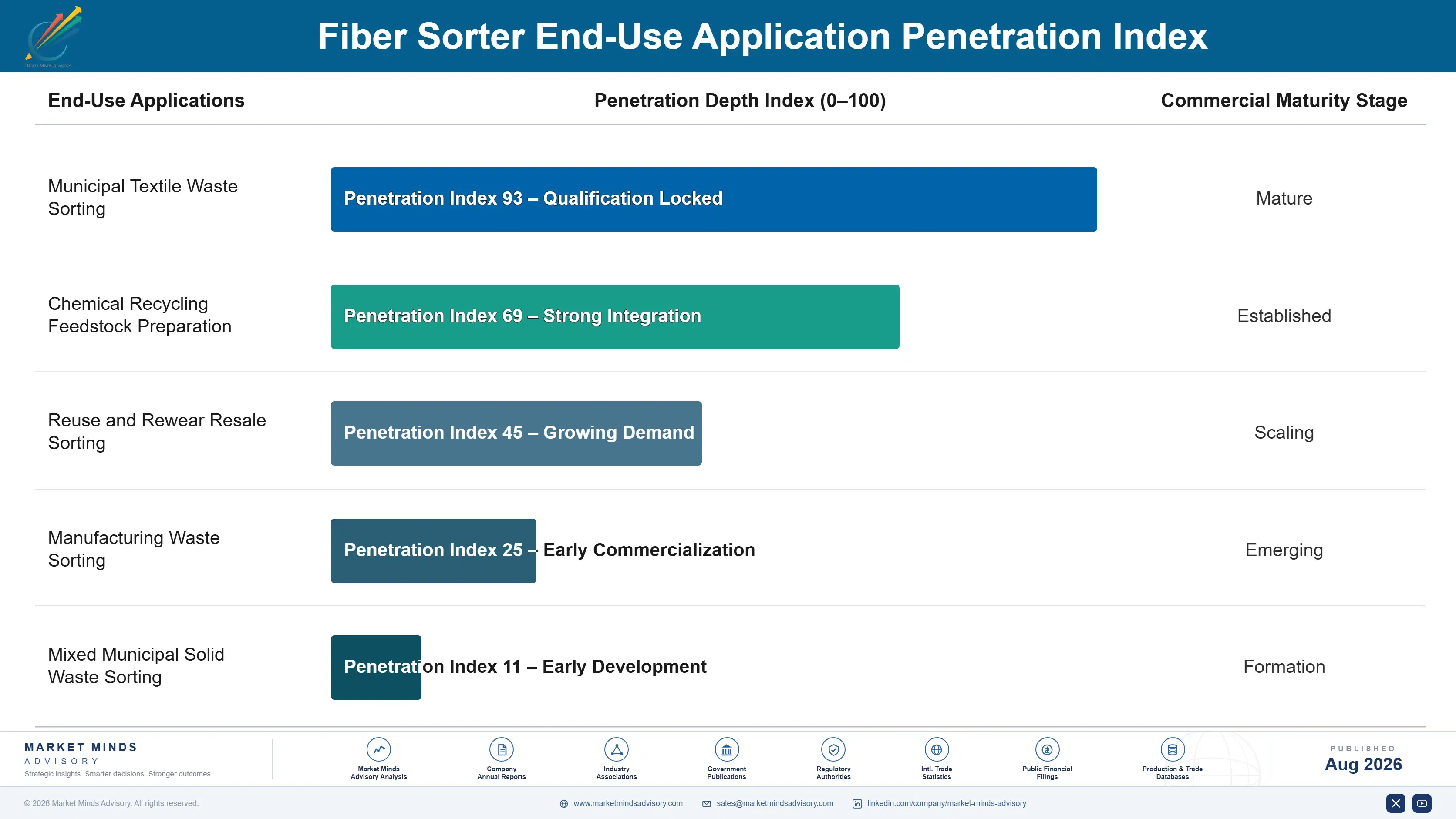
Fiber sorter demand carries a genuine annuity quality through service contracts, sensor calibration, and data analytics subscriptions layered on top of the initial capital equipment sale. Recyclers require ongoing calibration to maintain classification accuracy regardless of collection volume fluctuations, and service contract renewal rates above 70% give equipment makers a recurring revenue stream that persists independent of new equipment sales cycles across nearly every recycler account.
Adoption depth varies meaningfully by end-use segment. Chemical recycling feedstock preparation shows the deepest hyperspectral adoption, since fiber purity requirements there are both most stringent and most mature. Reuse and rewear sorting adoption is growing but newer as a robotic picking application, tracking garment-level precision demand more recently. Mixed municipal waste sorting adoption remains steadier and less dynamic, since conventional NIR technique still dominates that lower-value, higher-volume application.

A younger generation of recycling facility operators, trained on sensor-based classification and data-driven compliance reporting rather than manual sorting judgment, is accelerating facility demand for automated sorting platforms. That generational shift is reshaping which equipment makers even get invited into municipal and private recycler capital equipment evaluation processes in the first place, and which get quietly excluded.
fiber-sorter-market-end-use-penetration-index-1787301177800

What Wins in Fiber Sorting

These are among the four positions where our research anticipates prominent divergence between winners and laggards over the coming forecast period. Each is grounded in the demand model, the regulatory perimeter, and the announced capacity pipeline.
01 / SENSOR TECHNOLOGY INVESTMENT

Invest in hyperspectral sensor capability before it becomes standard equipment

Equipment makers that invest in hyperspectral sensor capability ahead of it becoming standard equipment capture premium pricing and chemical recycling contract access before that becomes a baseline market entry requirement. Waiting until hyperspectral becomes standard means competing for recycler capital budgets against manufacturers that built their sensor technology and manufacturing scale years earlier, at a moment when demand is accelerating across the entire category simultaneously. Early movers are also better positioned to win chemical recycling offtake-linked equipment contracts that increasingly specify fiber purity accuracy as an evaluation criterion.
02 / REGULATORY COMPLIANCE TIMING

Position ahead of EU member state EPR scheme rollout timelines

Equipment makers that position ahead of individual EU member state extended producer responsibility scheme rollout timelines capture the initial wave of compliance-driven equipment orders before competitors recognize the opportunity and enter the market. Waiting until a national scheme fully launches means competing for a compressed installation window against every other equipment maker simultaneously, rather than building customer relationships and reference installations during the earlier planning phase. The window to establish this timing advantage narrows as more member states finalize their national implementation timelines and equipment makers redirect sales attention accordingly.
03 / FINANCING PROGRAM DEVELOPMENT

Build in-house financing to reach smaller, cash-constrained recyclers

Equipment makers that build in-house financing and leasing programs capture sales from smaller recyclers who cannot access favorable third-party financing given the market's still-limited equipment resale value data. This financing capability opens a meaningfully larger addressable customer base beyond the largest, best-capitalized recyclers, and financed sales carry better overall account economics once interest income is included alongside equipment margin. Manufacturers without financing capability risk losing smaller recycler accounts to competitors willing to structure payment terms matching a smaller operator's cash flow constraints and collection volume growth timeline.
04 / SERVICE INFRASTRUCTURE INVESTMENT

Build service and calibration infrastructure ahead of installed base growth

Equipment makers that build extensive service and calibration infrastructure ahead of installed base growth capture recurring service revenue that persists independent of new equipment sales cycles, unlike those relying on third-party service providers who capture much of that margin instead. TOMRA's and Valvan's service contract renewal rates above 70% demonstrate how sticky this revenue becomes once recyclers build maintenance workflows around a specific manufacturer's service relationship. The window for proprietary service infrastructure to function as genuine differentiation narrows as third-party service providers become more capable across the industry.

Engagement Snapshot From the Field

A live engagement with an industry participant carrying material or product regulatory and market exposure ahead of a defining policy shift, showing how our research translates into a defensible multi-year portfolio strategy.
MARKET MINDS ADVISORY · CLIENT ENGAGEMENT SUMMARY
Fiber Sorter Producer Strategic Portfolio Review and Transition Roadmap 2026·Investment Scenario on Fiber Sorter Exposure Evaluation 2025-26
CLIENT PROFILE
The client is a regional textile recycling operator running 3 sorting facilities across two EU member states, processing more than 45,000 tonnes of collected textile waste annually with an existing manual and semi-automated sorting workforce, and evaluating an annual equipment capital budget exceeding EUR 12 million (client-reported, unverified by MMA). The operator was evaluating whether to invest in hyperspectral sorting capability to access chemical recycling offtake contracts.
STRATEGIC CHALLENGE
The client needed to determine whether investing in hyperspectral sorting capability across its facility network would generate sufficient chemical recycling offtake revenue to justify the capital cost premium over continuing with standard near-infrared sorting equipment, given uncertainty about how quickly chemical recycling offtake demand would scale in its operating region.
MMA APPROACH
MMA conducted a facility-by-facility analysis correlating current sorting technology, throughput capacity, and material composition mix against regional chemical recycling facility offtake contract terms and pricing. The engagement combined primary interviews with the client's facility managers and comparative benchmarking against peer recycling operators that had already invested in hyperspectral sorting capability.
KEY FINDINGS
  1. Roughly 35% of the client's collected volume consisted of blended fabrics that standard NIR sorting could not classify with sufficient accuracy for chemical recycling offtake eligibility under current contract terms.
  2. Hyperspectral sorting capability at the highest-volume facility alone would generate enough chemical recycling offtake revenue to justify the equipment investment within approximately three years.
  3. Regional chemical recycling offtake demand was concentrated among a small number of buyers willing to pay a meaningful premium for verified fiber purity data above standard thresholds.
  4. Peer benchmarking showed operators that invested in hyperspectral capability early captured offtake contracts at better pricing than those that waited for offtake demand to become more established.
CLIENT PROFILE
The client is a regional textile recycling operator running 3 sorting facilities across two EU member states, processing more than 45,000 tonnes of collected textile waste annually with an existing manual and semi-automated sorting workforce, and evaluating an annual equipment capital budget exceeding EUR 12 million (client-reported, unverified by MMA). The operator was evaluating whether to invest in hyperspectral sorting capability to access chemical recycling offtake contracts.
STRATEGIC CHALLENGE
The client needed to determine whether investing in hyperspectral sorting capability across its facility network would generate sufficient chemical recycling offtake revenue to justify the capital cost premium over continuing with standard near-infrared sorting equipment, given uncertainty about how quickly chemical recycling offtake demand would scale in its operating region.
MMA APPROACH
MMA conducted a facility-by-facility analysis correlating current sorting technology, throughput capacity, and material composition mix against regional chemical recycling facility offtake contract terms and pricing. The engagement combined primary interviews with the client's facility managers and comparative benchmarking against peer recycling operators that had already invested in hyperspectral sorting capability.
KEY FINDINGS
  1. Roughly 35% of the client's collected volume consisted of blended fabrics that standard NIR sorting could not classify with sufficient accuracy for chemical recycling offtake eligibility under current contract terms.
  2. Hyperspectral sorting capability at the highest-volume facility alone would generate enough chemical recycling offtake revenue to justify the equipment investment within approximately three years.
  3. Regional chemical recycling offtake demand was concentrated among a small number of buyers willing to pay a meaningful premium for verified fiber purity data above standard thresholds.
  4. Peer benchmarking showed operators that invested in hyperspectral capability early captured offtake contracts at better pricing than those that waited for offtake demand to become more established.
RECOMMENDED STRATEGY
Phase 1: Phase 1 (Months 1-3): Prioritize hyperspectral sorting investment at the highest-volume facility identified through the offtake revenue and payback analysis. Phase 2: Phase 2 (Months 4-12): Expand hyperspectral capability to remaining facilities, sequencing rollout by regional offtake contract availability and demand signals. Phase 3: Phase 3 (Months 13-18): Evaluate rollout performance against offtake revenue assumptions, then negotiate expanded chemical recycling contracts based on validated fiber purity results.
OUTCOME
The client's phased hyperspectral rollout secured chemical recycling offtake contracts at the priority facility within the first year, generating revenue ahead of its internal base case projection (client-reported, unverified by MMA). Sequencing the rollout by offtake availability rather than deploying uniformly reduced total capital deployment meaningfully compared to the client's original facility-wide plan.

Frequently Asked Questions

Foundational context covering the market sizes, CAGR, scope, country, region and competition that inform every finding below. This section is provided to cover basics and most often pre-purchase conversations, answered from the MMA Primary Research Dataset.

What is the current size of the Fiber Sorter Market?

The market was valued at US$0.68 billion in 2025 and is projected to reach US$0.75 billion in 2026 as EU collection mandates and chemical recycling demand continue accelerating.

How large will the Fiber Sorter Market be by 2036?

MMA projects the market will reach US$2.1 billion by 2036, roughly 2.80 times its 2026 value, driven by expanding EU regulation and sensor technology adoption.

What is the CAGR for the Fiber Sorter Market 2026 to 2036?

The market is projected to grow at a 10.8% CAGR between 2026 and 2036, with a bull case of 12.1% and a bear case of 9.4%.

Which segment is growing fastest?

AI-enabled robotic picking sorters are the fastest-growing segment at 14.9% annually, roughly 38% faster than the category average, driven by garment-level reuse and rewear sorting demand.

Who are the major companies in the Fiber Sorter Market?

Leading manufacturers include TOMRA, Pellenc ST, Stadler, Valvan Baling Systems, and Bollegraaf, which together hold roughly half of category revenue on a disclosed-revenue basis today.

Which country is growing fastest?

India leads country-level growth at an estimated 14.2% annually, supported by formalization of its large existing textile recycling and sorting hub infrastructure centered around Panipat.

Report Segmentation Architecture

The full report scope spans multiple orthogonal segmentation dimensions, with cross-tabulated demand data provided for each dimension pair. Coverage extends further to regional breakdowns, trend trajectories, and the competitive detail needed to support segment-level decision-making.

By Sorting Technology Type

  • Near-Infrared Spectroscopy Sorters
  • Hyperspectral Imaging Sorters
  • Mechanical and Air-Based Pre-Sorting Systems
  • AI-Enabled Robotic Picking Sorters
  • RFID and Chemical Marker-Based Sorters
  • Manual-Assist Semi-Automated Sorting Lines

By End-Use Application

  • Municipal Textile Waste Sorting
  • Chemical Recycling Feedstock Preparation
  • Reuse and Rewear Resale Sorting
  • Manufacturing Waste Sorting
  • Mixed Municipal Solid Waste Sorting

By Commercial Dimension

  • Municipal and Public Sector
  • Private Recycler Direct
  • Equipment Leasing and Financing
  • Distribution Channel

By Region

  • North America
  • Western Europe
  • East Asia
  • South Asia and Pacific
  • Latin America
  • Middle East and Africa
  • Eastern Europe

Scope, Methodology, and Coverage

Every figure in this report is reproducible from documented input assumptions. The scope below maps the historical period, the forecast horizon, the segmentation dimensions, and the countries covered, alongside the underlying primary and qualitative methodology.
Historical Period
2020 to 2025
Forecast Period
2026 to 2036
Base Year
2025 (USD billions; MMA Primary Research Dataset, August 2026)
Market Definition
The Fiber Sorter market covers automated optical, mechanical, and AI-enabled sorting equipment used to classify post-consumer and post-industrial textile and fiber waste by material composition, color, and condition for recycling and reuse channels. It excludes general municipal solid waste sorting equipment not configured for textile-specific material identification and manual sorting labor services.
Quantitative Units
USD billions (current prices); installed unit shipments in hundreds where disclosed by segment
Segmentation Dimensions
By Sorting Technology Type; By End-Use Application; By Commercial Dimension; By Region
Regions Covered
North America, Western Europe, East Asia, South Asia and Pacific, Latin America, Middle East and Africa, Eastern Europe
Countries Covered
USA, China, Germany, France, UK, Japan, South Korea, India, Australia, Canada, Brazil, Mexico, Indonesia, Vietnam, Thailand, Malaysia, UAE, Saudi Arabia, South Africa, Nigeria, Turkey, Poland, Netherlands, Italy, Spain, Sweden, Switzerland, Argentina, Colombia, Singapore, and additional markets relevant to this sector
Key Companies Profiled
TOMRA Sorting Solutions, Pellenc ST, Stadler Anlagenbau GmbH, Valvan Baling Systems NV, Bollegraaf Recycling Solutions, CP Group LLC, Machinex Industries Inc., Van Dyk Recycling Solutions, Steinert GmbH, Bühler Sortex Ltd., Refind Technologies AB, Wieland Textiles B.V., Comber Technologies S.r.l., Sesotec GmbH, Andritz AG, Eldan Recycling A/S, Lindner-Recyclingtech GmbH, Kiverco Ltd., Vecoplan AG, Guidetti S.r.l.
Quantitative Methodology
Primary survey, n=3,800 respondents, Q4 2025, six countries; demand-side model with trade association cross-validation
Qualitative Methodology
47 expert interviews, Q4 2025; applied to validate demand model assumptions, identify emerging dynamics, and assess competitive positioning
Report Format
PDF and XLSX data workbook (Word format preview document)
Publisher
Market Minds Advisory
Report Code
MMA-2026-CON-119
Published
August 2026
Contact
sales@marketmindsadvisory.com | www.marketmindsadvisory.com

Purchase the full Fiber Sorter Market Report (2026 to 2036).

The full report delivers a complete quantitative and qualitative assessment of the fiber sorter market through 2036, including technology-type and country-level forecasts across all seven MMA-tracked regions. It profiles the twenty leading equipment makers shaping competitive dynamics, with detailed moat and risk analysis for the top two players and a full development timeline of recent corporate activity. The report includes primary survey data from 3,800 respondents and 47 expert interviews conducted in Q4 2025, alongside a dedicated input cost and regulatory compliance analysis. Buyers receive segmentation, regional, and competitive datasets formatted for direct integration into internal strategic planning models.
Technology-type and regional forecasts through 2036 inclusive
Competitive profiles of twenty leading global equipment makers
Primary survey data from 3,800 global respondents
Expert interview insights from 47 industry practitioners
Input cost and regulatory compliance risk analysis
Editable data tables for internal strategic modeling

Built For The People Who Decide

From boardroom strategy to bench-side execution, this report is read cover-to-cover by leaders shaping the next decade of their industry, turning demand scenarios, market dynamics and valuation benchmarks into decisions.
CXOs/ Presidents/ VPs/ Managers
M&A and Corporate Development
Strategy Teams and R&D Heads
Procurement and Product Directors
Regulatory and Compliance Leaders
Investor Relations and Equity Analysts