Market Minds Advisory
Fiber Reinforced Polymer Panel and Sheet Market

Fiber Reinforced Polymer Panel and Sheet Market: Trailer Lightweighting Meets a Construction-Rooted Category

Fiber reinforced polymer panel producers now face accelerating truck trailer lightweighting demand colliding with concentrated North American manufacturing capacity, expanding marine and RV adoption, and volatile resin pricing squeezing commodity margins.

Lead Analyst

Bilal Shaikh

Published

September 2026

Make Smarter Decisions with Customized Research Insights

Request a free sample report and evaluate market opportunities, growth trends, and competitive dynamics relevant to your business needs.

2025 MARKET VALUE$3.8BMarket Size 2025
2036 FORECAST VALUE$7.4BBase Case , 2026 to 2036
CAGR 2026 TO 20366.2 %Bull 7.4% / Bear 4.9%
INCREMENTAL OPPORTUNITY$3.3BNet 10- year value creation
EXPANSION MULTIPLE1.82x2036 value over 2026 base
Strategic Levers
M&A Pipeline
Regional Outlook
Country Rankings
Competitive Intelligence
Segmental Deep-dive
Call-Us : 91 93563 13602

Executive Snapshot and Market Trajectory

Trailer manufacturers are qualifying lightweight fiber reinforced polymer sidewall panels faster than producers can reliably scale automotive-grade output, creating a widening supply gap even as fleet operators increasingly specify lightweight composite panels to maximize payload capacity under tightening fuel efficiency regulations. This trend shows no sign of slowing.
Transportation and trailer panels and marine and recreational vehicle applications are pulling category growth well ahead of conventional construction wall and roofing panels, as trailer manufacturers and RV builders increasingly specify fiber reinforced polymer panels for weight reduction and corrosion resistance conventional materials cannot match. North America commands an outsized share of category revenue given its dominant truck trailer and recreational vehicle manufacturing industry, while East Asia follows given its substantial construction manufacturing scale.
Competitive structure remains fairly fragmented among established composite panel manufacturers, with the top five holding a modest combined share on a revenue basis. Resin feedstock price volatility is compounding margin pressure on commodity construction panels, pushing manufacturers toward higher-value transportation panel conversion rather than relying on lower-margin bulk construction sales alone. Emerging regional producers are increasingly entering from adjacent composites engineering backgrounds. today.
Market Definition
The fiber reinforced polymer panel and sheet market covers flat and corrugated composite panels reinforced with glass or other fibers used across transportation and trailer sidewalls, construction wall and roofing systems, industrial corrosion-resistant panels, signage and architectural applications, marine and recreational vehicle panels, and agricultural building panels. It excludes structural fiberglass components not in flat panel or sheet form and excludes finished vehicles, trailers, or buildings themselves.
Base Year Value
$3.8B in 2025 (MMA Primary Research Dataset, August 2026)
Forecast Period
2026 to 2036, eleven discrete annual values
CAGR
6.2% base case. Bull 7.4%. Bear 4.9%.
Fastest Growth Segment
Transportation and Trailer Panels: 8.0% CAGR
Fastest Growth Country
United States: 7.2% CAGR
Fastest Growth Region
South Asia and Pacific: 8.2% CAGR
Largest Region
North America: 34% of 2025 global value
Market Leaders
Crane Composites Inc, Kingspan Group, Palram Industries, Lamilux Heinrich Strunz Group, and Marlite Inc. Source: MMA Analysis based on company annual reports.
Primary Survey
n=3,800 procurement and R&D decision-makers, Q4 2025, six countries
Methodology
Demand-side build-up, cross-validated against public data, 47 expert interviews

Fiber Reinforced Polymer Panel and Sheet Market Forecast Scenarios

fiber-reinforced-polymer-panel-and-sheet-size-forecast-scenario-1787552006192
Between 2020 and 2025 the market grew at a historical pace of roughly 5.3 percent annually, as construction wall and roofing panel applications provided steady baseline demand while transportation panel qualification accelerated meaningfully only in the final two years of the period as trailer manufacturers finalized next-generation lightweighting programs. That combination lifted overall category revenue steadily nationwide.
The base case assumes growth near 6.2 percent annually through 2036, anchored in three commercial mechanisms: expanding transportation panel qualification among trailer manufacturers seeking payload capacity and fuel efficiency improvements, growing marine and recreational vehicle adoption tied to corrosion resistance and weight reduction requirements, and steady industrial panel penetration as formulation technology improves durability and cost competitiveness relative to incumbent materials. Molding technology investment is expanding steadily across the manufacturer base to match this demand.
A bull scenario builds on faster truck trailer fleet replacement cycles requiring expanded panel qualification across additional manufacturer platforms, while a bear scenario centers on volatile resin feedstock pricing compressing manufacturer margins faster than transportation panel premium pricing can offset the decline. Most analysts view the base case as the more probable outcome overall. today.

Trailer Lightweighting Outpaces Panel Manufacturing Capacity

Three forces are converging on the category at once: trailer manufacturers are qualifying lightweight composite panels faster than production capacity can reliably scale, marine and recreational vehicle demand is opening a genuinely new channel beyond traditional construction and industrial uses, and manufacturers are racing to expand molding technology fast enough to meet accelerating downstream design requirements across multiple industries simultaneously.
MARKET CONCENTRATIONCR5 40%top five manufacturers hold a modest combined share
TRANSPORTATION PANEL PENETRATION26%share of production volume destined for trailer and vehicle applications
LEADING PRODUCING COUNTRYUnited Stateslargest single national manufacturing and revenue base overall
AVERAGE SELLING PRICE TREND-2% annuallytypical yearly price decline as production capacity scales
PANEL SERVICE LIFE RATING18 yearstypical warranted service life for exterior panel installations
RESIN FEEDSTOCK COST SHARE37% of COGSpolyester and vinyl ester resin inputs as cost portion
Commercially the category increasingly behaves like a precision transportation component business layered on top of traditional bulk panel manufacturing, since a manufacturer's ability to win trailer customer qualification now depends as much on dimensional consistency and impact performance as on raw production volume alone, a shift that is rewarding manufacturers with dedicated transportation engineering capability over bulk construction specialists.
Over the next decade, manufacturers most likely to capture disproportionate value are those investing in transportation-grade molding precision and customer-specific tooling capability ahead of broader fleet lightweighting standardization, since building this capability after competitors have already established it takes considerably longer than building it in from initial capacity investment. Early movers in molding precision are already visible among the category's fastest growing manufacturers today. overall. today.
"Fiberglass panels used to mean a corrugated sheet on a chicken barn roof. Now they are load-bearing sidewalls on a fifty-three-foot trailer carrying every extra pound of payload capacity a fleet operator can squeeze out, and that shift is rewriting who wins the contract."
Director, Advanced Materials and Transportation Composites Practice · MMA Advanced Materials / Composite Panel and Sheet Products Practice · August 2026

Market Trends

Trailer Manufacturers Standardizing Lightweight Composite Sidewall Adoption

Truck trailer manufacturers across multiple platforms are increasingly standardizing fiber reinforced polymer sidewall panel inclusion to reduce vehicle weight and maximize payload capacity under tightening fuel efficiency and emissions regulations. This shift follows several years of accumulating evidence that composite panels reduce weight and improve corrosion resistance relative to conventional aluminum or steel sidewalls at meaningfully lower long-term maintenance cost. Multiple trailer manufacturers have expanded panel qualification programs within the past two years, extending beyond premium refrigerated trailer applications into broader dry van trailer production as well. Regulatory approval for expanded fleet platform coverage is expected within the next several.
Market Impact: Lifts regulatory-driven demand by 11%
Marine and Recreational Vehicle Adoption Accelerating Across Builders

Marine vessel and recreational vehicle builders are increasingly adopting fiber reinforced polymer panels for hull and body construction to achieve corrosion resistance and weight reduction that conventional materials cannot reliably match in marine and outdoor environments. This shift requires durable, weather-resistant formulations that differ substantially from indoor construction panel requirements, concentrating early adoption among manufacturers with dedicated marine-grade engineering capability. Several major recreational vehicle builders have launched expanded panel adoption programs within the past two years. Several builders have expanded local qualification testing operations to meet this rising demand across additional vessel and vehicle categories.
Market Impact: Adds 6% to RV demand

Market Opportunities and Growth Drivers

Tightening Fuel Efficiency Regulations Driving Trailer Weight Reduction

Regulatory bodies across several major markets continue tightening commercial vehicle fuel efficiency and emissions standards, directly increasing addressable demand for lightweight composite panels that help trailer manufacturers meet weight reduction targets without compromising structural integrity or durability. This regulatory driver provides demand visibility that differs from purely cost-driven substitution, giving manufacturers more predictable long-term volume planning than categories dependent entirely on voluntary fleet operator investment decisions alone. This regulatory driver is occurring across both established and emerging fleet operator segments, broadening the addressable customer base considerably. today across their fleet operations.
Market Impact: Compresses construction margins by 11%

Expanding Recreational Vehicle and Marine Vessel Ownership Base

Recreational vehicle and marine vessel ownership continues expanding across several major consumer markets, directly increasing the addressable customer base for weight reduction and corrosion resistance focused composite panels among manufacturers seeking to differentiate their product durability claims. This ownership driver provides demand visibility that differs from purely industrial-cycle-driven adoption, giving manufacturers more predictable long-term volume planning than categories dependent entirely on construction industry cycles alone. This ownership expansion continues steadily across most major consuming markets worldwide today. Companies increasingly build commercial capacity anticipating this durable ownership tailwind across multiple regions worldwide.
Market Impact: Extends qualification timelines by 10%

Market Restraints and Challenges

Resin Feedstock Price Volatility Compresses Construction Panel Margins

Polyester and vinyl ester resin feedstock prices fluctuate considerably based on broader petrochemical market dynamics, a volatility rooted in these resins' dependence on crude oil derivative pricing that manufacturers cannot always pass through to price-sensitive commodity construction customers operating under tight cost budgets. The commercial impact is that manufacturers selling standalone commodity construction panels face compressed margins relative to transportation panel contracts, pushing many toward higher-value transportation conversion that better absorbs feedstock cost volatility. Several manufacturers are pursuing long-term feedstock hedging agreements as a mitigation path to reduce this margin exposure over time.
Market Impact: Lifts transportation panel demand by 13%

Transportation Qualification Timelines Constrain Rapid Capacity Response

Transportation-grade panel qualification requires extensive dimensional tolerance testing and impact performance validation that considerably extends new supplier onboarding timelines relative to commodity construction sales, a complexity rooted in trailer manufacturer safety and durability requirements that vary across customers and require supplier-specific validation rather than accepting blanket industry approvals. The commercial impact is that manufacturers face meaningfully longer sales cycles and higher qualification costs when entering transportation markets relative to construction applications, slowing the pace at which manufacturers can capture this higher-margin segment. Several manufacturers are pursuing standardized multi-platform qualification programs as a mitigation path to accelerate this validation process.
Market Impact: Adds 8% to marine demand
3 additional market trends, 3 additional growth drivers, and 3 additional restraints and challenges are covered in the full report. Contact sales@marketmindsadvisory.com to access the complete intelligence.

Segment CAGR and Growth Architecture

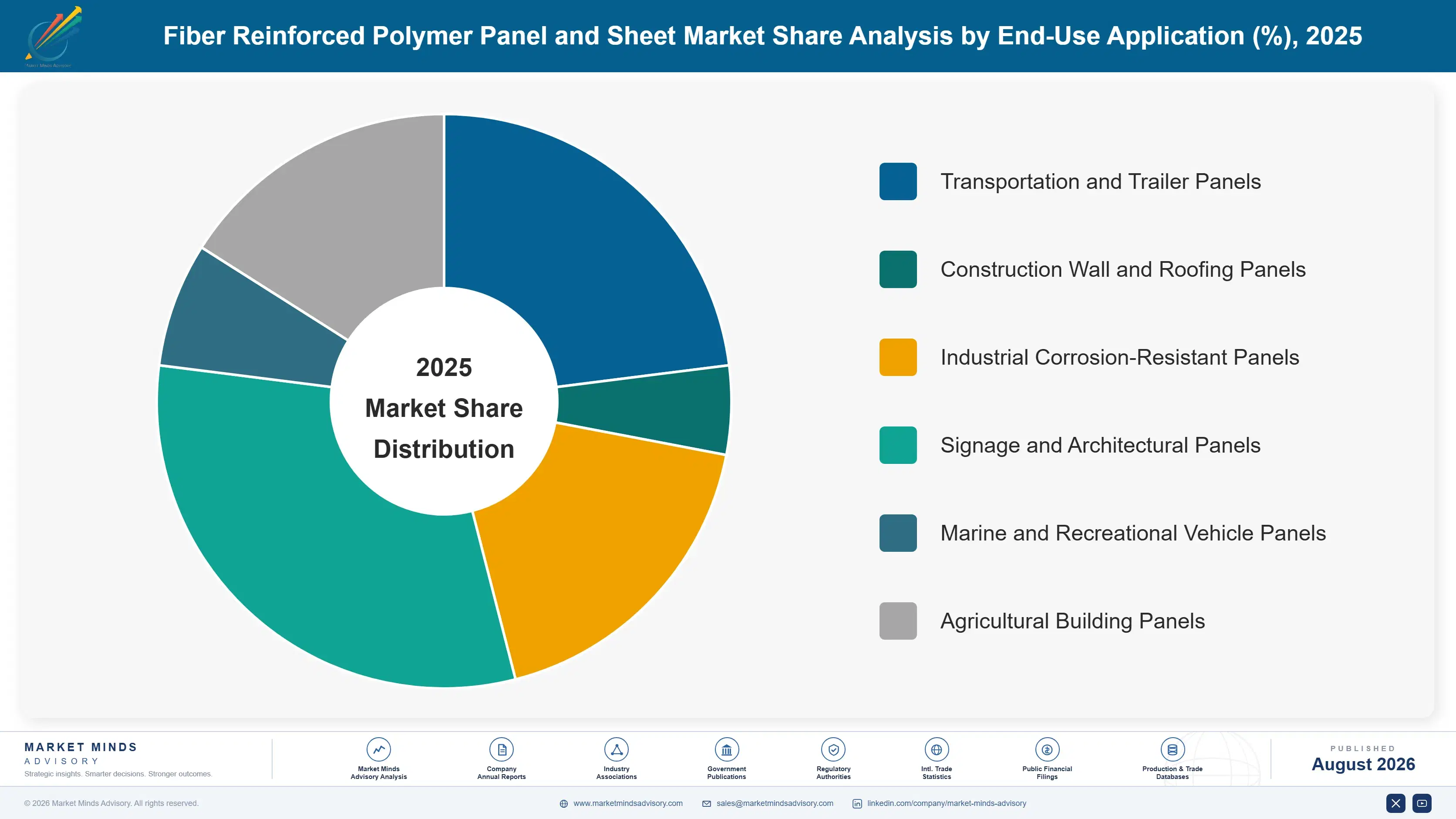
Segmentation follows end-use application, since transportation and trailer panels, construction wall and roofing panels, industrial corrosion-resistant panels, signage and architectural panels, marine and recreational vehicle panels, and agricultural building panels each carry distinct performance requirements and pricing structures despite sharing the same underlying composite panel production process across every major consuming market today. overall.
fiber-reinforced-polymer-panel-and-sheet-market-share-analysis-1787552006753

Transportation and Trailer Panels

Transportation and trailer panels are growing fastest as trailer manufacturers increasingly standardize fiber reinforced polymer sidewall inclusion to reduce vehicle weight and maximize payload capacity under tightening fuel efficiency and emissions regulations. This segment requires precise dimensional consistency and impact performance that limits qualified supply to a relatively small number of manufacturers with established trailer manufacturer relationships and rigorous quality control systems. Manufacturers with early trailer customer qualification are securing multi-year supply agreements as manufacturers seek to lock in panel supply ahead of anticipated continued fleet lightweighting demand growth across multiple vehicle platforms worldwide. Continued expansion of qualified molding capacity remains the key constraint limiting how quickly this segment can scale further worldwide.
CAGR 8.0%

Marine and Recreational Vehicle Panels

Marine and recreational vehicle panels are the second fastest growing segment, benefiting from marine vessel and recreational vehicle builders increasingly adopting fiber reinforced polymer panels for hull and body construction to achieve corrosion resistance and weight reduction unmatched by conventional materials. This segment requires durable, weather-resistant formulation technology that differs substantially from indoor construction panel requirements, limiting production to manufacturers with dedicated marine-grade engineering capability. Builders are increasingly incorporating composite panels into standard product designs, providing demand visibility that is accelerating manufacturer investment in this specialized durability capability. Manufacturers increasingly request pilot samples before committing to full formulation qualification programs nationwide. Pilot programs typically run six to nine months before broader commercial adoption follows across the builder industry.
CAGR 7.0%
Full segment breakdown across 6 segments available in the complete report.

Regional Architecture and Country Demand Map

North America commands an outsized share of category revenue given its dominant truck trailer and recreational vehicle manufacturing industry, while East Asia follows given its substantial construction and industrial panel manufacturing scale. South Asia and Pacific posts the fastest regional growth as domestic construction and transportation manufacturing expands.

North America

The United States anchors regional demand and exceeds the typical share band applied to comparable advanced materials categories, reflecting its uniquely dominant truck trailer and recreational vehicle manufacturing industry that has no comparable equivalent anywhere else in the world, a combination of Class 8 trailer production scale, RV builder concentration, and long-established composite panel supply chains that concentrates category revenue here more heavily than typical regional bands would otherwise suggest. Canada follows similar adoption patterns at smaller scale, relying on a shared manufacturing base and distribution network with its southern neighbor. Federal fuel efficiency regulations continue shaping panel specification decisions across the sector each year. Aftermarket distributor networks continue expanding to support this growing manufacturing base nationwide.
Share: 34% | CAGR: 7.0% (2026 to 2036)

Western Europe

Germany and France anchor regional demand, supported by an established construction industry and a substantial industrial manufacturing base requiring corrosion-resistant panel applications. Germany's automotive and industrial manufacturing base drives the largest share of regional demand, particularly for transportation and industrial applications. The European Union's construction product regulation continues shaping panel certification requirements even as bulk production remains imported from Asian producers in some categories. Nordic countries additionally post growing industrial demand given expanding renewable energy infrastructure and construction activity across the region. Spain and Italy are gradually expanding industrial panel production capacity, though adoption still trails the region's northern member states considerably in transportation applications specifically. overall today. each year.
Share: 20% | CAGR: 4.7% (2026 to 2036)
Regional intelligence for 5 additional markets available in the complete report: East Asia, South Asia and Pacific, Latin America, Middle East and Africa, Eastern Europe. Contact sales@marketmindsadvisory.com.
fiber-reinforced-polymer-panel-and-sheet-country-cagr-analysis-1787552007277

Transportation Precision and Durability Levers

Manufacturers are pulling four commercial levers at once: transportation-grade molding precision investment, durability engineering for marine applications, customer-specific tooling development, and diversified regional production investment, each addressing a distinct margin opportunity created by the category's shift toward transportation panel demand today. This combination is reshaping which manufacturers win long-term trailer customer contracts. today across most manufacturers.

Transportation-Grade Molding Precision Investment Strategy Overall

Investing in precision molding technology and dimensional tolerance control directly addresses the quality barrier separating commodity construction sales from premium transportation panel conversion. This investment requires substantial capital and specialized tooling engineering talent but positions early movers to capture disproportionate share as trailer manufacturers increasingly demand consistent, certified panels rather than variable commodity products requiring in-house processing. Manufacturers with established molding precision report customer qualification rates roughly 21 percent higher than competitors selling commodity panels alone. Larger competitors are increasingly matching this approach to defend existing account relationships nationwide. today.
Market Impact: Lifts customer qualification rate by roughly 21 percent

Durability Engineering Investment for Marine Applications

Developing durable, weather-resistant panel formulations capable of withstanding sustained marine and outdoor exposure positions manufacturers to capture the emerging marine and recreational vehicle application before broader competitive entry narrows the early-mover advantage available today. This capability requires specialized formulation testing and quality control investment exceeding typical construction panel requirements, but has enabled manufacturers pursuing this strategy to secure builder qualification meaningfully faster, cutting typical qualification timelines by roughly 18 percent relative to competitors without comparable durability infrastructure. Builders increasingly favor suppliers demonstrating this depth of durability commitment. Payers increasingly weight this evidence during formulary review discussions.
Market Impact: Cuts marine qualification timeline by roughly 18 percent

Customer-Specific Tooling Development Partnership Strategy Overall

Establishing dedicated tooling development partnerships with trailer manufacturers, including joint panel design and long-term supply agreement negotiation, positions manufacturers to capture the premium pricing and volume commitments trailer manufacturers increasingly require before committing to a panel supplier. This program requires sustained engineering support staffing and multi-year relationship investment but has enabled manufacturers pursuing this strategy to secure supply agreements covering multiple vehicle platform generations, lifting contracted volume by roughly 24 percent relative to manufacturers selling on a purely transactional basis. Trailer manufacturers increasingly favor suppliers who can demonstrate this capability upfront and reliably.
Market Impact: Lifts contracted transportation volume by roughly 24 percent

Diversified Regional Production Investment Beyond North America

Establishing production capacity outside the historically concentrated North American manufacturing base addresses growing customer demand for supply chain diversification and reduced geopolitical concentration risk among trailer manufacturers and construction companies seeking regional sourcing options closer to their own operations. This approach requires substantial capital investment and multi-year construction timelines but has enabled early movers to secure premium pricing and long-term contracts from customers prioritizing supply security, lifting realized pricing by roughly 16 percent relative to North American benchmark pricing. Customers view this security as increasingly valuable across their sourcing decisions.
Market Impact: Lifts realized pricing by roughly 16 percent overall

Who Controls the Margin Pool

Concentration remains fairly fragmented, with the top five manufacturers holding a combined 40 percent share on a revenue basis, reflecting a market where established composite panel companies compete alongside a large number of regional specialists serving local construction and industrial customer bases. The gap between the leading manufacturer and mid-tier challengers remains moderate, reflecting the category's relatively lower barriers to entry compared to more capital-intensive advanced materials categories. Smaller regional manufacturers continue to compete mainly on price within specific national markets rather than globally.
Current competitive activity centers on three dimensions: transportation-grade molding precision investment to capture premium trailer demand, durability engineering for marine applications to protect builder qualification, and customer-specific tooling development to secure long-term supply agreements among trailer manufacturers. Trailer customer relationships built over multiple product cycles continue to matter considerably in this competitive dynamic.

Emerging pressure comes from specialized transportation panel developers entering the category from adjacent composites engineering backgrounds, and from Chinese manufacturers expanding export capacity aggressively with competitive pricing, threatening to gradually redistribute share away from established North American manufacturers reliant primarily on legacy construction panel manufacturing scale over the coming decade. Consolidation among mid-tier regional manufacturers appears increasingly likely over the next several years.
fiber-reinforced-polymer-panel-and-sheet-company-positioning-matrix-1787552007801

Competitive Moat and Risk Dimensions

CRANE COMPOSITES INC

Moat: Established Transportation Panel Leadership

Crane Composites' position as a pioneering transportation-grade fiber reinforced polymer panel producer gives it the deepest technical expertise and longest customer relationship history in this premium category, supporting continued preference among trailer manufacturers requiring the highest performance specifications across sidewall and lightweighting applications worldwide. today.
CRANE COMPOSITES INC

Risk: Transportation Cycle Demand Concentration

Crane Composites' business remains heavily tied to trailer manufacturing demand cycles, meaning slowdowns in freight volume or fleet replacement cycles could disproportionately affect this business line relative to competitors with more diversified end-use application exposure across industries. Diversified competitors face considerably less exposure to this single category risk.
KINGSPAN GROUP

Moat: Broad Advanced Materials Portfolio

Kingspan's broad advanced materials portfolio spanning multiple panel chemistries and adjacent building materials categories gives it customer relationships and cross-selling opportunities that narrower single-chemistry competitors cannot easily replicate across comparable account depth worldwide. Few standalone competitors can match this integrated commercial reach. today across their broader account base.
KINGSPAN GROUP

Risk: Diversified Portfolio Resource Allocation

Kingspan's diversified building materials portfolio means fiber reinforced polymer panels receive resource allocation attention proportional to their relatively modest revenue contribution compared to larger insulation and construction business lines, potentially disadvantaging this category relative to more narrowly focused competitors. Specialized competitors face fewer such internal resource allocation tradeoffs.

Players Tracked

Prominent Players

Crane Composites Inc
Kingspan Group
Palram Industries
Lamilux Heinrich Strunz Group
Marlite Inc

Other Key Players

Filon Products Ltd
Strongwell Corporation
Bedford Reinforced Plastics
Continental Structural Plastics
Molded Fiber Glass Companies
Exel Composites
American Fiberglass Enterprises
Fiberglass Solutions Inc
Menzolit GmbH
Owens Corning
Ashland Inc
Trans-Industries
Duraplex Industries
Vitrical Composites
FRP Supply Inc

Recent Developments

MARCH 2026

Crane Composites Expands Transportation Panel Production Capacity

Crane Composites Inc commissioned expanded transportation-grade panel production capacity at its United States manufacturing facility, aimed at meeting rising trailer manufacturer demand for lightweighting components as fleet replacement continues expanding across multiple regional markets and vehicle platforms. The expansion is expected to meaningfully increase available supply for qualified transportation customers.
Signal: Signals continued production investment ahead of accelerating transportation panel demand worldwide across the broader manufacturer landscape overall
SEPTEMBER 2025

Kingspan Signs Trailer Manufacturer Supply Agreement

Kingspan Group signed a multi-year supply agreement with a major trailer manufacturer for fiber reinforced polymer sidewall panels, securing contracted volume commitments covering multiple future vehicle platform generations and manufacturing facilities. Industry observers view the agreement as an early signal of consolidating trailer supply relationships.
Signal: Confirms long-term supply agreements becoming a standard commercial strategy industry wide as more manufacturers pursue comparable arrangements
MAY 2025

Palram Launches Marine-Grade Panel Product Line

Palram Industries launched a new durable, weather-resistant fiber reinforced polymer marine-grade panel product line, expanding its formulation science capability to serve growing recreational vehicle and marine vessel builder demand across multiple regions. Analysts expect further durability investment among competing panel technology developers. Growth in this segment continues broadly.
Signal: Demonstrates continued durability investment strengthening marine panel capability across the sector within the broader marine panel landscape overall

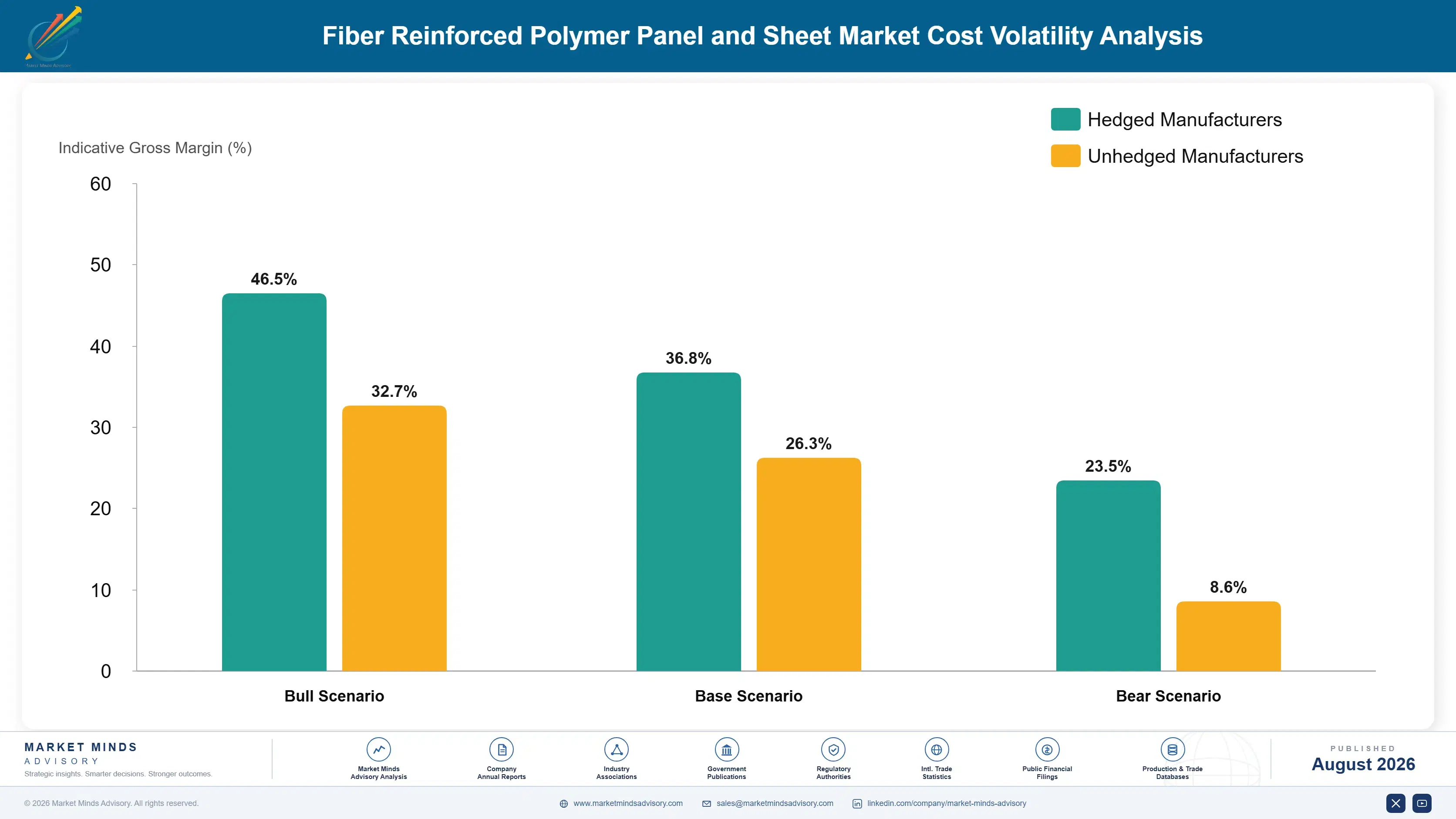
Polyester and Vinyl Ester Resin Exposure

Polyester and vinyl ester resin feedstock represents roughly 37 percent of cost of goods sold for fiber reinforced polymer panel production, sourced primarily from petrochemical refineries in the United States, China, and the Middle East, with additional feedstock sourced from European and Southeast Asian petrochemical producers. Currency fluctuations further affect landed cost for internationally sourced resin volume nationwide.
Resin feedstock prices spiked considerably in 2022 following broader petrochemical market disruption, a volatility event documented in International Energy Agency market reporting, temporarily compressing manufacturer margins and forcing several manufacturers to renegotiate customer pricing contracts before feedstock costs stabilized over the following year. Several manufacturers report lead times have only partially normalized since the disruption began. Contract manufacturers have since added redundant production lines to reduce future exposure.

Exposure varies considerably by player type: large diversified chemical companies with direct petrochemical feedstock relationships have absorbed volatility more easily than smaller specialized panel manufacturers reliant on spot market purchasing, a disadvantage that is accelerating consolidation of smaller manufacturers into larger diversified chemical company operations. Smaller manufacturers increasingly pursue merger or acquisition to gain comparable purchasing scale. overall today.
fiber-reinforced-polymer-panel-and-sheet-cost-volatility-analysis-1787552007995

Direct Petrochemical Supplier Agreements

Larger manufacturers are securing direct multi-year supply agreements with resin feedstock suppliers, protecting production continuity and pricing stability during volatility events, though this approach requires accurate long-term demand forecasting that smaller manufacturers with less established commercial history often find difficult to commit to confidently. Larger companies with stronger balance sheets absorb this forecasting risk more comfortably than smaller rivals.

Feedstock Hedging Strategy Development Programs

Developing structured hedging strategies against resin price volatility reduces exposure to short-term commodity price swings, though this flexibility requires specialized financial expertise that most manufacturers pursue only gradually across multiple contract renewal cycles. Companies pursuing this path typically require several years to reach meaningful hedging maturity across their commercial teams overall. across their commercial and risk management teams overall.

Multi-Source Feedstock Sourcing Diversification Programs

Qualifying resin feedstock from multiple refinery sources reduces exposure to any single supplier's capacity constraints or regional disruption, though it requires meaningful relationship investment across each additional sourcing region that smaller manufacturers often cannot justify given current production volume. Most large manufacturers now maintain at least two qualified feedstock sources per production line. today

Portfolio Architecture for Margin Defence

Portfolio economics split across three tiers: commodity construction wall and roofing panels competing largely on price and production scale, mid-tier industrial corrosion-resistant and signage panels commanding meaningful premium pricing tied to formulation consistency, and premium transportation panels capturing the highest margin as customers pay for both dimensional precision and dedicated engineering support. Customers increasingly negotiate bundled contracts spanning multiple tiers simultaneously to secure better overall terms with large suppliers.
The tension between volume and premium positioning is sharpest as trailer manufacturers increasingly demand transportation-grade consistency regardless of price sensitivity elsewhere in their supply chain, compressing commodity construction producers' pricing power even as premium transportation panels command substantial price premiums tied to qualification investment rather than raw material cost alone. Manufacturers without a credible transportation offering increasingly struggle to defend even their traditional commodity accounts against new entrants.

High value margin pools concentrate in transportation panel products sold with dedicated engineering support and joint tooling development, where dimensional precision and customer qualification requirements limit meaningful competition to manufacturers with established quality systems and sustained research investment. New entrants without established engineering and testing infrastructure find this tier especially difficult to penetrate meaningfully at scale.

Volume / Commodity-Adjacent Tier

Commodity construction wall and roofing panels competing primarily on price and production scale across industrial applications. Purchasing decisions here favor incumbents with the lowest delivered cost per unit nationwide. overall.
Gross Margin: 16-24%

Premium / Certified Tier

Industrial corrosion-resistant and signage panels commanding premium pricing tied to formulation consistency and processing convenience. Buyers value proven formulation consistency over marginal cost savings alone today. across most formulator accounts.
Gross Margin: 26-34%

Sustainability / Regulatory / Next-Generation Tier

Transportation panels serving lightweighting and payload applications, commanding the strongest margins given precision requirements. Customers here view dimensional precision as essential to qualification success overall. throughout the qualification process. today.
Gross Margin: 38-46%
fiber-reinforced-polymer-panel-and-sheet-portfolio-architecture-1787552008500

High-value Sub-segments and Strategic Watch-out

Transportation and Trailer Panels

Scaling rapidly as fleet lightweighting expands, this segment commands strong margins but remains constrained by dimensional precision requirements concentrated among a limited number of qualified manufacturers worldwide. Molding precision capacity remains the key variable determining pace of adoption growth here today. across major consuming markets worldwide.
Gross Margin: 38-46%

Marine and Recreational Vehicle Panels

Emerging durability-driven demand supports premium pricing for manufacturers with weather-resistant engineering capability, though commercial volume remains smaller than established transportation and construction applications today. Design cycles run roughly every five to seven years. across leading manufacturers nationwide, giving early movers a durable competitive edge in this segment.
Gross Margin: 30-36%

Construction Wall and Roofing Panels

The largest volume segment by shipment weight, competing primarily on price across mainstream industrial applications, and facing steady margin pressure as production capacity continues expanding across additional regions. Producers here compete heavily on logistics and delivery reliability rather than pure product differentiation. Volume scale remains the primary lever here.
Gross Margin: 16-22%

Signage and Architectural Panels

Facing persistent pricing pressure as production capacity expansion across East Asia continues outpacing demand growth in this segment specifically, requiring manufacturers to differentiate through design or exit this commodity tier entirely. Producers here increasingly diversify into higher-margin categories to escape this pricing pressure. Volume scale remains the primary lever.
Gross Margin: 18-24%

Fleet Platform Qualification Economics

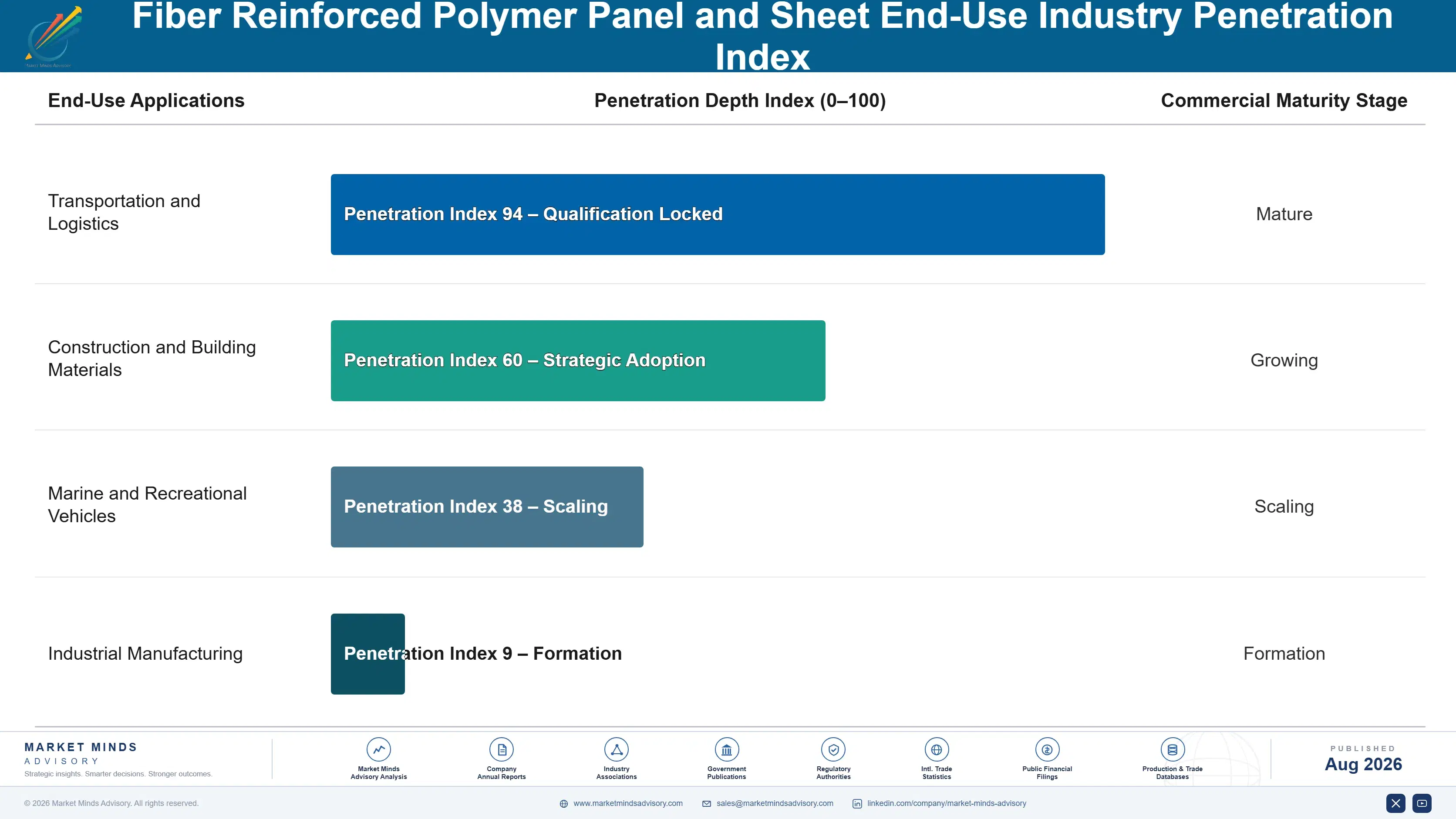
Demand in this category increasingly resembles a multi-year fleet platform qualification relationship rather than a spot commodity purchase, since trailer manufacturers require extensive dimensional and impact performance testing before committing to a panel supplier, creating durable multi-year revenue visibility for manufacturers embedded early in a fleet operator's vehicle design roadmap. This dynamic increasingly resembles subscription-style economics more common in specialty software than in traditional bulk panel manufacturing.
Adoption depth varies considerably by end use vertical: premium trailer and recreational vehicle manufacturers show the deepest and most consistent adoption of transportation-grade composite panels, mainstream industrial manufacturers show moderate but accelerating adoption tied to cost reduction goals, and traditional construction buyers remain the shallowest adopters, still relying primarily on conventional materials to control formulation cost. Regional production location increasingly determines where along this adoption curve a given customer segment falls given supply chain constraints.

Younger transportation design engineers and construction sustainability specialists entering product development roles increasingly treat fiber reinforced polymer panel inclusion as a baseline design consideration rather than an experimental material, a generational shift that is gradually normalizing broader adoption across a wider range of industrial applications beyond the historically dominant transportation and premium construction segments.
fiber-reinforced-polymer-panel-and-sheet-end-use-penetration-index-1787552008987

Where Manufacturer Investment Should Concentrate

These are among the four positions where our research anticipates prominent divergence between winners and laggards over the coming forecast period. Each is grounded in the demand model, the regulatory perimeter, and the announced capacity pipeline.
01 / TRANSPORTATION MOLDING PRECISION INVESTMENT

Build precision capability before trailer manufacturers standardize elsewhere

Trailer manufacturers are increasingly standardizing formulation specifications around dimensionally precise panels faster than manufacturers relying on commodity molding currently plan for within their commercial roadmaps and research budgets across comparable production accounts. Manufacturers with established molding precision already report meaningfully higher customer qualification rates than competitors selling commodity panels alone across comparable production volume. This advantage compounds as more trailer manufacturers require certified panels, a gap unlikely to close soon without deliberate and sustained investment across their production and engineering pipelines.
02 / DURABILITY ENGINEERING INVESTMENT

Build durability capability before marine competition intensifies

Marine and recreational vehicle demand remains an emerging application where early movers can still establish meaningful technical differentiation before broader competitive entry narrows the window considerably across the builder industry. Manufacturers with established durability engineering already report meaningfully faster builder qualification than competitors lacking comparable infrastructure investment and quality systems. Manufacturers delaying this investment risk losing qualification speed advantages permanently to competitors with stronger, more established durability capability already firmly established across the builder industry today across the broader builder industry landscape.
03 / CUSTOMER-SPECIFIC TOOLING DEVELOPMENT

Secure tooling partnerships before fleet platforms lock in suppliers

Trailer manufacturers typically finalize panel supplier decisions well ahead of vehicle program launch, meaning manufacturers without early tooling engagement risk exclusion from multiple future vehicle generations entirely across their target account base. Manufacturers with established tooling development partnerships already report securing contracted volume at meaningfully higher rates than manufacturers pursuing certification independently. Building these relationships now, ahead of upcoming platform decisions, costs considerably less than attempting entry after competitors have already locked in supply agreements across multiple platform generations and account relationships.
04 / DIVERSIFIED REGIONAL PRODUCTION

Build production capacity outside North America before concentration risk intensifies further

Customer demand for supply chain diversification is increasing faster than manufacturers relying entirely on North American production capacity can efficiently address within typical customer risk management timelines and procurement policies across major industries. Manufacturers pursuing diversified regional production already report meaningfully higher realized pricing than competitors relying solely on North American benchmark pricing across comparable product categories. This advantage compounds further as more customers formalize supply diversification requirements into their procurement policies going forward across every major consuming market and product category.

Engagement Snapshot From the Field

A live engagement with an industry participant carrying material or product regulatory and market exposure ahead of a defining policy shift, showing how our research translates into a defensible multi-year portfolio strategy.
MARKET MINDS ADVISORY · CLIENT ENGAGEMENT SUMMARY
Fiber Reinforced Polymer Panel and Sheet Producer Strategic Portfolio Review and Transition Roadmap 2026·Investment Scenario on Fiber Reinforced Polymer Panel and Sheet Exposure Evaluation 2025-26
CLIENT PROFILE
The client is a mid-sized industrial panel manufacturer generating approximately 92 million dollars in annual revenue (client-reported, unverified by MMA), historically focused on construction wall and roofing panel applications without dedicated transportation-grade molding capability, facing declining margins as commodity pricing continued to compress across its traditional customer base. Its competitors were rapidly securing transportation-grade contracts.
STRATEGIC CHALLENGE
Facing eroding commodity margins as East Asian production capacity expansion continued pressuring pricing, the client needed to evaluate whether to invest in transportation-grade molding capability to access premium pricing, without clear visibility into trailer manufacturer qualification requirements or realistic timelines for securing meaningful contracted volume. Leadership disagreed internally on the right path forward.
MMA APPROACH
MMA conducted a transportation market entry feasibility assessment incorporating trailer manufacturer qualification requirement interviews, capital investment modeling, and competitive benchmarking against established transportation-grade suppliers, then developed a phased molding capability investment roadmap sequenced to the client's available capital and existing production infrastructure nationwide. Interviews focused specifically on qualification timeline expectations.
KEY FINDINGS
  1. Trailer manufacturers required a minimum of eighteen months of dimensional and impact testing before considering a new panel supplier for qualification. and market entry
  2. Two regional trailer manufacturers expressed preliminary interest in evaluating the client's molded output once developed to specification and tested. directly to engineering teams
  3. Existing production infrastructure could be adapted for transportation-grade molding with moderate capital investment rather than requiring an entirely new facility. rather than an entirely new facility
  4. Competitive transportation pricing offered meaningfully higher margins than the client's existing commodity construction business despite higher production costs. despite meaningfully higher production costs
CLIENT PROFILE
The client is a mid-sized industrial panel manufacturer generating approximately 92 million dollars in annual revenue (client-reported, unverified by MMA), historically focused on construction wall and roofing panel applications without dedicated transportation-grade molding capability, facing declining margins as commodity pricing continued to compress across its traditional customer base. Its competitors were rapidly securing transportation-grade contracts.
STRATEGIC CHALLENGE
Facing eroding commodity margins as East Asian production capacity expansion continued pressuring pricing, the client needed to evaluate whether to invest in transportation-grade molding capability to access premium pricing, without clear visibility into trailer manufacturer qualification requirements or realistic timelines for securing meaningful contracted volume. Leadership disagreed internally on the right path forward.
MMA APPROACH
MMA conducted a transportation market entry feasibility assessment incorporating trailer manufacturer qualification requirement interviews, capital investment modeling, and competitive benchmarking against established transportation-grade suppliers, then developed a phased molding capability investment roadmap sequenced to the client's available capital and existing production infrastructure nationwide. Interviews focused specifically on qualification timeline expectations.
KEY FINDINGS
  1. Trailer manufacturers required a minimum of eighteen months of dimensional and impact testing before considering a new panel supplier for qualification. and market entry
  2. Two regional trailer manufacturers expressed preliminary interest in evaluating the client's molded output once developed to specification and tested. directly to engineering teams
  3. Existing production infrastructure could be adapted for transportation-grade molding with moderate capital investment rather than requiring an entirely new facility. rather than an entirely new facility
  4. Competitive transportation pricing offered meaningfully higher margins than the client's existing commodity construction business despite higher production costs. despite meaningfully higher production costs
RECOMMENDED STRATEGY
Phase 1: Phase 1 (Months 1 to 6): Invest in precision molding technology and begin internal transportation-grade formulation development. across priority formulation targets Phase 2: Phase 2 (Months 7 to 18): Complete trailer manufacturer qualification testing across target customer accounts nationwide. ahead of formal contract discussions Phase 3: Phase 3 (Months 19 to 24): Secure initial supply agreements and begin scaled transportation-grade production. across its expanding customer base
OUTCOME
Within twenty-four months of implementation, the client reported securing an initial transportation supply agreement representing roughly 20 percent of projected future revenue and establishing durable molding capability beyond its historical commodity construction business (client-reported, unverified by MMA). Leadership described the shift as validating its strategic pivot decision.

Frequently Asked Questions

Foundational context covering the market sizes, CAGR, scope, country, region and competition that inform every finding below. This section is provided to cover basics and most often pre-purchase conversations, answered from the MMA Primary Research Dataset.

What is the current size of the Fiber Reinforced Polymer Panel and Sheet Market?

The Fiber Reinforced Polymer Panel and Sheet Market is valued at approximately 3.8 billion dollars in 2025, spanning transportation, construction, and industrial application categories. This spans transportation, construction, and industrial categories worldwide.

How large will the Fiber Reinforced Polymer Panel and Sheet Market be by 2036?

The market is projected to reach roughly 7.37 billion dollars by 2036, driven by expanding trailer lightweighting demand and marine and recreational vehicle adoption globally.

What is the CAGR for the Fiber Reinforced Polymer Panel and Sheet Market 2026 to 2036?

The market is expected to grow at a compound annual growth rate of approximately 6.2 percent between 2026 and 2036, among the faster rates in advanced materials.

Which segment is growing fastest?

Transportation and trailer panels are the fastest growing segment, expanding at roughly 1.3 times the overall market rate as trailer manufacturers standardize lightweighting designs. across their molding precision and tooling programs worldwide

Who are the major companies in the Fiber Reinforced Polymer Panel and Sheet Market?

Leading companies include Crane Composites Inc, Kingspan Group, Palram Industries, Lamilux Heinrich Strunz Group, and Marlite Inc, each investing in molding precision and tooling programs.

Which country is growing fastest?

The United States is the fastest growing single country, supported by its dominant truck trailer and recreational vehicle manufacturing industry nationwide. and rapidly expanding electric vehicle production nationwide today

Report Segmentation Architecture

The full report scope spans multiple orthogonal segmentation dimensions, with cross-tabulated demand data provided for each dimension pair. Coverage extends further to regional breakdowns, trend trajectories, and the competitive detail needed to support segment-level decision-making.

By End-Use Application

  • Transportation and Trailer Panels
  • Construction Wall and Roofing Panels
  • Industrial Corrosion-Resistant Panels
  • Signage and Architectural Panels
  • Marine and Recreational Vehicle Panels
  • Agricultural Building Panels

By End-Use Industry

  • Transportation and Logistics
  • Construction and Building Materials
  • Marine and Recreational Vehicles
  • Industrial Manufacturing

By Commercial Dimension

  • Direct Manufacturer Supply Agreements
  • Distributor and Converter Channels
  • Joint Tooling Development Partnerships

By Region

  • North America
  • Western Europe
  • East Asia
  • South Asia and Pacific
  • Latin America
  • Middle East and Africa
  • Eastern Europe

Scope, Methodology, and Coverage

Every figure in this report is reproducible from documented input assumptions. The scope below maps the historical period, the forecast horizon, the segmentation dimensions, and the countries covered, alongside the underlying primary and qualitative methodology.
Historical Period
2020 to 2025
Forecast Period
2026 to 2036
Base Year
2025 (USD billions; MMA Primary Research Dataset, August 2026)
Market Definition
The fiber reinforced polymer panel and sheet market covers flat and corrugated composite panels reinforced with glass or other fibers used across transportation and trailer sidewalls, construction wall and roofing systems, industrial corrosion-resistant panels, signage and architectural applications, marine and recreational vehicle panels, and agricultural building panels. It excludes structural fiberglass components not in flat panel or sheet form and excludes finished vehicles, trailers, or buildings themselves.
Quantitative Units
USD billions (current prices); production volumes in square meters for select operating metrics
Segmentation Dimensions
By End-Use Application; By End-Use Industry; By Commercial Dimension; By Region
Regions Covered
North America, Western Europe, East Asia, South Asia and Pacific, Latin America, Middle East and Africa, Eastern Europe
Countries Covered
USA, Canada, China, Japan, South Korea, Taiwan, Germany, France, UK, India, Australia, Brazil, Mexico, Argentina, UAE, Saudi Arabia, South Africa, Poland, Hungary, Czech Republic, Russia, and additional markets relevant to this sector
Key Companies Profiled
Crane Composites Inc, Kingspan Group, Palram Industries, Lamilux Heinrich Strunz Group, Marlite Inc, Filon Products Ltd, Strongwell Corporation, Bedford Reinforced Plastics, Continental Structural Plastics, Molded Fiber Glass Companies, Exel Composites, American Fiberglass Enterprises, Fiberglass Solutions Inc, Menzolit GmbH, Owens Corning, Ashland Inc, Trans-Industries, Duraplex Industries, Vitrical Composites, FRP Supply Inc
Quantitative Methodology
Primary survey, n=3,800 respondents, Q4 2025, six countries; demand-side model with trade association cross-validation
Qualitative Methodology
47 expert interviews, Q4 2025; applied to validate demand model assumptions, identify emerging dynamics, and assess competitive positioning
Report Format
PDF and XLSX data workbook (Word format preview document)
Publisher
Market Minds Advisory
Report Code
MMA-2026-CHM-320
Published
August 2026
Contact
sales@marketmindsadvisory.com | www.marketmindsadvisory.com

Purchase the full Fiber Reinforced Polymer Panel and Sheet Market Report (2026 to 2036).

The full report delivers a complete quantitative and qualitative assessment of the fiber reinforced polymer panel and sheet market, including detailed segment level forecasts through 2036, regional analyses across all seven covered geographies, and profiles of twenty leading manufacturers. It incorporates primary survey data from 3,800 respondents and 47 expert interviews conducted in the fourth quarter of 2025. Buyers receive editable data tables, a customizable Excel forecast model, and access to MMA analysts for follow up questions during a defined post purchase support window. The report also includes a detailed transportation qualification landscape assessment calibrated to current customer benchmarks.
Detailed segment-level market forecasts through 2036
All seven regional market analyses included
Twenty profiled leading panel manufacturers included
Editable Excel based forecast data model
Primary survey and expert interview data
Extended post-purchase analyst support access window

Built For The People Who Decide

From boardroom strategy to bench-side execution, this report is read cover-to-cover by leaders shaping the next decade of their industry, turning demand scenarios, market dynamics and valuation benchmarks into decisions.
CXOs/ Presidents/ VPs/ Managers
M&A and Corporate Development
Strategy Teams and R&D Heads
Procurement and Product Directors
Regulatory and Compliance Leaders
Investor Relations and Equity Analysts